Electrical and Computer Engineering Conference
Papers, Posters and Presentations
Electrical and Computer Engineering
2015
Mining maximal cliques from an uncertain graph
Arko Provo Mukherjee
Iowa State University
Pan Xu
University of Maryland
Srikanta Tirthapura
Iowa State University, [email protected]
Follow this and additional works at:
http://lib.dr.iastate.edu/ece_conf
Part of the
Electrical and Computer Engineering Commons
This Conference Proceeding is brought to you for free and open access by the Electrical and Computer Engineering at Iowa State University Digital Repository. It has been accepted for inclusion in Electrical and Computer Engineering Conference Papers, Posters and Presentations by an authorized administrator of Iowa State University Digital Repository. For more information, please [email protected].
Recommended Citation
Mukherjee, Arko Provo; Xu, Pan; and Tirthapura, Srikanta, "Mining maximal cliques from an uncertain graph" (2015).Electrical and Computer Engineering Conference Papers, Posters and Presentations. 43.
Mining maximal cliques from an uncertain graph
Abstract
We consider mining dense substructures (maximal cliques) from an uncertain graph, which is a probability
distribution on a set of deterministic graphs. For parameter 0 we consider the notion of an α-maximal clique
in an uncertain graph. We present matching upper and lower bounds on the number of α-maximal cliques
possible within a (uncertain) graph. We present an algorithm to enumerate α-maximal cliques whose
worst-case runtime is near-optimal, and an experimental evaluation showing the practical utility of the algorithm.
KeywordsRuntime, Algorithm design and analysis, Proteins, Social network services, Communities, Data mining, Moon
DisciplinesElectrical and Computer Engineering
CommentsThis is a manuscript of a proceeding published as Mukherjee, Arko Provo, Pan Xu, and Srikanta Tirthapura.
"Mining maximal cliques from an uncertain graph." In Data Engineering (ICDE), 2015 IEEE 31st
International Conference on, pp. 243-254. IEEE, 2015.
10.1109/ICDE.2015.7113288
. Posted with
permission.
Rights
© 2015 IEEE. Personal use of this material is permitted. Permission from IEEE must be obtained for all other
uses, in any current or future media, including reprinting/republishing this material for advertising or
promotional purposes, creating new collective works, for resale or redistribution to servers or lists, or reuse of
any copyrighted component of this work in other works.
Mining Maximal Cliques from an Uncertain Graph
#Department of Electrical and Computer Engineering, Iowa State University
2215 Coover Hall, Ames, IA, USA
1[email protected] 3[email protected]
∗Department of Computer Science, University of Maryland
A.V. Williams Building, University of Maryland, College Park, MD, USA
Abstract—We consider mining dense substructures (maximal cliques) from an uncertain graph, which is a probability distri-bution on a set of deterministic graphs. For parameter0<α<1, we consider the notion of an α-maximal clique in an uncertain graph. We present matching upper and lower bounds on the number of α-maximal cliques possible within a (uncertain) graph. We present an algorithm to enumerateα-maximal cliques whose worst-case runtime is near-optimal, and an experimental evaluation showing the practical utility of the algorithm.
I. INTRODUCTION
Large datasets often contain information that is uncertain in nature. For example, given people A and B, it may not be possible to definitively assert a relation of the form “A knowsB” using available information. Our confidence in such relations are commonly quantified using probability, and we say that the relation exists with a probability of p, for some value p determined from the available information. In this work, we focus onuncertain graphs, where our knowledge is represented as a graph, and there is uncertainty in the presence of each edge in the graph. Uncertain graphs have been used extensively in modeling, for example, in communication net-works [1], [2], [3], social netnet-works [4], [5], [6], [7], [8], [9], protein interaction networks [10], [11], [12], and regulatory networks in biological systems [13].
Identification of dense substructures within a graph is a fundamental task, with numerous applications in data mining, including in clustering and community detection in social and biological networks [14], the study of the co-expression of genes under stress [15], integrating different types of genome mapping data [16]. Perhaps the most elementary dense sub-structure in a graph, also probably the most commonly used, is a clique, a completely connected subgraph. We are typically interested in a maximal clique, which is a clique that is not contained within any other clique. Enumerating all maximal cliques from a graph is one of the most basic problems in graph mining, and has been applied in many settings, including in finding overlapping communities from social networks [14], [17], [18], [19], finding overlapping multiple protein complexes [20], analysis of email networks [21] and other problems in bioinformatics [22], [23], [24].
While the notion of a dense substructure and methods for enumerating dense substructures are well understood in a deterministic graph, the same is not true in the case of an
uncertain graph. This is an important open problem today, given that many datasets increasingly incorporate data that is noisy and uncertain in nature. Uncertainty can result from a lack of data. For example, in constructing a social network from data collected through sensors, some communications between individuals maybe missed, or maybe anonymized [4]. In some cases, relationships themselves are probabilistic in nature; for example, the relation of one person influencing another in a social network [25]. In biological networks such as protein–protein interaction networks, it is known that there are frequent errors in finding interactions and our knowledge is best modeled probabilistically [10].
In this work, we consider the analog of a maximal clique in an uncertain graph. Intuitively, a clique in an uncertain graph is a set of vertices that has a high probability of being a completely connected subgraph. In other words, when we sample from the uncertain graph, this set is likely to form a (deterministic) clique. Finding such sets of vertices enables us to unearth robust communities within an uncertain graph, for example, a group of proteins such that it is likely that each protein interacts with each other protein. We present a systematic study of the problem of identifying cliques within an uncertain graph.
A. Our Contributions
First, we present a precise definition of a maximal clique in an uncertain graph, leading to the notion of anα-maximal
clique, for parameter 0<α ≤1. A set of vertices U in an
uncertain graph is anα-maximal clique ifU is a clique with probability at leastα, and there does not exist a vertex setU0 such thatU⊂U0 andU0 is a clique with probability at least
α. Whenα=1, the above definition reduces to the well un-derstood notion of a maximal clique in a deterministic graph. a) Number of Maximal Cliques: We first consider a basic question on maximal cliques in an uncertain graph:how many
α-maximal cliques can be present within an uncertain graph? For deterministic graphs, this question was first considered by Moon and Moser [26] in 1965, who presented matching upper and lower bounds for the largest number of maximal cliques within a graph; on a graph withnvertices, the largest possible number of maximal cliques is 3n31. For the case of uncertain
1This assumes that 3 dividesn. If not, the expressions are slightly different
Arko Provo Mukherjee
#1, Pan Xu
∗2, Srikanta Tirthapura
#3graphs, we present the first matching upper and lower bounds for the largest number of α-maximal cliques in a graph on n vertices. We show that for any 0<α <1, the maximum number of α-maximal cliques possible in an uncertain graph is bnn/2c, i.e. there is an uncertain graph on n vertices with
n
bn/2c
uncertain maximal cliques and no uncertain graph on n vertices can have more than bnn/2cα-maximal cliques.
b) Algorithm for Enumerating Maximal Cliques: We present a novel algorithm,MULE(MaximalUncertain cLique Enumeration), for enumerating all α-maximal cliques within
an uncertain graph. MULE is based on a depth-first-search of the graph, combined with optimizations for limiting ex-ploration of the search space, and a fast way to check for maximality based on an incremental computation of clique probabilities. We present a theoretical analysis showing that the worst-case runtime of MULE is O(n·2n), wherenis the number of vertices. This is nearly the best possible dependence on n, since our analysis of the number of maximal cliques shows that the size of the output can be as much asO(√n·2n). Such worst-case behavior occurs only in graphs that are very dense; for typical graphs, we can expect the runtime of MULE to be far better, as we show in our experimental evaluation. We also present an extension of MULE to efficiently enumerate only large maximal cliques.
Note that the worst–case runtime of our algorithm is not the same as an exhaustive search. The cost of checking whether an uncertain clique is maximal or not can be as large asΘ(n2). Considering that there are 2nsubsets of vertices of the graph, exhaustive search has a worst-case runtime of O n2·2n
, which is worse than our algorithm by a factor ofO(n).
c) Experimental Evaluation: We present an experimental evaluation of MULE using synthetic as well as real-world uncertain graphs. Our evaluation shows that MULE is practical and can enumerate maximal cliques in an uncertain graph with tens of thousands of vertices, more than hundred thousand edges and more than two millionα-maximal cliques. Interest-ingly, the observed runtime of this algorithm is proportional to the size of the output. The real-world graphs included a protein–protein interaction network, and a collaboration network inferred from DBLP.
B. Related Work
There has been much recent work in the database and data mining communities on mining from uncertain graphs, includ-ing shortest paths [27], nearest neighbors [28], clusterinclud-ing [29], enumerating frequent and reliable subgraphs [30], [31], [32], [33], [34], [35], and distance-constrained reachability [36]. Our problem of enumerating dense substructures is different from the problems mentioned above. In particular, the problem of finding reliable subgraphs is one of finding subgraphs that are connected with a high probability. However, these individ-ual subgraphs may be sparse. In contrast, we are interested in finding subgraphs that are not just connected, but also fully connected with a high probability. The most closely related work to ours is on mining cliques from an uncertain graph by Zou et. al [37]. Our work is different from theirs in significant ways as elaborated below.
• While we focus on enumerating all α-maximal cliques in a graph, they focus on a different problem, that of enumerating thekcliques with the highest probability of existence.
• We present bounds on the number of such cliques that could exist, while by definition, their problem requires them to output no more than kcliques.
• We provide a runtime complexity analysis of our algo-rithm and show that it is near optimal. No runtime com-plexity analysis was provided for the algorithm presented in [37].
• We also provide an algorithm to enumerate only large maximal uncertain cliques.
There is substantial prior work on maximal clique enumer-ation from a deterministic graph. A popular algorithm for maximal clique enumeration problem is the Bron-Kerbosch algorithm [38], also based on depth-first-search. Tomita et al. [39] improved the depth-first-search approach through a better strategy for pivot selection; their resulting algorithm runs in time O(3n3), which is worst-case optimal, due to the
bound on the number of maximal cliques possible [26]. Further work on enumeration of maximal cliques includes [40], [41], [42], [43], [44], [45], [46].
Our algorithm uses the general structure of search presented in [38], [39]. However, unlike the case of a deterministic maximal clique where it is easy to incrementally maintain the set of vertices that can be added to the clique, for an uncertain graph, this is more complex, since we need to be aware of the change in clique probabilities. Recomputing these can be expensive, and our algorithms reduce this cost through an incremental computation. Our runtime analysis and correctness proof need to take this into account, and do not follow from the analysis in [38] or [39].
Roadmap. We present a problem definition in Section II, bounds on the number ofα-maximal cliques in Section III, an algorithm to enumerate all α-maximal cliques in Section IV,
followed by experimental results in Section V.
II. PROBLEMDEFINITION
An uncertain graph is a probability distribution over a set of deterministic graphs. We deal with undirected simple graphs, i.e. there are no self-loops or multiple edges. An uncertain graph is a triple G = (V,E,p), whereV is a set of vertices, E⊆V×V is a set of (possible) edges, and p:E→(0,1] is a function that assigns a probability of existence p(e)to each edgee∈E. As in prior work on uncertain graphs, we assume that the existence of different edges are mutually independent events.
Let n=|V| and m=|E|. Note that G is a distribution over 2m deterministic graphs, each of which is a subgraph of
the undirected graph(V,E). This set of possible deterministic graphs is called the set of “possible graphs” of the uncertain graphG, and is denoted byD(G). Note that in order to sample from an uncertain graphG, it is sufficient to sample each edge e∈E independently with a probability p(e).
In an uncertain graph G = (V,E,p), two vertices u andv are said to be adjacent if there exists an edge {u,v} in E. Let the neighborhood of vertex u, denoted Γ(u), be the set of all vertices that are adjacent to u in G. The next two definitions are standard, and apply not to uncertain graphs, but to deterministic graphs.
Definition 1. A set of vertices C⊆V is a clique in a graph G= (V,E), if every pair of vertices in C is connected by an edge in E.
Definition 2. A set of vertices M⊆V is a maximal clique in a graph G= (V,E), if (1) M is a clique in G and (2) There is no vertex v∈V\M such that M∪ {v}is a clique in G.
Definition 3. In an uncertain graph G, for a set of vertices C⊆V , the clique probability of C, denoted by clq(C,G), is defined as the probability that in a graph sampled from G, C is a clique. For parameter0≤α≤1, C is called anα-clique if clq(C,G)≥α.
For any set of vertices C⊆V, let EC denote the set of
edges {e={u,v}|e∈E,u,v∈Candu6=v}, i.e. the set of edges connecting vertices inC.
Observation 1. For any set of vertices C⊆V inG = (V,E,p), such that C is a clique in G= (V,E), clq(C,G) =∏e∈ECp(e).
Proof:LetGbe a graph sampled fromG. The setCwill be a clique in Giff every edge in EC is present in G. Since
the events of selecting different edges are independent of each other, the observation follows.
Definition 4. Given an uncertain graphG = (V,E,p), and a parameter0≤α≤1, a set M⊆V is defined as anα-maximal
clique if (1) M is anα-clique inG, and (2) There is no vertex
v∈(V\M)such that M∪ {v}is an α-clique in G.
Definition 5. TheMaximal Clique Enumerationproblem in an Uncertain Graph G is to enumerate all vertex sets M⊆V such that M is an α-maximal clique inG.
The following two observations follow directly from Obser-vation 1.
Observation 2. For any two vertex sets A,B inG, if B⊂A then, clq(B,G)≥clq(A,G).
Observation 3. Let C be anα-clique inG. Then for all e∈EC
we have p(e)≥α.
III. NUMBER OFMAXIMALCLIQUES
The maximum number of maximal cliques in a deterministic graph onnvertices is known exactly due to a result by Moon and Moser [26]. If n mod 3=0, this number is 3n3. If n
mod 3=1, then it is 4·3n−34, and if n mod 3=2, then it
is 2·3n−32. The graphs that have the maximum number of
maximal cliques are known as Moon-Moser graphs.
For uncertain cliques, no such bound was known so far. In this section, we establish a bound on the maximum number of
α-maximal cliques in an uncertain graph. For 0<α<1, let
f(n,α)be the maximum number ofα-maximal cliques in any
uncertain graph withn nodes, without any assumption about the assignments of edge probabilities. The following theorem is the main result of this section.
Theorem 1. Let n≥2, and0<α<1. Then: f(n,α) = bnn/2c
Proof: We can easily verify that the theorem holds for n=2. for n≥3, let g(n) = b n
n/2c
. We show f(n,α) is at leastg(n)in Lemma 1, and then show that f(n,α)is no more thang(n)in Lemma 2.
Lemma 1. For any n≥3, and anyα,0<α<1, there exists an uncertain graphG= (V,E,p)with n nodes which has g(n)
α-maximal cliques.
Proof: First, we assume that n is even. Consider G = (V,E,p), whereE=V×V. Letκ= n/22. For eache∈E, let p(e) =q whereqκ=
α. We have 0<q<1 since 0<α<1.
LetSbe an arbitrary subset ofV such that|S|=n/2. We can verify thatS is anα-maximal clique since (1) the probability
thatS is a clique isqκ=
α and (2) for any setS0)S,S0⊆V, the probability that S0 is a clique is at most qqκ=q
α <α.
We can also observe that for any subsetS⊆V,Scannot be an
α-maximal clique if|S|<n/2 or|S|>n/2. Thus we conclude
that a subsetS⊆V is anα-maximal clique iff|S|=n/2 which implies that the total number of α-maximal cliques in G is
n n/2
. A similar proof applies when nis odd.
Note that our construction in the Lemma above employs the condition thatn≥3 and 0<α<1. When α=1, the upper bound is from the result of Moon and Moser for deterministic graphs, and in this case f(n,α) =3n3 and is smaller thang(n).
Next we present a useful definition required for proving the next Lemma.
Definition 6. A collection of sets C is said to be non-redundant if for any pair S1,S2∈C, S16=S2, we have S1*S2
and S2*S1.
Lemma 2. g(n)is an upper bound on f(n,α).
Proof: Let Cα(G) be the collection of all
α-maximal
cliques inG. Note that by the definition ofα-maximal cliques,
any α-maximal cliqueS inG can not be a proper subset of
any otherα-maximal clique inG. Thus from Definition 6, for any uncertain graphG,Cα(G)is a non-redundant collection.
Hence, it is clear that the largest number ofα-maximal cliques in G should be upper bounded by the size of a largest non-redundant collection of subsets ofV.
Let C be the collection of all subsets of V. Based on C, we construct such an undirected graph Gb= (C,Eb)where for
any two nodesS1∈C,S2∈C, there is an edge connectingS1
and S2 iffS1⊆S2 or S2⊆S1. It can be verified that a
sub-collectionC0⊆C is a non-redundant iffC0is an independent set in G. In Lemma 3, we show thatb g(n) is the size of a
largest independent set of G, which implies thatb g(n) is an
upper bound for the number of α-maximal cliques inG.
Let C∗ be a largest independent set in G. Also, letb Ck⊆
C,0≤k≤n be the collection of subsets ofV with the size of k. Observe that for each 0≤k≤n, Ck is an independent
set ofG. Also letb L(n)andU(n)be respectively the minimum
and maximum size of sets inC∗. We can show thatL(n)and U(n) can be bounded as shown in Lemma 4 and Lemma 5 respectively.
Lemma 3. For any n≥3,|C∗|=g(n).
Proof: We first consider the case when n is even. By Lemmas 4 and 5, we know n/2≤L(n)≤U(n)≤n/2. Thus we haveL(n) =U(n) =n/2 which impliesC∗=Cn∗/2. Recall that Ck⊆C,0≤k≤n is the collection of subsets ofV with
the size of k.
We have (1) C∗=Cn∗/2⊆Cn/2 and (2)|C∗| ≥ |C
n/2|since C∗is a largest independent set of
b
G. Thus we concludeC∗= Cn/2 which has the size of (nn/2)
=g(n).
We next consider the case whenn is odd. From Lemmas 4 and 5, we know (n−1)/2≤L(n)≤U(n)≤(n+1)/2. Thus we have C∗=C(∗n−1)/2SC∗
(n+1)/2. For notation convenience,
we set n1= (n−1)/2,n2= (n+1)/2. LetGb(Cn1,Cn2)be the
subgraph ofGbinduced byCn1∪Cn2. We can viewGb(Cn1,Cn2)
as a bipartite graph with two disjoint vertex sets Cn1 and Cn2 respectively. Observe thatC
∗ n1⊆Cn1 andC ∗ n2 ⊆Cn2. Let b E(Cn∗
1) be the set of edges induced by C ∗
n1 in Gb(Cn1,Cn2).
Since C∗ is an independent set of G, none of the edges inb b
E(Cn∗
1) will have an end in a node of C ∗
n2, i.e, all the edges
of Eb(Cn∗1) should have an end falling in Cn2\C ∗
n2. Note that
inGb(Cn1,Cn2), all nodes have a degree of n2. Thus we have:
|Eb(C ∗ n1)|=|C ∗ n1| ∗n2≤ |Cn2\C ∗ n2| ∗n2= (|Cn2| − |C ∗ n2|)∗n2
from which we obtain |C∗|=|Cn∗
1|+|C ∗ n2| ≤ |Cn2| = n n2 . Note that Cn2 itself is an independent set ofGbwith size nn
2
. Thus we conclude that |C∗|= n
n2
=g(n).
Lemma 4. L(n)≥ bn/2c
Proof: Let us assume n is an even number. We prove by contradiction as follows. Suppose L(n) =`≤n/2−1. Let
C∗
k ⊆C
∗,L(n)≤k≤U(n) be the collection of all sets in C∗ which has the size of k, i.e, C∗
k ={S ∈C
∗||S|=k}.
In the following we construct a new collection Cnew⊆C
which proves to be an independent set in Gb with the size
being strictly larger than C∗. For each S∈C`∗, we add to
C∗ all subsets of V which has the form as S∪ {i} where
i∈V\S and remove S from C∗ meanwhile. Let Cnew be
the collection obtained after we process the same route for all S∈C∗
`. Mathematically, we have: Cnew=C1 SC 2 where C1 =SS∈C∗ ` S i∈V\S{S∪ {i}},C2=C∗\C`∗. First we show
Cnewis an independent set ofG. Arbitrarily choose two distinctb
sets, say S1∈Cnew,S2 ∈Cnew,S1 6=S2. We check all the
possible cases one by one:
• S1∈C1,S2∈C1. We observe that|S1|=|S2|=`+1 and
S16=S2. Thus no inclusion relation could exist between
S1 andS2.
• S1∈C2,S2∈C2. In this case no inclusion relation can
exist between S1 and S2 sinceC2 is an independent set
of G.b
• S1∈C1,S2∈C2. Since C`∗ is the collection of sets in C∗ which has the smallest size `, we get that |S
2| ≥ `+1 =|S1|. Therefore there is only one possible
in-clusion relation existing here, that is S1⊂S2. Suppose
S1=S01∪ {i1} ⊂S2 for someS01∈C`∗. Thus we get that
S01⊂S2which impliesC∗is not an independent set ofG.b
Hence we conclude that no inclusion relation could exist betweenS1andS2.
Summarizing the analysis above, we get that no inclusion relation could exist between S1 andS2 which yields Cnew is
an independent set ofG.b
Now we prove that |Cnew|>|C∗|. Observe that C1 and C2 are disjoint from each other; otherwise C∗ is not an
independent set. So we have |Cnew|=|C1|+|C2|. Note that
|C∗|=|C`∗|+|C2| sinceC∗ is the union of the two disjoint
parts C`∗ and C2. Therefore |Cnew|>|C∗| is equivalent to
|C1|>|C`∗|. Let Gb(C`∗,C1) be the induced subgraph graph
of Gb by C`∗SC1. Note that Gb(C`∗,C1) can be viewed as
a bipartite graph where the two disjoint vertex sets are C`∗ and C1 respectively. In Gb(C`∗,C1) we observe that (1) for
each node S1∈C`∗, its degree d(S1) =n−`; (2) for each
node S2∈C1, its degree d(S2)≤`+1. Thus we get that
|Ee|=|C`∗|(n−`)≤ |C1|(`+1). According to our assumption
we have `≤n/2−1. Thus we have
|C`∗|/|C1| ≤(`+1)/(n−`)≤(n/2)/(n/2+1)<1, yielding
|C`∗|<|C1|which is equivalent to |C∗|<|Cnew|.
So far we have successfully constructed a new collection
Cnew⊆C such that (1) it is an independent set ofGband (2)
|Cnew|>|C∗|. That contradicts with the fact thatC∗is a largest
independent set of G. Thus our assumptionb `≤n/2−1 does
not hold, which yields `≥n/2. For the case whenn is odd, we can process essentially the same analysis as above and get
`≥(n−1)/2.
Lemma 5. U(n)≤ dn/2e
Proof: Let us assume n is an even number. Based on
C∗, we construct a dual collectionC∗
dual as follows: Initialize
C∗
dual as an empty collection. For eachS∈C
∗, we addV\S
into Cdual∗ . Mathematically, we have: Cdual∗ =S
S∈C∗{V\S}.
First we show Cdual∗ is an independent set of G. Arbitrarilyb
choose two distinct sets, say V\S1∈Cdual∗ ,V\S2∈Cdual∗ ,
whereS1∈C∗,S2∈C∗,S16=S2. Note that
V\S1⊂V\S2⇔S1⊃S2,V\S2⊂V\S1⇔S2⊃S1
Thus we have that no inclusion relation could exist between V\S1andV\S2since no inclusion relation exists betweenS1
andS2 resulting from the fact that C∗ is an independent set
of G. So we getb Cdual∗ is an independent set as well.
We can verify that |Cdual∗ |=|C∗|. Therefore we can con-clude Cdual∗ is a largest independent set of G. By Lemma 4,b
we get to know the minimum size of sets inCdual∗ should be at leastn/2, which yields the maximum size of of sets inC∗ should be at most n/2. For the case when n is odd, we can analyze essentially the same as above.
IV. ENUMERATIONALGORITHM
In this section, we present MULE (Maximal Uncertain cLique Enumeration), an algorithm for enumerating all α -maximal cliques in an uncertain graphG, followed by a proof of correctness and an analysis of the runtime. We assume that
G has no edges e such that p(e)<α. If there are any such
edges, they can be pruned away without losing anyα-maximal
cliques, using Observation 3. Let the vertex identifiers inG be 1,2, . . . ,n. For cliqueC, let max(C)denote the largest vertex in C. For ease of notation, let max(/0) =0, and letclq(/0,G) =1. d) Intuition: We first describe a basic approach to enu-meration using depth-first-search (DFS) with backtracking. The algorithm starts with a set of verticesC (initialized to an empty set) that is anα-clique and incrementally adds vertices toC, while retaining the property ofCbeing anα-clique, until we can add no more vertices toC. At this point, we have an
α-maximal clique. Upon finding a clique that isα-maximal,
the algorithm backtracks to explore other possible vertices that can be used to extendC, until all possible search paths have been explored. To avoid exploring the same setC more than once, we add vertices in increasing order of the vertex id. For instance, if C was currently the vertex set {1,3,4}, we do not consider adding vertex 2 to C, since the resulting clique
{1,2,3,4} will also be reached by the search path by adding vertices 1,2,3,4 in that order.
MULE improves over the above basic DFS approach in the following ways. First, given a current α-cliqueC, the set of
vertices that can be added to extend C includes only those vertices that are already connected to every vertex within C. Instead of considering every vertex that is greater than max(C), it is more efficient to track these vertices as the recursive algorithm progresses – this will save the effort of needing to check if a new vertex v can actually be used to extendC. This leads us to incrementally track vertices that can still be used to extendC.
Second, note that not all vertices that extendCinto a clique preserve the property of C being an α-clique. In particular, adding a new vertex v toC decreases the clique probability ofCby a factor equal to the product of the edge probabilities between vand every vertex inC. So, in considering vertexv for addition to C, we need to compute the factor by which the clique probability will fall. This computation can itself take Θ(n) time since the size of C can be Θ(n), and there
can be Θ(n) edges to consider in adding v. A key insight is
to reduce this time to O(1)by incrementally maintaining this factor for each vertexvstill under consideration. The recursive subproblem contains, in addition to current cliqueC, a setI consisting of pairs (u,r)such that u>max(C),u can extend C into an α-clique, and adding u will multiply the clique
probability ofC by a factor of r. This set I is incrementally maintained and supplied to further recursive calls.
Finally, there is the cost of checking maximality. Suppose that at a juncture in the algorithm we found thatIwas empty, i.e. there are no more vertices greater than max(C) that can extendC into an α-clique. This does not yet mean thatC is
an α-maximal clique, since it is possible there are vertices less than max(C), but not in C, which can extend C to an
α-maximal clique (note that such anα-maximal clique will be found through a different search path). This means that we have to run another check to see if C is an α-maximal clique. Note that even checking if a set of vertices C is an
α-maximal clique can be aΘ(n2)operation, since there can be as many asΘ(n)vertices to be potentially added toC, and Θ(n2)edge interactions to be considered. We reduce the time
for searching such vertices by maintaining the setXof vertices that can extendC, but will be explored in a different search path. By incrementally maintaining probabilities with vertices inI and X, we can reduce the time for checking maximality ofCtoΘ(n).
MULE incorporates the above ideas and is described in Algorithm 1.
Algorithm 1: MULE(G,α)
Input:G is the input uncertain graph
Input:α,0<α<1 is the user provided probability
threshold 1 Iˆ←/0 2 forall theu∈V do 3 Iˆ←Iˆ∪ {(u,1)} 4 Enum-Uncertain-MC( /0, 1 , ˆI, /0) Algorithm 2: Enum-Uncertain-MC(C,q,I,X)
Input: We assumeG andα are available as immutable
global variables
Input:C is the current Uncertain Clique being processed
Input:q=clq(C,G), maintained incrementally
Input:I is a set of all tuples(u,r), such that∀(u,r)∈I, u>max(C), andclq(C∪ {u},G) =q·r≥α, i.e. C∪ {u}is an α-clique inG
Input:X is a set of all tuples(v,s), such that∀(v,s)∈X, v6∈C,v<max(C), and clq(C∪ {v},G) =q·s≥α
, i.e.C∪ {v} is anα-clique in G
1 ifI=/0and X=/0then
2 OutputCas α-maximal clique
3 return
4 forall the(u,r)∈I considered in increasing order of u do 5 C0←C∪ {u} // Note m=max(C0) =u 6 q0←q·r// clq(C∪ {v},G) 7 I0←GenerateI(C0,q0,I) 8 X0←GenerateX(C0,q0,X) 9 Enum-Uncertain-MC(C0,q0,I0,X0) 10 X←X∪ {(u,r)} 247
Algorithm 3: GenerateI(C0,q0,I)
Input: We assumeG andα are available as immutable global variables 1 m←max(C0),I0←/0,S←/0 2 forall the (u,r)∈I do 3 S←S∪ {u} 4 S←S∩ {Γ(m)} 5 forall the (u,r)∈I do 6 if u>m and u∈S then 7 clq(C0∪ {u},G)←q0·r·p({u,m}) 8 if (clq(C0∪ {u},G))≥α then 9 u0←u 10 r0←r·p({u,m}) 11 I0←I0∪ {(u0,r0)} 12 return I’ Algorithm 4: GenerateX(C0,q0,X)
Input: We assumeG andα are available as immutable
global variables 1 m←max(C0),X0←/0,S←/0 2 forall the (v,s)∈I do 3 S←S∪ {v} 4 S←S∩ {Γ(m)} 5 forall the (v,s)∈X do 6 if v∈S then 7 clq(C0∪ {v},G)←q0·s·p({v,m}) 8 if (clq(C0∪ {v},G)≥α then 9 v0←v 10 s0←s·p({v,m}) 11 X0←X0∪ {(v0,s0)} 12 return X’ A. Proof of Correctness
In this section we prove the correctness of MULE. Many of the proofs are omitted due to lack of space and can be found in the Technical Report [47].
Theorem 2. MULE (Algorithm 1) enumerates allα-maximal
cliques from an input uncertain graph G.
Proof: To prove the theorem we need to show the following. First, ifCis a clique emitted by Algorithm 1, then Cmust be anα-maximal clique. Next, ifCis an α-maximal
clique, then it will be emitted by Algorithm 1. We prove them in Lemmas 8 and 9 respectively.
Before proving Lemmas 8 and 9, we prove some properties of Algorithm 2.
Lemma 6. When Algorithm 2 is called with C0in line 9, I0is a set of all tuples(u0r0), where u0∈V and0<r0≤1, such that,
∀(u0,r0)∈I0, u0>max(C0), and clq(C0∪ {u0},G) =q0·r0≥α, i.e. C0∪ {u0} is anα-clique inG.
The following observation follows from Lemma 6.
Observation 4. The input C to Algorithm 2 is anα-clique.
Lemma 7. When Algorithm 2 is called with C0 in line 9, X0 is a set of all tuples (v0,s0), where v0∈V and 0<s0≤1, such that, ∀(v0,s0)∈X0, we have v06∈C0, v0<max(C0), and (clq(C0∪ {v0},G) =q0·s0)≥α, i.e. C0∪ {v0}is anα-clique in
G.
Lemma 8. Let C be a clique emitted by Algorithm 2. Then C is anα-maximal clique.
Proof: Algorithm 2 emits C in Line 2. From Observa-tion 4, we know thatC is anα-clique. We need to show that
Cisα-maximal. We use proof by contradiction. SupposeCis
non-maximal. This means that there exists a vertexu∈V, such that C∪ {u} is an α-clique. We know that I=/0 when C is emitted. From Lemma 6, we know that there exists no vertex u∈V such that u>max(C) that can extend C. Again, we know thatX=/0 whenCis emitted. Thus from Lemma 7, we know that there exists no vertexv∈V such thatv<max(C) that can extendC. This is a contradiction and hence C is an
α-maximal clique.
Lemma 9. Let C be an α-maximal clique in G. Then C is
emitted by Algorithm 2.
B. Runtime Complexity
Theorem 3. The runtime of MULE (Algorithm 1) on an input graph of n vertices is O(n·2n).
Proof: MULE initializes variables and calls to Algo-rithm 2, hence we analyze the runtime of AlgoAlgo-rithm 2. An execution of the recursive Algorithm 2 can be viewed as a search tree as follows. Each call to Enum-Uncertain-MC is a node of this search tree. The first call to the method is the root node. A node in this search tree is either an internal node that makes one or more recursive calls, or a leaf node that does not make further recursive calls. To analyze the runtime of Algorithm 2, we consider the time spent at internal nodes as well as leaf nodes.
The runtime at each leaf node isO(1). For a leaf node, the parameterI=/0, and there are no further recursive calls. This implies that eitherC isα-maximal (X=/0) and is emitted in
line 2 or it is non-maximal (X6=/0) but cannot be extended by the loop in line 4 asI=/0. Checking the sizes ofI andX takes constant time.
We next consider the time taken at each internal node. Instead of adding up the times at different internal nodes, we equivalently add up the cost of the different edges in the search tree. At each internal node, the cost of making a recursive call can be analyzed as follows. Line 5 takes O(n) time as we add all vertices inC toC0 and also u. Line 6 takes constant time. Lines 7 and 8 take O(n) time (Lemmas 10 and 11 respectively). Note that lines 5 to 8 can get executed only once in between the two calls. Thus total runtime for each edge of the search tree isO(n).
Note that the total number of calls made to the method method Enum-Uncertain-MC is no more than the possible number of unique subsets ofV, which isO(2n). We see that for internal nodes, time complexity isO(n)and for leaf nodes it is O(1). Hence the time complexity of Algorithm 2 isO(n·2n). Thus now we need to prove that lines 7 and 8 take O(n) time. This implies that time complexity of Algorithms 3 and 4 isO(n). We prove the same in Lemmas 10 and 11 respectively. Due to the lack of space, the proofs can be found in the Report [47].
Lemma 10. The runtime of Algorithm 3 is O(n).
Lemma 11. The runtime of Algorithm 4 is O(n).
Observation 5. The worst-case runtime of any algorithm that can output all maximal cliques of an uncertain graph on n vertices isΩ(√n·2n).
Proof: From Theorem 1, we know that the number of maximal uncertain cliques can be as much as bnn/2c
=Θ 2n √ n
(using Stirling’s Approximation). Since the size of each un-certain clique can be Θ(n), the total output size can be Ω(
√
n·2n), which is a lower bound on the runtime of any
algorithm.
Lemma 12. The worst-case runtime of MULE on an n vertex graph is within a O(√n)factor of the runtime of an optimal algorithm for Maximal Clique Enumeration on an uncertain graph.
Proof: The proof follows from Theorem 3 and Observa-tion 5.
C. Enumerating Only Large Maximal Cliques
For a typical input graph, many maximal cliques are small, and may not be interesting to the user. Hence it is helpful to have an algorithm that can enumerate only large maximal cliques efficiently, rather than enumerate all maximal cliques. We now describe an algorithm that enumerates every α -maximal clique with more thant vertices, wheret is an user provided parameter.
As a first step, we prune the input uncertain graph G = (V,E,p) by employing techniques described by Modani and Dey [42]. We apply the “Shared Neighborhood Filtering” where edges are recursively checked and removed as follows. First drop all edges {u,v} ∈E, such that |Γ(u)∩Γ(v)|< (t−2). Next drop every vertex v∈V, that doesn’t satisfy the following condition. For vertex v∈V, there must exist at least (t−1) vertices in Γ(v), such that for u ∈Γ(v),
|Γ(u)∩Γ(v)|<(t−2). LetG0denote the graph resulting from
G after the pruning step.
Algorithm 5 runs on the pruned uncertain graph G0 to enumerate only large maximal cliques. The recursive method in Algorithm 6 differs from Algorithm 2 as follows. Before each recursive call to method Enum-Uncertain-MC-Large (Al-gorithm 6), the al(Al-gorithm checks if the sum of the sizes of the
current working cliqueC0 and the candidate vertex set I0 are greater than the size thresholdt. If not, the recursive method is not called. This optimization leads to a substantial pruning of the search space and hence a reduction in runtime.
Algorithm 5: LARGE–MULE(G,α,t)
Input:G0 is the input uncertain graph post pruning
Input:α,0<α<1 is the user provided probability threshold
Input:t,t≥2 is the user provided size threshold
1 Iˆ←/0
2 forall theu∈V do 3 Iˆ←Iˆ∪ {(u,1)}
4 Enum-Uncertain-MC-Large( /0, 1 , ˆI, /0,t)
Algorithm 6: Enum-Uncertain-MC-Large(C,q,I,X,t)
Input:C is the current Uncertain Clique being processed
Input:q is pre-computedclq(C,G)
Input:I is a set of tuples(u,r), such that∀(u,r)∈I, u>max(C), andclq(C∪ {u},G) =q·r≥α, i.e.
C∪ {u}is an α-clique inG
Input:X is a set of tuples(v,s), such that ∀(v,s)∈X, v6∈C,v<max(C), andclq(C∪ {v},G) =q·s≥α
, i.e.C∪ {v} is anα-clique in G Input:t is the user provided size threshold
1 ifI=/0and X=/0then
2 OutputCas α-maximal clique
3 return
4 forall theu,r∈I taken in lexicographical ordering of u do 5 C0←C∪ {u} // Note m=max(C0) =u 6 q0←q·r// clq(C∪ {v},G) 7 I0←GenerateI(C0,q0,I) 8 if|C0|+|I0|<t then 9 continue 10 X0←GenerateX(C0,q0,X) 11 Enum-Uncertain-MC-Large(C0,q0,I0,X0,t) 12 X←X∪ {(u,r)}
Lemma 13. Given an input graphG, LARGE–MULE (Algo-rithm 5) enumerates every α-maximal clique with more than
t vertices.
V. EXPERIMENTALRESULTS
We report the results of an experimental evaluation of our algorithm. We implemented the algorithm using Java. We ran all experiments on a system with a 3.19 GHz Intel(R) Core(TM) i5 processor and 4 GB of RAM, with heap space configured at 1.5GB.
TABLE I: Input Graphs
Input Graph Category Description # Vertices # Edges
Fruit-Fly Protein Protein Interaction network PPI for Fruit Fly from STRING Database 3751 3692
DBLP10 Social network Collaboration network from DBLP 684911 2284991
p2p-Gnutella08 Internet peer-to-peer networks Gnutella network August 8 2002 6301 20777 p2p-Gnutella04 Internet peer-to-peer networks Gnutella network August 4 2003 10879 39994 p2p-Gnutella09 Internet peer-to-peer networks Gnutella network August 9 2003 8114 26013
ca-GrQc Collaboration networks Arxiv General Relativity 5242 28980
wiki-vote Social networks wikipedia who-votes-whom network 7118 103689
BA5000 Barab´asi−Albert random graphs Random graph with 5K vertices 5000 50032 BA6000 Barab´asi−Albert random graphs Random graph with 6K vertices 6000 60129 BA7000 Barab´asi−Albert random graphs Random graph with 7K vertices 7000 70204 BA8000 Barab´asi−Albert random graphs Random graph with 8K vertices 8000 80185 BA9000 Barab´asi−Albert random graphs Random graph with 9K vertices 9000 90418 BA10000 Barab´asi−Albert random graphs Random graph with 10K vertices 10000 99194
1 10 100
wiki-vote BA5000 ca-GrQc PPI
Runtime (seconds) Input Graph DFS-NOIP MULE (a)α=0.9 1 10 100
wiki-vote BA5000 ca-GrQc PPI
Runtime (seconds) Input Graph DFS-NOIP MULE (b)α=0.8 1 10 100 1000 10000
wiki-vote BA5000 ca-GrQc PPI
Runtime (seconds) Input Graph DFS-NOIP MULE (c)α=0.0001 1 10 100 1000 10000
wiki-vote BA5000 ca-GrQc PPI
Runtime (seconds)
Input Graph
DFS-NOIP MULE
(d)α=0.0005
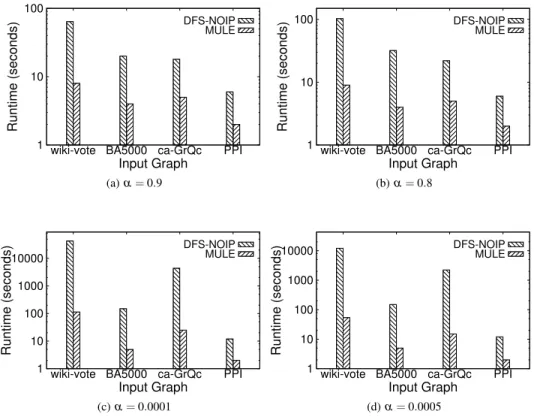
Fig. 1: Comparison of Simple and Optimized Depth First Search approaches. The Y–Axis is in log–scale.
e) Input Data:: Details of the input graphs that we used are shown in Table I.
The first set of graphs consists of real world uncertain graphs shared by authors of [31] and [35]. These include a protein-protein interaction (PPI) network of a Fruit Fly obtained by integrating data from the BioGRID 2 database with that form the STRING3database, and the DBLP4dataset from authors of [35], which is an uncertain network predicting future co-authorship. The PPI network is an uncertain graph
2http://thebiogrid.org/ 3http://string-db.org/ 4http://dblp.uni-trier.de/
where each vertex represents a protein and two vertices are
connected by an edge with a probability representing the likelihood of interaction between the the two proteins. The DBLP network represents co-authorship in academic articles. Each vertex in this network represents an author. Two vertices are connected by an edge with a probability that depends on the “strength” of their co-authorship, which is computed as 1−e−c/10, wherecis the number of papers co–authored.
The second set of graphs was obtained from the Stanford Large Network Collection [48], and includes graphs repre-senting Internet p2p networks, collaboration networks, and an online social network. The p2p-Gnutella graphs represent peer to peer file sharing networks, where each vertex in the graph
5 10 15 20 25 30 35 40 0.0001 0.001 0.01 0.1 1
Algorithm runtime (seconds)
Probability Threshold (α) BA5000 BA6000 BA7000 BA8000 BA9000 BA10000
(a) Random Graphs
0 20 40 60 80 100 120 0.0001 0.001 0.01 0.1 1
Algorithm runtime (seconds)
Probability Threshold (α) PPI ca-GrQc p2p-Gnutella04 p2p-Gnutella08 p2p-Gnutella09 wiki-vote
(b) Semi–synthetic and Real Graphs Fig. 2: Runtime vs Alpha (α). The X–Axis is in log–scale
10000 20000 30000 40000 50000 60000 70000 80000 90000 0.0001 0.001 0.01 0.1 1
Number of Alpha Maximal Cliques
Probability Threshold (α) BA5000 BA6000 BA7000 BA8000 BA9000 BA10000
(a) Random Graphs
0 200000 400000 600000 800000 1e+06 1.2e+06 1.4e+06 1.6e+06 1.8e+06 0.0001 0.001 0.01 0.1 1
Number of Alpha Maximal Cliques
Probability Threshold (α) PPI ca-GrQc p2p-Gnutella04 p2p-Gnutella08 p2p-Gnutella09 wiki-vote
(b) Semi–synthetic and Real Graphs Fig. 3: No ofα-maximal cliques vs Alpha (α). The X–Axis is in log–scale
represents a computer and the edges represent the communi-cation among them. The p2p-Gnutella04, p2p-Gnutella08 and p2p-Gnutella09 graphs represent communications occurring on 4th, 8th and 9th of August, 2002 respectively. The ca-GrQc graph represents the collaboration network among scientist working on General Relativity and Quantum Cosmology. Each vertex in the graph is a scientist and two vertices are connected by an edge if the corresponding scientists have co-authored a paper. Finally the wiki-vote graph represents the voting that occurs while selecting a new wikipedia administrator. Each vertex is either a wikipedia admin or wikipedia user and the edges represent the votes that each admin / user casts in favor of a candidate. The candidate is also a wikipedia user and hence is represented by a vertex in the graph. For all these graphs, the uncertain graphs were created from these deterministic graphs by assigning edge probabilities uniformly at random. Hence these can be considered as semi–synthetic uncertain graphs.
The third set of input graphs was synthetically generated using the Barab´asi−Albert model for random graphs [49]. Then the edges were assigned probabilities uniformly at random from [0,1].
Comparison with other approaches. We compare our algorithm with another algorithm based on depth-first-search,
which we call DFS-NOIP (DFS with NO Incremental Proba-bility Computation), described in Algorithm 7. This algorithm also performs a depth first search to enumerate allα–maximal
cliques but does not compute the probabilities incrementally like MULE does. Figure 1 compares the performance of MULE with DFS–NOIP. The results show that MULE per-forms much better than DFS–NOIP. For instance, for the graph wiki–vote with α =0.9 DFS–NOIP took 64 seconds while
MULE took only 8 secs. The relative performance results hold true over a wide range of input graphs and values of
α, including synthetic and real-world graphs, and small and large values of α. Forα=0.0001, MULE took only 25 secs to enumerate all maximal cliques in ca-GrQc, while DFS– NOIP took over 4400 secs. On the wiki–vote input graph with probability threshold 0.9, MULE took 8 seconds while DFS– NOIP took 64 seconds. For the same graph, with probability threshold 0.0001, MULE took 114 secs, while DFS–NOIP took more than 11 hours.
Dependence on α. We measured the runtime of
enumer-ation as well as the output size, (the number of α-maximal
cliques that were output) for different values of α and for
the various input graphs described above. The dependence of the runtime on α is shown in Figure 2, and the number of
cliques as a function ofα is shown in Figure 3. We note that
6 8 10 12 14 16 18 20 50000 60000 70000 80000 90000
Algorithm runtime (seconds)
Output Size ( Number of maximal cliques )
0.05 0.01 0.005 0.001 0.0005 0.0001
(a) Random Graphs Fig. 4: Runtime vs Output Size
Algorithm 7: DFS–NOIP(C,I)
1 Icopy←I
2 forall the u∈Icopy do
3 if u≤max(C)OR clq(C∪ {u})<α then 4 I←I\ {u}
5 if I=/0then
6 ifC is anα-maximal cliquethen 7 OutputC as α-maximal clique
8 return
9 forall the v∈I do 10 C0←C∪ {v}
11 ifC0 is an α-maximal clique then 12 OutputC0 asα-maximal clique 13 else
14 I0←I∩Γ(v) 15 DFS–NOIP(C0,I0)
as α increases, the number of maximal cliques, and the time of enumeration both drop sharply. The decrease in runtime is because with a larger value of α, the algorithm is able to
prune search paths aggressively early in the enumeration. We note that the number of α-maximal cliques does not
have to always decrease as α increases. Sometimes it is
possible that the number ofα-maximal cliques increases with α. This is because as α increases, a large maximal clique
may split into many smaller maximal cliques. However, these differences are negligible, and are not visible in the plots.
Dependence on Size of Output.Figure 4 shows the change in runtime with respect to the number of α-maximal cliques enumerated, for the randomly generated graphs. It can be seen that the runtime of the algorithm is almost proportional to the number of maximal cliques in the output. This shows that the algorithm runtime scales well with the number of
α-maximal cliques in output. This comparison was not done for real world or semi–synthetic graphs as these graphs have different structural properties, hence different sizes of maximal cliques and thus there is no meaningful way to interpret the results.
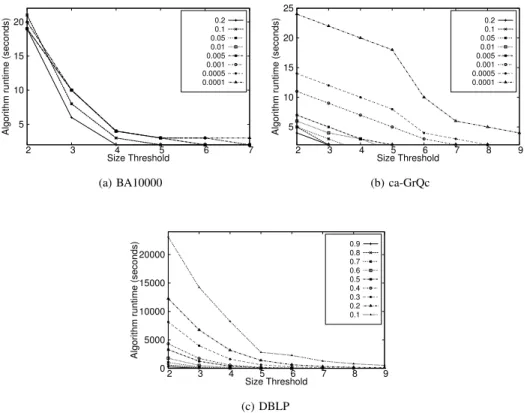
Enumerating Large Maximal Cliques. Figures 5 and 6 show the runtime of LARGE–MULE (Algorithm 5) and the output size respectively as a function oft, the minimum size of an α-maximal clique that is output. As t increases, both
runtime and output size decrease substantially. For instance, MULE takes 76797 seconds to enumerate all uncertain maxi-mal cliques from the DBLP dataset (for probability threshold 0.9). However, LARGE–MULE takes only 32 seconds when t=3. Similarly, for input graph ca-GrQc and α =0.0001,
MULE takes 125 seconds, while LARGE–MULE takes 10 seconds whent=6 and 6 seconds whent=7.
VI. CONCLUSION
We present a systematic study of the enumeration of maximal cliques from an uncertain graph, starting from a precise definition of the notion of an α-maximal clique,
followed by a proof showing that the maximum number of
α-maximal cliques in a graph onnvertices is exactly bnn/2c,
for 0<α <1. We present a novel algorithm, MULE, for
enumerating the set of all α-maximal cliques from a graph,
and an analysis showing that the worst-case runtime of this algorithm isO(n·2n). We present an experimental evaluation of MULE showing its performance, and an extension for faster enumeration of large maximal cliques.
An interesting open problem is to design an algorithm for enumerating maximal cliques from an uncertain graph whose time complexity is worst-case optimal, O(√n·2n). Finally, there are various dense substructures that can be found in a network. Some examples include bicliques, quasi–cliques and k-cores. Finding these dense substructures in the context of uncertain graphs can be an important future direction of work.
REFERENCES
[1] J. Ghosh, H. Ngo, S. Yoon, and C. Qiao, “On a routing problem within probabilistic graphs and its application to intermittently connected networks,” inINFOCOM 2007. 26th IEEE International Conference on Computer Communications. IEEE, 2007, pp. 1721–1729.
[2] S. Biswas and R. Morris, “Exor: opportunistic multi-hop routing for wireless networks,”ACM SIGCOMM Computer Communication Review, vol. 35, no. 4, pp. 133–144, Aug. 2005.
[3] H. Kawahigashi, Y. Terashima, N. Miyauchi, and T. Nakakawaji, “Mod-eling ad hoc sensor networks using random graph theory,” in Second IEEE Consumer Communications and Networking Conference, 2005, pp. 104–109.
[4] E. Adar and C. Re, “Managing uncertainty in social networks,”IEEE Data Engineering Bulletin, vol. 30, no. 2, pp. 15–22, 2007.
[5] R. Guha, R. Kumar, P. Raghavan, and A. Tomkins, “Propagation of trust and distrust,” inProceedings of the 13th International conference on World Wide Web, ser. WWW ’04. New York, NY, USA: ACM, 2004, pp. 403–412.
[6] D. Kempe, J. Kleinberg, and E. Tardos, “Maximizing the spread of influence through a social network,” in Proceedings of the 9th ACM SIGKDD International conference on Knowledge discovery and data mining, ser. KDD ’03. New York, NY, USA: ACM, 2003, pp. 137– 146.
5 10 15 20
2 3 4 5 6 7
Algorithm runtime (seconds)
Size Threshold 0.2 0.1 0.05 0.01 0.005 0.001 0.0005 0.0001 (a) BA10000 5 10 15 20 25 2 3 4 5 6 7 8 9
Algorithm runtime (seconds)
Size Threshold 0.2 0.1 0.05 0.01 0.005 0.001 0.0005 0.0001 (b) ca-GrQc 0 5000 10000 15000 20000 2 3 4 5 6 7 8 9
Algorithm runtime (seconds)
Size Threshold 0.9 0.8 0.7 0.6 0.5 0.4 0.3 0.2 0.1 (c) DBLP
Fig. 5: Runtime vs Size threshold of enumerated uncertain maximal cliques
10 100 1000 10000
2 2.5 3 3.5 4 4.5 5 5.5 6
Number of maximal cliques
Size Threshold 0.2 0.1 0.05 0.01 0.005 0.001 0.0005 0.0001 (a) BA10000 10 100 1000 10000 100000 2 3 4 5 6 7 8
Number of maximal cliques
Size Threshold 0.2 0.1 0.05 0.01 0.005 0.001 0.0005 0.0001 (b) ca-GrQc 10 100 1000 10000 100000 2 3 4 5 6 7 8
Number of maximal cliques
Size Threshold 0.9 0.8 0.7 0.6 0.5 0.4 0.3 0.2 0.1 (c) DBLP
Fig. 6: Number ofα-maximal cliques vs threshold on minimum size of uncertain maximal clique
[7] D. Liben-Nowell and J. Kleinberg, “The link prediction problem for social networks,” inProceedings of the 12th International conference on Information and knowledge management, ser. CIKM ’03. New York, NY, USA: ACM, 2003, pp. 556–559.
[8] U. Kuter and J. Golbeck, “Using probabilistic confidence models for trust inference in web-based social networks,”ACM Transactions on Internet Technology, vol. 10, no. 2, pp. 8:1–8:23, Jun. 2010.
[9] P. Boldi, F. Bonchi, A. Gionis, and T. Tassa, “Injecting uncertainty in graphs for identity obfuscation,”Proceedings of the VLDB Endowment, vol. 5, no. 11, pp. 1376–1387, 2012.
[10] S. Asthana, O. D. King, F. D. Gibbons, and F. P. Roth, “Predicting protein complex membership using probabilistic network reliability,”
Genome Research, vol. 14, pp. 1170–1175, 2004.
[11] J. Bader, A. Chaudhuri, J. Rothberg, and J. Chant, “Gaining confidence in high-throughput protein interaction networks.”Nature Biotechnology, vol. 22, no. 1, pp. 78–85, 2004.
[12] D. R. Rhodes, S. A. Tomlins, S. Varambally, V. Mahavisno, T. Barrette, S. Kalyana-Sundaram, D. Ghosh, A. Pandey, and A. M. Chinnaiyan, “Probabilistic model of the human protein-protein interaction network,”
Nature Biotechnology, vol. 23, no. 8, pp. 951–959, 2005.
[13] R. Jiang, Z. Tu, T. Chen, and F. Sun, “Network motif identification in stochastic networks,”Proceedings of the National Academy of Sciences, vol. 103, no. 25, pp. 9404–9409, 2006.
[14] G. Palla, I. Der´enyi, I. Farkas, and T. Vicsek, “Uncovering the overlap-ping community structure of complex networks in nature and society.”
Nature, vol. 435, no. 7043, pp. 814 – 818, 2005.
[15] O. Rokhlenko, Y. Wexler, and Z. Yakhini, “Similarities and differences of gene expression in yeast stress conditions,”Bioinformatics, vol. 23, no. 2, pp. 184–190, 2007.
[16] E. Harley and A. Bonner, “Uniform integration of genome mapping data using intersection graphs,”Bioinformatics, vol. 17, no. 6, pp. 487–494, 2001.
[17] J. Mcauley and J. Leskovec, “Discovering social circles in ego net-works,”ACM Transactions on Knowledge Discovery from Data, vol. 8, no. 1, pp. 4:1–4:28, Feb. 2014.
[18] H. Bernard, P. D. Killworth, and L. Sailer, “Informant accuracy in social network data iv: a comparison of clique-level structure in behavioral and cognitive network data,”Social Networks, vol. 2, no. 3, pp. 191 – 218, 19791980.
[19] J. Pattillo, N. Youssef, and S. Butenko, “Clique relaxation models in social network analysis,” in Handbook of Optimization in Complex Networks, ser. Springer Optimization and Its Applications. Springer New York, 2012, pp. 143–162.
[20] G. A. et al, “Functional organization of the yeast proteome by systematic analysis of protein complexes,”Nature, vol. 415, no. 6868, pp. 141 – 147, 2002.
[21] N. Pathak, S. Mane, and J. Srivastava, “Who thinks who knows who? socio-cognitive analysis of email networks,” in Sixth International Conference on Data Mining, 2006, pp. 466–477.
[22] E. Harley, A. Bonner, and N. Goodman, “Uniform integration of genome mapping data using intersection graphs,”Bioinformatics, vol. 17, no. 6, pp. 487–494, 2001.
[23] H. M. Grindley, P. J. Artymiuk, D. W. Rice, and P. Willett, “Identification of tertiary structure resemblance in proteins using a maximal common subgraph isomorphism algorithm,”Journal of Molecular Biology, vol. 229, no. 3, pp. 707–721, 1993.
[24] B. Zhang, B.-H. Park, T. Karpinets, and N. F. Samatova, “From pull-down data to protein interaction networks and complexes with biological relevance,”Bioinformatics, vol. 24, no. 7, pp. 979–986, 2008. [25] W. Chen, Y. Wang, and S. Yang, “Efficient influence maximization in
so-cial networks,” inProceedings of the 15th ACM SIGKDD International Conference on Knowledge Discovery and Data Mining, ser. KDD ’09. New York, NY, USA: ACM, 2009, pp. 199–208.
[26] J. Moon and L. Moser, “On cliques in graphs,” Israel Journal of Mathematics, vol. 3, pp. 23–28, 1965.
[27] Y. Yuan, L. Chen, and G. Wang, “Efficiently answering probabil-ity threshold-based shortest path queries over uncertain graphs,” in
Database Systems for Advanced Applications, ser. Lecture Notes in Computer Science. Springer Berlin Heidelberg, 2010, vol. 5981, pp.
155–170.
[28] M. Potamias, F. Bonchi, A. Gionis, and G. Kollios, “k-nearest neighbors in uncertain graphs,”Proceedings of the VLDB Endowment, vol. 3, no. 1-2, pp. 997–1008, September 2010.
[29] G. Kollios, M. Potamias, and E. Terzi, “Clustering large probabilistic graphs,” IEEE Transactions on Knowledge and Data Engineering, vol. 25, no. 2, pp. 325–336, 2013.
[30] P. Hintsanen and H. Toivonen, “Finding reliable subgraphs from large probabilistic graphs,”Data Mining and Knowledge Discovery, vol. 17, no. 1, pp. 3–23, August 2008.
[31] Z. Zou, J. Li, H. Gao, and S. Zhang, “Mining frequent subgraph patterns from uncertain graph data,”IEEE TKDE, vol. 22, no. 9, pp. 1203–1218, 2010.
[32] R. Jin, L. Liu, and C. C. Aggarwal, “Discovering highly reliable sub-graphs in uncertain sub-graphs,” inProceedings of the 17th ACM SIGKDD International conference on Knowledge discovery and data mining, ser. KDD ’11. New York, NY, USA: ACM, 2011, pp. 992–1000. [33] Z. Zou, H. Gao, and J. Li, “Discovering frequent subgraphs over
uncertain graph databases under probabilistic semantics,” inProceedings of the 16th ACM SIGKDD International conference on Knowledge discovery and data mining, ser. KDD ’10. New York, NY, USA: ACM, 2010, pp. 633–642.
[34] L. Liu, R. Jin, C. Aggarwal, and Y. Shen, “Reliable clustering on uncertain graphs,” in IEEE 12th International Conference on Data Mining (ICDM), 2012, pp. 459–468.
[35] A. Khan, F. Bonchi, A. Gionis, and F. Gullo, “Fast reliability search in uncertain graphs,” inProceedings of the 16th International Conference on Extending Database Technology, ser. EDBT ’14. New York, NY, USA: ACM, 2014, pp. 535–546.
[36] R. Jin, L. Liu, B. Ding, and H. Wang, “Distance-constraint reachability computation in uncertain graphs,”Proceedings of the VLDB Endowment, vol. 4, no. 9, pp. 551–562, June 2011.
[37] Z. Zou, J. Li, H. Gao, and S. Zhang, “Finding top-k maximal cliques in an uncertain graph,” inIEEE 26th International Conference on Data Engineering (ICDE), 2010, pp. 649–652.
[38] C. Bron and J. Kerbosch, “Algorithm 457: finding all cliques of an undirected graph,” Communications of ACM, vol. 16, no. 9, pp. 575– 577, September 1973.
[39] E. Tomita, A. Tanaka, and H. Takahashi, “The worst-case time complex-ity for generating all maximal cliques and computational experiments,”
Theoretical Computer Science, vol. 363, pp. 28–42, October 2006. [40] F. Cazals and C. Karande, “A note on the problem of reporting maximal
cliques,”Theoretical Computer Science, vol. 407, no. 1-3, pp. 564 – 568, 2008.
[41] D. Eppstein and D. Strash, “Listing all maximal cliques in large sparse real-world graphs,” in Experimental Algorithms, ser. Lecture Notes in Computer Science, P. Pardalos and S. Rebennack, Eds. Springer Berlin / Heidelberg, 2011, vol. 6630, pp. 364–375.
[42] N. Modani and K. Dey, “Large maximal cliques enumeration in sparse graphs,” inProceedings of the 17th ACM conference on Information and knowledge management, ser. CIKM ’08. New York, NY, USA: ACM, 2008, pp. 1377–1378.
[43] S. Tsukiyama, M. Ide, H. Ariyoshi, and I. Shirakawa, “A new algorithm for generating all the maximal independent sets,” SIAM Journal on Computing, vol. 6, no. 3, pp. 505–517, 1977.
[44] N. Chiba and T. Nishizeki, “Arboricity and subgraph listing algorithms,”
SIAM Journal on Computing, vol. 14, pp. 210–223, February 1985. [45] D. S. Johnson, M. Yannakakis, and C. H. Papadimitriou, “On generating
all maximal independent sets,”Information Processing Letters, vol. 27, no. 3, pp. 119 – 123, 1988.
[46] K. Makino and T. Uno, “New algorithms for enumerating all maximal cliques,” in Algorithm Theory - SWAT 2004, ser. Lecture Notes in Computer Science, T. Hagerup and J. Katajainen, Eds. Springer Berlin / Heidelberg, 2004, vol. 3111, pp. 260–272.
[47] A. P. Mukherjee, P. Xu, and S. Tirthapura, “Mining maximal cliques from an uncertain graph,” http://arxiv.org/pdf/1310.6780.pdf.
[48] J. Leskovec. Stanford large network dataset collection.
[49] R. Albert and A.-L. Barab´asi, “Statistical mechanics of complex net-works,”Reviews of Modern Physics, vol. 74, pp. 47–97, Jan 2002.