MICHAEL EUBANKS
Abstract. Tucked away in the Andes Mountains Machu Picchu is an amazing Inca site that has only recently been studied since its existence was made public in 1911. In this talk we focus on a specific building known as the Temple of the Sun, which is aligned with the winter solstice sunrise. We employ probabilistic methods to determine the likelihood that the Inca built the Temple of the Sun to align intentionally.
1. Introduction
About fifty miles from Cuzco, Peru, located in the Andes Mountains is the site Machu Picchu. It was built by the Inca in the 1400s, but was not known to the rest of the world until the early 1900s. Since its “rediscovery,” Machu Picchu has been heavily studied. This research involves a knowledge of Incan architecture, astronomy, and culture.
The Inca Empire had an abundance of temples and monuments throughout their land that were devoted to the sun. We would like to determine the likelihood they built the Temple of the Sun at Machu Picchu as a solar observatory. We will first need to understand a brief history of the Inca and their connection to the sun. Then, we will look at the method used to discover when and where the June solstice rose during the time that the Inca would have occupied Machu Picchu. Using this data we will employ probabilistic methods to determine the likelihood that the Inca built the Temple of the Sun to align intention-ally with the June solstice.
2. Machu Picchu Background
The Andes Mountains stretch north to south across most of the west coast of South America and divide Peru into two climates; dry-desert climate on the west along the coast and the rain forest of the Ama-zon Basin to the east. The mountain range itself has many different climates depending on the elevation, but Machu Picchu is mild in tem-perature and borders the rain forest. It is situated on the east side of a
Date: December 4, 2013.
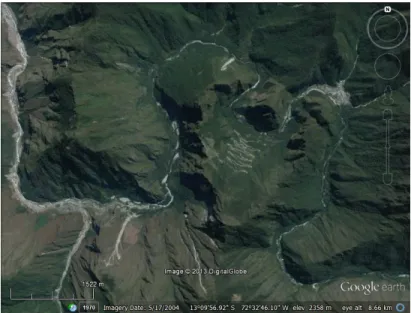
ridge line between Machu Picchu Mountain (3060m) and Huayna Pic-chu Mountain (2700m). The site is well protected on all sides because the Urubamba River flows hundreds of meters below, and envelops Machu Picchu on three sides with Machu Picchu Mountain situated in the south. The sides of this ridge line are so steep and covered with vegetation it is nearly impossible to see the site from the bank of the river.
Figure 1. Aerial view of Machu Picchu
Inca Pachacutec, who was the ninth Inca, ruled from the capital in Cuzco, Peru in the mid 1400s. During his reign he was responsi-ble for expanding the Inca culture from Cuzco into an empire called Tahuantinsuyu, the land of four regions. During the expansion, Pacha-cutec and the later Incas were able to gain a vast amount of resources that enabled them to rapidly become a robust empire. The abundance of labor helped Pachacutec build numerous sites throughout the region, including Machu Picchu around 1450 AD [8]. Machu Picchu is thought to have been more of a retreat for Pachacutec and other nobility than it was a military outpost or a trading center. The Inca believed that buildings belonged to their maker, and shortly after Pachacutec died in 1470, Machu Picchu was abandoned [6].
When the Spanish arrived on the Pacific coast of South America the Inca empire reached as far north as Colombia and south into Chile, but it was weakening due to civil war and an epidemic. The Inca initially
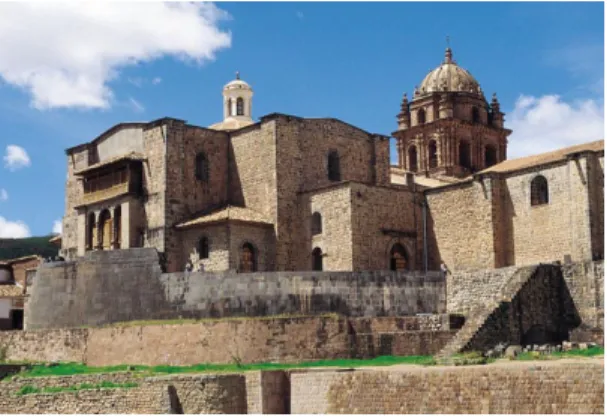
welcomed the Spanish, but it did not take long for the two distinct cultures to clash. The differences in spiritual beliefs caused much of the strife; the Spanish were fiercely evangelizing Christianity but the Inca held that spirituality lay in nature. The Inca believed in a cos-mic connection to the sun as was exhibited in their pottery, textiles, and architecture. These relics are limited because the Spanish tried to destroy as much of the Inca religious relics as possible in order to fa-cilitate conversions to Catholicism. One example of this is Qurikancha in Cuzco, which was the empire’s main Temple of the Sun.
Figure 2. Qurikancha in Cuzco, Peru
When the Spanish arrived they destroyed most of the Temple of the Sun and built a monastery on top of the remains. Luckily, the Spanish did not know about Machu Picchu and it stayed resting in the mountains for hundreds of years with few visitors. In 1911, Hiram Bingham was sponsored by Yale University to find the Lost City of the Inca. He and a small research team were led to Machu Picchu by two local farmers. Although it was not the Lost City and it was very overgrown, the “rediscovery” of Machu Picchu was epic and featured in the National Geographic magazine in April 1913.
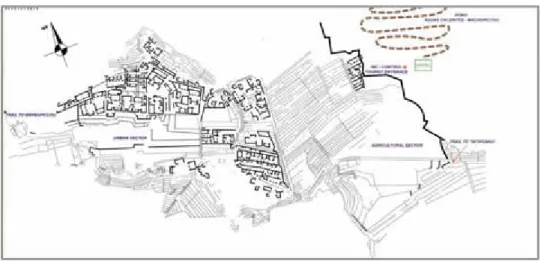
Like the rest of the Inca empire, Machu Picchu was well planned and constructed. There is a large agricultural section outside of the city wall. The Inca farmed on terraces that look like large steps scaling the side of the ridge. There was only one gate through the wall and from this location you can view the rest of the site. It is easy to see from the site map below that all of the buildings are polygons, with the exception of the building with the rounded wall.
Figure 4. Machu Picchu Map
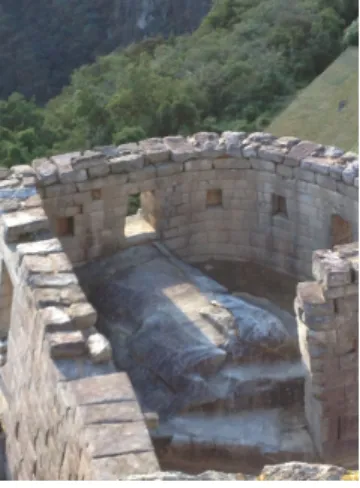
This semicircular room was labeled by Hiram Bingham in 1911 as the Temple of the Sun because of its similarities to Qurikancha. Below is a quote from Bingham’s National Geographic article where he men-tions some the similarities;
“In the semicircular tower which connects with this fine wall with the ingenious cutting of stones in such a way as to follow a selected curve reaches a perfection equaled only in the celebrated wall of the Temple of the Sun (now the Dominican Monastery), in Cuzco. Like that, it is a flattened curve, not round.” - Hiram Bingham [2]
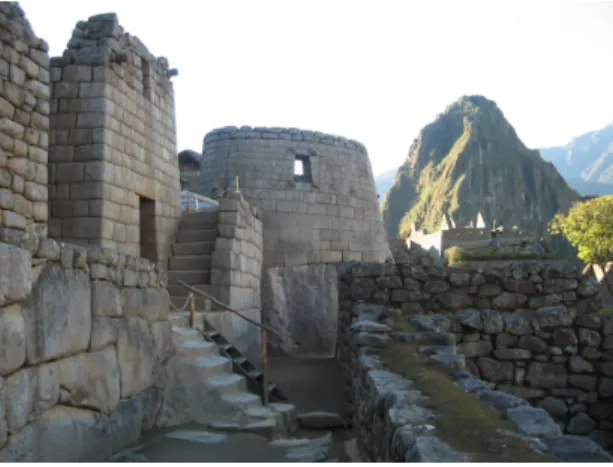
The Inca used many different styles of cut stones for building. These stones ranging from large rocks and boulders to carefully worked stones that resemble a cinder block. These fine cut blocks were used when constructing important religious or noble buildings, and they are the types used to construct both temples. Bingham also notes the fact that it looks like a tower. It resembles a tower because its position atop a massive rock sculpted to be the base of the wall on the east side. The top of the massive rock acts as the floor for the majority of
the room. On this rock, the Inca have chiseled an edge that points out of a window in the wall. The eastern facing wall and the edge on top of the rock are two key elements I used in my research. The other key element is the sun.
Figure 5. Machu Picchu, Martins, June, 21, 2012
The Inca used the alignment of the sun and quipus to keep track of their calender [5]. Also, they relied heavily on the sun as an agricul-tural guide. In order to know when to planet and harvest their crops, they needed a way to mark the winter solstice, or June solstice, in the Southern Hemisphere. The winter and summer solstice are the shortest and longest day of year, respectively. The winter solstice is when the sun’s path reaches the farthest north in the sky, at noon the sun is over the Tropic of Cancer. To this day, Andean cultures celebrate the June solstice by holding festivals throughout the month of June. This tradition is closely related to the festivals the Inca would have held for the winter solstice.
3. Probability Background
Probability is the mathematical description of an uncertain situation; that is, given a set of outcomes, what is the chance that a specific one occurs, or that the outcome falls in a specific interval. The set of all possible outcomes is referred to as the sample space. A random variable is the assignment of a numeric value to the outcome of an experiment whose result is unknown in advance. Within the study of probability there are two types of random variables, discrete and continuous.
Definition 1. A continuous random variable is real-valued func-tion of X, such that x∈X are the possible outcomes of an experiment that can take on any value within a given interval. [7]
This does not mean that each outcome will correspond to each value in the interval, but no value in the interval can be ruled out as a possible value.
We sayf(x) is a probability density function iff satisfies the follow-ing two conditions:
(1) f(x)≥0 for all x,−∞ ≤x≤ ∞.
(2) R∞
−∞f(x) dx= 1.[7]
Definition 2. A probability density function, PDF, is a function whose general integral over the range (a, b), where a ≤ b, is equal to the probability that the variable takes a value in that range. [4]
P r(a≤x≤b) = Z b
a
f(x) dx.
They−axisof the PDF is known as the frequency that the variousX
values occur. When studying continuous random variables it is useful to have descriptive measures associated with their distributions such as their expected value, variances and standard deviations.
Definition 3. The expected value of a continuous random variable X is
E(X) = Z ∞
−∞
xf(x) dx, provided that the integral exists. [1]
Definition 4. If X is a random variable with mean E[X] = µ, then the variance of X is the expected value of (X−µ)2. That is,
var(X) = E[(X−E[X])2] = Z ∞
−∞
(x−E[X])2f(x) dx. Also note that,
0≤E[(X−E[X])2] =E[X2]−(E[X])2.
[1]
Thus, variance of X is a measure of dispersion of x∈X around the expected value ofX. The variance of X is denotedvar(X) orσ2. The variable σ is used to represent standard deviation of X, thus
p
3.1. Uniform distribution. The most basic probability density func-tion is known as the uniform distribufunc-tion. This distribufunc-tion occurs when a continuous random variable X takes a constant value c in a interval [a, b]. Assume that a ≤ b and that any two subintervals of [a, b] of the same length have the same probability.
Definition 5. If a≤b, a random variableX is said to have a contin-uous uniform probability distribution on [a, b]if and only if the density function of X is fX(x) = 1 b−a, if a≤x≤b 0 , otherwise. [1]
The expected value of a uniform random variable is simply,
E[X] =µ= a+b 2 .
3.2. Normal distribution. A continuous random variableX is nor-mal or Gaussian if it has a PDF of the form,
fX(x) = 1 √
2πσe
−(x−µ)2/2σ2,
where µ and σ are two scalar parameters and σ ≥ 0. The mean and the variance can be calculated to be
E[X] =µ= θ1+θ2 2 , var(x) = σ 2 = r θ2−θ1 4 , where θ1 ≤θ2. [1] 4. Methods
The research was not strictly limited to mathematics, but also in-volved a knowledge of Archeoastronomy, the study of ancient astron-omy, and the use of Google Earth. Also included in this work is the first hand experience. We were present on the site for the winter solstice on June 21, 2013. However, access into the Temple of the Sun was blocked off during the two days I was on the site. Therefore, I was stationed above the Temple of the Sun looking down into the room. From this location, I was able to record the time in which the sun came over top of the mountain and photograph the movement of the shadow across the stone on the floor.
Figure 6. Qurikancha in Cuzco, Peru
I was later able to compare the time I recorded for the sunrise with the sunlight simulating tool in Google Earth to confirm the time the sun rose fully over the neighboring mountain peak. I was able to use the National Oceanic and Atmospheric Administration solar calculator to find the solar elevation to be 15.88◦. Solar elevation is the angle up from the horizon. Using the same calculator, I was able to calculate the solar azimuth at 15.88◦ elevation for June 21, 1450, which I labeled
a = 60.53◦. The solar azimuth is the measure of degrees the sun is positioned on the horizon, where 90◦ is due east and−90◦ is due west. We will use the azimuth angle of June 21, 1450 as the center of each interval to calculate the probability the sun or the stone fall within a given range around the solar azimuth
Also in Google Earth, I used the ruler tool to measure the angle of the east wall from due north. I recorded this measurement several times and took the average to the nearest hundredth place. I then subtracted 90◦ from that measurement to obtain what I called the wall angle, and labeled ω = 67.35◦. I use two cases when solving for the probability; first being that the wall angle could have been between 0◦ and 180◦ and secondly I took into account that they would not have likely faced the wall into the ridge line in the north or south, which restricted the possible orientation to be between 7◦ and 147◦. Since I was not able to measure the stone angle myself, I had to use a resource which gave me the error from the azimuth [3]. I calculated the angle formed by the edge from due north to bes = 62.6◦.
5.1. Wall alignment.
As mentioned in section 2, the Temple of the Sun was built on top of a massive rock that is part of the mountain. This might have made aligning the wall exactly with the June solstice difficult. Another rea-son is that the Inca may not have constructed the wall during or near the solstice, and would have been going off an estimate of where the sun would perhaps rise over the mountain. Here we will look at the two cases applied to the uniform distribution.
Case 1: Let (0◦ ≤ω≤180◦) and µ= 90◦,
P(53.5◦ ≤a≤67.5◦) = 14
180 = 0.078.
Case 2: Let (7◦ ≤ω≤147◦) and µ= 70◦,
P(53.53◦ ≤a≤67.53◦) = 14
140 = 0.100.
When modeling the probability with a uniform probability density function, we can see that both cases are greater than 0.050. There-fore, we can not say that if the wall were built with any possible ori-entation equally likely that it was meant to align with the June solstice. Next, we will use the normal distribution and the two possible cases. The normal probability density function is more reasonable since it is more likely that they would have faced the wall toward the rising sun in the east, and not down the valley in the north and south.
Case 1: (0◦ ≤ω ≤180◦) µ= 180 2 = 90 ◦ , σ = 180 4 = 45 ◦ .
Let z1 = 53.545−90 = −0.811 and z2 = 67.545−90 = −0.500. Note the following,
P(53.5◦ ≤a ≤67.5◦) =P(−0.811≤z ≤ −0.500)
=P(z ≤ −0.500)−P(z ≤ −0.811) = 0.309−0.204
= 0.100. Case 2: (7◦ ≤ω ≤147◦) µ= 77◦, σ = 140 4 = 35 ◦ .
Let z1 = 53.535−77 = −0.671 and z2 = 67.535−77 = −0.271. Note the following,
P(53.5◦ ≤a ≤67.5◦) =P(−0.671≤z ≤ −0.271)
=P(z ≤ −0.271)−P(z ≤ −0.671) = 0.393−0.251
= 0.142.
We see that each probability is greater than 0.050. Therefore, we can not conclude that the wall itself was used as a way for the Inca to observe the June Solstice.
5.2. Stone alignment.
The stone edge that we are interested in was carved by the Inca with fine stone working tools. The angle in which they cut it could have been any possibility between 0◦ and 180◦. Therefore, we will only use one case from each distribution. Here we can see the probability using a uniform PDF.
Let (0◦ ≤ω ≤180◦) and µ= 90◦,
P(58.3◦ ≤a≤62.7◦) = 4.4
180 = 0.024.
Since the probability using a uniform distribution is less than 0.050, we can say that the Inca did in fact use the stone edge as a way of observing the June solstice.
For the normal distribution, let (0◦ ≤ω ≤180◦), we know from the previous problem that
µ= 90◦, σ = 45◦.
Let z1 = 58.345−90 = −0.704 and z2 = 62.745−90 = −0.607. Note the following,
P(58.3◦ ≤a ≤62.7◦) =P(−0.704≤z ≤ −0.607)
=P(z ≤ −0.607)−P(z ≤ −0.704) = 0.272−0.241
= 0.031.
Again, we see that the probability is less than 0.050. Therefore, it is likely that the Inca did use the stone edge as a way of observing the June Solstice.
6. Conclusion
Through the use of probabilistic methods I was able to determine the Inca did in fact have an understanding of the position of the solar azimuth during the mid 15th century when they built the Temple of the Sun at Machu Picchu. The Inca would have wanted the Temple of the Sun to standout from the other buildings, and so even though the exterior wall did not align with the sun it is still an important aspect of the building itself. The stone edge that had been chiseled by the Inca is a sign that they intended to be as precise as possible in marking the azimuth on June 21, 1450.
References
[1] Bertsekas, Dimitri P., and John N. Tsitsiklis. Introduction to Probability: Dimitri P. Bertsekas and John N. Tsitsikis. Belmont, Massachussets: Athena Scientific, 2008.
[2] Bingham, Hiram. “In the Wonderland of Peru.” National Geographic Mag., Apr. 1913. 387-573. 13 Nov. 2013.
[3] Dearborn, D. S., and R. E. White. (1982), Archaeoastronomy at Machu Picchu. Annals of the New York Academy of Sciences, 385:249-259.
[4] Evans, Merran, Nicholas Hastings, and Brian Peacock. Statistical Distribu-tions. 3rd ed. New York: Wiley, 2000.
[5] Kelley, David H., and E. F. Milone. ”3, 14.” Exploring Ancient Skies: A Survey of Ancient and Cultural Astronomy. 2nd ed. New York: Springer, 2011. [6] Reinhard, Johan. Machu Picchu: Exploring an Ancient Sacred Center. Los
Angeles: Cotsen Institute of Archaeology, University of California, 2007. [7] Wackerly, Dennis D., William Mendenhall, and Richard L. Scheaffer.
Math-ematical Statistics with Applications. 7th ed. Belmont, CA: Thomson Brooks/Cole, 2008.
[8] Wright, Kenneth R., Alfredo V. Zegarra, and William L. Lorah. “Ancient Machu Picchu Drainage Engineering.” Journal of Irrigation and Drainage En-gineering Nov./Dec. (1999): 360-69.
[9] Wright, Ruth M., and Zegarra Alfredo. Valencia. The Machu Picchu Guide-book: A Self-guided Tour. Boulder, CO: Johnson, 2004.
Michael Eubanks, Mathematics Department, Georgia College, Milledgeville, GA 31061, U.S.A.