Joint Models for Information and
Knowledge Extraction
A dissertation submitted towards the degree Doctor of Natural Science/Engineering
of the Faculty of Mathematics and Computer Science of Saarland University
by
Dat Ba Nguyen
Saarbrücken 2017
Colloquium
Date : 01.12.2017
Place : Saarbrücken
Dean : Prof. Frank-Olaf Schreyer
Examination Board
Supervisor and Reviewer : Prof. Gerhard Weikum Supervisor and Reviewer : Prof. Martin Theobald
Reviewer : Prof. Klaus Berberich
Chairman : Prof. Dietrich Klakow
Scentific Assitant : Dr. Simon Razniewski
Abstract
Information and knowledge extraction from natural language text is a key as-set for question answering, semantic search, automatic summarization, and other machine reading applications. There are many sub-tasks involved such as named entity recognition, named entity disambiguation, co-reference resolution, relation extraction, event detection, discourse parsing, and others. Solving these tasks is challenging as natural language text is unstructured, noisy, and ambiguous. Key challenges, which focus on identifying and linking named entities, as well as dis-covering relations between them, include:
• High NERD Quality. Named entity recognition and disambiguation, NERD for short, are preformed first in the extraction pipeline. Their results may affect other downstream tasks.
• Coverage vs. Quality of Relation Extraction. Model-based information ex-traction methods achieve high exex-traction quality at low coverage, whereas open information extraction methods capture relational phrases between entities. However, the latter degrades in quality by non-canonicalized and noisy output. These limitations need to be overcome.
• On-the-fly Knowledge Acquisition.Real-world applications such as question answering, monitoring content streams, etc. demand on-the-fly knowledge acquisition. Building such an end-to-end system is challenging because it requires high throughput, high extraction quality, and high coverage. This dissertation addresses the above challenges, developing new methods to advance the state of the art. The first contribution is a robust model for joint in-ference between entity recognition and disambiguation. The second contribution is a novel model for relation extraction and entity disambiguation on Wikipedia-style text. The third contribution is an end-to-end system for constructing query-driven, on-the-fly knowledge bases.
Kurzfassung
Informations- und Wissensextraktion aus natürlichsprachlichen Texten sind Schlüsselthemen vieler wissensbassierter Anwendungen. Darunter fallen zum Beispiel Frage-Antwort-Systeme, semantische Suchmaschinen, oder Applikatio-nen zur automatischen Zusammenfassung und zum maschinellem Lesen von Tex-ten. Zur Lösung dieser Aufgaben müssen u.a. Teilaufgaben, wie die Erkennung und Disambiguierung benannter Entitäten, Koreferenzresolution, Relationsextrak-tion, Ereigniserkennung, oder Diskursparsen, durchgeführt werden. Solche Auf-gaben stellen eine Herausforderung dar, da Texte natürlicher Sprache in der Regel unstrukturiert, verrauscht und mehrdeutig sind. Folgende zentrale Herausforderun-gen adressieren sowohl die Identifizierung und das Verknüpfen benannter En-titäten als auch das Erkennen von Beziehungen zwischen diesen EnEn-titäten:
• Hohe NERD Qualität. Die Erkennung und Disambiguierung benannter En-titäten(engl. "Named Entity Recognition and Disambiguation", kurz "NERD") wird in Extraktionspipelines in der Regel zuerst ausgeführt. Die Ergebnisse beeinflussen andere nachgelagerte Aufgaben.
• Abdeckung und Qualität der Relationsextraktion. Modellbasierte Informa-tionsextraktionsmethoden erzielen eine hohe Extraktionsqualität, bei allerd-ings niedriger Abdeckung. Offene Informationsextraktionsmethoden er-fassen relationale Phrasen zwischen Entitäten. Allerdings leiden diese Meth-oden an niedriger Qualität durch mehrdeutige Entitäten und verrauschte Ausgaben. Diese Einschränkungen müssen überwunden werden.
• On-the-Fly Wissensakquisition. Reale Anwendungen wie Frage-Antwort-Systeme, die Überwachung von Inhaltsströmen usw. erfordern On-the-Fly Wissensakquise. Die Entwicklung solcher ganzheitlichen Systeme stellt eine hohe Herausforderung dar, da ein hoher Durchsatz, eine hohe Extrak-tionsqualität sowie eine hohe Abdeckung erforderlich sind.
Diese Arbeit adressiert diese Probleme und stellt neue Methoden vor, um den aktuellen Stand der Forschung zu erweitern. Diese sind:
• Ein robustes Modell zur integrierten Inferenz zur gemeinschaftlichen Erken-nung und Disambiguierung von Entitäten.
• Ein neues Modell zur Relationsextraktion und Disambiguierung von Wikipedia-ähnlichen Texten.
vi |
• Ein ganzheitliches System zur Erstellung Anfrage-getriebener On-the-Fly Wissensbanken.
Acknowledgements
I would take this moment to thank my advisor Prof. Martin Theobald and my supervisor Prof. Gerhard Weikum for their invaluable guidance throughout my doctoral studies. I especially enjoyed the freedom they gave me to pursue my research interests. They have not only assisted me in completing this work, but they have also helped me to broaden my attitude towards research, and to develop my personality.
I would like to thank my co-authors Johannes Hoffart, Abdalghani Abujabal and Nam Khanh Tran for their great team work and insightful discussions. Many thanks to my officemates Amy Siu, Sairam Gurajada, Xuan-Cuong Chu, and to all my colleagues and staff at D5 group for making the workplace an exciting atmosphere.
A special note of thanks to Quan Nguyen and his family for their great help to my life. Thanks are sent to Uncle Duy Ta, Aunt Hong Le, Aunt Nhung Le, Aunt Nga Le, and to my close friends Quoc-Dai Nguyen, Hai-Dang Tran, Hoang-Vu Nguyen, Duc-Duy Nguyen for their encouragement.
Finally, I would like to thank my parents and my parents-in-law. Without their support I would have not done this work.
viii |
Contents
1 Introduction 1
1.1 Scope and Goals . . . 1
1.2 Challenges . . . 2 1.3 Contributions . . . 3 1.4 Publications . . . 4 1.5 Organization . . . 5 2 Preliminaries 7 2.1 Data Model. . . 7
2.2 Feature Space for Named Entity Disambiguation . . . 8
2.2.1 Backgrounds . . . 8
2.2.2 Entity Repository and Name-Entity Dictionary . . . 9
2.2.3 Standard Features. . . 9
2.2.4 Domain-Oriented Feature . . . 10
2.2.5 Syntactic Dependency Feature. . . 12
3 Joint Model for Named Entity Recognition and Disambiguation 13 3.1 Introduction . . . 13 3.2 Related Work. . . 14 3.3 System Overview . . . 16 3.4 Feature Model . . . 19 3.4.1 NED Features . . . 20 3.4.2 NER Features . . . 20
3.5 J-NERD Factor Graph Model . . . 21
3.5.1 Linear-Chain Model . . . 21
3.5.2 Tree Model . . . 22
3.5.3 Global Models . . . 22
3.5.4 Inference & Learning . . . 23
3.6 Experiments . . . 24
3.6.1 Setup. . . 24
3.6.2 Results for CoNLL-YAGO2 . . . 26
3.6.3 End-to-End NERD on ACE. . . 29
x | Contents
3.6.4 End-to-End NERD on ClueWeb . . . 29
3.7 Summary . . . 30
4 Joint Model for Relation Extraction and Entity Disambiguation 31 4.1 Introduction and Related Work . . . 31
4.2 System Overview . . . 32
4.3 Relation Pattern Mining. . . 33
4.4 Relation Pattern Labeling . . . 33
4.5 Joint Model. . . 34
4.6 Experiments . . . 35
4.6.1 Corpora . . . 35
4.6.2 Systems under Comparison . . . 36
4.6.3 Experiments on Relation Extraction. . . 37
4.6.4 Experiments on Entity Disambiguation . . . 37
4.6.5 End-to-End Experiments . . . 38
4.7 Summary . . . 39
5 On-the-Fly Knowledge Base Construction 41 5.1 Introduction and Related Work . . . 41
5.2 System Overview . . . 43
5.2.1 Design Space and Choices . . . 43
5.2.2 QKBfly Overview . . . 44
5.3 Semantic Graph . . . 46
5.4 Graph Algorithm . . . 48
5.5 On-the-fly Knowledge Base Construction . . . 52
5.6 QKBfly at Work . . . 54
5.7 Experiments . . . 55
5.7.1 Experiments on KB Construction . . . 55
5.7.2 Experiment on Joint NED and CR . . . 58
5.7.3 Experiments on Information Extraction . . . 59
5.7.4 Use Case: Question Answering . . . 60
5.8 Summary . . . 62
6 Conclusions 65 6.1 Contributions . . . 65
6.2 Outlook. . . 66
6.2.1 Joint Inference at Feature-Level for Relation Extraction and Entity Disambiguation . . . 66
6.2.2 Higher-arity Relation Extraction and Entity Disambiguation 66 6.2.3 On-the-Fly Relation Paraphrase Mining . . . 66
Contents | xi
A Additional Details 81
A.1 ILP Setup . . . 81
Chapter
1
Introduction
1.1
Scope and Goals
The most natural form of storing information in the human history is text such as books, news articles, web pages, and more. This massive information source keeps increasing day by day. In the last decade, computer scientists have put a lot of effort into automatically extracting, representing, and organizing meaningful information from natural language text. Information and knowledge extraction is the process of derivinghigh-quality information or knowledge from natural language text (Hearst,1999). Consider the following example:
“In 1905, Einstein published a paper advancing an explanation of the photoelectric effect, which awarded him a Nobel Prize later.”
The goal is to automatically extract potentially valuable information and lift it into formal representation, for example:
• factF1:hAlbert_Einstein,work_on_in,Photoelectric_effect, 1905i,
• factF2:hAlbert_Einstein,win,Nobel_Prize_in_Physicsi, • the temporal and causality relationships betweenF1andF2.
There are many sub-tasks involved such as named entity recognition, named en-tity disambiguation, co-reference resolution, relation extraction, event detection, discourse parsing, and more.
Named Entity Recognition, NER for short, is the task that deals with the iden-tification of entity mentions in natural language text and their classification into coarse-grained semantic types such as person, location, organization, misc, and more (Grishman and Sundheim, 1996; Tjong Kim Sang and De Meulder,2003;
Finkel et al.,2005). For example, state-of-the-art NER tools annotate the above example sentence with aPERSONmention “Einstein” and a MISCmention “Nobel Prize”. Recently, the strict requirement that a mention must refer to an individual named entity as opposed to a general concept is relaxed, allowing for other in-formativenoun-phrases to be recognized as well. This is because the recognition of such noun-phrases may contribute to the end results of the extraction process.
2 | Chapter 1. Introduction
For instance, theTIMEmention “1905” and theMISCmention “photoelectric effect” should be annotated as well.
Named Entity Disambiguation, NED for short, is the task that involves the dis-ambiguation of entity mentions by mapping them to proper entities in a knowl-edge base (Bunescu and Pasca,2006;Hoffart et al.,2011a;Cucerzan,2014). For ex-ample, NED tools link the mention “Einstein” to the physicistAlbert_Einstein, the mention “Nobel Prize” toNobel_Prize_in_Physics, etc.
Co-reference Resolution, CR for short, is the task that aims to identify all lin-guistic expressions referring to the same entity within a text (Hirschman and Chinchor,1998;Doddington et al.,2004). For example, CR tools determine that “Einstein” and “him” both refer to the same entity, but are different from the men-tion “Nobel Prize”.
Relation Extractionis the task that aims to detect and classify the semantic rela-tions between entities, and thus can perform fact extraction from natural language text (Surdeanu and Ciaramita,2007;Mintz et al.,2009;Suchanek et al.,2009;Riedel et al.,2013). For example, the relationwinbetween two entitiesAlbert_Einstein andNobel_Prize_in_Physicscan be inferred based on the textual context (i.e., “awarded”) in the example sentence.
Event Detectionis the task that aims to extract events from text, each consisting of a fact with a given point of time and/or place (Ling and Weld,2010;Kuzey and Weikum,2012,2014). For example, the fact that Albert Einstein won the Nobel Prize in Physics at a specific point of time (i.e., 1921) is an event.
Discourse Parsingis the task that aims to detect and categorize discourse rela-tions between discourse segments in the text (Hernault et al.,2010;Feng and Hirst,
2012;Xue et al.,2015). For example, the example sentence expresses the temporal and causality relationships between the work of Einstein on photoelectric effect and his achievement (i.e., a Nobel Prize) later on.
Despite the fact that computer science and computational linguistics scientists have been working on those tasks for years, information and knowledge extrac-tion is still not a solved task as natural language text is unstructured, noisy, and ambiguous. There is a multitude of issues that need to be dealt with. Some of these –which focus on identifying and linking named entities, as well as discov-ering relations between them– are addressed in this work.
1.2
Challenges
Challenge C1: NERD Quality. Named entity recognition and disambiguation, NERD for short, are preformed first in the knowledge extraction pipeline. Their results may affect other downstream tasks. Therefore, controlling the quality of this process is extremely important. State of the art methods such as Finkel et al.(2005),Ratinov and Roth(2009) for NER, andCucerzan(2014);Hoffart et al.
1.3. Contributions | 3
(2011a);Ratinov et al.(2011) for NED are still far from human understanding ca-pabilities. Moreover, NERD typically proceed in two stages, which may produce inconsistent results. For example, there are cases when NER classifies a mention (e.g., “Germany”) into typeLOCATIONwhile NED links it to anORGANIZATIONentity (e.g.,Germany_national_football_team).
Challenge C2: Coverage vs. Quality of Relation Extraction.Early approaches (Brin,1998;Mintz et al.,2009;Suchanek et al.,2009;Singh et al.,2013) put great emphasis on the extraction quality by focusing on a set of predefined relations like those present in a knowledge base. However, they are inherently limited in the coverage of what happens in the real world. Other methods (Banko et al.,2007;
Etzioni et al.,2011;Mausam et al.,2012) extract relational surface phrases, and thus achieve much higher recall. They can potentially find any relation that holds between entities. However, the relational phrases are not canonicalized, and they are often noisy. These limitations of both directions need to be overcome. Challenge C3: On-the-fly Knowledge Acquisition. On-the-fly information extraction in general –and knowledge base construction in particular– are in high demand. They facilitate real-world applications such as question answering ( Be-rant et al.,2013;Bast and Haussmann,2015;Xu et al.,2016), monitoring digital content streams (e.g., when an analyst or journalist becomes interested in a par-ticular person, organization or event), and more. These types of systems require:
• efficiencyas they have to process a collection of text on-the-fly, • high coverageas they have to capture new entities, facts, and events, • high qualityas the output will serve as input for downstream applications. Building such an end-to-end system is challenging.
1.3
Contributions
This work addresses the above challenges, developing new methods to advance the state of the art:
J-NERD. We present J-NERD (Nguyen et al.,2014,2016), a novel kind of prob-abilistic graphical model for the joint recognition and disambiguation of named-entity mentions in natural-language text. J-NERD is based on a supervised, non-linear graphical model that combines multiple per-sentencetree-shaped models into an entity-coherence-aware global model. The global model detects men-tion spans, tags them with coarse-grained types, and maps them to entities in a single joint-inference step based on the Viterbi algorithm (for exact inference) or Gibbs sampling (for approximate inference). J-NERD additionally considers richer features, including domain-oriented feature and syntactic dependency fea-ture (i.e., harnessing dependency parse trees and verbal patterns that indicate mention types as part of theirsubject orobjectarguments). J-NERD improves the quality over the existing state of the art named entity recognition and disam-biguation systems (Challenge C1).
4 | Chapter 1. Introduction
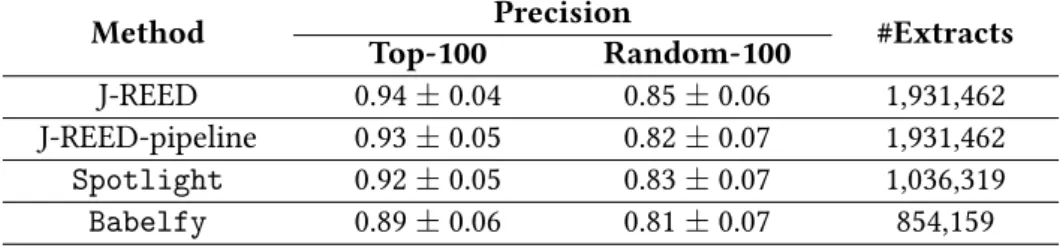
J-REED. We present J-REED (Nguyen et al.,2017), a novel joint model for re-lation extraction and entity disambiguation on Wikipedia-style text. J-REED is based on graphical models that capture interdependencies between entity disam-biguation and the relational phrases. By considering which lexical types of enti-ties are compatible with the type signature of which relation, we can boost the accuracy of both sub-tasks. Entity names are mapped to the entities registered in a knowledge base, while relation patterns are extracted as crisp as possible (Challenge C2). Additionally, without particular assumptions about the target relations, J-REED can capture many interesting relations which are absent from all recent knowledge bases. J-REED improves the quality over pipelined combina-tions of the state-of-the-art Open Information Extraction (Open IE) systems and NED systems.
QKBfly. We present QKBfly (Nguyen et al., 2018), a novel end-to-end system for constructing query-driven, on-the-fly KBs. QKBfly takes as input an entity-centric query or a natural-language question, automatically retrieves relevant source documents (via Wikipedia and news sources), runs a novel form of knowl-edge extraction on the sources, and builds a high-coverage knowlknowl-edge base that is focused on the entities of interest (Challenge C3). At the heart of QKBfly is a semantic-graph representation of sentences that captures per-sentence clauses, noun-phrases, pronouns, as well as their syntactic and semantic dependencies. Based on this graph, we devise an efficient inference technique that performs three key information extraction tasks, namely named-entity disambiguation, co-reference resolution and relation extraction, in a light-weight and integrated man-ner. Because of the clause-based representation of sentences, QKBfly is not lim-ited to binary predicates but can also extract ternary (or higher-arity) predicates. Compared to mainstream KBs, we acquire facts for a much larger set of predicates. Compared to Open IE methods, arguments of facts are canonicalized, thus refer-ring to unique entities with semantically typed predicates derived from precom-puted clusters of phrases (Challenge C2). In addition to supporting analytical queries, QKBfly thus also facilitates the application of question-answering (QA) frameworks.
1.4
Publications
This work includes material published in top-tier conferences and journals: • D. B. Nguyen, J. Hoffart, M. Theobald, and G. Weikum. (2014).
AIDA-light: High-Throughput Named-Entity Disambiguation. InProceedings of the Workshop on Linked Data on the Web co-located with the 23rd Interna-tional World Wide Web Conference (WWW ’14).
• D. B. Nguyen, M. Theobald, and G. Weikum. (2016). J-NERD: Joint Named Entity Recognition and Disambiguation with Rich Linguistic Features. Trans-actions of the Association of Computational Linguistics (TACL, vol. 4).
1.5. Organization | 5
• D. B. Nguyen, M. Theobald, and G. Weikum. (2017). J-REED: Joint Relation Extraction and Entity Disambiguation. InProceedings of the 26th Conference on Information and Knowledge Management (CIKM ’17).
• D. B. Nguyen, A. Abujabal, N. K. Tran, M. Theobald, and G. Weikum. (2018). Query-Driven On-The-Fly Knowledge Base Construction. InProceedings of the 44th International Conference on Very Large Databases (VLDB ’18).
1.5
Organization
The remainder of this dissertation is organized as follows.Chapter2introduces the data model, notations, and the feature space for named entity disambiguation -the core task in our work. This is followed by three Chapters which describe our methods for named entity recognition and disambiguation, relation extraction, and on-the-fly knowledge base construction. Chapter3presents a joint model for entity recognition and disambiguation.Chapter4presents a joint model for relation extraction and entity disambiguation for Wikipedia and other kinds of entity-centric documents.Chapter5presents an end-to-end system for on-the-fly KB construction that is triggered by an entity-centric user query or a natural-language question. Finally,Chapter6gives conclusions and possible directions for future work.
Chapter
2
Preliminaries
2.1
Data Model
In this section, we introduce our data model and establish necessary notations. Pre-processing. Text from an input document (D) is pre-processed through a standard NLP pipeline, including tokenization, part-of-speech (POS) tagging, noun-phrase chunking, and dependency parsing. Thus, we obtain:
• A sequence of tokenstok=htok1,tok2,. . .,tokli. We consider words,
punc-tuations, and other special characters like “$”, “€”, etc. as tokens.
• A sequence of POS tagspos = hpos1,pos2,. . .,posli. Every token has a POS tag, for exampleNNP for proper nouns,VBDfor past tense verbs, etc. (Santorini,1990).
• A sequence of noun-phrasesnp= hnp1,np2,. . .,npni. A noun-phrase is a phrase (i.e., formed by adjacent tokens) which has a noun or an indefinite pronoun as its head token. In our models, overlaps between noun-phrases are not allowed.
For example, performing the NLP pipeline on the sentence “Einstein was awarded a Nobel Prize.” results in sequences:
• tok=h“Einstein”,“was”,“awarded”,“a”,“Nobel”,“Prize”,“.”i, • pos=hNNP,VBD,VBN,DT,NNP,NNP, .i,
• np=h“Einstein”,“a Nobel Prize”i.
These sequences and thedependency types (de Marneffe et al.,2006) linked be-tween tokens intoksuch asnsubj(e.g., between“awarded”and“Einstein”),dobj (e.g., between“awarded” and“Prize”), prep_in,prep_for, etc. serve as input to the feature functions in our work.
Named Entity Recognition. NER for short, identifies entity mentions m = hm1,m2,. . .,mti, each with a coarse-grained type such asPERSON,ORGANIZATION, LOCATION, etc. For example, there are two mentions includingm1 = “Einstein”
with typePERSON, andm2 =“Nobel Prize”with typeMISCin the above sentence.
A mention is usually a sub-sequence of a noun-phrase. 7
8 | Chapter 2. Preliminaries
Named Entity Recognition.NED for short, links each mentionmito an entity eiin an entity repository (E) extracted from Wikipedia or from a knowledge base. Thus, we obtaine1=Albert_Einstein, ande2 =Nobel_Prize_in_Physics. Co-reference Resolution.CR for short, determines whether two noun-phrases, or a noun-phrase and a pronoun (defined by the POS tags) refer to the same entity. Relation Extraction. Finally, relation extraction (or knowledge extraction) de-tects and classifies the semantic relationships between entities. We consider dif-ferent kinds of relations. Chapter4focuses on binary relations between two enti-ties while Chapter5explores all possible relations in a group of entities including higher-arity ones.
2.2
Feature Space for Named Entity Disambiguation
In this section, we present a feature space used for named entity disambiguation (NED) – the core task in our work. After the pre-processing steps through a stan-dard NLP pipeline, we extract some different kinds ofcontexts(e.g., token context, domain theme, and dependency context) for our features. Some of the features are fairly standard, whereas others are novel.
• Standard features include prior probability of mention-entity mapping, and similarity measures between mention strings and entity names. Addition-ally, mention-entity token context similarity and entity-entity token coher-ence are important features for NED – not exactly a standard feature, but used in some prior works (Cucerzan, 2014; Hoffart et al.,2011a; Ratinov et al.,2011).
• Novel features about the topical domain of an input text (e.g., politics, sports, football, etc.) are obtained by a classifier based on “easy mentions”: those mentions for which the NED decision can be made easily with very high confidence without advanced features (Nguyen et al.,2014).
• The third feature group captures syntactic dependencies from the sentence parsing (Nguyen et al.,2016). To our knowledge, these have not been used in prior works.
2.2.1 Backgrounds
Named entity disambiguation is the task of linking a named entity mention to an instance in a knowledge base such as DBpedia (Auer et al.,2007), Yago (Suchanek et al.,2007), Wikidata (Vrandečić and Krötzsch,2014), Freebase (Bollacker et al.,
2008), and more. Consider the following sentence:
“David played for manu, real, and la galaxy.”
with the four mentions “David”, “manu”, “real”, and “la galaxy” that have already been marked up, NED aims to link them to the football playerDavid_Beckhamand the three football clubs includingManchester_United_F.C.,Real_Madrid_C.F.,
2.2. Feature Space for Named Entity Disambiguation | 9
andLA_Galaxy, respectively. State-of-the-art systems includes the Wikipedia Miner Wikifier (Milne and Witten,2013), the Illinois Wikifier (Ratinov et al.,2011), Spot-light (Mendes et al.,2011), Semanticizer (Meij et al.,2012), TagMe (Ferragina and Scaiella,2010;Cornolti et al.,2014), and AIDA (Hoffart et al.,2011a). Most of these prior works combine contextual similarity measures with some form of consid-eration for the contextual coherence among a selected set of candidate entities. Popular joint models are graph algorithms (Hoffart et al.,2011a), integer linear programming (Ratinov et al.,2011), or probabilistic graphical models (Kulkarni et al., 2009). To mark up mentions, these methods use the Stanford NER Tag-ger (Finkel et al.,2005) or dictionary-based matching.
2.2.2 Entity Repository and Name-Entity Dictionary
We harness a knowledge base, namely Yago (Suchanek et al.,2007;Hoffart et al.,
2011a,2013), as an entity repository and as a dictionary of name-to-entity pairs (i.e., aliases and paraphrases). We import the YagomeansandhasNamerelations, a total of more than 6 Million name-entity pairs (for more than 3 Million distinct entities). Additionally, we enrich this dictionary by including the first and last names ofPERSONentities in Yago.
Dictionary Augmentation via Locality Sensitive Hashing. In order to im-prove recall over a variety of input texts, including Web pages where many out-of-dictionary mentions occur, we apply Locality Sensitive Hashing (LSH) in com-bination with Min-Hash (Gionis et al.,1999;Indyk and Motwani,1998; Broder et al., 1998) to cover more spelling variations among these mentions. That is, once an out-of-dictionary mention occurs, we first attempt to findsimilar names in our name-entity dictionary via LSH. Second, all possible entity candidates of these similar names are assigned to this mention as candidate entities. For ex-ample, the mention “Northwest Fur Company” does not exist in the name-entity dictionary, and thus there is no entity candidate for it. However, via LSH we are able to detect that “Northwest Fur Company” and the dictionary entry “North West Fur Company” are highly similar, such that we are able to identify the
en-tityNorth_West_Companyas a candidate entity for this mention. KORE (Hoffart
et al.,2012) is the first work that integrated LSH into an NED system to cluster key-phrases for an efficient form of similarity computation.
2.2.3 Standard Features
2.2.3.1 Context-Independent Features
Mention-Entity Prior.Featuref1(mi,ei) captures a prior probability of mention
mimapping to entityei. These probabilities are estimated from co-occurrence fre-quencies of name-to-entity pairs in the background corpus, thus harnessing link-anchor texts in Wikipedia. For example, on the one hand, we may have a prior of f1(“Beckham”,David_Beckham) = 0.7, as David Beckham is more popular (today)
10 | Chapter 2. Preliminaries
than his wife Victoria. On the other hand,f1(“David”,David_Beckham) may be lower thanf1(“David”,David_Bowie), for example, as this still active pop star is more frequently and prominently mentioned than the retired football player. Mention-Entity n-Gram Similarity. Feature f2(mi,ei) measures the Jaccard
similarity of character-leveln-grams of mention namemiand the primary (i.e., full and most frequently used) name of entityei. For example, forn = 2 the value off2(“Becks”,David_Beckham) is113 . In our experiments, we setn= 3.
2.2.3.2 Token-Context-Based Features
We first explain how we maintain thetoken contextsof both mentions and candi-date entities which form the basis for our features.
Mention Token Context.Thetoken contextof mentionmi, denoted bycnt(mi), is extracted from the input tokens. Specifically, we form cnt(mi) by taking all tokens withtf-idf scores except for stop-words.
Entity Token Context. Similarly, the token context of entity ei, denoted by cnt(ei), consists of tokens (withtf-idf scores) which are obtained by simplifying the key-phrases provided by AIDA (Hoffart et al.,2011b) forei. For example, the context of the entityDavid_Beckhamwith two key-phrases {“M.U. player”, “M.U. midfielder”} in AIDA is reduced to the vector of tokens {“M.U.”, “player”, “ mid-fielder”}.
Mention-Entity Token Context Similarity. Feature f3(mi,ei) measures the
similarity between the token contexts of mentionmi and entity ei. For exam-ple, the mention “David” in the context of “midfielder”, “M.U.”, “football”, etc. is more coherent with entityDavid_Beckhamthan with entityDavid_Bowie.
As similarity measure, we employ the weighted overlap coefficient between two vectors of weighted elementscnt(x) =hv1,v2,. . .iandcnt(y) =hv10,v20,. . .i:
sim cxt(x),cxt(y) = P kmin(vk,vk0) min P kvk,P kvk0 (2.1)
Entity-Entity Token Context Similarity. In analogy to mention-entity token context similarity feature,f4(ei,ej) measures the coherence between the two token
contexts of two entity candidates ei andej. This feature allows us to establish cross-dependencies among labels in our graphical model. For example, the two entitiesDavid_BeckhamandManchester_United_F.C.are highly coherent as they share many tokens in their contexts, such as “champions”, “league”, “premier”, “cup”, etc. Thus, they should mapped jointly.
2.2.4 Domain-Oriented Feature
We use WordNetdomains, created byMiller(1995),Magnini and Cavaglià(2000), andBentivogli et al.(2004), to construct a taxonomy of domains, includingSports (e.g., football, basketball, etc.),Science(e.g., computer science, mathematics, etc.),
2.2. Feature Space for Named Entity Disambiguation | 11 English_footballers Football football_player_11010163 Domain: Wordnet: football_league_108232496 Wikicategory: Fooball_leagues_in_England Wikicategory: Wordnet:
Figure 2.1: A hierarchy for the domainFootball.
and more. We combine the domains with semantictypes(classes of entities) pro-vided by Yago, by assigning them to their respective domains. This is based on the manual assignment of WordNet synsets to domains, introduced byMagnini and Cavaglià(2000), andBentivogli et al.(2004), and extends to additional types in Yago. For example,SINGERis assigned toMusic, andFOOTBALL-PLAYERto Foot-ball, etc. In total, the 46 domain hierarchies1are enhanced with ca. 350,000 types imported from Yago. Figure2.1shows a domain hierarchy forFootball.
We classify input texts into domains by means of “easy mentions”. An easy mention is a match in the name-to-entity dictionary for which there exist at most three candidate entities. Although the mention boundaries may not be explicitly provided as input, we still can extract these easy mentions from the entirety of all mention candidates. In the following, letC∗ be the set of candidate entities for the easy mentions in the input text. For each domaindin the 46 domains, we compute thecoherenceof the easy mentionsM∗= {m1,m2,. . .}:
coh(M∗) = |C ∗∩Cd|
|C∗| (2.2)
whereCdis the set of all entities under domaind. We classify the document into the domain with the highest coherence score. Although the mentions and their entities may be inferred incorrectly, the domain classification still tends to work very reliably as it aggregates over all easy mention candidates.
Domain-Entity Coherence. Featuref5(mi,ei) captures the coherence between
mentionmi and entity candidateei with the respect to the domaind which the input text is classified into. That is,f5(mi,ei) = 1 if domaind contains entityei;
otherwise, the feature value is 0. For example, in domainFootball, the mention “David” is more coherent with entityDavid_Beckhamthan with entityDavid_Bowie.
1The 46 domains:badminton, baseball, basketball, cricket, football, golf, table tennis, rugby, soccer, tennis,
vol-leyball, cycling, skating, skiing, hockey, mountaineering, rowing, swimming, sub, diving, racing, athletics, wrestling, boxing, fencing, archery, fishing, hunting, music, agriculture, alimentation, architecture, computer science, engi-neering, medicine, veterinary, astronomy, biology, chemistry, earth, mathematics, physics, economy, fashion, indus-try, politics.
12 | Chapter 2. Preliminaries
Entity-Entity Type Coherence. Featuref6(ei,ej) computes the relatedness
be-tween the Wikipedia categories of two candidate entitieseiandej. f6(ei,ej) = max
cu∈cat(ei) cv∈cat(ej)
tc(cu,cv) (2.3)
where thetype coherencefunctiontc(cu,cv) computes the reciprocal length of the shortest path between categoriescu,cv in the domain taxonomy; andcatfunction retrieves all Wikipedia categories related to an entity.
2.2.5 Syntactic Dependency Feature
Mention Dependency Context.Thedependency contextof mentionmi, denoted bydep-cxt(mi), contains alldependency patternswhere (1) a pattern consists of a dependency types(de Marneffe et al.,2006), likensubj,dobj,prep_in,prep_for, etc., with twoarguments, and (2) one of the two argument ismi. We assign atf-idf score for each pattern in the dependency context.
Entity Dependency Context.Similarly, the dependency context of entityei, de-noted bydep-cxt(ei), contains all dependency patterns (withtf-idf scores) which are obtained from the background corpus (i.e., Wikipedia). For example, the de-pendency context of entityManchester_United_F.C.includesprep_for[play, *], nsubj[*, win], etc.
Mention-Entity Dependency Context Similarity.Featuref7(mi,ei) measures
the weighted overlap coefficient between the dependency contexts of mention mi and candidate entityei. For example, the mention “manu” in the context of patternprep_for[play, *]is more coherent with entityManchester_United_F.C. than with entityManu_Chaoas the pattern “FOOTBALLER play forFOOTBALL-CLUB” is more frequent than any patterns of something or somebody “play forSINGER”.
Chapter
3
Joint Model for Named Entity
Recognition and Disambiguation
3.1
Introduction
Motivation. Methods for named entity recognition and disambiguation, NERD for short, typically proceed in two stages:
• At the NER stage, text spans of entity mentions are detected and tagged with coarse-grained types likePERSON,ORGANIZATION,LOCATION, etc. This is typically performed by a trained Conditional Random Field (CRF) over word sequences (e.g.,Finkel et al.(2005)).
• At the NED stage, mentions are mapped to entities in a knowledge base (KB) based on contextual similarity measures and the semantic coherence of the selected entities (e.g.,Cucerzan(2014);Hoffart et al.(2011a);Ratinov et al.(2011)).
This two-stage approach has limitations. First, NER may produce false positives that can misguide NED. Second, NER may miss out on some entity mentions, and NED has no chance to compensate for these false negatives. Third, NED is not able to help NER, for example, by disambiguating “easy mentions” (e.g., of prominent entities with more or less unique names), and then using the entities and knowledge about them as enriched features for NER.
Example.Consider the following sentences:
“David played for manu, real, and la galaxy. His wife posh performed with the spice girls.”
This is difficult for NER because of the absence of upper-case spelling, which is not untypical in social media, for example. Most NER methods will miss out on multi-word mentions or words that are also common nouns (“spice”) or adjectives (“posh”, “real”). Typically, NER would pass only the mentions “David”, “manu”, and “la” to the NED stage, which then is prone to many errors like mapping the first two mentions to any prominent people with first names David and Manu, and
14 | Chapter 3. Joint Model for Named Entity Recognition and Disambiguation
mapping the third one to the city of Los Angeles. With NER and NED performed jointly, the possible disambiguation of “la galaxy” to the soccer club can guide NER to tag the right mentions with the right types (e.g., recognizing that “manu” could be a short name for a soccer team), which in turn helps NED to map “David” to the right entityDavid_Beckham.
Contribution.This chapter presents a novel kind of probabilistic graphical model for the joint recognition and disambiguation of named-entity mentions in natural-language text. With this integrated approach to NERD, we aim to overcome the limitations of the two-stage NER/NED methods. Our method, called J-NERD (Nguyen et al.,2016), is based on a supervised, non-linear graphical model that combines multiple per-sentence models into an entity-coherence-aware global model. The global model detects mention spans, tags them with coarse-grained types, and maps them to entities in a single joint-inference step based on the Viterbi algorithm (for exact inference) or Gibbs sampling (for approximate infer-ence). J-NERD comprises the following novel contributions:
• a tree-shaped model for each sentence, whose structure is derived from the dependency parse tree and thus captures linguistic context in a deeper way compared to prior work with CRF’s for NER and NED;
• richer features not considered in prior work, including domain-oriented feature and syntactic dependency feature (i.e., harnessing dependency parse trees and verbal patterns that indicate mention types as part of theirnsubj ordobjarguments);
• an inference method that maintains the uncertainty of both mention candi-dates (i.e., token spans) and entity candicandi-dates for competing mention can-didates, and makes joint decisions, as opposed to fixing mentions before reasoning on their disambiguation.
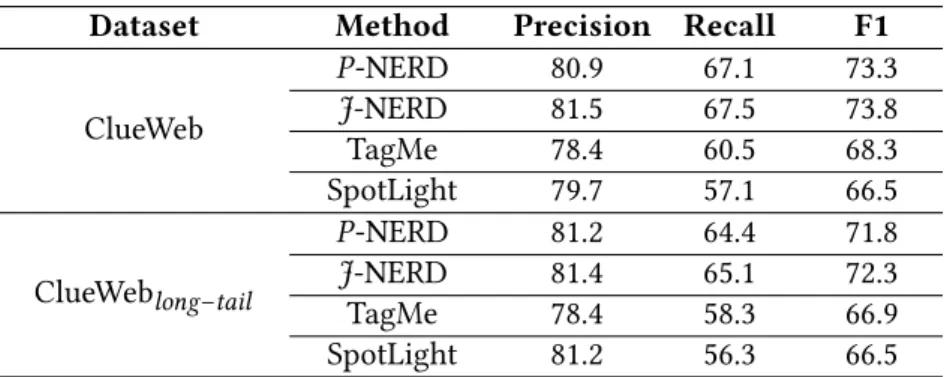
We present experiments with three major datasets: the CoNLL’03 collection of newswire articles, the ACE’05 corpus of news and blogs, and the ClueWeb’09-FACC1 corpus of web pages. Baselines that we compare J-NERD with include Spotlight (Daiber et al.,2013), TagMe (Ferragina and Scaiella,2010), and the recent joint NERD method ofDurrett and Klein(2014). J-NERD consistently outperforms these competitors in terms of both precision and recall.
3.2
Related Work
NER.Detecting the boundaries of text spans that denote named entities has been mostly addressed by supervised CRF’s over word sequences (McCallum and Li,
2003;Finkel et al.,2005). The work of Ratinov and Roth(2009) improved these techniques by additional features from context aggregation and external lexical sources (gazetteers, etc.). Passos et al. (2014) harnessed skip-gram features and external dictionaries for further improvement. An alternative line of NER tech-niques is based on dictionaries of name-entity pairs, including nicknames, short-hand names, and paraphrases (e.g., “the first man on the moon”). The work of
3.2. Related Work | 15
Ferragina and Scaiella(2010) andMendes et al.(2011) are examples of dictionary-based NER. The work ofSpitkovsky and Chang(2012) is an example of a large-scale dictionary that can be harnessed by such methods.
An additional output of the CRF’s are type tags for the recognized word spans, typically limited to coarse-grained types likePERSON,ORGANIZATION,LOCATION, andMISC. The most widely used tool of this kind is the Stanford NER Tagger (Finkel et al.,2005). Many NED tools use the Stanford NER Tagger in their first stage of detecting mentions.
Mention Typing.The specific NER task of inferring semantic types has been fur-ther refined and extended by various works on fine-grained typing (e.g.,MUSICIAN, POLITICIAN,SINGER,GUITARIST, etc.) for entity mentions and general noun phrases (Fleischman and Hovy,2002;Rahman and Ng,2010;Ling and Weld,2012;Yosef et al.,2012;Nakashole et al.,2013). Most of these works are based on supervised classification, using linguistic features from mentions and their surrounding text. One exception is the work ofNakashole et al.(2013) which is based on text pat-terns that connect entities of specific types, acquired by sequence mining from the Wikipedia full-text corpus. In contrast to our work, those are simple surface patterns, and the task addressed here is limited to typing noun phrases that likely denote emerging entities that are not yet registered in a KB.
NED. Methods and tools for NED go back to the seminal work of Dill et al.
(2003),Bunescu and Pasca(2006),Cucerzan(2007), andMilne and Witten(2008). More recent advances led to open-source tools like the Wikipedia Miner Wik-ifier (Milne and Witten, 2013), the Illinois Wikifier (Ratinov et al.,2011), Spot-light (Mendes et al.,2011), Semanticizer (Meij et al.,2012), TagMe (Ferragina and Scaiella,2010;Cornolti et al.,2014), and AIDA (Hoffart et al.,2011a). We choose some, namely Spotlight and TagMe, as baselines for our experiments. These are the best-performing, publicly available systems for news and web texts. Most of these methods combine contextual similarity measures with some form of con-sideration for the coherence among a selected set of candidate entities for disam-biguation. The latter aspect can be cast into a variety of computational models, like graph algorithms (Hoffart et al., 2011a), integer linear programming ( Rati-nov et al.,2011), or probabilistic graphical models (Kulkarni et al.,2009). All these methods use the Stanford NER Tagger or dictionary-based matching for their NER stages.Kulkarni et al.(2009) uses an ILP or LP solver (with rounding) for the NED inference, which is computationally expensive. Note that some of the NED tools aim to link not only named entities but also general concepts (e.g. “world peace”) for which Wikipedia has articles. In our work, we solely focus on proper entities. Joint NERD.There is little prior work on performing NER and NED jointly. Sil and Yates(2013), andDurrett and Klein(2014) are the most notable methods. Sil and Yates(2013) first compile a liberal set of mention and entity candidates, and then perform joint ranking of the candidates. Durrett and Klein(2014) present a CRF model for coreference resolution, mention typing, and mention disambigua-tion. Our model is also based on CRF’s, but distinguishes itself from prior work
16 | Chapter 3. Joint Model for Named Entity Recognition and Disambiguation
in three ways:
• tree-shaped CRF’s derived from dependency parse trees, as opposed to merely having connections among mentions and entity candidates;
• syntactic dependency features about verbal phrases from parse trees; • the maintaining of candidates for both mentions and entities and jointly
reasoning on their uncertainty.
Our experiments include comparisons with the method ofDurrett and Klein
(2014). There are also benchmarking efforts on measuring the performance for end-to-end NERD (Cornolti et al.,2013;Carmel et al.,2014;Usbeck et al.,2015), as opposed to assessing NER and NED separately. However, to the best of our knowledge, none of the participants in these competitions considered integrating NER and NED.
3.3
System Overview
We formalize the task as a sequence labeling problem which aims to label a se-quence of input tokens tok = htok1,. . .,tokli with a sequence of output labels y = hy1,. . .,yli, consisting of NER types and NED entities (i.e., Yago entities). We employ a family of linear-chain and tree-shapedprobabilistic graphical mod-els(Koller et al.,2007) to compactly encode a multivariate probability distribution overrandom variablesX ∪ Y, whereX denotes the set of variablesxi we may observe, andYdenotes the set of output labelsyi. By writingx, we denote an as-signment of observed variablestoX, while by writingy, we denote anassignment of labelstoY. In our running example:
“David played for manu, real, and la galaxy.”,
“David” is the first observed variablex1with the desired labely1=PERSON:David_ Beckham wherePERSON denotes the NER type and David_Beckham is the entity of interest. Consecutive and identical labels are considered to be entity men-tions. For example, forx5 = “la” andx6 = “galaxy”, the output would ideally be
y5 =ORGANIZATION:Los_Angeles_Galaxyandy6 =ORGANIZATION:Los_Angeles_ Galaxy, denoting the soccer club. Upfront these are merely candidate labels, though. Our method may alternatively consider the different labelsy5=LOCATION: Los_Angelesandy6 =MISC:Samsung_Galaxy. This would yield incorrect output
with two single-token mentions and improper entities.
Given an input text, J-NERD works in two stages. First, J-NERD harnesses a joint feature model for NER and NED. Some of the features are standard, while others are novel (see Section3.4). Second, J-NERD constructs a factor graph model (i.e.,linear-chain modelortree-shaped model) from input sentences. Subsequently, it jointly performs inference for both NER and NED (see Section3.5).
Stage 1: Feature Model.J-NERD first processes the text through a standard NLP pipeline, including sentence detection, tokenization, POS tagging, lemmatization,
3.3. System Overview | 17
dependency parsing, and noun-phrase chunking. Consequently, it extracts a va-riety of features, each take the possible assignmentsx,y of observed variables and labels, respectively, as input and give a binary value or real number as out-put. Binary values denote the presence or absence of a feature; real-valued ones typically denote frequencies of observed features.
Stage 2: Factor Graph Model. Next, J-NERD constructs a factor graph model (i.e.,linear-chain model or tree-shaped model) for each input sentence. State-of-the-art NER methods, such as the Stanford NER Tagger, employlinear-chain factor graph, known as Conditional Random Fields (CRF’s) (Sutton and McCallum,2012). We also devise more sophisticatedtree-shaped factor graphs whose structure is obtained from the dependency parse trees of the input sentences. These per-sentence models are optionally combined into aglobal factor graphby adding also cross-sentence dependencies (Finkel et al.,2005). These cross-sentence depen-dencies connects similar tokens which are potential co-references (e.g., “David” and “David Beckham”), or tokens in adjacent mentions in the same sentence (e.g., “David” and “manu”). Finally, J-NERD performs a joint inference by variants of the Viterbi algorithm or Gibbs sampling.
For tractability, probabilistic graphical models are typically constrained by making conditional independence assumptions, thus imposing structure and lo-cality onX ∪ Y. In our models, we postulate that the following conditional inde-pendence assumptions hold:
p(yi|x,y) =p(yi|x,yprev(i)) (3.1) That is, the labelyifor theithvariable directly depends only on the labelyprev(i)of some previous variables at positionprev(i) and potentially on all input variables. The case whereprev(i) =i– 1 is the standard setting for a linear-chain CRF, where the label of a variable depends only on the label of its preceding variable. We generalize this approach to consideringprev(i) based on the edges of a dependency parse tree and from co-references in preceding sentences.
By the Hammersley-Clifford Theorem, such a graphical model can be factor-ized into a product form where each factor captures a subsetA ⊆ X ∪ Yof the random variables. Typically, each factor considers only thoseX andY variables that are coupled by a conditional (in-)dependence assumptions, with overlapping Asets of different factors. The probability distribution encoded by the graphical model can then be expressed as follows:
p(x,y) = 1 Z
Y
A
FA(xA,yA) (3.2)
Here,FA(xA,yA) denotes thefactorsof the model, each of which is of the follow-ing form: FA(xA,yA) = exp X k λkfA,k(xA,yA) (3.3)
18 | Chapter 3. Joint Model for Named Entity Recognition and Disambiguation
The normalization constantZ =P
x,yQAFA(xA,yA) ensures that this
distribu-tion sums up to 1, whileλk are the parameters of the model, which we aim to learn from various annotated background corpora.
Our inference objective then is to find themost probable sequence of labelsy∗ when given the token sequencexas evidence:
y∗= arg maxyp(y|x) (3.4) That is, in our setting, we fixxto the observed token sequencetok=htok1,. . .,
tokli, whiley = hy1,. . .,yli ranges over all possible sequences of associated la-bels. In our approach, which we hence coinedJ-NERD, eachyilabel represents a combination of NER type and NED entity.
To reduce the dimensionality of the generated feature space and to make the factor-graph inference tractable, we use pruning techniques based on the knowl-edge base and the dictionaries. To determine if a token can be a mention or part of a mention, we first perform lookups of all sub-sequences against the name-entity dictionary (see Section2.2.2). As an option (and by default), this can be limited to sub-sequences that are tagged as noun phrases by the Stanford parser. For higher recall, we then add partial-match lookups when a token sub-sequence matches only some but not all tokens of an entity name in the dictionary. For example, for the sentence
“David played for manu, real and la galaxy.”,
we obtain “David”, “manu”, “real”, “la galaxy”, “la”, and “galaxy” as candidate mentions. For each such candidate mention, we look up the knowledge base for entities and consider only the bestn(using n = 20 in our experiments) highest ranked candidate entities. The ranking is based on the string similarity between the mention and the entity name, the prior popularity of the entity, and the local context similarity.
The NER types that we consider are the standard types including PERSON, ORGANIZATIONandLOCATION. All other types that, for example, the Stanford NER Tagger would mark, are collapsed into a typeMISC for miscellaneous. These in-clude labels like date and money (which are not genuine entities anyway) and also entity types like events and creative works such as movies, songs, etc. (which are disregarded by the Stanford NER Tagger). We add two dedicated tags for tokens to express the case when no meaningful NER type or NED entity can be assigned. For tokens that should not be labeled as a named entity at all (e.g., “played” in our example), we use the tagOTHER. For tokens with a valid NER type, we add the virtual entityout-of-KB(for “out of knowledge base”) to its entity candidates, to prepare for the possible situation where the token (and its surrounding tokens) actually denotes an emerging or long-tail entity that is not contained in the back-ground knowledge base (i.e., Yago). Once the output labels are determined, the actual boundaries of the mentions, i.e., their token spans, are trivially derived by combining adjacent tokens with the same label (and disregarding all tokens with the tagOTHER).
3.4. Feature Model | 19
3.4
Feature Model
First, we employ the Stanford CoreNLP tool suite (Manning et al.,2014) for pro-cessing input documents. This includes sentence detection, tokenization, POS tagging, lemmatization, dependency parsing, and noun-phrase chunking. All of these provide features for our graphical model. Second, we define features for detecting the combined NER/NED labels of token that denote or are part of an entity mention. In the following, we introduce the complete set of features which includes the 7 NED featuresf1..7(defined in Chapter2, Section2.2) and 10 feature
templatesf8..17for the joint NERD inference. Templates are instantiated based on
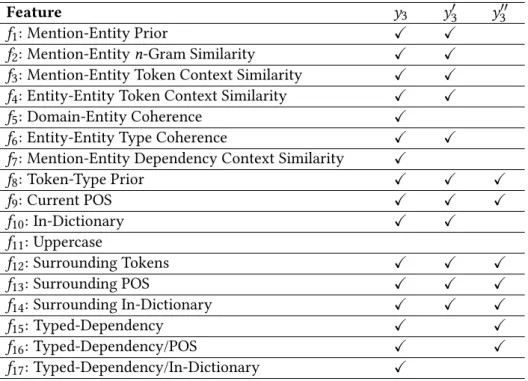
the observed input and the candidate space of possible labels for this input, and guided by distant resources like knowledge bases and dictionaries. The generated feature values depend on the assignment of input tokens to variablesxi ∈ X. In addition, our graphical models often consider only a specific subset ofcandidate labelsas assignments to the output variablesyi ∈ Y. Therefore, we formulate the feature-generation process as a set offeature functions that depend on both (per-factor subsets of)X andY. Table 3.1illustrates the feature generation by the set of active feature functions for the token “manu” in our running example, using three different candidate labels.
Table 3.1: Positive features for the token “manu” (x3) with candidate labels ORGANIZATION:Manchester_United_F.C.(y3),PERSON:Manu_Chao(y30) andOTHER (y300). Domain isFootball, and dependency pattern isprep_for[played, *].
Feature y3 y30 y003
f1: Mention-Entity Prior X X
f2: Mention-Entityn-Gram Similarity X X
f3: Mention-Entity Token Context Similarity X X
f4: Entity-Entity Token Context Similarity X X
f5: Domain-Entity Coherence X
f6: Entity-Entity Type Coherence X X
f7: Mention-Entity Dependency Context Similarity X
f8: Token-Type Prior X X X f9: Current POS X X X f10: In-Dictionary X X f11: Uppercase f12: Surrounding Tokens X X X f13: Surrounding POS X X X f14: Surrounding In-Dictionary X X X f15: Typed-Dependency X X f16: Typed-Dependency/POS X X f17: Typed-Dependency/In-Dictionary X
20 | Chapter 3. Joint Model for Named Entity Recognition and Disambiguation
3.4.1 NED Features
We harness NED featuresf1..7which include:
• standard features, namely Mention-Entity Prior, Mention-Entity n-Gram Similarity, Mention-Entity Token Context Similarity, and Entity-Entity To-ken Context Similarity,
• domain-oriented features, namely Domain-Entity Coherence and Entity-Entity Type Coherence,
• a syntactic dependency feature, namely Mention-Entity Dependency Con-text Similarity.
When computing actual values for these features at token level, we take the max-imum values over all mention candidates of the current token.
3.4.2 NER Features
For the following definitions of the NER feature templates, let dici denote the NER tag from the dictionary lookup oftoki(with POS tagposi), anddepi denote the parsing dependency that connectstokiwith another token. Further, we write suri=htoki–1,toki,toki+1ito refer to the sequence of tokens surroundingtoki. As
for the possible labels, lettypeidenote an NER type for the current tokentoki. Token-Type Prior. Feature f8(toki,typei) captures a prior probability fortoki
being of NER typetypei. These probabilities are estimated from an NER-annotated training corpus (i.e., CoNLL in our experiments). For example, we may thus obtain a prior off8(“Ltd.”,ORGANIZATION) = 0.8.
Current POS.Templatef9(toki,typei) generates a binary feature function if
to-kentokioccurs in the training corpus with POS tagposiand NER labeltypei. For example,f9(“David”,PERSON) = 1 if the current token “David” has occurred with POS tagNNP and NER labelPERSONin the training corpus. For combinations of tokens with POS tags and NER types that do not occur in the training corpus, no actual feature function is generated from the template (i.e., the value of func-tion would be 0). For the rest of this secfunc-tion, we assume that all binary feature functions are generated from their feature templates in an analogous manner. In-Dictionary.Templatef10(toki,typei) generates a binary feature function if the
current tokentokioccurs in the name-entity dictionary for some entity of NER labeltypei.
Uppercase. Template f11(toki,typei) generates a binary feature function if the
current tokentokiappears in upper-case form and additionally has the NER label typeiin the training corpus.
Surrounding Tokens.Templatef12(toki,typei) generates a binary feature
func-tion if the current tokentokihas NER labeltypei, given thattokialso appears with surrounding tokenssuriin the training corpus. When instantiated, this template could possibly lead to a huge number of feature functions. For tractability, we thus ignore sequences that occur only once in the training corpus.
3.5. J-NERD Factor Graph Model | 21
Surrounding POS.Templatef13(toki,typei) generates a binary feature function
if the current tokentokiand the POS sequence of its surrounding tokenssuriboth appear in the training corpus, wheretokialso has the NER labeltypei.
Surrounding In-Dictionary. We derive additional NER-type-specific phrase dictionaries from supporting phrases of GATE (Cunningham et al., 2011), e.g., “Mr.”, “Mrs.”, “Dr.”, “President”, etc. for the type PERSON; “city”, “river”, “park”, etc. for the typeLOCATION; “company”, “institute”, “Inc.”, “Ltd.”, etc. for the type ORGANIZATION. Templatef14(toki,typei) performs dictionary lookups for
surround-ing tokens insuri. It generates a binary feature function if the current tokentoki and the dictionary lookups of its surrounding tokenssuriappear in the training corpus, wheretokialso has NER labeltypei.
The abovef8..14features are widely used in prior NER systems. In the
follow-ing, we introduce three advanced features based on syntactic dependency pars-ing. Specifically, they harness dependency types between noun-phrases such as nsubj,dobj,prep_in,prep_for, etc. to refine NER labels.
Typed-Dependency. Templatef15(toki,typei) generates a binary feature
func-tion if the background corpus contains the pattern depi = deptype(arg1,arg2) where the current tokentokiis eitherarg1orarg2, andtokiis labeled with NER labeltypei.
Typed-Dependency/POS.Templatef16(toki,typei) captures linguistic patterns
that combine parsing dependencies (like inf15) and POS tags (like inf9) learned
from an annotated training corpus. It generates binary features if the current tokentoki appears in the dependency patterndepi with POS tag posi and this combination also occurs in the training data under NER labeltypei.
Typed-Dependency/In-Dictionary. Templatef17(toki,typei) captures
linguis-tic patterns that combine parsing dependencies (like inf15) and dictionary lookups
(like inf10) learned from an annotated training corpus. It generates a binary
fea-ture function if the current tokentokiappears in the dependency patterndepiand has an entrydiciin the name-entity dictionary for an entity with NER labeltypei.
3.5
J-NERD Factor Graph Model
3.5.1 Linear-Chain Model
In the local models, J-NERD works on each sentenceS: tok = htok1,. . .,tokli
separately. We construct a linear-chain CRF (see Figure3.1) by introducing an observed variablexifor each tokentokithat represents a proper word. For each xi, we additionally introduce a variableyi that represents the combined NERD label. As in any CRF, thexi,yiandyi,yi+1pairs are connected via factorsF(x,y),
22 | Chapter 3. Joint Model for Named Entity Recognition and Disambiguation
y1 y2 y3 y4 y5 y6
x1 x2 x3 x4 x5 x6 David played manu real la galaxy
Figure 3.1: Linear-chain model (CRF). 3.5.2 Tree Model
The factor graph for the tree-shaped model is constructed in a similar way. How-ever, here we add a factor that links a pair of labelsyi,yjif their respective tokens toki,tokj are connected via a typed dependency which we obtain from the Stan-ford parser. Figure3.2shows an example of such a tree model. Thus, while the linear-chain model adds factors between labels of adjacent tokens only based on their positions in the sentence, the tree model adds factors based on the depen-dency parse tree to enhance the coherence of labels across tokens.
y1 y2 y3 y4 y5 y6 x1 x2 x3 x4 x5 x6 David played
manu real la galaxy
[nsubj]
[p_f] [p_f]
[p_f]
[nn]
Figure 3.2: Tree model ([p_f]is[prep_for]).
3.5.3 Global Models
For global models, we consider an entire input text consisting of multiple sen-tencesS1,. . .,Sn:tok=htok1,. . .,tokli, for augmenting either one of the
linear-chain modelortree-shaped model. As shown in Figure3.3, cross-sentence edges among pairs of labelsyi,yj are introduced for the same observed tokens, such as the two tokens “David”. Additionally, we introduce factors for all pairs of tokens in adjacent mentions within the same sentence, such as “David" and “manu".
y1 y2 y3 y4 y5 y6 x1 x2 x3 x4 x5 x6 David played
manu real la galaxy
y7 y8 y9 y10 y11 x7 x8 x9 x10 x11 David Beckham born London England [nsubj] [p_f] [p_f] [p_f] [nn] [nn] [nn] [nsubjpass] [prep_in]
3.5. J-NERD Factor Graph Model | 23
3.5.4 Inference & Learning
Ourinference objectiveis to find the most probable sequence of NERD labels: y∗= arg max
y p(y|x) (3.5)
according to the objective function we defined in Section3.3. Instead of consid-ering the actual distribution:
p(x,y) = 1 Z Y A exp X k λkfA,k(xA,yA) (3.6)
for this purpose, we aim to maximize an equivalent objective function as fol-lows. Each factor A in our model couples a label variable yt with a variable yprev(t): either its immediately preceding token in the same sentence, or a
parsing-dependency-linked token in the same sentence, or a co-reference-linked token in a different sentence. Each of these factors has its feature functions, and we can regroup these features on a per-token basis given the log-linear nature of the ob-jective function. This leads to the following optimization problem which has its maximum for the same label assignment as the original problem:
y∗= arg max y1...yl exp l X t=1 K X k=1 λkfeaturek(yt,yprev(t),x1. . .xl) (3.7) where:
• prev(t) is the index of labelyjon whichyt depends,
• feature1..K are the feature functions generated from templates f1–f17
de-scribed in Section3.4,
• andλkare the feature weights, i.e., the model parameters to be learned. The actual number of generated features,K, depends on the training corpus and the choice of the graphical model. For example, the tree models haveK = 1, 767 parameters in our experiments. Given a trained model, exact inference with re-spect to the above objective function can be efficiently performed by variants of the Viterbi algorithm (Sutton and McCallum,2012) for the local models, both in the linear-chain and tree-shaped cases. For the global models, however, ex-act solutions are computationally intrex-actable. Therefore, we employ Gibbs sam-pling (Finkel et al.,2005) to approximate the solution.
As for the model parameters, J-NERD learns the feature weightsλkfrom the training data by maximizing a respective conditional likelihood function (Sutton and McCallum,2012), using a variant of the L-BFGS optimization algorithm (Liu and Nocedal,1989). We do this for each local model (linear-chain and tree models), and apply the same learned weights to the corresponding global models. Our implementation uses the RISO toolkit1for belief networks.
24 | Chapter 3. Joint Model for Named Entity Recognition and Disambiguation
3.6
Experiments
3.6.1 Setup
Data Collections. Our evaluation is mainly based on theCoNLL-YAGO2 cor-pus of newswire articles. Additionally, we report on experiments with an ex-tended version of theACE-2005corpus and a large sample of the entity-annotated ClueWeb’09-FACC1Web crawl.
CoNLL-YAGO2is derived from the CoNLL-YAGO corpus (Hoffart et al.,2011a)2 by removing tables where mentions in table cells do not have linguistic context; a typical example is sports results. The resulting corpus contains 1,244 docu-ments with 20,924 mentions including 4,774 out-of-KBentities. Ground-truth entities in Yago are provided byHoffart et al. (2011a). For a consistent ground-truth set, we derived the NER types from the NED ground-ground-truth entities, fixing some errors in the original annotations related to metonymy (e.g., labeling the mentions in “India beats Pakistan 2:1” incorrectly asLOCATION, whereas the enti-ties are the sports teams of typeORGANIZATION). This makes the dataset not only cleaner but also more demanding, as metonymous mentions are among the most difficult cases. For our evaluation, we use the “testb” subset of CoNLL-YAGO, which – after the removal of tables – has 199 documents with 3,054 mentions in-cluding 717out-of-KBentities. The other 1,045 documents with a total of 17,870 mentions (including 4,057out-of-KBmentions) are used for training.
ACE is an extended variant of the ACE 2005 corpus3, with additional NED labels byBentivogli et al.(2010). We consider only proper entities (i.e., the inter-section of Wikipedia articles and Yago entities) and exclude mentions of general concepts such as “revenue”, “world economy”, “financial crisis”, etc., as they do not correspond to individual entities in a knowledge base. This reduces the number of mentions, but gives the task a crisp focus. We disallow overlapping mention spans and consider only maximum-length mentions, following the rationale of the ERD Challenge 2014. The test set contains 117 documents with 2,958 mentions.
ClueWebcontains two randomly sampled subsets of the ClueWeb’09-FACC14 corpus with Freebase annotations:
• ClueWeb: 1,000 documents (24,289 mentions) each with at least 5 entities. • ClueWeblong–tail: 1,000 documents (49,604 mentions) each with at least 3
long-tail entities. We consider an entity to be “long-tail” if it has at most 10 incoming links in the English Wikipedia.
These Web documents are very different in style from the news-centric articles in CoNLL and ACE. Also note that the entity markup is automatically generated, but with emphasis on high precision. So the data captures only a small subset of the potential entity mentions, and it may contain a small fraction of false entities.
2
https://www.mpi-inf.mpg.de/yago-naga/yago/ 3http://projects.ldc.upenn.edu/ace/
3.6. Experiments | 25
Methods under Comparison. We compare J-NERD in its four variants (linear vs.treeandlocalvs.global) to various state-of-the-art NER/NED methods.
For NER (i.e., mention boundaries and types) we use the recent version 3.4.1 of the Stanford NER Tagger5(Finkel et al.,2005) and the recent version 2.8.4 of the Illinois Tagger6 (Ratinov and Roth,2009) as baselines. These systems have NER benchmark results on CoNLL’03 that are as good as the result reported inPassos et al.(2014). Weretrainedthis model by using the same corpus-specific training data that we use for J-NERD .
For NED, we compared J-NERD against the following methods for which we obtained open-source software or could call a Web service:
• Berkeley-entity (Durrett and Klein,2014) uses a joint model for coreference resolution, NER and NED with linkage to Wikipedia.
• TagMe (Ferragina and Scaiella,2010) is a Wikifier that maps mentions to entities or concepts in Wikipedia. It uses a Wikipedia-derived dictionary for NER.
• Spotlight (Mendes et al.,2011) links mentions to entities in DBpedia. It uses the LingPipe dictionary-based chunker for NER.
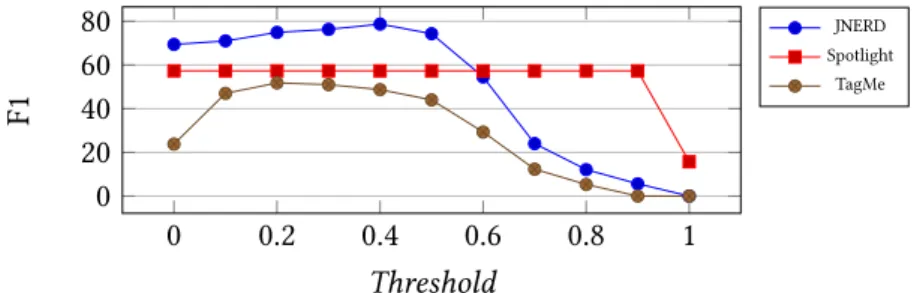
Some systems use confidence thresholds to decide on when to map a mention to out-of-KBentity. For each dataset, we used withheld data to tune these system-specific thresholds. Figure3.4illustrates the sensitivity of the thresholds for the CoNLL-YAGO2 dataset. 0 0.2 0.4 0.6 0.8 1 0 20 40 60 80 Threshold F1 JNERD Spotlight TagMe
Figure 3.4: F1 for varying confidence thresholds.
Evaluation Measures. We evaluate the output quality at the NER level alone and for the end-to-end NERD task. We do not evaluate NED alone, as this would require giving a ground-truth set of mentions to the systems to rule out that NER errors affect NED. Most competitors do not have interfaces for such a controlled NED-only evaluation. Each test collection has ground-truth annotations (G) con-sisting of text spans for mentions, NER types of the mentions, and mapping men-tions to entities in Yago or toout-of-KB. Recall that theout-of-KBcase captures entities that are not in the KB at all. LetX be the output of system X: detected mentions, NER types, NED mappings. Following the ERD 2014 Challenge (Carmel et al.,2014), we define precision and recall of X for end-to-end NERD as:
5
nlp.stanford.edu/software/CRF-NER.shtml 6http://cogcomp.cs.illinois.edu/
26 | Chapter 3. Joint Model for Named Entity Recognition and Disambiguation
Precision(X) = |X agrees withG|/|X| (3.8) Recall(X) = |X agrees withG|/|G| (3.9) where agreement means thatX andGoverlap in the text spans (i.e., have at least one token in common) for a mention, have the same NER type, and have the same mapping to an entity orout-of-KB. The F1 score ofX is the harmonic mean of precision and recall. For evaluating the mention-boundary detection alone, we consider only the overlap of text spans; for evaluating NER completely, we consider both mention overlap and agreement based on the assigned NER types. 3.6.2 Results for CoNLL-YAGO2
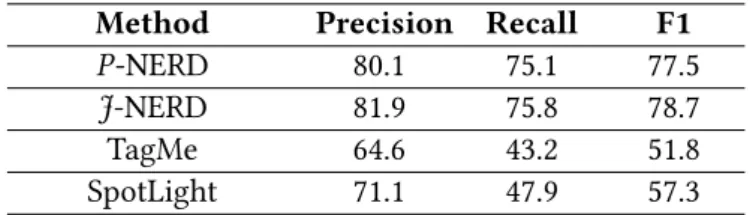
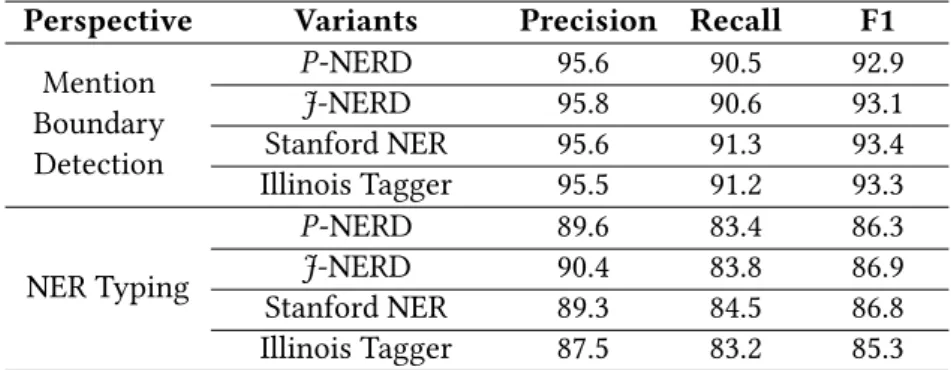
Our first experiment on CoNLL-YAGO2 is comparing the four CRF variants of J-NERD for three tasks: mention boundary detection, NER typing and end-to-end NERD. Then, the best model of J-NERD is compared against various baselines and a pipelined configuration of our method. Finally, we test the influence of different features groups.
3.6.2.1 Experiments on CRF Variants
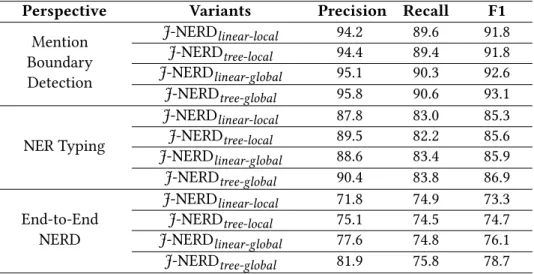
Table3.2compares the different CRF variants. All CRFs have the same features, but differ in their factors. Therefore, some features are not effective for the linear model and the tree model. For the linear CRF, the parsing-based linguistic features and the sentence features do not contribute; for the tree CRF, the cross-sentence features are not effective.
Table 3.2: Experiments on CRF Variants.
Perspective Variants Precision Recall F1
Mention Boundary Detection J-NERDlinear-local 94.2 89.6 91.8 J-NERDtree-local 94.4 89.4 91.8 J-NERDlinear-global 95.1 90.3 92.6 J-NERDtree-global 95.8 90.6 93.1 NER Typing J-NERDlinear-local 87.8 83.0 85.3 J-NERDtree-local 89.5 82.2 85.6 J-NERDlinear-global 88.6 83.4 85.9 J-NERDtree-global 90.4 83.8 86.9 End-to-End NERD J-NERDlinear-local 71.8 74.9 73.3 J-NERDtree-local 75.1 74.5 74.7 J-NERDlinear-global 77.6 74.8 76.1 J-NERDtree-global 81.9 75.8 78.7
3.6. Experiments | 27
We see that all variants perform very well on boundary detection and NER typing, with small differences on

![Figure 3.3: Global model, linking two tree models ([ p_f ] is [prep_for]).](https://thumb-us.123doks.com/thumbv2/123dok_us/425856.2548892/36.892.152.696.912.1054/figure-global-model-linking-tree-models-prep-for.webp)