Co nsist ent *Complete*W ellD o cu m en ted *E asy to Re us e * * Ev alu ate d * PO P L* Artifact * A EC
A Formally-Verified C Static Analyzer
Jacques-Henri Jourdan
Inria Paris-Rocquencourt [email protected]Vincent Laporte
IRISA and U. Rennes 1 [email protected]Sandrine Blazy
IRISA and U. Rennes 1 [email protected]Xavier Leroy
Inria Paris-RocquencourtDavid Pichardie
IRISA and ENS Rennes [email protected]Abstract
This paper reports on the design and soundness proof, using the Coq proof assistant, of Verasco, a static analyzer based on abstract interpretation for most of the ISO C 1999 language (excluding re-cursion and dynamic allocation). Verasco establishes the absence of run-time errors in the analyzed programs. It enjoys a modular architecture that supports the extensible combination of multiple abstract domains, both relational and non-relational. Verasco inte-grates with the CompCert formally-verified C compiler so that not only the soundness of the analysis results is guaranteed with math-ematical certitude, but also the fact that these guarantees carry over to the compiled code.
Categories and Subject Descriptors D.2.4 [Software
Engineer-ing]: Software/Program Verification—Assertion checkers,
Correct-ness proofs; F.3.1 [Logics and meanings of programs]: Specifying
and Verifying and Reasoning about Programs—Mechanical
verifi-cation
Keywords static analysis; abstract interpretation; soundness proofs; proof assistants
1.
Introduction
Verification tools are increasingly used during the development and validation of critical software. These tools provide guarantees that are always independent from those obtained by more conventional means such as testing and code review; often stronger; and some-times cheaper to obtain (rigorous testing can be very expensive). Verification tools are based on a variety of techniques such as static analysis, model checking, deductive program proof, and combina-tions thereof. The guarantees they provide range from basic mem-ory safety to full functional correctness. In this paper, we focus on static analyzers for low-level, C-like languages that establish the absence of run-time errors such as out-of-bound array accesses, null pointer dereference, and arithmetic exceptions. These basic
Publication rights licensed to ACM. ACM acknowledges that this contribution was authored or co-authored by an employee, contractor or affiliate of a national govern-ment. As such, the Government retains a nonexclusive, royalty-free right to publish or reproduce this article, or to allow others to do so, for Government purposes only. POPL ’15, January 15–17, 2015, Mumbai, India.
Copyright is held by the owner/author(s). Publication rights licensed to ACM. ACM 978-1-4503-3300-9/15/01. . . $15.00.
http://dx.doi.org/10.1145/2676726.2676966
properties are essential both for safety and security. Among the var-ious verification techniques, static analysis is perhaps the one that scales best to large existing code bases, with minimal intervention from the programmer.
Static analyzers can be used in two different ways: as sophis-ticated bug finders, discovering potential programming errors that are hard to find by testing; or as specialized program verifiers, es-tablishing that a given safety or security property holds with high confidence. For bug-finding, the analysis must be precise (too many false alarms render the tool unusable for this purpose), but no guar-antee is offered nor expected that all bugs of a certain class will be
found. For program verification, in contrast,soundnessof the
anal-ysis is paramount: if the analyzer reports no alarms, it must be the case that the program is free of the class of run-time errors tracked by the analyzer; in particular, all possible execution paths through the program must be accounted for.
To use a static analyzer as a verification tool, and obtain certi-fication credit in regulations such as DO-178C (avionics) or Com-mon Criteria (security), evidence of soundness of the analyzer must therefore be provided. Owing to the complexity of static analyzers and of their input data (programs written in “big” programming languages), rigorous testing of a static analyzer is very difficult. Even if the analyzer is built on mathematically-rigorous grounds such as abstract interpretation [14], the possibility of an implemen-tation bug remains. The alternative we investigate in this paper is
deductive formal verification of a static analyzer: we apply pro-gram proof, mechanized with the Coq proof assistant, to the imple-mentation of a static analyzer in order to prove its soundness with respect to the dynamic semantics of the analyzed language.
Our analyzer, called Verasco, is based on abstract interpreta-tion; handles most of the ISO C 1999 language, with the exception of recursion and dynamic memory allocation; combines several ab-stract domains, both non-relational (integer intervals and congru-ences, floating-point intervals, points-to sets) and relational (con-vex polyhedra, symbolic equalities); and is entirely proved to be sound using the Coq proof assistant. Moreover, Verasco is con-nected to the CompCert C formally-verified compiler [26], ensur-ing that the safety guarantees established by Verasco carry over to the compiled code.
Mechanizing soundness proofs of verification tools is not a new idea. It has been applied at large scale to Java type-checking and bytecode verification [25], proof-carrying code infrastructures [1, 12], and verification condition generators for C-like languages [20, 23], among other projects. The formal verification of static an-alyzers based on dataflow analysis or abstract interpretation is less developed. As detailed in section 10, earlier work in this area either
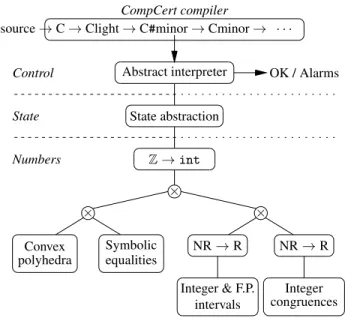
source→C→Clight→C#minor→Cminor→ · · · CompCert compiler Abstract interpreter State abstraction Z→int × × NR→R NR→R Integer & F.P. intervals Integer congruences × Symbolic equalities Convex polyhedra OK / Alarms Control State Numbers
Figure 1. Modular architecture of the Verasco static analyzer
focuses on simple static analyses (dataflow analyses, no widening, non-relational domains only) or on mini-languages such as IMP. Compared with this earlier work on verified static analyzers, Ve-rasco is a quantitative jump: the source language analyzed (most of C) is much more complex, and the static analysis technique used (combination of several abstract domains, including relational do-mains) is much more sophisticated.
This paper reports on the design and Coq verification of the Verasco static analyzer. In addition to the the quantitative jump mentioned above, we emphasize as a contribution the modular architecture of the analyzer and its verification, including fully-specified interfaces for the various components that makes it easy to connect new abstract domains to Verasco, as well as to reuse Verasco’s domains in other projects. The full Coq development is
available athttp://compcert.inria.fr/verasco/.
The paper is organized as follows. Section 2 presents the gen-eral architecture of the analyzer. The next five sections give more
details on the source language (§3), the abstract interpreter (§4), the
state and memory abstraction (§5), the numerical abstract domains
(§6) and how multiple domains communicate (§7). We finish by
some notes on the Coq development (§8), preliminary
experimen-tal results (§9), discussion of related work (§10), and conclusions
and perspectives (§11).
2.
Architecture of the analyzer
The general architecture of the Verasco analyzer is depicted in
fig-ure 1. It is inspired by that of ASTREE´ [6] and is structured in three
layers. At the top sits the abstract interpreter that infers abstract states at every program point and checks for potential run-time er-rors, raising alarms along the way. The abstract interpreter
oper-ates over the C#minor intermediate language described in section 3.
This language is the second intermediate language in the CompCert compilation pipeline. The Verasco analyzer reuses the CompCert
front-end to produce C#minor from the source C code. The
seman-tics preservation theorem of CompCert guarantees that any safety
property established on the C#minor intermediate language carries
over to the assembly code generated by CompCert. Combining this theorem with the soundness theorem for Verasco, we obtain that
any C#minor program that passes analysis without raising an alarm
compiles to assembly code that is free of run-time errors. The
Ve-rasco abstract interpreter proceeds by fixpoint iteration that follows
the structure of the C#minor program. Section 4 gives more details
on this abstract interpreter and its soundness proof.
The middle layer of Verasco is an abstract domain for execu-tion states, tracking the values of program variables, the contents of memory locations, and the chain of function calls. This state abstract domain is described in section 5. It is a parameter of the abstract interpreter, and has a well-defined interface (in terms of ab-stract operations provided and their specifications) outlined below. This parameterization makes it possible to experiment with sev-eral state domains of various precision, even though we currently have only one implementation of the state domain. Concerning val-ues that arise during program execution, the domain tracks pointer values itself via points-to analysis, but delegates the tracking of nu-merical values to a nunu-merical domain (bottom layer).
At the bottom layer of Verasco, the numerical abstract domain is itself an extensible combination of several domains. Some are non-relational, such as intervals and congruences, and track prop-erties of the (integer or floating-point) value of a single program variable or memory cell. Others are relational, such as convex poly-hedra and symbolic equalities, and track relations between the val-ues of several variables or cells. Two domain transformers perform
adaptation over domains: the “NR → R” transformer gives a
re-lational interface to a non-rere-lational domain, and the “Z→int”
transformer handles the overflow and wrap-around behaviors that
occur when mathematical integers (typeZ) and their arithmetic
op-erations are replaced by machine integers (n-bit vectors) and their
modulo-2narithmetic. Section 6 describes these abstract domains
and their verification; section 7 explains how they are combined and how they can exchange information during analysis.
Supporting such a modular composition of formally-verified
ab-stract domains requires that they adhere to well-definedinterfaces.
Figure 2 shows one of the three major interfaces used in Verasco (slightly simplified), the one for “machine” relational domains that acts as gateway between the numerical domains and the state do-main. All Verasco interfaces are presented as Coq’s type classes.
A machine relational domain consists of a typetequipped with a
semi-lattice structure: a decidable orderingleb, atopelement, a
joinoperation that returns an upper bound of its arguments (but
not necessarily the least upper bound), and awidenoperation used
to accelerate the convergence of fixpoint iteration with widening. There is no bottom element in Verasco’s domains: instead, when
we need to represent unreachability, we use the typet+⊥that adds
a genericBotelement to the domaint.
The three most important operations areforget,assignand
assume. Theforgetx Aoperation removes all information
asso-ciated with the variablexin stateA, simulating a nondeterministic
assignment tox. The typevarof variables is another parameter of
the class: it can be instantiated by program variables or, as the state abstract domain does, by abstract memory cells.
Theassignx e Aoperation updatesAto reflect the
assign-ment of expressioneto variable x. Numerical expressionse are
built upon variables and constants using the arithmetic, logical and
comparison operators of C#minor. (They are similar to C#minor
expressions except that they do not feature memory loads and that intervals can occur instead of numerical constants, capturing some amount of nondeterminism.) When analyzing source-level assign-ments, it is crucial that the numerical domains receive a numer-ical expression as close as possible to the right-hand side of the source-level assignment, typically the same expression modulo the replacement of memory loads by variables representing the mem-ory cells accessed; then, each domain can treat it to the best of
its abilities. For example, on treatingx = y + z, an interval
Class ab_machine_env (t var: Type): Type := { leb: t → t → bool ; top: t ; join: t → t → t ; widen: t → t → t ; forget: var → t → t+⊥
; assign: var → nexpr var → t → t+⊥
; assume: nexpr var → bool → t → t+⊥
; nonblock: nexpr var → t → bool
; concretize_int: nexpr var → t → int_set+>+⊥
; γ : t → ℘ (var→num_val) ; gamma_monotone: forall x y,
leb x y = true → γ x ⊆ γ y; ; gamma_top: forall x, x ∈ γ top; ; join_sound: forall x y,
γ x ∪ γ y ⊆ γ (join x y) ; forget_correct: forall x ρ n ab,
ρ ∈ γ ab →
(upd ρ x n) ∈ γ (forget x ab) ; assign_correct: forall x e ρ n ab,
ρ ∈ γ ab →
n ∈ eval_nexpr ρ e →
(upd ρ x n) ∈ γ (assign x e ab) ; assume_correct: forall e ρ ab b,
ρ ∈ γ ab →
of_bool b ∈ eval_nexpr ρ e → ρ ∈ γ (assume e b ab)
; nonblock_correct: forall e ρ ab,
ρ ∈ γ ab → nonblock e ab = true → block_nexpr ρ e → False ; concretize_int_correct: ∀ e ρ ab i, ρ ∈ γ ab → NVint i ∈ eval_nexpr ρ e → i ∈ γ (concretize_int e ab) }.
Figure 2. The interface for machine relational domains (slightly simplified).
andz, while a polyhedral domain will record the two inequalities
x≤y+z∧x≥y+z.
Finally,assumee b Arefines the abstract stateAto reflect the
fact that expressioneevaluates to the truth valueb(eithertrue
orfalse). It is used when analyzing conditional statements (if,
switch) to keep track of the value of the discriminating expression. Two query operations are provided to help the abstract inter-preter detect potential run-time errors and raise alarms
appropri-ately:nonblocke Areturnstrueife is guaranteed to evaluate
safely andfalseif it can cause a run-time error (such as a
divi-sion by zero) when evaluated in a concrete state matchingA; and
concretize inte Areturns the set of possible integer values for
the expressionethat can be deduced from the information in
ab-stract stateA.
The interface in figure 2 also specifies the soundness conditions
for the abstract operations above. The specification uses a
con-cretization functionγthat maps abstract statesAto sets of concrete
environmentsvar→num valmapping variables to values. Here,
values are the tagged union of 32-bit integers, 64-bit integers, and
double-precision floating-point numbers (IEEE754binary64
for-mat), that is, the numerical types offered by C#minor. As
custom-ary in Coq, the type℘(t)of sets oft’s is encoded ast→Prop,
so thatγis really a two-place predicate relating abstract states and
concrete environments. The specification does not use a full
Ga-lois connectionA −−→←−−
γ α
℘(C)because the abstraction functionα
is problematic in a constructive logic such as Coq’s: first, it is not a
computable function as soon as the typeCof concrete “things” is
infinite; second, for some domains,αis not well defined.1
The lack of an abstraction function α changes the style of
specification of abstract operators, focusing the specification on soundness conditions and freeing us from the obligation to prove
relative optimality. For example, the specification of forget in
Galois-connection style would be
forgetx A=α{ρ[x←v]|ρ∈γ(A), v∈Values}
Instead, inγ-only style we state soundness as
∀ρ, v, ρ∈γ(A)⇒ρ[x←v]∈γ(forgetx A)
(conditionforget correctin figure 2). We could also state
rela-tive optimality usingγonly:
∀A0, (∀ρ, v, ρ∈γ(A)⇒ρ[x←v]∈γ(A0))
⇒forgetx AvA0
However, we elected to mechanize proofs of soundness only, leav-ing relative optimality optional.
The other two major interfaces of Verasco are similar in spirit to what is described above, with the following differences. The in-terface for “ideal” numerical relational domains concretizes not to machine numbers, but to the sum of mathematical integers (type
Z) and FP numbers. It also supports communication channels
be-tween domains, as described in section 7. The interface for abstract execution states that mediates between the abstract interpreter and
the state domain uses full C#minor expressions, including memory
loads; adds abstract operations to handle memory stores and to push
and pop function calls in a call context; and concretizes to C#minor
memory states and local variable environments (section 5).
3.
The C
#
minor language
C#minor is the second intermediate language in the CompCert
compilation pipeline, immediately preceding Cminor, the entry lan-guage of the CompCert back-end described in [27]. Classically,
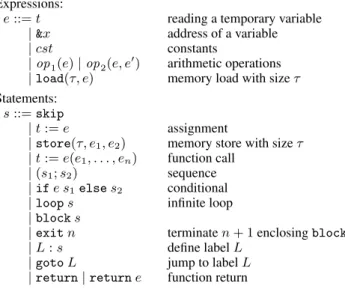
C#minor is structured in functions, statements, and expressions.
Expressions:
e::=t reading a temporary variable
|&x address of a variable
|cst constants
|op1(e)|op2(e, e0) arithmetic operations
|load(τ, e) memory load with sizeτ
Statements:
s::=skip
|t:=e assignment
|store(τ, e1, e2) memory store with sizeτ
|t:=e(e1, . . . , en) function call
|(s1;s2) sequence
|ife s1elses2 conditional
|loops infinite loop
|blocks
|exitn terminaten+ 1enclosingblocks
|L:s define labelL
|gotoL jump to labelL
|return|returne function return
1For example, in the domain of linear rational inequalities, the set of pairs {(x, y)|x2+y2≤1}has no best approximation as a polyhedron [28].
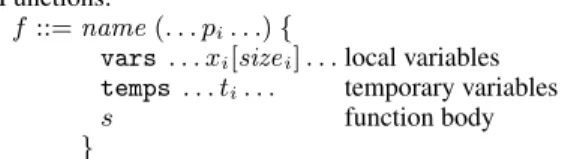
Functions:
f::=name(. . . pi. . .){
vars . . . xi[sizei]. . .local variables
temps . . . ti. . . temporary variables
s function body
}
A program is composed of function definitions and global variable declarations. Variables are of two kinds: addressable (their address
can be taken with the&operator) and temporary (not resident in
memory). Expressions have no side effects: assignments, memory stores and function calls are statements. The arithmetic, logical, comparison, and conversion operators are roughly those of C, but without overloading: for example, distinct operators are provided for integer multiplication and FP division. Likewise, there are no implicit casts: all conversions between numerical types are explicit.
Statements offer both structured control andgotowith labels.
C loops as well asbreakandcontinuestatements are encoded as
infinite loops with a multi-levelexitnthat jumps to the end of the
(n+ 1)-th enclosingblock.
The first passes of CompCert perform the following
transfor-mations to produce C#minor from C sources. First, side effects are
pulled outside of expressions, and temporaries are introduced to
hold their values. For example,z = f(x) + 2 * g(y)becomes
t1 = f(x); t2 = g(y); z = t1 + 2 * t2;
This transformation effectively picks one evaluation order among the several orders allowed in C. Second, local variables of scalar types whose addresses are never taken are “pulled out of memory” and turned into temporaries. Third, all type-dependent behaviors are made explicit: operator overloading is resolved, implicit
con-versions are materialized, and array andstructaccesses become
load and store operations with explicit address computations.
Fourth and last, C loops are encoded usingblockand exit, as
outlined in [7].
The dynamic semantics of C#minor is given in small-step style
as a transition relationC →ν C0 between configurationsC. The
optionalνlabel is an observable event possibly produced by the
transition, such as accessing avolatilevariable. A typical
con-figurationCcomprises a statementsunder consideration, a
contin-uationkthat describes what to do whensterminates (e.g., “move
to the right part of a sequence”, “iterate a loop once more”, or
“return from current function”), and a dynamic stateρ mapping
temporaries to their values, local and global variables to their
ad-dresses, and memory cells to their contents. The continuationk
en-codes both a context (where doessoccur in the currently-executing
function) and a call stack (the chain of pending function calls). Some transition rules actually perform computations (e.g., an
as-signment); others are refocusing rules that changesandkto focus
on the next computation.
The transition rules for C#minor are omitted from this paper, but
resemble those for Cminor given in [27, section 4]. The semitone
difference between Cminor and C#minor is that every Cminor
function has exactly one addressable variable called the stack data
block, while a C#minor function has zero, one or several variables
bound to logically separated memory blocks.
4.
The abstract interpreter
Exploring all execution paths of a program during static analysis can be achieved in two ways: the control flow graph (CFG) ap-proach and the structural apap-proach. In the CFG apap-proach, a control flow graph is built with program points as nodes, and edges car-rying elementary commands (assignments, tests, . . . ). The transfer
functionT for the analysis is defined for elementary commands.
The analyzer, then, sets up a system of inequations
Ap0 wT c Ap wherep→c p0is a CFG edge
with unknownsAp, the abstract states associated to every program
pointp. This system is then solved by global fixpoint iteration over
the whole CFG.
In contrast, the structural approach applies to languages with
structured control and compound statements such asifand loops.
There, the transfer functionT is defined over basic as well as
com-pound statements: given the abstract stateA“before” the execution
of statements, it returnsT s A, the abstract state “after” the
execu-tion ofs. For sequences, we haveT (s1;s2)A=T s2(T s1A).
For loops,T takes a local fixpoint of the transfer function for the
loop body.
Since C#minor is a mostly structured language (onlygoto
state-ments are unstructured), the abstract interpreter for C#minor
fol-lows the structural approach. This obviates the need to define
pro-gram points for C#minor (a nontrivial task). Moreover, structural
abstract interpreters use less memory than CFG-based ones, main-taining only a few different abstract states at any time, instead of one per program point. However, the transfer function for our ab-stract interpreter is more involved than usual, because control can
enter and leave a C#minor statement in several ways. The
state-ments can be entered normally at the beginning, or via agoto
that branches to one of the labels defined ins. Likewise,scan
ter-minate either normally by running to the end, or prematurely by
executing areturn,exit, orgotostatement. Consequently, the
transfer function is of the form
T s(Ai, Al) = (Ao, Ar, Ae, Ag)
whereAi (input) is the abstract state at the beginning ofs, Ao
(output) is the abstract state aftersterminates normally,Ar(return)
is the state if it returns, andAe (exits) maps exit numbers to the
corresponding abstract states. Thegotostatements are handled by
two maps from labels to abstract states:Al(labels) andAg(gotos),
the first representing the states that can flow to a label defined ins,
the second representing the states atgotostatements executed bys.
Figure 3 excerpts from the definition ofT and shows all these
components in action.
The loop case computes a post-fixpoint with widening and
narrowing, starting at⊥and iterating at mostNwiden times. The
pfpiterator is, classically, defined as
pfpF A N= > ifN = 0 narrowF A Nnarrow ifAwF A pfpF(A∇F A) (N−1) otherwise narrowF A N= A ifN= 0 narrowF(F A) (N−1) ifAwF A A otherwise
Each iteration ofpfpuses the widening operator∇provided by
the abstract domain to speed up convergence. Once a post-fixpoint
is found,F is iterated up toNnarrowtimes in the hope of finding a
smaller post-fixpoint.
In both widening and narrowing iterations, we use “fuel” N
to convince Coq that the recursions above are terminating, and to limit analysis time. We did not attempt to prove termination of iteration with widening: it would require difficult proofs over the widening operators of all our abstract domains [35], for no gain in soundness. Alternatively, we could delegate the computation of a
candidate post-fixpointAto an untrusted iterator written in Caml,
then checkA wF Ain a verified Coq function. This would cost
one more invocation of theF function, and it is unclear how the
Caml implementation could be made more efficient than thepfp
T(x:=e) (Ai, Al) = (assignx e Ai,⊥,⊥,⊥) T(s;s0) (Ai, Al) = (A0o, ArtA 0 r, AetAe, AgtA 0 g)where (
(Ao, Ar, Ae, Ag) =T s(Ai, Al) (A0o, A0r, A
0
e, A0g) =T s0(Ao, Al) T(if(e)selses0) (Ai, Al) =T s(assumeetrueAi, Al)tT s0(assumeefalseAi, Al)
T(loops) (Ai, Al) = (⊥, Ar, Ae, Ag)where(Ao, Ar, Ae, Ag) =pfp(λ(Xo, Xr, Xe, Xg). T s(AitXo, Al))⊥Nwiden
T(exitn) (Ai, Al) = (⊥,⊥,(λn0.ifn0=nthenAielse⊥),⊥)
T (blocks) (Ai, Al) = (AotAe(0), Ar,(λn. Ae(n+ 1)), Ag)where(Ao, Ar, Ae, Ag) =T s(Ai, Al) T(gotoL) (Ai, Al) = (⊥,⊥,⊥,(λL0.ifL0=LthenAielse⊥))
T (L:s) (Ai, Al) =T s(AitAl(L), Al)
Figure 3. Representative cases of the C#minor abstract interpreter
Optionally, the abstract interpreter can unroll loops on the fly:
the N first iterations of the loop are analyzed independently in
sequence; the remaining iterations are analyzed with apfpfixpoint.
This delays widening and gains precision. The unrolling factorN
is currently given by an annotation in the source code.
In addition to the analysis ofloopstatements, a post-fixpoint
is computed for every C#minor function to analyze goto
state-ments. This function-global iteration ensures that the abstract states
atgotostatements are consistent with those assumed at the
corre-sponding labeled statements. In other words, ifsis the body of a
function andT s(Ai, Al) = (Ao, Ar, Ae, Ag)is its analysis, the
analysis iterates untilAg(L)vAl(L)for every labelL. When this
condition holds, the abstraction of the function maps entry stateAi
to exit stateAotAr corresponding to the two ways a C#minor
function can return (explicitly or by reaching the end of the func-tion body).
Concerning functions, the abstract interpreter reanalyzes the body of a function at every call site, effectively unrolling the func-tion definifunc-tion on demand. We use fuel again to limit the depth of function unrolling. Moreover, since the state abstract domain does not handle recursion, it raises an alarm if a recursive call can occur. The abstract interpreter is written in monadic style so that alarms can be reported during analysis. We use a logging monad: when an alarm is raised, it is collected in the log, but analysis continues. This is better than stopping at the first alarm like an error monad would do: often, widening reaches a state that causes an alarm, but the subsequent narrowing steps cause this alarm to go away.
The soundness proof for the abstract interpreter is massive,
owing to the complexity of the C#minor language. To keep the
proof manageable, we break it in two parts: 1- the definition and
soundness proof of a suitable Hoare logic for C#minor, and 2- a
proof that the abstract interpreter infers Hoare “triples” that are valid in this logic.
We first explain the approach in a simplified case, that of the
IMP-like subset of C#minor, without goto, exit and return.
In this subset, statements can only be entered at the beginning and exited at the end, and the transfer function is of the form
T s A = A0. Intuitively, we expect this transfer function to be
sound if, for any statementsand initial abstract stateAsuch that
the analysis T s A raises no alarm, the execution ofs started
in any concrete state ρ ∈ γ(A) does not go wrong, and if it
terminates in stateρ0, thenρ0 ∈ γ(T s A). The way we prove
this property is first to show that if the analysisT s Araises no
alarms, then the weak Hoare triple{γ(A)}s{γ(T s A)}can be
derived in an appropriate program logic [5]. Then, we show that this
program logic is sound with respect to the operational semantics of
the language: if{P}s{Q}can be derived in the logic, then the
execution ofs, started in a state satisfyingP, does not go wrong,
and if it terminates, it does so on a state satisfyingQ.
The approach outlined above extends to the whole C#minor
language, but not without elbow grease. C#minor statements can
terminate in multiple ways: normally, or prematurely on anexit,
returnorgotostatement. They can also be entered in two ways:
at the beginning of the statement, or via agototo a label defined
within. Consequently, our program logic for C#minor manipulates
Hoare “heptuples” of the form
{P, Pl}s{Q, Qr, Qe, Qg}
whereP is the precondition ifs is entered normally,Pl(L) the
precondition ifs is entered by agotoL,Qthe postcondition if
sterminates normally,Qr(v)the postcondition ifsterminates by
areturn of valuev,Qe(i)the postcondition ifsterminates by
exit(i), andQg(L)the postcondition ifsterminates bygotoL.
We omit the rules of this program logic from this paper, as they are similar to those of the program logics for Cminor and Clight by Appel and Blazy [2, 3] (without the separation logic aspects). THEOREM1 (Soundness of the abstract interpreter).Assume that the analysisT s(Ai, Al)returns(Ao, Ar, Ae, Ag)without raising an alarm. Then, the heptuple
{γ(Ai), γ(Al)}s{γ(Ao), γ(Ar), γ(Ae), γ(Ag)}
is derivable in the C#minor program logic.
It remains to show the soundness of the program logic with
re-spect to the continuation-based small-step semantics of C#minor.
Taking inspiration from the work of Appelet al.on step-indexed
semantics [3, 4], we say that a configuration(s, k, ρ)is safe forn
steps if no sequence of at mostntransitions starting from(s, k, ρ)
triggers a run-time error: it either performsntransitions or reaches
a final configuration aftern0 < ntransitions. We say that a
con-tinuationk is safe fornsteps with respect to the postconditions
(Q, Qr, Qe, Qg)if:
Q ρ⇒(skip, k, ρ)safe fornsteps
Qrv ρ⇒(return(v), k, ρ)safe fornsteps
Qei ρ⇒(exit(i), k, ρ)safe fornsteps
QgL ρ⇒(gotoL, k, ρ)safe fornsteps
We can then state and prove soundness of the C#minor program
THEOREM2 (Soundness of the program logic).Assume that the heptuple{P, Pl}s{Q, Qr, Qe, Qg}is derivable in the program logic. Further assume thatk is safe for n steps with respect to
(Q, Qr, Qe, Qg). IfρsatisfiesP, then(s, k, ρ)is safe fornsteps. Moreover, ifρsatisfiesPlLandLis the label of sub-statements0
ofs, in continuationk0extendingk, then(s0, k0, ρ)is safe forn
steps.
5.
The state abstract domain
The state abstraction in Verasco tracks values contained both in memory and in temporary variables. Each value is attached to an abstract memory cell, or “cell” for short, representing one unit of storage: either a temporary variable or a scalar part of a local or global variable. A scalar part is either the whole variable if it is of
scalar type, or an element of scalar type in this variable (e.g., a field
in a structure, an element in an array). Therefore, a cell is given by the kind and the name of the variable it belongs to, the name of the function in which this variable is declared (unless it is global), and an offset and a value size (unless it is a temporary variable).
Cells: c::=temp(f, t) the temporarytin functionf
|local(f, x, δ, τ)slice of sizeτat offsetδin the
local variablexof functionf
|global(x, δ, τ) slice of sizeτat offsetδin the
global variablex
The state abstract domain interacts with three specific abstract
domains: an abstract value (tp,pt,nm) is a triple in types ×
points-to × num. First, type information is tracked for every memory cell in order to disambiguate, when possible, the behavior
of C#minor operators. For example addition of integer or pointer
values has various behaviors depending on the actual types of its arguments: adding two integers yields an integer; adding an integer to a pointer yields a pointer in the same block; and adding two pointers is undefined (therefore raises an alarm). In addition this type information is used to prove that values are not undefined, for instance when loaded from the memory.
Then, a points-to graph associates to each memory cell a set of memory blocks the cell may point to. A cell whose content is not a pointer may be associated with any set.
Finally, we track properties of the numbers contained in cells. The abstract state domain is parameterized by a relational numeri-cal abstract domain following the interface from figure 2. Cells act as variables for this numerical domain, which therefore abstracts
environmentsρmapping cells to numbers. The number associated
with a cell is its content if it is of numerical type, or, if it contains a pointer, the byte offset part of this pointer. Driving a relational numerical abstract domain requires special care because we must feed it with rich numerical commands, as we now illustrate.
Con-sider the following C#minor assignment occurring in a functionf.
s := s + load(int32, &T + 8×i + 4)
Here,sandiare temporary variables (i.e., the memory cell related
tosistemp(f,s)) andTis a global variable of array type.
Type analysis computes that&Tis a pointer whereassand i
are integers. Points-to analysis infers thatsandido not point to
any block, but&Tdefinitely points to the block ofT. In order to
feed the relational numerical domain with the assignment, we must
transform theload(int32, &T + 8×i + 4)expression into its
corresponding cells. We query the points-to domain to determine which memory blocks may be accessed during this load, yielding
the block ofT. We also query the numerical domain to obtain the
possible values of8×temp(f,i) + 4, that is, the byte offsets that
may be accessed during the load. Assume this query returns the
set{4,12}. We then approximate the load expression by the two
cellsglobal(T,4,int32)andglobal(T,12,int32), send the
numerical domain the two assignments
temp(f,s) := temp(f,s) + global(T,4,int32) temp(f,s) := temp(f,s) + global(T,12,int32)
and finally take the join of the two new numerical abstract states thus obtained.
For a memory store store(τ, el, er), we perform a similar
technique and generate a set{c1
l, . . . , c p
l}ofpcells that may be
modified during this store, and a set{e1
r, . . . , rrq}of numerical
expressions that capture the concrete value computed by expression
er. Whenp= 1, we can perform a strong update that overwrites the
previous value of the cellc1
l. Otherwise, we must perform a weak
(conservative) update and assume that any cell in{c1
l, . . . , c p l}may
still hold its old value after the update.
Concretization The types and points-to domains concretize to functions from cells to values whereas the numerical domain cretizes to purely numerical values. To combine them into one
con-cretization, the last one is lifted using an agreement relation∼tp
(parameterized by the types information) ensuring that types and
numerical values agree and that values bound byρmatch the
nu-merical values bound byρ0. In particular, if the value ρ(c) is a
pointer, the numberρ0(c)is the byte offset part of this pointer.
More precisely, a functionρfrom cells to values is in the
con-cretization of an abstract value(tp,pt,nm)iff 1) it is in the
con-cretizationγ(tp)of the types domaintp, 2) it is in the
concretiza-tionγ(pt) of the points-to domain (which means that for every
cellc that contains a pointer value with a block pointerb, then
b ∈ pt(c)) and 3) in the concretizationγ(nm) of the numerical
domain, there exists a concrete mappingρ0from cells to numerical
values that agrees withρ:
ρ∈γ(tp,pt,nm)⇔ρ∈γ(tp)∩γ(pt)∧ ∃ρ0∈γ(nm), ρ∼tpρ0
Finally, a functionρ from cells to values can be related to a
C#minor execution state (call stack and memory state): the call
stack determines a mapping fromtemp cells to values and from
localand global cells to memory locations, and the memory state gives values to these locations.
Inter-procedural analysis To analyze a function call such as
x:=f(args), where f is an expression, the function is first resolved, then the abstract state at function entry is prepared, and finally the function body is (recursively) analyzed from this state.
There, the analysis ofreturnstatements will compute the abstract
state after the call and assignment tox.
Function resolution uses points-to information to compute a set
of functions that expressionfmay point to.
The push frameoperation of the state abstract domain per-forms the assignments corresponding to argument passing: argu-ments are evaluated in the context of the caller and then assigned to local variables of the callee.
Since local variables are identified by their names and the func-tions they belong to, the call chain is remembered as an abstract stack. In addition, to be able to distinguish local from global vari-ables in expressions, the set of varivari-ables local to each function is remembered in this abstract stack.
Symmetrically, thepop frameoperation is used when
analyz-ingreturnestatements. The expressioneis analyzed in the callee context and assigned to a temporary in the caller context. Then,
pop framesimulates the freeing of local variables on function exit: this consists in invalidating the information associated to them, as well as invalidating pointers that may point to them.
As an illustration, consider the following program.
int f(int *p) { return *p; } int main(void) {
int x = 1;
int t = f(&x); return t; }
When analyzing the call to the functionf, the argument expression
is processed and the local variablepoffis assigned in the three
abstract domains. In particular,pis assigned to the constant zero
(the value of its offset) in the numerical domain and to the block
local(main,x)in the points-to domain. Therefore, the return
ex-pression offis known to access exactly one cell, about which
in-formation can be queried in the various domains. This inin-formation
is then assigned back to the temporarytofmain.
Progress verification At the same time we transform abstract
states, we perform verifications to prove that every C#minor
ex-pression evaluates safely (without blocking) in its evaluation con-text. In particular, we check that every load and store is performed within bounds and with the correct alignment. We also check that every deallocation of local variables at function returns is per-formed on valid pointers, as well as various other side conditions
(e.g.function pointers must have a null offset).
6.
The numerical abstract domains
6.1 Intervals and congruences
The first numerical domains verified in Verasco are non-relational
domains of intervals (x∈[a, b]) and congruences (xmodn=p).
They abstract numbers consisting of the union of mathematical
integers (typeZ) and double-precision floating-point (FP) numbers
(IEEE754’sbinary64format). Treating both kinds of numbers at
once facilitates the analysis of conversions between integers and FP numbers. Analyzing mathematical, exact integers instead of machine integers greatly simplifies the implementation and proof of abstract integer operations. In contrast, there is no benefit in analyzing FP numbers using a more mathematical type such as rationals: FP operations (with rounding) behave well with respect to FP ordering, and abstract operations that use rationals are costly.
Integer intervals Integer intervals are either[a, b]witha, b ∈Z
or>, standing for(−∞,∞). We do not represent the semi-open
in-tervals[a,∞)nor(−∞, b]. The implementation of arithmetic and
comparison operators over integer intervals is standard, with
com-parisons returning sub-intervals of[0,1]. We go to great lengths,
however, to derive tight intervals for bit-wise logical operations (“and”, “or”, “not”, . . . ). The widening operator does not jump
im-mediately to(−∞,∞)but first tries to replace the upper bound
by the next higher number in a list of well-chosen thresholds (zero and some powers of 2), and likewise replacing the lower bound by the next lower threshold [16]. The implementation and
sound-ness proof build on Coq’sZArithlibrary, which definesZfrom
first principles, essentially as lists of bits; no untrusted big integer library is involved.
Floating-point intervals Likewise, FP intervals are either[a, b]
whereaandbare non-NaN but possibly infinite FP numbers, or
>. Not-a-Number (NaN) belongs in>but not in[a, b]. Interval
analysis for FP arithmetic is complicated by the various special FP numbers (NaN, infinities, signed zeroes), but remains surprisingly close to reasoning over real numbers. IEEE754 specifies FP arith-metic operations as “compute the exact result as a real, then round it to a representable FP number”. For example, addition of two
fi-nite FP numbersx, yis defined asx⊕y=◦(x+y), where◦is
one of the rounding modes defined in IEEE754. Crucially, all these
rounding modes aremonotonicfunctions. Therefore, ifx∈ [a, b]
andy∈[c, d],
x⊕y=◦(x+y)∈[◦(a+c),◦(b+d)] = [a⊕c, b⊕d]
This property provides tight bounds for⊕and other FP operations,
provided the rounding mode is known statically. This is the case for
C#minor, which specifies round to nearest, ties to even, and gives
no way for the program to dynamically change the rounding mode.
Likewise, and unlike ISO C, C#minor specifies exactly the
preci-sion used by FP operations and the places where converpreci-sions be-tween precisions occur. Therefore, the FP interval domain does not need to account for excess precision and possible double rounding. The implementation and proof of the FP interval domain build on the Flocq library, which provides first-principles specifications and implementations of FP arithmetic in terms of mathematical integers and reals [9].
Integer congruences The congruence domain abstracts integers
as pairs(n, m)of a modulusmand a constantn, representing all
integers equal tonmodulom:
γ(n, m) ={x∈Z| ∃k, x=n+km}
The casem= 1corresponds to>. The casem= 0is meaningful
and corresponds to constant propagation:γ(n,0) ={n}. Tracking
constants this way enables more precise analysis of multiplications and divisions. This domain of congruences is crucial to analyze the safety of memory accesses, guaranteeing that they are properly aligned.
6.2 From non-relational to relational domains
The non-relational domains of intervals and congruences share a
common interface, specifying a typetof abstract values; a
con-cretizationγto the union ofZintegers and double-precision floats;
functions to abstract constants; and functions to perform “forward”
and “backward” analysis of C#minor operators. The following
ex-cerpt from the interface gives the flavor of the “forward” and “back-ward” functions.
forward_unop: i_unary_operation → t+> → t+>+⊥; backward_unop:
i_unary_operation → t+> → t+> → t+>+⊥; forward_unop_sound: ∀ op x x_ab, x ∈ γ x_ab →
eval_iunop op x ⊆ γ (forward_unop op x_ab); backward_unop_sound: ∀ op x x_ab, x ∈ γ x_ab →
∀ res res_ab, res ∈ γ res_ab →
eval_iunop op x res →
x ∈ γ (backward_unop op res_ab x_ab);
The “forward” functions compute an abstraction of the result given abstractions for the arguments of the operator. The “backward” functions take abstractions for the result and the arguments, and produce possibly better approximations for the arguments. For
ex-ample, the backward analysis of[0,1] + [1,2]with result [0,1]
produces[0,0]for the first argument and[1,1]for the second one.
A generic domain transformer turns any non-relational domain satisfying this interface into a relational domain. Abstract environ-ments are implemented as sparse finite maps from variables to
non->abstract values. Mappings from a variable to>are left implicit
to make abstract environments smaller. Theassignx e A
opera-tion of the relaopera-tional domain first computes an abstract valueafor
expressione, looking up abstract valuesA(y)for variablesy
oc-curring ineand using the forward operators provided by the
non-relational domain. The result is the updated abstract environment
A[x←a].
Theassumee b Aoperation of the relational domain abstractly
evaluatese“in reverse”, starting with an expected abstract result
that is the constant 1 ifb is true and the constant 0 otherwise.
The expected abstract resultares is propagated to the leaves ofe
using the backward operators of the non-relational domain. When
encountering a variableyine, the abstract value ofyis refined,
givingA0=A[y←A(y)uares].
This simple construction makes it easy to add other non-relational domains and combine them with non-relational domains.
6.3 Convex polyhedra
To exercise the interface for relational numerical domains, Verasco includes a relational domain of convex polyhedra. It builds on the
VPL library of Fouilh´eet al.[18], which implements all required
operations over convex polyhedra represented as conjunctions of linear inequalities with rational coefficients. VPL is implemented in Caml using GMP rational arithmetic, and therefore cannot be trusted. However, every operation produces a Farkas certificate that can easily be checked by a validator written and proved sound in
Coq [19]. For example, thejoinoperation, applied to polyhedras
P1, P2, returns not only a polyhedronPbut also Farkas certificates
proving that the system of inequations(P1∨P2)∧ ¬Pis
unsatis-fiable. Therefore, any concrete stateρ∈γ(P1)∪γ(P2)is also in
γ(P), establishing the soundness ofjoin.
This is, currently, the only instance of verified validation a pos-teriori in Verasco. While simpler abstract domains can be verified directly with reasonable proof effort, verified validation is a perfect match for this domain, avoiding proofs of difficult algorithms and enabling efficient implementations of costly polyhedral computa-tions.
6.4 Symbolic equalities
The relational domain of symbolic equalities records equalities
x =ecbetween a variablexand a conditional expressionec, as
well as factsec =trueorec =falseabout the Boolean value
of an expression. Conditional expressionsecextend numerical
ex-pressionsewith zero, one or several if-then-else selectors in prenex
position:
ec::=e|ec?ec:ec
On its own, this domain provides no numerical information that can be used to prove absence of run-time errors. Combined with other numerical domains via the communication mechanism of section 7,
symbolic equalities enable these other domains to analyzeassume
operations more precisely. A typical example comes from the way
CompCert compiles C’s short-circuit Boolean operators&&and||.
The pass that pulls side effects outside of expressions transforms these operators into assignments to temporary Boolean variables.
For example, “if (f(x) > 0 && y < z) { s; }” becomes, in
C#minor,
t1 = f(x);
if (t1 > 0) { t2 = y < z; } else { t2 = 0; }
if (t2) { s; }
The symbolic equality domain inferst2 =t1 >0? y<z: 0at
the secondif. Assuming t2 = true ins adds no information
in the interval and polyhedra domains. Noticing this fact, these domains can query the domain of equalities, obtain the symbolic
equality overt2above, and learn thaty<zandt1>0.
A set of equalitiesx =ecand factsec = bconcretizes to all
concrete environments that validate these equations:
γ(Eqs,Facts) = ρ
(x=ec)∈Eqs ⇒ρ(x)∈evalρ ec (ec=b)∈Facts⇒b∈evalρ ec
A new equation is added byassign, and a new fact is added by
assume. All equations and facts involving variablexare removed
when doingassignorforgetoverx. We do not track previous
values of assigned variables the way value numbering analyses
do. Likewise, we do not treat equalities between variablesx=y
specially.
The clever operation in this domain is the join between two abstract states: this is where conditional expressions are inferred. Computing (optimal) least upper bounds between sets of symbolic equalities is known to be difficult [21], so we settle for an over-approximation. Equations and facts that occur in both abstract
states (using syntactic equality for comparison) are kept. If one
state contains an equalityx = e0c and a factec = true, and
the other state containsx = e00c andec = false, the equality
x=ec ?e0c:e
00
c is added to the joined state. All other equalities
and facts are discarded. Widening is similar to join, except that new conditional expressions are not inferred.
6.5 Handling machine integers
Numerical domains such as intervals and polyhedra are well under-stood as abstractions of unbounded mathematical integers. How-ever, most integer types in programming languages are bounded, with arithmetic overflows treated either as run-time errors or by “wrapping around” and taking the result modulo the range of the
type. In C#minor, integer arithmetic is defined modulo2N
with
N = 32 or N = 64 depending on the operation. Moreover,
C#minor does not distinguish between signed and unsigned integer
types: both are justN-bit vectors. Some integer operations such as
division or comparisons come in two flavors, one that interprets its arguments as unsigned integers and the other as signed integers; but other integer operations such as addition and multiplication are presented as a single operator that handles signed and unsigned ar-guments identically.
All these subtleties of machine-level integer arithmetic compli-cate static analysis. For specific abstract domains such as intervals and congruences, ad hoc approaches are known, such as strided intervals [36], wrapped intervals [31], or reduced product of two
intervals ofZ, tracking signed and unsigned interpretations
respec-tively [8]. These approaches are difficult to extend to other do-mains, especially relational domains. In Verasco, we use a more generic construction that transforms any relational domain over
mathematical integersZinto a relational domain overN-bits
ma-chine integers with modulo-2Narithmetic.
We first outline the construction on a simple, non-relational
example. Consider the familiar domain of intervals overZ, with
concretizationγ([l, h]) = {x : Z | l ≤ x ≤ h}. To adapt this
domain to the analysis of 4-bit machine integers (typeint4), we
keep the same abstract values[l, h]withl, h ∈ Z, but concretize
them to machine integers as follows:
γm([l, h]) ={b:int4| ∃n:Z, n∈γ([l, h])∧b=nmod 24}
In other words, the mathematical integers inγ([l, h]), that is,l, l+
1, . . . , h−1, h, are projected modulo 16 into bit vectors. All arithmetic operations that are compatible with equality
modulo24
can be analyzed using the standard abstract operations
over Z-intervals. For example, 4-bit addition add is such that
addb1 b2 = (b1 +b2) mod 24. If it is know that x ∈ [0,2],
we analyzeaddx15like we would analyzex+ 15(addition in
Z), obtaining [0,2] + [15,15] = [15,17]. This interval [15,17]
concretizes to three 4-bit vectors,{15,0,1}with unsigned
inter-pretation and{−1,0,1}with signed interpretation. An overflow
occurred in the unsigned view, but theZ-interval arithmetic tracks
it correctly. The same technique of analyzing machine operations as if they were exact works for addition, subtraction, and bitwise operations (and, or, not), without loss of precision, and also for multiplication and left shift, possibly with loss of precision.
Other arithmetic operations such as division, right shifts, and
comparisons are not compatible with equality modulo24. (These
are exactly the operations that must come in two flavors, unsigned
and signed, at the machine level.) For example,−1≤0but150,
even though−1 = 15 (mod 24). To analyze these operations, we
first try to reduce the intervals for their arguments to the interval
[L, H)expected by the operation:[0,15]for an unsigned operation
and[−8,7]for a signed operation. To this end, we just add an
appropriate multiple of 16 to the original interval; this operation
above, add x 15 ∈ [15,17], viewed as a signed integer, can
be reduced to the interval add x 15 ∈ [−1,1]by subtracting
16. Therefore, the signed comparisonle s(addx15) 4can be
analyzed as
le s(addx15) 4∈([−1,1]≤[4,4]) =true
If we need to viewaddx15∈[15,17]as an unsigned 4-bit integer,
the best contiguous interval we can give is[0,15]. Therefore, the
unsigned comparisonle u(addx15) 4is analyzed as
le u(addx15) 4∈([0,15]≤[4,4]) =>
In the signed comparison case, the unsigned overflow during the
computation ofaddx15is benign and does not harm the precision
of the analysis. In the unsigned comparison case, the overflow is serious and makes the result of the comparison unpredictable.
On the example of intervals above, our construction is very close to wrapped intervals [31]. However, our construction gener-alizes to any relational domain that satisfies the Verasco interface for “ideal” numerical domains. Such domains abstract ideal
envi-ronmentsρ : var → Z+float64 where integer-valued
vari-ables range over mathematical integers, not machine integers.
Con-sider such a domain, with abstract statesAand concretization
func-tionγ. We now build a domain that abstracts machine environments
ρm:var→int32+int64+float64where integer-valued vari-ables are 32- or 64-bit machine integers with wrap-around
arith-metic. We keep the same typeAof abstract states, but interpret
them as sets of machine environments via
γm(A) ={ρm| ∃ρ∈γ(A), ∀v, ρm(v)∼=ρ(v)}
The agreement relation∼=between a machine number and an ideal
number is defined as
b∈int32 ∼= n∈Z iffb=nmod 232
b∈int64 ∼= n∈Z iffb=nmod 264
f∈float64 ∼= f0∈float64 ifff=f0
The abstract operationsassignm,assumem andforgetmover
the machine domain are defined in terms of those of the under-lying ideal domain after translation of the numerical expressions involved:
assignmx e A=assignx[[e]]AA
assumeme b A=assume[[e]]Ab A
forgetmx A=forgetx A
The translation of expressions inserts just enough normalizations
so that the ideal transformed expression[[e]]Aevaluates to an ideal
number that matches (up to the∼= relation) the value ofe as a
machine number. Variables and constants translate to themselves.
Arithmetic operators that are compatible with the∼=relation, such
as integer addition and subtraction, and all FP operations, translate isomorphically. Other arithmetic operators have their arguments reduced in range, as explained below.
[[x]]A=x
[[adde1e2]]A= [[e1]]A+ [[e2]]A
[[le ue1e2]]A=
reduceA[[e1]]A[0,232)≤reduceA[[e2]]A[0,232)
[[le se1e2]]A=
reduceA[[e1]]A[−231,231)≤reduceA[[e2]]A[−231,231)
The purpose ofreduceAe[L, H), where[L, H)is an interval of
width2N, is to reduce the values ofemodulo2Nso that they fit the
interval[L, H). To this end, it uses aget itve Aoperation of the
ideal numerical domain that returns a variation interval ofe. From
this interval, it determines the numberq of multiples of2N that
must be subtracted frometo bring it back to the interval[L, H).
This is not always possible, in which cases[L, H)is returned as
the reduced expression. (Remember that numerical expressions in Verasco are nondeterministic and use intervals as constants.)
reduceAe[L, H) =
let[l, h) =get itve Ain ifh−l≥2Nthen[L, H)else
letq=b(l−L)/2Ncin
ifh+q.2N ≤Hthene−q.2Nelse[L, H)
The translation of expressions is sound in the following sense. LEMMA3. Assumeρm∈γm(A),ρ∈γ(A)andρm(x) ∼= ρ(x)
for all variablesx. Then, for all machine expressionse,
vm∈evalmρme⇒ ∃v, v∈evalρ[[e]]A ∧vm∼=v
It follows that the assignmand assumem operations of the
transformed domain are sound.
7.
Communication between domains
Several abstract domains are used in order to keep track of different kinds of properties. For example, we need interval information to check that array accesses are within bounds. We use a congruence domain to check alignment of memory accesses. A domain of symbolic equalities helps us dealing with boolean expressions.
All those domains need to communicate. For example, only the interval domain is able to infer numerical information for all opera-tors, including bitwise operaopera-tors, division and FP operations; how-ever, all other domains may need to use this information. Another example is the symbolic equalities domain: if the condition of a test is just a variable, another domain can substitute the variable with a boolean expression provided by this symbolic domain in order to refine their abstract states.
The classic approach to combining two abstract domains and
make them exchange information is thereduced product[15].
Im-plementations of reduced products tend to be specific to the two domains being combined, and are difficult to scale to the
combi-nation ofn > 2domains. Reduced products are, therefore, not a
good match for the modular architecture of Verasco. Instead, we use a system of inter-domain communications based on channels,
inspired by that of ASTREE´ [17]. We define an input channel as
follows:
Record in_chan : Type :=
{ get_itv: iexpr var → IdealIntervals.abs+⊥; get_eq_expr: var → option (mux_iexpr var) }.
An input channel is a record of functions. Each function
corre-sponds to a specific kind of query:get_itvreturns an interval of
variation for an expression, whileget_eq_exprreturns an
expres-sion that evaluates to the same value as the variable it is called on. This type of channels is meant to be extended when needed. For example, one could add a query for a linear approximation of an expression, which could be answered by a dedicated domain and used by linear relational domains.
Like abstract states, channels have a concretization function.
Intuitively, an environmentρ : var → Z+float64 is in the
concretization of a channel if all answers to queries are valid inρ:
Record in_chan_gamma chan ρ : Prop := { get_itv_correct:
∀ e, eval_iexpr ρ e ⊆ γ (chan.(get_itv) e); get_eq_expr_correct:
∀ x e, chan.(get_eq_expr) x = Some e →
eval_mux_iexpr ρ e (ρ x) }.
Channels are used by domains when they need information from another domain. When an operation of a domain receives as argu-ment an abstract value, it also receives a channel corresponding to
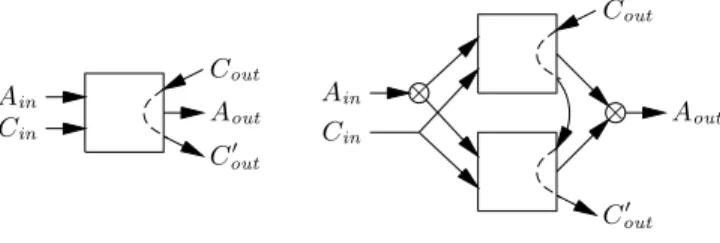
Ain Cin Aout Cout Cout0 × Ain Cin × Aout Cout Cout0 Figure 4. Communication channels between abstract operators. Left: single operator. Right: composition of two operators from different domains.
the same concrete environments. (ChannelCin in figure 4.)
Sym-metrically, each transfer function that returns a new abstract value
also returns a channelCout0 that other domains can query to obtain
information on the state after the execution of the transfer function.
Finally, yet another channelCoutis provided as extra argument to
each transfer function. Querying this channel will provide informa-tion on the state after the execuinforma-tion of transfer funcinforma-tions from other domains. Only abstract domains having already computed these function can answer these queries. In other words, the domain
op-eration producesCout0 by enriching information already present in
Coutwith information of its own. For example, theassigntransfer
function, which corresponds, in the concrete, to an assignment of an expression to a variable, has the following type:
assign: var → iexpr var → t * in_chan →
in_chan → (t * in_chan)+⊥;
The first and second arguments are the assigned variable and ex-pression. The third argument is a pair representing the initial states:
an abstract value and the channelCin. The fourth argument is the
channelCout representing the current information about the final
state after the assignment. If no contradiction is found,assign
re-turns the final abstract state and the enriched channelCout0 . The
specification ofassignis as follows:
assign_correct: ∀ x e ab chan ρ n, n ∈ eval_iexpr ρ e →
ρ ∈ γ ab →
(upd ρ x n) ∈ γ chan →
(upd ρ x n) ∈ γ (assign x e ab chan);
Here, we extendγ to pairs of abstract values and channels,
tak-ingγ (x, y) = γ x ∩ γ y and using Coq type classes. This
specification ofassignis analogous to the one in figure 2. The
difference is that we add an hypothesis stating that the two chan-nels given as parameters are correct with respect to initial and final states respectively. Moreover, we demand that the returned channel be correct with respect to the final state.
An implementation of such a specification has to create a chan-nel. For each query, the implementation can choose to forward it to the channel received as its fourth parameter, effectively forwarding it to another domain, or to answer it using its own information, or to do both and combine the information. For example, an interval
do-main will answerget_itvqueries but notget_eq_exprqueries,
forwarding the latter to other domains.
This interface for channel-aware transfer functions such as
assign makes it easy to combine two domains and have them communicate. Verasco provides a generic combinator (pictured as
⊗in figure 1) that takes two abstract domains over ideal numerical
environments and returns a product domain where information coming from both domains is stored, and where the two domains
can communicate via channels. The definition ofassignfor the
product is the following:
assign v e (ab:(A*B)*in_chan) chan := let ’((a, b), abchan) := ab in
(* Computation on the first component *) do_bot retachan <- assign v e (a, abchan) chan; let ’(reta, chan) := retachan in
(* Computation on the second component, using the new input channel *)
do_bot retbchan <- assign v e (b, abchan) chan; let ’(retb, chan) := retbchan in
NotBot ((reta, retb), chan)
The “plumbing” implemented here is depicted in figure 4, right
part. As shown there, theCoutchannel passed to the second abstract
domain is theCout0 channel generated by the first abstract domain.
This enables the second abstract domain to query the first one. Using this product construction, we can build trees (nested prod-ucts) of cooperating domains. As depicted in figure 1, the input to
the “Z → int” domain transformer described in section 6.5 is
such a combination of numerical domains. Abstract states of this combination are pairs of, on the one hand, nested pairs of abstract states from the individual numerical domains, and, on the other hand, a channel. The channel is not only used when calling abstract transfer functions, but also directly in order to get numerical
infor-mation such as variation intervals. When the “Z→ int” domain
transformer calls a transfer function, it simply passes as initialCout
channel a “top” channel whose concretization contains all concrete
environments:assign x e v in chan top.
One final technical difficulty is comparison between abstract
states, such as the subsumption testvused during post-fixpoint
computation. In the upper layers, abstract states comprise (nested pairs of) abstract values plus a channel. Therefore, it seems nec-essary to compare two channels, or at least one channel and one abstract state. However, channels being records of functions, com-parison is not decidable. Our solution is to maintain the invariant thatchannels never contain more information than what is con-tained in the abstract values they are paired with. That is, at the top of the combination of domains, when we manipulate a pair
(ab, chan)of an abstract value and a channel, we will make
sure thatγ(ab) ⊆ γ(chan)holds. In order to check whether one
such pair(ab1, chan1)is smaller than another(ab2, chan2),
we only need to check thatγ(ab1, chan1) ⊆ γ(ab2), which
is easily decidable. Thus, the type of the comparison function for abstract values is:
leb: t * in_chan → t → bool
Note that it is useful to providelebwith a channel for its first
argument: an abstract domain can, then, query other domains in order to compare abstract values.
However, the constraintγ(ab) ⊆ γ(chan)is too strong for
real abstract domains: it makes it impossible for a domain to for-ward a query to another domain. Instead, we use a weaker
con-straint for every transfer function. In the case ofassign, we prove:
∀ x e in chan0 ab chan,
assign x e in chan0 = NotBot (ab, chan) → γ chan0 ∩ γ ab ⊆ γ(chan)
That is, the returned channel contains no more information than what is contained in the returned abstract value and the
given channel. When chan0 is in_chan_top, it follows that
γ(ab) ⊆ γ(chan), ensuring the soundness of theleb compari-son function.
The property that limits the amount of information contained in channels is useful beyond the proof of soundness for comparisons: it is also a sanity check, ensuring that the returned channel only depends on the abstract value and on the channel given as the last argument, but not for instance on channels or abstract values
Specs Proofs Overall Interfaces 1081 139 3% Abstract interpreter 2335 2204 13% State abstraction 2473 3563 17% Numerical domains 7805 8563 48% Domain combinators 1305 1826 9% Intervals 1489 2224 10% Congruences 403 288 2%
Polyhedra (validator) 4038 3598 22% (from [19])
Symbolic equalities 570 627 3%
Miscellaneous libraries 3153 3329 19%
Total 16847 17040 33887 lines
Table 1. Size of the Coq development
previously computed. This is important for efficiency, because if the closures contained in the channel made references to previous channels or abstract values, this would make the analyzer keep old abstract values in memory, leading to bad memory behavior.
8.
Implementation and mechanization
The Coq development for Verasco is about 34 000 lines, excluding blanks and comments. An additional 6 000 lines of Caml imple-ment the operations over poyhedra that are validated a posteriori. The Coq sources split equally between proof scripts, on the one hand, and algorithms, specifications and statements of theorems on the other. Table 1 shows the relative sizes of the various compo-nents of Verasco. The parts reused from CompCert (e.g., syntax
and semantics of C#minor) are not counted.
The interfaces that provide the backbone of Verasco are pleas-antly lean. The bulk of the development is the abstract domains for states and (especially) for numbers, which involve large case anal-yses and difficult proofs over integer and F.P. arithmetic.
The Coq proofs are essentially constructive. The axiom of ex-cluded middle and the axiom of functional extensionality are used in a few places, for convenience rather than by necessity. How-ever, floating-point arithmetic is specified using Coq’s theory of real numbers, which relies on classical logic axioms.
Except for the operations over polyhedra, the algorithms used by Verasco are implemented directly in Coq’s specification lan-guage as function definitions in purely functional style. An exe-cutable analyzer is obtained by automatic extraction of Caml code from these function definitions and those of CompCert.
9.
Experimental results
We conducted preliminary experiments with the executable
C#minor static analyzer obtained as described in section 8. We
ran the analyzer on a number of small test C programs (up to a few hundred lines). The purpose was to verify the absence of run-time errors in these programs. To exercise further the analyzer,
we added support for a built-in functionverasco assert(e)to
explicitly ask the analyzer to prove invariants that are expressible
as C expressionse.
To model inputs, we added support for two other built-in
func-tions:any int64andany double, which nondeterministically
re-turn a value of the requested type. They are often coupled to the
built-in functionverasco assume(b)2 to further constrain their
results. These functions are also used to model library functions, whose code is not available or trusted.
2We only consider program executions where the boolean expressionbis
true whenverasco assume(b)is reached.
The following describes representative programs that we ana-lyzed. The other examples have similar characteristics and lead to comparable observations.
Function integration The exampleintegr.cis a small program adapted from a CompCert benchmark. Most of its code is given below.
typedef double (*fun)(double);
fun functions[N] = { id, square, fabs, sqrt }; double
integr(fun f, double low, double high, int n) { double h, x, s; int i;
h = (high - low) / n; s = 0;
for (i = n, x = low; i > 0; i--, x += h) s += f(x);
return s * h; }
int main(void) {
for (int i = 0; i < any_int(); ++i) { double m = any_double(); verasco_assume( 1. <= m ); int n = any_int(); verasco_assume (0 < n); integr(functions[i % N], 0., m, n); } return 0; }
This program repeatedly computes an approximation of the integral of a function between zero and some number greater than one. The function in question is picked from a constant array. It stresses various aspects of the analyzer such as function pointers, arrays, floating point and machine arithmetic.
Numerical simulations Two programs of a few hundred lines
taken from the CompCert benchmark,nbody.candalmabench.c,
feature heavy numerical (floating point) computations and array manipulation.
Cryptographic routines Thesmult.cexample performs scalar multiplication. It is taken from the cryptography library NaCl. Scalars and group elements are stored in arrays of bytes or unsigned integers. Many of these arrays are initialized within a loop. Under-standing that such an array is indeed properly initialized at the end of the loop would require a dedicated analysis beyond the scope of this paper [22]. Instead, we annotated the program to request full unrolling of these loops during analysis, thus preventing fixpoint computations.
Preliminary results On the examples described above, Verasco was able to prove the absence of run-time errors. This is en-couraging, since these examples exercise many delicate aspects of the C language: arrays, pointer arithmetic, function pointers, and floating-point arithmetic. As summarized in the table below, analysis times are high. Section 11 discusses possible directions to speed up the analyzer.
Program Size Time3
integr.c 42 lines 0.1s
smult.c 330 lines 86.0s
nbody.c 179 lines 30.8s
almabench.c 352 lines 328.6s