GJCST Classification (FOR) I.2.6, K.3.2
Children Abnormal GAIT Classification Using
Extreme Learning Machine
M. Pushpa Rani1, G.Arumugam2
Abstract-Analyzing human gait has earned considerable interest in recent computer vision researches, as it has immense use in deducing the physical well-being of people. Detection of unusual movement patterns can be performed using Support Vector Machines classification with T-Test pre-normalization. Support Vector Machine classifiers are powerful tools, specifically designed to solve large-scale classification problems. Almost all recent works broadly uses SVM method for gait analysis because of its remarkable learning ability. But when dealing with time complexity there exists a limitation with the SVM. As the computation cost for the SVM is high, the recently developed Extreme Learning Machine (ELM) is being used for the gait classification as a better option in this paper . ELM avoids problems like local minima, improper learning rate and over fitting commonly faced by previous iterative learning methods and completes the training very fast. The multi category classification performance of ELM with T-Test is evaluated with the Virginia gait dataset. The results indicate that ELM produces better classification accuracies with reduced training time and implementation complexity when compared to SVM.
Keypoints-Extreme learning machine, Gait analysis, SVM classification.
I. INTRODUCTION
uman gait is the way locomotion is achieved using human limbs. Different gaits are characterized by differences in limb movement patterns, overall velocity, forces, kinetic and potential energy cycles, and changes in the contact with the surface (ground, floor, etc). Early diagnosis of gait disease and rehabilitation assessment is possible with gait analysis.Most doctors diagnose gait diseases based on their own judgments by comparing many curves created by certain gait analysis system and it is inexact in many cases. In recent years, doctors gain a more objective and exact disease assessment by means of machine learning technology and this has gained much utilization of gait analysis [1].Artificial neural network (ANN) has strong non-linear learning ability, with which it is able to distinguish normal gait and diseased gait [2]. But, the ANN often gets into a local minimum and overstrains training samples which may reduce the accuracy of classifier. Also many ANN techniques are not suitable for gait analysis, as
_____________________________
About1-Ms.M.Pushpa Rani , Associate Professor in Computer Science ,Mother Teresa Women’s University, India. (telephone: +919942035825 email: [email protected]).
About2- Dr G Arumugam , Professor & Head ,Department of Computer
Science, Madurai Kamaraj University, India. (telephone: +919443090394 ( e-mail: [email protected]).
they demand high volume of data for training and it is very much time consuming in case of acquiring huge gait database. Also, this way of implementation will result in increase in the system complexity; greater computational burden and longer training time. Support Vector Machine (SVM) is widely applied in pattern recognition because of its remarkable learning ability. Begg [3] applied SVM for the gait classification of the children and the also for the elderly. Kamruzzaman [4] used SVM to distinguish the gait of children with cerebral palsy. As like the case in ANN, SVM also faces some difficulties, especially the time compatibility. Hence in order to overcome these difficulties, we propose a new training algorithm called the Extreme Learning Machine (ELM) for gait analysis in this paper . The performance of the ELM algorithm is tested using the Virginia gait dataset. For the Virginia data set, the results indicate that ELM can perform direct classification for these multi category microarray problems in a fast and efficient manner. ELM produces higher classification accuracies than those obtained by SVM with a more compact network and shorter training time in case of the Virginia data set .
II. RELATED WORK
The study of human gait has created much interest in many application areas. As a result many researches emerged in recent years and of which, a few studies related to Gait classification are noted herewith.A.Bobick et.al.,[5] projected a view-based approach to the representation and recognition of human movement. The basis of the representation is a temporal template-a static vector-image where the vector value at each point is a function of the motion properties at the corresponding spatial location in an image sequence. Using aerobics exercises as a test domain, the representational power of a simple, two component versions of the templates is explored: The first value is a binary value indicating the presence of motion and the second value is a function of the regency of motion in a sequence. Then the author develops a recognition method matching temporal templates against stored instances of views of known actions. The method automatically performs temporal segmentation, is invariant to linear changes in speed, and runs in real-time on standard platforms. Ross Cutler et.al.,[6] described new techniques to detect and analyze periodic motion as seen from both a static and a moving camera. By tracking objects of interest, we compute an object's self-similarity as it evolves in time. For periodic motion, the self-similarity measure is also periodic and we
apply Time-Frequency analysis to detect and characterize the periodic motion. The periodicity is also analyzed robustly using the 2D lattice structures inherent in similarity matrices.Sheng-Wu Xiong et.al.,[7] proposed in their paper that fuzzy support vector machines based on fuzzy c-means clustering. They apply the fuzzy c-means clustering technique to each class of the training set. During the clustering with a suitable fuzziness parameter q, the more important samples, such as support vectors, become the cluster centers respectively. G.-B. Huang et.al.,[8] explained in their paper about the recently developed Extreme Learning Machine (ELM). ELM is used for direct multi category classification problems in the cancer diagnosis area. ELM avoids problems like local minima; improper learning rate and over fitting commonly faced by iterative learning methods and completes the training very fast. The authors have evaluated the multi-category classification performance of ELM on three benchmark microarray datasets for cancer diagnosis, namely, the GCM dataset, the Lung dataset and the Lymphoma dataset. The results indicate that ELM produces comparable or better classification accuracies with reduced training time and implementation complexity compared to artificial neural networks methods like conventional back-propagation ANN, Linder's SANN, and Support Vector Machine methods like SVM-OVO and Ramaswamy's SVM-OVA. ELM also achieves better accuracies for classification of individual categories.C.-K. Siew et.al.,[9] gives an idea on ELM. In this paper they presented Extreme Learning Machine (ELM) for Single-hidden Layer Feed-forward Neural-networks (SLFNs) which randomly chooses hidden nodes and analytically determines the output weights of SLFNs. The ELM avoids problems like local minima, improper learning rate and over fitting commonly faced by iterative learning methods and completes the training very fast. The author have evaluated the multi-category classification performance of ELM on five different data sets related to bioinformatics namely, the Breast Cancer Wisconsin data set, the Pima Diabetes data set, the Heart-Statlog data set, the Hepatitis data set and the Hypothyroid data set. A detailed analysis of different activation functions with varying number of neurons is also carried out which concludes that Algebraic Sigmoid function outperforms all other activation functions on these data sets. The evaluation results indicate that ELM produces better classification accuracy with reduced training time and implementation complexity compared to earlier implemented models.Ju Han et al., [16] proposed a new spatio-temporal gait representation, called the Gait Energy Image (GEI), for individual recognition by gait. Unlike other gait representations which consider gait as a sequence of templates (poses), GEI represents human motion sequence in a single image while preserving temporal information. To overcome the limitation of training templates, we propose a simple model for simulating distortion in synthetic templates
and a statistical gait feature fusion approach for human recognition by gait. Experimental results show that 1) GEI is an effective and efficient gait representation and 2) the proposed recognition approach achieves highly competitive performance with respect to the published major gait recognition approaches. This paper presents a systematic and comprehensive gait recognition approach, which can work just as fine as other complex published techniques in terms of effectiveness of performance while providing all the advantages associated with the computational efficiency for real-world applications.
Davrondzhon Gafurov [17] presented an overview of biometric gait recognition is given. Depending on the way the gait data is captured, biometric gait verification and identification is categorized into three classes (MV-based, WS-based and FS-based). The primary advantage of MV based gait biometric is in being captured from the distance. The main advantage of WS-based and FS-based gait biometric is in providing unobtrusive user authentication and identification. In a multi- modal biometric system, gait helps to increase the accuracy of the system too. However, there are many factors that can negatively influence the accuracy of a gait recognition system. An investigation of these factors is very important towards developing robust systems. With respect to gait security, studies also indicated that gait biometric is robust against minimal effort impersonation attacks. However, impostors who know their closest person in the database or the gender of the users in the database can be a threat to a gait authentication system. Multi-modal biometric systems combine evidences from several biometric modalities to establish more reliable and accurate identification.
III. METHODOLOGY
The block diagram of the proposed system is as shown in Figure 5.1. After suitable preprocessing, the Salient Gait Features are extracted and statistical based feature selection is performed using the extracted features. These selected salient gait features are then subjected to normalization and ranking methodologies followed by a classification algorithm. The ranking and normalization methodologies dealt in this chapter are Principle Component Analysis (PCA) and T-Test. The two classification algorithms discussed here are Support Vector
Figure1.Block Diagram of Gait Analysis using ELM The two ranking methodology dealt in this paper are Principle Component Analysis (PCA) and T-Test. The two classification algorithm is Support Vector Machine (SVM) and Extreme Learning Machine (ELM).
1) Short introduction of SVM
SVM is usually used for classification problems introduced by Vapnik [10]. For binary classification, an SVM is used to find an optimal separating hyper plane (OSH) which generates a maximum margin between the two categories of data. To construct an OSH, SVM maps data into a higher dimensional feature space. SVM performs this nonlinear mapping by using a kernel function. Then, SVM constructs a linear OSH between the two categories of data in the higher feature space. Data vectors which are nearer to the OSH in the higher feature space are called support vectors (SVs) and will contain all the information required for classification. The theory of SVM can be briefed as follows [10].Consider training set with each input in x ∈ Rn and an associated output
yi { -1, +1}. Initially,each input x is mapped into a higher
dimension feature space F, by z=φ (x) via a nonlinear mapping φ: Rn
→F. When the data are linearly non-separable in F, there exists a vector w ∈ F and a scalar b which defines the separating hyper plane as:
(1)
where ( 0) are called slack variable. The hyper plane that optimally separates the data in F is the one that
(2) where C is called as the regularization parameter that determines the tradeoff between the maximum margin and the minimum classification error. By constructing a Lagrangian, the optimal hyper plane according to the equation (2) may be shown as the solution of
(3) where 1,….., L are the nonnegative Lagrangian
multipliers. The data points xi that correspond to i>0 are
SVs. The weight vector w is then given by
(4)
For any test vector x ∈Rn, the classification output is then given by
(5) To construct an SVM classifier, a suitable kernel function and its parameters need to be chosen. So far, no analytical or empirical studies have been established to prove the superiority of one kernel over another. Hence, in this study, the following three kernel functions have been applied to build the SVM classifiers:
1) Linear kernel function, K(x,z) = x,z ;
2) Polynomial kernel function K( x, z) =( x, z +1) dis the degree of polynomial;
3) Radial basis function, is the width of the function.
2) Introduction of FCM algorithm
FCM algorithm proposed by Dunn [11] and extended by Bezdek [12] is one of the most well-known methods in cluster analysis. FCM partitions a set of s-dimensional vectors X={X1,X2,…,Xn }into c clusters, where
represents the jth sample for j=1,….,n. The ith cluster is supposed to have a center vector
and FCM aims to determine the cluster centers vi , where 1≤i≤c. For the jth sample Xj and the ith cluster
center vi , there is a membership degree uij( [0,1])
indicating in which degree the sample Xj belongs to the cluster center vector vi, which results in a fuzzy partition
matrix U=(uij)nXc . The objective function J is defined as
follows:
(6)
(7)
(8)
subject to where m (usually set to be 2) in (11) and (12) is used to adjust the weight effect of membership values.
The FCM algorithm [13] may be described as follows: 1) Choose an integer c and a threshold value ε . Initialize
the fuzzy partition matrix U by c×n random numbers in the interval [0,1] ;
2) Compute according to equation (8); 3) Compute all dij and uij according to (7) and (9) respectively. Thus update the fuzzy partition matrix U by the new computed u ij.
4) Compute the objective function J. If the difference between two adjacent J values is less than the given threshold ε , then stop. Otherwise go to step 2.
3) SVM algorithm
SV plays a decisive role in SVM, but non-SVs are usually inoperative. In F-SVM, the treatment is not the same for each sample. Training samples that are affirmatively not SVs are not involved in SVM, and only the samples that have a weak relationship with each cluster are chosen to be trained in SVM. By using this method, the classification accuracy can be increased and the training time may considerably be reduced[7],[14].The selection of training data is executed by the FCM which may cluster samples non-compulsively. The membership degree ui in FCM
indicates with what degree a sample belongs to the cluster center vector vi. If there exists one which is bigger than a threshold λ (80% in this study), it is clearly that the sample is far from OSH and its probability to be a SV is small. So, this sample is not involved in SVM. The block diagram of F-SVM is shown in Figure 2
Figure 2 block diagram of the F-SVM.
The process of F-SVM is described as follows: 1) Choose a cluster number c (2 in this study) and a
threshold value ε for FCM. Choose a selection threshold λ (80% in this paper).
2) Cluster the training samples by applying FCM and calculate the membership degree uij according to equation (9). If uij< , i {1,….,c}, sent the sample to
SVM. Otherwise, abandon it.
3) Classify the selected training sample set using SVM. Calculate each classification output according to (7).
IV. EXTREME LEARNING MACHINE
A new learning algorithm called the Extreme Learning Machine (ELM) is a Single-hidden Layer Feed forward neural Networks (SLFNs) supervised batch learning. The output of an SLFN with ~N hidden nodes (additive or the RBF nodes) can be represented by
(10) where ai and bi are the learning parameters of hidden nodes and i is the weight connecting the ith hidden node to the
output node. G(ai,bi,X) is the output of the ith hidden node
with respect to the input x. For the additive hidden node with the activation function g(x):R R (e.g., sigmoid or threshold), G(ai,bi,X) is given by
(11)
Where ai is the weight vector connecting the input layer to the ith hidden node and bi is the bias of the ith hidden node. ai .x denotes the inner product of vectors ai and x in R. For a RBF hidden node with an activation function g(x):R R(e.g., Gaussian), G(ai,bi,X) is given by
(12)
where ai and bi are the center and impact factor of the ith RBF node. Here R+ indicates the set of all positive real values. The RBF network is a special case of SLFN with the RBF nodes in its hidden layer. Each RBF node has its own centroid and impact factor and its output is given by a radially symmetric function of the distance between the input and the center.The learning algorithms use a finite number of input-output samples for training. Here, we consider N arbitrary distinct samples (xi,ti) Rn x Rm, where
xi is an n x 1 input vector and ti is an m x 1 target vector. If
an SLFN with hidden nodes can approximate these N samples with zero error, it then implies that there exist i, ai,
and bi such that
(13) Equation () can be written compactly as
(14) Training Data
Set cluster number c; threshold ; selection threshold
Cluster by FCM
uij<
Sent the sample to SVM
Abandon the sample
Where
=
(15)
and (16)
H is called the hidden layer output matrix of the network [15]; the ith column of H is the ith hidden node‘s output vector with respect to inputs x1, x2,…, xN and the jth row of
H is the output vector of the hidden layer with respect to input xj.In real applications, the number of hidden nodes, ,
will always be less than the number of training samples, N, and, hence, the training error cannot be made exactly zero but can approach nearer to a nonzero training error . The hidden node parameters ai and bi (input weights and biases
or centers and impact factors) of SLFNs need not be tuned during training and may simply be assigned with random values according to any continuous sampling distribution. Equation (5) then becomes a linear system and the output weights _ are estimated as
(17)
Where the Moore-Penrose is generalized inverse [15] of the hidden layer output matrix H. The ELM algorithm which consists of only three steps, and can then be summarized as
ELM Algorithm: Given a training set
activation function g(x), and hidden node number ,
1) Assign random hidden nodes by randomly generating parameters (ai,bi) according to any continuous sampling
distribution, i=1,….,
2) Calculate the hidden layer output matrix H. 3) Calculate the output weight :
The universal approximation capability of ELM has been analyzed in Huang et al. [16] using an incremental method and it has been shown that single SLFNs with randomly generated additive or RBF nodes with a wide range of activation functions can universally approximate any continuous target functions in any compact subset of the euclidean space Rn. is the sigmoidal function used as activation function in ELM
V. EXPERIMENTAL RESULTS
This study mainly deals with the Performance analysis of the t-test ELM classification method for gait classification as normality and abnormality. Several experiments are carried out to test the validity of t-test ELM. A comparative analysis of the results of our proposed method is also done
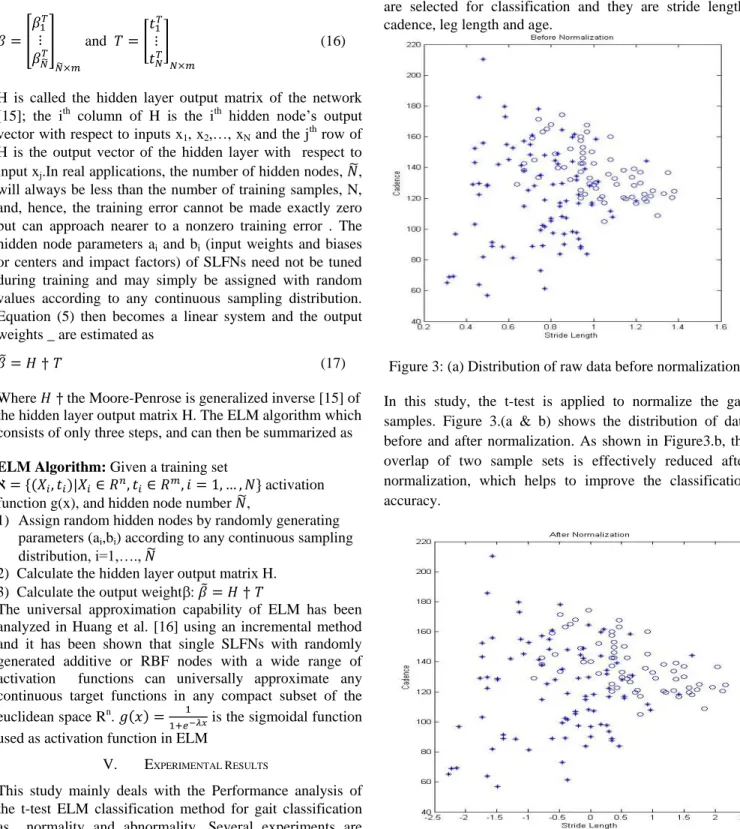
with t-test SVM. The experimental data used in this study are obtained from the gait database in Virginia University. There are totally 158 gait samples present in the database. These samples belong to 68 children with normal gait and 88 children with abnormal gait. The ages of these children range from 2 years to 13 years. Four features of gait samples are selected for classification and they are stride length, cadence, leg length and age.
Figure 3: (a) Distribution of raw data before normalization. In this study, the t-test is applied to normalize the gait samples. Figure 3.(a & b) shows the distribution of data before and after normalization. As shown in Figure3.b, the overlap of two sample sets is effectively reduced after normalization, which helps to improve the classification accuracy.
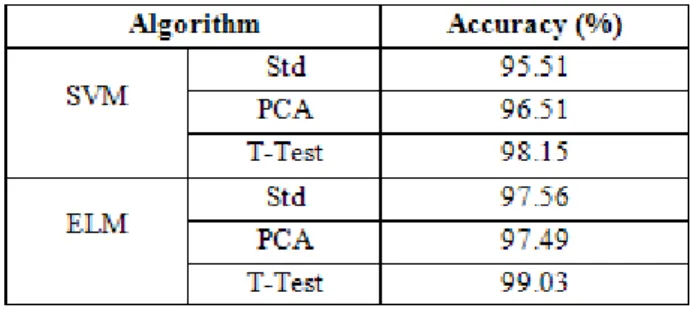
The generalization capability of SVM enhances along with the increase of C (Regularization parameter). This is because the regularization parameter C may adjust the ratio of confidence interval and empirical risk. The generalization capability of SVM is weak when C is small, because a small C indicates that the punishment for empirical risk is small and the empirical risk is large. When C exceeds a certain value, the complexity of a classifier reaches the allowed maximum in the feature space. In this case, the SVM has almost no change of the empirical risk and generalization capability. The accuracyof using standard SVM, SVM with PCA and SVM with T-Test are measured and tabulated in Table1
When dealing with Classification Accuracy of ELM, it achieves better results. The accuracy achieved by ELM is 95 percent or more. This is consistent with our hypothesis that ELM performs better in the multi category classification applications where the number of classes is large.For all data sets, ELM takes much less total training time than does the SVM algorithm. As mentioned before, the SVM- algorithm has to build binary classifiers to distinguish between every two class combinations. For the data sets used with the number of categories classified decreasing, the difference between ELM and SVM is also decreasing. ELM takes significantly lower training time. For all data sets, it can be seen that the number of hidden nodes for ELM is always smaller than the number of support vectors for SVM, indicating a more compact network realized by ELM. The accuracy of ELM with PCA and T-Test are tabulated in Table1.
Figure 4. Comparison of SVM and ELM accuracy. In reference with that ELM with PCA gives result with accuracy of 97.98% and when T-Test is used it gives the maximum accuracy of 99.21%. The increase in percentage of accuracy when using ELM is plotted in graph above.The performance of ELM can be estimated with the use of total training time. When the number of hidden nodes for ELM and support vectors of SVM is compared it can be seen that
the number of hidden nodes for ELM is always smaller than in support vectors indicating a more compact network realized by ELM. For each network, there are five modules each consisting of 10 hidden nodes. This means that, for each experiment, up to 4,600 hidden nodes are needed for the training process of SANN, while, for ELM, the network needs less than 50 hidden nodes. Thus reducing the number of hidden nodes reduces the training time. The total training time for ELM and SVM is shown in Table 2. This shows that SVM
Table1.SVM and ELM accuracies
took around 410 seconds to train the dataset completely. For the same dataset ELM took only 125 seconds. Table2. Total training time used by SVM and ELM
Algorithm Time(in sec)
SVM 410
ELM 125
This result clearly shows that ELM takes a much smaller training time than SVM.
VI. CONCLUSION
In this paper, a fast and efficient classification method called the ELM algorithm is used to classify the abnormal gait. ELM can perform the multi category classification directly, without any modification. Study results are consistent with our proposition that, when the number of categories for the classification task is large, the ELM algorithm achieves higher classification accuracy than the other algorithms with less training time and a smaller network structure. It can also be seen that ELM achieves better and more balanced classification for individual categories as well as very less training time comparative to SVM. In future some advanced neural network techniques can be used to train the ELM classifier which may enhance the classification accuracy further with reduced training time.
VII. REFERENCES
1) Simon S. R., Quantification of human motion: gait analysis-benefits and limitations to its application to clinical problems. Journal of Biomechanics, 2004(37): 1869-1880.
2) Barton J G, Lees A, An application of neural networks for distinguishing gait patterns on the basis of hip-knee joint angle diagrams. Gait and Posture, 1997(5): 28-33.
3) R. K. Begg, M. Palaniswami, and B. Owen, Support Vector Machines for automated gait classification. IEEE Trans. Biomed. Eng., vol. 52, no. 5, pp. 828-823, May 2005.
4) Joarder Kamruzzaman, Support Vector Machines and Other Pattern Recognition Approaches to the Diagnosis of Cerebral Palsy Gait. IEEE Trans. Biomed. Eng., vol. 53, no. 12, pp. 2479-2489, Dec 2006.
5) Bobick and W. Davis. The recognition of human movement using temporal templates. IEEE Transactions on Pattern Analysis and Machine Intelligence, 23(3),March 2001.
6) Ross Cutler and Larry Davis. Robust real-time periodic motion detection, analysis, and applications. IEEE Transactions on Pattern Analysis and Machine Intelligence, 22(8):781 – 796, 2000.
7) Sheng-Wu Xiong, Hong-Bing Liu and Xiao-Xiao Niu, Fuzzy support vector machines based on FCM clustering. Proceedings of 2005 International Conference on Machine Learning and Cybernetics, Aug. 2005, vol. 5, pp. 2608- 2613.
8) G.-B. Huang, Q.-Y. Zhou, and CK. Siew, ―Extreme Learning Machine: A New Learning Scheme of Feedforward Neural Networks,‖ Proc. Int‘l Joint Conf. Neural Networks (IJCNN ‘04), July 2004. 9) G.-B. Huang and C.-K. Siew, ―Extreme Learning
Machine with Randomly Assigned RBF Kernels,‖ Int‘l J. Information Technology, vol. 11, no. 1, 2005.
10) Vladimir N. Vapnik, The Nature of Statistical Learning Theory. New York: Springer-Verlag, 1995, 187 pp.
11) Dunn and J.C., Some recent investigations of a new fuzzy partition algorithm and its application to pattern classification problems. J. Cybernetics, vol. 4, pp. 1–15, 1974.
12) Bezdek and J.C., Pattern Recognition with Fuzzy Objective Function Algorithms. Plenum, New York, 1981.
13) Wang, Y. Wang, and L. Wang, Improving Fuzzy c-Means Clustering based on Feature-Weight Learning. Pattern Recognition Letters, 25 (10), pp. 1123–1132, 2004.
14) Dae-Jong Lee, Jong-Pil Lee, Pyeong-Shik Ji, Jae-Woon Park and Jae-Yoon Lim, Fault Diagnosis of Power Transformer Using SVM and FCM. 2008 IEEE International Symposium on Electrical Insulation, June 2008, pp. 112-115.
15) G.-B. Huang, ―Learning Capability and Storage Capacity of Two- Hidden-Layer Feedforward
Networks,‖ IEEE Trans. Neural Networks, vol. 14, no. 2, pp. 274-281, 2003.
16) Ju Han, Bir Bhanu, "Individual Recognition Using Gait Energy Image", IEEE Transactions on Pattern Analysis and Machine Intelligence, Vol. 28, No. 2, February 2006.
17) Davrondzhon Gafurov, "A Survey of Biometric Gait Recognition: Approaches, Security and Challenges", NIK-2007 conference.
GJCST Classification (FOR) J.1, J.3
Health Information System Implementation: The
Role Of Business Process Management On
Successful Implementation
Abdullah S. Al-Mudimigh Abstract-Integrated HIS provides significant improvements in
efficiency across an environment of health care. However, there are also risk associated with implementation of integrated HIS but the actual implementation of integrated health information systems (HIS) is a challenging issue. Implementing integrated HIS are increasingly seen as the way to achieve quality and continuity in treatment, reducing clinical errors, and supporting health care professional in providing care. With the hurried growth in popularity of integrated HIS package, an increasing number of health care sectors are making the decision to implement an integrated HIS. The critical success factors for integrated HIS implementation include top management support, a clear business vision and issues specific to HIS such as implementation strategy and software configuration. However, some of the more important factors are the issues related to re-engineering business processes and the integration of various core processes to the HIS. This paper investigates the role and impact of business process management in successful integrated HIS implementation. The paper starts by defining business process management and the integrated HIS critical success factors. The impact of business process management on successful integrated HIS implementation is then assessed through looking at the experiences of several health care sectors. The paper concludes by documenting best practices for capitalizing on business process management for successful integrated HIS implementation.
Key Words:Critical Success Factors (CSF), HIS, Business Process Management (BPM).
I. INTRODUCTION
he recent push for healthcare reform has caused health departments to focus on ways to streamline their processes in order to deliver high quality care while at the same time reducing costs. Integrated Health Information Systems (HIS) software packages (synonyms are hospital information systems, health information management, clinical information systems, healthcare information systems, health information technology, and health application systems) seek to integrate the complete range of a health departments processes and functions in order to present a holistic view of the health care from a single information and IT architecture. I can say that the health departments increasingly recognize the value of sharing information among all stakeholders. Few health care sectors will dispute the value that HIS software can bring to their business. However, most health organizations are not ______________________________
About- PhD Department of Information System College of Computer and Information Sciences King Saud University
E-mail – [email protected]
putting in place the procedures tomanage the changes and customizations they need to make to HIS for establishing better services to their patients and staff. Most health sectors are too busy building and running the technical aspects of their HIS package to recognize the need, and long-term value of change and business process management. These values extend well beyond application development and in fact it provides the backbone for successful installations and operation of an HIS. Health care are becoming engrossed in building and running the technical aspects of their HIS to recognize the need and long-term value of change and business process management. Integrated HIS is the umbrella for integrating sets of health departments applications that allow them to manage almost all aspects of operations. The value of this holistic view extends well beyond application development and in fact provides the backbone forsuccessful installations and operation of an integrated HIS software package. Integrated HIS packages have made a tremendous contribution to the world of health care [12]. Indeed, the value that HIS packages can bring to health sectors is clear to many health organizations and few will dispute its potential. However, there are also hazards associated with implementation of integrated HIS. Their failure is high and may cause negative effects on staff and patients [1,2,11]. These software packages are huge and complex systems and warrant careful plan and execution to ensure successful implementation. In other words, integrated HIS implementation is much more than implementation of hardware or software systems; they affect how a health care conducts itself. The success of an integrated HIS implementation has often been attributed to two facts: the HIS package is configured and running and the whole project is (more or less) on time and within budget [6]. However, this is a narrow view of HIS implementation focusing on the hard aspects and reducing it to mere software or IT project. Many integrated software implementation failures have been due to the lack of focus on ‗the soft issues‘, i.e. the business process and change management [5,14]. The role and impact of business process management (BPM) in successful integrated HIS implementation is crucial, and is the subject of our investigation here.
II. INTEGRATED HIS CRITICAL SUCCESS FACTORS
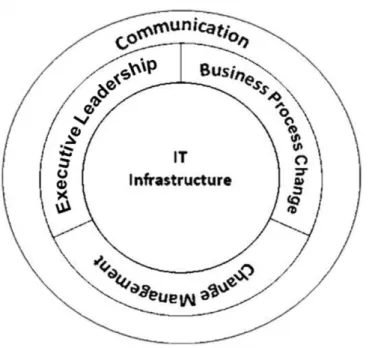
Due to the complex and integrated nature of HIS software package, the large investments involved (time and money), and the relatively high implementation failure rates [1,2,3]. It is imperative for health care sectors to study the experiences of others, and learn from their practices and success factors.A literature review was conducted to understand the critical success factors in successful integrated software implementation [17]. The review covered numerous published books and articles. The review concluded the identified CSFs fall under one of four main categories, namely: executive leadership, changing of the existing processes, deploying change management, and the IT infrastructure. These CSF categories are presented in Figure 1.
Figure 1: CSF Categories for successful integrated HIS The following is a brief overview of each of these categories:
1). Executive Leadership: Executive must be a part of integrated HIS implementations. The leadership is a high level official who works for institutionalization of the project, is a talent and good communicator, and has political awareness and influential contacts. The IT literatures have clearly demonstrated that for IT protects to succeed executive support is critical. However, executive in many health care sectors still view the installation of an integrated HIS as primarily a technological challenge and assign its responsibility to the IT departments. This is seen as a risky act due to HIS‘s profound health care implications.
2). Business Process Change (BPC): Implementing an Integrated HIS package involves changing the existing business processes to the best business process standard.
Integrated HIS was built on best practices that are followed in the health care sectors, and to successfully install HIS package, all the processes in a health departments must conform to the HIS package.
During the HIS preparation phase, health care sectors face a question as to whether to implement the HIS software "AS IS" or modify the product to the specific needs of their requirements. Indeed, it has been recommended by practitioners and expert people that a hospital has to change its processes to conform to the integrated HIS package. In fact, this need to change the hospital‘s business processes is seen as one of HIS‘s major benefits.
3). Change management: One of the main obstacles facing integrated HIS implementation is resistance to change. There will be resistance from users (for instance, from nurses, phlebotomists other paramedical staff, etc) who may feel that feeding information into the computerized system is additional work and not their primary responsibility or core competence. ―Health care constantly evolving. Wave after wave of new technologies, insurance model, information systems, regulatory changes, and institutional arrangements buffet the system and the people in it. But people and institutions, for the most part, do not like change. It is painful, difficult and uncertain‖ [2]. To successfully implement integrated HIS package, the way health departments do business will need to change and the ways people do their jobs will need to change too. Its success is largely dependent on the commitment of health management, IT staff, and program staff to implementing integrated HIS that will change the way they do their jobs [9]. Thus, change management is essential for preparing a company for the introduction of a HIS , and its successful implementation. However, change management has to be structured within an overall Business Process Management methodology to achieve its goals.
4). IT Infrastructure: Implementing integrated HIS presents an immediate information architectural challenges that has organizational implications. Adequate hardware, communication, and networking infrastructure is required for HIS application. Integrated HIS can‘t be without sophisticated information technology infrastructure. Three primary attributions of success were identified from the descriptive statistics: willingness to change to new computer applications, effort, and persistence. In addition to the infrastructure, clearly, the software configuration has a critical influence on the implementation process and outcome [4].Clearly, three out of four of these main categories fall under the umbrella of Business Process Management (BPM). If anything, this strongly re-iterates the fact that integrated HIS is not merely software implementation or an IT project. Thus, to ensure successful HIS implementation and running, health care sectors must pay sufficient attention to BPM.
III. BUSINESS PROCESS MANAGEMENT (BPM)
A business process is set of interrelated activities which have definable inputs and, when executed, result in an
output that adds value form a customer perspective. Business processes are quite simply the way work is done in any organization. They are cross-functional and go across the organizational functions, e.g. order fulfillment which spans all organizational functions from customer order to final delivery. BPM is a structured approach to understand, analyze, support, and continuously improve fundamental process such as manufacturing, marketing, communications and others major elements of a company‘s operations.
BPM is a wide and encompassing system that starts with top management understanding and involvement, focuses on process improvement across the supply chain, instills a structured approach to change management, and emphasizes people management and development.
IV. BPM FOR SUCCESSFUL HIS IMPLEMENTATION
The importance and impact of BPM on integrated HIS success will be demonstrated in this section through assessing the experiences of six hospitals.
1) Case Study Hospitals
The case studies analyzed in this paper are shown in Table 1. 2) Bpm Elements
As noted earlier, BPM has several main pillars. The following are highlights to demonstrate their importance in successful integrated HIS implementation
a. Executive Leadership
The experience of all six hospitals highlight the importance of having executive leadership directly involved in planning and implementing an HIS. KFSHRC‘s executive was instrumental in overseeing its integrated HIS project and the entire board reviewed and approved the plans. At KFMC and Dallah hospital, the decision to implement an integrated HIS was also made at the board level and the senior management team input was very important when selecting a suitable vendor.Executive support and commitment does not end with initiation and facilitation, but must extend to the full implementation of an integrated HIS. KFSHRC, KFMC, SGHG, and Dallah hospital noted that HIS implementation is about people, not technology. The organization went through a major transformation, and the management of this change was carefully planned (from a strategic viewpoint) and meticulously implemented [10]. All the case studies analyzed have shown that the key to a smooth rollout is the effective change management from top. Intervention from management has been necessary to crucial for the adequate resourcing of the project, to taking fast and effective decisions, resolve conflicts and bring everybody to the same thinking, to promote company-wide acceptance of the project, and to build co-operation among the diverse groups in the organization, and in many times across national borders. Executive needs to constantly monitor the progress of the project and provide direction to the implementation teams
Table1. Case Studies of successful integrated HIS Hospital Major integrated HIS Results
King Faisal Specialist Hospital & Research Centre (KFSHRC)
Improving the quality of patient care. Makes data retrieval faster
Makes management decision faster. Provides better service to Patients.
More expansion and increase of activities in the same resource. King Fahad Medical City (KFMC) Comprehensive Performance Reports.
Powerful Search Facility for patient records.
Use efforts and time more effectively and productively. Lower inventory holding.
Better decision. Dallah Hospital Reduce operation cost.
Access to timely and complete information
Cut the costs of operational systems, improved the reliability of customer service, and assured timely delivery and follow-up.
Data integration and standardization. Al-Noor Specialist Hospital Makes data retrieval faster.
Provides better service to Patients. Improved inventory record accuracy Enhanced data visibility.
Reduction in operation costs. Dr. Abdul Rahman Al-Mishari
Hospital
Comprehensive Performance Reports. increased revenue and the decreased costs
Information can be accessed in real-time, meeting one of the prime objectives of the project.
Saudi German Hospitals Group (SGHG)
Improving the quality of patient care. Well controlled inventory system. Improved financial control. Reduce administrative costs.
b. PROCESS MANAGEMENT AND IMPROVEMENT
The two main areas in process management and improvement that directly affected integrated HIS success were business process change, performance measurement, and putting in place the appropriate process management structure.Business Process Change – Proper business processes, re-engineering and accurate definition of workflows incorporating global best practices will improve
the effectiveness and efficiency of the hospital and in turn provide better patient care. The most common reason that hospitals walk away integrated HIS projects is that they discover that the software does not support one of their
important business processes. At that point there are two things they can do:
a). They can change the business process to accommodate the HIS software, which will mean deep changes in long-established ways of doing business (that often provide better services to patients and staff) and shake up important peoples' roles and responsibilities. Or they can modify the HIS software to fit the process, which will slow down the project, introduce risky bugs into the system and make upgrading the software to the integrated HIS vendor's next release excruciatingly difficult, because the customizations will need to be torn apart and rewritten to fit with the new version. Without exception, all six hospitals agreed that BPC is one of the main critical success factors for integrated HIS success. Rather than attempting to modify the software, KFSHRC, KFMC, Dr. Abdul Rahman Al-Mishari hospital, Al-Noor specialist hospital, Dallah hospital, and SGHG redesigned their business processes to be consistent with the software. This has proved to be critical to the project's success. The others undertook a mix of BPC and HIS software re-adjustment. Within this context, KFSHRC and KFMC have strongly emphasized on the criticality of structured project management approaches for integrated HIS success.
b). Performance Measurement – It has been said that you can not manage what you do not measure, and this is especially true in the case of integrated HIS implementation. Health sectors must be able to establish a clear and well defined performance measurement system to allow them to assess the development, and/or problems, that are occurring. KFSHRC, KFMC, and Dallah hospital noted that having a well established measurement system was crucial in their HIS project management initiative to allow for measuring and publicizing success stories for motivation, assessing progress, assigning and redirecting resources, and instilling an overall system of continuous improvement for the integrated HIS life cycle.
c). Process Management Structure - KFMC put someone "in charge" and centralized the management structure of the project in order to avoid duplication of effort. KFMC considered their project a success because of a centralized management structure. This has been implemented by KFSHRC, and Dallah hospital all saw this as an important factor in managing the HIS implementation efficiently. However, even those with no ‗HIS Process Leader‘ still maintained this focus by appointing a ‗champion‘. The project leader for the HIS project was clearly a "champion" for the project, and that role was critical to marketing the project throughout the organization.
c. Change Management
The main hurdle faced by all the organizations was resistance to change. There will be resistance from users (for instance, from nurses, phlebotomists other paramedical staff, etc) who may feel that feeding information into the computerized system is additional work and not their primary responsibility or core competence. Indeed, staff were reluctant to learn new techniques or the IT department
was reluctant to change due to attachment to its product; this was one of the main hurdles faced during the integrated HIS implementations [15,16]. For users, the implementation of HIS means that their computer-related job tasks is completed in totally different computer environment. The complexity of these systems results in enormous learning curves and behavioral changes for user, implementers, and organizations. A variety of reactions by individuals, ranging from resisting to enthusiastically embracing HISs, are demonstrated, and unexpected difficulties often arise during all phases of implementation. Consequently, HIS users need to make sense of, and understand, their reactions to this technology, and their changing computer environment and computer-related job tasks. The attribution of HIS performance are important because they can either positively or negatively influence user‘s learning, confidence levels, effort, persistence, and use of these systems. Unfortunately, our understanding of individuals‘ reactions to HISs, and why they elect to use or avoid them, is limited [9].Four elements which can help reduce the resistance are tremendous executive support; training and education, placement of best people on implementation; and heavy involvement of people from the field. The main approaches to achieve the sought-after people involvement and commitment are an open environment, characterized by open communication and trust. Dr. Abdul Rahman Al-Mishari hospital, AL-Noor specialist hospital, KFSHRC, Dallah hospital, and KFMC agreed that effective communications should tell everyone in advance what is happening including the scope, objectives, and activities of the project, and admit that there will be change. Dallah hospital and KFMC saw an open and honest information policy helping the user to become acquainted with the new situation, to build up confidence in the project and its members, and finally to accept the project.Open communication and ethical behavior generate trust. KFMC highlighted the relationships of trust among the project members as a main success factor for HIS package. KFSHRC noted that trust can be built up with intensive communication, coaching, delegation of responsibility, personal care and attention, among other things.
d. People Management And Development People management is clearly a subset of change management. However, some specific issues have been shown to directly affect the success of integrated HIS implementation, and were mainly in the area of people development. The implementation of integrated HIS package requires a whole new set of skills and expertise that organizations must pay extra attention to where these skills will come from. Two main streams have emerged and all six organizations have used a mix of both:Training and re-skilling - Rigorous and continuous training and showing tangible benefits are the answers to overcome the initial resistance. Training is critical in an integrated HIS project. The most effective HIS possible will not improve health departments if their employees do not know how to use it.
Installing an integrated HIS package without adequate staff preparation could yield drastic consequences. In this respect, KFSHRC and KFMC noted that the costs of training and support are often under-estimated, and these costs may be many times greater than originally anticipated. At Al-Noor specialist hospital, Dr. Abdul Rahman Al-Mishari hospital, Dallah hospital, and SGHG one of the critical workforce requirements for the project was the ability to obtain and train analysts with both "business" and technology knowledge. However, retaining these professionals was a significant problem because of their market value. SGHG, KFMC and KFSHRC invested heavily in training and re-skilling their developers in integrated HIS package software design and methodology. Dr. Abdul Rahman Al-Mishari hospital considered their project a success because of investments in training and support required to overcome technical and procedural challenges in design and implementation.
(b) Using external consultants - With new technology,it is often critical to acquire external expertise, including vendor support, to facilitate successful implementation. Hundreds of companies provide integrated information systems services. Those services may include all or some combination of these offerings:
Road Map
Change management HIS package selection
Business process planning or changing HIS implementation
Training
HIS maintenance and support
Quite simply, when they didn't have needed expertise internally, KFMC brought in the consultants they needed. They stressed that good consultants improve throughput time and quality. The success of a project depends strongly on the capabilities of the consultants because the consultant is the only one with in-depth knowledge of the integrated software
V. BEST PRACTICES FOR CAPITALIZING ON BPM FOR SUCCESSFUL HIS
This study relieves that the best practices for capitalizing on business process management for successful HIS implementation, are the following:The success of a major project like an integrated HIS implementation hinges on the sustained commitment form executive. An overall commitment that is visible, well defined and felt is a sure way to ensure a successful outcome.
1..Implementing an integrated HIS is not a matter of changing software systems; rather it is a matter of repositioning the health care sector and transforming the business practices. 2..Training - whole departments must be retrained, jobs redefined, and procedures discarded or rebuilt from scratch. 3..Performance Measurement - Because the successful implementation of an integrated HIS is contingent upon an accurate assessment of the associated organizational
changes, there is a need to investigate the organizational consequences of HIS software.
4..Selecting the right employees to participate in the implementation process and motivating them is critical for the implementation's success
VI. CONCLUSION
Healthcare departments involve complex processes that span diverse groups and organizations. The implementation of Health Information System (HIS) to manage and automate the processes has increasingly played an important role in improving the efficiency of healthcare enterprises. However, most of the Health Information System (HIS) implementations are big failures considering the time taken or the desired results achieved. However, the benefits of implementing a fully integrated Health Information System (HIS) – better patient care, increased efficiency, lower costs, etc. – can be enormous. But the price tag can also be large, and the time-to-payback long. Overall, it can be concluded that integrated HIS is far form being an IT project, and is more of an integrated clinical development approach that changes the way health departments do business, and the way work is done. Consequently, to implement HIS successfully, health departments must treat it like a change management project and focus on an integrated approach of Business Process Management. This paper has investigated the role and impact of business process management in successful integrated HIS implementation.
VII. REFERENCES
1) Anderson, J. ―Increasing the Acceptance of Clinical Information Systems‖, MD Computing, Jan-Feb, 1999, pp. 62-65.
2) Beynon-Davies, P., Lloyd- Williams, M. ―When health information systems fail‖, Topic in
3) Health Information Management, Vol. 20, No 1, 1999, pp 66- 79.Cain, M. and Mittman, R. ―Diffusion ofInnovation in Health Care‖, Oakland, CA: California Health Care Foundation, May 2002. 4) Holland, C. and Light, B. ―A Critical Success Factors Model For ERP Implementation‖, IEEE Software, May- June, 1999.
5) Kelly, S.; Holland, C. and Light, B. ―Enterprise Resource planning: A BusinessApproach ToSystems Development‖, In: Proceedings of AMCIS, Milwaukee,WI, USA, 1999.
6) Rosemann, M. and Wises, J.―Measuring the performance of ERP software: a Balanced Scorecard approach‖, Wellington, New Zealand, 1-3 December 1999.
7) Sumner, M. ―Critical Success Factors in Enterprise Wide Information Management Systems projects‖, In: Proceedings of AMCIS, Milwaukee, WI, USA, 13-15 August 1999.
8) Venrura, P. ―Poor Project Planning Leads to ERP Failure‖, Arabian Computer News, Vol. 18, July, 2003.
9) Wild, E., Hastigs, T., Gubernick, R., Ross, D., Fehrenbach, S. ―Key Elements for Successful Integrated Health Information Systems: Lessons From the States‖, Journal of Health Management Practice, November, 2004, pp. 36-47.
10) Brenda L. Killingsworth, ElaineSeeman. "An Integrative Health Information Systems, Approach for Facilitating Strategic Planning In Hospitals", in Proceeding of the Southern Association of Information Systems Conference, 2005.
11) Kim, K.K, & Michelman, J.E. "AnExamination of Factors for the Strategic Useof Information Systems in the Healthcare Industry", MIS Quarterly June, 1990.
12) Johnson K.F., "Integrated Systems Brings Hospital Data Together",Health Progress, October, 1987. 13) Hejna, W. J., and Hosking, J.E., "Five Critical
Strategies for Achieving Operational Efficiency".Journal of Healthcare Management, September 2004.
14) K. Dhinesh Kumar, H. Roth, L. Karunamoorthy, "Critical Success Factor for the Implementation of Integrated Automation Solutions with PC Based Control, in: Proceeding of the 10th Mediterranean Conference on Control and Automation MED 2002, Lisbon, Portugal, July 9-12, 2002.
15) Uttam Kumar Tripathi, Knut Hinkelmann and Daneila Feldkamp, "Life Cycle for Change Management in Business Process using Semantic Technologies", Journal of Computers, Vol. 3, No. 1, January, 2008.
16) Hartini Ahmad, Arthur Francis and Mahamed Zairi, "Business Process Re-Engineering: Critical Success Factors in Higher Education", Business Process
Management Journal Vol. 13, No. 3, 2007.
17) Cecilia Kennedy, "Critical Success Factors for Implementing a Clinical Information System", Health Care Industry, September, 2000.
18) Public Health Informatics Institute "Evaluation Toolkit for Integrated Health Information Systems", February, 2007.
Global Journals Guidelines Handbook 2010
© Copyright by Global Journals | Guidelines Handbook
I
Fellows
FELLOW OF INTERNATIONAL CONGRESS OF COMPUTER SCIENCE AND
TECHNOLOGY (FICCT)
FICCT' title will be awarded to the person after approval of Editor-in-Chief and
Editorial Board. The title 'FICCT" can be added to name in the following manner
e.g. Dr. Andrew Knoll, Ph.D., FICCT,
.
Er. Pettor Jone, M.E., FICCT
FICCT can submit two papers every year for publication without any charges. The
paper will be sent to two peer reviewers. The paper will be published after the
acceptance of peer reviewers and Editorial Board.
Free unlimited Web-space will be allotted to 'FICCT 'along with subDomain to
contribute and partake in our activities.
A professional email address will be allotted free with unlimited email space.
FICCT will be authorized to receive e-Journals - GJCST for the Lifetime.
FICCT will be exempted from the registration fees of
Seminar/Symposium/Conference/Workshop conducted internationally of GJCST
(FREE of Charge).
FICCT will be an Honorable Guest of any gathering hold.
ASSOCIATE OF INTERNATIONAL CONGRESS OF COMPUTER SCIENCE AND
TECHNOLOGY (AICCT)
AICCT title will be awarded to the person/institution after approval of
Editor-in-Chef and Editorial Board. The title 'AICCTcan be added to name in the following
manner:
eg. Dr. Thomas Herry, Ph.D., AICCT
AICCT can submit one paper every year for publication without any charges. The
paper will be sent to two peer reviewers. The paper will be published after the
acceptance of peer reviewers and Editorial Board.
Free 2GB Web-space will be allotted to 'FICCT' along with subDomain to
contribute and participate in our activities.
A professional email address will be allotted with free 1GB email space.
AICCT will be authorized to receive e-Journal GJCST for lifetime.
A professional email address will be allotted with free 1GB email space.
AICHSS will be authorized to receive e-Journal GJHSS for lifetime.
© Copyright by Global Journals| Guidelines Handbook
II
Auxiliary Memberships
ANNUAL MEMBER
Annual Member will be authorized to receive e-Journal GJCST for one
year (subscription for one year).
The member will be allotted free 1 GB Web-space along with subDomain to
contribute and participate in our activities.
A professional email address will be allotted free 500 MB email space.
PAPER PUBLICATION
The members can publish paper once. The paper will be sent to two-peer
reviewer. The paper will be published after the acceptance of peer reviewers and
Editorial Board.
© Copyright by Global Journals | Guidelines Handbook
III
Process of submission of Research Paper
The Area or field of specialization may or may not be of any category as mentioned in
‘Scope of Journal’ menu of the GlobalJournals.org website. There are 37 Research
Journal categorized with Six parental Journals GJCST, GJMR, GJRE, GJMBR, GJSFR,
GJHSS. For Authors should prefer the mentioned categories. There are three widely
used systems UDC, DDC and LCC. The details are available as ‘Knowledge Abstract’ at
Home page. The major advantage of this coding is that, the research work will be
exposed to and shared with all over the world as we are being abstracted and indexed
worldwide.
The paper should be in proper format. The format can be downloaded from first page of
‘Author Guideline’ Menu. The Author is expected to follow the general rules as
mentioned in this menu. The paper should be written in MS-Word Format
(*.DOC,*.DOCX).
The Author can submit the paper either online or offline. The authors should prefer
online submission.
Online Submission: There are three ways to submit your paper:
(A) (I) Register yourself using top right corner of Home page then Login from same
place twice. If you are already registered, then login using your username and
password.
(II) Choose corresponding Journal from “Research Journals” Menu.
(III) Click ‘Submit Manuscript’. Fill required information and Upload the paper.
(B) If you are using Internet Explorer (Although Mozilla Firefox is preferred), then
Direct Submission through Homepage is also available.
(C) If these two are not
convenient
, and then email the paper directly to
[email protected] as an attachment.
Offline Submission: Author can send the typed form of paper by Post. However, online
submission should be preferred.
© Copyright by Global Journals| Guidelines Handbook
IV
Preferred Author Guidelines
MANUSCRIPT STYLE INSTRUCTION (Must be strictly followed)
Page Size: 8.27" X 11'"
Left Margin: 0.65 Right Margin: 0.65 Top Margin: 0.75 Bottom Margin: 0.75
Font type of all text should be Times New Roman.
Paper Title should be of Font Size 24 with one Column section. Author Name in Font Size of 11 with one column as of Title. Abstract Font size of 9 Bold, “Abstract” word in Italic Bold. Main Text: Font size 10 with justified two columns section Two Column with Equal Column with of 3.38 and Gaping of .2 First Character must be two lines Drop capped.
Paragraph before Spacing of 1 pt and After of 0 pt. Line Spacing of 1 pt
Large Images must be in One Column
Numbering of First Main Headings (Heading 1) must be in Roman Letters, Capital Letter, and Font Size of 10. Numbering of Second Main Headings (Heading 2) must be in Alphabets, Italic, and Font Size of 10.
You can use your own standard format also. Author Guidelines:
1. General,
2. Ethical Guidelines, 3. Submission of Manuscripts, 4. Manuscript’s Category,
5. Structure and Format of Manuscript, 6. After Acceptance.
1. GENERAL
Before submitting your research paper, one is advised to go through the details as mentioned in following heads. It will be beneficial, while peer reviewer justify your paper for publication.
Scope
The Global Journals welcome the submission of original paper, review paper, survey article relevant to the all the streams of Philosophy and knowledge. The Global Journals is parental platform for Global Journal of Computer Science and Technology, Researches in Engineering, Medical Research, Science Frontier Research, Human Social Science, Management, and Business organization. The choice of specific field can be done otherwise as following in Abstracting and Indexing Page on this Website. As the all Global Journals are being abstracted and indexed (in process) by most of the reputed organizations. Topics of only narrow interest will not be accepted unless they have wider potential or consequences.
© Copyright by Global Journals | Guidelines Handbook
V
2. ETHICAL GUIDELINES
Authors should follow the ethical guidelines as mentioned below for publication of research paper and research activities.
Papers are accepted on strict understanding that the material in whole or in part has not been, nor is being, considered for publication elsewhere. If the paper once accepted by Global Journals and Editorial Board, will become the copyright of the Global Journals.
Authorship: The authors and coauthors should have active contribution to conception design, analysis and interpretation of findings. They should critically review the contents and drafting of the paper. All should approve the final version of the paper before submission
The Global Journals follows the definition of authorship set up by the Global Academy of Research and Development. According to the Global Academy of R&D authorship, criteria must be based on:
1) Substantial contributions to conception and acquisition of data, analysis and interpretation of the findings. 2) Drafting the paper and revising it critically regarding important academic content.
3) Final approval of the version of the paper to be published.
All authors should have been credited according to their appropriate contribution in research activity and preparing paper. Contributors who do not match the criteria as authors may be mentioned under Acknowledgement.
Acknowledgements: Contributors to the research other than authors credited should be mentioned under acknowledgement. The specifications of the source of funding for the research if appropriate can be included. Suppliers of resources may be mentioned along with address.
Appeal of Decision: The Editorial Board’s decision on publication of the paper is final and cannot be appealed elsewhere.
Permissions: It is the author's responsibility to have prior permission if all or parts of earlier published illustrations are used in this paper.
Please mention proper reference and appropriate acknowledgements wherever expected.
If all or parts of previously published illustrations are used, permission must be taken from the copyright holder concerned. It is the author's responsibility to take these in writing.
Approval for reproduction/modification of any information (including figures and tables) published elsewhere must be obtained by the authors/copyright holders before submission of the manuscript. Contributors (Authors) are responsible for any copyright fee involved.
3. SUBMISSION OF MANUSCRIPTS
Manuscripts should be uploaded via this online submission page. The online submission is most efficient method for submission of papers, as it enables rapid distribution of manuscripts and consequently speeds up the review procedure. It also enables authors to know the status of their own manuscripts by emailing us. Complete instructions for submitting a paper is available below.
Manuscript submission is a systematic procedure and little preparation is required beyond having all parts of your manuscript in a given format and a computer with an Internet connection and a Web browser. Full help and instructions are provided on-screen. As an author, you will be prompted for login and manuscript details as Field of Paper and then to upload your manuscript file(s) according to the instructions.
To avoid postal delays, all transaction is preferred by e-mail. A finished manuscript submission is confirmed by e-mail immediately and your paper enters the editorial process with no postal delays. When a conclusion is made about the publication of your paper by our Editorial Board, revisions can be submitted online with the same procedure, with an occasion to view and respond to all comments. Complete support for both authors and co-author is provided.
© Copyright by Global Journals| Guidelines Handbook
VI
4. MANUSCRIPT’S CATEGORY
Based on potential and nature, the manuscript can be categorized under the following heads: Original research paper: Such papers are reports of high-level significant original research work.
Review papers: These are concise, significant but helpful and decisive topics for young researchers. Research articles: These are handled with small investigation and applications
Research letters: The letters are small and concise comments on previously published matters.
5. STRUCTURE AND FORMAT OF MANUSCRIPT
The recommended size of original research paper is less than seven thousand words, review papers fewer than seven thousands words also. Preparation of research paper or how to write research paper, are major hurdle, while writing manuscript. The research articles and research letters should be fewer than three thousand words, the structure original research paper; sometime review paper should be as follows:
Papers: These are reports of significant research (typically less than 7000 words equivalent, including tables, figures, references), and comprise:
(a)Title should be relevant and commensurate with the theme of the paper.
(b) A brief Summary, “Abstract” (less than 150 words) containing the major results and conclusions. (c) Up to ten keywords, that precisely identifies the paper's subject, purpose, and focus.
(d) An Introduction, giving necessary background excluding subheadings; objectives must be clearly declared.
(e) Resources and techniques with sufficient complete experimental details (wherever possible by reference) to permit repetition; sources of information must be given and numerical methods must be specified by reference, unless non-standard.
(f) Results should be presented concisely, by well-designed tables and/or figures; the same data may not be used in both; suitable statistical data