Mobile Number Portability in Ghana: Its Effect on Subscribers
Daniel Ofori1 Alfred Sarbah2 Solomon Forkouh21.School of Economics, Wuhan University of Technology, Wuhan, P.R. China 430070., Kumasi Polytechnic, Ghana
2.School of Management & Economics, University of Electronic Science & Technology of China. Chengdu P.R. China 610054, Kumasi Polytechnic, Ghana
Email: ofori006@ yahoo.com;[email protected];[email protected]
Abstract
Telecommunication services have been recognized the world-over as an important tool for socio-economic development for a nation (Sutherland, 2007). It is one of the prime support services needed for rapid growth and modernization of various sectors of the world economy. The objective of this paper is to investigate the effect of the introduction of MNP in Ghana on subscribers. It highlights the concept of Mobile Number Portability (MNP) and its application in Ghana. However, from a consumer viewpoint, we summarize the benefits of the Mobile Number Portability system with five major themes. Firstly, the subscribers benefit from the advantages of all possible choices that resulted from the more competitive environment in the sector, it provides benefits like lower prices, higher quality and the wider range of services (Shin, 2005). Again, customers who change the operator following MNP benefit by crossing to the operator which provides the appropriate service for the expectations of them. Further, the calling subscribers don’t have to suffer to find the new numbers of her/his friends, when it is needed to communicate with them. The reality of retransferring of property rights is important, especially for special numbers (Buehler et al., 2005).To achieve the objective of this study logistic linear regression model was used to estimate the impact of Customer service, service problems, usage costs and income on switching preference of network subscribers. The regression results indicate that income of the respondents, high service problems, average service problems, the high usage cost and average usage cost are very important in determining customer intention to switch. Network operators have consequently reduced their tariff rate.
Keywords: Mobile Subscribers, Experience, Mobile Number Portability (MNP), Ghana
1.0 Introduction
Ghana’s telecommunication sector has undergone a major process of transformation through significant policy reforms, particularly beginning with the establishment of National Communication Authority (NCA report Daily Graphic November 7, 2011) to regulate the activities of telecom companies in Ghana. The mobile communication plays a major role in telecommunication industry. Mobile network falls under the service sector, which is experiencing a rapid development which in turn is supporting economic growth in Ghanaian economy. The most challenging job for present day for network providers is retaining their customers. Driven by various policy initiatives, Ghana’s telecom sector has witnessed a major transformation during the last decade. It has achieved a phenomenal growth during the last few years and is poised to take a big leap in the future also to improve competition and ensure high customer satisfaction in the telecommunication networks in Ghana, NCA introduced a new system called Mobile Number Portability (MNP) following parliamentary approval from July 7, 2011.( NCA) It highlights the concept of Mobile Number Portability (MNP) and its application in Ghana, how has mobile number portability improved subscribers experience of mobile network services in Ghana, how has mobile number portability influence the strategic mobile network and the factors that determine the network switching behaviour of mobile users in Ghana. The telecommunication services have been recognized the world-over as an important tool for socio-economic development for a nation (Sutherland, 2007). It is one of the prime support services needed for rapid growth and modernization of various sectors in the world.
MNP has been looked up by various authors, according Park (2006) defined Mobile Number Portability (MNP) as a system that allow subscribers to retain their existing mobile number when they switch from one mobile service provider to another irrespective of mobile technology being used by the other service provider. Mobile number portability is used as a tool by regulators globally to promote and encourage competition in the heavily monopolized wire line telecommunication industry (Reinke, 1998).
After the advent of mobile telephones, many countries including Ghana allotted different network codes to mobile operators. In Ghana the following network codes are assigned to mobile operators Airtel-026, Expresso-028, Glo - 023, MTN - 024/054, Tigo - 027 and Vodafone – 020). What this means is that a subscriber is identified to a particular mobile network by the network codes prior to MNP implementation, however with the introduction of MNP subscribers can switch to other networks while they retain their original number. For instance an MTN subscriber with network code 024 who ports to Airtel for instances will still maintain his 024
number. Although there have been many studies looking at the effect of number portability on competition at the industry level, across the globe, little attention has been shown on the individual level such as subscribers' behavior or perception.
This research is based on the effect of mobile number portability (MNP) on mobile subscribers in Ghana by focusing on subscribers' perception and behavior related to MNP in the Kumasi metropolis. It will also explore how MNP is impacting on the operational strategies of mobile network providers. Kumasi Metropolis is chosen because, as the second largest city in Ghana with many commercial activities, the city has the highest mobile number subscriber penetration rate of about 80% in 2011 contrasted with national penetration rate of 80.5% for the same period (National communication Authority third quarter Report, 2011). Therefore the city is an ideal place to conduct such research.
1.1 Conception of Mobile Number Portability
Many experts and scholars have presented their opinions on the concept of mobile number portability in a variety of ways. Humport (2008) defined mobile number portability as a process that permits a mobile phone subscriber to keep his or her mobile phone and number when he moves from one service provider to another. To Yengurk (2003), mobile number portability is the process of enabling a mobile subscriber to move from a network operator to another network operator without changing his or her mobile number. The concept simply means that a subscriber can retain the whole mobile number. Various stakeholders in the mobile telecommunication industry have viewed Mobile number portability as an essential policy framework necessary to ensure competition and to protect new entrants into the industry (Lyons, 2006). The motive of providing a consumer with the freedom to move freely between service providers and to ensure healthy competition in the mobile industry has always been the benchmark for regulators to promote mobile number portability (Reinke, 1998 and Lyons, 2006). It must be emphasized that the implementation of mobile number portability does not automatically bring competition in the mobile market (Shin, 2006). It is a facility that leads to; better service quality, reduction in prices, etc. because of the apparent desire to lure more customers, put intense pressure on them to offer a more competitive product to their customers (Park, 2009).
For operational purposes, this study defined mobile number portability as a system that facilitate mobile phone users to switch over mobile network operators without changing their personal number and codes, In pursuit of mobile number portability, Ghana was guided by the challenges that prominently featured in UK and elsewhere in choosing a particular model of porting system to adopt. Realizing the convenient associated with recipient – led porting system and with it international recognition, Ghana adopted the recipient led porting system. Again, Ghana adopted this mode of porting because it really gives meaning to mobile number portability.
1.1.2 Service Switching
In the context of services, switching refers to replacing the current service provider with another. Keaveney and Parthasarathy (2001) defined switching more clearly as “… where customers continue to use the service category (e.g., online service) but switch from one service provider (e.g., MTN) to another (e.g., TiGo)”. On the contrary, another stream of research has defined service switching by regarding the attitudinal component as ‘switching intention’ (Anton, 2007; Lin, 2010; Shin and Kim, 2008).
1.1.3 The benefits for implementing MNP
The thrust of introducing mandatory MNP is to bring about considerable benefits to consumers of mobile services (Ovum 2000). Comparing the results of studies like (Smura, 2004; Buehler, Dewenter & Haucap, 2005) on Mobile Number Portability brings to light various benefits associated with the implementation of the facility. The most commonly cited motive is the lowering of switching costs. Customers’ who switch operators in return for better quality of service and/or call rates, are benefited by the MNP facility as they do not incur costs to update their networks about a number change. In addition, they are less likely to miss out on phone calls (except during the short period when the actual number porting from one operator to another takes place). Furthermore subscribers of mobile network enjoy free mobility from one service provider to another, without changing the mobile number. Mobile Number Portability is design to bring competition among service providers which will lead to improvement in quality of service and product innovation, in order to retain and expand the customer base. MNP facilitates the movement of customers between service providers, putting the latter under pressure to provide greater levels of service. The introduction of MNP entails a rethinking of business strategies beyond price wars alone, which result in competitive tariffs among industry players (Buehler & Haucap, 2004), as they will not be enough to retain subscribers; instead, operators will have to improve their quality of service and even offer innovative services and features in order to prevent customers from changing networks.
system with five major themes. Firstly, the subscribers benefit from the advantages of all possible choices that resulted from the more competitive environment in the sector, it provides benefits like lower prices, higher quality and the wider range of services (Shin, 2005). Again, customers who change the operator following MNP benefit by crossing to the operator which provides the appropriate service for the expectations of them. Further, the calling subscribers don’t have to suffer to find the new numbers of her/his friends, when it is needed to communicate with them. The reality of retransferring of property rights is important, especially for special numbers (Buehler et al., 2005). Further benefit from this service is that it helps to create a level playing field for small and new entrants (Katka, 2004). Market asymmetries will be removed to a certain extent; and every service provider is given the opportunity to attract customers regardless of how well established the operator is. MNP has effects on “retail prices, termination charges, price elasticities, market shares, as well as entry and investment decisions” (Buehler, Dewenter & Haucap, 2005). Mobile Number Portability also lead to reallocation of property rights (Buehler, Dewenter and Haucap, 2005), thus making the subscribers become the sole owners of the mobile phone number that they hold there by controlling its use.
1.1.4 Perspective of mobile number portability
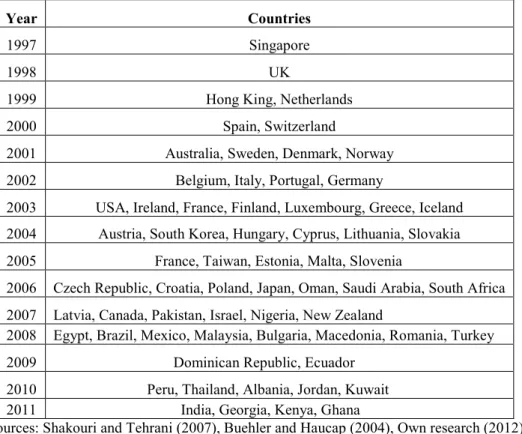
Singapore was the first country in the world to have implemented Mobile Number Portability (MNP) in 1997 (Infocomm Development Authority (IDA) and now over 60 countries have since implemented the concept. The table 2.0 below shows MNP implementation by year and country. The implementation of mobile number portability takes different forms in different countries, depending on the peculiar regulation regime of individual countries. However, the international best practice, particularly in Europe and Asia, is for a customer wishing to port his/her number to contact the new provider, who is the recipient.
The recipient will then arrange the necessary process with the old provider, who is the Donor. That process is known as 'Recipient-Led' porting. This system of porting works around the globe except in the United Kingdom (UK).
Table 1.0 Countries that have implemented mobile number portability across the Globe
Year Countries
1997 Singapore
1998 UK
1999 Hong King, Netherlands
2000 Spain, Switzerland
2001 Australia, Sweden, Denmark, Norway 2002 Belgium, Italy, Portugal, Germany
2003 USA, Ireland, France, Finland, Luxembourg, Greece, Iceland 2004 Austria, South Korea, Hungary, Cyprus, Lithuania, Slovakia 2005 France, Taiwan, Estonia, Malta, Slovenia
2006 Czech Republic, Croatia, Poland, Japan, Oman, Saudi Arabia, South Africa 2007 Latvia, Canada, Pakistan, Israel, Nigeria, New Zealand
2008 Egypt, Brazil, Mexico, Malaysia, Bulgaria, Macedonia, Romania, Turkey 2009 Dominican Republic, Ecuador
2010 Peru, Thailand, Albania, Jordan, Kuwait 2011 India, Georgia, Kenya, Ghana
Sources: Shakouri and Tehrani (2007), Buehler and Haucap (2004), Own research (2012)
The challenges faced by the UK telecom regulator and other regulators around the world guided the telecom operator in Ghana in deciding the particular kind of porting system it would adopt when MNP comes onboard. It was obvious that Ghana implemented the Recipient-led porting system as it is the main international standard now. Again Ghana opted for this system because it is subscriber friendly and also because it makes MNP meaningful.
2.0 Methodology
To achieved the objective of determining the effect of mobile number portability on the subscribers’ in Ghana and to identify the factors that determine the network switching behavior of mobile subscribers. In line with this, (Dix, Finlay, Abowd, & Beale, 1998) states that the best way to find out how a system meets users requirement and expectation is to ask the users their views on the effects of Mobile Number Portability. This survey uses the query techniques to obtain information from the respondents. However, the use of questionnaires is an inexpensive way to gather data from potentially large number of respondents. The use of questionnaires is feasible way to reach quite a number of reviewers large enough to allow statistical analysis of the results. A simple purposive survey was used in study the researcher concentrated on the impact of Mobile Number Portability on subscribers' behaviors and perceptions in Ghana – using Kumasi metropolis as a case study, this study is based on primary data. The survey method which was employed in gathering information from respondents consists of direct visitation, observation, interviews and questionnaires. A non-formal interview was conducted by asking operational managers of the various network operators about their views and strategies post MNP implementation etc.
2.1 Conceptual Framework Extension
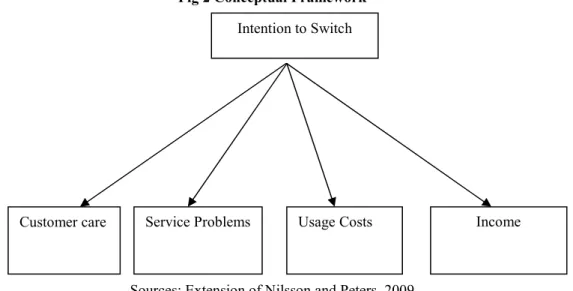
The conceptual framework in below fig 2.0 is an extension of the work done by Nilsson and Peters (2009) which was designed to help estimate the impact of switching characteristics (customer care, service problem, usage costs and income) on subscribers’ intention to switch from one network to another.
Fig 2 Conceptual Framework
Sources: Extension of Nilsson and Peters, 2009
This conceptual framework was designed to enable the researcher find out how variations in these switching characteristics (customer care, service problem, usage costs and income) influence subscribers switching behaviour following the implementation of mobile number portability in Ghana.
Model specification Model 1 S = f (C, P, U, I) S = β1 + β2 C + β3 P+ β4 U + β5 I + µ …….. Where,
S = Switching preference, C = Customer service, P = Service problems, U = Usage costs
I = Income, µ = Is white noise (include all omitted variables that can influence the dependent variables)
βs, = Parameters to be estimated to measure the impact of Customer service, service problems, usage costs and income on switching preference.
3.0 Analysis and Discussion of Empirical Results 3.1 Tools of Analysis (The Logit Regression Equation)
This session explores the impact of switching factors (income, customer service, service problems and usage costs) on the probability that subscribers are willing to switch or remain with the same network operator. Thus, the model has a qualitative dependent variable with binary or dichotomous responses. The questionnaires were
Intention to Switch
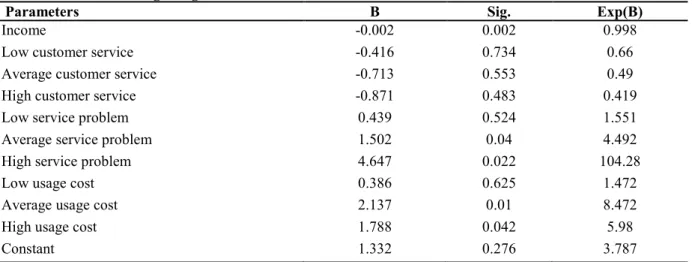
coded and entered into Statistical Package for Social Scientist (SPSS version 16) where regression analysis was carried out. The SPSS (version 16) result of the Logit regression is used to estimate the model in equation 3.0 and the result is contained in table 3.0 below. From Logit regression a proper interpretation of the coefficients is done by exponentiating the coefficient and interprets them as odd ratios.
Table 2.0: The SPSS Logit Regression Result
Parameters B Sig. Exp(B)
Income -0.002 0.002 0.998
Low customer service -0.416 0.734 0.66
Average customer service -0.713 0.553 0.49
High customer service -0.871 0.483 0.419
Low service problem 0.439 0.524 1.551
Average service problem 1.502 0.04 4.492
High service problem 4.647 0.022 104.28
Low usage cost 0.386 0.625 1.472
Average usage cost 2.137 0.01 8.472
High usage cost 1.788 0.042 5.98
Constant 1.332 0.276 3.787
Cox & Snell R square: 0.589 , Nagelkerke R square: 0.825 Wald chi- square: 97.853, sig. : 0.000
Source: Authors from field survey data, 2012 .
3.2 Income
From table 2.0 below, there is a negative relationship between willingness to switch and the income of the respondents and this is also statistically significant. The negative relationship between willingness to switch and the income of customers indicate that as income of customers increases they will not be willing to switch but remain with the same network operator (i.e. switching will decrease). With GH¢1.00 increase income, mobile subscribers are 0.998 times(e- 0.002 = 0.998) more not willing to switch to different network.
3.3 Customer service
Generally on customer service, the result from table above indicate that high customer service, average customer services and low customer services were however not statistically significant in determining the willingness of network subscriber to switch or remain with the same network provider.
3.4 Service Problems
Estimates from table 2.0 suggest that there is a positive relationship between willingness to switch and the high service problems and average service problems and this is statistically significant. The positive relationship between willingness to switch and the high service problems and average service problems means that as high and average service problems crops up, subscribers will be more willing to switch and not remain with the same network operator. The results show that subscribers are 104.280 times (e 4.647 = 104.280) and 4.492 times (e 1.502= 4.492) more willing to switch to different network if high service problems average service problems respectively increases. Low services problem was however not statistically significant in determining the willingness of network subscriber to switch or remain with the same network provider.
3.5 Usage Cost
It is clear from table 2.0 that there is a positive relationship between willingness to switch to different network and the high usage cost and average usage cost and this is statistically significant. This means that as usage cost increases subscribers will be more willing to switch and not remain with the same network operator. The results show that subscribers are 5.980 times (e 1.788 = 5.980) and 8.472 times (e 2.137= 4.492) more willing to switch to different net-work if high average usage cost increases. However low usage cost was not statistically significant in determining the willingness of network subscriber to switch or remain with the same network provider. The chi-square value of 97.853 indicates that the independent variables (Income, Service problems, Usage cost and Customer service) explain changes in dependent variable (switching preference) by 97.85%. The Cox and Snell’s R2 (0.589) and Nagelkerke’s R2 (0.825) which measure compares the actual results obtained from respondents to the outcome predicted by the model. These two R2s accounting (0.589 for Cox and Snell’s R2 and
0.825 for Nagelkerke’s R2) are above 0.5 and therefore the model’s explanatory power is high, though 1.0 is the ideal case. Perhaps there may be other more explanatory variables that may also account for the switching preference of subscribers in the era of mobile number portability.
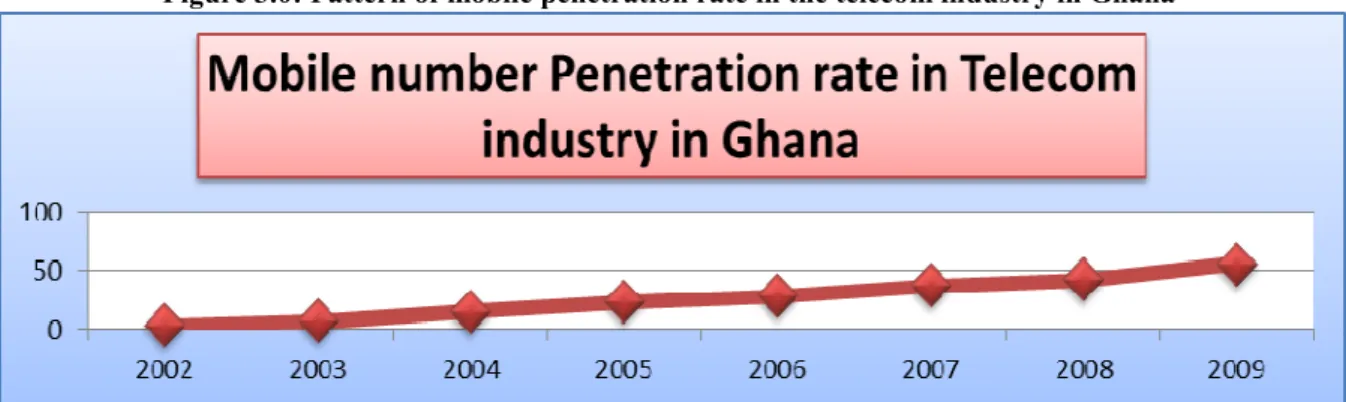
Table 2.1. Trend in the Ghanaian telecommunication industry
Year 2002 2003 2005 2006 2007 2008 2009 2010
Subscriber number (thousands) 1641 3180 6910 13983 23443 26816 29045 32342 Penetration rate (%) 3.6 7.2 15.1 23.2 28.3 36.8 41.9 5.5 Sales (million USD) 6.4 13.7 21.6 33.9 50.5 70.1 86.4 107..3 Sources: The National Communications Authority (NCA) last quarter Report of 2011..
Some of the most noteworthy current developments in the Ghanaian mobile telecommunication services are the start of 3G (third-generation) services which give users up to 2 Mbps download speed on mobile networks. This has propelled explosive growth of wireless Internet in Ghana. Internet is showing sharp growth, boosted by the advance of mobile telecommunication technology, the extensive diffusion of mobile devices capable of connecting to the wireless
Internet and colour LCD display, mobile devices (HSPA USB modems, Ipads, palm top e.tc), and diversification of digital content. The wireless Internet market grew from 2.0% of total mobile telecommunication services sales in 2002, to 30% in 2000.
Figure 3.0: Pattern of mobile penetration rate in the telecom industry in Ghana
Source: The National Communications Authority (NCA) last quarter Report of 2011.
Information retrieved from the management of 5 network operator (Tigo, MTN, expresso, Vodafone and Airtel) indicates consensual opinions on Mobile Number Portability. They were of the view that Mobile Number Portability is a facility that allows a network subscriber to keep all their 10 digit numbers when they move from one network operator to another. It was revealed that all the respondents affirm fact that Mobile Number Portability is a laudable and appropriate policy initiative in the telecommunication sector. In justifying their position, they contended among other thing that, Mobile Number Portability give flexibility to network subscribers in those subscribers can now associate with a network provider that can give them what they want. It also reward network operator the ability to win subscribers if the improve quality of service. They agreed that Mobile Number Portability ensures and provides a level playing field for the network operators. Respondents were of the view that subscribers port their number with the view of moving away from bad network providers and to get better deal in price and quality of service delivery.
In the issuing wake of Mobile Number Portability, managements of various network operators have adopted some operational strategies in order to benefit from Mobile Number Portability. While some network providers are providing best of communication service at most affordable price, better network coverage, fast data service to outwit their competitors are adopting promotional strategies to win more customers. Respondents were asked to indicate whether they have been able to achieve their objectives after putting those operational strategies in the wake of mobile number portability. While some argued that more subscribers have ported to their network and others are still joining their network on daily basis, others also contended that their objectives are being achieved since their subscription rate is increasing gradually throughout the month.
Within the context of telecommunication industry, the concept of mobile number portability have has so far achieved a fierce competition in the market and this is seen in the area of continue decrease in prices and
increase in promotional activities. It has also led to efficiency among network operators in the market. They recommended that National Communications Authority should do more education and assist to reduce the porting duration in order to help and lure more subscribers to port.
They concluded that generally, the concept of mobile number portability is a good and innovative technology which offers great opportunity to subscribers and network providers alike especially new entrants.
3.6 The Effects on Competitive Strategy Adopted Network Operators in Ghana
Network operators in the Ghana telecom industry clearly anticipated an increase in customer churn and the possibility of a price war when mobile number portability (MNP) is implemented. Industry expert indicate that cellular operators should start positioning themselves for MNP by aligning itself with their service offerings in such a way that it makes a positive difference for their subscribers. They made the call on the assertion that MNP increases subscriber choice and maximizing competition. The implementation of MNP in many other developed cellular markets has increased churn rates since it gives consumers the ability to change service providers without changing their cell phone numbers. The 2012 1st quarter National communication authority report also indicates that Ghana telecom industry is now facing marketing frenzy as operators seek to maneuver each other with cheaper and more innovative packages, thus forcing tariffs down. Expert believed that MTN and Vadafone have been able to attract increase in subscribers following MNP because they simply regard MNP as a new addition to their service portfolios rather than employing strategies based on defensive or negative tactics. Based on experience, they were of the view that subscribers usually churn if they are unhappy with an operator's customer care, service portfolio or unattractive tariff rates. For this reason, building a strong brand and forging close relationships with existing customers are the fundamentals in overcoming churn. Dewenter and Haucap (2005) asserted that the best practices and international experience with MNP suggest that operators can only benefit if they undertake a stringent network optimization exercise and develop an updated marketing plan with emphasis on customer retention and value-added services for the enterprise and mature segments.
In Ghana telecom market, network operators are beginning to assess their strategy as the markets start to saturate and the importance of customer retention increases. To overcome market demands and the impact it will have on the service players, operators are advised to look deep into traffic and revenue growth, focusing on segmentation and VAS portfolios as a means to subscriber retention.
4.0 Findings
The current findings provide new and important information regarding the relationship between subscribers switching intentions and switching characteristics (usage cost, service problem, customer care and income). Although Cox and Snell’s R2 (0.177) and Nagelkerke’s R2 (0.320) were low, some of the estimated coefficients of explanatory variables were significant at 5% level.It was found that there is a negative relationship between willingness to switch and the income of the respondents and this was statistically significant. High customer service, average customer services and low customer services were however not statistically significant in determining the willingness of network subscriber to switch or remain with the same network provider. Again, there was positive relationship between willingness to switch and the high service problems and average service problems and this was statistically significant. It is clear from the result that there is a positive relationship between willingness to switch to different network and the high usage cost and average usage cost and this is statistically significant.
5.0 Conclusion
Information retrieved from the management of five network operator (Tigo, MTN, expresso, Vodafone and Airtel) indicates that all the respondents affirm the fact that Mobile Number Portability is a laudable and appropriate policy initiative in the telecommunication sector. They argued that the facility give flexibility to network subscribers in that those subscribers can now associate with a network provider that can give them better quality of service. Managements of various network operators have adopted some operational strategies in order to benefit from Mobile Number Portability. They include providing best of communication service at most affordable price, better network coverage, and fast data service to outwit their competitors are adopting promotional strategies to win more customers. Mobile Number Portability has brought fierce competition in the market and this is seen in the area of continue decrease in prices and increase in promotional activities.
In conclusion, I recommended that National Communications Authority should do more education and assist to reduce the porting duration in order to help and lure more subscribers to port. I concluded that generally, the concept of mobile number portability is a good and innovative technology which offers great opportunity to subscribers and network provider’s alike especially new entrant’s operational strategies in order to benefit from
Mobile Number Portability.
6.0 References
[1] Anton, U. (2007). The impact of switching costs on the customer satisfaction-loyalty link: Mobile phone service in France. Journal of Services Marketing, 15(1), 35–48.
[2] D. Ofori, Haiyan and Zhu (2013). The research on the effect of mobile subscribers’ perception and behavior on Mobile Number Portability (International Conference on Innovation and management Science Paper)
[3] Lin F. L. (2010). Why customers stay: Measuring the underlying dimensions of services switching costs and managing their differential strategic outcomes. Journal of Business Research, 55, 441–450
[4] Lyons H. G. (2006) “Price Competition with Reduced Consumer Switching Costs: The Case of “Wireless Number Portability” in the Cellular Industry.” Working Paper, The University of Toronto.
[5] Maicas et al., (2009) Mobile Number Portability. Journal of Industry, Competition and Trade 4:3, pp. 223
[6] National Communication Authority, “Mobile Number Portability Statistics for 2011.
[7] National Communication Authority (NCA), Annual Reports 2008 -2011
[8] Nilsson, C. (2011). “Number Portability For GSM- To GSM Networks In FNR”, Ericsson, Internal reference: 4/155 17-ANT 307 01/7
[9] Nilsson R. T. and Peters N. (2009). Competition when Consumers have Switching Costs: An Overview with Application to Industrial Organization, Macroeconomics, and International Trade,” The Review of Economic Studies, Vol. 62, No 4, 515-539
[10] Omotayo G. H.and Joaching T. (2008),The Advantage of Network Size in Acquiring New Subscribers: a Conditional Logit Analysis of the Korean Mobile Telephony Market, Information Economics and Policy, No 15, 17-33
[11] Park R. (2009). A test of services marketing theory: Consumer information acquisition activities. Journal of Marketing, 55, 10–25.
[12] Russell E. (2010) “Switching Costs: Annex B – Review of empirical methods for identifying and measuring Switching Costs,” Report prepared for the Office of Fair Trading and the Department of Trade and Industry by National Economic Research Associates.
[13] Shin O. (2006) Switching barriers in consumer markets: An investigation of the financial services industry. Journal of Consumer Marketing, 18(4), 323–347.
[14] Saueborn et al (2008) “The Effect of mobile Number Portability on Switching Costs in the Telecommunication Industry,” Working Paper, The University of Wisconsin-Madison.