20th EURO Mini Conference
“Continuous Optimization and Knowledge-Based Technologies” (EurOPT-2008)
May 20–23, 2008, Neringa, LITHUANIA
L. Sakalauskas, G.W. Weber and E. K. Zavadskas (Eds.): EUROPT-2008 Selected papers. Vilnius, 2008, pp. 462–467 © Institute of Mathematics and Informatics, 2008 © Vilnius Gediminas Technical University, 2008
APPLICATION OF METAMODELLING FOR INFORMATION SYSTEMS ENGINEERING Gražina Kalibataitė
Kaunas University of Technology, Information Systems Department Studentu 50, Kaunas, Lithuania
E-mail: [email protected]
Abstract: The article deals with the problems of company activity computerization and usage of the knowledge, problem of conformity between business and information systems as well as problems of the knowledge management in activity of organizations. It strives highlighting the problems related to insuf-ficient usage of knowledge that is one of the most valuable recourses, stating of reasons that complicate information management processes. Also it discusses the problems of information integration, possibili-ties to use metadata in information systems. Conception of metadata as well as assumptions of its origin is discussed in the article, too. The article points up the role of metadata in an organization activity as well as technology to manage it, importance to computerize the knowledge management.
Keywords: metadata, metamodeling, enterprise modeling, information system modeling. 1. Introduction
Activity of enterprises more and more depends on the knowledge – one of the most valuable re-sources they possess. Enterprise knowledge is a very important clue that is necessary while supporting business processes, reacting quickly and adequately towards changing environment conditions. Enter-prises need unanimous, precise and permanent business information but knowledge submission and usage requires some basis of meta-knowledge, knowledge conception, and usage of representation and struc-tural methods.
Modern organizations vitally need implementing processes and technologies to distribute and use the knowledge. That is why the aim of the knowledge managing is to make teamwork easier using perma-nently increasing information flows as well as manage them. Business processes could become more ef-fective if using different knowledge management methodology. Knowledge in the activity of organiza-tions reverts into different shapes and it becomes more complicated to manage them. Quick and easy approach to the knowledge becomes more and more pressing for organizations. Organizations encounter problems of knowledge using and managing:
• to find the ways to reflect the possessed knowledge;
• to organize approach to the information and make it convenient for a user; • increasing number of distributed non-integrated systems.
Integration problems are problems of today. Activity of modern industrial enterprises in a market is determined by variety of products and technologies. Usually they have to apply products to rapidly changing customer demands. Modern company joins different, heterogeneous information systems that work autonomic, are distributed and should be integrated. Different company departments often use dif-ferent programmed equipment that have their own data sets and the aim of the enterprise activity integra-tion is to join all enterprise informaintegra-tion technologies (IT) systems, business processes and job places on the basis of IT.
Metadata is a highly important compound of enterprise activity information systems (IS). Today’s pressing problem is that every modern enterprise is overfilled by data. It is very important for companies to have a possibility to identify resources, their origin, semantics and ways to the information approach. Metadata is the resource of such information. The problem is that different enterprise departments use different sets of data support instruments. Metadata fits each such set and that is why it is impossible to relate some information changes with one another. For solving this problem enterprises need metadata integrated projects but most part of enterprises do not have clear strategy to be used with metadata. Using metadatabases model is one of the ways to carry out enterprise IT integration on the basis of knowledge; effective way to reach general enterprise information resources, carry out business data analysis more
precisely and quickly, determine and evaluate the enterprise data changes, manage information resources. The aim of metadatabases model is to achieve information integration between distributed and heteroge-neous systems, let those systems work together. The object of the article: reveal peculiarities of organiz-ing activities of modern enterprises: orientation towards knowledge, active their usage as well as pressorganiz-ing problems related to the knowledge usage; show metadatabases model is one of possible ways to increase effectiveness of an enterprise system.
2. Enterprise function computerizing and knowledge
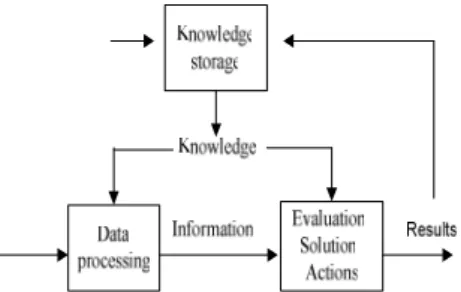
Talking about enterprise modeling, it is important to know it‘s importance and difference between data and information. Unless it is not known it will not be easy to understand information modeling sys-tem and it‘s efficiency.However today’s’ computer systems are working on the information and not on knowledge. Constantly changing outside and growing request makes difficult to control nowadays com-pany. Enterprises must have solid and constant business information (BI software, 2007). Organization knowledge is a cure, which helps to hold up business and allows to react adequate and quickly to volatile environmental conditions (Zalieckaitė, Mikalauskienė, 2007). Knowledge must be separated from data and information (Fig. 1). Data contains figures, facts, views and sounds. It is information stock for subject use and which helps it to get significant information (Bellinger, Castro, Mills, 2004; Kėdaitienė, 1999).
Fig. 1. Connection with data, information and knowledge
Talking about „organization knowledge“, it is considered to talk about the useful company informa-tion taking no count of its form and where it is hold. In estimainforma-tion of many authors knowledge is to be very important unit analysing information integration (Brazaitis, Brazaitienė, 1999; Inform, 2002; Kė-daitienė, 1999):
• Enterprise ability to use its immaterial property is coming major in compare with the ability of inves-tation and material property management ;
• Knowledge is used to process data and to make the information; • People have to do estimation, take decision and do the action;
• Knowledge ensure enterprise hardly transfered competitive advantage source;
• Development of new products, services and operations based on knowledge turns to the main inter-nal function of the enterprise.
3. Business and information system conformity problem
Disposable knowledge increasibly depends from different people, enterprise activity and its effective usage, which is the most valuable resource. Unfortunately, the means used to present the knowledge are not perfect. The essential importance for nowadays enterprises is to introduce processes and technologies, which could use the knowledge and distribute them. There are three essential knowledge ruling compo-nents (Prabhakaran, Chou, 2006; Попов, Фоминых, 2005):
• People, who give their experience to form new ideas;
• Processes, which are used for the whole information use and propagation; • Technologies, which effect to people and process work..
The other business processes could be more effective if to use various knowledge ruling methods. However knowledge ruling idea is not exactly structured yet (Попов, Фоминых, 2005). Mostly all com-panies operate huge quantity of result information and practical experience concentrated in data base, do-cument storage, e-mails, sales reports and of course in workers‘ mind. The problem is to organise access to this data and to give convenient form to user. The other problem is, that enterprises are using different
production systems, specialised in special areas for different purposes. This is why large quantity of dis-tributed not integrated systems is growing (Harjinder, 2000).
4. Knowledge outlook control and main principles
There are lots of knowledge forms in the enterprise activity, so it is hard to control them. Today knowledge control is connected with information and communication technology, which warrants knowl-edge processing, running and receiving. Enterprise knowlknowl-edge control objects (Joseph, 1999): to increase the knowledge quantity of its workers and to increase the possibility to share it. These principles are the same for all nowaday enterprises. Knowledge control model must be set to control enterprise knowledge. Knowledge control is the use of technologies in the way to reach propper and accessible information, in despite of its creation and storage place. The technologies must be addapted to the conditions (Brown, Duguid, 2004).
Enough plenty quantity of enterprise knowledge is noticed in business process and information struc-ture, which is the main knowledge control element. So it is why the business process models usage makes Activity Based Costing creation faster and gives conditions to pass the ActivityBased Management.
Knowledge based system is supposed to be computer programm with declarative knowledge base, which contains encoded human knowledge for solving the problems Knowledge base contains all the rules (rule-base) and most of the facts (Maskeliūnas, 2006). Usage motivation helps preserve knowledge-builds up the corporate memory of the firm. The main knowledge ruling object is – extraction, storage, concentration and effective usage.
5. Enterprise integration problems
Essential aspect of information system modeling belongs to integrity. Enterprise activity integrity plays huge role in IT systems base connection with IT systems, business process and working places. Main creation problems of integrated information systems are:
• It is hard to change data and knowledge in integrated systems due to tight infrastructures (business rules), integrated use;
• Business rules influence some business area and force for change all connected information and pro-gramm systems;
• Particular programm system can use different business rule systems and methods of their formalisation; • When the business changes occur, program systems must be modified newly going through the
whole system engineering cycle which takes long time;
• Business system could be changed periodically, so interative modification is necessary at once in se-veral systems.
Integrated account data control is expressed by: onetime data record and multiplex its usage, inte-grated index cast after data processing and initial data use for effective result information count.
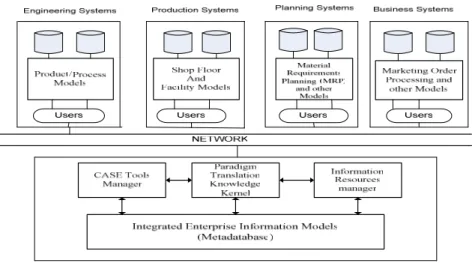
The meta-model system is envisioned to not only support CASE tools management and paradigm translation, but also utilize the resultant metadata capabilities to directly facilitate the management of ap-plication information systems across the enterprise (Fig. 2).
Metadata storage could be good architectural solution for the whole enterprise information integra-tion. To avoid difficulties in usage, such requirements must be followed: fast reach and flexibility, capa-bility, extention, orientation to user, adjustment reaction and business modeling.
6. Using metamodeling for enterprise computerising 6.1. Metadata approach model
Metadata is very important in every information system. Every modern enterprise is stuffed with
da-ta. It could be found everywhere with reccurence in different places. Enterprise must have the possibility to identify source, reason, semantics and access ways to data. Metadata is the source of this information. In despite of this, organizations do not have dedicated programs to define their meta data strategies (Mu-ralidhar, 2005; Prabhakaran, M.; Chou, 2006). Metadatabase is the store of info on enterprise structure, application programms function, their operating, information model, base, interaction and information dynamics in the enterprise. Metadata base model foresees enterprise information system integration on knowledge base and is striving for iformation integration between distributed and not uniformed systems to ensure their joint work(Hsu, Rattner, 1993).
Metadata model. In computer science and related disciplines, metamodeling is the construction of a
collection of “concepts” within a certain domain (Wikipedia). There are several ways to choose meta-modeling data: creating special data model for work with it; use of egzisting models standards. Two stan-dard models are used: Open Information Model(OIM) and Common Warehouse Meta-Mode) (CWM). CWM describe metadata changes between store activity based on knowledge means and ruling based on knowledge. OIM–tai metadata specification, described in universal modeling language UML (Muralidhar, 2005). Data storage source could be releative or orientated to objects storage. There do exist long range of possibilities. One of solutions is central storage, where all metadata is kept (Fig. 3). Main items of me-tadata are stored in centralised storage: engineering meme-tadata, data base system ruling, activity and meta-data are connected to various processes.
Fig. 3. Architecture using centralized storage (Muralidhar, 2005) 6.2. Metadatabase management system
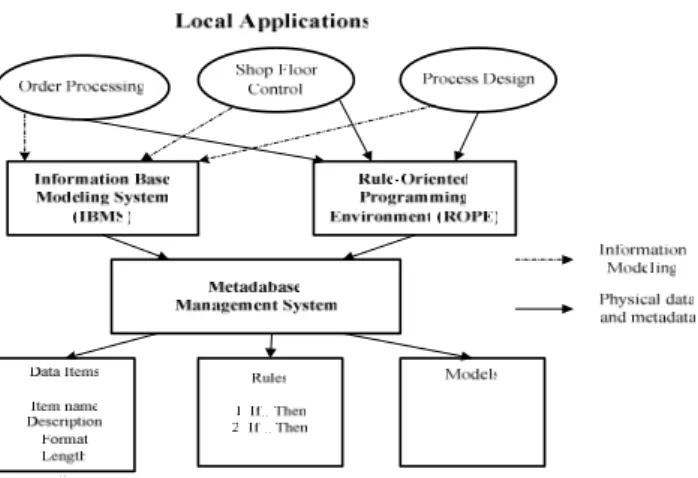
Main metadata ruling system structure (Fig.4): Metadatabase Management System (MDBMS); In-formation Base Modeling System (IBMS); Rule-Oriented Programming Environment (ROPE) (Hsu, Ba-bin, 1992).
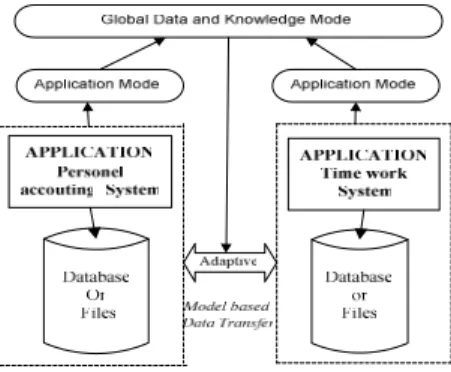
Metadatabase Management System is the conjunction of user and processor, which control infor-mation in metadata base. MDBMS contains three main elements: system connector, global request man-ager and metadata manman-ager.Information Base Modeling System is computerised software tool, which lets the system user design enterprise information system and collective information resource dictionary. Dictionary is metadata resource in automate setting, which directly provides metadata base with informa-tion. Rule-Oriented Programming Environment is such software, which ensures interaction between separate enterprise IS subsystem. This make a layer between metadata ruling system and local engineer-ing system. Based on rules software settengineer-ing is set to gather more system requirements. Main enterprise metadata base setting is based on parallel architecture (Hsu, Babin, 1992). Many efforts are put in systems integration to connect systems in data level i.e. to estimate, which data part is used and in which system. Using traditional information system integration method (Fig. 5) exact transferable data structure is to be used. Used metadata base in system integration (Fig.6) traditional model through exact encoding connec-tion chanels between systems is changed to data exchange model (based on knowledge and rules) (Hsu, Babin, 1992).
Fig. 5. Traditional Approach Fig. 6. Metadatabase Approach
to System Integration to System Integration
7. Conclusions
Article analyses industry information integration problems as well as a role of the metadatabases in the company information systems. Conception of metadatabases and its environment, presumptions of metadatabases, their role in the activity of an organization, importance of the informational management is discussed.
Today we face the problem, that lots of nowadays enterprises are fulfilled with data. You can find them everywhere and most of them are the same occur in several places. Many enterprises have no straight metadata usage strategy. Enterprises must save the possibility to identify sources, their origin, semantics and the data approach sources. Metadata is the main source of getting this information and mo-re it is very important component of every information system. Although metadata is not universal data ruling tool, which could demonstratively improve data analysis quality in the enterprise and at the same time influence growing work effectiviness. Metadata is used to decrease complication, expand queries and to do multiflex data analysis.
References
BI software company. 2007. Pagrindinės kompanijų problemos. Available from Internet:
<http://www.cee.businessobjects.com/global/resources/partners/Business%20Objects_Bukletas_Lt.doc.>. Brazaitis, Z.; Brazaitienė, T. 1998. Verslo vadybos informacinės sistemos. Vilnius.
Bellinger, G.; Castro, D.; Mills, A. 2004. Data, information, knowledge and wisdom. Available from Internet: <http://www.systems-thinking.org/dikw/dikw.htm>.
Brown, J.; Duguid, P. 2004. Socialinis informacijos gyvenimas. Vilnius.
Joseph, M. F. 1999. Enterprise knowledge management modeling and distributed knowledge management systems.
Available from Internet: <http://www.dkms.com/papers/ekmdkms.pdf>.
Harjinder, S. G. 2000. The case for enterprise business model management. DM Review Magazine. Available from Internet: <http://www.dmreview.com/issues/20001201/2789-1.html>.
Hsu, C.; Babin, G.; Bouziane, H.; Cheung, W.; Rattner, L.; Rubenstein, A. 1992. The metadatabase approach to in-tegrating and managing manufacturing information systems, Journal of Intelligent Manufacturing 333–349. Available from Internet:<http://viu.eng.rpi.edu/publications/mdbapp.pdf>.
Hsu, C.; Rattner, L. 1993. Metadatabase solutions for enterprise information integration problems, ACM Database, 23–35. Available from Internet: <http://portal.acm.org/citation.cfm?id=154424&coll=portal&dl=ACM>. Hsu, C.; Tao, Y. C.; Bouziane, M.; Babin, G. 1993. Paradigm translations in integrating manufacturing information
using a meta-model: The TSER Approach. Information Systems Engineering, France 1(3): 325–352. Available from Internet: <http://viu.eng.rpi.edu/publications/paratra.pdf>.
Informacinių sistemų kūrimo metodika. 2002. Available from Internet: <http://www.ivpk.lt/teises_aktai/ files/15.pdf>.
Kėdaitienė, A. 1999. Marketingo tyrimų informacija: mokomoji knyga. Metodinis leidybinis centras.
Maskeliūnas, S. 2006. Žinių technologijų pagrindinių terminų žodynėlis, Nr. 35. Matematikos ir informatikos insti-tutas. Available from Internet: < http://www.likit.lt/?i=klausimai/atsakymai>.
Muralidhar, P. 2005. Meta data management in the enterprise. DM Review Magazine. Available from Internet: <http://www.dmreview.com/article_sub.cfm?articleId=1032598>.
Prabhakaran, M.; Chou, C. 2006. Semantic integration in enterprise information management, SETLabs 4(2 Oct– Dec): 45–52. Available from Internet: <http://www.infosys.com/research/publications/SETLabs-briefings-enterprise-IT.pdf>.
Understanding Metadata. 2004. Published by: NISO Press National Information Standards Organization. Available from Internet: <http://www.niso.org/standards/resources/UnderstandingMetadata.pdf>.
Waddington, D. 2004. An architected approach to integrated information. Available from Internet: <http://hosteddocs.ittoolbox.com/DW041505.pdf>.
Wikipedia meta-modeling. Available from Internet: <http://en.wikipedia.org/wiki/Meta-modeling>.
Zalieckaitė, L.; Mikalauskienė, A. O. 2007. Organizacijos žinių struktūrų ir jų vadybos prieigų analizė, Informacijos
mokslai 41: 42–57. ISSN 1392–0561.
Попов, Э. В.; Фоминых, И. Б.; Харин, Н. П.; Виньков, М. М. 2005. Управление знаниями: Аналитический обзор. Available from Internet: <http://www.rfbr.ru/pics/20742ref/uprznan.pdf>.