Operations Support System Interface Specification
SP-OSSIv2.0-I02-020617
ISSUED
SPECIFICATION
Notice
This document is a cooperative effort undertaken at the direction of Cable Television Laboratories, Inc. for the benefit of the cable industry in general. Neither CableLabs nor any member company is responsible for any liability of any nature whatsoever resulting from or arising out of use or reliance upon this specification by any party. This document is furnished on an “AS IS” basis and neither CableLabs nor its members provides any representation or warranty, express or implied, regarding its accuracy, completeness, or fitness for a particular purpose.
© Copyright 1999-2002 Cable Television Laboratories, Inc. All rights reserved.
Document Status Sheet
Key to Document Status Codes
Work in Process An incomplete document, designed to guide discussion and generate feedback, that may
include several alternative requirements for consideration.
Draft A document in specification format considered largely complete, but lacking review by cable industry and
vendors. Drafts are susceptible to substantial change during the review process.
Issued A stable document, which has undergone rigorous member and vendor review and is suitable for product
design and development, cross-vendor interoperability, and for certification testing.
Closed A static document, reviewed, tested, validated, and closed to further engineering change requests to the
specification through CableLabs.
Document Control Number: SP-OSSIv2.0-I02-020617
Reference: Operations Support System Interface Specification
Revision History: I01 — First Issued Release, December 31, 2001
I02 — Second Issued Release, June 17, 2002
Date: June 17, 2002
Status Code: Work in
Process
Draft Issued Closed
Distribution Restrictions: CableLabs
only CL Reviewers CL Vendor Public
Contents
1 SCOPE AND PURPOSE...1
1.1 SCOPE...1 1.2 REQUIREMENTS...1 2 REFERENCES (NORMATIVE/INFORMATIVE) ...3 3 GLOSSARY (INFORMATIVE) ...7 4 ABBREVIATIONS ...17 5 SNMP PROTOCOL ...21
5.1 SNMP MODE FORDOCSIS 2.0-COMPLIANTCMTSES...21
5.1.1 Key Change Mechanism ...22
5.2 SNMP MODE FORDOCSIS 2.0-COMPLIANTCMS...22
5.2.1 SNMPv3 Initialization and Key changes ...23
5.2.2 SNMPv3 Initialization ...24
5.2.3 DH Key Changes ...25
5.2.4 VACM Profile ...25
6 MANAGEMENT INFORMATION BASES (MIBS) ...29
6.1 IPCDNDRAFTS AND OTHERS...30
6.2 IETF RFCS...30
6.3 MANAGED OBJECTS REQUIREMENTS...30
6.3.1 CMTS MIB requirements...31
6.3.2 Requirements for RFC 2669 ...31
6.3.3 Requirements for RFI-MIB-IPCDN-DRAFT ...31
6.3.4 Requirements for RFC 2863 ...31
6.3.5 Interface MIB and Trap Enable...34
6.3.6 Requirements for RFC 2665 ...34
6.3.7 Requirements for RFC 1493 ...34
6.3.8 Requirements for RFC 2011 ...35
6.3.9 Requirements for RFC 2013 ...35
6.3.10 Requirements for RFC 1907 ...35
6.3.11 Requirements for “draft-ietf-ipcdn-qos-mib-04.txt” ...35
6.3.12 Requirements for “draft-ietf-ipcdn-igmp-mib-01.txt”...35
6.3.13 Requirements for RFC 2933 ...35
6.3.14 Requirements for BPI+ MIB...36
6.3.15 Requirements for “draft-ietf-xxxx-xxxx-xxxx-00.txt” USB MIB...36
6.3.16 Requirements for Subscriber Management MIB ...36
6.3.17 Requirements for RFC 2786 Diffie-Helman USM Key...36
6.3.18 Requirements for RFC 3083 Baseline Privacy Interface MIB ...36
6.3.21 Requirements for SNMPv3 MIBs ... 37
6.4 CMCONFIGURATION FILES, TLV-11ANDMIB OIDS/VALUES... 37
6.4.1 CM configuration file TLV-11 element translation (to SNMP PDU) ... 37
6.4.2 CM configuration TLV-11 elements not supported by the CM... 38
6.4.3 CM state after CM configuration file processing success ... 38
6.4.4 CM state after CM configuration file processing failure ... 38
6.5 TREATMENT AND INTERPRETATION OFMIBCOUNTERS ON THECM ... 38
6.6 SNMPV3 NOTIFICATIONRECEIVER CONFIG FILE ELEMENT... 39
6.6.1 Mapping of TLV fields into created SNMPv3 table rows ... 39
7 OSSI FOR RADIO FREQUENCY INTERFACE ... 47
7.1 SUBSCRIBERACCOUNTMANAGEMENTINTERFACE SPECIFICATION... 47
7.1.1 Service Flows, Service Classes, and Subscriber Usage Billing ... 47
7.1.2 Requirements for Subscriber Usage Billing Records ... 48
7.1.3 Billing collection interval ... 50
7.1.4 Billing file retrieval model ... 51
7.1.5 Billing file security model ... 52
7.1.6 IP Detail Record (IPDR) standard ... 52
7.2 CONFIGURATIONMANAGEMENT... 55
7.2.1 Version Control... 56
7.2.2 System Initialization and Configuration ... 56
7.2.3 Secure Software Upgrades... 57
7.3 PROTOCOLFILTERS... 61 7.3.1 LLC filters ... 61 7.3.2 Special filters ... 61 7.3.3 IP spoofing filter ... 62 7.3.4 SNMP Access Filter ... 62 7.3.5 IP filter ... 63 7.4 FAULT MANAGEMENT... 63 7.4.1 SNMP Usage... 63 7.4.2 Event Notification ... 64
7.4.3 Throttling, limiting and priority for event, trap and Syslog ... 70
7.4.4 Non-SNMP Fault Management Protocols ... 71
7.5 PERFORMANCE MANAGEMENT... 71
7.5.1 Additional MIB implementation requirements ... 72
7.6 COEXISTENCE... 72
7.6.1 Coexistence and MIBs ... 72
7.6.2 Coexistence and SNMP... 75
8 OSS FOR BPI+... 77
8.1 DOCSIS ROOTCA... 77
8.2 DIGITALCERTIFICATEVALIDITYPERIOD ANDRE-ISSUANCE... 77
8.2.2 DOCSIS Manufacturer CA Certificate ...77
8.2.3 DOCSIS CM Certificate ...78
8.2.4 DOCSIS Code Verification Certificate...78
8.3 CM CODEFILESIGNINGPOLICY...78
8.3.1 Manufacturer CM Code File Signing Policy...78
9 OSSI FOR CMCI...81
9.1 SNMP ACCESS VIACMCI ...81
9.2 CONSOLEACCESS...81
9.3 CM DIAGNOSTICCAPABILITIES...81
9.4 PROTOCOLFILTERING...81
9.5 MANAGEMENTINFORMATIONBASE(MIB) REQUIREMENTS...82
ANNEX A DETAILED MIB REQUIREMENTS (NORMATIVE)...83
A.1 RFI-MIB-IPCDN-DRAFTIFTABLEMIB-OBJECT DETAILS...130
ANNEX B IPDR STANDARDS SUBMISSION FOR CABLE DATA SYSTEMS SUBSCRIBER USAGE BILLING RECORDS (NORMATIVE)...147
B.1 SERVICEDEFINITION...147
B.1.1 Service Requirements ...147
B.1.2 Service Usage Attribute List...148
B.2 EXAMPLEIPDR XML SUBSCRIBERUSAGEBILLINGRECORDS...150
B.2.1 Schema ...150
B.2.2 Sample Instance Document ...152
ANNEX C SNMPV2C INFORM REQUEST DEFINITION FOR SUBSCRIBER ACCOUNT MANAGEMENT (SAM) (NORMATIVE)...155
ANNEX D FORMAT AND CONTENT FOR EVENT, SYSLOG, AND SNMP TRAP (NORMATIVE)... 157 ANNEX E APPLICATION OF RFC 2933 TO DOCSIS 2.0 ACTIVE/PASSIVE IGMP DEVICES (NORMATIVE) ...203
E.1 DOCSIS 2.0 IGMP MIBS...203
E.1.1 IGMP Capabilities: Active and Passive Mode...203
E.1.2 IGMP Interfaces...203
E.2 DOCSIS 2.0 CM SUPPORT FOR THEIGMP MIB ...203
E.2.1 igmpInterfaceTable- igmpInterfaceEntry...204
E.2.2 igmpCacheTable - igmpCacheEntry ...208
E.3 DOCSIS2.0 CMTSSUPPORT FOR THEIGMP MIB ...210
E.3.1 igmpInterfaceTable- igmpInterfaceEntry...210
E.3.2 igmpCacheTable - igmpCacheEntry ...214
E.3.3 IGMP MIB Compliance ...217
ANNEX F EXPECTED BEHAVIORS FOR DOCSIS 2.0 MODEM IN 1.0, 1.1, AND 2.0 MODES IN OSS
AREA (NORMATIVE) ... 219
ANNEX G DOCS-IF-EXT-MIB (NORMATIVE) ... 223
ANNEX H DOCS-CABLE-DEVICE-TRAP-MIB (NORMATIVE)... 227
APPENDIX I BUSINESS PROCESS SCENARIOS FOR SUBSCRIBER ACCOUNT MANAGEMENT (INFORMATIVE) ... 243
I.1 THE OLD SERVICE MODEL: “ONE CLASS ONLY”AND“BEST-EFFORT”SERVICE... 243
I.2 THE OLD BILLING MODEL: “FLAT RATE”ACCESS... 243
I.3 A SUCCESSFULNEWBUSINESSPARADIGM... 243
I.3.1 Integrating "front end" processes seamlessly with "back office" functions ... 244
I.3.2 Designing Classes of Services ... 244
I.3.3 Usage-Based Billing ... 245
I.3.4 Designing Usage-Based Billing Models... 245
APPENDIX II SUMMARY OF CM AUTHENTICATION AND CODE FILE AUTHENTICATION (INFORMATIVE) ... 247
II.1 AUTHENTICATION OF THEDOCSIS 2.0-COMPLIANTCM ... 247
II.1.1 Responsibility of the DOCSIS Root CA... 247
II.1.2 Responsibility of the CM manufacturers... 248
II.1.3 Responsibility of the operators... 248
II.2 AUTHENTICATION OF THE CODE FILE FOR THEDOCSIS 2.0-COMPLIANTCM... 248
II.2.1 Responsibility of the DOCSIS Root CA... 249
II.2.2 Responsibility of the CM manufacturer ... 249
II.2.3 Responsibility of CableLabs... 250
II.2.4 Responsibility of the operators... 250
APPENDIX III ACKNOWLEDGMENTS (INFORMATIVE) ... 251
APPENDIX IV REVISIONS (INFORMATIVE)... 253
Figures
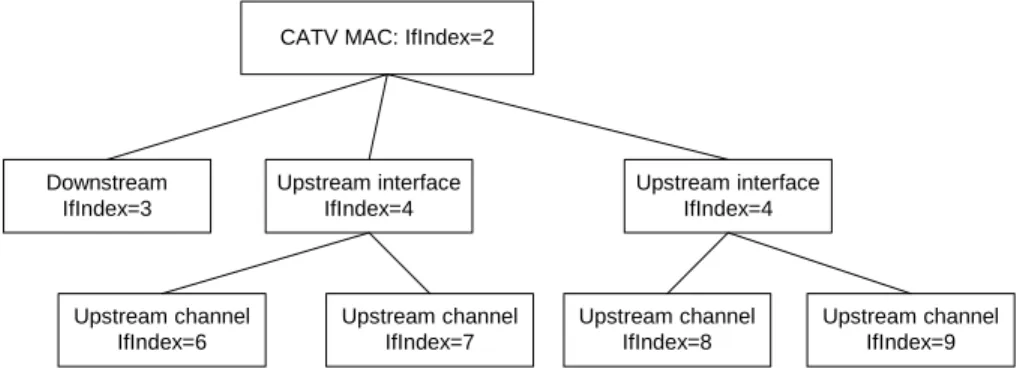
FIGURE6-1 IFINDEX EXAMPLE FORCMTS ...32
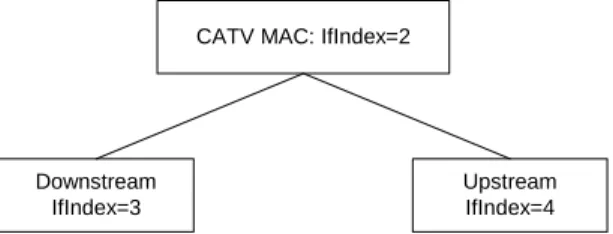
FIGURE6-2 IFINDEX EXAMPLE FORCM ...33
FIGURE7-1 COLLECTION INTERVAL TIME BASE...51
FIGURE7-2 IPDR BASICNETWORKMODEL(REF. [NDM-U 3.1]FROM WWW.IPDR.ORG) ...53
FIGURE7-3 IPDR XML ELEMENTHIERARCHY(REF. [NDM-U 3.1]FROM WWW.IPDR.ORG) ...54
FIGURE7-4 MANUFACTURER CONTROL SCHEME...57
FIGURE7-5 OPERATOR CONTROL SCHEME...58
FIGURE7-6 COEXISTENCE(DOCSIS 1.0MODE VS. DOCSIS 1.1MODE VS. DOCSIS 2.0MODE) ...72
FIGUREII-1 AUTHENTICATION OF THEDOCSIS 2.0-COMPLIANTCM ...247
Tables
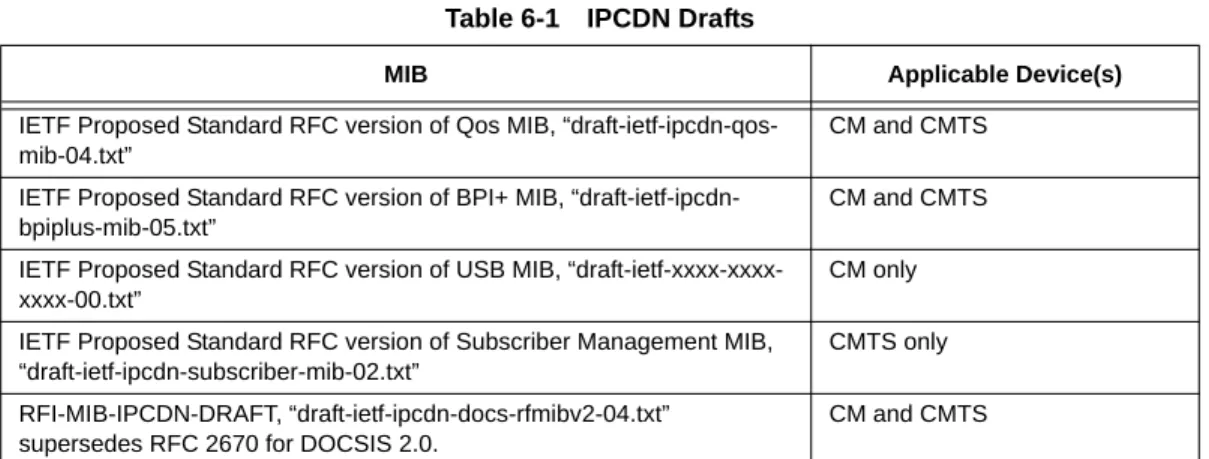
TABLE6-1 IPCDN DRAFTS...30
TABLE6-2 IETF RFCS...30
TABLE6-3 CMINTERFACE NUMBERING...33
TABLE6-4 DOCSIFCMSTATUSVALUE AND IFOPERSTATUS RELATIONSHIP...34
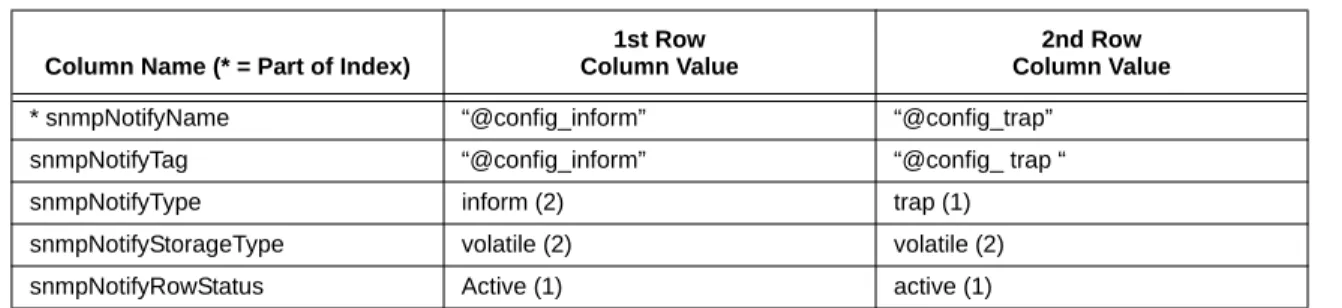
TABLE6-5 SNMPNOTIFYTABLE...40
TABLE6-6 SNMPTARGETADDRTABLE...40
TABLE6-7 SNMPTARGETADDREXTTABLE...41
TABLE6-8 SNMPTARGETPARAMSTABLE FOR<TRAP TYPE> 1, 2,OR3...41
TABLE6-9 SNMPTARGETPARAMSTABLE FOR<TRAP TYPE> 4OR5...42
TABLE6-10 SNMPNOTIFYFILTERPROFILETABLE...42
TABLE6-11 SNMPNOTIFYFILTERTABLE...42
TABLE6-12 SNMPCOMMUNITYTABLE...43
TABLE6-13 USMUSERTABLE...43
TABLE6-14 VACMSECURITYTOGROUPTABLE...44
TABLE6-15 VACMACCESSTABLE...45
TABLE6-16 VACMVIEWTREEFAMILYTABLE...45
TABLE7-1 SAMPLE DOCSDEVNMACCESSIP VALUES...63
TABLE7-2 DEFAULT EVENT PRIORITIES FOR THECABLEMODEM DEVICE...69
TABLE7-3 DEFAULTEVENT PRIORITIES FOR THECMTS DEVICE...69
TABLE7-4 MAXIMUMLEVEL OFSUPPORT FORCM EVENTS...70
TABLE7-5 MAXIMUMLEVEL OFSUPPORT FORCMTS EVENTS...70
TABLE7-6 DOCSIS 2.0 CM MODES ANDMIB REQUIREMENTS...73
TABLEB-1 SERVICEUSAGEATTRIBUTEVALUE NAMES...149
1
Scope and Purpose
1.1
Scope
This Specification defines the Network Management requirements to support a DOCSIS 2.0 environment. More specifically, the specification details the SNMPv3 protocol and how it coexists with SNMP v1/v2. The RFCs and Management Information Base (MIB) requirements are detailed as well as interface numbering, filtering, event notifications, etc. Basic network-management principles such as account, configuration, fault, and performance management are incorporated in this specification for better understanding of managing a high-speed cable modem environment.
1.2
Requirements
Throughout this document, the words that are used to define the significance of particular requirements are capitalized. These words are:
This document defines many features and parameters, and a valid range for each parameter is usually specified. Equipment (CM and CMTS) requirements are always explicitly stated. Equipment must comply with all mandatory (MUST and MUST NOT) requirements to be considered compliant with this specification. Support of non-mandatory features and parameter values is optional.
MUST This word or the adjective “REQUIRED” means that the item is an absolute requirement of this specification.
MUST NOT This phrase means that the item is an absolute prohibition of this specification. SHOULD This word or the adjective “RECOMMENDED” means that there may exist valid
reasons in particular circumstances to ignore this item, but the full implications should be understood and the case carefully weighed before choosing a different course. SHOULD NOT This phrase means that there may exist valid reasons in particular circumstances when
the listed behavior is acceptable or even useful, but the full implications should be understood and the case carefully weighed before implementing any behavior described with this label.
MAY This word or the adjective “OPTIONAL” means that this item is truly optional. One vendor may choose to include the item because a particular marketplace requires it or because it enhances the product, for example; another vendor may omit the same item.
2
References (normative/informative)
[DOCSIS 1] DOCSIS Cable Modem Termination System - Network-Side Interface Specification
SP-CMTS-NSI-I01-960702
[DOCSIS 2] DOCSIS Cable Modem to Customer Premise Equipment Interface Specification
SP-CMCI-I07-020301
[DOCSIS 4] DOCSIS Telephony Return Interface Specification SP-CMTRI-I01-970804
[DOCSIS 5] DOCSIS Radio Frequency Interface Specification SP-RFIv2.0-I02-020617
[DOCSIS 6] DOCSIS Baseline Privacy Plus Interface Specification SP-BPI+-I08-020301
[ID-IGMP] Fenner, W., IGMP-based Multicast Forwarding (“IGMP Proxying”), IETF Internet Draft, http://
www.ietf.org/internet-drafts/draft-fenner-igmp-proxy-03.txt.
[IETF3] draft-ietf-ipcdn-igmp-mib-00.txt, H. Abramson, “DOCSIS 1.1 IGMP MIB”, June 1999
[IETF4] draft-ietf-ipcdn-qos-mib-04.txt, Mike Patrick, “Data Over Cable System Quality of Service
Management Information Base”, Oct. 18, 2000
[IETF6] Proposed Standard RFC version of BPI+ MIB, “draft-ietf-ipcdn-bpiplus-05.txt”
[IETF7] Proposed Standard RFC version of USB MIB, “draft-ietf-xxxx-xxxx-xxxx-00.txt”
[IETF9] Proposed Standard RFC version of Customer Management MIB,
“draft-ietf-ipcdn-subscriber-mib-02.txt”
[NDM-U 3.1] “Network Data Management – Usage (NDM-U) For IP-Based Services”, Version 3.1, IPDR.org,
April 15, 2002.
[RFC 1157] Schoffstall, M., Fedor, M., Davin, J. and Case, J., A Simple Network Management Protocol
(SNMP), IETF RFC 1157, May, 1990
[RFC 1213] K. McCloghrie and M. Rose. Management Information Base for Network Management of TCP/
IP-base internets: MIB-II, IETF RFC 1213, March, 1991
[RFC 1224] L. Steinberg., Techniques for Managing Asynchronously Generated Alerts, IETF RFC 1224,
May, 1991
[RFC 1493] E. Decker, P. Langille, A. Rijsinghani, and K.McCloghrie., Definitions of Managed Objects for
Bridges, IETF RFC 1493, July, 1993
[RFC 1901] Case, J., McCloghrie, K., Rose, M. and S. Waldbusser, “Introduction to Community-based
SNMPv2”, RFC 1901, January, 1996.
[RFC 1903] Case, J., McCloghrie, K., Rose, M., and S. Waldbusser, “Textual Conventions for Version 2 of
the Simple Network Management Protocol (SNMPv2)”, RFC 1903, January, 1996.
[RFC 1905] Case, J., McCloghrie, K., Rose, M. and S. Waldbusser, “Protocol Operations for Version 2 of the
[RFC 1906] Case, J., McCloghrie, K., Rose, M. and S. Waldbusser, “Transport Mappings for Version 2 of the Simple Network Management Protocol (SNMPv2)”, RFC 1906, January 1996
[RFC 1907] Case, J., McCloghrie, K., Rose, M. and S. Waldbusser, “Management Information Base for
Version 2 of the Simple Network Management Protocol (SNMPv2)”, RFC 1907, January 1996.
[RFC 1952] Deutsch, P., “GZIP file format specification version 4.3”, RFC 1952, May, 1996.
[RFC 2011] K. McCloghrie, “Category: Standards Track SNMPv2 Management Information Base for the
Internet Protocol using SMIv2”, November 1996
[RFC 2013] K. McCloghrie, “Category: Standards Track SNMPv2 Management Information Base for the
User Datagram Protocol using SMIv2”, November 1996
[RFC 2132] S. Alexander, R. Droms. DHCP Options and BOOTP Vendor Extensions. IETF RFC 2132.
March, 1997.
[RFC 2233] K. McCloghrie, F. Kastenholz, “The Interfaces Group MIB using SMIv2”, November 1997
[RFC 2358] J. Flick, J. Johnson, “Definitions of Managed Objects for the Ethernet-like Interface Types”, June
1998
[RFC 2570] J. Case, R. Mundy, D. Partain, B. Stewart, “Introduction to Version 3 of the Internet-standard
Network Management Framework”, April 1999
[RFC 2571] Harrington, D., Presuhn, R. and B. Wijnen, “An Architecture for Describing SNMP Management
Frameworks”, RFC 2571, April 1999.
[RFC 2572] Case, J., Harrington, D., Presuhn, R. and B. Wijnen, “Message Processing and Dispatching for the
Simple Network Management Protocol (SNMP)”, RFC 2572, April 1999
[RFC 2573] Levi, D., Meyer, P. and B. Stewart, “SNMP Applications”, RFC 2573, April 1999.
[RFC 2574] Blumenthal, U. and B. Wijnen, “The User-Based Security Model for Version 3 of the Simple
Network Management Protocol (SNMPv3)”, RFC 2574, April 1999
[RFC 2575] Wijnen, B., Presuhn, R. and K. McCloghrie, “View-based Access Control Model for the Simple
Network Management Protocol (SNMP)”, RFC 2575, April 1999
[RFC 2576] R. Frye, D. Levi, S. Routhier, B. Wijnen, “Coexistence between Version 1, Version 2, and
Version 3 of the Internet-Standard and Network Management Framework”, RFC 2576, March 2000.
[RFC 2578] McCloghrie, K., Perkins, D., Schoenwaelder, J., Case, J., Rose, M. and S. Waldbusser, “Structure
of Management Information Version 2 (SMIv2)”, STD 58, RFC 2578, April 1999
[RFC 2579] McCloghrie, K., Perkins, D., Schoenwaelder, J., Case, J., Rose, M. and S. Waldbusser, “Textual
Conventions for SMIv2”, STD 58, RFC 2579, April 1999
[RFC 2580] McCloghrie, K., Perkins, D., Schoenwaelder, J., Case, J., Rose, M. and S. Waldbusser,
“Conformance Statements for SMIv2”, STD 58, RFC 2580, April 1999
[RFC 2669] M. St. Johns, “DOCSIS Cable Device MIB Cable Device Management Information Base for
[RFC 2670] M. St. Johns, “Radio Frequency (RF) Interface Management Information Base for MCNS/ DOCSIS compliant RF interfaces”, August 1999
[RFC 2786] stjohns-snmpv3-dhkeychange-mib-01.txt, Michael C. St. Johns, “Diffie-Helman USM Key MIB
August 1999 Diffie-Helman USM Key Management Information Base and Textual Convention”, Aug. 6, 1999
[RFC 2863] K. McCloghrie, F. Kastenholz, “The Interfaces Group MIB”, June 2000.
[RFC 2933] McCloghrie, K., Farinacci, D., Thaler, D., “Internet Group Management Protocol MIB”, RFC
2933
[RFC 3083] R. Woundy, “Baseline Privacy Interface Management Information Base for DOCSIS Compliant
Cable Modems and Cable Modem Termination Systems”, RFC 3083, March 2001.
[RFI-MIB-IPCDN-DRAFT] draft-ietf-ipcdn-docs-rfimibv2-04.txt, David Raftus, Aviv Goren, Radio
Frequency (RF) Interface Management Information Base for MCNS/DOCSIS compliant RF interfaces”, April, 2002.
3
Glossary (informative)
Active Service Flow An admitted Service Flow from the CM to the CMTS which is available for packet
transmission.
Address Resolution Protocol (ARP) A protocol of the IETF for converting network addresses to 48-bit
Ethernet addresses.
Admitted Service Flow A Service Flow, either provisioned or dynamically signaled, which is authorized and
for which resources have been reserved but is not active.
Allocation A group of contiguous mini-slots in a MAP which constitute a single transmit opportunity.
American National Standards Institute (ANSI) A US standards body.
Asynchronous Transfer Mode (ATM) A protocol for the transmission of a variety of digital signals using
uniform 53-byte cells.
A-TDMA DOCSIS 2.0 TDMA mode (as distinguished from DOCSIS 1.x TDMA).
Authorization Module The authorization module is an abstract module that the CMTS can contact to
authorize Service Flows and Classifiers. The authorization module tells the CMTS whether the requesting CM is authorized for the resources it is requesting.
Availability In cable television systems, availability is the long-term ratio of the actual RF channel operation
time to scheduled RF channel operation time (expressed as a percent value) and is based on a bit error rate (BER) assumption.
Bandwidth Allocation Map The MAC Management Message that the CMTS uses to allocate transmission
opportunities to CMs.
Bridge Protocol Data Unit (BDU) Spanning tree protocol messages as defined in [ISO/IEC10038].
Broadcast Addresses A predefined destination address that denotes the set of all data network service access
points.
Burst A single continuous RF signal from the upstream transmitter, from transmitter on to transmitter off.
Burst Error Second Any Errored Second containing at least 100 errors.
Cable Modem (CM) A modulator-demodulator at subscriber locations intended for use in conveying data
communications on a cable television system.
Cable Modem Termination System (CMTS) Cable modem termination system, located at the cable
television system head-end or distribution hub, which provides complementary functionality to the cable modems to enable data connectivity to a wide-area network.
Cable Modem Termination System - Network Side Interface (CMTS-NSI) The interface, defined in
[DOCSIS3], between a CMTS and the equipment on its network side.
Carrier Hum Modulation The peak-to-peak magnitude of the amplitude distortion relative to the RF carrier signal level due to the fundamental and low-order harmonics of the power-supply frequency.
Carrier-to-Noise Ratio (C/N or CNR) The ratio of signal power to noise power in the defined measurement
bandwidth. For digital modulation, CNR = Es/N0, the energy-per-symbol to noise-density ratio; the signal power is measured in the occupied bandwidth, and the noise power is normalized to the modulation-rate bandwidth. For video, the measurement bandwidth is 4 MHz.
CCCM CPE Controlled Cable Modem. Refer to the DOCSIS Cable Modem to Customer Premise Equipment Interface (CMCI) specification.
Channel The frequency spectrum occupied by a signal. Usually specified by center frequency and bandwidth
parameters.
Chip Each of the 128 bits comprising the S-CDMA spreading codes.
Chip Duration The time to transmit one chip of the S-CDMA spreading code. The inverse of the chip rate.
Chip Rate The rate at which individual chips of the S-CDMA spreading codes are transmitted. (1280 to 5120
kHz)
Classifier A set of criteria used for packet matching according to TCP, UDP, IP, LLC, and/or 802.1P/Q packet
fields. A classifier maps each packet to a Service Flow. A Downstream Classifier is used by the CMTS to assign packets to downstream service flows. An Upstream Classifier is used by the CM to assign packets to upstream service flows.
Code Hopping Matrix A shifted version of the reference code matrix (see below) that is used when code
hopping is employed to vary the codes used by each CM. The Code Hopping Matrix is either 128 rows by 128 columns (when all 128 codes are active) or is 127 rows by 128 columns (when less than 128 codes are active in the S-CDMA spreader-on frame). When less than 128 codes are active, Code 0 (all ones) is deleted from the matrix, but all remaining codes are still cycled through even if less than 127 codes are active in a frame.
Composite Second Order Beat (CSO) The peak of the average level of distortion products due to
second-order non-linearities in cable system equipment.
Composite Triple Beat (CTB) The peak of the average level of distortion components due to third-order
non-linearities in cable system equipment.
Cross-Modulation A form of television signal distortion where modulation from one or more television
channels is imposed on another channel or channels.
Customer See End User.
Customer Premises Equipment (CPE) Equipment at the end user’s premises; MAY be provided by the end
user or the service provider.
Data Link Layer Layer 2 in the Open System Interconnection (OSI) architecture; the layer that provides
services to transfer data over the transmission link between open systems.
Distribution Hub A location in a cable television network which performs the functions of a head-end for
customers in its immediate area, and which receives some or all of its television program material from a Master Head-end in the same metropolitan or regional area.
Drop Cable Coaxial cable that connects to a residence or service location from a directional coupler (tap) on the nearest coaxial feeder cable.
Dynamic Host Configuration Protocol (DHCP) An Internet protocol used for assigning network-layer (IP)
addresses.
Dynamic Range The ratio between the greatest signal power that can be transmitted over a multichannel
analog transmission system without exceeding distortion or other performance limits, and the least signal power that can be utilized without exceeding noise, error rate or other performance limits.
Electronic Industries Association (EIA) A voluntary body of manufacturers which, among other activities,
prepares and publishes standards.
End User A human being, organization, or telecommunications system that accesses the network in order to
communicate via the services provided by the network.
Engineering Change Notice The final step in the procedure to change specifications.
Engineering Change Order The second step in the procedure to change specifications. DOCSIS posts ECO
to web site EC table and ECO page (with indication of ECO Comment Deadline). DOCSIS issues ECO
announcement to DOCSIS-announce and working group mail lists (with indication of ECO Comment Deadline).
Engineering Change Request The first step in the procedure to change specifications. DOCSIS issues ECR
number, posts to web site EC table and ECR page. DOCSIS sends ECR to subject area working group mail list (and author).
Errored Second Any 1-sec interval containing at least one bit error.
Extended Subsplit A frequency division scheme that allows bidirectional traffic on a single coaxial cable.
Reverse path signals come to the head-end from 5 to 42 MHz. Forward path signals go from the head-end from 50 or 54 MHz to the upper frequency limit.
Feeder Cable Coaxial cables that run along streets within the served area and connect between the individual
taps which serve the customer drops.
Fiber Distributed Data Interface (FDDI) A fiber-based LAN standard.
Fiber Node A point of interface between a fiber trunk and the coaxial distribution.
Forward Channel The direction of RF signal flow away from the head-end toward the end user; equivalent to
Downstream.
Frame See MAC frame, S-CDMA frame, and MPEG frame.
Group Delay The difference in transmission time between the highest and lowest of several frequencies
through a device, circuit or system.
Guard Time Minimum time allocated between bursts in the upstream referenced from the symbol center of
the last symbol of a burst to the symbol center of the first symbol of the following burst. The guard time should be at least the duration of five symbols plus the maximum system timing error.
Harmonic Related Carrier (HRC) A method of spacing television channels on a cable television system in
Head-end The central location on the cable network that is responsible for injecting broadcast video and other signals in the downstream direction. See also Master Head-End, Distribution Hub.
Header Protocol control information located at the beginning of a protocol data unit.
High Frequency (HF) Used in this document to refer to the entire subsplit (5-30 MHz) and extended subsplit
(5-42 MHz) band used in reverse channel communications over the cable television network.
High Return A frequency division scheme that allows bi-directional traffic on a single coaxial cable. Reverse
channel signals propagate to the head-end above the downstream passband.
Hum Modulation Undesired modulation of the television visual carrier by the fundamental or low-order
harmonics of the power supply frequency, or other low-frequency disturbances.
Hybrid Fiber/Coax (HFC) System A broadband bidirectional shared-media transmission system using fiber
trunks between the head-end and the fiber nodes, and coaxial distribution from the fiber nodes to the customer locations.
Incremental Related Carriers (IRC) A method of spacing NTSC television channels on a cable television
system in which all channels except 5 and 6 correspond to the standard channel plan, used to reduce composite triple beat distortions.
Institute of Electrical and Electronic Engineers (IEEE) A voluntary organization which, among other
things, sponsors standards committees and is accredited by the American National Standards Institute.
International Electrotechnical Commission (IEC) An international standards body.
International Organization for Standardization (ISO) An international standards body, commonly known
as the International Standards Organization.
Internet Control Message Protocol (ICMP) An Internet network-layer protocol.
Internet Engineering Task Force (IETF) A body responsible, among other things, for developing standards
used in the Internet.
Internet Group Management Protocol (IGMP) A network-layer protocol for managing multicast groups on
the Internet
Impulse Noise Noise characterized by non-overlapping transient disturbances.
Information Element The fields that make up a MAP and define individual grants, deferred grants, etc.
Internet Protocol (IP) An Internet network-layer protocol.
Interval Usage Code A field in MAPs and UCDs to link burst profiles to grants.
Latency The time, expressed in quantity of symbols, taken for a signal element to pass through a device.
Layer A subdivision of the Open System Interconnection (OSI) architecture, constituted by subsystems of the
same rank
Local Area Network (LAN) A non-public data network in which serial transmission is used for direct data communication among data stations located on the user’s premises.
Logical Link Control (LLC) procedure In a local area network (LAN) or a Metropolitan Area Network
(MAN), that part of the protocol that governs the assembling of data link layer frames and their exchange between data stations, independent of how the transmission medium is shared.
Logical (Upstream) Channel A MAC entity identified by a unique channel ID and for which bandwidth is
allocated by an associated MAP message. A physical upstream channel may support multiple logical upstream channels. The associated UCD and MAP messages completely describe the logical channel.
MAC Frame MAC header plus optional PDU.
MAC Service Access Point An attachment to a MAC-sublayer domain.
MAP See Bandwidth Allocation Map.
Master Head-End A head-end which collects television program material from various sources by satellite,
microwave, fiber and other means, and distributes this material to Distribution Hubs in the same metropolitan or regional area. A Master Head-End MAY also perform the functions of a Distribution Hub for customers in its own immediate area.
Mean Time to Repair (MTTR) In cable television systems, the MTTR is the average elapsed time from the
moment a loss of RF channel operation is detected up to the moment the RF channel operation is fully restored.
Media Access Control (MAC) address The “built-in” hardware address of a device connected to a shared
medium.
Media Access Control (MAC) procedure In a subnetwork, that part of the protocol that governs access to the
transmission medium independent of the physical characteristics of the medium, but taking into account the topological aspects of the subnetworks, in order to enable the exchange of data between nodes. MAC procedures include framing, error protection, and acquiring the right to use the underlying transmission medium.
Media Access Control (MAC) sublayer The part of the data link layer that supports topology-dependent
functions and uses the services of the Physical Layer to provide services to the logical link control (LLC) sublayer.
Micro-reflections Echoes in the forward transmission path due to departures from ideal amplitude and phase
characteristics.
Mid Split A frequency division scheme that allows bi-directional traffic on a single coaxial cable. Reverse
channel signals propagate to the head-end from 5 to 108 MHz. Forward path signals go from the head-end from 162 MHz to the upper frequency limit. The diplex crossover band is located from 108 to 162 MHz.
Mini-Slot A “mini-slot” is an integer multiple of 6.25-microsecond increments.
Modulation Rate The signaling rate of the upstream modulator (1280 to 5120 kHz). In S-CDMA, the chip
rate. In TDMA, the channel symbol rate.
Moving Picture Experts Group (MPEG) A voluntary body which develops standards for digital compressed
moving pictures and associated audio.
Multipoint Connection A connection among more than two data network terminations.
National Cable Television Association (NCTA) A voluntary association of cable television operators which,
among other things, provides guidance on measurements and objectives for cable television systems in the USA.
National Television Systems Committee (NTSC) Committee which defined the analog color television
broadcast standard used today in North America.
Network Layer Layer 3 in the Open Systems Interconnection (OSI) architecture; the layer that provides
services to establish a path between open systems.
Network Management The functions related to the management of data link layer and physical layer
resources and their stations across the data network supported by the hybrid fiber/coax system.
Number Of Allocated Codes The total number of codes which a single CM uses in a single S-CDMA frame.
This number is determined by the size of the grants in minislots and the mapping of these minislots to S-CDMA frames (note that a CM may receive multiple grants which are mapped to a single S-CDMA frame). The number of allocated codes can be in the range of the number of Codes per Mini-slot to the number of active codes, and may vary from frame to frame, but is constant within an S-CDMA frame.
Open Systems Interconnection (OSI) A framework of ISO standards for communication between different
systems made by different vendors, in which the communications process is organized into seven different categories that are placed in a layered sequence based on their relationship to the user. Each layer uses the layer immediately below it and provides a service to the layer above. Layers 7 through 4 deal with end-to-end communication between the message source and destination, and layers 3 through 1 deal with network functions.
Organizationally Unique Identifier (OUI) A 3-octet IEEE assigned identifier that can be used to generate
Universal LAN MAC addresses and Protocol Identifiers per ANSI/IEEE Std 802 for use in Local and Metropolitan Area Network applications.
Packet Identifier (PID) A unique integer value used to identify elementary streams of a program in a
single-or multi-program MPEG-2 stream.
Partial Grant A grant that is smaller than the corresponding bandwidth request from the CM.
Payload Header Suppression The suppression of the header in a payload packet. (e.g., the suppression of the
Ethernet header in forwarded packets)
Payload Unit Start Indicator (PUSI) A flag in an MPEG header. A value of 1 indicates the presence of a
pointer field as the first byte of the payload.
Physical (PHY) Layer Layer 1 in the Open System Interconnection (OSI) architecture; the layer that provides
services to transmit bits or groups of bits over a transmission link between open systems and which entails electrical, mechanical and handshaking procedures.
Physical Media Dependent (PMD) Sublayer A sublayer of the Physical Layer which is concerned with
transmitting bits or groups of bits over particular types of transmission link between open systems and which entails electrical, mechanical and handshaking procedures.
Primary Service Flow All CMs have a Primary Upstream Service Flow and a Primary Downstream Service
Flow. They ensure that the CM is always manageable and they provide a default path for forwarded packets that are not classified to any other Service Flow
Program-Specific Information (PSI) In MPEG-2, normative data necessary for the demultiplexing of Transport Streams and the successful regeneration of programs.
Program Stream In MPEG-2, a multiplex of variable-length digital video and audio packets from one or more
program sources having a common time-base.
Protocol A set of rules and formats that determines the communication behavior of layer entities in the
performance of the layer functions.
Provisioned Service Flow A Service Flow that has been provisioned as part of the Registration process, but
has not yet been activated or admitted. It may still require an authorization exchange with a policy module or external policy server prior to admission.
QoS Parameter Set The set of Service Flow Encodings that describe the Quality of Service attributes of a
Service Flow or a Service Class.
Quadrature Amplitude Modulation (QAM) A method of modulating digital signals onto a radio-frequency
carrier signal involving both amplitude and phase coding.
Quadrature Phase-Shift Keying (QPSK) A method of modulating digital signals onto a radio-frequency
carrier signal using four phase states to code two digital bits.
Radio Frequency (RF) In cable television systems, this refers to electromagnetic signals in the range 5 to
1000 MHz.
Reference Code Matrix A 128-by-128 element matrix formed by stacking successive spreading codes on top
of each other, i.e., the bottom row of the reference code matrix is Code 0 (all ones) and the top row is Code 127. The code elements are placed in the matrix from right to left, i.e., the right-most column of the code matrix is the first element of each code, and the left-most column is the last element of each code.
Request For Comments (RFC) A technical policy document of the IETF; these documents can be accessed
on the World Wide Web at http://www.rfc-editor.org/.
Return Loss The parameter describing the attenuation of a guided wave signal (e.g., via a coaxial cable)
returned to a source by a device or medium resulting from reflections of the signal generated by the source.
Reverse Channel The direction of signal flow towards the head-end, away from the subscriber; equivalent to
Upstream.
Routing Information Protocol (RIP) A protocol of the IETF for exchanging routing information about IP
networks and subnets.
S-CDMA Frame A two dimensional representation of mini-slots, where the dimensions are codes and time.
An S-CDMA frame is composed of p active codes in the code dimension and K spreading intervals in the time dimension. Within the S-CDMA frame, the number of slots is determined by the number of codes per slot (c) and p, the number of active codes in the S-CDMA frame. Each S-CDMA frame thus contains s mini-slots, where s=p/c, and each mini-slot contains c*K information (QAM) symbols.
S-CDMA Subframe A subframe is a vertically-smaller subset of an S-CDMA frame over which interleaving
is performed, where the vertical dimension is R' codes, where R'≤p (the number of active codes). A subframe is generally used to constrain the interleaving region to be of a similar size to the Reed-Solomon codeword in order to provide protection from impulse noise.
Service Access Point (SAP) The point at which services are provided by one layer, or sublayer to the layer immediately above it.
Service Class A set of queuing and scheduling attributes that is named and that is configured at the CMTS. A
Service Class is identified by a Service Class Name. A Service Class has an associated QoS Parameter Set.
Service Class Name An ASCII string by which a Service Class may be referenced in modem configuration
files and protocol exchanges.
Service Data Unit (SDU) Information that is delivered as a unit between peer service access points
Service Flow A MAC-layer transport service which:
•
Provides unidirectional transport of packets from the upper layer service entity to the RF;•
Shapes, polices, and prioritizes traffic according to QoS traffic parameters defined for the Flow.Service Flow Identifier (SFID) An identifier assigned to a service flow by the CMTS. [32 bits]
Service Flow Reference A message parameter in Configuration Files and Dynamic Service MAC messages
used to associate Classifiers and other objects in the message with the Service Flow Encodings of a requested Service Flow.
Service Identifier (SID) A Service Flow Identifier assigned by the CMTS (in addition to a Service Flow
Identifier) to an Active or Admitted Upstream Service Flow. [14 bits]
Simple Network Management Protocol (SNMP) A network management protocol of the IETF.
Spectrum Management System (SMS) A system, defined in [SMS], for managing the RF cable spectrum.
Spread Symbol Or Spreading Interval At the output of the spreader, a group of 128 chips which comprise a
single S-CDMA spreading code, and are the result of spreading a single information (QAM) symbol. One spread symbol = one spreading interval = 128 chips = one information (QAM) symbol.
Spreader-Off S-CDMA Burst A transmission from a single CM in a spreader-off frame on an S-CDMA
channel defined by the time in which the CM’s transmitter turns on to the time it turns off. There will generally be several spreader off bursts in a spreader-off frame.
Spreader-Off S-CDMA Frame TDMA mini-slots on an S-CDMA channel in which the spreader is turned
off. These are differentiated from TDMA bursts on a TDMA channel in that, for example, the number of mini-slots per spreader-off SCDMA burst frame is constrained to be the same as the number of mini-mini-slots in a spreader-on SCDMA frame (s). This number of mini-slots will be less than the number of TDMA mini-slots in a TDMA channel over the same time interval if the number of active codes is significantly less than 128.
Spreading Interval Time to transmit a single complete S-CDMA spreading code, equal to the time to transmit
128 chips. Also, time to transmit a single information (QAM) symbol on an S-CDMA channel. See also Spread Symbol.
Sub-Channel A logical channel sharing same upstream spectrum (RF center frequency and RF channel) with
other logical channels.
Sublayer A subdivision of a layer in the Open System Interconnection (OSI) reference model.
Subnetwork Access Protocol (SNAP) An extension of the LLC header to accommodate the use of 802-type networks as IP networks.
Subscriber See End User.
Subsplit A frequency-division scheme that allows bi-directional traffic on a single cable. Reverse path signals
come to the head-end from 5 to 30 (up to 42 on Extended Subsplit systems) MHz. Forward path signals go from the head-end from 50 or 54 MHz to the upper frequency limit of the cable network.
Subsystem An element in a hierarchical division of an Open System that interacts directly with elements in the
next higher division or the next lower division of that open system.
System Clock Period The period of the 10.24 MHz system clock, nominally 97.65625 ns.
Systems Management Functions in the application layer related to the management of various open systems
Interconnection (OSI) resources and their status across all layers of the OSI architecture.
Tick 6.25-microsecond time intervals that are the reference for upstream mini-slot definition and upstream transmission times.
Tilt Maximum difference in transmission gain of a cable television system over a given bandwidth (typically the entire forward operating frequency range).
Transit Delay The time difference between the instant at which the first bit of a PDU crosses one designated
boundary, and the instant at which the last bit of the same PDU crosses a second designated boundary.
Transmission Control Protocol (TCP) A transport-layer Internet protocol which ensures successful
end-to-end delivery of data packets without error.
Transmission Convergence Sublayer A sublayer of the Physical Layer that provides an interface between the
Data Link Layer and the PMD Sublayer.
Transmission Link The physical unit of a subnetwork that provides the transmission connection between
adjacent nodes.
Transmission Medium The material on which information signals may be carried; e.g., optical fiber, coaxial
cable, and twisted-wire pairs.
Transmission System The interface and transmission medium through which peer physical layer entities
transfer bits.
Transmit On/Off Ratio In multiple-access systems, the ratio between the signal powers sent to line when
transmitting and when not transmitting.
Transport Stream In MPEG-2, a packet-based method of multiplexing one or more digital video and audio
streams having one or more independent time bases into a single stream.
Trivial File-Transfer Protocol (TFTP) An Internet protocol for transferring files without the requirement for
user names and passwords that is typically used for automatic downloads of data and software.
Trunk Cable Cables that carry the signal from the head-end to groups of subscribers. The cables can be either
Type/Length/Value (TLV) An encoding of three fields, in which the first field indicates the type of element, the second the length of the element, and the third field the value.
Upstream The direction from the subscriber location toward the head-end.
Upstream Channel Descriptor (UCD) The MAC Management Message used to communicate the
4
Abbreviations
ANSI American National Standards Institute
ARP Address Resolution Protocol
ASCII American Standard Code for Information Interchange
ATM Asynchronous Transfer Mode
BPDU Bridge Protocol Data Unit
BPI Baseline Privacy Interface
CA Certificate Authority
CATV Community Access Television, Cable Television
CCCM CPE Controlled Cable Modem
CM Cable Modem
CMCI Cable Modem to CPE Interface
CMTS Cable Modem Termination System
CMTS-NSI Cable Modem Termination System - Network Side Interface
CPE Customer Premises Equipment
CSA Code Signing Agent
CVC Code Verification Certificate
DCC Dynamic Channel Change
DES Digital Encryption Standard
DH Diffie-Helman
DHCP Dynamic Host Configuration Protocol
DOCSIS 1.x Abbreviation for “DOCSIS 1.0 or 1.1”
DOCSIS Data-Over-Cable Service Interface Specifications
ECN Engineering Change Notice
ECO Engineering Change Order
ECR Engineering Change Request
FTP File Transfer Protocol
HFC Hybrid Fiber/Coax (HFC) System
ICMP Internet Control Message Protocol
IE Information Element
IEEE Institute of Electrical and Electronic Engineers
IETF Internet Engineering Task Force
IGMP Internet Group Management Protocol
IP Internet Protocol
IPCDN Internet Protocol over Cable Data Network (IETF working group)
IPDR Internet Protocol Detail Record
IUC Interval Usage Code
LAN Local Area Network
LLC Logical Link Control procedure
MAC Media Access Control procedure
MIB Management Information Base
MPEG Moving Picture Experts Group
MSAP MAC Service Access Point
MSO Mulitple System Operator
MTA Multimedia Terminal Adapter
NMS Network Management System
OID Object Identifier
OSI Open Systems Interconnection
OSSI Operations Support System Interface
OUI Organization Unique Identifier
PCI Peripheral Component Interconnect
PDU Payload Data Unit
PHY Physical (PHY) Layer
PID Packet Identifier
PMD Physical Media Dependent (PMD) Sublayer
PSI Program-Specific Information
QAM Quadrature Amplitude Modulation
QoS Quality of Service
QPSK Quadrature Phase-Shift Keying
RFC Request for Comments
RFI Radio Frequency Interface
RO Read Only
RW Read/Write
SAID Security Association Identifier
SCN Service Class Name
SF Service Flow
SFID Service Flow Identifier
SID Service Identifier
SLA Service Level Agreement
SMI Structure of Management Informationhh
SMS Spectrum Management System
SNAP Subnetwork Access Protocol
SNMP Simple Network Management Protocol
SNMPv1 Version 1 of the Simple Network Management Protocol
SNMPv2c Version 2C of the Simple Network Management Protocol
SNMPv3 Version 3 of the Simple Network Management Protocol
STP Spanning Tree Protocol
TCP Transmission Control Protocol
TLV Type/Length/Value
UCC Upstream Channel Change
UDP User Datagram Protocol
USB Universal Synchronous Bus
USM User-based Security Model (USM) for version 3 of the Simple Network Management Protocol
VACM View-based Access Control Model for the simple Network Management Protocol (SNMP)
VoIP Voice over Internet Protocol
5
SNMP Protocol
The SNMPv3 protocol has been selected as the communication protocol for management of data-over-cable services and MUST be implemented. Although SNMPv3 offers advantages, many management systems may not be capable of supporting SNMPv3 agents; therefore, support of SNMPv1 and SNMPv2c is also required and MUST be implemented.
The following IETF SNMP-related RFCs MUST be implemented:
For support of SMIv2, the following IETF SNMP-related RFCs MUST be implemented:
5.1
SNMP Mode for DOCSIS 2.0-compliant CMTSes
DOCSIS 2.0-compliant CMTSes MUST support SNMPv1, SNMPv2c, and SNMPv3 and SNMP coexistence as described by RFC 2571 and RFC 2576, and MAY support SNMPv1 and SNMPv2c vendor proprietary solutions, including SNMP v1/v2c NmAccess mode, with the following requirements:
a) DOCSIS 2.0 compliant CMTS MUST operate in SNMP coexistence mode (not using
docsDevNmAccessTable); additionally, SNMP coexistence mode MAY be disabled, by vendor proprietary configuration control, to allow the CMTS to support SNMPv1, SNMPv2c vendor proprietary solutions, including SNMP v1/v2c NmAccess mode (using docsDevNmAccessTable).
b) CMTSes in SNMPv1/v2c NmAccess mode (using Cable Device MIB docsDevNmAccessTable) MUST operate subject to the following requirements and limitations:
RFC 2570 Introduction to Version 3 of the internet-standard Network Management
RFC 2571 An Architecture for Describing SNMP Management Frameworks
RFC 2572 Message Processing and Dispatching for the Simple Network Management Protocol (SNMP) RFC 2573 SNMP Applications
RFC 2574 User-based Security Model (USM) for version 3 of the Simple Network Management Protocol (SNMPv3)
RFC 2575 View-based Access Control Model (VACM) for the simple Network Management Protocol (SNMP)
RFC 1905 Protocol Operations for Version 2 of the Simple Network Management Protocol (SNMPv2) RFC 1906 Transport Mappings for Version 2 of the Simple
Network Management Protocol (SNMPv2) RFC 1907 Management Information Base for Version 2 of
the Simple Network Management Protocol (SNMPv2)
RFC 1901 Introduction to Community-based SNMPv2 RFC 1157 A Simple Network Management Protocol
RFC 2578 Structure of Management Information Version 2 (SMIv2)
RFC 2579 Textual Conventions for SMIv2 RFC 2580 Conformance Statements for SMIv2 RFC 2786 Diffie-Helman USM Key
•
Only SNMPv1/v2c packets are processed•
SNMPv3 packets are dropped•
The docsDevNmAccessTable controls SNMP access and SNMP trap destinations as described in RFC 2669•
None of the SNMPv3 MIBs (Community MIB, TARGET-MIB, VACM-MIB, USM-MIB, NOTIFICATION-MIB) is accessiblec) CMTS SNMPv1, SNMPv2c vendor-proprietary solutions MUST operate subject to the following requirements and limitations:
•
Only SNMPv1/v2c packets are processed•
SNMPv3 packets are dropped•
Vendor-proprietary solutions MUST control SNMP access and SNMP trap destinations•
None of the SNMPv3 MIBs (Community MIB, TARGET-MIB, VACM-MIB, USM-MIB, NOTIFICATION-MIB) are accessible.d) CMTS SNMP Coexistence Mode MUST operate subject to the following requirements and limitations:
•
SNMP v1/v2c/v3 Packets are processed as described by RFC2571-RFC2576.•
docsDevNmAccessTable is not accessible. (If the CMTS also support Cable Device MIB)•
Access control and trap destinations are determined by the snmpCommunityTable, Notification MIB, Target MIB, VACM-MIB, and USM-MIB•
Community MIB controls the translation of SNMPv1/v2c packet community string intosecurityName which select entries in the USM MIB. Access control is provided by the VACM MIB.
•
USM MIB and VACM MIB controls SNMPv3 packets•
Trap destinations are specified in the Target MIB and Notification MIB5.1.1 Key Change Mechanism
DOCSIS 2.0-compliant CMTSes SHOULD use the key-change mechanism specified in RFC 2786. CMTSes MUST always support the key-change mechanism described in RFC 2574 to comply with the industry-wide SNMPv3 standard.
5.2
SNMP Mode for DOCSIS 2.0-compliant CMs
DOCSIS 2.0-compliant CMs (in 2.0, 1.1, and 1.0 modes) MUST support SNMPv1, SNMPv2c, and SNMPv3 as well as SNMP-coexistence (RFC 2576) subject to the following requirements:
a) Before completion of registration, the CM MUST operate as follows (in some CCCM implementations, SNMP MAY be made inaccessible from CPE for security reasons; in such implementations, access to a similar set of MIB objects SHOULD be provided in a diagnostic utility):
•
SNMPv1/v2c read-only Access to all MIB variables which are required to be in view during SNMPv1/v2c operation is allowed from the CMCI port. No access is allowed from the RF port.•
SNMPv1/v2c packets are accepted which contain any community string•
All SNMPv3 packets are dropped•
Access SHOULD be prohibited to any MIB variable that would allow determination of the modem’s IP address, like the MIB-2 IpAddrTable•
None of the SNMPv3 MIBs (Community MIB, TARGET-MIB, VACM-MIB, USM-MIB, NOTIFICATION-MIB) is accessible, except that they may be set from the config file•
None of the elements in the SNMP-USM-DH-OBJECTS-MIB is accessible except that they may be set from the configuration file•
The registration request MUST be sent and registration MUST be completed after successful processing of all MIB elements in the config file, but before beginning the calculation of the public values in the USMDHKickstart Tableb) The content of the CM config file determines the CM SNMP mode after registration.
•
CM is in SNMPv1/v2c docsDevNmAccess mode if the CM configuration file contains ONLY docsDevNmAccessTable setting for SNMP access control•
If the configuration file does not contain SNMP access control items (docsDevNmAccessTable or snmpCommunityTable or TLV 34.1/34.2 orTLV38), the CM is in NmAccess mode•
CM is in SNMP coexistence mode if the CM configuration file contains snmpCommunityTable setting and/or TLV type 34.1 and 34.2. and/or TLV type 38. In this case, any entries made to the docsDevNmAccessTable are ignored.c) After completion of registration, the modem operates in one of 2 modes. The operating mode is determined by the contents of the config file as described above.
SNMPv1/v2c NmAccess Mode (using docsDevNmAccess Table)
•
Only SNMPv1/v2c packets are processed•
SNMPv3 packets are dropped•
docsDevNmAccessTable controls access and trap destinations as described in RFC 2669•
None of the SNMPv3 MIBs (Community MIB, TARGET-MIB, VACM-MIB, USM-MIB, NOTIFICATION-MIB) is accessible.SNMP Coexistence Mode
During calculation of USMDHKickstartTable public values:
•
The modem MUST NOT allow any SNMP access from the RF port•
The modem MAY continue to allow access from the CPE port with the limited access as configured by USM MIB, community MIB and VACM-MIBAfter calculation of USMDHKickstartTable public values:
•
The modem MUST send the cold start or warm start trap to indicate that the modem is now fully SNMPv3 manageable•
SNMPv1/v2c/v3 Packets are processed as described by RFC 2571 and RFC 2576•
docsDevNmAccessTable is not accessible•
Access control and trap destinations are determined by the snmpCommunityTable, Notification MIB, Target MIB, VACM-MIB, and USM-MIB•
Community MIB controls the translation of SNMPv1/v2c packet community string into security name which select entries in the USM MIB. Access control is provided by the VACM MIB.•
USM MIB and VACM MIB controls SNMPv3 packets•
Trap destinations are specified in the Target MIB and Notification MIB.d) In case of failure to complete SNMPv3 initialization (i.e., NMS cannot access CM via SNMPv3 PDU), the CM is in co-existence mode and will allow SNMPv1/v2c access if and only if the community MIB entries (and related entries) are configured.
5.2.1 SNMPv3 Initialization and Key changes
5.2.2 SNMPv3 Initialization
For each of up to 5 different security names, the Manager generates a pair of numbers. First, the Manager generates a random number Rm.
Then, the Manager uses the DH equation to translate Rm to a public number z. The equation is as follows: z = g ^ Rm MOD p
where g is from the set of Diffie-Helman parameters, and p is the prime from those parameters.
The CM configuration file is created to include the (security name, public number) pair. The CM MUST support a minimum of 5 pairs. For example:
TLV type 34.1 (SNMPv3 Kickstart Security Name) = docsisManager TLV type 34.2 (SNMPv3 Kickstart Public Number) = z
The CM MUST support the VACM entries defined in Section 5.2.4. Only VACM entries specified by the corresponding security name in the CM configuration file will (MUST) be active.
During the CM boot process, the above values (security name, public number) MUST be populated in the usmDHKickstartTable.
At this point:
usmDHKickstartMgrpublic.1 = “z” (octet string) usmDHKickstartSecurityName.1 = “docsisManager”
When usmDHKickstartMgrpublic.n is set with a valid value during the registration, a corresponding row is created in the usmUserTable with the following values:
usmUserEngineID: localEngineID
usmUserName: usmDHKickstartSecurityName.n value usmuserSecurityName: usmDHKickstartSecurityName.n value usmUserCloneFrom: ZeroDotZero
usmUserAuthProtocol: usmHMACMD5AuthProtocol usmuserAuthKeyChange: (derived from set value) usmUserOwnAuthKeyChange: (derived from set value) usmUserPrivProtocol: usmDESPrivProtocol
usmUserPrivKeyChange: (derived from set value) usmUserOwnPrivKeyChange: (derived from set value usmUserPublic
usmUserStorageType: permanent usmUserStatus: active
Note: For (CM) dhKickstart entries in usmUserTable, Permanent means it MUST be written to but not deleted and is not saved across reboots.
After the CM has registered with the CMTS:
1. The CM generates a random number xa for each row populated in the usmDHKickstartTable which has a non-zero length usmDHKickstartSecurityName and usmDHKickstartMgrPublic.
2. The CM uses DH equation to translate xa to a public number c (for each row identified above). c = g ^ xa MOD p
At this point:
usmDHKickstartMyPublic.1 = “c” (octet string) usmDHKickstartMgrPublic.1 = “z” (octet string) usmDHKickstartSecurityName.1 = “docsisManager” 3. The CM calculates shared secret sk where sk = z ^xa mod p.
4. The CM uses sk to derive the privacy key and authentication key for each row in usmDHKickstartTable and sets the values into the usmUserTable.
As specified in RFC 2786, the privacy key and the authentication key for the associated username,
“docsisManager” in this case, is derived from sk by applying the key derivation function PBKDF2 defined in PKCS#5 v2.0.
privacy key <---PBKDF2( salt = 0xd1310ba6, iterationCount = 500, keyLength = 16,
prf = id-hmacWithSHA1 )
authentication key <----PBKDF2( salt = 0x98dfb5ac, iterationCount = 500,
keyLength = 16 (usmHMACMD5AuthProtocol), prf = id-hmacWithSHA1 )
At this point the CM has completed its SNMPv3 initialization process and MUST allow appropriate access level to a valid securityName with the correct authentication key and/or privacy key.
DOCSIS 2.0-compliant CMs MUST properly populate keys to appropriate tables as specified by the SNMPv3-related RFCs and RFC 2786.
5. The following describes the process that the manager uses to derive the CM’s unique authentication key and privacy key.
The SNMP manager accesses the contents of the usmDHKickstartTable using the security name of ‘dhKickstart’ with no authentication.
DOCSIS 2.0-compliant CMs MUST provide pre-installed entries in the USM table and VACM tables to correctly create user ‘dhKickstart’ of security level noAuthNoPriv that has read-only access to system group and usmDHkickstartTable.
The SNMP manager gets the value of the CM’s usmDHKickstartMypublic number associated with the securityName for which the manager wants to derive authentication and privacy keys. Using the private random number, the manager can calculate the DH shared secret. From that shared secret, the manager can derive operational authentication and confidentiality keys for the securityName that the manager is going to use to communicate with the CM.
5.2.3 DH Key Changes
DOCSIS 2.0-compliant CMs MUST support the key-change mechanism specified in RFC 2786.
5.2.4 VACM Profile
This section addresses the default VACM profile for DOCSIS CMs operating in SNMP Coexistence mode. The following VACM entries MUST be included by default in a compliant CM:
•
The system manager, with full read/write/config access: vacmSecurityModel: 3 (USM) vacmSecurityName: docsisManager vacmGroupName: docsisManager vacmSecurityToGroupStorageType: permanent vacmSecurityToGroupStatus: active•
An operator/CSR with read/reset access to full modem: vacmSecurityModel: 3 (USM)vacmSecurityName: docsisOperator vacmGroupName: docsisOperator
vacmSecurityToGroupStorageType: permanent vacmSecurityToGroupStatus: active
•
RF Monitoring with read access to RF plant statistics: vacmSecurityModel: 3 (USM)vacmSecurityName: docsisMonitor vacmGroupName: docsisMonitor
vacmSecurityToGroupStorageType: permanent vacmSecurityToGroupStatus: active
•
User debugging with read access to ‘useful’ variables: vacmSecurityModel: 3 (USM)vacmSecurityName: docsisUser vacmGroupName: docsisUser
vacmSecurityToGroupStorageType: permanent vacmSecurityToGroupStatus: active
•
Group name to view translations vacmGroupName: docsisManager vacmAccessContextPrefix: ‘’ vacmAccessSecurityModel: 3 (USM) vacmAccessSecurityLevel: AuthPriv vacmAccessContextMatch: exact vacmAccessReadViewName: docsisManagerView vacmAccessWriteViewName: docsisManagerView vacmAccessNotifyViewName: docsisManagerView vacmAccessStorageType: permanent vacmAccessStatus: active vacmGroupName: docsisOperator vacmAccessContextPrefix: ‘’ vacmAccessSecurityModel: 3 (USM)vacmAccessSecurityLevel: AuthPriv & AuthNoPriv vacmAccessContextMatch: exact vacmAccessReadViewName: docsisManagerView vacmAccessWriteViewName: docsisOperatorWriteView vacmAccessNotifyViewName: docsisManagerView vacmAccessStorageType: permanent vacmAccessStatus: active vacmGroupName: docsisMonitor vacmAccessContextPrefix: ‘’ vacmAccessSecurityModel: 3 (USM)
vacmAccessSecurityLevel: AuthNoPriv vacmAccessContextMatch: exact vacmAccessReadViewName: docsisMonitorView vacmAccessWriteViewName: ‘’ vacmAccessNotifyViewName: docsisMonitorView vacmAccessStorageType: permanent vacmAccessStatus: active vacmGroupName: docsisUser vacmAccessContextPrefix: ‘’ vacmAccessSecurityModel: 3 (USM) vacmAccessSecurityLevel: AuthNoPriv vacmAccessContextMatch: exact vacmAccessReadViewName: docsisUserView vacmAccessWriteViewName: ‘’ vacmAccessNotifyViewName: ‘’ vacmAccessStorageType: permanent vacmAccessStatus: active
•
The views: docsisManagerViewsubtree: 1.3.6.1 (Entire MIB) docsisOperatorWriteView subtree: docsDevBase subtree: docsDevSoftware subtree: docsDevEvControl subtree: docsDevEvThrottleAdminStatus docsisMonitorView subtree: 1.3.6.1.2.1.1 (system) subtree: docsIfBaseObjects subtree: docsIfCmObjects docsisUserView subtree 1.3.6.1.2.1.1 (system) subtree: docsDevBase subtree: docsDevSwOperStatus subtree: docsDevSwCurrentVersion subtree docsDevServerConfigFile subtree: docsDevEventTable subtree: docsDevCpeTable subtree: docsIfUpstreamChannelTable subtree: docsIfDownstreamChannelTable subtree: docsIfSignalQualityTable subtree: docsIfCmStatusTable
DOCSIS 2.0-compliant CMs MUST also support additional VACM users as they are configured via an SNMP-embedded configuration file.
6
Management Information Bases (MIBs)
This section defines the minimum set of managed objects required to support the management of CM and CMTS. Vendors MAY augment this MIB with objects from other standard or vendor-specific MIBs where appropriate.
The DOCSIS OSSI 2.0 specification has priority over the IETF MIBs and all objects. Though deprecated or optional in the IETF MIB, the object can be required by this specification as mandatory. Regardless of having either a status of deprecated or optional in the IETF MIB, the CM and CMTS MUST implement MIB requirements in accordance with the OSSI 2.0 specification.
If not required by this specification, deprecated objects are optional. If a CM or CMTS implements a deprecated object, the object MUST be implemented correctly according to the MIB definition. If a CM or CMTS does not implement a deprecated object, the agent MUST NOT instantiate the object and when accessed, MUST respond with the appropriate error/exception condition, such as no such object for SNMPv2c.
If not required by this specification, optional objects are optional. If a CM or CMTS implements an optional object, the object MUST be implemented correctly according to the MIB definition. If a CM or CMTS does not implement an optional object, the agent MUST NOT instantiate the object and when accessed, MUST respond with the appropriate error/exception condition, such as no such object for SNMPv2c.
If not required by this specification, obsolete objects are optional. If a CM or CMTS implements an obsolete object, the object MUST be implemented correctly according to the MIB definition. If a CM or CMTS does not implement an obsolete object, the agent MUST NOT instantiate the object and when accessed, MUST respond with the appropriate error/exception condition, such as no such object for SNMPv2c.
Sections 6.1 and 6.2 include an overview of the MIB modules required for management of the facilities specified in the DOCSIS RFI 2.0 and BPI+ specifications.