Project no. FP7- 216556 Instrument: Integrated Project (IP)
Objective ICT-2007.1.2: Service and Software Architectures, Infrastructures and Engineering
Deliverable D.B9a
Project Web Site
Keywords:
Web Site, Service Level Agreement, Service-Oriented Infrastructure
Due date of deliverable: 30 June 2008 Actual submission to EC date: 25 July 2008
Start date of project: 1st June 2008 Duration: 36 months
Lead contractor for this deliverable: Intel Revision: V.1.0.1 (25th July 2008)
Project co-funded by the European Commission within the Seventh Framework Programme (2007-2013)
Dissemination Level
Document Status
Deliverable Lead John Kennedy, Intel
Reviewer 1 Wolfgang Theilmann, SAP
Reviewer 2 Marco Pistore, FBK
PMT Reviewer Sinan Toprak, SAP
Complete Version submitted to Reviewers 30th June 2008
Comments of Reviewer 1 received 1st July 2008
Comments of Reviewer 2 received 8th July 2008
Revised Version submitted to reviewers and PCC 8th July 2008
Final Approval of Reviewer 1 received 8th July 2008
Final Approval of Reviewer 2 received 8th July 2008
Deliverable submitted to PMT 8th July 2008
PMT approval 25th July 2008
Contributors
Partner Contributors
Intel Joe Butler, John Kennedy, Andrew Edmonds, Victor Bayon
SAP Wolfgang Theilmann
Notices
The information in this document is provided "as is", and no guarantee or warranty is given that the information is fit for any particular purpose. The above referenced consortium members shall have no liability for damages of any kind including without limitation direct, special, indirect, or consequential damages that may result from the use of these materials subject to any liability which is mandatory due to applicable law. Copyright 2008 by Intel Performance Learning Solutions Ltd. and SAP AG.
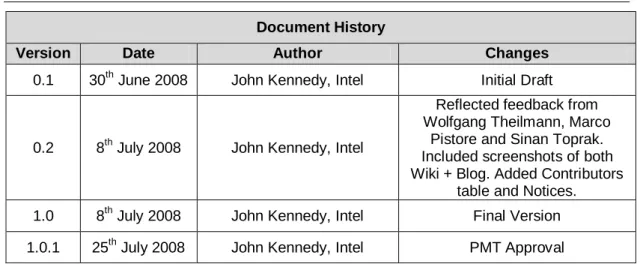
Document History
Version Date Author Changes
0.1 30th June 2008 John Kennedy, Intel Initial Draft
0.2 8th July 2008 John Kennedy, Intel
Reflected feedback from Wolfgang Theilmann, Marco
Pistore and Sinan Toprak. Included screenshots of both Wiki + Blog. Added Contributors
table and Notices. 1.0 8th July 2008 John Kennedy, Intel Final Version 1.0.1 25th July 2008 John Kennedy, Intel PMT Approval
Executive Summary
An initial version of the SLA@SOI project website has been designed, provisioned and deployed on the internet. It has been designed to quickly address the key questions that external visitors to the website are expected to have including
What is the project about?
What is the project delivering, and why? Who is participating in the project? What additional detail is available?
Who can be contacted for more information?
Powerful technologies such as Wikis, Blogs and Google Analytics* have also been considered and deployed at this early stage of the project. As collaboration, exploitation and dissemination requirements become clear these and other tools will be configured and enabled to support the project in all appropriate ways.
The project website will continuously evolve and develop as the project itself matures. The dedicated server provisioning solution that has been adopted delivers the flexibility to choose the most appropriate tools and technologies to support the future web-site needs of SLA@SOI, whatever they may be.
Table of Contents
1 Introduction...7
2 Initial Web Site...8
2.1 Domain name ...8
2.2 Physical Infrastructure ...8
2.3 Initial Content...9
2.3.1 The Home Page ...9
2.3.2 What We Do...10
2.3.3 Who We Are...10
2.3.4 Documents ...10
2.3.5 Contact Us ...10
2.4 Additional Considerations ...11
2.4.1 Wiki and Blog ...11
2.4.2 Identity and Branding ...11
2.4.3 Browser Compatibility...11 2.4.4 Google Analytics ...11 2.4.5 Google Indexing ...12 3 Future Work ...13 4 Conclusion ...14 5 Appendices ...15
5.1 Appendix A: Initial ‘Home Page’ Content ...15
5.2 Appendix B: Initial ‘What We Do’ Content...16
5.3 Appendix C: Initial ‘Who We Are’ Content...18
5.4 Appendix D: Initial ‘Documents’ Content...19
5.5 Appendix E: Initial ‘Contact Us’ Content ...20
5.6 Appendix F: Initial Project Wiki ...21
5.7 Appendix G: Initial Project Blog ...22
Table of Figures
Figure 1: Initial Site Map ...9
Figure 2: Google Analytics Dashboard ...12
Figure 3: Initial 'Home Page' Content...15
Figure 4: Initial 'Who We Are' Content ...18
Figure 5: Initial Documents Content...19
Figure 6: Initial 'Contact Us' Content...20
Figure 7: Initial Wiki Page ...21
1 Introduction
The SLA@SOI integrated project has extensive communication needs and requirements, both internal to the consortium and external. These requirements are currently being gathered as part of an extensive analysis process, however, even now it is clear that the SLA@SOI project web site will play a key role in enabling project collaboration, exploitation and dissemination. An initial version of the project website has been created and deployed, and this document is provided as an accompaniment to the actual live project website. This document together with the website form the entire deliverable D.B9a Project Web Site. This document describes the initial instantiation of the project website, outlines some future developments that are under consideration, and reproduces some content from the website itself.
2 Initial Web Site
To create an initial web presence several topics needed to be addressed including domain name, hosting infrastructure, and initial content. These are discussed below.
2.1 Domain name
The project domain name was selected during the project negotiation phase as initially http://www.sla-at-soi.org and then http://www.sla-at-soi.eu. The at-symbol “@” is a reserved character for universal resource locators (URLs) and so a domain including the character string “sla@soi” was not technically possible. These domain names were both reserved by Intel, the partner responsible for dissemination, via a .eu accredited third party registrar, IrishDomains.com1.
The website initially went live using the .org domain as the .eu registration remained in a pending status for some time. The website will transition to the .eu domain as soon as registration is complete. In parallel with the transition appropriate automatic redirects will be created to avoid any issues for anyone that happens to use the .org domain into the future.
2.2 Physical Infrastructure
In order to host the website, a suitable hosting infrastructure needed to be identified. Rather than give responsibility to an individual project partner for hosting the website, it was decided to employ an independent hosting provider.
The selection of hosting provider was largely driven by our predicted needs for the hosting environment. Rather than subscribe to a limited turn-key web-site hosting solution offered by most hosting providers, a dedicated server was deemed much more appropriate for the project requirements. A dedicated server would give the project complete flexibility in the collaboration and dissemination tools we wished to embrace. We would not be restricted, for example, to a particular wiki, chat server, blog engine or mailing list engine. As well as a dedicated server, appropriate backup facilities were also required.
A suitable, competitively priced, well-respected European hosting provider was identified – ovh.com2 - and an initial 12 month provisioning solution procured. This included a dedicated server built with Linux* (Ubuntu 8.04 Server*) as well as dedicated space on a separate, secure, storage area to accommodate our backup needs.
1
http://irishdomains.com
2
2.3 Initial Content
In order to provide a useful and relevant website even in advance of a comprehensive dissemination requirements analysis and subsequent dissemination plan, it was decided that the initial version of the project website would be a traditional static website addressing the predicted immediate needs of interested external stakeholders. Following a review of similar project websites and a discussion within the consortium, the website was conceived to answer key questions that researchers, technology experts, analysts, industry, academia and other stakeholders could be expected to have:
What is this project about, in a nutshell? What is the project delivering, and why? Who is participating in the project? What additional detail is available?
Who can be contacted about the project?
These questions were addressed using the site map illustrated in Figure 1 below.
Figure 1: Initial Site Map
The individual pages were then designed to address the following needs.
2.3.1 The Home Page
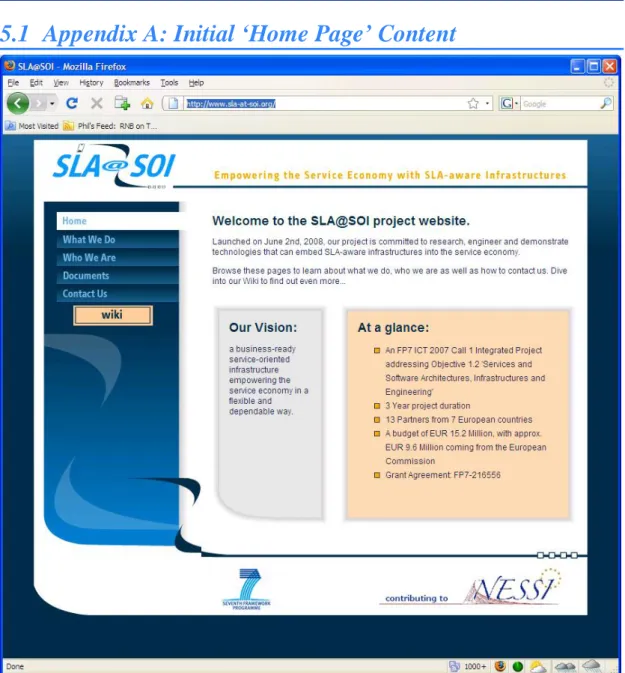
The ‘Home Page’ page had the following objectives: Briefly introduce the project
Welcome visitors to the website Provide key facts about the project
Provide links to answers for key follow-on questions
Give the project some context by referring to the funding programme and related organisations
The initial ‘Home Page’ content is reproduced in Appendix A: Initial ‘Home Page’ Content.
2.3.2 What We Do
The ‘What We Do’ page was provided to describe the: Project motivations
Project Goal
Benefits to business of the project Expected results
Technical approach of the project Industrial relevance of the project
The initial ‘What We Do’ content is reproduced in Appendix B: Initial ‘What We Do’ Content.
2.3.3 Who We Are
The ‘Who We Are’ page was provided to list the partners participating in the project, and the initial version is reproduced in Appendix C: Initial ‘Who We Are’ Content.
2.3.4 Documents
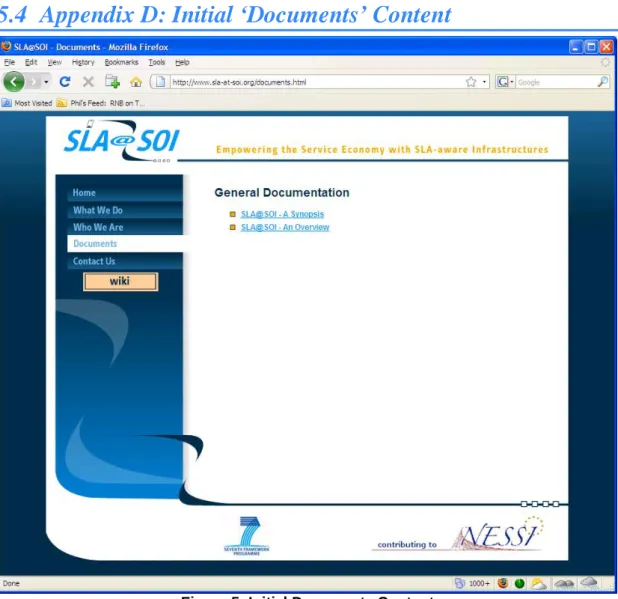
The ‘Documents’ page was provided to give access to documents that provide additional information about the project. For the first instantiation of the website two documents were provided:
A brief synopsis of the SLA@SOI project in brochure form (as provided previously to the European Commission),
A broader overview of the project in slideshow form.
Both documents were made available in pdf format.
The initial ‘Documents’ content is illustrated in Appendix D: Initial ‘Documents’ Content.
2.3.5 Contact Us
The ‘Contact Us’ page was provided to give contact details for any follow-up questions that visitors to the website may have. The initial version of this web page had the contact details for the Project Coordinator, and is illustrated in Appendix E: Initial ‘Contact Us’ Content.
2.4 Additional Considerations
2.4.1 Wiki and Blog
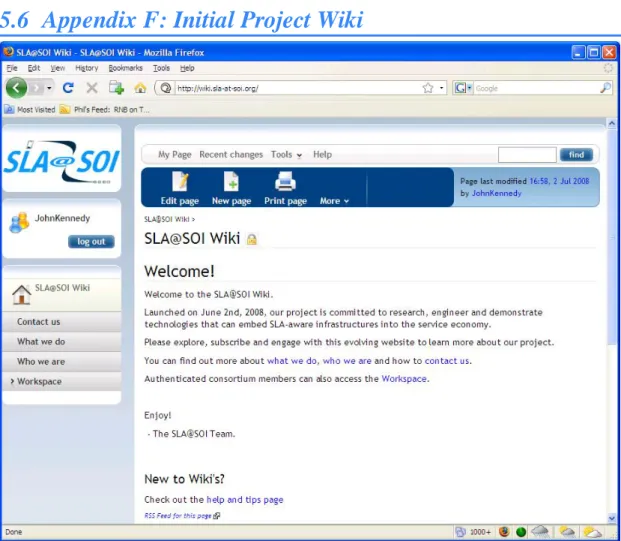
During the project negotiation phase the need for a project wiki and blog was identified and this was considered during the creation of the initial project website. An opensource Wiki - DekiWiki3 and an opensource Blog engine -Wordpress4 - were identified and installed on the dedicated project server. Screenshots of these tools are provided in Appendix F: Initial Project Wiki and Appendix G: Initial Project Blog.
However, after initial configuration and customisation of these tools it became obvious that time constraints did not allow for sufficient thought to go into the setup of these tools by the end of Month 1, the due date of this deliverable. Rather than give users access to an empty unstructured wiki and undefined blog processes at this early stage, it was decided to wait until appropriate requirements had been gathered from all partners and structured templates, procedures and processes could be agreed.
A comprehensive dissemination requirements gathering exercise is underway at the time of writing.
2.4.2 Identity and Branding
To help create a strong SLA@SOI identity and brand, the website was designed to be consistent with the previously adopted SLA@SOI logo. This logo, created for the project by Intel in consultation with the consortium, included glyphs to represent both SLAs and SOIs, connected to each other by a stylised spark or wave through the project name.
The website design included consistent glyphs, wave elements, fonts and colours to help reinforce this brand identity.
2.4.3 Browser Compatibility
To maximise visibility the website was designed to render appropriately in all common web browsers on all common operating systems. These included various versions of the Firefox*, Internet Explorer* and Safari* browsers on the Linux*, Apple MAC OS X* and Microsoft Windows* families of operating systems.
2.4.4 Google Analytics
To help understand the usage of the website, the website was registered with the free Google Analytics5 facility. This will allow rich reports to be run on the website, giving a very clear picture of information such as:
How many users are visiting the site
3 http://wiki.mindtouch.com/Deki_Wiki 4 http://wordpress.org/ 5 http://www.google.com/analytics/
What links and pages are more popular than others What websites are users coming from
Where are visitors coming from geographically
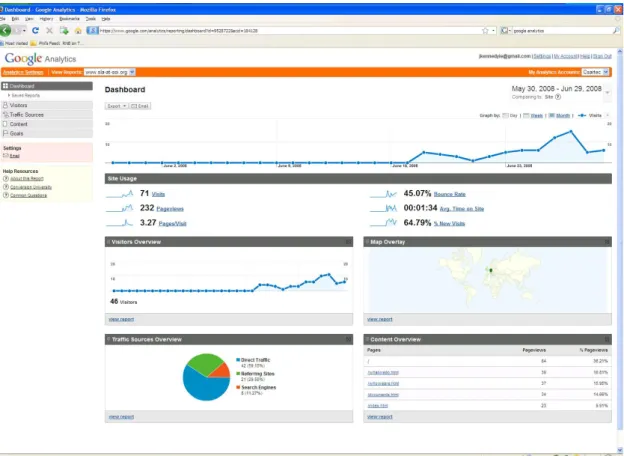
Some summary information available via Google Analytics at the end of Month 1 of the project is illustrated in Figure 2 below.
Figure 2: Google Analytics Dashboard
2.4.5 Google Indexing
To accelerate the indexing of the project website by the Google search engine, the website was registered with the Googlebot spider6. A suitable sitemap.xml document was also created in the root directory of the website to help optimise the indexing of the website by search engines. This file is listed in Appendix H: Initial sitemap.xml.
6
3 Future Work
It is intended that the project website will be a dynamic, vibrant piece of infrastructure that is continuously updated as the needs of the project change, content is generated by all Work Packages, and improved software tools become available.
Short term improvements to the website under consideration at the time of writing include:
Defining a suitable wiki structure for both internal and external use Identifying and defining appropriate wiki template pages (e.g. one each
for pages devoted to Work Packages, Deliverables, Partners, Meetings etc.)
Defining a coherent blog infrastructure and communications strategy for the project
These and additional work on the project website will be driven largely by the results of the requirements gathering exercises that are key deliverables in both the B8 Exploitation & Collaboration and B9 Dissemination work packages. This process will also help
Identify appropriate integration points of the project website with popular tools such as Twitter7, Delicious8 etc.
Choose any standards we wish to embrace to ensure accessibility and consistent rendering, and to enable localisation in the future if required. Determine what, if any, media-rich resources such as Flash*
animations and movies would be useful for project purposes.
Ultimately, it may even make sense for the initial static web pages to be completely replaced with wiki or blog-based content.
In any-event, all changes to the website will be driven by the needs of the project as they arise throughout the lifetime of the project, and in consultation with the appropriate project partners. Descriptions of these changes, and an analysis of the usage of the web facilities in general, will be included in future deliverables such as the Dissemination plan (Deliverable D.B9b due in Month 6) and the Dissemination reports (D.B9c, M24 and D.B9d, M36).
The flexibility of our dedicated server hosting infrastructure ensures our project website will not be limited in any arbitrary way.
7
http://twitter.com/
8
4 Conclusion
An initial version of the SLA@SOI project website has been designed, provisioned and deployed on the internet. Consisting mostly of static content, it has been designed to quickly answer the key questions that external visitors to the website are expected to have.
Powerful wiki and blog technologies have also been considered at this early stage of the project, and as collaboration, exploitation and dissemination requirements become clear these and other tools will be configured and enabled to support the project in all appropriate ways.
The project website will continuously evolve and develop as the project itself matures – the dedicated server provisioning solution we have adopted gives us the flexibility to choose the most appropriate tools and technologies to support the future needs of SLA@SOI.
5 Appendices
5.1 Appendix A: Initial ‘Home Page’ Content
5.2 Appendix B: Initial ‘What We Do’ Content
Motivation
The ongoing transformation of a product-oriented economy towards a service-oriented economy has come to a critical point. IT-supported service provisioning has become of major relevance in all
industries and domains. However, the nature of these setups is typically quite static because it requires significant effort to create service offers, to negotiate provisioning details with customers and to manage and control provided services.
Project goal
The research project SLA@SOI will provide a major milestone for the further evolution towards a service-oriented economy, where IT-based services can be flexibly traded as economic goods, i.e. under well defined and dependable conditions and with clearly associated costs. Eventually, this will allow for dynamic value networks that can be flexibly instantiated, thus driving innovation and competitiveness.
SLA@SOI will provide 3 major benefits to the provisioning of services:
Predictability & Dependability: The quality characteristics of service can be predicted and enforced at run-time.
Transparent SLA management: Service level agreements (SLAs) defining the exact conditions under which services are provided/consumed can be transparently managed across the whole business and IT stack.
Automation: The whole process of negotiating SLAs and provisioning, delivery and monitoring of services will be automated allowing for highly dynamic and scalable service consumption.
Business benefits
Eventually, all the main stakeholders in a service-oriented economy will benefit from the project results:
Software providers will be empowered to produce components with dependable behaviour for arbitrary scenarios.Service providers can offer services (possibly stemming from different software providers). This can be done flexibly according to different customer needs but always balancing these with IT capabilities and business strategies.Service aggregators can offer composed services which are well-managed according to IT and business needs.Infrastructure providers will be empowered to allocate infrastructure elements exactly according to higher-level customer needs. And last but not least,service customers are empowered to precisely specify and negotiate the actual service level according to which they buy a certain service.
The following figure gives a high-level overview of the anticipated SLA-driven process for service provisioning, detailing the SLA management activities across customers, providers and the various layers of a Business/IT stack:
Expected results
SLA@SOI will provide its results in 3 complementary ways.
First, an open source based SLA management framework will allow realisation of the benefits of predictability, transparency and automation in an arbitrary service-oriented infrastructure. Second, in-depth guidance for industrial stakeholders will be given explaining the best practise on how to transform their service business into an SLA-driven one.
Finally, SLA@SOI will provide an open reference case which allows for stakeholders to run, re-validate and even modify SLA experiments in the context of a concrete application.
Technical approach
The technical approach of SLA@SOI is to define a holistic view for the management of service level agreements (SLAs) and to implement an SLA management framework that can be easily integrated into a service-oriented infrastructure (SOI). The main innovative features of the project are (1) an automated e-contracting framework, (2) systematic grounding of SLAs from the business level down to the
infrastructure, (3) exploitation of virtualization technologies at infrastructure level for SLA enforcement, and (4) advanced engineering methodologies for creation of predictable and manageable services.
Industrial relevance
The research topic of this project is highly relevant for many industrial domains. Therefore, the project is based on various highly relevant but also complementary industrial use cases. These use cases will drive the project in terms of requirements but will also serve for validating project results.
The industrial use cases include scenarios from hosted Enterprise Resource Planning systems, Enterprise IT management, and service aggregation in telecommunication, eGovernment and Finance Industries.
Apart from use case specific evaluations the project will also derive an overall industrial assessment which then can be used in arbitrary domains for establishing an SLA-driven business.
5.3 Appendix C: Initial ‘Who We Are’ Content
5.4 Appendix D: Initial ‘Documents’ Content
5.5 Appendix E: Initial ‘Contact Us’ Content
5.6 Appendix F: Initial Project Wiki
5.7 Appendix G: Initial Project Blog
5.8 Appendix H: Initial sitemap.xml
<urlset> <url> <loc>http://www.sla-at-soi.org</loc> <lastmod>2008-06-17</lastmod> <changefreq>weekly</changefreq> <priority>0.5</priority> </url> <url> <loc>http://www.sla-at-soi.org/styles/css 1.css</loc> <lastmod>2008-06-06</lastmod> <changefreq>weekly</changefreq> <priority>0.5</priority> </url> <url> <loc>http://www.sla-at-soi.org/whatwedo.html</loc> <lastmod>2008-06-17</lastmod> <changefreq>weekly</changefreq> <priority>0.5</priority> </url> <url> <loc>http://www.sla-at-soi.org/whoweare.html</loc> <lastmod>2008-06-17</lastmod> <changefreq>weekly</changefreq> <priority>0.5</priority> </url> <url> <loc>http://www.sla-at-soi.org/documents.html</loc> <lastmod>2008-06-17</lastmod> <changefreq>weekly</changefreq> <priority>0.5</priority> </url> <url> <loc>http://www.sla-at-soi.org/contactus.html</loc> <lastmod>2008-06-17</lastmod> <changefreq>weekly</changefreq> <priority>0.5</priority> </url> <url> <loc>http://www.sla-at-soi.org/index.html</loc> <lastmod>2008-06-17</lastmod> <changefreq>weekly</changefreq> <priority>0.5</priority> </url> <url> <loc> http://www.sla-at-soi.org/documents/project-sla-at-soi_en.pdf </loc> <lastmod>2008-06-10</lastmod><changefreq>monthly</changefreq> <priority>0.5</priority> </url> <url> <loc> http://www.sla-at-soi.org/documents/[email protected] </loc> <lastmod>2008-06-10</lastmod> <changefreq>monthly</changefreq> <priority>0.5</priority> </url> </urlset>