A Privacy-Preserving Ticketing System
Kristof Verslype1, Bart De Decker1, Vincent Naessens2,Girma Nigusse1, Jorn Lapon2 and Pieter Verhaeghe1 1 Katholieke Universiteit Leuven, Department of Computer Science,
Celestijnenlaan 200A, 3001 Heverlee, Belgium [email protected]
2 Katholieke Hogeschool Sint-Lieven, Department of Industrial Engineering Gebroeders Desmetstraat 1, 9000 Gent, Belgium
Abstract. Electronic identity (eID) cards are deployed in an increasing number of countries. These cards often provide digital authentication and digital signature capabilities, but have at the same time serious privacy shortcomings. We can expect that ordering and issuing tickets for events (e.g. soccer matches) will be increasingly done using eID cards, hence, severely threatening the user’s privacy. This paper proposes two alternative ticketing systems that are using the eID card in a bootstrap procedure, but still are providing a high degree of privacy to the user.
Keywords:Privacy, Anonymity, Security, Ticketing, Electronic Identity cards
1
Introduction
Tickets are used for an innumerable number of events: soccer matches, music festivals, exhibitions, etc. These tickets are ever more bought electronically. An increasing number of countries issue electronic identity cards to their citizens. Examples are Belgium, Estonia and Austria. These eID cards usually allow the holder to authenticate and to digitally sign documents, but often, they are very privacy unfriendly. For example, authentication using the Belgian eID card will usually lead to the divulgement of important personal data such as your national registration number (NRN). Despite these privacy dangers, the use of the eID card is promoted by the governments. We can thus expect that in the near future, electronic ticketing systems will arise based on the eID card. A trivial solution is easy to devise. However, this solution is not acceptable because it further endangers the card holder’s privacy as profiles can easily be compiled, linked to each other and to the identity of the card holder. An advantage of the use of eID cards is that it is straightforward to impose restrictions on the maximum number of tickets that can be bought by one user, hence, thwarting sales on black markets. Sometimes, special offers are available for buyers under or over a certain age or living in the region where the event is organized. Here too, eID cards can help in securely conveying (proving) that these conditions
are satisfied for the buyer. However, the use of these cards will usually disclose more information than is required.
For big events with thousands of attendants, the police would be helped if tickets were not anonymous, but could be linked to the identity of the attendants, or at least to the identity of the buyers of these tickets. Especially, when rows or riots occur, it would make it easier to identify and prosecute the instigators. However, the use of tickets attributable to individuals poses severe privacy risks and brings us closer to a ”Big Brother” state.
This paper proposes two solutions where the eID card is needed to obtain an anonymized permit, allowing a user to obtain tickets in a privacy friendly way. The role of the eID card is thus reduced to a bootstrapping role. A first solution is based on pseudonym certificates, i.e. X.509 certificates containing a user’s nym instead of a real identity. A second solution is based on the more enhanced anonymous credential systems, which allow to anonymously disclose only a subset of the personal attributes (or properties thereof) embedded in the credential. Both solutions are validated and compared with the trivial solution and with each other.
The main requirements are given in section 2. Section 3 introduces the re-quired technologies. Section 4 explains notations and specifies the assumptions. Sections 5, 6 and 7 discuss the trivial protocol and two privacy friendly alterna-tives and are followed by a comparison in section 8. Sections 9 and 10 examine the related work, draw the conclusions and describe future work.
2
Requirements
The requirements are now summed up. F4 and F5 are optional. Functional/Security Requirements
F1 Every event may have a policy that limits the number of tickets obtain-able by one buyer. The policy may discriminate between different groups of buyers.
F2 Event organizers may choose to offer a subscription for a series of events. F3 Every event can have a pricing policy that differentiates between
differ-ent groups of buyers (e.g. youngsters or elderly people).
(F4) When abuse is detected or when serious incidents happen during the event, it should be possible to identify the buyer of the ticket(s) involved, but only with a court order.
(F5) Individuals who have been imposed a banning order for a particular event type, should not be able to buy tickets for this kind of events. Privacy Requirements
P1 Buyers of tickets should not directly be identifiable.
P2 Except when subscriptions are used, it should not be possible to compile buyer’s profiles.
3
Technologies
The main technologies required in this paper are pseudonym certificates, anony-mous credentials, commitment schemes and provable one-way functions. 3.1 Pseudonym Certificates
Pseudonym certificates [1] are traditional certificates where the identity infor-mation is replaced by a pseudonym. The certificate states that the identity of the user referred to by that pseudonym and the properties certified in the cer-tificate have been verified by the issuer. Different shows of the same cercer-tificate are linkable, which can undermine anonymity.
The relevant functions for both classical and pseudonymous certificates are: – U ¿I:Cert←issueCertificate(attributes).Iissues a certificateCerttoU. Iknows the certificateattributes, but not the private key corresponding to Cert. Pseudonyms, ids, expiry date, etc. are also considered attributes. – U →V:authenticate(Cert).U proves possession of Certto verifierV. As a
result,V gets to know all the attribute values embedded in Cert.
Enhanced Pseudonymous Certificates. We further extend the privacy with-out requiring considerable computational capabilities by replacing each certifi-cate attributeattthat contains personal properties (date of birth, social security number, etc.) byH(att,random). Showing such an enhanced pseudonym certifi-cate thus only reveals personal data if the owner of the certificertifi-cate also discloses the corresponding (att,random) tuple to the verifier. Evidently, the linkability issue persists.
3.2 Anonymous Credentials
Anonymous credential systems ([6], [5], [2]) allow for anonymous yet accountable transactions between users and organizations and allow for selective disclosure by showing properties of credential attributes (e.g. age > 18) while hiding all the other credential attribute information. In the Idemix system [5], different usages of the same credential areunlinkable(except when unique attribute values are revealed). Credentials can have features such as an expiry date, the allowed number of times it can be shown and the possibility to be revoked. A mix network ([11], [10]) is required to provide for anonymity at the network layer.
The (simplified) anonymous credential protocols relevant in this paper are: – U¿O: (Nym,Sig)←generateSignedNym(Cert). One can establish multiple
non-transferable pseudonyms (i.e. nyms) with the same organization. Here, the user signs the established N ym giving O a provable link between the nym and the identity certified inCert.
– U ←I:Cred←issueCredential(Nym,attributes). A credential is issued byI on a pseudonymNym. The credential is known only to the user and cannot be shared. Also, a number of attributes, not necessarily known byI, is embedded into the credential.
– U ¿V: transcript ←authenticate(Cred, properties, [DeanCond], [Msg]). A userU authenticates to verifierV by proving possession of a valid credential Cred. U can selectively reveal credential attributes or properties thereof. The resulting transcript for V may be deanonymizable upon fulfillment of conditionDeanCond(cfr. thedeanonymize()).Umay decide to sign a message Msg with his credential by a provable link between the transcript and the message. Different transcripts for the same credential are unlinkable (unless the value of a unique attribute is proved).
– U →V: prove(properties). Simplified notation of the above function. Propertieswill refer to the credential used in the proof.
– D: (Nym,DeanProof)←deanonymize(transcript,condition). If a credential show is deanonymizable, the pseudonymN ymon which the credential was issued can be revealed by a trusted deanonymizerD.DeanP roof proves the link between the transcript and the nym.D is only allowed to perform the deanonymization when condition fulfills DeanCond (included in the tran-script).
3.3 Commitments
A commitment [14, 7] hides one (or more) values. Later the committer can open the commitment, or prove properties of the committed value(s). The following (simplified) commitment methods are relevant:
– (Com,OpenInfo)←commit(attribute). A new commitment containing a sin-gle attribute is generated as well as the opening info required to prove prop-erties about the commitment (or to open it).
– U→V:prove(Com,properties,OpenInfo). Prove properties of commitments. 3.4 Provable One-Way Functions
We define a provable one-way function out ← f(in) as a one-way function whereof the one knowingincan prove that he knows ainsuch thatout=f(in) in a zero-knowledge proof. Multiple arguments are possible as well.
As an example, according to the DL assumption,out ← ginmodpis such
a function for pprime andg a generator of a multiplicative group with orderq withq|p−1 andpandq sufficiently large.
4
Assumptions and Notation
4.1 Assumptions
– For every protocol, a server always first authenticates toU using a classical X.509 certificate. Also, an integrity and confidentiality preserving connection is established during a protocol. Anonymity at the network layer is added when necessary.
– A ticketing server can service multiple events. However, for each event, there is only one ticketing server.
– Tickets do only contain a ticket identifier (e.g. event name, date and seat number) and are unforgeable.
4.2 Notation
– Each protocol requires the following roles: user U (client), ticket server T (issues tickets to users), event organizerE and the court of justiceJ. – U ¿B ¿T: (PayProofU, PayProofT) ←pay(price, Msg). U pays an
amount of money, via an intermediary bank B, to T. A message can be linked to the payment. The bank can deliver proofs of the payment to both parties. The payment protocols can preserveU’s privacy.
– U ¿T: (desc[], price, [Proof]) ←negotiate(Cert∨Cred, Nym∨Id, event, eventPolicy, #tickets, specification) allowsU and T to agree on the exact seat numbers as well as on the total price. Therefore, U gives an identi-fier (NymorId), shows (properties of) credential/certificate attributes. The event policy can state e.g. that people younger than 18 get reductions. Ev-idently, the number and (general) specification of the tickets are given as well. The restrictions on the blacklists can further constrain the possibilities of the user.U can giveT a proof of the agreement (signed byCertorCred). – O: Nym ←retrieveOrGenerateNym(Id∨Nym∗) returns a newly generated nym if the user refered to byId or Nym∗ does not yet have a nym with O. However, if that user already has been given a nym in the past, it is simply retrieved fromO’s local storage system.
– T: Restrictions ←retrieveRestrictions(Blacklist, Nym∨Id). T looks up in a blacklist the restrictions of a person referred to byNymorId.
– G: Restriction[] ←getRestrictionBooleans(Id) implicitly uses all blacklists, and returns for each event type whether or not the user is blacklisted or not. – Other, self explaining methods are:add(),lookup(), store(),update() and
generateTickets().
5
Trivial eID-based Solution
Without alternatives, this protocol will most likely be implemented in Belgium as the government is really promoting the use of the eID card in commercial applications. However, this protocol has serious privacy drawbacks.
U uses his eID card to authenticate toT, revealing a lot of personal data to T. A government agencyGmaintains a blacklist containing identifiable user ids. This blacklist is checked byT before issuing tickets.
The user authenticates toT using his eID card. T first checks whether the user is blacklisted. Based on the user’s id and personal attributes, the user can be given the possibility to buy a number of tickets as a result of the negotiation phase. After the payment and ticket issuance,T finally stores ticket selling info. Identification in case of abuse is straight forward since T knows the link between the seat (or ticket) and the user’s id.
The functional/security requirements are trivially fulfilled. However for the privacy requirements, this protocol fails completely.T knows the user’s id and all other attributes contained in the eID certificate (P1). User profiling is trivial for T as well as sharing and linking of profiles (P2). The users’ nrns are on the blacklist (P3). In addition, many countries simply forbid blacklists on which users are identifiable due to privacy legislation. Deployment will often thus result in omitting the F5 requirement.
6
Solution based on Enhanced Pseudonym Certificates
6.1 Introduction
This approach improves the privacy of the user by introducing pseudonymous permits. First, each user is issued a unique pseudonymous root certificate by the government. This allows the user to obtain pseudonymous permit certificates from different permit servers. One permit server could for instance be responsible for one event type (e.g. soccer matches). With such a pseudonymous permit a user can buy tickets for events that happen in a small (permit specific) time period3. The user will thus most likely need multiple permits. The blacklists no longer contain user identifiers, but pseudonyms.
6.2 Roles
Besides the already defined U, T and E, a government agency Gis needed to issue root certificates and a permit serverP S issues permit certificates.
6.3 Assumptions
– All certificates contain a unique serial number, a pseudonym or id, a public key and an expiry date.
– There can be many pseudonym servers (PS) and many ticket servers (T). – For every event, the ticket server (T) accepts permits issued by a limited set
of pseudonym servers. However, the user sets of different pseudonym servers do not overlap (necessary for requirement F1).
– Only one entityGcan issue valid pseudonymous root certificates. – Nyms that are no longer valid, are forgotten by the permit server. 3 The fixed time period is introduced to minimize linkabilities.
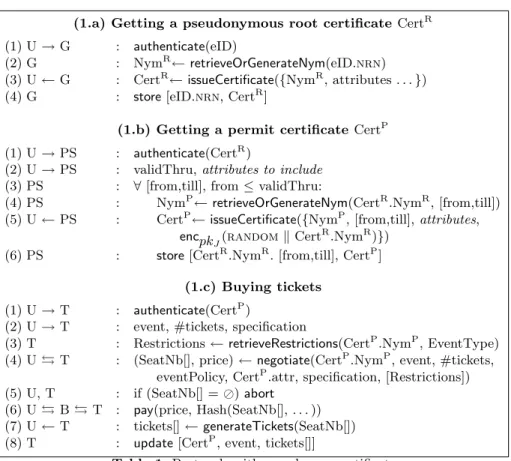
High Level Description and data structures. The user receives a pseudonymous root certificate (CertR), which contains a rootnym (NymR) and possibly other attributes (such as year of birth, citizenship, place of residency, . . . ). CertR is used to authenticate to the permit server PS.
The user can apply to the PS for a pseudonym (NymP) that is valid during a predefined time period. NymP will be certified in a (pseudonymous) permit certificate (CertP). Each certificate also contains a public key used to verify authentications with CertP, and possibly (properties of) other attributes that were copied from the root certificate (CertR). Using permit certificates with non-overlapping time-slots, each user can have at most one valid CertP to order tickets for a particular event. The PS can refuse permits to users who have been sentenced to a banning order for events supported by the PS.
6.4 Protocols
Getting a root certificate. A governmental instanceGassigns to each citizen one root pseudonym NymR. The first timeU requests a root certificate CertR, a new NymRis generated and included in CertR. In case the user was already assigned a NymRin the past, that pseudonym is retrieved fromG’s local storage instead. Gfinally stores the user’snrnand CertRs (which include NymR).
Getting a permit certificate. U authenticates with a valid root certificate CertR to the P S. P S will issue a number of permit certificates CertPs which have to be used before a (user specified) date (validThru). For instance, the user can request permit certificates that allow him to buy soccer tickets for the upcoming year.P Sgenerates a set of nyms (NymR) or retrieves them (if they were already assigned in the past): one nym per time period4. Each nym NymPis also certified in a permit certificate CertP which also contains a validity period (for NymP), possibly a set of attributes, and an encryption of the user’s root pseudonym NymR. The validity periods of NymPs are non-overlapping. Hence, users cannot buy tickets for the same event using different nyms. Also, when a user requests a new permit for the same period (e.g. because the previous one was lost or the private key was stolen), P S will always use the same nym (NymP). Each CertPcontains a probabilistic encryption of NymRwith the public key ofJ. This allows law enforcement to eventually identify the user involved in case of abusive behavior (see further). P S finally updates the list of CertPs that are issued to NymR.P Scan derive the time intervals for which a NymRhas obtained a valid CertP from that list.
Buying tickets for an event. The user first authenticates to the ticket server T using the permit certificate CertP that is valid for that specific event and specifies the number of tickets he wants to order.T then obtains the restrictions 4 The length of the non-overlapping time periods is chosen by theP S in such a way
associated with NymP on the blacklist. The user and the ticket server agree on the price of the tickets and the seats, based on the user’s nym, allowing to limit the number of tickets for that user. The limitations and price can depend on certain attributes that are embedded in the permit certificate (such as the user’s age) and on the restrictions on the blacklist. Finally, the ticket server updates the number of tickets that are sold to NymP for that event.
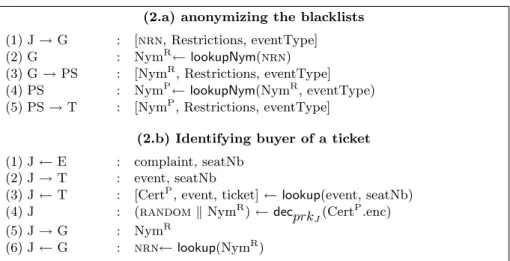
Updating anonymous blacklists. To fulfill requirement F4, anonymous blacklists are used. Four entities are involved in updating blacklists (see table 2).
A law enforcement entityJ forwards the court orders (nrn, Restrictions) toG. Gsubstitutes thenrns with the corresponding NymRs and forwards the list to the permit server P S. P S can then add NymR to a blacklist for certain event types (i.e.P S will no longer issue CertPs to NymR for the event types that are specified in the blacklist).
Finally, P S retrieves the valid NymPs for each NymR with a banning order, substitutes every NymR-record in the blacklist with a number of NymP-records and forwards the new list to the ticket server T. T no longer issues tickets to pseudonyms in the blacklist. Note that the ticket service can even revoke tickets that were already issued to pseudonyms in the blacklist.
Identifying buyer of a ticket. To reveal the identity of a participant with a specified seat number, the ticket serviceT looks up the NymP of the user that ordered the ticket. The corresponding permit certificate CertP is kept by the ticket server and is passed toJ. The latter can link CertP to NymR(as NymR is encrypted with the public key of J in CertP). Gcan reveal the user behind NymR(asGknows the mapping betweennrnand NymR).
Increasing privacy with enhanced pseudonym certificates. For each personal attribute attin CertR,G can include the hash valueH(att, randG) in
CertR instead, where randG is a random value. Each randG is sent to U as
part of the issuance of CertR. After authentication by U to a P S with CertR, the user sends to P S the randG value of those attributes of CertR that need
to be included in the CertP certificate. In a similar way, P S includes hash values using freshly generated randP S values in the new CertP. This allows U
to selectively disclose personal attributes toT. More complex constructions are possible as well, but are not discussed in this paper.
6.5 Evaluation
F1 This requirement is easily fulfilled as each user has only one NymPto buy tickets for a particular event.
F2 If NymPcan be used to order tickets for multiple events (e.g. multiple soccer games during a World Cup contest),T can even restrict the total number of tickets that can be bought for the whole contest (i.e. a set of events). F3 A user can get a lower price for some tickets based on the attribute values of
CertP. However, tickets can be passed on. Hence, T should be careful with price reductions.
(1.a) Getting a pseudonymous root certificate CertR (1) U→G : authenticate(eID)
(2) G : NymR←retrieveOrGenerateNym(eID.nrn) (3) U←G : CertR←issueCertificate({NymR, attributes . . .}) (4) G : store[eID.nrn, CertR]
(1.b) Getting a permit certificateCertP (1) U→PS : authenticate(CertR)
(2) U→PS : validThru,attributes to include (3) PS : ∀[from,till], from≤validThru:
(4) PS : NymP←retrieveOrGenerateNym(CertR.NymR, [from,till]) (5) U←PS : CertP←issueCertificate({NymP, [from,till],attributes,
encpkJ(randomkCertR.NymR)}) (6) PS : store[CertR.NymR. [from,till], CertP]
(1.c) Buying tickets (1) U→T : authenticate(CertP)
(2) U→T : event, #tickets, specification
(3) T : Restrictions←retrieveRestrictions(CertP.NymP, EventType) (4) U¿T : (SeatNb[], price)←negotiate(CertP.NymP, event, #tickets,
eventPolicy, CertP.attr, specification, [Restrictions]) (5) U, T : if (SeatNb[] =®)abort
(6) U¿B¿T : pay(price, Hash(SeatNb[], . . . )) (7) U←T : tickets[]←generateTickets(SeatNb[]) (8) T : update[CertP, event, tickets[]]
Table 1.Protocols with pseudonym certificates
F4 Fulfilled (cfr.”Identifying buyer of a ticket” protocol).
F5 Three entities are needed to ban a user from event types for which a user already has a permit certificate, namely G, P S and T. Two entities are needed to ban a user from event types for which a user does not yet have a permit certificate, namelyGandP S.
P1 As discussed in ”Identifying buyer of a ticket”, four entities are needed to reveal the user’s identity. Moreover, G(and maybe P S) are governmental instances. Hence, users can trust that players in the commercial sector (such asE andT) cannot identify users without help of governmental instances. P2 Each NymP only has a limited validity period. The number of tickets that
is issued to the same NymP is restricted. Hence,T andE can only compile limited profiles.P Scan link all NymPs to the same NymR. However, multiple pseudonym serversP Scan be used. If eachP Scan only issue permit certifi-cates for specific types of events, the oneP S cannot link multiple interests of the same NymR. Moreover, noP S obtains more personal attributes than needed. Only a subset of the attributes in CertP are revealed to T by U when the latter wants to buy a ticket. Evidently, differentT’s affiliated with
(2.a) anonymizing the blacklists (1) J→G : [nrn, Restrictions, eventType] (2) G : NymR←lookupNym(nrn) (3) G→PS : [NymR, Restrictions, eventType] (4) PS : NymP←lookupNym(NymR, eventType) (5) PS→T : [NymP, Restrictions, eventType]
(2.b) Identifying buyer of a ticket (1) J←E : complaint, seatNb
(2) J→T : event, seatNb
(3) J←T : [CertP, event, ticket]←lookup(event, seatNb) (4) J : (randomkNymR)←dec
prkJ(Cert
P.enc) (5) J→G : NymR
(6) J←G : nrn←lookup(NymR)
Table 2.Protocols with pseudonym certificates (bis)
the sameP Scan collaborate in order to get hold of more personal attribute values.
P3 Only NymRs and NymPs are kept in blacklists.
7
A Ticketing System Based on Anonymous Credentials
7.1 Introduction
We further increase the user’s privacy. The user needs a single permit - issued by a government agency - which allows the user to buy tickets for every event. In case of abuse, the transcript resulting from the permit show can be deanonymized. For each event type, there is a privacy-preserving blacklist, summing up the user’s rights restrictions.
7.2 Roles
BesidesU,E,T, andJ, we defineGas a government agency that issues permits and manages blacklists.
7.3 Assumptions
In the ticketing system based on anonymous credentials, we assume the following: – The anonymous credential system provides the unlinkability property to
per-mits. The user does not reveal identifiable permit attribute properties. – AllEs and allTs andGhave a unique, publicly available provable one-way
function; fE() for E, fT() for T and fG(. , .) for G. Note that the latter requires two arguments. These functions could for instance be included in their X.509 certificate.
– The opening info generated by a commit method does not reveal any in-formation about the content contained in the commitment. This is easily achieved using a symmetric keyK:
Comnew ←(Com, enc
K(OpenInfo)) andOpenInfonew ←K combined with
integrity preserving measures (e.g. MACs). 7.4 High Level Description
The permit is an anonymous credential containing a set of personal attributes, a boolean value for each event type indicating whether or not the user is black-listed, and two nyms. One nym (NymR) is known to G and used to blacklist persons. The other nym (NymP), is not known toG, but is used to generate an event specific nym, allowingT to keep track of the number of tickets sold to that person for that specific event.
Per event type, a blacklist is maintained byG. This blacklist contains user pseudonyms (NymRs). These nyms are converted to event specific nyms (NymEs) before the blacklist is sent to a specificT in order to avoid linkabilities.
7.5 Protocols
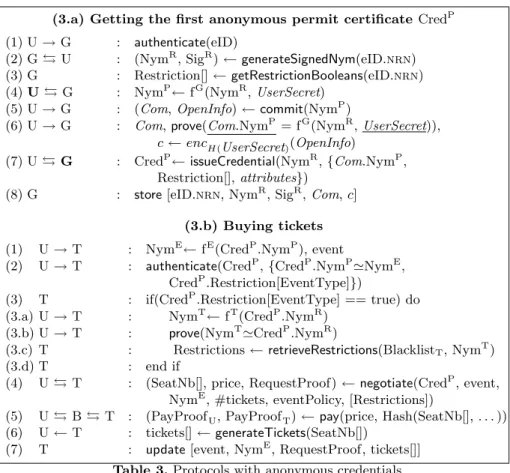
Getting an anonymous Permit Certificate. The actual issue of the permit (3.a.5) includes a subset of the user’s personal attributes (attributes) contained in the user’s eID. These can be selectively disclosed during a credential show protocol. The permit contains for each event type a boolean Restrictions[EventType] stating whether or not the user is blacklisted.Gcan easily extract this informa-tion out of the blacklists it manages (cfr. below).
Each permit contains two user unique pseudonyms NymRand NymP. NymR is known to both U andGand is the nym under which the permit is issued by G.Gpossesses a provable link SigRbetween theU’s id and his NymR. This can be used in case of disputes.
The second pseudonym in the permit, NymP, is known to the user U only and is included in the permit as an attribute that is not known to G. This is done using a commitment, whereof U proves that he knows the correspond-ingUserSecretand NymP(underlined in table 3) such that NymP←fG(NymR, UserSecret).
To obtain a new permit, after the previous one was lost, step 6 changes. After recalculating NymP←fG(NymR,UserSecret) and generating a new commitment Com2←commit(NymP) (Step 4 and 5),U decrypts c, resulting in the opening info of the previous commitment. This allows U to prove that Com.NymP= Com2.NymP(corresponds to step 6), convincingGthat the same NymPwas used. Buying a Ticket. For each ticket order, U sends NymE←fE(NymP) to T and proves possession of the corresponding NymP(3.b.1,2). The use of one-way func-tions gives the user for each event a different, but event-unique nym. This givesT the possibility to limit the number of tickets per user while at the same time, this
function avoids linking ofT’s customers to the customers of otherTs. Collusion withGdoes not help, becauseGdoes not even know NymP.
When ordering a ticket, the user proves that he is not blacklisted by showing Restrictions[EventType]. If U is blacklisted, he sends NymT←fT(NymR) toT and proves that NymT is correctly formed with CredP.NymR. T now looks up the exact restrictions associated with NymTon the blacklist (3.b.3). This limits linking possibilities and possible collusion withG. The latter can only be done for blacklistedUs.
The negotiation phase (3.b.4) requires the user’s permit as input, such that RequestProof can be generated. RequestProof is a proof forGthatU did request the negotiated tickets at the negotiated price. This proof is also deanonymizable byJ which provably reveals NymR.
(3.a) Getting the first anonymous permit certificate CredP (1) U→G : authenticate(eID)
(2) G¿U : (NymR, SigR)←generateSignedNym(eID.nrn) (3) G : Restriction[]←getRestrictionBooleans(eID.nrn) (4)U¿G : NymP←fG(NymR,UserSecret)
(5) U→G : (Com,OpenInfo)←commit(NymP)
(6) U→G : Com,prove(Com.NymP= fG(NymR,UserSecret)), c←encH(UserSecret)(OpenInfo)
(7) U¿G : CredP←issueCredential(NymR,{Com.NymP, Restriction[],attributes})
(8) G : store[eID.nrn, NymR, SigR,Com,c] (3.b) Buying tickets (1) U→T : NymE←fE(CredP.NymP), event
(2) U→T : authenticate(CredP,{CredP.NymP'NymE, CredP.Restriction[EventType]})
(3) T : if(CredP.Restriction[EventType] == true) do (3.a) U→T : NymT←fT(CredP.NymR)
(3.b) U→T : prove(NymT'CredP.NymR)
(3.c) T : Restrictions←retrieveRestrictions(BlacklistT, NymT) (3.d) T : end if
(4) U¿T : (SeatNb[], price, RequestProof)←negotiate(CredP, event, NymE, #tickets, eventPolicy, [Restrictions])
(5) U¿B¿T : (PayProofU, PayProofT)←pay(price, Hash(SeatNb[], . . . )) (6) U←T : tickets[]←generateTickets(SeatNb[])
(7) T : update[event, NymE, RequestProof, tickets[]] Table 3.Protocols with anonymous credentials
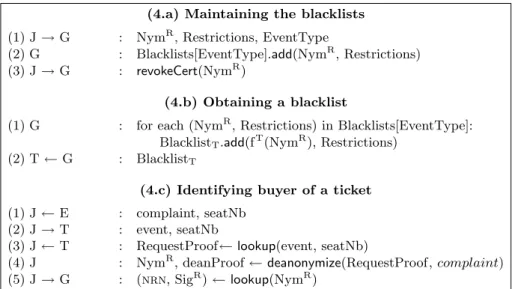
Blacklist Maintenance and Retrieval. A law enforcement entity J forwards the court orders (nrn, Restrictions) to G. Gsubstitutes the nrns with the
corre-sponding NymRs. Each NymRis further converted to NymT←fT(NymR) before the blacklist is sent to a specificT to avoid linkabilities and profiling byT (4.b). Misbehaviour and Deanonymization. Protocol 4.c illustrates how the collabora-tion ofE,T andGis required in order to obtain a (provable) link between the ticket and the user’s id. The proof is (RequestProof, deanProof, SigR). If someone is put on a blacklist for EventType, his permit CredP is revoked. U can obtain a new CredP, with the updated restrictions booleans Restriction[EventType], immediately.
(4.a) Maintaining the blacklists (1) J→G : NymR, Restrictions, EventType
(2) G : Blacklists[EventType].add(NymR, Restrictions) (3) J→G : revokeCert(NymR)
(4.b) Obtaining a blacklist
(1) G : for each (NymR, Restrictions) in Blacklists[EventType]: BlacklistT.add(fT(NymR), Restrictions)
(2) T←G : BlacklistT
(4.c) Identifying buyer of a ticket (1) J←E : complaint, seatNb
(2) J→T : event, seatNb
(3) J←T : RequestProof←lookup(event, seatNb)
(4) J : NymR, deanProof←deanonymize(RequestProof,complaint) (5) J→G : (nrn, SigR)←lookup(NymR)
Table 4.Protocols with anonymous credentials (bis)
7.6 Evaluation
We now evaluate by checking the requirements Functional and Security Evaluation
F1 NymE←fE(NymP) enables T to link ticket orders of the same U for the same event.
F2 A subscription can be issued by T or a coordinating organization. It can be an anonymous credential that contains NymP, NymR, the Restriction[EventType] booleans and information about the subscription. It can be pseudonymously shown to a ticketing service in order to obtain tickets without a payment phase. Alternatively, a multiple-use ticket with an expiry date can be issued.
F3 The user can selectively disclose properties in the permit. F4 is explained in section 7.5.
F5 is done using the anonymized blacklists. Revocation of tickets issued to per-sons that were blacklisted after the ticket order is possible if NymR is sys-tematically shown toT. However, the price is an increase in linkabilities. Privacy Evaluation
P1 Deanonymization requires the collaboration of T, GandJ as we argued in Misbehaviour and Deanonymization.
P2 We argued that a user has for eachE a different NymE←fE(NymP). Differ-entEs thus should know the user’s NymP – which remains hidden – to do linking. For blacklisted users,G can link NymR and NymT. Collusion ofT andGis then possible.
P3 Gknows the links between nyms on a blacklist and the user’s id. However, such convictions are publicly available. Collusion ofT andGcan reveal the identity associated with NymT.
8
Comparison and Feasibility
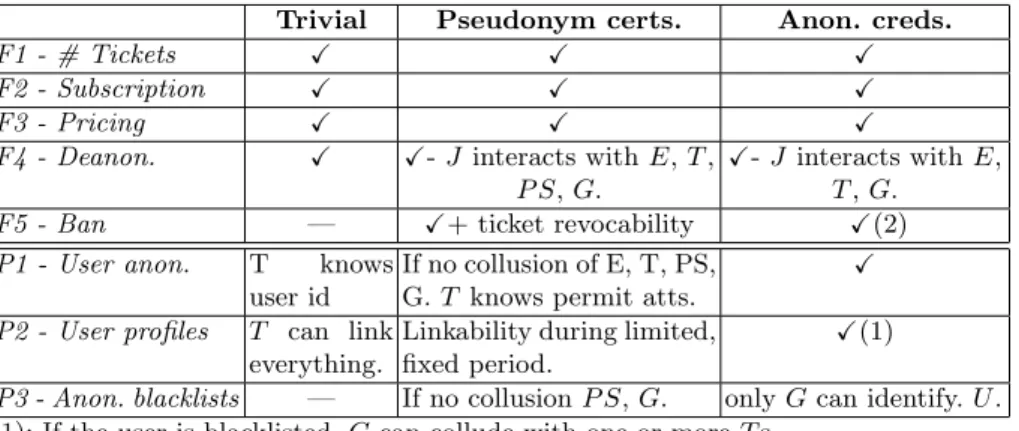
Table 5 compares the three approaches; the main functional/security require-ments can be fulfilled while boosting privacy. To maintain user-friendliness, the interactions with e.g. P S can be done transparently to the user. The proposed solutions disallow a banned person to buy tickets for someone else (e.g. father for his children) and it is still possible that a person buys tickets and gives them to a banned person.
Estimates of the feasibility on the server side where done on an Intel 1.83GHz CPU. In the case of pseudonym certificates, steps 2.a.3 and 2.b.5, i.e. key gener-ation, will be dominant if RSA is used; on average 377ms for 1024 bits and 4110 ms for 2048 bits. For the anonymous credential based protocols, issueCred and showCred/prove are dominant (steps 4.a.6, 4.a.7, 4.b.2 and optionally 4.b.3.b). showCred will require less than 400ms and less than 1,500ms for 1024 and 2048 bits respectively, while issuing lasts less than 600 ms and 2000 ms. Happily, obtaining (one or more) permit certificates will usually be spread in time.
9
Related Work
Ticketing framework [8], hybrid electronic ticketing [15] and ticket for mobile user and communication [3] [13] are valuable contributions for building future ticketing systems. However, except for [15], all fall short in properly addressing user privacy. In comparison, we propose two solutions that preserve the user’s privacy and avoid arbitrary blacklisting.
Heydt-Benjamin et al.[15] propose a hybrid electronic ticketing system which uses passive RFID transponders and higher powered computing devices such as
Trivial Pseudonym certs. Anon. creds.
F1 - # Tickets X X X
F2 - Subscription X X X
F3 - Pricing X X X
F4 - Deanon. X X-Jinteracts withE,T, P S,G.
X-J interacts withE, T,G.
F5 - Ban — X+ ticket revocability X(2)
P1 - User anon. T knows user id
If no collusion of E, T, PS, G.T knows permit atts.
X
P2 - User profiles T can link everything.
Linkability during limited, fixed period.
X(1)
P3 - Anon. blacklists — If no collusionP S,G. onlyGcan identify.U. (1): If the user is blacklisted,Gcan collude with one or moreTs.
(2): Ticket revocability is possible at the cost of increased linkabilites. Table 5.Comparison of the three approaches
smart phones or PDAs. Their hybrid ticketing system framework takes the ad-vantage of e-cash, anonymous credentials and proxy re-encryption[9] to alleviate the concern of privacy in public transportation ticketing systems.
In general, anonymous credential protocols as described in [5], [4] commonly use a Trusted Third Party (TTP) to selectively deanonymize (or link) misbe-having users. However, Patrick et al. [12] strongly argued that deanonymizing a user with the help of TTP is a too heavy measure against a misbehaving user in a privacy-preserving system. Some applications might not necessarily need deanonymization to discourage misbehaving users, they can simply black-list user pseudonyms, to block a user without actually revealing that user’s identity. Thus, the authors propose a scheme where user misbehaviour is judged subjectively and blacklisted by each individual service provider (SP) without the need for TTP. Although subjective blacklisting reduces the size of a blacklist in comparison with the usual centralized blacklisting approach, it can empower a SP to arbitrarily discriminate (or freely blacklist) among its ticket users. In comparison, our protocols do not allow SPs to blacklist a user or to maintain its own blacklist. As discussed previously, in our protocols the blacklist is centrally managed by atrusted government instance and forwarded to the SPs. Moreover, arbitrary user blacklisting is forbidden without a judicial verdict.
10
Conclusions and Future Work
Two privacy preserving ticketing systems were proposed; one based on pseudonym certificates and one on anonymous credentials. We showed that it is possible to offer the user a high degree of privacy, while the other requirements remain fullfilled. Still the privacy unfriendly eID card is used as bootstrap.
A prototype implementation will be made, using an applet for registration and ticket ordering. Entering the event can be done using a bar code reader. The influence of mix networks on the overall performance must be examined.
Acknowledgements. This research is a contribution to the European PRIME project and is partially funded by the Interuniversity Attraction Poles Pro-gramme Belgian State, Belgian Science Policy, the Research Fund K.U.Leuven and the IWT-SBO project (ADAPID) ”Advanced Applications for Electronic Identity Cards in Flanders”.
References
1. N. Asokan, Els Van Herreweghen, and Michael Steiner. Towards a framework for handling disputes in payment systems. Technical Report RZ 2996, 1998.
2. S. Brands. A technical overview of digital credentials, 1999.
3. L. Buttyn and J. P. Hubaux. Accountable anonymous access to services in mobile communication systems. In Proceedings of the 18th IEEE Symposium on Reliable Distributed Systems, 1999.
4. J. Camenisch and E.V. Herreweghen. Design and implementation of the idemix anonymous credential system. In ACM Computer and Communication Security. 2002.
5. Jan Camenisch and Anna Lysyanskaya. An efficient system for non-transferable anonymous credentials with optional anonymity revocation. In EUROCRYPT ’01: Proceedings of the International Conference on the Theory and Application of Cryptographic Techniques, pages 93–118, London, UK, 2001. Springer-Verlag. 6. David Chaum. Security without identification: transaction systems to make big
brother obsolete. Commun. ACM, 28(10):1030–1044, 1985.
7. I. Damgard, T. Pedersen, and B. Pfitzmann. Statistical secrecy and multi-bit commitments, 1996.
8. K. Fujimura and Y. Nakajima. General-purpose digital ticket framework. In Pro-ceedings of the 3rd USENIX Workshop on Electronic Commerce, pages 177–186, 1998.
9. M. Green G. Ateniese, K. Fu and S. Hohenberger. Improved proxy re-encryption schemes with applications to secure distributed storage. InIn: Proceedings of the 12th Annual Network and Distributed System Security Symposium (NDSS), 2005. 10. Matt Hooks and Jadrian Miles. Onion routing and online anonymity. CS182S,
2006.
11. D. M. Goldschlag P. F. Syverson and M. G. Reed. Anonymous connections and onion routing. In SP ’97: Proceedings of the 1997 IEEE Symposium on Security and Privacy, page 44, Washington, DC, USA, 1997. IEEE Computer Society. 12. A. Kapadia P. P. Tsang, M. H. Au and S. W. Smith. Blacklistable anonymous
credentials: blocking misbehaving users without TTPs. InCCS ’07: Proceedings of the 14th ACM conference on Computer and communications security, pages 72–81. ACM, 2007.
13. B. Patel and J. Crowcroft. Ticket based service access for the mobile user. InIn Proceedings of Mobicom’97, 1997.
14. Torben P. Pedersen. Non-interactive and information-theoretic secure verifiable secret sharing. In CRYPTO ’91: Proceedings of the 11th Annual International Cryptology Conference on Advances in Cryptology, pages 129–140, London, UK, 1992. Springer-Verlag.
15. B. Defend T. S. Heydt-Benjamin, H. Chae and K. Fu. Privacy for public trans-portation. InProceedings of the Sixth Workshop on Privacy Enhancing Technolo-gies (PET 2006). Springer, 2006.