A case study of cloud computing deployment in supply chain
management system
KHASHAYAR RAISIFARD, YAZRIWATI YAHYA, NAZRI KAMA, NURULHUDA
MOHAMAD AZMI, SAIFUL ADLI ISMAIL
Advanced Informatics School
Universiti Teknologi Malaysia
Jalan Semarak, 54100 Kuala Lumpur
MALAYSIA
[email protected]
, [email protected], [email protected], [email protected],
[email protected]
Abstract: - -
From the beginning, enabling the companies to lower operating costs and to fulfil increasing order
volumes has been the main purpose of Supply Chain Management (SCM) systems. However, the current SCM systems though bring some significant input still have issues when it comes to data integration between the stakeholders. Due to this matter, the documentation process also will be very challenging. After cloud computing emerged as a revolutionary technology having significant advantages for enterprises, especially for the large ones, a huge number of enterprises started using cloud to enhance their Supply Chain Management systems. This paper concentrates on SCM Cloud system focused on a selected module which facilitate the procurement activities such as manage tenders and manage contracts by presenting the information captured from the SAP systems. By deploying cloud based, data integration and documentation process in the selected module will be much easier, suggesting better resource consumption and more economical.Key-Words: -Supply Chain Management System, cloud computing, post award
1 Introduction
As industry has opened its doors to cloud computing technology, a lot of enterprises are trying to make the most out of this technology’s capability [1]. By using the cloud, all different types of enterprises from multi-national enterprises to Small-Medium Enterprises (SME) can benefit from the features derived by cloud computing, such as cost saving and better resource consumption. Two deployment models used commonly are private cloud and public cloud [2].
From the beginning, enabling the companies to lower operating costs and fulfil increasing order volumes has been the main purpose of Supply Chain Management (SCM) systems. In order to reach these objectives, an automation of supply chain processes is required.
Supply chain comprises facilities and distribution options for the procurement of materials from manufacturer to customer, and all points in between. It includes the production of materials into components and finished products, and then
distribution to customers. Supply chain management has become a key contemporary enterprise management model during the past decade. Various information systems have been developed in the domain of supply chain management. But there are still two immense difficulties because of the complexity of the supply chain. First, most of the traditional supply chain management systems cannot really achieve integration among different organizations. Second, few systems can adapt the changes of supply chain very quickly [3].
Therefore, applying cloud technology is going to play a significant role in supply chain management systems. Contemporary SCM applications can use cloud in integrating SCM processes both within the enterprises and between enterprises that are involved in the supply chain. For most businesses, improving the quality and efficiency of the supply chain is the key success factor. The preceding SCM applications were restricted to a few phases of supply chain and other phases were carried out manually [4].
New technologies from internet to Radio Frequency Identification (RFID), have always found their way
into the supply chain management. After a lot of enterprises realized the importance of supply chain management in today’s competitive market, they have tried to improve the integrity and consistency among supply chain. This is where the cloud can help the enterprises to have access and control the information flow across the supply chain. On the other hand, enterprises can reduce the costs by using one integrated system instead of separate systems for each phase of Supply Chain.
Since the supply chain involves different departments of an organization, therefore, they have their own standard to create the documents related to the scopes of the supply chain, which brings inconsistency to supply chain management. In order to avoid this matter, enterprises need an integrated system which follows the organization’s documentation standards. By using the cloud, the organization can leverage the supports and services that the cloud provider offers [5].
This paper discusses the facilitating and standardizing the documentation processes for the user in each different phase of the supply chain. The study was taken place at a local oil and gas company. Three modules were delivered to be integrated in SCM Cloud System. The modules were identified as Smart Post Award (SPA) module, Logistics module and Dashboard. The only SPA module will be discussed here. SPA module focuses on tender management and processes related to the tender
The rest of this paper is organized in following sections: Section 2 presents related keywords to the research, Section 3 explain the current SCM System, Section 4 discusses the deployment process and the experience, Section 5 concludes the work contributions.
2 Related Works
2.1 Supply Chain Management System
Supply chain management (SCM) systems are segmented into Supply Chain Planning (SCP) system and Supply Chain Execution (SCE) system to automate the flow of information between members of a supply chain so that they can use it to
make better decisions about when and how much to purchase, produce or ship. SCP can improve the flow and efficiency of the supply chain while reducing inventory by applying advanced mathematical applications while SCE is able to automate the different steps and stages of the supply chain [6].
Apart from the above mentioned systems, some other technologies that can be used for managing supply chains include: extranets, intranets, corporate portals, electronic data interchange (Internet based), intra-enterprise and inter-enterprise collaboration tools, radio frequency identification tags, business to business e-business applications (i.e., buy sites, sell sites, exchanges), and many others.
2.1.1 Tender Management
An invitation to offer for an item or work is called tender. According to [7], tendering process is an invitation to those relevant parties to make an offer to the principal, which must be capable of accepting the offer, thereby creating a legally binding contract. The principal is any party inviting and receiving tenders whilst the client may include a contractor. The tenderer is any party whose submitting tenders, including contractor, subcontractor and supplier. Tendering processes is a complex process. A typical one involves lots of business procedures such as tender specification preparation, tender advertisement, tender aggregation, tender evaluation, tender awarding, and contract monitoring.
Prequalification tendering process is to identify qualified suppliers based on some criteria as requested by clients. Besides that, this stage also certifies all the prequalification documents that are required to be submitted by the supplier. Prequalification stage is generally preferred by clients to minimize the risks and failures. It also will enhance the performance levels of selected contractors [8].
2.2
Information Technology in Supply
Chain Management
Easier information sharing across the supply chain and among heterogeneous organizations and systems was made possible by using the Internet and World Wide Web (WWW). A lot of organizations regard inter-organizational collaborations through
information sharing as a major strategy for strengthening their competitiveness. SCM is a strategy for optimizing the overall supply chain by sharing information among material suppliers, manufacturers, distributors and retailers. The key element of SCM is information sharing. Programs like JIT (Just-In-Time), CRP (Continuous Replenishment Process), and QR (Quick Response) in retail rely on the dissemination of scheduling, shipment or manufacturing information in the supply chain. Information sharing improves collaboration among the supply chain to manage material flow efficiently and reduces inventory costs. Software component technology and XML technology facilitates information sharing by providing a means for integrating heterogeneous information systems [9].
New technologies such as cloud-computing, mobile computing, and social computing, will be more adopted into supply chain management systems. In addition, integration of various internal systems and external issues would be a major focus for future supply management systems. The trends in the use of supply chain management systems today are the adoption of three possible stages in a company’s implementation of SCM systems [10]. They are:
First stage: improving internal supply chain
processes and external processes and relationships with suppliers and customers
Second stage: working on links among
suppliers, distributors, customers, and other trading partners
Third stage: developing and implementing
collaborative supply chain management applications/systems.
2.3
Cloud Computing
Cloud computing is a trend that refers to the delivery of ICT solutions, as online services, covering software applications, system software, hardware infrastructure, etc. The concept of cloud computing includes three cloud service delivery models [11]:
Infrastructure-as-a-Service (IaaS) is the delivery of fundamental computing resources (e.g. processing, storage and networks) as a service
Platform-as-a-Service (PaaS) provides a computing platform and solution stack upon which applications and services can be
developed and hosted by using programming concepts and tools supported by the provider.
Software-as-a-Service (SaaS) is a software deployment model that delivers software applications as online, on-demand services. Software vendors increasingly deliver their software applications as online services, in accordance with the above-mentioned SaaS model, and thus become SaaS providers. This enables their customers to use these software services on demand. Customers are thus freed from the management of the underpinning middleware and infrastructure. But the SaaS model requires software vendors to harvest the full benefits from economies of scale. Resources could thus be employed more efficiently and maintenance efforts can be centralized. These benefits, if well-achieved by the SaaS provider, add value to the offering, and reduce the operational costs of providing the software services [12].
3 Current SCM Systems
As tender management involved with procurement process and functionality, the procurement module of two prominent supply chain management systems are briefly described.
3.1
SAP Enterprise Resource Planning
System
Fig 1 illustrates the information flow in procurement cycle, which is covered by SAP ERP (Enterprise Resource Planning) [13].
Figure 3.0 illustrates the information flow in procurement cycle, which is covered by SAP ERP (Enterprise Resource Planning) [13].
Determination of requirements: The responsible
department can manually create a purchase requisition to inform purchasing about material requirements. If we have set a material requirements planning (MRP) procedure for a material in the material master (the database that contains all the materials used by the organization), the SAP system automatically generates a purchase requisition.
Determination of source of supply: As the buyer,
customers are supported in the determination of possible sources of supply. They can use the source of supply determination to create requests for quotation (RFQs) and then enter the quotations. In addition, they can refer to purchase orders, contracts, and conditions that already exist in the system.
Vendor selection: Price comparisons between the
various quotations make it easier to select vendors. Rejection letters can be sent automatically. Purchase order handling: Similar to purchase requisitions, purchase orders can be created manually or the system can create them automatically. When purchase orders are created, the data can come from other documents such as purchase requisitions or quotations, to reduce the amount of entries that need to be made. Working with outline agreements is another option.
Purchase order monitoring: The processing status
of the purchase orders can be monitored in the system. For example, determine whether a delivery or invoice has already been received for a purchase order item. Vendors can be reminded about outstanding deliveries.
Goods receipt: When inbound deliveries are
entered in the system, it can be referred to the associated purchase order. This reduces the amount of entries that needed to be made and allows users to check whether the goods and quantities delivered match the purchase order. The system also updates the purchase order history of the purchase order.
Invoice verification: Invoices can be entered by
referring to the previous purchase order or delivery, so calculations and the general accuracy of the invoice can be checked. The availability of purchase order and goods receipt data means that the user can be informed of deviations in quantity and price.
Payment processing: Vendor debts are paid using
the payment program. The accounting department is responsible for running this program on a regular basis.
3.2
Microsoft Dynamics AX
Fig 2 illustrates the information flow in procurement cycle which is covered by Microsoft Dynamics AX[14] [15].
Fig 2: Purchase Order Processing in Dynamics AX
Starting point for procurement in this application are correct data entry, which is vendor and item data. As for all master data, vendor and item records are usually entered once and are seldom changed. For the purchase processing, master data were copied to transaction data. Planning records and purchase orders, therefore retrieve an item and vendor data as default. The default data can be modified in transactions. Changing data in a transaction will not change master data. For example, if we generally agree to a change of payment terms with a vendor, we have to update the payment terms in the vendor record. Starting from correct master data, purchasing business process can be split into six phases as shown in the figure.
Planned order: The identification of material
requirements is the first step in the purchasing process and may take place in two different ways: a) Automatically, generating planned orders b) Manually, entering purchase requisitions. The basis for generating planned orders within operations planning are accurate figures in inventory, sales orders, purchase orders and forecasts as well as appropriate item coverage settings.
Purchase requisition: Unlike planned orders,
which are created automatically by master scheduling, purchase requisitions are internal documents entered manually in order to require the purchasing department to buy requested items. A
purchase requisition runs through an approval process workflow, before it may be released as a purchase order.
Requests for quote: Request for quotes are sent to
vendors in order to receive information on prices and delivery times. The purchasing department may either enter requests for quote manually or generate them out of a planned purchase orders and purchase requisitions.
Purchase orders: Purchase orders can be created
either manually or by transferring planned orders, purchase requisitions and requests for quote. A purchase order consists of a header, which contains vendor data followed by lists of required items. If user wants to send an order to their vendor electronically or in a printed document, they need to post the purchase order. Posting an order in Dynamics AX means to save it. The posted order therefore is available with its original content no matter if there is a modification of the current order afterwards. The status of a purchase order may be known by looking at the order status and the document status in the header as well as at the posted quantities at the lines. Apart from periodic reports and inquiries, alerts may be applied to problems in order processing like late shipments.
Item receipt: When goods or services actually
arrive, it is needed to record an item receipt related to the purchase order in Dynamics AX. Posting the packing slip receipt increases the physical quantity in inventory and reduces the open quantity in the purchase order.
Invoice Receipt: Together with the item or
sometime later, the vendor sends an invoice. When registering the invoice, Dynamics AX supports invoice control by comparing it with the purchase order and the packing slip. If a received vendor invoice not related to a purchase order, it will be posted in an invoice journal, referring to appropriate ledger accounts. Based on posted invoices, payments may be registered to vendors either manually or by running a payment proposal (this will automatically create a list of payments based on the defined criteria), taking into account due dates and cash discount periods.
Vendor Payment: Payment processing is
independent from purchase orders and usually a responsibility of the finance department. Because of the deep integration of Dynamics AX, all inventory and vendor transactions in purchasing post to ledger
accounts in parallel. In order to keep a record of the whole business process, Dynamics AX comprehensively applies the voucher principle to transactions: document should be registered, before it can be posted. After posting, no modification can be made to the document [16].
3.3
Comparing SAP ERP and Microsoft
Dynamics AX
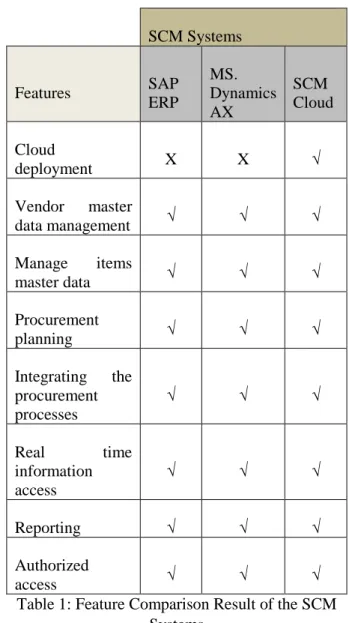
Table 1 contains the features that each SCM system has. SCM Systems Features SAP ERP MS. Dynamics AX SCM Cloud Cloud deployment X X √ Vendor master data management √ √ √ Manage items master data √ √ √ Procurement planning √ √ √ Integrating the procurement processes √ √ √ Real time information access √ √ √ Reporting √ √ √ Authorized access √ √ √
Table 1: Feature Comparison Result of the SCM Systems
The above table presents the differences between the current systems used by major companies with the SCM Cloud system. The contribution of the SCM cloud in features SCM Systems is the cloud
feature that will be improved in terms of integrity and real time information availability
4 Discussion
This section discusses the experiences in deploying the supply chain management system, a smart post award module in a cloud based system.
4.1
SCM Cloud System
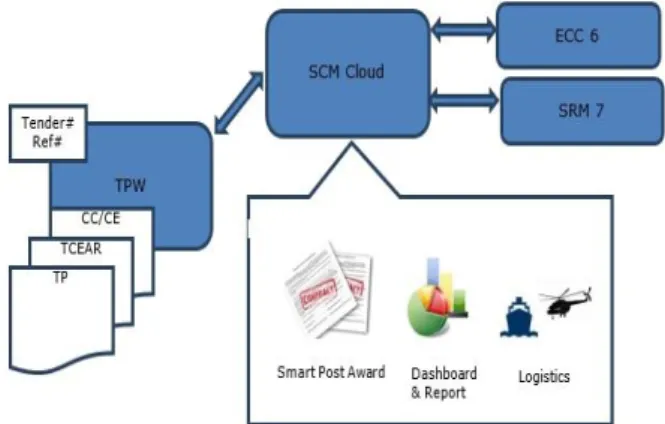
SCM Cloud system consists of three main modules named below and illustrated in Fig 3.
Fig 3: Modules in SCM Cloud System
a) Smart Post-Award (SPA)
The purpose of the SPA is to monitor post award related processes such as manage tender, manage Master Procurement Plan (MPP) and Unplanned Master Procurement Plan (UMPP), manage Pcard, manage documents, and manage a vendor. This system will be integrated with SAP Supplier Relationship Management (SRM) 7 and SAP ERP Central Component (ECC) 6 for obtaining the required information related to the contracts such as Outline Agreement [16], Approved Contract Value (ACV).
b) Logistic (Vessel and Aviation)
SCM Cloud will have the logistic monitoring system for Vessel and Aviation.
c) SCM Dashboard
The Dashboard contains a number of reports which includes aviation seating capacity, vessel usage management, aviation demand profile, and vessel berthing time.
4.2
Smart
Post-Award
Module
Development Process
The development process of SPA is illustrated in Fig 4. This process starts with planning which is the project manager’s task and it cannot be prepared without the team consultation. Then, during the requirement phase the Software Requirement Specification (SRS) documentation will be prepared followed by designing of the database. When the design phase completed, implementation is started. During the implementation developers have to make the unit test using visual studio and see if each method works as expected. After the development phase, the system testing level load test and black box testing techniques were used. Load testing is conducted to make sure that the system works properly under concurrent access of users. The acceptance testing was done by the end user by using the black box testing technique. The two-way arrow between the testing and development shows that there will be changes to the SRS and code. Acceptance testing comes after system testing and it will be done on the organization’s site. Lastly, the system will be deployed to the production server.
Planning Acceptance Deployment
Testing System Testing Design Requirement Unit Testing Implementation
Fig 4: Smart Post-Award Development Process
4.3
SPA Architecture
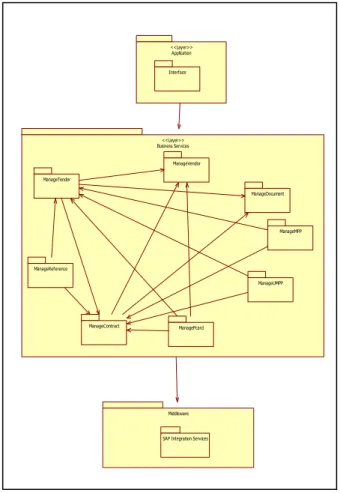
SPA is designed in a Layered Design Pattern which consists of three layers of software architecture, including Application Layer, Business Service Layer, and Middleware Layer. It involves handling interactions with multiple entities. A request is sent
to an entity to initiate an operation, its response is awaited and then on delivery of responsive, another request is sent to the next entity and this sequence continues until a response has been received from the last entity in the sequence. The following fig 5 shows the CSCI architecture diagram.
Fig 5: SPA Architecture
The detail of each layer is described as follows
Application Layer: Application Layer is basically a layer which consists of boundary classes of the system that interact with the user. This layer provides the information for the Business Layer controller classes.
Business Layer: Business Layer consists of Manage Tendering, Manage Contract, Manage Documents, Manage Pcard, Manage Reference, Manage Vendor, Manage UMPP, and Manage MPP packages that contain the controller classes and entity classes to handle the processes of the system made in the Application Layer. These classes store
and process the data of the system, and represent the behavior of the system.
Middleware Layer: Middleware Layer is a layer which contains the API packages. SAP Integration Services is the API which will be used to interact with the SAP external systems.
4.4
Improvements of SCM Cloud System
The main improvements identified after deployment of cloud based supply chain management system for the SPA module in the organization are described below.Integration: before using the SCM Cloud, the user
had to create the documents in Microsoft Office Word and send the documents to the managers through Microsoft Lync. This process was not efficient because the documents would be saved in different locations on the users’ PCs and it would make it hard for them to manage the documents. Users also may forget to send the document to the managers to get the approval. Another issue was that they had to find the information needed to create the documents from SAP SRM and SAP ECC manually. With the deployment of the SCM Cloud, all the systems involved can be integrated (e.g: SAP Systems can be integrated with Tender Paper Writer application). This integrity eased the documenting process and relieved the users from managing the documents.
Real Time Information: SCM Cloud improves the
information sharing across the supply chain as it provides the notification function. Notification function will send the appropriate messages to the users who are responsible for a specific procurement. For example, when a tender is registered in the system that has no MPP then the user will request UMPP by using the UMPP identifier in the Tender registration form. After registering this tender a message will be sent to the planning personnel who are in charge through email. Then when they approve the UMPP using SCM Cloud, a notification will be sent to all users who are included in the tender. These notifications are available in the SCM Cloud when the user logs in to the system. The notification will be shown in all systems as well as the tender paper write an application.
Application <<Layer>>
Interface
Business Services<<Layer>>
ManageTender ManageContract ManageReference ManageUMPP ManagePcard ManageMPP ManageDocument ManageVendor Middleware
Uniformity: SCM Cloud system strengths the uniformity of the supply chain processes. For instance, in order to register tender, create contracts, etc. users need to fill in specific fields of the forms, and they will follow the same template which is provided by the SCM Cloud to create Tender or Contract number.
Reporting: the reporting module of SCM Cloud
will use a third party application to create graphical reports for the senior managers. These reports are based on real time information, as they are using the SCM Cloud database which is always up to date. This feature will improve the visualization of the supply chain activities, as senior managers can monitor the tender numbers generated by their staffs and the tenders’ status by using the report module of the SCM Cloud system.
4.5
Procurement and Sourcing Process in
the Organization
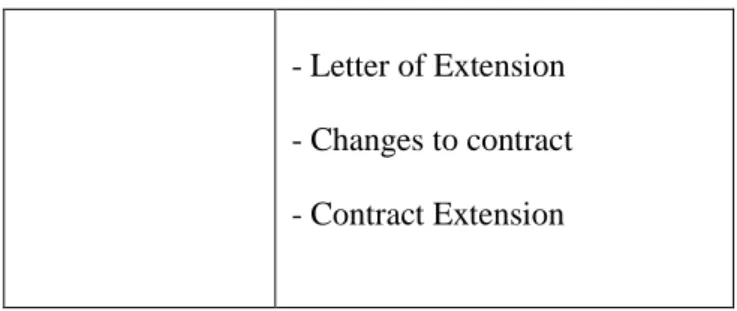
After investigating the procurement process in the organization the following phases have been recognized and the documents related to each phase are tabled in Table 2.
Procurement Phase
Documents
Planning - Master Procurement Plan
(MPP)
- Unplanned Master Procurement Plan (UMPP)
Pre-Award - Pre-Qualification
- Tender Plan
- Approving Authority - Technical Evaluation Report - Techno Commercial
- Evaluation Recommendation
Post-Award - Letter of Award
- Letter of Extension - Changes to contract - Contract Extension
Table 2: Procurement Phases and Documents
Every year, the organization gives a list of Master Procurement Plan which is a list of tender plans that are supposed to be executed for the year. Every tender plan executed will require an MPP code registration. After the planning has registered the MPP Codes, before preparing a tender plan, the Sourcing Executive will generate a tender number. If the MPP Code is not available, Sourcing Executive will require requesting an UMPP Code. When the UMPP Code is approved, planning will register the UMPP so the Sourcing Executive can generate the tender number for preparing the tender plan.
5 Conclusion
The SCM cloud system has been developed to facilitate the procurement process, improve the documentation process as well as real time information access, in the selected organization. This system could achieve its objectives by interacting with the SAP systems, and enable real time information visualization. SPA module will assist the users in the procurement related activities such as manage tender, manage contracts, and etc. The cloud based system enables all the systems to be integrated and it alleviates the documenting process and ease the users to manage the documents. By using the private cloud as the deployment environment enables the organization to reduce the expenses of the company by enabling them to scale the cloud easily. One of the most significant advantages of using cloud computing in supply change management system was that the user of the system does not need to have really high processing power, as the calculations are handled by the cloud which will certainly benefit the user as a whole.
References
[1] Mccracken, J. and Pfalzer, S. D, Test Drive ASP. NET MVC, Pragmatic Bookshelf, 2010
[2] Keung, J., Kwok, F., Cloud Deployment Model Selection Assessment for SMEs: Renting or Buying a Cloud. IEEE/ACM Fifth International Conference on Utility and Cloud Computing, 2012.
[3] Gold, S., Seuring, S. and Beske, P., Sustainable supply chain management and inter‐organizational resources: a literature review. Corporate Social Responsibility and Environmental Management, Vol. 17, No.4, 2010, pp. 230-245.
[4] Casati, F., Dayal, U., and Shan, M. , E-Business Applications for Supply Chain Management:Challenges and Solutions. IEEE, 2001.
[5] Luo, Y., Wirojanagud, P., and Caudill, R. J., Network-Based Optimization And Simulation Of Sustainable E-Supply Chain Management. IEEE, 2001.
[6] Baltzan, P., Phillips, A. L. and Haag, S., Business Driven Technology, MCGRAW-HILL Higher Education, 2008.
[7] Du, R., Foo, E., Boyd, C. and Fitzgerald, B., Defining security services for electronic tendering. Proceedings of the second workshop on Australasian information security, Data Mining and Web Intelligence, and Software Internationalisation, Vol.32, 2004, pp.43-52.
[8] Topcu, Y. I., A decision model proposal for construction contractor selection in Turkey. Building and Environment, Vol.39, 2004, pp.469-481.
[9] Tan, G. W., Shaw, M. J. , Fulkerson, B., Web-based Supply Chain Management.
Information Systems Frontiers, Vol.2, No.1, 2000, pp.41-55.
[10] O'brien, J. A. and Marakas, G. M., Management Information Systems, McGraw-Hill/Irwin, 2011.
[11] Vaquero, L. M., Rodero-Merino, L., Caceres, J. and Lindner, M., A break in the clouds: towards a cloud. SIGCOMM Comput Communicatiom, Vol.39, No.1, 2009, pp.50–55.
[12] Walvaren, S., Truyen, E. and Joosen, W., Comparing PaaS offerings in light of SaaS development A comparison of PaaS platforms based on a practical case study, Computing, Vol.96, 2014, pp.336-724.
[13] Kurbel, K., Case: SAP ERP. Enterprise Resource Planning and Supply Chain Management. Springer Berlin Heidelberg, 2013.
[14] Luo, Y., Wirojanagud, P., and Caudill, R. J., Network-Based Optimization And Simulation Of Sustainable E-Supply Chain Management. IEEE, 2001
[15] Luszczak, A., What is Microsoft Dynamics AX? Using Microsoft Dynamics AX 2009. Vieweg+Teubner, 2010.
[16] Luszczak, A., Purchasing Using Microsoft Dynamics AX 2009. Vieweg+Teubner, 2010.
[17] Fernandes, D. B., Soares, L. B., Gomes, J., Freire, M. and Inácio, P. M., Security issues in cloud environments: a survey. International Journal of Information Security,Vol.13, 2013, pp.113-170.
![Fig 1 illustrates the information flow in procurement cycle, which is covered by SAP ERP (Enterprise Resource Planning) [13]](https://thumb-us.123doks.com/thumbv2/123dok_us/9670193.2455134/3.892.476.820.890.1040/illustrates-information-procurement-cycle-covered-enterprise-resource-planning.webp)
![Figure 3.0 illustrates the information flow in procurement cycle, which is covered by SAP ERP (Enterprise Resource Planning) [13]](https://thumb-us.123doks.com/thumbv2/123dok_us/9670193.2455134/4.892.476.808.372.471/figure-illustrates-information-procurement-covered-enterprise-resource-planning.webp)