UNCLASSIFIED
CIO/G-6 Enterprise Reference Architecture Series
U.S. Army Enterprise Cloud
Computing Reference Architecture
(Aligned to the DOD Enterprise)
UNCLASSIFIED
i
Executive Summary
In order to improve mission and business effectiveness and achieve operational
information technology (IT) efficiencies, the Army is adopting Cloud Computing
technologies and approaches. This adoption is one critical component in achieving
Joint Information Environment (JIE) and LandWarNet (LWN) 2020 objectives. By
transitioning to cloud computing, the Army expects to realize efficiencies in data center
operations, application performance, and reduced overall IT costs.
The U.S. Army Enterprise Cloud Computing Reference Architecture (AECCRA) is being
developed incrementally to provide guidance for the Army’s transition to Cloud
Computing. Three versions of the document are anticipated with each version being
additive in scope to allow for the evolution and maturity of Cloud Computing technology.
The scope of this version of the reference architecture (RA) addresses enterprise-level
secure and non-secure fixed Army Enterprise Cloud Computing Environment (AECCE)
instantiations implemented in DOD, Federal, Mission Partner or Commercial data
centers. The next version will focus on data storage management, as well as
application and data migration. Version 3 will address support for the Army Deployed
Cloud and interoperability with the Intelligence Community (IC) Cloud.
The technique employed within the RA is the Rules-Based Methodology, which
organizes architecture data to align with capabilities, gaps and outcomes derived from
the principles, rules, and standards presented within the Department of Defense (DOD)
Information Enterprise Architecture (DOD IEA), the JIE, LWN 2020 and Beyond
Enterprise Architecture, the Common Operating Environment (COE) and other
emerging documents. Documenting information in this fashion allows architecture data
to be provided incrementally and provides an effective and timely means of codifying
the Army Chief Information Officer’s (CIO’s) strategy, position and intent in order to
solve a specific problem or enable a specific capability.
The intended audience for this RA includes, but is not limited to, HQDA CIO/G-6,
Assistant Secretary of the Army for Acquisition, Logistics and Technology (ASA(ALT)),
ASA(ALT) Program Executive Officers (PEOs), Office of Business Transformation
(OBT), as well as technical and solutions architects and engineers involved in the
planning, implementation, execution and maintenance of Army cloud computing
capabilities. Other significant stakeholders for this RA include Training and Doctrine
Command (TRADOC), Army Cyber Command (ARCYBER), Army Materiel Command
(AMC), Forces Command (FORSCOM), Army Service Component Commands (ASCC)
and other direct reporting units such as 2
ndArmy and Intelligence and Security
Command (INSCOM).
GARY W. BLOHM
Director, Army Enterprise Architecture
BLOHM.GARY.
W.1228949589
Digitally signed by
BLOHM.GARY.W.1228949589 DN: c=US, o=U.S. Government, ou=DoD, ou=PKI, ou=USA, cn=BLOHM.GARY.W.1228949589 Date: 2014.09.29 11:19:50 -04'00'
UNCLASSIFIED
ii
Table of Contents
Executive Summary ... i
1.
Introduction ... 1
1.1 Background ... 2 1.2 Overview ... 3 1.3 Purpose... 4 1.4 Scope ... 5 1.5 Intended Audience ... 6 1.6 Document Structure ... 71.7 Assumptions and Architectural Considerations ... 7
2.
Objective State ... 8
2.1 End-State Vision ... 8
2.2 Alignment with Joint, DOD Information Enterprise Architecture (IEA) and Army Enterprise Network (AEN) Portfolio ... 10
3.
Principles and Rules ... 12
3.1 Operational AECCE ... 13
3.1.1 Assumptions ... 14
3.1.2 Risks... 14
3.2 AECCE Information, Data and Services Management ... 15
3.2.1 Assumptions ... 17
3.2.2 Risks... 17
3.3 Operate and Defend the AECCE ... 17
3.3.1 Assumptions ... 19
3.3.2 Risks... 19
3.4 Govern and Manage AECCE ... 19
3.4.1 Assumptions ... 20
3.4.2 Risks... 20
4.
Summary ... 21
Appendix A - StdV-1 Standards View ... 22
UNCLASSIFIED
iii
Appendix C - Acronyms ... 29
Appendix D - References ... 33
Figures
Figure 1: Hierarchy of IEA Enterprise Architecture Documents ... 1
Figure 2: AECCRA In Context Diagram ... 5
Figure 3: Objective Seamless Cloud Capability ... 8
Figure 4: End-State Cloud Computing ... 9
Figure 5: CV-2a Capability Taxonomy: AEN mapping to the DOD/JIE Capabilities ... 11
Figure 6: CV-2b Capability Taxonomy: AECCE Mapping to AEN Domains ... 11
Tables
Table 1 - Interpretive/Bridge Table ... 12
Table 2 - Computing and Storage Infrastructure ... 13
Table 3 - End-User Connectivity ... 14
Table 4 - Core Enterprise Services ... 15
Table 5 - Information and Data Management ... 16
Table 6 - Services Management ... 17
Table 7 - Operate the AECCE ... 18
Table 8 - Defend the AECCE ... 18
Table 9 - Standards and Policy ... 19
Table 10 - Processes and Models ... 20
UNCLASSIFIED
CIO/G-6 Enterprise Reference Architecture Series
UNCLASSIFIED
1
1.
Introduction
The Army Information Enterprise Architecture (IEA) represents the totality of the
LandWarNet architecture, as it supports the Army’s warfighting, business, and defense
intelligence missions. The IEA consists of three types of architecture: Operational,
Systems, and Enterprise Architecture.
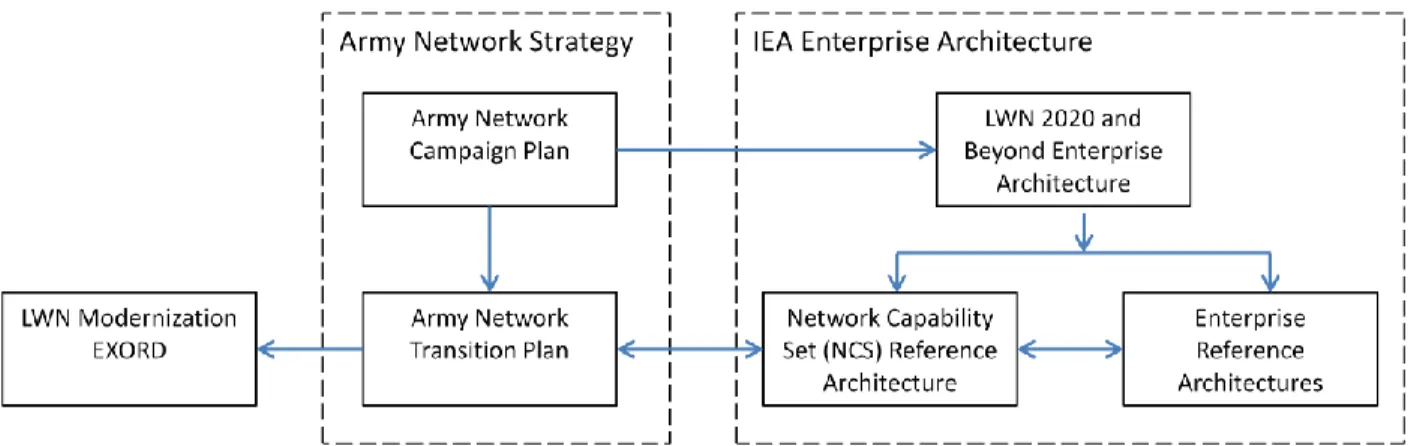
The IEA Enterprise Architecture is further sub divided into the LandWarNet Enterprise
Architecture, the Network Capability Set (NCS) Reference Architecture, and a set of
Enterprise Reference Architectures, all of which the CIO/G-6 develops.
The hierarchy of the IEA Enterprise Architecture, and the context in which it fits, is
shown in Figure 1.
Figure 1: Hierarchy of IEA Enterprise Architecture Documents
The overall objective of this set of documents is to provide the architecture guidance
and direction including technical guidance, principles, rules, policy, constraints,
forecasts, standards, implementation conventions, and criteria required for LandWarNet
to achieve the vision in the Army Network Strategy. Each of these documents has a
unique role in the IEA by providing specific architecture-related information, as
described below.
LandWarNet 2020 and Beyond Enterprise Architecture – Captures all CIO/G-6
architecture guidance and direction at the level of detail needed to support the
evaluation of potential IT investments and architecture options for their alignment
with the Army Network Strategy.
Network Capability Set (NCS) Reference Architecture – Sets the architecture
guidance that drives the design of the future NCS for each fiscal year. It is the
architecture roadmap to understand how LandWarNet will transition from its
current state to its future state.
Enterprise Reference Architectures – Aids in the resolution of specific recurring
problems and explains context, goals, purpose, and the problems being solved.
UNCLASSIFIED
2
The Army Enterprise Cloud Computing Reference Architecture (AECCRA) is a specific
instance of an Enterprise Reference Architecture. It provides overarching guidance to
support Army efforts to achieve Federal and DOD mandates to transition to cloud
computing. This reference architecture shares dependencies with other enterprise
reference architectures and successful delivery of the capabilities described herein
requires successful delivery of capabilities discussed in the other enterprise reference
architectures as components of Network Capability Sets.
1.1 Background
To improve mission and business effectiveness and achieve operational IT efficiencies,
the DOD and Army are transitioning to cloud computing technologies. Adopting cloud
computing technologies and approaches is one critical component in achieving Joint
Information Environment (JIE) and LandWarNet (LWN) 2020 objectives, as advances in
these technologies potentially offer the flexibility and agility needed to support tailored,
scalable operations.
The Army intends to leverage cloud technologies as an essential part of enabling the
movement of mission command and business systems applications, services and data
across all Joint Operations phases. Accordingly, CIO/G-6 is releasing a series of
documents to guide the Army’s migration of existing and future IT capabilities to a cloud
computing environment.
This document is the first of three versions:
Version 1 is the initial document release of a common set of Army guidelines and
requirements for instantiating an AECCE that include Information, Data and
Services Management; Operation and Defense; and Governance and Monitoring.
This version directly supports efforts of the Army Data Center Consolidation
Program (ADCCP) and Program Executive Office Enterprise Information
Systems (PEO EIS) to consolidate data center capabilities and deliver materiel
solutions that support the Army’s transition to cloud computing.
Version 2 will address data storage management within the AECCE and detailed
modernization of applications and data migration process.
Version 3 will address interoperability with Intelligence Community Information
Technology Enterprise (IC ITE).
1Interoperability reflects AECCE interaction with
the IC Cloud to leverage intelligence capabilities in support of Army missions. In
addition, this version will address the Deployed Cloud, which includes support of
Disconnected, Intermittent, Low Bandwidth (DIL) communications; Local
Monitoring and Management; and Data Staging and Forwarding.
Each version is additive, allowing cloud technology to mature and for implementation
patterns to evolve, leading to a complete document at version 3.
1
UNCLASSIFIED
3
Other cloud-enabling capabilities are addressed in separate RAs, such as the following:
Army Information Architecture
Identity and Access Management (IdAM)
Network Operations (NetOps)
Network Security
Thin/Zero Client
Unified Capabilities (UC)
For more information on these and other emerging RAs, please visit:
http://ciog6.army.mil/Architecture/tabid/146/Default.aspx/.
1.2 Overview
Historically, the Department of Defense (DOD) has developed and deployed Information
Technology (IT) applications, systems and data in a stove-piped manner resulting in
increased costs, decreased interoperability and portability, a larger deployment
footprint, and tremendous complexity in managing configuration. Additionally, outdated
business processes have delayed technology insertion and alignment with commercial
innovation. This situation has replicated across the DOD environment leading to
unacceptable IT costs and complexity. Declines in budget and force structure combined
with expanding operational needs are compelling the DOD to overhaul its IT
environment and strategy.
In 2012, the DOD Chief Information Officer (CIO) articulated its intent to transition to
cloud computing capabilities via the DOD Cloud Computing Strategy.
2To reinforce this
objective, DOD CIO released subsequent guidance, memoranda and directives aimed
at consolidating and standardizing applications and data and shifting IT modernization
toward cloud computing capabilities.
So, what is cloud computing? The National Institute of Standards and Technology
(NIST) in Special Publication (SP) 800-145 defines cloud computing as “… a model for
enabling ubiquitous, convenient, on-demand network access to a shared pool of
configurable computing resources (e.g., networks, servers, storage, applications and
services) that can be rapidly provisioned and released with minimal management effort
or service provider interaction.”
3This model is composed of five essential
characteristics:
On-demand Self service
Broad Network Access
Resource Pooling
Rapid Elasticity
Measured Service.
It enables three service models:
2
DoD Cloud Computing Strategy, 9 January 2012 3
UNCLASSIFIED
4
Software as a Service (SaaS),
Platform as a Service (PaaS)
Infrastructure as a Service (IaaS)
Lastly, the cloud computing model supports four deployment models:
Private Cloud,
Community Cloud
Public Cloud
Hybrid Cloud
For Army purposes, Cloud Computing entails the hosting of applications, data and
services on standardized, modular computing, storage and network capabilities. These
capabilities are located in enterprise-managed Army, DISA, Joint, Mission Partner or
commercial cloud service provider (CSP) facilities. These facilities will support metered
usage of dynamically provisioned and released capabilities to authorized users on
approved devices from any location at any time. While it is the intent of the Army to
maximize delivery of capabilities consistent with the NIST definition, early adoption
efforts indicate that legal and security restrictions may limit the extent to which the NIST
definition can be achieved.
In support of Federal and DOD guidance and in parallel to the development of the
AECCRA the Army CIO/G-6 is developing the Army Cloud Computing Strategy. The
purpose of that document is to establish and communicate the Army’s vision and
strategy for transitioning to a Cloud Computing environment, to include describing the
path forward to realize the objectives of the Army and DoD leadership to reduce the
costs associated with IT operations and maintenance while improving the agility of
deployment and the security posture of Army applications on the network.
The path forward described in the Army Cloud Computing Strategy is further articulated
in this document, which leverages guidance found in the DOD Reference Architecture
Description
4and uses a Rules-Based Architecture (RBA) approach. Using an RBA,
specific functional areas needing principles, baseline rules and desired outcomes can
be documented. The collection of rules helps inform, guide and bind the design and
implementation of a specific IT initiative or enterprise capability. Rules supporting
enterprise guiding principles are developed from existing architectural data, strategic
objectives and senior leader guidance and are further described (as required) to clearly
articulate the intent, purpose, and use of the rule.
1.3 Purpose
Building upon the Army Cloud Computing Strategy, this rules-based architecture
provides enterprise-level technical direction guiding the design, development,
procurement and fielding of cloud capabilities in support of Army mission needs. The
objectives of this document are as follows:
4
UNCLASSIFIED
5
Describe the elements and interactions of the Army Enterprise Cloud Computing
Environment (AECCE)
Inform activities associated with the migration of existing applications and data
Foster improved security and controlled access to applications and data
Facilitate governance process restructuring to support the transition to cloud
computing in alignment with JIE and Army Common Operating Environment
standards
Through achievement of these objectives, acquisition organizations will provide initial
cloud computing capabilities that support early migrations and provide lesson learned
for further, more rapid and seamless transitions to cloud computing technologies.
1.4 Scope
The scope of this version of the reference architecture (RA) is enterprise-level secure
and non-secure fixed AECCE instantiations implemented in DOD, Federal, Mission
Partner or Commercial data centers.
Figure 2: AECCRA In Context Diagram
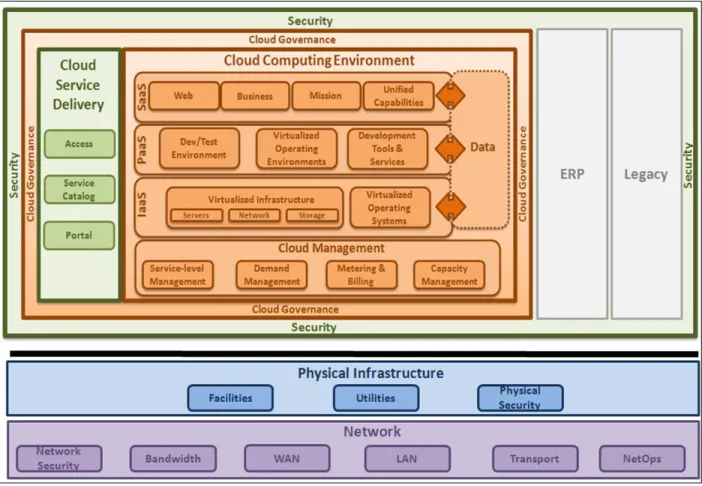
Figure 2 provides a graphical depiction of the AECCE. This RA will address the
elements above the Physical Infrastructure and the Network. It does not address
physical security and associated utilities for an installation or a data center facility (e.g.,
structural, electrical, mechanical, telecommunications or climate control). It is
UNCLASSIFIED
6
envisioned that DOD and non-DOD Cloud Service Providers (CSPs) engaged in
support of the Army will provide the capabilities within the solid green boundary as
described by the principles and rules in this document and negotiated with the
consumers of the capabilities.
Initial instantiations of the AECCE will occur in Defense Information Systems Agency
(DISA) Defense Enterprise Computing Centers (DECC) that are evolving to become
Core Data Centers in accordance with DOD Core Data Center RA
5and Commercial
facilities that are Federal Risk and Authorization Management Program (FedRAMP)
compliant
6and comply with additional security guidelines identified by the DOD
Enterprise Cloud Service Broker.
7As applications are evaluated for migration preparedness, it will be determined that
some are ready to run in a cloud environment, others may need to be modernized, and
others still may not become migration ready. The diagram above identifies
infrastructure to accommodate each of these situations and represents an interim
AECCE that is acquired to support data center consolidation and the cloud transition
between now and the end of fiscal year 18, which is the timeframe in which all
enterprise applications should reside in Core Data Centers.
81.5 Intended Audience
The intended audience for this RA includes, but is not limited to:
HQDA CIO/G-6
Assistant Secretary of the Army for Acquisition, Logistics and Technology
(ASA(ALT))
ASA(ALT) Program Executive Offices (PEOs)
Office of Business Transformation (OBT)
Technical and solutions architects and engineers involved in the planning,
implementation, execution and maintenance of Army cloud computing
capabilities.
Other stakeholders that will influence and may be influenced by this RA include:
Other HQDA Staff elements
Training and Doctrine Command (TRADOC)
Army Cyber Command (ARCYBER)
Army Materiel Command (AMC)
Forces Command (FORSCOM)
Army Service Component Commands (ASCC)
5
Director, Architecture & Interoperability, Office of the DOD Chief Information Officer, Core Data Center Reference Architecture, Version 1.01, February 5, 2013
6
FedRAMP Compliant Cloud Systems, http://cloud.cio.gov/fedramp/cloud-systems 7
DOD Enterprise Cloud Service Broker, http://www.disa.mil/Services/DoD-Cloud-Broker
8 DOD “Joint Information Environment: Continental United States Core Data Centers and Application and System Migration” 11 Jul 2013
UNCLASSIFIED
7
Other direct reporting units such as 2
ndArmy and Intelligence and Security
Command (INSCOM)
Architects will use the content of the Army Enterprise Cloud Computing Reference
Architecture (AECCRA) to develop Mission Area, Component, and solution
architectures able to drive JIE-conformant solutions. Investment decision makers use
the descriptions of capabilities as a baseline to project and spend funds. Capability
developers and managers use capability descriptions to design solutions and then
measure their progress toward achieving the desired end state.
1.6 Document Structure
An Army Enterprise RA provides information, guidance and direction that is applicable
across the Army. This information, guidance and direction are provided in the following
sections:
Section 2:
Objective State
o
CV-2a Capability Taxonomy: AEN Portfolio mapping to the DOD/JIE
Capabilities
o
CV-2b Capability Taxonomy: AECCE Mapping to AEN Domains
Section 3:
Guiding Principles and Rules
Appendix A:
StdV-1 Standards
Appendix B:
AV-2 Vocabulary (Integrated Dictionary)
Appendix C:
Acronyms
Appendix D:
References
1.7 Assumptions and Architectural Considerations
Cloud computing is enabled through the synchronization, integration and interoperability
of a number of other capabilities. Accordingly, several high-level assumptions are
required:
Delivery of the AECCE has the full support and cooperation of all Army senior
leaders, Soldiers and civilians.
Army Enterprise cloud computing end state is achieved through the iterative
delivery of capabilities in conjunction with Network Capability Sets.
AECCRA will be used to inform and shape solution architectures and
implementation plans including technical and engineering specifications.
Army cloud computing solution architects and developers will use this RA as
enterprise guidance for standardizing systems/applications, platforms and data
migration into the cloud computing environment.
Reliable, high bandwidth communication transport links implementing
UNCLASSIFIED
8
adequate bandwidth to each installation to support current demand with enough
expandable capacity to meet the cloud computing requirements.
All instantiations of the AECCE will adhere to standards and technical profiles
described in the current approved version of the Common Operating
Environment.
2.
Objective State
Cloud technologies and solutions will provide Army users with access to data and
applications over the network from centrally managed enterprise computing and storage
locations while enabling, as required, local cloud deployments to support critical
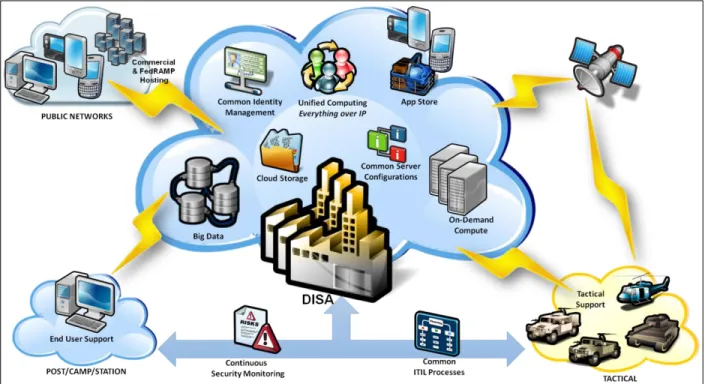
operational needs. Figure 3 depicts how the Army will leverage known and evolving
capabilities to deliver its concept of a seamless cloud capability integrated within the
LWN framework by 2020.
Figure 3: Objective Seamless Cloud Capability
2.1 End-State Vision
By 2020, the Army will maintain strategic and tactical advantage over its adversaries
through information dominance by fully leveraging a global mix of government and
commercial cloud service providers that support Total Force requirements for quality of
service and provide authorized users access to required data elements anywhere, on
any device, in any environment. Moreover, these data elements will be customizable to
the desired format of Mission Commanders, Senior Leaders, decision makers and other
authorized mission partners.
Cloud computing technologies will change how the Army organizes, trains, supports and
deploys its formations enabling immediate connectivity to the capabilities and data
UNCLASSIFIED
9
necessary to accomplish missions. The AECCE will enable real-time, secure, direct
connectivity and data sharing with other DOD Components/Services, Federal Agencies,
as well as Joint and commercial partners.
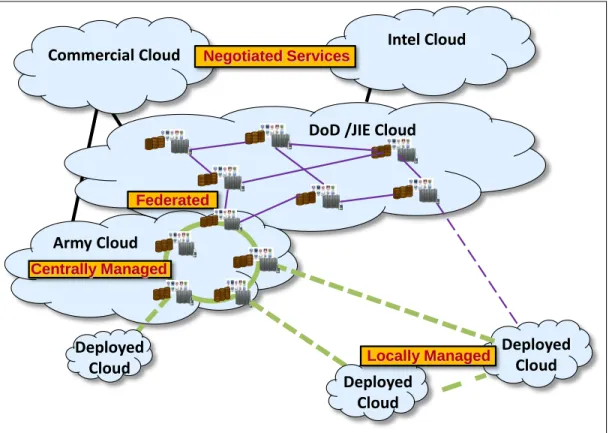
Figure 4 depicts the various cloud environments to be leveraged in the end state. This
end state includes support for multi-security level transport of data, appropriate
cross-domain solution implementation and the deployment of tools and access to support
enterprise-level control and management of a completely federated cloud computing
environment. In this federated cloud computing environment, the Army, through
negotiated agreements, will leverage services that exist in the Intel Cloud to meet Army
Cloud Computing requirements. As well, services will be acquired from the commercial
cloud from approved CSPs to host Army applications and data. These services will be
managed by Service Level Agreements that will include, but not limited to the topics of
CSP connections to DOD networks, appropriate segregation of data, and support for
monitoring by DOD Enterprise Operations Centers. The Army will maintain capabilities
within Installation Processing Nodes to support local services, local data storage, and
support tactical applications in the institutional environment. As units deploy, they will
be able to detach infrastructure that supports a Deployed Cloud environment. As
transport links are installed, the deployed cloud will reconnect to the Enterprise Cloud to
update its data stores.
Deployed
Cloud
Commercial Cloud
DoD /JIE Cloud
Army Cloud
Intel Cloud
Negotiated Services Federated Centrally ManagedDeployed
Cloud
Deployed
Cloud
Locally ManagedUNCLASSIFIED
10
2.2 Alignment with Joint, DOD Information Enterprise Architecture
(IEA) and Army Enterprise Network (AEN) Portfolio
The focus of this RA is to describe the AECCE. It is aligned with the DOD IEA/JIE and
the AEN Portfolio Domains.
The JIE is envisioned as a secure environment comprised of shared information
technology infrastructure, enterprise services and cybersecurity architecture to achieve
full spectrum superiority, improved mission effectiveness, increased security and the
realization of IT efficiencies. Operation and management of JIE is in accordance with
the Unified Command Plan, using enforceable standards, specifications and common
tactics, techniques and procedures, as described in DoD IEA v2.0
(http://dodcio.defense.gov/Home/Initiatives/DIEA.aspx). The JIE has three major
capabilities that are divided into sub-capabilities:
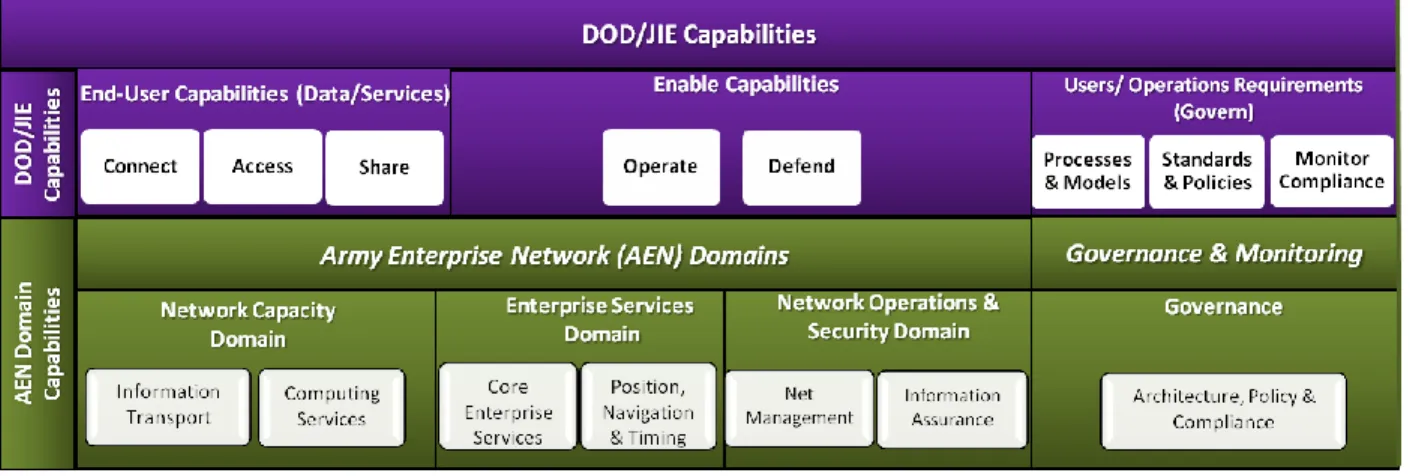
End User Capabilities: Connect, Access, Share
Enable Capabilities: Operate, Defend
Users & Operations Requirement (Govern): Processes, Policy, Compliance
The Army’s framework for managing network modernization is the Army Enterprise
Network (AEN) portfolio, which manages the Net-Centric (6.0) Joint Capability Areas
(JCAs). The portfolio is comprised of three AEN Domains - Network Capacity,
Enterprise Services and Network Operations and Security. Each domain is further
divided into capabilities:
Network Capacity Domain (NCD)
: The NCD portfolio includes the physical
infrastructure necessary for all services and information based activities to
traverse the network. The portfolio encompasses the foundational
infrastructure upon which the Enterprise Services and Network Operations &
Security solutions reside. Capabilities within this domain include –
Information Transport and Computing Services.
Enterprise Services Domain (ESD)
: This portfolio oversees delivery of an
easy-to-use, integrated suite of globally available, adaptable solutions that
seamlessly supports the Total Force while working with Unified Action
Partners (UAPs). These services, both user-facing and enabling, provide the
Total Force awareness of and access to information. Capabilities within this
domain include - Core Enterprise Services and Position, Navigation & Timing.
Network Operations & Security Domain (NSD)
: The NSD is responsible
for providing a secure, seamless and continuous network environment with
protected critical data and information for the Total Force and UAPs. To meet
this objective, NSD will provide capabilities that will improve the Army’s ability
to protect, detect, respond, restore, and manage information and systems.
NSD will also pursue capabilities that support the management of underlying
physical assets that provide end user services for a continuous network
environment. Capabilities within this domain include - Net Management and
Information Assurance/Cybersecurity.
The alignment between DOD/JIE and AEN Domains is depicted in Figure 5. This is a
first level of mapping to identify the capabilities associated with the AECCE. It is
UNCLASSIFIED
11
provided to support the crosswalk from delivered capabilities back to the DOD/JIE
objectives from which they are derived.
Figure 5: CV-2a Capability Taxonomy: AEN mapping to the DOD/JIE Capabilities
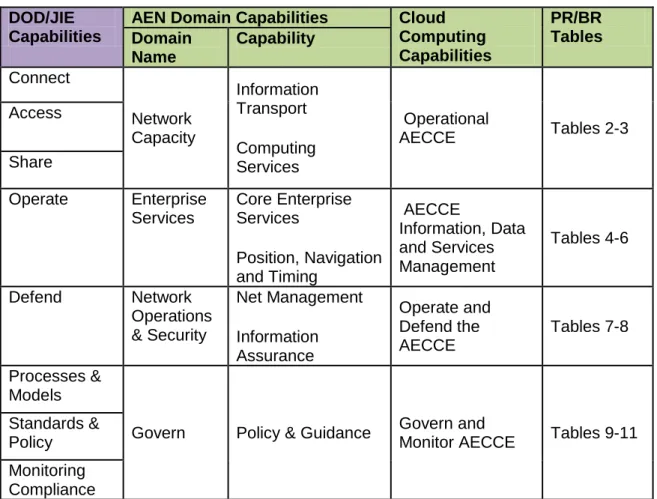
The second level of mapping, as depicted in Figure 6, pertains to cloud-specific
capabilities aligned with AEN Domains. Four Army cloud computing capabilities are
aligned to the AEN Domains in this RA: (1) Operational AECCE; (2) AECCE
Information, Data and Services Management; (3) Operate and Defend the AECCE; and
(4) Govern and Monitor AECCE.
UNCLASSIFIED
12
3.
Principles and Rules
RA principles are enduring guidelines that describe how the Army cloud computing
environment will fulfill its mission. They express the intent of the capability and
fundamental values to be achieved within the Army cloud computing environment.
These principles inform and support the Army’s cloud computing goals, which are
indicated in the emerging Army Cloud Computing Strategy. Business rules are
definitive statements that provide design tenets and also constrain the implementation
of principles and associated policies, as well as acquisition guidance.
The Interpretive/Bridge Table (1) summarizes the relationships between Figures 5 and
6, presented in section 2. This table sets the framework for the capability mappings to
principles and business rules listed in Tables 2 through 11.
DOD/JIE
Capabilities
AEN Domain Capabilities
Cloud
Computing
Capabilities
PR/BR
Tables
Domain
Name
Capability
Connect
Network
Capacity
Information
Transport
Computing
Services
Operational
AECCE
Tables 2-3
Access
Share
Operate
Enterprise
Services
Core Enterprise
Services
Position, Navigation
and Timing
AECCE
Information, Data
and Services
Management
Tables 4-6
Defend
Network
Operations
& Security
Net Management
Information
Assurance
Operate and
Defend the
AECCE
Tables 7-8
Processes &
Models
Govern
Policy & Guidance
Govern and
Monitor AECCE
Tables 9-11
Standards &
Policy
Monitoring
Compliance
Table 1 - Interpretive/Bridge Table
The following AECCE capabilities are mapped to high-level JIE Capabilities and IEA
principles (PRs)/business rules (BRs). These mappings will be updated in alignment
with newer versions of the DOD IEA and DOD Data Center RAs when the newer
versions become available. Additional detail on the planned capabilities of the COE
based AECCE can be found in the ASA(ALT) COE Data Center/Cloud Computing
Environment Architecture Addendum; v2.0.2, 1 June 2014, as well as the ASA(ALT)
COE Data Center/Cloud Computing Environment Architecture Compliance document,
v2.0.2, 1 June 2014.
UNCLASSIFIED
13
What follows in this section of the document is a common set of principles, rules and
standards that an AECCE instantiation must satisfy. The tables that follow include
principles and business rules derived from Federal, DOD and Army Strategy, Guidance,
and Enterprise Architecture documentation. Principles are labeled with CCEX.Y and
Army business rules with CCEX.Y.Z. CCE represents Cloud Computing Environment.
X represents the document version number, Y represents an Army principle, and Z
represents a rule associated with a principle.
3.1 Operational AECCE
The AECCE capability consists of computing infrastructure, computing storage, HW/SW
Protocols, End-User Devices (EUD), Network (NW) Access and Command and Control
(C2). Benefits derived from the AECCE are: improvement of our network's efficiency
by consolidating infrastructure & enterprise licenses; eliminating redundant capabilities,
operations and services to allow us to increase our focus on the most promising new
systems and technologies; optimizing operations and training at installations and while
deployed. The AECCE is a component of the LandWarNet 2020 & Beyond plan and
leverages the capacity, security and enterprise services delivered by LandWarNet. The
operational AECCE will be a hybrid cloud instantiated as DOD community and service
private clouds in DOD and non-DOD facilities.
CCE1.1: Approved DOD and non-DOD CSPs are available to provide computing infrastructure able to provide secure, dynamic, computing platform-agnostic and location-independent application hosting and data storage in support of the AECCE
CCE1.1.1: Army Acquisition community will acquire capabilities to support the cloud service models (IaaS, PaaS, SaaS) in order to provide environments for application and data migration and provide interim environments for enterprise hosting of non-cloud ready ERP and legacy applications.
CCE1.1.2: Non-DOD CSP facilities hosting AECCE data must be subject only to US legal jurisdiction. CCE1.1.3: Cloud Service Providers (CSP) (DOD and Non-DOD) shall be responsible for the cloud infrastructure (operating system and below) to include backups, system maintenance, patch
management, power management, hardware and operating environment software refresh and Continuity of Operation Program (COOP); physical infrastructure to include security, heating, ventilation and air conditioning (HVAC); and network connectivity in accordance with (IAW) service level agreements (SLA), Memorandums of Agreement (MOA) and Contract Terms and Clauses.
CCE1.2: Infrastructure hosting the AECCE is scalable, changeable, deployable, and rapidly manageable while anticipating the effects of the unexpected user. (DOD IEA, V2.0, Vol. II, B-4, SIP 03)
CCE1.2.1: AECCE will support the dynamic provisioning of computing resources throughout the federated cloud, where authorized by pre-approved rules or approved by authorized consumers, as needed within approved funding threshold limits.
CCE1.3: Infrastructure supporting the AECCE supports full Internet Protocol (IP) version 6 convergence of traffic (voice, video, and data) on a single network, within a security domain.
CCE1.3.1: The AECCE shall support IPv6 compliance and retain IPv4 capability for support of legacy applications/systems still using that standard.
CCE1.4: The AECCE leverages transport capabilities of the LandWarNet and commercial providers to provide reliable end user access to required applications/data with a contingency plan for a “disconnected mode" and for continued local processing during network outages (COOP).
CCE1.4.1: CSPs will comply with COOP guidelines and requirements to avoid or minimize disruption of the operations IAW current AR 500-3 U.S. Army Continuity of Operations Program Policy and Planning. CCE1.4.2: CSPs will develop a detailed COOP, which includes customer identified Mission Essential Functions (MEFs) for disaster recovery along with backup and recovery for the scheduled
data/databases, application, servers, storage devices and web services IAW SLA.
UNCLASSIFIED
14
CCE1.5: The AECCE supports computing services request from all enterprise approved software applications, as well as authorized end-users, including those changing their points of attachment among alternate operational and network domains and/or communities of interest. (DOD IEA, V2.0, Vol. II, B-4, SIP 02).
CCE1.5.1: AECCE will enable authorized user access to the applications, data and information from anywhere, anytime from any Army approved end-user device.
CCE1.5.2: End-users will have the same user experience (i.e. look, feel, content, utility, etc.) regardless of location or end-user device, to the extent possible.
CCE1.5.3: AECCE will tailor the view presented to each user based on their role(s), the trust level of the network enclave, and the IT capabilities provided to their organization.
CCE1.5.4: All IT components within the AECCE will be capable of being configured remotely.
Table 3 - End-User Connectivity
3.1.1 Assumptions
To the extent feasible, cloud computing solutions are COTS hardware and
software vendor neutral.
Information consumers do not have physical control or real
‐
time visibility into all
cloud activities.
Cloud implementation with COOP and Disaster Recovery infrastructure
requirements will be equal or better than current capabilities.
Virtualized applications, systems and databases will improve continuity of
operations and disaster recovery through the ability to change datacenter
operating locations electronically.
3.1.2 Risks
Latency due to Enterprise (connectivity, bandwidth, application …etc.) issues.
Degradation of expected user experience.
Transition to IPv6 can interrupt operations due to its non-compatibility and lack of
interoperability with current IPv4 networks.
COOP plans will be complicated requiring synchronization of the continuity of
operations across applications, IP protocols, security domains, software
applications and with software applications running other software applications in
the background
Without network connectivity, users will have limited or no access to applications
and data
Multi-layered organizational boundaries will potentially impact response times,
creating delays in action on operational request for adds, changes, and break/fix
activities due to the complexity of hands-off, formalized channels of
communication and differing priorities.
Different/more complex IA guidelines to follow.
Management construct may be radically different from what is familiar.
UNCLASSIFIED
15
3.2 AECCE Information, Data and Services Management
Aligning with DOD requirements to transition to an Enterprise Cloud may require
modifications to the design and implementation of applications and moving data from
installations to the DOD cloud computing environment. Army users will access
cloud-based solutions and enterprise capabilities that are available through a browser from
anyplace, anywhere and anytime, such as: Enterprise Email, Enterprise Portal,
Enterprise Web Hosting, Enterprise Storage and Unified Capabilities.
CCE1.6: AECCE data assets, services, and applications are visible, accessible, understandable, and trusted to authorized (including unanticipated) users. Unanticipated users may include Joint, interagency, intergovernmental, and multinational partners. Access granted may be limited by law, policy, security classification, or operational necessity.
CCE1.6.1: The AECCE will provide a mechanism for end-users to discover the IT services available to them, and the conditions of their use.
CCE1.6.2: AECCE authoritative data assets and capabilities shall be advertised in a manner that enables them to be searchable from an enterprise discovery solution. (DOD IEA, V2.0, Vol. II, B-2) CCE1.6.3: Mission or business functions hosted in the AECCE will be made available to authorized users as a network-based service with a published, well-defined interface. (DOD IEA, V2.0, Vol. II, B-2) CCE1.6.4: All AECCE information services and applications must uniquely and persistently digitally identify and authenticate users and devices. These services, applications, and networks shall enforce authorized access to information and other services or devices according to specified access control rules and quality of protection requirements for all individuals, organizations, COIs, automated services, and devices. (DOD IEA, V2.0, Vol. II, B-4)
CCE1.6.5: AECCE will provide timely access to critical data, services, and applications from any access point upon authentication of the user and their end-user device. (DOD IEA, V2.0, Vol. II, B-7)
CCE1.7: Army leveraged CSPs are capable of supporting DOD and Army specific services.
CCE1.7.1: Facilities hosting the AECCE shall be capable of enabling Army specific local services per SLAs.
CCE1.8: COE compliant software development environments are enabled in AECCE instantiations. CCE1.8.1: AECCE will provide a set of application development tools (programming languages, run-time environments, test environment) to facilitate high-quality, scalable application development/deployment. CCE1.8.2: All applications available from the AECCE will be developed, tested and integrated in software development environments compliant with the currently approved COE. AECCE hosting of applications not developed in COE compliant environments must be approved by CIO/G-6 (as may be the case for COTS software).
CCE1.8.3: All applications hosted in the AECCE will be evaluated and where cost effective modernized to operate in a cloud-enabled environment. Evaluation of applications shall be conducted in accordance with Enclosure 1: Application Migration Process Overview and Enclosure 2: System/Application Modernization Checklist of the Under Secretary of the Army Memorandum, Subject: Migration of Army Enterprise Systems/Applications to Core Data Centers, dated 9 Jun 2014.
UNCLASSIFIED
16
CCE1.9:
All information to be hosted in the AECCE will be assessed for impact if the information
confidentiality or integrity is compromised and assigned an impact level (1-6) based on
definitions provided in the DOD Cloud Way Forward and DOD Enterprise Cloud Service Broker
(ECSB) Cloud Security Model (CSM):
Impact Level 1: Unclassified-Public, approved for public release
Impact Level 2: Unclassified-Limited Access, approved for public release but is intended for a limited public audience
Impact Level 3: Non-National Security System (non-NSS) Controlled Unclassified Information (CUI) e.g., training systems
Impact Level 4: Non-NSS CUI e.g., HR systems
Impact Level 5: NSS CUI e.g., email systems
Impact Level 6: Classified information up to and including SECRET e.g., C2 systems DOD Cloud Way Forward:
https://software.forge.mil/sf/docman/do/listDocuments/projects.dodcloud/docman.root.dod_cloud_mild
ep_js_disa_cio_wg.13_august_2014
DOD ECSB CSM: http://iase.disa.mil/cloud_security/Pages/index.aspx
CCE1.9.1: Army cloud users will identify the DOD ECSB impact level (1-6) of their application, data, or system, and ensure the CSP enables appropriate information separation in their hosting environment. CCE1.10: Non-DOD CSPs are capable of providing appropriate data-separation in accordance with guidelines provided in the DOD Cloud Way Forward.
CCE1.10.1: Non-DOD CSPs may implement virtual or physical separation between DOD and Non-DOD tenants when hosting Army impact level 1 and 2 information.
CCE1.10.2: Non-DOD CSPs must implement physical separation between DOD and Non-DOD tenants when hosting Army impact levels 3 - 5 information.
CCE1.11: Owners of information and applications/services must establish and refine access policies to allow "need to know" access to appropriate user, even the rare or unanticipated user whose role and assigned mission require access.
CCE1.11.1: AECCE will provide technologies in support of archiving, retrieving, and reliably deleting data.
CCE1.11.2: AECCE will use existing enterprise data, services, and end-user interfaces whenever possible, practical, and appropriate, instead of re-creating those assets. (DOD IEA, V2.0, Vol. II, B-2, DSDR 11)
CCE1.11.3: AECCE will use metadata containing access control and quality of protection attributes that is strongly bound to or associated with information assets to make access decisions. (DOD IEA, V2.0, Vol. II, B-4,SAR 08)
CCE1.11.4: AECCE will include a mechanism for end-users to search for available data assets, and the data models or schema that define them. This mechanism should support the DOD Discovery Metadata Specification (DDMS) http://metadata.ces.mil/dse/irs/DDMS/.
CCE1.11.5: Data in the AECCE shall be decoupled from the applications and systems that use them to facilitate easier discovery, use and protection.
CCE1.11.6: Application owners and developers will minimize redundant data entry and identify approved, authoritative data sources to support application and system data requirements.
UNCLASSIFIED
17
CCE1.12: AECCE facilitates remote application and data management by authorized users, regardless of their physical location.
CCE1.12.1: The AECCE should support access to mission / business applications and data via an attribute-based access control (ABAC) methodology. Data owners should clearly state their access control rules in terms of user attributes.
CCE1.13: Mission / Business applications are executable within the Computing Environments (CE) defined in the COE.
CCE1.13.1: AECCE will closely adhere to approved and emerging DoD IT Standards Registry (DISR) standards and/or the standards listed in the COE StdV-1 and StdV-2 to enable enterprise & Army specific services and approved end-user devices. Compliance and conformance to the DISR and Reference Architecture will be managed by CIO/G6 and where necessary/justified wavers will be issued.
CCE1.14: Application services must be monitored to ensure users are able to accomplish their missions effectively and efficiently
CCE1.14.1: ARCYBER/2nd Army will establish a Service Desk to monitor performance of platform services provided by CSPs and to identify, report, track and resolve information technology faults, incidents, and problems within the AECCE per signed SLA/MOA/MOU.
CCE1.14.2: Application/System owners are responsible for deploying, configuring, updating, and managing the operations of an application including data when using PaaS.
CCE1.14.3: Application owner is responsible for application performance, tuning, patch management, and configuration management when using PaaS. Application performance is a shared responsibility between the application owner and the Cloud Service Provider IAW the SLA/MOA/MOU.
Table 6 - Services Management
3.2.1 Assumptions
None identified at this time.
3.2.2 Risks
Loss of application/system functionality during the execution of the application
migration.
Data migration and management may cause data loss
Overcoming network challenges between enterprise and edge users
Unforeseen or unplanned power outages and system downtime
Data corruption and data loss
Data security, data quality and data integrity
Current organizational structures and funding processes may not be optimal for
enterprise cloud service procurement, implementation, and management
Current Army operational requirements may preclude taking full advantage of
cloud capabilities
Continuity of CSP during migration/transition of applications and data.
Army organization may fail in its mission because of non-compliance with CSP's
SLA or because of application/service performance failure.
3.3 Operate and Defend the AECCE
Cybersecurity is an increased concern to the DOD and the Army in a virtualized
environment. The focus of this capability is strengthening Network and Cybersecurity
by supporting continuous monitoring; and integrating identity and access management.
UNCLASSIFIED
18
CCE1.15: AECCE products and services allow a high degree of automation for NetOps C2 and support dynamic adjustment of configuration and resource allocation. (DOD IEA, V2.0, Vol. II, B-6, NOAR 05) CCE1.15.1: AECCE infrastructure, applications and services, network resources, enclaves, and boundaries shall be capable of being configured and operated in accordance with applicable DoD and Army policy. Such policy must address differences in enterprise-wide, system high, community of interest, enclave, and operational mission needs. (DOD IEA, V2.0, Vol. II, B-3, SAR 02)
CCE1.15.2: The AECCE instantiations should ensure that configuration changes to networks, data assets, services, applications, and device settings can be automatically disseminated and implemented in conformance with GIG-standard configuration processes. (DOD IEA, V2.0, Vol. II, B-4, SAR 10)
CCE1.15.3: AECCE NetOps capabilities will enable dynamic optimization of the flow of data/information. CCE1.15.4: AECCE NetOps capabilities will enable management and control of operational IT
components to optimize the efficiency and effectiveness of IT service delivery to end-users. CCE1.15.5: AECCE NetOps will be capable of resolving resource contention in the use of network capacity in accordance with Army policy, service-level agreements, quality-of-service guidelines, etc. CCE1.15.6: NetOps functionality within AECCE will be managed by a single organization entity that has access to all AECCE operational and status data.
Table 7 - Operate the AECCE
CCE1.16: All AECCE services that enable the sharing or transfer of information across multiple security levels shall be centrally planned and coordinated, with proposed service enhancements considered first at the enterprise-wide level, then at the regional/organizational level, then at the service or application level. (DOD IEA, V2.0, Vol. II, B-3, SAR 06)
CCE1.16.1: AECCE will enable collaborative information sharing across network boundaries in accordance with DOD standards, guidelines, policies and Army Regulation (AR) 25-2.
CCE1.16.2: AECCE infrastructure (computing and network), programs, and applications shall protect data in transit and at rest according to their confidentiality level, Mission Assurance category, and level of exposure. (DOD IEA, V2.0, Vol. II, B-3, SAR 01)
CCE1.16.3: AECCE will, where required, implement appropriate cross-domain solutions to support encrypted data transport between internal and external networks for information sharing.
CCE1.17: An AECCE characteristic is strong authentication for person and non-person entities to allow only authorized users access to information and data by validating their credentials/attributes.
CCE1.17.1: All entities authorized to access AECCE instantiations will have one identity and universal credentials that are recognized by all producers of information and services. (DOD IEA, V2.0, Vol. II, B-7, OPR 01)
CCE1.17.2: AECCE will support roaming profiles optimized to the warfighter environment allowing them access to their information and services (e.g. data files, personal files, calendar, contact list, email, etc). (DOD IEA, V2.0, Vol. II, B-7, OPR 13)
CCE1.17.3: AECCE will leverage the Enterprise IdAM implementation for enablement of strong authentication of person and non-person entities to validate authorization for access to information and data.
CCE1.17.4: Cloud consumer and machine authentication will leverage the current DOD PKI solution and all digital certificates will comply with the current ITU-T X.509 standard.
CCE1.18: AECCE provides sufficient operational and status data so that complete cybersecurity situational awareness can be achieved.
CCE1.18.1: AECCE instantiations will support NetOps tools and processes in identifying, isolating, and resolving problems that either reduce network availability or impair the ability of end-users to use AECCE. CCE1.18.2: AECCE will implement an attribute-based access control (ABAC) methodology to control access to its resources.
UNCLASSIFIED
19
3.3.1 Assumptions
Federal Risk and Authorization Management Program (FedRAMP), Risk
Management Framework and DOD-identified security controls provide the
foundation for a standard approach to assessing and authorizing cloud
computing services.
Cloud implementation will align with updated DOD cybersecurity policies and
instructions, and cybersecurity controls and processes.
The security controls required in a cloud environment will be enforced IAW
FedRAMP and NIST and DOD security guidelines.
Requirements for continuous auditing/monitoring of cloud service providers are
necessary.
Detecting failures, understanding their consequences, isolating their effects, and
remediating risks are central to the adoption of cloud computing environment.
New applications are designed to be resilient and to withstand failure of one or
more elements of the cloud infrastructure
3.3.2 Risks
None identified at this time.
3.4 Govern and Manage AECCE
This activity identifies and enforces the required vision, strategy, and guidance to direct
the AECCE so it meets requirements and applicable law, regulation, and policy (LRP),
while at the same time delivering the capabilities necessary to fully enable net-centric
warfighting, business, and defense intelligence operations for successful mission
accomplishment. It establishes and uses structures and processes required to provide
effective, high-level management and oversight of the components of the AECCE and
its operations.
CCE1.19: The Army achieves infrastructure interoperability through definition and enforcement of standards, interface profiles and implementation guidance. (DOD IEA, V2.0, Vol. II, B-1, GP 02) CCE1.19.1: The AECCE is a capability managed within the Army Enterprise Network Portfolio (AENP) and requirements validation and policy guidance for the AECCE will be the responsibility of the Army Enterprise Network Council.
CCE1.19.2: Data Centers under Army Executive Agency will comply with DOD/JIE mandated Standards and guidelines, and be able to federate with other DOD and non-DOD facilities hosting the AECCE. CCE1.19.3: AECCE will integrate with DOD, DISA, and JIE Cloud Computing capabilities and adhere to associated guidelines, directives, and standards to achieve data and information sharing, interoperability and portability.
CCE1.19.4: Existing Army applications and its data will be modified, when necessary, to be cloud enabled to operate in a cloud computing environment and migrated to an appropriate data center to improve efficiencies,
CCE1.19.5: New Army applications will be designed and developed to be cloud optimized and take full advantage of functioning in a cloud computing environment to include the ability to withstand
infrastructure component failure without degrading application availability or performance and making use of PaaS capabilities as appropriate
CCE1.19.6: Legacy applications may exist in a non-virtualized / non-cloud environment with an approved waiver. The approval authority for all waivers is the Army CIO/G-6
UNCLASSIFIED
20
CCE1.20: Army will consolidate computing infrastructure by consolidating data centers and virtualizing servers and applications as a precondition for cloud migration.
CCE1.20.1: AECCE will provide a highly automated computing infrastructure, limiting the need for human intervention and enabling the optimization of computing infrastructure resources.
CCE1.20.2: ASA (ALT) will, in coordination with the CIO/G-6, develop an overarching infrastructure acquisition strategy (hardware, software, etc) and enforce common computing infrastructure standards. CCE1.20.3: Army Cyber Command (ARCYBER) and 2nd Army will establish and maintain Regional Combatant Command (CCMD)-aligned network service centers to shift from a Service-centric network construct to an operational (i.e., regional) construct supporting regional unified operations within the JIE CCE1.20.4: Application developers will adopt virtualization technology to reduce excess hardware and for consolidating infrastructure.
CCE1.20.5: Application Manager/owner will develop a detailed plan for modernization of applications identified for transition to a cloud computing environment to identify the issues that can be resolved before the migration.
CCE1.20.6: As a pre-condition, application owner will identify, record, and describe rationalization results and status of their application’s functionality, characteristics, and current status in the ADCCP Tracking Tool.
Table 10 - Processes and Models
CCE1.21: Cloud Service Providers and consumers will establish SLAs for all services provided within the AECCE.
CCE1.21.1: As a minimum SLAs should include but are not limited to the following topics: o Availability
o Backup Power Sources
o Remedies for Failure to Perform o Data Preservation/Retention o Legal Care of Consumer Information o Scheduled Outage
o Force Majeure Events o Service Agreement Change o Security, Criticality, and Backup o Service API Change
o Acceptable Use Policies o Licensed Software o Timely Payments o Termination Policy
o Access to usage and performance metrics o Application Failover Policy
o Application Virtual Resource Requirements o Application Performance Requirements
Table 11 - Monitoring and Compliance
3.4.1 Assumptions
None identified at this time.
3.4.2 Risks
UNCLASSIFIED
21
4.
Summary
The objectives of Version 1 of this RA are to standardize Army Cloud Computing
implementations and provide guidance in transitioning to cloud computing
environments. The achievement of these objectives has the expected benefits of
reduction in IT costs, better response to user needs, and improved security. Version 2
of this RA will be released in FY15. Version 2 will focus on data storage management
within the AECCE and detailed modernization of applications and data migration
processes. As it is additive, principles and rules provided in this version will be updated
to reflect new guidance from leadership, lessons learned from pilot activities, and
UNCLASSIFIED
22
Appendix A - StdV-1 Standards View
A StdV-1 is “The listing of standards that apply to solution elements.”
Note: The table below is not an exhaustive list of DOD IT Standards Registry (DISR)
and industry standards pertain to cloud computing. As the cloud standards mature
overtime, the CIO/G6 (in coordination with DOD and acquisition community) will submit
DISR Change Requests for the applicable non-DISR/non-Mandated standards. In
addition to CIO/G6’s guidance, solution providers will ensure compliance with the
current DOD/Joint policies when developing Information Support Plans & StdV-1/2.
Name Version Sponsoring Body
Recommended
DISR Status Description
Cloud Data Management Interface (CDMI)
1.0.2 ISO/IEC
and SNIA Mandated
Defines the functional interface that applications will use to create, retrieve, update, and delete data elements from the Cloud. Open Virtualization Format (OVF) 1.1.0 ANSI, ISO, DMTF Mandated
Describes an open format for the packaging and redeployment of virtual machines.
The specification also defines
Conformance levels, which describe the inclusion of custom elements that may impact portability.
Open Virtualization Format (OVF)
2.0 DMTF Emerging
The second version of the standard, OVF 2.0, which applies to emerging cloud use cases and provides important developments from OVF 1.0, including improved network configuration support and package encryption capabilities for safe delivery.
Virtual Machine
Disk (VMDK) 1.1 VMWare Mandated
The format is a container for virtual hard disk drives to be used in virtual
machines. Cloud Infrastructure Management Interface(CIMI) 1.0.0 DMTF Emerging
Provides a self-service interface for infrastructure clouds, allowing users to dynamically provision, configure, and administer their cloud usage using a high-level interface that abstracts away much of the complexity of systems management. Common Information Model Infrastructure (CIM-Infrastructure) 2.7.0 DMTF Emerging
Applies the basic structuring and conceptualization techniques of the object-oriented paradigm. Data Format Description Language (DFDL) 1.0 Open Grid Forum (OGF)
Emerging Used to describe formatting of text or binary data.
Open Cloud Computing
Interface – 1.1 OGF Emerging
Three distinct standards (Core, Infrastructure, HTTP) that allow the creation of tools for interoperability and
UNCLASSIFIED
23
Name Version Sponsoring Body
Recommended
DISR Status Description
Infrastructure (OCCI)
portability functions like semantic renderings, monitoring, billing, reservations and service negotiation/agreement. Open Data
Protocol (oData) 1.0 OASIS Emerging
Simplifies the querying and sharing of data across disparate applications and multiple stakeholders for re-use in the enterprise, cloud, and mobile devices. REST-based; builds on HTTP. Topology and Orchestration Specification for Cloud Applications (TOSCA) 1.0 OASIS Emerging
Enhances the portability of cloud applications and services.
Enables the interoperable description of application and infrastructure cloud services, the relationships between parts of the service, and the operational behavior of these services –
independent of the supplier creating the service and any particular cloud provider or hosting technology.
UNCLASSIFIED
24
Appendix B - AV-2 Vocabulary (Integrated Dictionary)
An Av-2 is “An architectural data repository with definitions of all terms used throughout
the architectural data and presentations.”
Term Definition
Application Management It is the process of managing the operation, maintenance, versioning and upgrading of an application throughout its lifecycle.
Availability Management Manage the availability of IT services through definition, analysis, planning, measurement, and improvement as the party responsible for ensuring that all IT infrastructure, processes, tools, and roles are appropriate for established service-level targets.
Backup and Recovery Backup and recovery refers to the process of backing up data in case of a loss and setting up systems that allow data recovery due to a data loss. Backing up data requires copying and archiving computer data, so that it is accessible in case of data deletion or corruption. Data from an earlier time may only be recovered if it has been backed up.
Data backup is a key element of disaster recovery and should be part of any disaster recovery plan.
Backward Compatible The ability of a software program or piece of hardware to read files in previous versions of the software or hardware. (DOD 5015.02-STD) April 25, 2007
Broad Network Access Capabilities are available over the network and accessed through standard mechanisms that promote use by heterogeneous thin or thick client platforms (e.g., mobile phones, tablets, laptops, and workstations). Business Rules Business rules are definitive statements that provide design tenets and
also constrain the implementation of principles and associated policies, as well as acquisition guidance.Business rules represent relationships among the AECCE inputs, controls, outputs, and the mechanisms and resources used. For example, a business rule can specify who can do what under specified conditions, the combination of inputs and controls needed, and the resulting outputs. AECCE business rules are based on best practices, provide design tenets, and constrain the implementation of principles and relevant policies.
Capacity Management Provide a process for ensuring that IT services and IT infrastructure are able to deliver established service-level targets in a cost-effective and timely manner.
Change Management Provide control of the lifecycle of all changes to enable beneficial modifications to be made with minimum disruption of enterprise-level IT services.
Client A hardware device or software application that requests and makes use of services provided by another computer called the server.
Cloud Broker An individual or organization that consults, mediates and facilitates the selection of cloud computing solutions on behalf of an organization. A cloud broker serves as a third party between a cloud service provider and organization buying the provider's products and solutions.
Cloud Computing (NIST) A model for enabling ubiquitous, convenient, on-demand network Access to a shared pool of configurable computing resources (e.g., networks, servers, storage, applications and services) that can be rapidly provisioned and released with minimal management effort or service provider interaction. (Source: NIST Special Publication 800-145) Cloud consumer / customer /
subscriber / user
A person or organization that maintains a business relationship with, and uses services from, Cloud Providers.