I
MPROVING CONSUMER INFORMATION
ABOUT MOTORCYCLE PROTECTIVE CLOTHING
PRODUCTS
Liz de Rome, Tom Gibson, Narelle Haworth,
Rebecca Ivers, Chika Sakashita & Paul Varnsverry
Improving consumer information about motorcycle protective clothing products (2012) was prepared for the Motor Accidents Authority of NSW (MAA), under the auspices of the Australian Heads of CTP.
The project was led by Liz de Rome with Rebecca Ivers and Chika Sakashita from The George Institute for Global Health, The University of Sydney.
Co-investigators were: Tom Gibson (Human Impact Engineering, Sydney), Narelle Haworth (Centre for Accident Research and Road Safety– Queensland, Queensland University of Technology) and Paul Varnsverry, PVA Technical File Services Limited (UK).
E
XECUTIVE SUMMARY
The Motor Accidents Authority of NSW (MAA), under the auspices of the Australian Heads of CTP, commissioned a study of the potential options for increasing the availability of credible consumer information regarding motorcycle safety clothing.
A review of the literature highlighted the increasing participation in motorcycling in Australasia and the associated increase in the numbers of motorcycle crash injuries. While there is evidence that specialized motorcycle protective clothing may significantly reduce the risk and severity of injuries in crashes, there is also evidence that over 25% of the protective clothing worn by motorcyclists in Australia is of inferior quality and may fail under crash conditions.
The researchers investigated a range of existing consumer information programs in road safety and other sectors, to identify the features of different business models. An international search of motorcycle clothing rating regimes found the most comprehensive and objective program available to be the tests specified under the European Standards for motorcycle protective clothing.
Consultations with riders and key stakeholders in the motorcycle accessories industry in Australia and New Zealand found no significant barriers to the proposition of an independent consumer testing and information program. Riders were generally supportive with the caveat that such a program must not lead to compulsory usage of protective clothing. A substantial proportion indicated that they would be willing to pay higher prices for protective clothing that has been independently tested and accredited. Industry stakeholders were concerned that they would be expected to absorb the costs of such a program, but did see some potential for such a program assisting them to compete with cheap low quality imports. Industry support for independent testing may increase as the provisions of the new Australian Consumer Law (ACL) become more widely known. Under this Act, anyone in the supply chain (e.g.
manufacturer, importer, retailer or hirer), can be held liable if a product is found to be unsafe. The findings of this report suggest that an independent scheme for testing and rating
motorcycle protective clothing could increase usage rates and reduce injuries, by enabling riders to make informed purchasing decisions. It would also provide incentives to industry to focus on higher quality products and would reduce the marketability of those found to be not fit for purpose. Options for quantifying the potential benefits of improved quality and uptake of protective clothing in terms of data sources and issues for benefit cost analysis are
discussed.
Five potential models of consumer information/ratings programs were examined to identify the optimal model for this program. Factors considered included whether products are assessed on single or multiple dimensions, completeness of coverage, how the ratings are communicated to consumers, whether the system is mandatory or voluntary, how it relates to any existing standards and how is it funded.
The recommended model is commonly used in road safety and requires external stakeholders to provide funding for purchase, testing and promotion of results to intending purchasers. For example, the Australian New Car Assessment Program (ANCAP) is funded by a consortium of motoring organizations and road authorities who independently purchase and crash test
cars to specified performance criteria, Tests are generally based on standards and results made available to the public though stakeholder communication networks. While this model requires significant input of resources from the accrediting body, it has several important advantages. It is not dependent on the support of either industry or consumers but, as the ANCAP program has demonstrated, this approach operates most effectively by educating consumers and thus shaping market demand for higher quality products. Over time the changing market demand would be expected to create a more inviting business case for industry to engage proactively with the program. As with ANCAP it would be recommended that manufacturers be encouraged to take part by paying for the testing of their products rather than waiting to be independently selected.
This model also has the potential to avoid the problems that have arisen in Europe where testing is the responsibility of manufacturers. This has resulted in many of the largest manufacturers avoiding the requirements of compliance with the European Standards by avoiding any reference to safety when marketing their motorcycle clothing products. With a funding base that is independent of industry, a star system may be more able than a voluntary industry standard to withstand pressure to reduce the performance requirements. Thus, the independent star system would potentially have greater safety benefits for motorcyclists. In addition to ANCAP other current examples include the Child Restrain Evaluation Program (CREP) and the Consumer Rating and Assessment of Safety Helmets (CRASH). The essential features are that the tests are objectively validated and the
methodology and criteria transparent.
Further work, including focus groups, will be required to refine the presentation of results (star ratings systems) to ensure they are readily comprehensible to the target audience. Essentially, it is proposed that ratings be based on two separate dimensions. Each garment would be rated firstly on injury protection and, secondly, on user comfort. The latter to comprise weather protection, water penetration, thermal comfort and ergonomics. It is proposed that a thermal manikin be used to ensure consistency and reliability in the thermal testing. As there are a number of appropriate water penetration and thermal comfort standards available, further work will be required to determine which would be optimal when used in combination with the injury protection tests. Injury protection performance and ergonomics would be evaluated using the equipment and test methodologies specified for the European standards for motorcycle protective clothing.
C
ONTENTS
The brief 1
The scope of the report 2
CHAPTER 1 – INTRODUCTION AND BACKGROUND 3
Injury risk and costs of motorcycle crashes 4
Crash data and injury incidence 5
The frequency and severity of injuries 6
Injury costs 9
Injury risk reduction and motorcycle protective clothing 10
The MAIDS study (Motorcycle Accident In-Depth Study) 10
The Gear study – effectiveness of motorcycle protective clothing 11
Quality And Failure Rates Of Motorcycle Clothing Products 13
Ride Magazine product tests 13
The Gear Study – product quality findings 13
Usage of motorcycle PPE 14
CHAPTER 2 - PRODUCT TESTS AND RATING SCHEMES FOR MOTORCYCLE
PROTECTIVE CLOTHING 21
Currently existing motorcycle clothing evaluation regimes 22
The European Standards for motorcycle protective clothing 22
background research and the evidence base for the european standards 22
The development of the European Standards for motorcycle protective clothing 23
Inter-product compatibility 24
Compliance with the European Standards 25
Industry support and compliance 26
Regulation of protective clothing in motorcycle sports 26
Motorcycle helmet rating schemes 27
Safety helmet assessment and rating program (SHARP) 27
Consumer rating and assessment of safety helmets (CRASH) 27
Consumer product information, reviews and ratings programs 28
Motorcycle magazine product reviews 28
Ride Magazine (UK) 29
Motorrad magazine (Germany) 29
CHAPTER 3 - CONSUMER RATING AND EVALUATION PROGRAMS 39
Identifying and classifying consumer information programs 39
Consumer information programs in vehicle and road safety 40
New and used car safety rating programs 40
Effects of car safety rating programs on purchase decisions 41
Other vehicle and road safety rating systems 42
Rating systems in other industries 43
Efficacy and cost-effectiveness 45
The different business models 52
CHAPTER 4 - CONSUMER CONSULTATIONS AND FURTHER RESEARCH55
Industry consultations 55
Rider consultations 56
The samples 56
Ownership and usage of protective clothing 57
Purchasing of protective clothing 57
Discussion and conclusions 58
The use of safety in protective clothing advertisements 58
Background to the study. 59
Aims and Method 59
Results 59
CHAPTER 5 - QUANTIFYING THE ECONOMIC AND HUMAN COSTS OF
MOTORCYCLE CRASHES 62
Introduction 62
Approaches to quantifying motorcycle road crash costs 62
Types of data required 65
Available sources of data and their limitations 67
Road crash data 67
Injury surveillance and claims data 68
Hospital admissions data 69
Injury insurance claims 69
Injury costs 69
Management of data limitations 70
Options for quantifying the potential benefits of improved quality and uptake of protective
Methodological imperative 1: 75
Methodological imperative 2: 75
Methodological imperative 3: 76
CHAPTER 6 – CONCLUSIONS AND RECOMMENDATIONS 83
Introduction 83
Current sources of consumer information about motorcycle safety clothing 83
Motorcycle clothing test and evaluation regimes 84
Test facilities 84
Relevant features of the motorcycle clothing market in Australasia. 85
Models of consumer information programs 85
The feasibility in the Australian and New Zealand context 86
Recommended approach and mechanisms 89
Business model 89
Administration 89
Testing 89
Publication of results 90
Rating and reporting 90
APPENDICES
A. European Standards for Motorcycle Protective Equipment (PPE) 93
B. RIDE test results 94
C. Rating schemes - decision matrix 103
D. Rider survey 113
E. Data for cost estimates 123
F. Test Facilities for EU Motorcycle PPE Standards 132
G. Standards for Thermal and Water Penetration test 133
I
MPROVING CONSUMER INFORMATION ABOUT
MOTORCYCLE PROTECTIVE CLOTHING PRODUCTS
T
HE BRIEFThe Motor Accidents Authority of NSW (MAA), under the auspices of the Australian Heads of CTP, commissioned a study of the potential options for increasing the availability of credible consumer information for motorcycle safety clothing.
The project team was coordinated by The George Institute for Global Health and includes representatives of CARRS-Q, Human Impact Engineering (Sydney) and PVA Technical File Services Limited (UK).
The current report is the first phase of a two part project. The aim of the first phase was to identify options and assess the feasibility of increasing the availability of credible information about the effectiveness of motorcycle protective clothing products in the Australasian market. A range of options were to be considered including, but not only, the establishment of an evidence-based rating program. The report is intended to provide sufficient information to provide a framework and direction for a possible second phase. Should the second phase proceed, it will involve a detailed cost benefit analysis and business case for implementation of the options identified in phase
Structure of the report
Chapter 1 provides the outcome of a targeted review of the literature and available evidence as to the risk, injury and cost reduction benefits of motorcycle protective clothing.
Chapter 2 provides a critical assessment of existing motorcycle protective clothing rating and/or testing' regimes both nationally and internationally.
Chapter 3 reports on existing consumer information programs and what is known about their efficacy and cost-effectiveness in road safety and other sectors.
Chapter 4 reports on the outcomes of industry and rider consultations in Australia and New Zealand and further research into the likely impacts of improved consumer information about protective clothing.
Chapter 5 outlines options for quantifying the economic and human costs of road crashes involving motorcyclists and pillion passengers, and the potential benefits of improved quality and uptake of protective clothing.
Chapter 6 describes the options for improving the availability of consumer information about motorcycle safety clothing. It discusses the feasibility of each of the identified options in the Australian and New Zealand context.
T
HE SCOPE OF THE REPORTThis report is concerned with motorcycle protective clothing designed for riding on-road. Protective equipment designed for off-road riding has been excluded as it is usually very specialised and designed for impacts not directly applicable to on-road riding. The range of products examined includes jackets, pants, one-piece suits, gloves and boots in addition to impact protectors for the limbs and back. As helmets are already the subject of an Australian/ New Zealand standard, they are not the primary focus of investigation but are included in the proposed options for consumer information systems.
The primary focus is on protection from injury in a crash, but also takes account of the functionality of clothing. Discomfort and heat-related stress are recognised factors associated with protective clothing in many industries, where protection from hazards has to be provided at a cost to comfort and flexibility (James 2002). This is because the materials required to provide injury protection tend to be heavier than normal clothing and, by creating
physiological stress, may potentially increase crash risk for motorcyclists (EEVC 1993). In addition to the potential crash risk, heat is also a significant factor in discouraging usage of protective clothing (de Rome 2011).
The aim of this project is to outline the options for increasing the availability of reliable independent information about the protective performance of motorcycle clothing products to riders in Australia and New Zealand. Options to be considered include the possibility of developing a national and cross-Tasman regime for the testing and rating of motorcycle protective clothing. The focus is the provision and promotion of reliable information to consumers, not the development of any regulatory frameworks or government enforcement policies.
C
HAPTER
1
–
I
NTRODUCTION AND BACKGROUND
Motorcyclists represent an increasing proportion of road crash casualties in Australia and around the world. This is due to the increasing number of riders, as motorcycles have become the fastest growing sector of motor vehicles globally (Rogers 2008). Motorcyclists also have a higher risk of injury than other motorised road users who are protected by a vehicle shell. The safety measures routinely fitted to motor cars in order to safeguard the vehicle occupants from injury in a road traffic accident are almost entirely absent from motorcycles. Vehicle-mounted systems include crash bars and air bags, but neither have proven a reliable or viable mechanism for general use due to the variety of pre-crash and collision motions of riders and motorcycles. Crash bars have been found to be effective in some situations but the agents of injury in others (Craig 1983, Mackay 1986, Ouellet et al. 1987, Sporner et al. 1990). While test results are encouraging, the effectiveness of airbags in motorcycle crashes is yet to proven (Ijima et al. 1998, Dragčević et al. 2009b, Thollon et al. 2010). A recent report to the European Transport Safety Council concluded that the development of airbags mounted on motorcycles will be a protracted task, particularly as the trend towards taller cars (people carriers, minivans and SUVs) increases the risk of severe injury crashes. Collisions involving vehicles with high, steep fronts or sides are more likely to result in the rider’s head impacting the roof frame with higher risk of severe injury (ETSC 2008).A number of researchers have concluded that effective injury prevention is most likely to come from protection systems worn by the rider rather than attached to the motorcycle (Craig 1983, Nordentoft et al. 1984, Ouellet et al. 1987, Sporner et al. 1990). Motorcycle helmets have been identified as an effective measure for reducing the risk of death or severe injury in motorcycle crashes (Liu et al. 2008). Most recently, work has also been done on fall
dynamics for the development of airbags integrated into motorcycle jackets (Bellati et al. 2006, Dragčević et al. 2009a). Less attention has been paid to the injury reduction benefits of motorcycle clothing but there is evidence that a significant proportion of motorcycle injuries may be reduced or prevented by the use of effective protective clothing (Schuller et al. 1986, EEVC 1993, Otte et al. 2002, ACEM 2004, de Rome et al. 2011a).
Despite such evidence, it is apparent that relatively few riders wear full motorcycle protective clothing when they ride (Reeder et al. 1996, ACEM 2004, de Rome et al. 2004, Watson et al. 2008). Research into non-usage of protective clothing suggests that there is a range of
associated factors including riders’ age, lack of information, type of motorcycle, and scepticism about its protective value (de Rome et al. 2011b), journeys purpose (de Rome 2006, Watson et al. 2008). In particular, hot weather has been cited as a factor in non-usage of protective clothing (Koch and Brendicke 1998, Manzardo 2006, de Rome et al. 2011b). The challenge for industry has been to provide protection from injury and weather conditions without restricting the riders ease of movement or causing discomfort or fatigue.
Standards for motorcycle protective clothing were issued in Europe in the late 1990s. This provided benchmarks and incentives for manufacturers to develop improved products (EEVC 1993). Despite the ensuing technical developments and new products, few European
manufacturers submit their products for testing, circumventing the need for compliance by avoiding any reference to safety or protection in product descriptions.
I
NJURY RISK AND COSTS OF MOTORCYCLE CRASHESIn Australia and New Zealand, as in many other high income countries, there has been a substantial increase in the numbers of motorcycles registered and the number of rider casualties. In the five years from 2004 and 2008, the reported numbers of motorcyclists injured increased by 21% in Australia and almost doubled (94%) in New Zealand (ABS 2011, Ministry of Transport 2011, NZTA 2011). A risk rate is calculated as the number of fatalities or injuries per 10,000 registered motorcycles. Thus while the numbers of reported fatalities and injuries have gone up in each country, the risk rates have declined or remained relatively stable. See Table 1.1 and Figure 1.1.
Table 1.1 Motorcycle casualties and casualty rates Australia and New Zealand†.
2004 2005 2006 2007 2008 2009 2010 2004-08 Australia Motorcycle registrations* 396 422 463 512 568 624 660 +43% Motorcycle fatalities 191 233 238 237 245 224 214 +28% Fatality rate** 4.8 5.5 5.1 4.6 4.3 3.6 3.2 -11% Motorcycle injuries 6,969 7,366 7,590 7,679 8,421 NA NA +21% Injury rate** 176.0 174.5 163.9 150.0 148.3 NA NA -16% New Zealand Motorcycle registrations* 59 64 75 85 97 101 100 +65% Motorcycle fatalities 34 36 38 41 50 48 50 +47% Fatality rate** 5.8 5.6 5.1 4.8 5.2 4.7 5.0 -11% Motorcycle injuries 721 903 1,017 1,336 1,396 1,369 1,300 +94% Injury rate** 122.9 141.6 135.3 156.5 144.0 134.9 130.1 +17% † Australian figures compiled from data published or provided by each State and Territory road authority. NZ data obtained from Ministry of Transport 2011, NZTA 2011.
* Registrations ‘000,
**Fatality and injury rates calculated as number per 10,000 registered motorcycles
NA Injury data was not available for all Australian States and Territories at the time of writing.
Figure 1.1 Casualty rates per 10,000 registered motorcycles, 2004-2010 176.0 174.5 163.9 150.0 148.3 122.9 141.6 135.3 156.5 144.0 134.9 130.1 4.8 5.5 5.1 4.6 4.3 3.6 3.2 5.8 5.6 5.1 4.8 5.2 4.7 5.0 0.0 2.0 4.0 6.0 8.0 10.0 12.0 14.0 16.0 18.0 20.0 0.0 20.0 40.0 60.0 80.0 100.0 120.0 140.0 160.0 180.0 200.0 2004 2005 2006 2007 2008 2009 2010
Injury rate (Aus) Injury rate (NZ) Fatalites rate (Aus) Fatalites rate (NZ)
CRASH DATA AND INJURY INCIDENCE
The true number of motorcycle crash injuries and particularly minor injuries is difficult to establish, even in countries where road fatality and serious injury records are relatively accurate. This is due to under reporting of motorcycle crashes to police, and also to the bias towards serious injuries that is inherent in records provided by hospital systems (Rutledge and Stutts 1993, Lin and Kraus 2008).
Under-reporting of motorcycle crashes compared to other motor vehicle crashes, particularly
in relation to minor injury and single vehicle motorcycle crashes, has been identified in many jurisdictions including Australia, New Zealand, Europe and Asia (Cercarelli et al. 1996, Lopez et al. 2000, Alsop and Langley 2001, Melhuish 2002, ADB 2006, Amoros et al. 2006, Wilson et al. 2011). A national survey conducted for the UK Department of Transport about reported and unreported crashes, found that overall, 17% of motorcycle crashes had been reported to police. This included 24% of injury crashes and 8% of non-injury crashes. Other studies using hospital data linkage suggest that between 33%-69% of motorcycle crashes in high income countries are reported to police (Harris 1990, Alsop and Langley 2001, Barros et al. 2003, Richardson and Paini 2006).
Bias in injury records is due to the exclusion of non-hospitalized injuries from many injury surveillance systems. In Australia, national injury surveillance systems exclude injured persons who are treated only at the scene, in emergency departments or by private medical services (AIHW 2011). A recent State-based study of motorcyclist presentations (n=104) to emergency departments in Perth, Western Australia over a six month period, found that 63% were subsequently admitted to hospital (Meuleners et al. 2007).
Population surveys may provide more accurate estimates of the actual proportions of injured riders. A cohort study of 4,721 junior college students in Taiwan, found that the incidence rates per 1,000 person-years were 358 crashes to 104 injured and 14 hospitalised (Lin et al. 2001).
Injury claims data is an alternate source of information, but is sometimes limited by the terms of coverage. For example some schemes exclude casualties who were at-fault or if the crash was not reported to police. However, the Accident Compensation Commission (ACC) in New Zealand provides comprehensive no-fault based injury insurance cover for all injuries. Over the period 2006-2010, there were 19,063 motorcycle road crash injury claims to the ACC, but only 34% (n = 6,418) motorcycle injury crashes were reported to police (ACC 2011a,
Ministry of Transport 2011). The NZ data on injury claims is likely a reliable estimate of the true number of motorcycle road crash injuries in New Zealand, but due to differences in police reporting systems does not provide a means of estimating numbers in other jurisdictions. The actual burden of injury from motorcycle crashes in Australia is more difficult to establish and may be substantially higher than is currently recorded in Australian jurisdictions (Richardson, 2006).
The burden of injury from motorcycle crashes may have repercussions beyond the short term of an immediate injury. Motorcyclists have a relatively high risk of impairment and disability following road crashes compared to other road user groups (Bull 1985, Mayou and Bryant 2003, Coben et al. 2007, Crompton et al. 2009, Hours et al. 2010). Their higher levels of disability have been attributed to the high frequency of head and limb injuries. Most of the documented research refers to of the disabling consequence head injuries and the
2004, Mertz and Weiss 2008, Crompton et al. 2009). However a retrospective study of motorcyclists in New Zealand, who had received accident compensation payments for
disablement, found that 68% were associated with mechanical impairment of a limb and 80% had disfiguring impairments due to soft tissue injuries including scarring and muscle wasting (Clarke and Langley 1995).
THE FREQUENCY AND SEVERITY OF INJURIES
Distributions of injury severity can be described in terms of the Abbreviated Injury Severity (AIS) scale, which classifies injury severity from 1 (minor) to 6 (maximal or currently
untreatable) (AAAM 2005). The distribution of injury severity for a sample of casualties can be in terms of the severity of all recorded injuries, or by the single most serious injury
(MAIS) recorded for each individual.
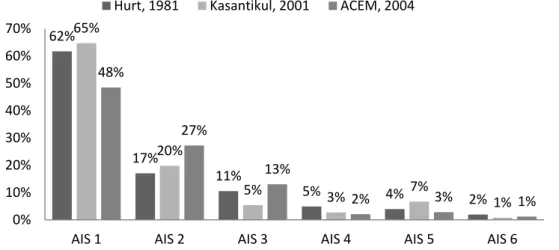
While most motorcycle crash casualties are likely to sustain multiple injuries, a substantial proportion will not sustain any severe injuries. The MAIDS European in-depth motorcycle crash study (n = 923) found almost half (48%) of all injuries recorded were relatively minor (AIS 1), as was the most serious injury (MAIS) suffered by a substantial proportion (38%) of crashed motorcyclists (ACEM 2004). Similarly, an in-depth study of 1,082 motorcycle crashes in Thailand reported similar proportions with minor (AIS 1) accounting for 65% of all recorded injuries and 74% of the single most serious injury sustained by each rider (Kasantikul 2001b, a). Twenty years earlier in the US, the respective proportions reported in the Hurt Study were 62% and 53% (Hurt et al. 1981b). Figure 1.2 illustrates the distribution of severity of all recorded injuries comparing crashes in Europe, Thailand and the US (Hurt et al. 1981b, Kasantikul 2001b, ACEM 2004). It should be noted that even for those who also have serious injuries, the reduction or prevention of additional minor injuries may improve clinical outcomes by reducing blood loss, pain or the risk of infection from wound
contamination (EEVC 1993)
Figure 1.2 Distribution of severity of all recorded injuries (AIS) comparing crashed riders in US (Hurt et al 1981b), Thailand (Kasantikul, 2001a,b) and Europe (ACEM, 2004).
Figure 1.3 illustrates the relative distribution of the most severe injuries (MAIS) sustained by riders in the US, Thai and European studies (Hurt et al. 1981b, Kasantikul 2001b, ACEM 2004). These figures suggest that if even just those injuries considered minor (AIS 1) could be reduced or prevented, the proportion of riders with any injuries could be substantially reduced. 62% 17% 11% 5% 4% 2% 65% 20% 5% 3% 7% 1% 48% 27% 13% 2% 3% 1% 0% 10% 20% 30% 40% 50% 60% 70%
AIS 1 AIS 2 AIS 3 AIS 4 AIS 5 AIS 6 Hurt, 1981 Kasantikul, 2001 ACEM, 2004
Figure 1.3 Distribution of the most serious injury (MAIS) sustained by each rider in USA (Hurt et al, 1981b) and Europe (ACEM, 2004).
The distribution of injury type and severity follow similar patterns across time and in different countries with heads, upper and lower limbs being most frequently injured in motorcycle crashes.
Table 1.2 provides the distribution and type of injury as described by Otte, Kalbe and Suren in 1981. The distribution is broadly consistent with that reported by other investigators over the intervening years and in different countries (Trinca and Dooley 1979, Harms 1981, Hurt et al. 1981b, Bachulis et al. 1988, Sosin et al. 1990, Koizumi 1992, Ankarath et al. 2002, Liu et al. 2008, Crandon et al. 2009, Fitzharris et al. 2009, Lin and Kraus 2009, Forman et al. 2011).
Table 1.2 Distribution of type of injury by body part (n=470, Otte et al 1981).
% of all % of all Soft tissue Fractures Internal
Head 22.9 48.4 39.6 14.4 29.8 Neck 1.8 8.7 5.7 3.3 0.4 Shoulder 3.8 19 12.5 9 - Thorax 6.7 19 12.3 8.5 6.3 Whole arm 18.8 56.2 50.6 17.1 - Upper arm 2.5 12.9 10.1 4.2 - Elbow 2.5 14.5 13.4 1.7 - Lower arm 4.6 21.9 14.5 8.8 - Wrist 2 11.8 9.9 1.7 - Hand 6.8 30.2 27.3 5.2 - Abdomen 4 13.6 8.3 1.1 6.6 Pelvis 30.1 13.1 11 3.3 0.6 Whole leg 38.9 81.2 75.7 32.2 - Upper leg 7.6 33.5 25.6 12.9 - Knee 11.3 19.7 48.1 3.1 - Lower leg 11.8 45.7 35.7 18.6 - Ankle 4.6 23 20.3 4.2 - Foot 3.3 16.2 14.9 3.5 -
Injuries to the head and chest are the type of injuries most likely to be severe, but these are not the most common type of injury sustained by motorcyclists. In 1993, Hell and Lob found that 43% of head injuries were severe (AIS≥2) compared to the proportions of lower
extremities (37%), upper extremities (30%), thorax (25%), abdomen (16%), spine (12%) and 53% 22% 12% 6% 4% 3% 74% 12% 8% 3% 3% 1% 38% 34% 16% 4% 5% 2% 0% 10% 20% 30% 40% 50% 60% 70% 80%
MAIS ≤1 MAIS 2 MAIS 3 MAIS 4 MAIS 5 MAIS 6 Hurt, 1981 Kasantikul, 2001 ACEM, 2004
pelvis (8%) (Hell and Lob 1993). These relative proportions are similar to those reported in other studies, with highest injury risks to the head and lower extremities but head injuries most likely to result in death or disability (Pedder et al. 1979, Hurt et al. 1981b, Otte 1987, Sosin et al. 1990, Ankarath et al. 2002, ACEM 2004, Chen 2006, WHO 2009).
The substantial proportion of relatively minor injuries is critical to the estimation of
motorcycle injury costs and protective clothing because the largest cost savings that could be made from protective clothing are for non-fatal injuries (EEVC 1993). In addition minor injuries have been estimated to account for 88% of quality adjusted life years lost due to injury in the first 6 months following a crash and for 91% over the remaining lifetime (McClure and Douglas 1996).
Table 1.3 shows the distribution of injuries by body location and type of the primary injury for motorcycle casualty claims in New Zealand in the financial years 2006-2010 (ACC 2011b). The locations of the most common primary injuries were the arms (n = 4321, 23%) and legs (n = 4874, 26%). Dislocations/ sprains (27%) and fractures (24%), followed by bruising or contusions (23%), were the most common types of injury.
Table 1.3 Number of claimants by type and location of primary injury, New Zealand 2006-2010 (ACC 2011b)
Count of Claims Arms Feet/
ankles
Hands/ wrists
Head/ face Legs Torso Other
(unknown) Total n (%) 23% 10% 11% 8% 26% 19% 4% 100% Bruising 676 (16) 366 (19) 262 (12) 739 (48) 1,343(28) 826 (23) 82 (12) 4,294 (23) Burns 311 (7) 6 (0) 161 (7) 31 (2) 514 (11) 11 (0) 1 (0) 1,035 (5) Open wounds 614 (14) 236 (12) 331 (15) 425 (28) 1,361 (28) 171 (5) 135 (5) 3,273 (17) Dislocation/sprain 1,318(31) 706 (36) 606 (28) 6 (0) 799 (16) 1,605(45) 36 (45) 5,076 (27) Fractures 1,361(31) 653 (33) 798 (37) 100 (7) 818 (17) 720 (20) 34 (20) 4,484 (24) Internal organ injury - - - 18 (1) - 70 (2) 8 (2) 96 (1) Other injury 41 (1) 1(0) 14(1) 212 (14) 39 (1) 126 (4) 372 (4) 805 (4) Total (100%) 4,321 1,968 2,172 1,531 4,874 3,529 668 19,063
INJURY COSTS
The cost of different types of motorcycle crash related injuries can also be estimated from claims records from the Accident Compensation Commission (NZ). Cost may be expressed in terms of dollars or in the number of days off work. Table 1.4 shows the average cost and Table 1.5 shows the average number of work compensation days paid by location and type for the primary injury sustained per claimant.
Table 1.4 Average cost of claims by type and location of primary injury, New Zealand 2006-2010 (ACC 2011b) Type of injury/ Cost of Claims Arms Feet/ ankles Hands/ wrists Head/ face
Legs Other Torso
Bruising $1,069 $843 $782 $6,414 $1,049 $2,319 $1,119
Burns $876 $1,830 $1,236 $930 $493 $0 $360
Open wounds $948 $3,022 $1,491 $1,566 $1,859 $3,875 $1,033 Dislocation/sprain $2,538 $1,360 $1,248 $606 $3,281 $5,732 $1,535
Fractures $6,893 $6,951 $5,557 $13,066 $14,869 $37,224 $13,232 Internal organ injury $19,964 $7,726 $15,248
Other injury $4,066 $20,542 $1,267 $4,115 $1,809 $15,819 $2,371 Total $3,349 $3,329 $2,811 $5,210 $3,908 $12,173 $4,098 Table 1.5 Average number of days work compensation paid by type and location of primary injury, New Zealand 2006-2010 (ACC 2011b)
Type of injury/ WC Days Paid (first 12 months) Arms Feet/ ankles Hands/ wrists Head/ face
Legs Other Torso
Bruising 5.5 4.4 4.8 21.9 5.5 17.8 6.1
Burns 3.6 10.2 6.9 3.2 1.8 1.0
Open wounds 4.4 19.4 8.2 6.8 10.4 19.0 4.6
Dislocation/sprain 16.7 9.4 8.1 0.0 22.5 32.9 5.4
Fractures 49.7 53.9 39.5 39.1 96.3 101.1 57.7
Internal organ injury 93.1 24.6 45.7 Other injury 30.2 140.0 7.6 15.6 12.1 19.5 14.7
I
NJURY RISK REDUCTION AND MOTORCYCLE PROTECTIVE CLOTHING For many years motorcycle safety research has been dominated by debate about theeffectiveness of helmets (Lawrence et al. 2002, Liu et al. 2008). There has been less focus on other protection for the rider’s body, although the protective value of materials such as
leather have been known for at least 30 years (Feldkamp et al. 1977, Zettas et al. 1979, Aldman et al. 1981, Hurt et al. 1981a, Schuller et al. 1982, Schuller et al. 1986, Otte and Middelhauve 1987, Hell and Lob 1993). These studies were mostly descriptive and did not conform to what would now be required of clinical research, but they did provide evidence of the injury reduction potential of abrasion resistant materials and identify the need for
additional shock absorption over high risk areas. The findings of these studies stimulated research into the development of more effective products and the development of standards by which these products could be judged.
The European Standards for motorcycle protective clothing are based on two mechanisms for protecting the motorcyclist’s body (EEVC 1993). The first requires protection of soft tissues by material and construction, that is abrasion, cut, tear and burst resistant (CEN 2002). The second requires the use of body armour or impact protectors (high-density foam shields) which absorb and distribute the force of direct impacts to exposed areas, e.g. elbows (CEN 1998). There are separate standards for motorcycle protective gloves, boots, one piece suits, jackets and pants and body armour for the limbs and back (see Appendix A). While only enforceable in Europe, the standards have provided benchmarks for manufacturers across the international market (de Rome 2006). The result has been the emergence of a new generation of protective clothing products, however few manufacturers have submitted their products for certification under the standards and until recently their performance in real world crashes had not been examined.
THE MAIDS STUDY (MOTORCYCLE ACCIDENT IN-DEPTH STUDY)
In 2004, the findings of the MAIDS Study in Europe were published (ACEM 2004). This was an in-depth motorcycle crash case-control study conducted over two years (1999-2000) in France, Germany, Netherlands, Spain and Italy. The study was conducted by the Association of European Motorcycle Manufacturers (ACEM) with the support of the European
Commission. Data was collected from 921 crashes including those involving motorcycles and scooters (57%) and those involving mopeds and mofas (43%). This was the first study to collect information about injuries and the effectiveness of clothing worn, since the development of the European Standards for motorcycle protective clothing.
To date, only descriptive results from the MAIDS study have been published, with clothing effectiveness coded only relative to the effect it had on minor injuries (AIS 1). According to the authors, the decision to consider only AIS 1 injuries was based on the belief that
motorcycle protective clothing has a minimal effect on reducing serious injuries (ACEM 2004). The effectiveness of clothing was coded according to whether there was evidence of direct contact with surfaces that could cause AIS 1 injury (e.g., roadway) and the presence or absence of injury in the medical record. Clothing was then classified according to whether it prevented, reduced or had no effect on the severity of the AIS 1 injuries. The results indicated that AIS 1 injuries were reduced or prevented on the upper torso (64.6%), lower torso
(61.3%), hands (43.5%) and feet (48.7%) by the clothing worn.
Clothing had also been classified by type of material (unknown, light, medium, heavy or leather) and whether clothing was motorcycle oriented, but the associations between these
levels of detail and injury prevalence were not reported. Data does not appear to have been collected on the usage of fitted impact protectors (also called body armour), possibly because these items were only just appearing in the market following the publication of European standards for impact protectors (CEN 1998). In addition, the report did not distinguish between the clothing worn by riders of motorcycles/scooters and that worn by those riding mopeds/mofas.
THE GEAR STUDY – EFFECTIVENESS OF MOTORCYCLE PROTECTIVE CLOTHING The Gear Study was a prospective cohort study of motorcyclists who crashed in the Australian Capital Territory between June 2008 and June 2009 (de Rome et al. 2011a, b). Eligible motorcyclists included riders and passengers of motorcycles and scooters who were involved in road crashes causing injury or motorcycle damage. Participants were volunteers recruited through the two hospitals and thirteen motorcycle repair services in the study area. Baseline interviews were conducted face-to-face in participants’ homes or in hospital
approximately two weeks after their crash. Follow-up surveys were conducted by mail
approximately two months and six months later with the reference period being ‘over the past four weeks’. At baseline, information was collected about the crash, clothing worn, injury details and basic demographics. Injury reports completed at the interview were subsequently corroborated with hospital records for independent scoring on the AIS scale by a trained assessor. At the interview, participants also completed questionnaires about their general health and functional ability prior to the crash. The questionnaires were also included as part of the follow-up surveys to monitor the longer term consequences of the crash.
Primary analysis – injury risk reductions and protective clothing
The aim of the first stage analysis was to examine the association between use of motorcycle protective clothing and risk of injury in crashes (de Rome et al. 2011a). This was a cross-sectional analytic study of crashed motorcyclists (n=212) representing 71% of identified eligible cases. The main outcome was hospitalisation and motorcycle crash-related injury. Poisson regression was used to estimate relative risk (RR) and 95% confidence intervals (CI) for injury to each body zone by injury type. Tests of association were adjusted for potential confounders of injury identified from the literature including age, gender, motorcycle type, crash type (single or multi-vehicle), type of impact (e.g. road surface, other vehicle or fixed object) and the estimated speed of impact.
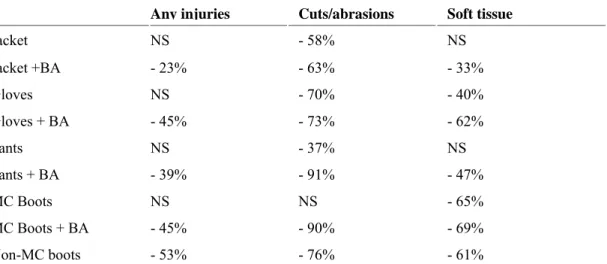
The results showed that motorcyclists were 21% less likely to be admitted to hospital if they crashed while wearing motorcycle jackets, but the risk reduction was greater if they were wearing motorcycle pants or gloves (51% and 59% respectively). When garments were fitted with body armour (impact protectors), there was a significantly reduced risk of any injury to the upper body (23%), hands and wrists (45%), legs (39%), feet and ankles (45%). However the benefits of body armour could not be detected specifically in relation to fracture injuries. Given the relatively low occurrence of fractures (15%), compared to soft tissue injuries (71%), in unprotected motorcyclists (Duffy and Blair 1991) the sample size was likely too small to be able to detect any such difference. While the findings of this study provide convincing evidence of the overall protective benefits of body armour, further research is necessary to establish the specific benefits of body armour for each part of the body in relation to specific injury types, particularly fractures. Non-motorcycle boots were also associated with a 53% reduced risk of any injury compared to shoes or joggers.
Table 1.6 shows the estimated injury risk reduction associated with each type of protective clothing, adjusted to take account of potentially confounding factors (rider age and gender, motorcycle type, single or multi-vehicle crash, impact speed and type of impact). It is apparent that the greatest risk reduction is in terms of cuts/abrasions, and to a lesser extent soft tissue injuries including bruises.
Table 1.6 Relative injury risk reduction (IRR) protected vs. unprotected riders by type of protective clothing
Any injuries Cuts/abrasions Soft tissue
Jacket NS - 58% NS Jacket +BA - 23% - 63% - 33% Gloves NS - 70% - 40% Gloves + BA - 45% - 73% - 62% Pants NS - 37% NS Pants + BA - 39% - 91% - 47% MC Boots NS NS - 65% MC Boots + BA - 45% - 90% - 69% Non-MC boots - 53% - 76% - 61%
NS Not statistically significant., BA Body Armour , Adjusted for rider age and gender, motorcycle type, single or multi-vehicle crash, type of impact and impact speed.
The Gear Study - health outcomes in the six months following a motorcycle crash The aim of the second stage analysis was to examine the associations between use of protective clothing and subsequent impairment and disability in the six months following a crash (de Rome et al. 2011c). Completed follow-up surveys at two and six months were returned by 69% (n = 146) of eligible motorcyclists.
The exposure factor was usage of protective clothing classified as full protection (motorcycle jacket and pants), partial protection (motorcycle jacket) and unprotected (neither). Outcomes of interest included general health status (Short Form SF-36), disability (Health Assessment Questionnaire) treatment and recovery progress, quality of life and return to work in the six months post-crash. Odds ratios (OR) were estimated for categorical outcomes using multiple logistic regression to assess differences in outcomes associated with levels of protection. Odds ratios were adjusted for potential confounders including age, sex, occupation, speed and type of impact. Non-parametric procedures were used for data that were not normally
distributed.
The results showed that compared to unprotected riders, both fully and partially protected riders had fewer days in hospital and reported less pain immediately post-crash. At two months, both protection groups were also less likely to have disabilities or reductions in physical function. By six months, there were no significant differences in disability or physical function between groups, but both protection groups were more likely to be fully recovered and returned to pre-crash work than unprotected riders. Fully protected riders achieved better outcomes than either partially or unprotected riders on most measures. There were few significant differences between the full and partial protection groups, although the latter showed greater impairment in physical health two months post-crash.
Q
UALITYA
NDF
AILURER
ATESO
FM
OTORCYCLEC
LOTHINGP
RODUCTS RIDE MAGAZINE PRODUCT TESTSThe only published evidence-based program of motorcycle clothing product tests is the one established by Ride Magazine in the United Kingdom (UK), which has published regular reports since the European Standards tests were first available. A review of the most recently available product tests (reported in detail in Appendix B), found that a substantial proportion of garments rated poorly in tests of their protective performance including abrasion, burst and impact force resistance. While these tests were based on those required by the European Standards for motorcycle protective clothing, the magazine reports relative or scaled scores rather than actual test results and in some cases improvised on the specified test
methodology. As a result it is not possible to infer from the published reports whether they would be predictive of garments’ likely compliance with the European Standards. It was apparent from the reports that price was not predictive of test performance.
THE GEAR STUDY – PRODUCT QUALITY FINDINGS
The Gear Study was the first in-depth study of the performance of motorcycle clothing in crashes (de Rome et al. 2011a). Whereas a majority of the protective garments worn sustained some impact in the crash, not all were damaged and only a proportion of those damaged were considered to have failed. For the purposes of the study, garments were assessed to have failed if damage to the protective layer potentially exposed the wearer to injury. The protective layer is not necessarily the outer shell for example, in the case of Kevlar lined jeans, the outer denim may be worn away but if the Kevlar lining remains intact the garment has not failed.
Construction failure was defined as seams splitting or fastenings opening in the protective layer due to crash impacts. Material failure was defined by holes in the protective layer of the garment. The failure rate is calculated from the number of garments that failed as a
proportion of those that had sustained an impact.
In all 29.7% of motorcycle designed jackets, 25.7% of pants and 28.1% of gloves were assessed to have failed in the crash. Table 1.5 lists the type of damage sustained by each type of garment and the number and proportion of those that sustained an impact and failed to provide the wearer with adequate protection. Such failure does not necessarily mean the rider was injured as a result of that exposure.
Table 1.7 Motorcycle clothing worn, impact and injuries sustained and failure recorded
Motorcycle clothing Jacket Pants Gloves Boots Worn (n) 175 (82.6) 74 (34.9) 185 (87.3) 81 (38.2) Impact sustained 142 (81.1) 55 (74.3) 120 (64.9) 54 (66.7) All garments damaged 115 (65.7) 42 (56.8) 101 (54.6) 56 (69.1)
Type of damage sustained*
Abrasion damage 107 (75.4) 35 (63.6) 89 (74.2) 51 (94.4) Burst damage 13 (9.2) 1 (1.8) 4 (3.3) 2 (3.7) Cut penetration 0 2 (3.6) 1 (0.8) 2 (3.7) Split 5 (3.5%) 1 (1.8) 10 (8.3) 3 (5.6) Torn material 51 (35.9) 22 (40.0) 44 (36.7) 6 (11.1) Clothing failure* Material failure 52 (29.7) 19 (25.7) 52 (28.1) 7 (8.6) Construction failure 18 (10.3) 2 (2.7) 14 (7.6) (6.2)
*Percentage damaged and percentage failure, are given as a proportion of those motorcycle designed garments that sustained an impact.
These results are consistent with the findings of the Ride magazine products tests and provide strong evidence that a substantial proportion of motorcycle garments may fail to provide the expected level of protection in a crash.
U
SAGE OF MOTORCYCLEPPE
Relatively few studies have documented the prevalence of usage of protective clothing by motorcyclists in the population. Most of those studies reporting itemised usage of protective clothing have been based on samples of crashed riders (Aldman et al. 1981, Hurt et al. 1981a, Schuller et al. 1982, Danner et al. 1984, ACEM 2004, Phan et al. 2008). The limitation of such approaches to estimate usage in the rider population is that crashed riders are not necessarily representative of all riders, and may include a higher proportion with
characteristics associated with higher crash risk, such as youth and risk taking ((Lin and Kraus 2009). A number of cross-sectional surveys have been conducted to provide estimates of usage in the wider riding population in Germany, New Zealand and Australia (Marburger 1987, Reeder et al. 1996, Koch and Brendicke 1998, de Rome and Brandon 2007, Wishart et al. 2009).
Population estimates of protective clothing usage rates are also difficult to obtain because motorcyclists are a small but highly segmented and diverse community, which makes it difficult to obtain a representative sample (Johnston et al. 2008, Christmas et al. 2009, Jamson and Chorlton 2009) (Johnston et al. 2008, Christmas et al. 2009, Jamson and Chorlton 2009).
Population surveys distributed through licensing authorities are expensive and efforts to survey samples within the motorcycling population are subject to bias according to the means by which potential recruits are identified. Volunteers, particularly those contacted through motorcycle media, networks or events, may be more representative of motorcycling enthusiasts. Observational surveys may be biased to particular sections of the rider population, according to the specific route or time or day of week (e.g. recreational or commuting) and time of year in terms of weather and climatic factors.
There is also evidence that riders usage of protective clothing may vary according to the type of machine (scooter or motorcycle), type of ride (recreation or commuting), their intended
destination and the weather. This was first documented in 1986 in a survey of riders (n = 557) attending a motorcycle exhibition in Germany. They were asked about their ownership and usage of motorcycle clothing when riding in urban environments, country roads and on motorways (Koch and Brendicke 1998). This study is of interest because it revealed that riders did not always wear the protective clothing that they owned and that patterns of usage varied according to riding environment. Discomfort and heat were identified as key
disincentives for always wearing full protective clothing.
Figure 1.4 presents the findings of three Australian cross-sectional surveys of riders’ usage of protective clothing. The NSW study was a cross-sectional survey (n = 1300) distributed to riders through motorcycle magazines, clubs and events in New South Wales and the Australian Capital Territory, Australia. Compared to the general riding population, the sample was over representative of experienced, older riders and motorcycle club members. Riders were asked what they normally wore for recreational and commuting rides. Those who had been involved in a crash (n = 338) were also asked what they had been wearing at the time (de Rome 2006). The ACT study was an observational study of riders taken on popular motorcycling recreational routes (n=116) and on key commuter routes (n = 272) in the Australian Capital Territory in 2007 (Watson et al. 2008). The QLD studies were also observational studies conducted in Brisbane on recreational (n = 144, 2006) and commuter routes (n = 262, 2008) (Wishart et al. 2009). In each study, it is apparent that many riders normally wear a helmet, gloves and motorcycle jackets, but are less likely to wear motorcycle pants or boots, particularly for commuting. It is also apparent that the NSW riders, who had been involved in a crash, were less likely to have been wearing protective clothing at the time of the crash, despite their self reported ‘normal’ usage.
Figure 1.4 Protective clothing reported in cross-sectional surveys of Australian riders 1
While none of the above studies can be assumed to provide an accurate picture of what all riders wear or even the ‘average’ rider wears, some consistencies in the patterns can be identified. It is apparent from this figure that riders are more likely to protect their upper body
1 Note: in the NSW study, riders who had been wearing a helmet but without eye protection, were not classified as having full protection for the head.
0% 20% 40% 60% 80% 100% 120% Helmet/ eye protection
MC Jacket MC Gloves Boots MC Pants
Recreation NSW Commuting NSW Crash NSW Recreation ACT Commuting ACT Recreation, QLD Commuter, QLD
than their lower body, to wear more protective clothing for recreational than commuting rides and that motorcycle pants are the garment least likely to be worn.
A survey of Australian and New Zealand riders (n=1020), conducted for the current project, confirmed these general trends. It found that riders were more likely to own motorcycle jackets and gloves than either boots or pants. Ownership did not necessarily imply always wearing those garments. Motorcycle pants were least likely to be always worn, with only 41% of all respondents always wearing and 58% of all who owned pants, always wearing them. A higher proportion owned (80%) and always wore (61%) motorcycle boots. Those that owned jackets and gloves were more likely to report that they always wear them. See Figure 1.5
Figure 1.5 Proportions of riders who own and who always wear each type of motorcycle clothing (Australia).
Conclusions
There is evidence that protective clothing can prevent or reduce the severity of injuries in motorcycle crashes. There is also evidence that not all riders wear full protective clothing and that not all protective clothing is of sufficient quality to be fit for the protective purpose. If the proportion of riders benefiting from wearing protective clothing is to be increased, then both usage rates and clothing quality must be improved. This is because if the quality is poor, an increase in usage will have no overall benefit and quality failures will deter usage.
References
AAAM, 2005. Abbreviated injury scale 2005,. In: Gennarelli, T.A., Wodzin, E. eds.
Association for the Advancement of Automotive Medicine (AAAM), Barrington, Il, USA. ABS, 2011. 9309.0 motor vehicle census, Australia, 31 january 2011.
ACC, 2011a. Data extracted on 11 October 2011 from ACC data warehouse tables refreshed on 8 October 2011. Geoff Ness, Wellington, NZ.
ACC, 2011b. Motorcycle crash injury claims, 2006-2010. Accident Compensation Commission, Wellington, NZ.
ACEM, 2004. MAIDS in-depth investigation of accidents involving powered two wheelers: Final report 1.2. Association of European Motorcycle Manufacturers (ACEM)
http://www.maids-study.eu/ Last accessed 11 October 2010, Brussels, pp. 173. 99% 92% 72% 80% 96% 98% 78% 41% 61% 79% 99% 84% 58% 77% 83% 0% 20% 40% 60% 80% 100% 120%
Helmet MC long sleeved jacket
MC protective pants
MC Boots MC Gloves Own Always wear Worn if owned
ADB, 2006. Mainstreaming road safety: Technical note. Asian Development Bank– Association of Southeast Asian Nations, http://www.adb.org/Documents/Books/Road-Safety-Guidelines/, Manila.
AIHW, 2011. Trends in serious injury due to land transport accidents, Australia. Injury Research and Statistics Series: No. 54. Australian Institute of Health and Welfare, Canberra.
Aldman, B., Cacciola, I., Gustafsson, H., Nygren, A., Wersall, J., 1981. The protective effect of different kinds of protective clothing worn by motorcyclists. In: Charpenne, J.P.C.A. ed. Proceedings of the 6th International Conference of the Research Council on the Biomechanics of Impact. IRCOBI, Salon-de-Provence (France), pp. 1-9.
Alsop, J., Langley, J., 2001. Under-reporting of motor vehicle traffic crash victims in New Zealand. Accident Analysis and Prevention33 (3), 353-9.
Amoros, E., Martin, J.-L., Laumon, B., 2006. Under-reporting of road crash casualties in France. Accident Analysis and Prevention38 (4), 627-635.
Ankarath, S., Giannoudis, P.V., Barlow, I., Bellamy, M.C., Matthews, S.J., Smith, R.M., 2002. Injury patterns associated with mortality following motorcycle crashes. Injury33 (6), 473-7.
Bachulis, B.L., Sangster, W., Gorrell, G.W., Long, W.B., 1988. Patterns of injury in helmeted and nonhelmeted motorcyclists. American Journal of Surgery155 (5), 708-711.
Barros, A.J., Amaral, R.L., Oliveira, M.S., Lima, S.C., Goncalves, E.V., 2003. Traffic accidents resulting in injuries: Under reporting, characteristics and case fatality rate. Cadernos Saude Publica19 (4), 979-86.
Bellati, A., Cossalter, V., Lot, R., Ambrogi, A., 2006. Preliminary investigation on the dynamics of motorcycle fall behavior: Influence of a simple airbag jacket system on rider safety. Proceedings of the International Conference for Motorcycle Safety. Institute fur Zweiradsicherheit, Cologne.
Bull, J.P., 1985. Disabilities caused by road traffic accidents and their relation to severity scores. Accident Analysis and Prevention17 (5), 387-397.
CEN, 1998. Motorcyclists' protective clothing against mechanical impact: Requirements and test methods for impact protectors. EN 1621-1:1998. European Committee for
Standardisation, Brussels.
CEN, 2002. Protective clothing for professional motorcycle riders: Jackets, trousers and one piece or divided suits - general requirements. EN 13595-1:2002. European Committee for Standardisation, Brussels.
Cercarelli, L.R., Rosman, D.L., Ryan, G.A., 1996. Comparison of accident and emergency with police road injury data. Journal of Trauma - Injury, Infection and Critical Care40, 805-809.
Chen, H.B., 2006. Injury patterns and risk factors of motorcycle crashes. Chinese Journal of Clinical Rehabilitation10 (40), 187-190.
Christmas, S., Young, D., Cookson, R., Cuerdenm, R., 2009. Passion, performance,
practicality: Motorcyclists' motivations and attitudes to safety. Motorcycle safety research project, PPR 442. Transport Research Laboratory, Wokingham, Berkshire UK.
Clarke, J.A., Langley, J.D., 1995. Disablement resulting from motorcycle crashes. Disability and Rehabilitation17 (7), 377-85.
Coben, J.H., Steiner, C.A., Miller, T.R., 2007. Characteristics of motorcycle-related hospitalizations: Comparing states with different helmet laws. Accident Analysis and Prevention39 (1), 190-6.
Craig, G.R., Sleet, R. & Wood, S.R. , 1983. Lower limb injuries in motorcycle accidents. Injury15, 163-166.
Crandon, I.W., Harding, H.E., Cawich, S.O., McDonald, A.H., Fearron-Boothe, D., 2009. Motorcycle accident injury profiles in Jamaica: An audit from the University Hospital of
the West Indies. International Journal of Injury Control and Safety Promotion16 (3), 175-178.
Crompton, J.G., Tolulope, O., Stevens, K.A., Efron, D.T., Haut, E.R., Haider, A.H., 2009. Motorcycle helmets save lives, but not limbs: A national trauma data bank analysis of functional outcomes after motorcycle crash. Journal of Surgical Research151 (2), 1-5. Danner, M., Langwieder, K., Polauke, J., Sporner, A., 1984. Protective clothing for riders.
Buro fur KFZ- Technik, Federal Highway Research Institute, Bergisch Gladbach.
de Rome, L., 2006. The injury reduction benefits of motorcycle protective clothing.
http://www.ntsb.gov/events/symp_motorcycle_safety/symp_motorcycle_safety.htm, NTSB Public Forum on Motorcycle Safety.National Transport Safety Board, September 12-13 2006,
Washington DC
de Rome, L., Brandon, T., 2007. Survey of motorcyclists in NSW, 2006 Motorcycle Council of NSW, Inc. www.roadsafety.mccofnsw.org.au. Last accessed 5 October 2010., Sydney. de Rome, L., Ivers, R., Fitzharris, M., Du, W., Richardson, D., Haworth, N., Heritier, S.,
2011a. Motorcycle protective clothing: Protection from injury or just the weather? Accident Analysis and Prevention43 (6), 1893-1900.
de Rome, L., Ivers, R., Haworth, N., Heritier, S., Du, W., Fitzharris, M., 2011b. Novice riders and the predictors of riding without motorcycle protective clothing. Accident Analysis and Prevention43 (3), 1095-1103.
de Rome, L., Ivers, R.Q., Fitzharris, M., Haworth, N., Heritier, S., Richardson, D., 2011c. Effectiveness of motorcycle protective clothing: Riders' health outcomes in the six months following a crash. doi: 10.1016/j.lnjury.2011.10.025.
de Rome, L., Stanford, G., Wood, B., 2004. Survey of motorcyclists and their safety initiatives. Australasian Road Safety Research, Policing and Education Conference, http://trid.trb.org/view.aspx?id=771117. Perth, Australia.
Dragčević, Z., Takeuchi, K., Vecaj, D., Hursa, A., 2009a. Motorcycle jacket with integrated air bag. Tekstil58 (7), 346-351.
Dragčević, Z., Takeuchi, K., Večaj, D., Hursa, A., 2009b. Motorcycle jacket with integrated air bag. Motorradjacke mit eingebautem airbag58 (7), 346-351.
Duffy, E.M., Blair, A., 1991. Motorcycle accidents: The leg injury problem in perspective. Proceedings of the International Conference of the Research Council on the Biomechanics of Impact. IRCOBI Berlin, pp. 231-246.
EEVC, 1993. Report on motorcycle Safety. An EEVC Paper, Report of the Ad-hoc Group on Motorcycle Safety, 1993. European Experimental Vehicles Committee Brussels, pp. 75. ETSC, 2008. Vulnerable riders: Safety implications of motorcycling in the European union.
European Transport Safety Council, Brussels.
Feldkamp, G., Prall, W.D., Buehler, G., Junghanns, K., 1977. Motocycle accidents;
epidemiology, clinical aspects and protective measures, a followup and prospective study. Unfallheilkunde80 (1), 1-19.
Fitzharris, M., Dandona, R., Kumar, G.A., Dandona, L., 2009. Crash characteristics and patterns of injury among hospitalized motorised two-wheeled vehicle users in urban India. BMC Public Health9.
Forman, J.L., Lopez-Valdes, F.J., Pollack, K., Heredero-Ordoyo, R., Molinero, A., Mansilla, A., Fildes, B., Segui-Gomez, M., 2011. Injuries among powered two-wheeler users in eight European countries: A descriptive analysis of hospital discharge data. Accident Analysis and PreventionIn Press, Corrected Proof. Available online 15 March 2011. Harms, P.L., 1981. Injury patterns of motorcyclists involved in accidents. Supplementary
Report No 651. Transport and Road Research Laboratory, Crowthorne, Berkshire. Harris, S., 1990. The real number of road traffic accident casualties in the Netherlands: A
Hell, W., Lob, G., 1993. Typical injury patterns of motorcyclists in different crash types- effectiveness & improvement of countermeasures. Proceedings of the 37th Annual Conference of the American Association for the Advancement of Automotive Medicine. AAAM, San Antonio, pp. 77-86.
Hotz, G., Cohn, S., Mishkin, D., Castelblanco, A., Li, P., Popkin, C., Duncan, R., 2004. Outcome of motorcycle riders at one year post-injury. Traffic Injury Prevention5 (1), 87-9.
Hours, M., Bernard, M., Charnay, P., Chossegros, L., Javouhey, E., Fort, E., Boisson, D., Sancho, P.O., Laumon, B., 2010. Functional outcome after road-crash injury: Description of the ESPARR victims cohort and 6-month follow-up results. Accident Analysis and Prevention42 (2), 412-421.
Hurt, H.H., Ouellet, J., Wagar, I., 1981a. Effectiveness of motorcycle safety helmets and protective clothing. Proceedings of the 25th Annual Conference of the American Association for the Advancement of Automotive Medicine. AAAM, San Francisco, pp. 223- 235.
Hurt, H.H., Ouellet, J.V., Thom, D.R., 1981b. Motorcycle accident cause factors and identification of countermeasures. In: University of Southern California Traffic Safety Center ed. Technical Report. National Highway Traffic Safety Administration,
Washington, DC.
Ijima, S., Ozono, S., Ota, A., Yamamoto, T., 1998. Exploration of an airbag concept for a large touring motorcycle. Proceedings of the 16th International Conference on the Enhanced Safety of Vehicles. NHTSA, Canada.
James, P.Z., 2002. The hidden hazard of protective apparel. Occupational Health and Safety 71 (1), 55.
Jamson, S., Chorlton, K., 2009. The changing nature of motorcycling: Patterns of use and rider characteristics. Transportation Research Part F: Traffic Psychology and Behaviour12 (4), 335-346.
Johnston, P., Brooks, C., Savage, H., 2008. Fatal and serious road crashes involving motorcyclists. Monograph 20 Department of Infrastructure,
http://www.infrastructure.gov.au/roads/safety/publications/2008/mono20.aspx Canberra, pp. 26.
Kasantikul, V., 2001a. Motorcycle accident causation and identification of countermeasures in Thailand, Volume 2: Up country Study. Chulalongkorn University, Bangkok, Thailand 10330.
Kasantikul, V., 2001b. Motorcycle accident causation and identification of countermeasures in Thailand. Volume 1. Bangkok Study. Chulalongkorn University, Bangkok, Thailand 10330.
Koch, H., Brendicke, R., 1998. Protective clothing: Wearing patterns, knowledge and attitudes of motorcyclists. In: Rothengatter, T., De Bruin, R. eds. Road user behaviour: Theory and research. Van Gorcum & Company Assen, Netherlands.
Koizumi, M.S., 1992. Injury patterns in motorcycle accident victims. Rev Saude Publica26 (5), 306-15.
Lawrence, B.A., Max, W., Miller, T.R., 2002. Costs of injuries resulting from motorcycle crashes: A literature review. National Highway Traffic Safety Administration,
Washington DC,
http://www.nhtsa.dot.gov/PEOPLE/INJURY/pedbimot/motorcycle/Motorcycle_HTML/to c.html (accessed June 11, 2010).
Lin, M.R., Hwang, H.F., Kuo, N.W., 2001. Crash severity, injury patterns, and helmet use in adolescent motorcycle riders. Journal of Trauma - Injury, Infection and Critical Care50 (1), 24-30.
Lin, M.R., Kraus, J.F., 2008. Methodological issues in motorcycle injury epidemiology. Accident Analysis and Prevention40 (5), 1653-1660.
Lin, M.R., Kraus, J.F., 2009. A review of risk factors and patterns of motorcycle injuries. Accident Analysis and Prevention41 (4), 710-722.
Liu, B., Ivers, R., Norton, R., Boufous, S., Blows, S., Lo, S., 2008. Helmets for preventing injury in motorcycle riders (review update). Cockrane Database of Systematic Reviews Issue 1, pp. 37.
Lopez, D.G., Rosman, D.L., Jelinek, G.A., Wilkes, G.J., Sprivulis, P.C., 2000. Complementing police road-crash records with trauma registry data -- an initial evaluation. Accident Analysis and Prevention32 (6), 771-777.
Mackay, M., 1986. Lower limb injuries to riders of motorcycles. Proceedings of the Biomechanics and Medical Aspects of Lower Limb Injuries Conference. Society of Automotive Engineers, Warrendale, PA USA, San Diego California, pp. 129-135. Manzardo, D., 2006. Report on the performance of riders protective devices and the
corresponding injuries of riders. State-of-the-art regarding motorcyclists helmets and clothing. Future research guidelines. APROSYS SP44 Integrated Project on Advanced Protection Systems, http://www.aprosys.com/ , Last accessed 20 August 2010 ed. Marburger, E.A., 1987. The protective clothing used by motorized two-wheelers in the
Federal Republic of Germany. Passive safety for motorcyclists: Contributions to second Bochum workshops for two-wheel safety. Institute for Motorcycle Safety, Bochum, Germany.
Mayou, R., Bryant, B., 2003. Consequences of road traffic accidents for different types of road user. Injury34 (3), 197-202.
McClure, R.J., Douglas, R.M., 1996. The public health impact of minor injury. Accident Analysis and Prevention28 (4), 443-451.
Melhuish, M., 2002. Technical report on road Safety in the Association of Southeast Asian Nations. TAR: STU 36046. ADB. Asian Development Bank, Manila, Philippines. Mertz, K., Weiss, H., 2008. Changes in motorcycle-related head injury deaths,
hospitalisations, and hospital charges following repeal of Pennsylvania's mandatory motorcycle helmet law. American Journal of Public Health98 (8), 1464-1467. Meuleners, L.B., Lee, A.H., Haworth, C., 2007. Road environment, crash type and
hospitalisation of bicyclists and motorcyclists presented to emergency departments in Western Australia. Accident Analysis and Prevention39 (6), 1222-1225.
Ministry of Transport, 2011. Motor vehicle crashes in New Zealand 2010. Statistical Statement Calendar year 2010. Ministry of Transport, Wellington, NZ.
Nordentoft, E.L., Larsen, C.F., Behrensdorff, I., 1984. The problem of leg injuries in motorcycle riders. In: Cesari, D., Charpenne, A. eds. Proceedings of the International Conference of the Research Council on the Biomechanics of Impact. IRCOBI, Delft, pp. 229-241.
NZTA, 2011. New Zealand motor vehicle registration statistics 2010. NZ Transport Agency, Palmerston North.
Otte, D., 1987. Kinematics of motorized bicycle accidents--injury patterns, long-term sequelae and protective possibilities. Z Unfallchir Versicherungsmed Berufskr80 (1), 37-46.
Otte, D., Middelhauve, V., 1987. Quantification of protective effects of special synthetic protectors in clothing for motorcyclists. In: Cesari, D., Charpenne, A. eds. Proceedings of the International Conference of the Research Council on the Biomechanics of Impact. IRCOBI, Birmingham, UK, pp. 1-18.
Otte, D., Schroeder, G., Richter, M., 2002. Possibilities for load reductions using garment leg protectors for motorcyclists -- a technical, medical and biomechanical approach.