The Fix is In: Detecting Portfolio Driven Manipulation of the
LIBOR
Connan Snidery UCLA Thomas Youlez University of Minnesota This Version: December 2012First Version: November 2009
Abstract
The London Interbank O¤ered Rate (Libor) is a set of vital benchmark interest rates to which hundreds of trillions of dollars of …nancial contracts are tied. The rates are set each day via a survey of large banks. In recent years, strange behavior of the rates have caused observers to question its proper function and some to suggest overt manipulation as the cause. Subsequent regulatory investigations have culminated in admissions of manipulation by at least three Libor panel banks. In this paper we develop tests for manipulation based on a model of bank submissions to the survey. Our results suggest manipulation was widespread and may have persisted into the more recent past, somewhat at odds with the picture painted by publicly available sources.
Keywords: Libor Manipulation, Detection of Corruption JEL Codes: C14, L50, L13, L93.
This paper has bene…ted from discussions with Pat Bajari, Darrell Du¢ e, Jin Hahn, Tom Holmes, Kyoo-Il Kim, Denis Kuo, John Krainer, Jamie McAndrews, Minjung Park, Amil Petrin, David Skeie, and James Vickrey. Seminar participants at the New York Fed, UCLA, University of Georgia, and University of Minnesota as well as conference participants at the 2010 Econometric Society World Congress provided valuable comments. The original version of this paper was circulated under the title "Does the Libor Re‡ect Bank Borrowing Costs". All remaining errors are our own.
yDepartment of Economics, UCLA, [email protected], ph: (310) 804-7574.
www.econ.ucla.edu/faculty/regular/Snider.html
1
Introduction
The London Interbank O¤ered Rate (Libor) is a set of benchmark interest rates, intended to re‡ect the average rate at which banks can borrow unsecured funds from other banks, to which trillions of dollars of …nancial contracts are explicitly tied.1 It also serves as a component in many models used to value a wide range of assets not explicitly tied to the rate. The British Bankers Association (BBA), the licensor of the rate, has called it "the most important number in the world." The rate is set each day by taking the truncated average of the reported borrowing costs of a panel of large banks. During the upheaval in …nancial markets that began around August 2007, the Libor began to diverge from some of its historic relationships causing observers to question its proper functioning and some to suggest manipulation by panel banks as the cause of the malfunction. Subsequent research led to investigations by regulators around the world and, by July of 2012, culminated in admissions of manipulation by Barclays, UBS, and the Royal Bank of Scotland.2 3 4
Much of the public research and discussion of Libor manipulation to date has focused on panel bank incentives, particularly at the height of the crisis, to intentionally report interbank funding costs below actual costs in order to burnish the markets’perception of their riskiness.5 The primary focus of this paper is another source of manipulation incentives: Panel bank portfolio exposure to the Libor. As revealed in the July 2012 Barclay’s admission of manipulation, released as part of a settlement with U.S. and U.K. regulators, individual traders from that bank (and others) had occasionally contacted colleagues responsible for quote submission to request a submission favorable to their trading positions and these requests were often accomodated.
In this paper, we formulate tests of such portfolio driven manipulation based on a simple model of bank quote submissions. In the model, bank pro…ts depend on the actual …x of the rate but they face misreporting costs that are increasing as the reported cost diverges further from the truth. We interpret the dependence of pro…ts on the rate itself as the bank’s (or one of a bank’s traders) portfolio incentives and the misreporting costs as detection costs. The model predicts, in the presence of this type of misreporting incentive, a particular form of "bunching" in the intraday
1
Partially overlapping panels, administered by the Brittish Bankers’ Association, determine rates in 10 di¤erent currencies and maturities ranging from overnight to twelve months.
2
An earlier version of this paper, that predates these investigations and contains additional analysis, is available on the authors’webpage under the title "Does the Libor Re‡ect Bank Borrowing Costs?"??
3
In February 2012 it was announced that UBS had admitted to manipulating the Yen Libor, while Barclays has admitted to manipulating the Dollar Libor.
4Most of these investigations are ongoing as of the writing of this draft. 5
See Mollenkamp and Whitehouse’s (2008) Wall Street Journal report for an early, in‡uential argument along these lines.
distribution of Libor quotes. The prediction is due to the form of the rate setting mechanism, which takes the average of the interquartile quotes submitted by the panel banks. If a given bank wants to change the overall Libor (as opposed to simply reporting costs) and it has a good forecast of the location of the pivotal quotes-those quotes above or below which the quote will not participate in the average-its own quotes will tend to bunch around these pivotal quotes. Outside these pivotal quotes its marginal impact on the rate, and thus the marginal pro…t of misreporting, goes to zero while its marginal misreporting cost increases.
In our empirical analysis, we aim to statistically distinguish "too much" bunching of a given bank’s quotes around the pivotal quotes, relative to a plausible joint distribution of true borrowing costs. Without much a priori information on the joint distribution of actual borrowing costs this is challenging as di¤erent such distributions can display an arbitrarily high degree of bunching of individual quotes around a given rank quote. To address this our testing strategy compares the amount of bunching around pivotal quotes in the actual cross sectional distribution of quotes with that of a plausible benchmark distribution estimated by …tting a vector autoregression model to the vector of quotes. The primary assumption embodied by this speci…cation is that in the long run, bank borrowing costs should be correlated through similarities in the banks themselves. It is natural to think, for example, that U.S. based banks should have positively correlated costs or that all banks with large retail operations should have correlated interbank borrowing costs. The crucial contrast here is that the benchmark distribution rules out long run relationships between a bank’s borrowing costs and the borrowing cost of a day’s fourth, or any other, rank bank. This exclusion is provides our source of identi…cation.
The speci…c predictions of our model allow us to argue we distinguish portfolio driven incen-tives from other sources of manipulation incenincen-tives and from generic market frictions, unrelated to manipulation, that may cause divergence between Libor rates and other, comparable rates. In the reputational theory of misreporting, for example, each bank should only care about the markets’ perception of its own individual quote not on the overall …x of the rate. Though these market perceptions themselves may depend on an individual bank’s position relative to other banks, there is no reason to think the market should condition this perception on a bank’s position relative to the pivotal quotes speci…cally. The welfare and legal rami…cations of Libor manipulation may depend crucially on distinguishing these sources of misreporting incentives. While manipulation driven by reputation concerns allow for a maintaining-stability-in-the-public-interest type justi…ca-tion, portfolio related incentives allow for no such rationalization; to the extent that manipulation
helped a bank’s bottom line they must have hurt another party’s. Distinguishing these sources is also important in determining an appropriate policy …x of the problem. For example, one sug-gested …x has been making individual submissions anonymous. This makes sense in the presence of reputation related incentives, however, in the presence of trading related incentives such a change could exacerbate the problem by decreasing detection costs.
Despite the "smoking gun" evidence of portfolio-driven manipuluation turned up in regulatory investigations, our results are not of just academic interest. The general picture of manipulation, painted by colorful emails discovered and testimony given, is one of the infrequent and idiosyncratic behavior of a few traders at a few banks. Our results, by their very strength, suggest otherwise. The nature of our tests are such that their power will depend on the prevalence of portfolio driven manipulation. We …nd strong statistical evidence of the bunching pattern predicted by our model even while taking pains to attribute the obseved variation in quotes to plausible variation in costs. Morevover, we …nd evidence of manipulation in the more recent past, even as the turmoil of …nancial crisis had receded somewhat. Our tests of manipulation are also able to pick up smaller deviations than those based on no-arbitrage arguments which, by their nature, are too coarse to detect deviations as small as 1 basis point or less.
This paper is related to a long literature that attempts to detect hidden corruption and con-spiracies by using forensic methods based on economic models of cheating. The contexts for these studies is diverse, ranging from sport (Wolfers 2006), to standardized testing in schools (Levitt) to international development (Olken and Barron 2009) and politics (Ferraz and Finan 2008). Zitzewitz (2011) surveys the broad literature on these forensic methods Harrington (2005), Porter (2005) and Abrantes-Metz and Bajari (2010a,b) survey a long literature speci…cally on detecting price …xing cartels.
Though Snider and Youle (2009) was the …rst academic paper to explore the implications of and evidence for portfolio driven manipulation, there has also been some other academic work relating to detecting manipulation of the Libor speci…cally. The study of Abrantes-Metz et al (2010) is the …rst such work of this kind to our knowledge and preceded the original version of this paper. The authors apply a screen for collusion developed by Abrantes-Metz, Froeb and Geweke (2006), …nding suspicious patterns. Abrantes-Metz and Villas-Boas (2010) apply a test based on Benford’s Law, a statistical regularity in the distribution of digits in data sets, to Libor submissions and again …nd highly irregular patterns.
strange behavior, and the most recent …ndings of regulatory investigations. Section 3 lays out a simple model of portfolio driven manipulation and performs some numerical experiments that motivate our tests. Section 4 examines the empirical evidence, develops tests for our theory, and describes our results. Section 5 concludes.
2
Libor
Libor is intended to represent the rate at which banks in London o¤er unsecured Eurodollar de-posits. Eurodollars are simply dollar deposits held outside the U.S. and thus outside the U.S. regulatory and Federal Reserve system. The rates and basic rate setting process emerged in the 1980’s in response to the rise of derivatives market and the subsequent demand for standardized, uniform Eurodollar rates to write into these contracts (Stigum and Crescenzi 2006 ch. 7). The usage and importance of the rate grew with derivatives market and, by 2007, over $300 trillion worth of contracts explicitly referenced it. They have also become ubiquitous benchmark rates used for the valuation of a wide range of assets that are not explicitly tied to Libor.
In aWall Street Journal investigative piece, Mollenkamp and Whitehouse (2008) brought public attention to the strange behavior of the rates during the …nancial crisis. Among other evidence, they showed panel bank rate submissions were out of line with what one would expect from credit default swap (CDS) spreads, essentially the premia on insuring against individual …rm default risk, of those banks. If bank dollar borrowing costs were entirely driven by default risk, these premia should be tightly correlated with rate submissions. Indeed, in a frictionless world no arbitrage conditions suggest a bank’s borrowing cost should be very close to the risk free rate plus that bank’s cds spread. In Snider and Youle (2009), we document additionally, at the bank level, within bank changes in CDS spreads have had little explanatory power in determining rate submissions or a bank’s rank in the panel.
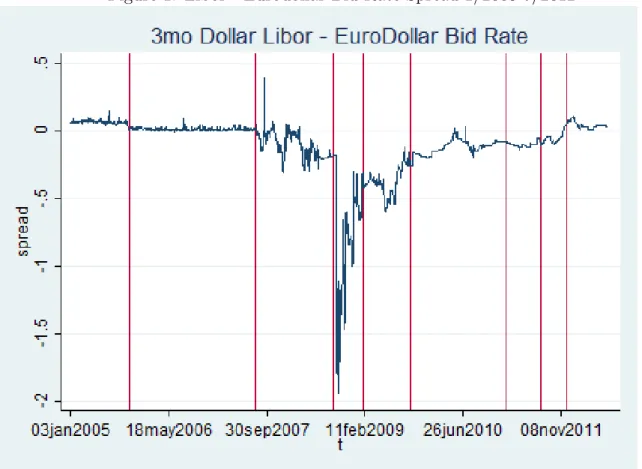
Further strange behavior can be seen in Libor’s divergence from similar rates. The Eurodollar bid rate is an aggregation of actual bids by market makers in the Eurodollar market. Prior to August 2007, the Eurodollar bid rate and Libor behaved as we might expect a bid-ask spread to behave; Libor submissions are a bank’s perceived ask rate they would face in the Eurodollar market. Figure 1 shows the spread between Libor and Eurodollar bid rate from January 2005 to July 2012. Banks submitted quotes over the pre-August 2007 period ranged between 6 and 12 basis points above the Eurodollar bid rate. Around August 2007, bank quotes and the resulting
Libor …xing fell below the Eurodollar bid rate. As shown in the …gure, Libor rates remained well below Eurodollar bid rate, 10-40 basis points, until late summer of 2011 when the spread climbed sharply and again became positive in early 2012. Incidentally, this sharp rise in the spread toward the end of the sample period was preceded by an announcement that UBS was cooperating with antitrust enforcers, making the graph suggestive of cartel breakdown episodes.
Kuo, Skeie, and Vickrey (2011) compare Libor submissions with bank bids in the Federal Re-serve Term Auction Facility (TAF) and inferred term borrowing costs derived from FedWire, the reporting system for actual interbank transactions within the Federal Reserve system (See Kuo, Skeie, Youle and Vickrey 2011 for a description). They …nd Libor submissions were 10-30 basis points lower than the comparison rates in the immediate aftermath of the Bear Stearns and Lehman Failures. Over other periods, however, they …nd that Libor rates are statistically indistinguishable from the comparison rates.
In recent testimony to the European Parliament Economic and Monetary A¤airs Committee on Libor reform, CFTC Chairman Gary Gensler (2012) provides a thorough discussion and graphical review of the suspicious patterns in Libor based on the logic of no-arbitrage and similar arguments. Notable in the presentation of these results is that the anomalous behavior of Libor rates appear to persist to the present. We omit a full rehash of all this evidence and refer the interested reader to this testimony and the wealth of other sources now available.
The divergence of Libor rates from comparable rates and the apparent violations of no arbitrage conditions suggest some form of malfunction in the determination of these rates. However, many areas of …nancial markets have seen logical and historic relationships upset since the onset of the …nancial crisis so simple malfunction does not imply the divergence is due to manipulation. Term, unsecured interbank lending markets experienced dramatic illiquidity problems beginning with the onset of the …nancial crisis and persisting to the present (Kuo, Skeie, Youle, and Vickrey 2011 ; Afonso, Kovner, and Schoar 2010; Wheatley 2012) . Liquidity and related issues in comparison markets, e.g. CDS markets, cast further doubt on the reliability of tests based on pre-crisis history or models of frictionless markets. Moreover, even in the best of times, statistical tests of violations of these logical and historic relationships are relatively coarse and unable to distinguish small deviations that we expect the portfolio driven manipulation to create.
By July of 2012, regulators around the world, spurred by the evidence discussed above, had opened investigations into the Libor submission process of most Dollar Libor panel banks as well as banks in various other currency panels. Most of these investigations are ongoing but in July 2012 the CFTC, Department of Justice, and UK Financial Services Administration had announced they had settled with Barclays over Libor manipulation. The bank agreed to pay a …ne totalling over $400 million and also agreed to a public release of …ndings from the investigation. The …ndings reveal that both reputation driven and portfolio driven incentives caused upper level bank management, in the former case, and individual traders, in the later case to request particular quotes or a particular direction of quotes from the bank’s Libor submitters dating back to at least 2005.
Not surprisingly, the reputation incentive appears to have been at work primarily during the hectic depths of the …nancial crisis. As the subprime crisis started to heat up in the middle of 2007, Barclays relatively high Libor submissions, in conjunction with the bank’s access of the Bank of England Emergency Lending Facility and reports of high exposure to subprime SIVs, began receiving negative press and market reaction. On September 3 2007, Barclays quotes were 6-9bps above the next highest submission in three Dollar tenors and near the top of the range in most others. A Bloomberg column, published that day, entitled "Barclays Takes a Money Market Beating", discussing the high quotes, ends with the ominous "There’s knowledge buried in the price that Barclays is being charged in the money markets. We just don’t know what that knowledge is yet."
In response to the negative press, senior Barclays management directed submitters to start "keep[ing] their heads below the pararpet", to avoid a negative reaction from the markets (CFTC Order p.19). For example
On November 29, 2007 the supervisor of the U.S. Dollar Libor submitters convened a telephone discussion with the senior Barclays Treasury managers and the U.S. Dol-lar Libor submitters. The supervisor said if the submitters submitted the rate for a particular tenor at 5.50, which was the rate they believed to by the appropriate sub-mission, Barclays would be 20 basis points above "the pack" and "it’s going to cause a shit storm." The supervisor asked the issue be taken "upstairs" meaning that it should be discussed among the more senior levels of Barclays management. The most senior Barclays treasury manager agreed that he would do so. For the Libor submission, the group decided to compromise by determining to set at the same level as another bank,
a rate of 5.3, which was, again, not the rate the submitters believed to be appropriate for Barclays." (Ibid. p.21)
Barclays management and treasury sta¤ believed they were following the lead of other banks and the market reaction, singling them out, associated with not doing so would be unjusti…ed and that this was leading the overall Libor to remain much lower than actual average costs. In the same November 29 2007 discussion,
the group also discussed their belief that other banks were submitting unrealisti-cally low rates and speculated that other banks were basing submissions on derivatives positions...One of the senior Barclays Treasury managers called a BBA representative and stated that he believed that Libor panel banks, including Barclays, were submit-ting rates that were too low because they were afraid to "stick their heads above the parapet" and that "no one will get out of the pack, the pack sort of stays low." (Ibid p.21)
As the previous quote also indicates, those in the know suspected manipulation due to trading incentives during the …nancial crisis. The CFTC order reveals such behavior predated the crisis, going back at least to early 2005, and continued until at least into 2009.6 Unlike the misreporting for reputation reasons, misreporting for trading reasons seems to have been initiated by individual traders and there is no evidence it was approved by upper level management. Requests from traders usually have come via, often casual and jocular, emails and instant messages mostly asking for changes, both high and low, in the one and three month dollar Libor. For example, a February 1, 2006 message from a Barclays trader in New York to a trader in London read
"You need to take a look at the reset ladder. We need 3M to stay low for the next 3 sets and then I think we will be completely out of our 3M position. Then its on. [Submitter] has to go crazy with raising 3M Libor." (Ibid. p.9)
Several communications between the traders and submitters reveal an awareness of the partic-ulars of the rate setting process. Speci…cally, traders sometimes requested that submitters report rates that would get the submission "kicked out" or "knocked out" of the panel, i.e. a quote outside
6Some accounts have Libor manipulation going as far back as the early 1990s. See Douglas Keenan’s July 26,
the interquartile range. For example, a November 22, 2005 message from a senior trader in New York to a Trader in London,
"WE HAVE TO GET KICKED OUT OF THE FIXINGS TOMORROW!! We need a 4.17 …x in 1m (low …x) We need a 4.41 …x in 3m." (Ibid p.9)
Several communications also reveal awareness of detection costs in the form of regulator discovery and punishment. For example, a March 13, 2006 email exchange between a Barclay’s trader in New York and a Libor submitter,
Trader: "The big day [has] arrived...My NYK are screaming at me about an un-changed 3m libor. As always any help wd be greatly appreciated. What do you think you’ll go for 3m?"
Submitter: "I am going 90 although 91 is what I should be posting."
Trader: "[...] when I retire and write a book about this business your name will be written in golden letters[...]."
Submitter: "I would prefer this [to] not be in any book!" (UK Financial Services Authority Final Notice p.12)
The language and frequency of requests suggests that traders believed their requests would be routinely accommodated by rate submitters. The UK FSA analyzed around 100 email and instant message requests uncovered by their investigation and found that rate submissions were consistent with the requests about 70% of the time. The Barclays communications also implicated at least four other banks, as yet unnamed, for cooperating with the requests ofBarclay’s traders. This, along with the fact that the Barclay’s investigation found evidence of many attempts to in‡uence submissions to the Euribor panel, a similar Euro rate with around 40 panelists so no substantial movement could not be accomplished by a single bank, suggests that many banks must have participated in manipulation.
3
A Simple Model of Quote Submission
We model the quote submission process as a Bayesian game between the Libor panel banks. There are 16 banks indexed by i = 1;2; :::;16. Each day the banks choose their quotes qi. Bank i’s
of which may be private information to the bank. We denote the vector of 16 quotes and costs as
q and c respectively. The Libor …x is a function of submitted quotes and is given by:
L(q) = 1 8 16 X j=1 1 qj > s4; qj s12 qj
Where s4 is the day’s fourth highest, or left, pivotal quote and s12 is the days twelfth highest or right pivotal quote.
Banks may have incentive to manipulate the …x because their …nal payo¤s depend on the real-ization of it. A bank will, however, not want to submit a quote too far from its actual cost because doing so risks detection and punishment. Speci…cally we model a bank’s expected payo¤ by:
i=Eq i[viL(q)
2(qi ci)
2]
Given its information a bank chooses its quote to maximize this expected payo¤. The …rst order condition determining the bank’s best response is given by:
vi 8
Z
1 qi > s4(q); qi s12(q) Fi(dq i) (qi c i) = 0
WhereFi is banki’s beliefs about the distribution of other quotes conditional on its information.
Letting Gi(qi) denote bank i’s equilibrium beliefs about the probability its quote participates, in
the truncated average, the equilibrium relationship between costs and quotes is:
qi=ci+ vi
8 Gi(qi)
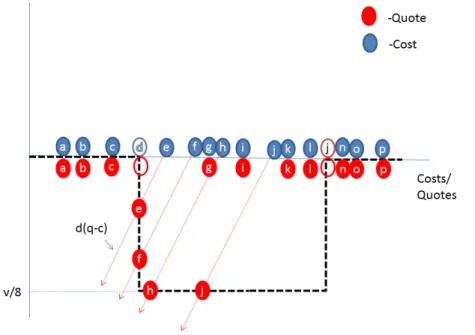
When the location of the pivotal quotes are known with certainty, as in the complete information version of the game, the G function is a step function that is one for quotes between the pivotal quotes and zero outside. Figure 2 shows a schematic representation of how these manipulation incentives a¤ect the intraday distribution of quotes vis a vis the intraday distribution of costs. In the …gure four banks, e, f, h, and j, have incentive to push the rate down. All four banks equate the marginal bene…t of skewing their quote, v8G(qi), with the marginal cost, (qi ci), where v
is negative (i.e. the incentive is to push the rate down). Banks e and f’s marginal cost function intersects the marginal bene…t function at it’s discontinuity, which occurs at the fourth highest quote, d. The quotes of e and f are thus identical to the quote of d and there is bunching at the fourth.
3.1 Numerical Experiments
Figure 3 shows some results of a numerical experiment and foreshadows our testing approach. In the pictured experiment, we assume that there are 12 banks, named bank 1-bank12, that occasionally attempt to manipulate the rate. Banks 13-16 never attempt to manipulate the rate. Underlying bank costs are drawn from a normal distribution with mean 1 and covariance matrix set to match the empirical covariance matrix of Libor quotes less the daily mean quote over the period January 2005 to July 2012. The strength of manipulation in each period, vit
8 , are i.i.d draws from a mixture distribution with 4/5 probability of no manipulation, i.e. vit
8 = 0 for all banks, and 1/5 probability that each of the 12 manipulating banks have incentives drawn uniform on [ 1=24;0]. For each of 10000 runs of the model, we calculate equilibrium quotes for the static, complete information game.7
The top panel of …gure 3 shows the distribution of quotes of manipulator bank 1 less the day’s fourth highest among the 15 other banks (blue bars). Also shown is the distribution of bank 1’s actual costs minus the fourth highest actual cost among the 15 other banks (white bars) and the distribution of simulated quotes less the simulated fourth highest actual cost of the 15 other banks (red bars), where the quotes are simulated from a …tted multivariate normal distribution. The bottom panel of …gure 3 shows the same distributions for the non-manipulating bank 16. The pooled empirical distribution of bank 1’s normalized quotes displays a large discontinuity at 0 relative to the pooled distribution of bank 16’s normalized quotes and the simulated distribution.
In our empirical analysis our testing procedure is guided by these experiments with the model. Namely, we test whether the pooled distribution of actual, normalized quotes has more mass around 0 than that of a reference distribution. We also test for the presence of a discontinuity at 0 in the distribution of normalized quotes relative to a reference distribution.
A priori, it is likely our tests will be prone to power and size issues. Clearly power will be a¤ected by not only sample size but also by the strength of manipulation incentives since these will a¤ect how frequently the optimal misreported quote will be identical to one of the pivots. Type I errors are also an issue because whenever a non-manipulating bank receives a cost draw that puts it in a pivotal position, manipulating banks will push their own quotes toward the non-manipulator causing the non-non-manipulator’s normalized quote to, itself, be close to 0. Intuitively,
7
There are, in general, multiple equilibria for a given vector of costs. For these experiments we focus on the
maximally distored equilibrium, the equilbrium with the largest average di¤erence between costs and quotes. In an
earlier version we showed that all complete information equilibria display the same type of bunching we focus on here.
even if we were willing to assume the cost distribution was perfectly smooth and exact ties a zero probability occurrence, in observing two banks tied at the fourth highest we would not be able to say which bank was manipulating or if both were. We explore these issues by performing a series of monte carlo experiments, mimicking our empirical tests, on simulated data generated by our simple model.
Table 1 shows the results of these experiments. Each entry in the table reports a summary statistic for the distribution of one sided t-test p-values obtained from simulating the model 1000 times for each associated parameterization. The columns in the table show the di¤erent hypotheses tested. The "Below" represents the hypothesis that the number of actual quotes, normalized by subtracting the day’s fourth highest quote, falling in the bin 1 basis point below the fourth highest ([ :01;0)) is less then the simulated number of normalized quotes falling into this bin. The "Above" column represents the hypothesis that the number of normalized actual quotes falling in the bin 1bp above the fourth highest is greater than the simulated number. The "Di¤" column represents the hypothesis that the di¤erence in the number of actual normalized quotes falling above and below is greater than the di¤erence in the number of simulated normalized quotes. The rows in the table report the average p-value, fraction of tests rejected at the 5% level, and the fraction of tests rejected at the 1% level and these are shown for a manipulator (Bank 1) and non-manipulator (Bank 16) for each of the parameterizations.
For each, simulation we maintain the assumption that there are 12 potential manipulators and bank costs are drawn from a joint normal distribution with mean 1 and covariance matrix equal to the empirical covariance matrix of 3 month Libor quotes less the daily mean quote.8 Across experiments we vary the sample size and two parameters controlling the frequency of manipulation and the strength of manipulation incentives. The "Fraction of manipulating days" parameter determines the fraction of days on which there is potentially any manipulation so a parameter value of .33 means that on 2/3 of days no banks have any manipulation incentives (vi
8 = 0;8i). On days in which manipulation is possible the strength of manipulation incentives are determined by the "Distribution of Incentives" parameter. On these days each of the 12 banks receives an incentive, vi
8 , drawn iid across banks and days, from a mixture distribution with a 50% probability
8
Assuming that fewer banks are potential manipulators makes it easier to distiguish the manipulator from the non-manipulator since there are more cost events that lead to a non-manipulator being bunched at the lower pivot. For example, with only one manipulator a non-manipulating bank will only be bunched at the lower pivot in the event that the non-manipulator receives the fourth highest cost draw and the cost and incentives draw of the manipulator causes it to misreport at the same level as the non-manipulator.
of getting a 0 draw and 50% probability of getting a draw from the uniform [ x;0] distribution, wherex is either 1/8, 1/24, or 1/40.
A …rst observation about the table is that each of the tests, evidently, allow us to distinguish the manipulating bank from the non-manipulator. On average, the distribution of manipulator quotes will have less mass, relative to the comparison distribution, just below the pivotal quote. A manipulator will also have more mass just above and a greater di¤erence in the mass just above and just below. The "Above" and "Di¤" tests appear to do a much better job both of identifying the manipulator and distinguishing the manipulator from the non-manipulator than does the "Below" test. However, unlike the former two the apparent ability of the "Below" test to contrast the two types improves, in the sense that the probability of incorrectly rejecting the null decreases for the manipulator while the probability of correctly rejecting the null for the manipulator improves for the "Below" test, whereas the other two tests increase the probability of correctly rejecting for the manipulator but also increase the probability of incorrectly rejecting for the non-manipulator.
Since our cost parameterization comes directly from the data, the table is also informative about the relationship between test statistics and the underlying frequency and intensity of manipulation. When manipulation is less frequent and/or incentives are weaker, the tests in summarized in the table have low power, only rejecting the null of no manipulation at the 5% level in 50-60% of those samples with 150 or 250 observations for the bottom rows of the table where the frequency and strength of manipulation is lowest. The simulated libor in this scenario is, on average .22 bp lower than what would prevail with honest reporting. By contrast, in the parameterization in the top rows of the table, where the null is correctly rejected for a manipulating bank at the 5% level 97-100% of the time, the average realized libor is .83 bp lower than what would prevail with honest reporting. These magnitudes suggest two things. First, our tests are able to detect deviations that are relatively small, when compared to day to day changes in quotes for instance, on average. Second, they suggest a ballpark lower bound on the frequency and intensity of manipulation incentives that we might infer from the strong rejection evidence we …nd our empirical analysis.
4
Data and Empirical Evidence
Our empirical analysis utilizes only data on bank rate submissions. The quotes of each panel bank on every business day from January 1, 2005 to July 1, 2012 were collected from a Bloomberg terminal. We focus on 3 month Dollar Libor submissions over the period ending February 1, 2011
when the panel increased to 21 members. From January 1, 2005 to February 1, 2011 the panel consisted the same 16 members with the exception of one change occurring in February 2009 when Societe General replaced HBOS following the absorption of HBOS by Lloyd’s. Motivated by a visual examination of the Eurodollar bid rate-Libor spread shown in Figure 1 we split the sample up into 6 periods and perform our analysis on the full sample as well as on each period individually. Table 2 shows some summary statistics for this sample over the various periods. On average, quotes are tightly clustered with an interquartile range of deviations from the median quote ranging from one basis point below to two basis points below. Similarly the interquartile range, the di¤erence between the upper and lower pivotal quotes is quite narrow. Overall, the average size of the range is 7.9 bps, though there is a good deal of variation across our periods, with the range varying from 3.4 bps in the …rst year and a half of the sample to 48bps in the period containing the Lehman failure. Also notable is that, while the ranking of banks in the panel tends to be persistent, there is still considerable variation in relative ranks over time with the daily standard deviation of a bank’s rank from its average rank at 4.39. Moreover, nearly all banks occupy almost all ranks over a su¢ ciently long horizon. Signi…cant variation in these relative quotes will be important for our testing strategy below.
As noted by Gensler (2012), one of the puzzling features of bank quote behavior is the lack of day to day movement in the submissions. Across all periods and all banks, over 40% of observations show no change from the previous day’s quote in spite of signi…cant day to day changes in related rates. An interesting regime change seems to appear in the last 15 months of the summarized sample the number of such zeros jumps to 62% of observations. The lack of comovement of quotes with underlying "cost drivers" (as well as the lack of much movement at all) is the logic behind the collusion tests examined in Abrates Metz et. al (2012).
4.1 Empirical Approach
Our model predicts that when banks have direct incentive to manipulate rates, as opposed to misreporting for other reasons, e.g. reputation, their quotes will bunch around the pivotal quotes. Without placing restrictions on the joint distribution of bank quotes over time, obviously any distribution of quotes can be rationalized as truthful by some joint distribution of underlying costs. However, since di¤erent distributions will naturally display di¤erent degrees of bunching around the twelfth and fourth order statistics, any test will be sensitive to these restrictions. In trying
to balance these trade-o¤s, we start by assuming latent underlying borrowing costs follow a vector autoregressive process.
ct= 0+
X
ct +"t
Where"t N(0; ).The VAR speci…cation is a reasonably ‡exible way to describe time series
relationships, however, there are two main restrictions embodied by this assumption. First, we assume that, in the long run, bank borrowing costs are correlated through similarities in the banks themselves. It is natural to think, for example, that U.S. based banks should have positively corre-lated costs or that all banks with large retail operations should be correcorre-lated. The crucial contrast here is that we rule out long run relationships between a bank’s borrowing costs and the borrowing cost of the fourth, or any other, rank bank. Second, is the assumptions that innovations are joint normally distributed. While the parametric restriction is necessary given the high dimension of the vector process, it is also undesirable. In the implementation of our tests, this is not directly an issue since, as discussed below, we work with …tted quotes.
Under a null of truthful reporting we can estimate this process using observed quotes. Due to cointegration and the high dimension of the vector process our preferred speci…cation is a two lag, rank two, vector error correction model.
qt= qt+
X
qt +"t
With these estimates at hand we can examine how di¤erences in the …tted or simulated versus actual distribution of quotes support our theory of manipulation (as opposed to simple misspec-i…cation of the cost process). Essentially, our testing strategy is to look for statistically and economically signi…cant di¤erences in the distribution of prediction errors conditional on the po-sition of pivotal quotes. Economically signi…cant, here, means consistent with our model, which predicts a particular form of bunching and not others that might predict clustering of quotes to-gether9. Identi…cation comes from transitory changes in the relative bank ranks driven by actual idiosyncratic cost shocks or changes in misreporting incentives. For example, suppose JP Morgan and Citigroup are on average the fourth and …fth ranked banks and their quotes are highly corre-lated. If neither bank faces idiosyncratic shocks that drive them up or down in relative rank then,
9
Banks may cluster together if they all have incentives to simply not stick their "heads above the parapet" as ordered by one Barclays executive in reference to the bank’s rate submission.
in the intraday distribution of quotes, both banks will be bunched at the fourth highest. The …tted model would re‡ect this and the …tted and simulated quotes of the two banks will also be bunched. If, on the other hand, occasional shocks shu- e JP Morgan out of the fourth rank and Citigroup’s submissions continue to bunch with the new occupant of the fourth spot, this will lead to bunching in the actual distribution but not the …tted and simulated distributions.
It is important to note that, if manipulation is present, our model will be contaminated even if our cost speci…cation is correct. Thus, if the null of truthful reporting is false our comparison distribution should be expected to, itself, bunch more around the pivotal quotes than the actual cost distribution as in …gure 3. How much more will depend on the degree of contamination; how many and how often banks are manipulating. Even if banks are constantly manipulating, however, the contaminated model will not display the predicted discontinuity in the distribution at the pivotal quotes. For this reason, we focus most of our attention on this discontinuity.
4.2 Results
Figure 4 (Figure 5) shows the pooled distribution of quotes of all banks normalized by subtracting the fourth (12th) highest quote of the 15other bank quotes over various time periods. The bottom half of each panel show the …tted versions of the same normalized quotes.10We use …tted quotes for our comparison distribution rather than simulating innovations and adding them to the …tted quotes because we worry about non-normality of the quotes. In particular, the large number of no-change observations suggests that the …tted quotes may be a better choice. We have performed the same analysis using simulated quotes as well and it only strengthens the results.
A couple of features of these …gures stand out. First, to a striking degree the distributions resemble the shape predicted by our model for both the upper and lower pivot normalizations. Second, the distribution of normalized …tted quotes also displays a good deal of bunching around the pivotal quotes, demonstrating the importance of developing our benchmark comparison dis-tribution. To statistically verify this graphical story we implement some simple statistical tests, motivated by the numerical experiments with the model. Namely, we test for a discontinuity at the pivotal quote. A natural approach for such a discontinuity test is suggested by McCrary (2008). Unfortunately rounding of quotes combined with the small scale make the required smoothing im-possible so instead we simply compare the histogram bin size of a small interval,[0; b)((0; b]), above
1 0
That is, for each bank, we subtract the fourth (12th) highest of the 15 other…tted quotes from its own …tted quote.
the quote minus the fourth (twelfth) highest to the bin size of a small interval, [ b;0) (( b;0]), below the quote minus the fourth (twelfth) highest. Since 65% of quotes are rounded to the nearest basis point, an additional 25% are rounded to the half basis point, and most of the rest are rounded to the quarter basis point, our preferred window size is one basis point (b = :01) but we report many of our results for the half(b=:005)and two(b=:02)basis point levels as well. Potentially incomplete information
Tables 3a-b show the results of our bunching tests for all banks pooled together at various window widths.11 The table con…rms the graphical evidence. For almost all periods and window widths each of our three bunching tests are signi…cant at the 1% level for the lower pivot normalization. The only exception is in the …nal period from October 2009 to January 2011 with 1bp window width. Here, the probability of a normalized quote falling in the bin just below zero is almost identical for the …tted and actual distributions. The "Above" and "Di¤" tests are both highly signi…cant, however. The prevalence of zero-change days, no doubt, contributes to an overall similarity in the …tted (zero innovation vector) and actual quotes. That this weakens our bunching results presents an interesting counterpoint to the argument that lack of quote variability is evidence of manipulation.
For the whole basis point windows, notably, the total mass in the windows around zero are similar for the …tted and actual distributions. Examining the data a bit more closely shows why this is the case. A huge fraction of quotes predicted to fall into the bin just below (just above in the case of the upper pivotal quote normalization) zero, fall into the just above (just below) bin. This demonstrates the mechanics of our tests using the possibly contaminated estimates as a benchmark distribution. If the comparison distribution were the actual distribution of costs we would expect to see quotes moving from bins further above (below) the pivots to bins closer to the pivots. Our tests are instead exploiting the change in the shape of the distributions at the pivotal quotes. Table 3c-d delve into the tests with two way tables showing the joint distribution of …tted and actual normalized quotes pooled over all banks and periods. In the analysis of individual banks, almost all bank-periods that fail our test have this same pattern.
Tables 4a-b show the same results at the bank level.12 Here a more nuanced and informative picture emerges. In the pre-Lehman failure periods almost all banks fail our manipulation tests resoundingly. In the post Lehman periods bunching at the individual bank level is less clear. In
1 1
Bank level histograms are available on the authors’website. "The Fix is In: Additional Figures" 1 2Bank level histograms are available in an online appedix available at the author’s website.
the September 2008-January 2009 period immediately following Lehman’s failure seven banks fail the lower pivot normalization "Di¤" test at the 5% level and three of these, Barclays, Royal Bank of Scotland (RBS), and Royal Bank of Canada (RBC), fail all three. With only 84 observations, small sample size could account for this relatively small number as a couple of other banks, Bank of Tokyo and JP Morgan, have substantial mass of quotes around 0 and the distribution qualitatively …ts the bunching pattern. On the other hand, Norinchukin fails the "Di¤" test at the 1% level on the strength of it’s failure of the "Below" test. Looking closely at the data here this failure is accounted for by four observations that were predicted to fall in the [-.01,0) bin fell instead in the [-.02,.01) bin. For the upper pivot normalization, four banks fail the "Di¤" test. Of these, only Deutsche Bank and Rabobank, fail an additional test and Deutsche Bank has only a handful of observation that fall in the neighborhood of 0.
In the February 2009 - October 2011 period four banks, Barclays, CSFB, RBS, and RBC, fail the lower pivot normalization, "Di¤" test and the later three fail all three tests. JP Morgan’s dis-tribution of normalized quotes has signi…cant mass around zero and qualitatively …ts our bunching pattern but the "Upper" test is insigni…cant at conventional levels. Bank of Tokyo,while failing the "Above" test, does not fail the "Below" and "Di¤" test. Closer examination of the data reveals that the additional mass in the bin below zero correspond to predicted quotes in the [-.02,.01) bin. Generally Bank of Tokyo’s observed quotes corresponding to predicted quotes below zero are pushed toward 0 from below. This pattern is suggestive of a model where Bank of Tokyo has less than complete information about the location of the lower pivotal quote. The upper pivot normalization tests show two banks that fail the "di¤" test and the 5% level, Lloyds and West LB, neither of these have signi…cant mass around zero. Bank of America just misses signi…cance at the 5% level and its quote distribution …ts the typical pattern of a test failure.
Five banks fail the lower pivot normalization "di¤" test at the 5% level in the October 2009-January 2011 period and, of these, three, Bank of Tokyo, CSFB, and Rabobank, fail all three tests. Absent from the list of banks failing the tests in these periods is RBS, which had failed all tests in each preceding period. This is notable because of reports that RBS made signi…cant changes in its compliance protocols taking e¤ect in the fall of 2009. While Citigroup fails each test, it only has a small fraction of normalized quotes in the neighborhood of zero. On the other hand, Deutsche Bank and HSBC do not fail the tests because they have more mass in the "Below" bin than is predicted. Looking at the joint distribution of …tted versus actual quotes reveals that this is due to the fact that actual normalized quotes bunch toward zero from below relative to the
…tted quotes. Again, this could be consistent with these banks having worse information about the location of the pivotal quote.
4.3 Later Periods
In February of 2011, four new banks were added to the Libor panel bringing the total up to 20. In calculating the day’s Libor, BBA continued to remove the top and bottom four quotes, averaging the middle 16 until August of 2011. At that point, WestLB was removed from the panel and the day’s Libor was then calculated as the average of the middle nine quotes, discarding the top and bottom …ve. Then, in mid-December 2011 Bank of Nova Scotia, one of the banks added in February 2011, left the panel and the calculation methodology reverted to averaging the middle 10 quotes, discarding the top and bottom 4.
Tables 5a-b show the results of the all bank bunching test for these later periods. Table 5a shows the bunching results for a 1bp window for quotes normalized by the fourth highest and for quotes normalized by the …fth highest of the other banks. The side by side comparison can be viewed as a placebo test. In the period Feb 2011 - Aug 2011, the "Above" and "Di¤" tests are signi…cant at the 1% level for the fourth highest normalization. Three individual banks fail tests at the 2% level, among these RBS fails all three at the 1% level. Quotes normalized by the …fth highest also display the characteristic bunching pattern-the fourth and …fth highest quotes overall are themselves separated by at most 1bp over this period-but none of the tests are signi…cant as the predicted distribution also displays the pattern and has more total mass around 0. JP Morgan and RBS fail the "Above" and "Di¤" tests at the 5% level using these normalized quotes.
The placebo tends to not support our approach in the period Sept. 2011-Dec. 2011. The "Below" and "Di¤" tests are signi…cant at the 1% level using quotes normalized by the fourth highest, while the quotes normalized by the …fth highest do not even qualitatively display the bunching pattern. All quotes in this period are ascending rapidly. All banks’ quotes, with the exception of HSBC, increase 20-30bp over the three month period. The overall …fth and fourth highest quotes also diverge sharply, which is unusual at any point in the sample, with the gap widening to up to 5bp in Nov 2011. Here the banks split into 2 groups, with the highest 15 quotes climbing much more rapidly than the bottom four, all European, banks. In the period Jan.-July 2012, the intraday distribution becomes widely dispersed and banks make very few day to day changes in their quotes. Neither set of normalized quotes display the bunching pattern even
qualitatively.
Table 5b shows the bunching results for a 1bp window for quotes normalized by the upper pivotal quote and for quotes normalized by the twelfth highest. In the period Feb.-Aug. 2011, both sets of normalized quotes display the qualitative bunching pattern, however, neither is signi…cantly rejected for any of the tests. One observation worth pointing out is that the …tted distribution predicts more total mass around the twelfth highest than the actual distribution but less mass around the sixteenth highest than the actual distribution. In the period Sep.2011- Dec 2011, the "Below" and "Di¤" tests are signi…cant at the 5% level for quotes normalized by the upper pivotal quote and each are insigni…cant for the quotes normalized by the twelfth highest. At the individual bank level these tests are driven by CSFB, Norinchukin, and SMBC which display the typical bunching pattern, though at marginal signi…cance levels. In the …nal 6 month period, there is, again, no evidence of bunching overall or for any individual banks.
4.4 Other Tenors and Yen Libor
So far we have focused on 3M dollar Libor submissions. We do this because the 3M dollar is the most important tenor and currency in terms of …nancial contracting making it the most likely to be the target of manipulation. For example, according to DealLogic, about 53% of swaps and ‡oating rate notes use the 3M Dollar Libor as the reference rate, whereas less than one half of one percent of these contracts use the 6M dollar as the reference rate. The 3M and 6M yen Libor account for around 4% and 24% of the reference rates used in these contracts, respectively.
Table 6a-b show the results of the bunching tests for all banks 6M dollar Libor quotes. The patterns shown here are roughly similar to those in tables 4a-b. Looking at the 1bp window for the lower pivot normalized quotes, the only di¤erence here is that we fail to reject for all tests for the …nal 15 months of the main sample. For the upper pivot normalized quotes, the same qualitative pattern holds as compared with the 3M counterpart. The only di¤erence being that in the Feb. 2009 - Sept 2009 period the 6M tests are not even marginally signi…cant.
Tables 6c-d show the bunching tests at the level of individual banks and again tell a more interesting story. For lower pivot normalized quotes, none of the bunching tests are violated by individual banks in the last two periods of the main sample, stretching from Feb. 2009 to Jan. 2011. Perhaps more interesting is the fact that some of the banks that most consistently fail the bunching tests in the 3M dollar data, do much better in the 6M dollar sample. Barclays, which
fails at least two of the tests in each of the periods in the 3M data, fails none of the tests at the 5% level and only the all periods "Di¤" test at the 10% level. Similarly CSFB, which fails at least two tests for the lower pivot normalized quotes in all but the period immediately following the Lehman failure (when they fail the tests in the upper pivot normalization), fails only 2 tests in the second period in the 6M data. One might worry that the window is too narrow given the higher overall variance, both intraday and over time, in the 6M quotes, however, expanding the window size to 2bp, if anything, only weakens the tests.
For the upper pivot normalization, the results are similarly weaker in the 6M data than in the 3M. None of the tests reject at even the 10% level for the …nal two periods of the sample. Eight of the banks fail the "di¤" test in the 6M data for all periods pooled compared to ten in the 3M data and, of these, only two fail all three tests in the 6M data for all periods compared with four in the 3M all periods data. On the other hand, the two banks that fail all three tests in the 6M data, RBS and JP Morgan, Do not fail the "Di¤" test in the 3M.
Tables 7a-b show the results of bunching tests for all banks 3M Yen Libor quotes. Looking at the 1bp window for quotes normalized by the fourth highest in table 7a, the "Di¤" test rejects at the 1% level for periods except the two periods spanning from September 2008 to September 2009. For the quotes normalized by the twelfth highest, the most notable di¤erence between the Dollar and Yen results is that in the …nal period the Yen data shows strong bunching, while the Dollar data shows no signi…cant bunching. Tables 8a-b show the Yen results at the bank level and, as can be seen in table 8b, the strong bunching pattern in the …nal period of the Yen data is driven mainly by four banks, Deutsche Bank, JP Morgan, Mizuho, and RBS.
Table 9 summarizes our testing results across three tenors, 3M, 6M, and 12M for both the dollar and yen data. The only real discernible pattern in this table is that bunching is widespread and strong in the pre-Lehman failure periods and then its prevalence declines, though it does not disappear, in the periods immediately following the failure. Bunching appears to pick back up slightly in the …nal 15 months of the sample. On the whole, it also seems that, on average, Dollar bunching is more likely to occur at the fourth highest relative to the Yen. Otherwise there is no obvious pattern of correlation in the direction or magnitude of bunching. The ‡ip side of this is that the lack of obvious pattern is there is not any clear systematic, non-manipulation, explanation for the test results. For example, in looking at the 6M dollar results versus the 3M dollar results, one might think that bunching is simply an artifact of the low degree of dispersion in the 3M data. Looking at the 12M results, however, indicate this is not the case as some bank-period observations
that display no bunching in the 6M show strong bunching in the 12M.
4.5 The Timing of Bunching and Collusion
Reports from ongoing Libor investigations and media coverage have indicated likely collusion among panel banks in manipulating rates. The basic implications, in terms of the shape of the intraday distribution of quotes, from our model are unchanged in the presence of collusion. When banks collude, however, the scope for manipulation is much greater and thus has serious implications for the magnitude of manipulation and resultant welfare e¤ects. When a bank acts unilaterally, their ability to distort the rate down, relative to the rate that would prevail from honest reporting, is bounded by 1/8 times the di¤erence between its true cost and its submission. At the other extreme, …ve or more banks acting in concert move the rate as far as they desired, though in a collusive equilibrium of our model they will not choose to do so due to the convex misreporting costs. To explore collusion in light of our model we simply extend our bunching tests to look at the correlation between banks of bunching behavior over time. We leave a fuller development of tests for collusion to future work.
Figure shows the smoothed average actual number of …rms quoting one basis point above (blue) the normalizing quote (fourth highest for the top panel and twelfth highest for the bottom panel) and the actual number quoting one basis point below for the 3M Dollar data. The vaguely sawtoothed pattern in the …gure is suggestive of what we think of as the primary source of portfolio exposure-related incentives, namely trader derivatives positions. For example, the …nal settlement price of expiring three month CME Eurodollar Futures are 100 minus the three month Libor on the second London bank business day immediately preceding the third Wednesday of the contract’s delivery month. So, if a trader had a long position in 3M dollar futures, there would be an incentive for him to try to in‡uence the rate submitter to push the rate down and improve the position just prior to expiration.
Figures show the same pictures for 6M Dollar and 3M and 6M Yen data. These …gures quali-tatively support the picture presented so far. The most striking feature is the large change in the number of banks in the below window in the …nal period in the Yen data, in particular for the 6M data. The qualitative patterns across tenors within each currency appear similar. Perhaps most striking is the jump in the size of the spikes in the last period of the Yen data. When compared with the summary table 8, where only a few banks strongly fail the test, this may be suggestive
of collusion; Only a few banks are bunching so they must be doing so on the same days to get the large spikes.
Figures shows the results of redoing our main bunching analysis using a rolling window rather than pooling within discrete periods for 3M and 6M tenors for both the Dollar and Yen data. Speci…cally we calculate kernel smoothed frequency of quotes falling into either the 1bp above the pivot or 1bp below the pivot
Yi;ta;4 = T X =1 K(th )1f0 qit s4 < bg T X =1 K(th ) Yi;tb;4 = T X =1 K(th )1f b qit s4<0g T X =1 K(th )
Where we use a simple, triangular kernel with 10 day bandwidth for K. We calculate the corresponding smoothed measure for quotes normalized by the twelfth highest quote and compare these with the …tted versions of the same.
Figures sThere is no obviously strong pattern of correlation in bunching behavior in these mea-sures between banks, though visually there appears to be a loose correlation in the timing of bunching episodes across all banks. The graphs also support the general observation that bunch-ing declines in the periods immediately followbunch-ing the failure of Lehman Brothers and the depths of the …nancial crisis, incidentally the time when it is most likely that reputation driven manipulation was occurring. This is especially true of the Dollar upward manipulation tests.
The picture painted here generally corroborates the discussion above. While there appears to be some correlation across banks in their bunching behavior, the correlations are as consistent with the existence of common underlying drivers of manipulation, as in the example of future positions, as they are with an explicit conspiracy. Moreover, since di¤erent sets of banks appear to be pushing in opposite directions at the same time and these sets don’t appear to be stable, the evidence is not suggestive of any speci…c set of banks participating in a grand cartel. In general, the data appear consistent with uncoordinated episodic manipulation, which may have involved occasional cooperation among multiple banks.
5
Conclusion
Over the past 30 years most corners of …nancial markets have come to rely on Libor as an essential gauge of the health of money markets and the direct and indirect implications thereof. Such heavy dependence has made the recent revelations of widespread manipulation of these rates shocking to the point of crisis. Concerns about manipulation were originally focused on the most tumultuous period of the …nancial crisis, when, it was suggested, banks may have been understating their borrowing costs in order to avoid negative market (over)reaction. While such a suggestion was disconcerting, market observers could take solace in the fact that the problems with the rate were con…ned to times when nothing seemed to be working properly and in the fact that misreporting banks may have been doing a public service by helping avoid further panic. Recently, however, investigations by regulators have uncovered evidence of manipulation driven by bank trading posi-tions with exposure to Libor.
In this paper we have developed tests for portfolio driven manipulation based on a model of Libor panel bank survey submissions. The model predicts that the intraday distribution of panel bank quotes will bunch around the fourth (twelfth) highest quote in the presence of incentives to push the rate down (up). Our simple tests are designed to deal with a couple of the most important empirical challenges presented by the submissions data and alternative indicators of manipulation. Since we do not have a strong prior on the form of the joint distribution of interbank borrowing costs, we develop a ‡exible benchmark distribution with which to compare
Going to the data, we …nd strong evidence of the type of bunching predicted by our model. Concerns about false negatives and false positives associated with our tests notwithstanding, the bunching evidence is especially strong in the early periods of our sample, with almost every bank individually failing our bunching tests at a very high level of signi…cance. Aspects of our …ndings are consistent with accounts of collusive behavior, however, they are also consistent with common underlying sources of manipulation incentives such as futures reset dates. Also, consistent with publicly available accounts of manipulation, our evidence suggests that coordination between par-ticular banks was on an episode by episode basis as opposed to a more centralized, overarching conspiracy.
One limitation of our analysis is that it requires pooling of quotes over time, making pinpointing speci…c, suspicious observations di¢ cult. However, we are able to perform our tests at the bank level and at more coarse time breakdown enabling the tests to inform a coherent narrative. Another
limitation of our study is that we have not done much to quantify the degree of manipulation. The best we can o¤er is evidence from numerical simulations of our model. Viewed as back of the envelope calculations, these results suggest test rejections at the level we observe, indicate frequent manipulation and strong incentives with an average deviation of observed Libor rates from actual rates over .5bp, which amounts to over a trillion dollars of contract mispricing on aggregate.
Our analysis has several implications for the e¤ective reform of Libor, several of which have already been adopted by the Wheatly commission. One of these is the desirability of putting more banks on the panel. As the number of banks increases, the in‡uence of any one bank on the overall rate diminishes and thus so do the incentives for misreporting. Our model also suggest increased regulatory oversight and audited submission rules would also be desirable as these increase misreporting costs. The Wheatly Commission opted not to adopt the change, suggested by some, to make submissions anonymous instead embargoing quote data for 60 days after submission. Our results suggest this is likely a sensible middle ground. Total anonymity might decrease misreporting costs for panel banks. On the other hand, total visibility increases the likelihood of tacit collusion.
References
[1] Abrantes-Metz, Rosa and Patrick Bajari (2010) "Screens for Conspiracies and Their Multiple Applications-Extended,"Competition Policy International Journal
[2] Abrantes-Metz, Rosa, Michael Kraten, Albert D. Metz, and Gim Seow (2012) "LIBOR Ma-nipulation?",Journal of Banking and Finance, 36, 136-150.
[3] Abrantes-Metz, Rosa, George G. Judd, and So…a B. Villas-Boas (2011) "Tracking the Libor Rate,"Applied Economics Letters, 18(10), 893-899.
[4] Afonso, Gara, Anna Kovner and Antoinette Schoar (2011) "Stressed, Not Frozen: The Federal Funds Market in the Financial Crisis."Journal of Finance 66(4), 1109-39.
[5] Commodity Futures Trading Commission (2012) Order Instituting Proceedings Pursuant to Sections 6(c) and 6(d) of the Commodity Exchange Act, As Amended, Making Findings and Imposing Remedial Sanctions
[6] Anelini, Paulo, Andrea Nobili, and Cristina Picillo (2011) "The Interbank Market after August 2007: What Has Changed and Why?"Journal of Money Credit and Banking 43(5), 923-58. [7] Duggan, Mark, and Steven Levitt (2002) “Winning Isn’t Everything: Corruption in Sumo.”
American Economic Review, 92(5): 1594-1605.
[8] Ferraz, Claudio and Federico Finan (2008) "Exposing Corrupt Politicians: The E¤ects of Brazil’s Publicly Released Audits on Electoral Outcomes." Quarterly Journal of Economics, 123, 703-735.
[9] Gensler, Gary (2012) Remarks of Chairman Gary Gensler. European Parliament, Economic and Monetary A¤airs Committee. Brussels Belgium.
[10] Jacob, Brian and Steven Levitt (2003) "Rotton Apples: An Investigation of the Prevalence and Predictors of Teacher Cheating"Quarterly Journal of Economics 118(3), 843-877. [11] Kuo, Dennis, David Skeie, and James Vickrey (2012) "A Comparison of Libor to Other
Mea-sures of Bank Borrowing Costs", Federal Reserve Bank of New York, Working Paper.
[12] Kuo, Dennis, David Skeie, Thomas Youle and James Vickrey (2012) "Identifying Term In-terbank Loans from Fedwire Payments Data." Federal Reserve Bank of New York , Working Paper.
[13] McCrary, Justin (2008) "Testing for Manipulation of the Running Variable in the Regression Discontinuity Design",Journal of Econometrics, 142(2), 698-714.
[14] Mollenkamp, Carrick and Whitehouse (2008) "Study Casts Doubt on Key Rate; WSJ Analysis Suggests Bank May Have Reported Flawed Interest Rate Data for Libor",Wall Street Journal, May 29, A1
[15] Porter, Robert (2005) "Detecting Collusion", Review of Industrial Organization, 26(2), 147-167.
[16] Snider, Connan and Thomas Youle (2010) "Does LIBOR Re‡ect Bank Borrowing Costs?" UCLA Unpublished Working Paper.
[17] Stigum, Marcia and Anthony Creszensi (2007) Stigum’s Money Market. 4th ed. New York. McGraw-Hill
[18] Wheatly, Martin (2012a) "The Wheatley Review of Libor: Initial Discussion Paper", HM Treasury.
[19] Wheatly, Martin (2012b) "The Wheatly Review of Libor: Final Report", HM Treasury. [20] Wolfers, Justin (2006) "Point Shaving in NCAA Basketball", American Economic Review
96(2), 279-283.
Figure 1: Libor - Eurodollar Bid Rate Spread 1/2005-7/2012
Notes: Vertical lines indicate breaks used to discretely separate periods in empirical analysis.
Source: Bloomberg.
Figure 2: Costs v. Quotes in the Model of Manipulation
Notes: The thick
dashed line represents the marginal benefit function v8G(q) as perceived by (symmetric)
manipulating banks e, f, h, and j in the complete information game. Thin dotted lines emanating from manipulating bank costs represent those banks’ marginal cost of
misreporting function, δ(qi−ci).
Figure 3: Simulated Distribution of Quotes Minus Daily 4th Highest of 15 Other Banks
Notes: Data simulated from 10000 runs of static complete information game. Underlying costs drawn i.i.d. over time from a joint normal distribution with mean 1 and covariance matrix equal to the empirical (data) distribution of quotes minus the daily average quote. Manipulation incentives drawn from a mixture distribution with all incentives set to 0 with
4/5 probability and with 1/5 probability banks 1-12 receive an incentive independently uniform distributed on [-1/24, 0].
Figure 4: All Banks: 3M Bank Quote Minus the 4th Highest of Fifteen Other Banks
Notes: Quotes normalized by subtracting the day’s 4th highest among the 15 other banks.
Dashed vertical line indicates bin to the right is the fraction of quotes that fall in the
interval [0, b) whereb is equal to 1 basis point (.01 of a percentage point). The bin
immediately to the left of the dashed vertical line are those quotes that fall in the interval
[−.01,0). White bins show the normalized distribution of the VAR model fitted quotes.
Source: Bloomberg.
Figure 5: All Banks: 3M Bank Quote Minus the 12th Highest of Fifteen Other Banks
Notes: Quotes normalized by subtracting the day’s 12th highest among the 15 other banks.
Dashed vertical line indicates bin to the right is the fraction of quotes that fall in the
interval (0, b] where b is equal to 1 basis point (.01 of a percentage point). The bin
immediately to the left of the dashed vertical line are those quotes that fall in the interval
(−.01,0]. White bins show the normalized distribution of the VAR model fitted quotes.
Source: Bloomberg.
Figure 6: All Banks: 3M Quote minus 4th and 5th Highest of 20, 19, or 18 Other Banks 2/2011-7/2012
Notes: Quotes normalized by subtracting the day’s 4th highest among the 15 other banks.
Dashed vertical line indicates bin to the right is the fraction of quotes that fall in the
interval [0, b) whereb is equal to 1 basis point (.01 of a percentage point). The bin
immediately to the left of the dashed vertical line are those quotes that fall in the interval
[−.01,0). White bins show the normalized distribution of the VAR model fitted quotes. 20
banks participated in the panel in the top row, 19 in the middle, and 18 in the bottom panel. Source: Bloomberg.
Figure 7: All Banks: 3M Quote minus 12th and 16th or 14th Highest of 20, 19, or 18 Other Banks 2/2011-7/2012
Notes: Quotes normalized by subtracting the day’s 12th highest among the 15 other banks.
Dashed vertical line indicates bin to the right is the fraction of quotes that fall in the
interval (0, b] where b is equal to 1 basis point (.01 of a percentage point). The bin
immediately to the left of the dashed vertical line are those quotes that fall in the interval
(−.01,0]. White bins show the normalized distribution of the VAR model fitted quotes. 20
banks participated in the panel in the top row, 19 in the middle, and 18 in the bottom panel. Source: Bloomberg.
Figure 8: All Banks: 6M Bank Quote Minus the 4th Highest of Fifteen Other Banks
Notes: Quotes normalized by subtracting the day’s 4th highest among the 15 other banks.
Dashed vertical line indicates bin to the right is the fraction of quotes that fall in the
interval [0, b) whereb is equal to 1 basis point (.01 of a percentage point). The bin
immediately to the left of the dashed vertical line are those quotes that fall in the interval
[−.01,0). White bins show the normalized distribution of the VAR model fitted quotes.
Source: Bloomberg.
Figure 9: All Banks: 6M Bank Quote Minus the 12th Highest of Fifteen Other Banks
Notes: Quotes normalized by subtracting the day’s 12th highest among the 15 other banks.
Dashed vertical line indicates bin to the right is the fraction of quotes that fall in the
interval (0, b] where b is equal to 1 basis point (.01 of a percentage point). The bin
immediately to the left of the dashed vertical line are those quotes that fall in the interval
(−.01,0]. White bins show the normalized distribution of the VAR model fitted quotes.
Source: Bloomberg.