Cisco ISR G2 platforms delivered 8 times improved
performance compared to previous generation ISRs
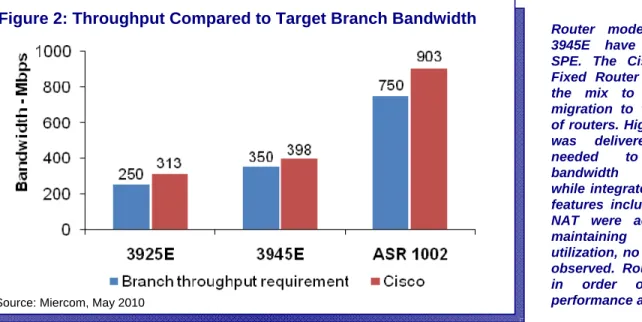
Cisco ISR 3945E delivered throughput of up to
398 Mbps with integrated services enabled
ISR G2 platforms support bandwidth–optimized and
scalable video including TelePresence and streaming
Cisco ISR G2 platforms offer “Service Ready Engine”
providing the flexibility to turn on services on demand
EnergyWise allows automatic port shutdown during off
hours (7PM to 7AM) enabling a 50% energy savings
WAN bandwidth usage decreased 100 times with
integrated Cisco WAAS WAN acceleration module
isco’s Integrated Services Router Generation 2 platform models 1941W, 2911, 2951 3925E, 3945 and 3945E were evaluated by Miercom for performance feature validation while being used in
Lab Testing
Summary
Report
MAY 2010
Report 091028G
Key findings and conclusions:
branch office scenarios. We also evaluated the ASR 1002 Fixed Router on some of these tests to show upward scalability of the next family of routers. The objective was to validate increased levels of voice, video, security, wireless, mobility and data service integration. While testing the features and services offered by the ISR G2 branch routers, performance and throughput was observed, to ascertain if the activated services affected the throughput.
Today’s branch routers must have the ability to serve the requirements of the current branch, and scale to the evolving needs of integrated services. This includes increased bandwidth requirements, supporting advanced security features and WAN and VPN technologies, with multi-media collaboration. (continued next page)
Product Category:
Integrated
Services Router
Generation 2
Vendor Tested:
Products Tested:
Cisco 1941W ISR
Cisco 2911 ISR
Cisco 2951 ISR
Cisco 3925E ISR
Cisco 3945E ISR
Cisco ASR 1002
C
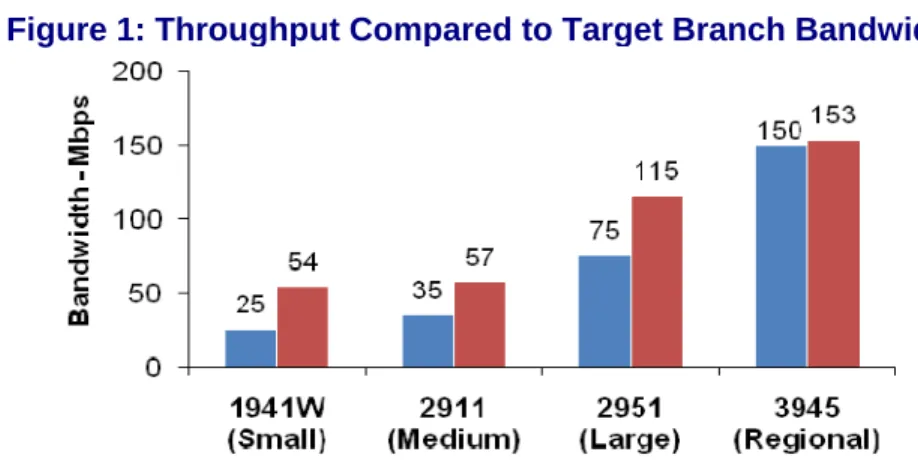
Higher throughput was delivered than was needed to meet the bandwidth requirements for the branches, while integrated services and features including IPsec and NAT were activated. While maintaining 75% CPU utilization, no frame loss was observed. Routers are listed in order of progressively increasing
Figure 1: Throughput Compared to Target Branch Bandwidth
A solution that provides security, wireless capabilities, UC, and WAN optimization in a single box, while maintaining existing performance and throughput is a true integrated solution. Integrated network based services are an effective way to reduce costs, while delivering new services to the end user. The ISR G2 platforms deliver these services and performance, while deployed in small to large remote branch office topologies.
Miercom tests the performance and validated the integrated features of the Cisco ISR G2 platforms. Tests were conducted with feature intensive branch office deployments, and considered actual branch settings currently used by ISR customers.
Branch Architecture
The architecture of the ISR G2 platforms enables richer media experience with video, voice and WAN evolution. Additions to the services available on the ISR G2 platforms include integrated security, unified communications, wireless, and application optimization services. Pay-As-You-Grow software licensing and Cisco IOS software packaging also reduces branch office expenses.
Branch offices are classified as small, medium, large and regional, with unique requirements for each category. All test cases described were based on specific branch requirements. A typical small branch, such as a retail store with 10-25 users, would use the ISR 1941W. A bank with 25-40 users would use the ISR 2911. A corporate branch or large branch accommodating 40-75 users would use the ISR 2951. While a regional office with 75-150 users would use the ISR 3945. Branches with greater bandwidth requirements would use 3925E, 3945E or an ASR 1002.
Performance Tests
Each class of branch routers was tested based on the typical branch configuration of the model with Dynamic Multipoint Virtual Private Network (DMVPN), Zone Based Policy Firewall (ZBF) and Intrusion Prevention System (IPS), and Hierarchical Quality of Service (HQOS) features enabled. We subjected the Cisco ISR G2 router platforms, with integrated services and features enabled, to a traffic mix consisting of the data, voice and/or Telepresence traffic recommended for each deployment scenario.
All of the Cisco ISR G2 branch routers delivered throughput which exceeded by 102% to 214% the The Cisco ISR G2 branch routers - 3925E, 3945E and the Cisco ASR 1002 Fixed Router - delivered performance throughput values greater than the target positioning bandwidth requirements while integrated services features were activated. By adding the new Service Performance Engines (SPE-200 and SPE-250) to the 3925E, we observed 5.5 times increased throughput. When the SPE was added to the 3945E, we observed 3.5 times increased throughput. All test results observed were recorded at zero frame loss while maintaining the CPU utilization at 75%.
Router models 3925E and 3945E have an enhanced SPE. The Cisco ASR 1002 Fixed Router is included in the mix to show upward migration to the next family of routers. Higher throughput was delivered than was needed to meet the bandwidth requirements while integrated services and features including IPsec and NAT were activated. While maintaining 75% CPU utilization, no frame loss was observed. Routers are listed in order of progressive performance and capabilities. Figure 2: Throughput Compared to Target Branch Bandwidth
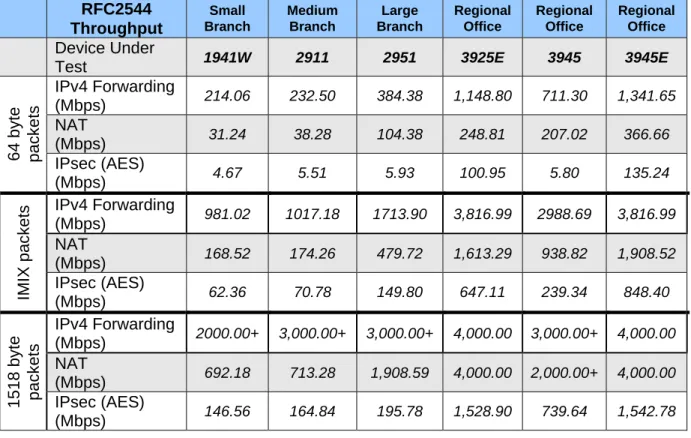
RFC2544 Throughput Small Branch Medium Branch Large Branch Regional Office Regional Office Regional Office Device Under
Test 1941W 2911 2951 3925E 3945 3945E
64 byte packets IPv4 Forwarding (Mbps) 214.06 232.50 384.38 1,148.80 711.30 1,341.65 NAT (Mbps) 31.24 38.28 104.38 248.81 207.02 366.66 IPsec (AES) (Mbps) 4.67 5.51 5.93 100.95 5.80 135.24 IMIX packets IPv4 Forwarding (Mbps) 981.02 1017.18 1713.90 3,816.99 2988.69 3,816.99 NAT (Mbps) 168.52 174.26 479.72 1,613.29 938.82 1,908.52 IPsec (AES) (Mbps) 62.36 70.78 149.80 647.11 239.34 848.40 1518 byte packets IPv4 Forwarding (Mbps) 2000.00+ 3,000.00+ 3,000.00+ 4,000.00 3,000.00+ 4,000.00 NAT (Mbps) 692.18 713.28 1,908.59 4,000.00 2,000.00+ 4,000.00 IPsec (AES) (Mbps) 146.56 164.84 195.78 1,528.90 739.64 1,542.78 Note: Significant IPSec performance increase is one characteristic of the greater performance of the 3925E and 3945E.
Figure 3: Throughput Performance Tests RFC 2544
stated bandwidth requirements of the branch, while integrated features were activated. See
Figure 1 on page 1. All test results were observed without any frame loss and maintaining CPU utilization of 75%.
RFC 2544 Performance Test
We conducted a series of tests to stress product performance at different packet sizes with various combinations of features enabled as shown in the above table.
RFC2544 is a standard test methodology from the Internet Engineering Task Force (IETF) that defines a consistent way of testing network equipment. The Throughput test calculates the maximum number of frames per second that can be transmitted without error. We tested with 64- and 1518-byte sized packets and IMIX packets, then compared the number of transmitted and received frames. When frame loss was encountered, the transmission rate was divided by two and the test was restarted. If during this test there was no frame loss, we increased the transmission rate by half of the difference from the previous
test. This methodology is repeated until there is no frame loss and a Mbps value is found.
We noted a vast difference in performance between the Cisco ISR 3945 and 3945E routers, attributed to the new Service Performance Engine (SPE) that was added to the ISR 3900s. Customers can increase the performance of their existing ISR 3900s by upgrading the SPE. The 3925 can be upgraded to a 3925E by replacing the SPE-100 with the SPE-200. Similarly, the ISR 3945 can be upgraded to a 3945E by replacing the SPE-150 with an SPE-250. When a 3945 is upgraded to a 3945E, performance is increased by as much as 96%.
The above table shows how the addition of the SPE in the 3945E improves performance by 95.7% when compared to the standard 3945 router when transmitting and receiving 64-byte packets. With IMIX packets, the 3945E exhibited a throughput improvement of 71.8% over the 3945. When tested with 1518-byte packets, the Cisco 3945E delivered a 52.1% improved performance compared to the ISR 3945 router. These percentages were calculated by taking the
IPsec (AES) throughput in Mbps value of the 3945 ISR and comparing it to the IPsec (AES) value of the 3945E to determine overall improvement. See Figure 3 on page 3.
Offensive Security Assessment
We evaluated the effectiveness and accuracy of the integrated security features of IPS, ZBF and DMVPN on the Cisco ISR G2 platforms.
The platforms were evaluated as a “standalone security device” in an un-tuned IPS deployment. Penetration testing was conducted with over 1,450 updated and in the wild attacks. Loaded with 2,670 signatures, the platforms thwarted the majority of attacks, with IOS IPS firing signatures before the network security could be compromised. In addition, the zone based policy firewall was resilient against network and application layer attacks, viruses and worms, adding more flexibility and granularity to already existing IOS stateful inspection.
IOS Content Filtering
Cisco IOS Content Filtering, available on the ISR 1941W and 2911, demonstrated category blocking to static black and white lists with keyword blocking and security ratings to websites requested. This IOS integrated feature offers policy-based web content control to limit exposure to websites that could incur liability issues or contribute to lost productivity. The Cisco IOS Content filtering utilizes a subscription-based service using an Internet-based reputation server. Policy-control parameters include keyword blocking, local black- and white-listing of up to 100 URLs, blocking and/or allowing by content categories by user credentials, and reputation-based content control. URL filtering was tested by selecting a category of permitted and non-allowed websites. It successfully blocked the websites by category as requested. See Figure 2 on page 2.
Unified Communications Trusted Firewall
The trusted firewall feature was evaluated to verify Unified Communications security. The UC firewall uses Trusted Relay Point (TRP), a software function which authorizes and inspects STUN messages. Once all checks are successful, a bidirectional pinhole is opened through the firewall for data flow. This prevents the need to blindly open media port ranges.
This feature gives Cisco a competitive edge for Cisco router-based secure UC solutions.
Unified Survivable Remote Site Telephony
Call processing redundancy is critical for all branch offices. Unified Survivable Remote Site Telephony (SRST) is an integrated voice feature available on all Cisco ISR G2 platforms. When activated, the Cisco Unified SRST acts as a call processing engine for the IP phones located in the branch office during a WAN blackout.
Once a WAN link fails, Cisco SRST automatically detects the failure in the network and initiates the SRST services to provide call processing backup for the IP phones at the branch office. Once WAN connectivity is restored, the system automatically shifts the call processing back to the primary Cisco Unified Communications Manager at headquarters.
Video Capability
Video call capabilities were evaluated on an ISR 2911 using the Cisco Unified Video Advantage (CUVA). CUVA allows Cisco non-video IP phones to make video calls to other video endpoints. Connecting the access port of the video-enabled Cisco Unified IP Phone 7965 to a PC with a USB video camera allowed calls to be placed to the branch office. These calls were made using normal phone processes and were displayed successfully with video on the PC without any further actions. The ISR 2911 demonstrated the ability to make video calls using the H.263, H.264 and H.323 protocols.
Communications Manager Express
The Cisco Unified CME (Communications Manager Express) provides call processing services at the branch office. This integrated feature adds call processing functionality at the Cisco ISR G2 branch router itself for branch offices. All the necessary files and configurations for IP phones are stored internally on the ISR G2, providing a single-platform solution.
Calls were made using Cisco Unified IP Phones 7965 to test the call processing functionality of the CME. Voice mails were left to demonstrate the messaging features offered by the CME. Using the VoiceView express feature we could easily browse, listen, and manage voicemail from the Cisco IP phone display and soft keys. These functions were demonstrated on the ISR 2951.
SIP Trunking
successfully combines traditional enterprise router functionality, advanced IP services like VoIP and security with the mobility capabilities of 3G WAN access. The integrated HWIC 3G Wireless feature was tested on the Cisco ISR 1941W for primary and backup WAN link connectivity as an integrated feature offering.
As the primary WAN link, 3G WWAN was tested with IOS security feature DMVPN enabled. To test for multimedia traffic over the 3G WAN link, we placed voice calls and monitored the MOS scores and call quality. Voice could be heard with clarity, all sessions were maintained and no calls were dropped.
When configured as a backup link, the failover time to 3G WWAN was noted to be 15 seconds, an acceptable failover time. This included time for the EzVPN tunnel to establish and pings to reply.
Wide Area Application Services
Cisco Wide Area Application Services (WAAS) module, was demonstrated on the ISR 2911, 2951 and 3945. It provides integrated WAN optimization features on the ISR G2 platforms. Advanced Data Redundancy Elimination (DRE), Persistent LZ compression, and TCP Flow Optimization (TFO), were among the WAAS functions tested, all of which accelerated application response times by alleviating WAN traffic loads and congestion.
We used the Spirent Avalanche/Reflector to generate real world HTTP traffic to traverse over the WAN link to the corporate network. Without the WAAS module providing integrated WAN optimization features, the bandwidth usage was recorded at 140 Mbps for HTTP traffic. With the integrated WAAS module, the bandwidth usage for the same HTTP traffic dropped to 1.4 Mbps decreasing it by 100 fold.
Multi Gigabit Fabric
The MGF is a new integrated solution added to the architecture of the ISR G2 platforms allowing high bandwidth module-to-module com- munications at speeds up to 1 Gbps without adding overhead to the router processor. The traffic between service modules is switched at line rate to one another without being forwarded to the router CPU, thereby improving LAN/WAN performance and scalability.
Two 24 port Cisco Enhanced EtherSwitch Service the ISR 3945 platform. For this test scenario
the CME was set and configured as the PBX that will interpret the SIP signal and pass the traffic. The Spirent Abacus was used to simulate SIP Trunking traffic, generating 30 SIP sessions per second. We observed zero RTP packet loss and no out of order packets. Stable MOS scores of 4.55 were achieved for all calls. In addition, RTP jitter values of 0.233 ms and R-factor of 93.2 was achieved, which falls in the desirable range for VoIP quality.
Wireless LAN
Wireless LAN capabilities are available only on the Cisco ISR 1941W which includes a native 802.11n access point and security features available to support secure mobility.
During testing, the ISR 1941W proved to be able to deploy secure, manageable WLANs, with fast secure mobility, authentication and simplified management. The ISR G2 router extends corporate networks, securing remote sites, allowing access to the applications found in the corporate offices. The Cisco ISR 1941W router meets WLAN needs with a single device, offering increased levels of services integration.
3G Wireless WAN
The Cisco 3G Wireless WAN HWIC (High-Speed WAN Interface Card) on the ISR 1941W URL category blocking message as displayed in a user’s Web browser.
were applied to extend EnergyWise functionality to control power to certain ports. Based on this policy, PoE power to interfaces was set to automatically to turn on/off at various times. These time policies could also be applied by device type, device location, priority of device and other settable parameters.
PoE Boost
When populated with dual power supplies, or a single power supply and Redundant Power System (RPS), the Cisco ISR G2 routers can operate in a PoE boost mode configuration, in lieu of redundant power mode. In this PoE boost configuration, the power capacity of the platform is increased to almost twice the normal power to support additional PoE ports. See Figure 5 below. Figure 5: Power available for PoE Ports in RPS and PoE Boost Mode for an ISR 3900
Mode Redundant PoE Boost
Maximum Power 520W 1000W
Allocated Power 6.3W 6.3W
IOS Software Licensing
With the new licensing and packaging process, Cisco ISR G2 platforms are shipped with a single universal IOS image, loaded during manufacturing, and containing all IOS features. All integrated service and features are now in four technology packages; previously offered in eight images and requiring a new software image for each feature change.
The level of IOS functionality available depends on the licenses purchased. To unlock or upgrade to a suite of IOS functionality, only a new license needs to be applied. The four categories of licenses are: IP Base, Data, Unified Communications and Security (SEC).
Bottom Line
The value of an integrated solution shows its worth for enabling integrated services on a single platform, delivering WAN optimization all in one single box, while maintaining existing performance and throughput metrics. The Cisco ISR G2 models ISR 1941W, ISR 2911, ISR 2951 and ISR 3945 deliver these services with exceptional performance while deployed in branch office (continued on page 8)
scaling from small branch offices of a few users, to large remote branches with 100 clients. For Modules (ESMs) were used for testing, with
Spirent Avalanche/Reflector used to generate traffic traversing from one Etherswitch module to the other. The log file for Cisco ISR 3945 recorded CPU utilization as zero, while 1Gbps of traffic passed through the Etherswitch modules. The receive bandwidth percentage utilization and transmit bandwidth percentage utilization for the port going to the platform CPU recorded zero, indicating that router processing power was not used.
Cisco EnergyWise
Cisco EnergyWise technology allows users to measure the power consumption of network infrastructure and network attached devices (IP phones, PC and access points) and manage power consumption with specific settable policies.
This IOS feature was demonstrated on the ISR 3945 platform f i t t e d wi t h t wo 2 4 p o r t E t h e r s wi t c h modules. Power monitoring and management capabilities of the Cisco EnergyWise feature were tested for slots and interface power management on the router. With Cisco E n e r g yW i s e , the Service modules could be powered-up or turned-d o wn u s i n g s i m p l e c o m m a n d s . Times of day policies were applied to extend EnergyWise functionality to control power to certain ports. Based on this policy, PoE power to interfaces was set to automatically to turn on/off at various times. These time policies could also be applied by device type, device location, priority of device and other settable parameters.
Cisco EnergyWise
Cisco EnergyWise technology allows users to measure the power consumption of network infrastructure and network attached devices (IP phones, PC and access points) and manage power consumption with specific settable policies.
This IOS feature was demonstrated on the ISR 3945 platform f i t t e d wi t h t wo 2 4 p o r t E t h e r s wi t c h modules. Power monitoring and management capabilities of the Cisco EnergyWise feature were tested for slots and interface power management on the router. With Cisco E n e r g yW i s e , the Service modules could be powered-up or turned-d o wn u s i n g s i m p l e c o m m a n d s . Times of day policies
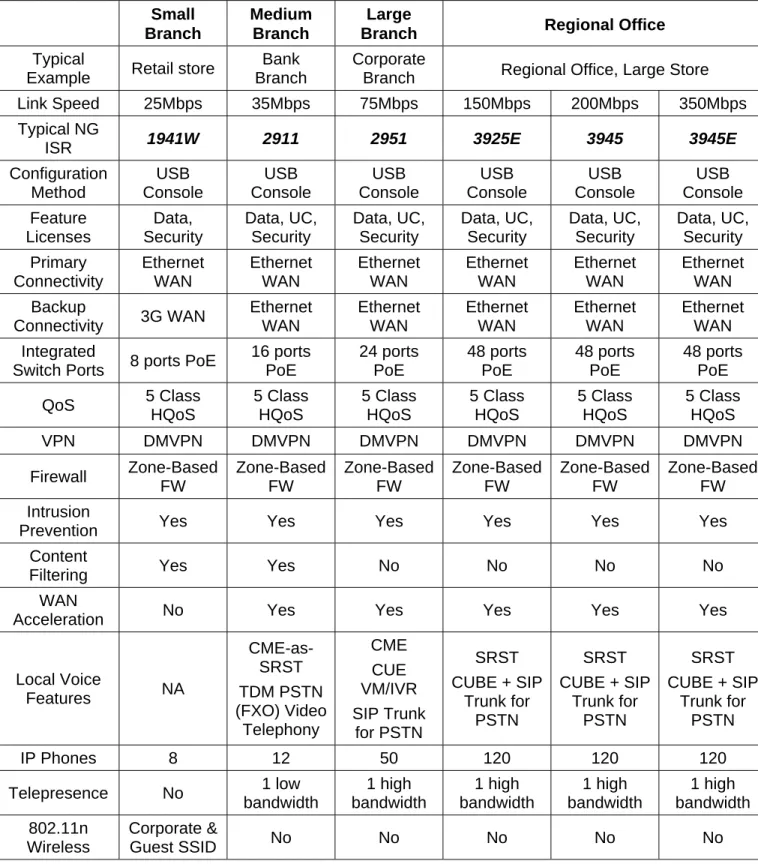
Small Branch
Medium Branch
Large
Branch Regional Office
Typical
Example Retail store
Bank Branch
Corporate
Branch Regional Office, Large Store
Link Speed 25Mbps 35Mbps 75Mbps 150Mbps 200Mbps 350Mbps Typical NG
ISR 1941W 2911 2951 3925E 3945 3945E
Configuration Method USB Console USB Console USB Console USB Console USB Console USB Console Feature Licenses Data, Security Data, UC, Security Data, UC, Security Data, UC, Security Data, UC, Security Data, UC, Security Primary Connectivity Ethernet WAN Ethernet WAN Ethernet WAN Ethernet WAN Ethernet WAN Ethernet WAN Backup Connectivity 3G WAN Ethernet WAN Ethernet WAN Ethernet WAN Ethernet WAN Ethernet WAN Integrated
Switch Ports 8 ports PoE
16 ports PoE 24 ports PoE 48 ports PoE 48 ports PoE 48 ports PoE QoS 5 Class HQoS 5 Class HQoS 5 Class HQoS 5 Class HQoS 5 Class HQoS 5 Class HQoS VPN DMVPN DMVPN DMVPN DMVPN DMVPN DMVPN Firewall Zone-Based FW Zone-Based FW Zone-Based FW Zone-Based FW Zone-Based FW Zone-Based FW Intrusion
Prevention Yes Yes Yes Yes Yes Yes
Content
Filtering Yes Yes No No No No
WAN
Acceleration No Yes Yes Yes Yes Yes
Local Voice Features NA CME-as-SRST TDM PSTN (FXO) Video Telephony CME CUE VM/IVR SIP Trunk for PSTN SRST CUBE + SIP Trunk for PSTN SRST CUBE + SIP Trunk for PSTN SRST CUBE + SIP Trunk for PSTN IP Phones 8 12 50 120 120 120 Telepresence No 1 low bandwidth 1 high bandwidth 1 high bandwidth 1 high bandwidth 1 high bandwidth 802.11n Wireless Corporate & Guest SSID No No No No No
Table 1: Description of Branch Office Deployment Scenarios and Features Applied
The branch offices have been categorized into small, medium, large and regional categories with unique requirements for each size office. The configurations shown above represent feature intensive branch deployments today and are likely to be closer to the norm in the future. All testing and test cases described in this document w conducted based on the branch office requirements for the respective Cisco ISR G2 routers.
additional details on this testing, contact Miercom at [email protected].
Ethernet Operations, Administration, and
Maintenance (OAM)
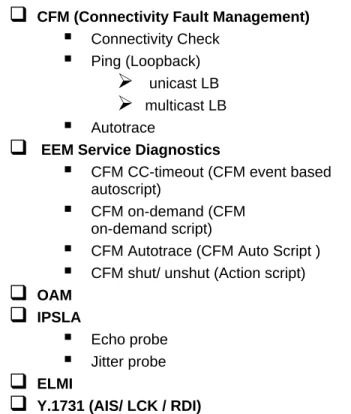
Cisco Integrated Services Routers Generation 2 support the tools for Ethernet Operations, Administration, and Maintenance (OAM) developed in accordance with the leading industry-standards organizations. We observed a testing demonstration of the Carrier Ethernet OAM capabilities while conducting performance testing on the routers. We specifically validated the following features:
These Fault Management and Performance Management tools for Ethernet allow service providers to manage each customer service instance individually. A customer service instance, or Ethernet Virtual Connection (EVC), is the service that is sold to a customer and is designated by the Service-VLAN tag. As a result, 802.1ag operates on a per-Service-VLAN (or per-EVC) basis. End-to-end service management using 802.1ag is a critical aspect of Ethernet management along with the Y.1731 fault management. It enables the service provider to know if an EVC has failed, and if so, provides the tools to rapidly isolate the failure. Another important area is the link management provided by IEEE 802.3ah. Ethernet link management (IEEE 802.3ah) enables service
providers to monitor and troubleshoot a single Ethernet link. Although it was defined for the first-mile connection to the customer demarcation where most link issues typically occur; IEEE 802.3ah is applicable to any point-point IEEE 802.3 links.
The primary benefits of 802.3ah are that it enables the service provider to monitor a link for critical events and then, if necessary, put the remote device into "loopback" mode in order to do testing on the link. It also discovers unidirectional links, which occur when only one direction of transmission fails.
Ethernet Local Management Interface (E-LMI) protocol has benefits to both the service provider and the end customer because it brings Ethernet manageability from the service provider network to the customer premises. E-LMI operates between the customer edge (CE) device and the user-facing provider edge (U-PE). It enables the service provider to configure the CE device to match the subscribed service. The CE device will automatically receive a VLAN-to-EVC mapping and the corresponding bandwidth profile and quality of service (QoS) settings.
The IP SLA for Ethernet adds to the performance monitoring strengths for Ethernet and are supported on ISR G2.
Service providers are using increased bandwidth requirements to offer newer and more cost-effective Ethernet services while utilizing the end-to-end service-assurance capabilities as offered by standardized Ethernet OAM on Cisco routing and switching platforms. Using these capabilities, service providers can deliver both entertainment- and business-grade services over an Ethernet network to meet the expectations of their end customers.
This diagram shows the main areas of Ethernet Operations, Administration, and Maintenance (OAM).
Figure 6: Cisco Carrier Ethernet OAM
CFM (Connectivity Fault Management)
Connectivity Check
Ping (Loopback)
unicast LB
multicast LB
Autotrace
EEM Service Diagnostics
CFM CC-timeout (CFM event based autoscript)
CFM on-demand (CFM on-demand script)
CFM Autotrace (CFM Auto Script )
CFM shut/ unshut (Action script)
OAM
IPSLA
Echo probe
Jitter probe
ELMISystems Under Test and Operating System Versions
Cisco Routers:
1941W licensed for: ip base, security, uc, and data ; running IOS version 15.0(1)M 2911 licensed for: ip base, security, uc, and data ; running IOS version 15.0(1)M 2951 licensed for: ip base, security, uc, and data ; running IOS version 15.0(1)M 3945E licensed for: ip base, security, uc, and data ; running IOS version 15.0(1)T 3925E licensed for: ip base, security, uc, and data ; running IOS version 15.0(1)T ASR 1002 Fixed Router fixed adventerprisek9 version 12.4(X), and IOS-XE 12.2 Mu Test Suite, version 4.5.6.r36499
Avalanche 2.50, Build 4070
Spirent TestCenter, version 2.50.1626.0000
Test Bed Diagram 1
VoIP Load Device Under Test (DUT) – Cisco ISR Avalanche Reflector
IPsec Traffic
Internet 7206 – NPE-G2How We Did It
Test Bed 1
Similar network topologies were used for all branch office deployments with variations added to reflect the typical needs of the different branch sizes. Spirent TestCenter, Spirent Avalanche and Reflector were used for traffic generation. Spirent TestCenter was used to generate RTP voice traffic. A custom Cisco traffic generation tool was used to simulate Telepresence sessions. This tool sends actual Telepresence video streams and monitors for any frame loss, jitter and latency. All traffic used for performance testing of the Cisco ISR G2 Device Under Test (DUT) were set to meet Service Level Agreement (SLA) of zero frame loss and acceptable latency or jitter values.
To evaluate the effectiveness of the security features of the Cisco ISR G2 platforms, offensive security tests were conducted using Miercom Offensive Security Testing Suite, the Ixia IxDefend platform (www.ixiacom.com) and the Mu Dynamics Test Suite (www.mudynamics.com). The Ixia IxDefend advanced security assessment tool analyzed quality, resiliency, and security exposures across a broad array of protocols and applications. The IxDefend test included 40 protocols from link layer to application protocols. Each protocol in each bundle included thousands of tests. IxDefend’s tests provide the deepest possible protocol coverage.
The Mu Test Suite distills information from the most recently discovered root-cause vulnerabilities into test cases that target the vulnerabilities that lie behind tens of thousands unique exploit vectors. The security assessment was conducted with Ixia’s (www.ixiacom.com) IxDefend which was used to generate exploits and attacks. Miercom recommends customers conduct their own needs analysis and test for the specific environment for product deployment before making a selection. Contact [email protected] for additional details on the configurations applied to the system under test and test tools used in this evaluation.
Test Bed Diagram 2
Test Bed Diagram 3
Test Bed 2
The Device Under Test (DUT) is only connected to the different traffic generation tools depicted. Throughput measurements were taken with and without features enabled such as IPsec VPN and NAT. Tests for throughput performance of RFC 2544 were conducted primarily using this test scenario.
Test Bed 3
The second test bed has the DUT connected to a HeadEnd router in addition to the traffic generation tools as shown in Figure 2. This is normally used for those cases, like IPSec, that require a connection to a peer router. The WAN interface of the ISR G2 DUT utilized a secure VPN connection as well as a backup connection specific to the size of the branch. For our tests, headquarters was represented by a Cisco 7200 Series router, terminating at the other side of the VPN connection and providing the core side connections for traffic generation and monitoring. To simulate the various streams found in a typical branch setting, generic stateful HTTP data traffic consisting of 25K, 30K and 130K objects, with 10 objects per TCP session, were used. All performance testing was conducted with router CPU maintained in the 50-70% range, which is the recommended load that allows sufficient overhead and tolerance for real-world network activity. Tests involving IPsec performance were conducted primarily using this test scenario.
Device Under Test
(DUT)
C3900E
Avalanche
Avalanche
Abacus
Abacus
Telepresence
Simulator
Telepresence
Simulator
Telepresence
Simulator
Telepresence
Simulator
Avalanche
Abacus
Avalanche
Abacus
Device Under Test
(DUT)
C3900E or ASR
ASR 1002
HeadEnd
Miercom has hundreds of product-comparison analyses published over the years in such leading network trade periodicals as Network World, Business Communications Review - NoJitter, Communications News, xchange, Internet Telephony and other leading publications, Miercom’s reputation as the leading, independent product test center is unquestioned.
Miercom’s private test services include competitive product analyses, as well as individual product evaluations. Miercom features comprehensive certification and test programs including: Certified Interoperable, Certified Reliable, Certified Secure and Certified Green. Products may also be evaluated under the NetWORKS As Advertised program, the industry’s most thorough and trusted assessment for product usability and performance.
About Miercom’s Product Testing Services
Before printing, pleaseconsider electronic distribution
Product names or services mentioned in this report are registered trademarks of their respective owners. Miercom makes every effort to ensure that information contained within our reports is accurate and complete, but is not liable for any errors, inaccuracies or omissions. Miercom is not liable for damages arising out of or related to the information contained within this report. Consult with professional services such as Miercom Consulting for specific customer needs analysis.
Report 091028G [email protected] www.miercom.com
Miercom Performance Verified
Based on Miercom’s review of the performance during testing, the Cisco ISR G2 platforms – ISR 1941W, ISR 2911, ISR 2951 and ISR 3945 routers have earned the Performance Verified award. The Cisco ISR G2 platforms provide security, wireless, UC, WAN optimization and energy management capabilities all in one box while meeting branch office performance and throughput requirements.
Cisco Systems, Inc. 170 West Tasman Drive
San Jose, CA 95134 www.cisco.com 1-800-553-6387 ISR 2911 ISR 2951 ISR 1941W
ISR 3925E, 3945 and 3945E