System Engineering Management Plan
MDOT-ITS 001-01-006
ITS Projects - Systems Engineering
Process Compliance
FHWA Final Rule (23 CFR 940)
Version 2.0
March 20, 2009
Prepared by:
Gresham, Smith and Partners, MS, P.C.
DBA
Gresham, Smith and Partners
MDOT ITS Mission Statement:
Revision History
Date
Version
Description
01/24/07 0.1 Draft submittal sent to FHWA for review. 08/22/07 0.2 Revised draft submitted for internal review. 01/17/08 1.0 First final version submitted for MDOT use. 03/20/09 2.0 Second final version submitted for MDOT use.
Forward
The Mississippi Department of Transportation (MDOT) has initiated the development of an Intelligent Transportation System (ITS) Program. Consistent with U.S. Department of Transportation (U.S. DOT) guidelines and rules, MDOT has established a framework (Statewide ITS Architecture) to guide regional ITS planning, project development and implementation. This framework is intended to effectively support MDOT‘s mission to
promote the planning and implementation of an integrated, intermodal transportation network. Federal Highway Administration (FHWA) Rule 940 provides policies and procedures for implementing Section 5206(e) of the Transportation Equity Act of the 21st Century (TEA-21), Public Law 105-178, 112 Stat. 457, pertaining to the conformance with the National ITS Architecture and supporting standards.
The rule states that all ITS projects, funded in whole or in part with funding from the Highway Trust Fund, shall be based on a systems engineering analysis consisting of seven required elements. Conformity with the Rule 940 requirements, listed below, is required for both routine and non-routine projects. However, with routine projects, the effort and scope of systems engineering analysis should be minimal. For non-routine projects, the scale of the systems engineering analysis depends on the scope of the project.
Rule 940 Requirements
As stated in 23 CFR 940, the systems engineering analysis shall include, at a minimum:
1. Identification of portions of the regional ITS architecture being implemented (or, in MDOT‘s case, the Statewide ITS Architecture and supporting Regional ITS Architectures); 2. Identification of participating agencies‘ roles and responsibilities;
3. Requirements definitions;
4. Analysis of alternative system configurations and technology options to meet requirements; 5. Procurement options;
6. Identification of applicable ITS standards and testing procedures; and 7. Procedures and resources necessary for operations and maintenance. Source: (http://ops.fhwa.dot.gov/its_arch_imp/docs/20010108.pdf)
A separate, but functionally equal regulation promulgated by the Federal Transit Administration (FTA) applies to federally funded transit projects.
This Systems Engineering Management Plan (SEMP) is a statement of standard operating procedure (SOP) for ensuring compliance with the Rule 940 requirements for qualifying ITS projects under the oversight of the MDOT and/or Local Public Agencies (LPAs). As such, the systems engineering process guidelines contained herein are an extension of the MDOT and LPA existing processes and procedures for ITS planning and project development. This document is intended to serve as a working reference for public agency management, planning, construction and operations staff relating to the systems engineering and
architecture requirements by standing FHWA and FTA policy and procedures for ITS project development. General Purpose of MDOT’s Systems Engineering Management Plan: Identify the process for system(s) development Define how the plan will be carried out Describe how progress will be tracked against the plan
Table of Contents
Forward ii List of Figures iv List of Tables iv List of Acronyms v Definitions, vii 1.0 Purpose 12.0 SEMP Document Organization 2
3.0 Systems Engineering (SE) Process Overview and SEMP Requirements 3
3.1
..
SE Process vs. Traditional Transportation Project Development ... 33.2
..
Mississippi ITS Project Life Cycle Framework ... 54.0 Managing ITS Projects Using the SE Process 7 4.1
..
Documentation of General Project Data /Project Need ... 74.2
..
Compliance with the Regional ITS Architecture ... 104.3
..
Needs Assessment ... 104.4
..
Concept Selection... 134.5
..
Systems Engineering Management Planning ... 145.0 ITS Business Plan 32 6.0 Technical Planning and Control 33 6.1
..
Concept of Operations ... 336.2
..
System Requirements Development ... 396.3
..
Managing System Requirements (Traceability) ... 396.4
..
High Level Design... 416.5
..
Component Level Detailed Design ... 426.6
..
Hardware and Software Development ... 426.7
..
Integration and Verification ... 426.8
..
System Deployment ... 436.9
..
System Validation ... 446.10Operations and Maintenance / Changes and Upgrades ... 44
6.11System Retirement and Replacement ... 45
7.0 References 46
Appendices
List of Figures
Figure 1: Traditional Transportation Project Development Process Steps Mapped to ―V‖ Diagram
and ITS Life Cycle Phases ... 4
Figure 2: Mississippi ITS Project Life Cycle Framework ... 6
Figure 3: Project/Procurement Planning... 17
Figure 4: Procurement Decision Model ... 19
Figure 5: FHWA Federal-Aid Procurement Regulations and Contracting Options ... 20
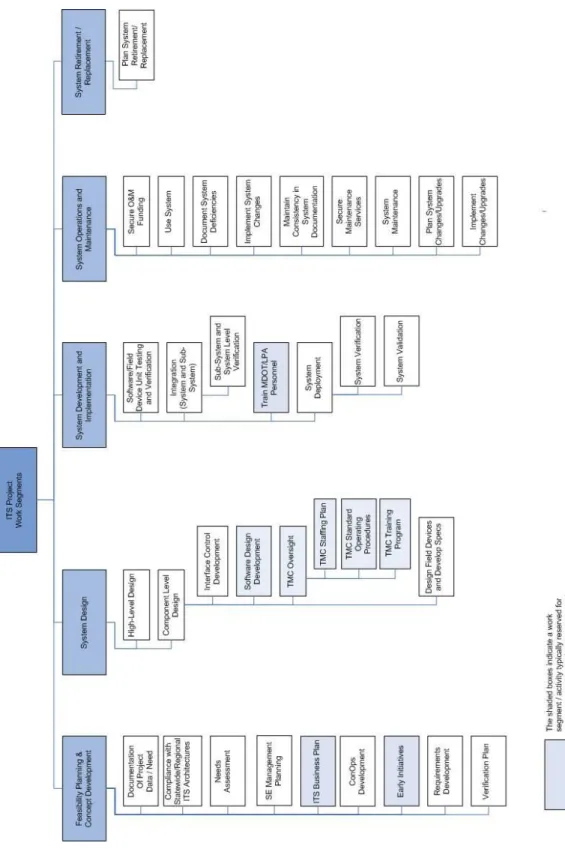
Figure 6: Work Breakdown Structure Diagram for the MDOT ITS System ... 24
List of Tables
Table 1: Minimum Project Review/Approval Milestone Requirements - ITS Project Life Cycle ... 5Table 2: SEMP Requirements Summary – Managing ITS Projects Using the SE Process ... 8
Table 3: Minimum SEA Requirements ... 15
Table 4: ITS Procurement Types ... 22
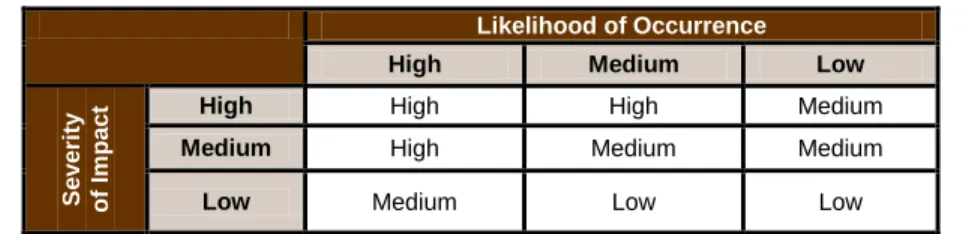
Table 5: Risk Prioritization Matrix ... 28
Table 6: SEMP Requirements Summary – Technical Planning and Control of ITS Projects Using the SE Process ... 34
List of Acronyms
AASHTO American Association of State Highway and Transportation Officials
ANSI American National Standards Institute
APTA American Public Transit Association
ATMS Advanced Traffic Management System
CCTV Closed Circuit Television
CDR Critical Design Review
CFR Code of Federal Regulations
CM Configuration Management
ConOps Concept of Operations
COTS Commercial off-the-shelf
CVISN Commercial Vehicle Information Systems Network
DMS Dynamic Message Sign
DSRC Dedicated Short Range Communications
FHWA Federal Highway Administration
FTA Federal Transit Administration
IEEE Institute of Electrical and Electronics Engineers
ISO International Standards Organization
IT Information Technology
ITE Institute of Transportation Engineers
ITS Intelligent Transportation Systems
JPO Joint Program Office
LPA Local Public Agency
MDOT Mississippi Department of Transportation
NEMA National Electrical Manufacturer‘s Association
NIST National Institute of Standards and Technology
O&M Operations and Maintenance
PAR Project Activation Request
PDM Project Development Manual
PDR Preliminary Design Review
PS&E Plans, Specifications and Estimates
RFP Request for Proposal
RITSA Regional ITS Architecture
ROW Right-of-Way
SAE Society of Automotive Engineers
SE Systems Engineering
SEA Systems Engineering Analysis
SEMP Systems Engineering Management Plan
SITSA Statewide ITS Architecture
SOP Standard Operating Procedures
SRS Software Requirements Specification
STIP Statewide Transportation Improvement Program
STP Surface Transportation Program
TIP Transportation Improvement Plan
TMC Traffic Management Center
TMDD Traffic Management Data Dictionary
USDOT United States Department of Transportation
V&V Verification and Validation
Definitions
1
,
2
Acceptance An action by an authorized representative of the acquirer by which the acquirer assumes
ownership of products as a partial or complete performance of the contract.
Acceptance Test Formal testing conducted to determine whether or not a system satisfies its acceptance criteria
and to enable the acquirer to determine whether or not to accept the system.
Architecture The organizational structure of a system, identifying its components, their interfaces, and a concept of execution among them.
Approval Written notification by an authorized representative of the acquirer that the developer‘s plans,
design, or other aspects of the project appear to be sound and can be used as the basis for further work. Such approval does not shift responsibility from the developer to meet contractual requirements.
Baseline An approved product at a point in time. Any changes made to this product must go through a
formal change process.
Concept A high-level conceptual project description, including services provided and the operational structure.
Concept Exploration The process of developing and comparing alternative conceptual approaches to meeting the
needs that drive the project. Concept of
Operations
A document that defines the way the system is envisioned to work from multiple stakeholder viewpoints [Users including operators, maintenance, management].
Configuration Item A product such as a document or a unit of software or hardware that performs a complete function and has been chosen to be placed under change control. That means that any changes that are to be made must go through a change management process. A baseline is a configuration item.
Configuration Management
A discipline applying technical and administrative direction and surveillance to identify and document the functional and physical characteristics of Configuration Items [CI‘s]; audit the CI‘s to verify conformance to specifications, manage interface control documents and other contract requirements control changes to CI‘s and their related documentation; and record and report information needed to manage CI‘s effectively, including the status of proposed changes and the implementation status of approved changes.
Configuration Management Plan
A plan defining the implementation [including policies and methods] of configuration management on a particular program/project.
Consultant The firm, individual, or other entity that provides contractual professional services to the Department or the Local Public Agency.
Control (Decision) Gates
Formal decision points along the life cycle that are used by the system‘s owner and
stakeholders to determine if the current phase of work has been completed and that the team is ready to move into the next phase of the life cycle.
Commercial Off-the-Shelf Software
Commercially available applications sold by vendors through public catalogue listings, not intended to be customized or enhanced. [Contract-negotiated software developed for a specific application is not COTS software.]
1
Systems Engineering Guidebook for ITS, Caltrans, Version 2.0, January 2007
2
Cross-cutting Activities
Enabling activities used to support one or more of the life cycle process steps.
Database Management System
An integrated set of computer programs that provide the capabilities needed to establish, modify, make available, and maintain the integrity of a database.
Decomposition The process of successively breaking down the system into components that can be built or
procured. Functional and physical decomposition are the key activities that are used.
Functional decomposition is breaking a function down into its smallest parts. For example, the function ramp metering decomposes into a number of sub-functions, e.g. detection, meter rate control, main line metering, ramp queuing, time of day, and communications. Physical
decomposition defines the physical elements needed to carry out the function. For example, the ramp metering physical decomposition includes loops or video detection, WWV time [world wide standard clock for accurate time], fiber or twisted pair for communications, 2070 or 170 controllers, and host computer.
Detailed Design Document
The product baseline used to develop the hardware and software components of the system.
Development Model A specific portion of the life cycle model that relates to the definition, decomposition,
development, and implementation of a system or a part of a system.
Elicitation The process to draw out, to discover and to make known so to gain knowledge and
information, often used in defining needs.
Enabling Products Products that enable the end product to be developed, supported, and maintained. For
example, these products typically are the software compilers, prototypes, development workstations, plans, specifications, requirements, and training materials.
Feasibility Assessment
A pre-development activity to evaluate alternative system concepts, selects the best one, and verifies that it is feasible within all of the project and system constraints.
Gap Analysis A technique to assess how far current [legacy] capabilities are from meeting the identified
needs, to be used to prioritize development activities. This is based both on how far the current capabilities are from meeting the needs [because of insufficient functionality, capabilities, performance or capacity] and whether the need is met in some places and not others. Intelligent
Transportation Systems
A broad range of diverse technologies which, when applied to our current transportation system, can help improve safety, reduce congestion, enhance mobility, minimize
environmental impacts, save energy, and promote economic productivity. ITS technologies are varied and include information processing, communications, control, and electronics.
Interface The functional and physical characteristics required to exist at a common boundary - in
development, a relationship among two or more entities [such as software-software, hardware-hardware, hardware-software, hardware-user, or software-user].
Interface Control Interface control comprises the delineation of the procedures and documentation, both
administrative and technical, contractually necessary for identification of functional and physical characteristics between two or more configuration items that are provided by different contractors/acquiring agencies, and the resolution of the problems thereto.
Legacy System The existing system to which the upgrade or change will be applied.
Life Cycle The end-to-end process from conception of a system to its retirement or disposal.
Local Public Agency Any unit of government in the State of Mississippi (other than MDOT) participating in the Federal-aid programs with MDOT. Examples include cities, counties, Metropolitan Planning Organizations, planning and development districts, public transit providers, Rails-to-Trails Districts, other state agencies, and tribal governments.
National ITS Architecture
A general framework for planning, defining, and integrating ITS. It was developed to support ITS implementations over a 20-year time period in urban, interurban, and rural environments across the country. The National ITS Architecture is available as a resource for any region and is maintained by the USDOT independently of any specific system design or region in the nation.
Needs Assessment
An activity accomplished early in system development to ensure that the system will meet the most important needs of the project‘s stakeholders, specifically that the needs are well understood, de-conflicted, and prioritized
Operational Baseline
The system that is currently in use, including all of the design, development, test, support and requirements documentation.
Operational Concept
The roles and responsibilities of the primary stakeholders and the systems they operate.
Process An organized set of activities.
Professional Services Contract
A contract for any non-bid professional services such as engineering, architectural,
accounting, transportation planning, management, construction engineering and inspection, or such other services as may be directed by the MDOT Executive Director or Local Public Agency‘s Chief Administrative Official.
Project An undertaking requiring concerted effort, which is focused on developing and/or maintaining a
specific product. The product may include hardware, software, and other components. Typically, a project has its own funding, cost accounting, and delivery schedule with the acquirer [customer].
Project Architecture
High Level Design.
Project Plan A description [what is to be done, what funds are available, when it will be done and by whom]
of the entire set of tasks that the project requires. Regional
ITS Architecture
A specific regional framework for ensuring institutional agreement and technical integration for the implementation of ITS projects in a particular region.
Requirements The total consideration as to WHAT is to be done [functional], HOW well it is to perform
[performance], and under WHAT CONDITIONS it is to operate. [Environmental and non-functional].
Reverse Engineering The process of documenting an existing Intelligent Transportation Systems functional [what it
does – requirements], physical [how it does it – design], and support [the way it was built and maintained – enabling products] characteristics.
Risk Management An organized process to identify what can go wrong, to quantify and access associated risks,
and to implement/control the appropriate approach for preventing or handling each risk. Software
Development
A set of activities that result in software products. Software development may include new development, modification, reuse, re-engineering, maintenance, or any other activities that result in software products.
Sole Source Contracts
A method of procuring consultant services in a non-competitive selection for one of the following reasons: (a) The service is available only from a single source; (b) There is an emergency which will not permit the time necessary to conduct competitive negotiations; or (c) After solicitation of a number of sources responding is determined to be inadequate.
Specification A document that describes the essential technical requirements for items, materials or services
including the procedures for determining whether or not the requirements have been met.
Stakeholders The people for whom the system is being built, as well as anyone who will manage, develop,
operate, maintain, use, benefit from, or otherwise be affected by the system.
Statement of Work A document primarily for use in procurement, which specifies the work requirements for a
project or program. It is used in conjunction with specifications and standards as a basis for a contract. The SOW will be used to determine whether the contractor meets stated
performance requirements.
System Elements A system element is a balanced solution to a functional requirement or a set of functional
requirements and must satisfy the performance requirements of the associated item. A system element is part of the system [hardware, software, facilities, personnel, data, material,
services, and techniques] that, individually or in combination, satisfies a function [task] the system must perform.
System An integrated composite of people, products, and processes, which provide a capability to
satisfy a stated need or objective. Systems
Engineering
An interdisciplinary approach and a means to enable the realization of successful systems. Systems engineering requires a broad knowledge, a mindset that keeps the big picture in mind, a facilitator, and a skilled conductor of a team.
System Specifications
A top level set of requirements for a system. A system specification may be a system/sub-system specification, Prime Item Development Specification, or a Critical Item Development Specification.
Technical Reviews A series of system engineering activities by which the technical progress on a project is
assessed relative to its technical or contractual requirements. The formal reviews are
conducted at logical transition points in the development effort to identify and correct problems resulting from the work completed thus far before the problem can disrupt or delay the technical progress. The reviews provide a method for the contractor and procuring activity to determine that the identification and development of a CI have met contract requirements.
Trade-off Study An objective evaluation of alternative requirements, architectures, design approaches, or
solutions using identical ground rules and criteria.
Validation The process of determining that the requirements are the correct requirements and that they
form a complete set of requirements this is done at the early stages of the development process. Validation of the end product or system determines if the system meets the users‘ needs.
Verification The process of determining whether or not the products of a given phase of the
system/software life cycle fulfill the requirements established during the preceding phase. Work Breakdown
Structure (WBS)
A product-oriented listing, in family tree order, of the hardware, software, services, and other work tasks, which completely defines a product or program. The listing results from project engineering during the development and production of a materiel item. A WBS relates the elements of work to be accomplished to each other and to the end product.
1.0 Purpose
The guidelines presented in this Systems Engineering Management Plan (SEMP) for the Mississippi Department of Transportation (MDOT) follow the recent establishment of MDOT‘s Statewide Intelligent Transportation System (ITS) Architecture - the overarching framework for ITS in Mississippi – and the recent revisions to the Project Development Manual for Local Public Agencies defining the project initiation activities associated with systems engineering and architecture requirements for ITS projects. The SEMP is generally intended to describe the systems engineering management process and requirements for planning, designing, deploying, operating and maintaining projects containing ITS elements.
The guidelines will aid in ensuring that ITS deployments in Mississippi result in a fully
operational and integrated transportation system that utilizes public resources in the most cost effective and efficient manner. And, that those deployments are in compliance with the Federal Highway Administration (FHWA) Federal Regulation 23 CFR 940, ITS Architecture and Standards, Final Rule and the Federal Transit Administration (FTA) policy on ITS, as it applies to federally funded transit projects.
To this end, the MDOT SEMP:
Describes how systems engineering analyses (SEAs) will be applied to projects;
Provides guidelines for SE activities required to plan, design, deploy, operate and maintain the components of a typical ITS project;
Describes critical control points (decision gates) in the process and defines criteria for project milestones;
Provides information on resource planning needs and procurement options available for project implementation;
Describes how project specific plans for systems integration and verification should be developed;
Describes how traceability requirements should be developed to ensure that requirements are verified throughout the life of the system; and
Describes how the design, deployment, operation and maintenance of the project will be tracked against the Project Plan.
These guidelines apply to all projects within Mississippi‘s transportation network qualifying for funding under the Federal-Aid System, as well as projects under Jurisdictional Systems to which funds from the Highway Trust Fund may be applied. These qualifying systems are further described in the following documents:
Mississippi Design Manual
Project Development Manual for Local Public Agencies
The reader should note that the general identification of participating agencies‘ roles and responsibilities in the Mississippi ITS program have been functionally defined under the Statewide ITS Architecture and its supporting Regional ITS Architectures, some of which remain under development at this time. Accordingly, stakeholder involvement is not addressed in detail in this SEMP document. However, provisions for validating stakeholder involvement in a particular project against the architectures is provided for in the project planning and concept of operations development sections of this SEMP, as well as the systems engineering process checklists appended to the document.
This SEMP applies to projects administered by the Mississippi DOT as well as Local Public Agencies . . . . . . and, is generally intended to describe the systems engineering development process requirements for planning, designing, deploying, operating and maintaining projects containing ITS elements.
2.0 SEMP Document Organization
This SEMP is organized to serve as a reference document on the steps required to validate compliance with the Rule 940 requirements and complete project-specific Systems
Engineering Analyses (SEAs) (See Section 4.5). In some cases, it may be sufficient in its use as a stand-alone document to ensure compliance with the systems engineering (SE) process for ITS projects, by use of the SE Process Compliance Checklist appended to this document. The process activities described in this SEMP can be adapted to fit the individual project.
This SEMP is arranged around two important aspects of the SE process:
Managing ITS Projects Using the SE process (Section 4) and Technical Planning and Control (Sections 6).
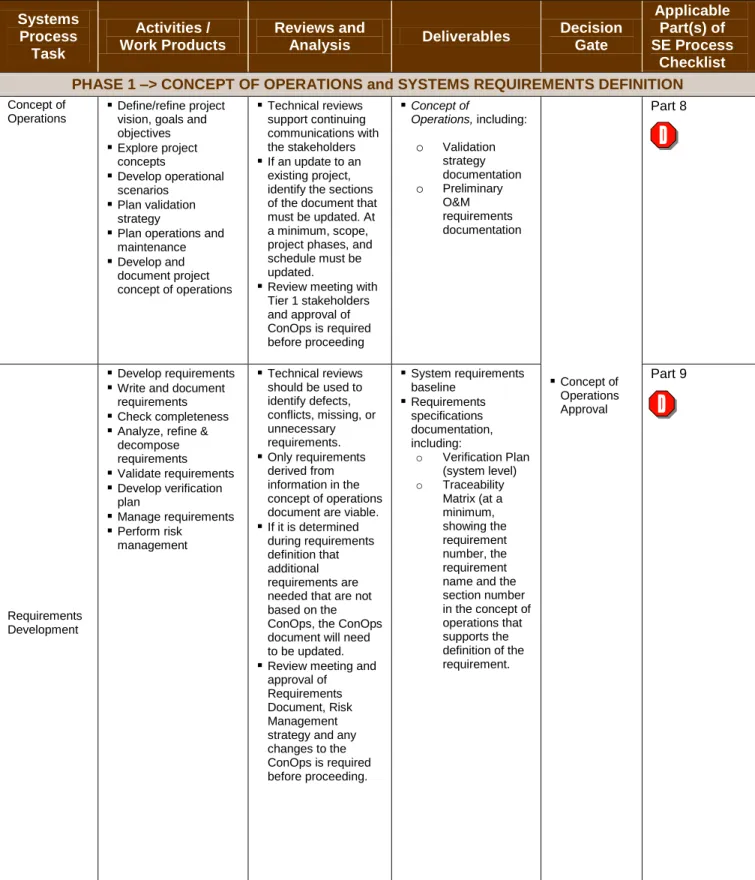
A table is presented in the beginning of Section 4 and 6 that summarizes the SE processes, work activities that are involved, necessary reviews and analysis, associated deliverables, and decision gates or project milestones. These tables should serve as a usable reference tool for each phase of the ITS project development life cycle. Additionally, Table 3 on Page 16 provides a list of the minimum SEA requirements, which will provide sufficient
documentation for most ITS projects.
Sections of the SE Process Compliance Checklist, appended to this document, are intended to be completed by the MDOT/LPA project management staff and should be submitted to MDOT as part of the overall documentation required at each major review/approval milestone (Ref: Section 3.2, Figure 2) for review/approval as indicated. Blank and example copies of the SE Process Compliance Checklist for ITS projects are provided in Appendix A and B, respectively.
It should be noted that the intent of this SEMP is not to replicate the voluminous
documentation currently available on applying the SE process to ITS projects but, rather, to serve as a user‘s guide in navigating through linkages to the national ITS program
documentation and the supporting efforts and documentation of various research agencies and organizations.
Icons used throughout the text of this SEMP are listed below.
Indicates a link to documentation on the Internet.
Indicates additional or emphasized information about the report text or a recommended action by the reader.
Indicates project or activity initiation
Indicates a major project milestone and its associated section of the SE Process Compliance Checklist that requires approval from MDOT.
GO
3.0 Systems Engineering (SE) Process
Overview and SEMP Requirements
It is important that the development of all ITS projects comply with both the Mississippi ITS Architectures and these SEMP requirements as they describe the SE activities needed to develop, deploy, operate and maintain the components of the Mississippi ITS Program. Federal Regulation 23 CFR 940 defines ITS as ―electronics, communications, or information processing used singly or in combination to improve the efficiency or safety of a surface transportation system.‖ As the Mississippi ITS program develops and matures, it is anticipated that a wide range of transportation engineering projects that incorporate ITS capabilities will be developed and implemented.
Additionally, MDOT is working towards integrated statewide management capabilities. As a result, ITS projects in Mississippi will often include multiple capabilities and should be considered complex systems; therefore, the systems engineering processes for ITS must be consistent throughout the life cycles of the projects.
MDOT elects to apply the systems engineering process guidelines contained herein to all ITS projects, regardless of size, with the exception of the following:
Emergency situations requiring immediate implementation, such as recovery from natural disasters, major weather or security events;
Isolated traffic control improvements, such as individual intersection improvements or enhancements, spot signing, striping or delineation activities, etc.;
Routine and preventive maintenance of ITS devices and subsystems, including related non-ITS traffic control devices; and
System expansions that add no new interfaces and no new functionality to an existing system (e.g., adding additional closed-circuit television [CCTV] cameras to an existing system).
3.1
SE Process vs. Traditional Transportation Project
Development
Although it may be appropriate for some ITS-oriented projects to follow MDOT‘s or a LPA‘s traditional transportation project development process, many ITS projects involve hardware and software development and integration that require systems engineering processes that are not part of the traditional project development process.
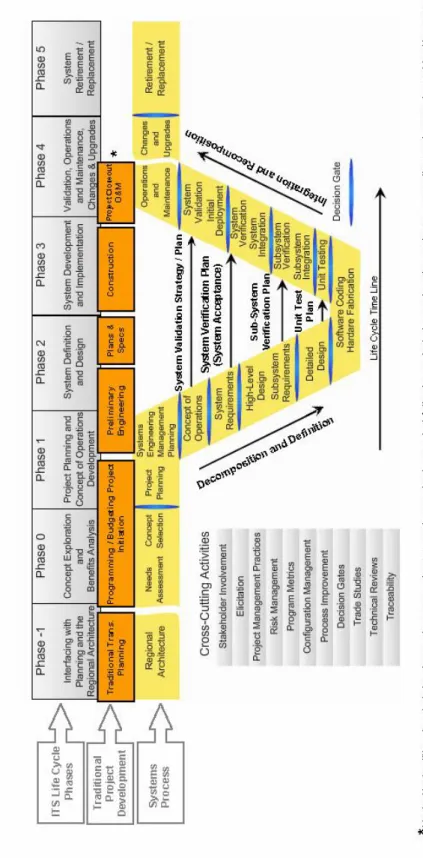
Introduced through the development of the Statewide ITS Architecture, all projects identified for application of the SE process must generally follow the ―V‖ development model. The traditional transportation project development process is mapped to the ―V‖ model in Figure 1. The traditional processes are shown in the orange boxes above the standard systems processes with which they correspond.
The mapping of the traditional processes to the ―V― diagram in Figure 1 also visually relates the traditional project development process to the ITS Life Cycle Phases, as defined by the National ITS Architecture and Standards program.
In all cases, the MDOT ITS Manager, in conjunction with the State Traffic Engineer, shall have responsibility for determining permissible exceptions from the systems engineering process in the interest of public safety,
security, and compliance with the MDOT policy and applicable regulations Benefits of Using the SE Process: Better system documentation Higher level of stakeholder participation System functionality that meets stakeholders’ expectations Potential for shorter project life cycles Systems can evolve with a minimum of redesign and cost Higher level of system reuse More predictable project outcomes
Figure 1: Traditional Transportation Project Development Process Steps Mapped to “V”
Diagram and ITS Life Cycle Phases2
2
3.2
Mississippi ITS Project Life Cycle Framework
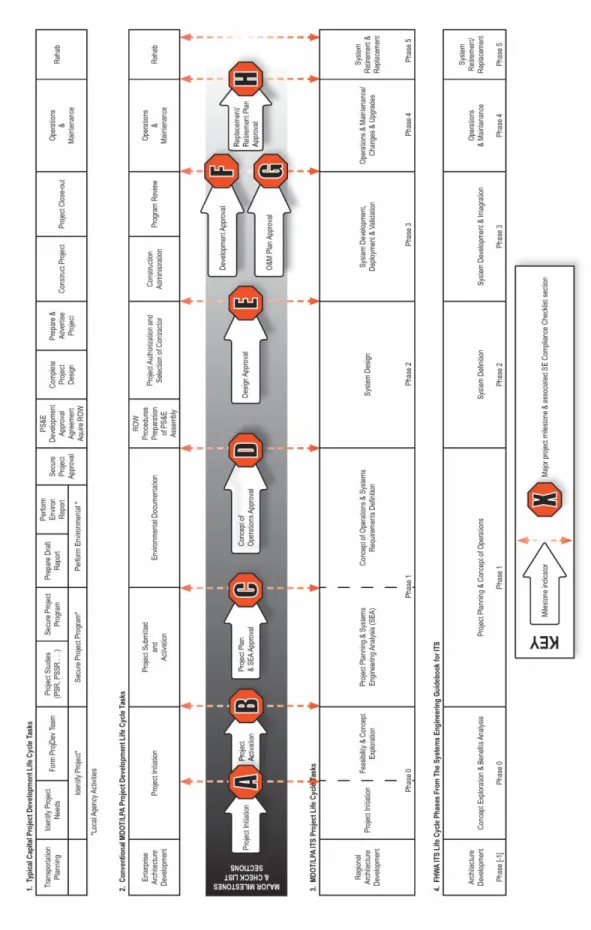
The relationship of the Federal ITS program ITS Life Cycle Phases is further linked to typical MDOT/LPA project development phases in Figure 2, Mississippi ITS Project Life Cycle Framework. Additionally, a comparison of the MDOT/LPA project development cycle to a typical capital project development cycle is provided.
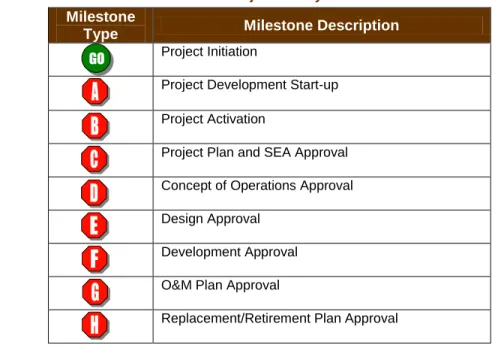
Figure 2 also depicts the major milestones defined for the SE Process for Mississippi ITS Projects, which are summarized in Table 1 below. The SE Process includes reviews at ―decision gates‖ or milestones, which are intended to generate visibility into the project development process, promote involvement from the stakeholders as well as allow for the identification of problems and their corrections during the development process.
Table 1: Minimum Project Review/Approval Milestone Requirements - ITS Project Life Cycle
Milestone
Type Milestone Description
Project Initiation
Project Development Start-up Project Activation
Project Plan and SEA Approval Concept of Operations Approval Design Approval
Development Approval O&M Plan Approval
Replacement/Retirement Plan Approval
The symbols used to represent the major project approval milestones in Table 1 and Figure 2 can also be found in the sidebar throughout the rest of this SEMP to indicate where approval is required. The letters inside the ―stop sign‖ symbols represent the applicable sections of the SE Process Compliance Checklist that must be completed and submitted to MDOT for approval.
These and other control points in the typical ITS project life cycle are described in more detail in other sections of this SEMP.
GO GO
4.0 Managing ITS Projects Using the SE Process
Systems engineering management planning involves performing a systems engineering analysis (SEA). Components of the SEA involve creation of a work breakdown structure (WBS), selection of the appropriate procurement method, identification of the task inputs and deliverables, necessary reviews / meetings, project milestones, and task resources for each activity in the WBS.
The SE process is initially a planning exercise, promoting up-front planning and system definition prior to technology identification and implementation. Once the project development activities are initiated by the MDOT Planning Division the systems engineering process outlined in this SEMP should begin.
The SE process initially involves documenting the general project data and identifying the general project needs. Compliance with the Statewide ITS Architecture (SITSA) and/or applicable Regional ITS Architecture (RITSA) should be demonstrated and used as a planning tool in developing the project‘s high-level operational concept and functional requirements. Needs should be elicited from stakeholders and documented, which will become the basis for defining what the project will accomplish. One key functional driver of the SE process is to ensure that the installed system meets the original stakeholder needs.
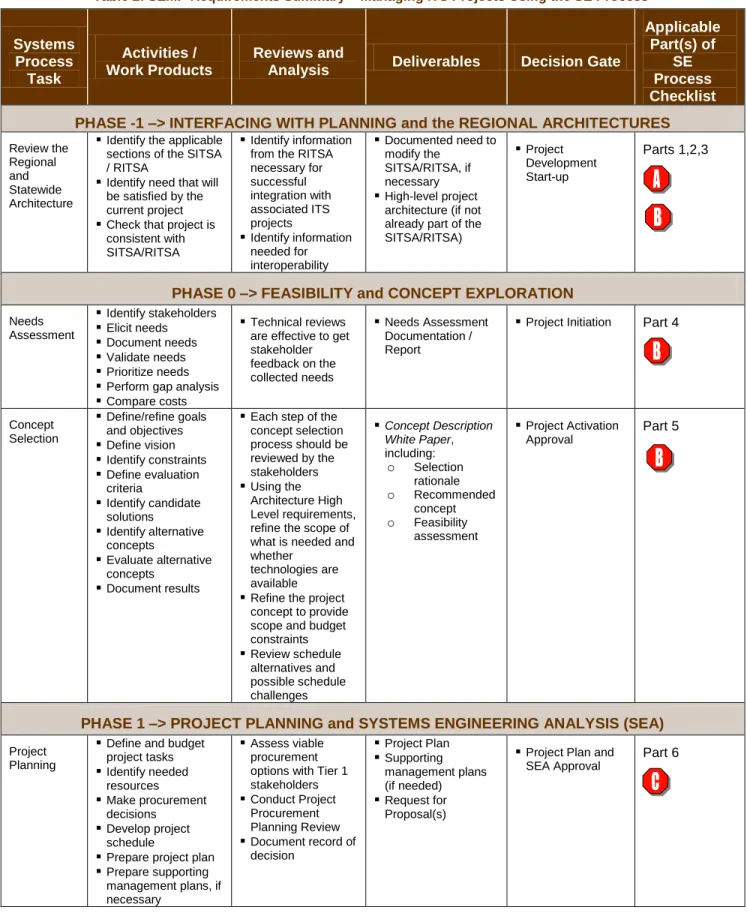
Table 2, on the following page, summarizes the SE processes, activities that are involved,
necessary reviews and analysis, associated deliverables, decision gates and applicable sections of the SE process checklist. It should serve as a usable reference tool for each phase of the SE management portion of the ITS project life cycle.
4.1
Documentation of General Project Data /Project Need
One of the first steps that need to occur in the SE process is the documentation of general project related information, which can be accomplished by filling out Part 1 of the SE Compliance Checklist. General project data should include the following:A brief description of the project Contact person
Location of the project Funding source Nature of the work
Relationship to other projects and phases
Types of equipment to be purchased with project funds Project status
Status of work plan for the project
In addition to the project data, an identified project need should be documented. The documented need should state the problems that exist with the current situation and how the ITS project will alleviate some or all of the stated problems. Detailed information should be provided on how the needs were identified, determined to be valid, and prioritized in the ―Needs Assessment‖ (Ref: Part 4 of the SE Process Compliance Checklist) portion of the SEA.
Project Development Initiation Complete Section A of the SE Process Compliance Checklist.
GO
GO
Table 2: SEMP Requirements Summary – Managing ITS Projects Using the SE Process Systems Process Task Activities / Work Products Reviews and
Analysis Deliverables Decision Gate
Applicable Part(s) of
SE Process Checklist
PHASE -1 –> INTERFACING WITH PLANNING and the REGIONAL ARCHITECTURES Review the
Regional and Statewide Architecture
Identify the applicable sections of the SITSA / RITSA
Identify need that will be satisfied by the current project
Check that project is consistent with SITSA/RITSA
Identify information from the RITSA necessary for successful integration with associated ITS projects Identify information needed for interoperability Documented need to modify the SITSA/RITSA, if necessary High-level project architecture (if not already part of the SITSA/RITSA)
Project Development Start-up
Parts 1,2,3
PHASE 0 –> FEASIBILITY and CONCEPT EXPLORATION Needs Assessment Identify stakeholders Elicit needs Document needs Validate needs Prioritize needs
Perform gap analysis
Compare costs
Technical reviews are effective to get stakeholder feedback on the collected needs Needs Assessment Documentation / Report
Project Initiation Part 4
Concept Selection Define/refine goals and objectives Define vision Identify constraints Define evaluation criteria Identify candidate solutions Identify alternative concepts Evaluate alternative concepts Document results
Each step of the concept selection process should be reviewed by the stakeholders Using the Architecture High Level requirements, refine the scope of what is needed and whether
technologies are available
Refine the project concept to provide scope and budget constraints Review schedule alternatives and possible schedule challenges Concept Description White Paper, including: o Selection rationale o Recommended concept o Feasibility assessment Project Activation Approval Part 5
PHASE 1 –> PROJECT PLANNING and SYSTEMS ENGINEERING ANALYSIS (SEA) Project
Planning
Define and budget project tasks Identify needed resources Make procurement decisions Develop project schedule
Prepare project plan
Prepare supporting management plans, if necessary
Assess viable procurement options with Tier 1 stakeholders Conduct Project Procurement Planning Review Document record of decision Project Plan Supporting management plans (if needed) Request for Proposal(s)
Project Plan and SEA Approval
Systems Process Task Activities / Work Products Reviews and
Analysis Deliverables Decision Gate
Applicable Part(s) of SE Process Checklist Systems Engineering Management Planning Assess project management activities and technical tasks Identify technical tasks necessary to mitigate project risk
Define needed systems engineering processes and resources
Make procurement decisions and specify integration activities
Prepare Systems Engineering Analysis and supporting plans (as needed)
Review Project Plans and SEAs from prior project, if available
Update the sections of the existing SEA that are affected by this project, if applicable
Integrate the SEA with he Project Plan
Conduct Project SEA Review with Tier 1 stakeholders
Systems Engineering Analysis Report
Supporting technical plans (as needed)
Request for Proposal(s)
Project Plan and SEA Approval
Part 7
MDOT Systems Engineering Management Plan
4.2
Compliance with the Regional ITS Architecture
The applicable ITS Architecture(s) should be used as a preliminary means for identifying stakeholders, developing a high-level operational concept, developing functional requirements and identifying interconnections between ITS projects planned for surrounding regions within Mississippi.
The current ITS planning documents Department (i.e., Mississippi Statewide ITS Architecture (SITSA) and the applicable Regional ITS Architecture (RITSA)) should be reviewed by the MDOT / LPA. If it is identified that the project is not part of the SITSA or RITSA, an update must be performed to all affected documents to incorporate the project. This update should be accomplished by MDOT with input from the LPA, if required.
The SITSA and RITSAs are very broad in nature and include most market packages; consequently, it is unlikely that projects being implemented will necessitate Architecture updates. If the LPA has any doubts about an ITS system or subsystem being included in the Architectures they should contact the MDOT ITS Manager.
The Statewide and Regional Architectures can be found on the ―Go MDOT‖ Web site. For more information on this step of the planning process, refer to the Systems Engineering Guidebook for ITS Web site.
4.3
Needs Assessment
The ―Needs Assessment‖ process is a preliminary task used to ensure that the needs of the stakeholders are well understood prior to starting project development. Initially, it is likely that there will be more needs identified than are feasible to include in project deployment, thus making needs prioritization an important step in defining the project. One of the first steps in the Needs Assessment process is to identify the stakeholders and their needs. These needs should be documented and validated to ensure that they are accurately represented. Once the needs have been validated, they should be prioritized and the most critical needs should be selected.
For more information on this step of the planning process, refer to the Systems Engineering Guidebook for ITS Web site.
4.3.1 Stakeholder Identification
The first step in the Needs Assessment process is to identify the stakeholders who will own, operate, maintain, use, benefit from or in some way be affected by the ITS
project. The RITSA / SITSA should be used as a preliminary means of identifying stakeholders. The MDOT / LPA should identify any additional local stakeholders not included in the architecture documents.
The MDOT / LPA should develop a list of stakeholders and submit it to MDOT for review. The MDOT ITS Manager will determine if stakeholder meetings are necessary on a project by project basis. In many cases the stakeholder meetings held during the Architecture development will have covered the necessary items. In some cases a stakeholder meeting would be beneficial, while in other cases a letter sent to the affected stakeholders notifying them of the proposed project should suffice.
In any event, input from the stakeholders is encouraged. All stakeholder input should be closely reviewed.
4.3.2 Elicit /Document Needs
There are various means of eliciting needs. Some of the techniques recommended in the Systems Engineering Guidebook for ITS are literature searches, day-in-the-life studies, surveys, one-on-one interviews and stakeholder workshops. It should be noted that stakeholder needs are usually vague and different elicitation techniques can be used to help clarify those needs.
The results from the elicitation process should be consolidated and documented. In order to validate the needs, this document will be reviewed by the stakeholders.
NOTE: It is just as important to capture the constraints as it is the needs. A
constraint for a single stakeholder, such as the maximum height of maintenance‘s bucket trucks, will impact the system for all. Mississippi State policy also needs to be considered here.3
4.3.3 Validate Needs
The documented results from the elicitation process should be presented to the stakeholders. This will be most successfully accomplished in a workshop where the stakeholders are encouraged to give feedback until they agree that all of the needs have been accurately documented.
3
4.3.4 Prioritize needs
Rarely does a project satisfy every need of every stakeholder. The project should address the most important needs that can be implemented in a cost effective manner.
The needs should be analyzed and prioritized. The Systems Engineering Guidebook for ITS recommends that the following techniques be used to aid in needs
prioritization:
Draw needs out of previous project documents and prioritize them with concurrence of the stakeholders
Conduct a workshop where the stakeholders review and rank candidate needs Use surveys
Define a decision process (e.g., voting, majority, and negotiation)
4.3.5 Perform Gap Analysis
A gap analysis should be performed to identify the ―gap‖ between the capability of the system in fulfilling the identified needs of the stakeholders and the desired capabilities. Funding is not always available to deploy an entire system. More often systems are deployed in phases across a number of years and projects. It is helpful to identify the gap(s) between the stakeholders‘ ultimate requirements and system as it will stand after the completion of the current project. As subsequent projects go through the systems engineering process, the gap between the installed and planned equipment should be measured. At some point the stakeholders‘ requirement will be met and the gap will be zero.
Many different qualitative methods of gap analysis could be used. One is not inherently better than the other, however, the important thing is to select a methodology which fits the situation, document the methodology and apply it consistently.
One method of qualitative analysis is described below.
Each of the needs should be ranked in terms of both the breadth (e.g., 70% of the freeways currently collect speed data) and depth (criticality) of the gap (e.g., 30% gap) between current and desired capabilities. The depth of the gap should be assigned a qualitative ranking on a scale of 0 to 10, 0 representing that the need is completely met with the current system and 10 representing that there is no current capability to satisfy the need. This rating of the depth of the gap (i.e., the 1-10 assignment) should be multiplied by the criticality of the depth (i.e., 30% gap), which results in a unit-less number that can be used to gauge how significant the gap is for each need.
Many times funding sources will determine the systems or subsystems which can be targeted. While the overall gap analysis of a system may indicate a greater need in other areas, specific funding may have to be used to fill lower priority gaps. For example the greatest need may be closed circuit television (CCTV) coverage of an
Figure ___.
Some type of flow chart
area but only Federal Transit Administration funds are available in the project budget.
In order to rank the needs, an inventory of the current system capabilities should be performed. The legacy system inventory should include all ITS devices currently in the field, an evaluation of the functionality of the existing Traffic Management Centers and the ITS communications network infrastructure.
4.3.6 Compare Costs
A cost estimate should be developed to meet each of the needs. Qualitative estimates will be sufficient (e.g., high/medium/low or easy/moderate/difficult to implement). It will be virtually impossible to come up with accurate cost estimates this early in the process, but the qualitative estimates may help in eliminating some of needs early in the process due to excessive cost or difficulty of implementation. It is helpful during this process to identify the typical funding sources for the project types. Some projects require larger matching funds than others. The amount of local funding required to complete a project is often the critical factor in deciding which projects can go forward.
4.3.7 Validate Key Needs
The most critical needs should be identified by taking into account the gap analysis and qualitative cost estimates performed in the steps above. These critical needs should be documented and presented to the stakeholders, and a forum should be provided for the stakeholders to comment on the selected needs.
4.4
Concept Selection
The concept selection process documents the effectiveness and feasibility of the project with justification based on a benefit cost analysis. It should include enough detail that it can be used to develop the Concept of Operations (ConOps).
For more information on this step of the planning process, refer to the Systems
Engineering Guidebook for ITSWeb site.
The activities that need to occur during the selection process are as follows:
Define goals and objectives – A description of the goals and objectives of the
project should be written from the point of view of the traveling public and should identify what the project is intended to accomplish.
Define vision – The vision should be a brief description of what the system will achieve when implemented. This description should be written using non-technical terms and should be easy for the stakeholders to understand.
Identify constraints – Constraints can be drawn from the SITSA and RITSAs but
also obtained from the stakeholders during the Needs Assessmentprocess. It should be noted that MDOT Policy and Procedures should also be examined when identifying constraints.
Define evaluation criteria – Since multiple projects may be considered for
implementation at the same time, it is important to develop a set of evaluation criteria so that each project will be evaluated in a consistent manner.
Identify candidate solutions – Candidate solutions to meet the stakeholders‘ needs
should already be identified in the SITSA / RITSA. These documents should be referenced during this process.
Identify alternative concepts – Alternative project concepts should be developed at
a high-level and should be built from the identified candidate solutions in conjunction with the SITSA / RITSA.
Document results – The results from the concept exploration process as well as the
rationale for the selected concept should be well documented.
Each step in the process listed above needs to include input / review from the stakeholders.
4.5
Systems Engineering Management Planning
A Systems Engineering Analysis (SEA) shall be performed and documented for all ITS projects in Mississippi. The result of this process should be the development of a project plan that identifies the project‘s needs and constraints, work activities, resources, budget and implementation timeline.
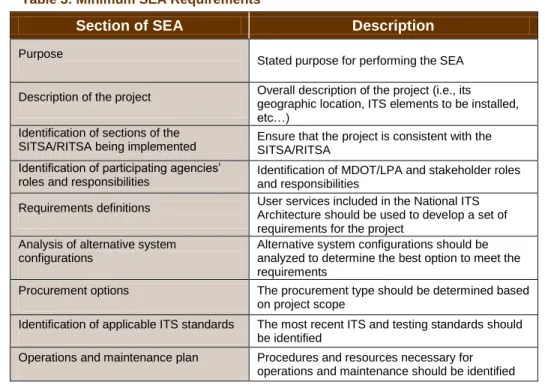
The SEA shall conform to the guidelines contained in this SEMP. It should be noted that the level of detail required by the SEA depends on the project scope. If the procuring agency is deploying a market package which has previously been deployed by another LPA, or statewide by MDOT, a SEA may already exist and should be used and modified as necessary. The level of detail necessary will be determined by the MDOT ITS Manager and/or FHWA, however, at a minimum, the SEA should address the following requirements outlined in Table 3 on the following page.
Complete Section B of the SE Process Compliance Checklist & submit completed Sections A&B of checklist to MDOT for approval.
Table 3: Minimum SEA Requirements
Section of SEA Description
Purpose
Stated purpose for performing the SEA
Description of the project Overall description of the project (i.e., its
geographic location, ITS elements to be installed, etc…)
Identification of sections of the
SITSA/RITSA being implemented Ensure that the project is consistent with the SITSA/RITSA Identification of participating agencies‘
roles and responsibilities
Identification of MDOT/LPA and stakeholder roles and responsibilities
Requirements definitions User services included in the National ITS
Architecture should be used to develop a set of requirements for the project
Analysis of alternative system configurations
Alternative system configurations should be analyzed to determine the best option to meet the requirements
Procurement options The procurement type should be determined based
on project scope
Identification of applicable ITS standards The most recent ITS and testing standards should be identified
Operations and maintenance plan Procedures and resources necessary for
operations and maintenance should be identified
The procuring agency should submit a brief outline of the proposed SEA with a draft Work Breakdown Structure (WBS) as early in the process as possible to the MDOT ITS Manager. The MDOT ITS Manager, or approved designee, will coordinate document review and initial activities required to perform the SEA. Guidance will be provided to the procuring agency to complete this requirement. The general requirements of the SEA are described in the sections that follow.
For more information on the systems engineering management planning process, refer to the Systems Engineering Guidebook for ITS Web site.
4.5.1 Project Procurement Planning
Procurement of ITS projects with Federal Highway funds presents unique challenges to the MDOT and the LPAs. The challenges are especially paramount when
procuring ITS projects that involve advanced technologies which require specialized skills and knowledge. Even deployment of simple ITS system expansions have become complex undertakings to ensure consistency with National ITS Architecture and evolving standards. Typically, the requirements of ITS projects cannot easily be specified at the outset of the project—resulting in the difficulty of establishing realistic low bids and ensuring end-product quality.
A brief project outline & draft WBS should be submitted to the MDOT ITS Manager as early in the process as possible.
The selection of appropriate contracting options for designing and constructing an ITS project depends on many variables. These variables include:
Type and complexity of the required products, systems, and services; Interdependence of project components and subsystems;
Inclusion of ITS systems components with roadway construction projects; Use of varied and rapidly changing advanced technologies;
Need to pre-qualify consultants and/or contractors; Constrained deployment schedule;
Magnitude of construction impacts on road users; and
Risk management factors associated with capital investments in transportation systems.
Portions of this section of the SEMP have been excerpted from the NCHRP 560 Report, Guide to Contracting ITS Projects.
Project Planning Phase
In general, the project planning phase of the overall planning process for ITS projects will conform to current MDOT and/or LPA standard procedures. There are, however, two process steps requiring additional consideration with ITS project development. These are highlighted in Figure 3, which depicts a simple, generic planning process.
The reader should refer to MDOT and/or LPA project development documentation (Project Development Manual for Local Public Agencies) for applicable detail on Mississippi requirements.
Project planning for ITS projects involves preparing of a project management plan and developing a procurement strategy consistent with an applicable system development process.
In the Project Planning Phase it is necessary to consider alternative fundamental approaches to the system development, such as:
• Stakeholder and management input in establishing project feasibility is represented by demonstration of conformance with the SITSA / RITSA(s). In the event of a project procurement requiring multiple sponsoring agencies, that the procuring agency and its project partners (stakeholders) "have their act together" and that their plans are compatible with the financial and personnel resources of the agency(s).
• The traditional project planning phase needs to also consider whether or not commercial-off-the-shelf (COTS) or outsourcing requirements are applicable to the project. These requirements will impact procurement type, as well as budget planning for the project.
*May also include plans and
specifications as required by the selected contracting alternative Start Budget and Schedule OK Establishing project feasibility Stakeholders & Management Consider COTS and Outsourcing YES NO Execute Decision Process including Contract Terms and
Conditions Prepare WBS for contracting process Prepare operations & maintenance plan Prepare Selection Criteria Prepare Statement of Work* Prepare RFP and Execute Procurement Plan Procurement Completed Management Contracts Legal • Decisions regarding COTS should be based on a critical comparison of needs with the features of available systems. If a good match can be achieved, COTS-type procurement should be considered. • A project is a candidate for outsourcing if an agency concludes that it does not have either the personnel or experience to manage the system acquisition. Similarly, in the Procurement
Planning Phase:
• Finalization of the contract terms and conditions is dependent upon the procurement method or type identified for the project. As described in the following parts of this section, the final work breakdown structure (WBS) will also vary depending on the contract type. • Another important consideration is whether or not a project should be implemented using more than one contract. Not all contracts associated with a project require
Figure 3: Project/Procurement Planning
the same contracting approach. The magnitude of a project may involve a mix of complexity and incompatible services (e.g. construction, custom software development, systems integration, operations and maintenance) that diminishes the possibility for implementation success under a single contractor.
• The complexity of a project can have a significant impact on the selection of a procurement strategy. ITS projects can range in complexity from those that are relatively straightforward as in adding field devices (e.g., CCTV, DMS, etc.) to an existing traffic management system, to those that are extremely complex
such as the implementation of a completely new transportation management system. The procurement strategy for these two undertakings would be significantly different.
• And, Operations and Maintenance (O&M) planning needs to be considered in many ITS projects prior to executing the final procurement plan. This follows the defined ITS Project Life Cycle Framework (Figure 2).
Contracting Options
Making initial decisions about the fundamental project characteristics that differentiate a system development, a consultant contract and an outsourcing contract is the key to a successful ITS procurement. The definitions of "construction," "engineering and design services" and "non-engineering/non-architectural" form the framework for determining how to procure an ITS project. Component interrelationships and system integration requirements must be considered in effectively grouping project elements into one or more component projects that individually meet these definitions. These component projects are procured using the most appropriate contracting options that will optimize project quality, deployment schedule and cost.
Logical and creative grouping of project elements into one or more component projects and selecting appropriate contracting options are critical for achieving success in procuring ITS projects. Figure 4, on the following page, represents the recommended logic to be used in initial project planning for ITS procurements.
Start Does the agency intend to outsource an existing activity or function? Does the project include a system development? Define work distribution (single vs. multiple contracts) Use outsourcing process. [1] NO YES YES Are traditional consulting services being procured? Use Consulting process.[2] Other services being procured. Not covered by Decision Model. [3] YES NO NO
[1] This outcome indicates you are planning to outsource an existing agency activity or agency function. Use outsourcing options. (See Table 3) [2] This outcome indicates the use of traditional consulting procurement processes. Per MDOT/LPA procedures (SOP: ADM-24-01-00-000)
[3] This outcome indicates that you are procuring services not addressed by any of the procurement packages covered within this guide. For example, Public-Private Partnerships. (See Table 3)
Figure 4: Procurement Decision Model
There are various contracting techniques, features, and provisions allowed within the Federal-aid regulations that can effectively serve the procurement needs of
transportation agencies. These contracting options, their applicability to ITS projects, and resulting FHWA approval requirements are presented in the following sections of the SEMP.
Currently, MDOT is using traditional construction contracting methods for ITS deployments. When using the traditional construction contracting methods the agency should become familiar with subsection 31-7-13 of the Mississippi Code of 1972.
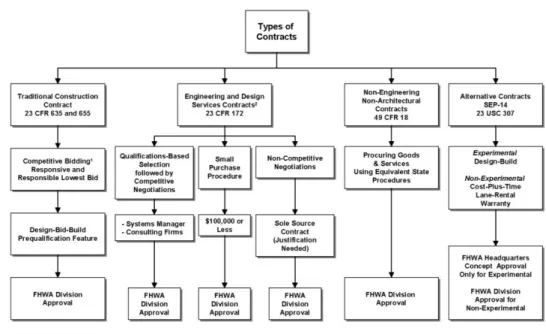
Figure 5 summarizes various types of contracting techniques, features and optional contracting provisions that are possible under the FHWA Federal-aid procurement regulations.
Figure 5: FHWA Federal-Aid Procurement Regulations and Contracting
Options4
The FHWA Federal-Aid ITS Procurement Regulations and Contracting Options should be referenced for further guidance on the review and approval processes applicable by type of contract proposed for and ITS project. The level of FHWA review and oversight for any given project depends on the contract type and stewardship agreement that exists between the FHWA Division Office and MDOT.
This definition of "construction" is necessary to evaluate the various components of ITS projects. Projects meeting this definition must be awarded to the lowest responsive and responsible bidder. This allows agencies to optimally group project elements into one or more projects for subsequent design and construction using the most appropriate contracting techniques. This requires a thorough understanding of the proposed components, skills, and experience required to design and construct the project; the agency's capabilities; and the project's implementation schedule.
For example, contractor installation of field devices and hardware typically meets the definition of construction, whereas services such as software development, system integration, and system engineering and design do not meet the definition of construction. It is recommended that State and local agencies consult with the FHWA Division and Region offices when attempting to choose appropriate contracting techniques for their planned ITS projects.
4
Specifications for ITS projects must be clearly written and include life cycle costs, documented experience, and warranty provisions. It has been shown that lowest bid is not always the best path to take for ITS projects. FHWA does not require a lowest bid approach. In fact they encourage a Life Cycle Cost approach. The MDOT/LPA should keep in mind that the selection other than the low bidder must be justified based upon the specifications.
Based on Figure 4 and eliminating Outsourcing Agency Activity or Function and Traditional Consultant services procurements, there are several primary procurement options available for ITS projects requiring any level of system development:
Commodity Supplier
Low-Bid Contractor with Consultant Design Systems Manager (Integrator)
Design-Build Contractor with Design Consultant
Table 4, on the following page, summarizes the procurement approaches most
commonly utilized for various elements of ITS implementation and operations and maintenance. It should be noted that design-build procurements require
Table 4: ITS Procurement Types Procurement Type Method of Award Contract Form Contract Type Comments Commodity Supplier Low-bid selection of pre-qualified packages Single phase or purchase order
Fixed Price Used for COTS
procurements Low-Bid Contractor with Consultant Design Low-bid for contractor Phased or Task Order
Fixed Price for contractor incentives optional Consultant performs 100% of design. May provide additional services during implementation Use should be restricted to well-defined systems Systems Manager Quality-based selection (negotiated procurement) Phased or Task Order Fixed price, cost plus or time & materials incentives optional Additional contracting burden placed on agency Field equipment procured by agency using low-bid process
Design-Build Contractor with Design Consultant Best-value selection (based on consideration of price and quality) Phased Usually fixed price, cost plus or time & materials incentives optional Consultant provides 30% design Most applicable to systems with time constraints and requirement for continuity between the design and
implementation
Consultant Negotiated Phased or
Task Order Fixed price, cost plus or time & materials incentives optional
Used for system design and many other consultant services Outsourcing Agency Activity Low-bid may be based on rates Usually single phase Fixed price or time & materials incentives optional
Typical activities include maintenance,
operations, signal timing, etc.)
Outsourcing Agency Function
Best value or
low-bid Single phase
Fixed price, cost plus or time & material contracts Incentives optional
Typical functions include traveler information and toll collection. May be public-private partnership Difficult to define measures and outcomes Table ___. ITS
Procurement Options
Criteria to help reduce the number of procurement options considered include: Systems manager is preferred to design-build when a significant amount of new software development required. Design-build is preferred over systems manager only for major projects when significant amounts of field construction are involved and there is a desire to reduce implementation delays associated with having to administer multiple procurement contracts. If a project includes
both new software and field construction, considersplitting it into multiple contracts.
Low-bid contracting should only be used if required by agency policy, and/or projects are limited to field construction and supply of off-the-shelf equipment. Commodity procurement is only applicable if an existing package is available that does not require any modification to meet agency‘s requirements.
Criteria to help reduce the number of procurement options considered include:
Systems manager is preferred to design-build when a significant amount of new software development required. Design-build is preferred over systems manager only for major projects when significant amounts of field construction are involved and there is a desire to reduce implementation delays associated with having to administer multiple procurement contracts. If a project includes both
new software and field construction, consider splitting it into multiple
contracts. Low-bid contracting should
only be used if required by agency policy, and/or projects are limited to field construction and supply of off-the-shelf equipment. Commodity procurement is only applicable if an existing package is available that does not require any modification to meet agency‘s requirements.