Michigan Saves
Home Energy Loan Program
Implementation Guide
March 2014
Version 5
Contents
INTRODUCTION ... 1
Purpose ... 1
About Michigan Saves ... 1
Using this Program Implementation Guide ... 1
SUMMARY OF MICHIGAN SAVES HOME ENERGY LOAN PROGRAM ... 1
BECOMING AN AUTHORIZED MICHIGAN SAVES CONTRACTOR ... 3
Advanced Contractors ... 5
Contractor Requirements for Solar PV Installations ... 5
Application Process to Become Michigan Saves Authorized Contractor ... 7
Changes and Other Updates to Contractor Information ... 7
Michigan Saves Authorized Contractors List ... 7
Michigan Saves Program Training ... 8
Michigan Saves Fees Assessed to Contractors ... 8
ENROLLING CUSTOMERS IN MICHIGAN SAVES ... 9
Customer Eligibility ... 9
Customer Enrollment Process ... 9
ELIGIBLE IMPROVEMENTS... 10
Eligible Measures List ... 10
Comprehensive Energy Assessment ... 11
Renewable Energy Measures ... 11
Non-Energy Building Performance Improvements ... 11
ADDITIONAL CONTRACTOR REQUIREMENTS ... 12
Licenses and Certification ... 12
Written Estimates ... 12
Warranties for Labor and Equipment: ... 12
Subcontracting Policy ... 12
Compliance with Applicable Laws ... 13
Installation Best Practices and Requirements ... 13
Prohibition on Contractor Reserves: ... 13
Relationship with Michigan Saves ... 13
Minimum Number of Projects ... 14
BILLING AND PAYMENT ... 14
Contractor Payment ... 14
Customer Loan Closing and Payment ... 14
Customer Rebates ... 14
CUSTOMER INQUIRIES AND COMPLAINTS ... 15
MICHIGAN SAVES ONLINE CONTRACTOR PORTAL ... 15
Contractor Application ... 15 Program Forms ... 16 Submittal Instructions ... 16 QUALITY ASSURANCE ... 17 Objectives... 17 QA Procedures ... 17
Document Review & File Check ... 18
Customer Satisfaction Survey ... 18
Site Inspections ... 18
Types of Deficiencies and Corrective Action Reports ... 20
EVALUATION, MEASUREMENT, AND VERIFICATION ... 25
MARKETING ... 25
APPENDIX A: GLOSSARY ... 27
APPENDIX B:ELIGIBLE MEASURES LIST... 29
APPENDIX C: UNDERWRITING CRITERIA FOR MICHIGAN SAVES LOANS ... 30
APPENDIX D: ALTERNATIVE PROGRAMS FOR FREE OR LOW-COST HOME WEATHERIZATION ... 33
APPENDIX E: REBATE PROGRAMS ... 35
Document History
Version Date Nature of Revisions
1.0 August 19, 2010 Initial Implementation Guide
2.0 February 15, 2011 Updated to reflect new ways for contractors to qualify as authorized or advanced; subcontracting policy; health and safety measures policy; quality assurance procedures; new specification sheet and online database option; and new Eligible Measures List including solar PV as eligible measure.
3.0 April 30, 2012 Loan limit increased to $20,000, new collection policy for per-loan fee described, instructions for Online Contractor Portal added.
4.0 September 4, 2012 Removed requirement regarding primary residence
5.0 March 15, 2014 Updated to reflect new loan cap of $30,000, revised FICO requirements and new terminology for QA process. Replaced ‘a la carte’ and ‘whole home assessment option’ terminology with a more functional
description that better represents how the program is implemented. Added contractor rating system.
INTRODUCTION
Purpose
This implementation guide outlines the details and requirements of the Michigan Saves Home Energy Loan Program, which provides easy, affordable loans to homeowners for qualifying energy efficiency and renewable energy improvements in Michigan. The guide serves as a reference for participating energy auditors and installation contractors to understand the program requirements and to promote the program to customers.
About Michigan Saves
Michigan Saves is a nonprofit organization dedicated to making energy improvements easy and affordable for all types of Michigan energy consumers—businesses, schools, municipalities, and residents. Endowed with an initial trust fund of $6.5 million from the Michigan Public Service Commission, this program eliminates the upfront costs of installation and provides a streamlined process for securing financing at preferred rates. To do this, Michigan Saves leverages third-party capital with innovative credit enhancement mechanisms, works closely with energy efficiency and renewable energy system contractors, coordinates with similar programs in the state and across the country, and monitors the program to track results and ensure success.
Using this Program Implementation Guide
This guide is written in a conversational way, reflecting the manner in which industry professionals refer to efficiency measures or efficiency programs. As a result, there are instances where terms are used interchangeably, such as the terms “audit” and “assessment.” A glossary of commonly used terms is provided in Appendix A.
This guide represents the best and most accurate information on the Michigan Saves loan program, as of the date on the front cover. A summary of changes to each version of this guide is recorded after the table of contents. Contractors should download the latest version of this guide and forms from the Michigan Saves website: www.michigansaves.org.
SUMMARY OF MICHIGAN SAVES HOME ENERGY LOAN PROGRAM
Under the Michigan Saves Home Energy Loan Program, homeowners can finance any eligible energy efficiency improvement that is implemented by a Michigan Saves Authorized Contractor. Eligible energy efficiency improvements include any measure or piece of equipment with an Energy Star® label, such as air conditioners, air source heat pumps, appliances, boilers, doors, furnaces, geothermal systems, roofs, skylights, water heaters and windows. See Appendix B for the full list of eligible measures. Air sealing and insulation are eligible for financing when the homeowner receives a comprehensive home energy assessment by a certified home energy auditor. Homeowners can also use Michigan Saves financing for renewable energy measures like solar PV systems and solar thermal systems. Michigan Saves will also finance the remediation of pre-existing environmental hazards or the repair of physical/structural defects that create health and safety issues, so long as the remediation or repairs are coupled with an appropriate efficiency measure and the cause(s) of the environmental hazard or physical defect are addressed.
Michigan Saves loans under this program are unsecured loans for amounts of $1,000 to $30,000 at 7 percent fixed-rate interest with terms of up to 120 months. Some lenders may offer loans at rates below 7 percent. Details are provided in Table 1. See Appendix C for additional details on the underwriting criteria, including required documentation.
Table 1.
Loan Product Details
Structure/Minimum Standards Eligible properties Owner-occupied, single-family (1–4 unit) homes Loan type Unsecured personal loan
Eligible improvements Energy-saving home improvements installed by a Michigan Saves Authorized Contractor
Loan amounts $1,000 to $30,000
Loan term One year per $1,000 up to $4,999; customer can pick term up to 10 years for loans $5,000 and higher
Loan rates Not to exceed 7.0% per year or such other rate as Michigan Saves may determine on a semi-annual basis. Lenders may offer rates below 7.0%. Fixed rate with no prepayment penalty.
Key Underwriting Criteria Minimum 640 FICO (if there are multiple borrowers, the lower score, regardless of income, must be used for qualification). Additional criteria apply. Each lender may set more stringent underwriting criteria.
Michigan Saves loans are made directly by participating lenders (see www.michigansaves. org for a list of lenders). To streamline the process, the loan application and approval process is centralized. The Michigan Saves loan application center takes loan applications via the Web or phone and provides a decision within minutes. Applications can also be taken directly by participating lenders. Customers make loan payments to the lender. This loan servicing function can also be performed by a utility if there is an agreement in place between the utility and the participating lender(s). Three lenders, MSUFCU, DCECU, and AAC, do not currently use the centralized loan application system. Contact the lender directly to apply. While the Home Energy Loan Program is available statewide, not all lenders are available in all parts of the state, and underwriting criteria vary slightly by lender. Michigan Saves offers lenders the choice of adopting a minimum 640 credit score or a minimum 680 credit score. Currently, all participating lenders allow credit scores of 640 and above. Participating lenders, and their minimum accepted credit score, are listed on the Michigan Saves website.
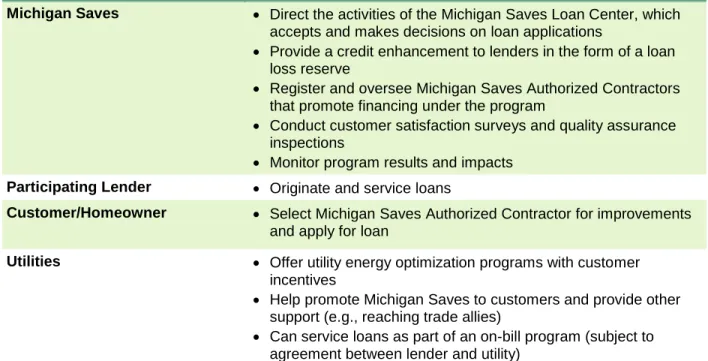
Numerous organizations are involved in this program—from the program’s marketing to the installation and financing of improvements and program monitoring. Roles of key entities, which are referenced in this guide, are summarized in Table 2.
Table 2.
Entities Involved in Implementing the Home Energy Loan Program
Entity Roles
Energy Auditor/Home Energy Assessment Professional
Become a Michigan Saves Authorized Contractor to promote financing to customers
Conduct comprehensive whole-home energy assessments
Installation Contractor Become a Michigan Saves Authorized Contractor to promote financing to customers (can be the same company as energy auditor)
Install energy-saving or renewable energy improvements under contract with the customer
Entity Roles
Michigan Saves Direct the activities of the Michigan Saves Loan Center, which accepts and makes decisions on loan applications
Provide a credit enhancement to lenders in the form of a loan loss reserve
Register and oversee Michigan Saves Authorized Contractors that promote financing under the program
Conduct customer satisfaction surveys and quality assurance inspections
Monitor program results and impacts
Participating Lender Originate and service loans
Customer/Homeowner Select Michigan Saves Authorized Contractor for improvements and apply for loan
Utilities Offer utility energy optimization programs with customer incentives
Help promote Michigan Saves to customers and provide other support (e.g., reaching trade allies)
Can service loans as part of an on-bill program (subject to agreement between lender and utility)
BECOMING AN AUTHORIZED MICHIGAN SAVES CONTRACTOR
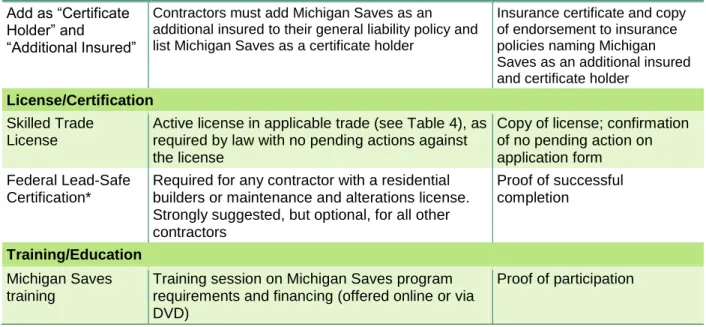
All energy-saving or renewable energy improvements and related services that qualify for a Michigan Saves loan must be performed or installed by a Michigan Saves Authorized Contractor (i.e., energy auditors and contractors installing qualifying improvements to homes). To be authorized, the contractor must meet certain minimum requirements, including appropriate insurance, licensure, and Michigan Saves program training, as set forth in Tables 3 and 4 below. These requirements are reflected in the contractor application that must be completed by the contractor to register with Michigan Saves.
AuthorizedContractors can implement any energy efficiency measure on the eligible measures list (See Appendix B), except air sealing or insulation measures.
Table 3.
Minimum Contractor Qualification Requirements
Category Description Documentation Required
Business Organization, Financial/Ethical Stability
State of Michigan Business License
Licensed to do business in State of Michigan License # and business type (LLC, corporation, etc.) on application form
Workers’
Compensation or Self-Insurance
Required for all contractors, unless a sole
proprietor or limited partnership which are exempt under state law, or a corporation or a limited liability company that has filed for an exclusion
Insurance certificate, proof of sole-proprietorship, or state exclusion form
General Liability Required with minimum coverage of $1,000,000 per occurrence, $1,000,000 aggregate
Category Description Documentation Required
Add as “Certificate Holder” and
“Additional Insured”
Contractors must add Michigan Saves as an additional insured to their general liability policy and list Michigan Saves as a certificate holder
Insurance certificate and copy of endorsement to insurance policies naming Michigan Saves as an additional insured and certificate holder
License/Certification
Skilled Trade License
Active license in applicable trade (see Table 4), as required by law with no pending actions against the license
Copy of license; confirmation of no pending action on application form Federal Lead-Safe
Certification*
Required for any contractor with a residential builders or maintenance and alterations license. Strongly suggested, but optional, for all other contractors Proof of successful completion Training/Education Michigan Saves training
Training session on Michigan Saves program requirements and financing (offered online or via DVD)
Proof of participation
* As of April 22, 2010, the Environmental Protection Agency (EPA) requires that contractors performing renovation, repair, and painting projects that disturb lead-based paint in homes, child care facilities, and schools must be certified and follow specific work practices to prevent lead contamination if the structure was built before 1978. Firms can become certified by completing an application and sending in a fee payment. Applications may take up to 90 days to be approved by the EPA. Individual renovation contractors must complete an EPA-accredited training course in order to receive certification. More information is available at http://www.epa.gov.
Any installation contractor performing work in a trade that requires a state license must have a valid license specific to that trade. The relevant state licenses are listed in Table 4.
Table 4.
Summary of State Licensing Requirements for Contractors
Skilled Trade License Special Designations
Boiler Boiler Installation None
Construction, including insulation, remodeling, and weatherization
Residential Builders or Maintenance and Alterations
For Maintenance and Alterations License
Insulation work
Screen & storm sash
Mechanical Mechanical Contractor 1. Hydronic heating, cooling, and process piping
2. HVAC equipment† 3. Ductwork
4. Refrigeration
5. Limited heating service† 6. Unlimited heating service 7. Limited refrigeration and air
conditioning service†
8. Unlimited refrigeration and air conditioning service
9. N/A for program 10. Specialty License
Skilled Trade License Special Designations
Plumbing Plumbing Contractor or Master Plumber
None
Solar Photovoltaic (PV)†† Master Electrician or Electrical Contractor and Residential Builders License
None
†Minimum requirement for Mechanical Contractor’s license. Strongly suggest classification # 1 (Hydronic heating, cooling & piping) and #3 (Ductwork), but do not require. Classification #7 & #8 are often waived for contractors in the Upper Peninsula.
††
Additional requirements apply.
Advanced Contractors
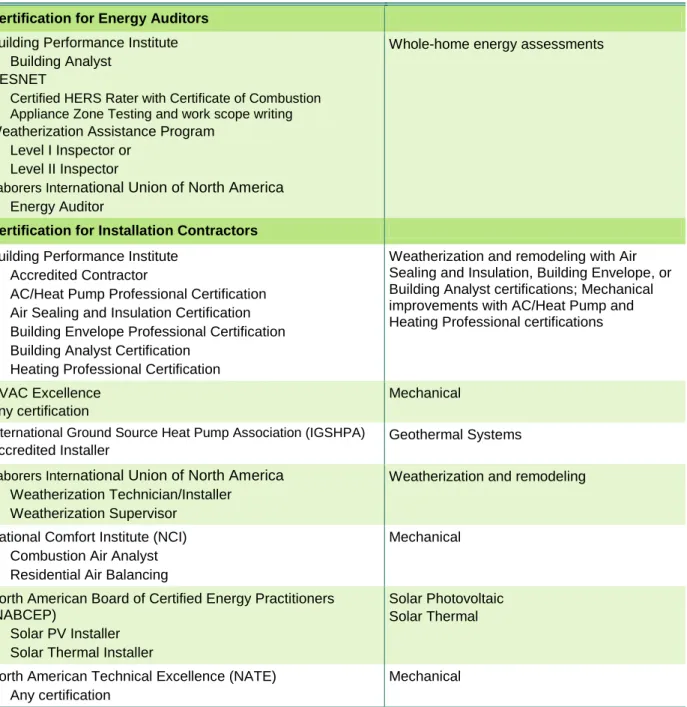
There is a subset of Authorized Contractors that Michigan Saves classifies as Advanced Contractors. To be considered an advanced contractor, contractors must have one or more of the third-party certifications or accreditations related to building science or a specific skilled trade as outlined in Table 5 for the assessment and/or improvement to be conducted or installed. All individuals performing energy assessments must hold one of the recognized certifications. Michigan Saves expects that contractors approved to participate in any Home Performance with Energy Star® program in the State of Michigan would fall under this Advanced Contractor status. Advanced Contractors are noted in contractor search results on the Michigan Saves website.
Contractor Requirements for Solar PV Installations
Because of the complex nature of solar photovoltaic systems, Michigan Saves has additional requirements for solar PV installation contractors. These additional requirements reflect Michigan Saves’ desire that only experienced contractors install these systems. Contractors must provide documentation that they meet the following minimum requirements. If a contractor does not hold the appropriate licenses, they should provide a copy of their sub-contractor’s license.
Master Electricians license or Electrical Contractors license and a Residential Builders license Contractors should also meet one of the following requirements
NABCEP Solar PV Installer Certification; or
NABCEP Solar PV Entry Level Program and two installations totaling 1 kWDC , with at least 1 solar PV system that include an inverter and is subject to a complete electrical permitting and inspection process by local authorities. The contractor must have served as foreman, site supervisor, or site manager, responsible for the quality of the installation, for both installations; or
Installations of at least 4 solar PV systems, with 3 that include an inverter and are subject to a complete electrical permitting and inspection process by local authorities. The contractor must have served as foreman, site supervisor, or site manager, responsible for the quality of the installation, for at least three of the installations.
Only contractors with the NABCEP Solar PV Installer Certification will be considered Advanced Contractors. All other contractor will be considered authorized.
Table 5.
Certification or Accreditation Required for Advanced Contractor
Certification Work Performed
Certification for Energy Auditors
Building Performance Institute
Building Analyst RESNET
Certified HERS Rater with Certificate of Combustion Appliance Zone Testing and work scope writing
Weatherization Assistance Program
Level I Inspector or
Level II Inspector
Laborers International Union of North America
Energy Auditor
Whole-home energy assessments
Certification for Installation Contractors
Building Performance Institute
Accredited Contractor
AC/Heat Pump Professional Certification
Air Sealing and Insulation Certification
Building Envelope Professional Certification
Building Analyst Certification
Heating Professional Certification
Weatherization and remodeling with Air Sealing and Insulation, Building Envelope, or Building Analyst certifications; Mechanical improvements with AC/Heat Pump and Heating Professional certifications
HVAC Excellence Any certification
Mechanical
International Ground Source Heat Pump Association (IGSHPA)
Accredited Installer
Geothermal Systems
Laborers International Union of North America
Weatherization Technician/Installer
Weatherization Supervisor
Weatherization and remodeling
National Comfort Institute (NCI)
Combustion Air Analyst
Residential Air Balancing
Mechanical
North American Board of Certified Energy Practitioners (NABCEP)
Solar PV Installer
Solar Thermal Installer
Solar Photovoltaic Solar Thermal
North American Technical Excellence (NATE)
Any certification
Mechanical
Michigan Saves reserves the right to require additional qualifications for contractors and will notify contractors of the new requirements. It is expected that any new requirements would be phased in over a 6–8 month period.
See Contractor Agreement and Additional Contractor Requirements section for additional terms and conditions for Authorized Contractors to participate in the program.
Application Process to Become Michigan Saves Authorized Contractor
To perform work under the Michigan Saves Home Energy Loan Program, contractors must apply to Michigan Saves by submitting the Contractor Application and required documentation, paying a one-time non-refundable application fee, and signing the Contractor Agreement (which is embedded in the online contractor application). Contractors may apply to be either a regular Authorized Contractor or an Advanced Contractor under the program. The Contractor Application is available on the Michigan Saves website.
Contractors begin the application process by creating a user name and password at https://www2.michigansaves.org/users/sign_up, which establishes their database account with Michigan Saves. Contractors should retain the user name and password, so they may access their account to submit the required project completion forms. Upon creating a user name and password, contractors then complete and submit the contractor application for review. Embedded within the application is a PayPal link, enabling contractors to pay the non-refundable application fee with a credit card. Contractors may also submit a check to Michigan Saves, if they so choose. Contractors should also register for the next online, contractor training session. A list of upcoming training sessions is available at http://michigansaves.org/event. Contractor training is usually offered on the forth Friday of each month. Michigan Saves reviews all applications and verifies all documentation. If any information is missing or inadequate, Michigan Saves contacts the individual for updated information. Once a contractor application is approved and after the contractor has attended the training, Michigan Saves provides the contractor with a unique Michigan Saves identification number and adds the contractor to the Michigan Saves Authorized Contractors List. The contractor will then have full access to the Michigan Saves loan center and can begin initiating loans for customers.
Application and documentation review should take approximately one week from the date the application and all documentation are received. Missing information and documentation will extend the length of the review process.
Changes and Other Updates to Contractor Information
Authorized Contractors must notify Michigan Saves of any changes in the information provided in the original application, including, but not limited to, changes in business status, contact information, licenses, insurance, or certification. This can be done by logging into the contractor application system through the Michigan Saves website. Then, a contractor should complete only those portions of the application where there is new information.
Authorized Contractors must immediately notify Michigan Saves if they no longer have any license, insurance, certification, or registration required by the program. Failure to do so could result in a contractor’s suspension or termination from the program.
Michigan Saves
Authorized Contractors List
Michigan Saves maintains a database of contractors authorized to perform work under the Michigan Saves loan program and updates this database on a regular basis. The Michigan Saves website contains the most recent version of the Authorized Contractors List.
Michigan Saves does not endorse any particular contractor. The Authorized Contractors List is a directory of contractors that have applied and been authorized to promote the Michigan Saves loan product. While contractors on the Authorized Contractors List have met certain requirements for participation, customers will enter into a direct relationship with the contractor of their choice. The selection of the contractor and
acceptance of the materials used and work performed is the sole responsibility of the customer. Michigan Saves encourages each customer to evaluate potential contractors by reviewing credentials, qualifications, and references.
Michigan Saves monitors all Authorized Contractors to ensure compliance with program guidelines. This includes paperwork reviews and periodic site inspections of homes to verify the installation of improvements. Michigan Saves removes contractors from the Authorized Contractors List for a number of reasons, including but not limited to, repeated failure to follow program guidelines, gross misrepresentation, loss of insurance or license, or criminal convictions. Please see the Quality Assurance section for more information.
Michigan Saves Program Training
Michigan Saves Authorized Contractors must participate in Michigan Saves training before performing any work under the Michigan Saves program. The training is offered online each month or through a DVD that can be mailed to the contractor. At least one designated employee for each contractor must
attend the training. That individual will serve as the contractor’s point person to train other employees. While they are not required to do so, other employees having direct contact with customers, particularly those promoting financing under the Michigan Saves program, are strongly encouraged to attend the training.
The program training covers the following topics:
Role of Michigan Saves Authorized Contractors in program Program guidelines, including eligible improvements Customer eligibility and enrollment process
Use of forms
Marketing and communications guidelines Quality assurance process
Michigan Saves provides information on training when the contractor’s application is initially approved. A list of upcoming training sessions is available at http://michigansaves.org/event.
Michigan Saves Fees Assessed to Contractors
Authorized contractors shall pay to Michigan Saves a fee of 1.99 percent of the Michigan Saves loan amount for work completed under the program. The proceeds from collected fees are used by Michigan Saves to sustain the program’s operations. The fee is collected in one of two ways:
For loans issued by a lender that participates in the automatic fee withdrawal, the 1.99 percent will be deducted from the amount sent by the lender to the contractor. The contractor will receive an invoice from Michigan Saves showing that the fee was paid. .
For loans issued by lenders that do not participate in automatic fee withdrawal, contractors will be invoiced by Michigan Saves on a monthly basis. Payment is due 30 days from the invoice date. Failure to pay the fee is grounds for suspension or termination from the program.
ENROLLING CUSTOMERS IN MICHIGAN SAVES
Customer Eligibility
To be eligible for a Michigan Saves loan, the customer must: Own the home—owner-occupied, single-family (1–4 unit) Meet lender’s underwriting criteria (see Appendix C for details) The customer can apply for the loan with a co-applicant.
Customers who are denied through the traditional channels (within Michigan Saves or otherwise) can apply to our Opportunity Fund Energy Financing. We have partnered with Opportunity Resource Fund to provide mission based lending to select customers who are denied through traditional lenders. Customers will have to show proof of a previous denial.
Customers who qualify for free or lower-cost weatherization or retrofit programs are encouraged to take advantage of those programs before seeking loans through Michigan Saves. Examples of such programs include: the Weatherization Assistance Program administered by the state and local community action agencies; the Michigan State Housing Development Authority Property Improvement Program; utility income-qualified weatherization programs; and the U.S. Department of Agriculture loan and grant programs. A summary of the eligibility requirements for these programs is provided in Appendix D. Customers are encouraged to contact individual programs for detailed eligibility requirements and current program information.
Customer Enrollment Process
The Michigan Saves Home Energy Loan Program is contractor driven. In some cases, customers will seek Michigan Saves Authorized Contractors via our online searchable database. In other cases, contractors will promote their affiliation with Michigan Saves through marketing materials. Regardless of the flow of contact between a customer and an Authorized Contractor, the enrollment process remains the same.
Step 1: Customer identifies a Michigan Saves Authorized Contractor (to search for an Authorized Contractor, visit https://www2.michigansaves.org/.)
Step 2: Customer works with contractor to identify the qualifying energy improvements (see the Eligible Improvements section below or Appendix B for details).
Step 3: Contractor provides information on the Michigan Saves loan program to the customer. Contractor initiates the loan application process by accessing the loan application center via phone or Internet for the customer.1 Contractors will be asked to provide their unique six-digit contractor identification number at the initiation of the application. Then, the customer completes the loan application over phone or web and receives a decision within minutes. If approved, the customer works with the individual lender to complete the necessary paperwork, including any documentation required by the lender.
1 Some lenders, including MSUFCU, AAC, and DCECU, do not use the centralized loan application system. Contractors
Step 4: Contractor installs efficiency improvements based on a final scope of work and contractor’s written contract with customer. For air sealing or insulation projects, contractor also performs the “test-out” diagnostics after installation.
Step 5: Contractor obtains the customer’s signature on the Certificate of Completion (COC) and sends the COC to the lender to trigger loan closing and final payment. Payment normally arrives within 7–10 days.
Step 6: Contractor logs into their account through the Michigan Saves website (https://www2. michigansaves.org/users/sign_in) and creates a new Specification Sheet (also called Spec Sheet or Project Record). Contactor attaches a copy of the signed Certificate of Completion to this Spec Sheet. Once the Spec Sheet is complete, contractor submits it to Michigan Saves.
See Summary of Forms section for form submittal instructions.
ELIGIBLE IMPROVEMENTS
Michigan Saves financing may only be used for qualifying efficiency improvements installed by authorized Michigan Saves contractors. Measures installed by the homeowner or any other individual or company not authorized by Michigan Saves (and not acting as a sub-contractor for an Authorized Contractor) are not eligible for financing. Additionally, improvements must save energy (no cosmetic improvements), unless the improvements are non-energy building performance improvements related to energy efficiency or eligible renewable energy installations.
Eligible Measures List
Homeowners can finance any eligible energy efficiency improvement that is implemented by a Michigan Saves Authorized Contractor. Generally, eligible energy efficiency improvements include any measure or piece of equipment with an Energy Star® label, such as air conditioners, air source heat pumps, appliances, boilers, doors, furnaces, geothermal systems, roofs, skylights, water heaters and windows. See Appendix B for the full list of eligible measures and efficiency requirements.
Qualifying appliances may be financed so long as other qualifying improvements (not including other appliances) have been selected. At a minimum, all appliances must be Energy Star® rated. Michigan Saves strongly encourages customers to select appliances from the Consortium for Energy Efficiency (CEE) Super-Efficient Home Appliances Initiative (SEHA), available at http://library.cee1.org/content/ cee-super-efficient-home-appliances-initiative-2012/.2 All appliances and other replaced equipment must be disabled and taken out of service permanently, and either recycled or disposed of in accordance with local, state, and federal laws, codes, and ordinances. Appliances and other replaced equipment may not be re-used.
The installation of single measures from the Eligible Measures List is best suited for customers who need immediate replacement of failed or failing equipment, such as a furnace or water heater. All work must be performed in accordance with all applicable federal, state, and local codes and standards, and contractors must obtain all required permits from local authorities.
2
SEHA provides a nationally recognized definition of “super-efficiency” through the establishment of performance tiers. Currently, SEHA addresses the residential refrigerator, room air-conditioner, washing machine, and
dishwasher markets. Contractors should download the most recent Qualifying Products List from the CEE website if a customer is interested in financing a super-efficient appliance.
Comprehensive Energy Assessment
Air sealing and insulation are only eligible for financing when the homeowner receives a comprehensive home energy assessment by a certified home energy auditor (see Table 5). The energy assessment must meet the Building Performance Institute (BPI) audit requirements and include “test-in” and “test-out” diagnostics and energy modeling of the home (visit www.bpi.org for more information on the audit process). Eligible energy models include Beacon, REMRATE, NEAT, TREAT, HomeCheck, or any other models approved by the U.S. Department of Energy (USDOE). With a comprehensive home energy assessment, homeowners are encouraged to implement multiple measures that achieve cumulative energy savings of 20 percent or more. Whenever recommended by the assessment, health and safety measures
must beimplemented for the project to be eligible for financing.
Michigan Saves will accept energy assessments and “test-in” diagnostics that were performed by a non-Michigan Saves Authorized Contractor within 12 months of the non-Michigan Saves project implementation. The Authorized Contractor is still responsible for performing “test-out” diagnostics.
Customers can pay for the energy assessment up front or roll the cost into their loan. If a homeowner does not implement any improvement identified by the energy assessment or is not approved for financing, the homeowner must pay the full cost of the energy assessment.
Rebates for energy audits may be available through some utilities. Customers should check with their electric and natural gas utility for the availability of assessment rebates. See Appendix E for more information.
Renewable Energy Measures
Homeowners can also use Michigan Saves financing for renewable energy measures like solar PV systems and solar thermal systems. Solar photovoltaic systems must be single-installation systems between 1kW and 20 kW in size, and must be interconnected to an electric service provider. The equipment (modules, inverter, and meter if necessary) must be approved by the California Energy Commission or the local utility provider. California Energy Commission lists of approved modules, inverters and meters can be found at http://www.gosolarcalifornia.org/equipment/index.php. The DTE list of eligible inverters can be found at http://www.dteenergy.com/pdfs/cgEquipmentList.pdf.
For all solar PV system installations on residential structures, Authorized Contractors must also obtain appropriate city or municipal building permits. All solar PV installations must include a solar generation meter and meter enclosure. The solar PV system must comply with current Michigan Utility Generator Interconnection Requirements. Contractors must provide a copy of the interconnection agreement or of the authorization letter with the certificate of completion.
At this time, residential wind turbines are not eligible for financing through Michigan Saves.
Non-Energy Building Performance Improvements
Michigan Saves will also finance the remediation of pre-existing environmental hazards or the repair of physical/structural defects that create health and safety issues, so long as the remediation or repairs are couple with appropriate efficiency measures and the cause(s) of the environmental hazard or physical defect are addressed. Examples of this type of work include:
Asbestos abatement with air sealing or when installing a new boiler system Electric service upgrade, necessary when installing a new heating/cooling unit
Upgrade of knob and tube wiring in order to install insulation Radon and lead abatement work
The cost of removing an oil tank when done in connection with a heating system replacement Repairs to the home due to water damage, molds or mildew, ice dams, or other symptoms of poor
building performance, as long as the cause(s) of building performance–related damage are addressed
In each of these examples, the remediation of the environmental hazard is coupled to the installation of an efficiency measure. Michigan Saves will not finance remediation work alone. A customer must also install a related efficiency measure.
Any remediation work must be performed by a contractor who is qualified, and in many cases, licensed for the task. Contractors should not attempt to remediate environmental hazards or correct physical defects for which they are not trained or qualified. Doing so will increase a contractor’s liability and jeopardize their participation in Michigan Saves. Authorized Michigan Saves contractors who are able to remediate environmental hazards should consider obtaining pollution occurrence (also called pollution liability) insurance to protect them from liability.
ADDITIONAL CONTRACTOR REQUIREMENTS
Michigan Saves is very mindful of building public trust and protecting the program’s reputation. Michigan Saves realizes that the loan program could be diminished by the acts of a few unprofessional, “fly-by-night” contractors. To ensure that all Authorized Contractors are committed to providing high-quality workmanship and a high level of professionalism, Michigan Saves asks that all contractors meet the following requirements. Repeated failure to meet these requirements could result in suspension or termination from the program.
Licenses and Certification
Contractors must comply with laws applicable to them (such as building code, workers compensation, and employment laws), and continuously maintain all appropriate licenses and certification for the work they perform with financing provided through a Michigan Saves loan to the customer.
Contractor shall only perform the work that contractor is licensed or certified to perform.
Written Estimates
Contractor must provide customers with written estimates and enter into written contracts with customers for work paid for with a Michigan Saves loan.
Warranties for Labor and Equipment:
Contractor shall provide the customer a written warranty of labor and materials for a minimum of one year from the date of service. Equipment installed shall carry the manufacturer’s warranty.
Subcontracting Policy
The Authorized or Advanced Contractor may sub-contract work to other entities that are not Michigan Saves Authorized Contractors, provided the sub-contracted entity is appropriately qualified and has required licenses. Sub-contracted work is subject to quality assurance review, and the Authorized Contractor initiating the project will be responsible for responding to any
corrective actions required as a result of quality assurance review. Only an Advanced Contractor can submit a whole-home assessment project for financing.
Compliance with Applicable Laws
Contractor must comply with all applicable federal, state, and municipal laws, ordinances, and regulations, including, but not limited to, the Michigan Home Solicitation Sales Act, Michigan’s Construction Lien Act, and residential building code. Some of the purchases that will be financed with Michigan Saves loans may be subject to the Michigan Home Solicitation Act. For these sales, the customer has a right to cancel any time prior to midnight of the third business day after the date of the sale.
Installation Best Practices and Requirements
Furnaces must be properly sized, as determined by a computer-generated, Manual J heat loss calculation or other load simulation using industry-recognized energy modeling software. Michigan Saves may request computer-generated load calculations for comparison with the size of the installed unit. Any significant discrepancies would likely trigger a site inspection.
All equipment installations and the work of all trades shall be performed in accordance with applicable codes, manufacturers’ written instructions and recommendations, industry best practices and standards, and federal, state, and local requirements. Examples of installation best practices include:
o The Air Conditioning Contractors of America, HVAC Quality Installation Specification, Standard Number ANSI/ACCA 5 QI-2007, http://www.cee1.org/resid/rs-ac/HVACQ Ispec.pdf.
o Technical standards developed by The Building Performance Institute, http://bpi.org/ standards_approved.aspx.
o The American Society for Testing Materials, ASTM E 2112-07, Standard Practice for Installation of Exterior Windows, Doors, and Skylights, www.astm.org
o The Energy and Environmental Building Association (EEBA) Builder Guides, www.eeba.org
o The Insulation Contractors Association of America (ICAA), 25 Checkpoints for Inspecting Insulation, http://www.insulate.org/ckpts.html
o Guide to Sealing and Insulating with ENERGY STAR, http://www.energystar.gov/index. cfm?c=diy.diy_index
o Proper equipment sizing, controls, airflow, and fuel connections must be verified for all combustion appliances.
Prohibition on Contractor Reserves:
Michigan Saves prohibits any participating lender from offering contractor reserves or other incentives or rewards that encourage participating contractors to promote one participating financial institution over another.
Relationship with Michigan Saves
At no time will the contractor represent its business as an agent or representative of Michigan Saves. Any contracts between the contractor and its customers or any third parties shall clearly and conspicuously state that no agency relationship exists between the contractor and Michigan Saves.
Contractors have no power or right to bind Michigan Saves or act on its behalf when dealing with customers or third parties. Contractors and Michigan Saves shall not exercise any control or supervision of one another, nor be responsible for each other in the performance of any service. Notwithstanding the foregoing, Michigan Saves reserves the right to conduct random quality assurance field inspections of work that has been performed pursuant to the terms of the Contractor Agreement and the Quality Assurance section of this guide.
Minimum Number of Projects
To remain in the Michigan Saves Home Energy Loan Program, Authorized Contractors must initiate and complete, in accordance with Michigan Saves requirements, a minimum of one qualifying energy improvement project within 12 months of the date that Authorized Contractor status is granted and each year thereafter.
BILLING AND PAYMENT
Contractor Payment
After the work is satisfactorily completed, the customer and contractor will sign a Certificate of Completion. The contractor is responsible for submitting this form and the Michigan Saves Specification Sheet to both the lender and Michigan Saves (see Summary of Forms section for details). Once the Certificate of Completion is received and the customer has closed the loan, the lender will pay the contractor. The lender will pay the contractor within seven days of receipt of the signed Certificate of Completion and signed loan closing documents. Payment to contractors will be delayed if the customer does not promptly close the loan. Michigan Saves strongly encourages contractors to maintain close communications with their customers to ensure that the loan is closed promptly.
Customer Loan Closing and Payment
Currently, all of the Michigan Saves authorized lenders are credit unions. By law, credit unions can only offer loans to their members. If a customer is not a member of the credit union that is originating and servicing their loan, they will have to join that credit union by opening an account and making a small deposit. This is handled routinely as part of the loan closing process.
If the customer lives within 20 miles of a branch of the credit union that is originating and servicing their loan, the credit union can ask the customer to close the loan in person. Otherwise, the customer can close the loan via mail. Customers who close the loan via mail may need the services of a notary public. Specific details regarding loan closing will be determined when the lender calls the customer a few days after the initial loan approval.
The lender will begin billing the customer after the loan is closed in accordance with their established billing practices.Automatic withdrawal may be offered by the lender or its servicing agent.Customers are permitted to pay off the loan early, and without penalty, if they choose.
Customer Rebates
The Michigan Saves financing program is designed to complement utility rebates, state rebates, contractor incentives, and federal tax credits. For rebates offered by the State of Michigan or individual utilities, the customer must follow the redemption procedures outlined by those entities. While the contractor can help the customer complete the redemption form, the customer is responsible for submitting the rebate form.
The customer is also responsible for claiming any applicable federal tax rebates. The contractor will provide all the necessary product information and costs for customers to include in their tax filing. Because rebate amounts and availability can change quickly and without notice, Michigan Saves strongly suggests that contractors and customers review utility websites for up-to-date information prior to installing any efficiency measure. Michigan Saves has no control or influence over any third-party rebate program and makes no assurances or guarantees as to rebate amounts or availability.
Links to rebate programs are provided in Appendix E.
The program does not currently provide for a contractor buydown of the interest rate on a Michigan Saves loan. However, contractors may apply other types of incentives before or after the loan is finalized (rebates, cash-back, etc.). The contractor shall report any incentives accepted by the customer on the Specification Sheet.
CUSTOMER INQUIRIES AND COMPLAINTS
Customer inquiries or complaints regarding services or equipment installed should be directed to the contractor. Although Michigan Saves reviews certain credentials of the contractors, Michigan Saves does not “certify,” “approve,” or “qualify” contractors. Michigan Saves cannot endorse or make any warranties as to the work and business practices of a contractor. Michigan Saves encourages each customer to research the contractor’s work through word of mouth, contractor ratings, customer networks such as Angie’s List, and the Better Business Bureau.
If a customer files a complaint with Michigan Saves regarding a contractor’s performance, workmanship, or professionalism, Michigan Saves will note the complaint in the contractor’s permanent file and take appropriate action. Repeated customer complaints can result in a contractor’s suspension or termination from Michigan Saves. Please see the Quality Assurance section for detailed information on contractor status in Michigan Saves.
Customers should direct any billing questions to their lender.
MICHIGAN SAVES ONLINE CONTRACTOR PORTAL
The Michigan Saves Online Contractor Portal (OCP) allows contractors to view and/or revise all of their account and project information in one convenient, central place. To apply to the Michigan Saves program, contractors should submit an application via the OCP. Each project completed using Michigan Saves financing should be entered in to the OCP as an individual record. Certificates of Completion, signed by customers and contractors, should also be uploaded to each project record. Contractors can log in to their account at https://www2.michigansaves.org/users/sign_in.
Contractor Application
Contractors must complete the online Contractor Application and sign the Contractor Agreement (online signatures accepted) to become a Michigan Saves Authorized Contractor. For more detail on how to become an Authorized Contractor, see the Becoming an Authorized Michigan Saves Contractor section in this guide.
Program Forms
The following forms are required for each project financed by Michigan Saves. The table below describes each form, its purpose, and to whom it should be submitted. Both the Certificate of Completion and the Specification Sheet can be found on the OCP.
Table 6.
Loan Product Details
Form Purpose/Use Responsible Submitted to Format
Loan application To determine if approved for Michigan Saves financing
Customer Loan application center
Online or by phone
Loan closing documents
To close loan with lender Customer Lender Hardcopy, in branch office or by mail
Certificate of Completion
Certifies that work is complete and program eligible
Customer release of certain program information Triggers loan closing and payment to contractor Customer and contractor (signatures required) Lender (original) Michigan Saves (copy) Hard copy to lender by mail; Upload copy to OCP for Michigan Saves Specification Sheet, aka Project Record
Summarizes the financed improvements and replaced equipment
Contractor Michigan Saves OCP
Submittal Instructions
Loan application
The loan application is completed online or over the phone. There is no application form that needs be submitted. In some cases, the customer may need to supply income verification.
Loan closing documents
These documents vary by lender, and are sent by the lender to the customer as soon as the loan is approved. The customer may submit the loan closing documents at any point. Payment will not be made to the contractor until the lender receives the Certificate of Completion, and the customer will not be billed by the lender until the contractor payment has been issued.
Loan closing documents may need to be submitted by the customer in person in a lender branch office, or they may be submitted by mail. If the documents are submitted by mail, the customer will need the service of a notary public.
Certificate of Completion
The contractor must submit the original Certificate of Completion to the lender and a copy to Michigan Saves. The original Certificate of Completion should be sent to the lender at the address that the contractor received at the time of loan approval. A facsimile can also be sent for quicker processing of the payment to the contractor, but the lender must eventually receive the original form.
The contractor must also scan and upload a copy of the Certificate of Completion to Michigan Saves. Copies should be uploaded through the Online Contractor Portal.
Specification sheet
The Specification Sheet (Spec Sheet) or Project Record collects basic information on the home and the work completed. This information can be entered to the online form accessible through the OCP. Note that the Specification Sheet contains sensitive information about the homeowner, including the customer’s name, address, utility, and potentially loan information.
QUALITY ASSURANCE
Contractors promoting Michigan Saves financing must provide high-quality work and comply with Michigan Saves requirements as outlined in this Implementation Guide. Michigan Saves and the third-party Michigan Saves Quality Assurance Coordinator (QAC) will perform certain quality assurance (QA) functions to confirm that—on a consistent basis—the measures financed through Michigan Saves qualify under program guidelines and were installed in accordance with applicable program requirements and industry standards, ensuring that energy savings can reasonably be achieved.
Objectives
The QA objectives are to:
Clearly define and educate contractors on the program requirements and institute processes and systems to avoid problems where possible and to proactively identify potential issues
Verify that financed measures are qualifying improvements under program guidelines
Verify that the contractor followed Michigan Saves program guidelines in performing the work and related paperwork requirements
Verify that there were no fraudulent or misleading actions on the part of the contractor or auditor Confirm customer satisfaction with contractor’s performance and quality of work
Provide a process for evaluation of contractor performance and workmanship and the resolution of identified problems
QA Procedures
The QA procedures for overall program compliance and installation of measures are summarized in the table below. The procedures combine contractor training and feedback with traditional oversight and energy savings tracking, providing a high level of assurance for homeowners that measures were installed correctly, a check for fraudulent activity, continual improvement from contractors, and reasonably accurate confirmation of energy and cost savings.
The procedures listed in Table 7 generally follow the Home Performance with Energy Star® (HPwES) model, including document reviews, file checks, and site inspections. Michigan Saves will coordinate with any HPwES program in the state, such as the Consumer’s Energy program, to use that program’s quality assurance in lieu of most of these procedures. In addition, to avoid duplication, Michigan Saves will coordinate with third-party accreditation programs on quality assurance activities for contractors that are also participating in the Michigan Saves program.
Table 7.
Summary of Quality Assurance Procedures
QA measure Purpose
Certification of Completion Review Ensure customer satisfaction and compliance with program guidelines
QA measure Purpose
Specification Sheet Review Verify that installed measures qualify and provide data for program evaluation
Customer Satisfaction Survey Confirm contractor work quality and customer satisfaction with overall program—screen for site inspection
Review of Diagnostic Testing Results (whole-home option only)
Verify “test-in’ “and “test-out” procedures and no health and safety issues—screen for site inspection
Manual J Calculation or Home Energy Model Results Review (periodic)
Check against specification sheet to confirm appropriate sizing of furnace—screen for site inspection
Site Inspections (periodic) Verify accurate reporting and appropriate installation of measures
Document Review & File Check
After Certificates of Completion and Specification Sheets are uploaded to Michigan Saves through the online contractor portal, Michigan Saves will review the documents for accuracy and completeness. If the documents are not complete, Michigan Saves will send an email to the contractor asking for the missing information. If the missing information is not provided within 2 weeks, Michigan Saves will call or send a second email request and give the contractor another 2 weeks to provide the missing information. If the contractor does not respond, then Michigan Saves will flag the project for site inspection and issue a Corrective Action Report (CAR) to the contractor.
Customer Satisfaction Survey
Michigan Saves sends a customer satisfaction survey to each customer following the completion of the project. Customers rate their experience with Michigan Saves and the Authorized Contractor. All customers are given the opportunity to provide feedback, and all feedback that is received is anonymized, recorded, and made available in the “rating” column of the contractor search result. Michigan Saves will not provide names or contact information for any customer that submits feedback. Concerns with any customer comments or ratings should be submitted to Michigan Saves staff.
Site Inspections
After Michigan Saves reviews the documents for completion and accuracy, the documents are passed to the Quality Assurance Coordinator (QAC). The QAC will also review the Specification Sheets, focusing on the diagnostic test results. Projects with unusual diagnostic test results will be flagged for site inspection. Project files that are judged by Michigan Saves or the QAC to demonstrate potential discrepancies will be prioritized for site inspection. If additional projects need to be inspected to meet the minimum level of site inspections, projects will be selected at random. The QAC will coordinate the site inspection directly with the homeowner.
Table 8 shows the site inspection schedule for the different contractor status designations. Contractors may advance to full status once the inspection schedule has been met and all inspections were satisfactory.
Table 8.
Contractor Inspection Schedule
Michigan Saves Contractor Status On-Site Inspection Rate Authorized & Advanced
Full Maintain at 5% of total jobs Enhanced Supervision 2 previous jobs plus 4 next jobs
The QAC may request additional documentation in advance of a site inspection. This may include records of window efficiency such as manual J calculations, manufacturer stickers or contractor invoice, or the start-up manual used to calibrate a furnace. Contractors must have these documents on file and supply them within ten days of the request.
For projects with qualified measures from the Eligible Measures List, site inspectors perform the following tasks:
Visually and through conversation with homeowner, verify basic information about the home Visually confirm that all work identified in work scope has been completed
Verify that installation of equipment or materials is satisfactory:
o Confirm reported efficiency rating of installed equipment, where applicable (evidence of window efficiency must be available at the home for purchase verification or available upon request)
o Verify that furnace was calibrated appropriately (manufacturer’s start up sheet has been completed and left with the homeowner or is available from contractor upon request) Verify that no unsafe conditions from installed work exist
For air sealing and insulation projects with a comprehensive energy assessment, site inspectors perform the following tasks:
Visually and through conversation with homeowner, verify basic information about the home Confirm that homeowner received an audit report (visually inspect if possible)
Visually confirm that all work identified in work scope has been completed Verify that installation of equipment or materials is satisfactory:
o Confirm reported efficiency rating of installed equipment, where applicable (evidence of window efficiency must be available at the home for purchase verification or available upon request)
o Verify that furnace was calibrated appropriately (manufacturer’s start up sheet has been completed and left with the homeowner or is available from contractor upon request)
o Visually inspect attic insulation to confirm pre and post R-levels of insulation
o Inspect other insulation
Verify that no unsafe conditions from installed work exist
Verify the CAZ test results including draft, CO spillage and depressurization Verify the blower door test-out results
Verify that duct sealing was completed when applicable and no substantial duct leakage exists with Pressure Pan test
Verify that there is no obvious failure to comply with applicable laws, codes, and ordinances, such as providing R value and material for insulation to occupant.
Verify that any health and safety concerns not due to installed work were mentioned to homeowner
Customer Complaint Process
Customer inquiries or complaints regarding equipment installed or services will be directed to the contractors. Although Michigan Saves reviews certain credentials of the contractors, Michigan Saves
cannot endorse or make any warranties as to the work and business practices of a contractor. Michigan Saves encourages each customer to research the contractor’s work through word of mouth, contractor ratings, customer networks such as Angie’s List, and the Better Business Bureau. If a customer files a complaint with Michigan Saves regarding a contractor’s performance, workmanship, or professionalism, Michigan Saves will note the complaint in the contractor’s permanent file and take appropriate action. Repeated customer complaints can result in a contractor’s suspension or termination from Michigan Saves.
Customer complaints will be flagged and reviewed by Michigan Saves and the QAC, and may prioritize a site for inspection. Site inspections do not constitute an effort to resolve any disagreement between the customer and the contractor.
Types of Deficiencies and Corrective Action Reports
All deficiencies identified during quality assurance reviews and inspections will be categorized as “Safety,” “Workmanship,” or “Programmatic” findings based on the guideline provided below. All deficiencies will require a corrective action, as indicated on the Corrective Action Report.
Any repeated deficiencies may be cause for evaluation of contractor program status or dismissal from the program.
If objective evidence is not supplied indicating that corrective actions have been addressed, including pictures or other such evidence, the QAC may require an additional field inspection to verify the completion of the corrective action in the field.
Safety Deficiencies
Safety deficiencies detected during quality assurance inspections must be addressed by the contractor within 48 hours of receipt of Corrective Action Report (CAR), or sooner, as indicated on the report. Short-term corrective actions for all safety CARs must be made at the project site within 48 hours’ notice of the CAR.
Safety deficiencies may include:
Electric, fire, or structural hazards to occupant that were part of installation Failed combustion safety testing results
Gas leaks
Improper clearance to combustibles that were part of installation Improper pipe wrap installation that creates a combustion hazard
Serious moisture issues that were not corrected by the installed measures Unsafe conditions from installed work that are an immediate risk to occupants Violation of Building Airflow Standard
Other issues as defined
Workmanship Deficiencies
Workmanship deficiencies detected during inspections must be addressed by the contractor within 14 days of contractor receipt of Corrective Action Report. Examples of workmanship deficiencies include:
Failure to follow all applicable laws, codes, and ordinances (such as not providing documentation of R value and material for insulation to occupant according to Michigan Residential Energy Code N1101.3.1).
Failure to provide homeowner with furnace calibration worksheet (start-up sheet) HVAC equipment is improperly installed or not operational
HVAC system is over- or under-sized by more than 20,000 BTUs when compared to Manual J calculation
Missing CO detector, conforming to UL-2034, per BPI (for whole home assessment projects only)
Poor workmanship
Test-out diagnostics incomplete or inaccurate (Example: greater than 10 percent variance between contractor test-out and QAC blower door results)
Unvented combustion appliances defined by BPI as a health and safety issue left in the home Other issues as noted by inspector
Programmatic Deficiencies
Programmatic deficiencies may be issued by the QAC or the Michigan Saves contractor office. Deficiencies must be addressed by the contractor within 30 days of contractor receipt of Corrective Action Report. Examples of programmatic deficiencies include:
Failure to submit COC or Spec Sheet in a timely manner Failure to respond to Safety and Workmanship CARs Financing of non-qualifying measures
Installation of measure was different than that specified on Michigan Saves Specification Sheet Installation of eligible measures not recorded on Specification Sheet
Misrepresentation
Other issues as noted by inspector
Contractor Response to Corrective Actions Reports
All inspection noncompliance and/or deficiencies, whether safety, workmanship or programmatic will be documented on a Corrective Action Report (CAR). Contractors that receive a CAR must submit a written response to Michigan Saves indicating how they have implemented the corrective action required, and what steps will be taken to prevent future deficiencies. Failure of the contractor to respond by the response time designated on the CAR may result in a change in contractor status. Non-responsive or late response to a CAR may result in the contractor’s probation, suspension, or termination.
The QAC or designee will be responsible for verifying and approving any corrective actions submitted by the contractor. If CARs are incomplete or do not adequately address the deficiency, the contractor will be notified of the deficiency by the QAC and required to resubmit the CAR response.
Corrective Action Response Times
Response times may vary, and contractors should consult the CAR for the response time specific to a given project. However, in general, the contractor response time to correct a deficiency of installation will be as shown below. Contractors may be required to implement longer-term measures to prevent further deficiencies in the future, such as staff training.
Safety Corrective Actions: Must be remedied by the contractor within 48 hours or time noted on CAR.
Workmanship Corrective Actions: If possible, deficiency must be remedied by the contractor within 14 days. If a remedy is not possible (i.e., the contractor has oversized a furnace) then the contractor must submit to Michigan Saves a written action plan to prevent future deficiencies. Programmatic Corrective Actions: If possible, deficiency must be remedied by the contractor
within 30 days. If a remedy is not possible, then the contractor must submit to Michigan Saves a written action plan to prevent future deficiencies.
Written Response
CARs include space for contractors to submit a written response to the deficiencies noted by the inspector. Contractors who receive a CAR should return the CAR with a written response to explain what steps they will take to correct the noted deficiency (short-term corrective actions), as well as what steps they will take to ensure that such deficiencies are not repeated (long-term corrective actions). Long-term corrective actions may include changes to a contractor’s business procedures and staff, or training for current staff. Objective evidence of corrective actions, such as pictures, training records, and updated procedural manuals, must be supplied for all safety and workmanship CARs and as needed for any minor CARs.
Responses and solutions will vary with each individual contractor, but must be accepted by the QAC. In some cases, the QAC may recommend a particular action. If contractors have any questions about the CAR or questions about filling out the CAR, they should contact the QAC.
Appeal Process
In the event of a dispute between a contractor and QAC, the contractor must submit the matter in writing to the QAC. In support of any arguments, the contractor may submit any documents that pertain to the dispute. The QAC will review all appeals and supporting documents, and make a decision. QAC personnel will not investigate any appeal, complaint, or dispute if they have been employed within the last two years by the contractor in question or by any party involved in the appeal, complaint, or dispute in question. The decision, with the appropriate rationale, will be documented and communicated to the contractor. These appeals will be submitted directly to Michigan Saves for review.
If the contractor is dissatisfied with the decision, the QAC will notify the contractor that they may send a copy of the appeal and the outcome to Michigan Saves. The QAC’s decision will be final unless overruled by Michigan Saves.
Corrective Action Examples
The following examples are provided as examples of the type of corrective actions that contractors can provide in the CAR (see Table 9).
Table 9.
Sample Corrective Actions
Deficiency CAR type Response time Root cause Short-term corrective action Long-term corrective action Objective evidence Gas leaks Safety 24 hours Improperinstallation
Leak repaired within 24 hours of notice
Written response notes the mistake made in installation Customer confirmation of repair Failed combustion safety testing results
Safety 48 hours Improper Installation
Repaired within 48 hours of notice
Staff provided notice that if combustion safety procedures not followed it could result in dismissal or disciplinary action Customer confirmation of repair Oversizing of HVAC equipment Work-manship 14 days Manual J Calculation was not correct
Notice