frameworks for client/server computing using distributed objects. I discuss top-ics affecting client/server frameworks, with a focus on the delegation of respon-sibilities between clients and servers and the stratification of client/server systems into levels. The component technologies I discuss are CORBA, the Object Management Group’s proposal for a distributed object framework, and DCOM, Microsoft’s system for creating and using objects on remote machines while maintaining the common para-digm for interaction among libraries, applications, and system software pro-vided by COM [Chappell 1996]. Ac-tiveXs, components built from COM-based technologies, are treated as important examples of DCOM parts in client/server systems. It should be noted that JavaBeans is not discussed, since it is a language-specific technology and not suitable for use in an environment when the participating components are not necessarily all written in Java. The Java programming language is dis-cussed in terms of its contributions to an effective framework for client/server computing using the distributed object services of CORBA. Java applications, which are suitable for downloading to a local machine from the World Wide Web, are discussed as Java component units providing total integration
frame-COMPUTING?
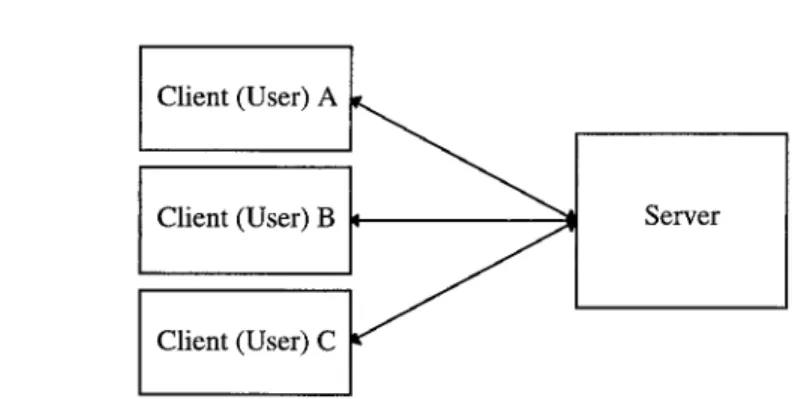
Client/server computing systems are comprised of two logical parts: a server that provides services and a client that requests services of the server. To-gether, the two form a complete comput-ing system with a distinct division of responsibility. More technically, client/ server computing relates two or more threads of execution using a consumer/ producer relationship. Clients serve as the consumers in a client/server system. That is, they make requests to servers for services or information and then use the response to carry out their own pur-pose. The server plays the role of the producer, filling data or service requests made by clients.
Client/server computing attempts to leverage the capabilities of the net-works used by typical corporations that are composed of many relatively power-ful workstations and a limited number of dedicated servers. Client/server com-puting has gained popularity in the re-cent years due to the proliferation of low-cost hardware and the increasingly apparent truth of the theory that a model relying on monolithic applica-tions fails when the number of users accessing a system grows too high or when too many features are integrated into a single system.
A good example of a client/server sys-Permission to make digital / hard copy of part or all of this work for personal or classroom use is granted without fee provided that the copies are not made or distributed for profit or commercial advantage, the copyright notice, the title of the publication, and its date appear, and notice is given that copying is by permission of the ACM, Inc. To copy otherwise, to republish, to post on servers, or to redistribute to lists, requires prior specific permission and / or a fee.
tem is a simple automated teller ma-chine (ATM) network. Users typically use ATMs as clients to interface with a small sub-server, which collaborates with a larger server that manages all of the smaller servers. In this model, the sub-servers are servers to the ATMs and clients to the master server. ATMs provide the user interface and can be customized as required (e.g. for multi-lingual support), while the intermediate servers provide the application logic, such as checking account balances and transferring money between accounts. The sub-servers allow the system to be scaled since adding servers allows an increased number of ATMs to be sup-ported. However, the application logic is provided only with the help of the cen-tralized server. The results of the ser-vices are communicated to the user through the ATMs. The centralized server provides additional application logic, such as ensuring that concurrent transactions are handled correctly. It also serves as a central brokerage for all account information so that users can access their accounts from any ATM worldwide.
2.1 Clients
Many clients have a modern graphical user interface (GUI) that presents each resource accessible by the user as an independent object; the GUI is usually provided with the help of the OS so that consistency across multiple applications
is maintained. A typical example of a GUI is the common desktop metaphor in which each storage device, file, and printer is depicted as an independent entity. Clients can also offer services to other clients. Normal models of client/ server computing place no limit on the number of servers a client can access simultaneously.
2.2 Servers
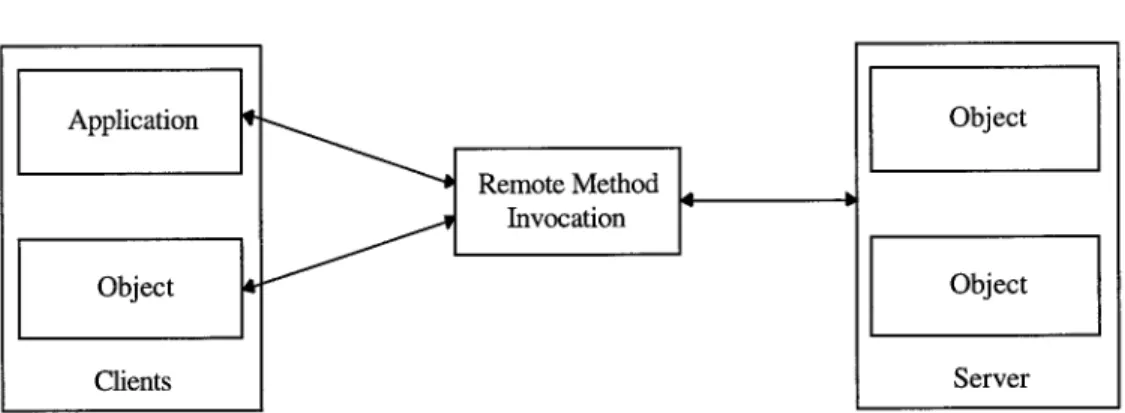
“Traditional” servers are entities that passively await requests from clients and then act on them, but recent re-search in this area encompasses sys-tems fulfilling the theoretical organiza-tion of client/server systems in which servers can actively search out changes in the state of clients and take appropri-ate action. Servers typically fill one spe-cific need and encapsulate the provided services so that the state of the server is protected and the means by which the service is provided are hidden from the client. In order to accommodate work-station clients as first-rate network members, servers must handle peer-to-peer protocols that are used for “file sharing” on PCs, handle PC messages, and service PC resources using native formats. An important consideration in determining the granularity of services offered by a server is the possibility of having servers act as clients to other servers. Using this model, a server can execute a task by dividing it into sub-Figure 1. A traditional client/server system. Clients request services of the server independently but use the same interface.
sources distributed across a network is usually provided through middleware, which serves as a framework for com-munication between the client and server portions of a system. Middleware can be thought of as the networking between the components of a client/ server system; it is what allows the various components to communicate in a structured manner. Middleware is de-fined to include the APIs used by clients to request a service from a server, the physical transmission of the request to the network (or the communication of the service request to a local server), and the resulting transmission of data for the client back to the network. Middleware is run on both the client and server ends of a transaction.
Middleware is where most of the com-mercial competition and development in client/server computing has occurred. Examples of the proliferation of compet-ing domain-specific standards include database middleware such as ODBC, SQL, and Oracle Glue; groupware middleware such as Microsoft Exchange and Lotus Notes; Internet middleware such as HTTP and Secure Socket Layer (SSL); and object middleware such as CORBA and DCOM. “Generic” or “fun-damental” middleware forms the basis of client/server systems; the domain-specific middleware serves to harness the capabilities of the fundamental middleware for a more specialized pur-pose. Network authentication services, queues (such as those for peripherals or tasks), network procedure calls, dis-tributed file systems, and network time services are all considered part of the fundamental middleware. The most com-mon network communication protocol used by middleware is TCP/IP, although
2.4 Fat Servers vs. Fat Clients
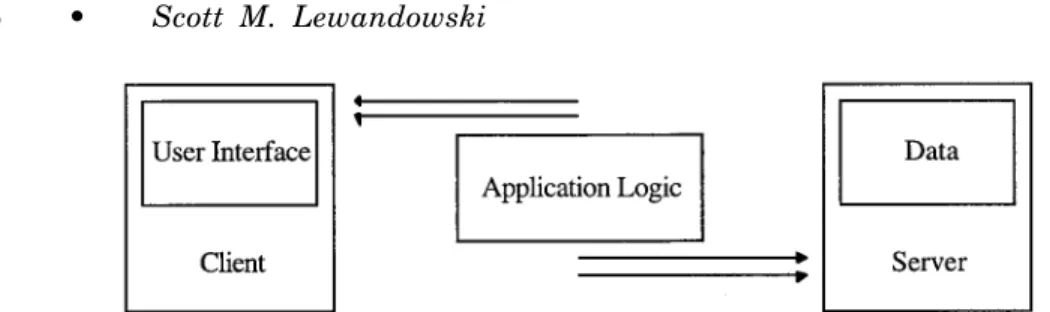
Although clients and servers both play important roles in a successful client/ server system, most systems are flexible with regard to the distribution of au-thority, responsibility, and intelligence. Information systems specialists dub a part of a system with a disproportionate amount of functionality “fat”; a “thin” portion of a system is a part with less responsibility delegated to it [Orfali et al. 1996a]. The server portion of a cli-ent/server system almost always holds the data, and the client is nearly always responsible for the user interface; the shifting of application logic constitutes the distinction between fat clients and fat servers. Fat server systems, such as groupware systems and Web servers, delegate more responsibility for the ap-plication logic to the server, whereas fat client systems, such as most database systems, place more responsibility on the client. Distributed object models of client/server computing are unique in that either the client or the server can be fat while still maintaining approxi-mately the same degree of flexibility and power. However, shifting intelli-gence from the client to the server or vice versa shifts the capabilities and strengths of the system. For example, if a fat server is being used, it usually is easy to update application logic since a new client does not need to be distrib-uted. However, if fat clients are being
1Most domain-specific middleware is designed for
use with TCP/IP, and TCP/IP is supported by nearly all operating systems. Since Windows95 and the MacOS support TCP/IP, almost all desk-top computer users have access to TCP/IP ser-vices.
used, the server need not be touched and system stability is not jeopardized.
Although systems relying on fat serv-ers have comprised the majority of cli-ent/server systems in the past, many programmers now favor fat-client sys-tems because they are generally easier to program. Fat clients let users create applications and modify complex front-ends to systems easily, but this comes at the price of reduced data encapsula-tion; as more responsibility is placed on a client, the client requires a more inti-mate knowledge regarding the organiza-tion of data on the serving end. How-ever, the continued development of fat-server systems has been significantly influenced by the industry trend to-wards greater object orientation, which favors a high degree of data encapsula-tion. By encapsulating the data better, more abstract services can be provided by the server, and raw data is hidden from the client. Instead of returning unprocessed data, meaningful responses to service requests are communicated back to the client by the server.
The use of fat servers has also in-creased because of their recently ex-ploited efficiencies. Generally, fat serv-ers are easier to manage and deploy since the data and code exist in a cen-tralized location. Instead of coordinat-ing it across a network, debuggcoordinat-ing is all done from one machine; unfortunately, as mobile servers and processes become the norm, this benefit will become less important. Fat servers reduce the prob-lem of limited bandwidth by carrying out more of the work where the data resides, reducing the need for costly
data transfers over the network. Mis-sion-critical applications requiring the highest degree of fault tolerance and stability use fat servers for ease of maintenance.
The fat server model is often used to ensure greater compatibility between clients and servers: the more work the server does, the less dependent it is on the client. For example, a Web page designed under the fat server model would assume that no plugins, ActiveX, or Java capabilities are available (be-cause the user is using a thin client, a basic Web browser), and the server would be restricted to the HTML 2.0 standard. Using this thin-client model ensures that all users see an “accept-able” page in a predictable manner, al-though little flexibility for page design or functionality is possible without the use of the advanced technologies. If a more robust user experience is needed (which, in this example, would be de-rived from using plugins and the like), the fat client model can be used at the expense of universal compatibility.
2.5 N-Tiered Systems
The canonical client/server model as-sumes exactly two discrete participants in the system. This is called a “two-tier system;” the application logic must be in the client or the server, or shared be-tween the two. It is also possible to have the application logic reside separately from the user interface and the data, turning the system into a “three-tier system.” In an idealized three-tier sys-tem, all application logic resides in a Figure 2. Since the distribution of the user interface and data is fixed, the placement of the application logic is what distinguishes fat-client from fat-server systems.
the application logic from the client and server gives application logic processes a new level of autonomy. The processes become more robust since they can oper-ate independently of the clients and servers. Furthermore, decoupling the application logic from the data allows data from multiple sources to be used in a single transaction without a break-down in the client/server model. This advancement in client/server architec-ture is largely responsible for the notion of distributed data.
Standard Web applications are the most common examples of three-tier systems. The first tier is the user inter-face, provided via interpretation of HTML by a browser. The embedded components displayed by the browser reside in the middle tier; these could be Java applets, ActiveXs, or some other kind of entity that provide the applica-tion logic pertinent to the system. The final tier is the data served from a Web server. Quite often this is a database-style system, but it can be a data-ware-housing or groupware system.
Many advanced applications can ben-efit from the use of more than three tiers. For example, when multiple data sources are integrated (as in a data warehousing application), four tiers are possible: the individual data reposito-ries, a server that unifies the view of this data, an application server that performs queries based on the unified view of the data, and the front end. The development of efficient and reliable systems with more than three tiers is still an imprecise science, but research in distributed computing continues to increase the availability and usefulness of such systems.
server system must keep parts of the application loosely coupled; of course, communication via message passing must continue in order to support the granularity of communication (most of-ten, method invocation) required be-tween client and server. Access to shared resources must be regulated to handle cases in which client and server attempt to access the same resource (this occurs most often when client and server are running on the same ma-chine) or in which multiple clients at-tempt to access the same resource via the server. In addition, a client/server system must provide a standardized system through which network services can be utilized to provide location– transparent access to all services.
As client/server systems have grown more robust, the computing community has acknowledged their many distinct advantages. Perhaps the most impor-tant advantage is the natural mapping of applications into a client/server framework. A typical example of this is an electronic phonebook system. Since the data is relatively static (and is uni-form for all users of the system) and the data repository needs to be able to re-spond to queries, it makes sense to con-struct this portion of the application as a server. A thin client is a logical match since it is difficult to update every us-er’s database of phone numbers, the op-timal search algorithm can change at any time, and the space required for the amount of data manipulated is prohibi-tive for many users’ workstations.
As a result of the availability of com-patible middleware for multiple plat-forms and recent advances in binary interoperability, client/server systems can usually relate a client on one
plat-form to a server on another. Technolo-gies such as Java and object request brokers (ORBs) promise to provide seamless integration among all plat-forms within a few years. If portions of a client/server system encapsulate a single function and follow a rigid inter-face, those parts of a client/server sys-tem providing the services can be inter-changed without upsetting other portions of the system. This allows users to customize their environments for maximum efficiency and system admin-istrators to upgrade transparently to more powerful, capable, or less expen-sive servers without notifying the users (clients). Application development is simplified since a client and server each fill a specific need, and each properly designed server supports an interface directly related to the realization of one common goal.
Client/server models leverage the ad-vantages of commodity-like hardware prices since resource-intensive applica-tions can be designed to run on multiple low-cost systems. Systems can grow since client/server systems scale both horizontally and vertically, meaning that clients can be added with little performance penalty and that extra per-formance can be extracted from a client/ server system by adding faster server hardware.
Despite maintainability issues arising from the distribution of data and code throughout a network and the difficul-ties vendors have “keeping up” with competing standards, the client/server model is extremely well suited for many applications.
3. DISTRIBUTED OBJECTS AND COMPONENTS
As computing systems evolved, new par-adigms of constructing software applica-tions were developed and the paradigm of algorithmic computation was re-placed by the use of interacting objects.
3.1 From Objects to Distributed Objects
Classical objects can be viewed as self-contained entities that encapsulate data, and a set of operations that act on that data. The operations supported by an object (often called “methods”) may rely on the internal state of the object. Objects provide a clean way of separat-ing related data and functionality from other parts of a system in order to ease system construction and maintenance.
Whereas regular objects “reside” in a single program and do not even exist as separate entities once the program is compiled, distributed objects are ex-tended objects that can reside anywhere on a network and continue to exist as physical standalone entities while re-maining accessible remotely by other objects. Robust distributed object sys-tems allow objects written in different languages and compiled by different compilers to communicate seamlessly via standardized messaging protocols embodied by middleware. Such object frameworks allow higher levels of trans-parency of interoperability between dis-tributed objects.
3.2 Benefits of Distributed Objects
Distributed objects promise to revolution-ize the construction of scaleable client/ server systems by providing modularized software that features interchangeable parts. Advanced architectures will offer the end user the ability to add compo-nents, allowing simple customization of applications.
Objects designed for self-management are the types of components most easily utilized since they impose little burden on the application programmer. Self-managing distributed objects take re-sponsibility for their own resources, work across networks, and interact with other objects. These capabilities are fre-quently given to objects through a dis-tributed object framework that provides middleware to regulate the necessary inter-object communications and pro-vides a resource pool for each object
that is deleted when that object ceases to exist. An example of such self-manag-ing objects is ActiveXs; the DCOM middleware ensures interoperation be-tween remote objects and handles re-source allocation.
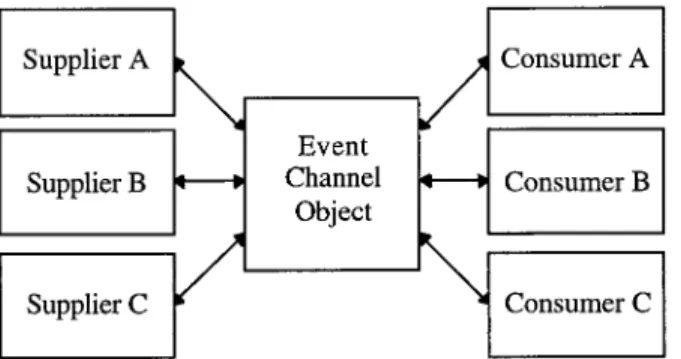
Self-managing objects are used easily by other objects since no management burdens are imposed on the client ob-ject: it receives object services “at no cost.” Objects crafted to these specifica-tions rely on a solid event model that allows objects to broadcast specific mes-sages and generate certain events. These events, which can be likened to an alarm signaling a human to take some action, are “listened for” by other objects, which then take action based on them. Each listening object responds to a given event in its own manner. By using object-oriented techniques such as polymorphism, closely related objects react differently to the same event. These capabilities simplify the program-ming of complex client/server systems and also help provide an accurate repre-sentation of the real-world system mod-eled.
Objects can generate events to notify other objects that an action should take place. In this sense, events can be viewed as synchronization objects that allow one thread of execution to notify another thread that something has hap-pened. Using this model, an event can notify a component that it should take a certain action. An object that can listen
for events provides a more robust framework for interaction between ob-jects than a model that forces obob-jects to wait for the next instruction. For exam-ple, a word processor might generate a “finished printing” event when it has spooled a document to a printer. If someone wants to add a display dialog alerting the user that the printing was done, it is necessary to write an object listening for the “finished printing” event; the word processor would not know of the existence of the alert object without it. Under a traditional model, the alert object needs to be told explic-itly to show the dialog; this requires modifications to the word processor source code and subsequent recompila-tion, which is not always feasible.
Because of the strict encapsulation that objects provide, distributed objects are a fundamentally sound unit from which to build client/server applications when separation of data is important. Cooperating objects form the logic por-tion of most substantial client/server systems because of the rich interaction services they offer [Wegner 1997a; 1997b]. The flexibility of granularity of-fered by components should not be over-looked. Objects can be as small as re-quired to provide the correct degree of “mixing” of services, or as large and complex as required to encapsulate com-pletely the logic of a particular system segment without unwarranted reliance on other objects.
Figure 3. A sample event management system. Depicted is CORBA’s Event Service, which is important because it extends CORBA’s otherwise synchronous communication model.
Since distributed objects allow appli-cations to be split up into lightweight pieces that can be executed on separate machines, less powerful machines can run demanding applications. Advanced applications for which distributed ob-jects are well suited include roaming agents (autonomous objects that move logically or physically within a network, performing various tasks at specified locations) and objects that adjust dy-namically to their execution environ-ment to provide optimal performance in any given situation.
3.3 Components
Components are the smallest self-man-aging, independent, and useful parts of a system that works in multiple envi-ronments. Such parts may not even be objects; ActiveX controls (Microsoft’s no-tion of a standalone software component that performs a common task in a stan-dard way) provide one such example. Components promise rapid application development and a high degree of cus-tomizability for end users, leading to fine-tuned applications that are rela-tively inexpensive to develop and easy to learn.
Components are most often distrib-uted objects incorporating advanced self-management features. Such compo-nents rely on robust distributed–object models so as to maintain transparency of location and implementation. Compo-nents may contain multiple distributed or local objects, and they are often used to centralize and secure an operation. For example, a function provided on a Web page through JavaScript may be moved to a component to protect the logic of the application or to allow the operation to execute on a more powerful server.
The interface of a component should be the primary concern of its developer. Since components are designed for use in a variety of systems and need to provide reliable services regardless of context, developers attempting to use a component must be able to identify
clearly the function of a component and the means of invoking this behavior.
4. A NEW MODEL FOR CLIENT/SERVER COMPUTING
The use of distributed objects in client/ server systems provides numerous ben-efits to end users and system develop-ers. If distributed objects are used, it is essential to choose the most appropriate distributed object model and program-ming language in order to leverage the advantages of the client/server para-digm.
4.1 Client/Server Using Distributed Objects
Due to market forces, only CORBA and DCOM provide viable long-term solu-tions to the challenge of a standardized framework for object-based client/server systems, since other technologies do not support a large enough feature set or have as great an installed base and momentum as these two systems.
4.1.1 Client/Server with CORBA. The computer industry has rallied to create an open standard for distributed object computing, which is known as the Common Object Request Broker Archi-tecture (CORBA).2 The most ambitious middleware undertaking ever, CORBA manages every detail of component in-teroperability, ensuring the possibility of interaction-based systems that incor-porate components from multiple sources. Because an object’s service specification is completely separated from its implementation, CORBA is able to provide a self-specifying system that allows the discovery of other ob-jects on the network; this capability
2Traditionally, an open standard is a standard
designed and supported by many companies that provides for interoperation between specific ven-dor implementations of similar systems; an open standard allows continued innovation and devel-opment of the system by all companies working on it. The key benefits are: ready availability of infor-mation about the standard and assurance that no one company will gain a significant competitive edge by having the “best” technology.
opens up new possibilities for interac-tive systems.
CORBA objects can exist anywhere on a network, and their location is com-pletely transparent. Details such as the language in which an object is written or the operating system on which it currently runs are also hidden to cli-ents. The implementation of an object is of no concern to an invoking object; the interface is the only consideration a cli-ent must make when selecting a serving object.
CORBA provides fundamental system and application services to the objects that rely on it for management. The inclusion of these services at the middleware level eliminates the need for most “mixin classes” (small classes providing generic functionality, such as garbage collection or persistence, to all objects inheriting from them); these classes tend to distort the object model and unnecessarily complicate the inher-itance hierarchy of systems.3
The most important part of a CORBA system is the Object Request Broker (ORB). The ORB defines the object model and provides bidirectional loca-tion-transparent object access. The ORB is what shields clients from the
neces-sity of dealing with the complexities of remote object communication; the ORB handles all of the difficulties in coordi-nating the task. The CORBA 2.0 specifi-cation mandates intervendor ORB com-patibility, which is accomplished via the required Internet Inter-ORB Protocol (IIOP). IIOP provides a common com-munication backbone between different ORBs by adding several CORBA-spe-cific messages to the TCP/IP schema already widely used today. The ORB provides most of the middleware-like services that a robust distributed object system should provide. Many CORBA features are drawn from proven models such as Remote Procedure Calls (RPC) and Message-Oriented Middleware (MOM).
CORBA uses the ORB to establish a client/server relationship between com-ponents. The ORB intercepts method invocations from client objects and routes them to an appropriate server. The serving component can be a specific object or a general server that delivers the services required to meet the de-mands of a generic client request. By using an ORB with such capabilities, CORBA shields the programmer from implementation details (e.g. the lan-guage used to write the cooperating component) as well as run-time vari-ables (e.g. the details of which machine hosts a given component). The ORB does not bind a given component to a client or a server role: the same compo-nent acts as a client to other objects yet 3In fact, the CORBA model does use mixins to
provide these services, but they do not interfere with the “traditional” object interface since they are mixed in at run time. Mixins could also be included at build time, but this limits the flexibil-ity of the model.
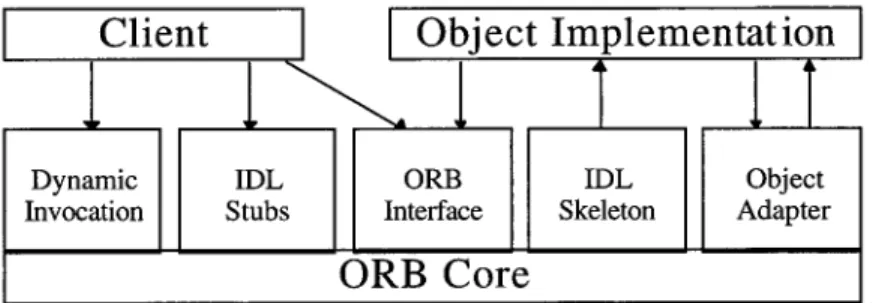
Figure 4. The CORBA architecture. The major ORB components used by the client and the implemen-tation of the object are shown.
still delivers requested services, making it also a server.
At the heart of CORBA’s strong in-teroperability is the language-neutral Interface Definition Language (IDL). The IDL, used to specify the services that an object can provide, was designed to be fully independent of the imple-mentation language, tools, operating system, and other factors that normally affect interoperability. Important issues such as error handling are accounted for by this completely declarative language. Programmers write interactive se-quences of code using native language constructs and rely on the IDL only to express object interfaces and related traits, such as its inheritance tree, the events that the object can trigger, and the exceptions the objects raise (for er-ror-handling purposes). When the inter-face is specified, the programmer speci-fies parameter and return types to ensure the appropriate invocation of the object’s methods. To make the IDL easy to learn, it is a superset of C11; the IDL even includes support for prepro-cessor directives.
Client IDL stubs communicate the static interfaces that allow a client to be written as though it simply invoked lo-cal methods; in reality, the ORB routes
the method invocations to the appropri-ate server objects. This flexibility comes at the expense of equipping each client component with an IDL stub for each server used. In addition to static method invocation, CORBA supports dynamic method invocation, which is handled through the Dynamic Invoca-tion Interface (DII). DII allows a compo-nent to learn about the methods of other components at run time. It serves as a generic interface that does not require stubs; instead, it supports the dynamic construction of method invocations as needed by the client at run time. Stan-dardized methods support the transfer of data in a metadata format; however, the full utility of DII is yet to be ex-ploited due to the complexities inherent in writing a component that uses ser-vices not yet known to exist.
The server side of a client/server transaction need not know whether the method invocation it handles is static or dynamic. Serving objects have Server IDL Stubs, similar to the Client IDL Stubs, that denote the static interface of the serving component. To accommo-date components without IDL-based stubs, CORBA provides a Dynamic Skeleton Interface (DSI) that binds in-coming method calls for such objects at Figure 5. The structure of a CORBA IDL file.
run time. Server demands are met via an Object Adapter, which provides the core run-time functionality required by servers. It supports the registration of components, and thus returns object references to client components. The Implementation Repository gives server components a repository for run-time information about a variety of a server’s services such as the supported inter-faces, audit trails, security details, and other administrative or “housekeeping” information.
Related to these two interfaces is the Interface Repository API, which allows components to obtain and modify the interfaces of registered components to which it has access. The Interface Re-pository contains all of the IDL defini-tions, which describe the attributes, op-erations, user-specified types, and exceptions supported by server objects. Using the Interface Repository API, components can update their published interfaces, making CORBA a self-de-scribing system. By supporting these flexible interface services, CORBA pro-vides both the safety and speed of static method invocation as well as the flexi-bility afforded by dynamic method invo-cation.
CORBA specifies two means by which an object can locate another object in a system. The first is the Naming Service. This service is analogous to the white pages in a phone book: an object looks up another object by the name under
which the object registered itself with the ORB on initialization. This method of finding an object relies on unique signatures: a client must know the ex-act name a server gave when it regis-tered for use. The second service is the Trader Service, which is like the yellow pages: objects can ask the Trader Ser-vice what objects with certain serSer-vice characteristics have registered. The trading repository then returns refer-ences to salient objects and gives the client information regarding the proper-ties of the services. The client then chooses a server to contact for the needed services.
CORBA also provides CORBAser-vices, which define system–level object frameworks that extend the CORBA model, and CORBAfacilities, which pro-vide horizontal and vertical application frameworks used by business objects. Although quite important to the design and implementation of a successful CORBA-compliant system, these facili-ties are not important in the use of CORBA to support a robust client/ server environment [Orfali et al. 1996b].
4.1.2 Client/Server with DCOM. Mi-crosoft is touting DCOM, which first shipped with WindowsNT 4.0, as the future model for Internet computing; DCOM manifests itself primarily through the use of ActiveX components, Figure 6. Client/server computing using distributed objects. Communication between components (denoted by arrows) is facilitated through ORBs (which have been omitted for clarity).
which are DCOM objects.4Furthermore, software releases from Microsoft (such as Visual J11) reveal that Microsoft is intent on providing a workable platform on which to implement Java objects. The integration of Java with DCOM through Visual J11 is even greater than that of C11 and DCOM provided through Visual C11. This is particu-larly interesting in light of the fact that C11 is the language originally in-tended to be used with DCOM. DCOM has migrated from a system for binary interoperability to the more accepted (and needed) system of providing high-level bindings to popular languages. The bindings provided with Visual J11 are strong enough so that ActiveXs written in other languages can be made to look like remote Java objects.
DCOM is like CORBA in that it cleanly separates interface from func-tionality using an IDL. Microsoft has chosen to use an IDL based on the Dis-tributed Computing Environment (DCE). The IDL is neither CORBA- nor DCE-compliant; this severely limits the potential for interoperability. In addi-tion, separate interface functionality for Microsoft’s Object Linking and Embed-ding technology is provided using the Object Definition Language (ODL).5
DCOM does not support the
tradi-tional notion of an object. DCOM “ob-jects” do not have a state; rather, they are collections of interfaces. One could liken this to a collection of algorithms, suggesting that a DCOM “object” is in-herently not as powerful a computing machine as a CORBA object [Wegner 1997b]. When a reference to a DCOM object is requested, the handle is arbi-trary; a subsequent request for the same object may yield a different han-dle connecting the client with an equiv-alent interface. DCOM supports a regis-try of available interfaces for objects to reference, and even provides informa-tion on the meanings and types of pa-rameters that should accompany a ser-vice request.
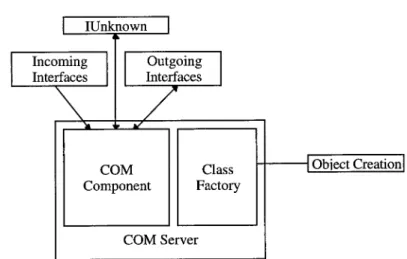
The client/server contract can be ful-filled in DCOM by the use of object interfaces. As in CORBA, DCOM inter-faces make the implementation lan-guage and the location of objects trans-parent. This assumes that a language binding for the language in question is available. For a DCOM client to access the methods of an object, it must use a virtual lookup table to obtain a pointer to that function. Multiple virtual tables can exist for each object and they can be modified to make interfaces alterable while the application executes.
These differences from the traditional notion of an object may leave the reader wondering what a DCOM object really is. A DCOM object can best be described as a software component supporting at least one interface; no knowledge of state is provided. Since DCOM objects have no unique object identification, there are no naming or trading services 4Microsoft’s WindowsDNA initiative strives to
further integrate DCOM with Web-based client/ server models.
5OLE no longer refers to Object Linking and
Embedding but rather to any COM-based technol-ogy. The ODL support for Object Linking and Embedding exists in order to ensure backwards compatibility [Chappell 1996].
Figure 7. Sample DCOM IDL code defining the interface for ISpellChecker. The compiler generates proxies and stubs along with other related code. The non-standard parameter types are required by COM.
nected to an arbitrary server supporting the services needed. Since DCOM does not support multiple inheritance of in-terfaces (proven to be the purest model for interface composition in Wegner [1997b], DCOM objects cannot automat-ically support multiple interfaces. If an object contains an object supporting a given interface, then the containing ob-ject can tell requesting clients that it supports that same interface; the calls must be forwarded to the contained ob-ject. There are two ways to do so. (1) Containment/Delegation: The
con-taining object must request the same service of its inner object as requested of it. The top-level object delegates service requests to more capable objects.
(2) Aggregation: This model directly ex-poses the object interfaces to re-questing clients when they ask for the interface of the top-level object. Put another way, the top-level ob-ject presents the interfaces of its component objects as its own. This has the side effect of allowing a cli-ent to communicate directly with the objects contained by the top-level object. Performance and effi-ciency can benefit from such an ap-proach, but some flexibility, control, and encapsulation may be lost. By providing only for the functionality mandated by the notion of inheritance and thus ignoring inheritance on a con-ceptual level, Microsoft limits users of DCOM to a “flat” object world. In addi-tion, programmers are forced to use con-tainment in place of inheritance in or-der to reuse code. This limitation has a host of theoretical and practical
ramifi-that instantiates the class. In addition, the server must tell the Windows regis-try which classes it supports; this often takes place when the server component is first installed on a system. Numerous problems with Windows registries make it a poor model for advertising system services.7 A major disadvantage of the Windows model is that it does not ac-commodate “newly” supported clients nicely (for example, compatible clients). Using interface pointers, DCOM sup-ports transparent communication be-tween clients and remote server objects. The DCOM runtime does some behind-the-scenes work to ensure that the in-terface pointer is local to the invoking process (through the use of a proxy, if necessary), but the client’s view is of the perpetual availability of services. When proxies are created, they communicate with stubs on the serving end. This model is quite similar to the mechanism employed by CORBA to provide loca-tion-independent access to objects.
Although Microsoft has taken many liberties with the object model that should improve performance, mark tests indicate otherwise: bench-marks incorporating network communi-cation and simple method invocommuni-cation show DCOM to be almost 20% slower than CORBA.8
6These issues are treated adequately in most
texts on software engineering and design.
7Most of these problems involve registry
integ-rity. Because the Windows registry is used so often, it is very susceptible to corruption.
8A simple benchmark involved two 120-Mhz
Pen-tiums running WindowsNT Workstation 4.0 con-nected by a 10 Mb/s Ethernet LAN. The client (written in C11) invoked a method on a server (also written in C11) 1000 times and measured the average response time of remote pings. The
4.1.3 CORBA as the Dominant Model. With DCOM running only on Microsoft operating systems, there is little ques-tion that CORBA is the more portable system.9 CORBA is now in its third generation, and the standards body gov-erning its evolution serves as assurance that it will remain an open system. In contrast, DCOM is currently a Win-dows-only technology (although there have been some experimentation with porting the system to flavors of UNIX) and it is apparently governed by its maintainer, Microsoft. Several barriers to porting DCOM to other platforms ex-ist. For example, DCOM relies on the WindowsNT security model to provide system security; it is unclear what will provide security when DCOM is used on other platforms. In contrast, CORBA uses a universal security mechanism that will work on all platforms, regard-less of operating-system-level security.
CORBA provides a superior object model by supporting the foundations of the popular classical object model. By
supporting unique object references, ca-pabilities such as persistence are easily supported by CORBA, allowing a whole domain of specialized applications to le-verage this strength to provide more robust end user services. Native state handling provided by CORBA frees the client from the burden of providing a managed-state system to handle the needs of interacting objects.
Support for legacy systems is essen-tial to the success of any new computing technology. CORBA provides seamless integration for the most popular object oriented languages, and robust support for all languages. DCOM language sup-port is limited to Java, C, C11, and Visual Basic. CORBA hides the IDL from the programmer, whereas an un-derstanding of the DCOM IDL is essen-tial to DCOM programming.
Although CORBA is clearly a superior technology, one should never underesti-mate any technology backed by Mi-crosoft and its huge installed base and resource pool. However, the rest of the industry, including giants such as Hewlett Packard, IBM, Novell, and Ap-ple, along with quickly moving newcom-ers such as Netscape, Oracle, and Java-Soft, are rallying behind CORBA to make it the distributed object standard. DCOM setup gave an average execution time of
3.9ms; the CORBA setup, which used the VisiBro-ker ORB, gave an execution time of 3.2ms.
9As of mid-1997, Microsoft has pledged to support
DCOM on the MacOS and on the most popular UNIX variants.
Figure 8. A typical DCOM component, showing the supported interfaces and mandatory class factory and object creation capabilities.
ties. Using Java applications, one can distribute executable content as easily as one can deliver traditional static con-tent.
Java supports a mobile code system; this makes it an excellent choice for meeting the needs of mobile agents, which need to share (or distribute) both code and data across multiple servers and clients. Mobile code is distinguished from traditional application code in that it is dynamically executed by an appli-cation that provides the run-time envi-ronment. In Java, the assisting applica-tion is quite often a Web browser or some other stand-alone application, al-though operating systems are probably a better choice for this task. For code to be considered mobile, it must be porta-ble, meaning the code can be run on a variety of platforms; code bound to a specific machine architecture or operat-ing system is not very mobile. Because the security provided by the runtime varies, mobile code systems must pro-vide security. Since Java applications can “roam” and are executable on any client machine, and since we would like users to be able to download and exe-cute programs without the threat of harm to their computing environment, the mobile code system must protect host resources such as memory and files. Other considerations for mobile code systems are: mechanisms for load-ing, unloadload-ing, and discarding applica-tions, and a way to transfer applications to hosts in a manner that guarantees their integrity.
Java’s mobile code system is provided through bytecodes, which elegantly solves the portability and security prob-lems. The bytecode system calls for pro-grams to be “compiled” until they are at
this translation and execution, the Java Verifier checks all code scheduled to be executed for malicious code (such as forged references or access violations). Security is augmented by four other lev-els of verification, ranging from native language design features to regulated access to system facilities.
Although Java is often compared to C11, it is quite different in many ways. Java supports only single inheritance of implementation, which solves many se-mantic problems arising in complex in-heritance hierarchies and allows an ob-ject to support multiple interfaces. Interface inheritance is not considered harmful and is generally recognized as providing a more clean and accurate object model. Java interfaces are quite similar to CORBA IDL files in that they both specify the services available from an object without revealing its imple-mentation.
Namespace semantics are provided by Java packages. Packages allow dynamic class linking with methods that can be overridden at runtime. Java also pro-vides automatic garbage collection and array-bounds checking; it does not allow pointers, enforces strong type checking, and treats exceptions as essential lan-guage constructs. Native support for multi-platform multithreading is pro-vided; some simple features to meet thread synchronization needs are also included. These language features as-sist developers writing client/server components that must interoperate eas-ily and provide high degrees of security and reliability.
10Unfortunately, this works better in theory than
in practice; numerous incompatibilities between virtual machines still exist.
Much of Java’s appeal comes from the core classes that are part of any stan-dard Java implementation. Since much of the application functionality is pro-vided externally, application sizes are minimized, and since a lot of “busy-work” code has already been written, debugged, and approved as multi-plat-form-compatible, program development is greatly simplified. Some of these pre-built classes are provided through pack-ages such as java.lang, java.io, and java. util, while other parts come from established frameworks. Some core frameworks relevant to client/server computing include:
—Java Applet Framework: Provides the “basics” needed for Java applets (small applications meant to be down-loaded from the Web and executed usually within a Web browser) such as base objects, native types, threads, exceptions, stream and file support, sockets, generic data structures (hash tables, stacks, etc.), a portable GUI layer (to support events), animation, and wave audio.
—Java Commerce Framework: Provides secure monetary transactions, includ-ing online purchasinclud-ing and financial management.
—Java Enterprise Framework: Provides object- and database-access services for distributed systems. Incorporated here are APIs that support Java-to-CORBA communication, Java-to-Java communication, and Java-to-Java-Da-tabase-Connectivity (very similar to ODBC) communication.
—Java Server Framework: Simplifies the development of Internet servers by providing APIs specifying simple and uniform access to servers. It also supports servlets, which are minia-ture servers that end users can deploy on a network to handle simple client requests.
—Java Media Framework: Supports 2D graphics and animation,
synchroniza-tion services, and audio. It is being extended to support MIDI, 3D graph-ics, telephony, conferencing, and video. Using the media framework al-lows applications with robust interac-tion semantics to work across multi-ple platforms with modification. —Java Security Framework: Provides
support for authentication, digital signatures, and encryption.
—Java Beans Framework: Serves as a component model native to Java. It extends the application model by al-lowing flexible event handling across multiple components, discovery of methods supported by other objects, persistent objects, and user interface allocation among multiple objects. This framework is quite important as it allows objects on a Web page to communicate and occupy overlapping screen areas.
These frameworks suggest that Java is not simply a language but, rather, a portable object platform.
By introducing a new way to develop applications, Java has created a new paradigm for managing and deploying client/server systems. By ensuring multi-platform compatibility, Java al-lows a developer to deliver an applica-tion to millions of users through its availability for downloading from a Web server. A formal installation procedure is not usually required, and updates are provided by updating the single copy of the application on the Web server. Server technology also stands to benefit from Java, most notably from the use of mobile code. With no modification to the application or its source code, servers can start processes on any machine on the network, and can move themselves or their child processes to the most ap-propriate machine at any time. The po-tential for rapid application develop-ment also makes Java a good client/ server programming language since effective client/server development re-quires constant feedback from end users.
ogy, it forms a strong basis for the devel-opment of a robust system that supports client/server computing. A platform for universal network computing can be created using Java as a programming language and mobile code system and CORBA as an integration technology.
CORBA can replace the current Web-based system of providing client/server services, which uses HTTP/CGI. Doing this would bring three significant bene-fits to Java.
(1) Superior performance and flexibil-ity: CORBA allows clients to invoke methods on a server directly, with parameters passed by precompiled stubs or generated dynamically. This system is more flexible than the system supported by HTTP since the client component is not limited to the predefined methods supported by HTTP; any IDL-de-fined method can be invoked. In ad-dition, CORBA allows parameters of any type to be passed, whereas CGI accepts only strings as parameters. CORBA also avoids rerunning a pro-gram at each client request, and can store state between client invoca-tions; CGI requires the program to be executed for each request, and it does not support state.
(2) Scalability: The CORBA ORB can dispatch incoming client requests to a server of its choosing, allowing load balancing of client requests (this is further facilitated by inter-server communication via the ORB). CGI applications have no way of dis-tributing client requests to other servers; one CGI application must handle all the requests it receives.
ponents written in other languages. Of course, CORBA would also sup-ply its standard component services, such as transactions and persis-tence.
Since it was designed to naturally sup-port three-tier client/server systems, CORBA is a natural extension to Java’s object model that brings robust distri-bution services to Java objects. In many cases, using CORBA with Java would allow Java components to be split into client and server side components, mak-ing the Web client/server model even more attractive since download time would decrease (only the client compo-nent would need to be downloaded).
Java can build on the strengths of CORBA. By using CORBA to provide network transparency and Java to pro-vide implementation transparency, a system that offers total transparency of components can be created. Some ways in which Java improves on CORBA in-clude:
—Simplified code distribution: Using Java, code is easily deployed from a central server for download on de-mand. This ensures that all updates are “installed” (instead of requiring that system administrators update each workstation manually).
—Mobile code: Using Java’s native mo-bile code capabilities, functionality can be moved dynamically between machines or between the client and server components of a system. —Agenting: Since it is assumed that
every machine visited by a roaming agent will have a Java virtual ma-chine installed on it, CORBA applica-tions requiring agents can use Java’s
mobile code system to move around behavior, with CORBA providing state persistence services and Java providing the behavior.
—Additional component services: CORBA defines “visual containers” (based on Apple Computer’s OpenDoc) for components, and Java applications can serve as the portable components that exist within these containers. CORBA’s mobile container structure, based on OpenDoc’s “Bento” system for storing structured data, can be used as a mechanism for moving Java agents around.
—Superior language features: Java is well suited for writing robust client and server code because of its native multithreading, garbage collection, and error management. Java works well with CORBA since both systems separate interface from implementa-tion.
Java and CORBA complement each other quite well, with CORBA providing a distributed object infrastructure and Java providing a strong mobile code sys-tem. Together, they let any two objects on the same network communicate un-der all circumstances.
5. FRAMEWORKS
A goal of object technology is the con-struction of software systems structured in the same way as the analogous real-world systems. Frameworks are a tool to help programmers achieve this goal.
5.1 What Are Frameworks?
Frameworks typically provide a way to manage a system of interacting objects and to develop objects that will inte-grate seamlessly into the framework. Frequently, frameworks suggest pat-terns of collaboration between the ob-jects that constitute the framework, al-though a well designed framework allows flexible channels of collaboration that suit the application at hand. Com-ponents that emerge from a finished
framework share consistent design at-tributes, and may even share common implementations. The benefit is a more maintainable and consistent software system.
In contrast to the traditional ap-proaches to software reuse, which are built on the paradigm of a set of librar-ies containing many small building-blocks, object-oriented frameworks al-low the highest common abstraction level between a number of similar sys-tems to be captured in terms of general concepts and structures. The result is a generic design that can be instantiated for each object system constructed.
The framework is ideally suited for capturing the elements common to a family of related systems. In this sense, the framework is essentially a large de-sign pattern capturing the essence of one specific kind of object system. The bulk of the system functionality is cap-tured in the framework, which is main-tained as a single entity. Each software system using framework is an instantia-tion of that framework.
Frameworks provide a high degree of design reuse for interactive systems composed of collaborating objects and ensure that a “product” of the work will work within it. Thus, frame-works are a valuable tool for ensuring the availability of object services.
5.2 Business Objects as a Client/Server Framework
Business objects are self-managing com-ponents used to represent key objects or processes in a real-life system. Business objects are “shippable” products that usually have a user interface and the ability to cooperate with other objects to meet a certain user need. They can be used across single or multiple enter-prises. Business objects allow applica-tion-independent concepts to be de-scribed at a high level, minimizing the importance of languages, tools, and ap-plication-level concepts. Business ob-jects represent a major breakthrough in the modeling of business events since
they can describe both a portion of a real-world business system and the exe-cuting piece of the information system supporting that portion of the business [Orfali et al. 1996a; 1996b].
Perhaps the most significant advan-tage of using business objects is the capability to model accurately the corre-sponding real-life business processes. Collaboration among business objects is essential to most robust systems since few business events involve only one object. For example, the task of billing a customer involves the invoice, the pur-chaser, the goods being sold, and the seller. While some systems are modeled relatively easily using basic objects, business objects allow collaboration at a higher degree of semantic accuracy, re-ducing application development costs. When reengineering a business’s com-puter systems, the result of modeling should be a high-level group of compo-nents that can be configured immedi-ately to run distributed across a net-work [Orfali et al. 1996b]. With this infrastructure in place, modeling any event affecting the business requires simply the instantiation of a new busi-ness object. For example, if an order is placed, a new invoice object must be instantiated. This new object then has its own life-cycle and could support it-self by collaborating with other objects using the underlying ORB. (It should be noted that “business objects” need not apply to business processes. Any system relying on concrete objects can be
mod-eled using business objects. A more ac-curate name would thus be “domain ob-jects;” however, the mainstream client/ server community has adopted the term business objects already.)
Like other components, business ob-jects should support late binding so they can be interchanged easily and interact immediately with existing components; they should also support standard com-ponent features such as event handling and state maintenance. Business ob-jects are relatively easy to develop, since they can be based on CORBA ob-jects, which already provide a means for inter-component collaboration and re-source management. By using CORBA as a framework to construct business objects, much of the work of building a robust component is eliminated from the development cycle.
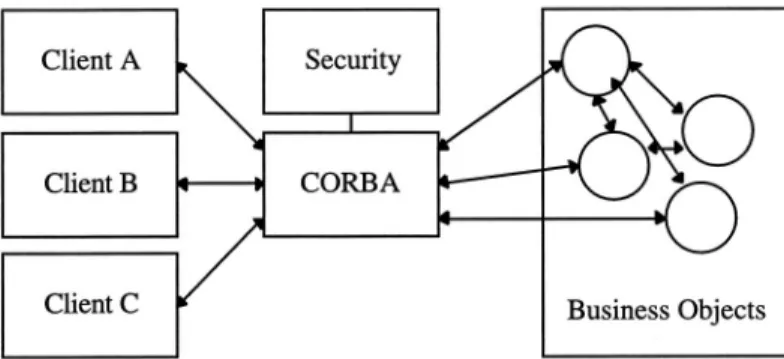
Business objects provide the same benefits to system developers that tradi-tional objects provide; however, the ben-efits are specialized to a particular do-main. Business objects are reusable, so the same invoice object can function in both the accounts receivable and ship-ping portions of a company’s order man-agement system. In fact, the component could be shippable to the purchaser of the goods and also work with the ac-counts payable module of the purchas-er’s computer system. Business objects can be specialized to meet the unique demands of a business. A business can purchase an accounting package and then specialize the invoice object to ac-Figure 9. CORBA and business objects work together to provide client services.
commodate some special need, such as verifying the compatibility of items or-dered.
The Business Object Model Special Interest Group (BOMSIG) has proposed a standard for business objects. The standard calls for each business object to be composed of three types of cooper-ating objects.
(1) Business Logic Object (BLO) defines how the object reacts to certain events; it is responsible for the busi-ness logic of the component as well as for storing the relevant business data.
(2) Business Process Object(BPO) helps maintain the business logic for the entire system. The primary differ-ence between a BPO and a BLO is the logical lifetime of the unit of logic: BPOs traditionally handle long-lived processes or processes related to the system as a whole.
(3) Presentation Objects provide the user with a representation of the component, usually but not neces-sarily visual.
A normal business object is likely to have multiple Presentation Objects, but usually has one BLO and BPO. Because these three objects are managed by one object, collaborating components see
only one object that provides the aggre-gate services of its constituent objects.
This three-object construction can be viewed as a three tier client/server sys-tem.
—Tier 1: Visual aspects of a system, usually handled by a client system. —Tier 2: Data for the object and the
application logic required to meaning-fully act on it.
—Tier 3: Data and application logic re-quired to integrate the business object with other business objects and exist-ing systems, such as legacy servers or databases.
The middle tier plays the largest role in this organizational scheme. Tier-two ob-jects communicate directly with the tier-one objects to provide feedback to the user; they also provide the logic for the entire business object. Furthermore, tier-two objects communicate with mul-tiple data repositories (tier three) and collaborate with other business objects to assist them provide services. This model separates the client from data for which it is not logically responsible. By channeling all requests for information through the tier-two servers, major changes (such as the implementation of a new database system) remain com-pletely transparent to the user. If ORBs Figure 10. The parts of a business object and their communication with other system objects [Orfali et al. 1996b].
are used for communication between the clients and the tier-two objects, ro-bust system services such as load bal-ancing and event exchanges are imple-mented easily and applications remain scaleable.
The business object model works well with CORBA because CORBA allows the constituent objects to reside on any machine. For example, the objects man-aging the business logic can reside on a server, while the client-side Presenta-tion Object runs on a local workstaPresenta-tion. This setup provides an inherent client/ server relationship between compo-nents. Business objects can collaborate in a semantically and technically rich manner by using the facilities provided to every CORBA component. By lever-aging CORBA’s frameworks for data transfer and collaboration and the pow-erful mobile code system provided by Java, business objects can interoperate in a stable manner, while allowing com-ponents to be added to or removed from the system. By keeping the framework for collaboration fixed, the object life-cycle continues without affecting end users.
5.3 Compound Documents as a Client Framework
A compound document is a tool for orga-nizing components that serves as a framework for integrating the visual and containment relationships between cooperating components. Compound documents can be composed of compo-nents from a wide variety of sources,
making them universally applicable. The familiarity of documents to end us-ers makes the compound document an obvious choice for introducing object technology on a widespread basis. The extension of the desktop metaphor, which incorporates application services and operating system services to pro-vide a seamless user experience, demon-strates the viability of such compound document systems.11
The compound document framework calls for containers that can contain components. The containers themselves are components; this allows recursive system construction. That is, a spelling-checker “container” can be constructed from dialog boxes, buttons, a dictionary file, and a database engine. This con-tainer can then become a component in a word processor, along with compo-nents for stylized text, graphics, gram-mar checking, and the like. Components can represent traditional programming entities or common data types. In fact, any data type can be extended to be-come a component. By melding each data type into a component mold, com-pound documents accommodate all user demands, since they can contain any-thing the user would like. Since data is
11The most notable compound document system
is Apple’s now-canceled OpenDoc project; many of the concepts and principles of current compound document models are derived from this project. Interested readers are encouraged to examine some of the literature available both online and in print. For a fairly detailed introduction to Open-Doc, see Feiler and Meadow [1996].
managed by its containing component, new data types can be added immedi-ately to documents; the document need not know about the specific data type.
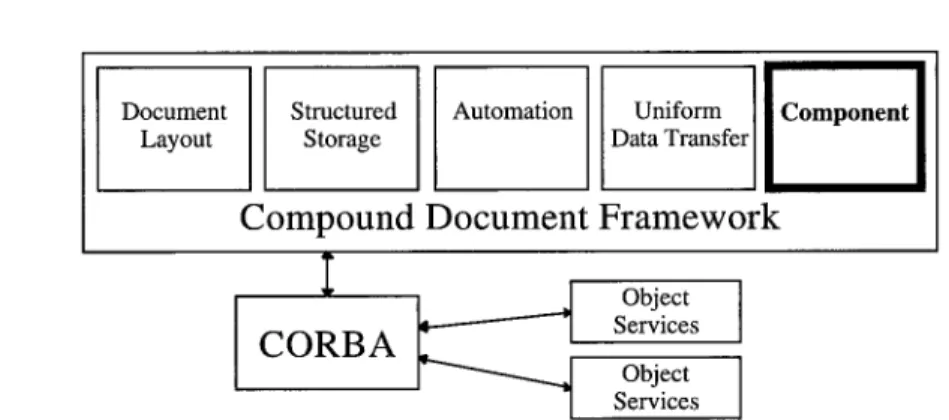
In order that components with no pre-existing knowledge of other components be allowed to collaborate within a com-pound document, a system of communi-cation is required between the compo-nents managing a document’s data and those managing the document itself. The component framework provides this communication and manages shared re-sources, such as files and windows on the user’s screen. A compound docu-ment framework is built on top of an object bus, such as CORBA, which is built from object services. The frame-work provides four core services to ob-jects serving as run-time members of the framework [Orfali et al. 1996b]: (1) Document layout allows
indepen-dent components to share a common display area (usually a window). Components are required to collabo-rate via the document layout service to present themselves to the user. Once a display area is allocated, components that are also containers must recursively allocate space to the components they contain. Each individual component is responsible for interacting with the user and displaying its data in the space allo-cated to it. Containers distribute events to the components they
con-tain and manage the resources they share.
(2) Structured storage. Since compound documents consist of many pieces of data managed by separate compo-nents, the storage needs of the framework are unique. A file storing a compound document consists of separate blocks of data, each man-aged by a component. Much like the display, files must be partitioned into spaces that each component can control without adversely affecting other components. A recursive structure similar to that used by the document layout manager is em-ployed. In addition to containing embedded data, files can also con-tain links to external data.
(3) Automation allows users to create their own relationships between components and to customize their documents to create robust applica-tions. Scripts may replace tradi-tional code, allowing the client com-ponent of a client/server system to be implemented as a compound doc-ument; intelligent active compound documents can also be crafted using scripts [Wegner 1997a]. The possi-bilities for scripts are wide-ranging: password protection for documents, personalized document views, and active data gathering are just a few examples. The use of scripts in con-junction with compound documents Figure 12. The compound document framework uses the object framework (here CORBA) to take advantage of object services.
transfer via the clipboard, linking, and drag-and-drop; compound docu-ments must do likewise, at the same time taking into account the added technical complexities of the new metaphor. UDT provides a single mechanism that works with the transfer mechanisms mentioned and handles containers intelligently by copying not only the container itself but also its components.
Compound documents offer enhance-ments to older user interface meta-phors. Since it is possible to switch to any component immediately without launching a different application (usual-ly by clicking on it), editing multiple components “simultaneously” is not as burdensome as in the current model, which requires users to switch applica-tions. Through this metaphor, compo-nents give the user the tools required for the contained data in a context-sen-sitive way. Usability therefore im-proves, as positioning palettes next to the data being edited instead of at some “default location,” and other such things are now allowed. The components of a document are further integrated by eliminating the need for separate files for each document component. Every-thing a document contains is stored within a single file (links to the compo-nents can be maintained instead) so that the user need not track the individ-ual items of data separately.
As compound document frameworks become embedded more seamlessly into the operating system, everything a user deals with will be considered a compo-nent. Initially, the transition from the WIMP user interface metaphor will not be apparent. Users will still move fold-ers, and the files in them will follow.
documents. Mobile documents are able to be edited, printed, and shared just like regular documents. Their added power comes from the ability to exploit the compound nature of the document. Since documents can contain executable code, they can perform functions such as routing themselves automatically. In addition, the document can contain not only the salient data, but also the user interface for the document, a record of changes to it, a method for controlling who can access what portions of it, and other advanced functionality.
The compound document model can be extended to create new user environ-ments. As compound documents begin to replace the traditional desktop meta-phor, collaborative environments tai-lored to real-world models can be con-structed. Different environments for children, doctors, and salespeople can form the basis of a person’s interactions with local and remote services. Creating such a virtual environment requires merely assembling a collection of com-ponents into a container document, so the environment can be easily down-loaded by users who do not wish to craft their own environment. To accommo-date fee-based service access, companies can charge to download an environ-ment. The environment alone would contain the components needed to transact with the remote components, so non-paying consumers would be un-able to access the service. Once an envi-ronment has been constructed, it can serve as the client for all network ser-vices, including access to business ob-jects.
Compound documents provide a framework for Web browsing as they are a visual component foundation for a
new generation of open Web browsers as well as a concrete container meta-phor for storing and distributing data. By downloading a pre-built compound document, a user has access to an tirely new and customized operating en-vironment. The use of compound docu-ments in place of the older models of Web browsing has several distinct ad-vantages. Compound documents inte-grate the visual experience by allowing components on a Web page (including Java applets or applications and tradi-tional content) to share window real estate and users to edit a component in place without a separate application. New documents are created easily by combining high-level components from existing documents in a new way. The metaphor also allows a user to rear-range a Web “page” to his or her tastes. In addition, the components automati-cally share common menus, palettes, colors, and clipboards so the user expe-rience is seamless. Components can be dragged onto other components, or com-ponents can realize they are in the same document and work together to take some action. Once Web documents be-come componentized, new methods of displaying information will abound.
Because of its unique advantages, the compound document model is likely to become a dominant force on the client side in the growing client/server mar-ket. The model provides a convenient way of grouping related objects and manages the difficulties of displaying, storing, and moving them via networks. Since a compound document maintains links to servers, it serves as a universal client. Client applications can be built with ease by developers or end users by incorporating ready-made components and pre-written application logic, and then customized for each individual user. The user’s entire workspace can be stored in one document if desired.
6. CONCLUSIONS
Distributed objects promise to revolu-tionize the stagnant client/server
mar-ket. CORBA’s object references provide a clean way of gaining an object’s inter-face. Callbacks allow servers to control clients and allow clients to receive new content to add to compound documents. In addition to its speed, the CORBA ORB is interoperable with C11 objects and integrates smoothly with Java. By supporting a three-tier client/server system, CORBA allows data from multi-ple sources to be encapsulated and pools of servers to be created. The provisions for dynamic discovery of object inter-faces make CORBA components self-de-scribing, allowing flexible binding and easy interoperation between compo-nents. The development of ubiquitous middleware available on all platforms will lead to true location transparency, and the fact that CORBA is an open standard will ensure continued innova-tion and evoluinnova-tion of the system.
Leveraging CORBA and Java pro-vides the most notable advantages of component technology in the domain of client/server computing. CORBA works well with Java applications, which make very good downloadable clients because of their small size and Java’s mobile code system. Using just-in-time (JIT) compilers, Java applications can deliver acceptable speed for all but the most demanding of client/server appli-cations, and as processors specialized for Java are introduced, this perfor-mance will increase further. The Ab-stract Window Toolkit (AWT) provided with Java allows multipanel applica-tions to be created easily and deployed under a variety of windowing systems with no need to rewrite UI-specific code. Business processes can be modeled naturally and efficiently using distrib-uted objects. The interactive and collab-orative relationships between processes or business divisions can be modeled especially well by business objects. The potential for the reuse of key portions of business objects can decrease develop-ment costs substantially, and the map-ping of business objects into a three-tier
the component management facilities of compound documents, a new generation of active documents can change the way in which client/server applications are viewed. The capability for interaction among components within a document will drastically change the limits of cli-ent-side data manipulation. Compound documents can also form the basis for dynamic customizable user environ-ments crafted from components.