Del análisis pormenorizado de la literatura científica se desprende que se necesitan más investigaciones istemáticas puesto que la mayoría de los estudios sobre el papel del HPT en el TB y la implicación del eje HPT en los déficits neurop-sicológicos muestran resultados discrepantes.
Palabras clave:
Trastorno bipolar. Hipotalámico-pituitario-tiroideo. Funciones neuropsicológicas.
INTRODUCTION
Bipolar disorder (BD) is an alteration of the mechanisms that regulate the mood state and is characterized by alternating periods of manic, hypomanic, and depressive episodes and mixed states. Its prevalence in the general population reaches 4.4% if the mildest forms are included1;2
and may even reach 6.5% if the atypical forms are included.3
Its pathophysiology is complex and has not yet been clarified. Even so, research has been aimed towards the study of the neurotransmission mechanisms, neuroanatomical and neuro-functional variables as well as neuroendocrine aspects. Regarding the latter, the hypothalamic-pituitary-adrenal axis (HPA) has been studied the most in the pathophysiology of both unipolar and bipolar depression.4-6 The
hypothalamic-pituitary-thyroid (HPT) and gonadal (HPG) axis have generated more discreet and less conclusive scientific production.
Cognitive dysfunctions in bipolar disorder
Any specialist in BD knows that the statement by Kraepelin on the inter-episodic recovery in patients with BD is almost a myth.7-10 Both the investigation and the clinical
practice show that cognitive deficits are considered one more factor that is a predictor of the evolution of the disorder and psychosocial functioning.8;9;11
Verbal memory is one of the cognitive domains most affected and mentioned in the literature.7-9;12;13 This deficit
persist even in prolonged periods of euthymia, suggesting
Bipolar disorder, cognitive functioning
and hypothalamic-pituitary-thyroid
axis
The hypothalamic-pituitary- thyroid axis (HPT) in relation to bipolar disorder (BD) and neuropsychological functions has been studied little in the field of psychoneuroendocrinology. The aim of this study is to review the current status of the following subjects: (1) cognitive dysfunctions in BD as well as their hypothetic etiology; (2) response of the HPT axis in each phase of BD, and finally, (3) the connection between alterations in HPT and neuropsychological deficits.
After a careful analysis of the scientific literature, we conclude that more systematic research is needed because most of the issues, such as the role of HPT in BD and the implication of HPT in neuropsychological deficits, still remain unclear.
Key words:
Bipolar disorder. Hypothalamic-pituitary- thyroid axis. Neuropsychological functions.
Actas Esp Psiquiatr 2010;38(4):223-228
Trastorno bipolar, funciones cognitivas y eje
hipotalámico-pituitario-tiroideo
En el campo de la Psiconeuroendocrinología, el eje hi-potalámico-pituitario-tiroideo (HPT) ha sido un aspecto poco estudiado en relación con el trastorno bipolar (TB) y las funciones neuropsicológicas. El objetivo de este estudio es revisar el estado actual de los siguientes temas: (1) las dis-funciones cognitivas en el TB, así como la etiología de las mismas; (2) la respuesta del eje HPT en las distintas fases del TB y, finalmente, (3) la conexión entre alteraciones del eje HPT y déficits neuropsicológicos. C.M. Bonnin1 A. Martinez-Aran2 J. Sanchez-Moreno1,3 C. Torrent2 C. Franco1 I. Pacchiarotti2 E. Vieta2
1Bipolar Disorders Program
Instituto de Neurociencias Hospital Clínico Universidad de Barcelona IDIBAPS Barcelona. Spain. Correspondence: Eduard Vieta Hospital Clínic Villarroel, 170 08036 Barcelona
E-mail: [email protected] / www.bipolarclinic.org
2Bipolar Disorders Program
Instituto de Neurociencias Hospital Clínico Universidad de Barcelona IDIBAPS, CIBERSAM Barcelona. Spain. 3Psychiatry Department
Universidad Autonoma de Madrid Madrid. Spain
The thyroid axis in bipolar disorder
Subclinical hypothyroidism and rapid cycling
Subclinical hypothryoidism (SCH) is a condition which has been related with rapid cycling (RC)36 and female gender
since the beginning.37 However, other studies37-39 have not
found any relationship between SCH and RC. In fact, Joffe38
had already reported that this condition was associated more to treatment duration with lithium than to the course of the disease itself (RC vs. No RC). It is true that prophylactic treatment with lithium reduces iodine uptake in the thyroid gland and the conversion of tetraiodothyroine (T4) to triiodothyronine (T3).40 In fact, the studies that include
patients who have never been exposed to lithium do not find differences in the prevalence of SCH in the RC groups vs. no RC ones.41 Along the same line, Zhang et al.42 compared
two samples of patients: one receiving prophylactic treatment with lithium versus another sample without lithium or carbamazepine. The group that did not receive lithium had lower prevalences of SCH (CI: 6.3%-10.8%) versus those treated with lithium (CI: 28%-32.1%). Bauer et al.43 suggested a very convincing hypothesis that postulates
that individuals with RC have high susceptibility to stressants, so that there is no reason for RC and no RC to be differentiated regarding the thyroid function until the former are subjected to antithryoid agents such as lithium or carbamazepine. The Gyulai et al. study44 tested this
hypothesis, comparing the effects of short-term lithium treatment in a sample of patients and another sample with healthy controls. In the baseline evaluation, neither group differed in regards to the HPT axis values and they had an adequate negative feedback to the TRH stimulation test. After the lithium treatment, the RC patient group had superior levels of TSH compared with the controls and an exaggerated response with the TRH stimulation test. Such variations were not a consequence of emotional status, or lithemias, treatment duration.
The thyroid axis in the acute phases of BD
Mania and mixed states.
-The Zarate et al. 45 and Chang et al.46 studies compared
two samples: manic vs. mixed states, without a control group and both obtained a thyroid profile of the mixed patients characterized by elevated levels of TSH in regards to the manics. However, they differed in regards to the thyroxine level concentrations (T4). Specifically, Chang 46 found a lower concentration in the mixed
patient group in comparison with the manics. Both studies timidly insinuate that mania and the mixed states not only differ regarding symptoms but also their pathophysiology. However, a recent study of Cassidy et al.47 did not find differences in the thyroid profiles
between manics and mixed. that it is a marker of risk of the disorder. Even more, recent
studies have proposed it as a cognitive endophenotype since it is also present in first degree relatives.14;15
Regarding executive functions, the existence of prefrontal alterations have been mentioned.16-18 In
addition, the study of Kolur et al.,19 performed in a
sample of young patients, also suggests that it may be a risk marker. Finally, the systematic review of Daban et al., 20 that compared executive function in schizophrenic
and bipolar patients, concluded that both groups had problems with cognitive flexibility but that the bipolar patients had better performance in abstraction and formation of concepts.
In summary, both verbal memory dysfunctions and executive dysfunctions are as possible cognitive endopheno-types for bipolar disorder.
Etiology of cognitive dysfunctions in bipolar
disorder
These dysfunctions can be grouped into 3 categories: (a) genetic factors, (b) environmental factors and (c) factors associated to the disease course per se.
genetic factors: introduction of endophenotypes is
a)
making it possible to perform a carefully done study of the genes involved in BD.21 Several studies22-24 and
systematic reviews14;15;25 that indicate that first degree
relatives who are not affected by BD also have dysfunctions in different cognitive domains.
environmental factors: It has been demonstrated that
b)
comorbid consumption of addictive substances not only worsens but also accelerates cognitive deterioration.26;27
Another critical endpoint is the medication that could be contributing to a certain degree to the cognitive deterioration observed. Although psychodrugs could be affecting some aspects of cognition, it does not seem to be the first cause of deterioration.
Finally, the study of Savitz et al.28 stresses the need to
control variables related with childhood traumas (e.g. sexual abuse) since they interfere with verbal capacity, visual memory, verbal fluency and cognitive flexibility. factors related with the disease course: variables such as
c)
interepisodic functioning,29-31 psychotic symptoms 12;20;32-34 and course and severity of the disorder10;13 could also
contribute to the cognitive deterioration.
Currently, the debate on the explanatory hypotheses of the cognitive deterioration resolves around two hypothesis: hypotheses of neurodevelopment vs. neurodegenerative. 35
Based on the hypotheses that we choose, each one of the factors described would have a different explanatory weight in the cognitive deterioration.
this and they suggest that replacement therapy is not useful to improve cognitive functions.
Standing out among the studies in the 1980s and 1990s is that of Haggerty et al.,62 who found neuropsychological
alterations with poor performance in verbal memory, visuo-spatial and selective attention tasks. Furthermore, in another previous study, Haggerty et al., 62 reported that these deficits
are partially reversible with levothyroxine. Nystrom et al.63
also found difficulties on the level of information processing speed and immediate visual recall. The patients of the Monzani study64 also improved after 6 months of replacement
treatment, when they initially had worse scores for attentional capacity and immediate visual and verbal recall.
Regarding the most recent studies, the investigation of Bono et al.65 did not find a relationship between the TSH
levels and cognitive variables and therefore there was no positive effect of treatment with levothyroxine. Improvement was found in posttreatment verbal fluency, but this did not correlate with the changes in the TSH levels. The Jorde et al. study66 follows the same line, but they evaluated a larger
sample and also included a control group with double-blind treatment administration. The groups no longer differed on the baseline level, and the replacement treatment also did not cause improvement in the SCH group, except for clinical symptoms. It should be mentioned that the TSH ranges for the SCH group were between 3.5-10 mLU/l. Therefore, there is no reason to extrapolate these results to SCH with more elevated TSH levels.
CONCLUSIONS
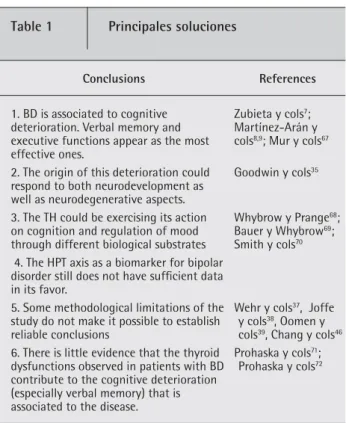
The principal conclusions of this review are summarized in table 1.
The principal purpose of this review has been to clarify up to what point alterations in the HPT axis could be related with the course of the BD per se and to the cognitive deterioration associated to bipolar patients.
In regards to point 1, the cognitive defects and BD, it can be stated that they are two aspects that are almost inseparable and that they are repeated as a leitmotiv in a large percentage of patients (40-60%), above all verbal memory and executive functions deficits.10 However, the
etiology of this deterioration has still not been well established35 (point 2).
Point 3: In regards to the relationship of the TH with cognition and mood regulation, different brain mechanisms are proposed through which the THs exert their effect. In the case of mood modulation, there are different hypotheses that support that the action of the thyroid hormone interacts with the noradrenergic68 and serotoninergic system of the
Depression.
-Musselmen and Nemeroff48 have summarized the levels
on which the thyroid dysfunctions were found in patients with depressive episodes:
Alterations in TSH when responding to TRH.
1. 49;50
Elevated abnormal prevalences of anti-thyroid 2.
antibodies.51;52
Elevated concentrations of TRH in LCR.
3. 53;54
In regards to response to antidepressant treatment, there are studies that use TSH levels as predictors of good response to treatment. It seems that low levels of free thyroxine (T4-F) and high levels of TSH, within the normal ranges, predict poor response in the first treatment days and, complimentarily, high levels of T4-F and low levels of TSH are associated to rapid resolution of the depressive episode.55 Frye et al.,56 in a longitudinal
study that evaluated prophylactic treatment with lithium versus carbamazepine, found that there were lower levels of T4-F in the lithium phase that were associated with greater affective instability (= more episodes) and greater severity of depressions. Hatterer et al.57 also obtained similar results, but with levels of
T3. In fact, it seems that depressions with melancholic traits or that are treatment resistant are those most associated to subclinical thyroid dysfunctions.58 Finally,
Haggerty59 hypothesizes that SCH decreases the
threshold for the occurrence of depression.
Is there a connection between thyroid disorders
and cognitive ones?
Thyroid hormones (TH) are essential for brain development, intervene in glial proliferation, myelinization and in synthesis of enzymes for the formation of neurotransmitters. 60 Thus, the deficit of these hormones in
prenatal periods causes profound mental retardation and cretinism. In the adult stage, the implication of TH deficit in cognition (a) is well-established if there is evident hyperthyroidism. However, (b) in the cases of SCH, the validity of this statement is dispelled.
(a) The deficits recorded in evident hypothyroidism are:
a)
memory, general intelligence, attention and concentration, psychomotor speed, visuo-perceptive skills and constructive skills.61 In addition, in elderly
patients, hypothyroidism may be a cause of dementia (or pseudodementia).61
(b) In regards to SCH, there are discrepancies on different
b)
levels: (1) if SCH really produces cognitive deficits and (2) if these deficits –if they exist - are reversible with replacement treatment (T4 or combination of T3/T4). While the oldest studies seem to favor the existence of cognitive alterations in SCH, the most recent ones refute
mentioned have some methodological limitations: Lack of a control group,38;39 retrospective design and without
comparison of control group, 37 differences in age between
groups and lack of monitoring of the lithium doses with objectivation of lithemias.46
Point 6: According to what we know and have reviewed, there are few studies that include the three aspects herein mentioned (SCH, BD and cognitive deficits). Prohaska et al.72
carried out research in which they proposed that part of the cognitive alterations produced by lithium, and especially verbal learning, were a consequence of the drug on the functioning of the thyroid axis. The high levels of TSH correlated with low scores on the verbal learning test and in addition, no correlations were established between lithemias and the scores on this test. According to this hypothesis, it could also be expected that treatment with thyroxine would reverse these deficits.71 Thus, if we apply this same reasoning,
patients diagnosed of BD and with treated SCH do not necessarily have to have a greater cognitive deterioration than those without this dual diagnosis.
Finally, in spite of the fact that in this review it was not possible to gather sufficient conclusive evidence on the role of the HPT axis in cognition and BD, signs were found on the existence of a subgroup of patients with high susceptibility in this endocrine axis. If this susceptibility is prior to the onset of the disorder, if it is self-limited to the acute phases or if it is a consequence of the evolution itself of the disorder must still be clarified. It is also not known if it could be a marker of severity, resistance or atypicity.
ACKNOWLEDGMENTS
The authors thank the Ministerio de Innovación y Ciencia, Instituto de Salud Carlos III, CIBERSAM and the Institut d’Investigacions Biomèdiques August Pi i Sunyer (IDIBAPS)
REFERENCES
1. Hirschfeld RM, Calabrese JR, Weissman MM, et al. Screen-ing for bipolar disorder in the community. J Clin Psychiatry 2003;64: 53-9
2. Merikangas KR, Akiskal HS, Angst J, et al. Lifetime and 12-month prevalence of bipolar spectrum disorder in the national comorbidity survey replication. Arch Gen Psychiatry 2007;64: 543-52
3. Angst J. [Epidemiology of the bipolar spectrum]. Encephale 1995;21 Spec No 6: 37-42
4. Vieta E, Gasto C, Martinez de Osaba MJ, et al. Prediction of depressive relapse in remitted bipolar patients using cortico-trophin-releasing hormone challenge test. Acta Psychiatr Scand 1997;95: 205-11
5. Holsboer F. The corticosteroid receptor hypothesis of depression. Neuropsychopharmacology 2000;23: 477-501
CNS. 69 Even more, this could be the biological substrate that
would explain the effectiveness of the TH replacement treatment (levothyroxine) as coadjuvant therapy for the treatment of euthyroid patients with resistant BD (rapid cycling)73;74 and resistant bipolar depression.75
In regards to cognition, the review of Smith et al.70
proposes that TH would act on the cholinergic system on the level of the basal forebrain and hippocampus. In this sense, the TH in the bipolar disorder has been shown to be useful to decrease the amnesic effects of electroconvulsive therapy and to accelerate the effects of this treatment.76
Point 4: The SCH is the thyroid dysfunction most associated to BD. Approximately 30% of the patients treated with lithium develop this condition. 42 One of the hypothesis
that has been verified is that of the RC and SCH proposed by Bauer et al.43 and verified by Gyulai et al.44 Even though this
study manifests that the RC is associated to a latent hypofunction of the HPT axis, the directionality of this relationship (RC and SCH) is still under debate.
When we focus on studies that have tried to provide a profile of the response of the axis in the acute phases of BD, non-specific heterogeneous responses are also obtained45;46
and even negative results. 47 Thus, the idea that this axis may
function as a biomarker is still very incipient.
Point 5: In any event, it is difficult to establish any solid conclusion considering that some of the studies
Table 1 Principales soluciones
Conclusions References 1. BD is associated to cognitive
deterioration. Verbal memory and executive functions appear as the most effective ones.
Zubieta y cols7;
Martínez-Arán y cols8,9; Mur y cols67
2. The origin of this deterioration could respond to both neurodevelopment as well as neurodegenerative aspects.
Goodwin y cols35
3. The TH could be exercising its action on cognition and regulation of mood through different biological substrates
Whybrow y Prange68;
Bauer y Whybrow69;
Smith y cols70
4. The HPT axis as a biomarker for bipolar disorder still does not have suffi cient data in its favor.
5. Some methodological limitations of the study do not make it possible to establish reliable conclusions
Wehr y cols37, Joffe
y cols38, Oomen y
cols39, Chang y cols46
6. There is little evidence that the thyroid dysfunctions observed in patients with BD contribute to the cognitive deterioration (especially verbal memory) that is associated to the disease.
Prohaska y cols71;
assessment of human neurotoxic syndromes. 2nd Edition ed. NY: 1995
27. van Gorp WG, Altshuler L, Theberge DC, et al. Cognitive im-pairment in euthymic bipolar patients with and without prior alcohol dependence. A preliminary study. Arch Gen Psychiatry 1998;55: 41-6
28. Savitz JB, van der ML, Stein DJ, et al. Neuropsychological task per-formance in bipolar spectrum illness: genetics, alcohol abuse, medi-cation and childhood trauma. Bipolar Disord 2008;10: 479-94 29. Tabarés-Seisdedos R, Balanzá-Martínez V, Sánchez-Moreno J,
Martinez-Aran A, Salazar-Fraile J, Selva-Vera G, Rubio C, Mata I, Gómez-Beneyto M, Vieta E. Neurocognitive and clinical predic-tors of functional outcome in patients with schizophrenia and bipolar I disorder at one-year follow-up. J Affect Disord. 2008 Aug;109(3):286-99
30. Ferrier IN, Stanton BR, Kelly TP, et al. Neuropsychological func-tion in euthymic patients with bipolar disorder. Br J Psychiatry 1999;175: 246-51
31. Clark L, Iversen SD, Goodwin GM. Sustained attention defi cit in bipolar disorder. Br J Psychiatry 2002;180: 313-9
32. Torrent C, Martinez-Aran A, Daban C, et al. Cognitive impair-ment in bipolar II disorder. Br J Psychiatry 2006;189: 254-9 33. Martinez-Aran A, Torrent C, Tabares-Seisdedos R, et al.
Neuro-cognitive impairment in bipolar patients with and without his-tory of psychosis. J Clin Psychiatry 2008;69: 233-9
34. Glahn DC, Bearden CE, Barguil M, Barrett J, Reichenberg A, Bowden CL, Soares JC, Velligan DI.The neurocognitive signa-ture of psychotic bipolar disorder Biol Psychiatry. 2007 Oct 15;62(8):910-6
35. Goodwin GM, Martinez-Aran A, Glahn DC, et al. Cognitive im-pairment in bipolar disorder: neurodevelopment or neurodegen-eration? An ECNP expert meeting report. Eur Neuropsychophar-macol 2008;18: 787-93
36. Cowdry RW, Wehr TA, Zis AP, et al. Thyroid abnormalities as-sociated with rapid-cycling bipolar illness. Arch Gen Psychiatry 1983;40: 414-20
37. Wehr TA, Sack DA, Rosenthal NE, et al. Rapid cycling affective disorder: contributing factors and treatment responses in 51 pa-tients. Am J Psychiatry 1988;145: 179-84
38. Joffe RT, Kutcher S, MacDonald C. Thyroid function and bipolar affective disorder. Psychiatry Res 1988;25: 117-21
39. Oomen HA, Schipperijn AJ, Drexhage HA. The prevalence of af-fective disorder and in particular of a rapid cycling of bipolar disorder in patients with abnormal thyroid function tests. Clin Endocrinol (Oxf) 1996;45: 215-23
40. Lazarus JH. The effects of lithium therapy on thyroid and thyro-tropin-releasing hormone. Thyroid 1998;8: 909-13
41. Valle J, Ayuso-Gutierrez JL, Abril A, et al. Evaluation of thy-roid function in lithium-naive bipolar patients. Eur Psychiatry 1999;14: 341-5
42. Zhang ZJ, Qiang L, Kang WH, et al. Differences in hypothyroidism between lithium-free and -treated patients with bipolar disor-ders. Life Sci 2006;78: 771-6
43. Bauer MS, Whybrow PC, Winokur A. Rapid cycling bipolar affec-tive disorder. I. Association with grade I hypothyroidism. Arch Gen Psychiatry 1990;47: 427-32
44. Gyulai L, Bauer M, Bauer MS, et al. Thyroid hypofunction in patients with rapid-cycling bipolar disorder after lithium chal-lenge. Biol Psychiatry 2003;53: 899-905
45. Zarate CA, Tohen M, Zarate SB. Thyroid function tests in fi rst-episode bipolar disorder manic and mixed types. Biol Psychiatry 1997;42: 302-4
46. Chang KD, Keck PE, Jr., Stanton SP, et al. Differences in thyroid function between bipolar manic and mixed states. Biol Psychia-6. Daban C, Vieta E, Mackin P, et al.
Hypothalamic-pituitary-adrenal axis and bipolar disorder. Psychiatr Clin North Am 2005;28: 469-80
7. Zubieta JK, Huguelet P, O’Neil RL, et al. Cognitive function in euthymic bipolar I disorder. Psychiatry Res 2001;102: 9-20 8. Martinez-Aran A, Vieta E, Colom F, et al. Cognitive impairment
in euthymic bipolar patients: implications for clinical and func-tional outcome. Bipolar Disord 2004;6: 224-32
9. Martinez-Aran A, Vieta E, Reinares M, et al. Cognitive function across manic or hypomanic, depressed, and euthymic states in bipolar disorder. Am J Psychiatry 2004;161: 262-70
10. Robinson LJ, Thompson JM, Gallagher P, et al. A meta-analysis of cognitive defi cits in euthymic patients with bipolar disorder. J Affect Disord 2006;93: 105-15
11. Martinez-Aran A, Vieta E, Torrent C, et al. Functional outcome in bipolar disorder: the role of clinical and cognitive factors. Bipolar Disord 2007;9: 103-13
12. Torrent C, Martinez-Aran A, Amann B, et al. Cognitive im-pairment in schizoaffective disorder: a comparison with non-psychotic bipolar and healthy subjects. Acta Psychiatr Scand 2007;116: 453-60
13. Denicoff KD, Ali SO, Mirsky AF, et al. Relationship between prior course of illness and neuropsychological functioning in patients with bipolar disorder. J Affect Disord 1999;56: 67-73
14. Balanza-Martinez V, Rubio C, Selva-Vera G, et al. Neurocogni-tive endophenotypes (Endophenocognitypes) from studies of relatives of bipolar disorder subjects: A systematic review. Neu-rosci Biobehav Rev 2008;
15. Arts B, Jabben N, Krabbendam L, et al. Meta-analyses of cog-nitive functioning in euthymic bipolar patients and their fi rst-degree relatives. Psychol Med 2008;38: 771-85
16. Martinez-Aran A, Penades R, Vieta E, et al. Executive function in patients with remitted bipolar disorder and schizophrenia and its relationship with functional outcome. Psychother Psychosom 2002;71: 39-46
17. Mur M, Portella MJ, Martinez-Aran A, et al. Persistent neuropsy-chological defi cit in euthymic bipolar patients: executive func-tion as a core defi cit. J Clin Psychiatry 2007;68: 1078-86 18. Mur M, Portella MJ, Martinez-Aran A, et al. Long-Term Stability
of Cognitive Impairment in Bipolar Disorder: A 2-Year Follow-Up Study of Lithium-Treated Euthymic Bipolar Patients. J Clin Psychiatry 2008; e1-e8
19. Kolur US, Reddy YC, John JP, et al. Sustained attention and exec-utive functions in euthymic young people with bipolar disorder. Br J Psychiatry 2006;189: 453-8
20. Daban C, Martinez-Aran A, Torrent C, et al. Specifi city of cogni-tive defi cits in bipolar disorder versus schizophrenia. A system-atic review. Psychother Psychosom 2006;75: 72-84
21. Gottesman II, Gould TD. The endophenotype concept in psy-chiatry: etymology and strategic intentions. Am J Psychiatry 2003;160: 636-45
22. Ferrier IN, Chowdhury R, Thompson JM, et al. Neurocognitive function in unaffected fi rst-degree relatives of patients with bipolar disorder: a preliminary report. Bipolar Disord 2004;6: 319-22
23. Zalla T, Joyce C, Szoke A, et al. Executive dysfunctions as po-tential markers of familial vulnerability to bipolar disorder and schizophrenia. Psychiatry Res 2004;121: 207-17
24. Frantom LV, Allen DN, Cross CL. Neurocognitive endophenotypes for bipolar disorder. Bipolar Disord 2008;10: 387-99
25. Bora E, Vahip S, Akdeniz F, et al. Executive and verbal working memory dysfunction in fi rst-degree relatives of patients with bipolar disorder. Psychiatry Res 2008;
12-month study of L-thyroxine treatment of women with ‘sub-clinical’ hypothyroidism. Clin Endocrinol (Oxf) 1988;29: 63-75 64. Monzani F, Del GP, Caraccio N, et al. Subclinical hypothyroidism:
neurobehavioral features and benefi cial effect of L-thyroxine treatment. Clin Investig 1993;71: 367-71
65. Bono G, Fancellu R, Blandini F, et al. Cognitive and affective status in mild hypothyroidism and interactions with L-thyroxine treatment. Acta Neurol Scand 2004;110: 59-66
66. Jorde R, Waterloo K, Storhaug H, et al. Neuropsychological func-tion and symptoms in subjects with subclinical hypothyroidism and the effect of thyroxine treatment. J Clin Endocrinol Metab 2006;91: 145-53
67. Mur M, Portella MJ, Martinez-Aran A, et al. Long-term stability of cognitive impairment in bipolar disorder: a 2-year follow-up study of lithium-treated euthymic bipolar patients. J Clin Psy-chiatry 2008;69: 712-9
68. Whybrow PC, Prange AJ, Jr. A hypothesis of thyroid-catecho-lamine-receptor interaction. Its relevance to affective illness. Arch Gen Psychiatry 1981;38: 106-13
69. Bauer M, Whybrow PC. Thyroid hormone, neural tissue and mood modulation. World J Biol Psychiatry 2001;2: 59-69 70. Smith JW, Evans AT, Costall B, et al. Thyroid hormones, brain
function and cognition: a brief review. Neurosci Biobehav Rev 2002;26: 45-60
71. Prohaska ML, Stern RA, Nevels CT, et al. Thyroid hormone and lithium related- neuropsychological defi cits: a preliminary test of the lithium-thyroid interactive hypothesis. J Int Neuropsy-chological Soc 1995; 134
72. Prohaska ML, Stern RA, Nevels CT, et al. The relationship be-tween thyroid status and neuropsychologial performance in psychiatric outpatients maintained on lithium. Neuropsychiatry Neuropsychol Behav Neurol 1996;9: 30-4
73. Whybrow PC. The therapeutic use of triiodothyronine and high dose thyroxine in psychiatric disorder. Acta Med Austriaca 1994;21: 47-52
74. Bauer M, Berghofer A, Bschor T, et al. Supraphysiological doses of L-thyroxine in the maintenance treatment of prophylaxis-resistant affective disorders. Neuropsychopharmacology 2002;27: 620-8 75. Bauer M, London ED, Rasgon N, et al. Supraphysiological doses
of levothyroxine alter regional cerebral metabolism and improve mood in bipolar depression. Mol Psychiatry 2005;10: 456-69 76. Stern RA, Nevels CT, Shelhorse ME, et al. Antidepressant and
memory effects of combined thyroid hormone treatment and electroconvulsive therapy: preliminary fi ndings. Biol Psychiatry 1991;30: 623-7
try 1998;43: 730-3
47. Cassidy F, Ahearn EP, Carroll BJ. Thyroid function in mixed and pure manic episodes. Bipolar Disord 2002;4: 393-7
48. Musselman DL, Nemeroff CB. Depression and endocrine disor-ders: focus on the thyroid and adrenal system. Br J Psychiatry Suppl 1996; 123-8
49. Loosen PT, Prange AJ, Jr. Serum thyrotropin response to thyro-tropin-releasing hormone in psychiatric patients: a review. Am J Psychiatry 1982;139: 405-16
50. Larsen JK, Faber J, Christensen EM, et al. Relationship between mood and TSH response to TRH stimulation in bipolar affective disorder. Psychoneuroendocrinology 2004;29: 917-24
51. Gold MS, Pottash AL, Extein I. “Symptomless” autoimmune thy-roiditis in depression. Psychiatry Res 1982;6: 261-9
52. Nemeroff CB, Simon JS, Haggerty JJ, Jr., et al. Antithyroid anti-bodies in depressed patients. Am J Psychiatry 1985;142: 840-3 53. Banki CM, Bissette G, Arato M, et al. Elevation of immunoreactive
CSF TRH in depressed patients. Am J Psychiatry 1988;145: 1526-31 54. Kirkegaard C, Faber J, Hummer L, et al. Increased levels of TRH in
cerebrospinal fl uid from patients with endogenous depression. Psychoneuroendocrinology 1979;4: 227-35
55. Cole DP, Thase ME, Mallinger AG, et al. Slower treatment re-sponse in bipolar depression predicted by lower pretreatment thyroid function. Am J Psychiatry 2002;159: 116-21
56. Frye MA, Denicoff KD, Bryan AL, et al. Association between low-er slow-erum free T4 and greatlow-er mood instability and depression in lithium-maintained bipolar patients. Am J Psychiatry 1999;156: 1909-14
57. Hatterer JA, Kocsis JH, Stokes PE. Thyroid function in patients maintained on lithium. Psychiatry Res 1988;26: 249-57 58. Rao ML, Ruhrmann S, Retey B, et al. Low plasma thyroid
in-dices of depressed patients are attenuated by antidepressant drugs and infl uence treatment outcome. Pharmacopsychiatry 1996;29: 180-6
59. Haggerty JJ, Jr., Stern RA, Mason GA, et al. Subclinical hypothy-roidism: a modifi able risk factor for depression? Am J Psychiatry 1993;150: 508-10
60. Bernal J, Nunez J. Thyroid hormones and brain development. Eur J Endocrinol 1995;133: 390-8
61. Dugbartey AT. Neurocognitive aspects of hypothyroidism. Arch Intern Med 1998;158: 1413-8
62. Haggerty JJ, Jr., Evans DL, Prange AJ, Jr. Organic brain syndrome associated with marginal hypothyroidism. Am J Psychiatry 1986;143: 785-6