Volume 49 Issue 2 Article 4
2020
Parent Borrowing and College Completion
Parent Borrowing and College Completion
Jennie H. WooRTI, International, [email protected]
Stephen Lew
RTI, International, [email protected]
Follow this and additional works at: https://ir.library.louisville.edu/jsfa Recommended Citation
Recommended Citation
Woo, Jennie H. and Lew, Stephen (2020) "Parent Borrowing and College Completion," Journal of Student Financial Aid: Vol. 49 : Iss. 2 , Article 4.
Available at: https://ir.library.louisville.edu/jsfa/vol49/iss2/4
This Research Article is brought to you for free and open access by ThinkIR: The University of Louisville's Institutional Repository. It has been accepted for inclusion in Journal of Student Financial Aid by an authorized administrator of ThinkIR: The University of Louisville's Institutional Repository. For more information, please contact [email protected].
Parent PLUS loans are available for parents of traditional students, allowing them to borrow up to the complete cost of attendance if they pass a credit check. Having access to more loan funds might increase a student’s chances of obtaining a bachelor’s degree by allowing them to attend a higher quality school, or to spend fewer hours working and perform better academically. Among students who intend to earn a 4-year degree and are eligible for PLUS loans, are those whose parents take out Parent PLUS loans, more likely to earn BA degrees than those who don’t? Using the 2004/09 Beginning Postsecondary Students Longitudinal Study (BPS: 04/09) and controlling for student demographic characteristics, parent’s financial resources, support level, family demographic characteristics, the child’s academic ability, institution sector, and the child’s transfer status we examine this possibility. The initial regression showed that having a Parent PLUS loan was not significantly associated with the probability of earning bachelor’s degree within 6 years of first enrollment. However, after weighting the sample by inverse propensity scores we found that having a PLUS loan significantly increased the odds of earning a bachelor’s degree by 43%.
Keywords: Parent PLUS, student loans, parental support, BA completion
inancial aid allows students, who otherwise don’t have the means, to access a college education and the ensuing benefits. In the past 30 years the proportion of high school graduates from low-income backgrounds who enrolled in higher education rose impressively from 40% in 1985 to 69% in 2015 (NCES 2016). However, entering college does not always lead to success. Government estimates show that of those who began a 4-year college education in 2003-04, only 58% had obtained a bachelor’s degree by 2009 (Radford et al. 2010). In their analysis, Radford et al. found that completion rates for this cohort differed starkly by family income, with the highest income group whose family reported over $92,000 per year, succeeding at the rate of 76% while the lowest group, under $32,000, had a completion rate of 47%. These data imply that family financial resources might strongly influence not only on getting to college, but on persisting through to completion. Resources might assist college completion directly by covering all college expenses so the student can work less for wages and study more, and indirectly by allowing matriculation to a higher quality institution with better support in the first place.
College students who are not from wealthy families or gifted enough to receive full scholarships, can tap few sources for extra liquidity. The federal grant and loan programs include strict limits and most students’
Jennie H. Woo is a Senior Fellow at JW Partnership and Stephen Lew is a Research Systems Programmer Analyst at RTI, International
financial aid doesn’t cover all the expenses of attending their institutions (Janko et al. 2019).1 One federal
loan program, however, contains high limits, covering all expenses associated with the total cost of college attendance minus financial aid already received – the Parent PLUS loan program (U.S. Department of Education 2015). While generous in this way compared to other federal loan programs, Parent PLUS loans target only credit-worthy parents of dependent students. This focus actually provides an opportunity to examine directly the completion effects for a group of mostly middle-income students with involved parents. These students might not have faced as many other academic, social, and familial constraints as those that plagued lower-income students who were more likely to be minority, first-generation college goers, first- or second-generation immigrants, or learned English as a second language (Chen and Nunnery 2020). This targeting allows us to concentrate on one question - does simply having sufficient resources while attending school make any difference in the likelihood of completing college?
Parent PLUS loans currently represent a growing undergraduate source of federal loans. In AY2016-17 the federal government lent over $12 billion in new PLUS loans to the parents of undergraduates, a 16% increase from $10.6 billion in AY2010-11 (authors’ tabulations, US Department of Education 2017). Adjusting for the decrease in undergraduate enrollment and the increase in inflation, we found from this same data source, that the PLUS loan amounts per loan recipient also increased 13% in the period. We calculated that Parent PLUS loans grew from comprising 15% of all undergraduate loan disbursements to 23% in those six years, increasing its importance to the federal loan programs.
Created in 1980, the Parent PLUS program allowed middle-income parents to borrow for their children who needed assistance covering the full cost of college. Parent PLUS loans were limited to the biological, adoptive, or in some cases step-parents of dependent students (U.S. Department of Education 2015). Those are undergraduate students under 24 years old, single, without children or other dependents, not an orphan or otherwise without family, and not serving in the U.S. armed forces nor a veteran. Federal loans were only available to students who were U.S. citizens or eligible noncitizens and who were enrolled at least half-time in an eligible degree program. Unlike federal grants and Subsidized Direct loans, parent borrowers did not have to demonstrate the financial need of the student, but they had to possess a clean credit history with no recent delinquent or defaulted loans. The loan amounts were not as limited as Federal Direct loans. Initially they were capped lower but after 1992 parents could borrow up to the full cost of attending college -- tuition and living expenses -- net of other financial assistance. (Beginning in 2006, graduate students were also allowed to take out PLUS loans, but these are not part of this analysis. 2) Given their targeting of
traditional, relatively financially stable families with the backing of the federal government, Parent PLUS loans appear to represent a type of financial aid that enables choice in postsecondary education as much as access (Fishman 2014; McClure 2017; Rodriguez 2014). Who is most likely to benefit from these loans? And with the greater choice afforded by these extra funds for eligible families, do they improve chances for degree completion?
This paper describes who uses Parent PLUS loans and examines whether the provision of PLUS loans, with their greater liquidity, might cause better academic outcomes – namely increasing the likelihood of
completing a bachelor’s degree. To assess this, we used inverse propensity weighting to create two comparable groups – those who had PLUS loans and those who were eligible but did not borrow. By estimating the average treatment effect on the treated, those who had Parent PLUS loans, and comparing it to the control,
1 For eligibility and amount limits for federal grant and loan programs, see U.S. Department of Education, Office of Federal
Student Aid websites: https://studentaid.ed.gov/sa/sites/default/files/federal-grant-programs.pdf and https://studentaid.ed.gov/sa/sites/default/files/federal-loan-programs.pdf
2 Private banks offer student loans that are market-driven, tend to carry higher interest rates, possess fewer repayment
protections, and impose higher credit barriers than federal loans but offer enhanced liquidity similar to Parent PLUS loans (Woo and Velez 2016). They are also not examined here.
those without, we found in the analysis described below, that those with Parent PLUS loans were significantly
more likely by 43%, to complete a bachelor’s degree.
Literature Review
College Completion, Loans, and Persistence
Recently, families are more motivated to see their children obtain a college degree but have fewer means to cover the increasing costs. The returns to a bachelor’s degree are high and have risen in the past three decades, compared to having a two-year degree, some college, or a high school degree (Abel and Deitz 2014; Autor 2014; Baum et al. 2013; Carnevale et al. 2011; Goldin and Katz 2008; Lindley and Machin 2016; Oreopoulos and Petronijevic 2013). At the same time, the burden of paying for college has shifted substantially from taxpayers to individual students and their families (Callan and Finney, 1997; Mumper, 1996). And the population which seeks higher education has become more financially unequal, with a higher proportion of lower-income and less prepared students seeking a college education (Bound et al. 2010; Belley and Lochner 2007).
In this environment, research indicates that borrowing can enhance completion. Obtaining loans reduces the burden of work hours during school allowing students to concentrate on studying (Avery and Turner 2012; Scott-Clayton 2012). For example, Denning (2017) concluded that seniors who became eligible for higher loan amounts had shorter times to degree because they tried more credits and worked fewer hours. Studies have shown that loans can have a positive benefit for access and persistence, (Alon, 2007; Chen and DesJardins, 2010; DesJardins et al. 2002; Singell, 2004). Cofer and Somers (2000) found that the loan amount was positively associated with in-year persistence for undergraduates at four-year institutions.
Evidence exists that the choice of college plays a role in degree completion. Graduation rates vary by the quality and resources of an institution and several studies have demonstrated that students who gain admittance to more selective institutions with more resources increased their chances of graduation (Goodman et al. 2015; Shamsuddin 2016; Smith 2013). Conversely lower quality institutions have lower graduation rates and lower college completion rates at public universities appears to be due to reduced resources expended per student (Bound et al. 2010; Cohodes and Goodman 2014).
There is evidence that student loans, in overcoming credit constraints, lead to better human capital investment (Lochner and Monge-Naranjo 2011). The effect does not appear uniform for all types of students. Many studies which examined the relation between loan provision and academic success by student characteristics found that they work better for the more affluent than lower-income groups (Dwyer et al. 2012; Dynarski 2002; Kim, 2007; Paulsen and St. John 2002; Stinebrickner and Stinebrickner 2008). Higher levels of enrollment intensity and persistence were found for community college students who had access to loans in some recent studies (Dunlop 2013; Weiderspan 2016) but not in an older report (Dowd and Coury 2006).
Role of Parents
Parents seem to play an important role in successful college attendance and this might also extend to the behavior of students whose parents went into debt to support their college dreams. Research has shown that aside from the institutional quality -- especially academic instruction, the level of student support services, and other ancillary characteristics – background factors also predict successful bachelor’s degree completion
(Bound et al. 2010). The financial resources of families constitute the largest such factor (Belley and Lochner 2007; Bailey and Dynarski 2011; Smith and Stange 2015). The academic preparation of the student, associated with their academic ability and the quality of their high school training as influenced by parents, comprises another key element of success (Keane and Wolpin 2001).
In addition, parents could play other roles as well. Researchers have found that parental involvement is associated with aspiring to and enrolling in college, (Cabrera and La Nasa 2000; Horn 1998; Hossler et al. 1989; Hossler et al. 1999; Perna 2000), as well as earning higher grades (Lee 1993; Muller 1993; Zick et al. 2001). Parental education can also providecultural capital that strongly enhances students’ educational careers
(Perna and Titus 2005). Parent’s attitude and encouragement, as well as enough financial aid, were found to be crucial in persistence (Cabrera et al. 1993).
Parent PLUS Loan Research
Researchers have not studied the direct effects of Parent PLUS loans as often as those of other loan types, possibly because of its relatively small size. Overall, Parent PLUS disbursements made up just 14% of all loan volume, undergraduate and graduate, in AY2016-17 which is higher than previously (US Department of Education 2017). These loans are also not included in the U.S. Department of Education’s default rates used to inform students about borrowing risks and to administer the federal loan program. Parent PLUS default rates are not released publicly by the government on a regular basis but several releases of different types of rates for various years shows the rate to be much lower than for other undergraduate loan types, making them of less concern to policy-makers (Office of Management and Budget 2017; US Department of Education 2012). There is even evidence that the government earns money on these loans (Congressional Budget Office 2014). Some research shows that certain rare types of schools rely heavily on Parent PLUS loans for their financing model: historically black colleges and some specialized technology, art and design schools. (Dancy 2016; Doubleday 2013; Rodriguez 2014).
Parents’ willingness to contribute to their child’s educational costs by going into debt appears associated with their having better financial circumstances, including higher income, higher education level, and being married; with fewer children, and having high parental educational aspirations which could be indirectly positively related to academic achievement (Steelman and Powell 1991). Parental willingness to go into debt when their children were already attending college were found in the same study by Steelman and Powell, to be associated with higher parent’s education, greater parental educational aspirations, having a male child rather than a female, lower child’s test scores, and fewer children. One of the few studies which focused directly on the role of Parent PLUS loans on persistence found that the loans had no effect on full-time
four-year students’ re-enrollment from fall to spring semesters when compared to other types of loans (McClure 2017).
Who Uses Parent PLUS Loans?
To identify who benefits from Parent PLUS loans, we examined data from the 2015-16 National Postsecondary Student Aid Study (NPSAS:16) (NCES n.d.). This is the most recent cross-sectional, nationally representative dataset which covers students’ demographic characteristics, academic programs, financial aid, and student loans for the academic year 2015-16 (NCES 2018b).
As Parent PLUS loans are limited to credit-worthy parents of dependent undergraduates enrolled at least half-time, only 4% of undergraduates used Parent PLUS loans in 2015-16, compared to 36% who received either Direct Subsidized or Unsubsidized loans (authors’ tabulations, National Postsecondary Student Aid
Study 2016, NPSAS:16). The average amount lent per year per student in PLUS loans was $14,000 in 2015-16 dollars. Parent PLUS loans are primarily used for students to attend four-year institutions where the tuition is higher than 2-year or shorter courses of study. Among dependent undergraduates, the for-profit sector, at all levels, had the highest proportion of students whose families took out PLUS loans, with 19% of dependent
undergraduates’ parents at for-profit schools using them in 2015-16.3 In contrast, 15% of private nonprofit
four-year dependent students’ families took out PLUS loans and 10% of families of public four-year students did so. However, the majority of PLUS loan recipients, just as the majority of all undergraduates in bachelor’s
degree programs, attended public four-year institutions. About 64% of all four-year students attended public institutions, and 60% of four-year students with PLUS loans were enrolled in public institutions (authors’
tabulations, NPSAS:16).
Evidence from NPSAS indicates that even among dependent undergraduates, Parent PLUS loans were generally used by middle-income or wealthier families (Figure 1). Students from families with incomes above the 50th percentile (about $63,000) borrowed at significantly higher rates than families at lower incomes did.
Of those in the 50th to 75th quartile ($63,000 to $113,000), for example, 10% had Parent PLUS loans while 6%
from the lowest quartile (below $27,500) received these loans. Figure 1
Percentage of dependent undergraduates with PLUS loans by parent’s income quartile: 2015-16
Source: U.S. Department of Education, National Center for Education Statistics, 2015-16 National Postsecondary Student Aid Study (NPSAS:16).
9 6 8 10 10 0 2 4 6 8 10 12 Total Below $27,500 $27,500 -$62,700 $62,700 -$113,200 Over $113,200
Table 1
Profile of Parent PLUS borrowers and other dependent undergraduates: 2015-16
Characteristic PLUS Loan PLUS Different No
Average family size 4 4
Percent Black 19 11 *
Percent with a BA or above 56 53 *
Percent married 65 62 *
Average family income (including zero) $92,700 $83,800 * Median family income (including zero) $74,400 $62,000 *
Average tuition of student $20,300 $11,000 *
Average paid in federal taxes (including zero) $9,700 $8,600 * Median paid in federal taxes (including zero) $4,150 $2,300 * Average Expected Family Contribution (inc
zero) 15,200 15,200
Median Expected Family Contribution (inc
zero) $8,300 $5,300 *
Percent borrowing elsewhere besides PLUS 96 38 *
Average amount borrowed in PLUS $14,027 $0 *
Average amount borrowed all sources (> zero) $20,435 $7,509 * Note: Estimates cited as significantly different were compared using the students t statistic at the p < .05 level.
Source: U.S. Department of Education, National Center for Education Statistics, National Postsecondary Student Aid Study (NPSAS:16).
The income of a PLUS borrower’s parents averaged $93,000, significantly higher than the $84,000 average for parents of dependent students without PLUS loans (Table 1). Among dependent students who received Pell grants (federal grants for low-income students), 9% took out Parent PLUS loans; a rate that was slightly but still significantly higher than 8%, the rate among those without a Pell (NPSAS:16).
The average family taking out Parent PLUS loans in 2015-16 had married parents, a family size of four people, and took out $20,400 in loans from all sources. The factor most strongly associated with taking out a PLUS loan was the tuition level of the institution, with Parent PLUS families facing an average tuition of $20,300 compared to $11,000 for families who did not take out PLUS loans. The average amount of Parent PLUS loans taken out in 2015-16 equaled about $14,000 with a median of $12,000 (NPSAS:16).4
4 The median amount of Expected Family Contribution (EFC) for PLUS borrowers was significantly higher than for those who
did not have PLUS loans, as expected, but the average amounts were not significantly different between the two groups. The EFC of PLUS borrowers at the 75th percentile or below was higher than those for non-PLUS borrowers. Above that, the PLUS
borrower percentiles were similar or lower than non-PLUS but significance was not possible due to a low number of cases. This suggests that there might be some families with very high EFCs among the group who did not borrow Parent PLUS loans, bringing up the average to a level similar to Parent PLUS borrowers, possibly due to very high assets. The maximum EFC in the database is $1,000,000.
The Role of Parent PLUS Loans in Degree Completion
To examine the link between financing education and completing a degree we required longitudinal data. We analyzed the 2004/09 Beginning Postsecondary Students Longitudinal Study (BPS: 04/09), a nationally-representative sample of college students who began postsecondary education in 2003-04 (NCES 2018a). The survey measured their progress in school, academic programs, employment, and how they paid for their education in the first, third, and sixth years after starting. This allowed a better perspective on the long-term outcomes of students’ financial aid options taken throughout college. We limited analysis to dependent undergraduate U.S. citizens since only their parents were eligible for these loans.5
Overall 40% of eligible dependent students who began postsecondary education in the 2003-04 academic
year, completed a bachelor’s degree 6 years later. About 50% of those whose parents took out PLUS loans
completed a bachelor’s degree and about 39% of those whose parents did not have PLUS loans, obtained a degree (Figure 2). This difference was large and significant for those who began in the 2-year sector, where 14% completed without PLUS loans and 32% completed with them. This didn’t hold for those who began in 4-year public or private nonprofit or selective institutions which had high completion rates and no significant difference in completion rate between those with or without PLUS loans. The for-profit sector had too few cases to measure.
5 Dependent students whose parents are denied a PLUS loan because of adverse credit history or other exceptional
circumstances can borrow more in unsubsidized loans. In 2003-04, for example, they were allowed to take out up to an additional $5,000 per year. We would have preferred to exclude this group since they also benefitted from more liquidity, although not through Parent PLUS loans, but we couldn’t identify them in the database. We estimated what proportion they might comprise from the cross-sectional data in NPSAS:04, for students at all undergraduate levels. Among dependent undergraduates in 2003-04 who did not have PLUS loans, less than 3% borrowed more than the loan limits for that year in subsidized or unsubsidized loans. Since they could have exceeded the limits for other reasons, some smaller proportion were presumably those whose parents had been denied PLUS loans.
Figure 2
Percentage of dependent students completing a bachelor’s degree within 6 years, by incidence of Parent PLYS loans and first
institution type: 2003-2009
Note: *Estimates are significantly different between the two groups using the students t statistic at the p < .05 level.
‡ Too few cases for a reliable estimate.
Source: U.S. Department of Education, National Center for. Education Statistics, Beginning Postsecondary Students Longitudinal Study (BPS:04/09).
Examining completion rates by level of family income, revealed that for the two middle-income groups, those with family incomes between $31,000 and $89,000, the Parent PLUS recipients had significantly higher completion rates than those without (Figure 3). For the higher middle-income group, those with incomes
between $56,000 and $89,000 and Parent PLUS loans, about 55% finished a bachelor’s degree compared to
41% without PLUS loans.
39 14 62 68 4 50 32 66 69 ‡ 0 10 20 30 40 50 60 70 80 Total* Pub or pnp 2 year*
Public 4-year Private
nonprofit 4-yr
For-profit
Figure 3
Percentage of dependent students completing a bachelor’s degree within 6 years, by incidence of Parent PLUS loans and family
income quartile: 2003-2009
Note: *Estimates are significantly different between the two groups using the student’s t statistic at the p < .05 level.
Source: U.S. Department of Education, National Center for. Education Statistics, Beginning Postsecondary Students Longitudinal Study (BPS:04/09).
Parent PLUS loans, like all student loans, allow students and their families to have access to more funds to pay for college. This increases the choice set of possible institutions, allowing a student to attend a more expensive institution than they otherwise might, or even to continue in college, if they cannot afford the cost of tuition and living expenses with the amount of financial aid they received. One possibility is that with the expansion of college choice, a student could attend an institution of higher quality which might boost their
chances of graduating. One of the biggest predictors of successful bachelor’s degree completion is the quality of the institution attended (Goodman et al. 2015; Shamsuddin 2016). With the ability to afford a larger set of
schools, a student could increase their chances of obtaining a bachelor’s degree. Another possibility is that it might allow a student, holding college quality constant, to spend more hours studying and fewer hours working and thereby attain better results at the same college (See Stinebrickner and Stinebrickner 2003; Scott-Clayton 2011).
These hopeful scenarios could be contrasted with a rare but darker one, where PLUS loans are introduced to a student and their family by a school to entice them to enroll but which is not necessarily a good fit for the student. This includes schools with low graduation rates, schools where the student, given their capabilities, is unlikely to finish, or schools where good employment doesn’t follow even with completion. These are often schools which use PLUS loans as a basis of their financing model (see Dancy, 2016 and Fishman, 2014). 25 34 41 57 27 44 55 62 0 10 20 30 40 50 60 70 Below $31,000 $31,000 - $56,000* $56,000 - $89,000* Over $89,000
Multivariate Study: Determinants of Earning a BA in Six Years
The objective of the multivariate analysis was to address the following question: Among students who intend to earn a 4-year degree and are eligible for PLUS loans, are those whose parents take out Parent PLUS loans, all things equal, more likely to earn BA degrees than those who don’t? This required a rich longitudinal dataset which could link the provision of loans to the ultimate academic success of the students, but control for the many intervening factors. BPS:04/09 included a breadth of corollary data that enabled this analysis, with
information on many aspects of the students’ background, academic status, financial resources, and debt. We could limit the analysis to those who were eligible for Parent PLUS loans because there was information on dependency, citizenship, attendance status, and highest degree expected.
The variables which we included in the multivariate analysis reflect the factors found in previous research to be important determinants of earning a bachelor’s degree within 6 years. We controlled for family financial resources by including measures of family income, whether parents owned their home, parents’ education
level, marital status, and race. We included the student’s gender, whether the they began at a 2-year public institution and transferred, and student’s academic ability with high school grades, and SAT math score or it’s ACT equivalent. Aside from parents’ education, another variable also measured the family’s familiarity with
college: whether the student had an older sibling who attended college. The size of the family and whether the family gave the student a monthly allowance indicated how supportive the family was or how well they could focus on the child in question. We included whether the student themselves also had taken out loans to control for some level of risk tolerance and familiarity with federal loans in general. Institution type, which plays a key role in determining success, was also added. Finally, we created a variable to indicate if the student attended one of the group of schools which had very high PLUS loan rates - over 25% of dependent students’
families taking out PLUS loans. The schools flagged were Historically Black Colleges and Universities (HBCUs) or specialized technology, art or design schools.
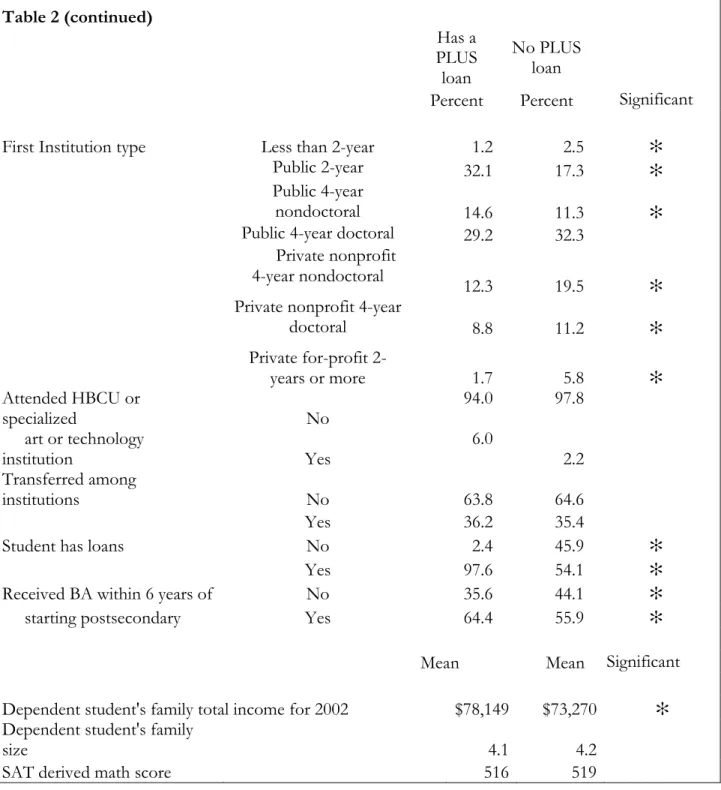
In a bivariate analysis of the selected variables, Table 2 shows the distribution of characteristics for both students whose parents’ used Parent Plus loans and students who qualified for these loans, but whose parents
didn’t receive them. Students whose families had Parent PLUS loans were more likely to be White, less likely to be Hispanic, or other race or ethnicity, while there was no difference for Blacks. PLUS loan parents mostly had a vocational education, some college, a 2-year degree, or a bachelor’s degree but rarely had just a high school or elementary education, or conversely had attended graduate school. Parent PLUS loans had disproportionate use by families of students who began at public 2-year or public 4-year non-doctorate institutions. As noted above, the largest number of PLUS loan parents have children attending 4-year institutions, so those who began at public 2-year institutions probably did most of their large borrowing only after they transferred to 4-year institutions.
Table 2
Among 2003-04 dependent beginning postsecondary students who expected to earn a BA or higher, percentage distribution or mean values of background characteristics, by whether parents had PLUS loans: 2003-2009
Has a
PLUS loan No PLUS Loan
Percent Percent Significant
Student's race/ethnicity White 72.2 66.9 ✻
Black 10.0 8.7
Hispanic 9.3 12.7 ✻
Other 8.6 11.7 ✻
Student's gender Female 53.6 54.7
Male 46.4 45.3
Parents' marital status Married 77.4 74.5
Single 22.6 25.5
Parents' highest education
High School 19.5 22.6
Voc or 2yr 27.5 23.5 ✻
Bachelor's degree 29.5 27.0
Graduate Level 23.6 26.9 ✻
Parents own home No 9.5 13.0
Yes 90.5 87.0
Siblings in college before No 52.7 54.1
student Yes 47.3 45.9
Parents provided monthly No 78.5 81.2
allowance Yes 21.5 18.8
Grade point average in 0.5-0.9 (D- to D) ‡ 0.1 !
high school 1.0-1.4 (D to C-) 0.7 !! 0.5 1.5-1.9 (C- to C) 1.6 ! 1.3 2.0-2.4 (C to B-) 7.0 9.4 2.5-2.9 (B- to B) 10.2 11.7 3.0-3.4 (B to A-) 37.6 35.4 3.5-4.0 (A- to A) 42.6 41.7
Table 2 (continued) Has a PLUS loan No PLUS loan
Percent Percent Significant
First Institution type Less than 2-year 1.2 2.5 ✻
Public 2-year 32.1 17.3 ✻
Public 4-year
nondoctoral 14.6 11.3 ✻
Public 4-year doctoral 29.2 32.3
Private nonprofit
4-year nondoctoral 12.3 19.5 ✻
Private nonprofit 4-year
doctoral 8.8 11.2 ✻ Private for-profit 2-years or more 1.7 5.8 ✻ Attended HBCU or specialized No 94.0 97.8 art or technology institution Yes 6.0 2.2 Transferred among institutions No 63.8 64.6 Yes 36.2 35.4
Student has loans No 2.4 45.9 ✻
Yes 97.6 54.1 ✻
Received BA within 6 years of No 35.6 44.1 ✻
starting postsecondary Yes 64.4 55.9 ✻
Mean Mean Significant
Dependent student's family total income for 2002 $78,149 $73,270 ✻ Dependent student's family
size 4.1 4.2
SAT derived math score 516 519
Note: *Estimates are significantly different between the two groups using the student’s t statistic at the p < .05 level. ‘‡’ means too few cases for a reliable estimate. ‘!’ means standard error is over 30 percent. ‘!!’
means standard error is over 50 percent
Source: U.S. Department of Education, National Center for Education Statistics, Beginning Postsecondary Students Longitudinal Study (BPS:04/09)
Determining whether Parent PLUS loans make a significant difference in college completion is challenging because not all parents need to consider PLUS loans, having enough savings or other liquidity to avoid extensive borrowing. Federal Stafford loans for the students themselves, both subsidized and unsubsidized, might be sufficient. Financial aid from other sources such as Pell grants, institutional and state grants,
scholarships from outside sources or gifts from extended family or community could also cover the bill with less future cost. Perhaps not surprisingly, of students whose parents had PLUS loans, 98% had borrowed themselves, indicating a willingness and a need to borrow substantially to finance college. Overall, of this
sample of dependent students who aspired to a bachelor’s degree, 64% of those with Parent PLUS loans
completed a bachelor’s degree in 6 years, significantly higher than the 56% of those who did not have PLUS
loans.
Methodology
Since students are not randomly assigned to Parent PLUS loans to finance their education, comparisons of outcomes between students who had different financing mechanisms will not simply reflect the difference in outcomes due to taking out Parent PLUS loans. Rather, the difference will be biased by characteristics of students in each group that are correlated with both the decision to take out a Parent PLUS loan and outcomes at 4-year institutions. While some characteristics may be observable in the dataset, such as race or gender, undoubtedly there are some unobserved, but equally important characteristics that can help explain both the decision to borrow and scholastic success. One important factor is academic ability because it influences both the kind of institution a student is admitted to and the receipt of merit-based student aid which reduces the necessity of taking out loans. Factors such as risk tolerance, existing parental financial debt, financial sophistication, understanding of financial aid options, and educational motivation comprise other important unobserved influences.
We took several measures to address these challenges. First, we excluded foreign students, independent
undergraduates and graduate students who are not eligible for these loans, as well as those who don’t aspire to get a bachelor’s degree or higher. This focused the analysis on the group of students whose parents had the option of using PLUS loans to increase their liquidity. Second, we tried to control for as many influencing factors as possible by using a database that was rich in student background and family financial data as well as financial aid and academic outcomes.
Finally, we employed the empirical technique of inverse propensity weighting (IPW) to assess the effects of having a Parent PLUS loan against a similar group who did not have these loans on the probability of
obtaining a bachelor’s degree within 6 years. This technique relies on observable characteristics to determine the predicted probability that a student’s family takes out a Parent PLUS loan; this predicted probability is then interpreted as a score or weight that is used to compare Parent PLUS borrowers to those without these loans. The purpose of calculating the average effect of a PLUS loan through propensity weighting is to reduce bias in estimating the advantage of having PLUS loans on completion compared to those who did not have them. Since taking out PLUS loans is voluntary it’s appropriate to calculate the average treatment effect of the treated not the average treatment effect.
The following student characteristics were employed in the prediction equations: student demographic characteristics, parent’s financial resources, support level, family demographic characteristics, the student’s
academic ability, institution sector, and the student’s transfer status. Students in the sample were divided into equal strata based on propensity score values and then weighted by the inverse probability of receiving the treatment that they actually received, thereby incurring no loss of sample. This method of weighting was implemented with the goal of constructing a control group (students whose parents did not take out a PLUS loan) that was observationally similar to the treatment group (students whose parents did have such loans) and estimating an average treatment effect on the treated (ATT). It should be noted that despite controlling for a wide array of student and academic characteristics, we are unable to control for various unobserved influences on the decision to obtain a Parent PLUS loan such as those listed above. These steps cannot account for all relevant factors underlying selection into or out of degree completion, but we could show that our weighting procedure successfully reduced bias.
Results
To investigate the relationship between taking out a Parent PLUS loan and successfully earning a bachelor’s
degree, we first estimated a logistic regression model with corresponding marginal effects, and then calculated results from a comparison group generated by propensity score weighting.
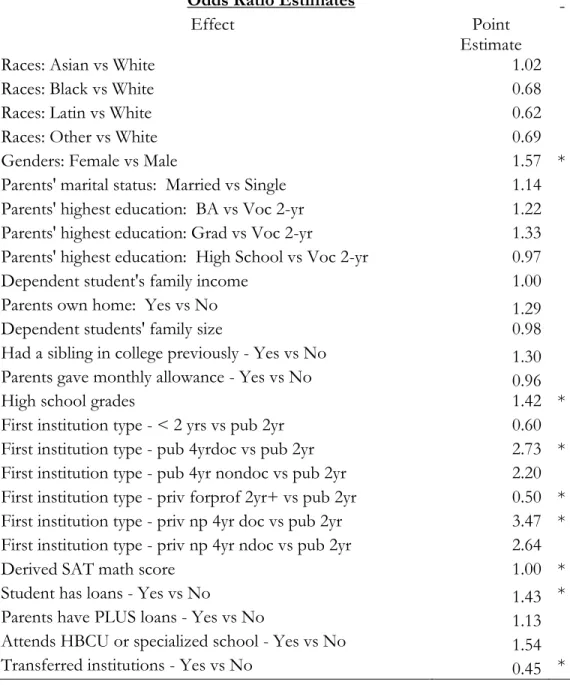
Table 3 presents the results of the logistic regression, using complex survey weighting, with the outcome of interest. This shows that before using IPW, having a Parent PLUS loan was not significantly associated with the probability of earning bachelor’s degree within 6 years of first enrollment.
Table 3
Odds Ratio of selected demographic and enrollment characteristics of 2003-04 dependent beginning postsecondary students who expected to earn a BA or higher, on the likelihood of earning a bachelor’s degree within 6 years: 2003-2009 (before propensity score weighting)
Odds Ratio Estimates
Effect Point
Estimate
Races: Asian vs White 1.02
Races: Black vs White 0.68
Races: Latin vs White 0.62
Races: Other vs White 0.69
Genders: Female vs Male 1.57 *
Parents' marital status: Married vs Single 1.14
Parents' highest education: BA vs Voc 2-yr 1.22
Parents' highest education: Grad vs Voc 2-yr 1.33
Parents' highest education: High School vs Voc 2-yr 0.97
Dependent student's family income 1.00
Parents own home: Yes vs No 1.29
Dependent students' family size 0.98
Had a sibling in college previously - Yes vs No 1.30
Parents gave monthly allowance - Yes vs No 0.96
High school grades 1.42 *
First institution type - < 2 yrs vs pub 2yr 0.60
First institution type - pub 4yrdoc vs pub 2yr 2.73 *
First institution type - pub 4yr nondoc vs pub 2yr 2.20 First institution type - priv forprof 2yr+ vs pub 2yr 0.50 * First institution type - priv np 4yr doc vs pub 2yr 3.47 * First institution type - priv np 4yr ndoc vs pub 2yr 2.64
Derived SAT math score 1.00 *
Student has loans - Yes vs No 1.43 *
Parents have PLUS loans - Yes vs No 1.13
Attends HBCU or specialized school - Yes vs No 1.54
Notes: *Estimates are significantly different between the two groups using the student’s t statistic at the p < .05 level.
Source: U.S. Department of Education, National Center for Education Statistics, Beginning Postsecondary Students Longitudinal Study (BPS:04/09).
The variables which were significantly positively associated with a student earning a bachelor’s degree were
being female, having good high school grades, high SAT or ACT math test scores, and having student loans of their own. The starkest effect was beginning at a 4-year, doctorate granting institution (either public or private non-profit) which conferred three times the likelihood of completing a bachelor’s degree compared to
starting at a public 2-year school. Beginning at a for-profit institution or transferring lowered the odds of earning a degree by almost half.
However, this model has issues related to selection bias. Although we controlled for various observable characteristics, we are unable to account for all the variables that influenced the decision to take out Parent PLUS loans and the choice of institution it allowed students to attend. And since taking out PLUS loans could not be randomly assigned throughout the population, comparing those with the loans to those without had to be statistically adjusted in some manner. An effective way to reduce bias and variability remaining in our estimates due to differences in observed characteristics, was to employ the IPW technique. We used estimates from the logistic regression of the treatment to balance the covariates between treatment and control groups. The conditioning method used to estimate the average treatment effect was calculating the inverse probability of treatment weights. This method had the advantage of having no loss of sample size, important when only 17% of likely eligible dependent undergraduates had Parent PLUS loans.
Table 4 shows overall statistics and the estimates for having PLUS loans for both the initial logistic regression and the final one using the inverse probability of the treatment weights. This table presents the probability of a student obtaining a bachelor’s degree within 6 years of beginning postsecondary education by
whether their parents took out a Parent PLUS loan. In the first regression, controlling all other factors, having
Parent PLUS loans made no significant difference in whether a student earned a bachelor’s degree. The second regression, now weighted by inverse propensity scores, shows a changed estimation. In this model, having a PLUS loan is significantly associated with earning a bachelor’s degree, increasing the odds by 43%.
Table 4
Results of Model before and After Inverse Propensity Weights Odds Ratio Estimates
Model and Effect
Point
Estimate 95% Confidence Limits
Pr > |t| or ChiSq
No IPW - HASPLUS 1 vs 0 1.13 0.92 1.39 0.23
With IPW - HASPLUS 1 vs 0 1.43 1.42 1.44 <.0001
Association of Predicted Probabilities and Observed Responses
No IPW With IPW
Percent Concordant 81.1 16.8
Percent Discordant 18.8 13
Percent Tied 0.2 70.2
Source: U.S. Department of Education, National Center for Education Statistics, Beginning Postsecondary Students Longitudinal Study (BPS:04/09)
Graph 1 shows the common support region of propensity score distributions between the two groups, those with PLUS loans and those without. This indicates some incompatibility which could potentially indicate bias in the estimation. The group without Parent PLUS loans does include many students with very low odds
of getting a bachelor’s degree.
Graph 1
Evaluation of common support: Propensity score distributions for those with and without Parent PLUS loans
Source: U.S. Department of Education, National Cener for Education Statistics, Beginning Postsecondary Students Longitudinal Study (BPS:04/09)
Graph 2 is a balance check that shows the comparison of the distribution of family income across the two groups to evaluate the quality of the propensity scores with respect to this covariate. This shows that for the income variable, the two groups are well-balanced.
Distribution of ps_pred by HASPLUS
0 1 HASPLUS 0.0 0.2 0.4 0.6 0.8 E st im at ed P ro ba bi lit y 0 1 HASPLUS 0.0 0.2 0.4 0.6 0.8 E st im at ed P ro ba bi lit y
Graph 2
Evaluation of balance: Cumulative distribution of dependent family income by presence of Parent PLUS loan
Source: U.S. Department of Education, National Cener for Education Statistics, Beginning Postsecondary Students Longitudinal Study (BPS:04/09)
A common diagnostic that measures balance is the standardized difference in means, measured before and after propensity weighting (Stuart 2010). The absolute standardized difference in means should be in the range of 0.5 and 2 (Rubin 2001). This balance is well illustrated in Graph 3 for the inverse propensity weighted model but not the original one.
0 100000 200000 300000 400000 500000 Sc or e 0 1 HASPLUS
Distribution of Data Scores for DEPINC
0 100000 200000 300000 400000 500000 Sc or e 0 1 HASPLUS 0.1732 Pr > |Z| 0.0866 Pr > Z
Graph 3
Comparison of Standardized Differences of Means for Model Covariates Before and After Propensity Weighting
Source: Beginning Postsecondary Students Longitudinal Study (BPS:04/09)
Discussion
The results support the view that having more liquidity, through more generous loans, at least for those whose families are willing and able to borrow more funds, might allow better chances of degree completion. This may be particularly true of those who transferred from 2-year schools since their bi-variate completion rates are so much higher than students who did not take out these loans (see Figure 2). Since we used a quasi-experimental method which relies on balancing the distribution of observable characteristics among treatment and control groups, we cannot unequivocally interpret our results as causal. Our results could still be subject to bias induced by unobservable characteristics underlying a parent’s decision to take out a PLUS loan that are not accounted for by the weighting algorithm employed here. We can’t identify the mechanism by which
earning a bachelor’s degree occurs, only assert that school choice or fewer work hours might play a role. It is likely that the treatment assignment, parents taking out PLUS loans, is not independent of successfully
completing a bachelor’s degree because of certain background variables such as family support, ambition, and financial knowledge that cannot be captured in the measured variables. Private loans, the financing alternative from commercial sources mentioned above, or home equity loans mimic the liquidity advantages of Parent PLUS loans but appear more expensive for the borrower, especially if the borrower has a relatively low credit score. Parent PLUS loans require the borrower to pass a credit check, which disqualifies them for previous delinquencies or defaults, but does not incorporate the credit score, which includes income, outstanding debt, and lines of credit.6 As mentioned previously, the percentage of parents attempting to borrow a PLUS loan
6 For more details on the Parent PLUS credit check see U.S. Department of Education, Direct PLUS Loans and Adverse Credit. Accessed Oct. 28, 2019 at: https://studentaid.ed.gov/sa/sites/default/files/plus-adverse-credit.pdf
-0.04 -0.02 0 0.02 0.04 0.06 0.08 0.1
but failing the credit check is not known. Among families with good credit, a more sophisticated family might perceive the advantages of a Parent PLUS loan, while a less-informed one might simply borrow privately to get extra needed funds, thus biasing the Parent PLUS sample towards students with more financially savvy families. It is also possible that students from more financially knowledgeable families may be more successful
in academics and in obtaining a bachelor’s degree.
Another, possibly more powerful unobserved influence is that of parental support in general. While measuring family finances and education can give indications of the ability for financial support, the overall
support and engagement of parents with their child’s higher education might underlie both their borrowing
and their child’s academic success. The act of going into debt to underwrite a child’s college education perhaps
selects for parents who perceive college as still an important part of their purview, compared to families who view college as primarily the child’s responsibility.
These results pertain only to dependent students – the potential PLUS borrower families. Students who are over 24 years old, in graduate school, who are married, veterans, or parents themselves might also benefit from extra liquidity provided by parents or family members and we can’t conclude anything about those effects. Also, this dataset does not have any details about parental savings including 529 plans, the use of home equity loans, or other ways that families might increase their liquid holdings and increase the odds that their student could be academically successful.
We did not examine the effect of loan amounts although the average cumulative amount borrowed in PLUS loans by the parents of this cohort after 6 years in 2009, for those who had them, was $20,000. In
contrast, this cohort’s student borrowers themselves accumulated a Stafford loan average of $11,500. We
don’t know if variations in the amounts borrowed or the percentage of college costs covered would have
influenced the ultimate academic success of the student.
Implications for Practice
These results suggest that providing generous loans to credit-worthy students’ parents increases the chances that those students can successfully complete a bachelor’s degree and leads to several practical implications. First, lack of financial resources may pose an impediment to college completion, at least for this middle-income group who mostly don’t qualify for need-based grants. It could be that many students (or their families) choose school term employment over parental borrowing, underestimating the academic cost of working long hours and overestimating the dangers of debt. Second, college quality may play a critical role in academic success, and those who can attend higher quality schools might gain better results. Families may underrate the advantages of some expensive schools or perceive the only real difference between institutions to be their out-of-pocket price. Finally, those who have active parental support may be more likely to succeed, and perhaps those without such supportive families might benefit from some alternate source of financial support, advice, and encouragement.
References
Alon, S. (2007). The influence of financial aid in leveling group differences in graduating from elite institutions. Economics of Education Review, 26, 296–311.
Abel, J.R. & Deitz, R. (2014). Do the benefits of college still outweigh the costs? Current Issues in Economics and Finance, 20(3).
Autor, D.H. (2014). Skills, education, and the rise of earnings inequality among the “other 99 percent.” Science, 344(6186), 843–851.
Avery C. & Turner, S. (2012). Student loans: Do college students borrow too much—Or not enough?
Journal of Economic Perspectives, 26(1), 165-192.
Bailey, M.J. & Dynarski, S. (2011). Inequality in postsecondary education. In Duncan, G., & Murnane, R. (Eds.), Whither opportunity?: Rising inequality, schools, and children’s life chances. (pp. 117-132). New York: Russell Sage Foundation.
Baum, S., Ma, J., & Payea, K. (2013). Education pays 2013. New York: The College Board. Retrieved from http://trends.collegeboard.org/education-pays.
Belley, P. & Lochner, L. (2007). The changing role of family income and ability in determining educational achievement. Journal of Human Capital 1(1), 37–89.
Bound, J., Lovenheim, M., & Turner, S. (2010). Why have college completion rates declined? An analysis of changing student preparation and collegiate resources. American Economic Journal: Applied Economics 2(3), 129–57.
Cabrera, A.F. & La Nasa, S. M. (2000). Understanding the college choice process. New Directions for Institutional Research. 2000 (107), 5-22.
Cabrera, A.F., Nora, A., & Castaneda, M.B. (1993). College persistence: Structural equations modeling test of an integrated model of student retention. Journal of Higher Education, 64 (2), 123-139.
Callan, P. M. & Finney, J. E. (Eds.) (1997). Public and private financing of higher education: Shaping public policy for the future. Phoenix, AZ: American Council on Education and Oryx Press.
Carnevale, A., Rose, S., & Cheah, B. (2011). The College payoff: Education, occupations, lifetime earnings. Washington: Georgetown University, Center on Education and the Workforce. Retrieved from https://cew.georgetown.edu/cew-reports/the-college-payoff/
Chen, R. & DesJardins, S. (2010). Investigating the impact of financial aid on student dropout risks: racial and ethnic differences. Journal of Higher Education, 81(2), 179-208.
Chen, X. & Nunnery, A. (2020). Profile of very low- and low-income undergraduates in 2015–16 (NCES 2020-460). U.S. Department of Education. Washington, DC: National Center for Education Statistics.
Retrieved from http://nces.ed.gov/pubsearch
Cofer, J. & Somers, P. (2000). A comparison of the influence of debtload on the persistence of students at public and private colleges. Journal of Student Financial Aid, 30(2), 39-58.
Cohodes, S. & Goodman, J. (2014). Merit aid, college quality, and college
completion: Massachusetts' Adams Scholarship as an in-kind subsidy. American Economic Journal: Applied Economics 6(4), 251-285.
Congressional Budget Office. (2014). Fair value estimates of the cost of selected federal credit programs for 2015 to 2024.
Retrieved from https://www.cbo.gov/publication/45383
Dancy, K. (2016). Who takes out Parent PLUS loans, anyway? Washington, D.C.: New America Education Policy Program, New America Foundation. Retrieved from http://www.edcentral.org/parent-plus-loans/
Denning, J. (2017). Born under a lucky star: Financial aid, college completion, labor supply and credit constraints. Upjohn Institute Working Paper 17-267. Kalamazoo, MI: W.E. Upjohn Institute for Employment Research.
DesJardins, S., Ahlburg, D., & McCall, B. (2002). Simulating the longitudinal effects of changes in financial aid on student departure from college. The Journal of Human Resources, 37(3), 653-679.
Doubleday, J. M. (2013). With parents denied loans, students scramble at HBCU’s. The Chronicle of Higher Education. Oct. 7, 2013. Retrieved from http://www.chronicle.com/article/without-federal-plus-loans/142147?cid=wb&utm_source=wb&utm_medium=en
Dowd, A. & Coury, T. (2006). The effect of loans on the persistence and attainment of community college students. Research in Higher Education. 47 (1), 33-62.
Dunlop, E. (2013). What do Stafford Loans actually buy you? The effect of Stafford Loan access on
community college students. CALDER Working Paper No. 94. Washington, DC: National Center for Analysis of Longitudinal Data in Education Research.
Dwyer, R.E., McCloud, L. & Hodson, R. (2012). Debt and graduation from American universities. Social Forces, 90(4) 1133-1155.
Dynarski, S. (2002). The behavioral and distributional implications of aid for college. American Economic Review. 92(2), 279–85.
Fishman, R. (2014). The parent trap: Parent PLUS loans and intergenerational borrowing. Washington, D.C.: New America Education Policy Program, New America Foundation,
https://www.newamerica.org/downloads/Corrected-20140110-ParentTrap.pdf
Goldin, C. & Katz, L. (2008). The race between education and technology. Cambridge, MA: Harvard University Press.
Goodman, J., Hurwitz, M., & Smith, J. (2015). Access to four-year public colleges and degree completion.
NBER Working Paper Series, 20996. Retrieved from http://www.nber.org/papers/w20996. Horn, L. (1998). Stopouts or stayouts? Undergraduates who leave college in their first year (NCES 1999-087).
Washington, DC: National Center for Education Statistics. Institute of Education Sciences, U.S. Department of Education.
Hossler, D., Braxton, J., & Coopersmith, G. (1989). Understanding student college choice. In Smart, J. C. (Ed.), Higher education: Handbook of theory and research (IV), (pp. 231-288). New York: Agathon Press. Hossler, D., Schmit, J., & Vesper, N. (1999). Going to college: How social, economic, and educational factors influence
the decisions students make. Baltimore, MD: Johns Hopkins Press.
Janko, E., Moore, C., Liu, A., & Miller, J. (2019). Student financing of undergraduate education in 2015 – 16:
Students’ net price, expected family contribution, and financial need (NCES 2019 - 475). U.S. Department of Education. Washington, DC: National Center for Education Statistics. Retrieved from
http://nces.ed.gov/pubsearch
Keane, M. P. & Wolpin, K. I. (2001). The effect of parental transfers and borrowing constraints on educational attainment. International Economic Review. 42(4), 1051‐1103.
Kim, D. (2007). The effect of loans on students’ degree attainment: differences by student and institutional
characteristics. Harvard Educational Review. 77(1), 64-100.
Lee, S. A. (1993). Family structure effects on student outcomes. In B. Schneider & J. S. Coleman (Eds.),
Parents, their children, and school (pp. 43 –75). Boulder, CO: Westview Press.
Lindley, J.&Machin, S., (2016). Therising postgraduate wage premium, Economica, 83 (330), 281-306. Lochner, L. & Monge-Naranjo, A. (2011). The nature of credit constraints and human capital. American
Economic Review 101(6), 2487–2529.
McClure, T. (2017). ‘Does PLUS push? A multilevel analysis of the relationship between PLUS loans and persistence for low-income students. Dissertation for Graduate School Education and Human Development, George Washington University. Retrieved from
http://search.proquest.com/openview/8cbf74fe046566575a6c344bff58f1f6/1?pq-origsite=gscholar&cbl=18750&diss=y
Muller, C. (1993). Parent involvement and academic achievement: An analysis of family resources available to the child. In B. Schneider & J. S. Coleman (Eds.), Parents, their children, and school (pp. 77–113). Boulder, CO: Westview Press.
Mumper, M. (1996). Removing college price barriers: What government has done and why it hasn't worked. Albany: SUNY Press.
National Center for Education Statistics (NCES) (n.d.). U.S. Department of Education. Datalab. (https://nces.ed.gov/datalab/index.aspx)
National Center for Education Statistics (2016). Digest of education statistics 2016. Institute of Education Sciences, U.S. Department of Education. Washington, DC.
(https://nces.ed.gov/programs/digest/current_tables.asp)
-- (2018a). 2004/09 Beginning Postsecondary Students Longitudinal Study (BPS:04/09) Restricted-Use Data
File (NCES 2018 - 412). National Center for Education Statistics, Institute of Education Sciences, U.S. Department of Education. Washington, DC.
-- (2018b). 2015–16 National Postsecondary Student Aid Study (NPSAS:16): Student financial aid estimates for 2015–16 (NCES 2018 - 466). National Center for Education Statistics, Institute of Education Sciences, U.S. Department of Education. Washington, DC.
Office of Management and Budget (2017). FY2018 Budget of the U.S. Government, Appendix, Detailed Budget Estimates, Department of Education, May 2017, Budget lifetime default rates by loan type, p. 355. Retrieved from
https://www.whitehouse.gov/sites/whitehouse.gov/files/omb/budget/fy2018/edu.pdf
Oreopoulos, P. & Petronijevic, U. (2013). Making college worth it: A review of research on the returns to higher education. NBER Working Paper Series, 19053. Retrieved from
http://www.nber.org/papers/w19053.
Paulsen, M. B. & St. John, E. P. (2002). Social class and college costs: Examining the financial nexus between college choice and persistence. Journal of Higher Education, 73(3), 189–236.
Perna, L. W. (2000). Differences in the decision to attend college among African Americans, Hispanics, and Whites. Journal of Higher Education, 71, 117–141.
Perna, L. & Titus, M. (2005). The relationship between parental involvement as social capital and college enrollment: An examination of racial/ethnic group differences. The Journal of Higher Education. 76(5), 485-518.
Radford, A., Berkner, L., Wheeless, S., and Shepherd, B. (2010). Persistence and attainment of 2003 – 04 Beginning Postsecondary Students: After 6 years (NCES 2011 - 151). U.S. Department of Education. Washington, DC: National Center for Education Statistics. Retrieved from
http://nces.ed.gov/pubsearch
Rodriguez, A. (2014). Access to what and for whom?: A closer look at Federal Parent PLUS loans. Washington, D.C.: Center for Higher Education Reform, American Enterprise Institute.
Rubin, D.B. (2001) Using propensity scores to help design observational studies: Application to the tobacco litigation. Health Services & Outcomes Research Methodology. 2, 169-188.
Scott-Clayton, J. (2011). The causal effect of federal work-study participation: Quasi-experimental evidence from West Virginia. Educational Evaluation and Policy Analysis. 33(4), 506–527.
Scott-Clayton, J. (2012). What explains trends in labor supply among U.S. undergraduates. National Tax Journal.65(1), 181-210.
Shamsuddin, S. (2016) Berkeley or bust? Estimating the causal effect of college selectivity on bachelor’s
degree completion. Research in Higher Education. 57, 794-822.
Singell, D. L. (2004). Come and stay a while: Does financial aid effect retention conditioned on enrollment at a large public university? Economics of Education Review, 23(5), 459–471.
Smith, J. (2013). "Ova and out: Using twins to estimate the educational returns to attending a selective college." Economics of Education Review, 36: 166-180.
Smith, J. & Stange, K. (2016). A new measure of college quality to study the effects of college sector and peers on degree attainment. Education Finance and Policy. 11(4), 369-403
Steelman L.C. & Powell, B. (1991) Sponsoring the next generation: Parental willingness to pay for higher education. American Journal of Sociology. 96(6), 1505 – 1521.
Stinebrickner, R. & Stinebrickner, T. (2003). Working during school and academic performance. Journal of Labor Economics, 15(4), 735–776.
Stinebrickner, R. & Stinebrickner, T. (2008). The effect of credit constraints on the college drop-out decision: A direct approach using a new panel study. The American EconomicReview, 98(5):2163–
2184.
Stuart, E. A. (2010). Matching methods for causal inference: A review and a look forward. Statistical Science 25(1), 1–21
U.S. Department of Education (2012). PLUS borrowers 3-year cohort default rates. “pii2-PLUS
borrowers-cdr,” as cited in Rodriguez 2014. Accessed from
http://www2.ed.gov/policy/highered/reg/hearulemaking/2012/pii2-plusborrowers-cdr.xls -- (2015). Office of Federal Student Aid. Direct PLUS loan basics for parents.
https://studentaid.ed.gov/sa/sites/default/files/direct-loan-basics-parents.pdf
--(2017). Federal Student Aid, Title IV program volume reports. https://studentaid.ed.gov/sa/about/data-center/student/title-iv
Wiederspan, M. (2016). Denying loan access: The student-level consequences when community colleges opt out of the Stafford Loan Program. Economics of Education Review.51, 79-96.
Woo, J. & Velez, E. (2016). Use of private loans by postsecondary students: Selected years 2003-04 through 2011-12
(NCES 2017 - 420). National Center for Education Statistics, Institute of Education Sciences, U.S. Department of Education. Washington, DC
Zick, C., Bryant, W.K. & Osterbacka, E. (2001). Mother’s employment, parental involvement, and the implications for intermediate child outcomes. Social Science Research. 30 (1), 25-49.