In D. de Waard, J. Sauer, S. Röttger, A. Kluge, D. Manzey, C. Weikert, A. Toffetti, R. Wiczorek, K. Brookhuis, and H. Hoonhout (Eds.) (2015). Proceedings of the Human Factors and Ergonomics Society Europe Chapter 2014 Annual Conference. ISSN 2333-4959 (online). Available from http://hfes-europe.org
Interventions for Doctors-on-call
Vera Hagemann1, Annette Kluge² & Clemens Kehren³ 1University of Duisburg-Essen ²Ruhr University Bochum ³University Medical Centre Essen Germany
Abstract
"Doctors-on-call" work in High Responsibility Teams, e.g. in hospitals or a (helicopter) emergency medical service (H/EMS), so called High Reliability Organisations. Due to their complex and demanding work contexts, where errors lead to severe consequences, doctors-on-call are required to develop non-technical competencies. To support reliable teamwork (aeromedical) crisis resource management (A/CRM) interventions have been implemented in initial training and further education more and more. The objective of this study is to evaluate the effectiveness of A/CRM interventions in initial training as well as in combined recurrent HEMS trainings for pilots, paramedics and doctors-on-call. Two interventions for doctors-on-call in initial training (n=79) and five interventions in HEMS training (n=71) were evaluated. Results of the pre-post-test-design for A/CRM for doctors-on-call initial training showed that the intervention was judged positively regarding usefulness and learning. Safety-relevant attitudes changed significantly (.13 <η²p< .24). The results for A/CRM in HEMS training also demonstrated effectiveness regarding usefulness and learning and safety-relevant attitudes increased significantly (.28 <η²p< .41). Due to a pre-post-post-test-design results showed stable attitude changes also three months later. So far, no studies exist documenting the valuable effects of A/CRM interventions for doctors-on-call in initial training and working in HEMS.
Introduction
Teams are a core element of a wide range of organisations. Given the increasing complexity of organizations and task fulfilment, teamwork is essential for success in meeting constantly changing requirements and reacting flexibly to turbulent business environments (Cannon-Bowers & Bowers, 2011; Hollenbeck et al., 2012). The advantage of teamwork is to use synergies of team members` competencies, knowledge and skills. Therefore, teams are able to adapt to changing conditions and cope with new situations successfully (Baker et al., 2006). Within some work environments the work has been structured as teamwork from the historical beginning of their professions, which means there was no period of time when it was en-vogue to implement teamwork with a special focus on teamwork processes, such as in the automobile industry or coal mines (cf. Hagemann, 2011, p.26). No one has
ever questioned the importance of teamwork within hospital anaesthesia teams, doctors-on-call or disaster management and first responder teams in the fire service. It would be barely conceivable that those people are not working as a team. But that does not mean that these teams have no teamwork problems.
Teams in healthcare, fire services, aviation or police units work in so-called High Reliability Organizations (HROs, Weick & Sutcliffe, 2003). They are named High Responsibility Teams (HRTs; cf. Hagemann et al., 2011) due to their dynamic and often unpredictable working conditions and demanding work contexts, in which technical faults and slips have severe consequences for human beings and the environment if they are not identified and resolved within the team immediately (Kluge et al., 2009). HRTs bear responsibility regarding their own lives and those of third parties based on their actions and consequences. In order to adapt to the dynamic und unpredictable working conditions successfully, they are confronted with specific requirements regarding information sharing and coordination – their non-technical skills (see e.g. Flin et al., 2005). Teamwork in HRTs is different from those in non-HRTs and is assumed to be very demanding (cf. Hagemann, 2011, pp.27-28). The impact on other peoples` life is enormous, especially when incidents or accidents occur. The notion that HRTs have always worked in teams does not imply that a particular team communicates and coordinates teamwork successfully. The human contribution to accidents and incidents in HRT-work has been recognised by many industries over the last three decades (Reason, 2008). The causal relationship between human error and teamwork problems such as breakdowns in communication or coordination processes or failures in decision-making and accidents and incidents was recognised. Examples of this are the Tenerife airport accident in 1977, which resulted in a loss of 583 lives, or the explosion of the Deep Water Horizon in spring 2010, which claimed 11 lives (Flin et al., 2002; Helmreich et al., 1999).
Teamwork professions such as medical teams in hospitals or doctors-on-call are as well recognizing the human contribution to errors and incidents. Examples in this regard include the tragic death of the (healthy) 2-month-old Jose Martinez in a hospital in Houston in 1996 due to medication errors (Belkin, 1997) or the death of the cardiac Rosemarie Voser who received a donor heart with a wrong blood type in Zurich due to a misunderstanding in communication4. It is estimated that about 44.000 up to 98.000 people in the USA die each year as a result of medical errors (Kohn et al., 2007). These examples show that HRTs also need support in their teamwork processes and special attention from teamwork experts, even though they work in teams for a very long time. The aim of the present studies is thus to explore the positive effects of a special kind of team training for doctors-on-call in hospital teams or helicopter emergency medical service (HEMS) teams on team members’ reactions and teamwork safety-relevant attitudes.
Doctors-on-call’s work (environment)
There are two different models of the pre-hospital medical care in emergency cases. On one hand the “Anglo-American model” which operates with pre-hospital care specialists, such as paramedics or emergency medical technicians (EMTs). Doctors-on-call (also called emergency physicians) are not part of this model in the pre-hospital care. In contrast the so called “Franco-German-Model” which is led by physicians and supported by paramedics. This is also typical for most countries in Central Europe. Doctors-on-call in Germany provide the necessary medical interventions for patients in emergency medical service. Therefore they are active as well in road ambulances as in helicopter emergency medical services. Germany is one of the rare countries in the world having established a complete comprehensive network of helicopter emergencies. Hence, every patient can be reached within 15 minutes by a rescue helicopter from its more than 70 bases. Some of the rescue helicopters provide a day and night service, 24/7. Although the rescue network is comprehensive in Germany, all team members of the emergency medical technicians still face the challenge of reaching the emergency scene within minutes.
Regularly, confrontations with seriously injured patients, e.g. after motor vehicle crashes, but also with victims of crime scenes or outbreak of violence occurs. Due to these particular cognitive and social demands a close co-operation with the police, beside the collaboration with the fire department or the emergency rooms in hospitals is required. To take live care / life support decisions within seconds in the rescue unit during the assignment, teamwork is the key.
Crew or Aeromedical Crisis Resource Management
Professions such as surgery, anaesthesia, or doctors-on-call are recognizing the human contribution to errors and incidents and are trying to help themselves by applying a team training intervention originally developed for aviation personnel in order to accomplish the challenges of their demanding and complex teamwork contexts (cf. Gaba et al., 2001; Müller et al., 2007). This intervention, called Crew Resource Management (CRM) was developed to improve teamwork-relevant non-technical skills (e.g. communication or adaptation) of team members and increase team effectiveness and safety in HRTs. CRM has been defined as “the use of all available resources to achieve safe and efficient flight operations” (Lauber, 1984, p. 20). CRM-based training concepts are instructional strategies for HRTs in order to a) train them to use all available resources efficiently (i.e. people, equipment, and information), b) enhance their teamwork and therefore enhance their performance, and c) diminish the likelihood of possible human error with severe consequences for people and the environment (Salas et al., 2006a).
In its early stages, CRM mainly focused on pilots. During the 1990s, it was extended to flight attendants and maintenance technicians (Helmreich et al., 1999) and today it is also prescribed by law for all aviation personnel worldwide (EU OPS 1). CRM-based training concepts have been well established within commercial aviation for over 30 years. During this time span and due to this training concept, that focuses on team members’ non-technical skills and error management, incident and accident rates have been reduced (Flin et al., 2002). At the end of the 1990s, a tendency to
apply CRM within anaesthesia could be observed. Specific team training interventions called aeromedical or anaesthesia crisis resource management (ACRM) were developed (Davies, 2001; Gaba et al., 2001). Since then, more and more HRTs in the fire service or surgery are trying to transfer CRM from aviation to their own teams, called, for instance team resource management for the fire service (cf. Hagemann & Kluge, 2013; Okray & Lubnau, 2004).
Some meta-analyses support the effectiveness of CRM interventions on teamwork relevant competence acquisition in HRTs for aviation and military or medical teams as well as in the oil industry. For example, Salas et al. (2006b) report in their meta-analysis—100 studies included—positive effects of CRM on team members’ reactions and teamwork safety-relevant attitudes. Diverse results (positive or no effects) are reported in regard to teamwork safety-relevant knowledge and behaviour as well as on organisational outcomes. The meta-analysis conducted by O`Connor et al. (2008) included 16 studies and supports positive training effects. The reported studies demonstrated positive effects of CRM on team members’ reactions, teamwork safety-relevant attitudes and behaviour. In regard to a safety-relevant knowledge gain medium effects were found.
The positive influence of teamwork relevant competencies and accordingly team processes on team performance has also been demonstrated in some studies. Schmutz and Manser (2013) included 28 studies in their review and report medium to large effect sizes regarding the positive effects of team process behaviours on clinical performance, such as task management, problems during operation, operating time, or morbidity. Because A/CRM interventions support teamwork relevant competence acquisition and teamwork competencies influence clinical performance positively, A/CRM is a very powerful “instrument” in supporting HRTs for reliable teamwork, also in a medical context.
So far, nearly nothing is known about the effects of A/CRM interventions on prerequisites for successful teamwork of doctors-on-call, working in e.g. hospitals or HEMS. In order to assess positive training effects on teamwork relevant competence acquisition for this target group, the widely used training evaluation hierarchy from Kirkpatrick (1998) is applied. This hierarchy categorises training outcomes on four levels. The first two levels are considered here. The first level is the evaluation of “reactions”, such as subjectively perceived enjoyment and perceived usefulness of the A/CRM intervention. The second level is “learning” and contains the participant’s attitudinal changes and knowledge gain after A/CRM intervention. “Behavioural changes” are the hierarchy’s third level and refer to the application of acquired knowledge and skills to the job. This level will be considered indirectly in the evaluation based on questions regarding the transfer climate. The aim of the present paper is to demonstrate the positive effects of A/CRM interventions for doctors-on-call on team members’ reactions, subjectively rated learning success, and teamwork safety-relevant attitudes.
Hypotheses
As demonstrated in the meta-analyses by Salas et al. (2006b) and O`Connor et al. (2008), first, it is assumed that the A/CRM interventions will have a positive impact on team members’ reactions.
Second, it is assumed that the A/CRM interventions will have a positive impact on team members’ subjectively rated learningsuccess (knowledge and attitude).
Third, it is assumed that the A/CRM interventions will have a positive impact on the teamwork-relevant attitudes such as those demonstrated by Gregorich, Helmreich, and Wilhelm (1990) and Helmreich and Wilhelm (1991). Evaluating this effect is important, because in training research it is assumed that positive changes in attitudes (affective levels) are one essential prerequisite for changes in (safety-relevant) behaviour (O’Connor, Flin, Fletcher & Hemsley, 2003).
Furthermore, it is analysed whether doctors-on-call have the possibilities to apply the newly learned concepts and skills in training during their daily work or not. That means the transfer climate is measured.
Method
Samples
Two samples were included in this study. One sample consisted of doctors-on-call in initial training (n = 79). These doctors have been in vocational training to become doctors-on-call. The sample consisted of two subgroups which got the initial training at different times. 38 doctors were male, 31 female, and 10 doctors did not indicate their sex. Their mean age was M = 32.63 years (SD = 7.40). 13.5% of the doctors declared that they already had participated in any sort of A/CRM intervention before.
The second sample consisted of doctors-on-call, pilots and paramedics (helicopter crew member, HCM) in combined recurrent HEMS trainings (n = 71). Five groups in combined recurrent HEMS training that received an A/CRM intervention were includes in the study. 60 people were male, 5 female, and 6 people did not indicate their sex. Their mean age was M = 42.1 years (SD = 7.45). 25 people were pilots, 21 were HCMs and 23 were doctors-on-call (2 missing). 32 people (47.1%) declared that they already had participated in any sort of A/CRM intervention before. 23 people of those 32 were pilots, 6 HCMs and 3 were doctors-on-call. The mean age for doctors-on-call was M = 42.4 years (SD = 5.8), 19 of them were male and 4 female.
Field study design
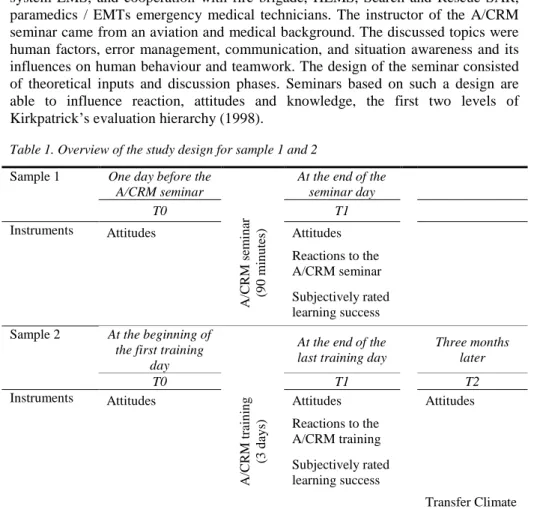
The study included two within-group comparisons with a pre-post-test design for doctors-on-call in initial training (sample 1, S1) and a pre-post-post-test design for participants in combined recurrent HEMS training (sample 2, S2). Due to organisational constraints and patient needs the participants were not able to visit the
interventions all at the same time. Hence, the A/CRM interventions were conducted two (S1) respectively 5 (S2) times in the same manner.
The doctors-on-call in S1 participated in an A/CRM seminar of one and a half hours duration. This seminar was integrated into a one week vocational training in a German hospital to become a doctor-on-call. Other seminar topics for example were trauma support, cardio-pulmonal-resuscitation, specifics of the emergency medical system EMS, and cooperation with fire brigade, HEMS, Search and Rescue SAR, paramedics / EMTs emergency medical technicians. The instructor of the A/CRM seminar came from an aviation and medical background. The discussed topics were human factors, error management, communication, and situation awareness and its influences on human behaviour and teamwork. The design of the seminar consisted of theoretical inputs and discussion phases. Seminars based on such a design are able to influence reaction, attitudes and knowledge, the first two levels of Kirkpatrick’s evaluation hierarchy (1998).
Table 1. Overview of the study design for sample 1 and 2
Sample 1 One day before the A/CRM seminar
At the end of the seminar day T0 A/CRM se m in ar (9 0 m in u tes ) T1
Instruments Attitudes Attitudes
Reactions to the A/CRM seminar Subjectively rated learning success Sample 2 At the beginning of
the first training day
At the end of the last training day
Three months later T0 A/CRM train in g (3 d ay s) T1 T2
Instruments Attitudes Attitudes Attitudes
Reactions to the A/CRM training Subjectively rated learning success
Transfer Climate
The participants in S2 got an A/CRM training of three days duration. The training was a combined training for pilots, HCMs, and doctors-on-call all working in a helicopter emergency medical service in Germany. This combination of participants is due to the fact that a helicopter crew in missions consists of one pilot, one HCM, and one doctor-on-call. The underlying proposition is that the people who work together should also be trained together. The discussed topics were human factors, error chains, attitudes, communication and coordination, leadership, situation awareness, and shared mental models and its influences on human behaviour and teamwork processes and outcomes. The design of the training was interactive and
consisted of a mixture of theoretical inputs, exercises, discussions, and reflections. Trainings based on such a design are able to influence attitudes, knowledge and behaviour, the first three levels of Kirkpatrick’s evaluation hierarchy.
In S2 also the team members’ behaviour was influenced. Because it was not possible to directly assess the behaviour of the team members after training all participants from S2 were asked to fill in a questionnaire measuring the transfer climate within their daily work three months after the training. The aim was to analyse whether the participants have the possibilities to apply the newly learned concepts and skills in training during their daily work.
The instruments measuring the team members’ reactions to the A/CRM interventions, the subjectively rated learning success, and the teamwork safety-relevant attitudes were distributed in S1 one day before the seminar (T0) and at the end of the seminar day (T1). In addition to the listed instruments here S2 also worked on an instrument measuring the transfer climate. The instruments were handed out at the beginning of the first day of training (T0), at the end of the last day of training (T1) and three months later (T2) (see table 1). Due to this long time span and because of holidays, shift changes, and absenteeism, not all doctors-on-call, pilots, and HCMs were able to participate at all three measurement times.
Applied measuring instruments
Teamwork safety-relevant attitudes
To measure a change in teamwork safety-relevant attitudes an adapted version of the Fire Service Management Attitudes Questionnaire (FSMAQ, Hagemann, 2011) was applied two (T0, T1) or three times (T0, T1, T2) for sample 1 and 2, respectively. The questionnaire consisted of 20 items (five-point Likert scale from 1 to 5) and is called Doctors-on-call Management Attitudes Questionnaire (DMAQ). Other well established instruments have been the basis for this attitude questionnaire, e.g. ORMAQ surgery (Yule et al., 2004), ORMAQ anaesthesia (Sexton et al., 2000), CMAQ cockpit (Gregorich et al., 1990), and CAQ (McDonald & Shadow, 2003). The questionnaire covered the eight most frequently investigated safety-relevant attitudes: command roles and responsibilities (4 items, e.g., ‘Team members should not question the decisions or actions of senior staff’), speak up (2 items, e.g., ‘I inform other team members when my workload is too high’), debriefing (2 items, e.g., ‘A regular debriefing of procedures and decisions after a mission is an important part of teamwork’), feedback and critique (2 items, e.g., ‘Disagreements in the team are appropriately resolved, i.e., it is not ‘who’ is right, but what is best for the mission’), realistic appraisal of stress (3 items, e.g., ‘Personal problems can adversely affect my performance’), denial of stress (3 items, e.g., ‘A professional doctor-on-call is able to hide personal problems during the whole mission’), handling errors (2 items, e.g., ‘I am more likely to make errors in tense or hostile situations’), and teamwork (2 items, e.g., ‘I enjoy working in a team’).
Subjectively perceived training outcomes
The training evaluation inventory (TEI; Ritzmann et al., 2014; Hagemann & Kluge, 2014) was applied for evaluating the A/CRM interventions and the team members’ reactions and subjectively rated learning success, respectively, at T1. This inventory
consisted of 16 items (five-point Likert scale from 1 to 5). It covered training outcomes based on the first (reaction) and second (learning) level of Kirkpatrick’s (1998) four levels of evaluation. Based on the work of Alliger et al. (1997), Phillips and Phillips (2001) and Salas et al. (2006a), the first level (reaction) was further divided into three scales: reported enjoyment (3 items, e.g., ‘I enjoyed learning’), perceived difficulty (3 items, e.g., ‘I understood all technical terms’) and perceived usefulness (4 items, e.g., ‘The training is useful for my profession’). In particular, perceived usefulness is assumed to support the motivation to apply acquired knowledge and skills to the trainees’ field of work (Helmreich & Wilhelm, 1991; Phillips & Phillips, 2001; Salas et al, 2006c). Furthermore, it enhances the probability of the trainees’ work performance improving. The second level (learning) was divided into learning knowledge (3 items, subjectively rated learning success, e.g., ‘I think my knowledge has been expanded in the long term’) and learning attitudes (3 items, e.g., ‘I would recommend this training to my colleagues’). The subjectively rated learning success proved to be a successful predictor in relation to objectively measured learning success or knowledge acquisition (Ritzmann et al., 2014), and was therefore used as in indicator for the second level of Kirkpatrick’s evaluation hierarchy. The TEI was used as it was developed for training evaluation and has been applied in various CRM training evaluation studies (see Ritzmann et al., 2014).
Transfer climate
In order to analyse whether doctors-on-call have the possibilities to apply the newly learned concepts and skills in training during their daily work a transfer climate questionnaire was applied at T2 (only S2). The instrument consisted of 15 items (five-point Likert scale from 1 to 5) and was developed based on the transfer climate questionnaire by Thayer and Teachout (1995). The questionnaire covered cues, reinforcements, and extinction possibilities. The scales were goal cues (3 items, e.g. ‘My supervisors set performance goals that encourage me to apply the skills learned in the ACRM-training’), social cues (2 items, e.g. ‘My colleagues help me applying the concepts learned in the ACRM-training at work’), task cues (2 items, e.g. ‘We have the resources (equipment, human power, time) in order to fulfil the work as learned in the ACRM-training’), positive reinforcement (3 items, e.g. ‘My supervisors appreciate it when I transfer the things learned in the ACRM-training to work’), negative reinforcement (3 items, e.g. ‘(Experienced) Colleagues make fun of the concepts communicated in the ACRM-training’), and extinction (2 items, e.g. ‘I have only a few possibilities to apply the skills learned in the ACRM-training, so it is difficult for me to internalise them’).
Results
In the following the three hypotheses will be tested for sample 1 (doctors-on-call initial training) and sample 2 (combined recurrent HEMS training). The last research question regarding the transfer climate will be tested for sample 2 only.
Table 2. M, SD, and Cronbach’s α of training outcome scales at T1 for sample 1 and 2 A/CRM seminar (S1), n = 79 A/CRM training (S2), n = 71 Scales α M SD Α M SD Reported Enjoyment .88 4.05 0.76 .80 4.65 0.52 Perceived Usefulness .87 4.23 0.74 .84 4.70 0.43 Perceived Difficulty+ .82 4.47 0.59 .60 4.54 0.43 Learning Knowledge .81 3.92 0.78 .81 4.25 0.58 Learning Attitudes .92 4.21 0.83 .82 4.75 0.41
Notes. + A high score means that the training was not difficult; range from 1 to 5
In order to test hypotheses 1 and 2, the subjectively perceived outcomes of the A/CRM seminar and the A/CRM training were evaluated by applying the TEI at T1. The internal consistencies and means of the evaluation scales regarding reaction and learning are displayed in Table 2 for both samples. The mean values of the five scales indicated an overall very positive evaluation of the seminar or rather the training regarding team members’ reactions and subjectively rated learning success in both samples. Hence, the results supported Hypotheses 1 and 2.
In order to test the third hypothesis, whether the teamwork safety-relevant attitudes changed positively and significantly after the A/CRM seminar/training, univariate analyses of variance (ANOVA) with repeated measures for analysing within-group effects were conducted – for each of the eight scales. The attitudes at T0 and T1 were within-subject factors.
Table 3. M, SD (in brackets), α and results of ANOVA with repeated measures regarding attitudes at T0 compared to T1 for sample 1 (n = 60) and 2 (n = 65)
Sample 1 α T0 T1 F P η2p
Command roles and responsibilities .72 4.39 (0.55) 4.43 (0.61) 0.663 .419 .01 Speaking up .56 3.75 (0.72) 4.05 (0.81) 10.585 .002 .15 Debriefing .37 4.78 (0.36) 4.78 (0.38) 0.000 1.00 .00 Feedback and critique .21 4.01 (0.67) 4.02 (0.69) 0.012 .912 .00 Realistic appraisal of stress .67 3.97 (0.73) 4.18 (0.67) 11.457 .001 .16 Denial of stress+ .70 2.98 (0.89) 2.63 (0.98) 18.903 .000 .24 Handling errors .69 3.79 (0.85) 4.07 (0.82) 8.460 .005 .13 Teamwork .28 3.90 (0.61) 3.98 (0.65) 1.065 .306 .02 Sample 2 α T0 T1 F P η2p
Command roles and responsibilities .63 4.26 (0.46) 4.50 (0.41) 26.024 .001 .30 Speaking up .68 3.78 4.05 10.286 .002 .14
(0.70) (0.59) Debriefing .35 4.35 (0.52) 4.58 (0.52) 10.091 .002 .14 Feedback and critique .74 3.78 (0.56) 3.95 (0.65) 4.089 .050 .06 Realistic appraisal of stress .88 4.04 (0.61) 4.32 (0.71) 21.351 .001 .25 Denial of stress+ .83 2.84 (0.80) 2.35 (0.79) 32.699 .001 .34 Handling errors .54 3.67 (0.65) 3.97 (0.84) 8.727 .004 .12 Teamwork .30 4.26 (0.59) 4.34 (0.58) 1.438 .235 .02
Notes. + Low values indicate a positive attitude; range from 1 to 5.
Referring to S1, there were no significant results for “command roles and responsibilities”, “debriefing”, “feedback and critique”, and “teamwork” (see Table 3). Regarding “speaking up” (F(1/60) = 10.585, p < .01, η2p = .15), “realistic appraisal of stress” (F(1/60) = 11.457, p < .01, η2p = .16), “denial of stress” (F(1/60) 18.903, p < .001, η2p = .24), and “handling errors” (F(1/60) = 8.460, p = .001, η2p = .13) the main effects for measurement time reached significance and the effect sizes were medium to large. Thus, these four attitudes changed significantly and positively from T0 to T1. The doctors-on-call showed a significant positive change in speaking up, realistic appraisal of stress, denial of stress, and handling errors.
Referring to S2, there were no significant results for “feedback and critique” and “teamwork” (see Table 3). Regarding “command roles and responsibilities” (F(1/63) = 26.024, p < .001, η2p = .30), “speaking up” (F(1/65) = 10.286, p < .002, η2p = .14), “debriefing” (F(1/65) = 10.091, p < .002, η2p = .14), “realistic appraisal of stress” (F-(1/65) = 21.351, p < .001, η2p = .25), “denial of stress” (F(1/65) = 32.699, p < .001, η2p = .34), and “handling errors” (F(1/65) = 8.727, p < .004, η2p = .12) the main effects for measurement time reached significance and the effect sizes were all medium to large. Hence, these six attitudes changed significantly and positively from T0 to T1. Summing up, hypothesis 3 could be partially supported; both, the A/CRM seminar and training had a positive impact on safety-relevant attitudes.
In order to test whether the six attitude changes from T0 to T1 were stable over a time period of three months, paired samples t-tests were calculated to compare the results between T1 and T2 (see Table 4). This analysis was conducted for S2 only, because only this sample had a follow-up evaluation three months later. The six attitudes—command roles and responsibilities, speaking up, debriefing, realistic appraisal of stress, denial of stress, and handling errors—remained stable over time, as no difference between T1 and T2 reached significance (two-tailed). Summing up, the results indicate that the six positive attitude changes from T0 to T1 were stable over a period of three months.
Table 4. Means and results of paired samples t-tests of four attitudes between T1 and T2 (which changed significantly from T0 to T1) (n = 12)
T1 T2 T Sig. (two-tailed)
Command roles and
responsibilities 4.55 4.63 t(11) = -1.05 p > .32
Speaking up 4.21 4.38 t(11) = -1.00 p > .34
Debriefing 4.70 4.63 t(11) = 1.00 p > .34
Realistic appraisal of stress 4.33 4.19 t(11) = .68 p > .51
Denial of stress+ 2.42 2.53 t(11) = -.51 p > .62
Handling Errors 4.21 3.67 t(11) = 2.24 p = .05
Notes. + Low values indicate a positive attitude; range from 1 to 5.
Furthermore, descriptive data were analysed in order to answer the last research question, whether the pilots, HCMs, and doctors-on-call had the possibilities to apply the newly learned concepts and skills in training during their daily work. For this purpose a transfer climate questionnaire was applied in S2 at T2. The internal consistencies and means of the evaluation scales regarding cues, reinforcements and extinction are displayed in Table 5. The mean values of the six scales indicated an overall very positive transfer climate at work for the participants. Thus, the results indicated good possibilities to apply newly learned skills in training at work. Table 5. M, SD, and Cronbach’s α of transfer climate scales at T2 for sample 2
A/CRM training (S2), n = 12 Scales α M SD Goal Cues .87 3.86 0.96 Social Cues .91 3.67 0.98 Task Cues .26 3.75 0.66 Positive Reinforcement .81 3.92 0.95 Negative Reinforcement+ .59 3.00 0.90 Extinction+ .78 3.54 1.05
Notes. + High values indicate a positive transfer climate; range from 1 to 5.
All results were controlled for age and sex differences. No impacts of age and sex on the effects could be detected.
Discussion
The goal of the present studies was to investigate the positive impact of A/CRM seminars and trainings on doctors-on-calls’ reactions, subjectively rated learning success, and teamwork safety-relevant attitudes. The first two hypotheses were supported; the third one was partially supported. According to the first hypothesis, the team members—in both samples—reported that they enjoyed the A/CRM seminar/training and that it was easy for them to follow it. They perceived the seminar/training as useful for their work and stated that they would, for example, recommend it to their colleagues. According to the second hypothesis, they developed a positive attitude towards the seminar/training and teamwork-relevant topics, respectively, and stated that they learned a lot. These results confirm findings
of previous evaluation studies of CRM training within aviation, military and fire service as demonstrated by Hagemann and Kluge (2014), Ritzmann et al. (2011), Salas et al. (1999), Salas et al. (2001), and Salas et al. (2006a). The present findings seem to indicate that A/CRM seminars and trainings for doctors-on-call could also be useful for enhancing non-technical teamwork competencies.
Evaluating perceived usefulness of a seminar or training is also important, because studies showed positive relationships between perceived usefulness of an intervention and transfer motivation, subjectively rated learning success as well as objective measurement of knowledge acquisition and maintenance (Alliger et al., 1997; Hagemann & Kluge, 2013, 2014; Helmreich & Wilhelm, 1991). Furthermore, the subjectively rated learning success is also a reliable predictor for objective measurement of knowledge acquisition (Ritzmann et al., 2014). The reported results indicate, that the doctors-on-call expended their knowledge regarding safety relevant teamwork competencies. These findings stress the importance of evaluating trainee reactions in a differentiated manner by focusing on perceived usefulness and subjectively rated learning success.
According to hypothesis three, positive changes in teamwork safety-relevant attitudes could be found in both samples. Results for the first sample showed that after the A/CRM seminar, four of the eight attitudes changed. These four were “speaking up”, “realistic appraisal of stress”, “denial of stress”, and “handling errors”. Results for the second sample showed that after the A/CRM training, six of the eight attitudes changed. These six were “command roles and responsibilities”, “speaking up”, “debriefing”, “realistic appraisal of stress”, “denial of stress”, and “handling errors”. Possible explanations for why attitudes regarding “realistic appraisal of stress” and “denial of stress” changed significantly in both samples might be that the seminar/training focused these topics deeply. To pick the link between handling and denial of stress—factors which influence performance negatively—and accidents and incidents out as a central theme is very common in A/CRM interventions. In sample 2, but not in sample 1, after the training the participants showed more positive attitudes regarding “command roles and responsibilities” and “debriefing”. These differences could be explained by the thematic setting of priorities. In sample 1 the doctors-on-call were 10 years younger on average and at the beginning of their career as a doctor-on-call than the team members in sample 2. Hence, different teamwork relevant competencies are important for these target groups. More experienced team members might be more interested in leadership topics and instruments to steer team processes, such as debriefings.
These positive attitude changes are in accordance with some previous studies within other HRTs in aviation (Gregorich et al., 1990; Helmreich & Wilhelm, 1991) or in fire service teams (Hagemann & Kluge, 2013). Even though Röttger et al. (2013) did not report effects of CRM training on attitude changes, however they found significant relationships between negative attitudes and teamwork behaviour and performance in the maritime domain. In the present study it was also demonstrated that after a time period of three months, the positive attitude changes were stable (only S2). The demonstrated positive attitude changes are an important prerequisite
for showing safety-relevant behaviour during missions (Sexton & Klinect, 2001). Furthermore, the attitude changes demonstrated in the present studies are not common findings. O’Connor et al. (2012, p. 30) report, that many of the studies examining the impact of CRM training on attitude changes did not find any significant effects. Moreover, psychometric properties of the applied instruments were lacking. In their own study with naval aviators, O’Connor et al. also did not find any significant effects of CRM training on attitude changes. They report the psychometric properties of their inventory, which ranged from α = .44 to α = .59. These internal consistencies were typical of this type of questionnaire. The internal consistencies of the DMAQ within the present studies are in line with these results predominantly and ranged from α = .21 to α = .88.
The last research question focused on the transfer climate in sample 2. It was of interest, whether participants have the possibilities to apply the newly learned concepts and skills in training during their daily work or not. Because it was not possible to directly assess the behaviour of the team members during work after training they were asked to fill in a questionnaire measuring the transfer climate within their daily work three months after the training. The underlying idea was that the A/CRM trainings are able to influence not only knowledge and attitudes, but also behaviour. But new behaviour congruent to training will not or hardly be shown if there is no transfer climate. So transfer climate is a prerequisite to experience newly acquired behaviour (Greif & Kluge, 2004; Thayer & Teachout, 1995). The results of the present study show, that the doctors-on-call, the pilots, and the HCMs reported a good transfer climate after training. The aspect regarding positive reinforcement was assessed most positively.
Summing up, the findings indicate that A/CRM interventions for doctors-on-call are useful in terms of enhancing non-technical teamwork competencies, especially reactions, learning, and attitudes, but also behaviour. Furthermore, other research, for example regarding Bridge Resource Management training for navy teams (cf. O’Connor, 2011), indicates that not all kinds of CRM adaptations successfully lead to positive training outcomes, and indeed some have no effect at all. Thus, the findings of the present studies broaden the field regarding effective applications of A/CRM interventions. As a result medical services should consider implementing ACRM into their education and further trainings. A/CRM should be implemented into the curricula equal to other topics, not only for medical students but also for doctors in initial training to become doctors-on-call or in further education.
Limitations and Outlook
With regard to methodological problems, the DMAQ for evaluating the teamwork safety-relevant attitudes showed problems regarding reliability aspects. Some scales (e.g. teamwork or debriefing) had very low internal consistencies. These problems regarding attitude evaluations are common in the scientific community, as discussed earlier, but further research is needed for developing reliable and valid instruments for assessing attitudes.
Team diversity was not taken into consideration neither in the present studies nor in the A/CRM seminar or training. Jackson and Joshi (2011) stated in their review that
work team diversity “is likely to impede frequent and effective communication among team members” (p. 661) and has diverse—positive as well as negative— influences on team performance (p. 666). Hence, possible effects of team diversity on team performance should be taken into consideration in future studies. Furthermore, the topic “team diversity” and its implications on team performance and team processes should be implemented into A/CRM interventions. Today, medical teams become more and more diverse regarding gender, age, nationality, personality, attitudes, values, educational level or organizational tenure.
The third level (behaviour) in Kirkpatrick’s (1998) evaluation hierarchy was assessed indirectly; the fourth level (outcomes) was not assessed at all in the present studies. This is a well known phenomenon in training evaluation studies. It costs a lot of time and resources to do that, but for further research it is required to evaluate behaviour at work after training. Also objective measures or so called hard facts (e.g. no complication during surgery or patient alive) should be analysed in order to assess training outcomes, which means the effects of A/CRM interventions on team performance as defined by patient well-being.
Summing up, the studies indicate the usefulness of A/CRM interventions for doctors-on-call on their non-technical teamwork competencies, even if the people do not have any prior experience with this kind of intervention. The foundations for more research regarding A/CRM interventions for doctors-on-call are led.
References
Alliger, G.M., Tannenbaum, S.I., Bennett, W., Traver, H., & Shotland, A. (1997). A Meta-Analysis of the Relations among Training Criteria. Personnel Psychology, 50, 341-358.
Baker, D.P., Day, R., & Salas, E. (2006). Teamwork as an Essential Component of High-Reliability Organizations. Health Services Research, 41, 1576-1598.
Belkin, L. (1997). How can we save the next victim? The New York Times.
Cannon-Bowers, J.A., & Bowers, C.A. (2011). Team Development and Functioning. In S. Zehdeck (Ed.), APA Handbook of Industrial and Organizational Psychology Building and Developing the Organization (Vol. 1, pp. 597-650). Washington: American Psychological Association.
Davies, J.M. (2001). Medical applications of crew resource management. In E. Salas, C.A. Bowers, and E. Edens (Eds.), Improving Teamwork in Organizations (pp. 265–282). Lawrence Erlbaum Associates, Mahwah New Jersey.
Flin, R., Martin, L., Goeters, K. M., Hörmann, H.J., Amalberti, R., Valot, C., & Nijhuis, H. (2005). Development of the NOTECHS (non-technical skills) system for assessing pilots’ CRM skills (pp.133-154). In D. Harris and H.C. Muir (Eds.), Contemporary issues in human factors and aviation safety. Aldershot: Ashgate.
Flin, R., O’Connor, P., & Mearns, K. (2002). Crew resource management: Improving team work in high reliability industries. Team Performance Management: An International Journal,8, 68-78.
Gaba, D.M., Howard, S.K., Fish, K.J., Smith, B.E., & Sowb, Y.A. (2001). Simulation-based training in anaesthesia crisis resource management (ACRM): a decade of experience, Simulation and Gaming, 32, 175–193. Gregorich, S.E., Helmreich, R. L., & Wilhelm, J.A. (1990). The structure of cockpit
management attitudes. Journal of Applied Psychology, 75 (6), 682-690. Greif, S., & Kluge, A. (2004). Lernen in Organisationen [Learning in
Organisations]. In H. Schuler (Ed..), Enzyklopädie der Psychologie [Encyclopaedia Psychology], Themenbereich D, Serie 3, Wirtschafts-, Organisations- und Arbeitspsychologie [Business-, Organisational-, and Work-Psychology], Band 3, Organisationspsychologie - Grundlagen und Personalpsychologie [Organisational Psychology – Basics and Personell Psychology] (pp. 751-825). Göttingen, Bern, Toronto, Seattle: Hogrefe. Hagemann, V., & Kluge, A. (2014). Einflussfaktoren auf den Erfolg von und
Methoden der Erfolgsmessung beruflicher Weiterbildung [Impact factors on the success of and performance measurement methods of professional training], Wirtschaftspsychologie [Business Psychology], 16, 81-93. Hagemann, V., & Kluge, A. (2013). The Effects of a Scientifically Based Team
Resource Management Intervention for Fire Service Teams, International Journal of Human Factors and Ergonomics, 2, 196-220.
Hagemann, V. (2011). Trainingsentwicklung für High Responsibility Teams [Training development for High Responsibility Teams]. Lengerich: Pabst Science Publishers.
Hagemann, V., Kluge, A., & Ritzmann, S. (2011). High Responsibility Teams - Eine systematische Analyse von Teamarbeitskontexten für einen effektiven Kompetenzerwerb [A systematic analysis of teamwork contexts for effective competence acquisition]. Psychologie des Alltagshandelns [Psychology of everyday activity], 4, 22-42.
Helmreich, R.L., Merritt, A.C., & Wilhelm, J.A. (1999). The evolution of crew resource management training in commercial aviation. The International Journal of Aviation Psychology, 9, 19-32.
Helmreich, R.L., & Wilhelm, J.A. (1991). Outcomes of crew resource management training. The International Journal of Aviation Psychology, 1, 287-300. Hollenbeck, J., Beersma, B., & Schouten, M. (2012). Beyond Team Types and
Taxonomies: A Dimensional Scaling Conceptualization for Team Description. Academy of Managment Review, 37, 82-106.
Jackson, S.E., & Joshi, A. (2011). Work Team Diversity. In S. Zehdeck (Ed.), APA Handbook of Industrial and Organizational Psychology Building and Developing the Organization (Vol. 1, pp. 651-686). Washington: American Psychological Association.
Kluge, A., Sauer, J., Schüler, K., & Burkolter, D. (2009). Designing training for process control simulators: a review of empirical findings and current practices, Theoretical Issues in Ergonomics Science, 10, 489-509.
Kohn, L, Corrigan, J., & Donaldson, M. (2007). To Err is Human. Building a safer health system. Washington: National Academy Press.
Lauber, J. K. (1984). Resource management in the cockpit. Air Line Pilot, 53, 20-23. McDonald, L.S., & Shadow, L. (2003). Precursor for Error. An Analysis of Wildland Fire Crew Leaders’ Attitudes about Organizational Culture and Safety.
Third International Wildland Fire Conference/AFAC Conference Sydney, New South Wales, Australia.
Müller, M.P., Hänsel, M., Stehr, S.N., Fichtner, A., Weber, S., Hardt, F., Bergmann, B., & Koch, Th. (2007). Six steps from head to hand: A simulator based transfer oriented psychological training to improve patient safety. Resuscitation, 73, 137-143.
O’Connor, P., Jones, D. W., McCauley, M., & Buttrey, S.E. (2012). An evaluation of the effectiveness of the crew resource management programme in naval aviation, International Journal of Human Factors and Ergonomics, 1, 21-40.
O’Connor, P. (2011). Assessing the Effectiveness of Bridge Resource Management Training, The International Journal of Aviation Psychology, 21, 357-374. O’Connor, P., Flin, R., Fletcher, G., & Hemsley, P. (2003). Methods used to
evaluate the effectiveness of flightcrew CRM Training in the UK aviation industry (CAA Paper 2002/05). UK: Civil Aviation Authority (CAA). Okray, R., & Lubnau, T. (2004). Crew Resource Management for the Fire Service.
Tulsa, Oklahoma, U.S.A: PennWell Corporation.
Phillips, P., & Phillips, J. (2001). Symposium on the evaluation of training. International Journal of Training and Development, 5, 240-247.
Reason, J. (2008). The Human Contribution. Farnham: Ashgate.
Ritzmann, S., Hagemann, V., & Kluge, A. (2014). The training evaluation inventory (TEI) - Evaluation of training design and measurement of training outcomes for predicting training success, Vocations and Learning, 7, 41-73.
Ritzmann, S., Kluge, A., Hagemann, V., & Tanner, M. (2011). Integrating Safety and Crew Resource Management (CRM) Aspects in the Recurrent Training of Cabin Crew Members, Aviation Psychology and Applied Human Factors, 1, 45-51.
Röttger, S., Vetter, S., & Kowalski, J. (2013). Ship Management Attitudes and their Relation to Behavior and Performance, Human Factors,55, 659-671. Salas, E., Wilson, K.A., Burke, C.S., & Wightman, D. (2006a). Does crew resource
management work? An update, an extension, and some critical needs. Human Factors, 48, 392-412.
Salas, E., Wilson, K., Burke, S., Wightman, D., & Howse, W. (2006b). Crew resource management training research, practice, and lessons learned. In R.C. Williges (Ed.), Reviewsof Human Factors and Ergonomics (pp. 35– 73). Thousand Oaks: Human Factors and Ergonomics Society.
Salas, E., Wilson, K.A., Priest, H.A., & Guthrie, J.W. (2006c). Design, delivery, and evaluation of training systems. In G. Salvendy (Ed.), Handbook of Human Factors and Ergonomics (pp. 472–512). Hoboken: J. Wiley.
Salas, E., Burke, C.S., Bowers, C.A., & Wilson, K.A. (2001). Team Training in the Skies: Does Crew Resource Management Training Work?, Human Factors, 43, 641-674.
Salas, E., Prince, C., Bowers, C.A., Stout, R.J., Oser, R.L., & Cannon-Bowers, J.A. (1999). A Methodology for Enhancing Crew Resource Management Training. Human Factors, 41, 161-172.
Schmutz, J., & Manser, T. (2013). Do team processes really have an effect on clinical performance? A systematic literature review, British Journal of Anaesthesia, 110, 529-544.
Sexton, J.B., & Klinect, J.R. (2001). The Link between Safety Attitudes and Observed Performance in Flight Operations. In Proceedings of the Eleventh International Symposium on Aviation Psychology (pp. 7-13). Ohio State University.
Sexton, J.B., Helmreich, R.L., Glenn, D., Wilhelm, J.A., & Merritt, A.C. (2000). Operating room management attitudes questionnaire (ORMAQ) (Technical Report No. 2). Retrieved from http://homepage.psy.utexas. edu/homepage/group/HelmreichLAB/Publications/595.doc
Thayer, P.W., & Teachout, M.S. (1995). A Climate for Transfer Model (AL/HR-TP-1995-0035). Texas: Brooks Air Force Base.
Weick, K.E., & Sutcliffe, K.M. (2003). Managing the unexpected. Stuttgart: Klett-Cotta.
Yule, S., Flin, R., Paterson-Brown, S., & Maran, N. (2004). Surgeons’ attitudes to teamwork and safety. In Proceedings of the Human Factors and Ergonomics Society 48th Annual Meeting (pp. 2045-2049). Thousand Oaks: SAGE Publications.