WO R K I N G PA P E R S E R I E S
N O 7 4 6 / A P R I L 2 0 0 7
U.S. EVOLVING
MACROECONOMIC
DYNAMICS
A STRUCTURAL
INVESTIGATION
In 2007 all ECB publications feature a motif taken from the
€20 banknote.
W O R K I N G PA P E R S E R I E S
N O 7 4 6 / A P R I L 2 0 0 7
This paper can be downloaded without charge from http://www.ecb.int or from the Social Science Research Network electronic library at http://ssrn.com/abstract_id=978374.
U.S. EVOLVING
MACROECONOMIC
DYNAMICS
A STRUCTURAL
INVESTIGATION
Iby Luca Benati
2and Haroon Mumtaz
3© European Central Bank, 2007
Address Kaiserstrasse 29
60311 Frankfurt am Main, Germany
Postal address Postfach 16 03 19
60066 Frankfurt am Main, Germany
Telephone +49 69 1344 0 Internet http://www.ecb.int Fax +49 69 1344 6000 Telex 411 144 ecb d
All rights reserved.
Any reproduction, publication and reprint in the form of a different publication, whether printed or produced electronically, in whole or in part, is permitted only with the explicit written authorisation of the ECB or the author(s).
CONTENTS
Abstract 4
Non-technical summary 5
1 Introduction 6
2 A time-varying parameters VAR with
stochastic volatility 7
3 Bayesian inference 9
3.1 Priors 9
3.2 Simulating the posterior distribution 11
3.3 Assessing the convergence of the Markov chain to the ergodic distribution 12
4 Reduced-form evidence 13
4.1 The evolution of Ωt 13
4.1.1 The Great Moderation and the
evolution of ln|Ωt| 13
4.1.2 The other components of|Ωt| 14
4.2 Inflation’s variance and persistence 14
4.3 Assessing changes in the economy’s
predictability 15
4.4 Evolving macroeconomic uncertainty 17
5 Structural analysis 18
5.1 Identification 18
5.2 The systematic component of monetary
policy 19
5.2.1 The historical record 19
5.2.2 Policy counterfactuals 20
5.3 Structural variance decomposition 24
5.4 Changes in the transmission of monetary policy shocks 25
6 26
7 Conclusions 28
References 29
A The data 32
B Computing generalised impulse-response
B functions 32
Tables and figures 33
European Central Bank Working Paper Series 46
Abstract
We fit a Bayesian time-varying parameters structural VAR with stochastic volatility to the Federal Funds rate, GDP deflator inflation, real GDP growth, and the rate of growth of M2. We identify 4 shocks–monetary policy, demand non-policy, supply, and money demand–by imposing sign restrictions on the estimated reduced-form VAR on a period-by-period basis. The evolution of the monetary rule in the structural VAR accords well with narrative accounts of post-WWII U.S. economic history, with (e.g.) significant increases in the long-run coefficients on inflation and money growth around the time of the Volcker disinflation. Overall, however, our evidence points towards a dominant role played by good luck in fostering the more stable macroeconomic environment of the last two decades. First, the Great Inflation was due, to a dominant extent, to large demand non-policy shocks, and to a lower extent to supply shocks. Second, imposing either Volcker or Greenspan over the entire sample period would only have had a limited impact on the Great Inflation episode, while imposing Burns and Miller would have resulted in a counterfactual inflation path remarkably close to the actual historical one. Although the systematic component of monetary policy clearly appears to have improved over the sample period, this does not appear to have been the dominant influence in post-WWII U.S. macroeconomic dynamics.
Keywords: Bayesian VARs; stochastic volatility; identified VARs; time-varying parameters; frequency domain; Great Inflation; Lucas critique.
Non Technical Summary
The U.S. ‘Great Moderation’–the dramatic decrease in macroeconomic volatility across the board of the last two decades–has been, in recent years, one of the most intensely investigated topics in macroeconomics. The stated goal of this strand of literature is to identify the relative contributions of two main candidates, good policy and good luck, in fostering the more stable macroeconomic environment of the most recent period. If the bulk of the stability of the post-Volcker stabilisation era were indeed to be attributed to the impact of improved monetary policy, we might then
be reasonably confident that macroeconomic instability is a memory of the past–
with the right monetary policy in place, the 1970s could never return. If, on the other hand, the current, more stable macroeconomic environment found its origin in the fact that, in recent years, the U.S. economy has been spared the large shocks of previous decades, even the best monetary policy would not necessarily shield the United States from a reappearance of macroeconomic turbulence.
In this paper wefit a Bayesian time-varying parameters structural VAR with
sto-chastic volatility to the Federal Funds rate, GDP deflator inflation, real GDP growth, and the rate of growth of M2, in order to investigate the evolution of both reduced-form properties, and, especially, structural characteristics of the U.S. economy over the post-1960 period. We identify 4 shocks–monetary policy, demand non-policy, supply, and money demand–by imposing sign restrictions on the estimated reduced-form VAR on a period-by-period basis, and we then investigate time-variation in sev-eral key aspects of the structure we recovered. Our main results may be summarised as follows.
The evolution of the long-run coefficients of the structural monetary rule in the
VAR accords remarkably well with narrative accounts of post-WWII U.S.
macroeco-nomic history, with (e.g.) a comparatively less aggressive counter-inflationary stance
over the first part of the sample, and dramatic increases in the coefficients on
in-flation and money growth around the time of the Volcker disinflation. Interestingly,
the FED’s counter-inflationary stance clearly appears to have temporarily decreased
around the time of both the 1990-1991 recession, and the most recent one, following the collapse of the dotcom bubble.
Overall, however–in line with the previous contributions of (e.g.) Primiceri
(2005), Sims and Zha (2006), and Gambetti, Pappa, and Canova (2006)–our ev-idence points towards a dominant role played by good luck in fostering the more
stable macroeconomic environment of the last two decades. First, the Great Inflation
was due, to a dominant extent, to large demand non-policy shocks, and to a lower extent to supply shocks. Second, ‘bringing Alan Greenspan back in time’ would only
have had a limited impact on the Great Inflation episode, with the maximum impact
on inflation equal to slightly more than three percentage points, at the cost of
signif-icantly lower output growth in the first part of the sample, especially in the second
half of the 1970s.
So, although the systematic component of monetary policy clearly appears to have
1
Introduction
The U.S. ‘Great Moderation’–the dramatic decrease in macroeconomic volatility across the board of the last two decades–has been, in recent years, one of the most
intensely investigated topics in macroeconomics.1 The stated goal of this strand of
literature is to identify the relative contributions of two main candidates, good policy and good luck, in fostering the more stable macroeconomic environment of the most recent period. If the bulk of the stability of the post-Volcker stabilisation era were indeed to be attributed to the impact of improved monetary policy, we might then
be reasonably confident that macroeconomic instability is a memory of the past–
with the right monetary policy in place, the 1970s could never return. If, on the other hand, the current, more stable macroeconomic environment found its origin in the fact that, in recent years, the U.S. economy has been spared the large shocks of previous decades, even the best monetary policy would not necessarily shield the U.S. from a reappearance of macroeconomic turbulence.
In this paper wefit a Bayesian time-varying parameters structural VAR with
sto-chastic volatility to the Federal Funds rate, GDP deflator inflation, real GDP growth, and the rate of growth of M2, in order to investigate the evolution of both reduced-form properties, and, especially, structural characteristics of the U.S. economy over the post-1960 period. We identify 4 shocks–monetary policy, demand non-policy, supply, and money demand–by imposing sign restrictions on the estimated reduced-form VAR on a period-by-period basis, and we then investigate time-variation in sev-eral key aspects of the structure we recovered. Our main results may be summarised as follows.
• The evolution of the long-run coefficients of the structural monetary rule in
the VAR accords remarkably well with narrative accounts of post-WWII U.S. macroeconomic history, with (e.g.) a comparatively less aggressive
counter-inflationary stance over the first part of the sample, and dramatic increases in
the coefficients on inflation and money growth around the time of the Volcker
disinflation. Interestingly, the FED’s counter-inflationary stance clearly appears to have temporarily decreased around the time of both the 1990-1991 recession, and the most recent one, following the collapse of the dotcom bubble.
• Overall, however–in line with the previous contributions of Stock and
Wat-son (2002), Primiceri (2005), Sims and Zha (2006), and Canova and his co-authors–our evidence points towards a dominant role played by good luck in fostering the more stable macroeconomic environment of the last two decades.
First, the Great Inflation was due, to a dominant extent, to large demand
non-policy shocks, and to a lower extent to supply shocks. Second, ‘bringing Alan Greenspan back in time’ would only have had a limited impact on the Great
1See in particular Stock and Watson (2002), Ahmed, Levin, and Wilson (2004), Primiceri (2005), Canova and Gambetti (2005), Gambetti, Pappa, and Canova (2006) and Sims and Zha (2006).
Inflation episode, with the maximum impact on inflation equal to slightly more
than three percentage points, at the cost of significantly lower output growth
in the first part of the sample, especially in the second half of the 1970s.
So, although the systematic component of monetary policy clearly appears to have
improved over the sample period, this does not appear to have been the dominant
influence in post-WWII U.S. macroeconomic dynamics.
From a methodological point of view, our paper improves upon previous studies based on time-varying parameters models along several dimensions. Primiceri (2005) only considers a Cholesky decomposition–which allows him to identify only a mon-etary policy shock–and in computing impulse-responses disregards the uncertainty originating from future time-variation in the VAR’s structure, which we instead tackle
via Monte Carlo integration. Both Canova and Gambetti (2005) and Gambetti,
Pappa, and Canova (2006), on the other hand, do not have a time-varying covariance
structure. While it is true that random-walk time-variation in the VAR’s coefficients
introduces a form of heteroskedasticity in the model, a key problem is that, by
con-struction, it induces a close correlation between changes in the VAR’s coefficients and
changes in the covariance structure, which a comparison between Cogley and Sargent (2002) and Cogley and Sargent (2005) clearly shows not to be in the data–at least
for the U.S.–and which, in general we have no reason to assume to hold.2
The paper is organised as follows. Section 2 discusses the reduced-form
speci-fication for the time-varying parameters VAR with stochastic volatility which we
use throughout the paper. Section 3 discusses key details of Bayesian inference–in particular, our choices for the priors, and the Markov chain Monte Carlo algorithm we use to simulate the posterior distribution of the hyperparameters and the states conditional on the data. Section 4 discusses time-variation in the reduced-form prop-erties of the economy since the second half of the 1960s, while Section 5 focusses on structural features. Section 6 concludes.
2
A Time-Varying Parameters VAR with
Stochas-tic Volatility
In what follows we work with the following time-varying parameters VAR(p) model:
Yt =B0,t+B1,tYt−1+...+Bp,tYt−p+ t≡X
0
tθt+ t (1)
where the notation is obvious, and Yt is defined as Yt ≡ [rt, πt, yt, mt]0, with rt, πt, yt, mtbeing the Federal funds rate, GDP deflator inflation, and the rates of growth 2In his comment on Cogley and Sargent (2002), Stock (2002) stresses how, if the data generation process is characterised by a time-varying volatility structure, imposition of a constant covariance stucture automatically induces an upward bias in the estimated extent of parameters’ drift in the VAR, as the algorithm compensates for lack of time-variation in the covariance by ‘blowing up’ time-variation in the VAR’s coefficients.
of real GDP and nominal M2, respectively (for a description of the data, see Appendix
A).3 The overall sample period is 1959:1-2005:4. For reasons of comparability with
other papers in the literature4we set the lag order top=2. Following, e.g., Cogley and
Sargent (2002), Cogley and Sargent (2005), Primiceri (2005), and Gambetti, Pappa,
and Canova (2006) the VAR’s time-varying parameters, collected in the vectorθt, are
postulated to evolve according to
p(θt | θt−1, Q) =I(θt) f(θt | θt−1, Q) (2)
with I(θt) being an indicator function rejecting unstable draws–thus enforcing a
stationarity constraint on the VAR–and with f(θt | θt−1, Q)given by
θt=θt−1+ηt (3)
with ηt ∼ N(0, Q). The VAR’s reduced-form innovations in (1) are postulated to
be zero-mean normally distributed, with time-varying covariance matrix Ωt which,
following established practice, we factor as
Var( t)≡Ωt=At−1Ht(A−t1)0 (4)
The time-varying matrices Ht and At are defined as:
Ht≡ ⎡ ⎢ ⎢ ⎣ h1,t 0 0 0 0 h2,t 0 0 0 0 h3,t 0 0 0 0 h4,t ⎤ ⎥ ⎥ ⎦ At ≡ ⎡ ⎢ ⎢ ⎣ 1 0 0 0 α21,t 1 0 0 α31,t α32,t 1 0 α41,t α42,t α43,t 1 ⎤ ⎥ ⎥ ⎦ (5)
with thehi,t evolving as geometric random walks,
lnhi,t = lnhi,t−1+νi,t (6)
For future reference, we define ht ≡[h1,t, h2,t, h3,t, h4,t]0. Following Primiceri (2005),
we postulate the non-zero and non-one elements of the matrix At–which we collect
in the vectorαt≡[α21,t,α31,t, ..., α43,t]0–to evolve as driftless random walks,
αt=αt−1+τt , (7)
3GDP deflator inflation and the rates of growth of real GDP and nominal M2 have been computed as the non-annualised quarter-on-quarter rates of growth of the relevant series. The Federal funds rate has then been rescaled in order to make it conceptually comparable with the other three series. Specifically, by defining the quarter-on-quarter and the annualised quarter-on-quarterfigures for the Federal Funds rate asrtandrAt, we havert=(1+rAt)1/4-1.
4See e.g. Cogley and Sargent (2002), Cogley and Sargent (2005), Primiceri (2005), and Gambetti, Pappa, and Canova (2006).
and we assume the vector[u0t,η0t, τ0t,ν0t]0 to be distributed as ⎡ ⎢ ⎢ ⎣ ut ηt τt νt ⎤ ⎥ ⎥ ⎦∼N(0, V), with V = ⎡ ⎢ ⎢ ⎣ I4 0 0 0 0 Q 0 0 0 0 S 0 0 0 0 Z ⎤ ⎥ ⎥ ⎦ andZ = ⎡ ⎢ ⎢ ⎣ σ2 1 0 0 0 0 σ2 2 0 0 0 0 σ23 0 0 0 0 σ2 4 ⎤ ⎥ ⎥ ⎦ (8) where ut is such that t≡A−t1H
1 2
t ut. As discussed in Primiceri (2005), there are two
justifications for assuming a block-diagonal structure for Vt. First, parsimony, as
the model is already quite heavily parameterized. Second, ‘allowing for a completely
generic correlation structure among different sources of uncertainty would preclude
any structural interpretation of the innovations’.5 Finally, following, again, Primiceri
(2005) we adopt the additional simplifying assumption of postulating a block-diagonal
structure for S, too–namely
S ≡Var(τt) =Var(τt) = ⎡ ⎣ 0S2×11 0S1×22 0021××33 03×1 03×2 S3 ⎤ ⎦ (9)
with S1 ≡ Var(τ21,t), S2 ≡ Var([τ31,t, τ32,t]0), and S3 ≡ Var([τ41,t, τ32,t, τ43,t]0), thus
implying that the non-zero and non-one elements of At belonging to different rows
evolve independently. As discussed in Primiceri (2005, Appendix A.2), this assump-tion drastically simplifies inference, as it allows to do Gibbs sampling on the non-zero
and non-one elements of At equation by equation.
We estimate (1)-(9)via Bayesian methods. The next section discusses our choices
for the priors, and the Markov-Chain Monte Carlo algorithm we use to simulate the posterior distribution of the hyperparameters and the states conditional on the data.
3
Bayesian Inference
We estimate (1)-(9) via Bayesian methods. The next two subsections describe our
choices for the priors, and the Markov-Chain Monte Carlo algorithm we use to sim-ulate the posterior distribution of the hyperparameters and the states conditional on the data, while the third section discusses how we check for convergence of the Markov chain to the ergodic distribution.
3.1
Priors
For the sake of simplicity, the prior distributions for the initial values of the states–
θ0,α0, andh0–which we postulate all to be normal, are assumed to be independent both from one another, and from the distribution of the hyperparameters. In order
to calibrate the prior distributions for θ0, α0 and h0 we estimate a time-invariant
version of (1) based on thefirst 8 years of data, from 1959 Q3 to 1966 Q4, and we set
θ0 ∼N h ˆ θOLS,4·Vˆ(ˆθOLS) i (10)
As forα0 andh0 we proceed as follows. LetΣˆOLS be the estimated covariance matrix
of t from the time-invariant VAR, and letC be the lower-triangular Choleski factor
of ΣˆOLS–i.e., CC0 = ˆΣOLS. We set
lnh0 ∼N(lnµ0,10×I3) (11)
where µ0 is a vector collecting the logarithms of the squared elements on the
diag-onal of C. We then divide each column of C by the corresponding element on the
diagonal–let’s call the matrix we thus obtain C˜–and we set
α0 ∼N[˜α0,V˜(˜α0)] (12)
whereα˜0–which, for future reference, we define asα˜0 ≡[˜α0,11, α˜0,21, ...,α˜0,61]0–is a vector collecting all the non-zero and non-one elements ofC˜−1(i.e, the elements below the diagonal), and its covariance matrix, V˜(˜α0), is postulated to be diagonal, with
each individual (j,j) element equal to 10 times the absolute value of the corresponding
j-th element of α˜0. Such a choice for the covariance matrix ofα0 is clearly arbitrary,
but is motivated by our goal to scale the variance of each individual element ofα0 in
such a way as to take into account of the element’s magnitude.
Turning to the hyperparameters, we postulate independence between the
para-meters corresponding to the three matrices Q, S, and Z–an assumption we adopt
uniquely for reasons of convenience–and we make the following, standard
assump-tions. The matrix Q is postulated to follow an inverted Wishart distribution,
Q∼IW¡Q¯−1, T0
¢
(13)
with prior degrees of freedom T0 and scale matrix T0Q¯. In order to minimize the
impact of the prior, thus maximizing the influence of sample information, we set T0
equal to the minimum value allowed, the length ofθtplus one. As for Q¯, we calibrate
it as Q¯= γ×ΣˆOLS, setting γ=1.0×10⁻⁴, the same value used in Primiceri (2005), a
relatively ‘conservative’ prior compared to the 3.5×10⁻⁴ used by Cogley and Sargent
(2005).
The three blocks of S are assumed to follow inverted Wishart distributions, with
prior degrees of freedom set, again, equal to the minimum allowed, respectively, 2, 3 and 4: S1 ∼IW ¡¯ S1−1,2¢ (14) S2 ∼IW ¡¯ S2−1,3¢ (15) S3 ∼IW ¡¯ S3−1,4¢ (16)
As for S¯1, S¯2 and S¯3, we calibrate them based on α˜0 in (12) as S¯1=10−3 × |α˜0,11|,
¯
S2=10−3
×diag([|α˜0,21|,|α˜0,31|]0) and S¯3=10−3×diag([|α˜0,41|,|α˜0,51|,|α˜0,61|]0). Such a
calibration is consistent with the one we adopted forQ, as it is equivalent to setting
¯
S1, S¯2 and S¯3 equal to 10−4 times the relevant diagonal block of V˜(˜α0) in (12). Finally, as for the variances of the stochastic volatility innovations, we follow Cogley and Sargent (2002, 2005) and we postulate an inverse-Gamma distribution for the elements of Z, σ2i ∼IG µ 10−4 2 , 1 2 ¶ (17)
3.2
Simulating the posterior distribution
We simulate the posterior distribution of the hyperparameters and the states
condi-tional on the datavia the following MCMC algorithm, combining elements of
Prim-iceri (2005) and Cogley and Sargent (2002, 2005). In what follows, xt denotes the
entire history of the vector x up to time t–i.e. xt
≡ [x0
1, x02, , x0t]0–while T is the sample length.
(a) Drawing the elements of θt Conditional onYT,αT, and HT, the observation equation (1) is linear, with Gaussian innovations and a known covariance matrix. Following Carter and Kohn (2004), the density p(θT|YT, αT, HT, V) can be factored as
p(θT|YT, αT, HT, V) =p(θT|YT, αT, HT, V) TY−1
t=1
p(θt|θt+1, YT, αT, HT, V) (18)
Conditional on αT, HT, and V, the standard Kalman filter recursions nail down the
first element on the right hand side of (18), p(θT|YT, αT, HT, V) = N(θT, PT), with
PT being the precision matrix of θT produced by the Kalman filter. The remaining
elements in the factorization can then be computed via the backward recursion algo-rithm found, e.g., in Kim and Nelson (2000), or Cogley and Sargent (2005, appendix
B.2.1). Given the conditional normality of θt, we have
θt|t+1 =θt|t+Pt|tPt−+11|t(θt+1−θt) (19) Pt|t+1=Pt|t−Pt|tPt−+11|tPt|t (20) which provides, for each t from T-1 to 1, the remaining elements in (1), p(θt|θt+1, YT, αT, HT, V) = N(θt|t+1, Pt|t+1). Specifically, the backward recursion starts with a draw from N(θT, PT), call it ˜θT Conditional on ˜θT, (19)-(20) give us θT−1|T and PT−1|T, thus allowing us to draw ˜θT−1 from N(θT−1|T, PT−1|T), and so on untilt=1.
(b) Drawing the elements of αt Conditional on YT,θT, andHT, following
Prim-iceri (2005), we draw the elements of αt as follows. Equation (1) can be rewritten as
AtY˜t≡At(Yt-X
0
tθt)=At t ≡ut, with Var(ut)=Ht, namely
˜
˜
Y3,t =−α31,tY˜1,t−α32,tY˜2,t+u3,t (22)
˜
Y4,t =−α41,tY˜1,t−α42,tY˜2,t−α43,tY˜3,t+u4,t (23) –plus the identity Y˜1,t = u1,t–where [ ˜Y1,t, Y˜2,t,Y˜3,t,Y˜4,t]0 ≡ Y˜t. Based on the
ob-servation equations (21)-(23), and the transition equation (7), the elements of αt
can then be drawn by applying the same algorithm we described in the previous
paragraph separately to (21), (22) and (23). The assumption that S has the
block-diagonal structure (9) is in this respect crucial, although, as stressed by Primiceri (2005, Appendix D), it could in principle be relaxed.
(c) Drawing the elements of Ht Conditional on YT, θT, and αT, the orthogo-nalised innovations ut ≡ At(Yt-X
0
tθt), with Var(ut)=Ht, are observable. Following
Cogley and Sargent (2002), we then sample the hi,t’s by applying the univariate
al-gorithm of Jacquier, Polson, and Rossi (2004) element by element.6
(d) Drawing the hyperparameters Finally, conditional on YT, θT, HT, and αT,
the innovations to θt, αt, the hi,t’s are observable, which allows us to draw the
hyperparameters–the elements of Q, S1, S2 S3, and the σ2i–from their respective
distributions.
Summing up, the MCMC algorithm simulates the posterior distribution of the
states and the hyperparameters, conditional on the data, by iterating on (a)-(d). In
what follows we use a burn-in period of 50,000 iterations to converge to the ergodic distribution, and after that we run 10,000 more iterations sampling every 10th draw
in order to reduce the autocorrelation across draws.7
3.3
Assessing the convergence of the Markov chain to the
ergodic distribution
Following Primiceri (2005), we assess the convergence of the Markov chain by inspect-ing the autocorrelation properties of the ergodic distribution’s draws. Specifically, in
what follows we consider the draws’ inefficiency factors (henceforth, IFs), defined as
the inverse of the relative numerical efficiency measure of Geweke (1992),
RN E= (2π)−1 1
S(0)
Z π
−π
S(ω)dω (24)
where S(ω) is the spectral density of the sequence of draws from the Gibbs sampler
for the quantity of interest at the frequencyω. We estimate the spectral densities by
smoothing the periodograms in the frequency domain by means of a Bartlett spectral window. Following Berkowitz and Diebold (1998), we select the bandwidth parameter
automatically via the procedure introduced by Beltrao and Bloomfield (1987).
6For details, see Cogley and Sargent (2005, Appendix B.2.5).
7In this we follow Cogley and Sargent (2005). As stressed by Cogley and Sargent (2005), however, this has the drawback of ‘increasing the variance of ensemble averages from the simulation’.
Figure 1 shows the draws’ IFs for the models’ hyperparameters–i.e., the free
elements of the matricesQ, Z, and S–and for the states, i.e. the time-varying
coef-ficients of the VAR (theθt), the volatilities (the hi,t’s), and the non-zero elements of
the matrix At. As the figure clearly shows, the autocorrelation of the draws is
uni-formly very low, being in the vast majority of cases around or below 3–as stressed by Primiceri (2005, Appendix B), values of the IFs below or around twenty are generally regarded as satisfactory.
4
Reduced-Form Evidence
Figures 2 to 7 show reduced-form evidence on the evolution of the U.S. economy since the second half of the 1960s–specifically, the time-varying elements ofΩt; the spectra,
normalised spectra and overall variance of inflation; the four series’ time-varying
overall predictability; and the standard deviations of k-step-ahead projections.
4.1
The evolution of
Ω
t4.1.1 The Great Moderation and the evolution of ln|Ωt|
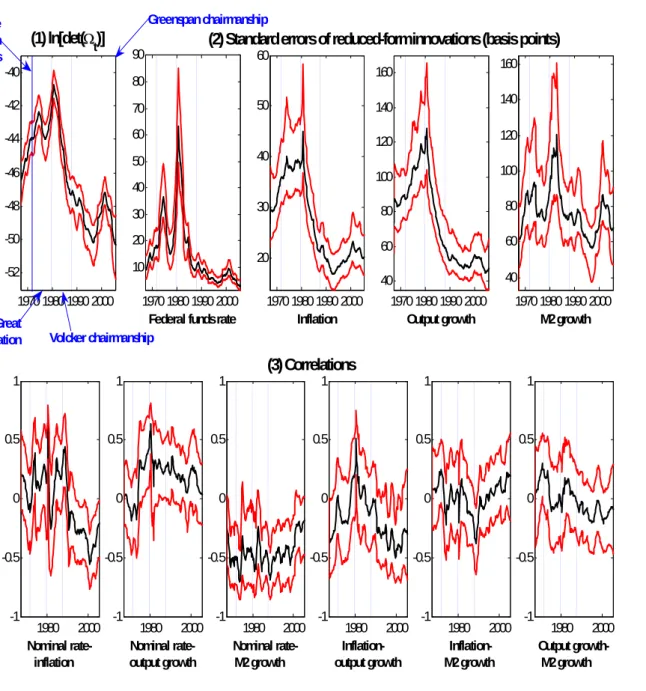
The top-left panel of Figure 2 provides a simple and stark illustration of the Great Moderation phenomenon, by plotting the median of the time-varying distribution of ln|Ωt|, which, following Cogley and Sargent (2005),8 we interpret as a measure of the
total amount of noise ‘hitting the system’ at each point in time9–together with the
16th and 84th percentiles.10 ln
|Ωt|is estimated to have significantly increased around
the time of the Great Inflation episode,11 reaching a historical peak in 1980:2; to
have dramatically decreased under the Chairmanship of Paul Volcker, and during the
8In turn, they were following Whittle (1953)–see Cogley and Sargent (2005, Section 3.5). 9An anonymous referee pointed out that this ‘[...] can be misleading: suppose that the system has two shocks which have high variance, but are nearly linearly dependent. Then log determinant of variance matrix will be very small, and yet the system may be very hard to predict.’ We entirely take this point, so it is important to be aware of the fact that these results suffer from this limitation. Unfortunately, it is not clear at all (at least, to us ...) how to effectively solve this problem.
10Under normality, the 16th and 84th percentiles are the bounds of a one standard deviation confidence interval, so that on average, for the normal distribution, the interval between these two percentiles encloses 68% of the distribution of the object of interest.
11Interestingly, the top-left panel of Figure 2 clearly suggests that the total prediction variance started increasingbefore the collapse of Bretton Woods, in August 1971. There are two possible– and not mutually exclusive–interpretations of this result. First, from a strictly technical point of view, estimates of the states based on Gibbs sampling are, by construction, two-sided, and in the case of sharp breaks they therefore inevitably tend to ‘mix the future with the past’, thus giving the impression that the change took place before it actually did. Because of this, these results
are not incompatible with the notion that the increase in the total prediction variance actually
took place after August 1971. A second possibility is that these results are precisely capturing the macroeconomic turbulence that ultimately undid Bretton Woods–e.g. the large fiscal shocks associated with thefinancing of the Vietnam war.
first half of Alan Greenspan’s tenure; to have increased around the time of the 2000-2001 recession, thus testifying to the marked increase in macroeconomic turbulence associated with the unwinding of the dotcom bubble; and to have decreased ever since, reaching (based on median estimates) a historical low in the last quarter of the sample, 2005:4.
4.1.2 The other components of Ωt
Turning to the other components of Ωt, the remaining four panels in the top row
of Figure 2 show the evolution of the standard deviations of the VAR’s residuals, in basis points. For all four series, the volatility of reduced-form shocks reached a peak
around the time of the Volcker disinflation. This is especially clear for the Federal
Funds rate, which exhibited a dramatic spike corresponding to the FED’s temporary adoption of a policy of targeting non-borrowed reserves, between October 1979 and October 1982, but it is equally apparent, although in a less dramatic fashion, for the other three series.
The bottom row of Figure 2 shows the time-varying correlations between the four
reduced-form shocks. The sign of the correlation between shocks to inflation and to the
Federal Funds rate switched (based on median estimates) from predominantly positive
before the Volcker disinflation to negative thereafter. Although the interpretation
of this finding within the present non-structural setting is inevitably fraught with
hazards, such evidence is compatible with the notion that during the first half of the
sample the U.S. economy had been hit by large structural inflationary disturbances,
which caused inflation to shoot up, and monetary policy ‘to play catch-up’ with
inflation, thus inducing a positive correlation between the reduced-form shocks to
inflation and the Federal Funds rate. During the second half of the sample, on the
other hand, with the fall in the magnitude of structural inflationary disturbances, the
negative correlation between reduced-form shocks to the Federal Funds rate and to
inflation induced by structural monetary policy shocks became dominant. By contrast,
the correlation between reduced-form shocks to M2 growth and the Federal Funds
rate has remained comparatively quite remarkably stable,fluctuating around -0.5 for
the entire sample, with the only exception of the most recent years.
4.2
In
fl
ation’s variance and persistence
Figure 3 shows the logarithms of the medians of the distributions of the estimated
time-varying spectral densities of inflation, which following Cogley and Sargent (2005)
we approximate as fπ,t|T(ω) =sπ(I3−At|Te−iω)−1 Ωt|T 2π £ (I3 −At|Te−iω)−1 ¤0 s0π (25)
(where sπ is a row vector selecting inflation); the logarithms of the medians of the
inflation’s spectral density), together with the 16th and 84th percentiles; the medians of the distributions of the normalised spectrum computed based on (25); and the
median normalised spectrum atω=0, together with the 16th and 84th percentiles.
In line with Cogley and Sargent (2005) and Cogley and Sargent (2005), the data
generation process for U.S. inflation appears to have experienced two major changes
since the times of the Great Inflation. First, a dramatic reduction in inflation’s overall
variance, with the spectral density of inflation markedly decreasing at all frequencies
around the time of the Volcker disinflation; and inflation’s overall variance reaching a peak in 1980:2, systematically decreasing up until the end of Volcker’s Chairmanship,
and fluctuating at comparatively low levels under Chairman Greenspan. Second, a
fall in persistence coinciding, once again, with the Volcker disinflation episode. Based
on median estimates the normalised spectrum of inflation at ω=0 is estimated to
have fallen from a peak of 0.475 in 1975:1 to a low of 0.088 in 1985:1. After slightly
increasing during the second half of the 1980s, it has fluctuated, since mid-1992,
between 0.044 and 0.06.12 Given that, as it is well-known–see e.g. Granger and
Newbold (1986) and Barsky (1987)–a stochastic process’ persistence is positively related to its extent of R2-forecastability, such marked fall in inflation persistence
should automatically imply a corresponding decrease in inflation’s predictability. As
the next section shows, this has indeed been the case.
4.3
Assessing changes in the economy’s predictability
Following Cogley (2005), we measure changes in the four series’ predictability by
computing, for each of them, a time-varying multivariate R2 statistic on a
quarter-12A word of caution on the interpretation of persistence measures. As it is well known from the work of, e.g., Pierre Perron–see in particular Perron (1989)–measuredpersistence crucially depends on the assumed specification for the mean (equilibrium component) of the process. Although in the present context we have postulated the equilibrium components of the three series to evolve smoothly over time, an alternative, and equally plausible, specification would be a step function– for an application to inflation within the univariate context, see e.g. Corvoisier and Mojon (2005). There are several reasons to prefer the present specification. First, and least important, for reasons of consistency with the previous literature, as the related work of Primiceri (2005), Canova and Gambetti (2005), and Gambetti, Pappa, and Canova (2006) has adopted the same specification. Second, and crucially, modelling the equilibrium components of the three series according to step functions would require afixed-coefficients VAR with (some of the) coefficients subject to structural breaks. Although, in principle, the break dates could be estimatedvia structural break tests–e.g., Bai and Perron (2003)–in practice both Cogley and Sargent (2005) and Benati (2007a) have shown such tests to possess a sometimes remarkably low power when the true DGP is characterised by random walk time variation. Time-varying parameters models, on the other hand, are well known for being capable of successfully tracking processes subject to structural breaks. As a consequence, while the ‘step function’ specification can be expected to perform well if and only if the DGP is subject to structural breaks, our specification can reasonably be expected to perform well under both scenarios.
by-quarter basis as13 R2x,t|T = 1− σ 2 ,t|T σ2 x,t|T (26) with x =rt, πt, yt,mt, where σ2x,t|T = Z π −π fx,t|T(ω)dω (27)
is variable x’s estimated overall time-varying variance; fx,t|T(ω) is the time-varying
estimate of the spectral density of x based on the estimated time-varying VAR; and
σ2,t|T = 2πexp ½ 1 2π Z π −π ln£fx,t|T(ω)dω ¤¾ (28)
is variable x’s estimated time-varying innovation variance, based on Kolmogorov’s
formula.
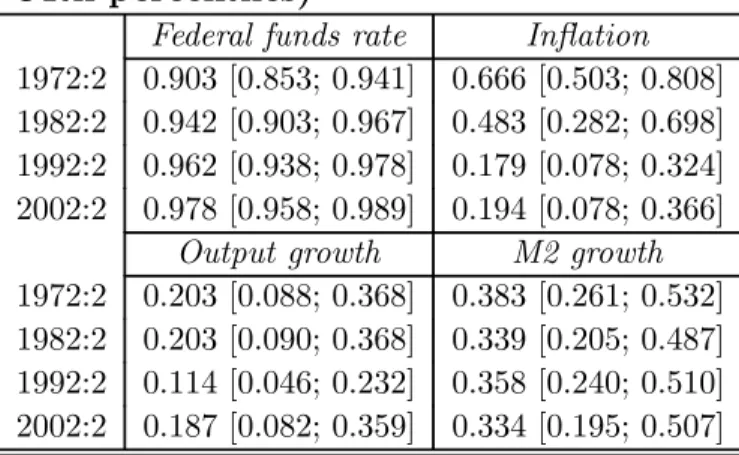
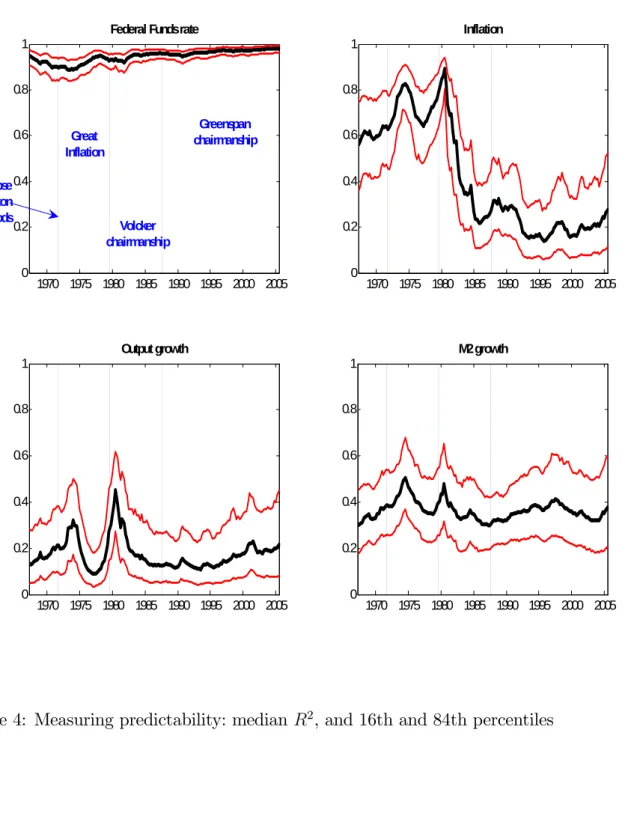
Figure 4 shows, for the four series, the medians of the distributions of the
time-varying multivariateR2 statistics, together with the 16th and 84th percentiles, while
Table 1 reports the same objects for four selected quarters. As both thefigure and the
table make clear, the predictability of the Federal Funds rate has remained virtually
unchanged at values very close to one over the entire sample period,14 while M2
growth’s forecastability has remained largely unchanged with the possible exception
of two mild spikes corresponding to the recession of the first half of the 1970s, and
to the Volcker recession. Output growth exhibits, overall, a pattern very similar to
that of M2 growth, with the main differences being, first, a uniformly lower overall
predictability, and second, a much more pronounced U-shape around the time of the Great Inflation, with a larger spike corresponding to the Volcker recession.15 Finally,
consistent with the results for inflation persistence discussed in the previous section– and in line with the recent work of Stock and Watson (2007) documenting a decrease in U.S. inflation forecastability over the most recent years–inflation’s predictability is estimated to have reached (based on median estimates) a peak of 0.89 in 1980:2; to have dramatically declined during Volcker’s Chairmanship, reaching 0.27 at the end
of his tenure; and to have fluctuated at comparatively low levels, between 0.14 and
0.32, under Chairman Greenspan.
13Given the enormous computational burden associated with re-estimating the model every single quarter, both this section’s exercise, and next section’s one, have been performed based on the smoothed (i.e, two-sided) output of the Gibbs samplerconditional on the full sample. This implies that both this section’s predictability measures, and next section’sk-step ahead projections, should only be regarded as approximations to the authentic out-of-sample objects that would result from a proper recursive estimation. (Unfortunately, it is not clear how to even gauge an idea of the goodness of such approximation.)
14This was in a sense to be expected, given that, as it is well known, the Federal Funds rate’s behavior is close to a unit root.
15This was, again, to be expected, given that the Volcker recession has been the deepest and longest since the times of the Great Depression.
Having discussed time-variation in the economy’s predictability, let’s now turn to the extent of uncertainty associated with future projections, as captured by the width and shape of model-generated ‘fan charts’ for the four series of interest.
4.4
Evolving macroeconomic uncertainty
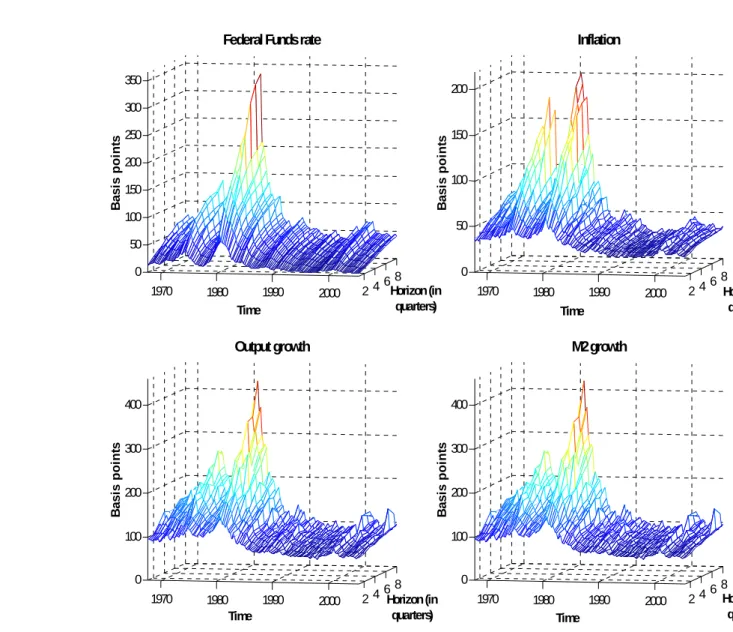
Figure 5 shows changes over time in the standard deviations (in basis points) of the
distributions of k-step-ahead forecasts for the four series of interest (for k = 1, 2,
..., 8 quarters), a simple measure of the extent of uncertainty associated with future projections, while Table 1 reports the same objects for four selected quarters and
three horizons.16 Projections have been computed by stochastically simulating the
VAR into the future 1,000 times.17 As in the previous section, the present exercise
has been performed based on the two-sided output of the Gibbs sampler conditional
on the full sample, so that these k-step ahead projections should only be regarded
as approximations to the authentic out-of-sample objects that would result from a proper recursive estimation.
Several findings clearly emerge from Figure 5. First, consistent with the
discus-sion on the U.S. ‘Great Moderation’ of section 4.1, for all series, and at all horizons, the extent of uncertainty exhibits a very broadly similar hump-shaped pattern over the sample period, with peaks reached, depending on the series, in either 1980 or
1981, corresponding to the Volcker disinflation. After decreasing dramatically during
subsequent years for all series, and at all horizons, uncertainty has then fluctuated
at historically low levels ever since, with only mild and temporary increases corre-sponding to the 2000-2001 recession. Focussing on the two-year horizon–the one tra-ditionally associated with monetary policy decisions–the standard deviations of the
distributions of the projections for the Federal Funds rate, inflation, output growth,
and M2 growth have decreased from peaks of 332, 199, 419, and 375 basis points in 1980-1981 to 41, 35, 95, and 125 basis points in the last quarter of the sample, 2005:4, thus testifying to the dramatic decrease in macroeconomic uncertainty across the board over the last two decades and a half.
As for inflation, both the figure, and especially the table, clearly highlight the
impact on the extent of uncertainty surrounding its projections of two previously
discussed major changes which affected its data generation process, a decrease in
both its persistence, and the volatility of its reduced-form innovations. While the decrease in the volatility of innovations caused a generalised downward shift in the
16In order to correctly interpret the information contained in the Figure and the Table, the reader should keep in mind that inflation and the rates of growth of output and M2 have been computed as the non-annualised quarter-on-quarter rate of change of the relevant series, and that the Federal Funds rate has been rescaled accordingly.
17Specifically, for every quarter, and for each of the 1,000 simulations, we start by sampling the current state of the economy from the Gibbs sampler’s output for that quarter, by drawing a random number from a uniform distribution defined over [1; 1,000]. Conditional on this draw for the current state of the economy att, we then simulate the VAR 8 quarters into the future.
extent of uncertainty at all horizons, the fall in persistence ‘twisted’ the relationship between the forecast horizon and the standard deviation of the distribution of the
projections, making it flatter than it was around the time of the Great Inflation.18
A comparison between these results and those in the previous sub-section therefore clearly shows how–consistent with Stock and Watson (2007)–over the most recent
years U.S. inflation appears to have been, so far, less predictable than in the past
in the R2 sense, but, on the other hand, the extent of uncertainty associated with
inflation projection has drastically fallen, especially compared with the Great Inflation episode.
5
Structural Analysis
In the spirit of Primiceri (2005), Canova and Gambetti (2005), and Gambetti, Pappa, and Canova (2006), in this section we impose, on the estimated time-varying reduced-form VAR, identifying restrictions on a period-by-period basis. We identify four structural shocks–a monetary policy shock, a supply shock, a demand non-policy shock, and a money demand shock–based on sign restrictions.
5.1
Identi
fi
cation
Following Canova and de Nicolo (2002), Faust (1998), Peersman (2005), and Uhlig
(2005), our identification strategy relies on imposing the following sign restrictions
on the contemporaneous impacts of the structural shocks on the endogenous variable. We postulate
• the impact of a positive monetary policy shock to be non-negative on the interest
rate, and non-positive on inflation, and on the rates of growth of output and
M2;
• the impact of a demand non-policy shock be non-negative on all four variables.
• the impact of a supply shock be non-negative on output growth and non-positive
on inflation, while we leave its impact on the other two variables as
uncon-strained.
• the impact of a money demand shock be non-negative on both the interest rate
and M2 growth, and to be non-positive on both inflation and output growth.
18The easiest way to understand such changes is to focus on the limiting theoretical cases of a pure random walk and of a pure white noise process. While for a random walk uncertainty (as measured by the conditional variance of the projection) increases linearly with the forecast horizon, for a pure whote noise process it is constant at all horizons.
It can be trivially shown that these restrictions are sufficient to uniquely identify
the four shocks. We compute the time-varying structural impact matrix, A0,t, via
the procedure recently introduced by Rubio-Ramirez, Waggoner, and Zha (2005).19
Specifically, let Ωt = PtDtPt0 be the eigenvalue-eigenvector decomposition of the VAR’s time-varying covariance matrixΩt, and let A˜0,t ≡PtD
1 2
t. We draw anN ×N
matrix,K, from theN(0, 1) distribution, we take the QRdecomposition of K–that
is, we compute matrices Q and R such that K=Q·R–and we compute the
time-varying structural impact matrix asA0,t=A˜0,t·Q0. If the draw satisfies the restrictions we keep it, otherwise we discard it and we keep drawing until the restrictions are
sat-isfied, as in the Rubio-Waggoner-Zha code SRestrictRWZalg.m which implements
their algorithm.
5.2
The systematic component of monetary policy
5.2.1 The historical record
Figure 6 plots the medians and the 16th and 84th percentiles of the distributions of
the long-run coefficients on inflation, output growth, and M2 growth in the
struc-tural monetary rule.20 Abstracting from the significant extent of econometric
un-certainty, especially apparent in the second half of the sample, and focussing on
median estimates, the results reported in the figure accord, overall, quite
remark-ably well with traditional, ‘narrative’ accounts of post-WWII U.S. macroeconomic
history.21 Up to the arrival of Paul Volcker, U.S. monetary stance is estimated to
have been characterised by virtually no reaction to output growth; no reaction, or
a mildly negative reaction to M2 growth; and, most importantly, a comparatively
low reaction to inflation, estimated, during the Great Inflation episode, at slightly
below one.22 Volcker’s chairmanship appears instead to have been characterised by
two major changes. First–in line with both ‘folk wisdom’, and traditional narrative
accounts–dramatic increases in the long-run coefficients on both inflation and M2
growth.23 Second, a negative coefficient on output growth around the time of the
19See at http://home.earthlink.net/~tzha02/ProgramCode/SRestrictRWZalg.m.
20We do not report the corresponding objects for the lagged Federal Funds rate as they are not especially interesting, but they are available from the authors upon request.
21See in particular DeLong (1997).
22An important point to stress is that the fact that the long-run coefficient on inflation be–or not be–above one should be drastically de-emphasised. As stressed by, e.g., Lubik and Schorfheide (2004), (in)determinacy is a system property–having to do with the interplay between all of the coefficients of the monetary rule and all of the structural coefficients of the model–and as such it bears no clear-cut relationship with the value taken by asingle (policy or non-policy) coefficient.
23As we already stressed in Section 4.1.1., because of the two-sided nature of Gibbs sampling’s estimates, the fact that a specific object is estimated to have increased (decreased) over a period of several years isnot incompatiblewith the notion that, in reality, its change has been swift and sudden. So in the present case our estimates are compatible with the notion that the long-run coefficients on inflation and M2 growth changed suddenly with the beginning of Volcker’s chairmanship.
Volcker disinflation, when the deepest recession since the Great Depression failed to
prevent further hikes in the Federal Funds rate.24 This is in line with the folk
wis-dom about the Volcker disinflation as a decisive move to squeeze inflation out of the
system ‘no matter what’. Finally, the period since mid-1980s has been characterised by an overall declining weight on M2 growth; an overall increasing weight on output growth; and an overall slightly declining weight on inflation. Interestingly, the weight
on inflation clearly appears to have temporarily declined corresponding to the two
most recent recessions, the 1990-1991 one, coinciding with the first Gulf War, and
the one following the collapse of the dotcom bubble.25
Given that the evolution of the systematic component of monetary policy appears to have been in line with narrative accounts of post-WWII U.S. macroeconomic his-tory, a question naturally arises: ‘What if the most recent, stabilising monetary rule
had been in place around the time of the Great Inflation? Would it have been able
to save the day?’. Maybe surprisingly, as the next section shows the fact that U.S. monetary policy clearly appears to have improved compared with the pre-Volcker era
does not imply that the more recent monetary rule could have prevented the Great
Inflation at limited costs in terms of lost output.
5.2.2 Policy counterfactuals
Figures 7-9 shows results from a set of 1,000 counterfactual simulations in which we
have imposed, over the entire sample period, the structural monetary rules identified
for the Chairmanships26 of Arthur Burns and William Miller,27Paul Volcker, and Alan
Greenspan.28 Specifically, the figures shows, for each of the four series, the medians
of the distributions of the difference between the counterfactual paths and the actual
24It is important to remember, once again, that during the experiment with targeting non-borrowed reserves (October 1979-October 1982) the Federal Funds rate was behaving like a market price, so that interest rates hikes were not purposefullyengineered by the FED, but they were rather
accepted.
25The results in the first two panels of Figure 6 are qualitatively in line with those reported in Kim and Nelson (2006)–see their Figures 2 and 3. Admittedly, though, Kim and Nelson’s Figure 3 is for the output gap, as opposed to output growth.
26As found at the Federal Reserve Board’s website–see at
http://www.federalreserve.gov/bios/boardmembership.htm–the Chairmen’s tenures are the following. William McChesney Martin, Jr.: Apr. 2, 1951-Jan. 31, 1970; Arthur F. Burns: Feb. 1, 1970-Jan. 31, 1978; G. William Miller: Mar. 8, 1978-Aug. 6, 1979; Paul A. Volcker: Aug. 6, 1979-Aug. 11, 1987; Alan Greenspan Aug. 11, 1987-Jan. 31, 2006.
27Due to William Miller’s short tenure–just 17 months–we are ‘merging’ his Chairmanship with Burns’.
28Specifically, for each simulationj=1, 2, ...,N, at each quartert=p+1,p+2, ...,T we draw three random numbers,τ, indexing the quarter of the Chairmanship from which we draw the elements of the structural monetary rule; andκtandκτ, indexing the iterations of the Gibbs sampler at times tand, respectively,τ from which we draw the state of the economy. (All three numbers are defined over appropriate uniform distributions.) We then take all of the elements of the monetary rule from iterationκτ of the Gibbs sampler for quarterτ, while we take everything else from iterationκtfor
series, together with the 16th and 84th percentiles. Due to the limited number of observations available for the Chairmanship of William Martin (less than three years), we have chosen not to report the results from the counterfactual corresponding to this Chairman, but they are available upon request. Before delving into the results, an important point to mention is that, as it has been well known for a long time, structural VAR-based counterfactual simulations are, in principle, vulnerable to the Lucas critique, so that, in general, the results of this section should necessarily be
taken with a grain of salt.29 In a sub-section at the end of this paragraph we will
therefore discuss to which extent Lucas critique-type problems can reasonably be thought to be relevant in the present context.
Starting with Figure 7, imposing Burns and Miller over the entire sample period produces three main results. First, the counterfactual Federal Funds rate is–not surprisingly–very close to the actual historical one up until the beginning of the
Volcker Chairmanship; the difference between the counterfactual path and the actual
series then decreases quite significantly under Volcker, reaching (based on median
estimates) a negative peak in excess of four percentage points around the time of the Volcker recession; and it then (very) slowly converges towards zero starting from mid-1980s. Second, the counterfactual inflation path is strikingly similar to the actual
one–if anything it is, quite surprisingly, very slightly lower than the actual one
around the time of the Volcker disinflation. Third, as it should be expected, output
growth is comparatively higher around the time of the 1980-1982 recession (by a maximum extent equal to about two percentage points), and it is still slightly higher
than the actual historical figure around the time of the 1990-1992 recession. Other
than that, however, the only non-negligible difference with historical outcomes is
around mid-1970s, when counterfactual output growth falls short of actual growth by about one percentage point. Overall, results from this counterfactual simulation clearly suggest, therefore, only a modest impact of policy on actual macroeconomic
outcomes, thus pointing towards luck, first bad, and then good, as the explanation
for the bulk of post-WWII U.S. macroeconomic dynamics.30
Turning to Figure 8, imposing Paul Volcker over the entire sample period produces
of the vectorYt.
It was pointed out by an anonymous referee that in this way ‘the policy coefficients do not evolve smoothly [...], because now consecutive time periods [...] may receive policy coefficients from non-consecutive periods’. This is certainly true, but the key issue here is that the ultimate goal of the counterfactual isnotto impose the Chairmen over the sample period in a way which is consistent with the specific way in which their chairmanships have historically evolved. Rather, it is to substitute (loosely speaking) an ‘average’ of the chairmanships over the entire sample.
29We wish to thank an anonimous referee for stressing the importance of this issue, and for providing extremely useful suggestions.
30Based exactly on the same kind of logic, Benati (2007b) argues for a dominant role of good luck in fostering the more stable macroeconomic environment of (roughly) the last two decades in the United Kingdom: if, by imposing the supposedly bad monetary rule of the 1970s over the entire sample period, basically nothing changes compared with actual historical outcomes, it necessarily has to be the case that policy did not play much of a role ...
two main results. First, virtually no difference, or very little difference, between ac-tual and counterfacac-tual outcomes over the period following the end of the Volcker
disinflation. Second, as for the years up to the end of the Volcker disinflation, it
generates counterfactual paths for inflation, output growth, and M2 growth
system-atically below actual historical ones. (It has to be stressed, however, that in the case
of inflation the difference is not enormous, reaching a maximum of about minus three
percentage points in the second half of the 1970s, when actual inflation was moving
towards ten per cent). Although this is exactly what we would have expected based
on Paul Volcker’s aggressively counter-inflationary reputation, what is at first sight
puzzling is that such disinflationary impact doesnot get achievedvia higher interest
ratesat any point in the sample, and especially during the very first few years. As the top-left panel clearly shows, indeed, up until 1976-1977 the counterfactual Federal Funds rate is broadly in line with the actual one, while during the years between
1976-1977 and the end of the Volcker disinflation the counterfactual rate is actually
lower than the historical one (by a maximum of about three percentage points in
1980Q1), thus suggesting that the lower counterfactual path for inflation translated,
via the Fisher effect, into a lower path for interest rates. Given that higher
inter-est rates during the veryfirst years of the sample are not a possible explanation for
the systematically lower counterfactual paths for inflation, output growth, and M2
growth, the most logical explanation is, in our view, the expectational impact of the Volcker monetary rule.
Finally, turning to Figure 9, ‘bringing Alan Greenspan back in time’31 would have
had little impact on inflation before the collapse of Bretton Woods; it would have had
no discernible effect after 1983-1984; and, most notably, it would have had a prolonged
discernible impact–equal, however, to at most slightly more than three percentage
points–between 1977 and 1981-1982, when inflation fluctuated between 5 and 11.6
per cent. As thefirst column shows, such a minor stabilising impact on inflation would
have been achievedvia higher interest rates, up to two additional percentage points,
in 1975-1977, and subsequently lower output and M2 growth during the second half of the 1970s.
How vulnerable are these results to the Lucas critique? In spite of the changes in the systematic component of monetary policy documented in the previous sub-section, overall, results from counterfactual simulations therefore suggest that
systematic monetary policy was not at the root of the Great Inflation episode, so
that either systematic policy mistakes, or just plain bad luck (e.g., large
non-31It was pointed out by an anonymous referee that, given the comparatively greater uncertainty associated with the time-varying long-run coefficients in the structural monetary policy rule (see Figure 6: this is especially clear for the coefficient on inflation), ‘bringing Greenspan back in time means not only higher coefficients on inflation and money growth, but also much more volatile coefficients on inflation and money growth.’
policy shocks) must have been behind the inflationary upsurge of the 1970s.32 But how vulnerable are these results to the Lucas critique? Within a conceptually similar context, Sims and Zha (2006) raise indeed doubts on the reliability of the results reported in their Figure 8, depicting counterfactual paths for the Federal Funds rate,
output growth, and inflation conditional on an “inflation hawk Greenspan” with
doubled coefficients on inflation in his monetary policy rule. In particular, they
question the reliability of the significant output losses generated by this simulation,
with the counterfactual path for output growth systematically and significantly below
the actual one until the beginning of the 1980s:
‘The counterfactual simulations that imply lower inflation create a
marked change in the stochastic process followed by output and inflation.
It is therefore quite possible that the output costs of the stronger
anti-inflationary policy stance would not have been so persistent as shown in
the graphs.’
In plain English, the output losses are so large that (i) they cannot be literally
believed, and (ii) they most likely results from Lucas critique-type problems. If, within the counterfactual, the full impact on expectations of the alternative monetary rule could have correctly been captured, the output losses would most likely be much lower.
Although solid within the context of the specific exercise Sims and Zha are
per-forming, such an argument appears (at least to to us) less so within the present
context, for the simple reason that, in two cases out of three, the differences between
actual and counterfactual paths are nowhere as nearly as dramatic as those depicted in Sims and Zha’s Figure 8 . Only in the case of the ‘Greenspan counterfactual’ of Figure 9 the output losses up to the end of the 1970s reach magnitudes comparable to
those generated by Sims and Zha’s “inflation hawk Greenspan”. Accordingly, in line
with Sims and Zha, these results should therefore be quite significantly discounted.
Figure 9, however, is not our only piece of evidence. In particular, as we previously stressed–and in line with Benati (2007b)–the fact that imposing the supposedly
‘bad’ monetary rule of the 1970s over the entire sample period (i) implies almost no
difference between the actual and counterfactual inflation paths, and (ii) it implies a
comparatively minor difference between the actual and counterfactual output growth
paths, represents, in our view, decisive evidence that the systematic component of
monetary policy did not play a significant role in generating the high macroeconomic
turbulence of the 1970s.
32Our overall conclusion is therefore in line with Sims and Zha’s (2006) that ‘[...] the estimated policy changes do make a noticeable difference, but not a drastic difference.’
5.3
Structural variance decomposition
Figure 10 shows, for each of the four series, and for each single quarter, the
frac-tions of overall variance explained by each individual shock–specifically, the figure
shows the medians of the distributions of the fractions together with the 16th and 84th percentiles. The decomposition has been computed in the frequency domain, by
computing, for each quarter, each iteration of the Gibbs sampler, and each series x,
with x=rt,πt, yt,mt, both the series’ actual spectral density–fx,t|T(ω) in (27) and 28–and the four ‘counterfactual’ spectral densities obtained by setting to zero the
variances of each of the fours structural shocks but one.33 Given that a series’
vari-ance is equal to the integral of its spectral density, this trivially allows for a structural
decomposition of a series’ overall variance at each point in time.34
As the second row shows, demand non-policy shocks explained the lion’s share of the variance of inflation during the period up to the beginning of the Volcker disinfl a-tion, with (based on median estimates) the fraction of overall variance increasing from 40-50 per cent at the end of the 1960s to a peak in excess of 60 per cent around 1980. After falling below 40 per cent in 1981, the fraction of inflation’s variance due to
de-mand shocks continued to decline during subsequent years, and has beenfluctuating
between 10 and 20 per cent over the most recent period.35 By contrast, the fraction
due to policy shocks fluctuated around 10 per cent over the entire sample period–
with the exception of a short-lived spike up to about 20 per cent corresponding to
the Volcker disinflation–thus testifying, once again, to the negligible role played by
monetary policy in engineering the Great Inflation, even in itsnon-systematic
compo-nent. The influence of money demand shocks appears to have been likewise negligible
up to the end of the Volcker Chairmanship, but it has rapidly increased under Alan Greenspan, reaching almost 30 per cent at the end of the sample. Finally, the
frac-tion due to supply shocks fluctuated around 20 per cent until the beginning of the
Volcker disinflation, ‘it rapidly increased under Paul Volcker, and it had been fl uctu-ating, under Alan Greenspan, around 40 per cent. Taken together with the previous section’s findings, these results indicate that (i) the Great Inflation was due, to an overwhelming extent, to bad luck, i.e. to large non-policy shocks–in particular, to a
33An important point to stress is that while it can be easily shown that it is not possible to uniquely identify the innovation variances of the four structural shocks, it is on the other hand possible to compute the (time-varying) covariance matrix of the VAR that would result from setting one (or more) of the structural innovation variances to zero.
34To put it differently, the sum of the four ‘counterfactual’ spectral densities is by construction equal to the series’ actual spectral density,fx,t|T(ω).
35As it was pointed out by a referee, ‘[i]t is possible that the weight of demand shocks in variance decomposition of inflation and output has fallen exactly because monetary policy changed to less accommodating, and, in equilibrium, also private sector responses to such shocks diminished. If this is true, ‘Bringing Greenspan back in time’ would have a huge beneficial effect.’. Here the problem is that the counterfactuals we performed in the previous sub-section do not support this hypothesis. To be fair, such counterfactuals are most likely subject to a Lucas critique argument, but then the issue becomes abandoning the SVAR methodology and using a DSGE model ...
dominant extent to demand shocks, and to a lower extent to supply shocks; and (ii) confronted with those large non-policy shocks, a more aggressive monetary rule like
Chairman Greenspan’s could have stabilised inflation only to a minor extent, and at
the price of significantly lower output growth in the second half of the 1970s.
Turning to the Federal Funds rate, thefirst column of Figure 10 shows that–quite
reassuringly ...–monetary policy shocks explain a comparatively minor fraction of the rate’s overall variance, with the bulk of the variation due instead to demand shocks, especially up until mid-1990s. The fraction due to supply shocks, on the other hand, remained relatively stable around 15-20 per cent over the entire sample period, with the exception of the most recent recession, when it temporarily shot up in excess of 40 per cent. Interestingly, the fraction of variance due to monetary policy shocks exhibits
a temporary spike in excess of 30 per cent corresponding to the Volcker disinflation
episode.
An analogous spike in excess of 30 per cent for monetary policy shocks
corre-sponding to the Volcker disinflation can be seen for output growth. Interestingly,
afterfluctuating quite erratically during the period up to 1987, the fraction of output
growth variance due to the non-systematic component of monetary policy stabilised, under Greenspan, around 10 per cent. Greenspan’s Chairmanship appears to have
been characterised by two other major phenomena: first, an analogous decrease in
the fraction of variance due to demand shocks; second, an higher fraction due to sup-ply shocks. Taken together, all these results are compatible with a view of monetary policymaking under Greenspan according to which the FED succeeded, to a greater extent than before, in keeping the economy close to the stochastic trend, minimising
the influence of demand shocks–either policy or non-policy–in driving output away
from potential, thus allowing supply shocks to dominate outputfluctuations.36
5.4
Changes in the transmission of monetary policy shocks
Although, historically, the non-systematic component of monetary policy appears to have explained only a minor fraction of the overall variance for all series except M2 growth, it might be of interest to explore how the transmission mechanism of monetary policy shocks has changed over time. Figure 11 plots, for the four series, the time-varying median generalised impulse-response functions (henceforth, IRFs) to a 25 basis points monetary policy shock, while Figure 12 shows the same objects, together with the16th and 84th percentiles of the distributions, for four selected dates.
Generalised IRFs have been computed via the Monte Carlo integration procedure
described in Appendix B, which allows to effectively tackle the uncertainty originating
from future time-variation in the VAR’s structure. Due to the computational intensity of such a procedure, IRFs have been computed only every four quarters, starting from
36Another way of putting this is that the Greenspan FED, by keeping the economy closer to the stochastic trend than before, caused it to behave, to a greater extent, like a real business cycle model.
Bothfigures clearly point towards an important change in the response of the Fed-eral Funds rate over the sample period, with a 25 basis points shock being followed,
over the first part of the sample, by negligible subsequent increases, and being
in-stead followed, over the most recent years, by comparatively larger subsequent hikes, building up, overall, up to about 40 basis points. It is also worth stressing how, during the second half of the 1970s, the contractionary impact of a interest rate hike
used to be partially offset by a subsequent ‘reversal’, with the IRF becomingnegative
after about 6-8 quarters. Overall, these results are therefore fully consistent with the
findings of Section 5.2 of an improvement in the conduct of monetary policy
post-October 1979. Turning to the other three variables, once taking into account of the uncertainty surrounding median estimates (see Figure 12), it is not entirely clear that
IRFs have experienced significant changes over the sample period. The exception is
obviously represented by the very last portion of the sample, when the negative im-pact of a monetary policy shock increases dramatically for all the three variables, but one likely explanation for such results is simply that the very last quarters have just been imprecisely estimated.
6
A
Caveat
: The ‘Indeterminacy Hypothesis’
Taken at face value, our results clearly point towards good luck as the most plausible explanation for the greater macroeconomic stability of the most recent period. But
are there anycaveatsto ourinterpretationof these results? We believe that there is an
important one, which is currently being investigated in our related work in progress,37
and is extensively discussed in a companion paper on the Great Moderation in the
United Kingdom,38 to which the reader is referred to for further details.
Our point of departure is the striking contrast between the results from (time-varying parameters or Markov-switching) structural VARs, and those coming from an alternative, ‘narrative’ approach. As we previously discussed, the SVAR-based results of Stock and Watson (2002), Primiceri (2005), Sims and Zha (2006), and Canova and his co-authors suggest–in line with the present work–that plain good luck is the
key reason for the transition from the Great Inflation to the Great Moderation in
the United States. The narrative evidence, by contrast–see, in particular the work of DeLong (1997) and Romer and Romer (2002)–typically points towards improved
monetary policy, with the evolution of the U.S. monetary authority’s understanding
of the functioning of the economy being identified by the Romers as the main driver.
The contrast between the results coming from the two approaches is even more striking in the case of the United Kingdom. Although Benati (2007c), based on the
same methodology we used in the present work, identifies once again good luck as the
37Benati and Surico (2007). 38Benati (2007c).
explanation for the remarkable macroeconomic stability enjoyed by the U.K. economy
over the last two decades, as he discusses,39 his results stand in marked contrast with
the narrative evidence produced