©Axonics Modulation Technologies, Inc. All rights reserved. www.axonics.com/mri
MRI Patient Guidelines
For patients with the Axonics SNM System
For use in Europe
Instruction for Use
Note: This document contains information related to magnetic resonance imaging (MRI) use with the Axonics SNM System. Refer to the Axonics SNM System product manuals for more detailed information about non-MRI aspects of implantation, programming, charging, and use of the components of the Axonics SNM System.
Table of Contents
GLOSSARY ... ii
1.
WHAT IS MAGNETIC RESONANCE IMAGING (MRI)? ... 1
2.
CAN I HAVE AN MRI? ... 1
3.
MR CONDITIONAL DEVICE ... 2
4.
POSSIBLE RISKS OF MRI WITH THE AXONICS SNM SYSTEM ... 3
4.1. Heating of the Implant ... 3
4.2. Unintended Stimulation ... 3
4.3. Magnetic Field Interactions ... 3
4.4. Device Malfunction or Damage ... 3
4.5. Image Artifacts ... 3
4.6. MR UNSAFE DEVICES ... 4
5.
MRI GUIDELINES ... 5
5.1. Before Starting an MRI Exam ... 5
5.2. During the MRI Exam ... 5
Axonics MRI Patient Guidelines – Europe ii
GLOSSARY
CE Marking of Conformity MRI – Magnetic Resonance Imaging.
MR Conditional – an item with demonstrated safety in the MR environment within defined conditions.
MR Unsafe – an item which poses unacceptable risks to the patient, medical staff, or other persons within the MR environment.
Sacral Neuromodulation (SNM) – a type of electrical stimulation therapy that uses mild electrical pulses to stimulate the sacral nerve located in the pelvic region.
1.
WHAT IS MAGNETIC RESONANCE IMAGING (MRI)?
Magnetic resonance imaging (MRI) is a technique that is used for creating pictures of the internal structures of the body. Unlike an x-ray exam, it does not use radiation. Instead, it uses a large magnet, radio waves, and a computer to create pictures of body structures and organs.
2.
CAN I HAVE AN MRI?
The Axonics Sacral Neuromodulation (SNM) System is an MR Conditional device. This means that patients with the Axonics SNM System can safely have MRI examinations of the head or body under certain conditions. Consult with your doctor and MRI technologist to determine if you are eligible for MRI examination.
You are required to discuss with your doctor and MRI technologist if you have any other device(s) implanted. Possible implanted devices include:
• Pacemaker
• Implantable cardioverter-defibrillator (ICD)
• Aneurysm clips
• Cochlear implants
• Orthopedic prostheses (e.g. hip implant)
• Other neurostimulators
• Stents
• Metal plates, pins, or screws
• Dental implants
You are also required to discuss with your doctor and MRI technologist if you have or suspect you have any of the following issues with your implant:
• broken lead
• lead disconnection from the neurostimulator
• malfunctioning neurostimulator
• neurostimulator implanted at an area other than posterior hip or upper buttock
• irregular stimulation
You should inform the MRI technologist before the MRI procedure:
• If you are pregnant or suspect you are pregnant
• If you are breast feeding at the time of the scheduled procedure
Axonics MRI Patient Guidelines – Europe 2
3.
MR CONDITIONAL DEVICE
MR Conditional
The Axonics SNM System is an MR Conditional device. This means that patients with the Axonics SNM System can safely have MRI examinations of the body under certain conditions. The conditions for MRI scanning of the head are different than those for the full body.
Consult with your MRI technologist prior to the MRI exam. They will make sure the specific conditions for either head or body MRI scanning are met. Make sure to read the entire document and follow the procedures in Section 5.
Always obtain the latest MRI guidelines. Refer to the contact information on the last page of these MRI guidelines, or go to www.axonics.com/patients/mri
Note: The external components of the Axonics SNM System are MR UNSAFE, including the Clinician Programmer, Remote Control, Charger and Dock, and External Trial System (External Trial Stimulator, percutaneous leads and cables). These devices must NOT be brought into the magnet room.
Note: The guidelines in this document are approved only in geographies where CE marking and approval are recognized.
4.
POSSIBLE RISKS OF MRI WITH THE AXONICS SNM SYSTEM
Patients with the Axonics SNM System can safely have an MRI exam when the conditions for safe MRI specified in this document are followed. However, there may be some risks from having an MRI exam with the implanted SNM System. Possible risks include:
• Heating of the implant
• Unintended stimulation
• Magnetic field interactions
• Device malfunction or damage
• Image distortion and artifacts
4.1.
Heating of the Implant
MRI may cause the implant to become hot. However, if the conditions for safe MRI are followed, this heating is minimal. If the specific MRI conditions are not followed, heating of the implant could damage the sacral nerve and/or surrounding structures. If the site of your implant feels hot during MRI, inform the MRI technologist immediately and then contact your doctor.
4.2.
Unintended Stimulation
MRI may cause unintended stimulation from the implant. This unintended stimulation may be uncomfortable (e.g. tingling, shocking, or jolting). However, if the conditions for safe MRI are followed, such stimulations should not happen. If you feel any stimulation during MRI, inform the MRI technologist immediately and then contact your doctor.
4.3.
Magnetic Field Interactions
The magnets used in MRI may cause the implant to shift or move slightly within the implant pocket. This may cause stress to the tissues and the lead. As a result, you may feel a slight tugging sensation at the site of your implant. If you feel uncomfortable during the MRI scan, inform the MRI technologist immediately.
4.4.
Device Malfunction or Damage
Device malfunction or damage refers to changes in stimulation, difficulty in operation, and other device-related problems that occur after the MRI scan. If the conditions for safe MRI are followed, device malfunction or damage should not happen. If you feel any changes to the device performance after MRI, inform the MRI technologist immediately and then contact your doctor.
Axonics MRI Patient Guidelines – Europe 4
4.6.
MR UNSAFE DEVICES
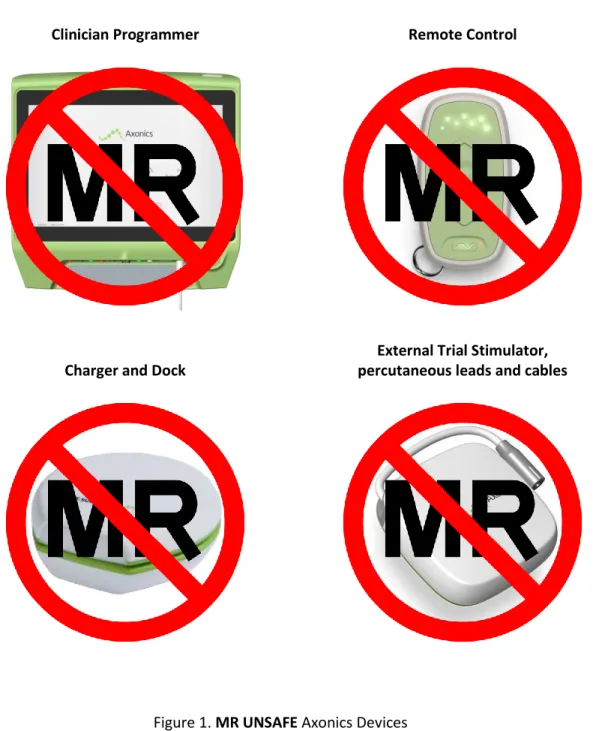
The external components of the Axonics SNM System are MR UNSAFE, including the Clinician Programmer, Remote Control, Charger and Dock, and External Trial System (External Trial Stimulator and percutaneous leads and cables) (Figure 1). These devices must NOT be brought into the magnet room.
Clinician Programmer Remote Control
Charger and Dock
External Trial Stimulator, percutaneous leads and cables
5.
MRI GUIDELINES
The guidelines for head and full body MRI exams are specific for the implantable Axonics SNM System. Precautions are to be taken before, during, and after the MRI exam. Talk to your MRI technologist or your doctor should you have any questions or concerns.
5.1.
Before Starting an MRI Exam
5.1.1.Consult your doctor and MRI technologist to determine if you are eligible for a head or body MRI exam (Refer to Section 2):
• Inform your doctor and MRI technologist if you have multiple Axonics SNM devices or any other medical device(s) implanted, such as a pacemaker, drug pump, hip prosthesis, stent, etc.
• Inform your doctor and MRI technologist if you think your neurostimulator and/or lead have any issues. Do not have a body MRI exam if there are issues with your implant.
• Inform your MRI technologist if you are pregnant, suspect you are pregnant, breastfeeding, or having a fever.
5.1.2.Bring the most up-to-date patient ID card to all MRI appointments.
5.1.3.Your MRI technologist may also give you additional MRI Patient Guides and Instructions. Make sure that you fully understand and comply with those instructions. Discuss with your MRI technologist or your doctor if you have any concerns.
5.1.4.Make sure that the Neurostimulator stimulation is turned OFF. Refer to your Remote Control Manual on how to turn the stimulation off. Alternatively, your doctor or MRI technologist can also turn the stimulation off using the Clinician Programmer.
5.1.5.Make sure you remove any external metallic objects before entering the magnet room. 5.1.6.Do not carry any external devices associated with the Axonics SNM system, such as the Remote
Control, Charger and Dock, etc. into the magnet room.
5.2.
During the MRI Exam
5.2.1.You are required to lie still during the MRI exam.
5.2.2.You may feel slight tugging, vibration, warming, and/or tapping in the area where the Neurostimulator is located during the MRI exam. If those feelings cause discomfort, you should let the MRI technologist know immediately. See Section 4 for more details on the risks of MRI with the Axonics SNM System.
5.2.3.If you are not feeling well for any other reasons prior to or at the time of the MRI exam, please inform your MRI technologist.
Axonics MRI Patient Guidelines – Europe 6
5.3.
After the MRI Exam
5.3.1.If you had a head MRI exam, turn the stimulation back on with the Remote Control. Refer to your Remote Control Manual on how to turn the stimulation back on.
5.3.2.If you had a full body MRI exam, your doctor or MRI technologist can also turn the stimulation back on using the Clinician Programmer. They will make sure that the same stimulation settings used prior to MRI scan are restored in your device.
5.3.3.If you feel any changes in stimulation after an MRI, you should contact your doctor and turn the stimulation off if uncomfortable.
Axonics Modulation Technologies, Inc. Irvine, CA 92618 (USA)
www.axonics.com
Tel. +1-877-9AXONICS (+1-877-929-6642) Fax +1-949 396-6321
HealthLink Europe Services BV De Tweeling 20-22
5215 MC 's-Hertogenbosch The Netherlands
All Rights Reserved. Copyright 2020. Axonics Modulation Technologies, Inc.
110-0074-001rK