Document Structure Integrity: A Robust Basis for Cross-site Scripting Defense
Yacin Nadji
∗Illinois Institute of Technology
Chicago, IL, USA
[email protected]
Prateek Saxena
University of California
Berkeley, CA, USA
[email protected]
Dawn Song
University of California
Berkeley, CA, USA
[email protected]
Abstract
Cross-site scripting (or XSS) has been the most domi-nant class of web vulnerabilities in 2007. The main under-lying reason for XSS vulnerabilities is that web markup and client-side languages do not provide principled mechanisms to ensure secure, ground-up isolation of user-generated data in web application code. In this paper, we develop a new approach that combines randomization of web ap-plication code and runtime tracking of untrusted data both on the server and the browser to combat XSS attacks. Our technique ensures a fundamental integrity property that pre-vents untrusted data from altering the structure of trusted code throughout the execution lifetime of the web applica-tion. We call this propertydocument structure integrity(or DSI). Similar to prepared statements in SQL, DSI enforce-ment ensures automatic syntactic isolation of inline user-generated data at the parser-level. This forms the basis for confinement of untrusted data in the web browser based on a server-specified policy.
We propose a client-server architecture that enforces document structure integrity in a way that can be imple-mented in current browsers with a minimal impact to com-patibility and that requires minimal effort from the web de-veloper. We implemented a proof-of-concept and demon-strated that such DSI enforcement with a simple default pol-icy is sufficient to defeat over 98% of the 5,328 real-world reflected XSS vulnerabilities documented in 2007, with very low performance overhead both on the client and server.
1
Introduction
Cross-site scripting (XSS) attacks have become the most prevalent threat to the web in the last few years. Accord-ing to Symantec’s Internet Threat Report, over 17,000 site-specific XSS vulnerabilities have been documented in 2007 alone, which constitute over 4 times as many as the
tradi-∗This work was done while the author was visiting UC Berkeley.
tional vulnerabilities observed in that period [36]. Web Ap-plication Security Consortium’s XSS vulnerability report shows that over30%of the web sites analyzed in 2007 were vulnerable to XSS attacks [42]. In addition, there exist pub-licly available XSS attack repositories where new attacks are being added constantly [43].
Web languages, such as HTML, have evolved from light-weight mechanisms for static data markup, to full blown vehicles for supporting dynamic code execution of web ap-plications. HTML allows inline constructs both to embed untrusted data and to invoke code in higher-order languages such as JavaScript. Due to their somewhat ad-hoc evolu-tion to support demands of the growing web, HTML and other web languages lack principled mechanisms to sepa-rate trusted code from inline data and to further isolate un-trusted data (such as user-generated content) from un-trusted data. As a result, web developers pervasively use fragile input validation and sanitization mechanisms, which have been notoriously hard to get right and have lead to numerous subtle security holes. We make the following observations explaining why it is not surprising that XSS vulnerabilities plague such a large number of web sites.
Purely server-side defenses are insufficient. Server-side validation of untrusted content has been the most commonly adopted defense in practice, and a majority of defense tech-niques proposed in the research literature have also fo-cused on server-side mitigation [3, 44, 5, 16, 25, 22]. A common problem with purely server-side mitigation strate-gies is the assumption that parsing/rendering on the client browser is consistent with the server-side processing. In practice, this consistency has been missing. This weak-ness has been targeted by several attacks recently. For ex-ample, one such vulnerability [34] was found in Facebook in 2008. The vulnerability is that the server-side XSS fil-ter recognizes the “:” character as a namespace identifier separator, whereas the web browser (Firefox v<2.0.0.2 ) strip it as a whitespace character. As a result, a string such as <img src=‘‘...’’ onload:=attackcode>
Browser # Attacks
Internet Explorer 7.0 49 Internet Explorer 6.0 89 Netscape 8.1-IE Rendering 89 Netscape 8.1-Gecko Rendering 47
Firefox 2.0 45
Firefox 1.5 50
Opera 9.02 61
Netscape 4 5
Figure 1: XSS attacks vary significantly from browser to browser. A classification of 92 publicly available XSS at-tacks showing the diversity in the number of atat-tacks that affect different web browsers [12].
onload=attackcode>, which executesattackcode as a JavaScript code. In contrast, the Facebook XSS filter fails to recognize the attack stringattackcodeas code altogether. In general, it is problematic to expect the web server to accurately validate input data consistently with the browser, because actual browser behavior varies with browser implementation quirks and user configuration set-tings. Figure 1 highlights the diversity in the range of at-tacks that a user may be susceptible to depending on the browser implementation being used.
Integrity of client-side scripting code is subject to dynamic attacks. Several attacks target code injection vulnerabili-ties in client-side scripting code which processes untrusted data in an unsafe manner during its execution. Such attacks subvert the integrity of dynamic operations performed by web applications in the browser. Automatic XSS detection tools which employ server-side static analysis [22] or run-time analysis [44] are designed to identify attacks that tar-get integrity of HTML code alone; these tools are severely handicapped as they do not model semantics of a diverse set of client-side languages supported by the browser. With the increasing popularity of AJAX applications such XSS vulnerabilities are a serious threat for Web 2.0 applications. The onus of eliminating such vulnerabilities places heavy burden on web developers who are ill-equipped to robustly detect them before deployment. One example of attacks that target dynamic processing of untrusted content by client-side JavaScript is the vulnerability [20] in the OnlineNow mechanism of MySpace.com web application. The Onli-neNow mechanism provides dynamic online/offline status of a user’s friends on MySpace. The vulnerability allows an attacker “friend” to place a crafted<div>tag below his/her picture, which when viewed by a victim causes a JavaScript evalstatement to execute the attacker’s code. Such vul-nerabilities are not targeted at lack of validation in server-side scripting code (such as PHP); rather they target web
application code written in client-side scripting languages.
XSS attacks are not limited to JavaScript injection and cookie-stealing. Attackers need not use JavaScript as a vector for script based attacks — attack vectors can be based on Flash (ActionScript), QuickTime, VBScript, CSS, XUL and even languages supported by web browser extensions. For instance, XSS attacks were demonstrated using certain features of the PDF language supported by Adobe Acrobat Reader plugin for the web browser [29]. Another observa-tion worthy of note is that XSS vulnerabilities can result in damage well beyond automatic password or cookie theft. One compelling example of an attack that does not target cookie theft, is the recent XSS vulnerability on a banking web site reported by Netcraft [26]. Fraudsters exploited this vulnerability for a phishing attack, by injecting a modified login form (using aniframe) onto the bank’s login page. This allows the attacker to steal the user’s credentials by having them manually submit their credentials, rather than covertly stealing the password via a script.
Content validation is an error-prone mechanism. The most commonly used mechanism for preventing XSS is val-idation of untrusted data. Sanitizationis one kind of val-idation which removes possibly malicious elements from untrusted data;escapingis another form which transforms dangerous elements so that they are prevented from be-ing interpreted as special characters. Balzarotti et. al. [3] showed that sanitization mechanism is often insufficient to prevent all attacks, especially when web developers use custom built-in sanitization routines provided by popular scripting languages such as PHP. In general, there has been no “one-size-fits-all” sanitization mechanism, as validation checks change with the policy that the server wishes to en-force and no single primitive filters out dangerous content independent of the context where the untrusted data is in-lined and used.
Defense Requirements. Based on these empirical obser-vations, we formulate the following four requirements for a cross-site scripting defense.
1. The defense should not rely on server-side sanitization of untrusted data; instead it should form a second level of defense to safeguard against holes that result from error-prone sanitization mechanism.
2. The defense should confine untrusted data in a manner consistent with the browser implementation and user configuration.
3. The defense must address attacks that target server-side as well as client-server-side languages.
4. The defense should proactively protect against attacks without relying on detection of common symptoms of malicious activity such as cross-domain sensitive in-formation theft.
Our Approach. In this paper, we develop an approach that significantly shifts the burden of preventing XSS at-tacks from the web developer to the web execution plat-form. Our approach can be implemented transparently in the web server and the browser requiring minimal web de-veloper intervention and it provides a second line of defense for preventing XSS attacks. In our approach, XSS is viewed as a privilege escalation vulnerability, as opposed to an in-put validation problem. Sanitization and filtering/escaping of untrusted content aims to block or modify the content to prevent it from being interpreted as code. Our approach does not analyze the values of the untrusted data; instead, it restricts the interpretation of untrusted content to cer-tain lexical and syntactic operations—more like a type sys-tem. The web developer specifies a restrictive policy for untrusted content, and the web browser enforces the speci-fied policy.
To realize this system we propose a new scheme, which uses markup primitives for the server to securely demar-cate inline user-generated data in the web document, and is designed to offer robustness in the face of an adaptive adversary. This allows the web browser to verifiably iso-late untrusted data while initially parsing the web page. Subsequently, untrusted data is tracked and isolated as it is processed by higher-order languages such as JavaScript. This ensures the integrity of the document parse tree — we term this property as document structure integrity (or DSI). DSI is similar to PreparedStatements [9] which pro-vide query integrity in SQL. DSI is enforced using a fun-damental mechanism, which we callparser-level isolation (or PLI), that isolates inline untrusted data and forms the basis for uniform runtime enforcement of server-specified syntactic confinement policies.
We discuss the deployment of this scheme in a client-server architecture that can be implemented with a minimum impact to backwards compatibility in modern browsers. Our proposed architecture employs server-side taint tracking proposed by previous research to minimize changes to the web application code. We implemented a proof-of-concept that embodies our approach and evaluated it on a dataset of 5,328 web sites with known XSS vulnera-bilities and 500 other popular web sites. Our preliminary evaluation demonstrates that parser-level isolation with a single default policy is sufficient to nullify over98%of the attacks we studied. Our evaluation also suggests that our techniques can be implemented with very low false posi-tives, in contrast to false positives that are likely to arise due to fixation of policy in purely client-side defenses. In
com-parison to existing XSS defenses, DSI enforcement offers a more comprehensive defense against attacks that extend be-yond script injection and sensitive information stealing, and safeguards against both static as well as dynamic integrity threats.
Summary of Contributions. We outline the contribu-tions of this paper below.
• We develop a new approach to XSS defense that pro-vides principled isolation and confinement of inline untrusted data that has the following distinguishing features.
– Employs a new markup randomization scheme, which is similar to instruction set randomiza-tion [17], to provide robust isolarandomiza-tion in the face of an adaptive attacker.
– Preserves the structural integrity of the web ap-plication code throughout its lifetime includ-ing durinclud-ing dynamic updates and operations per-formed by execution of client-side code.
– Ensures that confinement of untrusted data is consistent with the browser processing.
– Eliminates some of the main difficulties with server-side sanitization mechanism.
• We empirically show that DSI enforcement with a sin-gle default policy effectively thwarts over98%of re-flected real-world attack vectors we study. We discuss how the full implementation of client-server architec-ture could achieve these gains at very low performance costs and with almost no false positives.
2
XSS Definition and Examples
An XSS vulnerability is one that allows injection of un-trusted data into a victim web page which is subsequently interpreted in a malicious way by the browser on behalf of the victim web site. This untrusted data could be interpreted as any form of code that is not intended by the server’s pol-icy, including scripts and HTML markup. We treat only user-generated input as untrusted and use the terms “un-trusted data” and “user-generated data” interchangeably in this paper. We also refer to content as being eitherpassive, i.e, consisting of elements derived by language terminals (such as string literals and integers)– oractive, i.e, code that is interpreted (such as HTML and JavaScript).
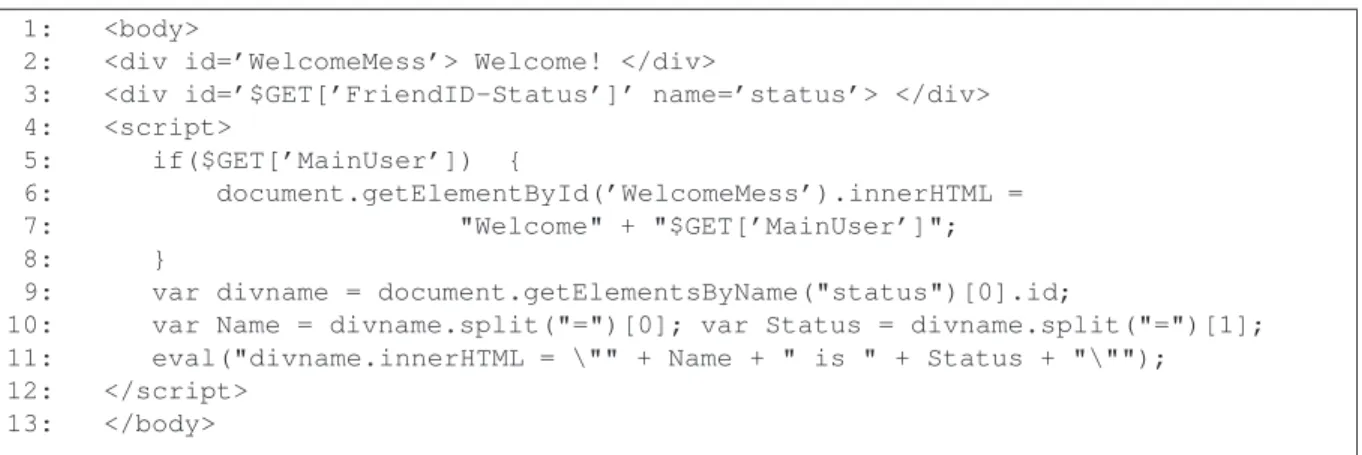
Running Example. To outline the challenges of pre-venting exploits for XSS vulnerabilities, we show a toy example of a social networking site in Figure 2. The
1: <body>
2: <div id=’WelcomeMess’> Welcome! </div>
3: <div id=’$GET[’FriendID-Status’]’ name=’status’> </div> 4: <script>
5: if($GET[’MainUser’]) {
6: document.getElementById(’WelcomeMess’).innerHTML = 7: "Welcome" + "$GET[’MainUser’]";
8: }
9: var divname = document.getElementsByName("status")[0].id;
10: var Name = divname.split("=")[0]; var Status = divname.split("=")[1]; 11: eval("divname.innerHTML = \"" + Name + " is " + Status + "\""); 12: </script>
13: </body>
Figure 2: Running example showing a snippet of HTML pseudocode generated by a vulnerable social networking web site server. Untrusted user data is embedded inline, identified by the$GET[’...’]variables.
Untrusted variable Attack String
Attack 1 $GET[’FriendID-Status’] ’ onmouseover=javascript:document.location="http://a.com"
Attack 2 $GET[’MainUser’] </script><script>alert(document.cookie);</script>
Attack 3 $GET[’FriendID-Status’] Attacker=Online"; alert(document.cookie);+"
Attack 4 $GET[’MainUser’] <iframe src=http://attacker.com></iframe>
Figure 3: Example attacks for exploiting vulnerabilities in Figure 2.
pseudo HTML code is shown here and places where un-trusted user data is inlined are denoted by elements of $GET[’...’] array (signifying data directly copied from GET/POST request parameters). In this example, the server expects the value of$GET[’MainUser’]to con-tain the name of the current user logged into the site, and $GET[’FriendID-Status’]to contain a string with the name of another user and his status message (“online” or “offline”) separated by a delimiter (“=”). Assuming no sanitization is applied, this code has at least 4 places where vulnerabilities arise, which we illustrate with possible ex-ploits1summarized in Figure 3.
• Attack 1: String split & Attribute injection. In this at-tack, the untrusted$GET[’FriendID-Status’] variable could prematurely break out of the id at-tribute of the <div> tag on line 3, and inject un-intended attributes and/or tags. In this particular in-stance, the attack string shown in Figure 3 closes the string delimited by the single quote character, which allows the attacker to inject theonmouseover JavaScript event. The event causes the page to redirect tohttp://a.compotentially fooling the user into trusting the attacker’s website.
A similar attack is possible at line 7, wherein the at-tacker breaks out of the JavaScript string literal using 1The sample attacks are illustrative of attacks seen in the past, and are not guaranteed to work on all browsers. See Figure 1 for more details.
an end-of-string delimiter (") character in the value for the variable$GET[’MainUser’].
• Attack 2: Node splitting. Even if this server san-itizes $GET[’MainUser’] on line 7 to disallow JavaScript end-of-string delimiters, another attack is possible. The attacker could inject a string to split the enclosing<script>environment, and then inject a newscripttag, as shown by the second attack string in Figure 3.
• Attack 3: Dynamic code injection. A more subtle at-tack is one that targets the integrity of theevalquery on line 11. Notice that JavaScript variableNameand Statusare derived from parsing the untrustedidof thedivelement on line 3. Even if the server sanitizes the$GET[’FriendID-Status’]value for use in thedivelement context on line 3 by removing the’ delimiter, the attacker could still inject code in the dy-namically generated javascriptevalstatement. The vulnerability on line 10 parses theidattribute value of each div element into separate user name and status variables, which performs no sanitization for variable namedStatus. The attacker can use an attack string value as shown as the third string in Figure 3 to execute the arbitrary JavaScript code at line 11.
• Attack 4: Dynamic active HTML update. The at-tacker could inject active elements inside the<div>
with id WelcomeMess at line 6-7, by using the fourth attack string in Figure 3 as the value for $GET[’MainUser’]. This attack updates the web page DOM2tree dynamically on the client side after the web page has been parsed and the script code has been executed.
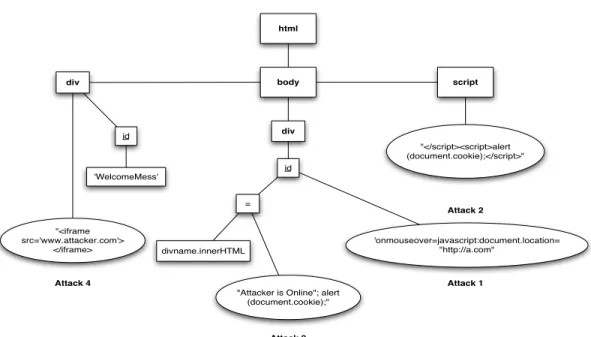
Motivation for our approach. We observe that all of the attacks outlined in Figure 3 require breaking the intended structure of the parse tree on the browser. The resulting parse trees from all attacks are shown superimposed in Fig-ure 4. It is worth noting that attacks 1 and 2 break the struc-ture of the web page during its initial parsing by the HTML and JavaScript parsers, whereas attack 3 and 4 alter the doc-ument structure during dynamic client-side operations.
If the browser could robustly isolate untrusted data on the web page, then it canquarantine untrusted data with respect to an intended policy. In this example, the server wishes to coerce untrusted nodes to leaf nodes in the parse tree, by treating them as string literals. This disallows injection of any language non-terminal (possible active HTML/JavaScript content) in the web page.
These examples bring out the complexity in defending against attacks with sanitization alone. To reinforce our ob-servations, it is easy to understand that server side sanitiza-tion would be hard to perform in a moderately large appli-cation. The application developer would need to understand all possible contexts in which the data could be used with respect to multiple languages. Sanitization for each kind of active content varies based on the policy that server wishes to enforce, and could also vary based on the target browser’s mechanism for rendering. Attacks need not be JavaScript based and may target a variety of goals (scripting with Flash and click fraud3, in addition to sensitive information steal-ing).
3
Approach Overview
Web pages are parsed by various language parsers that are part of the web browser into internal parse trees. Un-der a benign query, the web server produces a web page that when parsed, results in a parse tree with a certain struc-ture. This parse tree represents the structure that the web server aims to allow in the web document, and hence we term it as thedocument structure. In our approach, we en-sure that the browser can identify and isolate nodes derived from user-generated data, in the parse tree during parsing. In principle, we whitelist the intended document structure and prevent the untrusted nodes from changing this struc-ture in unintended ways. We call the property of ensuring
2DOM is the parse tree for the HTML code of the web page
3Using XSS to trick the user into clicking a “pay-per-click” link or advertisement through injecting HTML [11].
intended document structure as enforcingdocument struc-ture integrityorDSI.
We clearly separate the notion of aconfinement policy from the parser-level isolation mechanism. As in our run-ning example, web sites often wish to restrict untrusted data to leaf nodes in the document structure, as this is an effec-tive way to stop an attacker from injecting aceffec-tive content. We refer to this confinement policy asterminal confinement, i.e., confinement of untrusted data to leaves in the document structure, or equivalently, to strings derived from terminals in the grammar representing valid web pages. Figure 5 is the parse tree obtained by DSI enforcement for our running example.
The server may wish to instruct the browser to enforce other higher-level semantic policy, such as specifying a re-stricted sandbox, but this is possible only if the underly-ing language or application execution framework provides primitives that prevent an attacker can from breaking out of the confinement region. For instance, the new pro-posal ofsandbox attributes for iframetags (introduced in HTML 5 [40]) defines semantic confinement policies for untrusted data from another domain. However, it relies on theiframe abstraction to provide the isolation. Similar toiframes, DSI forms the basis for higher level policy specification on web page regions that contain inline un-trusted data. Our isolation primitives have no dependence on escaping/quoting or input sanitization for their internal working, thus making our mechanism a strong second line of defense for input validation checks already being used in web application code.
Key challenges in ensuring DSI in web applications. The high-level concept of terminal confinement has been pro-posed to defend against attacks such as SQL injection [35], but HTML differs from SQL in two significant ways. First, HTML can embed code written in various higher-order languages which share the same inline data. For instance, there are both generic (such as JavaScript URI) and browser-specific ways to invoke functions in VBScript, XUL, JavaScript, CSS and so on. To account for this dif-ficulty, we treat the document structure as that implied by the superimposition of the parse trees obtained from code written in all languages (including HTML, JavaScript) used in a web page.
A second distinguishing challenge in securing web ap-plications, specially AJAX driven apap-plications, is that the document parse trees can be dynamically generated and updated on the client side. In real web pages, code in client-side scripting languages parses web content asyn-chronously, which results in repeated invocations of dif-ferent language parsers. To address dynamic parsing, we treat the document structure as having two different components—a static component and a dynamic one. A
html 'Welcome!' body div onmouseover script alert (document.cookie); script div iframe Attack 4 Attack 1 Attack 2 www.attacker.com src id 'WelcomeMess' id div javascript:document.location= "http://a.com" =
divname.innerHTML "Attacker is Online";
"alert (document.cookie);"
Attack 3
=
Figure 4: Coalesced parse tree for the vulnerable web page in Figure 2 showing superimposition of parse trees resulting from all attacks simultaneously. White node show the valid intended nodes whereas the dark nodes show the untrusted nodes inserted by the attacker.
web page must have astatic document structure, i.e., the document structure implied by the parse tree obtained from the initial web page markup received by the browser. Sim-ilarly, a web page also has adynamic document structure, i.e., the structure implied by the set of parse trees created by different parsers dynamically. To illustrate the distinction, we point out that attacks 1 and 2 in our running example violate static DSI, whereas attacks 3 and 4 violate dynamic DSI.
Goals. Parser-level isolation is a set of mechanisms to ensure robust isolation of untrusted data in the document structure throughout the lifetime of the web application. Using PLI we outline three goals that enforce DSI for a web page with respect to a server-specified policy, say
P. First, we aim to enforcestatic DSI with respect to P, from the point web page is generated by the server to the point at which it is parsed into its initial parse trees in the browser. As a result, the browser separates untrusted data from trusted data in its initial parse tree robustly. Second, we aim to enforcedynamic DSI with respect toP in the browser, across all subsequent parsing operations. Third, we require that the attacker can not evade PLI by embed-ding untrusted content that results in escalated interpreta-tion of untrusted data. These three goals enforce DSI based on uniform parser-level isolation.
Outline of Mechanisms. We view the operation of encod-ing the web page in HTML, merely asserialization(or
mar-shaling4) of the content and the static document structure on the server side, and browser-side parsing of HTML as the deserialization step. We outline 4 steps that implement PLI and ensure the document structure is reconstructed by the browser from the point that the web server generates the web page.
Server-side. There are two steps that the server takes. • Step 1—Separation of trusted and user-generated
data. As a first step, web servers need to identify un-trusted data at their output interface, and should dis-tinguish it from trusted application code. We make this assumption to begin with, and discuss some ways to achieve this step through automatic methods in Section 5. We believe that this is not an unrealis-tic assumption—previous work on automaunrealis-tic dynamic taint tracking [44, 27] has shown that tracking un-trusted user-generated data at the output interface is possible; in fact, many popular server-side scripting language interpreters (such as PHP) now have built-in support for this. Our goal in subsequent steps is to sup-plement integrity preserving primitives to ensure that the server-specified policy is correctly enforced in the client browser, instead of the sanitization at the server output interface for reasons outlined in Section 1. 4akin to serialization in other programming languages and RPC mech-anisms
html "<iframe src='www.attacker.com'> </iframe> body div script div Attack 4 Attack 1 Attack 2 id 'WelcomeMess' id 'onmouseover=javascript:document.location= "http://a.com" "</script><script>alert (document.cookie);</script>" = divname.innerHTML
"Attacker is Online"; alert (document.cookie);"
Attack 3
Figure 5: Coalesced parse tree (corresponding to parse tree in Figure 4) resulting from DSI enforcement with the terminal confinement policy—untrusted subtrees are forced into leaf nodes.
• Step 2—Serialization: Enhancement of static struc-ture with markup. The key to robust serialization is to prevent embedded untrusted data from subverting the mechanism that distinguishes trusted code from in-line untrusted data in the browser. To prevent such attacks, we propose the idea of markup randomiza-tion, i.e., addition of non-deterministic changes to the markup. This idea is similar to instruction set random-ization [17] proposed for preventing traditional vulner-abilities.
Browser-side. There are two steps that the browser takes. • Step 3—Deserialization: Browser-side reconstruction of static document structure. The web browser parses the web page into its initial parse tree, coercing the parse tree to preserve the intended structure. Thus, it can robustly identify untrusted data in the document structure at the end of the deserialization step. • Step 4—Browser-side dynamic PLI. This step is
needed to ensure DSI when web pages are dynamically updated. In essence, once untrusted data is identified in the browser at previous step, we initialize it as quaran-tinedand track quarantined data in the browser dynam-ically. Language parsers for HTML and other higher-order languages like JavaScript are modified to disal-low quarantined data from being used during parsing in a way that violates the policy. This step removes the burden of having the client-side code explicitly check
integrity of the dynamic document structure, as it em-beds a reference monitor in the language parsers them-selves. Thus, no changes need to be made to existing client-side code for DSI-compliance.
4
Enforcement Mechanisms
We describe the high level ideas of the mechanisms in this section. Concrete details for implementing these are described in Section 5.
4.1
Serialization
Web pages are augmented with additional markup at the server’s end, in such a way that the browser can separate trusted structural entities from untrusted data in the static document structure. We call this step serialization, and it is ideally performed at the output interface of the web server.
Adaptive Attacks. One naive way to perform serializa-tion is to selectively demarcate or annotate untrusted data in the web page with special markup. The key concern is that an adaptive attacker can include additional markup to evade the isolation. For instance, let us say that we embed the untrusted data in a contained region with a special tag that disallows script execution that looks like:
<div class="noexecute">
possibly-malicious content </div>
...
3 : <div id="J5367GET[’FriendId-Status’] K5367">
4 : <script>
5 : if (J3246 GET[’MainUser’] K3246) {
...
Figure 6: Example of minimal serialization using random-ized delimiters for lines 3-5 of the example shown in Fig-ure 2.
This scheme is proposed in BEEP [15]. As the authors of BEEP pointed out, this naive scheme is weak because an adaptive attacker can prematurely close the<div> en-vironment by including a</div>in a node splitting at-tack. The authors of BEEP suggest an alternative mecha-nism that encodes user data as a JavaScript string, and uses server-side quoting of string data to prevent it from escaping the JavaScript string context. They suggest the following scheme:
<div class="noexecute" id="n5"></div> <script>
document.getElementById("n5").innerHTML = "quoted possibly-malicious content"; </script>
We point out that it can be tricky to prevent the mali-cious content from breaking out of even the simple static JavaScript string context. It is not sufficient to quote the JavaScript end-of-string delimiters (") – an attack string such as</script><iframe>...</iframe> perpe-trates a node splitting attack closing the script environment altogether, without explicitly breaking out the string con-text. Sanitization of HTML special characters<,>might solve this instance of the problem, but a developer may not employ such a restrictive mechanism if the server’s policy allows some form of HTML markup in untrusted data (such as<p>or<b>tags in user content).
Our goal is to separate the isolation mechanism from the policy. The above outlined attack reiterates that con-tent server-side quoting or validation may vary depending upon the web application’s policy and is an error-prone pro-cess; keeping the isolation mechanism independent of input validation is an important design goal. We propose the fol-lowing serialization schemes as an alternative.
Minimal Serialization. In this form of serialization, only the regions of the static web page that contain untrusted data are surrounded by special delimiters. Delimiters are added around inlined untrusted data independent of the con-text where the data is embedded. For our running example shown in the Figure 2, the serialization step places these delimiters around all occurrences of the GET array vari-ables. If the markup elements used as delimiters are stat-ically fixed, an adaptive attacker could break out of the
con-finement region by embedding the ending special delimiter in its attack string as discussed above. We propose an alter-native mechanism calledmarkup randomizationto defend against such attacks.
The idea is to generate randomized markup values for special delimiters each time the web page is served, so that the attacker can not deterministically guess the confining context tag it should use to break out. Abstractly, the server appends a integer suffixc, c ∈ C to a matching pairJ K of delimiters enclosing an occurrence of untrusted data, to generateJcKcwhile serializing. The setCis randomly
gen-erated for each web page served. C is sent in a confiden-tial, tamper-proof communication to the browser along with the web page. Clearly, if we use a pseudo-random number generator with a seedCsto generateC, it is sufficient to
send{Cs, n}, wherenis the number of elements inC
ob-tained by repeated invocations of the pseudo-random num-ber generator. In the Figure 6 , we show the special de-limiters added to the lines 3-5 of our running example in Figure 2. One instance of a minimal serialization scheme is the tag matching scheme proposed in the informaljail tag[7], which is formally analyzed by Louw et. al. [21].
Full Serialization. An alternative to minimal serializa-tion is to mark all trusted structural entities explicitly, which we call full serialization. For markup randomization, the server appends a random suffixc, c∈C,to each trusted ele-ment (including HTML tags, attributes, values of attributes, strings) and so on.
Though a preferable mechanism from a security stand-point, we need a scheme that can mark trusted elements independent of the context of occurrence with a very fine granularity of specification. For instance, we need mech-anism to selectively mark theidattribute of thediv ele-ment of line 3 in the running example (shown in Figure 2) as trusted (to be able to detect attribute injection attacks), without marking the attribute value as trusted. Only then can we selectively treat the value part as untrusted which can be essential to detect dynamic code injection attacks, such as attack 3 in Figure 3.
Independently and concurrent with our work, Gundy et. al. have described a new randomization based full seri-alization scheme, called Noncespaces [10] that uses XML namespaces. However, XML namespaces does not have the required granularity of specification that is described above, and hence we have not experimented with this scheme. It is possible, however, to apply the full serialization scheme de-scribed therein as part of our architecture as well, sacrificing some of the dynamic integrity protection that is only possi-ble with a finer-grained specification. We do not discuss full serialization further, and interested readers are referred to Noncespace [10] for details.
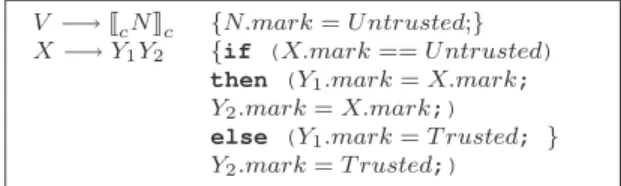
V −→JcNKc {N.mark=U ntrusted;} X−→Y1Y2 {if (X.mark==U ntrusted)
then (Y1.mark=X.mark; Y2.mark=X.mark;) else (Y1.mark=T rusted; } Y2.mark=T rusted;)
Figure 7: Rules for computingmarkattributes in minimal deserialization.
4.2
Deserialization
When the browser receives the serialized web page, it first parses it into the initial static document structure. The document parse tree obtained from deserialization can veri-fiably identify the untrusted nodes.
Minimal deserialization . Conceptually, to perform de-serialization the browser parses as normal, except that it does special processing for randomized delimitersJc,Kc. It
ensures that the token corresponding toJcmatches the token
corresponding toKc, iff their suffixes are the same random
valuecandc∈C. It also marks the nodes in the parse tree that are delimited by special delimiters as untrusted.
Algorithm to mark untrusted nodes. Minimal deserial-ization is a syntax-directed translation scheme, which com-putes an inherited attribute, mark, associated with each node in the parse tree, denoting whether the node is TrustedorUntrusted. For the sake of conceptual ex-planation, let us assume that we can represent valid web pages that the browser accepts by a context-free grammarG
5.LetG = {V,Σ, S, P}, whereV denotes non-terminals,
Σdenotes terminals including special delimiters,S is the start symbol, andP is a set of productions. Assuming that
Cis the set of valid randomized suffix values, the serialized web pagesobeys the following rules:
(a) All untrusted data is confined to a subtree rooted at some non-terminalN, such that a production,V −→ JcNKc, is inP.
(b) Productions of the formV −→Jc1NKc2, c16=c2are
not allowed in P.
(c)∀c ∈ C, all productions of the formV −→ JcNKc
are valid in P.
The rules to compute the inherited attributemark are defined in Figure 7, withmarkattribute forSinitialized to
Trusted.
Fail-Safe. Appending random suffixes does not lead to ro-bust design by itself. Sending the setC of random values 5practical implementations may not strictly parse context-free gram-mars ... 3 : <div id="J5367.. J2222... K5367"> 4 : <script> 5 : if (J3246 .. K2222... K3246) { ...
Figure 8: One possible attack on minimal serialization, if
Cwere not explicitly sent. The attacker provides delimiters with the suffix 2222 to produce 2 valid parse trees in the browser.
used in randomizing the additional markups adds robustness against attacker spoofing delimiters.
To see why, supposeC was not explicitly sent in our design. Consider the scenario where an adaptive attacker tries to confuse the parser by generating two valid parse trees. In Figure 8 the attacker embeds delimiterJ2222 in GET[’FriendId-Status’]and a matching delimiter K2222 inGET[’MainUser’]. There could be two valid parse trees—one that matches delimiters with suffix 5367 and 3246, and another that matches the delimiters with suf-fix 2222. Although, the browser could allow the former to be selected as valid as delimiter with 5367 is seen first ear-lier in the parsing, this is a fragile design because it relies on the server’s ability to inject the constraining tag first and requires sequential parsing of the web page. In practice, we can even expect the delimiter placement may be imperfect or missing in cases. For instance in Figure 8, if the special delimiters with suffix 5367 were missing, then even if the server had sanitized GET[’FriendId-Status’] per-fectly against string splitting attack (attack 1 in Section 2), the attacker possesses an avenue to inject a spurious de-limiter tagJ2222. All subsequent tags placed by the server would be discarded in an attempt to match the attacker pro-vided delimiter. The attacker’s ability to inject isolation markup is a weakness in the mechanism which does not ex-plicitly send C. The informal<jail> proposal may be susceptible to such attacks as well [7]. Our explicit com-munication ofCalleviates this concern.
4.3
Browser-side dynamic PLI
Once data is marked untrusted, we initialize it as quar-antined. With each character we associate aquarantine bit, signifying whether it is quarantined or not. We dynamically track quarantined metadata in the browser. Whenever the base type of the data is converted from the data type in one language to a data type in another, we preserve the quaran-tine bit through the type transformation. For instance, when the JavaScript code reads a string from the browser DOM into a JavaScript string, appropriate quarantine bit is pre-served. Similarly, when a JavaScript string is written back to a DOM property, the corresponding HTML lexical enti-ties preserve the dynamic quarantine bit.
Quarantine bits are updated to reflect data dependences between higher-order language variables, i.e. for arithmetic and data operations (including string manipulation), the destination variable is marked quarantined, iff any source operand is marked quarantined. We do not track control dependence code as we do not consider this a significant avenue of attack in benign application. We do summa-rize quarantine bit updates for certain functions which result in data assignment operations but may internally use table lookups or control dependence in the interpreter implemen-tation to perform assignments. For instance, the JavaScript String.fromCharCodefunction requires special pro-cessing, since it may use conditional switch statement or a table-lookup to convert the parameter bytes to a string ele-ments. In this way, all invocations of the parsers track quar-antined data and preserve this across data structures repre-senting various parse trees.
Example. For instance, consider the attack 3 in our ex-ample. It constructs a parse tree for theevalstatement as shown in Figure 4. The initial string representing the ter-minalidon line 3 is marked quarantined by the deserial-ization step. With our dynamic quarantine bit tracking, the JavaScript internal representation of the div’sidand vari-ablesdivname,NameandStatusare marked quaran-tined. According to the terminal confinement policy, during parsing our mechanism detects that the variableStatus contains a delimiter non-terminal “;”. It coerces the lexeme “;” to be treated a terminal character rather than interpret-ing it as a separator non-terminal, thus nullifyinterpret-ing the attack.
5
Architecture
In this section, we discuss the details of a client/server ar-chitecture that embodies our approach. We first outline the goals we aim to achieve in our architecture and then outline how we realize the different steps proposed in Section 4.
5.1
Architecture Goals
We propose a client-server architecture to realize DSI. We outline the following goals for web sites employing DSI enforcement, which are most important to make our approach amenable for adoption in practice.
1. Render in non-compliant6browsers, with minimal im-pact. At least the trusted part of the document should render as original in non-compliant browsers. Most user-generated data is benign, so even inlined un-trusted data should render with minimal impact in non-compliant browsers.
6Web browsers that are not DSI-compliant are referred to as
non-compliant
2. Low false positives. DSI-compliant browsers should raise very few or no false positives. A client-server ar-chitecture, such as ours, reduces the likelihood of false positives that arise from a purely-client side implemen-tation of DSI (see Section 7).
3. Require minimal web application developer effort. Au-tomated tools should be employed to retrofit DSI mechanisms to current web sites, without requiring a huge developer involvement.
5.2
Client-Server Co-operation Architecture
Identification of Untrusted data. Manual code refac-toring is possible for several web sites. Several web mashup components, such as Google Maps, separate the template code of the web application from the untrusted data already, but rely on sanitization to prevent DSI attacks. Our explicit mechanisms would make this distinction easier to specify and enforce.
Automatic transformation to enhance the markup gener-ated by the server is also feasible for several commercial web sites. Several server side dynamic and static taint-tracking mechanisms [44, 19, 38] have been developed in the past. Languages such as PHP, that are most popularly used, have been augmented to dynamically track untrusted data with moderate performance overheads, both using au-tomatic source code transformation [44] as well as manual source code upgrades for PHPTaint [38]. Automatic mech-anisms that provide taint information could be directly used to selectively place delimiters at the server output.
We have experimented with PHPTaint [38], an imple-mentation of taint-tracking in the PHP 5.2.5 engine, to au-tomatically augment the minimal serialization primitives for all tainted data seen in the output of the web server. We en-able dynamic taint tracking of GET/POST request parame-ters and database pulls. We disable taint declassification of data when sanitized by PHP sanitization functions (since we wish to treat even sanitized data as potentially malicious). All output tainted data are augmented with surrounding de-limiters for minimal serialization. Our modifications shows that automatic serialization is possible using off-the-shelf tools.
For more complex web sites that use a multi-component architecture, cross-component dynamic taint analysis may be needed. This is an active area of research and auto-matic support for minimal serialization at the server side would readily benefit from advances in this area. Recent techniques proposed for program analysis to identify taint-style vulnerabilities [22, 16] could help identify taint sink points in larger web application, where manual identifica-tion is hard. Similarly, Nanda et al. have recently shown cross-component dynamic taint tracking for the LAMP ar-chitecture is possible [25].
Communicating valid suffixes. In our design it is suffi-cient to communicate{Cs, n}in a secure way, whereCsis
the random number generator seed to use andnis the num-ber of invocations to generate the setC of valid delimiter suffixes. Our scheme communicates these as two special HTML tag attributes, (seed andsuffixsetlength), as part of the HTMLheadtag of the web page. We assume that the server and the browser use the same implementation of the psuedo-random number generator. Once read by the browser, it generates this set for the entire lifetime of the page and does not recompute it even if the attacker corrupts the value of the special attributes dynamically. We have ver-ified that this scheme is backwards compatible with HTML handling in current browsers, i.e, these special attributes are completely ignored for rendering in current browsers7.
Choice of serialization alphabet for encoding delimiters.
We discuss two schemes for encoding delimiters.
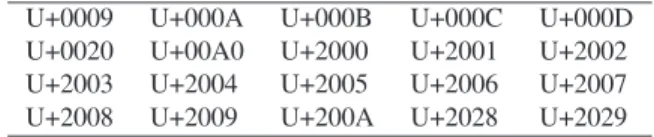
• We propose use of byte values from the Unicode Char-acter Database [37] which are rendered as whitespace on the major browsers independent of the selected character set used for web page decoding. Our ratio-nale for using whitespace characters is its uniformity across all common character sets, and the fact that this does not hinder parsing of HTML or script in most relevant contexts (including between tags, between at-tributes and values and strings). In certain exceptional contexts where these may hinder semantics of parsing, these errors would show up in pre-deployment testing and can easily be fixed. There are 20 such character values which can be used to encode start and end de-limiter symbols. All of the characters, as shown in ap-pendix A, render as whitespace on cuurent browsers. To encode the delimiters’ random suffixes we could use the remaining 18 (2 are used for delimiters them-selves) as symbols. Thus, each symbol can encode 18 possible values, so a suffixℓ−symbolslong, should be sufficient to yield an entropy ofℓ ×(lg(18)) or (ℓ×4.16) bits.
It should be clear that a compliant browser can eas-ily distinguish pages served from a non-compliant web server to a randomization compliant web server—it looks at theseed attribute in the <head> element of the web page. When a compliant browser views a non-compliant page, it simply treats the delimiter en-coding bytes as whitespace as per current semantics, as this is a non-compliant web page. When a compli-ant browser renders a complicompli-ant web page, it treats any found delimiter characters as valid iff they have valid suffixes, or else it discards the sequence of characters 7“current browsers” refers to: Safari, Firefox 2/3, Internet Explorer 6/7/8, Google Chrome, Opera 9.6 and Konqueror 3.5.9 in this paper.
as whitespace (these may occur by chance in the origi-nal web page, or may be attacker’s spoofing attempts). Having initialized the enclosed characters as untrusted in its internal representation, it strips these whitespace characters away. Thus, the scheme is secure whether the page is DSI-compliant or not.
• Another approach is to use special delimiter tags, <qtag>, with an attributecheck=suffix, as well. Qtags have a lesser impact on readability of code than the above scheme. Qtags have the same encoding mechanism as<jail>tags proposed informally [7]. We verified that it renders safely in today’s popular browsers in most contexts, but is unsuitable to be used in certain contexts such as within strings. Another is-sue with this scheme is that XHTML does not allow attributes in end tags, and so they don’t render well in XHTML pages on non-compliant browsers, and may be difficult to accepted as a standard.
Policy Specification. Our policies confine untrusted data only. Currently, we support per-page policies that are en-forced for the entire web page, rather than varying region-based policies. By default, we enforce the terminal con-finement policy which is a default fail-close policy. In most cases, this policy is sufficient for several web sites to de-fend against reflected XSS attacks. A more flexible policy that is useful is to allow certain HTML syntactic constructs in inline untrusted data, such as restricted set of HTML markup in user blog posts. We support a whitelist of syn-tactic HTML elements as part of a configurable policy.
We allow configurable specification of whitelisted HTML construct names through a allowuser tag at-tribute for HTML<meta>tag which can have a comma-separated list of allowed tags. For instance, the following specification would allow untrusted nodes corresponding to the paragraph, boldface, line break elements, the attribute id(in all elements) and the anchor element with optional hrefattribute (only with anchor element) in parse tree to not be flagged as an exploit. The following markup renders properly in non-compliant browsers since unknown markup is discarded in the popular browsers.
<meta allowuser=’p,b,br,@id,a@href’> For security, untrusted data is disallowed to define allowusertag without exception. Policy development and standardization of default policies are important prob-lems which involve a detail study of common elements that are safe to allow on most web sites. However, we consider this beyond the scope of this paper, but deem worthy of fu-ture work.
6
Implementation
We discuss details of our prototype implementation of a PLI enabled web browser and a PLI enabled web server first. Next, we demonstrate an example forum application that was deployed on this framework requiring no changes to application code. Finally, we outline the implementation of a web proxy server used for evaluation in section 7.
DSI compliant browser. We have implemented a proof-of-concept PLI enabled web browser by modifying Kon-queror 3.5.9. Before each HTML parsing operation, the HTML parsing engine identifies special delimiter tags. This step is performed before any character decoding is per-formed, and our choice of unicode alphabet for delimiters ensures that we deal with all character set encodings. The modified browser simulates a pushdown automaton during parsing to keep track of delimiter symbols for matching. Delimited characters are initialized as quarantined, which is represented by enhancing the type declaration for the character class in Konqueror with a quarantine bit. Parse tree nodes that are derived from quarantined characters are marked quarantined as well. Before any quarantined inter-nal node is updated to the document’s parse tree, the parser invokes the policy checker which ensures that the parse tree update is permitted by the policy. Any internal nodes that are not permitted by the policy are collapsed with their sub-tree to be treated as a leaf node and rendered as a string literal.
We modified the JavaScript interpreter in Konqueror 3.5.9 to facilitate automatic quarantine bit tracking and pre-vented tainted access through the JavaScript-DOM inter-face. The modifications required were a substantial imple-mentation effort compared to the HTML parser modifica-tions. Internal object representations were enhanced to store the quarantine bits and handlers for each JavaScript opera-tion had to be altered to propagate the quarantine bits. The implemented policy checks ensure that quarantined data is only interpreted as a terminal in the JavaScript language.
DSI compliant server. We employed PHPTaint [38] which is an existing implementation dynamic taint track-ing in the PHP interpreter. It enables taint variables in PHP and can be configured to indicate which sources of data are marked tainted in the server. We made minor modifications to PHPTaint to integrate in our framework. By default when untrusted data is processed by a built-in sanitization rou-tine, PHPTaint endorses the data as safe anddeclassifies(or clears) the taint; we changed this behavior to not declassify taint in such situations even though the data is sanitized. Whenever data is echoed to the output we interpose in PH-PTaint and surround tainted data with special delimiter tags with randomized values at runtime. For serialization, we
used the unicode charactersU+2029 as a start-delimiter. Immediately following the start-delimiter are ℓ randomly chosen unicode whitespace characters, thekey, from the re-maining 18 unicode characters. We have chosenℓ = 10, though this is easily configurable in our implementation. Following the key is the end-delimiterU+2028to signify the key has been fully read.
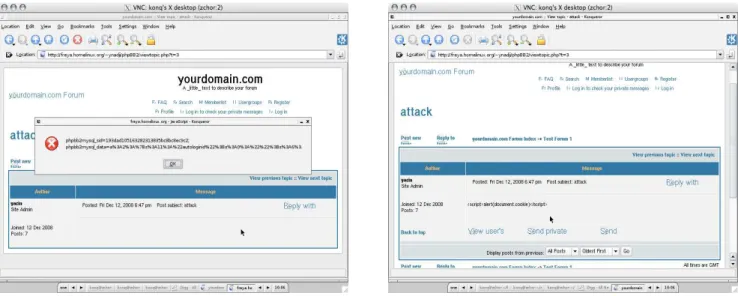
Example application. Figure 9(a) shows a vulnerable web forum application, phpBB version 2.0.18, running on a vanilla Apache 1.3.41 web server with PHP 5.2.5 when viewed with a vanilla Konqueror 3.5.9 with no DSI enforce-ment. The attacker posts a post containing a script tag which results in a cookie alert. To prevent such attacks, we de-ployed the phpBB forum application on our DSI-compliant web server next. We requiredno changes to the web ap-plication code to deploy it on our prototype DSI-compliant web server. Figure 9(b) shows how the attack is nullified by our client-server DSI enforcement prototype which em-ploys PHPTaint to automatically mark forum data (derived from the database) as tainted, enhances it with minimal se-rialization which enables a DSI-compliant version of Kon-queror 3.5.9 to nullify the attack.
Client-side Proxy Server. For evaluation of the 5,328 real-world web sites, we could not use our prototype taint-enabled PHP based server because we do not have ac-cess to server code of the vulnerable web sites. To over-come this practical limitation, we implemented a client-side proxy server that approximately mimics the server-side op-erations.
When the browser visits a vulnerable web site, the proxy web server records all GET/POST data sent by the browser, and maintains state about the HTTP request parameters sent. The proxy essentially performscontent based taint-ingacross data sent to the real server and the received re-sponse, to approximate what the server would do in the full deployment of the client-server architecture.
The web server proxy performs a lexical string match between the sent parameter data and the data it receives in the HTTP response. For all data in the HTTP response that matches, the proxy performs minimal serialization (ap-proximating the operations of a DSI-compliant server) i.e, it lexically adds randomized delimiters to demarcate matched data in the response page as untrusted, before forwarding it to the PLI enabled browser.
7
Evaluation
To evaluate the effectiveness and overhead of PLI and PLI enabled browsers we conducted experiments with two configurations. The first configuration consists of running
Figure 9: (a) A sample web forum application running on a vulnerable version of phpBB 2.0.18, victimized by stored XSS attack as it shows with vanilla Konqueror browser (b) Attack neutralized by our proof-of-concept prototype client-server DSI enforcement.
our prototype PLI enabled browser and a server running PHPTaint with the phpBB application. This configuration was used to evaluate effectiveness against stored XSS at-tacks. The second configuration ran our PLI enabled web browser directing all HTTP requests to the proxy web server described in section 7. The second configuration was used to study real-world reflected attacks, since we did not have access to the vulnerable web server code.
7.1
Experimental Setup
Our experiments were performed on two systems—one ran a Mac OS X 10.4.11 on a 2.0 GHz Intel processor with 2GB of memory, and the other runs Gentoo GNU/Linux 2.6.17.6 on a 3.4 GHz Intel Xeon processor with 2 GB of memory. The first machine ran an Apache 1.3.41 web server with PHP 5.2.5 engine and MySQL back-end, while the second ran the DSI compliant Konqueror. The two ma-chines were connected by a 100 Mbps switch. We config-ured our prototype PLI enabled browser and server to apply the default policy of terminal confinement to all web re-quests unless the server overrides with another whitelisting based policy.
7.2
Experimental Results and Analysis
7.2.1 Attack Detection
Reflected XSS. We evaluated the effectiveness against all real-world web sites with known vulnerabilities, archived at the XSSed [43] web site as of 25th July 2008, which re-sulted in successful attacks using Konqueror 3.5.9. In this
Attack Category # Attacks # Prevented Reflected XSS 5,328 5,243 (98.4%) Stored XSS 25 25 (100%)
Figure 10: Effectiveness of DSI enforcement against both reflected XSS attacks [43] as well as stored XSS attack vec-tors [12].
category, there were 5,328 web sites which constituted our final test dataset. Our DSI-enforcement using the proxy web server and DSI compliant browser nullified98.4%of these attacks as shown in Figure 10. Upon further analy-sis of the false negatives in this experiment, we discovered that 46 of the remaining cases were missed because the real web server modified the attack input before embedding it on the web page—our web server proxy failed to recognize this server-side modification as it performs a simple string matching between data sent by the browser and the received HTTP response. We believe that in full-deployment these would be captured with server explicitly demarcating un-trusted data. We could not determine the cause of missing the remaining 39, as the sent input was not discernible in the HTTP response web page. We showed that the policy of terminal confinement, if supported in web servers as the default, is sufficient to prevent a large majority of reflected XSS attacks.
Stored XSS. We setup a vulnerable version of phpBB web blog application (version 2.0.18) on our DSI enabled web server, and injected 30 benign text and HTML based posts, and all of the stored attack vectors taken from XSS
Figure 12: Increase in CPU overhead averaged over 5 runs for different page sizes for a DSI-enabled web server using PHPTaint [38].
cheat sheet [12] that worked in Konqueror 3.5.9. Of the 92 attack vectors outlined therein, only 25 worked in a vanilla Konqueror 3.5.9 browser. We configured the policy to allow only<p>, <b> and <a>HTML tags and andhref at-tributes. No modifications were made to the phpBB appli-cation code. Our prototype nullified all 25 XSS attacks.
7.2.2 Performance
Browser Performance. To measure the browser perfor-mance overhead, we compared the page load times of our modified version of Konqueror 3.5.9 and the vanilla version of Konqueror 3.5.9. We evaluated against the test bench-mark internally used at Mozilla for browser performance testing, consisting of over 350 web pages of popular web pages with common features including HTML, JavaScript, CSS, and images[24]. No data on this web pages was marked untrusted. We measured a performance overhead of1.8%averaged over 5 runs of the benchmark.
We also measured the performance of loading all the pages from the XSSed dataset consisting of 5,328, with un-trusted data marked with serialization delimiters. We ob-served a similar overhead of1.85%when processing web pages with tainted data.
Web page (or code) size increase often translates to in-creased corporate bandwidth consumption, and is important to characterize in a cost analysis. For the XSSed dataset, our instrumentation with delimiters of lengthℓ= 10increased the page size by less than1.1%on average for all the web pages with marked untrusted data.
Server Performance. We measured the CPU overhead for the phpBB application running on a DSI compliant web server with PHPTaint enabled. This was done with ab (ApacheBench), a tool provided with Apache to measure
performance [1]. It is configured to generate dynamic fo-rum web pages of sizes varying from 10 KB to 40 KB. In our experiment, 64,000 requests were issued to the server with 16 concurrent requests. As shown in Figure 12, we observed average CPU overheads of1.2%,2.9%and3.1%
for pages of 10 KB, 20 KB, and 40 KB in size respectively. This is consistent with the performance overheads reported by the authors of PHPTaint [38]. Figure 11 shows a com-parison between the vanilla web server and a DSI-compliant web server (both running phpBB) in terms of the percentage of HTTP requests completed within a certain response time frame. For 10 concurrent requests, the two servers perform nearly very similar, wheres for 30 concurrent requests the server with PHPTaint shows some degradation for complet-ing more than95%of the requests.
7.2.3 False Positives
We observed a fewer false positives rate in our stored XSS attacks experiment than in the reflected XSS experiment. In the stored experiment, we did not observe any false positives. In the reflected XSS experiment, we observed false positives when we deliberately provided inputs that matched existing page content. For the latter experiment, we manually browsed the Global Top 500 websites listed on Alexa [2] browsing with deliberate intent to raise false positives. For each website, we visited an average of 3 second-level pages by creating accounts, logging in with malicious inputs, performing searches for dangerous key-words, as well as clicking on links on the web pages to sim-ulate normal user activity.
With our default policy, as expected, we were able to in-duce false positives on 5 of the web pages. For instance, a search query for the string “<title>” on Slashdot8caused benign data to be returned page to be marked quarantined. We confirmed that these arise because our client-side proxy server marks trusted code as untrusted which subsequently raises alarms when interpreted as code by the browser. In principle, we expect that full-implementation with a taint-aware server side component would eliminate these false positives inherent in the client-side proxy server approxi-mation.
We also report that even with the client-side proxy server approximation, we didnot raise false positives in certain cases where the IE 8 Beta XSS filter did. For instance, we do not raise false positives when searching for the string “javascript:” on Google search engine. This is because our DSI enforcement is parser context aware—though all occur-rences of “javascript:” are marked untrusted in the HTTP response page, our browser did not raise an alert as un-trusted data was not interpreted as code.
Figure 11: Percentage of responses completed within a certain timeframe. 1000 requests on a 10 KB document with (a) 10 concurrent requests and (b) 30 concurrent requests.
8
Comparison with Existing XSS Defenses
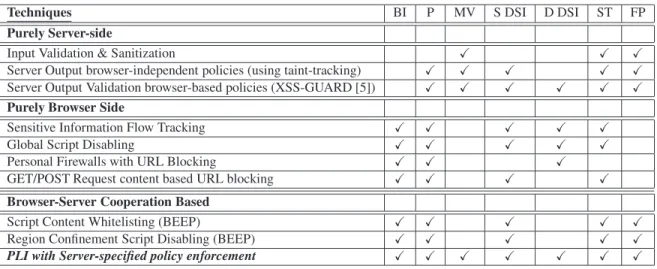
We outline the criteria for analytically comparing differ-ent XSS defenses first, and then discuss each of the existing defenses next providing a summary of the comparison in Figure 13.
8.1
Comparison Criteria
To concretely summarize the strengths and weaknesses of various XSS defense techniques, we present a defender-centric taxonomy of adaptive attacks to characterize the ability of current defenses against current attacks as well as attacks in the future that try to evade the defenses. Adaptive attackers can potentially target at least the avenues outlined below.
• Browser inconsistency. Inconsistency in assumptions made by the server and client lead to various attacks as outlined in the Section 1.
• Lexical Polymorphism. To evade lexical sanitization, attackers may find variants in lexical entities.
• Keyword Polymorphism. To evade keyword filters, at-tackers may find different syntactic constructs to by-pass these. For instance, in the Samy worm [32], to inject a restricted keyword innerHTML, the at-tacker used a semantically equivalent construct “eval (’inner’+’HTML’)”.
• Multiple Injection Vectors. Attacker can inject non-script based elements.
• Breaking static structural integrity. To specifically evade confinement based schemes, attacker can break out of the static confinement regions on the web page.
• Breaking dynamic structural integrity. Attacks may target breaking the structure of the dynamically exe-cuting client-side code, as discussed in Section 2. Defense against each of the above adaptive attack cate-gories serves a point of comparing existing defenses. In ad-dition to these, we analytically compare the potential effec-tiveness of techniques to defend against stored XSS attacks. We also characterize whether a defense mechanism enables flexible server-side specification of policies or not. This is important because fixation of policies often results in false positives, especially for content-rich untrusted data, which can be a serious impediment to the eventual deployability of an approach.
8.2
Existing Techniques
Figure 13 shows the comparative capabilities of exist-ing defense techniques at a glance on the basis of criteria outlined earlier in this section. We describe current XSS defenses and discuss some of their weaknesses.
8.2.1 Purely server-side defenses
Input Validation and sanitization. Popular server side languages such as PHP provide standard sanitization func-tions, such ashtmlspecialchars. However, the code logic to check validity is often concentrated at the input in-terface of the server, and also distributed based on the con-text where untrusted data gets embedded. This mechanism serves as a first line of defense in practice, but is not ro-bust as it places excessive burden on the web developer for its correctness. Prevalence of XSS attacks today shows that these mechanisms fail to safeguard against both static and dynamic DSI attacks.
Techniques BI P MV S DSI D DSI ST FP
Purely Server-side
Input Validation & Sanitization X X X
Server Output browser-independent policies (using taint-tracking) X X X X X
Server Output Validation browser-based policies (XSS-GUARD [5]) X X X X X X
Purely Browser Side
Sensitive Information Flow Tracking X X X X X
Global Script Disabling X X X X X
Personal Firewalls with URL Blocking X X X
GET/POST Request content based URL blocking X X X X
Browser-Server Cooperation Based
Script Content Whitelisting (BEEP) X X X X X
Region Confinement Script Disabling (BEEP) X X X X X
PLI with Server-specified policy enforcement X X X X X X X
BI Not susceptible to browser-server inconsistency bugs
P Designed to easily defeats lexical and keyword polymorphism based attacks
MV Designed for comprehensiveness against multiple vectors and attack goals (Flash objects as scripting vectors, iframes insertion for phishing, click fraud).
S DSI Designed to easily defeat evasion attacks that break static DSI (attacks such as 1,2 in Section 2). D DSI Designed to easily defeat evasion attacks that break dynamic DSI (attacks such as 3,4 in Section 2). ST Can potentially deal with stored XSS attacks.
FP Allows flexible server configurable policies (important to eliminate false positives for content-rich untrusted data)
Figure 13: Various XSS Mitigation Techniques Capabilities at a glance. Columns 2 - 6 represent security properties, and columns 7-9 represent other practical issues. A ‘X’ denotes that the mechanism demonstrates the property.
Browser-independent Policy Checking at Output. Taint-tracking [44, 25, 27, 30] on the server-side aims to central-ize sanitization checks at the output interface with the use of taint metadata. Since the context of where untrusted data are being embedded can be arbitrary, the policy checking becomes complicated especially when dealing with attacks that affect dynamic DSI. The primary reason is the lack of semantics of client side behavior in the policy checking en-gine at the interface. Another problem with this approach is that the policy checks are not specific to the browser that the client uses and can be susceptible to browser-server in-consistency bugs.
Browser-based Policy Checking at Output. To mitigate the lack of client-side language semantics at the server output interface, XSS-GUARD [5] employs a complete browser implementation on the server output. In princi-ple, this enables XSS-GUARD to deal with both static and dynamic DSI attacks, at the expense of significant perfor-mance overheads. However, this scheme conceptually still suffers from browser inconsistency bugs as a different tar-get browser may be used by the client than the one checked against. Our technique enables the primary benefits of XSS-GUARD without high performance overheads and making the policy enforcement consistent with the client browser.
8.2.2 Purely client-side defenses
Sensitive information flow tracking. Vogt et. al. propose sensitive information flow tracking [39] in the browser to identify spurious cross-domain sensitive information trans-fer as a XSS attack. This approach is symptom targeted and limited in its goal, and hence does not lend easily to other attack targets outlined in the introduction. It also requires moderately high false positives in normal usage. This stems from the lack of specification of the intended policy by the web server.
Script Injection Blocking. Several techniques are focused on stopping script injection attacks. For instance, the Fire-fox NoScript extension block scripts globally on web sites the user does not explicitly state as trusted. Many web sites do not render well with this extension turned on, and this re-quires user intervention. Once allowed, all scripts (includ-ing those from attacks) can run in the browser.
Personal Firewalls with URL blocking. Noxes [18] is a client-side rule based proxy to disallow users visiting po-tentially unsafe URL using heuristics. First, such solutions are not designed to distinguish trusted data generated by the server from user-generated data. As a result, they can have high false negatives (Noxes treats static links in the page as safe) and have false positives [18] due to lack of server-side configuration of policy to be enforced. Second, they
![Figure 1: XSS attacks vary significantly from browser to browser. A classification of 92 publicly available XSS at-tacks showing the diversity in the number of atat-tacks that affect different web browsers [12].](https://thumb-us.123doks.com/thumbv2/123dok_us/9485099.2430518/2.918.125.412.105.277/figure-significantly-classification-publicly-available-diversity-different-browsers.webp)

![Figure 12: Increase in CPU overhead averaged over 5 runs for different page sizes for a DSI-enabled web server using PHPTaint [38].](https://thumb-us.123doks.com/thumbv2/123dok_us/9485099.2430518/14.918.87.440.108.319/figure-increase-overhead-averaged-different-enabled-server-phptaint.webp)