A Global Constraint for Parallelizing the Execution of
Task Sets in Non-Preemptive Scheduling
Michael Marte
1Institut f¨ur Informatik, Universit¨at M ¨unchen Oettingenstr. 67, 80538 M ¨unchen, Germany
1
Introduction
In this paper, we introduce tracks. A track is a global constraint for parallelizing the execution of task sets in non-preemptive scheduling. We give algorithms for bound as well as for domain reasoning, we propose applications in school timetabling, and we report results of a large-scale empirical study. Section2 introduces concepts and notations we rely on. Section3defines tracks in terms of syntax and semantics. Section
4gives algorithms for solving tracks. Section 5introduces to school timetabling and section 6 shows how to infer tracks in this setting. Section 7 proposes applications of tracks in school timetabling, presents our experimental design, and reports results. Section8closes with perspectives for future work.
2
Preliminaries
Definition 1. A constraint network is a triple (X;δ;C). The single components are
specified in the following.
X=fX1;:::;Xngis the set of problem variables that constraints may refer to. δis called computation state. It is a function from X to sets of values.δis called
failed iff9x2X:δ(x)=/0. It is called a complete assignment iff8x2X:jδ(x)j=
1. We say thatδ1succeedsδ0iffδ1is a function on X ,8x2X:δ1(x)δ0(x),
and9x2X:δ1(x)δ0(x).
C is a set of constraints. A constraint c is an object that is defined over a set of
variables vars(c)X in terms of the complete assignments that satisfy c.
If N=(X;δ;C)is a constraint network, then sol(N)denotes the set of complete
as-signments that succeedδ and simultaneously satisfy all c2C. Constraint networks N0=(X0;δ0;C0)and N1=(X1;δ1;C1)are called equivalent iff X0=X1and sol(N0)=
sol(N1).
3
Syntax and Semantics of Tracks
Informally, a track is of a set of rails, where each rail is a set of tasks. The problem of solving a track consists in finding a schedule for each rail such that the schedules cover the same set of time slots.
Definition 2. The expression track(T)is called a track iff T=fR1;:::;Rngand
81in:9mi>0:Ri=f(Si1;Pi1);:::;(Sim
i;Pim
i)g:
(Each pair(Si j;Pi j)of problem variables is intended to model a task in terms of its start timeSi jand its processing timePi j. Fixed start or processing times may be modeled by
means of variables with singleton domains.)
Definition 3. Let(X;δ;C)be a constraint network such that track(T)2C andδis not
failed. Let R2T and t=(S;P)2R.
1. Value covers
(a) vc(t;δ)=[maxδ(S);minδ(S)+minδ(P) 1℄
(b) vc(R;δ)= S t2R vc(t;δ) (c) vc(T;δ)= S R2T vc(R;δ) 2. Value supplies (a) vs(t;δ)= S s2δ(S) [s;s+maxδ(P) 1℄ (b) vs(R;δ)= S t2R vs(t;δ) (c) vs(T;δ)= T R2T vs(R;δ)
3. Earliest start times (a) est(t;δ)=minδ(S)
(b) est(R;δ)=mint 2Rest (t;δ) (c) est(T;δ)=maxR 2Test (R;δ)
4. Latest completion times
(a) lct(t;δ)=maxδ(S)+maxδ(P) 1
(b) lct(R;δ)=maxt 2Rlct (t;δ) (c) lct(T;δ)=minR 2Tlct (R;δ)
Definition 4. Let(X;δ;C)be a constraint network such that track(T)2C. Ifδis a
complete assignment, track(T)is satisfied byδiff
jfvc(R;δ): R2Tgj=1;
4
Solving Tracks
We may prune all start and processing times that entail the covering of values that are lower than the earliest start time or greater than the latest completion time of the track (Proposition1), or that entail the covering of values that are not element of the value supply of the track (Proposition2). Comparing bounds on the processing times of rails may reveal an inconsistency (Proposition3). Under certain conditions, a task may be forced to cover a certain value (Proposition4).
Proposition 1. Let N0=(X;δ0;C)be a constraint network such that track(T)2C and
δ0is not failed. Let R2T and let(S;P)2R. Ifδ1=δ0except for
δ1(S)=fs2δ0(S): est(T;δ0)slct(T;δ0) minδ0(P)+1g and δ1(P)=fp2δ0(P): plct(T;δ0) maxfminδ0(S);est(T;δ0)g+1g; then N0and N1=(X;δ1;C)are equivalent.
Proposition 2. Let N0=(X;δ0;C)be a constraint network such that track(T)2C and
δ0is not failed. Let R2T and let(S;P)2R. Ifδ1=δ0except for
δ1(S)=fs2δ0(S):9p2δ0(P):[s;s+p 1℄vs(T;δ0)g and δ1(P)=fp2δ0(P):9s2δ0(S):[s;s+p 1℄vs(T;δ0)g; then N0and N1=(X;δ1;C)are equivalent.
Proposition 3. Let N=(X;δ;C)be a constraint network such that track(T)2C and
δis not failed. Let R0;R12T . Let l;u0 such that, for allσ2sol(N), l is a lower bound onjvc(R0;σ)jand u is an upper bound onjvc(R1;σ)j. If u<l, then sol(N)=/0. Proposition 4. Let N0=(X;δ0;C)be a constraint network such that track(T)2C and
δ0is not failed. Let R2T and let a2vc(T;δ0)such that a2=vc(R;δ0). Let t=(S;P)2R such that a2vs(t;δ0)and suppose that no other task in R has this property. Ifδ1=δ0 except for
δ1(S)=fs2δ0(S):9p2δ0(P):a2[s;s+p 1℄g and δ1(P)=fp2δ0(P):9s2δ0(S):a2[s;s+p 1℄g; then N0and N1=(X;δ1;C)are equivalent.
5
School Timetabling
The German grammar school (GGS) comprises nine grades (5-13). In grades 5-11, pupils are grouped to form classes. In grades 12 and 13, pupils must choose from a set of courses resulting in a more college-like education. In grades 9-11, several branches of education, differing in curricula, may be available. Frequently, heterogeneous classes with boys and girls from different branches and with different religious denominations cannot be avoided. For economical and educational reasons, heterogeneous classes usu-ally imply the need to join pupils from different classes for physical education, religious
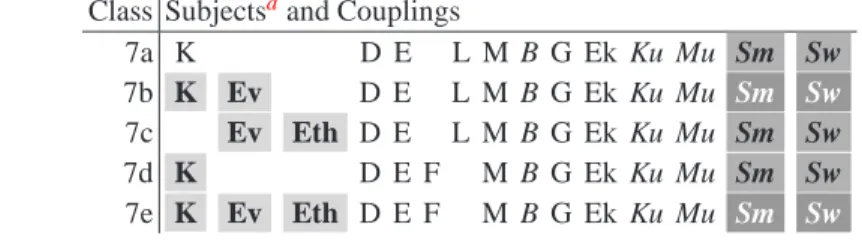
Class Subjectsaand Couplings 7a K D E L M B G Ek Ku Mu Sm Sw 7b K Ev D E L M B G Ek Ku Mu Sm Sw 7c Ev Eth D E L M B G Ek Ku Mu Sm Sw 7d K D E F M B G Ek Ku Mu Sm Sw 7e K Ev Eth D E F M B G Ek Ku Mu Sm Sw
Table 1: The seventh grade of a timetabling problem
aK/Ev/Eth = Religious Education for Catholics/Protestants/others, D = German, E = English, F = French,
L = Latin, M = Mathematics, B = Biology, G = History, Ek = Geography, Ku = Art, Mu = Music, Sm/Sw = Physical Education for Boys/Girls. If a subject code is printed in italic face, a science lab, a craft room, or some other special facility is required.
Class Subjects and Tracks
7a K D E L M B G Ek Ku Mu Sm Sw
7b K Ev D E L M B G Ek Ku Mu Sm Sw
7c Ev Eth D E L M B G Ek Ku Mu Sm Sw
7d K D E F M B G Ek Ku Mu Sm Sw
7e K Ev Eth D E F M B G Ek Ku Mu Sm Sw
Table 2: Two tracks inferred from the couplings specified by table1
education, and branch-specific lessons. The resulting need for simultaneous education of pupils from several classes is modeled by means of couplings. A coupling is a set of lessons that are to be scheduled for the same time. Couplings complicate timetabling considerably due to simultaneous resource demands.
Table1defines the seventh grade of a GGS timetabling problem in terms of classes, subjects, and couplings. Couplings are marked up by means of bold face types on gray backgrounds of varying intensity where intensity is used to distinguish couplings. We observe that, with respect to gender, all classes are mixed. In fact, this situation results in couplings. For example, the table specifies that all boys from 7b and 7e have to be joined for physical education. The same holds for the girls of 7b and 7e.
In GGS timetabling, the assignment of teachers to lessons is part of the problem specification. In contrast, allocating rooms is part of the timetabling problem. Qual-ity criteria include teacher-specific bounds on the daily workload and subject-specific bounds on the daily number of lessons. Furthermore, tight timeframes are imposed: In grades 5-10, the number of acceptable slots equals the number of lessons prescribed by the curriculum.
6
Inference of Tracks in School Timetabling
In school timetabling, redundant tracks can be inferred from couplings. Before giving our algorithm for inferring tracks, we illustrate the idea by means of two examples.
Table2shows two tracks that have been inferred from the couplings that are speci-fied by table1. Tracks are marked up by means of gray backgrounds of varying intensity where intensity is used to distinguish tracks. For the first example, consider the classes 7b and 7e. Since the pupils are joined for religious and for physical education, the remaining subjects have to be scheduled for the remaining slots. This conclusion has been modeled by a track with two rails. The upper rail contains only lessons of class 7b while the lower rail contains only lessons of class 7e. Each rail contains all lessons of its class except for the lessons pupils from both classes are joined for. Thus, in this case, religious and physical education are missing. For the second example, consider the classes 7a, 7c, and 7d. Since the pupils are joined for physical education, we obtain a track with three rails where physical education is missing.2
Our general inference method works as follows. Let C be a set of classes and sup-pose that the following conditions hold. (1) The classes in C are joined for m lessons where m>0. (2) The classes in C feature the same timeframe. Let n be the number of
slots of this timeframe. (3) For each c2C, the number of lessons prescribed by the
cur-riculum equals n. If these conditions hold, the problem specification implies track(T)
where T contains a rail for each class in C and each rail contains all the lessons of its class except for the lessons pupils from all the classes in C are joined for. Let R2T .
We know thatjRj=n m. Furthermore, since the lessons of a class must not overlap,
vc(R;σ)=jRjin any solutionσ. In consequence,jvc(T;σ)j=jRjin any solutionσ.
7
Applications of Tracks in School Timetabling
We exploit tracks in two ways. First, in problem generation to avoid infeasible teacher allocations. Second, in search to prune subtrees without solutions.
Suppose track(T)has been inferred and let R2T . We know thatjvc(T;σ)j=jRj
in any solutionσ. It follows that a teacher must not be assigned more thanjRjlessons
of T . Otherwisejvc(T;σ)j>jRjbecause the lessons of a teacher must not overlap.
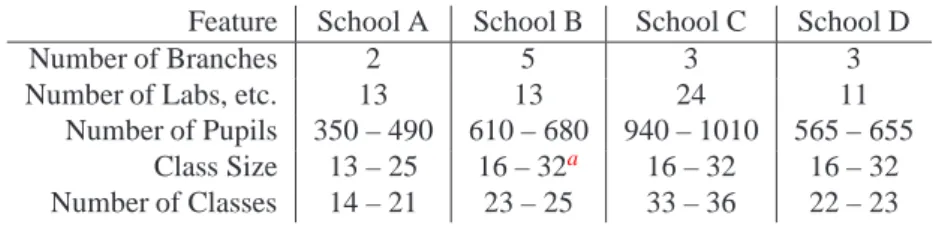
To investigate the operational impact of tracks, we performed a experiment. To ensure the practical relevance of results, the problem set has been generated on the basis of school profiles. A school profile contains key features such as branches, rooms, bounds on the number of pupils, bounds on class sizes, the equipment lessons require, and distributions over the features of pupils and teachers. Table 3characterizes our schools.
Our basic model features three finite-domain problem variables for each lesson: The domain of the period-level (day-level) slot variable initially contains all the periods (days) of the prescribed timeframe. The domain of the room variable initially contains all the rooms that are acceptable for the lesson. To avoid double-booking of teachers and classes, the model features a period-level, non-preemptive, disjunctive scheduling problem for each teacher and for each class. To enforce quality criteria, the model fea-tures a day-level, non-preemptive scheduling problem (either disjunctive or cumulative) for each teacher and for each subject of each class. Furthermore, for each lesson, the model specifies a square that is to be placed in a two-dimensional space spanned by
2At the first glance, this track looks weird because it involves religious education of 7b and 7e, too. This is caused by the coupling in religious education that involves lessons of 7b and 7e.
Feature School A School B School C School D
Number of Branches 2 5 3 3
Number of Labs, etc. 13 13 24 11
Number of Pupils 350 – 490 610 – 680 940 – 1010 565 – 655 Class Size 13 – 25 16 – 32a 16 – 32 16 – 32 Number of Classes 14 – 21 23 – 25 33 – 36 22 – 23
Table 3: Characteristics of schools
aIn grade 11: 13 – 25
Problem Model School A School B School C School D
Without Tracks 98.2% 43.7% 49.6% 60.1%
With tracksa Without tracksb 98.6% 64.1% 68.2% 77.0% With tracksa With tracksc 98.6% 81.1% 65.0% 77.7%
Table 4: Results
aTracks have been considered in teacher allocation. bTracks have not been used to prune the search space. cTracks have been used to prune the search space.
the set of periods and by the set of rooms. The position of the square is determined by the period the lesson is scheduled for and by the room that is assigned to the lesson. To avoid double-booking of rooms, the model requires that the squares must not inter-sect. In addition, symmetries are eliminated by precedences among lessons. For each class and for each subject of that class, a total order among the lessons of the subject is established because, from a practical point of view, the lessons are equivalent.
Our solver embeds constraint propagation into chronological backtracking. Con-straint propagation takes place at each node of the search space. The scheduling prob-lems are propagated by means of edge finding [3] and network-flow techniques [4,5]. The geometric placement problem is propagated by value sweep pruning [1]. Tracks are propagated by means of the domain-reasoning method described by Proposition2. The search space is unfolded as follows. First, a period-level slot variable is selected. If a dead end was encountered right before, the search procedure will prefer the variable that was selected right before detecting the dead end. Otherwise, one of the variables that have smallest domains is selected. Periods are assigned in ascending order. To maxi-mize the utilization of scarce resources, double lessons are preferably placed following a grid. After the lesson has been placed, a room is assigned. The solver prefers rooms that are as small or supply as few equipment as possible. The solver has been built on top of a finite-domain constraint solver [2] which itself is part of a constraint-logic programming environment.
Table4reports the percentage of solved problems (out of 1000) for each class of problems and models. The solver was constrained to abort after 1000 dead ends.
8
Future Work
Future work includes the extension of the problem set, the identification and exploita-tion of redundant constraints, the optimizaexploita-tion of timetables with respect to the num-ber of idle periods by introducing a suitable global constraint, the investigation of discrepancy-based search methods, and the relaxation of unsolvable problems.
References
[1] N. Beldiceanu. Sweep as a generic pruning technique. Technical Report T2000/08, Swedish Institute of Computer Science, 2000.
[2] M. Carlsson, G. Ottosson, and B. Carlson. An open-ended finite domain constraint solver. In Ninth International Symposium on Programming Languages,
Implemen-tations, Logics, and Programs, LNCS 1292, pages 191–206. Springer, 1997.
[3] P. Martin and D. B. Shmoys. A new approach to computing optimal schedules for the job-shop scheduling problem. In Proceedings of the 5th International
Confer-ence on Integer Programming and Combinatorial Optimization, LNCS 1084, pages
389–403. Springer, 1996.
[4] J.-C. R´egin. A filtering algorithm for constraints of difference in CSPs. In
Proceed-ings of the Twelfth National Conference on Artificial Intelligence, volume 1, pages
362–367. AAAI Press, 1994.
[5] J.-C. R´egin. Generalized arc consistency for global cardinality constraint. pages 209–215. AAAI Press/ MIT Press, 1996.