14
Payments and International
Investment Position Analysis
A. Introduction
14.1 This chapter provides an introduction to the use of balance of payments and international investment position data in economic analysis. Preceding chapters of this Manual present the concepts underlying the components used in the international accounts. The importance of this accounting and statistical report-ing framework describreport-ing an economy’s international transactions and positions derives primarily from their impact on the domestic economy. Although the interna-tional accounts are sometimes called the “external sec-tor” or “rest of the world sector,” they do not constitute a sector, in the sense of a group of institutional units with similar motivations. Rather, international accounts show the relationship between domestic sectors and the rest of the world. This chapter discusses some of these major links.
14.2 This discussion directs particular emphasis to the factors influencing international transactions and positions and the extent to which such factors are sustainable. Finally, some of the implications of bal-ance of payments adjustments for economic policy are considered. In this chapter, it is assumed, by and large, that international and domestic transactions are not constrained by formal or informal admin-istrative controls and that market participants are free to respond to price signals and macroeconomic policies. It also assumed that the economy does not affect global interest rates.
14.3 Owing to the introductory nature of this chap-ter, the discussion of balance of payments financing and adjustment in Sections D and E is not exhaustive, and focuses on an illustrative case that demonstrates fundamental mechanisms and macroeconomic inter-actions. More complex cases with volatile and highly mobile financial and balance sheet effects bring addi-tional concerns and limitations. These issues are briefly discussed in Section G, but more complete analysis
goes beyond the scope of the Manual, and the reader is encouraged to refer to additional literature, for which some references are provided in Section H. The chapter does not discuss the special issues associated with a currency union.
B. General Framework
14.4 The relationships among the economic accounts in the SNA are described in Chapter 2, Overview of the Framework. The major accounts can be expressed as accounting identities. Because these are identities, no causation should be inferred. The
SNA goods and services account shows the balance between supply and use:
Supply = Output + M (1) = Use = C + G + I+X + IC,
where
M = imports of goods and services
C = household consumption
G = government consumption
I = gross capital formation1
X = exports of goods and services
IC= intermediate consumption
Because GDP is equal to gross output less intermediate consumption, identity (1) can be rearranged as:
GDP = C + G + I + X – M, (2)
1Often called investment in economic analysis. The SNA uses the term “capital formation” to mean investment in nonfinancial assets so as to make a clear distinction from investment in financial assets. Investment is used subsequently in this chapter to mean capital for-mation in the SNA sense. Capital formation includes fixed capital, inventories, and valuables.
that is, the expenditure approach to GDP, where
GDP = gross domestic product.
The definition of gross national disposable income (GNDY) is GDP plus net primary and secondary income from abroad, so
GNDY = C + G + I + X – M + BPI + BSI, (3) where
BPI = balance on primary income
BSI = balance on secondary income (net current transfers)
The current account balance is:
CAB = X – M + BPI + BSI (4)
where
CAB = current account balance
From equations (3) and (4), the current account bal-ance can also be seen equivalently as the gap between disposable income and expenditure:
CAB = GNDY – C – G – I. (5)
Or equivalently:
GNDY =C + G+I + CAB. (6)
As defined in the SNA use of income account:
S = GNDY – C – G, (7)
where
S = gross saving.
Substituting identity (3) in (7),
S = I+CAB, (8)
which can be rearranged as:
S – I = CAB. (9)
That is, the current account balance is the gap between saving and investment.2
14.5 Thus, the current account balance mirrors the saving and investment behavior of the economy. In
2These relationships have been shown for the gross values of production, income, capital formation, and saving, before deduc-tion of consumpdeduc-tion of fixed capital. The reladeduc-tionships also hold if production, income, capital formation, and saving are expressed net of consumption of fixed capital.
analyzing changes in the current account balance of an economy, it is therefore important to understand the manner in which these changes reflect movements in saving and investment. For example, an increase in investment relative to saving will have the same impact on the current account—at least in the short run—as a decline in saving relative to investment. However, the longer-run implications for the exter-nal position of the economy may be quite different. More generally, identity (9) shows that any change in an economy’s current account balance (e.g., a larger surplus or smaller deficit) is necessarily equivalent to an increase in saving relative to investment. This rela-tionship highlights the importance of ascertaining the extent to which any policy measures designed to alter the current account balance directly (e.g., changes in tariffs, quotas, and exchange rates) will affect saving and investment behavior.
14.6 This link between domestic transactions and transactions with the rest of the world is shown in iden-tity (5). The implication of this relationship for balance of payments analysis is that improvement in an econo-my’s current account requires a reduction in expendi-ture relative to income. Alternatively, it may be possible to achieve an improvement in the current account bal-ance by means of an increase in national income that is not matched by a commensurate rise in consumption or domestic investment. Implementation of structural measures that increase the efficiency of the economy would be one way to achieve this objective.
14.7 This last point highlights an important aspect of the identities shown previously; these are identities that define relationships among variables rather than describe the behavior of economic agents. By them-selves, the identities cannot provide a full analysis of the factors determining developments in the current account. For example, total expenditure on goods and services by domestic residents (C + G + I) is likely to be influenced in part by their income (GNDY). Thus it would be inappropriate to use identity (5) to ana-lyze the impact of a change in GNDY on the current account balance without taking full account of the induced response in consumption and capital forma-tion of such a change. This example illustrates the necessity for understanding the spending propensities of residents of the economy when analyzing the bal-ance of payments.
14.8 The interrelationship of the current account balance with saving and investment can be seen in greater detail by distinguishing between the private and government sectors. Private saving and investment
(Sp and Ip) and government saving and investment (Sg and Ig)3 are identified as:
S – I = Sp + Sg – Ip – Ig. (10)
Use of the saving-investment gap identity for the cur-rent account in identity (9) then gives:
CAB = (Sp – Ip) + (Sg – Ig). (11) This identity shows that, if government sector dissav-ing is not offset by net savdissav-ing on the part of the private sector, the current account will be in deficit. More spe-cifically, the identity shows that the budgetary balance of the government (Sg–Ig) may be an important factor influencing the current account balance. In particular, a sustained current account deficit may reflect persistent government spending in excess of receipts, and such excess spending suggests that fiscal tightening is the appropriate policy action.
14.9 To reiterate an important point, however, iden-tity (11) cannot be used by itself to analyze develop-ments in the balance of paydevelop-ments in terms of investment and saving on the part of the private and government sectors because there are links between the variables on the right-hand side of identity (11). For example, an increase in taxes could be considered the appropriate policy measure both to raise government saving (or reduce dissaving) and to contribute to an improvement in an economy’s current account balance. In analyz-ing the impact of higher taxes, it is necessary to take account of the behavioral response of private saving and private investment. Private investment could be posi-tively or negaposi-tively affected by higher taxes. The effect would depend, in part, on whether the taxes were levied on consumption, an action that would release domes-tic resources and thereby tend to “crowd in” domesdomes-tic investment, or on returns to investment. In addition, private saving would tend to fall because of the decline in disposable income caused by taxes on consumption. Similarly, an increase in interest rates could tend to reduce private consumption and investment, but also tend to put upward pressure on the exchange rate with consequent effects on exports, imports, and differing effects on debt service for domestic currency and for-eign currency liabilities.
14.10 Thus, identity (11) provides only a starting point for an analysis of the interaction between saving
3The scope of the “government sector” could be defined as gen-eral government or the public sector (definitions of both are given in Chapter 4), according to analytical needs; the private sector would be defined in a complementary way.
and investment decisions and the balance of payments; the identity must be supplemented by specific infor-mation about the factors that determine the behavior of both the private sector and the government before the effect of policy measures on an economy’s current account can be ascertained.
14.11 As noted in Box 2.1, the basic principle of double-entry bookkeeping used in constructing the bal-ance of payments implies that the sum of all interna-tional transactions—current, capital, and financial—is in principle equal to zero.4 Accordingly, the financial
account shows how the sum of the current account and capital account balances is financed. For example, imports of goods may be financed by nonresident sup-pliers so that an increase in imports can be matched by a financial inflow. At the expiration of the financing period, the payment to the nonresident supplier will involve either a drawdown of foreign assets (e.g., for-eign deposits held by domestic banks) or the replace-ment of the liability to the nonresident supplier by another liability to nonresidents. There are also close connections between many financial account transac-tions. For example, the proceeds from the sale of bonds in foreign financial markets (a financial inflow) may be invested temporarily in short-term assets abroad (a financial outflow).
14.12 This balance between financial and other entries can be expressed as:
NLB =CAB + KAB = NFA, (12)
where
NLB = net lending/net borrowing
KAB = the capital account balance
NFA = net financial account entries
In words, this identity shows that net lending/net bor-rowing (from the sum of the current account balance and capital account balance) is conceptually equal to net lending/net borrowing from the financial account. Alternatively, it could be said that the current account balance is equal to the sum of balances on the capital and financial accounts (with signs reversed, if neces-sary, depending on the presentation used)5 including
reserve assets.
4In practice, they may not balance owing to errors or omissions. 5Net financial account transactions could be presented as in net lending (+)/net borrowing (–) in Tables 2.1 and 8.1 and following from the heading-based presentation in paragraph 3.31. Alterna-tively, they could be presented with a sign-based presentation
(nega-CAB = NKF + RT, (13) where
NKF = net capital and financial account transactions excluding reserve assets
RT = net reserve asset transactions
14.13 Thus the net provision of resources to or from the rest of the world, as measured by the current and capital account balances, must—by definition—be matched by a change in net claims on the rest of the world. For example, a surplus on the current and capital accounts is reflected in an increase in net claims, which may be in the form of acquisition of reserve assets on the part of the monetary authorities or other official or private claims on nonresidents. Alternatively, a deficit on the current and capital accounts implies that the net acquisition of resources from the rest of the world must be paid for by either liquidating foreign assets or increasing liabilities to nonresidents.
C. Alternative Presentations of
Balance of Payments Data
14.14 The different presentations discussed below can be used to highlight different aspects of balance of payments financing and its effect on the economy. These presentations involve reorganization of the items to emphasize particular aspects.
1. Standard presentation
14.15 The tables presented in Chapters 2 and 7–13 use a standard presentation that groups economic pro-cesses and phenomena, consistent with the SNA and other macroeconomic statistics. It features two major lines for balances:
(a) between current account entries and accumula-tion entries—the balancing item is the current account balance, and
(b) between financial and nonfinancial entries—the balancing item is net lending/net borrowing. In addition, there are a range of other balancing items shown in Table 2.1 and Chapters 7–13 that highlight different components.
tive signs for increases in assets, etc.), in which case the signs would need to be reversed.
2. “Analytic” presentation
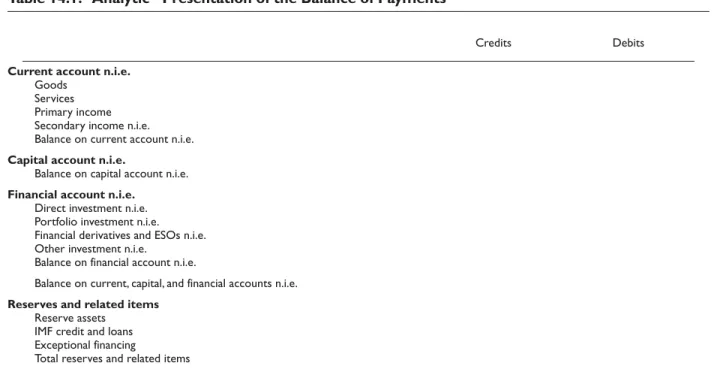
14.16 The analytic presentation is a reorganization of the standard presentation of balance of payments statistics to facilitate a basic distinction between (a) reserves and closely related items and (b) other trans-actions. The analytic presentation is an example of a satellite account and is designed to focus on manage-ment of reserves and closely related items, but the term “analytic” should not be taken to suggest that this presentation is suitable for all analytical purposes or that other presentations are not useful for other kinds of analysis. Table 14.1 illustrates this presenta-tion. It draws the line between the ways monetary authorities finance transactions (below the line) and other items (above the line).
14.17 This presentation shows how reserves, along with the related items of IMF credit and loans, and exceptional financing (such as accumulation of arrears, debt forgiveness, intergovernmental grants, and debt restructuring) are used to finance other “autonomous” international transactions. Exceptional financing is dis-cussed in detail in Appendix 1. The presentation is useful for monetary authorities that use intervention, including managed exchange rate regimes, with vari-ous degrees of flexibility. Arrears related to exceptional financing are recorded below the line as transactions in the analytical presentation with the corresponding entry in the relevant instrument. (This treatment is because, although the accumulation of arrears is not a transaction, it results from the actions of the monetary authorities.) Categories of the balance of the payments above-the-line from which transactions could be taken to below-the-line are marked as “(n.i.e.).”
3. Sectoral analysis
14.18 Another analytical presentation groups items in the financial account by the type of resi-dent recipient of external financing—for example, central bank, deposit-taking corporations except the central bank, general government. To support this approach, sectoral splits are required for most finan-cial account items.
14.19 Sectoral presentations provide a convenient way to analyze the net foreign lending or borrowing of each domestic sector. These data help identify issues of sustainability and vulnerability. Sectoral analysis is developed in conjunction with the balance sheets (see paragraphs 14.57–14.66) and in the presentation of external debt statistics (see External Debt Statistics: Guide for Compilers and Users).
4. Monetary presentation Reference:
Louis Bê Duc, Frank Mayerlen, and Pierre Sola, The Monetary Presentation of the Euro Area Balance
of Payments, European Central Bank Occasional
Paper No. 96 (September 2008).6
14.20 The monetary presentation explicitly shows the link between the balance of payments and monetary and financial statistics (as mentioned in paragraph 2.8). It identifies the transactions of the deposit-taking corpora-tions (plus money market funds, if their liabilities are included in the definition of broad money), which are equal to the foreign assets and liabilities of the same enti-ties, as recorded in monetary and financial statistics.
14.21 This presentation highlights the effects of international transactions on monetary developments. This may be summarized by the following equations:
(a) The transactions derived from the balance sheet of deposit-taking corporations (and money mar-ket funds, where relevant) can be expressed as follows:
6Available at http://www.ecb.europa.eu/pub/scpops/ecbocp96.pdf.
NFA + $DC – $M + OTR = 0, (14) where
NFA = transactions in foreign assets and liabilities of the deposit-taking corporations
DC = domestic credit
M = broad money (liabilities)
OTR = other (net) transactions vis-à-vis residents
$ = transactions derived from corresponding positions (i.e., excluding any changes due to revaluation or other changes in volume) (b) The identification of transactions by deposit-by
deposit-taking corporations in the balance of paymentsin the balance of payments leads to the following equation:
NFA + ETN = 0, (15)
where
ETN = nonfinancial balance of payments transac-tions and transactransac-tions in foreign assets and liabilities by sectors other than deposit-taking corporations7
7Under this type of analysis, if deposit-taking corporations trans-act in foreign assets with other resident sectors, for the identities to
Table 14.1. “Analytic” Presentation of the Balance of Payments1
Credits Debits
Current account n.i.e.
Goods Services Primary income Secondary income n.i.e. Balance on current account n.i.e.
Capital account n.i.e.
Balance on capital account n.i.e.
Financial account n.i.e.
Direct investment n.i.e. Portfolio investment n.i.e. Financial derivatives and ESOs n.i.e. Other investment n.i.e.
Balance on financial account n.i.e.
Balance on current, capital, and financial accounts n.i.e.
Reserves and related items
Reserve assets IMF credit and loans Exceptional financing
Total reserves and related items
1Exceptional financing items are moved from the current, capital, and financial accounts to the reserves and related items heading. For this reason, other items are
(c) Combining these equations makes explicit the link between developments in broad money and the balance of payments transactions of the sec-tors other than deposit-taking corporations:
$M = –ETN + $DC + OTR. (16)
14.22 This presentation highlights the effect of international transactions on domestic liquidity. It emphasizes the links between balance of payments and monetary statistics.
5. Partner analysis
14.23 Data by partner economy can assist in the conduct of international trade negotiations. They are also useful in identifying potential vulnerability from excessive reliance on another economy, and in fore-casting and analyzing contagion effects. They can be used to monitor data quality, through the study of comparison of bilateral data as reported by each of the partner economies (see, for example, Eurostat’s study of asymmetries in EU current account data, cited at the end of this chapter). Such analysis reflects devel-opments such as the need to monitor large payments imbalances between and among certain individual economies and groups of economies, and the analyti-cal interest in the source of balance of payments flows and positions for economies.
14.24 For analysis of IIP by partner, assets are shown according to the residence of the debtor (or issuers of nondebt instruments), and liabilities according to the residence of the creditor (or hold-ers of nondebt instruments). For analysis of balance of payments transactions by partner, data both on a debtor-creditor and a transactor basis may be of interest.8 The debtor-creditor basis facilitates
anal-yses concerned with such issues as whose securi-ties are being purchased and sold. The transactor basis allows for analysis of where residents engage in financial asset transactions with nonresidents, changes in relative importance and growth of inter-national financial centers, and so forth.
hold, transactions in both NFA and ETN need to be recorded, even those that are resident-to-resident, and therefore not balance of pay-ments, transactions. As noted in paragraph 3.8, in practice balance of payments transactions in financial assets may be derived from data that do not distinguish whether the counterparty is a resident or a nonresident.
8The debtor/creditor and the transactor bases differ in the case of secondary market transactions and are discussed in paragraph 4.154.
D. Financing a Current Account Deficit
14.25 This section examines the financing of a cur-rent account deficit by means of net financial inflows and changes in reserve assets, and some of the eco-nomic policy issues involved. For such an analysis, it would be helpful to use identity (12), and to assume that initially S=I (i.e., that the current account is in balance and that net capital and financial account and reserve asset transactions are also zero). From this initial situa-tion, it is instructive to trace the effects, on the current account and the financial account, of an autonomous increase in investment (capital formation), which is generated by a rise in the productivity of capital. If this additional investment is not matched by a correspond-ing rise in savcorrespond-ing, interest rates will tend to rise as long as the monetary authorities do not “control” the rates. The excess of investment over saving will be reflected in a current account deficit, which may be financed by a net financial inflow.
14.26 Whether there is spontaneous financing of a current account deficit—that is, whether the gap between saving and investment is met from autono-mous flows—depends on a number of considerations. The functional categories of the international accounts, as well as additional breakdowns (e.g., domestic sec-tor, partner economy, currency of denomination), can be crucial to assess the determinants of such financ-ing, and therefore the appropriate policy measures to foster the most appropriate and sustainable financing sources. In particular, direct investment is frequently characterized by stable and long-lasting economic links, as well as the provision of technology and man-agement. The financial inflow may be directly related to increased capital formation as a result of direct investment, loans obtained from foreign banks, or bonds issued in international financial markets. The foreign financing can be for the purchase of imported goods and services required for an investment project and for the purchase of domestic inputs. Alternatively, additional investment may be financed domestically by means of bank loans or issues of equities and bonds. In this case, there is no direct link between increased domestic expenditures and foreign financ-ing. However, the tendency for domestic interest rates to rise (in comparison with rates abroad) because of the increased investment will provide an incentive for funds to flow into the economy. Whether or not funds do so depends largely on how investors view the economic prospects of the economy. The prevalence of stable economic and political conditions—particu-larly if it is not likely that the higher interest rate will
be offset by a continuing depreciation of the exchange rate of the economy—will increase the spontaneous movement of funds into the economy.
14.27 The financial inflow associated with the excess of investment over saving involves a reduction in the net foreign asset position of the economy and the reduction, in turn, will change the net investment income flow of the economy. The key analytical issue is whether the economy will be able to service the change in the net foreign investment position without undertak-ing significant modifications in economic policies or without incurring undesirable changes in interest rates or exchange rates. Servicing is likely to occur without changes if the investment makes a significant contribu-tion to the productivity of the economy. Such a contri-bution can be manifested in two ways: first, the firm or government enterprise undertaking the investment must be sufficiently profitable to pay the rate of return that will attract the funds to finance the investment; second, the additional investment must enhance the debt-servicing capacity of the economy. As long as funds from abroad are invested productively, external financ-ing for a current account deficit is likely to be forthcom-ing for a considerable period of time. In this situation, the finance-receiving economy’s current account deficit manifests an efficient allocation of resources.
14.28 Alternatively, it is useful to consider a case in which investment is unchanged but saving declines— for example, because of an increase in government spending not matched by a rise in tax and other rev-enue or because of an increase in private consumption not matched by an offsetting change in government saving. In this situation, domestic interest rates would also tend to rise. However, unlike the previous case, the shift to a current account deficit is not paralleled by an increase in productivity in the economy. Under these conditions, there may not be a spontaneous inflow of funds if investors view the deterioration in the current account as reflecting inappropriate and unsustainable government policies. For example, the decline in saving may reflect an enlarged public sector deficit that is not associated with increased investment. Alternatively, the rise in absorption may be due to higher private spending generated by an expansionary monetary policy. Under these circumstances, investors may not wish to increase their net claims on the economy.
14.29 In the absence of a spontaneous financial inflow, some combination of the following will be necessary: policy actions to attract private funds, the use of reserve assets for balance of payments financ-ing, and the implementation of balance of payments
adjustment measures. From identity (12), it can be seen that, if the current account shifts into deficit, financing must take place either by drawing down the economy’s reserve assets or by increasing incentives for attracting private funds. The latter can be achieved by enhancing the domestic economic environment for long-term investment. The adoption of monetary and fiscal policies that support stable economic conditions and encourage direct and other investment would tend to induce financial inflows on a sustained basis. Funds may also be induced to flow in from abroad—and to provide balance of payments financing—by the rais-ing of domestic interest rates. Such a policy may well be appropriate if the current account deficit is caused by aggregate demand pressures; a restrictive monetary policy would have the effect of dampening excess demand and providing short-term financing. However, such financing may not be dependable from a long-term perspective as, for example, changes in foreign monetary conditions may make investment of liquid assets in the domestic economy appear unattractive. Therefore, it is necessary to look at the underlying causes of a current account deficit.
14.30 The appropriateness of using reserve assets to finance a gap between domestic expenditure and income, rather than undertaking adjustment measures to reduce or eliminate this gap, depends on the extent to which the gap is temporary or reversible. As an economy’s stock of reserve assets (as well as the resources it can borrow to supplement its reserve assets) is limited, the use of reserve assets to finance a current account deficit is confined within these limits. However, by mitigat-ing the necessity for balance of payments adjustment, official financing can perform a useful buffer function. For example, temporary shocks, such as poor harvests or other temporary supply disruptions, to domestic out-put do not necessarily require comparable changes in the domestic absorption of goods and services. Thus the financing, through the use of reserve assets, of a temporary excess of consumption and investment over national income can provide a desirable smoothing of the path of expenditures by residents. The reserve assets can also be used to finance seasonal swings in foreign payments and receipts. While the financing of temporary shocks is appropriate, recourse—although it can make the adjustment path smoother and more gradual—to owned or borrowed reserve assets does not obviate the necessity for adjustment if deterioration in the current account persists.
14.31 There are limits to the extent to which pri-vate funds and official resources can finance a current
account deficit. The willingness of the private sector to invest in the economy may be directly influenced by ongoing changes in reserve assets. If the existing stock of reserve assets is relatively low in compari-son with the current account deficit and the monetary authorities are expected to exhaust the economy’s reserve assets within the investment horizon of the investors, then the probability of a depreciation of the exchange rate or the introduction of other policy mea-sures adversely affecting the rate of return expected by investors would tend to increase significantly. Under these circumstances, any private funds from abroad that are financing all or part of a current account deficit could quickly switch from a net inflow to a net outflow. As can be seen from identity (12), unless adjustment measures are implemented to reverse both the current account deficit and the financial account outflow, reserve assets would be required to finance both an excess of domestic investment over saving and a net increase in liabilities to nonresidents. Such a situation would probably result in a loss of confidence in the currency, exacerbation of the financial outflow, and a rapid exhaustion of reserve assets.
14.32 More generally, in a world of high financial mobility, external and domestic private sector willing-ness to provide financing are influenced by a complex set of expectations about future economic, political, and other developments in the recipient economy and in the rest of the world. Changes in these expecta-tions may result in rapid rebalancing of the composition of balance sheets and cause high volatility in finan-cial flows with significant current account and other macroeconomic implications. Section F provides more extended discussion.
14.33 The previously described framework for analysis of the balance of payments is applicable, irre-spective of the exchange rate regime adopted by an economy. For example, if the exchange rate is pegged, then transactions in reserve assets will be determined by the net demand or supply of foreign exchange at that exchange rate (i.e., from identity (13), RT = CAB
– NKF). At the other extreme, if the exchange rate arrangement involves a pure float so that no exchange market intervention takes place, then CAB = NKF. In the intermediate case of a managed float, purchases and sales of reserve assets are typically undertaken to achieve a desired exchange rate path for the domestic currency in terms of one or more foreign currencies.
14.34 Financial account transactions, as included in the NKF term in identity (13), can be analyzed in terms of their composition. Direct investment, portfolio
invest-ment, financial derivatives, and other investment can have different implications for the economy, in terms of factors such as volatility, future returns, and effect on capital formation. More detailed data on instruments and maturity are also relevant to understanding the nature of the financing and its future effects.
14.35 There is another connection between the financial account and the current account. Finan-cial flows generate changes in foreign claims and liabilities. In nearly all cases, these financial stocks earn returns (interest, dividends, or reinvested earn-ings) that appear in the current account as investment income. The rate of these returns can differ between assets and liabilities and between different types of investment. This link between the accounts is partic-ularly relevant in the case of an economy running a current account deficit because there is an important dynamic relationship between an existing deficit and the future current account balance. A deficit in the current account must be financed by some combina-tion of an increase in liabilities to nonresidents and a reduction in claims on nonresidents so that the net result is a decline in net foreign assets. As a conse-quence, there will be a reduction in net investment income (unless rates of return adjust in an offsetting manner), and this reduction will increase the current account deficit. This interaction between the cur-rent account and the financial account can lead to a destabilizing situation in which the current account balance progressively worsens unless changes in economic policies or adjustments in certain vari-ables (e.g., exchange rates) are made to arrest the deterioration.
14.36 In analyzing the balance of payments and, in particular, the sustainability of any specific current account situation, it is important to consider the deter-minants of financial flows. These relate mainly to fac-tors affecting the rate of return and risk on foreign and domestic assets. Such factors include interest rates, the profitability of direct and other investments, expected changes in exchange rates, and tax considerations. These factors are embodied in the expected real (i.e., adjusted for exchange rates and inflation) after-tax rate of return on the stock of foreign assets held by residents and on the stock of claims held by nonresidents. Resi-dents and nonresiResi-dents are subject to different legal and tax considerations, which affect the rates of return on asset holdings. However, both are similarly affected by economic conditions external to the countries in which they are resident. Moreover, these external conditions are exogenous to an individual economy.
14.37 Indeed, whereas in circumstances of low financial mobility and mostly official financing it could be reasonable to focus mostly on domestic conditions, in a world of high financial mobility, external conditions—such as changing world interest rates—are important factors in influencing financial flows.
14.38 Balance of payments statistics use the accrual principle, which reflects underlying resource flows. However, a payments crisis is usually driven by cash flows. It may therefore be useful to consider cash flow dimensions when there are significant timing dif-ferences between payments and resource flows, for example, in the cases of accrual of interest, reinvested earnings, and nonperforming loans.
E. Balance of Payments Adjustment in
Response to a Current Account Deficit
14.39 There are many situations in which it may not be feasible to rely on private and official resources to finance a current account deficit on a sustained basis. If a deficit is unsustainable, the adjustment will necessarily happen through change in the will-ingness of market participants to provide financing or depletion of reserves and other financial assets, or a combination of both. Such adjustments may be abrupt and painful (up to the possibility of a bal-ance of payments crisis). Therefore, policy measures aimed at mitigating the adjustment path may need to be considered.
14.40 For balance of payments analysis, it is there-fore important to consider the possible introduction of adjustment measures to achieve a viable external pay-ments position (i.e., conditions under which a deficit on goods, services, and income can be financed by private and official transfers, private financial inflows, and some recourse to reserve and other financial assets). The subsequent discussion illustrates some possible measures, but it is not exhaustive. It exam-ines briefly the roles of exchange rate changes, fiscal measures, and monetary policy in achieving balance of payments adjustment.
14.41 In this analysis, it may be useful to rewrite identity (9) as:
S – I =CAB
=BTG + BTS + BPI + BSI
=NKF + RT (17)
where
BTG = balance on trade in goods
BTS = balance on trade in services
BPI = balance on primary income
BSI = balance on secondary income
The magnitude of the necessary adjustment in the balance of payments depends, to some extent, on the nature of the components of the current account bal-ance. For example, an economy may have been run-ning a persistent deficit on trade in goods that was financed, in part, by borrowing from private and offi-cial sources. In this situation, the economy is also likely to be running a deficit on the balance of pri-mary income that reflects the servicing of this debt. A deficit for goods, services, and primary income may, however, be offset by a surplus on secondary income, which could reflect both official and private current transfers. If such inward transfers are expected to be of a long-term nature and can confidently be relied upon to finance all or part of the deficit in other com-ponents of the current account, then the extent of the necessary balance of payments adjustment may be rather small.
14.42 However, even in the case of a small adjust-ment, it is nonetheless important to be fully cognizant of the fact that foreign debt must be repaid. Thus the amortization schedule of the economy is an important factor for judging the sustainability of a particular balance of payments situation. If large amortization payments are due in the near future and expected financial inflows are not sufficient to cover payments falling due, it may be necessary to undertake adjust-ment measures beforehand to avoid more drastic mea-sures required for dealing with a subsequent balance of payments crisis.
14.43 In the face of an unsustainable current account deficit in an economy with a fixed or managed exchange rate, one adjustment measure that could be considered is a depreciation of the exchange rate of the domestic cur-rency.9 Such a depreciation may be necessary to offset a
domestic price rise (relative to prices abroad) that—by penalizing exports and encouraging imports—worsens the balance on trade in goods. To the extent that the depreciation raises the prices of traded goods and ser-vices (i.e., exports and imports) in comparison with the
9The application of such a depreciation may be complicated by significant currency balance sheet mismatches, which need to be taken into account. These mismatches are discussed in Section G.
prices of nontraded goods and services, depreciation will promote the substitution of domestic for imported products and stimulate foreign demand for domestic products. However, because the depreciation will be accompanied by a rise in domestic prices in response to the increase in the cost of imported goods and services and the rise in demand for exports and domestically produced import substitutes, the improvement in inter-national competitiveness generated by the exchange rate change will be partially or fully eroded. Such a devel-opment underscores the importance of supplementing the exchange rate adjustment with restrictive monetary and fiscal policies to facilitate the shift in resources signaled by the change (caused by the depreciation) in relative prices. Thus, an expenditure-switching policy in the form of exchange rate depreciation must gener-ally be supported by expenditure-reducing measures; indeed, such measures are essential if there is no excess capacity in the economy.
14.44 The effects of such action can be seen from identity (9), which shows that any improvement in the current account must be matched by a corresponding positive change in the difference between saving and investment. An exchange rate depreciation by itself may generate such a change in the desired direction. In particular, if there is no change in the stance of monetary policy, the increase in demand generated by the depreciation will raise the demand for money. With an unchanged money supply, the greater demand for money will tend to increase nominal and real domestic interest rates. As a result, interest-sensitive expenditures will be dampened, and there could be a positive impact on saving. However, it is unlikely that this induced effect on the gap between saving and investment will itself be sufficient, particularly if the economy is at full employment, to achieve the desired improvement in the current account. Therefore, in all likelihood, it will be necessary to accompany the adjustment in the exchange rate with measures to reduce the level of domestic expendi-ture through tighter monetary and fiscal policies that release resources to expand output in the exporting and import-substitution industries.
14.45 The discussion of identity (11) pointed to fiscal deficits as one potential cause of external imbal-ances. Changes in government spending and taxation may therefore be necessary to achieve the required reduction in the saving-investment gap—to the extent that an exchange rate depreciation does not induce a sufficient response in the difference between total sav-ing and investment. However, it is important that
fis-cal policy measures be designed to achieve the desired objective and not exacerbate the adjustment problem. For example, cuts in infrastructure investment may have the desired short-run balance of payments effect, but such cuts could have, particularly if the spending reductions are in such areas as transport or electricity, a long-run adverse impact on the supply potential of the economy and the generation and supply of energy designed to relieve bottlenecks. Moreover, tax mea-sures that result in very high marginal tax rates or that are aimed particularly at investment income could have the undesired side effect of inducing offsetting reductions in private saving and reducing incentives to invest in the economy. Such disincentive effects can be avoided by implementing fiscal action aimed at reducing or eliminating subsidies and by cutting back on government activity that can be performed better by the private sector.
14.46 The stance of monetary policy plays an important role in balance of payments adjustment. The existing external imbalance may reflect an excess of domestic investment over saving (or what is the same thing—an excess of domestic spending over income) that results from an excessively expansion-ary monetexpansion-ary policy. It is, first of all, important to adjust the stance of monetary policy so that interest rates are generally positive in real terms and provide an incentive to savers and so that domestic economic conditions are sufficiently stable to encourage invest-ment. From the perspective of aggregate supply and demand, it can be seen from identity (5) that mon-etary policy should ensure that the level of domestic expenditure is in line with the productive capacity of the economy. Thus, from the point of view of bal-ance of payments analysis, the objective of monetary and fiscal policies is to limit domestic spending to what is available from domestic resources and for-eign financing.
14.47 One important aspect of monetary policy in balance of payments adjustment is the link between reserve asset transactions and domestic monetary con-ditions. A decline in reserve assets may be associated with a current account deficit or a net financial outflow caused by an expansionary monetary policy or both. The reserve asset decline can lead to a reduction in the monetary base and therefore to a tightening in the stance of monetary policy. A more restrictive mon-etary policy tends to correct the payments imbalance through higher interest rates that dampen domestic demand and make domestic assets more attractive to investors. However, this built-in adjustment mechanism
can be short-circuited if the monetary authorities offset the effect of the loss of reserve assets on the monetary base by increasing the domestic component of the base (e.g., through open-market purchases of securities held by the banking system). Such offsetting action tends to prevent domestic interest rates from rising and thereby contributes to the persistence of the balance of pay-ments deficit.
F. Implications of a Current Account
Surplus
14.48 The foregoing discussion focuses entirely on an economy that faces an actual or incipient balance of payments problem in the form of a persistent cur-rent account deficit.10 Of course, for the world as a
whole, the current account deficits of economies in deficit are exactly offset by the surpluses of other economies. Although surpluses typically do not lead to crises in the countries that run them, an analysis of some aspects of a surplus balance of payments situa-tion is useful as surpluses may raise important issues associated with domestic monetary management and vulnerabilities and the speed of adjustment toward more balanced external accounts. As can be seen from identity (13), a surplus in the current account is reflected in an increase in net claims held by the pri-vate sector or government (NKF) on nonresidents or an increase in official reserve assets (NRT), or both. The change in the net foreign asset position may be due to a reduction in liabilities to nonresidents rather than to an increase in gross claims. Such a reduction may well be a desirable development if a previous large buildup of liabilities has imposed a severe debt service burden on the economy. In this case, a current account surplus can be an appropriate step toward achieving a viable balance of payments.
14.49 The case of an economy with no recent cur-rent account deficits and an increase in its gross pri-vate claims on the rest of the world reflects an excess of aggregate saving over domestic investment. If the government’s fiscal balance is in deficit, private sector saving will exceed domestic investment. The allocation
10In practice, owing to measurement problems, the sum of the balances of all economies was negative in many years because of measurement problems. For discussion of this issue, see IMF, Report on the World Current Account Discrepancy, September 1987, and Jean Godeaux, Report on the Measurement of International Capital Flows, September 1992. More recent data are available in most issues of the Annual Report of the IMF Committee on Balance of Payments Statistics.
of part of saving to foreign assets presumably reflects the fact that investors find the rate of return on these assets more attractive, at the margin, than investment opportunities in the domestic economy. The provision of resources to the rest of the world in the form of a buildup of net claims on nonresidents will, by and large, result in an efficient allocation of the domestic economy’s saving as long as the buildup of net claims reflects the operation of market forces rather than government policies designed directly or indirectly to increase such claims.
14.50 Thus, for analyzing the balance of payments of an economy in persistent surplus, one key consid-eration is whether government policies distort saving and investment decisions and thereby bias an economy toward a current account surplus. Such distortions can take many forms. First, there are measures that directly influence the current account. Examples are tariffs and quotas that limit imports, restrictions on payments abroad, and export subsidies and govern-ment procuregovern-ment policies that give preference to domestic producers. Moreover, an exchange market intervention policy may bias the value of the currency downward. Finally, there may be measures that limit foreign acquisition of domestic assets—a limitation that would tend to bias the financial account toward a net outflow and thereby shift the current account in the direction of a surplus.
14.51 These measures may, in fact, not lead to a larger current account surplus. Policy actions aimed at particu-lar components of the balance of payments will, over time, lead to offsetting movements in other components in the absence of changes in the underlying determinants of saving and investment. In any event, if a large and per-sistent current account surplus appears to arise from such distortionary measures, the appropriate policy action is the reduction and eventual removal of these distortions. If a persistent surplus remains after such measures are eliminated, then the accumulation of net claims on the rest of the world would appear to manifest the saving and investment propensities of the economy. If, in this case, one were to identify the surplus as a problem, it would generally be necessary to establish that private saving or government saving was excessively high or that domestic investment was too low. It is considerably more difficult to arrive at such a conclusion than to identify the previously enumerated distortions that relate directly to international transactions.
14.52 A current account surplus, while reflecting entirely a response to market forces, may cause eco-nomic difficulties for an economy. For example, an
economy with a “resource curse” experiences either a natural resource discovery or a substantial improve-ment in the terms of trade for the natural resources sector. The expanding sector or terms of trade gains lead to an improvement in the current account and an appreciation of the exchange rate. This develop-ment tends to make other sectors of the economy contract and be less competitive internationally. If the newly discovered resources are expected to be depleted fairly rapidly and the gains in terms of trade to be transitory, it may be appropriate to protect the sectors adversely affected. One way to achieve this objective is through exchange market intervention to prevent or moderate the exchange rate appreciation. The accumulation of reserve assets or special funds tends to insulate the real economy from having to adjust to the short-run disturbance.
14.53 Current account surpluses may also create other difficulties in the domestic economy, such as difficulties in monetary management and increases in vulnerabilities associated with large and rapid mon-etary expansions. When a current account surplus causes an increase in reserve assets, the economy’s monetary aggregates expand and a credit expansion will tend to take place. If this credit expansion is too large and rapid, the economy may overheat (lead-ing to inflationary pressures) or vulnerabilities in the financial sector may emerge, particularly if there are weaknesses in financial sector supervision. Steriliza-tion of the buildup in reserves—that is, offsetting its monetary impact through, typically, sales of domestic securities—can help mitigate this effect, but not for-ever, and often at significant cost. These costs typi-cally arise because the domestic securities will carry a higher interest rate than the (usually low) rate received by the monetary authorities for their reserves. More-over, if the currency were to appreciate in the future, the monetary authority would experience a decline in net worth, because the value of the reserves would fall relative to the value of the domestic securities used for the sterilization operations.
14.54 A conclusion of the preceding analysis is that, when a current account surplus is not the result of government policy actions, it may be difficult to establish that an economy is investing too much of its saving abroad and whether, therefore, specific policy changes are needed when a country is facing a cur-rent account surplus. Some guidance may be obtained, however, from the behavior of reserve assets. When a current account surplus is reflected in a buildup of foreign reserve assets rather than in a rise in net foreign
assets held by the private sector, the buildup represents specific government policy action in the form of for-eign exchange market intervention. Intervention, which involves the sale of domestic currency in exchange for foreign currency, has the tendency to keep the foreign exchange value of the domestic currency lower than it otherwise would be. The accumulation of reserve assets may therefore limit the extent to which the cur-rency appreciates and—particularly when accompanied by sterilization—prevent the operation of the self-correcting mechanism that would tend to reduce the current account surplus.
14.55 Thus, one aspect of balance of payments anal-ysis for an economy with a persistent current account surplus involves an appraisal of the level of reserve assets held by monetary authorities. The accumula-tion of such assets is excessive if the assets exceed, by a wide margin, the amount required to finance pos-sible future short-run deficits. In such a situation, the economy’s resources may well be more efficiently used if devoted to domestic consumption or capital forma-tion rather than exports. If the private and government sectors are unlikely to increase domestic capital forma-tion, cessation of reserve asset accumulation would lead to an increase in domestic absorption or to a rise in net foreign investment by residents or both.11 In either case,
allocation of the economy’s resources would tend to be more efficient as the allocation would be responding to market forces.
14.56 As in the case of an economy exhibiting a cur-rent account deficit, monetary, fiscal, and exchange rate policies have an important role in the adjustment of an economy with a current account surplus. In principle, the surplus could be reduced through expenditure-expand-ing policies (e.g., expansionary fiscal and monetary policies) or through expenditure-switching policies that would drive consumption toward foreign goods and away from domestic goods (e.g., a currency appreciation). Nevertheless, expansionary fiscal and monetary poli-cies could have the unwanted implication of fueling the credit boom, which would cause increased inflationary pressures and possibly heighten credit-related vulner-abilities. A currency appreciation would, on the contrary, moderate the credit expansion by increasing consumers’
11Economies that are large exporters of nonrenewable resources, such as oil, may have limited domestic investment opportunities. In such cases, the buildup of foreign assets can be viewed not so much as an accumulation of reserve assets for balance of payments financ-ing purposes but rather as a diversification of the economy’s stock of wealth. Also, there may be a case for the accumulation of reserve assets in the instance of an economy subject to resource curse if the effects are expected to be transitory.
purchasing power in terms of foreign goods (which would drive demand toward the consumption of foreign goods), and by limiting the creation of new base money (because the monetary authority would be limiting its intervention in the foreign exchange market). Given that the cur-rency appreciation would also make domestic goods less attractive abroad, a gradual appreciation process may be needed in order to achieve a smooth adjustment of the external accounts.
G. The Balance Sheet Approach
References:
M. Allen, C. Rosenberg, C. Keller, B. Setser, and N. Roubini, A Balance Sheet Approach to Financial
Crisis, IMF Working Paper (WP/02/210).
J. Mathisen and A. Pellechio, Using the Balance Sheet Approach in Surveillance: Framework, Data
Sources, and Data Availability, IMF Working
Paper (WP/06/100).
IMF and others, External Debt Statistics: Guide for
Compilers and Users; Part III, Use of External
Debt Statistics.
14.57 As financial markets in many economies have become increasingly integrated with global mar-kets, foreign borrowing has helped finance higher lev-els of investment than would be possible with saving by residents alone and contributed to sustained peri-ods of growth. But the opening of financial markets has revealed that private financial flows are sensitive to market conditions, perceived policy weaknesses, and negative shocks. Flows of private finance have been volatile with some economies experiencing financial crises.
14.58 The financial structure of economies—the composition and size of the liabilities and assets on the economy’s financial balance sheet—has been an important source of vulnerability to crises. Financial weaknesses, such as a high level of short-term debt, can be a trigger for domestic and external investors to reassess their willingness to finance an economy. The composition of the IIP also helps indicate the vulnerability of the economy to changes in external market conditions. The implications for vulnerabil-ity differ among different functional categories and instruments. In the case of direct investment liabili-ties and portfolio investment equity, the return to the creditor depends on the performance of the issuer. In contrast, in the case of debt liabilities other than for direct investment, the return to the creditor is not
dependent on the performance of the debtor, so the economy of the debtor has a greater risk exposure, in that payments are required to be made even if the debtor faces difficult circumstances.
14.59 The balance sheet approach provides a sys-tematic analytical framework for exploring how bal-ance sheet weaknesses contribute to macrofinancial vulnerabilities, including the origin and propaga-tion of modern-day financial crises. It draws on the growing body of academic work that emphasizes the importance of balance sheets. It pays particular attention to the balance sheets of key sectors of the economy and explores how weaknesses in one sector can cascade and ultimately generate a broader crisis. It is built on the use of harmonized classifications and definitions in different types of economic statis-tics, so that data can be aggregated and compared. For international accounts compilation, the balance sheet approach requires that institutional sector classifications and the level of detail should match those used for monetary, financial, and government finance statistics.
14.60 Unlike traditional analysis, which is based on the examination of flow variables (such as cur-rent account and fiscal balance), the balance sheet approach focuses on the examination of stock variables in an economy’s sectoral balance sheets. The econo-my’s aggregate balance sheet—the external assets and liabilities of all sectors of the economy—is vital. The net IIP at the end of a specific period reflects not only financial flows but also valuation changes and other adjustments during the period, all of which affect the current value of a country’s total claims on nonresi-dents and total liabilities to nonresinonresi-dents.
14.61 Indeed, as the financial assets and liabilities of domestic sectors cancel each other out, a country’s balance sheet consists of its stock of domestic nonfi-nancial assets plus its net IIP. But the balance sheet approach emphasizes that it is often equally important to look inside an economy and to examine the balance sheet of an economy’s key sectors, such as general government, the financial sector, and the nonfinancial corporations sector.
14.62 The sources of financial vulnerability are var-ied: creditors may lose confidence in an economy’s ability to earn foreign exchange to service the external debt; in the government’s ability to service its debt; in the banking system’s ability to meet deposit outflows; or in corporations’ ability to repay bank loans and other debt. An entire sector may be unable to attract new
financing or roll over existing short-term liabilities. It must then either find the resources to pay off its debts or seek a restructuring.
14.63 To support this analysis, the framework for assessing balance sheet risks focuses on five types of balance sheet mismatches, all of which help to deter-mine an economy’s ability to service debt in the face of shocks:
(a) Maturity mismatches, where a gap between lia-bilities due in the short term and liquid assets leaves an institutional sector unable to honor its contractual commitments if creditors decline to roll over debt. They also expose the sector to the risk that interest rates will rise;
(b) Currency mismatches, where, if unhedged, a change in the exchange rate leads to a holding loss;
(c) Financial structure problems, where a heavy reli-ance on debt rather than equity financing leaves a firm or bank less able to weather revenue shocks;
(d) Solvency problems, where assets—including the present value of future revenue streams—are insufficient to cover liabilities, including contin-gent liabilities;12 and
(e) Dependency problems. IIP by partner economy (and also balance of payments by partner) can help identify overreliance on another economy, and hence potential vulnerability and contagion concerns.
Additional items on the currency composition and residual maturity of debt liabilities are designed to support analysis of these issues. Analysis should also take into account hedging strategy; for example, cur-rency or interest rate exposure may be hedged, or unhedged financial derivatives exposure may imply much greater vulnerability to changes than the value of the derivatives suggests. Maturity mismatches, cur-rency mismatches, and a poor financial structure all can contribute to solvency risk, but solvency risk can also arise from simply borrowing too much or from investing in low-yielding assets.
14.64 Composition of the IIP sheds light on the dynamics. For example, if assets are largely
denomi-12The interpretation of loan asset values is enhanced by taking into account additional information on fair values and nonperform-ing loans.
nated in foreign currency and liabilities are largely denominated in domestic currency, a depreciation (an appreciation) of the domestic currency will have posi-tive (negaposi-tive) wealth effects. Currency depreciations (appreciations) usually have expansionary (contrac-tionary) impact on production via the improvement of net exports and a contractionary (expansionary) impact on domestic consumption. The wealth effect associated with the currency composition of foreign assets and liabilities may dampen the impact of a depreciation (appreciation) on domestic consumption. On the contrary, when assets are denominated in the domestic currency and liabilities in a foreign currency the wealth effect associated with a currency change will reinforce the impact of a depreciation (apprecia-tion) on domestic consumption.
14.65 Further, debts among residents that create internal balance sheet mismatches also generate vul-nerability to an external balance of payments crisis. The transmission mechanism often works through the domestic banking system. For instance, broad con-cerns about the government’s ability to service its debt, whether denominated in domestic or foreign cur-rency, will quickly destabilize confidence in the banks holding this debt and may lead to a deposit run. Alter-natively, a change in the exchange rate coupled with unhedged foreign exchange exposure in the nonfinan-cial corporations sector can undermine confidence in the banks that have lent to that sector. The run on the banking system can take the form of a withdrawal of cross-border lending by nonresident creditors, or the withdrawal of deposits by domestic residents. Indeed, if the latter results in an increased demand for foreign currency or other foreign assets by domestic residents, this could lead to financial outflows, loss of reserves, or a combination of both.
14.66 Many of the characteristics of a financial account crisis derive from the adjustment in portfolios that follows from an initial shock. Underlying weak-nesses in balance sheets can linger for years without triggering a crisis. For example, a currency mismatch can be masked so long as continued financial inflows support the exchange rate. Consequently, the exact tim-ing of a crisis is difficult to predict. However, should a shock undermine confidence, it can trigger a large and disorderly adjustment, as the initial shock reveals additional weaknesses and a broad range of investors, including local residents, seek to reduce their exposure to the economy. If these flows cannot be financed out of reserves, the relative price of foreign and domestic assets has to adjust.
H. Further Information
Al-Hamidy, Abdulrahman, Use of Balance of
Pay-ments Statistics: Case of Saudi Arabia
(BOP-COM-02/50).
Allen, Mark, Christoph Rosenberg, Christian Keller, Brad Setser, and Nouriel Roubini, A Balance Sheet Approach to Financial Crisis, IMF Working Paper (WP/02/210).
Bank of Uganda, Policy Applications of Balance of
Payments and IIP Statistics (BOPCOM-03/37).
Bê Duc, Louis, Frank Mayerlen, and Pierre Sola, The Monetary Presentation of the Euro Area Balance
of Payments, European Central Bank Occasional
Paper No. 96 (September 2008).
Brunner, Allan D., and Kanda Naknoi, Trade Costs, Market Integration, and Macroeconomic Volatil-ity, IMF Working Paper (WP/03/54).
European Central Bank, Use of Balance of Payments Statistics (unnumbered paper presented at the 2001 meeting of BOPCOM).
Eurostat, Asymmetries in EU Current Account Data (2006 Edition), Working Papers and Studies, prepared by Maria-Helena Figueira and Mushtaq Hussain. IMF, Policy Development and Review Department,
Debt- and Reserve-Related Indicators of External Vulnerability, March 23, 2000.
IMF, Statistics Department, Training in the Use of
Bal-ance of Payments Statistics—Staff Notes
(BOP-COM-00/12).
Jahjah, Samir, and Peter Montiel, Exchange Rate
Pol-icy and Debt Crises in Emerging Economies, IMF
Working Paper (WP/03/60).
Lambert, Frederic, and Laurent Paul, The International Investment Position: Measurement Aspects and
Usefulness for Monetary Policy and Financial
Stability Issues (BOPCOM-02/74).
Lane, Philip R., and Gian Maria Milesi-Ferretti,
Long-Term Capital Movements, IMF Working Paper
(WP/01/107).
Lehmann, Alexander, Foreign Direct Investment in Emerg-ing Markets: Income, Repatriations and Financial Vulnerabilities, IMF Working Paper (WP/02/47). Mathisen, Johan, and Anthony J. Pellechio, Using
the Balance Sheet Approach in Surveillance: Framework, Data Sources, and Data Availability, IMF Working Paper (WP/06/100).
OECD, OECD Handbook on Economic Globalisation Indicators.
Polak, Jacques J., The Two Monetary Approaches to the Balance of Payments: Keynesian and Johnsonian,
IMF Working Paper (WP/01/100).
Scherbakov, S., Use of Balance of Payments Statistics in Foreign Exchange Policy Formulation: Russia’s
Experience BOPCOM-02/49).
Shcherbakov, S.G., Foreign Reserve Adequacy: Case of
Russia (BOPCOM-02/53).
Sighvatsson, Arnór, The Current Account Deficit
in an International and Historical Context,
Central Bank of Iceland, Monetary Bulletin, 2001/1.
South African Reserve Bank, The Use of Balance of Payments Statistics in the Determination of
Mon-etary and Fiscal Policy (BOPCOM-02/51).
U.K. Office for National Statistics, Use of Balance of Payments Statistics in the United Kingdom (BOP-COM-01/36).
U.K. Office for National Statistics, Use of International
Investment Position Statistics in UK