WELL-BEING
_______________
A Thesis
Presented to the
Faculty of
San Diego State University
_______________
In Partial Fulfillment
of the Requirements for the Degree
Master of Social Work
and
Master of Public Health
_______________
by
Katherine Lee Rule
Copyright © 2015 by
Katherine Lee Rule All Rights Reserved
DEDICATION
This thesis is dedicated to my family. All of your love and support during my journey here at San Diego State has really helped me achieve all my accomplishments over the past three years. Especially to my mom and dad, who have been supportive of me in more ways than I can ask. Thank you for always encouraging me and allowing me to partake on this journey here at San Diego State.
ABSTRACT OF THE THESIS
Effects of Parental Support on Social Work Students’ Well-Being by
Katherine Lee Rule
Master of Social Work and Master of Public Health San Diego State University, 2015
The purpose of this study is to examine the impact of parental financial support and emotional support on college social work students’ well-being. Exploring how different levels of parental financial and emotional support effect a student’s depression, stress, negative emotion, and positive emotion, specifically between high and low income level students. This was conducted through a exploratory, non-experimental study. An anonymous self-reported questionnaire was used to conduct non-random, single time
observation from a convenience sample of undergraduate and graduate Social Work Students from San Diego State University. One hundred and forty-six students participated in the present study. Due to various participants having missing data, especially in the family income measurement, only ninety-seven participant’s data were analyzed.
The majority of the results in this study did not support the hypotheses. However, this study’s results did indicate that the more financial support and parental social support students received from their parents, the more positive emotion they experienced. It was also found the more parent social support a student with lower income desired, the higher the student’s level of stress and depression. Also, higher levels of desire for parental social support was less influential on their depression and stress level for students of higher family income than among lower family income level students. Contrary to the researcher’s
expectation, it was found that the larger the gap between parent social support experience and parent social support desired was associated with higher positive emotion among students.
In conclusion, since the study found a relationship between parental financial support and parental social support experience and positive emotion, it may be important to conduct further research in this area in order to establish more effective outreach programs for students and their families. This is especially important due to the stressful economic situation and the current increase in college tuition, as well as the negative impact of stress and depression on a student’s academic achievement and retention within college programs. These outreach programs within universities could help educate and support families and students in different ways to help students increase their well-being and be successful during college.
TABLE OF CONTENTS
PAGE ABSTRACT ...v LIST OF TABLES ... ix LIST OF FIGURES ...x ACKNOWLEDGEMENTS ... xi CHAPTER 1 INTRODUCTION ...1Problem Statement and Rationale ...2
Purpose of the Study ...2
Research Question ...3
Hypotheses ...4
Nominal Definitions of Terms and Concepts ...6
2 LITERATURE REVIEW ...8
Stress ...8
Depression and Negative Emotion ...9
Social Support ...10
Well-Being of Social Work Students ...10
Parent-Child Relationship ...11
Support ...12
Financial Support ...12
Social Support ...13
Family Support and Academic Achievement ...14
Socioeconomic Status ...14
Well-Being ...14
Academic Achievement ...15
3 METHODOLOGY ...17
Research Design and Notation ...17
Sample Selection and Assignment ...17
Measurement ...18
Operational Definitions and Levels of Measurement ...19
Parental Financial Support ...19
Social Support ...19
Positive and Negative Emotion ...20
Stress ...21
Depression...21
Family Income ...22
Demographics ...22
Reliability and Validity of Instruments/Measures ...22
Threats to Validity ...23
Analysis...24
Human Subject Considerations: Informed Consent Template...24
4 RESULTS AND DISCUSSION ...25
Results ...25 Hypothesis 1...25 Hypothesis 2...25 Hypothesis 3...25 Hypothesis 4...26 Stress ...26 Positive Emotion ...27 Negative Emotion ...27 Depression...27 Hypothesis 5...28 Stress ...28 Positive Emotion ...29 Negative Emotion ...29 Depression...29 Hypothesis 6...30
Stress ...30
Positive Emotion ...32
Negative Emotion ...32
Depression...32
Discussion ...34
Parent Financial Support and Well-Being ...35
Family Income and Well-Being ...35
Parent Social Support Difference and Well-Being ...36
Parent Social Support Experienced and Well-Being ...38
Parent Social Support Desired and Well-Being ...38
Limitations and Future Directions ...39
Implications and Conclusions ...40
REFERENCES ...42
APPENDIX A PARENTAL FINANCIAL SUPPORT INSTRUMENT ...48
B PANAS SCALE ...49
C PERCEIVED STRESS SCALE ...51
D CES-D INSTRUMENT ...53
E DEMOGRAPHICS AND FAMILY INCOME MEASURE ...54
F INFORMED CONSENT FORM ...55
LIST OF TABLES
PAGE
Table 1. Frequencies of Demographic Variables ...23 Table 2. Interrelationships between Variables ...26 Table 3. Regression Analysis Predicting Interaction Effect between Family Income
and Parental Financial Support ...28 Table 4. Regression Analysis Predicting Interaction Effect between Family Income
and Parental Social Support Experienced ...30 Table 5. Regression Analysis Predicting Interaction Effect between Family Income
LIST OF FIGURES
PAGE
Figure 1. Hypothesis Correlations and Interactions. ...6 Figure 2. Stress Regressed onto Family Income and Parent Social Support Desired. ...31 Figure 3. Depression Regressed onto Family Income and Parent Social Support
ACKNOWLEDGEMENTS
First, I would like to express my sincere gratitude to my chair, Dr. Susan Woodruff, for her constant guidance, and advice throughout this process. Your constant support and time over the past two years has allowed me to grow as student, especially within the are of research and critical thinking. I would like to thank the rest of my thesis committee, Dr. Mark Reed and Dr. Melody Schiaffino, for your insightful feedback and time.
I would like to thank my other four Dual Masters in Social Work and Public Health students: McKenzie Gregory, Anna Hendricks, Janelle Isaia, and Erin Springer. Through your friendship, encouragement, and assistance, I have been able to overcome the challenges I faced during these past three years.
To all my professors within the schools of Public Health and Social Work, thank you for sharing your knowledge and expertise with me over my past three years at San Diego State.
CHAPTER 1
INTRODUCTION
Money can be a stressful topic for many people. The recession that began in 2007 is the largest economic downturn since post-World War II, during the Great Depression (Elsby, Hobijn, Sahin, Katz, & Shimer, 2010). This recession has had a major impact on the U.S. job market with record low long-term unemployment rates (Elsby et al., 2010). Without a job, an individual may not have a strong source of income to support him or herself. Studies have shown that persistent unemployment for parents is associated with lower academic
achievement and earnings for their children (Dao & Loungani, 2010). Even with the recession beginning to improve, studies have shown an impact of psychological stress for families and children due to lack of financial stability created from the recession (Greenglass, Marjanovic, & Fiksenbaum, 2013).
Currently, there is a large increase in the number of students enrolling and attending colleges and universities across the United States (Lucia & Baumann, 2009). Although there is an influx of individuals graduating college, the recent recession in 2009 has affected this growing trend (Elsby et al., 2010). Studies have shown that the amount of financial aid offered can have an impact on if one accepts and enrolls into that college (Braunstein, Mcgrath, & Pescatrice, 1999). According to Christian (2007), people with a more restricted borrowing ability have greater difficulty paying for college during a recession. The effect of the recession has also impacted college students with a decreased availability of jobs after graduation (Greenglass et al., 2013). Besides the increase of uncertainty of job attainment after graduation, the increasing use of student loans has also been linked to an increase in stress and decrease in overall well-being for college students (Greenglass et al., 2013).
Therefore, various obstacles seem to exist for families and students to find the money to pay for college.
Obtaining a college degree can also be a stressful process. For students, there are many new challenges to be faced with during college: class schedules, homework, papers, tests, and social life (Arnett, 2001). Also, students may hold jobs to help cover the cost of school. The cost of obtaining a college degree is expensive (Hoover, 2004). During the 2004 - 2005 school year, public two-year colleges’ tuition rose by 9 % and tuition rose by 6% for four-year private college (Hoover, 2004). From data collected during 2007, on average it costs $13,727 per year for a college student, which includes tuition, dorms, books, and food (Clark, 2007). With the recession, there was a cut in government spending that increased tuition even more (Johnson, 2014). Studies found an increase of $2,800 in tuition from 2011-2012 in some states (Johnson, 2014). Unfortunately, the states that raised the tuition the most during this year were the states where citizens were least able to afford it (Johnson, 2014). California specifically raised their tuition by $2,500 on average for a four-year state university (Johnson, 2014). These tuition increases result in growing financial burden for college students and their families.
P
ROBLEMS
TATEMENT ANDR
ATIONALEAccording to the literature, both male and female college students experience stress over these daily hassles and common concerns, with one of the major areas seeming to be financial (Brougham, Zail, Mendoza, & Miller, 2009; Staats, Cosmar, & Kaffenberger, 2007 as cited in Serido, Shim, Mishra, & Tang, 2010). Stress and depression were also found to negatively affect a student’s ability to graduate college (Wintre & Bowers, 2007). Therefore, the interest of this study involves how much a parent can alleviate their college student’s stress through financial support and the overall impact of a parent’s financial and emotional support on a social work student’s well-being.
P
URPOSE OF THES
TUDYIndividuals in the fields of Social Work and Public Health work with a vast range of clients from numerous backgrounds. Within these fields, one may work with people from different socioeconomic statuses, race, ethnicity, gender, age, and other varying factors. This study looks at the impact of parental resources available to college students and their effect on students’ well-being. The knowledge into what ways a parent can impact their child’s
well-being may help employees in the Public Health or Social Work fields to educate and inform their clients about ways to increase student’s health.
If a parent’s financial support has an impact on a child’s well-being, as a social worker, it is important to find resources for a family to financially assist the college student. Money may already be a stressful issue for families trying to provide for their children. If a parent is unable to provide the money needed for tuition, a social worker can help the family get connected with resources and provide information in areas surrounding applying for financial aid or loan processes. Also, research has shown social workers can decrease the overall stress for low-income families by building on their identified strengths (Rothwell & Han, 2010).
In regards to Public Health, it is important to understand what factors are contributing to negative well-being. Stress and depression has been strongly associated with financial stress and poor health status (Bartfay, Bartfay, & Wu, 2013; de Rooij, 2013; Rutter,
Weatherill, Krill, Orazem, & Taft, 2013). This study will provide more information on how different forms of parental support can contribute to poor health outcomes in individuals. This information can help lead to the development of interventions to prevent poor health outcomes. Also, from a Public Health standpoint, to intervene with these young college students may prevent long-term effects of stress and depression on a student’s overall health status.
The current study aims to build on previous research to examine the effects of parental financial support on college students’ well-being, as measured by perceived stress, positive emotion, negative emotion, and depression. The researcher hopes to expand the literature in the field of support and health by examining the impact between financial and social support along the socioeconomic continuum, and the resulting effect on psychological well-being in the college student population. By expanding the literature and knowledge of the field, evidence-based practices and programs for how families can best support their child and their child’s well-being throughout college can be developed.
R
ESEARCHQ
UESTIONIt is clear from prior studies that parental social support is effective in helping to reduce student stress and increase psychological well-being (Brannan, Biswas-Diener, Mohr,
Mortazavi, & Stein, 2013; Crockett et al., 2007). In addition, financial support may reduce the source of the stress, depression, or negative emotion (Shim, Barber, Card, Xiao, & Serido, 2010). Research has also shown the lack of financial support to be strongly
correlated to stress for students of varying socioeconomic statuses (Pillay & Ngcobo, 2010). College students receiving high parental emotional support display higher well being scores and greater academic achievements than college students with low parental emotional support (Brannan et al., 2013; Ratelle, Larose, Guay, & Senécal, 2005). However, it is uncertain how financial support and emotional support from parents interact with family income for multiple measures of well-being. Since it is known that students of lower socioeconomic status experience more stress, it is valuable to understand which type of support may be more effective in reducing their stress and mitigating psychological distress. In addition, should financial support serve as a factor within the relationship between family income status and well-being in college students, understanding financial support and how it is likely to be most valuable and effective for certain students would be important to gain more knowledge of the field.
The current study is interested in the effects of parental support on college social work students’ well-being. Parental support is explored through financial support and emotional support from parents to their college children. The researcher is interested in how different levels of parental financial and emotional support affect a student’s depression, stress, negative emotion, and positive emotion, specifically between high and low income level students.
H
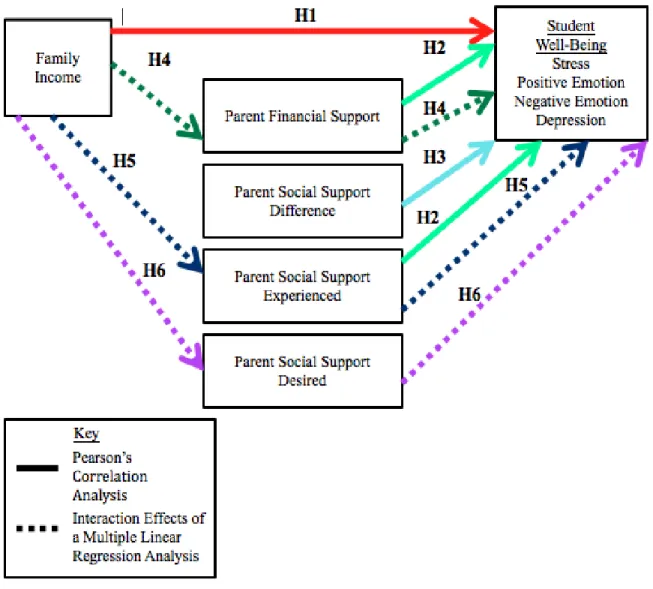
YPOTHESESHypothesis 1. The researcher expects that as family income decreases, the well-being of students does, as well. This hypothesis suggests that family income will be positively correlated with positive emotion. Also, the family income level of students will be negatively correlated with stress, negative emotion, and depression scores.
Hypothesis 2. Scores on depression, stress, and negative emotion measures will be negatively correlated with scores from both financial and social support from parents. Positive emotion scores will be positively correlated with scores from both financial and social support from parents.
Hypothesis 3. The researcher expects that as the gap between parent social support desired and parent social support experienced decreases, the well-being of students will increase. This hypothesis suggests that the parent social support difference score will be negatively correlated with a student’s positive emotion score. In turn, parent social support difference scores of students will be positively correlated with stress, negative emotion, and depression scores.
Hypothesis 4. It is hypothesized that among lower family income students, higher levels of parent financial support will be associated with lower stress, depression, and negative emotion than among higher family income level students. Among lower family income students, higher levels of parent financial support will be associated with higher positive emotion than among higher family income level students.
Hypothesis 5. There will be an interaction between family income and parent social support experienced such that higher parent social support experienced will be associated with lower stress, depression, and negative emotion more so among lower family income level students than among higher family income level students. Among lower family income level students, higher parent social support experienced will be associated with higher
positive emotion more than among higher family income level students.
Hypothesis 6. it is hypothesized that there will be an interaction between family income and parent social support desired such that among lower family income level
students, higher parent social support desired will be associated with lower stress, depression, and negative emotion more so than among higher family income level students.
Furthermore, among lower family income level students, higher parent social support desired will be associated with higher positive emotion more than among higher family income level students.
Figure 1 graphically depicts all of the hypotheses, along with the variables and analysis used to test each hypothesis.
Figure 1. Hypothesis Correlations and Interactions.
N
OMINALD
EFINITIONS OFT
ERMS ANDC
ONCEPTSIn this study, parental support is defined as financial support and emotional support. In the literature, financial support can be termed as financial investment or parental aid (Hamilton, 2013). In this study, financial support is operationalized by measuring a parent’s income along with different aspects in their child’s life that they pay for; for example, whether a parent pays for their child’s books or tuition while at college.
In this study, well-being is examined among college students. Well-being is defined in two ways: Positive well-being and negative well-being. Positive well-being can be looked at through positive life experiences and positive mental health (Peterson, Canady & Duncan,
2012). In this study, measuring a student’s positive emotion through self-reported measures operationalizes the term positive well-being. Negative well-being and emotion can be related to or defined in multiple ways according to literature. Negative emotion is linked to
depression and depressive symptoms (Watson & Clark, 1984). Negative well-being can also be defined by negative emotion or negative mood affects (Singh & Mishra, 2011). The term can also be linked to psychological distress and stress (Brougham et al., 2009; St-Onge & Lavoie, 1997). In this study, negative well-being is operationalized through self-reported measures of a student’s stress, depression, and negative emotion.
CHAPTER 2
LITERATURE REVIEW
A thorough literature search was conducted surrounding the well-being measures of stress, depression, negative emotion, and positive emotion among college students. This chapter also includes literature surrounding different types of relationships that exist between parental support or socioeconomic status and college students.
S
TRESSCollege is widely known to be a time of great transition and identity development for young adults (Arnett, 2001). During this transitional period, students are forming their own beliefs and values, are establishing a new and equal relationship with their parents, are learning to take responsibility for their own actions, and are gradually becoming financially independent (Arnett, 2001). In addition to these developmental tasks, students are also faced with social and academic concerns such as receiving passing grades, developing new
friendships, forming a more concrete identity, discovering career interests, transitioning from a dependent family life to one of independence, and learning how to handle the new financial burden that has been placed upon them (Brougham et al., 2009). As a number of these factors increase for an individual, their stress level also increases (Hong, 2008). According to previous studies, both male and female college students experience stress over these daily hassles and common concerns, with one of the major areas seeming to be financial concerns (Brougham et al., 2009; Staats, Cosmar, & Kaffenberger, 2007 as cited in Serido et al., 2010). For many college students, financial concerns are likely to be new stressors that they have not dealt with in the past or are stressors that have been exacerbated with increased financial and personal responsibility (Brougham et al., 2009). In addition, for both college men and women, holding an outside job in order to afford school was correlated with
there is a link between familial and financial stressors and the use of maladaptive coping strategies, specifically avoidance (denial and blaming others) and self-punishment (self-focused rumination and blame) among the college student population (Carver et al., 1989). Also, the transition into college from high school has been found to be a major source of stress for college students (Conley, Travers, & Bryant, 2013).
D
EPRESSION ANDN
EGATIVEE
MOTIONCollege students are not only under a great deal of stress throughout the initial transition to university life, but may also be experiencing high rates of depression and negative emotion. In fact, 75% of sophomores “reported having experienced at least mild depression the previous year” (Bosse et al., 1975). Further, 41% of that same population reported experiencing moderate to severe depression during their freshman year (Bosse et al., 1975). More recently, the Centers for Disease Control and Prevention (CDC, 2008) reported that more than 1 in 20 Americans over the age of 12 reported experiencing depression in 2005, 4.7% of those between the ages of 18-39. Considerable amounts of evidence indicate a strong relationship between negative emotion and depression. Those who scored high on negative emotion measures also reported high levels of depression and anxiety, while a low score on positive emotion measures was related only to depression (Watson & Clark, 1984). Also, it has been found that higher stress levels are associated with lower well-being and higher depression, especially in Latino students (Arbona & Jimenez, 2014). One explanation that has been studied is the effect of perceived control on depression. Researchers Alloy and Clements (1992) found that when students were given the illusion of control, they exhibited less negative emotion, discouragement, and depression in both laboratory and real life settings. Furthermore, a study of university students from 23 high, middle, and low-income nations found depression to be associated with a lower sense of control as well as low socioeconomic status (Steptoe, Tsuda, Tanaka, & Wardle, 2007). Unsurprisingly, evidence has also been found that people who are depressed have an especially negative view of the future and low self-efficacy expectancies (Bandura, 1988; Haaga, Dyck & Ernst, 1991). These findings suggest that people who are depressed or experience high negative emotion believe they have less control over their lives, expect less positive outcomes in the future, and feel less capable and self-sufficient than those who are not.
Social Support
Additionally, those suffering from depression may be facing obstacles in their social and family lives. According to research findings by Rich and Bonner (1987), negative social problem-solving self-appraisal, combined with low family support, interacted with stress to predict higher rates of depression among university students. However, college students who are experiencing depression may also find relief from the support of their families (Rich & Bonner, 1987). In a study examining the influence of family support and religious beliefs, researchers found greater family support to be significantly associated with decreased
depression and anxiety, independent of religious beliefs (Hovey, Booker, & Seligman, 2007). From the evidence gathered by numerous researchers, it is clear that families play an
important role in supporting or hindering their college students’ well-being. While many college students will suffer from at least mild depression during their freshman year, the amount and type of support offered from parents may be crucial in the maintenance of psychological health and recovery from depressive episodes.
W
ELL-B
EING OFS
OCIALW
ORKS
TUDENTSSocial work is a rewarding, but stressful career (Coffey, Dugdill, & Tattersall, 2004; Collins, 2008). There are many factors that cause stress to social workers. The stressful work environment negatively impacts social workers’ well-being (Graham, & Shier, 2014). Studies have found that the various roles of a social worker and having to work in adverse situations decrease a social worker’s overall well-being (Graham, & Shier, 2014). Although there is extensive literature on the stress and well-being on of those working in the Social Work profession and college students in general, there are minimal amounts of research specifically on social work students. Yet, it has been found that social work students commonly deal with the stress of adjusting to meet the field demands and improving their knowledge and skills in the classroom (Goldblatt & Buchbinder, 2003; Razack, 2001). Furthermore, being in an educational program that combines academic and professional requirements, such as internships, will evoke more stress than educational programs that do not (Dziegielewski, Turnage, & Roest-Marti, 2004). One study found a significant number of college students self-reporting high levels of emotional exhaustion and low self-esteem (Collins, Coffey, & Morris, 2010). There was also high level of part-time social work
students who had to work to help pay for college tuition (Collins et al., 2010). Those students working and going to college part-time experienced higher levels of stress (Collins et al., 2010). Lastly, in regards to support, social work students who reported having higher level of support reported higher levels of well-being (Collins et al., 2010). There is evidence in the literature that reveals that individuals working in the social work field experience high levels of stress and burnout due to the job demands (Kim & Stoner, 2008). However, Dziegielewski and colleagues reported finding a lack of social work student focused
research, especially surrounding stress and burnout even though there is existing knowledge it exists within the social work profession (Dziegielewski et al., 2004). Therefore, this reveals this area of social work students and stress should be researched more. Overall, the research that does exist on social work students reveals this population commonly
experiences low levels of well-being.
P
ARENT-C
HILDR
ELATIONSHIPThe parent-child relationship is one of great importance. Adolescents have relied on their parents to support them throughout their development, and continue to do so through the transition to adulthood. Parental care does not stop affecting the emotional and
psychological health of the young adult at departure; rather, the support offered directly affects the well-being and adjustment of college students. In fact, evidence has been found that the parent-child relationship is very critical to the academic, physical, and psychological well-being of college students (Shim, Xiao, Barber, & Lyons, 2009). According to one study, parents act as “‘scaffolding’ and ‘safety nets’ to aid their children’s successful transition to adulthood” (Swartz, Kim, Uno, Mortimer, & O’Brien, 2011). In order to scaffold, parents supply temporary support that helps children achieve specific
socioeconomic goals. To be a safety net, they supply temporary and periodic help during difficult situations to reduce setbacks that occur in the transition to adulthood (Swartz et al., 2011). Another study found that parental care aids young adults in overcoming the numerous challenges and stressors they must face as they transition from adolescence to adulthood (Aquilino, 2005). In Klein and Pierce’s 2009 study, undergraduates with parents who provided high care and low over-protection were the most well-adjusted and least anxious across multiple domains. Further, students who received the support they desired from their
parents were more likely to seek help in stressful situations (Miczo, Miczo, & Johnson, 2006). It is logical then to assume that college students would continue to seek advice, care, and support from their parents in order to help reduce perceived and experienced stress. Since it has been shown that the majority of college students use emotion-focused coping strategies to handle their stress, it follows that many would choose to turn to parental figures and find a partner in this experience of coping. However, dependent on individual
circumstances such as personality and desire, it may be important to determine whether financial or social support is more effective in relieving stress, depressive symptoms, and negative emotions.
S
UPPORTSupport was broken down by looking at financial support, social support, and family support.
Financial Support
A key way that parents support their children is through tangible, financial assistance. Parents play an essential role in forming college students’ attitudes and behaviors concerning financial matters; the parent-child financial relationship is an investment in the lives of young adults (Shim et al., 2010). Additionally, many college students remain dependent upon their parents for financial support during the transition to adulthood (Schoeni & Ross, 2005). Because of this, open communication regarding financial assistance and clear expectations between parents and children is very important. A study performed by Padilla-Walker, Nelson, and Carroll (2012), looked at the level of financial support given by a parent to their college student child and different outcomes and behaviors by the child. They found lower income families tend to provide less support for their child (Padilla-Walker et al., 2012). The college student children who received lower financial assistance from their parents tended to be older in age, work fewer hours, and engage less in social drinking behaviors It is the researchers’ goal to identify the effects of positive parent-child financial relationships on student well-being, independent of emotional and social support.
Social Support
The utilization of social support in stressful situations is a very important, yet very complex process. Support from family members has been specifically associated with less emotional dysfunction and strain during stressful life changes (Holahan & Moos, 1990). Holahan and Moos (1990) also found evidence that people who receive more support from their families are more likely to use adaptive coping strategies. In turn, this increased use of approach coping mediated the relationship between family social support and positive psychological outcomes during stressful life events (Holahan & Moos, 1990, 1991). The evidence gathered by Holahan and Moos shows a strong tie between social-emotional support from family members and increased psychological well-being during times of stress. However, the tie between social support and well-being is not always direct. There is
evidence to suggest that parental support may have an indirect effect on young adults’ transitions, and perception of available support may be more important than actually directly receiving the support (Bolger, Zuckerman, & Kessler, 2000; Maughan & Champion, 1990). Researchers Wethington and Kessler (1986) found evidence that the perception of available support led to better psychological outcomes than for those who were actually involved in support transactions. In other words, perceived availability of support acts as a “buffer” that protects individuals against high levels of stress (Cohen & Hoberman, 1983). These findings suggest that having at least one supportive parental figure throughout the transition to college could improve the psychological health of college students (Cohen & Hoberman, 1983). There may also be a correlation between the difference of how much perceived support is desired by the student and how much is actually received and the strength of stress-protective effects (Cohen & Hoberman, 1983). One study found an interaction effect that indicated high parental support and positive active coping buffered the effect of high levels of stress associated with depressive symptoms (Wintre & Bowers, 2007). Also, the perceived family social support for college students in the United States predicted higher levels of positive mood for those students (Brannan et al., 2013). In addition, researchers found the need for available social support is linked to stress and well-being in college students (Neely,
Schallert, Mohammed, Roberts, & Chen, 2009). These findings indicate there is a desire for students to have some sort of support while in college. There may also be a correlation
between the difference of how much perceived support is desired by the student and how much is actually received and the strength of stress-protective effects.
Family Support and Academic Achievement
Parental support has also been found to have an impact on a college student’s academic achievement (Crockett et al., 2007; Ratelle et al., 2005). When accounting for lower socioeconomic status, parental support acted as a moderator on the effects of low socioeconomic status on academic achievement (Ong, Phinney, & Dennis, 2006). Especially in Latino students, parental support was found to have more positive psychological outcomes and greater academic achievements (Ong et al., 2006). Also, one study conducted by Pillay and Ngcobo (2010), on first-year university students surrounding stress and support levels, found their parents to be the most supportive when they were feeling stressed. These studies show the positive impact parental support can have on a college student and their overall success rate during their college years.
S
OCIOECONOMICS
TATUSSocioeconomic status was researched in how it was related with well-being measures and academic achievement for students.
Well-Being
It has been well documented that socioeconomic status has far reaching effects on the well-being of the individual across multiple domains. Low socioeconomic status has also been shown to increase the risk for a range of psychological problems in children such as disrupted socioemotional functioning (McLoyd, 1998). Further, multiple researchers have found evidence that family economic strain is related to adolescent adjustment issues, as well as symptoms of depression, anxiety, and antisocial behavior (Conger, Conger, Elder, & Lorenz, 1992). Finances have been found to be a significantly higher stress factor in students in less affluent communities and disadvantaged backgrounds (Pillay & Ngcobo, 2010). Living with less money than one needs in order to pay bills, rent, tuition, or other basic necessities is a very stressful situation (Siefert, Bowman, Heflin, Danziger, & Williams, 2000). Not only does economic strain put stress on the individual, it may also increase the likelihood of tension or conflict among family members (Wadsworth & Compas, 2002). In
the college population, when parental support is such a crucial part of a successful transition to independent living, financial and emotional security may be related to favorable outcomes. According to research by Xiao, Chuanyi, and Shim (2009), college students who felt they had more control over their financial situation and were more satisfied with their financial status were more likely to exhibit positive spending behaviors. These behaviors were then linked to better physical health, academic success, life satisfaction, and better psychological health (Xiao et al., 2009). Revealed extensively in previous literature, there is a significant association between socioeconomic status, availability of financial resources, and well-being. However, when financial resources are limited, and stressful situations abound, the question remains as to what type of support is most beneficial, and in what form it should be
delivered.
Academic Achievement
Stress in students has been found to have a significant impact on students and their overall academic success (Pillay & Ngcobo, 2010). Socioeconomic status can play a role in this relationship between stress and academic achievement. In a meta-analysis review of literature concerning socioeconomic status and its relationship to academic success from 1990 to 2000, Sirin (2005) found a medium to strong correlation. Research has also found African American students within a family of lower socioeconomic status have lower well-being and lower academic achievement (Wilson, 2009). Grade point averages (GPA) also seemed to be impacted if a student is from a family with lower socioeconomic status (An, 2013). A study done by Goodman, Miller, and West-Olatunji, (2012) explored the impact of stress on academic achievement for lower socioeconomic students. They found that lower socioeconomic status and stress did predict lower academic achievement (Goodman et al., 2012). Overall, the findings show how lower economic status of a student can negatively effect their stress and overall academic achievement while in school.
C
ONCLUSIONOverall, there is a connection to lower financial support for a student and negative outcomes with increased stress levels, depression, and lower well-being (Brougham et al., 2009; Steptoe et al., 2007). Also, parental and social support has been shown to help
improve college student’s stress levels and overall well-being (Brannan et al., 2013; Ong et al., 2006). Lastly, socioeconomic status plays a factor in how much a family can financially support their child and the impacts on the college student’s well-being (Goodman et al., 2012; Pillay & Ngcobo, 2010). Yet, not much research has studied the impact of emotional support and financial support from a parent between high and low socioeconomic students and their well-being. Additionally, there is a lack of research on social work students specifically and what types of support help counteract the stress they experience during college. Therefore, this study hopes to provide more information about the impact a parent’s financial and emotional support has on a social work student’s overall well-being during college.
CHAPTER 3
METHODOLOGY
R
ESEARCHD
ESIGN ANDN
OTATIONThis study is an exploratory, non-experimental study examining the relationship between parental financial and emotional support and their college-age child’s well-being. This is a cross-sectional, correlational study that had participants self-report through surveys on the amount of parental financial and emotional support received and well-being measures.
S
AMPLES
ELECTION ANDA
SSIGNMENTThe sampling frame used in this study was the list of students enrolled in social work courses at San Diego State University (SDSU). Subjects were recruited through graduate and undergraduate Social Work classes. This study used a convenience sample of students enrolled in four different social work courses. One course had undergraduate students, two courses had graduate social work students on the clinical track, and the last course had graduate social work students on the administration and community development track. The results of the study will be posted on social media venues connected to the school of Social Work at SDSU to allow students to read the overall outcomes of the study. Students were informed by the professor at the beginning of class of an opportunity to stay after class and take the survey. The principal investigator read a script before handing out the surveys to students willing to participate. Therefore, participants were volunteers who chose to stay after class and complete the survey. It is estimated that between 75% to 100% of the students in each class stayed to participate.
To protect confidentiality and keep each participant’s survey answers anonymous, San Diego State’s IRB approved the right to waive a signed informed consent sheet from each participant. However, each participant was still handed and instructed to read an informed consent handout before beginning the survey. The informed consent form
informed the student that the study was voluntary and it would not be held against them in any way if they choose not to participate. Their participation was voluntary and they had the right to ask questions to the researcher at any time or end the survey whenever they wanted by turning it into the researcher's box face down. The consent form also informed students’ of their right to not answer or skip questions if they desired and the confidentiality of their answers.
A debriefing handout was also given to each participant after completion of the survey. The debriefing material contained contact information to the counseling services on San Diego State University’s campus, the faculty advisor of this thesis, and the San Diego State University’s IRB in case a participant had any issue.
One hundred and forty-six students participated in the present study. Due to various participants having missing data, especially in the family income measurement, only ninety-seven participant’s data were analyzed.
M
EASUREMENTThis study included multiple variables to assess the impact of different types of parental support on their college student’s well-being. Family income, parental financial support, parental social support experienced, parental social support desired, and parent social support difference were all independent variables used to measure different types of parental support.
Four dependent variables were used to measure a student’s well-being. The Positive and Negative Affect Scale (PANAS) developed by Watson, Clark, and Tellegen (1988) was used to measure a student’s positive and negative emotion. The participants’ stress was measured through the Perceived Stress Scale (PSS) (Cohen, 1988). A student’s depressive symptoms were measured using the Center for Epidemiological Studies Depression Scale (CES-D; Radloff, 1977).
Demographic information was also collected included self-reported age, sex, ethnic identity, and sexual orientation.
O
PERATIONALD
EFINITIONS ANDL
EVELS OFM
EASUREMENTThis study used a mixture of already existing measures and developing a new measure to be used to measure the different variables analyzed in this study.
Parental Financial Support
To measure parental financial support, a questionnaire created by the researcher was used. The questionnaire asked the participants to estimate the percentage of money their parents give them each year in the following domains: tuition, books, rent, utilities, groceries, gas, and social activities. The participant was asked to respond by circling a number from a 0-100 scale listed in ten-percentile intervals. A score of 0 was given if the participant circled 0% and a score of 10 was given if the participant circled 100%. An average of all domains listed above, except for Social Activities, was created to create a score for parent’s financial support ( =0.82, m = 24.03, SD = 30.90). Social Activities was excluded after running a Cronbach’s Alpha test to test the reliability of the measures of the scale and found this measure to not have consistent reliable with the other seven measures. See Appendix A to view the Parental Financial Support measure utilized in the survey.
Social Support
Student’s parental social support experienced and desired variables were measured from a modified version of scales developed by Xu and Burleson (2001). The scale was modified by altering the instructions, from the relationship with a “spouse” to the relationship with “one parent.” For the parental social support experienced scale, the participants were asked to consider how much social support they experienced from their parents (e.g., “Telling you that you are still a good person even when you have a problem.”). Items were assessed on a five-point Likert response scale ranging from 1 (don’t experience at all) to 5 (experience a great deal). To create a participant’s experience parental support score, an average of all their responses to the 35 questions on the five-point Likert response scale were averaged. Therefore, the participants’ scores on parent social support experienced ranged from 1 to 5, with a high score representing more parent social support experienced by the participant ( =.94, m =3.29, SD = .73).
The parental social support desired scale asked the participants to consider how much of each support behavior they desire from their parents using the same 35 questions from the “parental social support experience” questionnaire except the Likert response scale ranged from 1 (don’t desire at all) to 5 (desire a great deal). To create a participant’s parental social support desire score, an average of all their responses to the 35 questions on the five-point Likert response scale were averaged. Therefore, the participants’ scores on parent social support desired ranged from 1 to 5, with a high score representing more parent social support desired by the participant ( =.96; m = 3.31, SD = .72).
To measure if there was a difference between the amount of social support a student desired from a parent compared to the amount they actually experienced from that parent, the average score created for each participant on the parent social support desired was subtracted from the average score of parent social support experienced to give us a parent social support difference score. The absolute value of this score was taken to measure the size of the gap between how much parental social support a student experienced from their parents and how much a student desired from their parents ( =.94, m = 0.56, SD = .49). A higher number represents a larger gap between how much parent social support a student desires and how much they experience from their parents. A low score represents a student experiencing a small difference between the amount of social support from their parents they experience and the amount they desire.
Positive and Negative Emotion
Well-being was measured using the Positive and Negative Affect Scale (PANAS) (Watson et al., 1988). The PANAS is a 20-item self-report questionnaire, with 10 items assessing positive emotion and 10 items assessing negative emotion. Each item contains one adjective that is either a positive or negative emotion. Participants were expected to report on how often they experienced feeling these positive or negative affects within the past week. The items were assessed on a five-point Likert scale ranging from 1 (very slightly or not at all) to 5 (extremely). Each participant’s positive emotion score was created by averaging his or her response score for the 10 items assessing positive emotion. Therefore, the lowest and highest possible scores ranged from 1 to 5, with a higher average reflecting a greater amount of positive emotion. Examples of positive items included: strong, excited, proud, and
determined ( =.85; m = 3.56, SD = .57, with scores ranging from 2.20 to 5.00). Each participant’s negative emotion score was created by averaging his or her response score for the 10 items assessing negative emotion. Therefore, the lowest and highest possible scores ranged from 1 to 5, with a higher average reflecting a greater amount of negative emotion. Examples of negative items included: hostile, upset, afraid, and ashamed ( = .84; m = 2.22, SD = .73, with scores ranging from 1.00 to 5.00). See Appendix B for the example of PANAS questionnaire within the survey provided to participants.
Stress
The participants’ stress was measured through the Perceived Stress Scale (PSS) (Cohen, 1988). The questionnaire asked the participants to report their feelings and thoughts during the previous month. An example of a question is, “In the last month, how often have you been upset because of something that happened unexpectedly?” The 10 questions are assessed on a five-point Likert scale ranging from 1 (never) to 5 (very often). To develop a participants stress score, their response score for all 10 questions were average. Therefore, the highest and lowest possible scores ranged from 1 to 5, with a higher average endorsing a larger amount of stress reported by the participant ( =.85, m = 2.81, SD = .62, with scores ranging from 1.40 to 5.00). See Appendix C for a sample of the PSS scale used in the questionnaire.
Depression
The Center for Epidemiological Studies Depression Scale (CES-D; Radloff, 1977) measures a participant’s depressive symptoms by asking them to report their behaviors and feelings in the past week. An example of an item from this scale states, “I was bothered by things that usually do not bother me.” Responses were assessed on a four-point Likert scale (1: rarely or none of the time (less than 1 day); 2: some or a little of the time (1-2 days); 3: occasionally or a moderate amount of time (3-4 days); and 4: most or all of the time (5-7 days)). After reverse coding the appropriate items, the twenty items were averaged to develop a participant’s depression score ( = .90; m = 1.72, SD = .52, with scores ranging from 1.00 to 3.50). See Appendix D for an example of the CES-D questionnaire used in this study.
Family Income
To operationalize family income, the participants were asked in an open-ended format to estimate both their mother and father’s annual income. The average father’s income was $50,242 (SD= 55,963) and the average mother’s income was $31,386 per year (SD = 37,030). Adding together the participant’s reported mother’s income and father’s income created the total family income. After running a frequency on the family income variable, family income was found to be skewed right (skewness = 2.36). Based on literature, high skewness is +/- 1 > 0, moderate skewness is +/- 1.0 to 0.5, approximate symmetry is +/- 0.5 to 0.25, and +/-0.1 to 0 is considered normally distributed (McDonald, Sorensen, & Turley, 2013). Due to the high level of skewness, family income was recoded into two income categories of high family income and low income based on the median of $72,000. High family income was recoded to “1” for any reported family income ≥ $72,000 and low family income was recoded to “0” for any reported family income ≤ $72,000. See Appendix E for the sample of the open-ended questionnaire to measure family income used in this study.
Demographics
Demographic information collected included self-reported age, sex, ethnic identity, and sexual orientation (Table 1).
R
ELIABILITY ANDV
ALIDITY OFI
NSTRUMENTS/M
EASURESCronbach’s Alpha was used to test the reliability of each scale. This statistical test measures the internal consistency reliability of a measure. Internal consistency reliability examines how well items trying to measure a similar concept are able to produce similar results. A split-half reliability test measures internal consistency reliability by breaking the items into two groups, administering the items to a sample then calculate a total score. The total scores between the two groups are then correlated. Cronbach’s alpha is computed by averaging all the possible split-half reliability measures. Cronbach’s alpha is a coefficient of reliability that is reported on a scale between 0 and 1. The closer the alpha is to 1, the stronger the internal consistency reliability of the scale items.
Table 1. Frequencies of Demographic Variables Characteristic N % Gender Male Female Missing 13 83 1 13.4 86.5 1.0 Ethnic African American Asian American Latin American European American Middle Eastern American
Missing 3 18 30 41 2 3 3.1 18.6 30.9 42.3 2.1 3.1 Sexual Orientation Heterosexual Homosexual Bisexual Asexual Missing 76 7 3 1 10 87.4 8.0 3.4 1.1 10.3
Independent Variables Mean Standard Deviation
Family Income Parental Financial Support Parent Social Support Experienced
Parent Social Support Desired Parent Social Support Difference
81,628.87 24.03 3.29 3.31 0.56 69,911.90 30.90 0.73 0.72 0.49
Dependent Variables Mean Standard Deviation
Stress Positive Emotion Negative Emotion Depression 2.81 3.56 2.22 1.72 0.62 0.57 0.73 0.52
When measuring parental financial support, an average of all domains except social activities was created to account for parent’s financial support ( =0.89). The positive items on PANAS scale produced an alpha of 0.81 ( =.81); the negative items on the PANAS scale reported an alpha of 0.70 ( = .70). The Perceived Stress Scale (PSS) (Cohen, 1988) resulted in an alpha of 0.78 ( =.78). The 20-item Center for Epidemiological Studies Depression Scale (CES-D; Radloff, 1977) produced an alpha of 0.83 ( = .83) after reverse coding the appropriate items.
Threats to Validity
Due to this study being a non-experiment, there are many internal threats. Having a nonrandom sample of social work students, whom were only surveyed once, limits the
generalizability and reliability of the data collected. Also, this does not allow for a cause and effect relationship to be found.
With regard to external validity this study may not have included a sample that is an adequate representation of the population of social work college students. Due to
convenience sampling from students in a Social Work class, the sample is not representative of all college students or even all social work students. Also, due to a non-random sample used for this study, selection bias occurs. Therefore, generalizability to other social work students or college students is limited.
A
NALYSISPearson’s r Correlation was used to describe the bivariate relationship between family income and all of the well-being measures to test hypothesis 1. Pearson’s r Correlation was also used to test the second and third hypothesis to describe if a relationship exists between parental financial support and any of the well-being measures, parental social support experienced and any of the well-being measures, and the absolute value of parent social support difference and any of the well-being measures.
To test hypothesis 4, 5, and 6, a multiple linear regression model was used. All variables were centered to create a mean of zero. This was done by finding the mean of each individual measure and then subtracting this mean value from a participant’s score for that variable. This was done to remove the colinearity that can occur when creating interaction terms with variables to be used in a regression model. Then an interaction term was developed between the created centered variables of family income and parental financial support to be used in the regression model to test hypothesis 4. An interaction term was developed between the created centered variables of family income and parental social support experienced to be used in the regression model to test hypothesis 5. Lastly, an interaction term was developed between the created centered variables of family income and parental social support desired to be used in the regression model to test hypothesis 6.
H
UMANS
UBJECTC
ONSIDERATIONS:
I
NFORMEDC
ONSENTT
EMPLATEThe Informed Consent Form was submitted and approved by the university IRB. See Appendix F.
CHAPTER 4
RESULTS AND DISCUSSION
R
ESULTSHypothesis 1
There was not a significant relationship found between family income and any of the well-being measures (see Table 2). Therefore, hypothesis 1 was not supported in finding higher family income being positively associated with positive emotion and negatively associated with stress, negative emotion, and depression.
Hypothesis 2
Hypothesis 2 was supported with a significant, positive association between parent financial support experienced and positive emotion (see Table 2). This reveals that the more parental financial support a student received, the higher positive emotion a student
experienced. Also, there was a significant positive association with parental social support and positive emotion (see Table 2). This reveals the more a parent socially supported their child, the higher positive emotion of the student. However, there was not a significant relationship found between parent social support experienced or parent financial support and stress, negative emotion, or depression scores among students (see Table 2).
Hypothesis 3
A significant, positive association between parent social support difference and positive emotion was found (see Table 2). This suggests the opposite of what was
hypothesized because this reveals that as the gap between parent social support experienced and parent social support desired increases, a student’s positive emotion also increases. No significant relationships were found between parent social support difference and stress, negative emotion, or depression scores among students (see Table 2).
Table 2. Interrelationships between Variables Family Income Parent Financial Support Parent Social Support Exp. Parent Social Support Des. Parent Social Support Diff. Stress Pos. Emo. Neg. Emo. Dep. Family Income 1 .27** .03 -.01 -.08 -.19 .01 -.07 -.18 Parent Financial Support 1 .11 .14 -.01 -.09 .24* .08 .02 Parent Social Support Exp. 1 .48* .13 -.14 .28** -.14 -.08 Parent Social Support Desired 1 -.12 .16 .24** .08 .11 Parent Social Support Difference 1 -.03 .35** .15 .05 Stress 1 -.34** .50** .73** Positive Emotion 1 -.09 -.16 Negative Emotion 1 .63** Depression 1 ** p < .01 *p < .05
Hypothesis 4
S
TRESSStress was regressed onto family income, parent financial support, and their interaction term and the model predicted 4% of the variance in this regression model (see Table 3). Stress was predicted by family income (= -.18, p < .10). This suggests that students with reported lower income levels had higher reported levels of stress. However, there was not a significant relationship between parent financial support and stress ( = -.05, ns) and there was no interaction effect found with parent financial support and family income and stress ( = .03, ns). Hypothesis 4 was not supported because there was no significant
difference between students with low and high family income in the degree to which negative emotion was related to parental financial support (see Table 3).
P
OSITIVEE
MOTIONPositive emotion was regressed onto family income, parent financial support, and their interaction term and 3% of the variation is accounted for with this model (see Table 3). The relationship between family income and positive well-being was not significant ( = .04, ns), but there was a significant relationship between family income level and positive
emotion ( = .23, p <.05). This reveals the higher the family income of a student, the higher the student’s positive emotion. However, there was no interaction effect detected between family income and parental financial support on positive emotion (= -.01, ns). Hypothesis 4 was not supported because there was no significant difference between family income level and the amount of parent financial support a student receives in relation to positive emotion.
N
EGATIVEE
MOTIONNegative emotion was regressed onto family income ( = -.08, ns), parent financial support (= .11, ns) and their interaction term ( = -.05, ns) and no significant relationship was found to support hypothesis 4 (see Table 3). Hypothesis 4 was not supported because there was no significant difference between students with low and high family income in the degree to which negative emotion was related to parental financial support.
D
EPRESSIONDepression was regressed onto family income, parent financial support, and their interaction term. The model accounted for 1% of the variation and family income was found to have a significant relationship with depression ( = -.20, p <.10) (see Table 3). This shows that as student’s income level decreases, the student’s reported level of depression increases. However, there was no significant relationship found between stress and parent financial support ( = .07, ns), or the interaction of family income and parent financial support ( = -.01, ns). Hypothesis 4 was not supported because there was no difference between students with low and high family income in the degree to which depression was related to parental financial support.
Overall, hypothesis 4 was not supported because there was no significant association between the strength of low and high family income levels of students in the relationship between parent financial support and well-being.
Table 3. Regression Analysis Predicting Interaction Effect between Family Income and Parental Financial Support
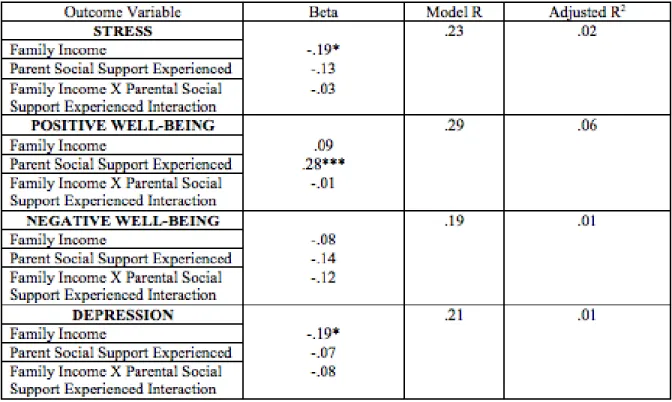
Hypothesis 5
S
TRESSStress was regressed onto family income, parent social support experienced, and their interaction term and no significant relationship was found to support hypothesis 5 (see Table 4). The model accounted for 2% of the variation among these variables. Family income was found to have a significant relationship with stress ( = -.19, p<.10). This reveals that a student’s stress level increases as their family income level decreases. However, there was no significant relationships found between stress and parent social support experienced ( = -.13, ns), or the interaction of family income and parent social support experienced ( = -.03, ns). Hypothesis 5 was not supported because there was no difference between students with
low and high family income in the degree to which stress was related to parental social support experienced.
P
OSITIVEE
MOTIONPositive emotion was regressed onto family income, parent social support
experienced and their interaction term (see Table 4). This model accounted for 6% of the variation. The relationship between family income and positive well-being was not
significant ( = .09, ns), but there was a significant relationship found between parent social support experienced and positive emotion ( = .28, p<.01). This suggests that a student’s positive well-being increases with the more parent social support they experience. However, there was no interaction effect detected between family income and parental financial support on positive emotion (= -.01, ns). Therefore, hypothesis 5 was not supported because there was no significant difference between students with low and high family income in the degree to which positive emotion was related to parental social support experienced.
N
EGATIVEE
MOTIONNegative emotion was regressed onto family income ( = -.08, ns), parent social support experienced ( = -.14, ns), and their interaction term ( = -.12, ns) and were not found to be significant as predictors (see Table 4). This model accounted for 1% of the variance. Hypothesis 5 was not supported because there was no significant difference between students with low and high family income in the degree to which negative emotion was related to parental social support experienced
D
EPRESSIONDepression was regressed onto family income, parent social support experienced, and their interaction term were regressed onto depressive symptoms and no significant
relationships were found to support hypothesis 5 (see Table 4). This model accounted for 1% of the variance and family income ( = -.19, p <.10) was found to have a significant
relationship with depression. This reveals that as a student’s family income decreases, higher levels of depression are reported. However, there was no significant relationship found between stress and parent social support experienced ( = -.07, ns), and the interaction of
family income and parent social support experienced ( = -.08, ns). Hypothesis 5 was not supported because there was no difference between students with low and high family
income in the degree to which depression was related to parental social support experienced. Overall, hypothesis 5 was not supported because there was not a difference detected between the strength of low and high family income levels of students in the relationship between parent social support experienced and well-being.
Table 4. Regression Analysis Predicting Interaction Effect between Family Income and Parental Social Support Experienced
Hypothesis 6
S
TRESSStress was regressed onto family income, parent social support desired, and their interaction term and the model accounted for 7% of the variation (see Table 5). Stress was found to be predicted by family income ( = -.17, p <.05). This finding suggests that as a student’s family income decreases, they report higher levels of stress. There was no
significant relationship found between stress and parent social support desired ( = .16, ns). However, the interaction between family income and parent social support desired was found to be a predictor of stress ( = -.18, p < .10) (see Figure 2). Therefore, hypothesis 6 was supported because a student’s family income level was related to stress differently at different levels of desired social support from their parents. The results showed the higher the income level of a student, the less important their desire for parental social support impacted their stress levels. However, for lower income students the level of parental social support they desired was of higher importance. This is shown by lower income level
students having increasing stress levels as their desired social support from their parents increased.
Figure 2. Stress Regressed onto Family Income and Parent Social Support Desired.
P
OSITIVEE
MOTIONPositive emotion was regressed onto family income, parent social support desired, and their interaction term and the model accounted for 4% of the variation (see Table 5). The relationship between family income and positive well-being was not significant ( = .13, ns), but positive emotion was predicted by parent social support desired ( = .24, p <.05). This finding reveals that as a student desired more parent social support, their positive emotion score was higher. However, there was no interaction effect detected between family income and parental financial support on positive emotion (= .01, ns). Hypothesis 6 was not supported because there was no significant difference between students with low and high family income in the degree to which positive emotion was related to parental social support desired.
N
EGATIVEE
MOTIONNegative emotion was regressed onto family income ( = -.05, ns), parent social support desired ( = .02, ns), and their interaction term ( = -.10, ns) and were not found to be significant predictors (see Table 5). This model accounted for 0% of the variation. Hypothesis 6 was not supported because there was no significant difference between students with low and high family income in the degree to which negative emotion was related to parental social support desired.
D
EPRESSIONDepression was regressed onto family income, parent social support desired, and their interaction term were regressed onto depression and this model accounted for 4% of the variation (see Table 5). Family income was found to predict stress (= -.18, p <.10) and this suggests that as family income level decreases, the student’s reported level of depression increases. Parent social support desired was not found to be significantly related to stress ( = .11, ns). The interaction term of family income and parent social support desired was found to have a significant effect on depression ( = -.18, p <.05) (see Figure 3). Hypothesis 6 was supported because the more parent social support a student with lower income desired, the higher the student’s depression score. Also, the students with higher family income were
found that their desired parental social support was less important of an influence on their depression level.
Figure 3. Depression Regressed onto Family Income and Parent Social Support Desired.
Overall, hypothesis 6 was supported for two of the four well-being measures (stress and depression) by finding higher parent social support desired was associated with higher stress and depression more so for lower income family level students than among higher family income level students.
Table 5. Regression Analysis Predicting Interaction Effect between Family Income and Parental Social Support Desired
D
ISCUSSIONThe majority of the results in this study did not support the hypotheses due to being either insignificant or contrary to expectations. However, this study’s results did indicate that the more financial support and parental social support students received from their parents, the more positive emotion they experienced. The researcher’s expectation was also confirmed by finding that the more parent social support a student with lower income desired, the higher