CLAC 73 2018: 267-278 267 Círculo de Lingüística Aplicada a la Comunicación
ISSN: 1576-4737
http://dx.doi.org/10.5209/CLAC.59069
Language strategies used by tourism degree students for learning
German as a third language
M. Cristina Santana-Quintana1
Recibido: 22 de febrero de 2017/Aceptado: 22 de enero de 2018
Resumen. This study examines the perceptions of Tourism major students of strategies for learning German as their L3. Using questionnaires adopted from the Oxford (1990) Strategy Inventory of Language Learning (SILL), this research aims to answer the following questions: (1) What are the most and the least frequently used language learning strategies (LLSs) among learners of German as a third language? (2) Is it possible to identify differences between the strategies employed if the language is studied for a specific purpose (LSP) in the Tourism Degree Programme? If so, (3) which strategy is best adapted to this specific group? The results of this study show that (1) according to the analysis of the data from the SILL questionnaire, the students were medium user of strategies in learning German as their L3, and that metacognitive strategies (mean =3.55) were the most frequently used, while affective strategies (mean= 3.06) were the least frequently used. (2) The best LLS to choose will depend on the students’ needs, and German in the Tourism Bachelor focuses on communicative competence and interaction to facilitate more flexible, and above all more experimental, learner behaviour. (3) Social strategies are the ones that have been identified as the best for this specific group, because these LLSs help to improve students’ oral communication skills.
Palabras clave: Language learning strategies, German for Specific Purposes, Tourism Studies, Strategy Inventory for Language Learning (SILL), Communication skills, Social strategies.
Cómo citar: Santana-Quintana, M. C. (2018): Language strategies used by tourism degree students for learning German as a third language, en Círculo de lingüística aplicada a la comunicación 73,
243-254.
Índice. 1. Introduction. 2. Language learning strategies (LLSs). 3. Methodology: Subjects and analysis procedures. 3.1. Subjects. 3.2. Instruments: Strategy inventory for language learning (SILL). 4. Results of using different kinds of language learning strategies. 5. Discussion. 6. Conclusions and suggestions. References.
1. Introduction
The Common European Framework of Reference for Languages (CEFR) aims to set the standards for learners in different countries to create a close link between language, culture and the European identity to achieve a common communicative sphere (Council of Europe, 2001). Language learning strategies (LLSs) and
_____________
1 Universidad de las Palmas de Gran Canaria (IATEXT)
autonomous learning have attracted a fair amount of attention in recent years. This might well be related to a focus on autonomous language learning in the European context generally, and the influence of CEFR. There has been increasing interest in language learning and language learners since the 1970s with the emergence of the cognitive revolution, special attention has been paid to LLSs ever since (Farmanlu & Abdolmanafi-Rokni, 2014). But the prominent change has occurred in language teaching and learning over the last forty years. In the past, the emphasis was on teachers and teaching, while now the emphasis is on learners and learning (Mohammadi et al., 2013). No modern language teacher, researcher or policy-maker needs to be reminded of the enormous changes that have taken place in modern foreign language teaching and learning over recent decades (Grenfell & Erler, 2007).
Several studies indicate some of the learning strategy preferences reported by students in different cultural contexts, but the research suggest that students do not use them widely. This situation has motivated applied researchers in the field of L2 learning and teaching to try to diagnose the problems and find solutions to them. Murray (2010) says that there have been many studies of the effective use of LLSs in the second language (L2) classrooms that have produced positive results. Despite such abundant learning strategy use, very little research has studied the relationships between LLSs and the acquisition of a third language. Research conducted into LLSs, has focused mainly on learning a first or a second language, but third language learning strategies and studies of German have received little or no attention to date (Nasser Najafi Tireh Shabankareh & Hadizadeh, 2011). On the other hand, recent literature on LLSs shows that studies have been conducted on numerous populations, but very few have studied a Spanish population (Judge, 2012).
The aim of this article is to use a case study to help explore the LLSs most frequently used by students in higher education. The novelty of our contribution is the fact that we analyse the relations between students studying German as third language for specific purposes (LSP) in the Degree Programme in Tourism in a European context and LLSs. This study aims to investigate LLSs used by the Tourism Degree Programme at the Universidad de Las Palmas de Gran Canaria (ULPGC) in Spain. The specific aim of the study is to answer the following research questions: (1) what are the most and least frequently used LLSs among learners of German as a third foreign language? (2) Is it possible to identify differences between the strategies employed to study a language for LSP in the Degree Programme in Tourism? If so, (3) which strategy would be the most suited to the specific group?
2. Language learning strategies (LLSs)
According to Oxford (1990, 16), LLSs “are very important because they are tools for active self-directed involvement, and appropriate LLSs are related to improved proficiency and greater self-confidence”. The Council of Europe also determines that “a strategy is any organised, purposeful and regulated line of action chosen by an individual to carry out a task which he or she sets for himself or herself or with which he or she faces” (2001: 1). Brown (2000) described strategies as specific methods of approaching problems or tasks, modes of operation for achieving a
particular end. Most definitions of LLSs stress their importance in language learning.
On the other hand, many authors show that a number of variables have also been identified as influencing students in their choice of learning strategies, such as motivation, gender, cultural issues, affective factors, age, etc. Many of them have utilised the SILL to examine how learning strategies employed by students can be improved to enhance their academic achievement. Hence, they have shown the importance of LLSs and they suggest that more proficient second (L2) language students use sequences of strategies to complete a task effectively; see Green and Oxford (1995), Chamot and El-Dinary (1999), Griffiths (2003), Gan and et al. (2004), Zare-eea (2010), Azrien & Adnan (2011), Farmanlu & Abdolmanafi-Rokni (2014), Nosratinia et al. (2014), and Tang & Tian (2015); or that SLLSs correlate with academic success, such as O’Mally and Chamot (1990), Coutinho (2007), Lavasani & Faryadres (2011), Heo et al. (2012), Fazeli (2012), Korkmaz (2013), Del Ángel and Gallardo (2014) and Barrios (2015); or with motivation, Ellis (1994), Dörnyei (2001), Schmidt and Watanabe (2001), Wen (2001), Qin and Wen (2002), Dörnyei (2003), Luo & Jian (2004), Cohen & Macaro (2007), Manfred (2007), Rahimi et al. (2008), Macaro & Mutton (2009), Xu (2011); and that using them improves students’ language awareness, Garrett and James (2000), Nakatani (2005), Gallagher-Brett (2007), Lee & Oxford (2008), Tragant and Victori (2012), Nosratinia et al. (2014), and Cáceres-Lorenzo (2015). However, not much work has been done on LLSs and third language acquisition, and no research on the relationships between LLSs and German for LSP in the Tourism Bachelor Programme.
3. Methodology: Subjects and analysis procedures 3.1. Subjects
The target population of this research was a group of Spanish graduates. Participants in this study were students in their 3rd semester of the Bachelor's degree in Tourism at the ULPGC in 2015-2016. The researcher administered a self-report instrument called a “strategy inventory for language learning (SILL) that assesses LLSs to 60 students studying German as a third language.
3.2. Instruments: Strategy inventory for language learning (SILL)
This current study adopts the framework developed by Oxford (1990), which is one of the most widely-accepted classification scheme involving a variety of language learning strategies. The SILL was chosen for this study because it is the most frequently used strategy scale and it is highly reliable and valid (Ellis, 1994; Sung, 2011; Judge, 2012; Barrios, 2015; Chuin & Kaur, 2015), both in its original English version and in translation as in the present case.
The SILL is a tool that students and teachers can use to assess the specific language learning strategies that are employed by students to learn a foreign language. This study used version 7.0 of the SILL, but it was translated into Spanish so that students could answer the questions in their mother tongue. The SILL consists of 50 items, which are assessed on a five-point Likert scale ranging from 1 to 5 (5 always; 4 frequently; 3 occasionally; 2 rarely; and 1 never or almost
never). The 50 items are classified into two major groups: direct and indirect, sub-divided into six categories (Oxford, 1990):
(a) direct strategies are strategies that are directly involved in language learning. All the direct strategies are associated with “the mental processing of the language” (Oxford, 1990, 37) such as memory, cognitive and compensation strategies:
(1) Memory strategies (items 1-9) used for learning, storing and retrieving information. This includes the use of flash cards or grouping words with similar functions, helping learners to remember new vocabulary. The use of memory strategies is most frequently applied at the beginning of the process of language learning.
(2) Cognitive strategies (items 10-23) for manipulating the language material and re-organising information to develop knowledge structures such as highlighting, analysing, or summarising messages. These are used to understand the meaning and expression of the target language. For instance, the use of skimming strategy helps learners locate the main idea in a text. (3) Compensation strategies (items 24-29) are used to help learners use the new language for comprehension and production, despite the shortcomings in their knowledge of the language, such as guessing from context and gestures or using synonyms.
(b) indirect strategies, such as metacognitive, affective and social strategies, on the other hand, do not directly assist students in language learning. They are used to plan for language tasks and evaluate learning:
(4) Metacognitive strategies (items 30 to 38) are used to manage the learning process so that learners can more easily organise and make the most of their efforts. They include identifying preferences and needs, planning, monitoring, and evaluating their own learning.
(5) Affective strategies (items 39 to 44) help learners to control their feelings, motivations, and attitudes to language learning, like deep breathing, using checklists or talking about feelings and rewarding oneself.
(6) Social strategies (items 45 to 50) refer to the student’s communication with people who use the target language, like asking questions or co-operating with others.
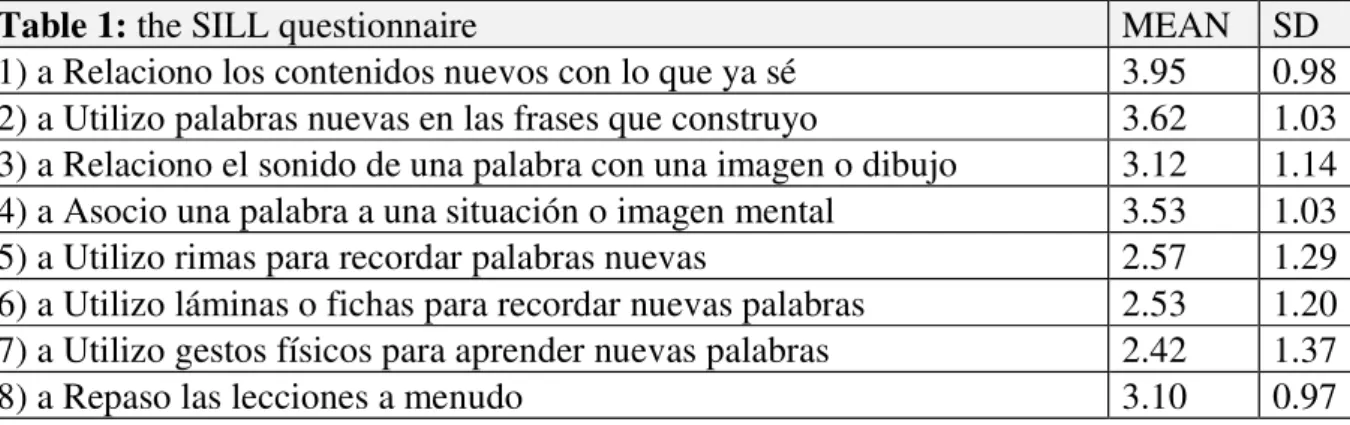
Descriptive statistics were employed to investigate the language learning strategies that Spanish undergraduates use. SPSS statistical software was used to analyse the survey data, using the procedure of descriptive analysis such as the mean and standard deviation of each item (see Table 1).
Table 1: the SILL questionnaire MEAN SD
1) a Relaciono los contenidos nuevos con lo que ya sé 3.95 0.98
2) a Utilizo palabras nuevas en las frases que construyo 3.62 1.03
3) a Relaciono el sonido de una palabra con una imagen o dibujo 3.12 1.14
4) a Asocio una palabra a una situación o imagen mental 3.53 1.03
5) a Utilizo rimas para recordar palabras nuevas 2.57 1.29
6) a Utilizo láminas o fichas para recordar nuevas palabras 2.53 1.20
7) a Utilizo gestos físicos para aprender nuevas palabras 2.42 1.37
9) a Relaciono las palabras nuevas con el lugar en el que aparecen 3.07 1.22
10) b Pronuncio o escribo las palabras nuevas varias veces 2.81 1.25
11) b Intento hablar como un nativo o el profesor 3.38 1.17
12) b Practico los sonidos de la lengua extranjera 3.68 1.08
13) b Utilizo las palabras que conozco en contextos diferentes 3.43 1.09
14) b Empiezo conversaciones en la lengua extranjera 3.34 1.12
15) b Veo la tele o vídeos y escucho música en la lengua extranjera 3.83 1.20
16) b Leo por placer en la lengua extranjera 2.85 1.36
17) b Escribo mensajes, notas, cartas, etc. en el idioma extranjero 3.20 1.34
18) b Antes de leer un texto detenidamente compruebo de qué trata 3.54 1.16
19) b Busco palabras en mi idioma parecidas de la lengua extranjera 3.23 1.27
20) b Intento encontrar normas o reglas que me faciliten el estudio 3.39 1.22
21) b Busco el significado de algunas palabras descomponiéndolas 2.95 1.34
22) b Procuro no traducir palabra por palabra 3.33 1.26
23) b Hago resúmenes de las informaciones 3.33 1.27
24) c Intento adivinar el significado de las palabras extrañas 3.72 1.04
25) c Me ayudo de los gestos cuando no recuerdo una palabra 2.93 1.27
26) c Me invento palabras nuevas cuando estoy bloqueado 2.76 1.43
27) c Leo sin buscar el significado de todas las palabras 3.24 1.26
28) c Intento adivinar lo que otra persona dice 3.60 1.17
29) c Uso sinónimos o perífrasis al expresarme 3.32 1.11
30) d Busco nuevas formas de aprender una lengua extranjera 3.69 1.10
31) d Anoto mis errores e intento hacerlo mejor 3.70 1.09
32) d Presto atención a quien esté hablando 4.08 1.00
33) d Reflexiono sobre cómo se aprende otro idioma 3.63 1.19
34) d Planifico mis estudios para tener suficiente tiempo 3.25 1.02
35) d Busco a otras personas para practicar hablando 3.02 1.11
36) d Busco oportunidades para leer en lengua extranjera 3.28 1.15
37) d Sé lo que tengo que hacer para mejorar mis habilidades 3.60 1.03
38) d Reflexiono sobre mi progreso en el estudio 3.67 1.04
39) e Procuro relajarme cuando estoy tenso 3.80 1.07
40) e Me doy ánimos para hablar en la lengua extranjera cuando estoy tenso 3.13 1.26
41) e Me recompenso a mí mismo cuando lo hago bien 3.45 1.17
42) e Noto cuando estoy tenso y me pongo nervioso 3.85 1.16
43) e Anoto en un diario mis sentimientos sobre la lengua extranjera 1.75 1.13
44) e Comparto mis sentimientos con otras personas sobre el aprendizaje
de la lengua extranjera 2.36 1.19
45) f Le pido a la otra persona que habla la lengua extranjera, que repita o
hable más lento 3.17 1.24
46) f Pido que me corrijan cuando hablo 3.31 1.32
47) f Practico la lengua extranjera con otros estudiantes 3.07 1.38
48) f Solicito la ayuda de los profesores 3.07 1.30
49) f Hago preguntas en de la lengua extranjera 3.48 1.16
50) f Intento comprender la cultura de la lengua extranjera que estoy
4. Results of using different kinds of language learning strategies
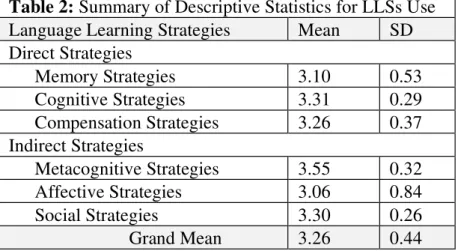
There were 60 respondents who filled in the SILL questionnaire. The means (Table 2) showing the average use of learning strategies by the whole student population of the study are between 3.06 (the lowest) and 3.55 (the highest). Table 2 illustrates that the mean of frequency of overall strategy use was 3.26 with a standard deviation of 0.44. Oxford (1990) suggests a mean of 2.4 and lower for “low”, a mean range of 2.5 to 3.4 for “medium,” and a mean range of 3.5 to 5 for “high” levels of strategy use. Consequently, they indicate that these learners of German as a third language use strategies to approximately a medium degree (‘sometimes used’, average between 2.5 and 3.4 on the SILL scale from 1.0 to 5.0).
Table 2: Summary of Descriptive Statistics for LLSs Use
Language Learning Strategies Mean SD
Direct Strategies Memory Strategies 3.10 0.53 Cognitive Strategies 3.31 0.29 Compensation Strategies 3.26 0.37 Indirect Strategies Metacognitive Strategies 3.55 0.32 Affective Strategies 3.06 0.84 Social Strategies 3.30 0.26 Grand Mean 3.26 0.44
Table 3 presents the descriptive statistics for the use of strategy categories in descending order by frequency of use, and we observed that the German majors used both direct strategies and indirect strategies indistinctively in their language learning. According to the results of this Table, where the strategies were ranked from the highest mean to the lowest mean, the most frequently used strategy was the metacognitive strategy (mean=3,55, SD=0.32), followed by cognitive strategy (mean=3.31, SD=0.29), social strategy (mean=3,30, SD=0.26), compensation strategy (mean=3,26, SD=0.37), and memory strategy (mean=3,10, SD=0.53) and the affective strategy (mean=3.06, SD=0.84) was the least frequently used by participants in this study.
Table 3: Rank ordering of frequency of use of categories of LLSs
Language Learning Strategies Rank
Metacognitive Strategies 1 Cognitive Strategies 2 Social Strategies 3 Compensation Strategies 4 Memory Strategies 5 Affective Strategies 6
5. Discussion
An analysis of the data from the SILL questionnaire showed that the LLSs most frequently used of the six categories is metacognitive strategies, which is in line with the findings of other research studies, such as Rahimi et al. (2008), Eckerth et al. (2009), Nacera (2010), Fazeli (2012) or Barrios (2015). Regarding metacognitive and affective strategies on the other hand, the results of this study of the most and least frequently used strategies are also similar to others studies from the literature reviewed, such as Mohammadi et al. (2013) and Gerami & Baighlou (2011). In relation to Oxford’s (1990) LLS theory, she emphasised that cognitive strategies are typically found to be the most popular strategies employed by language learners, meaning that our findings do not agree with this concept expressed by Oxford. However, Oxford (1990) indicated that affective strategies tend to be least-frequently used by language learners, thus agreeing with the results of this paper.
Metacognitive strategies help learners regulate the process of acquiring a language and gaining enough confidence to be autonomous and efficient. These strategies allow learners to control their own learning and use of the language (Rezvani Kalajahi et al., 2012). This means that learners with reasonable metacognitive awareness also have a strong belief in their own capabilities to successfully undertake a task (Nosratinia & Saveiy, 2014). The bachelor in Tourism allows students to master the professional skills needed to succeed in the leisure and tourism sector, as well as gaining specialised knowledge and, often, relevant practical experience. To be successful in a leisure and tourism role, professionals generally need to be able to communicate effectively with all kinds of people. The Degree Programme in Tourism at the ULPGC also includes lessons in a modern language in the programme, because good language skills are highly valued by the profession: the students learn to work in multicultural teams, they will start creating their professional networks during their studies and will improve their language skills. A bachelor’s degree course in Tourism at ULPGC takes four years and the requirement is 240 (ECTS) credit points over the eight semesters of classroom study. It is organised around four thematic “pillars” that form the fundamental framework of the programme. One of these pillars is modern language, where the graduates have several languages available to them. Spanish and English are compulsory languages for students, and then they have to choose a third language too (German, French or Chinese).
German falls within the subject of “Language for Specific Purposes (LSP)” in language education in the Tourism degree. LSP can be defined as the teaching of a language as a second or foreign language for certain groups of students for whom the syllabus, tasks and methodology are specially tailored to their interests and needs (Laborda, 2011). The main target of LSP is to provide the communicative competence necessary to be hired in different professional contexts (Rodríguez-Piñero Alcalá, 2013). This implies the need to teach not only the typical contents of the language (speaking, writing, vocabulary, grammar), but also specific tasks. Basically, German teaching focuses on communicative language education, since real communication is considered to be the essential purpose of learning languages (Caridad de Otto, 2004; Jiménez, 2016). Given the significant function of communication strategies in the exchange between interlocutors during situations
of communication, it is understandable that they are also considered an enhancing factor in the acquisition of a language (Le Pichon & et al., 2010).
As an LSP, written communication skills are important but oral skills must be practised much more as they play an important role in successful tourism business and provide the students with the skills to master the daily management tasks involved in working in the tourism industry. In this case, methodologies and materials have to be adapted to particular groups of learners and to students’ needs, which can be understood as the language knowledge that the learner requires for professional development. In other words, knowing how to pronounce words correctly, the use of appropriate grammar rules and an adequate vocabulary is not sufficient to speak a foreign language successfully. We also need to develop the knowledge that enables us to know what and how to say something depending on who we are speaking to, where we are speaking and what we are talking about. That is, we need to develop communicative competence (Santos et al., 2016; Berenguer-Román et al., 2016). Furthermore, to be able to speak a foreign language comfortably, we need to develop speaking strategies. This is the reason why German as an LSP in Tourism put receptive skills and verbal production in the foreground of the German lessons, thus oral communication is a fundamental target (Roca & Bosch, 2005).
In this sense, LLSs have crucial value for second/third language learners because they can help students to advance their communication competences (Lavasani & Faryadres, 2011). Oxford (1990, p.1) stated that strategies are particularly important for language learning “because they are tools for active, self-directed involvement, which is essential for developing communicative competence”. So, that means that SILLs help to develop linguistic and socio-linguistic competence in the target language to incorporate these into one’s inter-language competence. The most appropriate of all the strategies for German as LSP students studying Tourism are the “social strategies” for co-operating with others and understanding the culture as well as the language. Social strategies refer to the learner’s communication with people who use the target language and they involve learning through communication with other people, which can be seen as a form of social behaviour that involves asking questions, cooperating with others and empathising with others (Oxford, 1990). It is used to learn the target language through interaction with others. At the same time, learners can use social strategies to develop cultural understanding and become aware of the thoughts and feeling of others.
In the world of customer services, culture transfer between service staff and guests must be seen as an integral aspect of foreign language use in communicative interaction in the professional service encounter. The employment of proper communication strategies in the hospitality industry is an important aspect that ensures satisfaction of the management, staff and customers. The most important aspect of communication convergence in the hospitality service encounter is the staff's initiative in demonstrating a positive service attitude through the use of affiliative skills when interacting with guests. And particularly, social strategies (indirect) enable learning through interaction and understanding the target culture and provide interaction and a more empathetic understanding, which are also
important factors in attaining communicative competence (Oxford, 1990), and include actions to interact with other learners or native speakers of the language. 6. Conclusions and suggestions
In conclusion, the study provides valuable information about the preferences of LLSs for learning German as a third language used by Tourism undergraduates at ULPGC. The results of this study show that the participants were medium strategy users and reported also that metacognitive strategies were the most frequently used, while affective strategies were the least frequently used. This study recommends that teacher introduce students to LLSs and that they stress their importance for learning German as measures to facilitate self-learning in specific tasks.
LLSs are useful for improving language, but must be tailored to the students’ needs, so specific instructions have to be given to students to enhance their learning performance. The instructor’s goal is to develop a student that is able to evaluate and identify the appropriate strategy that could solve the language learning task. Furthermore, the instructor has to make sure that students are able to transfer the strategies that they have mastered to any new learning situation (Chuin & Kaur, 2015). In any case, just one methodology might not serve for all the degree courses; the specific characteristics of the students need to be borne in mind (Gil et al., 2009), as well at their perceptions of their use of strategy categories. German teaching in the Tourism Degree course has focused on communicative competence and interaction to facilitate more flexible, more thoughtful and, above all more experimental learner behaviour. Social strategies are used to learn the target language through interaction with others, as well as the other culture. Asking question is the most helpful and comes closest to understanding the meaning, and learners can use social strategies to develop cultural understanding and become aware of the thoughts and feeling of others (Lavasani & Faryadres, 2011).
In this sense, social strategies have been identified as aspects to bear in mind, because these LLSs contribute to the development of communication. Research has shown that social strategies were ranked third, with an average score of 3.30. Furthermore, teachers should also raise awareness among students of social strategies in order to familiarise them, so that the most preferred language learning strategies of the respondents were social strategies. Consistently, teachers should pay attention to training German students in the Tourism course to learn by themselves, but they must select the LLS most adapted to their own language learning needs, and they must be taught how to use these strategies and make the maximum benefit of them in the learning process. The findings of this study may suggest that teachers of German as a third language should encourage students to raise their awareness of social strategies use as effectively practical training in communication skills. These strategies can help them to advance their communication competences, which can be improved to enhance their professional achievement.
References
Azrien, M., & Adnan, M. (2011). Language learning strategies and self-efficacy belief in Arabic language earning: A Malaysian context. AJTLH, 3, 50-59.
Barrios, E. (2015). Spanish pre-service teachers of English perceived use of language learning strategies and its relationship with proficiency. Revista Española de Lingüística Aplicada, 28(1), 48-72. doi: 10.1075/resla.28.1.03bar.
Berenguer-Román, I. L., Roca-Revilla, M., & Torres-Berenguer, I. V. (2016). La competencia comunicativa en la enseñanza de idiomas. Dominio de las Ciencias, Vol. 2, núm. 2, 25-31.
Brown, H. D. (2000). Principles and Practices of Language Learning and Teaching (fourth edition). New York: Addison Wesley Longman.
Cáceres-Lorenzo, M. T. (2015). Teenagers learning Chinese as a foreign language in a European Confucius Institute: the relationship between language learner strategies and successful learning factors. Language Awareness, Vol. 24, No. 3, 255-272. doi.org/10.1080/09658416.2015.1075544
Caridad de Otto, E. (2004). Diseño e implementación de un curso de alemán para la enseñanza semipresencial. Qurriculum: Revista De Teoría, Investigación y Práctica Educativa, (17), 187-196.
Chamot, A., & El-Dinary, P. (1999). Children’s learning strategies in immersion classrooms. The Modern Language Journal, 83(3), 319-341.
Chuin, T. K., & Kaur, S. (2015). Types of language learning strategies used by tertiary english majors. TEFLIN Journal, 26(1), 17-35.
Cohen, A. D., & Macaro, E. (2007). Language learner strategies: 30 years of research and practice. Oxford: Oxford University Press.
Council of Europe. (2001). Common European framework of reference for languages: Learning, teaching, assessment. Strasbourg: Cambridge University Press.
Coutinho, S. (2007). The relationship between goals, metacognition, and academic success. Educate, 7 (1), 39-47.
Del Ángel, M. C., & Gallardo, K. E. (2014). Language learning strategies and academic success: A Mexican perspective. Universitas Psychologica, 13(2), 703-713. doi:10.11144/ Javeriana.UPSY13-2.llsa.
Dörnyei, Z. (2001). Motivational strategies in the language classroom. Cambridge: Cambridge University Press.
Dörnyei, Z. (2003). Attitudes, Orientation, and Motivations in Language Learning: Advances in Theory, Research, and Applications. Language Learning, 1, 3-32. doi:10.1111/1467-9922.53222.
Eckerth, J., Schramm, K., & Tschirner, E. (2009). Review of recent research (2002–2008) on applied linguistics and language teaching with specific reference to L2 german (part 1). Language Teaching, 42(1), 41-66. doi:10.1017/S0261444808005405
Ellis, R. (1994). Understanding Second Language Acquisition. Oxford: Oxford University Press.
Farmanlu, M., & Abdolmanafi-Rokni, S. J. (2014). Relationship between EFL in-service teachers’ language learning strategies and their beliefs toward teaching methodologies. International Journal of Applied Linguistics and English Literature, 3(6), 162-168. Fazeli, S. H. (2012). The psychometric analysis of the Persian version of the Strategy
Inventory for Language Learning of Rebecca L. Oxford. Indian Journal of Science and Technology, 5(4), 2638-2644.
Gallagher-Brett, A. (2007). What do learners’ beliefs about speaking reveal about their awareness of learning strategies? Language Learning Journal, 35(1), 37-49.
Gan, Z., Humphreys, G., & Hamp-Lyons, L. (2004). Understanding successful and unsuccessful EFL Students in Chinese universities. The Modern Language Journal, 88: 229-44.
Garrett, P., & James, C. (2000). Language awareness. In M. Byram (Ed.), The routledge encyclopedia of language teaching and learning (pp. 330-333). New York, NY: Routledge.
Gerami, M. H., & Baighlou, S. M. G. (2011). Language learning strategies used by successful and unsuccessful iranian EFL students. Procedia - Social and Behavioral Sciences, 29: 1567-1576.
Gil, P., Bernaras, E., Elizalde, L- M., & Arrieta, M. (2009). Estrategias de aprendizaje y patrones de motivación del alumnado de cuatro titulaciones del Campus de Gipuzkoa. Infancia y Aprendizaje, 32 (3), 329-341.
Green, J.M., & Oxford, R.L. (1995). A closer look at learning strategies, L2 Proficiency, and gender. TESOL Quarterly, 29, 261-297.
Grenfell, M. & Erler L. (2007). Language learner strategies. Language Learning Journal, Vol. 35, No. 1, pp. 5-7.
Griffiths, C. (2003). Patterns of language learning strategy use, System, 31, 367–383. Heo, M., Stoffa, R., & Kush, J. C. (2012). Factor analysis of the ESL/EFL strategy
inventory for language learning: Generation 1.5 korean immigrant college students' language learning strategies. Language, Culture and Curriculum, 25(3), 231-247. doi:10.1080/07908318.2012.706302
Jiménez, D. S. (2016). Delimitación y desarrollo de las lenguas de especialidad. Problemas actuales en la definición de los géneros discursivos en las lenguas con propósitos específicos. Tonos Digital, (30), 1.
Judge, J. W. (2012). Use of language learning strategies by spanish adults for business
english. International Journal of English Studies, 12(1), 37-54.
doi:10.6018/ijes.12.1.117951
Korkmaz, S. (2013). Third language learning strategies of ELT learners studying either german or french. Hacettepe Universitesi Egitim Fakultesi Dergisi-Hacettepe University Journal of Education, 28(1), 92-104.
Laborda, J. G. (2011). Revisiting materials for teaching languages for specific purposes. 3L: The Southeast Asian Journal of English Language Studies, 17(1), 102.
Lavasani, M. G., & Faryadres, F. (2011). Language learning strategies and suggested model in adults processes of learning second language. Procedia - Social and Behavioral Sciences, 15, 191-197. doi:10.1016/j.sbspro.2011.03.072
Le Pichon-Vorstman, E. M. M., de Swart, H. E., Vorstman, J. A. S., & van den Bergh, H. H. (2010). Influence of the context of learning a language on the strategic competence
of children. International Journal of Bilingualism, 14(4), 447-465.
doi:10.1177/1367006910370921.
Lee, K. R., & Oxford, R. (2008). Understanding EFL learners’ strategy use and strategy awareness. Asian EFL Journal, 10(1), 7–32.
Luo, Jiawen & Jian, Xiaoming. (2004). Research on Relationships among Learning Motivation, Foreign Language Learning Strategies and Academic Achievement. Research in Teaching, 27, 149-151.
Macaro, E., & Mutton, T. (2009). Developing reading achievement in primary learners of French: Inferencing strategies versus exposure to ‘graded readers’. Language Learning Journal, 37(2), 165-182.
Manfred, W.M.F. (2007). The relationships between the use of metacognitive language-learning strategies and language-language-learning motivation among Chinese-speaking ESL learners at a vocational education institute in Hong Kong. Asian EFL Journal, 9(3), 93– 117.
Mohammadi, E. G., Biria, R., Koosha, M., & Shahsavari, A. (2013). The Relationship between Foreign Language Anxiety and Language Learning Strategies among University Students. Theory and Practice in Language Studies, Vol. 3, No. 4, 637-646. Murray, B. (2010). Students' language learning strategy use and achievement in the korean
as a foreign language classroom. Foreign Language Annals, 43(4), 624-634. doi:10.1111/j.1944-9720.2010.01105.x.
Nacera, A. (2010). Languages learning strategies and the vocabulary size. Procedia - Social and Behavioral Sciences, 2(2), 4021-4025. doi:10.1016/j.sbspro.2010.03.634.
Nakatani, Y. (2005). The effects of awareness-raising training on oral communication strategy use. Modern Language Journal, 89(i), 76-91.
Nasser Najafi Tireh Shabankareh, & Hadizadeh, A. (2011). A comparison of language learning strategies (LLSs) between bilingual and monolingual learners, female and male learners, high school and university students, and high-level and low-level learners learning english as a foreign language in iran. International Journal of Arts & Sciences, 4(8), 1.
Nosratinia, M., Saveiy, M., & Zaker, A. (2014). EFL learners' self-efficacy, metacognitive awareness, and use of language learning strategies: How are they associated? Theory and Practice in Language Studies, 4(5), 1080. doi:10.4304/tpls.4.5.1080-1092.
O’Malley y A.U. Chamot. (1990). Learning Strategies in Second Languages acquisition. Cambridge: Cambridge University Press.
Oxford, R. L. (1990). Language Learning Strategies: What Every Teacher Should Know. New York: Newbury House.
Qin, Xiaoqing & Wen, Qiufang. (2002). Internal Structure of EFL Motivation at the Tertiary Level in China. Foreign Language Teaching and Research, 34, 51-58.
Rahimi, M., Riazi, A., & Saif, S. (2008). An investigation into the factors affecting the use of language learning strategies by Persian EFL learners. Canadian Journal of Applied Linguistics, 11(2), 31–60.
Rezvani Kalajahi, S. A., Nimehchisalem, V., Pourshahian, B. (2012). How Do English Language Learners Apply Language Learning Strategies in Different Proficiency Levels? A Case of Turkish EFL Students. Language India, Volume 12, 187-203.
Roca, F, & Bosch G. (2005). Deutsch für den Tourismus im Spannungsfeld zwischen Gemein- Berufs- und Fachsprache. Encuentro 15, 79-85.
Rodríguez-Piñero Alcalá, A. I. (2013). La enseñanza de las lenguas profesionales y académicas. Círculo de Lingüística Aplicada a la Comunicación 53, 54-94.
Santos, N., Alarcón, M., & Pablo, I. (2016). Fillers and the development of oral strategic competence in foreign language learning. Porta Linguarum, (25), 191-201.
Schmidt, R. & Watanabe, Y. (2001). Motivation, strategy use, and pedagogical preferences in foreign language learning. In Dörnyei, Z & Schmidt, R (Eds.), Motivation and Second Language Acquisition, (pp. 313-360). Hawaii: University of Hawaii Press. Sung, K. (2011). Factors influencing Chinese language learners’ strategy use, International
Journal of Multilingualism, 8 (2), 117-134.
Tang, M., & Tian, J. (2015). Associations between chinese EFL graduate students' beliefs and language learning strategies. International Journal of Bilingual Education and Bilingualism, 18(2), 131-152. doi:10.1080/13670050.2014.882882.
Tragant, E., & Victori, M. (2012). Language learning strategies, course grades, and age in EFL secondary school learners. Language Awareness, 21(3), 293-308.
Wen, Q. (2001). Developmental patterns in motivation, beliefs and strategies of English learners in China. Foreign Language Teaching and Research, 33, 105-110
Xu, X. (2011). The relationship between language learning motivation and the choice of language learning strategies among chinese graduates. International Journal of English Linguistics, 1(2), 203-212. doi:10.5539/ijel.v1n2p203.
Zare-ee A. (2010) Associations between university students' beliefs and their learning strategy use. Procedia - Social and Behavioral Sciences. 2010; 5: 882-886.