All Regis University Theses
Fall 2015
The Intervention of Active Learning Strategies to
Increase Nursing Student Self-Directed Learning
Janelle A. Patterson
Regis University
Follow this and additional works at:https://epublications.regis.edu/theses
Part of theMedicine and Health Sciences Commons
This Thesis - Open Access is brought to you for free and open access by ePublications at Regis University. It has been accepted for inclusion in All Regis University Theses by an authorized administrator of ePublications at Regis University. For more information, please [email protected].
Recommended Citation
Patterson, Janelle A., "The Intervention of Active Learning Strategies to Increase Nursing Student Self-Directed Learning" (2015).All Regis University Theses. 680.
Regis University
Rueckert-Hartman College for Health Professions
Capstone/Thesis
Use of the materials available in the Regis University Capstone/Thesis Collection (“Collection”) is limited and restricted to those users who agree to comply with the following terms of use. Regis University reserves the right to deny access to the Collection to any person who violates these terms of use or who seeks to or does alter, avoid or supersede the functional conditions, restrictions and
limitations of the Collection.
The site may be used only for lawful purposes. The user is solely responsible for knowing and adhering to any and all applicable laws, rules, and regulations relating or pertaining to use of the Collection.
All content in this Collection is owned by and subject to the exclusive control of Regis University and the authors of the materials. It is available only for research purposes and may not be used in violation of copyright laws or for unlawful purposes. The materials may not be downloaded in whole or in part without permission of the copyright holder or as otherwise authorized in the “fair use” standards of the U.S. copyright laws and regulations.
The Intervention of Active Learning Strategies to Increase Nursing Student Self-Directed Learning
Janelle A. Patterson
Submitted as Partial Fulfillment for the Doctor of Nursing Practice Degree Regis University
i
Copyright © 2015 Janelle A. Patterson. All rights reserved. No part of this work may be reproduced, stores in a retrieval system, or transmitted, in any form or by any means, electronic, mechanical, photocopying, recording, or otherwise, without the author’s prior written
ii
The Intervention of Active Learning Strategies on a Nursing Student’s Level of Self-Directed Learning
Executive Summary Problem
Undergraduate nursing students at a Midwestern community college struggled to understand and retain content presented in long lecture format courses. The Population, Intervention, Comparison, and Outcomes (PICO) for the program are as follows: P—Nursing students at a Midwestern community college in terms 1, 2, 4, and 5 of the LPN and ADN program; I—Use of guided practice as an active learning teaching strategy in the lab setting to enhance nursing student self-directed learning readiness in terms 1 and 4; C— Nursing students in term 2 and term 5 at a Midwestern community college who did not have a lab course that used guided practice; O— Increased student results on a self-directed learning readiness post-test questionnaire compared to the pre-test results. The PICO question was: “In
Midwestern community college nursing students enrolled in current lab courses, does using guided practice as an active learning strategy during lab, develop better self-directed learning skills?”
Purpose
The purpose of the project was to determine if active learning strategies impacted nursing students by increasing the student’s level of self-directed learning.
Goals and Objectives
Goals included increased self-directed learning scores, student engagement, lower attrition rates, increased NCLEX pass rates, and increased course grades. The objectives of this project were to
determine if active learning strategies, specifically the use of guided practice in the lab setting, increased a nursing student’s self-directed learning, and to determine what demographic factors affected a nursing student’s self-directed learning.
Plan
A quantitative pretest and posttest design was implemented. Students received an emailed link with the self-rating scale of self-directed learning questionnaire pretest at the start of the semester and were given the same questionnaire as the posttest at the end of the semester. Students formed four different groups and two of the groups received the guided practice active learning intervention in a lab course. The data from each participant’s pretest and posttest scores were coded and analyzed using an independent t-test to compare means. Descriptive statistics were also collected for demographic variables and were coded for frequency counts.
Outcomes and Results
Of the students enrolled in the spring semester of the nursing program, 47 students completed the pre-test and 59 completed the post-test SRSSDL tool. The results of this study were inconclusive that the use of guided practice as an active learning strategy alone increases a nursing student’s level of self-directed learning in one semester of nursing school. Guided practice may have been one of several contributors amongst other active learning strategies and inherent individual student characteristics and growth that caused all four terms of students to have higher self-directed learning scores on the SRSSDL tool at the end of the semester than at the beginning of the semester. The p-value for comparing the overall pre-test and post-test of all terms combined was .027 showing statistically significant results for a difference in the pre-test and post-test for all terms but was not significant when comparing the
intervention and control groups. The Pearson’s coefficient for the project was 0.9983 and Cronbach’s alpha for the overall project was 0.8672. Students report that they appreciate the use of active learning strategies rather than strictly lectures, and other research supports the use of active learning strategies to encourage student engagement and learning. Students should also be encouraged to take the SRSSDL to allow them to see where they fall on the scale. They should then be encouraged to determine what inherent demographic factors help them to be self-directed learners and then to use those qualities and the
iii
SRSSDL tool to continue to increase their levels of SDL while in nursing school and during their careers as they continue to be lifelong learners.
Acknowledgements
I would like to thank my parents for all of their support during the doctoral program. They helped to make my life much easier and allowed me to be able to focus on school during an intense time in my personal life as well. I would also like to acknowledge my sisters, especially Charlene who served as my faithful and reliable editor for all of my papers during the DNP program.
I would like to thank my faculty mentor, Dr. Colleen McCallum, for all of her shared knowledge and encouragement during my doctoral journey. She had a lot of patience and was always positive and supportive. I would like to acknowledge my mentor, Amber Mahrt, who offered a kind word and smile during the clinical hours courses.
Last, I would like to acknowledge my supportive coworkers at Des Moines Area Community College who encouraged me with my project. In addition to my faculty peers, I would like to thank all the DMACC Boone campus nursing students during the spring 2015 academic semester who were willing to take the pre-test and post-test to participate in this study.
iv Table of Contents Copyright Page i Executive Summary ii Acknowledgements iii Table of Contents iv List of Tables vi
List of Figures viii
List of Appendices ix
Problem Recognition and Definition 1
Statement of Purpose 1
PICO Statement and Question 2
Project Significance, Scope, and Rationale 3
Theoretical Foundations 3
Review of Evidence 7
Project Plan and Evaluation 13
Market and Risk Analysis 13
SWOT Analysis 16
Driving and Restraining Forces 19
Stakeholders 21
Cost and Benefit Analysis 22
Mission, Vision, and Goals 24
v
Logic Model 28
Methodology 29
Population and Sampling Parameters 31
Instrument Reliability and Validity 35
Protection of Human Rights 36
Data Collection and Treatment 39
Project Findings and Results 40
Bivariate Parametric Tests 40
Statistical Significance 46
Pearson’s Coefficient and Cronbach’s Alpha 47
Descriptive Statistics 50
Limitations 77
Recommendations 79
Implications for Change 80
Opportunities for Future Research 80
Conclusion 81
vi
List of Tables
1. Average Pre-test and Post-test Scores for Term 1 43
2. Average Pre-test and Post-test Scores for Term 2 44
3. Average Pre-test and Post-test Scores for Term 3 45
4. Average Pre-test and Post-test Scores for Term 5 45
5. Statistical Significance of Means of Pre-test and Post-test 46
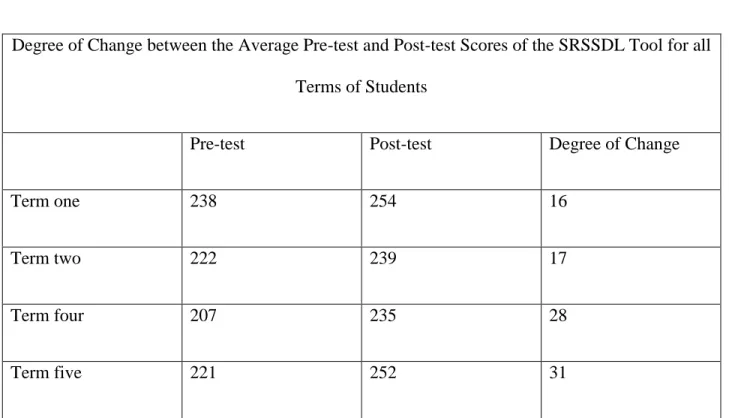
6. Degree of Change between the Average Pre-test and Post-test Scores 49
7. Pre-test and Post-test Age and SRSSDL Categories Frequencies 51
8. 17-21 Age Group and SRSSDL Category 54
9. 22-29 Age Group and SRSSDL Category 55
10. 30-39 Age Group and SRSSDL Category 55
11. Pre-test and Post-test Prerequisite Course Grade and SRSSDL Frequencies 56
12. Prerequisite Course Grade of an A 60
13. Prerequisite Course Grade of a B 60
14. Pre-test and Post-test Nursing Course Grade and SRSSDL Frequencies 61
15. Nursing Course Grade of an A ` 65
16. Nursing Course Grade of a B 65
vii
18. Never Worked as a CNA 70
19. Worked as a CNA in LTC 70
20. Worked as a CNA in a Hospital 71
21. Pre-test and Post-test Gender and SRSSDL Frequencies 72
22. Male Participants 75
viii
List of Figures
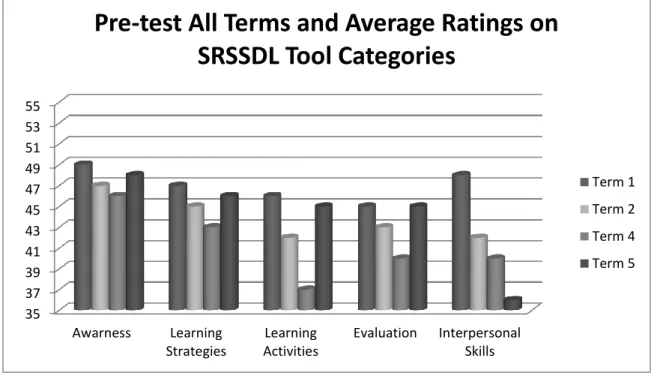
I. Pre-test All Terms and Average Ratings on SRSSDL Tool Categories 41
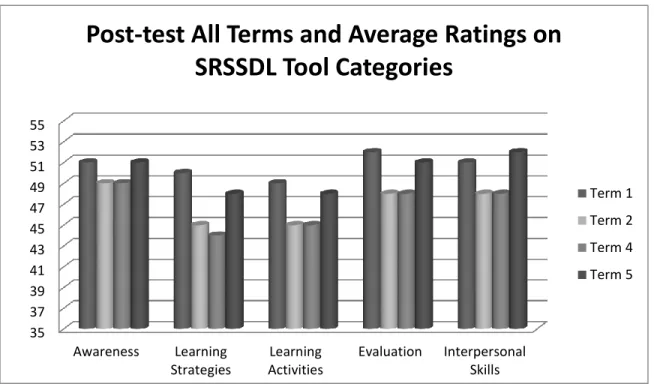
II. Post-test All Terms and Average Ratings on SRSSDL Tool Categories 41
III. Pre-test All Terms and Overall Average SRSSDL Tool 42
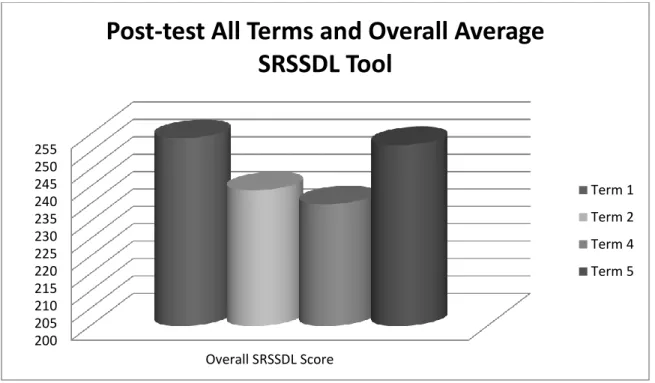
IV. Post-test All Terms and Overall Average SRSSDL Tool 42
V. Pre-test Age and SRSSDL Categories 53
VI. Post-test Age and SRSSDL Categories 54
VII. Pre-test Prerequisite Course Grade and SRSSDL Categories 59
VIII. Post-test Prerequisite Course Grade and SRSSDL Categories 59
IX. Pre-test Nursing Courses Grade and SRSSDL Categories 64
X. Post-test Nursing Courses Grade and SRSSDL Categories 64
XI. Pre-test Work Experience and SRSSDL Categories 69
XII. Post-test Work Experience and SRSSDL Categories 69
XIII. Pre-test Gender and SRSSDL Categories 74
ix
List of Appendices
Appendix A SROL Table Summary 91
Appendix B Informational Sheet for Study Participants 92
Appendix C Williamson (2007) SRSSDL Tool 93
Appendix D Logic Model 94
Appendix E CITI Training Certificate 95
Appendix F Regis IRB Approval Letter 96
Appendix G DMACC Cooperation Assurance 2014 97
Appendix H Email Approval from Swapna Williamson 98
Appendix J Support Letter from DMACC Nursing Director 99
Appendix K Timeframe 100
i
The Intervention of Active Learning Strategies to Increase Nursing Student Self-Directed Learning
Problem Recognition and Definition
Based on several anecdotal conversations with students, nursing students at a Midwestern community college struggled to understand and retain information needed to
succeed on critical-thinking exercises and exams. Students were accustomed to being taught in a lecture format during their prerequisite courses. Nursing courses, though, tended to be two to four hours in length, and informal student feedback indicated that they struggled to pay attention for three to four hours, and did not feel a connection with the course content when it was
presented in lecture format. In addition, students were not used to the time-consuming nature of nursing courses and the amount of work required outside of class to be successful in the
program. Therefore, students struggled to apply course content on application-focused test questions found on the nursing exams that prepared students to take the National Certification Licensure Examination (NCLEX). Due to the intense nature of nursing school, along with students trying to balance school, work, and life, there is a 30% attrition rate among nursing students at a Midwestern community college, varying slightly by semester (K. Ericson, personal communication, October 3, 2014).
Statement of Project Purpose
The purpose of this project was to determine if the use of a guided-practice active learning strategy in the nursing lab setting would increase nursing students’ ability to be self-directed learners as they progressed through the nursing program. A secondary result of this
2
study was to determine what demographic factors inherently affected the self-directed learning (SDL) of the typical nursing student.
Problem Statement and PICO Question
The PICO statement (P, population; I, intervention; C, comparison; O, outcome)
developed to address the problem in nursing education at a Midwestern community college was as follows:
P—Nursing students at a Midwestern community college in terms one, two, four, and five of the licensed practical nurse and associates degree in nursing programs.
I—Use of guided practice as an active learning teaching strategy in the lab setting to enhance nursing student SDL readiness in terms one and four. These students attend nursing theory courses, clinicals, and lab courses using guided practice.
C— Nursing students in term two and term five at a Midwestern community college who did not have a current lab course that used guided practice. These students attend nursing theory courses and clinicals.
O— Increased student results on a SDL readiness post-test questionnaire compared to the pre-test results. Higher results or degree of change from surveyed Midwestern community college nursing students in terms one and four was expected.
The goal of the study was to answer the question: In Midwestern community college nursing students enrolled in current lab courses, does using guided practice as an active learning strategy during lab develop better SDL skills?
3
Project Significance and Scope
The scope of this capstone project involved a descriptive and quasi-experimental study using a pre-test and post-test design that asked nursing students at a Midwestern community college to rate their SDL on a scale using the Self-Rating Scale of Self-Directed Learning (SRSSDL) tool (Williamson, 2007). The pre-test was given at the beginning of the semester, and the post-test was given at the end of the semester. The interventional groups were nursing students in terms one and four who were enrolled in a lab course that used guided practice, an active learning strategy. The two control groups were nursing students in terms two and five who were not enrolled in a lab course. The significance of the results would impact how nursing is taught at a Midwestern community college in upcoming semesters. This outcome was student sensitive, teacher sensitive, and organizational sensitive, as it impacts the learning needs of the student, the format a nursing instructor uses to teach information, and it will probably impact a change in teaching methods across the nursing program at a Midwestern community college (Kane & Radosevich, 2011).
Nursing Theory
Hildegard Peplau (1997) developed the Theory of Interpersonal Relations. Peplau’s theory focuses on the nurse-patient relationship, but several of the theory’s principles can be applied to the nursing student-student relationship as well. This theory discusses how humans have a need for connectedness. Peplau (1997) discusses how patients have a need for
connectedness due to increased levels of stress due to health concerns. Nursing students also have increased levels of stress due to the complex nature of nursing school. Nursing students can feel connected to each other as they support one another throughout the stressful years of
4
nursing school. “People need relationships with other persons. At their best, relationships confirm self-worth, provide a sense of connectedness with others, and support self-esteem. Relationships constitute the social fabric of life” (Peplau, 1997, p. 166). Peplau’s (1997) theory discusses three phases: the orientation phase, the working phase, and the termination phase. Nursing students also go through these three phases as they interact throughout the nursing program from meeting each other in their first course to graduating and going their separate ways. This theory applies to active learning strategies in that it encourages human
connectedness and interpersonal relations as students work together to form conclusions and devise solutions to nursing problems.
Education Theory
David Kolb is a researcher known for the promotion of experiential learning theory. Experiential learning theory is defined as “the process whereby knowledge is created through the transformation of experience” (Kolb & Kolb, 2005, p. 194). There are six main assumptions to support this theory:
1. “Learning is best conceived as a process, not in terms of outcomes. 2. All learning is relearning.
3. Learning requires the resolution of conflicts between dialectically opposed modes of adaptation to the world.
4. Learning is a holistic process of adaptation to the world.
5. Learning results from synergetic transactions between the person and the environment.
5
According to Kolb & Kolb (2005), learning is a lifelong process that takes a person’s personal experiences and reframes them into learning opportunities that affect the person holistically. This theory supports the use of building on the learner’s prior experience with the subject matter and giving the learner new experiences to offer more exposure to the subject matter. Kolb & Kolb (2005) encourage the use of a productive learning environment and giving learners the time for conversational learning, acting, reflecting, feeling, and thinking. Lastly, Kolb & Kolb (2005) encourage the use of strategies that allow learners to take responsibility for their own learning. This helps learners develop their SDL skills as they are given opportunities to work together to help each other learn in an active learning environment.
The nursing major lends itself well to experiential learning theory due to the fact that over half of the learning experiences occur in the lab or clinical setting. Providing care for patients in a lab, simulation, or clinical setting allows students to experience classroom topics in a real-life, hands-on situation. Kolb & Kolb’s (2005) theory can be used to support the use of active learning strategies by using the lab setting for students to work together to assist each other in developing nursing skills. Students can discuss with their peers in the lab environment their feelings, thoughts, actions, and priorities for the mannequin or patient scenario as they are practicing their skills. This allows students to reflect on their experiences and think deeply about the course subject matter as it relates to their lab-simulated patient (Kolb & Kolb, 2005; Lisko & O’Dell, 2010).
Foundational Theory
Malcolm Knowles first defined andragogy as “the art and science of helping adult
6
uses teaching approaches that allow adult learners to be collaborative and solve problems rather than being lectured to in a classroom. Also, andragogy encourages equality between a teacher and learner. The teacher is viewed as a facilitator of learning rather than the head of the classroom (Queensland Occupational Therapy Fieldwork Collaborative (QOTFC), 2007).
Knowles’s adult learning theory has four main assumptions. These assumptions are that as individuals mature:
1) Their self-concept moves from one of being a dependent personality toward being a self-directed human being;
2) They accumulate a growing reservoir of experience that becomes an increasingly rich resource for learning;
3) Their readiness to learn becomes oriented increasingly to developmental tasks of their social roles; and
4) Their time perspective changes from one of postponed application of knowledge to immediacy of application, and accordingly, their orientation toward learning shifts from one of subject-centeredness to one of performance-centeredness (Knowles, 1988, p. 44-45).
Knowles identifies six principles to the adult learning theory. Knowles notes that “adults are internally motivated and self-directed; adults bring life experiences and knowledge to
learning experiences; adults are goal oriented; adults are relevancy oriented; adults are practical; adult learners like to be respected” (QOTFC, 2007, para. 3).
7
Knowles (1988) goes on to clarify an adult learner’s readiness to learn by stating that “people become ready to learn something when they experience a need to learn it in order to cope more satisfyingly with real-life tasks or problems” (p. 44). Adult learners enrolled in nursing school may have an increased readiness to learn due to the task of being successful in the nursing program and the desire to assume the role of being a nurse. A nursing educator needs to create a learning environment that fosters the learner’s readiness to learn and centers around what the student “needs to know” that directly applies to his or her life goals (Knowles, 1988).
In regard to implications of practice for Knowles’s readiness to learn assumption, he recommends that teachers focus the timing of their teaching concepts on what the adult learner most wants to learn at that time. In other words, take advantage of teachable moments. Second, Knowles recommends grouping the adult learners into homogeneous or heterogeneous groups, depending on what the subject matter involves. If the group is based on a distinct developmental task, then homogeneous groups might be better. If the group is based on a variety of tasks, then heterogeneous groups would allow students to have flexibility and meet others with similar interests (Knowles, 1988).
Review of Evidence
Nursing students at a Midwestern community college struggled to understand and retain information needed to succeed on critical-thinking exercises and exams. Students also struggled to apply course content on application-focused test questions found on the nursing exams. Due to the intense nature of nursing school, along with students trying to balance school, work, and life, there is a 30% attrition rate among nursing students at a Midwestern community college, varying slightly by semester (K. Ericson, personal communication, October 3, 2014).
8
Systematic Review of the Literature
A literature review was conducted using the EBSCO Host database and using the
keywords of “nursing education,” “active learning strategies,” “self-directed learning,” “student motivation,” “evaluation tools,” “peer group learning,” and “skill acquisition.” Results were found from multiple databases, including Academic Search Premier, Cumulative Index for Nursing and Allied Health Literature (CINAHL), PsycINFO, and Medline. Articles included Level II through Level VII of evidence as based on Houser and Oman’s (2011) Seven Tiered Levels of Evidence Table (p. 141). These levels consist of evidence obtained from one well-designed randomized control trial, quasi-experimental designs, non-experimental studies,
systematic reviews of the literature, a single description study, and expert opinion. Articles were used if they directly related to the search terms listed above. Searches had to be filtered, as most resulted in an abundance of articles. Articles were excluded if they focused on nursing practice instead of nursing education, were in a foreign language, were more than ten years old, involved only online or distance education, were not published in peer-reviewed journals, only involved simulation, or were too narrowly focused and not generalizable. Articles were prioritized on whether or not they directly involved nursing education. (See Appendix A).
Active learning. Greenwood (2011) defines active learning as “The process of
having students engage in some activity that forces them to reflect upon ideas and how they are using those ideas. Requiring students to regularly assess their own degree of understanding and skill at handling concepts or problems in a particular discipline. The attainment of knowledge by participating or contributing. The process of keeping students mentally, and often physically, active in their learning through activities that involve them in gathering information, thinking
9
and problem solving.” This collective definition encompasses a more descriptive and specific definition of active learning strategies that was used as the basis for this project.
Research encourages a shift in teaching styles from a “sage on the stage” lecture style to a “guide on the side” active learning model. There is currently a shift from teaching to learning in today’s educational institutions, with a new focus on active learning strategies, student
engagement, promoting critical thinking, and encouraging SDL. Using active learning strategies allows students to participate in the learning process and helps them to develop into lifelong self-directed learners. (Chunta & Katrancha, 2010; Clark et al., 2008; Clayton, 2006; Fisher, King, & Tague, 2001; Gabr & Mohamed, 2011; Peter, 2005; Phillips & Vinten, 2010; Popkess and McDaniel, 2011).
One of the main articles used for this project paper was by Popkess and McDaniel (2011). Their research was a descriptive correlational design with a sample of 3,000 college students in three difference majors and used results from a 2003 survey of college student engagement. The results showed that nursing students were less engaged than their education and other health career majors peers. According to Popkess & McDaniel (2011), using active learning strategies in a nursing classroom encourages students to be actively involved in learning the information, resulting in better student outcomes and knowledge retention. At present, research shows nursing students feel that they are less engaged in active and collaborative learning strategies than other majors (Popkess and McDaniel, 2011). With active learning strategies, learning is placed in the hands of the students. The goal is for the students to be engaged in the learning as they partake in activities covering the content. A second article by Clark (2008) conducted research on two groups of nursing students to test if student engagement and communication
10
skills increased after using team-based learning as an active learning strategy. The results supported increased student engagement and communication skills for the students attending the team-based learning nursing course. Clark et al. (2008) encourages faculty to move away from traditional lectures, which place the responsibility for learning on the instructor dispersing the information. Instead, faculty should act as facilitators, creating a group learning environment in which students are engaged and encouraged to work together to obtain new knowledge.
The use of active learning strategies has been shown to increase student engagement, increase student retention of material, increase critical-thinking skills, increase problem-solving skills, encourage team work and learning from one another, and encourage personal reflection (Chunta & Katrancha, 2010; Clark et al., 2008; Clayton, 2006; Fisher, King, & Tague, 2001; Gabr & Mohamed, 2011; Peter, 2005; Phillips & Vinten, 2010; Popkess and McDaniel, 2011).
Self-directed learning. Active learning strategies can lead students to be more
self-directed learners as they progress through the nursing program and enter the nursing profession. Malcolm Knowles is credited with defining SDL (Knowles, 1975). Knowles (1975) states that SDL is “a process in which individuals take the initiative, with or without the help of others, in diagnosing their learning needs, formulating learning goals, identifying human and material resources for learning, choosing and implementing appropriate learning strategies and evaluating learning outcomes” (p. 18). SDL is an instructional method that is popular in adult education and allows the learner to accept responsibility for his or her own learning. SDL involves a process where the learner determines what they need to know, takes the initiative for learning that material, and evaluates if learning was achieved without the assistance of an instructor (Knowles et al., 2008). “The degree of control the learner is willing to take over their own learning will depend on their attitude, abilities, and personality characteristics” (Fisher, King, &
11
Tague, 2001, p. 516). Each learner has a personal readiness level for SDL. SDL is important in nursing education due to the amount of study time that is required outside of the classroom for most students to be successful. In addition, practice with SDL prepares nursing students to become lifelong learners as they enter the nursing profession and continue to seek out evidence-based practice (Cadorin, et al., 2012; Fisher, King, & Tague, 2001).
Nurses need to stay up to date on advances in health care treatments and best practices. Nurses need to seek out current information based on evidence-based practice to provide the most up-to-date care for their patients. “Healthcare professionals work in a complex system where constantly changing social and technological aspects represent a serious challenge. These advances require many competencies, which need to be frequently refreshed” (Cadorin, et al., 2012, p. 153).
Three original SDL scales have been developed. Guglielmino (1977) developed the Self-Directed Learning Readiness Scale. Oddi et al. (1990) developed the Oddi Continuing Learning Inventory. Fisher and King have re-validated the tool developed by Guglielmino (1977) and reduced it to forty items (Fisher & King, 2010; Fisher et al., 2001). In 2007, Williamson created the SRSSDL. Based on Williamson’s (2007) scale, an Italian version was created and validated that further supported Williamson’s scale (Cadorin, Bortoluzzi, & Palese, 2013).
Studies have revealed several benefits of using SDL in nursing education. SDL has been shown to increase the motivation, autonomy, and confidence of nursing students; help strengthen learning skills; help develop interpersonal communication skills; and to affect nursing students throughout their lives (Avdal, 2013; Gagnon et al., 2013; Hewitt-Taylor, 2001; Levett-Jones, 2005; & O’Shea, 2003; Timmins, 2008). Avdal (2013) found that high levels of SDL are linked
12
with high student achievement levels. Timmins (2008) and Levett-Jones (2005) both focus on how important it is for nursing faculty to encourage and develop SDL skills in students.
Guided practice. Guided practice involves students helping each other practice a lab
skill for the first time by each student assuming a role to assist in the learning process. Guided practice has been used at a Midwestern community college for years. Guided practice has been used in lab courses to encourage nursing students to help one another during the learning of a new skill. Students are expected to be actively engaged in the learning process. Students are divided into groups of four. Students assume three roles during guided practice. The
Demonstrator performs the skill while being guided or assisted by the Evaluator. The Evaluator guides the Demonstrator as they perform the skill using the skill checklist as a guide. The remaining two students are both Observers who observe the Demonstrator and Evaluator while following the skill checklist. Observers have the opportunity to ask questions of the
Demonstrator, Evaluator, or instructor at the end of each rotation. They double check that the Evaluator has encouraged the Demonstrator to perform the skill correctly. Students rotate throughout every role until every student has assumed each role. Students take turns in the
rotation order throughout the semester (M. Bethards, personal communication, October 6,2014).
With each rotation, the ability of the Demonstrator to independently perform the skill correctly increases. During the first rotation, the Demonstrator and Evaluator work together as a team, providing the Demonstrator with as much help as necessary. The Observers may assist as well. During the second rotation, the Evaluator may help the Demonstrator only if needed. The Observers are attentive and give direction if the Demonstrator and Evaluator miss something. During the third rotation, the Evaluator may help the Demonstrator only if they make a mistake, and then the Evaluator and Observers will stop the Demonstrator and correct the mistake.
13
During the fourth rotation, the Demonstrator gets no assistance with the skill. The skill should be done as if in the client’s room. The Evaluator and Observers make notes and provide
feedback after the skill is completed. The Demonstrator is not stopped if a mistake is made (M. Bethards, personal communication, October 6,2014). Students are also encouraged to practice the skill as often as needed during open lab times, with peers or on their own. The instructor’s role is to be present in the room. The instructor will not demonstrate the skill and will intervene only if an error goes unrecognized by peers (M. Bethards, personal communication, October 6, 2014).
The use of collaboration between nursing student peers for guided practice is supported in the literature. The literature supports that students enjoy the process and that peer assessment facilitates student engagement and motivation and encourages more professional accountability amongst students (Casey et al., 2011; Clark et al., 2008; Cushing et al., 2011; Goldsmith, Stewart, & Ferguson 2006; Grierson et al., 2012; Stables, 2012).
Project Plan and Evaluation
Market Analyses
A market analysis consists of outlining the details of the nursing education industry.
Need and Industry description and outlook. The Bureau of Labor Statistics (2015)
says that the job outlook for registered nurses is expected to increase by 19% through the year 2022. This translates to an increase of 526,800 jobs. The job outlook is increasing faster than the average for all other occupations because of an increased emphasis on preventative care,
14
increasing rates of chronic health conditions, and the demand for health care for the aging Baby Boomer population.
The entry-level education required to be a nurse is an associate’s degree in nursing, and the median pay in 2012 was $31.48 per hour or $65,470 per year. There is no required on-the-job training or work experience in a related occupation. The number of registered nurses employed in the United States in 2012 was 2,711,500 (Bureau of Labor Statistics, 2015). Colleges of nursing will be called on to educate more nurses in order to fit this growing need.
Nursing education is in the growth stage of its product lifecycle due to the rapidly growing need for nursing educators and registered nurses. The main customer groups within nursing education are colleges and universities that offer nursing as a major (Fortenberry, 2010).
Target market and Resources. Community colleges appeal to local residents who want
an affordable education. Specifically, the Midwestern community college markets to students seeking a two-year degree, students seeking college preparatory classes, and non-traditional students seeking a career change. The Midwestern community college nursing program offers an associate of nursing degree that is quicker to obtain than a bachelor’s degree in nursing and is also more affordable. The Midwestern community college fills the need of a quality education at an affordable cost per credit hour.
Defining the customer. The customer of this capstone project was the typical nursing
student. For the purpose of this discussion, typical nursing students would be considered female and between the ages of 20 and 44.
Sustainability and Wants and needs of the customer. The typical nursing student
15
in the future. Nursing is a reliable and rewarding career that attracts a lot of caring students. Nursing students also would love to have less stress during school, and they want to be
successful in the program and on the NCLEX so they can accomplish their goal of becoming a nurse. Nursing students desire that nursing education be straight-forward, manageable, and to prepare them well for practice (Popkess & McDaniel, 2011).
Sustainability and Cyclical trends. Cyclical trends in the nursing student population
could involve younger nursing students in their late teens or early twenties being less ready for SDL and active learning strategies due to a lack of real-life experience. Also, non-traditional or older nursing students may be uncomfortable with active learning strategies, as they might be used to more traditional lectures from previous schooling experiences.
Feasibility. The project was very easy to implement at a Midwestern Community
College where guided practice was already being used and the nursing program was interested in switching to more active learning strategies in a new concept-based curriculum. The project was not cost prohibitive and could easily be replicated at another nursing college. The project was achievable in one semester and the data collection process for study participants was easy to access and involved a minimal time commitment.
Risks. The risks associated with this project for study participants are minimal. There
could be fear of punishment if they did not participate but this was addressed in the emailed informational sheet. The SRSSDL tool also took a minimal time commitment so the risks were limited and none of the questions posed an obvious threat to the participants. All demographic questions were optional to decrease any threats and ensure anonymity. The risks to the project in
16
general included inconclusive results, lack of students willing to participate to cause a small sample size, and multiple extraneous variables that could affect the project outcome.
Unintended consequences. Any detrimental unintended consequences were minimal. If
anything, students recognized more about their level of SDL as they completed the SRSSDL which would be a positive outcome. Students might have even recognized growth or a change in learning attitude because of the pre and post-test questionnaire.
SWOT Analysis
Strengths. The strengths of the project centered on the benefits that the results will bring
to the Midwestern community college nursing program after sustainability. If students can increase their readiness for SDL through the use of guided practice and other active learning strategies, then students will be better prepared to be successful in the nursing program. Also, developing skills to be self-directed learners will continue to help nursing students as they progress in their careers and become lifelong learners. In addition, demographic characteristics were also considered and compared in study results. This project provided information on demographic considerations that could influence a student’s SDL (Avdal, 2013; Gagnon et al., 2013; Hewitt-Taylor, 2001; Knowles, 1975; Levett-Jones, 2005; & O’Shea, 2003; Timmins, 2008).
Weaknesses. The weaknesses of the project included several extraneous, moderator, and
antecedent variables. The extraneous variable is “sometimes referred to as a confounding variable because it may interfere with or obscure the relationships between the independent and dependent variables” (Christenbery, 2011, p. 252). Extraneous variables for the capstone project included lack of student motivation to study outside of class time, students being distracted
17
during lab guided practice due to life circumstances, students missing labs due to illness,
students’ level of preparation for lab and class, students responding in a certain way to please the instructor, broken equipment to implement planned active learning strategies of guided practice, variability in the knowledge level of the students between the four terms, and a difference in teaching methods of guided practice and active learning strategies (Giddens et al., 2012; Lisko & O’Dell, 2010). Most of the above variables would have had a negative impact or no impact on the proposed outcome. These extraneous variables were managed by recognizing all
uncontrollable variables as limitations in the study report.
The moderator variable is defined as “a variable that influences or moderates the relationship between the independent and dependent variables” (Christenbery, 2011, p. 252). Moderator variables for the capstone project included a student who does not participate in guided practice, a student’s age, a student’s gender, a student’s individual learning style, a
student’s attitude toward the instructor, a student’s academic level, a student’s preparation for lab and class, and a student’s acceptance of the use of guided practice in lab (Chunta & Katrancha, 2010; Clark et al., 2008; Clayton, 2006; Fisher, King, & Tague, 2001; Gabr & Mohamed, 2011; Peter, 2005; Phillips & Vinten, 2010; Popkess and McDaniel, 2011). Most of the above
moderator variables would have had a negative impact on achieving the outcome, except for student age, student gender, and student learning styles, which could have had a positive or negative impact, or no relationship at all.
The antecedent variable is defined as “a variable that occurs before the independent and dependent variables and therefore can have an influence on the dependent variable”
18
motivation to learn the content, students’ interest in the lab and class topics, students’ previous experience with lectures and active learning activities, and the instructor’s comfort with using an active learning style teaching approach (Chunta & Katrancha, 2010; Clark et al., 2008; Clayton, 2006; Fisher, King, & Tague, 2001; Gabr & Mohamed, 2011; Peter, 2005; Phillips & Vinten, 2010; Popkess and McDaniel, 2011). All of the above antecedent variables would have had either a positive or negative effect on the intervention depending on the previous feelings or thoughts of the student and instructor.
A ranking in SDL scales is based on many demographic characteristics that affected the results of this study in addition to the active learning strategy of guided practice. A student’s gender, age, achievement level, learning type, and internal motivation level, along with other possible variables, impacted the rating each student gave for the SDL scale. A weakness of this study was that the number of students responding to the questionnaire was small—47 student participants for the pre-test and 59 student participants for the post-test. Also, the study involved four terms of nursing students but took place during only one semester of nursing school, so the study does not show longevity, effects on the NCLEX pass rates, effects on student attrition rates, or student personal growth. Another weakness of this project is that not all previous research has supported links between SDL and learner attributes or demographics. Results of previous studies vary widely. Another weakness is that the active learning strategy that was used as the intervention in this project is the use of guided practice in the lab setting. This did not exclude the use of other types of active learning strategies used in theory courses throughout the Midwestern community college nursing program in terms one, two, four, and five.
19
Opportunities. The opportunities for this project were to influence the teaching style
within the nursing program at a Midwestern community college toward a focus on the use of active learning strategies, with the specific use of guided practice. In addition, a Midwestern community college is switching to a concept-based curriculum in the fall of 2015. The results of this project will help support the continued use of guided practice in lab courses. The use of active learning strategies is encouraged in a concept-based curriculum (Giddens et al., 2012).
Threats. The threats of this project were results that did not support the capstone project
or show no statistically significant difference. Threats also included several of the extraneous, moderator, and antecedent variables listed above, including students not willing to participate in the project, students not taking the pre-test and post-test seriously, and possible cost of
replication of the study. Several antecedent, moderator, and extraneous variables could also alter the results of this study. In addition, a lab course is inherently hands-on, while a theory course is didactic in nature, which was a limitation of this study (Chunta & Katrancha, 2010; Clark et al., 2008; Clayton, 2006; Fisher, King, & Tague, 2001; Gabr & Mohamed, 2011; Peter, 2005; Phillips & Vinten, 2010; Popkess and McDaniel, 2011).
Forces
The driving force for this capstone project involved the current push toward the use of active learning strategies in education and involved students in the learning process, especially for adult learners. The use of active learning strategies has been shown to increase student engagement, increase student satisfaction, increase student retention, increase critical-thinking skills, increase problem-solving skills, encourage team work and learning from each other, and encourage personal reflection (Chunta & Katrancha, 2010; Clark et al., 2008; Clayton, 2006;
20
Fisher, King, & Tague, 2001; Gabr & Mohamed, 2011; Peter, 2005; Phillips & Vinten, 2010; Popkess and McDaniel, 2011).
Restraining forces were as follows: faculty comfort level with active learning strategies, student motivation to learn the content and participate in guided practice, students’ previous experience with lectures and active learning activities, students’ preparation for labs and class, and students’ willingness and motivation to be self-directed learners. An additional restraining force is the increased amount of time it takes to conduct active learning strategies as opposed to lecturing. Also, it is more difficult to use active learning strategies with larger class sizes due to the complexity of working with a large group of people at the same time. Last, in a lab setting, the student-to-faculty ratio is smaller and averages eight students to one instructor. In the typical theory classroom, the ratio is twenty-four or more students to one instructor (Clark et al., 2008; Fisher, King, & Tague, 2001; Peter, 2005; Phillips & Vinten, 2010; Popkess and McDaniel, 2011).
A sustaining force of this capstone project is the benefit of using active learning strategies to increase student retention and engagement in nursing courses (Knowles, 1988; & Popkess and McDaniel, 2011). If students are self-directed learners who seek out ways to learn the content in active learning situations in the classroom environment and in a format that works for their learning needs outside of class, then they will hopefully reap the benefits by succeeding on nursing exams and successful completion of their associate of nursing degree (ADN). If this study could be continued in later years, it would be beneficial to study how the use of guided-practice and active learning strategies in the new concept-based nursing curriculum at a
21
sustaining force is the fact that this Midwestern community college is switching to a concept-based curriculum in the fall of 2015, and this type of curriculum encourages the use of active learning strategies (Giddens et al., 2012).
Stakeholders
The main stakeholders of this study were the nursing students. Typical nursing students would be considered to be female and between the ages of 20 and 44. One campus of a
Midwestern community college has several nursing students who are male, aged 18-19, and some who are greater than 45 years of age, but these are outliers to the typical nursing student population. There are several nursing students who are single parents, and most are also trying to work part-time, if not full-time, to meet financial obligations. Most students currently work in the healthcare field. Several nursing students have pursued other majors before switching to nursing. All of the nursing students at a Midwestern community college have taken certified nurse’s aide (CNA) coursework, but they vary in their work experience as CNAs. All nursing students try to balance a family life, social life, work, and school, sometimes leading to stressful situations (N. Thilges, personal communication, February 21,2014).
Nursing students are usually juggling multiple life responsibilities. Besides the demands of a hectic school and clinical schedule, they may be single parents, have a low income, first-generation college students, in the process of a divorce, in an abusive relationship, or working full time. Between all of these possible life responsibilities, attending classroom theory courses and working up to 16 hours of clinical per week can make the typical nursing student vulnerable during the time she or he is in school (Jimenez, Navia-Osorio, & Vacas Diaz, 2010; Pulido-Martos, et al., 2011).
22
Additional stakeholders would be the nursing faculty at a Midwestern community college using the active learning strategies, the Midwestern community college nursing program if NCLEX rates were to improve as a result of future studies, and future employers who would benefit from a nursing graduate’s strong desire to seek out resources while being a lifelong learner.
Project Team
The project team included the investigator, the Capstone advisor at Regis University, Dr. Colleen McCallum, the project mentor, and a project consultant that had experience with past research and had studied the benefits of guided practice in 2007.
Cost and Benefit Analysis
The researcher plans used an institution-purchased survey tool called Qualtrics, to administer an electronic version of the SRSSDL which was free to use. Additional costs would be faculty time of approximately 200 hours at a cost of $50.00 an hour, totaling $10,000.00. A Regis University faculty member was available to help analyze the data for no additional costs.
Nursing education in the midwest has been shown to cost an average of $27,000-$28,000 per year for the top-rated colleges. Students who are able to pass the nursing program would be able to benefit by earning a nursing salary of $40,000 a year and up. Students who are unable to pass the nursing program or the NCLEX exam would have thousands of dollars’ worth of student loans and would be unable to find a job as a registered nurse to assist in paying off those loans (U.S. News and World Report, 2014).
23
The benefit would be statistics to show the advantage of the use of active learning
strategies in a nursing classroom, specifically the use of guided practice in the lab setting. Future benefits might include higher student engagement, higher student motivation to study and be prepared for class and lab, increased self-esteem for nursing students, higher grades for nursing students, a lower attrition rate for nursing students, a higher NCLEX pass rate for a Midwestern community college, and a strong hiring rate of nursing graduates by area employers. This would allow students the benefit mentioned above of earning a nurse’s salary and obtaining a degree after paying for an education.
Timeframe for Capstone Project
The project was presented to Doctorate of Nursing Practice faculty at Regis University for approval in the fall of 2014. Regis University Institutional Review Board approval was obtained in January 2015. The project was implemented at a Midwestern community college during the spring 2015 academic semester. The pre-test SRSSDL was administered during the first seven weeks of classes in January 2015. The post-test SRSSDL was administered during the last four weeks of the semester in April and May. Throughout the spring 2015 academic semester, the lab courses implemented the use of guided practice as students learned new nursing skills in terms 1 and 4. The data was analyzed in July and August 2015. Results of the study will be disseminated in August or September of 2015.
Budget and Required Resources
The cost of replicating this study would depend on if the researcher was a faculty
member at the institution. If not, the researcher would have to rent the use of a classroom, which can vary in cost from approximately $50.00-$300.00 for an auditorium. The researcher might
24
have to use survey software which could cost $100.00 or pay for paper and copies of a hard copy questionnaire scale for $10.00. A statistician may need to be hired for $200.00. A statistical program may need to be purchased to run statistics on the results for $100-200.00. The required resources include an academic institution supportive of the project, assistance from faculty at the institution, and willingness of students to participate in the study. Resources at the institution would be a classroom with computers for each student for an online survey and access to students throughout the semester to implement the intervention.
The researcher involved in this study conducted the intervention part of this research as part of her normal faculty job duties. The classrooms were already in use by each term of
students as regularly scheduled. An online survey tool was used that the college had access to as an annual subscription.
Nursing education in the Midwest has been shown to cost an average of $27,000-$28,000 per year for the top-rated colleges. Students who are able to pass the nursing program would be able to benefit by making a nursing salary. Students who are unable to pass the nursing program or the NCLEX exam would have thousands of dollars’ worth of loans and would be unable to find a job as a nurse to assist in paying off school loans (U.S. News and World Report, 2014). Faculty salaries range from $40,000-$100,000 across the Midwest and would be in important consideration in the replication of this study at another college.
Mission and Vision Statements
The mission statement for this project was to provide statistical evidence that active learning strategies, specifically the use of guided practice in the lab setting, increased a nursing student’s SDL to assist the student to be successful in the nursing program and continuing on to
25
be a lifelong learner. The vision statement for this project was that nursing students’ success in a Midwestern community college nursing program would improve due to the use of active learning strategies throughout the program to achieve a higher level of SDL.
Project Goals
Short-term goals for this project included higher student engagement, higher student motivation to study and be prepared for class and lab, higher grades for nursing students, and a lower attrition rate for nursing students.
Long-term goals for this project included increased motivation to be life-long learners, faculty acceptance and support of using active-learning strategies instead of lecture in nursing courses, and a higher NCLEX pass rate for a Midwestern community college.
Project Processes and Outcomes
A pre-test questionnaire of the SRSSDL was offered to nursing students at one campus of a Midwestern community college in terms one, two, four, and five (there was no term three at this Midwestern community college; it is the summer term of support courses) during the first seven weeks of the Spring 2015 school semester. Students in terms one and four were involved in lab courses using guided practice in addition to theory courses and clinicals throughout the semester. Students in terms two and five attended theory courses and clinicals. During the last four weeks of the end of the semester, all nursing students were given the same questionnaire as a post-test. As the semester concluded and during the summer of 2015, the results were analyzed and links were found between the intervention and demographic data and SDL levels. A final report of the project and its findings was available in August of 2015 (Williamson, 2007).
26
The students in each term were different students. A student can only be in one term at a time so four different groups of students were involved in this study in the form of four groups of aggregate data. The students were sent an email to the entire cohort of students in each term. The email provided an informational sheet to each student about participation in this study. (See Appendix B). The student received a link to the online SRSSDL tool. In addition to the 60 question tool, the student was asked to provide voluntary and optional answers to demographic questions: gender, age, typical course grades, and work experience. These answers were optional to help ensure a participant’s consent to questions that may decrease the anonymity of certain questions due to decreased numbers of students in that demographic category. A demographic disclaimer was included to alert students that the demographic questions were optional. The survey was done via an email link to ensure it was done outside of class time. While this decreased the number of participants, it ensured anonymity for those who chose not to participate in the study without any repercussions from faculty or classmates. Making the survey optional outside of class time also eliminated any concerns of having a captive audience and students feeling forced to the survey due to peer pressure in the classroom setting. This helped increase the reliability and validity of the results. The completion of the tool and demographic data took approximately 10 minutes or less of time.
Study participants did not have access to their pre-test SRRSDL scores so that this information did not affect their actions throughout the semester and decrease the validity of the study. In addition, the pre-test scores and post-test scores of each individual student were not compared. The data was only looked at as aggregate data between each term or cohort of students.
27
In order to not have to randomize the student sample, the two control group cohorts of students in terms two and five were offered the guided practice intervention during open lab time in two hour increments throughout the semester to guarantee that they had equal access to the intervention.
The outcome of this project was similar to the goals and was to show that the use of guided practice in the lab setting as an active learning strategy assisted students in becoming better self-directed learners. Another outcome of this project was to show how demographic factors affect a student’s SDL. The outcome for each study participant consisted of five broad categories that are evaluated for SDL on the SRSSDL. These five categories are awareness, learning strategies, learning activities, evaluation, and interpersonal skills. From the results of the 12 questions that fall under each of these categories, the subjects were given a total score for SDL that was used to evaluate their level of self-directedness in learning (Williamson, 2007).
In the tool created by Williamson (2007), each of the five broad areas is defined. Awareness: Twelve items relating to the learners’ understanding of the factors contributing to becoming self-directed learners. Learning strategies: Twelve items explaining the various strategies self-directed learners should adopt in order to become self-directed in their learning processes. Learning activities: Twelve items specifying the requisite learning activities learners should actively engage in in order to become self-directed in their learning processes. Evaluation: Twelve items revealing learners’ specific attributes in order to help monitor their learning activities. Interpersonal skills: Twelve items relating to learners’ skills in interpersonal relationships, which are pre-requisite to their becoming self-directed learners (Williamson, 2007, p. 70-71).
28
Williamson (2007) also divides the scoring of the 60-question tool into a range of categories for the level of directedness of the learner. A low level of learner self-directedness is a range of 60-140. Williamson (2007) describes this level as “Guidance is definitely needed from the teacher. Any specific changes necessary for improvement must be identified and a possible complete re-structuring of the methods of learning” (p. 83). A moderate level of learner self-directedness is a range of 141-220. Williamson (2007) describes this level as “This is half way to becoming a self-directed learner. Areas for improvement must be identified, evaluated and a strategy adopted with teacher guidance when necessary” (p. 83). A high level of learner self-directedness is a range of 221-300. Williamson (2007) describes this level as “This indicates effective SDL. The goal now is to maintain progress by identifying strengths and methods for consolidation of the students’ effective SDL” (p. 83). (See Appendix C).
Logic Model
Conceptual models are diagrams used to show causal linkages and relationships between a series of variables or concepts. “A conceptual model provides a visual picture that represents the research question which is to be investigated. The best models convey complex information in a way that is not only parsimonious but also permits a quick grasp of complicated
relationships” (Donatti, Wild, Hareendran, 2008). The logic model used for this capstone project explains the relationship between the inputs, activities, outputs, outcomes, and impacts of using active learning strategies. (See Appendix D).
Problem = Students can not apply and do not retain information presented in traditional lecture format. Inputs = Nursing students and faculty at a Midwestern Community College;
29
access to guided practice and active learning strategies. Activities = Implementation of an active learning strategy using guided practice in the nursing lab setting. Outputs = Positive student feedback about the use of active learning strategies and increased scores on the post-test SRSSDL tool. Outcomes = Students will feel engaged in their learning and be able to apply, retrain, and grow from the knowledge obtained through this activity and increased scores on SRSSDL tool. Impact = College will switch to using active learning strategies with new curriculum.
Methodology
This project is an evidence-based practice (EBP) project in which a quality improvement plan, program evaluation, or simple educational or standard of care intervention will be
completed. In most cases, a simple pre-test and post-test evaluation will assess the effect of the intervention. The project will be internal to an agency and will inform the agency of issues regarding health care quality, cost, and patient satisfaction. The results of this project are not meant to generate new knowledge or be generalizable across settings but rather seek to address a specific population, at a specific time, in a specific agency. These projects translate and apply the science of nursing to the greater health care field.
Projects utilize the acronym “PICO”, rather than stating a formal research hypothesis. The acronym stands for: Population or Disease (P), Intervention or Issue of Interest (I),
Comparison group or Current Practice (C), and Outcome (O) and is usually framed as a question (Melnyk and Fineout-Overholt, 2011, p. 31).
30
The question this study seeks to address is: In Midwestern community college nursing students enrolled in current lab courses, does using guided practice as an active learning strategy during lab develop better SDL skills?
The scope of the capstone project involved a descriptive and quasi-experimental study using a pre-test and post-test design asking nursing students at a Midwestern community college to rate their SDL on a scale. The pre-test was given at the beginning of the semester, and the post-test was given at the end of the semester. The two control groups were nursing students in terms two and five who were not currently enrolled in a lab course using the intervention of guided practice. The significance of the results will impact how nursing is taught at a
Midwestern community college. If students show an increase in their SDL, then a shift to the use of more active learning strategies and guided practice will be encouraged in all nursing courses. This outcome is student sensitive, teacher sensitive, and organizational sensitive, as it impacts the learning needs of the student, the format a nursing instructor uses to teach
information, and it will probably impact a change in teaching methods across the nursing program at a Midwestern community college (Kane & Radosevich, 2011).
The pre-test questionnaire of the SRSSDL was offered to nursing students at one campus of a Midwestern community college in terms one, two, four, and five (there is no term three at this Midwestern community college; it is the summer term of support courses) within the first six weeks of the Spring 2015 school semester. Students in terms one and four were involved in lab courses using guided practice in addition to theory courses and clinicals throughout the semester. Students in terms two and five attended theory courses and clinicals only. During the last four weeks of the end of the semester, all nursing students were given the same questionnaire as a post-test. As the semester concluded and during the summer of 2015, the results were analyzed
31
to search for links and statistically significant differences amongst the data. A final report of the project and its findings was available in August of 2015 (Williamson, 2007).
Population and Sampling parameters. The subjects involved in this study were a
nonrandom convenience sample of all current nursing students enrolled on one campus of a Midwestern community college. The students in each term are different students. A student could only be in one term at a time so four different groups of students were involved in this study in the form of four groups of aggregate data. The students were sent an email to the entire cohort of students in each term. The email provided an informational sheet to each student about participation in this study. (See Appendix B). The student also received a link to the online SRSSDL tool. In addition to the 60 question tool, the student was asked to provide voluntary and optional answers to demographic questions: gender, age, typical course grades, and work experience. These answers were optional to help ensure a participant’s consent to questions that may decrease the anonymity of certain questions due to decreased numbers of students in that demographic category. A demographic disclaimer was included to alert students that the demographic questions were optional. The survey was sent via an email link to ensure it was completed outside of class time. While this may have decreased the number of participants, it ensured anonymity for those who chose not to participate in the study without any repercussions from faculty or classmates. Making the survey optional outside of class time also eliminated any concerns of having a captive audience and students feeling forced to complete the survey due to peer pressure in the classroom setting. This helped increase the reliability and validity of the results. The completion of the tool and demographic data for study participants take
32
Study participants did not have access to their pre-test SRSSDL scores so that this information would not affect their actions throughout the semester and decrease the validity of the study. In addition, the pre-test scores and post-test scores of each individual student will not be compared. The data will only be looked at as aggregate data between each term or cohort of students.
In order to not have to randomize the student sample, the two control group cohorts of students in terms two and five were offered the guided practice intervention during open lab time throughout the semester to guarantee that they had equal access to the intervention (Polit, 2009).
Description of population and sample. “The population is everyone or everything that
meets the criteria for inclusion” (Zaccagnini & White, 2014, p. 78). According to this definition, the population could be any student. The criteria for inclusion in this project involved any nursing student currently enrolled in the nursing program at one campus of a Midwestern community college. If all four terms were full then the maximum population for this project would have been 96 students but some semesters were not full due to student attrition.
“The sample is a subset of the population and the process for how the subset will be selected” (Zaccagnini & White, 2014, p. 78). The ideal sample size for inclusion in this project was 24 students in each nursing course or 96 students total. For the pre-test, 47 students filled out a portion of the SRSDDL with 42 fully completed surveys. Five participants did not complete all 60 questions. For the post-test, 59 students filled out the SRSSDL but only 56 students completed the entire survey. Incomplete surveys were discarded and not used in data analyses.