i
THE DEVELOPMENT OF AN ADVANCED PRACTICE NURSING (CHILD HEALTH NURSE PRACTITIONER) CURRICULUM FRAMEWORK FOR
SUB-SAHARAN AFRICA: A MULTI-METHOD STUDY
Christmal Dela Christmals
A thesis submitted to the Faculty of Health Sciences, University of the
Witwatersrand, Johannesburg, in fulfilment of the requirement for the degree of Doctor of Philosophy in Nursing
Johannesburg, 2018
ii
DECLARATION
I, Christmal Dela Christmals, declare that this research report (Human Research Ethics Clearance number M160632 is my own work. It is being submitted for the degree of Doctor of Philosophy in Nursing at the University of the Witwatersrand, Johannesburg. It has not been submitted before for any degree or examination at this or any other University.
... Signed at Johannesburg
iii
ABSTRACT
Background: Nurses are the majority of readily available healthcare professionals in Sub-Saharan Africa (SSA), therefore, improving access to Advanced Practice Nursing (APN) programmes in order to improve healthcare within SSA where preventive services are much needed is essential. Sub-Saharan Africa is unique in terms of its challenges, opportunities and health need hence an APN (Child Health) curriculum must be designed and continually reviewed to meet the needs of the continent. Professional education has not kept pace with SSA’s special healthcare challenges, largely because of fragmented, outdated, and static curricula that produce ill-equipped graduates.
Aim: The aim of this study is to develop a curriculum development framework to guide governments and Nursing Education Institutions in the development of relevant Advanced Practice Nursing (Child Health Nurse Practitioner) curriculum that responds to the child healthcare needs of Sub-Saharan Africa
Methodology: A sequential multi-method research design was employed in this study. The study began with a scoping review, followed by a Delphi, then concept development, and the development, confirmation and evaluation of the curriculum framework.
Findings: Children are the majority of Saharan Africa. Between 70-90% of the Sub-Saharan African population is rural and lack access to quality and cost-effective healthcare services as most healthcare facilities are located in the cities and small towns. The implementation of Advanced Practice Nursing programmes is essential in increasing access to quality healthcare services for the majority and marginalized rural population of Sub-Saharan Africa. The introduction of Advanced Practice Nursing programmes is challenged by the opposition from the medical profession, the existence of lower cadre medical professionals, meagre resource allocation, lack of scope of practice, lack of context-specific benchmark programmes and lack of political will. The need to increase access to quality healthcare to the rural population, the push for Primary Health Care, the dominance of nursing professionals in the healthcare system of Sub-Saharan Africa, the existence of resource sharing opportunities were facilitating factors. A concept-based Child Health Nurse Practitioner curriculum framework for Sub-Saharan Africa was developed.
Conclusion:The Child Health Nursing Practitioner curriculum framework is comprehensive, context-specific, has the potential to respond to the special child healthcare needs of
Sub-iv
Saharan Africa and is adaptable for other Advanced Practice Nursing speciality programmes in Sub-Saharan Africa.
v
PRESENTATIONS ARISING FROM THIS STUDY
Christmals CD and Armstrong SJ, (2017). Advanced Child Health Nursing in Sub-Saharan Africa: A Driving Force for Effective Primary Health Care Delivery, 7th ICCHNR International Conference Community Health: Action for Change, Monte Casino, Johannesburg, South Africa 20 – 22 September 2017
Christmals CD and Armstrong SJ, (2017). The Development of Advanced Practice Nursing (Child Health Nurse Practitioner) Curriculum Framework for Sub-Saharan Africa: A Scoping Review, Sigma Theta Tau International: Chi Xi at-Large Chapter: First Biennial Conference, Lobamba, Swaziland.
vi
DEDICATION
I dedicate this work to my mum and mentor,
Professor Janet J. Gross
(Morehead State University, USA; University of Cape Coast, Ghana; West End University College, Ghana; Muni University, Uganda; Southern Africa Nazarene University, Swaziland;
Mother Patern College of Health Sciences, Liberia; Global Health Services Partnership- US Peace Corps Volunteer)
vii
ACKNOWLEDGEMENTS
My gratitude and thanks go to the following people who made this study possible:
Gary Patton said, "The mediocre leader tells. The good leader explains. The superior leader demonstrates. The great leader inspires." Thank you for your inspiration Dr. Susan J. Armstrong, my supervisor. I appreciate your support, availability, and motivation throughout this study.
The Head of Department, Prof. Lize Maree, and all the lecturers of the Department of Nursing Education, Wits University, you provided the best of support and motivation.
To all the three sets of participants (the Delphi, Curriculum committee, and curriculum evaluators) in this study. I cannot be much grateful.
To Dr. Neloiuse Gayer, Dr. Tendani Mabuda, Ms. Lizelle Cruise, Dr. Catherine Thurling, Dr. Elsa Mate, Prof. Hellen Myezwa, Dr. Adetunde Ajidahuh, Dr. Lydia Aziato, Prof. Grace Omoni and Prof. Kwabena Mante Bosompem for the expert advice given me throughout the study.
Special thanks to Ms. Siza Khoza for her expert child health inputs throughout this study. To my family: D.E.P Klenam, Apostle. Evans Kobina, Mr. Elvis Zibrim, Senyo Cudjoe, Samuel Krakani, Charles Awuku, Albert Kpodo, Salvation Grace Outreach, Faith Temple of Fire Centre, GHAJOSA and GESAM UCC and UHAS thank you for being there for me. To my big sister away from home, Nomonde, and the Thabang Makhudu family, God richly bless you. Special thanks to my friends: Matha Motlokoa, Hellen Mwafulirwa, Nomthetho Mpepe, Lindiwe Matshingane, Catherine Maditjane, Dr. Gbenga Olurunfemi, Joshua Adekeye, Pamela Dubula, Sithembile Shongwe, Samuel Bingo and Pretty Ndlovu.
To all my colleague postgraduate students for their peer review and encouragement.
To the University of Witwatersrand for the financial support through the Ph.D. Merit Award. To my examiners for all their input and comments that improved this work.
To Catherine Ann Bell for taking time out to edit chapters five to nine of this work. God bless you all.
viii
TABLE OF CONTENTS
DECLARATION ... II ABSTRACT ... III PRESENTATIONS ARISING FROM THIS STUDY ... V DEDICATION ... VI ACKNOWLEDGEMENTS ... VII
: OVERVIEW OF THE STUDY ... 1
CHAPTER 1 1.1 INTRODUCTION ... 1
1.2 THECONTEXT:SUB-SAHARANAFRICA ... 2
1.2.1 POLITICAL ISSUES IN SUB-SAHARAN AFRICA ... 3
1.2.2 ECONOMIC FACTORS ... 5
1.2.3 TECHNOLOGICAL ISSUES ... 6
1.2.4 DEMOGRAPHY ... 6
1.2.5 EDUCATIONAL SYSTEMS ... 9
1.2.6 BACHELORS IN NURSING IN SUB-SAHARAN AFRICA ... 12
1.2.7 NATIONAL QUALIFICATION FRAMEWORKS ... 16
1.2.8 THE SSAHEALTHCARE SYSTEM ... 17
1.3 PRIMARYHEALTHCARE ... 19
1.3.1 PROTECTING PEOPLE AGAINST THE COST OF HEALTHCARE IN SUB-SAHARAN AFRICA ... 21
1.4 CHILDHEALTHINSUB-SAHARANAFRICA ... 22
1.5 EDUCATION-NEEDSMISMATCHINSSA ... 23
1.6 PROBLEMSTATEMENT ... 24
1.7 SIGNIFICANCEOFTHESTUDY ... 25
1.8 RESEARCHQUESTION ... 26
1.9 PURPOSEANDOBJECTIVESOFTHESTUDY ... 26
1.10 CONCEPTUALDEFINITIONS ... 26
1.11 ORGANIZATIONOFTHETHESIS ... 28
10.12 CONCLUSION ... 28
: LITERATURE REVIEW ... 30
CHAPTER 2 2.1 INTRODUCTION ... 30
2.2 ADVANCEDPRACTICENURSING ... 30
2.2.1 CANADA ... 31
ix
2.2.3 UNITED KINGDOM (UK) ... 32
2.2.4 OTHER JURISDICTIONS ... 32
2.2.5 SUB-SAHARAN AFRICA... 34
2.2.6 ADVANCED PRACTICE NURSES VERSUS GENERAL PRACTITIONERS ... 35
2.2.7 THE NEED FOR ADVANCED PRACTICE NURSES IN SUB-SAHARAN AFRICA ... 36
2.2.8 COMPETENCIES FOR APN ... 36
2.3 CURRICULUMANDCURRICULUMDEVELOPMENT ... 37
2.3.1 OVERVIEW OF EDUCATIONAL PHILOSOPHY ... 38
2.3.2 OVERVIEW OF COMMON TYPES OF NURSING CURRICULUM ... 40
2.4 CONCEPT-BASEDCURRICULUM ... 45
2.4.1 INTRODUCTION ... 45
2.4.2 THE DEVELOPMENT OF A CONCEPT-BASED CURRICULUM ... 47
2.4.3 STAGES OF THE CONCEPT-BASED CURRICULUM DEVELOPMENT PROCESS ... 49
2.4.4 12-STEPS APPROACH TO CONCEPT-BASED CURRICULUM DEVELOPMENT ... 50
2.5 CURRICULUMFRAMEWORK ... 55
2.6 CONCLUSION ... 56
: RESEARCH METHODOLOGY ... 57
CHAPTER 3 3.1 INTRODUCTION ... 57
3.2 STUDYDESIGN:MULTI-METHODDESIGN ... 57
3.3 THECONCEPTUALFRAMEWORKANDCURRICULUM ... 62
3.3.1 REVIEW ... 63
3.3.2 INITIATE ... 63
3.3.3 PLAN ... 63
3.3.4 DEVELOP ... 64
3.3.5 IMPLEMENTATION... 64
3.4 THECONCEPTUALFRAMEWORKANDTHERESEARCHPROCESS ... 64
3.5 SCOPINGREVIEWMETHOD ... 66
3.5.1 THE SCOPING REVIEW PROCESS ... 68
3.6 THEDELPHIMETHOD ... 71
3.6.1 OBJECTIVE ... 72
3.6.2 SAMPLING ... 72
3.6.3 THE TOOL ... 72
3.6.4 DATA ANALYSIS ... 72
3.7 DEVELOPMENTOFCONCEPTSFORTHECHNPCURRICULUMFRAMEWORK ... 73
x
3.8.1 ADDRESSING THE NEEDS OF THE STUDENT ... 74
3.8.2 MAKING LEARNING OBJECTIVES EXPLICIT ... 74
3.8.3 CULTURALLY SENSITIVE ... 74
3.8.4 PUBLIC ACCOUNTABILITY ... 74
3.8.5 THE FRAMEWORK MUST BE BUILT ON STRONG THEORETICAL FOUNDATIONS AND ADULT LEARNING PRINCIPLES 75 3.8.6 CLARITY TO ALL STAKEHOLDERS ... 75
3.9 CONFIRMATIONOFTHECURRICULUMFRAMEWORK ... 75
3.10 EVALUATIONOFTHECURRICULUMFRAMEWORK ... 76
3.10.1 SAMPLE ... 76
3.10.2 DATA COLLECTION ... 76
3.10.3 DATA ANALYSIS ... 77
3.11 RIGOUROFTHESTUDY ... 77
3.11.1 VALIDITY AND RELIABILITY ... 77
3.11.2 TRUSTWORTHINESS ... 78
3.11.3 ETHICAL CONSIDERATIONS ... 79
3.12 RESEARCHERS ONTOLOGICAL/EPISTEMOLOGICAL STANCE ... 80
3.13 CONCLUSION ... 81
: THE SCOPING REVIEW ... 82
CHAPTER 4 4.1 AIM ... 82
4.2 REVIEWQUESTION ... 82
4.3 SEARCHANDINCLUSION ... 82
4.4 CHARTINGDATA ... 84
4.5 COLLATING,SUMMARIZINGANDREPORTINGRESULTS ... 85
4.6 CONSULTATION ... 85
4.7 THEMESANDSUB-THEMES ... 85
4.7.1 THEME 1:INDICATORS FOR CHILD HEALTH NURSE PRACTITIONER PROGRAMME IN SSA ... 85
4.7.2 THEME 2:CHALLENGES AND OPPORTUNITIES FOR THE IMPLEMENTATION OF CHNPPROGRAMME IN SSA ... 89
4.7.3 THEME 3:APNCURRICULUM DEVELOPMENT FOR SSA ... 92
4.8 CONCLUSION ... 99
: THE DELPHI SURVEY ... 100
CHAPTER 5 5.1 INTRODUCTION ... 100
5.2 PHASEONE ... 100
xi
5.2.2 DATA COLLECTION ... 102
5.2.3 RESULTS ... 102
5.3 PHASETWO:FOLLOWUPONTHEQUESTIONSWITHOUTCONSENSUS ... 107
5.3.1 SAMPLE AND SAMPLING:THE EXPERT GROUP ... 107
5.3.2 DATA COLLECTION ... 107
5.3.3 RESULTS ... 107
5.4 PHASETHREE:EDUCATIONALSTRUCTURE,STRUCTUREOFCURRICULUMCONTENT,TEACHING ANDASSESSMENTMETHODS ... 118
5.4.1 EXPERT GROUP ... 118
5.4.2 DATA COLLECTION ... 118
5.4.3 RESULTS ... 119
5.5 PHASE4:SECTION6(RESOURCESNEEDEDFORTHECHNPPROGRAMME) ... 135
5.5.1 EXPERT GROUP ... 135
5.5.2 DATA COLLECTION ... 135
5.5.3 RESULTS ... 135
5.6 CONCLUSION ... 144
: THE DEVELOPMENT OF CONCEPTS FOR THE CHILD HEALTH NURSE PRACTITIONER CHAPTER 6 CURRICULUM FRAMEWORK ... 145
6.1 INTRODUCTION ... 145
6.2 CURRICULUMCOMMITTEE ... 145
6.3 CONCEPTSFORTHECHILDHEALTHNURSEPRACTITIONERPROGRAMME... 146
6.4 CONCEPTDEVELOPMENT... 146
6.4.1 DEFINITION OF ATTRIBUTES OF A CONCEPT ... 146
6.5 CONCEPTANALYSIS ... 153 6.5.1 TRANSFORMATIONAL LEADERSHIP ... 153 6.5.2 GOVERNANCE ... 154 6.5.3 SYSTEMS THINKING ... 156 6.5.4 QUALITY OF CARE ... 157 6.5.5 CLINICAL ASSESSMENT ... 158
6.5.6 CLINICAL DECISION MAKING ... 159
6.5.7 TREATMENT SELECTION ... 160
6.5.8 NURSING CASE MANAGEMENT ... 161
6.5.9 CHILD MORTALITY ... 162
6.5.10 MEDICAL RECORD MANAGEMENT ... 163
xii 6.5.12 INFLUENCING CURRICULUM ... 165 6.5.13 NURSING RESEARCH ... 166 6.5.14 RESEARCH DISSEMINATION ... 167 6.6 TRANSFORMATIONALLEADERSHIP ... 168 6.6.1 SCOPE ... 168
6.6.2 ATTRIBUTES AND CRITERIA ... 169
6.6.3 THEORETICAL LINKS ... 170
6.6.4 CONTEXT TO ADVANCED PRACTICE NURSING ... 170
6.6.5 EXEMPLARS (FIRST 3 FROM CONCEPT ANALYSIS) ... 170
6.6.6 INTERRELATED CONCEPTS ... 170
6.7 GOVERNANCE ... 170
6.7.1 SCOPE ... 171
6.7.2 ATTRIBUTES AND CRITERIA... 171
6.7.3 THEORETICAL LINKS ... 172
6.7.4 CONTEXT TO ADVANCED PRACTICE NURSING ... 173
6.7.5 EXEMPLARS (FIRST 3 FROM CONCEPT ANALYSIS) ... 174
6.7.6 INTERRELATED CONCEPTS ... 174
6.8 HEALTHSYSTEMSTHINKING ... 174
6.8.1 SCOPE ... 174
6.8.2 ATTRIBUTES AND CRITERIA... 174
6.8.3 CONTEXT TO ADVANCED PRACTICE NURSING ... 175
6.8.4 EXEMPLARS (FIRST 3 FROM CONCEPT ANALYSIS) ... 175
6.8.5 INTERRELATED CONCEPTS ... 175
6.9 QUALITYOFCARE ... 175
6.9.1 SCOPE ... 176
6.9.2 ATTRIBUTES AND CRITERIA... 176
6.9.3 CONTEXT TO ADVANCED PRACTICE NURSING ... 177
6.9.4 EXEMPLARS (FIRST 3 FROM CONCEPT ANALYSIS) ... 177
6.9.5 INTERRELATED CONCEPTS ... 177
6.10 CLINICALASSESSMENT... 178
6.10.1 SCOPE ... 178
6.10.2 ATTRIBUTES AND CRITERIA ... 178
6.10.3 CONTEXT TO ADVANCED PRACTICE NURSING ... 179
6.10.4 EXEMPLARS (FIRST 3 FROM CONCEPT ANALYSIS) ... 179
xiii
6.11 CLINICALDECISIONMAKING ... 180
6.11.1 SCOPE ... 180
6.11.2 ATTRIBUTES AND CRITERIA ... 180
6.11.3 CONTEXT TO ADVANCED PRACTICE NURSING ... 181
6.11.4 EXEMPLARS (FIRST 3 FROM CONCEPT ANALYSIS) ... 181
6.11.5 INTERRELATED CONCEPTS ... 182
6.12 TREATMENTSELECTION ... 182
6.12.1 SCOPE... 182
6.12.2 ATTRIBUTES AND CRITERIA ... 183
6.12.3 CONTEXT TO ADVANCED PRACTICE NURSING ... 183
6.12.4 EXEMPLARS (FIRST 3 FROM CONCEPT ANALYSIS) ... 183
6.12.5 INTERRELATED CONCEPTS ... 184
6.13 NURSINGCASEMANAGEMENT ... 184
6.13.1 SCOPE ... 184
6.13.2 ATTRIBUTES AND CRITERIA... 184
6.13.3 CONTEXT TO ADVANCED PRACTICE NURSING ... 185
6.13.4 EXEMPLARS (FIRST 3 FROM CONCEPT ANALYSIS) ... 185
6.13.5 INTERRELATED CONCEPTS ... 185
6.14 CHILDMORBIDITY ... 185
6.14.1 SCOPE ... 185
6.14.2 ATTRIBUTES AND CRITERIA... 186
6.14.3 RISK FACTORS ... 186
6.14.4 ASSESSMENT ... 187
6.14.5 CLINICAL MANAGEMENT ... 187
6.14.6 EXEMPLARS (FIRST 3 FROM CONCEPT ANALYSIS) ... 187
6.14.7 INTERRELATED CONCEPTS ... 187
6.15 MEDICALRECORDMANAGEMENT ... 188
6.15.1 SCOPE ... 188
6.15.2 ATTRIBUTES AND CRITERIA... 188
6.15.3 CONTEXT TO ADVANCED PRACTICE NURSING ... 189
6.15.4 EXEMPLARS (FIRST 3 FROM CONCEPT ANALYSIS) ... 189
6.16 TEACHING ... 190
6.16.1 SCOPE ... 190
6.16.2 ATTRIBUTES AND CHARACTERISTICS ... 191
xiv
6.16.4 EXEMPLARS (FIRST 3 FROM CONCEPT ANALYSIS) ... 193
6.16.5 INTERRELATED CONCEPTS ... 193
6.17 INFLUENCINGCURRICULUM ... 193
6.17.1 SCOPE ... 194
6.17.2 ATTRIBUTES AND CRITERIA... 194
6.17.3 CONTEXT TO ADVANCED PRACTICE NURSING ... 194
6.17.4 EXEMPLARS (FIRST 3 FROM CONCEPT ANALYSIS) ... 195
6.17.5 INTERRELATED CONCEPTS ... 195
6.18 NURSINGRESEARCH ... 195
6.18.1 SCOPE ... 195
6.18.2 ATTRIBUTES AND CRITERIA... 195
6.18.3 CONTEXT TO ADVANCED PRACTICE NURSING ... 196
6.18.4 EXEMPLARS (FIRST 3 FROM CONCEPT ANALYSIS) ... 197
6.18.5 INTERRELATED CONCEPTS ... 197
6.19 RESEARCHDISSEMINATION ... 197
6.19.1 SCOPE ... 197
6.19.2 ATTRIBUTES AND CRITERIA... 198
6.19.3 CONTEXT TO ADVANCED PRACTICE NURSING ... 199
6.19.4 EXEMPLARS (FIRST 3 FROM CONCEPT ANALYSIS) ... 199
6.19.5 INTERRELATED CONCEPTS ... 199
6.20 CONCLUSION ... 199
: THE DEVELOPMENT OF THE CURRICULUM FRAMEWORK... 200
CHAPTER 7 7.1 INTRODUCTION ... 200
7.2 CURRENT CONTEXT ... 200
7.3 THE EDUCATIONAL POLICY STATEMENT ... 202
7.4 BROAD LEARNING OBJECTIVES AND OUTCOMES ... 203
7.5 STRUCTURE OF THE EDUCATIONAL SYSTEM ... 204
7.6 STRUCTURE OF THE CURRICULUM CONTENT ... 205
7.7 STANDARDS OF RESOURCES REQUIRED FOR IMPLEMENTATION ... 212
7.7.1 LECTURER QUALIFICATIONS ... 212
7.7.2 STUDENT RESOURCES ... 212
7.7.3 LIBRARY RESOURCES ... 212
7.7.4 CLASSROOM RESOURCES NEEDED ... 212
7.7.5 TEACHER STUDENT RATIO ... 213
xv
7.9 ASSESSMENT AND REPORTING METHODS. ... 213
7.10 OTHER ELEMENTS ... 213
7.10.1 CLINICAL TRAINING ... 213
7.10.2 INTERNSHIP ... 214
7.10.3 LICENSURE AND CPD ... 214
7.10.4 ADOPTION AND ADAPTATION OF THE CHILD HEALTH NURSE PRACTITIONER CURRICULUM FRAMEWORK .. 214
7.11 CONCLUSION ... 214
: CONFIRMATION AND EVALUATION OF THE CHILD HEALTH NURSE PRACTITIONER CHAPTER 8 CURRICULUM FRAMEWORK FOR SUB-SAHARAN AFRICA ... 215
8.1 INTRODUCTION ... 215 8.2 CONFIRMATION ... 215 8.3 EVALUATION ... 216 8.3.1 PARTICIPANTS ... 216 8.3.2 RESULTS ... 217 8.4 CONCLUSION ... 221
: DISCUSSION, CONCLUSION AND RECOMMENDATIONS ... 223
CHAPTER 9 9.1 INTRODUCTION ... 223
9.2 DISCUSSION ... 223
9.2.1 DEMOGRAPHIC ISSUES ... 223
9.2.2 CHILD HEALTH ISSUES ... 223
9.2.3 NEED FOR CHILD HEALTH NURSE PRACTITIONERS ... 224
9.2.4 THREATS TO THE INTRODUCTION OF THE CHILD HEALTH NURSE PRACTITIONER CURRICULUM IN SUB-SAHARAN AFRICA 225 9.2.5 OPPORTUNITIES FOR THE INTRODUCTION OF THE CHILD HEALTH NURSE PRACTITIONER CURRICULUM IN SUB -SAHARAN AFRICA... 225
9.2.6 ISSUES THAT PROVED DIFFICULT FOR CONSENSUS BY EXPERT IN THE DELPHI ... 225
9.2.7 CONCEPTS FOR CHILD HEALTH NURSE PRACTITIONER CURRICULUM FRAMEWORK ... 227
9.2.8 CHNPCURRICULUM FRAMEWORK ... 229
9.3 LIMITATIONSOFTHESTUDY ... 232
9.4 RECOMMENDATIONS ... 233
9.5 CONCLUSION ... 234
REFERENCES ... 237
ANNEXURES ... 277
xvi
ANNEXUREB:DELPHIPHASE1QUESTIONNAIRE ... 296
ANNEXUREC:DELPHIPHASE2QUESTIONNAIRE ... 305
ANNEXURED:DELPHIPHASE3QUESTIONNAIRE ... 309
ANNEXUREE:DELPHIPHASE4QUESTIONNAIRE... 313
ANNEXUREF:GUIDELINESFORCONCEPTDEVELOPMENT ... 315
ANNEXUREG:CONCEPTANALYSISQUESTIONNAIRE ... 316
ANNEXUREH:THECONFIRMATIONQUESTIONNAIRE ... 328
ANNEXUREI:CURRICULUMFRAMEWORKEVALUATIONQUESTIONNAIRE ... 329
ANNEXUREJ:CHILDHEALTHNURSECURICULUMFRAMEWORKFORSUB-SAHARANAFRICA ... 330
ANNEXUREK:APPROVALOFAMENDEDTITLEOFTHESTUDY ... 344
ANNEXURE L:CHANGEOFSTUDYTITLE... 345
ANNEXUREM:APPROVALOFFIRSTTITLE ... 346
ANNEXUREN:ETHICSCLEARANCECERTIFICATE ... 347
ANNEXUREO:ETHICALAPPROVALOFAMMENDEDPROTOCOL ... 348
ANNEXUREP:INFORMATIONLETTERFORCONSENT ... 349
ANNEXUREQ:CONSENTFORM ... 351
ANNEXURER:KEYSTATEMENTSSPPORTINGTHEMESAND SUBTHEMESINTHESCOPINGREVIEW. ... 352
CLINICAL PRACTICE ... 365
LIST OF TABLES TABLE 1.1 COUNTRIES IN SUB-SAHARAN AFRICA ... 2
TABLE 1.2: NUMBER OF YEARS FOR BASIC, HIGH SCHOOL AND NURSING QUALIFICATION IN SOME SELECTED SSA COUNTRIES... 12
TABLE 1.3: BACHELORS’ OF NURSING ACROSS SUB-SAHARAN AFRICA ... 13
TABLE 1.4: SOME COUNTRIES AND THEIR NATIONAL QUALIFICATION FRAMEWORKS ... 17
TABLE 1.5 LEVELS OF HEALTHCARE IN SOME SELECTED SUB-SHARAN AFRICAN COUNTRIES ... 19
TABLE 1.6: THE OVERVIEW OF THE THESIS ... 28
TABLE 2.1: CONCEPTS FOR NURSING PRACTICE DEVELOPED BY GIDDENS (2008) ... 52
TABLE 3.1: THE RESEARCH PROCESS ... 60
TABLE 5.1: EXPERTS INCLUDED IN THE DELPHI PHASE 1 ... 101
TABLE 5.2: RESULT FROM DELPHI PHASE 1 ... 104
TABLE 5.3: TOPICS RECOMMENDED BY THE EXPERT GROUP UNDER THE SIX DOMAINS. ... 122
TABLE 5.4: CONVENTIONAL CONTENT ANALYSIS (CONTENT OF THE ADVANCED CHILD HEALTH NURSE PRACTITIONER PROGRAMME) ... 124
xvii
TABLE 6.1 THE CURRICULUM DEVELOPMENT TEAM ... 145
TABLE 6.2: CONCEPTS FOR CHILD HEALTH NURSE PRACTITIONER CURRICULUM ... 149
TABLE 7.1STRUCTURE OF THE EDUCATIONAL SYSTEM ... 204
TABLE 7.2 MODULE CREDITS FOR CHILD HEALTH NURSE PRACTITIONER CURRICULUM ... 206
TABLE 8.1: EXPLANATION OF THE CHOICE OF RANKING IN QUESTION 1 ... 218
TABLE 8.2: ADAPTATION OF THE CHNP CURRICULUM FRAMEWORK FOR OTHER APN SPECIALTIES ... 220
LIST OF FIGURES FIGURE 1.1: MAP OF SUB-SAHARAN AFRICAN. ... 3
FIGURE 2.1: AN EXAMPLE OF A GRAPHICAL REPRESENTATION OF A CONCEPT AND EXEMPLARS ... 54
FIGURE 3.1: GOVERNMENT OF ALBERTA CURRICULUM DEVELOPMENT FRAMEWORK 2006 (PARSONS & BEAUCHAMP, 2012). ... 62
FIGURE 4.1 THE SEARCH AND INCLUSION PROCESS ... 84
FIGURE 5.1: LEVEL OF THE CHNP PROGRAMME ... 119
FIGURE 5.2: TYPE OF ATTENDANCE ... 119
FIGURE 5.3: ACADEMIC YEARS ... 120
FIGURE 5.4: NUMBER OF WEEKS PER ACADEMIC YEAR ... 120
FIGURE 5.5: SCHOOL HOURS PER WEEK ... 120
FIGURE 5.6: YEARS OF POST-GRADUATION INTERNSHIP... 121
FIGURE 5.7: TYPE OF CURRICULUM PREFERRED BY EXPERTS. [NOTE: THE SUM OF THE VALUES IS MORE THAN 27 AS EXPERTS WERE ALLOWED TO CHOOSE MORE THAN ONE CURRICULUM TYPE] ... 121
FIGURE 5.8: TEACHING METHODS PROPOSED BY THE EXPERTS ... 134
FIGURE 5.9: ASSESSMENT METHODS PROPOSED BY THE EXPERTS ... 135
FIGURE 5.10: SHOULD THE CURRICULUM BE CONCEPT-BASED? ... 136
FIGURE 5.11: NUMBER OF LEARNING HOURS PER SCHOOL WEEK ... 136
FIGURE 5.12: NUMBER OF CLINICAL PRACTICE HOURS FOR THE 2-YEARS CHNP PROGRAMME ... 137
FIGURE 5.13: MINIMUM ENTRY QUALIFICATION FOR THE CHNP PROGRAMME ... 137
FIGURE 5.14: MINIMUM ENTRY GRADE POINT AVERAGE ... 138
FIGURE 5.15: CHALLENGE EXAMINATION AS AN ENTRY REQUIREMENT ... 138
FIGURE 5.16: PRIOR CLINICAL PRACTICE REQUIREMENT ... 139
FIGURE 5.17: PRE-REQUISITE SKILLS ... 140
FIGURE 5.18: PREREQUISITE UNDERGRADUATE COURSE/MODULES ... 140
FIGURE 5.19: MINIMUM NURSING LECTURER REQUIREMENT FOR THE CHNP PROGRAMME ... 141
FIGURE 5.20: MINIMUM NON-NURSING LECTURER QUALIFICATION ... 142
FIGURE 5.21: TEACHING QUALIFICATION ... 142
FIGURE 5.22: LIBRARY RESOURCES NEEDED ... 143
FIGURE 5.23: CLASSROOM RESOURCES NEEDED ... 143
FIGURE 5.24: TEACHER/STUDENT RATIO ... 144
xviii
FIGURE 6.2: EXEMPLARS FOR 'TRANSFORMATIONAL LEADERSHIP” [ X̅ -->1, MOST IMPORTANT] ... 154
FIGURE 6.3: SHOULD GOVERNANCE BE INCLUDED, REVISED OR EXCLUDED? ... 154
FIGURE 6.4: EXEMPLARS FOR THE CONCEPT “GOVERNANCE” [ X̅ -->1, MOST IMPORTANT] ... 155
FIGURE 6.5: SHOULD HEALTH SYSTEMS THINKING BE INCLUDED, REVISED OR EXCLUDED ... 156
FIGURE 6.6: EXEMPLARS FOR THE CONCEPT “HEALTH SYSTEMS THINKING” [ X̅ -->1, MOST IMPORTANT] ... 156
FIGURE 6.7: SHOULD HEALTH QUALITY OF CARE BE INCLUDED, REVISED OR EXCLUDED? ... 157
FIGURE 6.8: EXEMPLARS FOR THE CONCEPT “QUALITY OF CARE” [ X̅ -->1, MOST IMPORTANT] ... 157
FIGURE 6.9: SHOULD CLINICAL ASSESSMENT OF CARE BE INCLUDED, REVISED OR EXCLUDED?... 158
FIGURE 6.10: EXEMPLARS OF THE CONCEPT “CLINICAL ASSESSMENT” [ X̅ -->1, MOST IMPORTANT] ... 158
FIGURE 6.11: SHOULD CLINICAL DECISION MAKING BE INCLUDED, REVISED OR EXCLUDED? ... 159
FIGURE 6.12: EXEMPLARS FOR THE CONCEPT “CLINICAL DECISION MAKING” [ X̅ -->1, MOST IMPORTANT] ... 159
FIGURE 6.13: SHOULD TREATMENT SELECTION BE INCLUDED, REVISED OR EXCLUDED? ... 160
FIGURE 6.14: EXEMPLARS FOR THE CONCEPT “TREATMENT SELECTION” [ X̅ -->1, MOST IMPORTANT] ... 160
FIGURE 6.15: SHOULD NURSING CASE MANAGEMENT BE INCLUDED, REVISED OR EXCLUDED?... 161
FIGURE 6.16: EXEMPLARS FOR THE CONCEPT “NURSING CASE MANAGEMENT” [ X̅ -->1, MOST IMPORTANT] ... 162
FIGURE 6.17: SHOULD CHILD MORTALITY BE INCLUDED, REVISED OR EXCLUDED? ... 162
FIGURE 6.18: EXEMPLARS FOR THE CONCEPT “NURSING CASE MANAGEMENT” [ X̅ -->1, MOST IMPORTANT] ... 163
FIGURE 6.19: SHOULD MEDICAL RECORD MANAGEMENT BE INCLUDED, REVISED OR EXCLUDED? ... 163
FIGURE 6.20: EXEMPLARS FOR THE CONCEPT “MEDICAL RECORD MANAGEMENT” [ X̅ -->1, MOST IMPORTANT] 164 FIGURE 6.21: SHOULD TEACHING BE INCLUDED, REVISED OR EXCLUDED? ... 164
FIGURE 6.22: EXEMPLARS FOR THE CONCEPT “TEACHING” [ X̅ -->1, MOST IMPORTANT] ... 165
FIGURE 6.23: SHOULD INFLUENCING CURRICULUM BE INCLUDED, REVISED OR EXCLUDED? ... 165
FIGURE 6.24: EXEMPLARS FOR THE CONCEPT “INFLUENCING CURRICULUM”. [ X̅ -->1, MOST IMPORTANT] ... 166
FIGURE 6.25: SHOULD NURSING RESEARCH BE INCLUDED, REVISED OR EXCLUDED? ... 166
FIGURE 6.26: EXEMPLARS FOR THE CONCEPT “NURSING RESEARCH” [ X̅ -->1, MOST IMPORTANT] ... 167
FIGURE 6.27: SHOULD RESEARCH DISSEMINATION BE INCLUDED, REVISED OR EXCLUDED? ... 167
FIGURE 6.28: EXEMPLARS FOR THE CONCEPT “RESEARCH DISSEMINATION” [ X̅ -->1, MOST IMPORTANT] ... 168
FIGURE 6.29: SCOPE OF CHILD MORTALITY ... 186
FIGURE 7.1STRUCTURE OF THE CURRICULUM CONTENT ... 210
FIGURE 8.1: WORD CLOUD OF RESPONSES FROM RESPONDENTS ON ANY DEVIATIONS OF THE CURRICULUM FRAMEWORK FROM THE FINDINGS IN THE DELPHI STUDY. ... 216
FIGURE 8.2: RANKING OF THE CURRICULUM FRAMEWORK ... 217
1
: OVERVIEW OF THE STUDY CHAPTER 1
1.1 INTRODUCTION
This chapter introduces the reader to the study, thus describes the context of the study which is sub-Saharan African context, as well as the theory and processes of curriculum and curriculum development, Advanced Practice Nursing, Child Health, conceptual definitions and states the problem statement, the research question, purpose and objectives of the study, the significance of this study and the organisation of this thesis.
Disease, despair and death are the African stories the world is accustomed to (Garcia, Pence & Evans, 2008). The major challenges of Africa can be grouped into five main sectors: education, healthcare, agriculture, governance and infrastructure (United Nations, 2005; Nicholls et al., 2011). These challenges reflect in poverty, war (political and tribal instability), insecurity, poor health indices, and underdevelopment, to mention just a few.
Children are the majority (51.1%) of the population of sub-Saharan Africa (SSA) (Ahmed et al., 2011; World Bank Group, 2015; populationpyramid.net, 2016). It is estimated that 65% of children born in Africa will suffer the consequences of poverty, 14 million of them will be orphaned through HIV/AIDS and a third of them will be excluded from various social amenities due to their gender and ethnicity (Garcia, Pence & Evans, 2008). Fifty percent of children in sub-Saharan Africa lack good shelter, about 45 % lack good water, about 30 % are excluded from education and 27% are deprived of healthcare (Garcia, Pence & Evans, 2008). Sub-Saharan Africa is experiencing an excessive disease burden due to the lack of suitable healthcare workforce to respond to the health problems of the population. There is need to structure the production of the healthcare workforce according to the SSA population dynamics and health needs (Hiatt et al., 2017) which includes providing specialist trained child health nurses. This study developed a curriculum framework to guide institutions and states to develop responsive Child Health Nurse Practitioner curricula in sub-Saharan Africa. In the following section, the concepts Advanced Practice Nursing, child health and curriculum development will be explained within the sub-Saharan Africa context.
2
1.2 THE CONTEXT: SUB-SAHARAN AFRICA
Sub-Saharan Africa consists of forty-nine countries out of the fifty-four in Africa (Figure 1.1). Sub-Saharan Africa is the region representing all the rest of Africa to the south of the Sahara desert, thus excludes the five Arab/North African countries-Algeria, Egypt, Libya, Tunisia, and Morocco (Federal Ministry for Economic Cooperation and Development Germany, 2017). Some Arab states that are found in North Africa are part of sub-Saharan Africa politically including Somalia, Djibouti, Comoros and Mauritania (Kpodo, Thurling & Armstrong, 2016). Although Arab Africa and sub-Saharan Africa share geographical space and vegetation, their healthcare system and practices are much different. The health statistics of the Arab states are much better than that of sub-Saharan Africa, hence this study focused on SSA (Meso, Mbarika & Sood, 2007; New World Encyclopedia, 2015). sub-Saharan Africa is geographically and politically divided into four main sub-regions: East, West, Central and Southern Africa and their respective countries are given in Table 1.1 (New World Encyclopedia, 2015).
Table 1.1 Countries in Sub-Saharan Africa
No. East Africa West Africa Central Africa Southern Africa
1. Djibouti Benin Burundi Angola
2. Eritrea Burkina Faso Cameroon Botswana
3. Ethiopia Cape Verde (Island) Central African Republic Comoros (Island)
4. Kenya Côte d'Ivoire Chad Lesotho
5. Rwanda Gabon Democratic Republic of Congo Madagascar (Island)
6. Seychelles(Island) The Gambia Equatorial Guinea Malawi
7. Somalia Ghana Republic of Congo Mauritius (Island)
8. South Sudan Guinea Mozambique
9. Sudan Guinea-Bissau Namibia
10. Tanzania Liberia South Africa
11. Uganda Mali Swaziland
12. Mauritania Zambia
13. Niger Zimbabwe
14. Nigeria
15. São Tomé and
Príncipe (Island) 16. Senegal 17. Sierra Leone 18. Togo 19. 20.
3
Figure 1.1: Map of Sub-Saharan African.
Source:(Broad,2007); http://www.michiganbusiness.org/news/global-trade-outlook-sub-saharan-africa/
1.2.1 Political Issues in Sub-Saharan Africa
Politics is an overarching factor among other factors such as economics, culture, education, healthcare, transportation, agriculture, food security and technology that impact sustainable development at regional and local levels (United Nations, 2005; New World Encyclopedia, 2015; Federal Ministry for Economic Cooperation and Development Germany, 2017; GSM Association, 2017).
A situational or needs analysis is necessary for the introduction of any business or programme into a new region. The assessment of the political issues within sub-Saharan Africa is necessary to facilitate the introduction and sustenance of Child Health Nurse Practitioner programme.
4
Poor governance and unstable governments in sub-Saharan Africa is responsible for the increasing poverty, poor economic growth and worsening healthcare indicators (United Nations, 2005). African leaders and their allies have abused and misused their political offices for their personal gains (Nicholls et al., 2011; Transparency International, 2017). Corruption in top-government and the growing trend of families and close allies of presidents in most African countries becoming the richest and influential in the various sub-Saharan African countries is a worrying phenomenon. This lead to the less than 50% corruption perception index score with an average corruption perception index score of 31% in the year 2016 by 89% of sub-Saharan African countries (Transparency International, 2017). During his reign in Nigeria, President Sani Abacha was estimated to have accumulated $1 billion per annum and was described as practicing ‘grand corruption’ (Nicholls et al., 2011). Even though Ghana is seen as a model of political stability in sub-Saharan Africa, Ghana has declined in corruption index due to rampant corruption allegations against the former president (John Dramani Mahama), his family and government, leading to change of government in the year 2016 (Transparency International, 2017).
Large African economies such as South Africa, Nigeria, Tanzania and Kenya have also failed to improve in the fight against corruption. For example, the South African president (Jacob Zuma) has been probed by the judiciary and the legislature on several corruption charges leading to the African National Congress recalling him from the office of the President of the Republic of South Africa whereas the president of Kenya (Uhuru Kenyatta) lamented that the anti-corruption strategies instituted by his government were not producing results (Transparency International, 2017).
While those in power and their close relations enjoy the resources of the various countries, the larger proportion of the sub-Saharan African countries wallow in poverty. Wars, coup d’état, post-election violence and other forms of political instability had a great impact on sub-Saharan Africa (Minoiu & Shemyakina, 2014; Foster & Brooks-Gunn, 2015). Healthcare policy in Africa is poor and is mostly driven by international organizations and institutions (Soucat, Scheffler & Ghebrey, 2013; Mooketsane & Phirinyane, 2015).
Nursing in Africa, as with other professions, is subjected to political influences (Omaswa & Crisp, 2014). There are four main stakeholders whose roles in nursing education and practice are distinct and complementary. The nursing councils regulate nursing, the nursing unions form the nursing labour arm, the educators/ educational institutions form the training arm
5
whereas the departments/ministries of health make the necessary policies that affect the roles of all the other arms and serve as the main employers (Omaswa & Crisp, 2014). Some African countries do not have nursing councils and/or no Chief Nursing Officers in the Departments of Health where the ministers are mostly medical doctors. This makes the governance of nursing difficult. Some existing nursing councils do not have the capacity or the necessary autonomy to make regulations, resulting in the nursing councils being advised by the ministries of health instead of the nursing councils advising the ministries of health (Omaswa & Crisp, 2014).
1.2.2 Economic Factors
Sub-Saharan Africa is one of the poorest regions on earth (New World Encyclopedia, 2015). Despite the political challenges, SSA is making strides in economic growth and six out of the 10 fastest growing economies are located in SSA (Tonic Institute, 2017). Factors that contribute to economic growth, inflation and forex exchange rates do have an effect on APN in SSA. Africa is the most resourced continent on earth with about 10% of the world’s oil reserve, 40% gold, 80% chromium and platinum reserves and most importantly 60% of the virgin land (Tonic Institute, 2017). Africa is attracting a lot of investors through its natural resources and the increasing political stability. The formation of regional economic blocs such as the African Union, the Southern Economic Development Community (SADC), the East African Community (EAC), the Community of East and Southern Africa States (COMESA) and Economic Community of West African States (ECOWAS) to facilitate trade among African countries promotes economic stability in sub-Saharan Africa (United Nations, 2005; Federal Ministry for Economic Cooperation and Development Germany, 2017; GSM Association, 2017). Economic stability is essential as it influences access to healthcare and the healthcare choices of individuals (Vogenberg & Cutts, 2009).
Healthcare investment is poor in sub-Saharan Africa compared to the global GDP healthcare expenditure. For example, the region spent 4.5% less of its Gross Domestic Products (GDP) on healthcare compared to the 10.5% global GDP healthcare expenditure (Ministry of Health, 2012; Mooketsane & Phirinyane, 2015). It is estimated that for every one extra year lived by human beings, the Gross Domestic Product increases by 4% (Harmonizing for Health in Africa, 2011). It is therefore important for sub-Saharan Africa countries to invest in healthcare (Soucat, Scheffler & Ghebrey, 2013; Mooketsane & Phirinyane, 2015).
6
Despite the economic challenges, some African countries (Ghana, Kenya, Nigeria, Tanzania and Uganda) have implemented National Health Insurance Schemes that make healthcare affordable to the poor (Carapinha et al., in press). Some countries are in the development and piloting stage of similar insurance schemes (Kruk et al., 2010; Omaswa & Crisp, 2014; Department of Health, 2017).
1.2.3 Technological Issues
At the end of 2016, there were 420 million unique mobile subscribers in sub-Saharan Africa, equivalent to a penetration rate of 43%. The region continues to grow faster than any other region; the Compound Annual Growth Rate (CAGR) of 6.1% over the five years to 2020 is around 50% higher than the global average. The region will have more than half a billion unique mobile subscribers by 2020, by which time about half the population will subscribe to a mobile service. The total number of SIM connections in the region reached 731 million at the end of 2016 and will rise to nearly 1 billion by 2020 (GSM Association, 2017). Tanzania, Uganda and Kenya have successfully implemented e-learning programmes at diploma level. Other African countries are following the examples of these countries (Omaswa & Crisp, 2014). The increasing penetration of internet and mobile telecommunication technology in Africa is an opportunity that the African countries are using to improve healthcare education and delivery (Thierry et al., 2016). For example, the “Living Goods” healthcare application is being used to promote efficiency and effectiveness of Community Health Promoters (CHPs) in Uganda. The use of 321 VAS (the mobile technology platform launched by Airtel Malawi) to improve access to maternal and child health information and other mobile phone-based health delivery systems such as momConnect (South Africa), mHealth (Ghana) are innovative ways of using mobile technology in improving healthcare in Africa (GSM Association, 2017). Technology, especially mobile technology, is very essential in driving healthcare delivery in SSA (The Economist Intelligence Unit, 2011; Thierry et al., 2016).
1.2.4 Demography
In 1950, Africa represented 9% of the population of the world but had increased to 16% in the year 2015 (UNICEF, 2014). It is estimated that by the end of the 21st century, the population of Africa will rise such that 4 out of every 10 humans will be an African (UNICEF, 2014). It is estimated that the population will increase from its current 39 humans per square meter to 80 people per square meter by 2050. This means the population of sub-Saharan Africa will be overcrowded and there will be competition for social amenities due to the slow rate of
7
infrastructure development (UNICEF, 2014; da Silva Francisco, 2016; Wongboonsin & Phiromswad, 2017).
The population explosion in Africa is attributed to the increasing fertility rate, reduction in child and overall low mortality rates, and high adolescent childbirths (UNICEF, 2014; Wongboonsin & Phiromswad, 2017). It is estimated that every female (between the ages of 15 and 49) in Africa has about 4.7 children. Countries that are politically unstable and economically poor have the highest fertility and birth rates in Africa and the world at large. Somalia, Chad, Mali and Niger have fertility rate above six children per women in their reproductive age (Wongboonsin & Phiromswad, 2017). The top ten countries (Niger, South Sudan, Chad, Democratic Republic of Congo, Somalia, Burundi, Angola, Mali, Mozambique and Uganda) with the highest fertility rate are from SSA (Population Reference Bureau, 2016). Within every country, women who live in the poorest households give birth to more children than those in the richer households. In some selected African countries, women in the poor households have, on average, two to four more children than their counterparts in richer households (Wongboonsin & Phiromswad, 2017).
The average number of birth per year in the world is 147, 183,065 and the average number of deaths is 57, 387,752 resulting to a natural increase of 89,795,313 people. In the more developed countries, births per year are 13,714,857 and deaths per year are 12,580,616 resulting in a natural increase of 1,134,242 people per year. In the less developed countries, births per year are 133,468,215 and deaths per year are 44,807,108 leading to a natural increase of 88,661,107 people per year. It can be deduced from the statistics above that in every minute, about 171 human beings are added to the population of the world, that is two for the developed countries and about 169 for developing countries (Population Reference Bureau, 2016).
Infant mortality in the developed world is 65,229 per year, whereas it is approximately 5,160,998 per year for developing countries, meaning that every day, about 179 children die in the developed world while about 54,140 dies in the developing countries (Population Reference Bureau, 2016). Due to the failing healthcare systems in most developing countries easily treatable diseases and illness are not responded to quickly and effectively, lead to increased infant mortality (Population Reference Bureau, 2016).
8
About 30 % of children in Africa live in countries plagued with political and economic instability (O’Malley et al., 2014). O’Malley et al. (2014) stated that there are about 40 million children under the age of five and 100 million adolescents in SSA. They further indicated that by the end of the 21st Century, half of the population of children in the world will be below 18 years of age and living in developing countries across Africa (O’Malley et al., 2014). UNICEF (2014) stated that about 47% of the population is less than 18 years with the highest child dependency rate (73%) whereas more than 50% of the population of 31% of SSA countries are children. Forecasts have shown that by the year 2050, about 37% (one billion) of the population of children in the world will be residing in Africa (O’Malley et al., 2014), signifying a five times population growth in African since 1950 (UNICEF, 2014). African populations are fairly young, creating a negative impact on African economic growth and development (Wongboonsin & Phiromswad, 2017). Efforts focussing on child health, education, child right of protection and inclusion are therefore necessary to keep the young population healthy and well educated so as to contribute to the economic growth of the continent (Wongboonsin & Phiromswad, 2017).
Child morbidity and mortality remain a major healthcare challenge in SSA (Cheema, Stephen & Westwood, 2013; Coetzee, 2014; WHO, 2014; Coetzee et al., 2016; UNICEF, 2016; Kassebaum et al., 2017). The two regions in the world with the highest rate of child mortality are SSA and Southern Asia. The major cause of child mortality in SSA is acute respiratory infections (especially pneumonia).
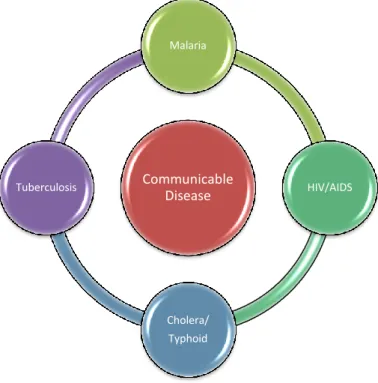
Sub-Saharan Africa is a unique continent with diverse socio-cultural contexts, a frequent outbreak of communicable diseases such as cholera and Ebola, high prevalence and incidence of HIV/AIDS, high poverty rates with associated high rates of malnutrition, and high rates of maternal and child deaths (Sheer & Wong, 2008). The majority of malaria infections in the world occur in children under the age of five in sub-Saharan Africa (World Health Organization, 2006a). The major causes of death in children under the age of five in sub-Saharan Africa are preventable (acute respiratory infections, malaria, diarrhoea diseases, HIV/AIDS, and measles) and are complicated by malnutrition due to the severe poverty across the sub-region (WHO, 2014).
Whereas the developed countries are battling with non-communicable diseases and diseases of old age, SSA is still struggling with communicable diseases to a large extent (Institute of Health Metrics and Evaluation, 2015), thus health professional education and practice in SSA must be more preventive oriented than curative (Soucat, Scheffler & Ghebrey, 2013). Giving
9
children in SSA the opportunity to develop and function at an optimal level in adulthood is difficult under the conditions of poverty, food insecurity, low literacy rate and political instability (Wittenberg, 2013; WHO, 2014).
Unfortunately, paediatric nursing training in Africa has been historically established on the western philosophy and education materials (Coetzee et al., 2016). Almost all postgraduate paediatric nursing programmes in SSA are acute care oriented despite the preventive diseases that threaten the lives of children in Africa. Experts are wondering if the paediatric nursing training programmes in SSA are appropriate for the context and characteristics of the healthcare system in which they are implemented (Coetzee et al., 2016).
1.2.5 Educational Systems
No scientific statement can ever be proven to be true, thus “every scientific statement must remain tentative forever” (Popper, 1959). Such is knowledge and education. Education is seen as a cause and effect in social change. Systems change as better ways of doing things evolve, curricula are dynamic due to the changing characteristics of students and the changing needs of the society for which the graduates of an educational system function. Any educational system that is not dynamic enough to produce graduates to function at the optimal level of their abilities within the context in which they are being trained is ineffective or irresponsive. All levels of education in Africa are influenced by local and global forces. Among these forces is the influence of the philosophy of colonial masters (Nsamenang, 2005). Knowledge generation is poor in Africa and mostly due to the western and eastern acculturation which trivializes the indigenous African knowledge, misguiding African innovation and inventions (Nsamenang, 2005). Nsamenang (2005) believes that the net outcome of most interventions on the African continent is derived from the wholesale replacement of African systems of education with western and eastern ones. He further stated that one cannot advocate for completely turning away from western educational philosophies and methods as they have their own merits. African educationists (Fafunwa, 1991; Nsamenang, 2005; Casimir & Nwakego, Orajaka Sussan Umezinwa, 2013) believe that the Eurocentric education systems in Africa are detrimental to humaness of Africans and called for pragmatic changes in African education philosophy and curricula such as the use indigenous knowledge and language in education and training.
1.2.5.1 Basic education
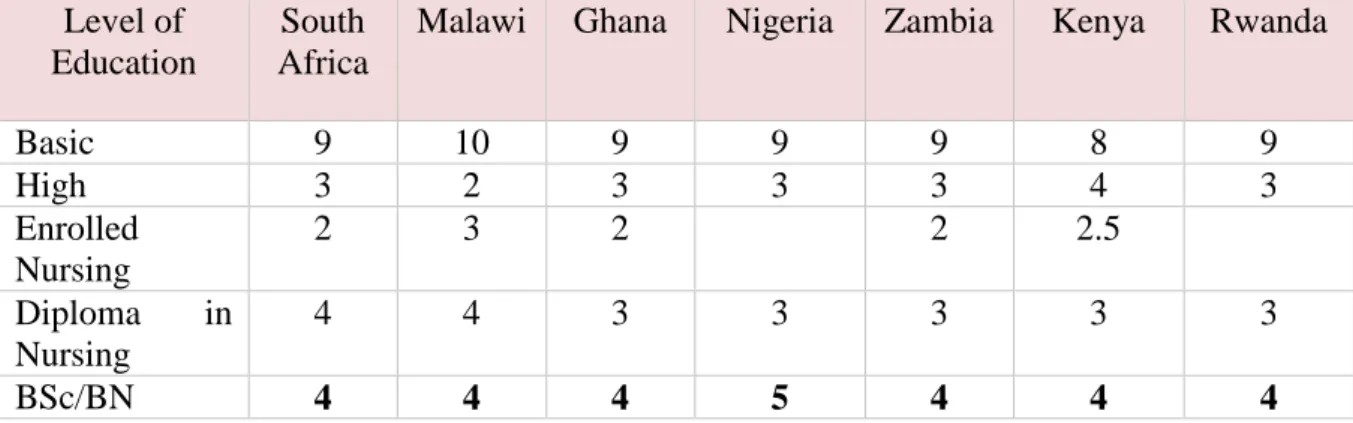
The basic education system of SSA generally spans nine years with the pupils having the opportunity to enrol in high schools as illustrated in Table 1.2 below (Lewin & Sabates,
10
2012). Basic school education improved in SSA after the World Conference on Education for All, held in in Jomqtien, Thailand in 1990. It was explicitly declared that education is a fundamental right of every human being irrespective of gender. The conference also iterated that education is indispensable as it helps in providing safer, healthier and prosperous life (Lewin & Sabates, 2012). Commitment from governments is a key driving force of education globally. Almost all governments in SSA have implemented free basic school in one form or the other. Since the declaration, access to basic education has increased tremendously in SSA The increase in infrastructure and human resource is not commensurate with the increasing access to basic education in almost all SSA countries, mounting pressure on the existing infrastructure and the concomitant poor outputs (Lewin & Sabates, 2012). For example, after the election of a new government in 1994 in Malawi, the primary school enrolment sharply increased from 600 000 to more than 1 million, making grade 1 enrolments six times the number of pupils in grade 8 (Lewin & Sabates, 2012).
A major challenge for children in sub-Saharan Africa is ‘over-age for grade’ due to the competition for space in basic schools. When a child is older than his\her grade, it is highly likely that he or she will underperform and miss some fundamental development skills at a stage where he or she is much receptive of those skills (Lewin & Sabates, 2012). A child could be older than a grade because he or she is or repeating a grade(s) or gained access to school at an older age.
Lewin and Sabates (2012) studied children who were not in school at school going age across sub-Saharan Africa and noted that the percentage of children (male;female) who were not in school at school-going age reduced from 1990 to 2000 for the following countries: Kenya (21;22 to 13;16); Malawi (32;34 to 20;18%); Nigeria (33;44 to 26;33); Tanzania (46;44 to 22;17%); Uganda (27;32 to 13;14%) and Zambia (34;35% to 19;19). Furthermore, the number of girls at home at the school-going age were more than those of boys across SSA. Children from poorer households are more likely not to be at school at school-going age. Generally, the gap between the rich and the poor in terms of access to basic education has increased in West Africa, stablilised in East Africa and reduced in Southern Africa (Lewin & Sabates, 2012).
UNESCO (2009) stated that the educational system of SSA is fragmented vertically and horizontally, creating a huge gap between the general and the vocational subjects. They asserted that the content-based curricula prescribed by national governments make the educational system resistant to adaptation or innovation in teaching and learning (UNESCO,
11
2009). They further condemned the dominance of teacher-centred methods in basic education in SSA and stated that quality in basic education should be centered on the teaching and learning process and outcomes of the education process rather than inputs from teachers, textbooks and infrastructure. They concluded that teacher’s underperformance and poor basic education was largely attributed to poor remuneration and lack of incentives for most teachers in SSA.
Contrary to the fragmentation critique on the education system by UNESCO, the World Bank stated that the educational system in sub-Saharan Africa is aligned with each other from basic to tertiary level (Verspoor & Bregman, 2008). They also asserted that primary education feed into the junior high school, which prepares pupils for the senior secondary/high school level, and the high school for the tertiary institutions such as the universities, polytechnics/technikons, teacher and nursing training colleges smoothly (Verspoor & Bregman, 2008).
1.2.5.2 High/Secondary School Education in SSA
High school education is the conduit to nursing education in SSA. The quality of basic and secondary/high school training, arguably, affects the process and outcomes of nursing education in SSA. Sub-Saharan African countries have increased investment in access to secondary school and higher education over the years (Al-Samarrai & Bennell, 2007). Free high school education currently ongoing in Ghana and other countries (Kavuma, 2011). Despite the huge investments and the relative increase in access to high school education in SSA, the enrolment of basic school leavers to high school is about 30% and the quality of the training questionable (Verspoor & Bregman, 2008). Verspoor and Bregman (2008) in their report to the World Bank indicated that there is the need to refocus on secondary education without completely shifting attention and the necessary resources from basic education. Despite all levels of education linking into each other, Verspoor and Bregman (2008) believed that secondary school curriculum is outdated and does not prepare the leaver to contribute to economic growth. They stated that there is the need for a pragmatic (practically oriented) review of the curriculum to respond to the current needs of the economy instead of the partial momentary changes, which are subject-specific and does not affect the holistic teaching and learning philosophy.
The increased number of graduates competing for the fixed government job opportunities creates an excess of high school and university graduates without jobs to utilize the skills they acquired through formal education. The nursing profession seems to be one of the surest ways of gaining employment during and after training.
12
Basic and high school education are the foundation of tertiary education. Poor quality of the 12-year compulsory education will have an adverse effect on the higher education process, for instance, either the quality standards of the higher education system are lowered for the poorly prepared students to cope with the demands of higher education or the students drop out of school. Extra resources may also be committed to helping the students to cope leading to increased cost of education to the funders of the higher education system.
Table 1.2: Number of years for Basic, High School and Nursing Qualification in some selected SSA countries
Level of Education
South Africa
Malawi Ghana Nigeria Zambia Kenya Rwanda
Basic 9 10 9 9 9 8 9 High 3 2 3 3 3 4 3 Enrolled Nursing 2 3 2 2 2.5 Diploma in Nursing 4 4 3 3 3 3 3 BSc/BN 4 4 4 5 4 4 4
Sources: (EP-Nuffic, 2015; Nursing Council of Kenya, 2017; U.S. Embassy in Ghana, 2017).
1.2.6 Bachelors in Nursing in Sub-Saharan Africa
A Bachelors (first) degree in nursing is the only way students could get access to Masters level Advanced Practice Nursing programme in SSA and other parts of the world since the former is a prerequisite for the latter. The Bachelors of Nursing programme in sub-Saharan Africa is mainly four years, except for Nigeria, where it is implemented over a five-year period. Despite bachelors’ programmes being a minimum of four years, the post-diploma/certificate track gives nurses the opportunity to qualify for a degree certificate in two or three years. Across SSA, there are disparities in the course content, the number of credit hours and the number of clinical hours gained by the pre-registration bachelor’s students. Table 1.3 shows an overview of the content of the bachelors in nursing programmes in some
13
Table 1.3: Bachelors’ of Nursing across Sub-Saharan Africa
Year University of Nairobi University of Limpopo University of Ghana Ahmadu Bello University, Nigeria
1st Year
Nutrition And Health Fundamentals of Nursing Practice 1 Human Anatomy I Foundation of Nursing I
Fundamentals Of Nursing Chemistry Human Anatomy II Heat and Property of Matter
Medical Physiology English for Health Science I Human Physiology I Introduction to Practical Physics
Psychology Human Anatomy 1 Human Physiology II Introductory Organic Chemistry
Introduction To Sociology Introduction to Psychology Introduction to Community Health Nursing Introduction to General Chemistry
Introduction To Anthropology Fundamentals of Nursing Practice 2 Introduction to Mental Health Nursing Introduction to Organic Chemistry
Community Health Biophysics 1C Fundamentals of Mental Health Nursing Introduction to Practical Chemistry
Cognitive and Health Psychology Nursing Perspectives Plants systemic
English for Health Sciences Trauma and Emergency Nursing English and Communication Skills
Human Anatomy Psychology for Nurses History of Scientific ideas
Obstetric Anatomy and Normal Pregnancy Nationalism
Fundamentals of Nursing Foundation of Nursing II
Nursing Practical I Introduction to Evolution and Genetics
Introduction to Ecology General Physics Practical II
Electricity Magnetism and Modern Physics Introduction to Organic Chemistry Introduction to Chemistry Practical Introduction to Physical Chemistry Mathematics
Introduction to Sociology Environmental Health
2nd Year
Human Anatomy Community Health Nursing Principles and Practice of Health Assessment Foundation of Nursing III
Haematology General Nursing Science I Medical Conditions of Integumentary, Gastrointestinal
and Endocrine Systems
Human Anatomy I
Basic Statistics Microbiology Medical Microbiology and Parasitology Human Physiology I
Reproductive Anatomy And Physiology Physiology for the Health Sciences I Surgical Conditions of Integumentary, Gastrointestinal
and Endocrine Systems
Biochemistry of Macromolecules
Educational Psychology Psychology for Nurses Normal Labour and Puerperium Biochemistry PracticalI
Medical Microbiology Community Health Sciences Abnormal Pregnancy, Labour and Puerperium Nigerian Government and Politics
Clinical Chemistry General Nursing Sciences 1 Theoretical Foundations of Nursing African History and Culture
Medical-Surgical Nursing I Medical and Social Psychology Classification and Management of Mental Disorders Introduction to Computer Science
Clinical Pharmacology &
Pharmacotherapeutics
Psychology for the Health Sciences II Pharmacology Biostatistics
Family Health Nursing Medical and Surgical Conditions of the Newborn and
the Child
14
Prevention and Control of Communicable Diseases Human Anatomy II
Management of Child Welfare Clinics Human Physiology II
Nursing Practical II Man and His Environment
Nursing Practical III Medical Microbiology & Parasitology
Nutrition and Dietetics Sociology II
Pathology General Metabolism I
3rd Year
Paediatric Nursing Community Health Nursing Medical Conditions of Respiratory, Cardiovascular
and Genitourinary Systems
Mental Health Nursing I
Community Health Nursing I General Nursing Science Medical Conditions of Nervous and Musculo-skeletal
Systems and Sensori-Neural Organs
Medical-Surgical Nursing I
Mental Health And Psychiatric Nursing Midwifery Surgical Conditions of Respiratory, Cardiovascular
and Genitourinary Systems
Community Health Nursing I Midwifery/obstetric & Gynaecological
Nursing
Pharmacology Surgical Conditions of Nervous and Musculo-skeletal
Systems and Sensori-Neural Organs
Moral Philosophy
Educational Communication And
Technology
Psychiatric Nursing Science Community Health Service Organization and
Participation
Nutrition
Medical / Surgical Nursing II Community Health Nursing Occupational and Community Health Services Clinical Posting and Practical Examination
General Nursing Nursing Practical IV Human Anatomy III
Pharmacology Nursing Practical V
Post-Natal and New-Born Care and Legislation
Reproductive Health Developmental Psychology
Psychiatric Nursing Science High-Risk Neonate Mental Nursing II
Medical Surgical Conditions in Childhood Medico-Surgical Nursing II
Principles of Psychiatric Nursing Maternal and Child Health I
Management of Major Psychiatric Disorders Community Health Nursing II
Nursing Research Pharmacodynamics and Chemotherapy
Proposal Development and Report Writing General Cellular Pathology & Cytology
Gynaecological Nursing and Obstetric /
Gynaecological Operations
Conc. Clinical posting+ Practical exam (5 weeks)
Advanced Clinical Nursing I
Medical-Surgical Nursing III General Nursing and Professional Practice Project work Principles and Methods of Epidemiology
Management And Administration Of Nursing Services
Midwifery Tools and Methods of Teaching Nursing Medico-surgical Nursing
Curriculum And Instruction In Nursing Pharmacology Curriculum Development in Nursing Education Principles of Education
Research Project Post-Natal and New-born Care and
Legislation
Principles of Management in Nursing Curriculum Dev. & Teaching Methods
Community Health Practice Psychiatric Nursing Science Administration of Nursing Services and Schools Community Health Nursing III
Research Methodology Midwifery Biostatistics Maternal and Child Health II
Nursing Administration and Clinical Teaching
Teaching Practice Clinical Posting + Practical Examination
15
4th Year
Psychiatric Nursing Science Nursing Practical VI (Speciality Option) Systemic Pharmacology
Sociology Nursing Practical VII (Speciality Option) Management of Nursing Care Services
Advanced Clinical Nursing II Research Methodology
Nursing Seminar Teaching/Management Practice (TP)
Palliative care and Hospital Emergency Management Nursing Seminar
Peri-Operative and Critical Care Nursing Medical-Surgical Nursing IV
Childhood Chronic and Life Threatening Diseases Nutrition in Health and Illness
Integrated Management of Childhood Illnesses Medical Jurisprudence
Home-Based Nursing and National Health Programme Management of Nursing Care Services Community Health Nursing Administration
Domiciliary Midwifery Advanced Midwifery Practice
Theoretical Frameworks in Mental Health Nursing Advanced Practice in Mental Health Nursing
5th Year
Primary Health Care Nursing I Maternal and Child Health III
Clinical Posting + practical Examination (O&G Posting) (8 weeks)
* Clinical Posting + Practical Examination (Labour Ward) (8 weeks)
Primary Health Care Nursing III Research Project
Health Economics
Examination (Labour Ward) (8 weeks)
Credits Not available 480 Not available 188
16
1.2.7 National Qualification Frameworks
Apart from the South African Qualification Authority (SAQA), none of the sub-Saharan African countries have well defined and coordinated National Qualification Framework (NQF). This study makes reference to the NQF of SAQA for consistency and verifiability. A national qualification framework is a system that describes education qualifications in terms of the level of qualification and the knowledge, skills and attitudes the student should acquire to be awarded such qualifications (South African Qualifications Authority, 2000a, 2017; Koleva et al., 2012; Stanciu & Banciu, 2012; UK Accredited Qualifications, 2017).
A National qualification framework makes the administration and quality control of an educational system easy (Young, 2003). It also informs job descriptions and remuneration scales. Foreign qualification authorities and education institutions are able to comprehend and synchronize qualifications from foreign institutions easily when that nation has a well-defined national qualification framework (Young, 2003).
According to the South African Qualification Authority, a four-year degree carries 480 credits. Currently, only NQF level 8(4-years/ honours degree in nursing) is eligible for admission into the Masters of Nursing in South Africa (Table 1.4). As demonstrated in Table 1.3 above, there are different credit systems in various countries. For example, a four-year degree in Ghana carries between 120-144 credits (National Accreditation Board, 2013), a five-year degree in Nigeria covers about 188 credits and in the United States, a four-year Bachelor’s degree in Nursing requires a minimum of 120 credits for qualification (U.S. Department of Education, 2008) whereas 120 credits are required to complete one year of the four-year degree in South Africa and Europe (Scottish Qualification Authority, 2006; Duma et al., 2012; European Centre for the Development of Vocational Training, 2012; South African Qualifications Authority, 2014; Quality and Qualifications Ireland, 2017).
One credit in Ghana is equivalent to one credit in the USA (North Carolina State University, n.d.) and defined as a one hour lecture or tutorial or a 2-3 hours practical session or a six hours fieldwork (University of Ghana, 2009). South African Qualifications Authority (2000b) defined one credit as equivalent to ten notional hours (the number of hours needed for the average student to learning towards the achievement of a specified standard. Definition of credits differs from one jurisdiction to the other therefore the comparison of credits alone is inadequate for the comparison of degrees.
17
If credits were the only criteria for foreign qualification evaluation, it will be difficult to transfer qualifications from a USA-benchmarked educational system to any European or African educational system. The disparities in the credit systems of various countries create space for under cognition or over recognition of foreign qualifications. Below is a sample of some qualification frameworks of some countries.
Table 1.4: Some Countries and their national qualification Frameworks Level Europe/ England/Northern
Ireland
Ireland South Africa (Post 2009) Scotland
1 GCSE Grade D-G Level 1certificate Grade 9 National 1
2 GCSE Grade A-C Level 2 certificate Grade 10 /National (vocational) Certificates level 2 National 2 3 A level/ National Diploma/National Certificate Level 3/Junior certificate
Grade 11 and National (vocational) Certificates level 3
National 3
4 Higher National Certificate (HNC)
Level/Leaving certificate
Grade 12 National Senior Certificate /National (vocational) Cert. level 4
National 4
5 Foundation Degree/ HND Level 5/Leaving certificate
Higher Certificates and Advanced National (vocational) Cert
National 5
6 University Degree Advanced/ Higher certificate
National Diploma and Advanced certificate
Higher Skills for Work
7 Masters Ordinary
Bachelor’s degree
Ordinary Degree/ Advanced Diploma/Bachelor of technology
Higher National Certificate
8 PhD Honours Bachelor’s
degree
Honours degree/ Post Graduate Diploma/Professional Qualification Higher National Diploma 9 Master’s degree/ Post-graduate Diploma
Master’s degree Ordinary Degree
10 Ph.D./ Higher
Degree
Doctoral degree Honours
11 Masters
12 PhD
Nursing education in SSA has evolved over the years. Progress has been made in the profession in areas of specialisation, regulation and research. However, due to knowledge evolution, increasing influx of technology and practice-based nature of nursing programmes, constant review and improvement are needed to stay abreast with current population health needs and demands of the nursing profession. This is necessary to ensure educational programmes and their products effectively responsive to the population health needs.
1.2.8 The SSA Healthcare System
The healthier the population, the more productive they are and the easier they are able to climb the social and economic ladder (Sambo, 2014).The weaknesses in the healthcare system of Africa are reflected in the level of poverty and the widespread inequality as observed