Should We Regulate Financial Information?
Pablo Kurlat and Laura Veldkamp∗ May 14, 2012
Abstract
Regulations that require asset issuers to disclose payoff-relevant information to potential buyers sound like obvious measures to increase investor welfare. But in many cases, such regu-lations harm investors. In an equilibrium model, asset returns compensate investors for risk. By making payoffs less uncertain, disclosure reduces risk and therefore reduces return. As high-risk, high-return investments disappear, investor welfare falls. Of course, information is still valuable to each individual investor. But acquiring information is like a prisoners’ dilemma. Each in-vestor is better off with the information, but collectively inin-vestors are better off if they remain uninformed. The only cases in which providing information improves investors’ welfare are ones where there would otherwise be severe asymmetric information. Using a model of information markets, the paper explores when such outcomes are likely to arise. When we extend the model so that financial markets with information allocate the real capital stock more efficiently, these conclusions do not change. Disclosure improves efficiency, but more efficient firms do not have more risk and therefore do not offer investors higher return. Instead, they simply command a higher price, which only benefits the asset issuer. Since the efficiency gains are fully internalized by asset issuers, who can choose to disclose without disclosure being mandatory, the efficiency argument is not a logical rationale for regulation.
∗[email protected], and [email protected]. A previous version of this paper circulated under the title
“De-regulation of markets for financial information.” Thanks to David Backus, Peter DeMarzo, Darrell Duffie, Pete Klenow, Andy Skrzypacz, Stijn Van Nieuwerburgh, and Xavier Vives for comments. Thanks also to seminar and conference participants at 2012 AEA meetings, UC Davis, Santa Barbara LAEF conference, CEPR conference on information in macroeconomics, Society for Economic Dynamics conference, Stanford, SITE, Universidad de San Andr´es, Universidad Di Tella, Fundacao Getulio Vargas, PUC, Maryland, New York Federal Reserve, NYU University of Pennsylvania, Minneapolis Federal Reserve, and Wisconsin. Laura Veldkamp thanks the Hoover Institution for their hospitality and financial support through the national fellows program. Thanks to Isaac Baley and Krishna Rao for helpful research assistance. Keywords: information markets, social value of public information, financial regulation. JEL codes: E5, E6, D8.
Regulations that require asset issuers to disclose payoff-relevant information to potential buyers sound like obvious measures to increase investor welfare. This paper builds a new model with an equilibrium asset market, an information market and a real production sector to investigate whether such information regulations improve investor welfare. We find that in many cases, requiring information disclosure harms investors. The reason is that asset returns compensate investors for risk. By making payoffs less uncertain, disclosure reduces risk and therefore reduces return. As high-risk, high-return investments disappear, investor welfare falls. Of course, information is still valuable to each individual investor. But acquiring information is like a prisoners’ dilemma. Each investor is better off with the information, but collectively investors are better off if they remain uninformed. The only cases in which providing information improves investors’ welfare are ones where there would otherwise be information asymmetry. The paper explores when such outcomes are likely to arise.
Many recent financial reforms have sought to increase the transparency of financial products by requiring the seller to disclose additional information.1 Proponents of these reforms argue that giving buyers more information about the expected costs and benefits of a financial product in-creases their welfare, and allows the financial market to allocate capital more efficiently. Opponents point out that disclosure is costly for firms and that an active market for financial information and consulting services exists to provide this information in cases where it is efficient. We show why neither argument is correct. Although the free-market efficiency argument is intuitively appealing, our model highlights the free-rider problems, spillovers to real investment, and other externalities that make information market outcomes inefficient. Similarly, we show that while information can improve the allocation of capital, that does not translate into a rationale for mandatory disclosure. Literatures in economics, finance, and accounting consider how disclosures remedy managers’ incentive problems in principal-agent settings. But to examine market externalities and evaluate the merits of free-market efficiency claims requires a model with many agents interacting in a market. Therefore, we use a standard noisy-rational-expectations asset market with a continuum of agents as our foundation. On top of this foundation, we build a new framework that allows us to analyze equilibrium effects of regulation in information markets, its effects on asset markets,
1
For example, Title X, section 1032 of the Dodd-Frank act of 2010 requires that features of consumer financial products, such as credit cards or insurance, are clearly disclosed to the consumer. Title IV, section 404 requires that hedge funds must disclose their leverage, types of assets held, trading practices, etc. Title IX, section 942 requires that the issuers of asset-backed securities disclose asset composition and risk-retention of originators. Title XIV, section 1419 requires that mortgage lenders disclose fees, total interest, and maximum payments. Title IV of the Sarbanes-Oxley act of 2002 increased the amount of financial information that publicly traded corporations are required to disclose.
and the spillover effects on the real economy, all in an analytically tractable way. In our model, information can be produced at a cost. This cost can be borne by the issuer of a security, who discloses the information, free of charge, to all potential investors, or by independent analysts who can produce the information and sell it to each investor. After observing issuer or analyst reports, rational investors choose how much to pay for the security. After all shares are sold at a market-clearing price, the payoff of the security is realized and agents get utility payoffs. The policy we evaluate in the model is a mandatory disclosure regulation, which requires asset issuers to provide the information at their own cost.
Section 2 begins by considering the welfare effects of an exogenous change in the amount of symmetric information investors observe. Information affects asset prices in two ways: First, a surprisingly positive report will push the price of the asset up, while a surprisingly positive report will reduce the price. In expectation, reports are neutral and this effect washes out. The second effect is that information makes the asset’s payoff less uncertain. In doing so, it makes the asset less risky. Lowering risk lowers the equilibrium return and systematically raises the asset’s price. For welfare, this means that on the one hand, information reduces the risk investors face when buying an asset. On the other hand, lower risk implies lower return. We show that, with exponential utility and normally distributed payoffs, the return effect always dominates. The conclusion is that requiring firms to disclose information that no investors would otherwise know makes investors worse off.
There are some circumstances in which mandatory disclosure can improve investor welfare. Since mandatory disclosure shifts information costs from investors to asset issuers, one might think that disclosure would be most valuable when this cost is large. Ironically, investors only benefit from disclosure when the cost of information is low. If the information in analyst reports is expensive, few investors will buy the reports. Since there is little information asymmetry, the effect of disclosure is similar to the previous case where information is symmetric and more information reduces investor welfare. But when the analyst reports are cheap, many investors buy them. Any remaining uninformed investors face severe asymmetric information, which reduces risk-sharing. Disclosure can remedy this distortion. If analyst reports are so cheap that all investors choose to purchase them, then prices and allocations are identical to those in an economy with mandatory disclosure, except that the (small) cost of information is borne by investors instead of by the issuer.
Together, these results reveal that mandatory disclosure is not warranted simply because in-vestors are poorly-informed about a security. To the contrary, the case for regulating financial information, as an investor protection measure, hinges on establishing that either a) some investors
have this information already or b) all investors already expend resources to acquire this informa-tion. In the first case, mandatory disclosure remedies distortions from asymmetric informainforma-tion. In the second case, it simply shifts information costs from investors on to asset issuers. If instead, all investors lack information about the asset’s payoffs, then a higher asset return will compensate them for this uncertainty and mandatory disclosure can reduce their welfare.
Section 3 uses the model’s information market structure to investigate what kinds of assets are most likely to suffer from asymmetric information. This tells us: For which assets would investors benefit from mandating that issuers disclose payoff information? The intuitive answer, that one should target the assets whose payoffs are most uncertain, turns out to be incorrect. When prior beliefs are very uncertain, either asset issuers or investors will opt to purchase information, even without regulatory mandates. Conversely, when prior beliefs are very precise, information will indeed be scarce but the scarcity has little price impact and thus little welfare impact. Disclosure regulation is beneficial not for assets with the most or least uncertain payoffs, but for the ones in between. A similar argument reveals that disclosure is also most beneficial when analyst report precision is not very high or very low.
One potential objection to our results is that they come from preferences with constant absolute risk aversion (CARA). CARA preferences are useful because they are simple and the CARA-normal setting provides a familiar benchmark with which to compare our results. But they also have the well-known shortcoming that investors’ decisions are not affected by wealth. To ensure that wealth effects do not overturn our results, section 4 examines a variant of the model where different investors have different absolute risk aversion coefficients.2 We find that indeed their decisions are different, with less risk averse (presumably wealthier) investors taking larger positions and being more willing to pay for information. However, the welfare consequences of mandatory disclosure regulations are unchanged: all investors prefer to have no information and only benefit from mandatory disclosure if it prevents informational asymmetry.
Another potential objection to our results and an often-cited reason to regulate financial infor-mation provision is that better inforinfor-mation in financial markets facilitates efficient real investments. Therefore, section 5 incorporates a positive spillover from financial information to the real economy in the following way: At time 1, an issuer can choose how much real capital to invest in his firm. His payoff depends on the price the asset sells for in the time-2 financial market. If financial asset prices
2
It would also be useful to relax the assumption that payoffs are normal. But with a general payoff distribution, the value of information cannot be expressed explicitly as a function of exogenous variables. In fact, Breon-Drish (2012) proves that equilibrium asset prices may not even exist. He derives properties of welfare. But computing welfare is not analytically tractable.
are very sensitive to changes in the value of the capital stock (they are informationally efficient), then the issuer is incentivized to invest the optimal amount.
Our results show that requiring more information disclosure improves the efficiency of capital allocation and maximizes output. But, surprisingly, considering the positive spillovers from financial information to the real economy does not overturn our result that more precise information hurts investor welfare. The reason is that all the efficiency gains accrue to the issuer. Investor returns are compensation for bearing risk. A project that is known by all to be more valuable will command a higher price. In equilibrium, it will have the same return as an equally risky, but lower-payoff project. If improving efficiency does not affect the risk of the project, then promoting efficient real investment may be a laudable goal, but it does not interact in any way with investor protection.
Ultimately, the desirability of mandatory disclosure depends on parameter values, which makes the optimal policy a quantitative question. Of course, quantifying a model based on sale of infor-mation is not an easy task. But one context where inforinfor-mation is quantifiable is credit ratings. Section 6 uses data on ratings, prices, and performance of corporate bonds issued between 2004 and 2005 to estimate the model parameters and uses those estimates to compare the costs and benefits of ratings. The resulting numerical predictions tell us that rating costs are low, compared to the benefit of information, for the typical security. The costs are sufficiently low that without the ratings mandate, issuers would cease to buy ratings and all investors would buy analyst reports for themselves. Thus, requiring disclosure has no effect on the amount of information available about the average security. It would simply replace analyst markets with issuer disclosures. Shifting information costs from investors to issuers benefits investors, but does not improve efficiency. It is a pure transfer.
Markets for information, and the question of whether to mandate information provision, matter beyond just the finance industry. For instance, buying consumer goods or services with uncertain benefits is similar to investing in a risky asset. While financial information helps to allocate real productive capital, consumer goods information encourages high-value goods to be supplied and low-value goods to be withdrawn. In both cases, mandatory information improves allocative ef-ficiency. But this efficiency gain may not benefit consumers because, in equilibrium, the price of goods with less-uncertain quality is higher. One contribution of this paper is to assess regulation of financial market disclosure laws. But a second contribution is a framework that can be used to think through and to quantify these competing equilibrium effects in a broad array of markets.
Related literature Our paper is closely related to a recent literature on the welfare consequences of information disclosure. In Amador and Weill (2012, 2010) and Kondor (2011), providing financial information can be welfare-reducing. But they do not model an information market and do not consider the same equilibrium effects as we do. Similarly, Gozalo Llosa and Venkateswaran (2012) consider the efficiency of information acquisition decisions in a coordination game, but not in an equilibrium asset market. Gorton and Ordonez (2012) allow investors to acquire information that helps them distinguish firms with good collateral from those without. This type of information is specific to collateralized lending and is distinct from the information about asset payoffs that we consider.
Our work also contributes to the literature that connects the real and financial sides of the economy. Most of these linkages work through the supply of credit to individuals or firms. In contrast, our model captures the idea that asset markets govern incentives: Market prices that aggregate more investor information provide better incentives for firms to invest in a more efficient manner. Like our model, Goldstein, Ozdenoren, and Yuan (2011), Ozdenoren and Yuan (2008) Albagli, Hellwig, and Tsyvinski (2009) and Angeletos, Lorenzoni, and Pavan (2010) all propose mechanisms that capture an information externality. The information spillover is that asset prices aggregate information that firm managers can use to guide their real investment decisions. When financial investors can affect real investment, this creates complementarities in demand among investors and the potential for multiple equilibria. This effect is not possible in our model beause real investment takes place first. More importantly, the type of information spillover our model describes is distinct. An important part of our contribution is a simple, tractable way to capture the idea that improving investors’ access to information incentivizes firms to allocate capital efficiently. Our analysis also builds on work on costly information acquisition, such as Grossman and Stiglitz (1980), Verrecchia (1982), Peress (2010), and Fishman and Parker (2011). But it extends this work by considering the trade-offs between issuer- and investor-purchased information and connecting the asset market to the real economy. If the issuer does not provide the signal, investors themselves can choose to purchase the information from an information market. We model the market for information in a richer way than most of the previous literature by considering the non-rival nature of information and solving for its endogenous market price (as in Wiederholt (2011)). This allows us to consider whether, in the absence of disclosure regulation, either issuer-provided or investor-purchased information markets will fill in the void. Furthermore, the model connects financial information choices to real investment choices, output and welfare.
disclosure (e.g. Shavell (1994), Diamond (1985) and Jovanovic (1982)). Our model differs because it features a continuum of investors in a market that has an equilibrium price. Our results come primarily from equilibrium effects. Hirshleifer (1971) also argues that information acquisition is welfare-reducing because investors pay for it and it does not create any social value. Our results go beyond Hirshleifer’s effect by showing that investor welfare falls even when the investors do not pay for the information, even when it does not distort risk-sharing, and even in an economy where informed trade in asset markets results in a more output.
1
Model
Asset issuer A risk-neutral issuer sells a risky asset whose whose payoff is y∼N(¯y,h1
y). Before
knowing y, the issuer must decide whether to produce a report about the asset’s quality. The report is a number θ which is a noisy, unbiased signal about the risky asset’s payoff: θ = y+η, where η ∼N(0,h1
θ). Producing this report has a cost χ. Denote the sale price of the asset by p,
the decision to produce a report by D= 1 and the decision not to do so by D= 0. The issuer’s objective function is:
E(p|D)−χD (1)
A policy of mandated disclosure consists of mandating that the issuer choose D= 1.
Investors and financial markets There is a continuum of ex-ante identical investors with measure Q. They have CARA expected utility3 with coefficient of risk aversionρ:
EU =E[−e−ρW], (2)
where W is their realized wealth. They have an initial endowment of wealth w0. Investors can purchase fractional shares of the risky asset. They can also store their initial endowment with zero net return. If the issuer has not provided a report on the asset quality, it may instead be possible for individual investors to purchase an equivalent report from an independent analyst at a pricec. Each investor i individually chooses whether to purchase such a report (di = 1) or not (di = 0).
3
Since the model has a single asset, any risk is systematic and will be priced as such. More generally, since asset returns are correlated, the return analysts report on has a systematic component, which justifies modeling investors in any given asset as risk-averse.
The investor’s realized wealth is therefore
W =w0+qi(y−p)−dic. (3)
whereqi is the share of the project the investor buys.
The price p is determined in an auction. Each investor submits a bidding function bi(q) that
specifies the maximum amount that he is willing to pay for a fraction q of the risky asset as a function of his information. These bid functions determine the aggregate demand. The auctioneer specifies a market-clearing pricepthat equates aggregate demand and supply, and each trader pays this price for each unit purchased (a Walrasian auction).4
Asset supply noise There is a set of agents who are subject to random shocks that force them to buy or sell the asset, at any current price. The demand of this group of agents is normally distributed with mean zero: ξ ∼N(0,h1
x). Let x denote the net supply of the asset, after accounting for the
noise trader demand: x ≡1−ξ. Thus, x ∼N(1,h1
x). This noise ensures that the price investors
condition on is not perfectly informative about information that others may know.
Information markets If the issuer does not produce information about the asset, the same signal θ can be discovered by independent analyst, at the same cost χ.5 Once this fixed cost is incurred, the information can be distributed at zero marginal cost. Analysts sell their services to individual investors at a price c. For now, we assume that the information is protected by intellectual property law and reselling it is forbidden. We revisit this assumption in the concluding remarks.
The analyst market is perfectly contestable, so that analysts earn zero profits.6 This implies that, if a measure λ of investors chooses to purchase the analyst report, the price of the report must be c= χλ.
The fact that information markets are competitive is crucial. The exact market structure is not. Veldkamp (2006) analyzes a Cournot and a monopolistic competition market as well. All three
4
As shown by Reny and Perry (2006), this formulation of the financial market is equivalent to proposing a Walrasian rational-expectations equilibrium. In particular, this is equivalent to assuming that investors take the market-clearing price as given and the price is part of their information set.
5One might think that the cost would be higher for the independent analyst, especially if the issuer does not
cooperate, but as we will see below the issuer has every incentive to make the collection of information as easy as possible.
6
One way to ensure that the market is contestable is to force agents to choose prices in a first stage and choose entry in a second stage.
markets produce information prices that decrease in demand.
Order of Events
1. The issuer decides whether or not he will pay to disclose information. (He does not know y,
θor η yet.)
2. (a) If the issuer discloses, all investors observeθ.
(b) If the issuer does not disclose, the analyst decides whether to find out θ and sets the pricec. Investors then simultaneously decide whether or not to buy the analyst’s report. Those who do observe θ.
3. Investors submit menus of prices and quantities of assets they are willing to purchase at each pricebi(q).
4. Asset auction takes place. The auctioneer sets a market-clearing price. 5. y is realized and all payoffs are received.
Equilibrium An equilibrium is a disclosure decisionDby the issuer, a demanddiby each investor
for analyst reports, a decision by the analyst about whether to produce a report and a pricecfor the report, bidding functions bi(q) for each possible information set and an asset price p(θ, D,{di}, ξ)
such that: issuers choose disclosureDto maximize (1); investors choosedi and bidding functions to
maximize (2) subject to (3); analysts make zero profits, and the asset market clears: ∫0Qqidi=x.
2
Equilibrium and Welfare
We start by analyzing the properties of the second-period financial market equilibrium, for given information choices. Once we know what are the welfare consequences of investors having each information structure, we can then investigate (in the following section) how information markets affect these welfare predictions.
2.1 Equilibrium asset prices and information demand
Equilibrium prices With CARA utility and Normal asset payoffs, investori’s first order condi-tion for portfolio choice is:
qi =
Ei(y)−p ρV ari(y)
The bidding function is just the inverse of (4), i.e. bi(q) = Ei(y)−qρV ari(y). The subscript i
denotes the fact that the calculation is made under investori’s information set. For investors who have observed the report θ, Bayes’ law says that
Eθ(y) = ¯ yhy+θhθ hy+hθ (5) V arθ(y) = 1 hy +hθ . (6)
For investors who have not observed the analyst report, the market-clearing auction price of the risky asset partially reveals the analyst report that others (if any) have observed. Since the price depends on asset demand and demand depends on information in the price, there is a fixed point problem. We solve by guessing a linear price rule
p=α+βξ+γ(θ−y¯), (7)
and solving for the coefficientsα,β andγ. The following price coefficients are derived in appendix A.1: α = y¯− ρ λ(hy+hθ) + (Q−λ)(hy+hp) (8) β = ρ λhθ λhθ+ (Q−λ)hp λ(hy+hθ) + (Q−λ) (hy+hp) (9) γ = λhθ+ (Q−λ)hp λ(hy+hθ) + (Q−λ)(hy+hp) (10)
wherehp is the informativeness of the price and satisfies
hp =
λ2h2θhx λ2h
θhx+ρ2
. (11)
and λis the measure of investors who observe the signalθ.
The average price isα, and it consists of the ex-ante expected payoff ¯y less a term that accounts for investors’ risk aversion ρ and the amount of information they have, which depends on the precision of the information, the informativeness of prices and how many investors buy the report. The sensitivity of the price to information (the report or disclosure) is given by γ. γ takes values between 0 and 1, and is greater when information is very precise relative to the prior and a large fraction of investors buy them. The sensitivity of the price to noise in demand is given byβ. Prices
will tend to be relatively sensitive to demand noise when investors are risk averse, when few have bought the analysts’ report or when the report is not very informative.
For the case where the issuer discloses the information (either by choice or due to the mandate), formulas (8) - (11) still apply, setting λ=Q. For the case where no one buys the analyst report, the formulas apply taking the limit as λ→0.
Information choice when the issuer does not disclose In case the issuer does not provide the report, investors will simultaneously choose whether to buy it from the analyst. Since they are ex-ante identical, they will only make different choices when those choices yield identical expected utility. Appendix A.2 shows that the equilibrium measure of informed investors is
λ= √ ρ hxhθ √ hθ (hy +hθ)(1−exp(−2ρc))− 1 (12)
By equation (11), higher values of λ make prices more informative, which diminishes the value of the signal, and vice versa, which means there is at most one value of λ that makes investors indifferent. If equation (12) produces a number that is not between 0 andQ, then there is a corner solution. If the right hand side of (12) is an imaginary number, this means that utility is always higher for uninformed investors and therefore the corner solution is λ= 0. If the right hand side of (12) is greater thanQ, then the corner solution is λ=Qand all investors become informed.
Equation (12) implies that demand for the analyst report is decreasing in the pricec, decreasing in the precision of the prior hy and increasing in the variability of noise trader demand h1x, which
makes prices less informative. The effect of analyst report precisionhθ is ambiguous. On the one
hand, more precise information is more valuable; on the other, it induces informed traders to take larger positions in the asset, which makes equilibrium prices more informative as well.
Equilibrium implies that, if the issuer does not disclose, either the analyst does not produce the signal or (12) and the zero-profit condition holds:
c= χ
λ. (13)
Voluntary disclosure by the issuer In those cases where, absent regulation, the issuer would voluntarily provide a report then disclosure mandates would be irrelevant. The issuer will volun-tarily choose D = 1 only when the increase in expected prices from doing so outweighs the cost
if D = 0 and information provision is determined by whatever is the outcome in the market for analyst reports. Then, the issuer will disclose whenE[p1]−χ > E[p0].
Proposition 1 (Disclosure by issuer)
1. If ρ Q hθ hy(hθ+hy) > χ, (14)
then either the issuer will disclose, or at least some investors will buy a report 2. If condition (14) does not hold, the issuer will not disclose.
When the issuer considers whether or not to disclose, he takes into account the equilibrium measure of investors that will buy the analyst report if he doesn’t provide it (λ). In case disclosing results in more information (which will be the case unless λ= Q), equation (8) implies that this raises his expected revenue from selling the asset. The reason is that, by providing investors with information, the issuer reduces the risk they have to bear, which increases average prices. Of course, it is always possible that the disclosure results in bad news that reduces the asset’s price. But on average, the news is neither good nor bad. It’s average effect is simply its effect of reducing uncertainty. The issuer trades off this expected gain against the cost χof disclosure.
Condition (14) says that the gains from providing information outweigh the cost, assuming that if the issuer does not disclose, the investors will not buy analyst reports. If the condition holds, then either the issuer expects a sufficient number of investors to buy information on their own, or he will disclose. If the condition doesn’t hold, then the issuer prefers not to disclose in any circumstance, even if he expects all investors to remain uninformed.
Proposition 1 implies that issuers will certainly not disclose (and therefore mandatory disclosure regulation will matter) if: (1) the precisionhθis too low; or (2) the costχis too high; or (3) investors
are sufficiently risk tolerant (low ρ) or numerous (high Q) that the discount from bearing risk is small; or (4) the precision of investors’ prior is high enough that the additional information from the disclosure makes little difference
2.2 Welfare
Maximizing a weighted sum of utilities is the most commonly used social welfare criterion. In this setting, the objective this produces depends on how one weights the issuer (a single entity) versus the investors (a continuum of agents). The question of how one models the noise traders then also
comes into play. Since we have no guidance on how to weight these various constituencies, we simply examine their utilities separately. In each case, we ask how they would be affected by a policy that mandatedD= 1.
Issuer A simple revealed preference argument establishes that the asset issuer is always weakly better off without the disclosure mandate. Without the mandate, the asset issuer can always choose
D= 1, with identical effects as if he were forced to do so. But with the mandate, he cannot choose
D= 0, which could be the preferred option for some parameter values.
Investors We start by comparing a hypothetical market where investors have no access to any information (in the notation above, λ= 0) to one where there is mandatory disclosure.
Proposition 2 (Investors prefer information market collapse) Investors have higher ex-ante expected utility when no information is provided than when disclosure is mandatory.
Investors benefit from access to a high-risk, high-return asset. They are indifferent between holding the last, marginal share of a risky asset, but earn a utility benefit from holding all the inframarginal shares. When firms disclose, it is as if the asset is replaced by a lower-risk, lower return asset. Investors earn less of a utility benefit from holding this asset at the new, higher equilibrium price.
To see why investors prefer high return and high risk, note that in the CARA-Normal framework, conditional expected utility satisfies
Ei[U]∝ −exp { −1 2 (Ei(y)−p)2 V ari(y) } . (15)
(See Appendix A.2 for derivation.) Roughly speaking, expected returns enter quadratically in investors’ utility because the direct effect is compounded by them taking larger positions. The fact that variance enters (linearly) in the denominator of the fraction tells us that each investor individually would prefer more information. But when all investors acquire more information, the expected return falls. Using equation (8) for the special cases ofλ= 0 orλ=Q, the unconditional expected return per unit of the asset is proportional to the conditional variance: E[y]−p=ρV ari(y).
Overall, the effect of higher variance on utility through higher expected returns dominates the direct risk effect and expected utility is increasing in the conditional variance of the asset payoff. Acquiring information is like a prisoner’s dilemma. Each investor wants to observe more information. But investors would like to collectively commit to observe less.
Proposition 2 implies that if the choice were between mandating and prohibiting disclosure (or the distribution of any analysis), investors would collectively benefit from a prohibition. However, this does not immediately imply that disclosure mandates make them worse off. Investors may prefer mandatory disclosure when the alternative is asymmetric information. If issuers will not disclose and only some investors are willing to buy the analyst report at the equilibrium information price, then there will be asymmetric information, with some investors knowing θ and others not. The informed and uninformed investors will hold different quantities of risky and riskless assets. But since all investors are identical ex-ante, holding different portfolios entails sharing risk inefficiently. Inefficient risk sharing reduces investor welfare. If this welfare effect is strong enough, investors prefer that a mandatory disclosure statute restore information symmetry.
Proposition 3 (Investors prefer mandatory disclosure to asymmetric information) If in equilibrium D = 0 and λ is sufficiently high, then investors have higher expected utility when disclosure is mandatory.
If the equilibrium is such that most investors will choose to buy the signal from the independent analyst, any given investor faces a choice between being less informed than most other traders or paying for the information. In the limit, if everyone else is informed (λ=Q), an investor who pays for the information will have the same utility as in the mandatory disclosure case minus the cost of the report. In an equilibrium with λclose to Q, each investor will be indifferent between bearing the cost of information or suffering from asymmetric information and would prefer mandatory disclosure, which shifts the cost of the report onto the issuer.
Noise traders Finally, there is the issue of how (whether) to include noise traders in the welfare calculation. One possible interpretation of noise traders is that they are merely a modeling conve-nience to capture the idea of imperfection in the information aggregation process and thus one can safely ignore them in the welfare calculation. Another is to assume that noise traders are either trading for liquidity reasons or are making mistakes. Their welfare is still affected by the profits or losses they make from trading in this market. The aggregate profits they make are given by
π = (y−p)ξ
and, using (7), expected profits are given by
Eπ=− β
hx
where β, given by equation (9), is the sensitivity of the asset price to noise trader demand. Noise traders are hurt by the fact that when they trade they move the price against themselves.
Proposition 4 (Noise traders benefit from mandates) The profits of noise traders are max-imized when disclosure is mandatory.
When all investors are informed, the asset is less risky for them, which makes their demand more elastic and thus more able to absorb noise with little change in price. Furthermore, the fact that investors are informed means they don’t infer anything from prices, so noise traders do not adversely affect investors’ estimates of the value of the asset. For this reason, noise traders are always better off when λ=Q, which the mandate brings about.
3
For Which Assets Might Regulation Be Beneficial to Investors?
The results above show that mandatory disclosure regulation can be beneficial for investors when, absent a mandate, they would be faced with a choice between paying for information or being asymmetrically less informed than other traders. This section analyzes under what conditions this situation is likely to arise.
Cost of producing information
Proposition 5 (Investors prefer mandatory disclosure when information is cheap.) There exists a cutoffχ∗ such that forχ < χ∗, investor welfare is higher with mandatory disclosure. One might think that it is when information is very expensive that investors would prefer for asset issuers to pay for it and provide it to them for free. Instead, when information is expensive, investors know that few among them will buy analyst reports, so there will be few informed investors to drive up asset prices and excess returns will be available. Instead, when information is cheap, most investors will buy it. Anticipating this, the issuer will choose not to provide the report. In this scenario, investors would prefer that disclosure be provided for free.
Precision of information
Proposition 6 (Investors do not buy low-precision reports) If
hθ hy <exp ( 2ρχ Q ) −1 (17)
investors will not buy an analyst report
Proposition 6 implies that an investor-based information market will not exist if: (1) the in-formation content of the analyst report hθ is small relative to the precision of the prior hy, since
this makes information less valuable; or (2) either the fixed cost of information discoveryχ is high or the investor base Qis small (which makes the price c that the analyst needs to charge high, or (3) investors are very risk averse, which makes them take small positions in the asset and therefore profit little from better information.
Proposition 7 (Investors do not buy high-precision reports) Investors will not buy an an-alyst report if hθ is sufficiently high.
Proposition 7 reveals a subtlety about the market for analyst reports. If the reports contain very precise information, informed investors will take large positions, which makes prices highly informative. With a fixed pricecfor the analyst report, this would imply that as precision increases, only a vanishing measure of investors choose to become informed, as is the case in the model of Grossman and Stiglitz (1980). However, because the analyst must cover the fixed cost χ, low demand means it must raise prices. For sufficiently high precision, there is simply no price at which this market is viable.
Propositions 6 and 7 jointly imply that an investor-led market for analyst reports can only function if the information is of some intermediate level of precision. Therefore it is only for these intermediate levels of precision where the asymmetric information situation might arise. In either precision extreme, the independent analyst market is not viable so investors do not have to worry about being less informed than others.
4
Heterogeneous Investors and Wealth Effects
One of the shortcoming of working with the CARA specification for preferences is that it assumes away wealth effects in investment decisions and, by extension, in information choice decisions. A simple way to allow for wealth effects while keeping the simplicity of the CARA-Normal framework is to allow for different investors to have different (constant) absolute risk aversion coefficients. One could in principle then link back the level of absolute risk aversion to each investor’s wealth by postulating a relationship between wealth and absolute risk aversion. Makarov and Schornick (2010) follow this approach. This extension makes it possible to ask whether different disclosure regulations might have different impact on investors of different wealth levels.
Formally, assume that there is a function ρi that specifies the absolute risk aversion coefficient
of investor i and assume without loss of generality that this function is increasing. The issuer and investors play the same game as in section 1. Equating supply and demand reveals that the equilibrium price will be linear, as in (7), with coefficients
α= ¯y− 1 (hy+hθ)ψL+ (hy+hp)ψH β= 1 ψLhθ ψLhθ+ψHhp (hy+hθ)ψL+ (hy+hp)ψH γ = ψLhθ+ψHhp (hy+hθ)ψL+ (hy+hp)ψH , where ψL ≡ ∫i∗
0 1/ρidi is the average risk tolerance of informed agents, ψH ≡ ∫Q
i∗ 1/ρidi is the
average risk tolerance of uninformed agents, and i∗ is the investor who is indifferent between buying and not buying the signal, who satisfies the indifference condition
ρi∗ = 1 2clog ( hy+hθ hy+hp ) .
Finally, the equilibrium asset price is a signal about firm value, with precision
hp =
ψ2Lh2θhx ψ2
Lhθhx+ 1 .
Investors with lower absolute risk aversion (implicitly, wealthier investors) take larger positions in the risk asset and therefore have a higher willingness to pay for a given piece of information. In equilibrium, there is a cutoff investor i∗ such that investors with lower risk aversion than i∗ buy the analyst report and those with higher risk aversion choose to remain uninformed. In principle, this could mean that some investors benefit from mandatory disclosure rules while other are hurt by them. Nevertheless, the results below show that the main welfare results for the homogeneous-investor case carry over to this more general case.
Proposition 8 (Investor welfare with heterogeneity)
1. All investors have higher expected utility with no information than with mandatory disclosure. 2. If in equilibrium D = 0 and i∗ is sufficiently high, all investors have higher expected utility
3. There exists a cutoff χ∗ such that all investors have higher expected utility with mandatory disclosure if χ < χ∗.
Part 1 of Proposition 8 generalizes Proposition 2 for the case with heterogeneous risk aversion; part 2 generalizes Proposition 3 and part 3 generalizes Proposition 5.
Together, these results show that none of the main welfare results are depend on the assumption of homogeneous investors and/or the absence of wealth effects. All investors, irrespective of their risk aversion, benefit when the lack of information gives them access to a higher risk, higher return asset. Also, all investors benefit from mandatory disclosure when it is the only way to avoid a choice between paying a cost or being at an informational disadvantage. This case is still likely to arise when the cost of producing information is relatively small.
5
Financial Information and Real Economic Efficiency
By studying the asset market in isolation, we have seen why investors prefer no information, to full information, to severe asymmetric information. Considering the interaction between investor and issuer information choice and the prices in information markets delivered insights into which assets were likely to generate asymmetric information. But one would suspect that these results could change dramatically if we allowed for financial information to have spillovers into the real economy. To see how real economic spillovers change the results, we build on the previous model by adding an initial period where an issuer builds up his firm, prior to its IPO.
The real investment model Suppose that instead of having an exogenous payoffy, the dividend from the asset depends on the issuer’s investment according to
y=f(k) +u (18)
wherek≥0 is real capital investment andf is a concave function withf′(0)>1 andu∼N(0,h1
y).
The issuer chooses Dfirst, and then kto maximize:
E(p|k, D)−k−CD (19)
The choice of kis not observable by investors. The game progresses as follows. First, the issuer chooses D and k. Then the game progresses as in section 1. Finally, y is realized and payoffs
are received. Since the decision D is observable but k is not, it is necessary to specify both what investment k(D) the issuer would choose for each disclosure decision D(including off-equilibrium) and what are investors’ beliefs about k depending on D, which we denote by k∗(D). Note that the issuer chooses his disclosure first, so that there is no signalling value to the choice ofDand no strategic disclosure. The realistic counterpart to this assumption is that firms have long-standing disclosure policies. They disclose at regular intervals and rarely change that policy, even if they would prefer not to disclose bad news. This leads to the following equilibrium definition.
Equilibrium An equilibrium consists of a disclosure decisionDand then an investment decision
k(D) by the issuer; a demand di by each investor for analyst reports, a decision by the analyst
about whether to produce a report and a price c for the report, bidding functions bi(q) for each
possible information set and an asset price p(θ, D,{di}, ξ) such that: issuers choose disclosure D
to maximize (19) and, taking D as given, choose k(D) to maxmize (19); investors choose di and
bidding functions to maximize (2) subject to (3); analysts make zero profits; the asset market clears: ∫0Qqidi=x, and investors’ belief about investment is correct: k∗(D) =k(D).
5.1 Real investment decision
Replacing the equilibrium price into the issuer’s objective function in (19) and noting that θ =
f(k) +u+η, the issuer solves
max
k E[α+βξ+γ(f(k) +u+η−f(k
∗(D)))]−k
Note that, because investment is unobserved, the issuer cannot affect beliefs about k∗(D) through the investment decision. The reason for the issuer to undertake investment is to affect the analyst report and therefore to indirectly affect the selling price.
The first order condition for investment is
f′(k) = 1
γ
The value of γ depends on whether the issuer has disclosed and, if he has not, on how many investors have purchased analyst reports. Since by equation (10), γ < 1, investment always falls below its first-best level, which is defined by f′(k) = 1. Furthermore, since γ is increasing in λ, investment will be higher when more investors are informed. Therefore whenever the equilibrium
value ofλin an investor-driven market is less than Q, investment will be higher under disclosure. Note further that if no information is provided for investors, thenγ = 0 and thereforek= 0.7
Information is socially valuable in this model because when investors are informed, they bid more for firms that have invested more. Since the owners of the high-investment firms gain more from selling higher-priced shares, this gives issuers an incentive to invest. The inefficiency here comes from the fact that investment is unobserved. Providing investors with noisy signals about the firm’s value helps to remedy this friction. Thus it promotes a level of investment that is closer to the efficient level.
5.2 Welfare in a production economy
Effect on output One possible objective a government might have is to simply maximize the production of real goods. This is obviously a simplification, but it makes for a good starting point. The relevant question becomes: Which disclosure policies maximize outputf(k)?
The primary friction in the model is that investors’ imperfect information about capital invest-ment decisions of the firm reduces the issuer’s return to investing in capital. In other words, if investors don’t know that the issuer invested more, he won’t be compensated for that investment when he sells his firm. Efficiency requires that the marginal return to investment be equal to its unit marginal cost: f′(k) = 1. Therefore if we somehow manage to ensure that the private return to a marginal unit of investment is equal to its social return, ∂E(kp|k) =f′(k), then investment will be efficient. With imperfect information, the left side is typically smaller than the right because prices can only respond to changes inkto the extent that investors knowk. The following analysis shows that mandatory information provision to financial markets helps to remedy this friction because it makesp more responsive to k.
Since the production function is concave, a higherf(k) corresponds to a lower marginal product of capital f′(k). The issuer’s first-order condition tells him to set f′(k) = 1/γ. The pricing coefficientγ (equation 10) is increasing in the measure of informed investorsλbecausehθ≥hp, i.e
prices cannot reveal more information that what is contained in the signals they are revealing. If disclosure is mandated by the government, λ = Q, this maximizes γ, minimizes f′(k) and thus maximizes f(k) over all feasible values (λ∈[0, Q]). Thus, mandating disclosure provides the maximum possible information, which maximizes output of real economic goods. Since information
7
The result that k = 0 without disclosure is obviously unrealistic. To remedying this problem simply requires adding a free public signal abouty. Section 6 works out a model with a free public signal. It does not undermine our effect.
facilitates the efficient allocation of capital, mandatory information disclosure maximizes gross output.
Effect on output net of costs One obvious objection to the analysis in the previous subsection is that it does not take into account the cost of information production. Another possible objective is to maximize f(k)−k−δχ, whereδ = 1 if any agent (issuer or investor) discovers information and δ= 0 otherwise.
If equilibrium is such thatD= 0 butλ∈(0, Q], then it is immediate that mandatory disclosure maximizes net output, since the cost will be paid regardless andλ=Qwill bring investment closest to efficient levels. If equilibrium is such thatD= 1, then mandatory disclosure is irrelevant. Finally, if equilibrium is such that the information is not produced at all, then in equilibrium k = 0 and mandatory disclosure maximizes net output wheneverf(k∗(1))−k∗(1)−χ > f(0). Substituting in
kfrom the first-order condition in this inequality yields
f ( (f′)−1 ( 1 +hy hθ )) −(f′)−1 ( 1 +hy hθ ) −χ. > f(0)
We know thatf′(k∗(1))>1, so that anything that increases k∗(1) also increasesf′(k∗(1))−k∗(1) and therefore makes the inequality more likely to hold. A higher ratio of the signal precision to prior precision (hθ/hy) makes k∗(1) higher, making it more likely that the high-information level
of capital is the one that maximizes output net of investment and information costs.
Investor welfare Next, we show that the same two investor welfare results from the model without production still hold in the model with production.
Proposition 9 (Investor welfare in the economy with production) Propositions 2-7 hold in the production economy.
What the production economy changes is that now disclosure raises the expected value of the asset. But recall that investors benefit from access to a high-risk, high-return asset. They do not benefit from high-expected-value assets because these assets have a high price to compensate for their high value. Return is offered for bearing risk, not for buying valuable assets. This can be seen from equation (8), which shows that increases in ¯y translate one-for-one into increases in the price, and therefore have no effect on expected returns or on investor welfare. In other words, any efficiency gains from improved incentives to invest are captured 100% by the issuer of the asset.
Therefore all the results regarding how mandatory disclosure affects investor welfare carry through directly.
Of course, this is a stylized model. One could certainly build a model where the presence of the production economy affected investor welfare. But the key to building such a model would be that the production economy must change the risk investors bear. Expected increases in efficiency result in more valuable assets, and higher prices for those assets. When the payoff and the price increases together, the return on the asset doesn’t change. In an equilibrium model with a constant price of risk, anything that doesn’t change risk doesn’t change returns.
5.3 Issuer disclosure decision
The addition of a production economy does not change how investors rank information structures, but it does change which information structure is likely to prevail. Specifically, it makes it more advantageous for the issuer to disclose information, which makes asymmetric information problems less likely. Therefore, it shrinks the set of parameters for which mandatory disclosure benefits investors.
As before, the issuer will disclose iff expected payoffs net of the information cost χ exceed expected payoffs without information. Now, with production, he takes into account that his decision to disclose will affect his decision of how much to invest and will affect the price the asset sells for in the financial market. Let p1 be the price of an asset when investment k∗(1) is undertaken and all investors observe the analysts’ report. Letp0 be the price of the asset when investmentk∗(0) is undertaken and there is an active market for analyst reports. Then, the issuer will disclose when
E[p1]−k∗(1)−χ > E[p0]−k∗(0).
Proposition 10 (Disclosure by issuer with production)
1. If f(k∗(1))−k∗(1)−f(0) + ρ Q hθ hy(hθ+hy) > χ, (20)
then either the issuer will disclose, or at least some investors will buy a report 2. If condition (20) does not hold, the issuer will not disclose.
As before, by providing investors with information, the issuer reduces the risk they have to bear, which increases average prices. The new source of gain is that better information will result in closer-to-efficient investment. Compared to (14), condition (20) introduces the additional term
f(k∗(1))−k∗(1)−f(0) which reflects the efficiency gains from disclosure. Hence the set of parameters for which the issuer will chooseD= 1, preventing asymmetric information and making mandatory disclosure irrelevant, is larger than in the economy with no production. Although policy makers cite efficiency gains as a rationale for mandatory disclosure laws, ironically, adding real efficiency gains weakens the case for disclosure as an investor protection measure.
6
A Quantitative Evaluation
The theory can provide a set of parameter values for which investors prefer disclosure mandates and set of parameters for which the investors prefer their repeal. So ultimately, the question of whether disclosure enhances investor welfare or not is a quantitative one. This section examines a particular type of information (credit ratings), proposes some rough estimates for the model parameters and finds that the individual benefit to an investor of acquiring information about an average bond far outweighs the price of the information. Thus, even though investors are collectively worse off when everyone acquires information, the individual incentive to become informed is so strong that all investors choose to purchase information. Thus, it suggests that for average assets, mandating disclosure simply substitutes firm disclosures for information that investors would otherwise acquire on their own.
Focusing on credit ratings has advantages and disadvantages. The advantage is that there is a clear sense of what the information in credit ratings is and there exist measures of how much it costs to produce. Furthermore, current regulation on credit ratings is somewhat akin to a mandatory disclosure system, in that many types of investors can only invest in rated assets and therefore issuers must obtain a rating and bear the cost if they wish to sell their securities to these investors. On the other hand, credit ratings are about debt-like instruments, so the normality-of-payoff assumptions that we make in the model are not a great fit.
Data description We select parameters to match features of corporate bonds. Our data comes from Datastream and includes all corporate bonds issued in 2004 and 2005, with maturities of not more than 30 years, whose prices are tracked by Datastream. In total, this amounts to 770 different bonds. The bond ratings are the Standard and Poor’s rating, prior to issuance.
For each bond, we know the price at the time when it was issued and the rating at the time of issue. It is this initial rating that we compare to the model rating θ. We also know the promised
annual coupon (interest) payments on the bond, its face value and its market price 1 year later.8 In our sample, the average coupon rate (annual interest promised) is 5.7%.
To make the data comparable to the objects in the model, we make two transformations. First, we adjust prices for fluctuations in the risk-free rate. The problem is that if a bond is issued in 2004, and then in 2005 the risk-free interest rises, the 2005 price of the bond will fall for reasons that are outside our model. Second, the contractual terms (e.g. the coupon rate) differ across bonds. To adjust for this, we construct a variable yp that is the present value of all the promised payments – coupons plus face value at redemption. Then, we normalize the issue price ˜p and the bond payoff ˜y by yp so thatp= ˜p/yp andy= ˜y/yp. These normalized prices and payoffs are what we compare topandy in the model. The details of these transformations are laid out in Appendix B.
Parameter selection In order to estimate parameters we assume that the data has been gener-ated by the model under the current regime of issuer-provided ratings, which impliesλ=Q. We set the values of the five key model parameters to match five moments of the data whose dependence on the parameters is fairly straightforward.
We do this in a slightly extended version of the model where, in addition to the rating, all investors observe a public signal w=y+ν whereν ∼N(0, h−w1). Details of this extension are in Appendix C. The extension makes no difference for the theoretical results above since this public signal enters the model in exactly the same way as the prior. However, this extension allows the model to better fit the data since the public signal, though unobserved to the econometrician, is allowed to be different for each bond in the sample and gets incorporated into prices. This allows the model to account for the fact that prices, even though they have noise, are slightly more informative about bond payoffs than are ratings.
The appendix derives the following five moments that are functions of the parameters: hy,hw, hθ,hx and ρ/Q:
1. The unconditional variance of bond payoffs. It pins down the parameterhy.
V ar(y) = 1
hy
(21) 8
Ideally, one would follow each bond all they way up to maturity or default but data limitations prevented this. Thus, our measure of the output from the asset is the value an investor would have realized by selling the bond one year after issue, when at least some uncertainty has been realized. As a robustness check, we re-did the analysis using the bond’s market price 2 years later and found very little difference in the result.
2. Informativeness of the rating. This is the R2 of a regression of bond payoffs y on ratings θ. Given that the first moment pinned down hy, this one determines the noise in ratingshθ.
Ry2|θ= 1 1 +hy
hθ
(22)
Since ratings are discrete, when we estimate this R2, we use a dummy variable for each possible rating.
3. Average returns. The average bond return is particularly sensitive to, and therefore particu-larly informative about risk aversion and the measure of investors ρ/Q.
E[y−p] = ρ
Q(hy+hw+hθ)
(23)
This measure of return is an absolute amount, not a percentage return, as typically computed in the data. To convert this absolute return into an average percentage return, simply divide by the average (nomalized) bond price, which is 0.914.
4. Informativeness of the price. This is theR2 of a regression of bond payoffsy on bond pricesp. It is sensitive to the amount of public informationhw and how much noise the noise trading
introduceshx. R2y|p = ( 1 ρ (hθ+hw)Q )2 h y hx + 1 + hy hθ+hw (24)
Ifhw is very high, then thisR2 approaches 1. Instead if hw = 0, thisR2 = [
( ρ hθQ )2 h y hx + 1 + hy hθ]
−1, which means the informativeness of prices is necessarily lower than the informativeness of ratings. In the data, prices are slightly more informative than ratings, which means thatw
must contain at least some information. In other words, investors know more than just “this is a bond,” even before they observe any bond ratings.
Similarly, if noise trader demand is very predictable (highhx) then prices reveal most of the
information in ratings and public signals. This makes the R2 high. If noise trading is very volatile, then prices will reflect more noise and less information. The effect of noise trading also depends on risk aversion and signal precision. If investors have low risk aversion or very precise information, then noise traders have less effect on prices.
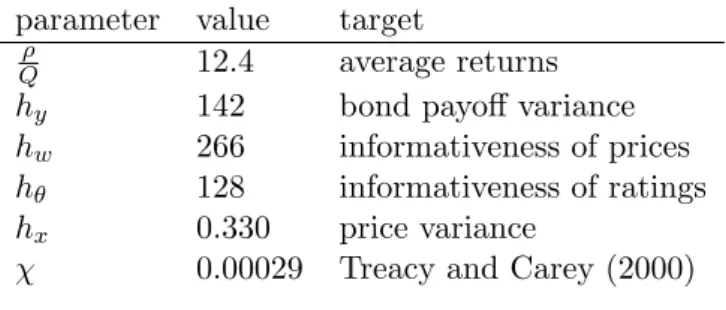
Table 1: Parameter values for numerical results. parameter value target
ρ
Q 12.4 average returns hy 142 bond payoff variance hw 266 informativeness of prices hθ 128 informativeness of ratings hx 0.330 price variance
χ 0.00029 Treacy and Carey (2000)
trading causes the price to vary and how much public information moves price around.
V ar(p) = ( 1 hy+hw+hθ )2[( ρ Q )2 1 hx +(hθ+hw) 2 hy +hθ+hw ] (25)
Notice thatρand Qalways enter as a ratio, implying that they are not separately identified in the model whenλ=Q.
The one other parameter we need to calibrate is the fixed cost of information discovery. Treacy and Carey (2000) report that the average cost of rating an asset is 0.0325% of the value of the issue, so we set the χ equal to 0.0325% times the average price of 0.91. Table 1 summarizes our parameter estimates.
Note that ratings are about as informative as prior beliefs. But public information is more informative than either. The variance of noise trader demand is quite high (lowhx) to account for
the relatively high variance of prices conditional on ratings, which the model interprets as resulting from noise.
Numerical results Given these parameters values, the optimal strategy for an asset issuer is not to disclose. The reason is that the issuer knows that all investors will buy the rating anyway. Thus, with or without mandatory disclosure, all investors are informed. A disclosure mandate simply transfers the amount of the ratings fee c from investors to issuers. These findings suggest that recent wave of mandatory disclosure policies benefit investors, at the expense of asset issuers. But they also tell us that the reform is not likely to affect market information or liquidity.
To see why all investors would choose to purchase the rating, consider the indifference condition for the marginal investor who decides whether or not to buy the rating. It tells us that the investor will buy the rating as long as the utility benefit (left-hand side) exceeds the utility cost (right hand
side): √
V ar(y|p)
V ar(y|θ) −1>exp (ρc)−1 (26) Consider the case where all investors buy the rating and examine the incentive of the last infinites-imal investor to buy the rating as well. Given our estimated parameters, which implyhp = 27.58,
the conditional variances of payoffs are √ V ar(y|p) V ar(y|θ) = √ hy+hw+hθ hy+hw+hp = √ 536 435.58 = 1.109.
If all investors buy the signal, the ratings agencies charge each investor c =χ/Q. Thus, exp(ρc) = exp(χρ/Q) = exp(12.4·.00029) = 1.004. Subtracting one and comparing these terms, we find that the utility benefit of the rating is 0.109, while the utility cost is 0.004. This means that, even when the value of information is at its lowest, when all other investors also have the information, the value of that information exceeds its cost by more than a factor of 25.
7
Conclusions
The paper investigated the welfare consequences of mandatory financial disclosures. It character-izes the types of assets for which a free market for information will provide reports to investors. Information could be produced and disclosed by an issuer who wants to make his project less risky and therefore more valuable to investors, so that it fetches a higher price at auction. Alternatively, analyst reports could be purchased by investors who want to know how much of the risky asset to buy.
When the private market provides information to most investors, mandatory disclosure will have little effect on most assets’ prices or on welfare. But in some instances, that private market does not provide information. In these cases, issuers are always better off without the disclosure mandate. Surprisingly, investors are often better off without the mandate as well. Investors’ welfare is maximized when no information about the asset payoff is available to anyone.
There are some limitations to interpreting these welfare results. This model included only two salent potential benefits of financial information: facilitating the allocation of productive capital and preventing the inefficient risk-sharing that comes with asymmetrically informed investors. These benefits must be weighed against the cost of information discovery and the loss of investors surplus when an asset becomes less risky. But there are other possible benefits of disclosure, such as
the ability to limit risk-taking by banks or portfolio managers or the ability to assess the risk of large pools of assets. There are also other possible problems with disclosures such as manipulation of reports, the possibility that firm disclosures crowd out some richer more nuanced sources of information, or outright fraud. None of these are incorporated in the model. Yet, the ability of disclosures to ameliorate asymmetric information problems and to improve the efficiency of asset prices are certainly two of the most widely-acknowledged benefits.
A maintained assumption in the model is that, unlike partial revelation through prices, direct leakage of information, for instance by investors who bought the analyst report sharing it with those who have not, can be effectively prevented by intellectual property laws. However, this might be hard to enforce due to technologies that make it easy to disseminate information. If information leakage cannot be prevented, analysts might not be able to sell enough copies of the information at a high enough price to pay for the fixed cost of information discovery. This would render the investor-pay market inviable through a far more direct channel than the model examines.
The degree to which information leakage is an insurmountable concern is a matter of debate. For the case of credit ratings, ratings agencies did mainly follow an investor-pay model until around the mid-twentieth century, and historical accounts differ on the relative roles played by regulation and technological progress (in particular, photocopying machines) in driving the shift towards an issuer-pay market (White, 2010). For other types of information such as equity analysis, the issue is even less clear. Analysts can try to take measures to prevent easy retransmission of information, such as delivering their reports in non-recorded oral communications, but whether these attempts are successful remains an open question.
If the threat of information leakage undermines the investor pay market, asset issuers would still prefer no regulation because then they can choose to disclose or not. Investors’ opposition to a disclosure mandate would now be unambiguous: Unregulated information markets would never result in asymmetric information. Therefore, if the mandate has any effect at all, it is to prevent there being no information available. But investors prefer to have no information available because more information reduces the expected return on the assets they buy.