Seton Hall University Seton Hall University
eRepository @ Seton Hall
eRepository @ Seton Hall
Seton Hall University Dissertations and Theses
(ETDs) Seton Hall University Dissertations and Theses
Spring 5-13-2020
Exploring New Jersey High School Athletic Trainers' Experience
Exploring New Jersey High School Athletic Trainers' Experience
and Perceptions Associated with a Multifaceted Approach to
and Perceptions Associated with a Multifaceted Approach to
Concussion Management
Concussion Management
James StavitzFollow this and additional works at: https://scholarship.shu.edu/dissertations
Part of the Medicine and Health Sciences Commons, and the Sports Studies Commons
Recommended Citation Recommended Citation
Stavitz, James, "Exploring New Jersey High School Athletic Trainers' Experience and Perceptions Associated with a Multifaceted Approach to Concussion Management" (2020). Seton Hall University Dissertations and Theses (ETDs). 2780.
Exploring New Jersey High School Athletic Trainers’ Experience and Perceptions Associated With a Multifaceted Approach to Concussion Management
BY
James Andrew Stavitz
Dissertation Committee
Dr. Genevieve Pinto-Zipp, PT, EdD, FNAP (Chair) Dr. Michelle L. D’Abundo, PhD, MSH, CHES
Dr. Deborah A. DeLuca, MS, JD
Submitted in partial fulfillment of the requirements for the degree Doctor of Philosophy
Department of Interprofessional Health Sciences and Health Administration Seton Hall University
Copyright © 2020 James Stavitz All right reserved
i
ACKNOWLEDGEMENTS
The pathway toward this dissertation has been circuitous. Its completion is thanks in large part to the special people who challenged, supported, and stuck with me along the way. I am tremendously fortunate to have committee members Dr. Genevieve Pinto-Zipp, Dr. Michelle D’Abundo, and Dr. Deborah DeLuca. Dr. Zipp served as my committee chair and brought a depth of knowledge that few could match. Her guidance and leadership is something that has been bestowed in her long before my commencement at Seton Hall University. I thank her supporting this project and always aiming to move me forward. Though it was daunting to write for a committee whose work I regard so highly, their support encouraged me to keep working. Dr. D’Abundo’s expertise on qualitative research always shined when I needed her most. Dr. DeLuca spent years practicing law and her ability to ask questions often brought me to a higher level-of-thought that I did not think I could reach and it always came at the right time. Thank you, also, to Joann Deberto, who was always there for support, despite her overwhelming responsibilities.
I would also to thank my family for their endless support. My wife, Brittany, has been my rock. She is my support system and my biggest cheerleader. There were sacrifices that needed to be made by both of us for me to complete this journey and she handled them with ease. I would also like thank my mother, Peggy. From as early as I can remember, she instilled the idea in me that I could accomplish anything I set my mind to. She has always supported my education and my goals. To the rest of my family: My dad, Dave, my brother, Russell, my two step-brothers, Stephan and Justin, my mother-and father-in law, Doreen and Nick, my sister-in-law and brother-in-law, Brynn and Frank, my aunts and uncles, and cousins who cheered me on throughout this, thank you. I would also like to thank my second family: Ryan, Michael,
ii
Thomas and Robert. Education means so much to me largely in part to the high standards you all hold for yourselves and that you have held for me, also. I thank you all for the part you have played, and continue to play, in my life.
iii
DEDICATION
iv
TABLE OF CONTENTS
ACKNOWLEDGEMENTS ... i
DEDICATION... iii
LIST OF FIGURES ... vi
LIST OF TABLES ... vii
ABSTRACT ... viii I CHAPTER I ...1 INTRODUCTION...1 Background ...2 Statement of Problem ...4 Purpose Statement ...5 Research Questions ...5 Theoretical Framework ...6 Chapter I Summary ...7 II CHAPTER II ...9 LITERATURE REVIEW ...9
Athletic Trainers Use of a Multifaceted Approach to Concussion Management ....9
Perceived Barriers andPressure ...9
Beliefs Associated ...10
College Athletic Trainer Multifaceted Concussion Management ...10
High School Athletic Trainer Multifaceted Concussion Management ...10
Theoretical Perspective ...11
Knowledge to Action Framework ...11
Chapter II Summary ...12
III CHAPTER III ...13
METHODOLOGY ...13
Aim of the Study ...13
Research Approach ...13
Study Design ...13
Participants and Sample ...14
Inclusion Criteria ...14 Recruitment ...15 Data Collection ...15 Study Procedures ...16 Data Analysis ...17 Interpretation ...19 Trustworthiness ...19 Summary of Methodology ...20 Ethical Considerations ...21 IV CHAPTER IV...23 RESULTS ...23 Demographics ...23
v
Themes ...27
Five overarching themes regarding experiences and perceptions associated with a multifaceted approach to concussion management ...27
Lack of standardization allows assessment, referral, and return-to-play experiences to vary significantly...28
Referral experiences vary pending upon athletic trainers’ ability to refer to a trusted and responsive physician ...33
Barriers include clearances from unqualified physicians ...36
Pressure from coaches, parents, and students to return students to play ...39
Benefits include increased knowledge and awareness resulting in more effective care for students ...42
Chapter IV Summary ...44
V CHAPTER V ...46
DISCUSSION ...46
Knowledge to Action Framework ...46
Interpretation and Conclusion ...47
Research Question 1 ...48 Theme 1 ...48 Theme 2 ...49 Research Question 2 ...51 Theme 3 ...51 Theme 4 ...52 Theme 5 ...53
Implications for Practice ...54
Study Limitations ...55
Suggestions for Further Research ...56
Dissertation Conclusion ...57
REFERENCES ...28
APPENDICES ...64
vi
LIST OF FIGURES
Figure 1. The Knowledge to Action Model, as depicted by Graham et al. (2006). ...7
Figure 2. Gender of Participants ...24
Figure 3. Location of Participants by New Jersey County ...25
Figure 4. Bachelors Degree of Participants ...26
vii
LIST OF TABLES
Table 1. Data Analysis of Themes ...27
Table 2. Theme One Codes ...28
Table 3. Theme Two Codes ...34
Table 4. Theme Three Codes ...37
Table 5. Theme Four Codes ...40
viii
ABSTRACT
EXPLORING NEW JERSEY HIGH SCHOOL ATHLETIC TRAINERS EXPERIENCE AND PERCEPTIONS ASSOCIATED WITH A MULTIFACETED APPROACH TO
CONCUSSION MANAGEMENT
James Andrew Stavitz Seton Hall University, 2020
Dissertation Chair: Dr. Genevieve Pinto-Zipp, PT, EdD, FNAP
Background: Concussions are a subset of mild traumatic brain injuries that have become a serious concern for high school athletes. An estimated 1.3 million sport- and recreation-related concussions occur in high school athletes each year in the United States. The actual incidence of sport-related concussions in U.S. high school athletes may be significantly higher, however, because this population underreports concussions at an estimated rate of 50 percent.
Athletic Trainers (ATC’s) are licensed healthcare professionals and have one of the strongest lobby's in the United States. This lobby is known as the National Athletic Trainers’ Association or NATA. When it comes to concussions and concussion management, the NATA has developed a non-binding position statement with reference to the treatment and management of concussion and concussion symptoms: NATA’s Position Statement: Management of Sport Concussion. This position statement is a multifaceted approach to which all ATC’s should be following. The problem is that concussions are prevalent in high school athletics and ATC’s are front line healthcare professionals managing the health of student athletes. The NATA position statement on concussion management only recommends a multifaceted approach, but there are no specific tests. Presently, the exploration of a multifaceted approach to concussion
management for athletic trainers has mainly been at the colligate level with little research looking at perceptions of athletic trainers at the high school level. It is important to note that
ix
currently this NATA position statement does not account for high school policies, student population, school budgets, resources or time.
Purpose: The purpose of this study is to explore New Jersey high school athletic trainers’ experience and perceptions associated with a multifaceted approach to concussion management.
Methods: This study used a general qualitative design since the problem needed to be explored and could be easily measured. Fifteen participants participated in the study and all were practicing certified athletic trainers who were currently working in a New Jersey high school for at least one year.
Data Collection and Analysis: Data analysis occurred concurrently with the data
collection process. Descriptive coding was used which analyzes descriptive words and phrases. Saturation was met at fifteen interviews and five overarching themes emerged from the data analysis.
Results: The 5 overarching themes regarding the exploration of New Jersey high school athletic trainers’ experience and perceptions regarding a multifaceted approach to concussion
management are as follows:
1. Lack of standardization allows assessment, referral, and return-to-play experiences to vary significantly.
2. Referral experiences vary pending upon athletic trainers ability to refer to a trusted and responsive physician
3. Barriers include clearances from unqualified physicians.
4. Pressure from coaches, parents, and students to return students to play.
5. Benefits include increased knowledge and awareness resulting in more effective care for students.
x
Conclusion: This study showed that the participants had significant varying experiences and perceptions regarding their multifaceted approaches to concussion management. However, there were many notable similarities in the experiences, pressures, barriers and benefits when applying their concussion protocol. There is so much research out there looking at concussions, the management of concussions, and the best practices to do so. However, there is little evidence looking at the experience and the perceptions of the individuals who are treating these injuries, especially at the high school level.
Key Words: qualitative research; concussion management; multifaceted approach; knowledge to action framework.
Chapter I. INTRODUCTION
Concussions are a subset of mild traumatic brain injuries that have become a serious concern for high school athletes (King, Brughelli, Hume & Gissane, 2014). An estimated 1.3 million sport- and recreation-related concussions occur in high school athletes each year in the United States (Broglio, Cantu, Gioia, Guskiewicz, Kutcher, Palm, & Valovich-McLeod, 2014). The actual incidence of sport-related concussions in U.S. high school athletes may be
significantly higher, however, because this population underreports concussions at an estimated rate of 50 percent (Collins, Kontos, Reynolds, Murawski, & Fu, 2014; Dompier, Kerr, Marshall, Hainline, Snook, Hayden, & Simon, 2015). The University of Pittsburgh Medical Center’s Sports Medicine Concussion Program (2019) notes that two out of every ten high school athletes who play a sport will sustain a concussion this year. Even more concerning is that 30% of these athletes return to play (RTP) the same day. Returning to play before the symptoms of
concussion have remitted increases the risk of additional concussion and even potential fatal brain swelling (Carson, Lawrence, Kraft, Garel, Snow, Chatterjee, ... & Frémont, 2014). The high incidence of concussions in U.S. high school athletes is a significant problem, because concussions are serious health issues that affect multiple regions of the brain, including but not limited to balance, proprioception, and neurocognitive functioning (Broglio et al., 2014).
Concussion symptoms may include unstable vision, difficulty focusing, motion
discomfort, difficulty negotiating visual environments, headaches, nausea, sensitivity to bright lights and sounds, and balance and proprioception issues (Collins, et al., 2014). Additionally, a concussion may permanently or temporarily disrupt communication between the central nervous and peripheral nervous systems, causing moderate to severe postural instability (Guskiewicz,
Echemendia, & Cantu, 2011). If an athlete returns to play before concussion symptoms have completely remitted, consequences may include a heightened risk of additional concussion, exacerbation of concussion symptoms, an increased likelihood that concussion symptoms will become permanent, and potentially fatal brain swelling if a second concussion occurs (Carson et al., 2014). These risks make it necessary that all athletes who have suffered concussions be thoroughly and accurately assessed as symptom-free before they return to play (Broglio et al., 2014; Carson et al., 2014).
Background
Broglio et al. (2014) states that athletic trainers (ATCs) are among the practitioners who assess and treat concussions in high school athletes. In high school athletics, the athletic trainer is typically first on the scene of a concussion, first to assess the athlete, and, in many instances, the primary provider of subsequent treatment, management, and return to play decisions. In most states, there is legislation requiring that a student athlete who has suffered a concussion be evaluated and cleared by an athletic trainer or healthcare provider before he or she can return to play (Samson, 2018). One such document is the New Jersey Policy and Guidance for Prevention and Treatment of Sports-Related Concussions and Head Injuries (New Jersey State Law, 2010). Upon closer scrutiny, the document only suggests that healthcare professionals follow the objective guidelines. These guidelines are not laws, only suggestions. However, there is currently no documented, standardized assessment protocol that athletic trainers and healthcare providers are required to follow in making return to play decisions for athletes who have sustained concussions.
In its 2014 position statement on a multifaceted management of sport concussion, the National Association of Athletic Trainers (NATA) made the non-binding recommendation that
athletic trainers implement a multiday and multifaceted approach to determine whether an athlete who has suffered a concussion can return to play: NATA’s Position Statement: Management of Sport Concussion. The purpose of the NATA’s multifaceted approach to concussion
management is to give guidance and consistency in the assessment and management of concussions for all practicing athletic trainers. The NATA position statement (2014) on
concussion management has suggested that prior to the athletic season, athletes at all levels are recommended to take baseline neurocognition and sensorimotor assessments. These assessments are re-introduced post-trauma and the objective numbers are compared, as well as the monitoring of symptoms and progressing in activity, regardless of which particular measures the provider chooses.
Currently, there are documentations that state athletic trainers must follow this exact protocol. However, it has become the gold standard and certain organizations, like the National Football League (NFL Health & Safety, 2016), have set policies in place so that a particular procedure must be followed prior to letting an athlete return to the field. In most professional sports, if the procedures are not followed appropriately, a hefty fine will be imposed (NFL and NFLPA Policy to Enforce Concussion Protocol, 2016).
Broglio et al. (2014) note that a multifaceted approach for concussion management provides a means to enhance evidence-based care for athletes. As athletic trainers are often the most knowledgeable person on the scene of an athletic injury, decision-making may fall solely on their shoulders. Concussion management training for athletic trainers is essential. Both the Board of Certification (BOC) and Commission on Accreditation of Athletic Training Education (CAATE) developed guidelines towards comprehensive training to equip athletic trainers with the skills to manage a multifaceted approach. Athletic trainers’ adherence to these guidelines
can prevent premature return-to-play, but there is evidence that high school athletes are
frequently cleared for return to play while they are still symptomatic, because guidelines such as those in NATA’s Position Statement are not being followed (D’Lauro, Johnson, McGinty,
Allred, Campbell, & Jackson, 2018; Meier, Brummel, Singh, Nerio, Polanski, & Bellgowan, 2015).
Identifying experiences and perceptions associated to the implementation of NATA’s multifaceted position statement regarding concussion management would contribute to addressing and removing barriers and challenges, and therefore ensuring the safety of high school athletes who have suffered concussions. However, it is unknown how high school athletic trainers perceive a multifaceted approach to concussion management, or what challenges, barriers, and pressures may be preventing high school athletic trainers from following or applying the guidelines.
Statement of Problem
Approximately 1.3 million concussions are reported in U.S. each year (Broglio et al., 2014) and an estimated 50 percent of concussions in high school athletes may be unreported (Dompier et al., 2015). Allowing an athlete to return to play before concussion symptoms have completely remitted creates the risk of an additional concussion, exacerbation of concussion symptoms, an increased likelihood that concussion symptoms will become permanent, and potentially fatal brain swelling if a second concussion occurs (Carson et al., 2014). It is therefore of the utmost importance that a standardized and validated protocol for assessing concussion symptoms be consistently and rigorously implemented in determining when high school athletes can return to play (Broglio et al., 2014; Carson et al., 2014).
Athletic trainers frequently assess and treat concussions in high school athletes, and often serve as the primary treatment manager and decision-maker in clearing a high school athlete to return to play (Broglio et al., 2014). The National Athletic Trainers Association (NATA) has published guidelines in the form of a five-day protocol for assessing concussion symptoms in athletes and making return to play decisions (Broglio et al., 2014). Athletic trainers’ consistent
following of this protocol would reduce the number of high school athletes who return to play prematurely (Broglio et al., 2014). However, there is evidence that high school athletes are frequently cleared prematurely for return to play because assessment guidelines such as NATA’s are not being followed (D’Lauro et al., 2018; Meier et al., 2015). Identifying perceived barriers to the implementation of the NATA’s Position Statement guidelines would contribute to
addressing and removing those barriers, and therefore ensuring the safety of high school athletes who have suffered concussions. However, it is not known how high school athletic trainers perceive NATA’s guidelines, or what perceived barriers are preventing universal
implementation.
Purpose Statement
The purpose of this study is to explore New Jersey high school athletic trainer’s
experience and perceptions associated with a multifaceted approach to concussion management.
Research Questions
Creswell and Creswell (2018) note that in qualitative research, the research questions assume two forms: Central questions and associated sub-questions. The central questions are the overarching questions that asks for the exploration of the central concept of the study in which the researchers recommend 1-2 central questions. The associated sub-questions are more narrow questions that will help formulate the items asked during the data collection. Creswell and
Creswell (2018) mention that you can have up to five - seven sub-questions, however, the more questions you have, the more challenging the study may become so three - five questions in total is ideal. Two central questions and three associated sub-questions were used to guide this study:
Central Questions
1. What are New Jersey high school athletic trainers’ experiences associated with a multifaceted approach to concussion management as defined by the NATA Position Statement/NJ State Law?
2. What are New Jersey high school athletic trainers’ perceptions associated with a multifaceted approach to concussion management as defined by the NATA Position Statement/NJ State Law?
Associated Sub-Questions
3. What are New Jersey high school athletic trainers’ perceived barriers associated with a multifaceted approach to concussion management, as defined by the NATA Position Statement/NJ State Law?
4. What are New Jersey high school athletic trainers’ perceived pressures associated with a multifaceted approach to concussion management, as defined by the NATA Position Statement/NJ State Law?
5. What are New Jersey high school athletic trainers’ perceived benefits associated with a multifaceted approach to concussion management, as defined by the NATA Position Statement/NJ State Law?
Theoretical Framework
Knowledge transfer is the transfer and exchange of information into different areas of science. In healthcare, it involves interactions between scientists, doctors and patients. There
are many models of knowledge translation. One frequently cited model first described by
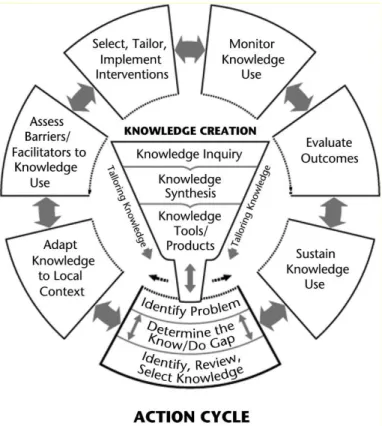
Graham, Logan, Harrison, Straus, Tetroe, Caswell and Robinson (2006) called the Knowledge to Action Model, or Knowledge to Action Framework, is guiding this research. The Knowledge to Action model divides knowledge translation into two parts, including the knowledge creation funnel and the action cycle. Knowledge creation begins with the inquiry of knowledge,
knowledge synthesis followed by knowledge tools and products. The action cycle identifies the steps required for a unit of knowledge to reach widespread use. The cycle is dynamic and can perform in any order. Figure 1 is a visual representation of the model:
Figure 1. The Knowledge to Action Model, as depicted by Graham et al. (2006).
Chapter I Summary
Broglio et al. (2014) note that a multifaceted approach for concussion management was developed as a means to enhance evidence-based care. Athletic trainers at the high school level
play a major role in the diagnosis and management of concussion and are usually the
lone-medical-provider. It is important that researchers understand this at the college level, but it is just as, if not more important at the high school level considering the sensitivity of the adolescent brain (Arain, Haque, Johal, Mathur, Nel, Rais, A.,… Sharma, 2013). In order to support
evidence-based management of concussion amongst all practicing athletic trainers, the NATA’s multifaceted concussion-management position statement is used as a guide. It was the intent that this approach would provide direction to the practicing athletic trainer in their decision-making (Broglio et al., 2014).
We have limited evidence suggesting that a multifaceted approach to concussion
management is being used (Murphy, et al., 2012). Given the fact that athletic trainers, especially at the high school level, play a major role in the diagnosis and management of concussions, we must first find what their experience and perceptions are associated with a multifaceted approach to concussion management. The further we understand our high school athletic trainer’s
experiences and perceptions in concussion management, the further we can help address issues associated with concussion management and improve its inequity (Rigby, Vela, & Housman, 2013).
Chapter II.
LITERATURE REVIEW
This chapter provides an in depth review of the literature specific to athletic trainers and their perceived barriers and pressures associated with employing current concussion management protocols. Understanding this unique population of health care professionals’ perceptions in relation to their experiences with a multifaceted approach to concussion management laid a strong foundation for the need to further explore this question.
Most recently, Bacon, Cohen, Kay, Tierney, and McLeod (2018) explored the perceived challenges towards concussion management of athletic trainers in secondary school settings across the US. They found that athletic trainers in secondary schools noted time and personnel challenges were a big component of the perceived challenges. They also noted that there was a perceived lack of access to a concussion specialist as a referral source. Surprisingly, the ATs perceived that a lack of education on the management of concussion and understanding of the demands of student-athletes is present among community medical doctors. Parents, coaches, and teachers were found to be potential barriers, as well. Some parents were more aware of their child's wellbeing due to media coverage, movies and education resources; the public perception is identified as a big challenge, as well. The ATs own experience level were considered to be a challenge since current practices are not similar to what was done in past and thus leading to ATs with varying levels of knowledge practicing in the schools.
Kroshus, Baugh, Danesvar, Stamm, Laursen, and Austin (2015) explored the pressures placed on sports medicine clinicians to return college athletes to play after concussions
prematurely. They found that nearly two thirds of participants experienced pressure from
other clinicians. Researchers found greater pressures from coaches when the athletic programs themselves were under scrutiny and female clinicians report greater pressure from coaches than their male counterparts.
Rigby, Vela, and Housman (2013) explored athletic trainers' beliefs toward a
multifaceted approach to concussion management using the Theory of Planned Behavior to guide their research inquiry. They found that attitudes towards the behavior, and perceived behavior control, were the most influential constructs. ATs with positive attitudes toward concussion-management recommendations were found to be more likely to implement them. Conversely, ATs were less likely to implement concussion management recommendations when they did not believe they had the resources or power to do so.
Kelly, Jordan, Joyner, Burdette, and Buckley (2014) explored NCAA Division I athletic trainers' concussion-management practice patterns. They found that the majority of Division I athletic trainers used a multifaceted approach at baseline, during the acute phase of the injury, and to determine return-to-play status. Baugh, Kroshus, Stamm, Daneshvar, Pepin, and Meehan (2016) examined athletic trainers and sport medicine physician’s clinical practices in collegiate concussion management. They found that almost all of administered baseline exams, mainly to high-risk athletes (football, hockey and rugby athletes…etc.). Interestingly, computerized neurocognitive and balance testing were the most common assessments used. The researchers also noted that Division I, II and III athletes returned-to-play anywhere from nine to 10 days post-diagnosis.
Murphy, Kaufman, Molton, Coppel, Benson and Herring (2012) explored concussion evaluation methods among Washington State high school football coaches and athletic trainers. They found that roughly half used the Sport Concussion Assessment Tool (SCAT), a
multifaceted assessment tool, for on-the field assessment. The researchers noted that one third of the participants indicated that they did use a neurocognitive assessment, pre and post-diagnosis, whereas two thirds noted that they did not. Interestingly, those with 10 years’ of experience, or more, were less likely to use a neurocognitive test during the concussion management process. Yard and Comstock (2009) assessed compliance with return to play guidelines following concussions in high school athletes throughout the United States. The researchers reported that nearly one half of the concussed high school athletes’ returned-to-play prematurely under nationally recognized return-to-play guidelines, one being the NATA position statement on concussion management.
Theoretical Perspective
Theory is used to guide research and frame the research study. In this study, Knowledge to Action Framework by Graham, et al., (2006), was used to inform the research questions, the purpose of the study, and develop the interview guide. It also was used as a lens to interpret the findings.
Knowledge to Action Framework
The Knowledge to Action Framework was established in response to the unclear array of
terms used to define the course of moving knowledge into action. Graham, et al. (2006) studied
31 planned action theories regarding the process-of-change. Most of the theories were
interdisciplinary in nature or emerged from nursing literature between 1983 and 2006. Their
findings informed their conceptual framework development, which proposed the need for
simplicity in explaining the Knowledge to Action cycle.
Graham and colleagues (2006) mention that the Knowledge to Action Framework
Cycle. Each element involves several phases which intersect and can repeat. The researchers
describe the phases as “dynamic” and “can influence each other” (p. 20). The action segments
may be carried out consecutively or concurrently while the knowledge phases may influence the
action phases. The Action Cycle frameworks a process on behalf of the events required for
knowledge to be useful in practice. Knowledge is modified to the local situation and barriers and
facilitators to its use are openly evaluated. The contribution of stakeholders, and adapting
knowledge to the needs of these individuals who are going to apply the knowledge use, is
essential.
Summary
In summary, current data has explored the knowledge, perceptions and application of the multifaceted approach to concussion management for athletic trainers working at the colligate level. However, to date a limited understanding exists based upon the literature specific to the level of experience, perceptions of and application of high school athletic trainers, regarding the multifaceted approach to concussion management. Thus, possessing a major concern for the AT profession, coaches, parents and high school athlete as the sole purpose of the high school ATs is to protect adolescent athletes.
Chapter III. Methodology Aim of the Study
The purpose of this study is to explore New Jersey high school athletic trainer’s
experience and perceptions of a multifaceted approach to concussion management. Chapter III includes an in-depth description of this study’s methodology and design, followed by
descriptions of the study sample and recruitment procedures. Next, this chapter includes descriptions of the data collection and data analysis procedures, followed by a discussion of the procedures that strengthen the trustworthiness of the study’s results. This chapter then includes a
description of ethical considerations relevant to this study, followed by a summary.
Research Approach
A qualitative methodology was used in this study based upon the lack of literature on the topic. A qualitative methodology is appropriate when the researcher wishes to conduct an open-ended exploration of a phenomenon through the reported perceptions and experiences of people who are familiar with that phenomenon (Creswell, 2013; Liu, 2016; Percy, Kostere & Kostere, 2015).
Study Design
Traditionally, there are five qualitative designs, including case study, ethnography, narrative, grounded theory, and phenomenology (Creswell, 2012) however, given that this study did not fit into one specific design it can be characterized as a general qualitative design.
In this study, the researcher explored New Jersey high school athletic trainer’s
experiences and perceptions associated with a multifaceted approach to concussion management. The PI was specifically interested in taking a deeper dive into understanding what those who are
practicing in New Jersey have in relation to one another. Creswell and Creswell (2018) note that qualitative generalization is a term used in a limited way in qualitative research, since the intent of this form of inquiry is not to generalize findings to individuals, sites, or places outside of those under study. In fact, the value of qualitative research lies in the description and themes
developed in the context of a specific area-of-study. Particularity, rather than generalizability, is the “hallmark for good qualitative research” (Creswell & Creswell, 2018, p. 278).
Using a general qualitative design the researcher developed a description of experiences and perceptions associated with a multifaceted approach to concussion management, as defined by the NATA position statement on concussion management, which emerged from the
experiences and perceptions of the representative sample of athletic trainers (Percy et al., 2015). Information-rich descriptions noted in this study will be relevant to practitioners and researchers who are interested in ensuring the safety of high school athletes who have suffered concussions.
Participants and Sampling
This study used criterion sampling as the PI was looking for a specific group of New Jersey clinicians that meet the study criterion. The PI used the NATA New Jersey mail list to reach NJ ATs via a letter of solicitation (LOS). Additionally, the LOS asked that the letter of solicitation be shared with other ATs in New Jersey high school setting. The PI was looking for approximately 15 subjects, or until saturation was reached and no novel themes had emerged from the data collection (Creswell, 2013).
Inclusion Criteria
The inclusion criteriaincluded the following: All participants must be board certified and New Jersey licensed athletic trainers practicing in a high school setting. All participants must be 18 years of age and proficient in speaking the English language. All participants must report that
have been employed at their current position for at least one year, and, because this is a homogeneous group, all participants must report that they are treating, or permitted to treat, concussion patients according to their school policy. The exclusion criteriais the contrary of the inclusion and membership in any population designated as vulnerable by Seton Hall University’s
Institutional Review Board (IRB).
Recruitment
The researcher contacted the NATA New Jersey representative (District 2) and asked for permission to send an email blast with the letter of solicitation (LOS) and link to the prescreen survey. The NATA membership database filtered potential participants by selecting the
individuals that were New Jersey athletic trainers and working in a high school setting. Of that, 342 member emails were sent out January 7, 2020, January 21, 2020 and February 4, 2020. Out of the 342 members that were contacted, 33 inclusion surveys were started, 25 were finished and 20 provided an email to reach out and schedule an interview.
Data Collection
Data collection occurred in two steps: The first step included a letter-of-solicitation (LOS) with link to a prescreen survey with inclusion criteria. In order to ensure that all potential participants met the inclusion criteria, the PI developed a prescreening survey via Qualtrics™, which ask the participants to respond to questions specific to the inclusion status. If participants responded “yes” to all questions and were interested in participating in the survey, they were
instructed to provide an email address when submitting the Qualtrics™ survey. The PI received and reviewed all completed surveys. For those individuals meeting the inclusion criteria and submitting an email address, the PI contacted them via email to arrange for study consent and to schedule an interview.
Study Procedures
Data collection used a semi-structured interview approach. Seidman (2013) notes that a semi-structured approach provides key questions and allows flexibility to expand on information that emerges throughout the interview. There were twelve interview questions, with probes, for further expansion. The interviews were approximately 90 (ninety) minutes in length, conducted face-to-face, and recorded for post-verbatim transcription.
At the time of the interview, the PI briefly reviewed the purpose of the study to refresh the participant’s memory. Next, the PI reviewed the terms of the informed consent form with the
participant and asked if he or she had any questions. When all questions were answered to the participant’s satisfaction, the researcher requested that he or she print and sign the emailed
informed consent form and email a scan or photo of the signed document to the PI. Next, the PI asked for the participant’s consent to turn on the audio-recorder. Once consent was given, the audio-recorder was turned on.
Guiding the interview was a protocol consisting of open-ended questions formulated based on NATA’s Position Statement: Management of Sport Concussion (Broglio et al., 2014).
If the participant answered the scripted questions too briefly, too vaguely, or otherwise without providing adequate data, the PI asked probing and follow-up questions to elicit more
information. In a general qualitative study, it is desirable for data to include rich and detailed accounts of the participants’ perceptions and lived experiences (Liu, 2016). Therefore, the PI attempted to elicit as much description and detail from participants as the interview duration allowed. After the PI asked all of the scripted questions, the PI asked the participant if he or she had anything he or she would like to add and if there were any further questions or concerns (Tobin & Begley, 2004; Lincoln & Guba, 1985).
The PI requested the participant’s permission to email him or her the transcript of the interview for him or her to review and correct if needed. Next, the PI ensured that the participant had the appropriate contact information in case any issues or questions related to the study arose. Lastly, the PI thanked the participant for his or her time and concluded the interview (Tobin & Begley, 2004; Lincoln & Guba, 1985).
Data Analysis
This research was inductive in nature and the data analysis began after the first interview had been completed and continued to occur at the same time as the interviewing process. Data analysis was inductive and thematic using the six-step procedure for data analysis developed by Braun and Clarke (2006). Use of this procedure allowed themes to emerge inductively from the data without the PI imposing any themes. The six steps of the analysis included :
1. Reading and rereading the data to gain familiarity with it;
2. First cycle coding using the elemental method, descriptive coding which group descriptive codes and phrase;
3. Category generation and theme creation;
4. Peer review for inter-coder agreement and validity and reliability of themes; 5. Develop, define, reviewing and refining the themes;
6. Interpretation and reporting of the results.
In summary, data analysis began with reading, and rereading, the data to gain familiarity (Creswell, 2013) as well as transcribing the recorded interviews, verbatim, to assure accuracy. The PI, personally, coded the transcribed interview data for analysis instead of using a computer software. As a novice researcher, the PI believed that conducting the analysis independently provided for a much better understanding of the emerging themes.
Once initial codes were established and common categories were generated, themes were created and two professional content experts (a certified and New Jersey Licensed athletic Trainer and an orthopedic surgeon, fellowship-trained in sports medicine) were used to read over the interview transcripts and review codes for code agreement (consensus reaching established), in order to establish validity and reliability. After all codes were created, the PI established themes to better understand the major experiences and perceptions associated with a multifaceted approach to concussion management. Again, consensus reaching was established by the 2
experts for all themes and they then were used to interpret the findings and address the research questions.
Saldaña (2016) explains that the analytic goals of data analysis are to develop an overarching theme from the data. Braun and Clarke (2006) explain how reflective analysis allows the researcher to document close reflections of potential findings and implications of the research study. The PI did this by keeping a reflective journal, which was useful for reflecting on emergent patterns, themes and concepts.
Creswell (2013) suggests coding based on the themes that emerge from the data. This inductive approach means the PI did not use pre-existing themes that were developed before the interviews took place, and instead looked to see what came from the actual interviews. This allowed for more flexibility in analysis and did not force the PI to fit the data into categories or themes (Creswell, 2013; Gale, Gemma, Cameron, Rashid & Redwood, 2013; Taylor-Powell & Renner, 2003). Similar codes were grouped together to develop categories that represent a common idea (Creswell, 2013; Durdella, 2018).
Interpretation
Finally, after generating different codes from the interviews, these codes (categories) were placed into themes and the data was analyzed using the theoretical frame that the PI had selected, Knowledge to Action Framework, in which Creswell (2013) recommends five to six themes be developed.
Trustworthiness
The trustworthiness of qualitative results were enhanced by ensuring that the four elements of trustworthiness identified by Lincoln and Guba (1985) were meet. The four elements of trustworthiness are credibility, transferability, dependability, and confirmability. These four elements are analogous to the quantitative constructs of internal validity, external validity, reliability, and objectivity, respectively (Lincoln & Guba, 1985). Validation and trustworthiness are ways to argue the research findings are worthy of attention. Researchers refined this concept, by introducing the aforementioned criteria of trustworthiness (Tobin & Begley, 2004; Lincoln & Guba, 1985). To add, Creswell (2013) notes that it is important that the research be recognized as familiar and understood as legitimate, by researchers, practitioners, policy makers, and the public.
The PI achieved credibility by conducting peer debriefing to provide an external check on the research process, as well as member checking to test the findings and interpretations with the participants (Tobin & Begley, 2004; Lincoln & Guba, 1985). The PI provided thick descriptions, so that those who seek to transfer the findings to their own site can judge transferability (Lincoln & Guba, 1985). The PI established dependability via Audit Trails (Sandelowski & Barroso, 2002). Sandelowski and Barroso (2002) stated that a study and its findings are auditable when another researcher can clearly follow the decision trail. Koch (1994) argued that another
researcher with the same data, perspective, and situation could arrive at the same or comparable, but not contradictory, conclusions. PI achieved this by keeping records of the raw data, field notes, transcripts, and a reflective journal to help systemize, relate, and cross-reference data, as well as ease the reporting of the research process. Confirmability was established when
credibility, transferability, and dependability were all achieved. (Tobin & Begley, 2004; Lincoln & Guba, 1985). To add, Creswell (2013) mentions that trustworthiness is built throughout the entire interview process.
Finally, the PI used audit trails to ensure trustworthiness and credibility as suggested by Lincoln and Guba (1985). Audit trails consist of physical and intellectual audits (Carcary, 2009; Koch, 1994). Intellectual audits include record keeping of the researcher’s thoughts and thinking
processes during the complete research process. Physical audit trails consist of all the documents used in the research and record of the decisions and methods used (Koch, 1994). Carcary (2009) suggested that audit trails were useful and effective in enhancing the trustworthiness of
qualitative research, especially in the case of novice researchers. To increase the trustworthiness and credibility of this research an audit trail was used (Carcary, 2009; Koch, 1994; Sandelowski, 1986).
Summary of Methodology
In summary, data collection did not begin until the PI received Seton Hall University’s Institutional Review Board approval. Then the researcher began to recruit participants. Once identified, the participants had to complete the demographic survey and schedule their interview. Each participant has a code name that was the only way to connect the interview with the
prescreening information in order to ensure confidentiality. All data collection was through one-on-one, face-to-face, semi-structured interviews and lasted approximately 90 minutes.
Interviews were guided by an interview protocol consisting of approximately 12 open-ended questions, with follow-up questions (probes) being formulated and asked as necessary when responses to scripted questions do not provide sufficient data (Creswell, 2013; Durdella, 2018).
Finally, all interviews were audio-recorded and the recordings were transcribed, verbatim, within 48 hours of the interview. The PI then analyzed the data (see data analysis
section, below). Participant recruitment, data collection, and data analysis had occurred
concomitantly until data saturation. Data saturation occurred when additional data collection and data analysis yielded no new significant information (Creswell, 2013; Fusch & Ness, 2015).
Ethical Considerations
Participants who reported that they were members of a population designated by the Seton Hall University IRB as vulnerable were excluded from the study. IRB approval was obtained before participant recruitment began and all participants signed the informed consent form before any data was collected (Appendix A). The informed consent form indicated the following:
Participation is completely voluntary;
Participants can choose to leave the study at any time or decline to answer any interview question for any reason, and they do not need to state the reason;
There will be no consequences for withdrawal from the study or for declining to answer any questions;
There will be no benefits or rewards for participating in the study, other than knowing the results might be used to help remove barriers to ensuring the safety of high school
athletes, and;
The PI recruited participants with whom he has no other relationship with. To add, participants’ identities were kept confidential and interview transcripts were de-identified through the removal of participants’ names and any other identifying details, including but not
limited to the name of the employing high school and its specific geographic location.
Pseudonyms replaced the participants’ names in all work products related to the study. The only two places where participants’ real names appeared, were on their signed consent forms and on a
handwritten key, which indicated which pseudonyms corresponds to which real names. All data collected is kept on a single, password-protected, USB flash drive. This flash drive is kept under lock-and-key. Recordings have been deleted from the recording device as soon as they were uploaded onto the password protected hard drive. The signed consent forms and the handwritten key are in a locked drawer to which only the PI has access. No copies are made of the handwritten key. The data collected is kept and stored away with lock-and-key and will remain this way for 3 years. After this 3-year period has lapsed, the USB flash drive and all remaining documentation will be shredded and disposed of properly.
CHAPTER IV RESULTS
The purpose of this study was to explore New Jersey high school athletic trainers’
experiences and perceptions associated with a multifaceted approach to concussion management. To achieve this, a generic qualitative approach was used, involving semi-structured interviews with high school athletic trainers currently employed in New Jersey. Use of a general qualitative approach allowed for an open-ended exploration of participants’ experiences and perceptions of a multifaceted approach to concussion management (Percy et al., 2015). The following section of this chapter includes a description of the participants. Next, this chapter includes a
presentation of the results of data collection and analysis, organized by themes that emerged and the research questions that they addressed. The presentation of the results starts with Theme 1 and moves on chronologically. Of note, throughout this chapter, participants are designated by alphanumeric codes (i.e., P1, P2, etc.) to maintain confidentiality.
Demographics
Based on gender, 60% of the participants were males, while 40% were females (Figure 2). The National Athletic Trainers Association (NATA) reports that 45% of the members are males, so this number is higher than the national breakdown of certified athletic trainers.
Figure 2. The pie graphic illustrates the representation of males and females in the study.
An exact geographic location was not asked of each participant. Instead, he or she was asked what county they practiced in. The majority of the participants came from the northeastern part of New Jersey and a small percentage from central New Jersey (Figure 3).
Males 60% Females 40% n = 15 GENDER
Figure 3: The pie graphic illustrates the percentage of participants from each representation New Jersey County
Each participant was asked whether their athletic training degree was received as a Bachelor’s or Master’s degree. Currently, there are programs offered at both levels that allow an
individual to graduate with an athletic training degree and sit for the board exam to become a certified AT. While historically there were more Bachelor degree programs offering athletic training, there is currently a transition underway in the way ATs are educated (Bowman,
Mazerolle, & Barret, 2017). Beginning in 2022, bachelor programs will be phasing out, with the last freshman class being admitted that year. After 2022, all athletic training education programs will have to be Master’s level in order to stay compliant with CAATE standards (Bowman et al.,
2017).
In this study, 80% of participants, or 12 of the 15, received their Bachelor’s degree in athletic training, 13% of participants, or 2 of the 15, received their Bachelor’s degree in Exercise Science or Exercise Physiology and 7% of participants, or 1 of the 15, received their Bachelor’s
Bergen 20% Burlington 6% Essex 27% Ocean 7% Sussex 13% Union 20% Morris 7%
Participant Location Throughout New Jersey County
Degree in Health and Physical Education (Figure 4). Participants were also asked their highest degree they held. In this study, 60% of participants, or 10 of the 15 held advanced degrees, one of them being a terminal degree and the others being Master’s degrees. The remaining
participants held their highest level of education at the Bachelor’s level (Figure 5).
Figure 4: The pie graphic illustrates the participant’s reported Bachelor’s degree.
Figure 5: The pie graphic illustrates the highest degree held by each participant in this study Athletic Training 80% Exercise Science 13% Health and PE 7% Undergraduate Degree Bachelors 33% Masters 60% Doctorate 7%
Themes
Five major themes emerged during data analysis to address the research questions. The codes grouped to form them are indicated in the table included in the discussion of each theme. The presentation of each theme also includes direct quotations from the data as evidence for the findings so the reader can independently confirm them. The inclusion of direct quotations will also assist future researchers in assessing transferability by providing a rich description of the data in participants’ own words. Table 1 indicates the major themes that emerged during data
analysis and the number of transcript excerpts included. Table 1.
Data Analysis Themes
Theme Number of transcript
excerpts included Theme 1: Lack of standardization allows assessment, referral, and
return-to-play experiences to vary significantly
67
Referral experiences vary pending up athletic trainers’ ability to refer to a trusted and responsive physician.
15
Theme 3: Barriers include clearances from unqualified physicians 43
Theme 4: Pressure from coaches, parents, and students to return students to play
15
Theme 5: Benefits include increased knowledge and awareness resulting in more effective care for students
18
In the following presentation of results, study findings are organized by the addressed research question to demonstrate their alignment with the study objectives. Within the discussion of each research question and sub-question, findings are organized by emergent themes. As discussed previously in this section, the emergent themes have been named and defined to indicate their relevance to address the research questions and sub-questions.
RQ1: What are New Jersey high school athletic trainers’ experiences associated with a multifaceted approach to concussion management as defined by the NATA Position Statement?
Two major themes emerged during data analysis to address this question. The first theme was: Lack of standardization allows assessment, referral, and return-to-play experiences to vary significantly. The second theme was: Referral experiences vary pending up athletic trainers’ ability to refer to a trusted and responsive physician. Discussion of each theme is presented in the following sub-sections.
Theme 1: Lack of standardization allows assessment, referral, and return-to-play experiences to vary significantly.
When participants described their current approaches to concussion management in general terms, their descriptions were consistent. However, when participants described specific triggering conditions for steps in the procedure, their responses varied significantly. Participants attributed uncertainties about best practices to the lack of a mandated, standardized approach to concussion management. Table 2 indicates the codes grouped to form this theme, the number of participants who contributed to each code, and the number of transcript excerpts included in each code. Table 2 Theme 1 Codes Code Number of participants contributing Number of transcript excerpts included Varying perceptions of state guidelines 12 19
Inconsistent referral policies 10 19 Inconsistent assessment practices 10 18 Inconsistent return-to-play policies 10 15
All participants reported that their current procedure for assessing student athletes for concussion involved an initial, on-field assessment using a standardized instrument such as the state-issued form. Participants were able to articulate in broad outline the procedures they used when concussion symptoms were detected, including informing parents, recommending or requiring that the student’s parents obtain a physician’s assessment, implementing academic
accommodations, and temporarily suspending the student’s athletic participation. P1 summarized this common procedure as follows:
“What we're using [for on-field assessments] is a written document that has been provided by the State of New Jersey. It's a one-page sheet that describes the signs and symptoms of a concussion and the appropriate actions that should be taken should the student athlete exhibit any of those signs or symptoms. Once those signs and symptoms are presented to a school official, the next step is to run it through the athletic trainer, who describes the policy to the parents and [informs the parents] that the child needs to be evaluated by a physician trained in concussion management.” (P1)
Comparison of responses across participants indicated significant inconsistencies in their knowledge and implementation of practices, however. First, participants differed in the
approaches they used to detect concussion symptoms during the on-field assessment, and they expressed differing levels of confidence in the instruments they currently used. P9 believed the SCAT-5 was too easy to pass: “Unfortunately, the SCAT is a great resource, but I feel like most
kids even with a concussion can do very well on the SCAT form.” P9 therefore relied on heuristics based on his own experience to supplement the SCAT in detecting concussion
symptoms. In contrast, P2 perceived the SCAT’s assessment of cognitive and motor functioning as almost infallible:
“I will use an on-field evaluation such as the SCAT . . . Most athletes know how to fake [not having a concussion] till they make it, [but] you can't fake your cognitive or your motor [function], so it's important that it's not just, ‘Do you have blurry vision? No? Okay, you're ready, you can go back.’” (P2)
P10 described his school’s concussion assessment procedures as multifaceted, but he expressed that by “multifaceted” he meant that the procedure involved several kinds of informal
assessment, including trying to establish a baseline retrospectively by speaking with people who knew the student well:
“From an assessment standpoint, you really have to use a multifaceted approach. You can't just rely on if they have a headache or not. There's just so many other things that can be affected. So, looking at the sense of balance, talking to the parents, talking to people who see [the injured athlete] on a day-to-day basis. Giving them some set time as well, if they do not have a headache five or ten minutes after the injury, but 24 hours post-, now it is a different story. So, you definitely have to make sure that your diligence and making sure that you are, you know, you take a multifaceted approach.” (P10) Thus, assessment procedures and confidence in those procedures varied significantly between participants. Similar inconsistencies emerged from participants’ responses describing when a physician referral was necessary or appropriate for students who exhibited symptoms of concussion. Some participants believed a physician referral in such cases was an immediate legal requirement, because they had the misconception that the New Jersey Policy and Guidance for Prevention and Treatment of Sports-Related Concussions and Head Injuries was a
For example, P11 stated, “By law in New Jersey, [students athletes exhibiting signs of concussion] need to be seen and cleared by a physician who’s trained in the evaluation and management of head injury and concussion.” Similarly, P6 stated, “That's in the New Jersey law: if an athlete has signs and symptoms of concussion, they need to be referred to a concussion specialist.” P1 also described the guidelines as laws: “New Jersey instituted a law for the
management of concussions, and our [school] policy follows the standards of that law.” P8 appeared to be the only participant who understood both that the New Jersey guidelines were only recommendations, but that physician referrals for students with concussion symptoms were an evidence-based best practice to which it was important to adhere: “We follow the state
guidelines for concussion management, that [students] have to get cleared by a doctor. Then we do follow the seven-day symptom-free [guideline] before they can do the return-to-play
protocol.”
Not all participants perceived a physician referral as mandatory or even advisable for students with mild or moderate concussion symptoms immediately following an impact. P7 would conduct an assessment at the time of the injury and then reassess the athlete 24 hours later, referring students to a physician only if the follow-up assessment indicated that symptoms had worsened:
“We wait 24 hours and see how they feel. If they feel fine in less than 24 hours and a SCAT was totally clear, or almost, like almost perfect 29 and 30, somewhere around there. As opposed to the patient who comes in the next day and says, ‘I feel worse or I'm still hurt, I still have a headache.’ Then we'll call the parents and say, ‘Okay, he's not going to be able to play until he sees a doctor.’ Then they'll see the doctor, and they'll start the protocol.” (P7)
For students who received a physician referral, P7 implemented a protocol that involved a gradual return to physical activity, but he omitted reference to neurocognitive and sensorimotor assessment comparisons with preseason baselines:
“It's usually 24 hours symptom-free, then return to some moderate activity. Maybe the first and second day, treadmill, and then a couple of days of practice. The first day [of practice], a little less vigorous, less contact, and then the second day of practice full. Then a final doctor's clearance, with final review of their post-injury impact test from the doctor.” (P7)
P5 also reassessed students whose symptoms did not seem severe after 24 hours instead of immediately referring them to a physician: “Some students’ exhibit symptoms right away and we begin to facilitate a physician visit. Others we monitor overnight and into the next day to see if and how symptoms progress and then make a decision at that time.” P3 indicated that referrals to doctors were provided to most students one day after the injury if symptoms did not
spontaneously remit. Physician referrals were only made on the day of the injury if the student’s symptoms worsened significantly within a few hours of the impact, P3 indicated. P2 reported that his school’s policies were developed by a private-sector company and subject to
modification by the school physician: “The policy is set forth by whatever policy company creates policies for the school, based off of Zurich statement . . . our team doctor is the one that can amend or waive some of the policy.” P2 indicated that concussion management and return to
play were placed entirely at the discretion of the athlete’s parents: “We have to defer to the parent. Ultimately, it’s their decision. I give the sheet that has the signs and symptoms . . . I try to give them the information I have myself. I give them my opinion.” P2 deferred to the parents
unless the student’s symptoms became so severe at school that emergency care appeared
necessary.
P4 stated that guidelines for referrals and other concussion management procedures were inconsistent because no standardized procedure had been mandated:
“[The procedure for referrals] was never specifically just spelled out. I just always remembered, even at the college level, it's between you and the doctor to kind of get [the athlete] back in play. I’m sorry, I don't think I've ever heard someone specifically say a ‘multifaceted approach’.” (P4)
P8 was aware that New Jersey’s concussion guidelines were only guidelines, not laws,
and he perceived concussion management procedures as lacking definition because there was no mandated procedure: “I wish the state would be more specific with the laws and following this seven-day protocol, because it is only a guideline.” P8 expressed concern about the lack of specificity regarding the type of medical practitioner who could clear a student to return to play: “[The guidelines] say that you need to be cleared by a doctor, but they are not specific on what kind of doctor.” The following theme indicates some of the problems participants encountered
as a result of the guidelines’ lack of specificity regarding the types of physicians who could be consulted.
Theme 2: Referral experiences vary pending up athletic trainers’ ability to refer to a trusted and responsive physician.
Participants reported that they were satisfied with their current referral procedures when they exercised significant discretion over the doctors to whom students were referred. Their discretion allowed them to send students to concussion specialists of proven competence whose assessments of students’ conditions were perceived as trustworthy. Participants’ experiences of
referral procedures were either less positive or negative when there were significant delays before students could be seen by a physician and when the participant did not have sufficient discretion to ensure the student was evaluated by a trusted specialist. Table 3 indicates the codes grouped to form this theme, the number of participants who contributed to each code, and the number of transcript excerpts included in each code.
Table 3 Theme 2 Codes Code Number of participants contributing Number of transcript excerpts included Referral policy is satisfactory, but parents may
ignore advice
9 9
Referral policy and practice allow a highly satisfactory level of AT discretion
5 5
Referrals are a frustrating “free-for-all” 1 1
Participants who reported a high level of satisfaction with current referral procedures associated their positive experiences with their ability to obtain evaluations quickly from trusted physicians. P1’s access to a network of trusted physicians who could assess students quickly after an injury contributed to a positive experience of the referral process: “I think we're lucky in our area that there's about 10 physicians that do a really great job . . . between those 10
physicians, it never takes more than a couple of days to get an appointment.” P5’s positive
experiences with the referral process were also associated with the ability to obtain assessments from trusted, responsive physicians: “I am very fortunate to have a great group of physicians that work closely with our student-athletes. Referral is often very quick and painless.” P6 was enthusiastic in reporting positive experiences of the referral process associated with access to trusted, responsive physicians, saying of the referral process, “I absolutely love it . . . the
concussion specialists, those guys are phenomenal . . . If anything happens or they evaluate somebody, they call me up right away.”
When participants expressed dissatisfaction with their experiences of physician referrals, they attributed it to parents’ declining to take the student athlete to a trusted provider. P4’s school had a partnership with a local concussion center in which P4 had a high level of trust, but he said of the referral process overall, “I don't love it,” and explained:
“Parents here already have doctors that they like, or, ‘Oh, I heard so-and-so went to this doctor and he cleared [the student to return to play] in two days, so we're going to send our daughter there.’ So, that part I don't like, because it’s kind of a free-for-all. I call the parent and let them know, ‘Hey, your daughter has a possible concussion. She needs to get evaluated by a doctor, a concussion specialist. Here's a place that I recommend. Here's the information.’ Then whether they go there or not, it's a crapshoot.” (P4) P2 indicated some dissatisfaction with referral experiences because students could be cleared for play by doctors who were not concussion specialists. P2 said of the referral process, “It's tough, because a lot of our athletes are just going to be going to a general practitioner or a walk-in . . . some of our student athletes have issues with getting to neurologists.” P3 said of
overall satisfaction with the referral process, “It depends on the doctors that [the students] go to.” P9’s negative experiences of the referral process were associated with parents’
circumventing the referral requirement by taking advantage of the lack of specificity in the state guidelines about what kinds of doctors could approve the athlete to return to play:
“Unfortunately, some of the parents and their kids like to try to get around [the referral requirement]. I've had someone cleared by a foot doctor. I had someone cleared by a gynecologist.”
RQ2: What are New Jersey high school athletic trainers’ perceptions associated with a multifaceted approach to concussion management as defined by the NATA Position Statement?
This overarching research question was addressed with the findings that addressed its three sub-questions. Discussion of this research question is organized by sub-question. Within the discussion of findings related to each sub-question, findings are organized by theme.
Sub-Q1: What are New Jersey high school athletic trainers’ perceived barriers associated with a multifaceted approach to concussion management as defined by the NATA Position Statement?
One theme emerged during data analysis to answer this sub-question, including: Barriers include clearances from unqualified physicians. Discussion of this theme follows.
Theme 3: Barriers include clearances from unqualified physicians.
Participants reported that barriers associated with a multifaceted approach to concussion management as defined by the NATA Position Statement included the ability under New Jersey State law for physicians whom the athletic trainer deem unqualified to assess concussions to issue clearances for student athletes to return to play. Table 4 indicates the codes grouped to form this theme, the number of participants who contributed to each code, and the number of transcript excerpts included in each code.