Volume 3 | Issue 1 eP1103
Evaluation of an Interprofessional Elective Course
for Health Professions Students: Teaching Core
Competencies for Interprofessional Collaborative
Practice
Bethanne Brown, Bonnie Brehm, Heather S. Dodge, Tiffiny Diers, Ruth Anne Van Loon, Phyllis Breen, Valorie A. Grant, Andrea Wall
© 2016 Brown et al. This open access article is distributed under a Creative Commons Attribution License, which allows unrestricted use, distribution, and reproduction in any medium, providing the original author and source are credited.
HIP is a quarterly journal published by Pacific University | ISSN 2159-1253 | commons.pacificu.edu/hip
Brown, B, Brehm, B, Dodge, HS, Diers, T, Van Loon, R, Breen, P, Grant, VA, Wall, A. (2016). Evaluation of an Interprofessional Elective Course for Health Professions Students: Teaching Core Competencies for Interprofessional Collaborative Practice.Health and Interprofessional Practice3(1):eP1103.
Evaluation of an Interprofessional Elective Course for
Health Professions Students: Teaching Core Competencies
for Interprofessional Collaborative Practice
Bethanne Brown
PharmD College of Pharmacy, University of CincinnatiBonnie Brehm
PhD, RDCollege of Nursing, University of CincinnatiHeather S. Dodge
MSWSchool of Social Work, University of CincinnatiTiffany Diers MD
College of Medicine, University of CincinnatiRuth Anne Van Loon
PhD, MSW, LISW, ACSWSchool of Social Work, University of CincinnatiPhyllis Breen
MA, CCC-SLPDepartment of Communication Sciences & Disorders, University of CincinnatiValorie A. Grant
MSN, MEdCollege of Nursing, University of CincinnatiAndrea Wall
BS Pharm, RPhCollege of Pharmacy, University of CincinnatiAbstract
OBJECTIVE To evaluate the efficacy of an elective course for health professions students designed to expose, immerse, and provide opportunities for mastery of the core competencies needed for interprofessional collaborative practice (i.e. teamwork, interprofessional communication, values/ethics, and the roles and responsibilities of other health professions).
METHODS Undergraduate and graduate students from five health professions (pharmacy, nursing, medicine, communication sciences and disorders, and social work) at the University of Cincinnati Academic Health Center who were enrolled in an elective course in the fall of 2014 were asked to complete the following three surveys at key time points in the semester: Clinical Cultural Competency Questionnaire (CCCQ) – modified pre-training version, Team Climate Inventory (TCI) – short version, and the Interprofessional Socialization and Valuing Scale (ISVS).
RESULTS Of 41 students, 40 consented to participate in the study and 95% of participants (n = 38) completed all surveys, in addition to a final course evaluation. Statistically significant differences in pre- and post-assessments of each survey and positive end-of-the-semester course evaluations indicate students’ perceived progression toward mastery of the four core competencies.
CONCLUSIONS Positive results of the surveys and course evaluation demonstrate an effective and feasible model of providing didactic IP experiences that will enhance health professions students’ essential skills for interprofessional collaborative practice.
Received: 03/01/2016 Accepted: 04/08/2016
© 2016 Brown et al. This open access article is distributed under a Creative Commons Attribution License, which allows unrestricted use, distribution, and reproduction in any medium, provided the original author and source are credited.
Introduction
Interprofessional collaborative practice (IPCP) is widely recognized as essential for well-coor-dinated care that results in improved patient satisfaction and health outcomes (Institute of Medicine [IOM], 2015; Poling, Labarbera, & Kiersma, 2015; WHO, 2010). Given the tradition of profession-specific training and accredita-tion, national organizations for the training of health professionals have developed four core competency domains with 38 specific compe-tencies to prepare practitioners for IPCP. These domains, namely teamwork, interprofessional (IP) communication, values/ethics, and the roles and responsibilities of other health professions, provide a clear target for educators developing IP curricula (Interprofessional Education Collabor-ative [IPEC] Expert Panel, 2011).
Interprofessional education (IPE) experiences assist health professions students in developing core competencies by learning from, with, and about each other. IP team members who are knowledgeable about the scope of practice and professional culture of other practitioners, are able to create effective teams, develop mutual respect, and negotiate power differentials as required for collaborative decision making (Baker, Egan-Lee, Martimianakis, & Reeves, 2011; Hamilton, 2011; RWJF, 2015). Ideally, opportu-nities for IP collaboration should be introduced early in health professions curricula (IOM, 2011; RWJF, 2015) to discourage the development of a ‘uniprofessional identity’ that can create compet-itive attitudes (Hamilton, 2011; Khalili, Orchard, Spence Laschinger, & Farah, 2013) and poten-tially lead to medical errors (IOM, 2011).
The knowledge, skills, and attitudes required for IPCP can also serve health professions students in their ability to connect with patients and families in healing relationships and to promote shared decision-making with patients. Given a population that is increasing in age, diversity, and chronic conditions, the development of cultural competence across the health profes-sions, as outlined in the domain of values/ethics, is of national concern for the reduction of health
disparities (National Partnership for Action [NPA] 2011, IPEC 2011 p. 19). Cultivating an attitude of cultural humility by learning to acknowledge one’s own health beliefs and seeking increased understanding of the beliefs of others is essential to progress in cultural competence, reduce health disparities, and provide safe, high-quality care (NPA, 2011, Joint Commission 2010). Although the case for IPE is robust, a review by Abu-Rish et al. (2012) reports that IPE literature does not commonly provide sufficient descrip-tions of implementation strategies, participants, and/or outcome measures, an analysis which supports a recent statement by the IOM (2015) that IPE lacks evidence-based methods. Also IPE experiences are not a required component of many health professions programs, including those on the campus of the University of Cincin-nati Academic Health Center (UCAHC). In an effort to contribute to the knowledge base and promote effective IPE curricula for health professions students, this article will describe the curriculum and educational outcomes of an elec-tive IP course conducted in the fall of 2014 at the UCAHC.
Course Design
Student Population
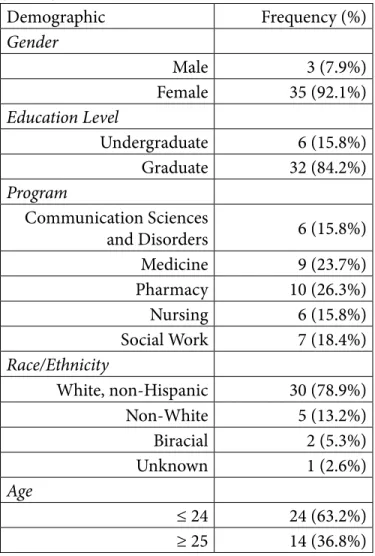
The course was open to both graduate and upper level undergraduate students enrolled in the health professions programs offered by the UCAHC. Students were recruited from the Colleges of Nursing, Pharmacy, Medicine, and Allied Health Sciences (specifically the Social Work and Communication Sciences and Disor-ders programs). To ensure interprofessional representation, student enrollment was limited to 10 students from each discipline. Table I describes the student characteristics of this cohort. Females represented approximately 92% of the study population. Students in Communi-cation Sciences and Disorders (CSD) accounted entirely for the undergraduate population, about 16 percent.
Table 1. Student Demographics
Faculty
The number of course faculty and their affiliated programs were as follows: Nursing (2), Pharmacy (2), Medicine (1), and Allied Health Sciences (Social Work {1} and Communication Sciences and Disorders {1}). This group of faculty has been working together since 2004 and has developed expertise in IPE via several training opportunities. Based on these experiences, the faculty actively modeled interprofessional collabora-tion by equally sharing the responsibilities of the course (O’Neill & Wyness, 2005). Examples of faculty activities include recruiting interested students, creating patient cases for discussion, facilitating class activities, and evaluating assignments. One faculty member assumed a core leadership role as course coordinator. To facili-tate the teaching of this course, faculty employed the use of the university-wide electronic course manage-ment system, Blackboard®, on which all course materials including the syllabus, class schedule, patient-case background material, cultural resources, assignments,
and grades were posted.
Student Learning Objectives
The course aimed to (1) contribute discipline-specific knowledge and skills to patient/client care, (2) analyze case-based problems using ethical principles and an interdisciplinary approach, (3) promote effective collaboration with other health professions students, and (4) assist students in the progression of cultural competence.
Course Mechanics
The elective was structured as a hybrid course to allow for maximum student interactions with minimal impact on students’ varying curricular schedules. The course included four four-hour class meetings onsite, one brief patient encounter session, and 10 on-line class activities (i.e. either individual or team exer-cises). This type of course design has been used by many institutions to facilitate interprofessional expe-riences (Balogun, Fletcher, & Bradle, 2014; Chernett, Yuen, Thoth-Cohen, & Simmons, 2010; Manthey, 2012: Martinez & Rose-St Prix, 2013). As an elective, this course attracted students who were motivated to gain experience in team work, cultural competence, and interprofessional skills as part of their didactic learning.
The course was designed and built on the University of British Columbia (UBC) model of interprofessional education and the IPE core competencies (Charles, Bainbridge, & Gilbert, 2010). The UBC model is a three-part set of overlapping processes defined as: exposure, immersion, and mastery. This model guides the design of IPE experiences to meet the students where they are in their training at the opportune time to introduce the skills for effective collaboration. Exposure involves providing students with experiences that open their minds to multiple perspectives of the various health professions. Immersion allows students to learn collaboratively, identifying the strengths of their own profession as well as others. The final stage is mastery, which provides IP teams an opportunity to apply and demonstrate their knowledge and skills and to be assessed by others (Charles et al., 2010). While a modified version of the UBC model guided course development, the specific activities were designed to Demographic Frequency (%) Gender Male 3 (7.9%) Female 35 (92.1%) Education Level Undergraduate 6 (15.8%) Graduate 32 (84.2%) Program Communication Sciences and Disorders 6 (15.8%) Medicine 9 (23.7%) Pharmacy 10 (26.3%) Nursing 6 (15.8%) Social Work 7 (18.4%) Race/Ethnicity White, non-Hispanic 30 (78.9%) Non-White 5 (13.2%) Biracial 2 (5.3%) Unknown 1 (2.6%) Age ≤ 24 24 (63.2%) ≥ 25 14 (36.8%) (n = 38)
meet the IPE core competencies as described above (IPEC, 2011). See Appendix A for further informa-tion regarding the UBC model (i.e. class topics, IPE competency mapping, activity description, and related assessments).
Exposure: Classes 1 to 5. At the start of the semester, learning activities were designed to introduce students to core material and the roles of various health profes-sions. During the first class, which was offered live, students were initially grouped in their own professions to address the following topics: health professions’ roles and responsibilities, collaborating with medical interpreters, and cultural competence. To facilitate an effective IPE environment, the course syllabus, objec-tives, and class schedule were also reviewed (D’Eon, 2004). Toward the end of the class, students were randomly assigned to six interprofessional groups (IPG), balanced by profession, to begin the process of team development. The “marshmallow challenge” team activity was used to promote these initial interac-tions (Wujec, n.d.). For the duration of the semester, students remained in these assigned groups to promote face-to-face interactions, another key component to effective interprofessional learning (D’Eon, 2004). Each IPG was mentored by one of the course faculty, promoting additional IP interactions. Classes 2 and 3 were offered on-line and focused on activities related to cultural competence. Each student completed a personal health beliefs assignment reflecting on their own beliefs which they shared with their group for class 2 activities. For class 3, each student interviewed an individual of a different culture (e.g. race, religion, socioeconomic status) about his or her health beliefs, wrote a report, and then collaborated with the IPG members to write a paper, comparing and contrasting what they learned from the experience. Classes 4 (live) and 5 (on-line) provided an opportunity for the teams to converse about videotaped case scenarios featuring culturally and medically diverse patients (Fanlight, 2003). In class 4, the students gained back-ground knowledge about the care planning process and required documentation. The groups then discussed two patient cases and created interprofessional care plans for each case. This activity was guided by faculty who intervened when necessary. Class 5 continued to focus on patient care planning with an on-line group activity involving a third unique patient case.
Immersion: Classes 6, 7, and 8. As the teams became more highly functioning, the course work shifted to promote more advanced interprofessional learning by challenging and engaging the students. For classes 6 and 7 (on-line), students participated in the Got Ethics (Akerson et al., 2013) activities by reviewing their own discipline’s codes of ethics, watching a videotaped patient case, and answering discussion questions. Medical ethics, a shared, complex concern for health professionals, was then the backdrop for group activi-ties for class 8. Due to time constraints, the student groups completed two activities within one class period, spending 2 hours on the remaining Got Ethics exer-cises (i.e. completing an interprofessional ethics grid and discussing the patient case as a group) and 2 addi-tional hours engaging in a simulated patient activity. The simulation provided an opportunity to assess and plan care for a “patient” in an ambulatory care setting. Simulated patient activities are very popular as IPE experiences and allow students to explore collabora-tive ways of improving communication (Kenaszchuk, MacMillan, van Soeren, & Reeves, 2011). Student groups were allowed 15 minutes to prepare an inter-view plan, 30 minutes for the patient interinter-view (with no more than 5 minutes per profession), 30 minutes to create an IP plan of care, and 15 minutes to present the team’s plan to the patient. At the end of the experi-ence, a debriefing occurred with the IPGs and faculty. These events strengthened the IPGs by facilitating the acquisition of the skills needed for effective health care teams.
Mastery: Classes 9 to 14. The remaining class times (both on-line and live) were dedicated to the IPG preparing for the Health Care Team Challenge (HCTC)tm. Developed by Washington State University
Health Sciences, this world-wide IPE activity is designed to simulate real-life team-based problem solving (Rich-ardson, Gers, & Potter, 2012). For our event, we chose a real patient with a complex medical and social history. During class 9, students were provided with the patient’s medical and social history and current medication list, as well as instructions for the HCTC. Each team chose two students from their IP group to interview the patient face to face in class. However, due to the patient’s hospitalization, the interviews were conducted virtually. The teams then collaborated for four weeks to create a presentation demonstrating an IP plan of care. During class 14, teams were given 20 minutes to
present their care plan to an audience of their peers, the patient’s family, and a panel of judges (i.e. interpro-fessional faculty recruited from the UCAHC). Teams were judged on the following criteria using the HCTC evaluation rubric: interprofessional quality related to plan of care; team implementation and communica-tion; health care concerns and achievability as it relates to prioritizing health care concerns of the patient and creating a realistic plan; and presentation including contribution of team members, creativity, and profes-sionalism. Prizes were awarded for first, second, and third place. This culminating event provided IPGs a chance to demonstrate team growth and maturity. Methods of Assessment
The course was assessed in multiple ways, using student grades, reflection papers, and validated surveys to eval-uate course impact. Course grades were determined as follows: class participation (25% of total grade points), health beliefs reports (20%), Got Ethics exer-cises (5%), patient case-related assignments (25%), and the Health Care Team Challenge (25%). Student reflection papers were required at the end of each live class session and were reviewed by faculty for content and common themes. Surveys were used to measure changes in cultural competence, IP skills, and team-work skills. Each survey was chosen based on its use in previously published research, ability to measure IPEC core competency achievement, and applicability to the course content. Students were asked to complete the following surveys: Interprofessional Socialization and Valuing Scale (ISVS) (King, Shaw, Orchard, & Miller, 2010), Team Climate Inventory (TCI) – short version (Kivimaki & Elovainio, 1999), and Clinical Cultural Competency Questionnaire (CCCQ) – modified pre-training version (Like, 2001).
The ISVS was developed to measure the effects of IPE on health professionals’ beliefs, behaviors, and attitudes related to IPCP (IPEC Core Competency: Interprofes-sional Communication). It is a 24-item self-report measure that uses a 6-point Likert scale, where 1 = not at all and 6 = to a very great extent. An option for “not applicable” is also included, with a value of zero. King et al. (2010) report the Cronbach alpha for the entire scale to be 0.90.
The shortened version of the TCI is a 14-item survey
that measures team climate according to the four-factor theory used in the 38-item original version of the TCI (Anderson & West, 1994). These factors include support for innovation, participatory safety, vision, and task orientation (IPEC Core Competency: Team and Teamwork). Each factor is measured on a 5-point Likert scale, where 1 = strongly disagree and 5 = strongly agree, indicating a more agreeable team climate. The shortened TCI has high reported internal consistency with Cronbach alpha scores of 0.90 or greater (Kivimaki & Elovainio, 1999; Loo & Loewen, 2002).
The CCCQ is a self-report assessment tool created to evaluate physicians’ level of cultural competence and knowledge of health disparities pre- and post-training. After receiving permission from the author, the 64-item pre-training version was tailored to health professions students and reduced to 49 items. Modifications were informed according to those made by Okoro et al. (2012). Participants were assessed using the modified pre-training version for both pre and post assessments. Items in each of the five areas of focus were scored on a 5-point Likert scale for which 1 = not at all and 5 = very. A sixth response of “don’t know” was included in the focus area of attitude, with a corresponding value of zero. This survey tool was used to measure the IPEC Core Competency Values/Ethics.
The timing of the administration of the surveys is important to note. The ISVS and CCCQ were admin-istered during class 1 and class 14. The TCI survey was not initially administered until class 4 and then repeated at class 14. This schedule allowed time for IPGs to experience the phases of team development (i.e. forming, storming, norming, and performing) as defined by Tuckman (1965). Students were not provided incentives for participation, and this meth-odology was approved by the University of Cincinnati Institutional Review Board.
Results
Learning outcomes were evaluated based on pre- and post-survey data from three validated assessment tools and an end-of-course evaluation. Of 41 students, 40 consented to participate in the study, and 95% of partic-ipants completed all pre- and post-course assessments and the course evaluation (n = 38). Descriptive
statis-tics were used to evaluate assessment data. Two-tailed, paired samples t tests with an alpha of 0.05 were used to investigate changes in attitudes and behaviors related to interprofessional practice and cultural competency over time.
Thirty-eight students completed the ISVS at pre- and post-course time points. The mean difference between ISVS scores before (M = 116.29, SD = 13.62) and after (M = 122.74, SD = 14.12) the course was statistically significant (t (37) = 2.64, p < 0.05, d = 0.46), demon-strating improved interprofessional collaborative practice. A Bonferroni-corrected alpha of 0.017 was employed to examine the change in mean scores for each of the three sub-scales (see Table 2). The analysis revealed significant improvement for two of the three subscales, namely value in working with others and comfort in working with others.
Thirty-nine students completed a short version of the TCI at both data points. The results demonstrate a significant overall improvement (t (38) = 3.64, p = 0.001, d = 0.62) across sub-scales (see Table 3). Statis-tically significant increases in TCI ratings over the course of the semester reflect growth in students’ ability to collaboratively generate and implement new ideas (support for innovation), foster a non-threatening work environment (participatory safety), agree upon desired outcomes (vision), and performance standards (task orientation).
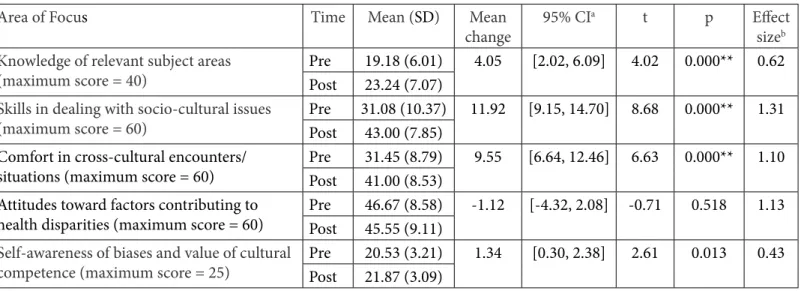
A modified version of the CCCQ was completed by 38 students pre-and post-course. The post-course average score (M = 174.66, SD = 25.42) indicated considerable growth from the pre-course average (M = 148.91, SD = 24.71) and was statistically significant (t (37) = 6.98, p < 0.001, d = 1.03). Further analysis using a Bonfer-roni correction revealed significant improvement over time in three of the five areas of focus including: knowl-edge of relevant subject areas, skills in dealing with socio-cultural issues, and comfort in cross-cultural encounters/situations (see Table 4).
All student learning objectives were rated on the end-of-course evaluation with an average of less than 2 (see Table 5), indicating that students believed the objectives were achieved at an above average level (1= strongly agree, 5= strongly disagree). Twenty-nine of 38 students (76.3%) agreed or strongly agreed
that they contributed discipline-specific knowledge and skills to patient/client care. Thirty-three students (86.8%) agreed or strongly agreed that their ability to analyze case-based problems using ethical principles and an interprofessional approach improved. Thirty-five students (92.1%) agreed or strongly agreed that course content enabled them to collaborate effectively with other health professions students. The content presented was not as successful in helping students progress in the development of cultural competence, with 27 students (71%) agreeing or strongly agreeing with this course objective.
Discussion
Findings from this study indicate that course methods and topics were effective in furthering students’ progression towards competency in the four core IPCP domains, outlined by IPEC (2011). Specifically, scores from the ISVS (IPEC Core Competency Interprofes-sional Communication) indicate students developed increased value and comfort in collaborating with other health professions. These findings contrast with King et al. (2010) who reports that health professions students did not demonstrate increased comfort in working with others after a series of IPE workshops. King et al. postulate that developing a sense of ease in collaborative work may be the most challenging aspect of IPE to teach.
Also the difference between graduate and under-graduate students is notable. In subgroup analyses (pre-course M = 111.67, SD = 20.20, post course M = 106.67, SD = 20.83), the post-course mean was 5 points less than the pre-course mean for undergraduate students only, suggesting a loss of perceived value in IPCP experiences during the semester. This result may be related to the timing of this group of students’ partic-ipation in the course. It has been noted by Charles et al. (2010) that IPCP activities must be timed correctly in order to promote value and readiness for learning in IPCP settings.
While the ISVS subscale Ability to Work with Others did not show significant change, this finding can be viewed in the context of the TCI results (IPEC Core Compe-tency: Team and Teamwork). All subscales in this instrument indicated improvement over the duration of the course. Additionally, students rated collaborative teamwork as the most improved skill on the
end-Table 2. Mean Change Across Sub-scales of the Interprofessional Socialization and Valuing Scale (ISVS)
(n = 38)
* Significant to Bonferroni corrected alpha = 0.017
a Confidence interval b Cohen’s d
Table 3. Mean Change Across Sub-scales of the Team Climate Inventory - Short Version (TCI)
(n = 39)
Table 4. Mean Change Across Areas of Focus of the Modified Clinical Cultural Competency Questionnaire (CCCQ)
(n = 38)
*** Significant to Bonferroni corrected alpha = 0.012.
a Confidence interval b Cohen’s d
*** Significant to Bonferroni corrected alpha = 0.012.
a Confidence interval b Cohen’s d
Sub-scale Time Mean (SD) changeMean 95% CIa t p Effect sizeb
Ability to work with others Pre 45.29 (6.01) 1.92 [-0.29, 4.13] 1.76 0.087 0.33
(maximum score = 54) Post 47.21 (5.67)
Value in working with others Pre 44.21 (5.23) 2.47 [0.59, 4.36] 2.66 0.012* 0.50
(maximum score = 54) Post 46.68 (4.68)
Comfort in working with others Pre 26.79 (4.19) 2.05 [0.58, 3.53] 2.81 0.008* 0.44
(maximum score = 36) Post 28.84 (5.04)
Sub-scale Time Mean (SD) changeMean 95% CIa t p Effect
sizeb
Support for innovation Pre 9.46 (2.45) 1.90 [1.82, 1.98] 47.03 0.000*** 0.74
(maximum score = 15) Post 11.36 (2.70)
Participatory safety Pre 13.64 (2.80) 2.23 [1.91, 2.55] 14.22 0.000*** 0.68
(maximum score = 20) Post 15.87 (3.78)
Vision Pre 13.67 (3.11) 0.69 [0.30, 1.08] 3.61 0.001*** 0.19
(maximum score = 20) Post 14.36 (4.31)
Task orientation Pre 9.67 (2.90) 1.05 [0.84, 1.27] 9.87 0.000*** 0.33 (maximum score = 15) Post 10.72 (3.56)
Area of Focus Time Mean (SD) Mean
change 95% CI
a t p Effect
sizeb Knowledge of relevant subject areas
(maximum score = 40) PrePost 19.18 (6.01)23.24 (7.07) 4.05 [2.02, 6.09] 4.02 0.000** 0.62
Skills in dealing with socio-cultural issues
(maximum score = 60) PrePost 31.08 (10.37)43.00 (7.85) 11.92 [9.15, 14.70] 8.68 0.000** 1.31
Comfort in cross-cultural encounters/
situations (maximum score = 60) PrePost 31.45 (8.79)41.00 (8.53) 9.55 [6.64, 12.46] 6.63 0.000** 1.10 Attitudes toward factors contributing to
health disparities (maximum score = 60) PrePost 46.67 (8.58)45.55 (9.11) -1.12 [-4.32, 2.08] -0.71 0.518 1.13
Self-awareness of biases and value of cultural
of-course evaluation. This finding validates the IPG structure in which group activities are planned to move teams from exposure to mastery, thus allowing students to effectively gain teamwork skills as well as comfort working collaboratively. These critical skills are empha-sized in several reports geared toward improving health care outcomes such as the IOM Report: Measuring the Impact of Interprofessional Collaborative Practice and Patient Outcomes (2015).
Furthermore, the curricula effectively supported students in their progression toward cultural compe-tence (IPEC Core Competency: Values/Ethics) as demonstrated by the statistically significant improve-ment in overall CCCQ mean scores and a robust effect size. Although mean scores for the subscales Attitudes and Self-awareness reflect considerably less improve-ment than the other subscales, similar findings were reported in other samples of health professions students (Evans & Hanes, 2014; Okoro et al., 2012; Okoro, Odedina, & Smith, 2015). Perhaps these aspects of cultural competence require a more extensive clinical background than most students have experienced at this point in their training.
The achievement of course objectives was also verified by the students’ course evaluations. Although students did not confirm the course’s ability to enhance disci-pline-specific knowledge as strongly as the other course objectives, the results still indicate most students rated the objective favorably (M = 1.95, SD = 1.16. with strongly agree = 1). Due to the large standard devia-tion, a subgroup analysis was performed, with results showing that undergraduate students again reported the lowest score (M = 3.33, SD = 1.21), indicating discontent with their professional roles within this course/team. Due to survey results, the faculty have
determined the course may be best suited to graduate students. The second lowest ranked course objec-tive was related to cultural competence (M = 1.92, SD = 0.82). While all patient encounters (video, simu-lated, or live) and on-line work included significant cultural concerns that needed to be addressed in the plan of care, the students failed to recognize their use and development of cultural competence skills. There-fore, the course content will be modified to emphasize cultural issues within each activity.
Limitations to this study include a small sample that may not represent the university population, minimizing the generalizability of the findings. Addi-tionally, the internal consistency of the modified CCCQ was not calculated. However, other studies using modified versions for health care providers report alphas greater than 0.80 for all subscales (Krajic, Straβmayr, Karl-Trummer, Novak-Zezula, & Pelikan, 2005; Mareno, Hart, & VanBrackle, 2013). Also, the TCI uses reverse coding for the last seven questions and, despite the change in values in the subheading, several students reported the same score for every question. This suggests the ratings for the last seven questions may have been marked carelessly and, thus, likely may not be accurate. The subjective nature of the surveys is another limitation. Honest reporting was encouraged by following specific distribution protocols to support anonymity and reduce biased reporting. While the literature supports that IPE should occur early in health professions training (Hamilton, 2011; RWJF, 2015), undergraduate students in the course represented a limitation due to their differing level of academic training and clinical experience. Perhaps, an IPE course tailored to the discipline-specific knowl-edge and skills of undergraduate students may be most beneficial to those in earlier phases of their academic
Table 5. Mean Ratings for Learning Objectives on the End-of-Course Evaluation
(n = 38)
aMean based on a five-point Likert scale (strongly agree = 1, strongly disagree = 5). Note. n = 38
Learning Objective Meana (SD)
Contribute discipline-specific knowledge and skills to patient/client care 1.95 (1.16) Analyze case-based problems using ethical principles and an interprofessional
approach
1.76 (0.88) Collaborate effectively with other health professions students 1.53 (0.83) Progress in the development of cultural competence 1.92 (0.82)
programs. Despite these limitations, the current study contributes valuable insights to the literature on IPE curricula for health professions students.
Conclusion
This course aimed to fill a gap in IPE at UCAHC by creating an IP environment for health professions students to achieve core competencies of IPCP and progress in cultural competence. Evaluation of the course via interprofessionalism, teamwork, and cultural competency assessment measures, and end-of-course surveys demonstrates an effective and feasible model of didactic IP curricula. These results support the long-term goal for universities to mandate IPE experiences as a component of all health professions’ curricula. The course described here could be one of several potential IPE experiences on campus. By offering multiple sections, the course could reach more students and additional health professions. Researchers can build upon the current findings by exploring novel ways to expand IPE beyond the classroom with IP clinical experiences alone or in combination with didactic courses. Furthermore, future research should assess the sustainability of students’ interprofessional and cultural competency skills when they transition into professional practice.
References
Abu-Rish, E., Kim, S., Varpio, L., Malik, E., White, A. A., Craddick, K., . . . Zierler, B. (2012). Current trends in interprofessional education of health sciences students: A literature review. Journal of Interprofessional Care, 26, 444-451. http://dx.doi.org/10.3109/13561820.2012.715604
Akerson, E., Stewart, A., Baldwin, J., Gloeckner, J., Bryson, B., & Cockley, D. (2013). Got ethics? Exploring the value of interprofessional collaboration through a comparison of discipline specific codes of ethics. MedEdPORTAL Publications. Retrieved from https://www.mededportal.org/publication/9331 Baker, L., Egan-Lee, E., Martimianakis, M. A., & Reeves, S. (2011). Relationships of power: Implications for interprofessional education. Journal of Interprofessional Care, 25, 98-104. http:// dx.doi.org/10.3109/13561820.2010.505350
Balogun, S. A., Fletcher, K., & Bradle, E. B. (2014).
Interprofessional geriatrics education program: Train the trainer pilot model. Journal of Gerontology Geriatric Research, 3, 161. http://dx.doi.org/10.4172/2167-7182.1000161
Charles, G., Bainbridge, L., & Gilbert, J. (2010). The University of British Columbia model of interprofessional education. Journal of Interprofessional Care, 24(1), 9-18. http://dx.doi.org/10.3109/13561820903294549
Chernett, N., Yuen, E., Thoth-Cohen, S., & Simmons, R. (2010). An innovative interprofessional course: Cultural humility and competence. Jefferson Center for InterProfessional Education (JCIPE) Interprofessional Education and Care e-Newsletter, 1(1). Retrieved from http://jdc.jefferson.edu/jcipe/vol1/iss1/4 D’Eon, M. A. (2004). A blueprint for interprofessional learning. Medical Teacher, 26(7), 604-609. http://dx.doi. org/10.1080/01421590400004924
Evans, L., & Hanes, P. J. (2014). Online cultural competency education for millennial dental students. Journal of Dental Education, 78(6), 867-875. http://www.jdentaled.org/content/ 78/6/867.full
Fanlight Productions (Producer), & Gainer-Monson, M. and Haslett, J. (Directors). (2003). Worlds apart: A four-part series on cross cultural health care [Video/DVD]. United States: Fanlight Productions.
Hamilton, J. (2011). Two birds with one stone: Addressing interprofessional education aims and objectives in health profession curricula through interdisciplinary cultural competency training. Medical Teacher, 33(4), e199-e203. http:// dx.doi.org/10.3109/0142159X.2011.557414
Institute of Medicine. (2011). The future of nursing: Leading change, advancing health. Retrieved from http://www.nap.edu/ catalog/12956.html
Institute of Medicine. (2015). Measuring the impact of
interprofessional education on collaborative practice and patient outcomes. Retrieved from http://iom.nationalacademies.org/ Reports/2015/Impact-of-IPE.aspx
Interprofessional Education Collaborative Expert Panel. (2011). Core competencies for interprofessional collaborative practice: Report of an expert panel. Retrieved from http://www.aacn.nche. edu/education-resources/ipecreport.pdf
The Joint Commission. (2010). Advancing effective communication, cultural competence, and patient- and family-centered care: A roadmap for hospitals. Retrieved from http://www.jointcommission.org/assets/1/6/ ARoadmapforHospitalsfinalversion727.pdf
Kenaszchuk, C., MacMillan, K., van Soeren, M., & Reeves, S. (2011). Interprofessional simulated learning: Short term associations between simulation and interprofessional collaboration. BMC Medicine, 9, 1-10. http://dx.doi. org/10.1186/1741-7015-9-29
Khalili, H., Orchard, C., Spence Laschinger, H. K., & Farah, R. (2013). An interprofessional socialization framework for developing an interprofessional identity among health
professions students. Journal of Interprofessional Care, 27(6), 448-453. http://dx.doi.org/10.3109/13561820.2013.804042
King, G., Shaw, L., Orchard, C., & Miller, S. (2010). The Interprofessional Socialization and Valuing Scale: A tool for evaluating the shift toward collaborative care approaches in health care settings. Work: A Journal of Prevention, Assessment and Rehabilitation, 35, 77–85. http:// dx.doi.org/10.3233/WOR-2010-0959
Kivimaki, M., & Elovainio, M. (1999). A short version of the Team Climate Inventory: Development and psychometric properties. Journal of Occupational and Organizational Psychology, 72, 241-246. http://dx.doi. org/10.1348/096317999166644
Krajic, K., Straβmayr, C., Karl-Trummer, U., Novak-Zezula, S. & Pelikan, J. M. (2005). Improving ethnocultural competence of hospital staff by training: Experiences from the European ‘Migrant-friendly Hospitals’ project. Diversity in Health and Social Care, 2(4), 279-290. http://diversityhealthcare.imedpub. com/
Like, R. C. (2001). Clinical Cultural Competency Questionnaire (pre-training version) [Measurement instrument]. Center for Healthy Families and Cultural Diversity, Department of Family Medicine, UMDNJ-Robert Wood Johnson Medical School. Hartford, CT: Aetna Foundation.
Loo, R. & Loewen, P. (2002). A confirmatory factor-analytic and psychometric examination of the Team Climate Inventory: Full and short versions. Small Group Research, 33(2), 254-
265. http://dx.doi.org/10.1177/104649640203300205 Manthey, M. (2012). Foundations of interprofessional
communication and collaboration. Creative Nursing, 18(2), 64-67. http://dx.doi.org/10.1891/1078-4535.18.2.64
Mareno, N., Hart, P. L., VanBrackle, L. (2013). Psychometric validation of the revides Clinical Cultural Competency
Questionnaire. Journal of Nursing Measurement, 21(3), 426-436. http://dx.doi.org/10.1891/1061-3749.21.3.426
Martinez, I. & Rose-St.Prix, C. (2013). A hybrid educational experience training future health professionals to work together to improve patient outcomes. MedEdPORTAL Publications. http://dx.doi.org/10.15766/mep_2374-8265.9304
National Partnership for Action to End Health Disparities. (2011, April). National stakeholder strategy for achieving health equity. Retrieved from http://minorityhealth.hhs.gov/npa/ templates/content.aspx?lvl=1&lvlid=33&ID=286
Okoro, O. N., Odedina, F. T., Reams, R. R., & Smith, W. T. (2012). Cultural competency and knowledge of health disparities among pharmacy students. American Journal of Pharmaceutical Education, 76(3), 1-9. http://dx.doi.org/10.5688/ ajpe79450
Okoro, O., Odedina, F., & Smith, W. T. (2015). Determining the sufficiency of cultural competence instruction in pharmacy school curriculum. American Journal of Pharmaceutical Education, 79(4), 1-9. http://dx.doi.org/10.5688/ajpe79450 O’Neill, B. J., & Wyness, M. (2005). Student voices on an interprofessional course. Medical Teacher, 27(5), 433-438. http:// dx.doi.org/10.1080/01421590500086680
Poling, D., Labarbera, D., & Kiersma, M. (2015). Does interprofessional education change student attitudes about interprofessional learning and patient safety? Health and Interprofessional Practice, 2(3), 1-10. doi:10.7772/2159-1253.1074 Richardson, B., Gersh,. M., & Potter, N. (2012). Health Care Team Challenge: A versatile model for interprofessional education. MedEdPORTAL Publications. http://dx.doi.org/10.15766/ mep_2374-8265.9287
Robert Wood Johnson Foundation. (2015). Lessons from the field: Promising interprofessional collaboration practices. Retrieved from http://www.rwjf.org/content/dam/farm/reports/ reports/2015/rwjf418568
Thibault, G. E. (2012). Interprofessional education in the USA: Current activities and future directions. Journal of
Interprofessional Care, 26, 440-441. http://dx.doi.org/10.3109/135 61820.2012.704778
Tuckman, B. W. (1965). Developmental sequence in small groups. Psychological Bulletin. 63(6), 84–99. http://dx.doi.org/10.1037/ h0022100
U.S. Census Bureau. (2015, March). Projections of the size and composition of the U.S. population: 2014 to 2060. S. L. Colby and J. M. Ortman. Retrieved from https://www.census.gov/content/ dam/Census/library/publications/2015/demo/p25-1143.pdf World Health Organization. (2010). Framework for action on interprofessional education & collaborative practice. Retrieved from http://www.who.int/hrh/resources/framework_action/en/ Wujec, T. (n.d.). The marshmallow challenge. Retrieved from http://www.marshmallowchallenge.com/Welcome.html
UBC
Model CLASS CLASS TOPIC IPE Core Competency ACTIVITIES ASSESSMENT
E X P O S U R E #1: LIVE Roles/ Responsibilities Cultural Competence Working with Interpreters Team/Team work • Interprofessional Communication
• Values and Ethics
• Roles and Re-sponsibilities
• Teams and Team work
Welcome to class and course handbook
Roles and responsibilities Working with interpreters Administration of consent and survey instruments
Cultural competence activities Create groups/Group activities
Participation in class and group activities
#2 On-line Cultural
Competence Values and Ethics Personal health beliefs assignment Report -personal health beliefs #3 On-line Cultural
Competence Interprofessional Communication Health beliefs assignment: Individual and group Report -health beliefs interviews #4 LIVE Patient Care and
Medical Issues, Care Planning
• Interprofessional Communication
• Values and Ethics
• Teams and Team Work
• Roles and Re-sponsibilities
Overview of Health Care Team Challenge (HCTC)
Administration of survey instruments
Care plan presentation/Video Individual professions preparation Case studies + interprofessional care plan creation
Care planning lecture and activities
Completion of
interprofessional discussion questions for video patient cases
#5 On-line Patient Care and Medical Issues, Care Planning
• Interprofessional Communication
• Values and Ethics
• Teams and Team Work
• Roles and Re-sponsibilities
Posting of group-created care plan Creation of a care plan for video patient case
I M M E R S I O N
#6 On-line Patient Care and
Ethics • • Values and EthicsTeams and Team Work
Video + individual professions
preparation Completion of discipline- specific preparation #7 On-line Ethics • Values and Ethics
• Roles and Re-sponsibilities
Got Ethics activities
Simulated patient preparation activities
Completion of Got Ethics exercise
Completion of discipline- specific preparation for simulation activities #8 LIVE Ethics
Simulated Patient • Interprofessional Communication
• Values and Ethics
• Teams and Team Work
• Roles and Re-sponsibilities
Simulated patient activity
Ethics exercises Completion of interprofessional group discussion questions Appendix A
Corresponding Author
Bethanne Brown PharmD Associate Professor Pharmacy Practice and Admin Sciences University Hall, Suite 540, ML0663 University of Cincinnati Cincinnati, OH 45221-0663 [email protected] M A S T E R Y
#9 LIVE Health Care Team
Challenge • Interprofessional Communication
• Values and Ethics
• Teams and Team Work
• Roles and Re-sponsibilities
Health Care Team Challenge-
patient interview. None
#10, 11, 12, and 13 On-Line
Health Care Team
Challenge • Interprofessional Communication
• Values and Ethics
• Teams and Team Work
• Roles and Re-sponsibilities
Health Care Team Challenge-
progress reports due None
#14 LIVE Health Care Team
Challenge • Interprofessional Communication
• Values and Ethics
• Teams and Team Work
• Roles and Re-sponsibilities
Health Care Team Challenge presentations
Repeat administration of survey instruments
Panel judging of the HCTC competition- determine first, second, and third place