Chinese Management Studies
China’s 40-year Road to InnovationJournal: Chinese Management Studies Manuscript ID CMS-01-2019-0019.R1 Manuscript Type: Research Paper
Chinese Management Studies
1
China’s 40-year Road to Innovation
Purpose
The purpose of this paper is to review the evolution of policies and practice of innovation in China for the past 40 years.
Design/methodology/approach
This is a review paper. It adopts a different multi-dimensional, qualitative methodology to examine China’s trajectory of innovation from the economic reform since 1978, highlighting ‘China’ experiences in the developing innovation-driven economy, also pointing the challenges that China faces in this transition process and future prospects. The analysis of China’s innovation performance was based mostly on secondary data from sources and institutions that use statistical data to build country rankings, such as Global Innovation Index (GII) and Global Competitiveness Index (GCI).
Findings
It is found that the institutional foundations of national innovation system in China are already being laid, and so far, China has made extraordinary progress regarding innovation performance from country to region and from business to individual. However, some critical challenges in its innovation-driven development still need urgent attention and effective efforts to reinforce them.
Originality/value
This paper aims to fill the gap in the literature by providing an overview of the evolution of the policies and practices of innovation development in China since the 1978 economic reforms, and explores the Chinese experiences in transforming into an innovation-driven economy. Keywords China, Innovation, Chinese experiences, The innovation-driven development Paper type General review
1. Introduction
The past 40 years have witnessed fascinating socioeconomic change and extraordinary economic growth of China, transforming from an impoverished agrarian economy into an industrial juggernaut, and from a small exporter of resources and unskilled-labour-intensive products to a significant player of world-manufactured exports. By the end of 2017, the National Bureau of Statistics indicated that China's GDP was 87.7122 trillion yuan (US$12.25 trillion), up from 306 billion US dollars in 1980. From 1978 until 2017, China's average annual GDP growth was 9.56%. The total industrial value-added increased from US$91 billion in 1980 to US$ 4.951 trillion in 2017, and the share of industrial products in total exports increased from 50% in 1980 to more than 95% in 2017 (NBS, 2017).
Indeed, China's unprecedented economic success under an authoritarian political system over the past 40 years has raised many questions: What factor led to China's rapid economic growth? Given that China's success in the last couple of decades toppled the notion about the realities of government's role in economies, is there a 'China model' that will replace the Western model of modernisation? The primary mechanism driving this growth is simple: a constant flow of
3 4 5 6 7 8 9 10 11 12 13 14 15 16 17 18 19 20 21 22 23 24 25 26 27 28 29 30 31 32 33 34 35 36 37 38 39 40 41 42 43 44 45 46 47 48 49 50 51 52 53 54 55 56 57 58 59 60
Chinese Management Studies
2
new workers into the labour force and massive investment in housing, infrastructure, and industrial capacity. Additionally, low wages for workers leads to low production cost; low prices in niche markets lead to higher volumes; small companies turn into large companies, which, in turn, have a greater competitive advantage in global markets (Mckinsey Global Institute, 2015). Parallel to this self-cost reduction mechanism, these companies have built up knowledge and experience in the emerging markets, gradually evolving from imitators to imaginative and effective innovators (Gassmann et al., 2012). Nevertheless, Zhu (2012) provided a different picture of China's growth by examining the contributions of sector-level productivity growth and resource relocation across sectors and companies within a sector to aggregate productivity growth. Given this context, Zhu argued that China's rapid growth is driven by productivity growth rather than massive investment, high saving rates and accumulation of labour. Despite the rapid 40-year economic growth after 1978, China’s productivity level is still much lower than that of the U.S., meaning China still has large space for productivity growth though future economic reforms (Liu, 2016). Although capital and labour input has played an important role in the early stage of China’s economic development, given China's transformation into an innovation-driven economy, the new source of growth must become productivity as measured by total-factor productivity (TFP). To this end, innovation and entrepreneurship are the most important means of increasing TFP (Song et al., 2016). Considering China now faces crucial challenges in sustainable development and structural change, it is pertinent to review China’s road to innovation.
In recent years, China's rising profile in innovation has challenged the future of U.S. technological leadership. In 2017, China's national research and development (R&D) spending reached RMB 1.76 trillion (roughly $279 billion), poised to overtake that of the United States within the next decade.1 According to Global Innovation Index 2018, a ranking produced by INSEAD, China is now 17th among the most innovative countries in the world, up five positions from 2017, marking the first time that the Asian country finished in the GII's top 20 (INSEAD, 2018). China also made headlines with remarkable accomplishments in high-tech manufacturing industries, including aerospace, computer and communications equipment, semiconductors, pharmaceuticals, and scientific instruments. The global output from high-tech manufacturing totalled $1.6 trillion in 2016, with the U.S. (31%) and China (24%) as the largest providers of the global share. China’s output has risen sharply over time and now exceeds that of the EU.2 Moreover, China recently surpassed Japan as the number two patent cooperation treaty (PCT) filer, just behind the United States, according to the World IP Organization (WIPO).
Undoubtedly, China is dramatically catching up and is on the verge of becoming a world-leading technological innovator. An increasing number of Chinese firms with global ambitions, such as Huawei and Tencent, have stood at the centre of the world stage. The prospect of China's achievements in innovation has attracted both worldwide attention and discussion. Typical questions include what are China’s aspiration for innovation? How has China performed its overall innovation development in recent years and what are the characters of China’s
1 'China spends $279 bln on R&D in 2017: Science minister', Reuters, 27 February 2018.
2 'The rise of China in science and engineering', National Science Foundation, 2018.
3 4 5 6 7 8 9 10 11 12 13 14 15 16 17 18 19 20 21 22 23 24 25 26 27 28 29 30 31 32 33 34 35 36 37 38 39 40 41 42 43 44 45 46 47 48 49 50 51 52 53 54 55 56 57 58 59 60
Chinese Management Studies
3
innovation process? What are Chinese experiences in developing an innovation-driven economy? This paper seeks to answer these questions by exploring China's ongoing experiment in innovation-oriented transformation through its 40 years of socioeconomic development.
The paper is organised as follows. After a description of research methodology and data, Section 3 discusses China's aspiration for innovation. Section 4 investigates the performance of China's innovation-driven development. Section 5 summarises the Chinese experiences in developing an innovation-driven economy, Section 6 discusses trends and challenges of innovation in China. Section 7 provides a conclusion.
2. Research Methods and Data
This paper adopts a different multi-dimensional, qualitative methodology to examine China’s trajectory of innovation since its economic reform of 1978. Specifically, this paper integrates historical archives and a case study approach, covering policies and practices at both the macro- and micro-levels.
Although many academic researchers, practitioners, and policy makers have tried to find different ways to measure innovation performance to create a better understanding of the innovation system, innovation is a qualitative and complex phenomenon that is greatly influenced by a given context and geographical background; therefore, a holistic and multipronged view of innovation is needed (Smith, 2005). Some indices and innovation rankings try to evaluate innovation performance and rank the performance of different countries against each other by some strict metrics. These usually measure innovation performance on the basis of innovation input/output, thus highlighting strengths and weaknesses according to their respective methods (ibid.). Although these studies collect rich data from the public domain, it is difficult to compare their innovation rankings because of their differences in data-gathering methods and geographical locations. In general, global innovation indices and rankings produced by reputable international organisations are given credit for their advanced methods for measurement, primary data collection, and comprehensiveness in international coverage. Therefore, the global innovation rankings generated by the World Economic Forum (WEF) and INSEAD with other supplementary measurements are a valuable means to evaluate updated innovation performance in China.
3. China’s Aspiration for Innovation
Thousands of years ago, when ancient China was one of the most sophisticated civilisations of its time, the spate of inventions that flourished in ancient China constituted one of the earliest potential revolutions in industry. Among the many Chinse technological contributions, one can list Chinese invented paper (200 C.E.), bone china (300 C.E.), the magnetic compass (300 C.E.), the letter press (750 C.E.) and, of course, gunpowder (1000 C.E.). For some reason, China's innovative ability languished after the 14th century. This rich history suggests that China seeks to re-establish its identity as a leader in technological innovation (Yip and Mckern, 2016).
During the period of Chinese contemporary history, it is necessary to highlight three watershed years that provide a more explicit picture of China's economic development. The first is 1978, when China began to implement a series of economic reforms. From 1978 to 1982, the central government mainly focused on rural liberalisation. The ‘Personal Responsibility System' was implemented to allow farm households to lease land from the local government
3 4 5 6 7 8 9 10 11 12 13 14 15 16 17 18 19 20 21 22 23 24 25 26 27 28 29 30 31 32 33 34 35 36 37 38 39 40 41 42 43 44 45 46 47 48 49 50 51 52 53 54 55 56 57 58 59 60
Chinese Management Studies
4
and sell the output on a double-track price system: a fixed quota at a state-controlled price and the rest at freely determined prices in agriculture markets. Township and village governments were encouraged to establish township and village enterprises (TVEs) for the production and sale of industrial goods outside the central plan. After 1980, China's economy gradually opened to international trade and capital with the devaluation of the highly overvalued exchange rate and the establishment of a retention system for foreign exchange for exporting firms. This trade liberalisation went far and deep throughout the 1980s. Some of the remarkable implementations, such as an increasing amount of foreign direct investment (FDI), setting up special economic zones in the coastal regions, and establishing a rudimentary foreign exchange market, were carried out from the top-down.
The second landmark is 1992, with Deng Xiaoping's famous tour of southern China. This called for an all-out effort to speed up the reform, re-igniting the reform momentum. There was also a formal endorsement of the ‘socialist market economy' as the objective of China's economic reform at the party congress in 1992 (Sachs et al., 1994).
The third turning point is 2006, when China officially released the Medium and Long-Term National Plan for Science and Technology Development (MLNP) (2006-2020), a milestone in China's economic transformation. The goal of this strategy is to make China a world-leading innovation country by developing its innovation economy. In particular, the heart of this strategy is to foster indigenous innovation paradigms that include three aspects: introducing technology through digestion and absorption, integrating innovation, and encouraging original innovation (Chen et al., 2018). The implementation of the MLNP seeks to ensure that China will not fall into the so-called ‘middle income trap' and that China's future prosperity is shared among the whole population with inclusive development (Liu et al., 2017).
In retrospect, China's achievements over the past 40 years have been phenomenal. Its rapid economic growth has driven its per capita income from one of the poorest in the world to the level of an upper-income country, and from an economy with basic agriculture and technology to a global manufacturing centre-hub, transitioning now into an innovation-driven economy. To avoid stagnation in its economic growth, China is urgently moving up the industrial value chain, which is not an easy achievement as the previous experiences of Southern Asian countries have demonstrated. De Meyer and Grag (2005) noted that the firms in these countries have failed to climb the global industrial value chain in the late twentieth century is the limited knowledge transfer from foreign multinational companies to the local firms despite the inflow of heavy FDI. It seems that China’s previous growth model faces similar challenges. Since the 1978 reforms, China has experienced a substantial transformation in the area of innovation. At the beginning of the reform, many Chinese companies benefitted from various policies, thereby heavily relied on foreign technology transfer through imports and FDI for technology upgrading. This was conducive to imitation-type diffusional innovation (Fu and Gong, 2011). The fastest growth of FDI inflows started from Deng Xiaoping’s southern tour in 1992: as China moved towards a nationwide implementation of open policies for FDI, inflows of FDI reached a peak level in the later 1990s. Although China’s innovation capabilities have been improved greatly owing to FDI, which served as a major platform to provide technological and managerial knowledge as well as financial capital in the transfer of advanced foreign technology to developing countries (ibid.), there resulted a lack of creativity and indigenous capabilities in core technologies given heavy dependence on foreign technology transfer and imitation. FDI is
3 4 5 6 7 8 9 10 11 12 13 14 15 16 17 18 19 20 21 22 23 24 25 26 27 28 29 30 31 32 33 34 35 36 37 38 39 40 41 42 43 44 45 46 47 48 49 50 51 52 53 54 55 56 57 58 59 60
Chinese Management Studies
5
employed as major vehicle for foreign technology transfer. In the late 1990s, the focus of China’s technology development was transitioning from technology transfer to indigenous innovation. The promotion of indigenous innovation was formally announced as a priority in 2006, whereupon the total R&D expenditure grew from RMB 7.4 billion in 1987 to RMB 35 billion in 1995 and to RMB 300.3 billion in 2016, showing an average annual growth rate of 21% (MOST, 2010a). While China has experienced rapid economic growth and a fascinating transformation of it economy and industry, with the disappearance of the demographic dividend and high social and environmental cost, sustainable growth is becoming less and less promising. Therefore, it is urgent for China to transition into a more skill-intensive and technology-intensive growth path. In addition, the pursuit of an innovation-driven goal of economic transformation should foster indigenous innovation with due consideration of the Chinese context. As Fu (2015) stated, the long-term core strategy for the Chinese government is to encourage indigenous innovation and build an innovation-oriented economy.
4. The Performance of China’s Innovation-driven Development
4.1 the overall performance of the innovation-driven developmentAs shown in the previous section, China has a long history as an innovative culture. After years of wars, the road to China's revival is full of twists and turns. It began from the establishment of the People’s Republic of China in 1949 to the 'Great Leap Forward' and the 'Culture Revolution' from 1966 to 1976. Under the leadership of Deng Xiaoping, the government began to pursue a new economic development strategy and open-door policy with the purpose of rebuilding the economy and society devastated by the Culture Revolution. Again, in 2006, the release of the MLNP manifested China's determination to turn the country into an innovative economy by 2020.
Innovation has been placed in the heart of China's future national development strategy. After more than 10 years of accumulating experiences and reallocating resources, along with re-establishing a national system of incentives for science, technology, and innovation (STI), China is on its way to becoming an innovation powerhouse by continuously increasing STI investment, reinforcing the country's scientific and technological strength, and improving its competitive ability all around. Gradually, there has been more empirical evidence from the literature regarding China's innovation system, with improved availability of STI data. However, research on a comprehensive and systematic review of China's innovation system and the evolution of innovation strategies and instruction infrastructure, as well as their impact on China's innovation performance and technological upgrading, has yet to be done (Ding and Li, 2015). In this section, we will try to deliver a full picture of the performance of China’s innovation-driven development by using various data from resources such as the National Bureau of Statistics of China, the World Economic Forum, and China’s official government website.
The MLNP explicitly stated the goal of transforming China into ‘an innovative society' by 2020: building globally competitive high-tech products, brands and standards, while reducing its dependence on imported technologies (Xu, 2017). Hence, a series of specific targets for 2020 have been set up:
To increase domestic investment in R&D to at least 2.5 percent of GDP; increase the
3 4 5 6 7 8 9 10 11 12 13 14 15 16 17 18 19 20 21 22 23 24 25 26 27 28 29 30 31 32 33 34 35 36 37 38 39 40 41 42 43 44 45 46 47 48 49 50 51 52 53 54 55 56 57 58 59 60
Chinese Management Studies
6
contribution of technology innovation to the economy to 60 percent; reduce China’s reliance on imported technology to no more than 30 percent; increase patent application to the level of the world’s top five countries; and join the world’s top five countries in citation of international science and technology publications. (State Council, 2006)
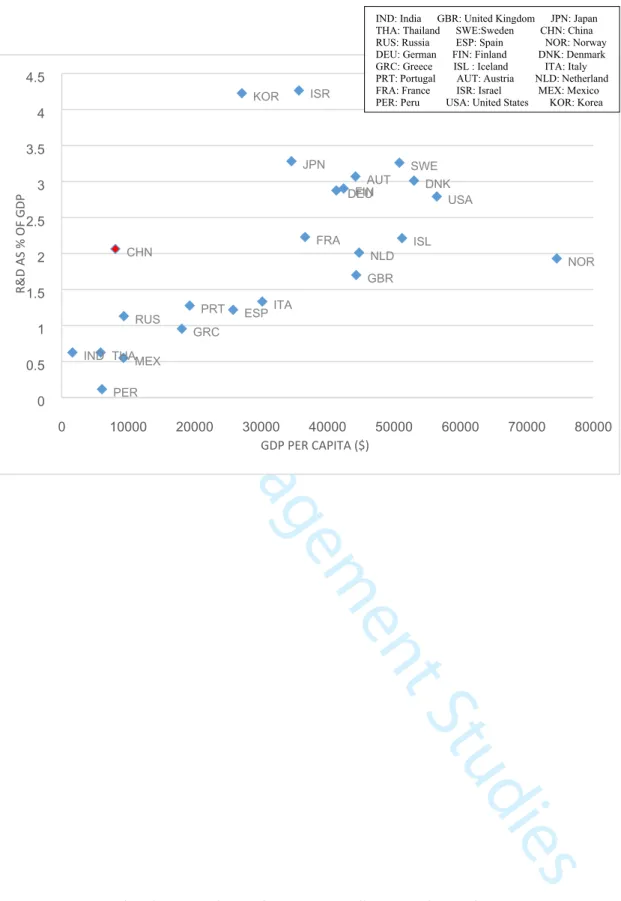
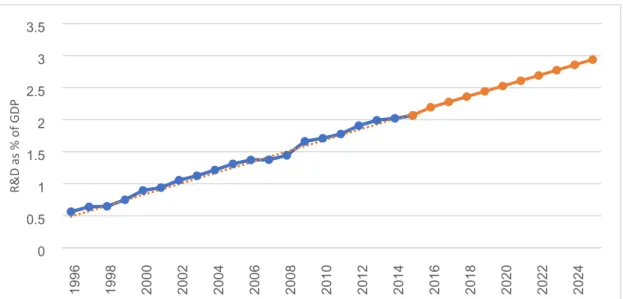
In 2015, China spent RMB1416.9 billion on R&D, equivalent to 2.07% of GDP, in comparison with R&D spending as a percentage of GDP of 0.56% in 1996. Internationally, as shown in Figure 1, China's investment in R&D, as a share of GDP, was ahead of some developed economies, such as the UK, Spain, Portugal, Norway and the Netherlands. Also, China was also leading other emerging economies, such as Russia, Mexico, Greece and India. The most updated R&D spending is RMB 1.76 trillion in 2017, equivalent to 2.12% of GDP. However, compared with advanced innovative economies, such as South Korea, Israel, etc., China's R&D investment still needs to be improved by some means. Concerning a long-standing outlook of China's key metric of innovation, Figure 2 shows a clear linear upward trend for this metric by implementing a simple time-series of data from 1996 to 2015. Noticeably, R&D spending as a percentage of GDP continuously increases over the years with an expected a long-term trend that will reach 2.525% by 2020 and 2.938% by 2025, just hitting the pre-set target in the MLNP.
(insert Figure 1 here) (insert Figure 2 here)
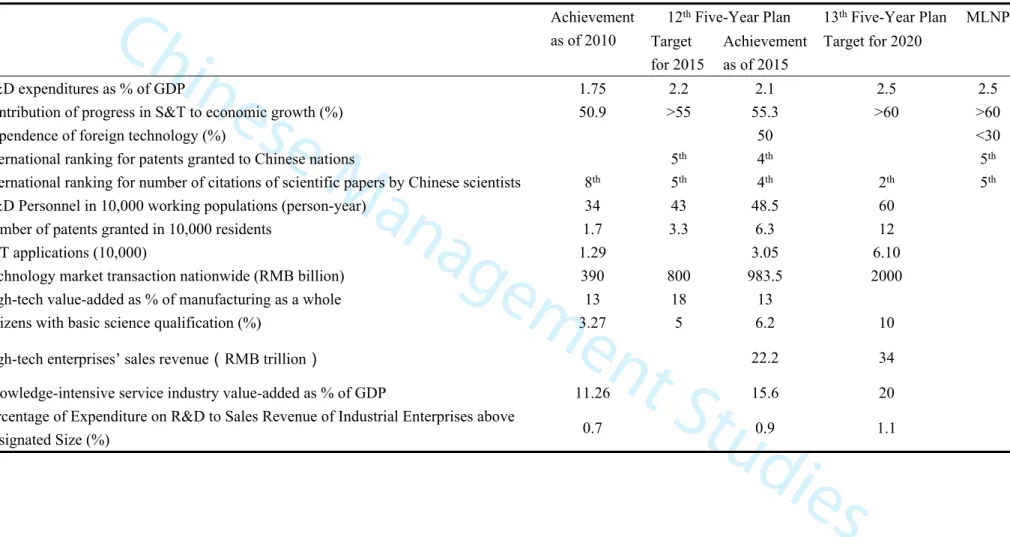
Other innovation performance indicators as of 2017 display a mixed picture of the establishment of the innovation-driven economy. As shown in Table 1, China made praiseworthy progress in Science and Technology to economic growth, such as R&D personnel in 10,000 working population (Person-year) and an international ranking for citations of scientific papers by Chinese scientists. However, China was not able to achieve the target of R&D spending as a share of GDP in 2015, which was 2.2, or high-tech value-added as a percent of manufacturing as a whole.
(insert Table 1 here)
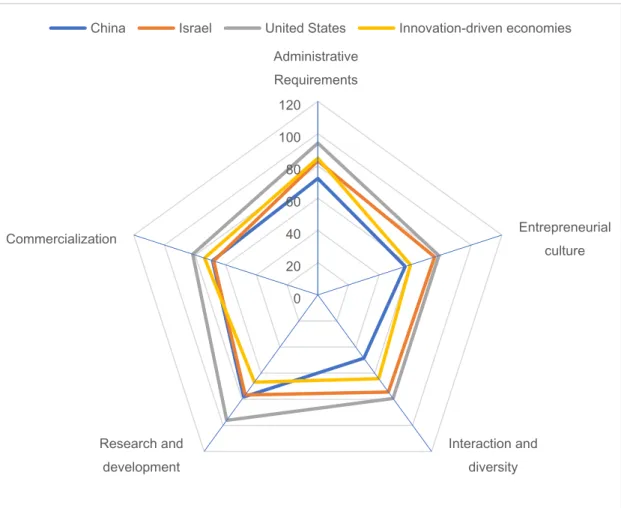
To get a fuller picture of China’s innovation performance, we then analyse a few indicators by accessing evidence from international studies. The Global Competitiveness Index (GCI), a yearly report first developed by WEF in 2004, is used as a standard to measure a country’s competitiveness and, therefore, is expected to be related to economic strength and growth. The GCI uses a comprehensive dashboard of 100 variables, organised into 12 pillars, with each pillar representing an area considered as an essential determinant of competitiveness. In the GCI 2018, the innovation ecosystem is an integral part of national competitiveness. As mentioned previously, innovation is a complex process, happening within an ecosystem of a variety of factors (World Economic Forum, 2018). The WEF designed the innovation capability and business dynamism pillars to assess each economy’s innovation ecosystem. Innovation capability, comprising indicators on the less tangible aspects of idea generation, is captured in interaction and diversity, as well as Research and Development and commercialisation (the capacity to successfully bring innovation to the market) sub-pillars. The business dynamism pillar captures broader factors summarised in two sub-pillars: Administrative requirements (the extent to which the regulatory framework supports creative destruction by making it easy to found and close companies) and entrepreneurial culture (a country’s willingness to take risks
3 4 5 6 7 8 9 10 11 12 13 14 15 16 17 18 19 20 21 22 23 24 25 26 27 28 29 30 31 32 33 34 35 36 37 38 39 40 41 42 43 44 45 46 47 48 49 50 51 52 53 54 55 56 57 58 59 60
Chinese Management Studies
7
and embrace disruptive ideas).
Similar to the WEF, INSEAD first published its Global Innovation Index (GII) in 2007. Since then, it has generated a yearly report and index. The aim of the GII is to help create an environment wherein innovation factors are continually evaluated. The GII index contains four measures: the overall GII (simple average of the input and output sub-index scores); the input sub-index, which is based on five pillars (institutions, human capital and research, infrastructure, market sophistication and business sophistication); the innovation output sub-index, which has two pillars (knowledge and technology outputs and creative outputs); and the innovation efficiency ratio (ratio of the output sub-index score to input sub-index score). The GII and GCI provide different pictures of innovation because of diversified data resources and the analytical framework they used.
China's rapid rise in the GII rankings over the last few years has been spectacular. Since 2016, China featured in the top 25 and continuously moved forward to 17th in 2018. China’s innovation prowess is conspicuous in many aspects. China has made phenomenal progress in areas like international R&D companies, high-tech imports, the quality of its publications, and tertiary enrolment. Most of all, China is now ranked 1st or 2nd in areas such as R&D expenditures and the number of researchers, patents, and publications, which are far ahead of most high-income economies (INSEAD, 2018).
Similarly, the European Commission published the ‘Innovation Union Scoreboard 2018’ in May 2018 (EU, 2018), which holds the same opinion. Although the primary purpose of this report is to assess the innovation performance of 27 member states, China and other non-EU countries were included for comparison. The EU report concludes that, while the EU continues to improve its position vis-à-vis the United States, Japan, Australia and Canada and is catching up to South Korea, China has shown a growth rate three times faster than that of the EU-27. The report indicates that China is improving in nine indicators (tertiary education, international co-publications, most cited publications, R&D expenditure public sector, R&D expenditure business sector, public-private co-publications, PCT patent applications, trademark application, design applications) and has strengths in business R&D expenditures and trademark and design. Overall, China has achieved outstanding innovation performance with particular regard to research and development, knowledge and technology outputs, and business sophistication. As seen in Figures 3 and 4, China outscores the high-income group in the GII and innovation-driven economies in the GCI. Specifically with regard to the innovation input sub-index in the GII report, China has moved into the top 30 in human capital & research (23rd), determined as education, tertiary education and research & development; infrastructure (29th), identified as information & communication technologies (ICTs), general infrastructure and ecological sustainability; market sophistication (25th), determined as credit, investment and trade, competition and market value; and business sophistication (9th), defined as knowledge workers, innovation linkages and knowledge absorption. However, in comparison with the high-income group including the United States, and the middle-income group, where China exists, we identified the major bottleneck in the innovation system of China. Although China is a leading innovation power, its institutional framework, comprising its political environment, regulatory environment, and business environment, lags far behind than those economies shown in Figure 3.
Weak institutions are quite common in emerging economies, and a series of studies have
3 4 5 6 7 8 9 10 11 12 13 14 15 16 17 18 19 20 21 22 23 24 25 26 27 28 29 30 31 32 33 34 35 36 37 38 39 40 41 42 43 44 45 46 47 48 49 50 51 52 53 54 55 56 57 58 59 60
Chinese Management Studies
8
shown that the innovation effort of companies in any nation can be negatively affected by that nation's formal political-economic institutions (Acemoglu and Robinson, 2012; North, 1990; Walder et al., 2015). In addition, the GCI report shown in Figure 4 indicates that China is already more advanced when it comes to investing in the research and development sub-pillar than innovation-driven economies, whereas commercialisation, administrative requirements, interaction and diversity, and entrepreneurial culture are the weak links in China's innovations system when compared to innovation-driven economies. It indicates that Chinese universities and research institutions need to be encouraged to bring their best innovative technology to the market. Also, developing and enabling a dynamic regulatory framework to encourage start-up companies is necessary, as is building an entrepreneurship-friendly environment that enables stakeholders to carry out innovative activities.
(insert Figure 3 here) (insert Figure 4 here)
4.2 The characters of China’s innovation process
China's innovation performance manifested its attempts to transform itself from a low value-added manufacturing centre to recognised innovation leader, particularly because lower-cost economies compete for China's core business (OECD, 2015). Innovation is, indeed, the primary force behind China's new round of economic growth, structural adjustment and industrial transformation and upgrade. According to the Mckinsey Global Institute (2015), China has established strength in efficiency-driven and customer-focused innovation regarding products like mobile phones, household appliances, solar panels, and railway equipment, which have reached the world’s frontline. Firms innovate by solving engineering issues using accumulated know-how, integrating technologies from suppliers and partners, and generating discoveries and turning them into products. In this context, central government support and policy continue to play a large role in science and engineering-based innovation, such as acquiring critical knowledge through purchasing programs that drive local demand and by facilitating knowledge and technology transfer with foreign joint-venture partners and expanding expenses on higher education and R&D funding (ibid.).
Given the evolution of China's innovation process, Chung and Tan (2017) identified three dominant themes: yin (引), Tiao (调) and Chuang (创). 'Yin' represents the initial innovation development stage which is 'duplicative imitation' and has the meaning of introducing and adopting others' knowledge or experience. The next stage is 'Tiao', a transition stage between imitation and innovation that involves adjusting and improving existing products, services and technology. The last is the ‘original innovation' stage defined as 'Chuang', which means creating new items and developing indigenous innovation. Most importantly, this evolving process is heavily influenced by Chinese characteristics: size effect, knowledge-absorptive capacities, and extensive manufacturing ecosystems.
First, China is a massive nation, both in terms of geographical size and population. Both provide a positive effect such as cost reduction by the migration of hundreds of millions of peasants from the countryside and a skilled workforce that involves numerous scientists graduating from universities. Fishman (2012) explained the meaning behind this fact as the
3 4 5 6 7 8 9 10 11 12 13 14 15 16 17 18 19 20 21 22 23 24 25 26 27 28 29 30 31 32 33 34 35 36 37 38 39 40 41 42 43 44 45 46 47 48 49 50 51 52 53 54 55 56 57 58 59 60
Chinese Management Studies
9
productive might of China's vast low-cost manufacturing machine, along with the swelling appetites of its billion-plus consumers, having turned China's people into what is arguably the greatest natural resource on the planet. It also means that China has accumulated vast resources to pursue innovation. In addition, China's huge market can become a platform for accelerated innovation (Fu and Xiong, 2011).
Second, a knowledge-absorptive capacity refers to a firm's ability to create and arrange the knowledge for developing operational capabilities and achieve a competitive advantage (Zahra and George, 2002; Sun and Anderson, 2010). Since China's ‘open door' policy was implemented in 1978, it has always been a technological follower, taking advantage of the accumulated knowledge and technology from advanced economies. Being a 'technological follower' can reduce the risk stemming from pioneering costs (Mohan et al., 2015). This can explain why many Chinese firms adopted an imitation approach, which is an affordable and profitable approach and can help the firms build up their innovation capacities.
Third, as the world's largest manufacturing economy, China has built an unmatched manufacturing ecosystem that enables continuous process innovation, with the world's largest supplier base, a massive manufacturing workforce, and a modern supply-chain infrastructure (Mckinsey Global Institute, 2015). Despite all these advantages, China is now in a hurry to step up its effort in original innovation. From the other perspective, China's economic prowess, to a large extent, is dependent on its achievements in manufacturing goods, not on the design and marketing of these goods (Hulten and Hao, 2012), implying that China's technological strength is currently built on perfecting innovation invented by novel-product master nations, not on novel-product innovation itself. However, Breznitz and Murphree (2011) have argued that, for China to gain sustained economic growth, there is no urgency for it to become a master at novel-product-innovation. A recent example was in early 2018 where Zhongxing Telecommunications Equipment Corporation (ZTE), one of China's leading technology exporters, was banned from the U.S. market, nearly bringing it close to bankruptcy. The block on ZTE was a wake-up call as it exposed the Achilles' heel of China's hi-tech industry—its lingering reliance on key foreign technologies, and the issue of a lack of control over core technology. Therefore, there is no denying that China should revive its emphasis on indigenous innovation. Furthermore, according to an analysis of China's innovation performance, China is currently on the point of transforming itself from a technological follower to innovation leader with high expectations. However, considering the current political environment, this will not be an easy process.
5. Chinese Experiences in Developing an Innovation-driven Economy
Many researchers have characterised the Chinese innovation development phases as imitation to innovation (Zhou, 2006; Dobson and Safaian, 2008; Yip and Mckern, 2016) or similar to the early Japanese and South Korean development stages (Liu and White, 2001; Xia, 2000). Nonetheless, the Chinese government established many policies to boost innovation capacities to transform itself from 'Made in China' to 'Designed in China' (China State Council, 2015; Fuller, 2009). Many of those policies are China's emulation of successful international experiences, and some others are novel and experimental. So far, there is not enough empirical data to evaluate whether these policies have met the objectives and brought in inspiring outcomes. Nevertheless, it has become apparent that a consensus has emerged concerning the
3 4 5 6 7 8 9 10 11 12 13 14 15 16 17 18 19 20 21 22 23 24 25 26 27 28 29 30 31 32 33 34 35 36 37 38 39 40 41 42 43 44 45 46 47 48 49 50 51 52 53 54 55 56 57 58 59 60
Chinese Management Studies
10
quantitative improvements in China's science, technology and innovation outcomes after the government implemented these policies. However, some China researchers have argued that the qualitative change in China's indigenous innovation has remained, albeit blurred, pointing to the fact that China has few world-beating innovations and game-changing products and services, whereas Orr and Roth (2012) asserted that China is innovating, evident in both business-to-consumer and business-to-business sectors. China is now trying to push itself towards an innovation-driven economy within its social context, which seems to be a great experiment in front of the world. China's experiences with innovation are important for policymakers in other rapidly emerging economies. The question about what has been China's experiences so far has received a great deal of attention, but there is little consensus as to the answer. Although we draw several conclusions about China's experiences instead of complete responses, we hope to encourage different thought patterns when reviewing China’s innovation trajectory.
5.1 Formulating successive policies to encourage innovation and planning strategically
Since the 1970s, the modernisation of science and technology has been positioned as one of the 'four modernisations', along with those of industry, agriculture and national defence, underlying reform and opening up, and the government has been actively and consistently supporting innovation to accomplish it. In particular, the announcement of the MLNP in 2006 has shown the determination of the central government to transform China into an innovation-driven nation. In the plan, the State Council committed to supporting eight areas in advanced technologies to cultivate and improve China's core competence in technology (State Council, 2006). Additionally, at the 18th Communist Party Congress in November 2012, scientific and technological innovation was instituted as 'strategic support for raising the productive forces and boosting the overall national strength'. The strategy of innovation has been inherited by the government of Xi Jinping that took office following the 18th Party Congress.
In 2015, the 'Made in China 2025' initiative was developed jointly by China's National Development and Reform Commission (NDRC) and the Ministry of Science and Technology (MOST), with additional contributions from the Ministry of Industry and Information Technology (MIIT) and other constituencies, to enhance China's innovation power (State Council, 2017). This plan sets up strategy goals for innovation-driven development for the next 10 years from 2016 to 2025 and signals China's determination to transform its industry from labour-intensive production to knowledge-intensive manufacturing. The primary focus of this plan is to improve the quality of Chinese products, strengthen China's brands and develop cutting-edge advanced technologies. Specifically, this plan identifies 10 industries as a priority: information technology, high-end numerical control machinery and automation, aerospace, and aviation equipment, maritime engineering equipment and high-tech vessel manufacturing, rail equipment, energy-saving vehicles, electrical equipment, new material, biomedicine and high-performance medical apparatus and agricultural equipment (ibid.).
In the same year, the 13th Five-Year Plan (FYP) was announced with a set of new development principles to pursue innovation-based, balanced, green, and open economics growth. The 12th FYP shows the realisation of the old growth model as a road leading to nowhere and needing to embark on transitional measures by the Chinese central government, while the 13th FYP indicates that they have already drafted a future blueprint (Kennedy and
3 4 5 6 7 8 9 10 11 12 13 14 15 16 17 18 19 20 21 22 23 24 25 26 27 28 29 30 31 32 33 34 35 36 37 38 39 40 41 42 43 44 45 46 47 48 49 50 51 52 53 54 55 56 57 58 59 60
Chinese Management Studies
11
Johnson, 2016). Undoubtedly, the FYP is a kind of strategic plan for aligning the objectives of the national innovation system with long-term national economic goals. As for the advantages of this planning system, Heilmann and Melton (2013) explained that the development plan in China is a valuable management tool for strategic policy coordination, resource mobilisation, and macroeconomic control. Additionally, strategic plans such as the MLNP and FYP build consensus across parties from top to bottom, serving as a guideline for ministry-specific and lower-level implementation (Ahrens, 2013). It is also worth stressing that this long-term planning is beneficial to innovation policy design and implementation through signal delivering and building consensus.
5.2 Giving space to the spontaneity of creativity and encouraging 'grassroots innovation'
If China’s innovation route only followed national strategic planning as led by the government, it would not have accomplished such achievements in the past years (Ding and Li, 2015). Many success stories of innovation have come from outside of strategic planning. For example, considerable technological breakthroughs in the industry fields largely come from non-government planning. The most likely reason is that non-government-led national S&T programmes are incapable of addressing non-consensual research projects and provide them with sufficient financial support (ibid.). Therefore, some remarkable technological breakthroughs are made by individuals, non-government research institutions and private enterprises, which could be referred as 'grassroots' (caogen). Grassroots innovation (GI) refers to 'networks of activities and organizations generating novel bottom-up solutions for sustainable development, solutions that respond to the local situation and interests and values of communities involved' (Seyfang and Smith, 2007, p.585). Also, GI stands for innovation generated by civil society rather than government or business (Tang, 2011). In the Chinese context, GI is the bottom-up innovation starting from grassroots, including blue-collar workers, unemployed workers, farmers, non-governmental scientific research institutions and private enterprises, and their innovation inherits China's traditional culture and wisdom. For example, Chinese Internet giant Alibaba’s greatest innovation stems from unleashing the forces of grassroots entrepreneurship. In order to facilitate China's move towards becoming a fertile ground for innovation, GI has been encouraged by policies aimed at supporting Science and Technology (S&T) education in rural areas through programs like S&T for Rural Areas and Farmers, STI laboratory for Country Teenagers, Poverty Alleviation by Education, and others. Furthermore, the government promotes GI by providing S&T services such as innovation incubation, financing loans and technical consultations (CAST, 2016).
More generally, the locus of the GI movement in China is the Pearl River Delta, and the most successful story is that of Shenzhen, China's Special Economic Zone. As a 'city of the maker', Shenzhen witnessed an explosion of maker-spaces, incubators and Fablabs. Also, the city leads the world in such sectors as supercomputing, gene sequencing, metamaterial, and 4G technology. It is home to over a thousand labs, including key labs, engineering labs, engineering centres, and corporate technology centres. The Pearl River Delta region was designated as an experimental zone by the Chinese government because of its distance from Beijing and remoteness. Being the site of reform, local cadres developed a desire for more autonomy from Beijing's official culture and, at the same time, allied with business and investors from Hong Kong to develop export-oriented industries using local land and labour. The reform encouraged
3 4 5 6 7 8 9 10 11 12 13 14 15 16 17 18 19 20 21 22 23 24 25 26 27 28 29 30 31 32 33 34 35 36 37 38 39 40 41 42 43 44 45 46 47 48 49 50 51 52 53 54 55 56 57 58 59 60
Chinese Management Studies
12
Hong Kong to finance and locally initiate Town Village Enterprises (TVEs) to grow. The grassroots development contributed to the rise of Shenzhen, and Pearl River Delta region more generally rather than planned actions by the central state (Breznitz and Murphree, 2011).
On the other hand, the government provides scientific and technological services to support grassroots innovation. These services' platforms and networks allow entities to find suitable partners for grassroots innovators and projects, help incubate projects and provide start-up funding. Such services include the provision of technical advice and guidance for grassroots innovators and projects, as well as intellectual property rights protections and assistance in product development, such as 'Garage Café', where entrepreneurs can, for the price of a cup of coffee, enjoy a free open office environment and share ideas. Other examples include plentiful incubation bases co-established by universities for students and recent graduates to realise their business ideas and start-ups. Perhaps this is best illustrated by the youth entrepreneurship service associations and 'innovation workshops' that help young people set up their own business by releasing the latest information about policies and the markets and providing information from internal resources.
More importantly, the central and local government carried out various science popularisation projects to promote scientific knowledge among the grassroots class. For example, in 2006, the central government launched the 'science popularisation benefitting villages and agriculture project' through 'model demonstrations' seeking to reward leading, demonstrative, and far-reaching professional agricultural associations, science demonstration bases, pioneers in rural science popularisation and science popularisation teams for ethnic minorities. The China Association for Science and Technology, Ministry of Education and MOST have also organised an annual event, the National Youth Science and Technology Innovation Contest. Moreover, MOST, with five other departments, including the CPC Department of Organisation and the China Association for Science and Technology, launched the Rural Youth Science and Technology Innovation Laboratory project (CAST, 2016).
5.3 The ‘invisible hand’ shaking the ‘visible hand’
Before China began economic reform, the economy was planned by the government, which acted as the ‘visible hand' involved in all spectrums of economic life. The overall objective of economic reform was to move from a system under which all parties obeyed specific centralised commands to a decentralised system to improve the system of managerial resource allocation that is responsive to market forces, referred as the ‘invisible hand' (Groves et al., 1995). Since 1992, China, having established the so-called socialist market system with Chinese characteristics, achieved formidable economic development, emerging as the second-largest economy in the world. Hu (2013) explained the hybrid mechanisms underpinning this socialist market system as the cooperation of ‘visible hands' and ‘invisible hands.' The invisible hand (or market economy) aims to promote economic prosperity and provides private goods while the visible hand (planned economy) is engaged in developing a harmonious society and providing public goods. This cooperation enables the government to serve as a market guide and provide necessary supplements to the market as well as facilitate a market-friendly environment.
This hybrid mechanism has performed well for facilities innovation. Plenty of evidence has testified to this. For instance, central and local governments significantly developed venture
3 4 5 6 7 8 9 10 11 12 13 14 15 16 17 18 19 20 21 22 23 24 25 26 27 28 29 30 31 32 33 34 35 36 37 38 39 40 41 42 43 44 45 46 47 48 49 50 51 52 53 54 55 56 57 58 59 60
Chinese Management Studies
13
capital markets to finance innovation. Specifically, the venture capital markets has facilitated many indigenous firms in recent years in exploiting financing channels, absorbing social capital, and establishing and strengthening the social-industrial investment fund to reform traditional high-tech industries. China's central government laid down a set of policy goals to build a venture capital mechanism and develop public venture capital institutions (Fu, 2015). Moreover, the government also played a facilitating role in supporting technology firms by developing various S&T-oriented financial products. In transition economies such as China's, the government plays a vital role in the developing innovation capabilities through direct intervention and its industrial and S&T policies (Choi et al., 2011). Policymaking with respect to incentives for innovation over the past few years has emphasised the function of the market for stimulating innovation, pushing the government from the front stage (Ding and Li, 2015). In this connection, balancing the ‘visible hand' and the ‘invisible hand' is not an easy task. Armannios et al. (2017) suggested that local governments in emerging economies such as China's act as an institutional entrepreneur, controlling the allocation and utilisation of critical public resources and exerting considerable influence on regional development and entrepreneurship (Smallbone and Welter, 2012). With such resource under their control, some Chinese local governments have not yet clarified its relations with the market, interfering too much in some microeconomic activities, thus invalidating the market mechanism (Xiao, 2017). Accordingly, government-market problems remain unsolved, especially at the local level. Fu (2015) pointed that local government often provide subsidies to promote certain industries thus create market dispute. In fact, from the past until now, the process of China's economic reform has been the process of making the ‘visible hand’ shake the ‘invisible hand' and letting them play their proper roles to ensure sustainable development. With deepening reform in years to come, these puzzles will be answered.
5.4 Engaging state-owned and privately-owned firms in collaborative innovation
During China's economic reform, state-owned enterprises (SOEs) have played or are playing an essential role in the market. Most SOEs are the leading providers of public services such as energy, infrastructure and transport, indicating that they have a crucial influence on the everyday life of citizens and the economy. Since late 1978, China began to reform the SOEs that had been a critical component of China's transformation into a socialist market economy (Fischer and Gelb, 1991). First, Chinas restructured the SOEs in the 1990s by following the adoption of the new Company Law in 1994, which provides a uniform legal framework for ownership reform. Second, it allowed SOEs to go bankrupt or be sold to private buyers and companies if they had lost their competitiveness in the mid-1990s. Third, the government set up the State-Owned Assets Supervision and Administration Commission (SASAC) in 2003 to take over the control of large SOEs. Up to today, SOEs reform has already achieved some outstanding accomplishments regarding firm performance, but it still faces an enormous challenge in China's transition process.
Nevertheless, most academic literature suggests that SOEs operate less innovatively than private firms (Jefferson et al., 2006; Zhang et al. 2003). Most such arguments build on evidence that SOEs are governed by administrative rather than economic imperatives, government intervention is inescapable, and numerous political tasks impede firm development. Moreover, managers in SOEs often lack incentives to pursue market-driven, efficiency-based innovative
3 4 5 6 7 8 9 10 11 12 13 14 15 16 17 18 19 20 21 22 23 24 25 26 27 28 29 30 31 32 33 34 35 36 37 38 39 40 41 42 43 44 45 46 47 48 49 50 51 52 53 54 55 56 57 58 59 60
Chinese Management Studies
14
activities and just routinely fulfil administrative tasks (Freund, 2001;Ramamurti, 2000). That notwithstanding, evidence suggests that some SOEs have achieved great success in applied research and innovation in such areas as nuclear energy, the defence sector, and electricity networks, as well as less apparent areas like telecommunications (Kou and Henning, 2017). Further, while SOEs play an important role in the transition period, private-owned enterprises (POEs) have overgrown. Tan (2006a, b) revealed that decision makers in POEs are more likely to make innovative and risk-taking decisions when faced with market uncertainty and technology turbulences than SOEs. Fu (2014) echoed the viewpoint, pointing out that POEs appear to choose to open up their innovation process to overcome the constraints and risks they face in innovation. Although SOEs have been a major force in the Chinese economy in the early stage of reform, POEs are currently more efficient in innovation and are producing more innovative outcomes. However, both SOEs and POEs have their comparative advantages in different areas. Also, SOEs have taken a leading role in pushing forward the technology frontier among Chinese firms, while POEs offer the most contributions to technology upgrading and innovation. Therefore, instead of a pure market-driven model or a state-led model of innovation, China's path to innovation follows a multi-driver model led by a mix of players. It appears that SOEs and POEs are encouraged by the central government to carry on win-win cooperation and pursue inclusive development. That said, engaging SOEs and POEs in 'collaborative innovation' helps firms acquire missing knowledge and complements resources of finance to reduce the risk and cost as well as to enlarge their social networks (Hoffman and Schlosser, 2001).
5.5 Combining the principles of 'going out' and 'bringing in'
Recently, a report delivered by Xi Jinping at the 19th National Congress of the Communist Party of China (CPC) stated that:
We should pursue the Belt and Road Initiative as a priority, give equal emphasis to 'bring in' and 'going global', follow the principle of achieving shared growth through discussion and collaboration, and increase openness and cooperation in building innovation capacity. With these efforts, we hope to make new ground in opening China further through links running eastward and westward, across the land and over the sea.
Xi's report calls for building up China's strength for international economic cooperation and competition, which testifies to the country's will to open up on all fronts. Also, it shows that, regarding global governance, China is transforming from a bystander and follower to a practitioner and forerunner. The Belt and Road Initiative (BRI), proposed by Xi Jinping in 2013, was a declaration of China's vision for international and regional cooperation and shared benefits and sustainable development. Under the BRI, China has strengthened cooperation with participating countries in many aspects, such as infrastructure connectivity, production capacity, trade, investment and finance. Up though 2017, Chinese firms have established 56 economic and trade cooperation zones in more than 20 countries, with a total investment exceeding USD 18.5 billion, generating USD 1.1 billion in tax revenue and 180,000 jobs for these countries (MOST, 2017). Cai (2017) emphasised that the BRI offers an opportunity for China to build its regional leadership through many programs of economic integration. The major purpose of the
3 4 5 6 7 8 9 10 11 12 13 14 15 16 17 18 19 20 21 22 23 24 25 26 27 28 29 30 31 32 33 34 35 36 37 38 39 40 41 42 43 44 45 46 47 48 49 50 51 52 53 54 55 56 57 58 59 60
Chinese Management Studies
15
BRI is for China to become a centre of advanced manufacturing and innovation and even a standard setter by creating a regional production chain. Not only is China trying to export higher-end goods through the BRI, it is also expecting participating countries to accept Chinese standards. The Chinese government has a broader ambition to become an innovation-based economy and a leader of R&D with its focus on exporting technological measures.
On the other hand, China has also introduced new policies to ease market access for foreign investment and encourage foreign firms to enter into the Chinese market, while, at the same time, creating a fairer business environment for foreign and domestic enterprises (Xinhua, 2017). For example, on January 17, 2017, the central government issued a 'Circular Concerning Measures on the Further Opening up and Actively Utilizing Foreign Investment', which listed 20 specific measures to further open up its economy, improve the business environment, and bring more foreign investment into China. Particularly, the Catalogue for the Guidance of Industries for Foreign Investment has been revised to further open the service, manufacturing, and mining sectors to foreign investment. These foreign investments are willing to take part in the implementation of China's innovation-driven development plans, such as 'Made in China 2025', are strongly encouraged by the Chinese government (State Council, 2017).
Apart from continuously bringing in qualified foreign investment, China has also promoted people-to-people exchanges under the BRI with the aim of promoting innovation alliance. In recent years, the cooperation on scientific and technological innovation has been fruitful in enhancing Chinese firms' capabilities in the creation of innovation outcomes that are ground-breaking to the world. Since 2011, MOST has organised more than 200 training workshops, attracting 5,000 trainees for other developing countries. In 2013, MOST launched the Talented Young Scientist Program for scholars below the age of 45 from other developing countries to pay short-term working visits of 6 to 12 months at research institutions, universities or companies in China. In 2016, MOST, the National Development and Reform Commission, the Ministry of Foreign Affairs, and the Ministry of Commerce jointly released the Plan on Cooperation in STI under the BRI. It involves a series of 'bring in' activities, such as inviting 2,500 young foreign scientists for short-term research in China, training 5,000 foreign R&D and administrative staff and building 50 joint labs in the next five years (MOST, 2017).
5.6 Chinese people and embracing culture
The terms ‘common destiny' or ‘shared future' have become a recurrent feature in many of Xi's speeches, which shows his vision of space as referring to a ‘common' or ‘shared' ‘future of mankind. This version has expanded from a narrow perspective of commonality among peripheral countries with the same destiny to the wider dream of new world order. Xi's concept of ‘a community with a shared future for mankind’ (renlei mingyun gongtongti) identifies the overarching goals of China’s foreign policy in the years ahead, and, after the 19th Party Congress, it was incorporated into the Party Constitution as an essential part of Xi Jinping’s thought. This concept has been inspired by 5,000 years of Chinese civilization. The nation has always pursued and inherited a firm idea of peace, harmony and tolerance (Wang, 2018). The ‘embracing culture' which advocates ‘harmony' rooted in Chinese culture for thousands of years has been brought into China's global outlook, a new win-win model in international relations and future innovation-driven development. Following this, Li-Hua (2014) proposed a strategic model called ‘China's embracing innovation' to refer to the strategic model of the wise who are
3 4 5 6 7 8 9 10 11 12 13 14 15 16 17 18 19 20 21 22 23 24 25 26 27 28 29 30 31 32 33 34 35 36 37 38 39 40 41 42 43 44 45 46 47 48 49 50 51 52 53 54 55 56 57 58 59 60
Chinese Management Studies
16
seeking common development, sharing resources and a win-win solution. Embracing innovation is a novel and innovative solution to a complicated social problem, which defines the concept of embracing innovation as a social innovation with Chinese characteristics. It demonstrates that there is no future for narrow-minded and short-sighted anti-globalisation movements. Also, it is helpful to embrace contradiction and seek common ground while maintaining differences, so that the completeness of Chinese firms could be maintained (Li-Hua, 2017). An example from many successful stories of Chinese firms is in 2010, the Chinese Car manufacturer Geely acquired the luxury car brand Volvo and proactively helped Volvo build a plant in China. Following a refocus of Volvo’s product line under Geely, the brand has since moved upmarket to compete against other luxury brands, such as BMW. Also, Geely and Volvo have built several R&D centres with the aim of becoming a major player in the global auto industry.
Along with the ‘embracing culture' that has profoundly influenced the Chinese innovation model, human resources has also become the key source to gain and sustain a competitive advantage in the internal building of capability for innovation. Based on the vast Chinese labour market, the accumulation of high technology and talented technicians are of great importance to the government and Chinese enterprises. Lee and Peterson (2000) pointed out that the Chinese have been entrepreneurial throughout their history and are incredibly hardworking. The younger generation especially is developing an entrepreneurial spirit characterised by innovative thinking, modernisation and individualism. The latest OECD statistics (2017) confirmed this viewpoint that Chinese workers log an average of 2,000 to 2,200 working hours each year, which is far higher than their counterparts in the United States (1,790 hours per year), the Netherlands (1,419), Germany (1,371), and even Japan (1,719). Hence, without question, the intelligent, entrepreneurial, and hard-working Chinese are the principal source of the indigenous innovation of Chinese enterprises to face global challenges.
6. Discussion
6.1 Trends of innovation in China
China has achieved remarkable transformation over the past 40 years, with an excellent speed of growth driven mostly by a high level of investment, both domestic and foreign. Its openness to investment and trade, combined with its particular advantages in the labour market and market scale, has made it the world's manufacturing superpower. However, the real question for China's future concerns is becoming an innovative country and eventually moving towards becoming an innovation powerhouse. In China's 40 years development, our study demonstrates that the institutional foundations of national innovation system are already being laid, and, so far, China has made extraordinary progress regarding innovation performance from country to region and from business to individual.
Given the 13th FYP, China is set to take innovation as the driving force for development. It contemplates finding new drivers by making use of scientific innovations and encouraging mass innovation and entrepreneurship. It also announced the launch of six key scientific and technological (S&T) projects as well as nine other major projects under the 'Scientific
3 4 5 6 7 8 9 10 11 12 13 14 15 16 17 18 19 20 21 22 23 24 25 26 27 28 29 30 31 32 33 34 35 36 37 38 39 40 41 42 43 44 45 46 47 48 49 50 51 52 53 54 55 56 57 58 59 60
Chinese Management Studies
17
Innovation 2030' initiative3, as well as the implementation of the 'Made in China 2025' strategy for building a strong manufacturing country to improve the manufacturing sector’s innovation capacity and competitive edge, while promoting the development of strategic emerging industries. Additionally, this strategy will promote the application of information technology and seek to expand the scope of the online economy. Based on these development directions, it can be expected that, under China’s 13th Five-Year Plan, efforts will be made to implement the Made in China 2025 initiative in greater depth, thus achieving China’s objectives of becoming a manufacturing powerhouse, creating a favourable environment for the growth of new strategic industries and optimising modern industrial systems.
6.2 Challenges of innovation in China
Admittedly, China still faces extraordinary challenges in its innovation-driven development. First, the quality and practice of Chinese innovation still lag behind the world's top innovators. Instead of being an 'innovation sponge', China should push itself to be a leader by innovating independently. Although being an 'innovative sponge' benefits Chinese firms to grasp advanced knowledge and technology quickly by shortening R&D time and resources, in the long run, this approach will not help them develop much-needed core technologies (World Economic Forum, 2016). Second, although China has surged to become the world's largest producer of scientific papers, when, it comes to high-profile research, China is still a long way behind countries like the United States. Third, the quality and quantity of self-relied intellectual property still needs to be improved to make China an innovative country. Public awareness of the importance of intellectual property is comparatively weak. Thus, there remains a relatively serious problem of infringement of intellectual property (Devonshire-Ellis et al., 2011). Fourth, some SOEs face challenges in their management system and R&D infrastructure. For other large SOEs, as industry leaders and national innovators, it is urgent to improve their efficiency of resource allocation and enhance their capabilities. Fifth, the outputs of original S&T are inadequate, and core technologies are limited. According to the World Economic Forum (2016), despite China becoming the world's largest manufacturer of smartphones and personal computers, the industry still depends on other countries for high-performance circuits and infrastructure software. In 2015, China’s imports of integrated circuits amounted to $230 billion, representing 13.7% of the total imported goods and the single largest item. Over 90% of China’s computer central processing units (CPU) and advanced 4G smartphone chip markets are controlled by foreign companies. Last and more fundamental challenge is above mentioned the balancing of government-market relationship. For example, market trade dispute could be caused by selective policies, especially those subsidies and preferential policies to promote the growth of certain industries. To reduce this problem, the Government should allocate more resources and
3 For more long-term development by 2030, the 13th FYP makes it clear that China will launch a number of key S&T projects and major development projects of national strategic significance. The six key S&T projects cover the fields of aviation engine and gas turbines; deep underwater stations; quantum teleportation and quantum computers; neuroscience and brain-like intelligence studies; national cyberspace security; and deep space exploration and on-orbit service and maintenance systems for spacecraft. The nine major development projects include independent innovation in the farming industry; efficient and clean use of coal; smart grid; integrated space-terrestrial information networks; big data analytics; smart manufacturing and robotics; research and application of major new materials; comprehensive environmental improvement of the Beijing-Tianjin-Hebei region; and healthcare.
3 4 5 6 7 8 9 10 11 12 13 14 15 16 17 18 19 20 21 22 23 24 25 26 27 28 29 30 31 32 33 34 35 36 37 38 39 40 41 42 43 44 45 46 47 48 49 50 51 52 53 54 55 56 57 58 59 60
Chinese Management Studies
18
use more horizontal policies to support education, R&D, and improve the institutional environment. Additionally, instead of intervening in market-led activities such as most of commercialisation process, the government must focus on those activities which easy to suffer from market failure, such as basic research that involves high risk and uncertainties and provide them long-term investment and necessary preferential policies. Overall, those challenges need to be overcome by deeper reform, national innovation system improvements, and policy refinement.
7. Conclusions
This paper offers the following main contribution. First, given the historic review of China’s innovation development, we highlight three watershed years since the 1978 reforms to explain China’s aspiration for innovation. We proved that this aspiration is rooted in the national situation of China’s growth model, and, to pursue sustainable growth, China seeking a more skill-intensive and technology-intensive growth path. Second, we reviewed the evolution of China’s strategic development plans and used different data to analyse the performance of China’s innovation development and its position compared to other innovation-driven economies, revealing that China has achieved outstanding innovation performance with particular regard to research and development, knowledge and technology outputs, and business sophistication. Consequently, China is currently on the point of transforming itself from a technological follower to innovation leader with high expectations. Third, and most important, we identified six interesting and unique Chinese experiences in innovation-driven development. As this research focused on China’s innovation-driven development, the findings may not be generalisable to other countries. However, the Chinese experiences could be applicable to some emerging economies such as India and other south Asian countries. More broadly, both developed and developing countries could benefit from the Chinese model of innovation in the long run (Mckinsey Global Institute, 2015).
Although this paper has conducted a comprehensive analysis of China’s 40-year road to innovation, there needs to be in-depth discussions on several important issues considering that innovation is a complicated system. These issues include but are not limited to the impact factors on the propensity, intensity and quality of innovation at the macro, meso and micro levels. For instance, at the macro level, questions emerge, such as what is the role of the government in China’s innovation system and in which industries, using what tools, to what extent and in what order should policies be implemented to regulate the market? At the meso level, what are the factors that affect the efficiency of innovation at the project and industry levels? What is the role of the public sector in a national innovation system? At the micro level, what could be used to promote the propensity and intensity of innovation in Chinese firms?
As a national strategy, innovation can be viewed as a marathon run between countries and economies. In China's case, future research should focus on (a) the different means of creating an institutional and policy environment which is more conducive to innovation and the mechanism of inspiring and protecting entrepreneurship; (b) policies/institutional mechanisms that strictly protect all kinds of property rights so that innovative entrepreneurs have stable expectations and enjoy innovation and entrepreneurial achievements; and (c) as innovation is driven by people, how is it relayed from generation to generation? Other questions include where do these tough and innovative entrepreneurs come from? How do we make the new
3 4 5 6 7 8 9 10 11 12 13 14 15 16 17 18 19 20 21 22 23 24 25 26 27 28 29 30 31 32 33 34 35 36 37 38 39 40 41 42 43 44 45 46 47 48 49 50 51 52 53 54 55 56 57 58 59 60