PAPER • OPEN ACCESS
Filtration model with multiple particle capture
To cite this article: Yu V Osipov et al 2019 J. Phys.: Conf. Ser. 1425 012110Content from this work may be used under the terms of theCreative Commons Attribution 3.0 licence. Any further distribution of this work must maintain attribution to the author(s) and the title of the work, journal citation and DOI.
Published under licence by IOP Publishing Ltd 1
Filtration model with multiple particle capture
Yu V Osipov, G L Safina and Yu P Galaguz
Moscow State University of Civil Engineering, Yaroslavskoe shosse, 26, Moscow, 129337, Russia
Abstract. Grout filtration in porous soil is used in construction industry to create underground waterproof walls. When the suspension flows through the pores, various forces act on the suspended particles, blocking them on the frame of the porous medium. A one-dimensional model of deep bed filtration for a monodisperse suspension in a porous medium with several particle capture mechanisms is considered. The mathematical model includes the equation of mass balance of suspended and retained particles and the kinetic equation of deposit growth with a piecewise-smooth linear-constant filtration function and a nonlinear concentration function. The solution of the nonlinear model is obtained by the finite difference method using an explicit difference scheme with second-order approximation. To construct the asymptotics of a complex model, the solutions of simplified linear and semilinear models and their combination are used. In the zone of a smooth filtration function, the best approximation of the solution of a complex model is determined by a certain linear combination of simple solutions. In another area, solution of a simplified problem with a piecewise-smooth filtration function and a linear concentration function is closest to the solution of a nonlinear model. Calculations show that in the zone of a smooth filtration function, a combination of simple solutions defines a solution approximation with second-order of smallness. In the area where it is necessary to take into account the non-smoothness of the filtration function, the approximation of a solution has a first order of smallness.
1. Introduction
Filtration of suspension in a porous medium occurs in oil and gas production, in chemical industries, in the treatment of municipal and industrial liquid waste, in biotechnology and many other industries [1, 2]. In the construction industry, to create waterproof walls in the soil, filtration of grout in a porous medium is used [3].
When filtering a suspension in a porous medium, some particles get stuck and form a stationary deposit. Depending on the properties of the porous medium and solid suspended particles, various mechanisms of particle capture take part in particles retention. If the particle and pore sizes are of the same order, the size-exclusion capture mechanism is decisive. At the same time some particles can attach to the walls of pore channels, diffuse into dead-end pores, form arched bridges at the entrance of large pores, etc. Electrostatic, hydrodynamic, and gravitational forces also contribute to particle retention [4].
Models of deep bed filtration include the equation of mass balance of suspended and retained particles and a kinetic equation that determines the growth of deposit in proportion to the product of the filtration and concentration functions. The linear functions of filtration and concentration
determine only one size-exclusion particle capture mechanism [5]. The nonlinear filtration function takes into account the change in the properties of the porous medium during deposit growth [6]. To account for the effects of several capture mechanisms, the partial deposits formed by various capture mechanisms can be considered separately [7].
The introduction of a piecewise-smooth filtration function allows us to describe the simultaneous action of the size-exclusion particle capture mechanism and attachment of particles to the walls of pore channels [8]. The nonlinear concentration function models the size-exclusion and the formation of arch bridges [9]. However, each of these filtration models uses the linearity of one of the filtration or concentration functions.
The paper considers a one-dimensional model of deep bed filtration of a monodisperse suspension with multiple particle capture mechanisms. The mathematical model includes a deposit growth equation with a piecewise-smooth filtration function and a nonlinear concentration function. The complex structure of the nonlinear problem does not allow constructing an analytical solution in the entire filtration domain [10]. The possibility of approximating a solution is investigated using a combination of solutions of linear and semilinear problems. Calculations show that in the zone of a smooth filtration function, an optimal approximation is obtained by a linear combination of solutions to simpler problems. In other areas, the best approximation is the solution of a problem with a piecewise-smooth filtration function and a linear concentration function. A comparison of the numerical solution of a complex problem with the solutions of simplified problems for various parameter values allows to determine the order of smallness of the approximation. In a smooth zone, the approximation is of the second order of smallness, and in the domain where the nonsmoothness of the filtration function must be taken into account, the first order approximation is valid.
2. Mathematical models of deep bed filtration
2.1. Model with nonlinear filtration and concentration functions
In the domain
{0 x 1, t 0}
consider the system of partial differential equations 0 C C S t x t ; (1) ( ) ( ) S S F C t ; (2)
with boundary and initial conditions
0 : 1
x C ; (3)
0 : 0; 0
t C S . (4)
The filtration function ( ) S is a piecewise-smooth linear-constant function of the form
0 1 1 1 , 0 ; ( ) , . m m m S S S S S S S (5)
The concentration function is a continuous function that vanishes at C0
1
( ) ( )
F C С F C . (6)
Here 0, 1, are positive constants.
Since the initial and boundary conditions are not consistent at the origin, the solution C x t( , ) is discontinuous on the characteristic line tx along which the concentration front of suspended and retained particles propagates; the solution S x t( , ) is continuous in . Problem (1)-(4) has a zero
3
solution in the domain 0 {0 x 1, 0 t x}. In the domain {0 x 1,tx}, the solution is
positive. On the concentration front, the solution ( , )S x t is zero ( , ) 0
t x
S x t . (7)
Below in the domain the system of equations (1), (2) with conditions (3), (7) is considered. The solution to this problem coincides with the solution to problem (1) - (4) in the domain .
Denote characteristic variables
,
t x y x
. In the new variables in the domain
{0 y 1, 0}
equations (1), (2) take the form
0 C S y ; (8) ( ) ( ) S S F C . (9)
Conditions (3), (7) in characteristic variables have the form 0 : 1
y C ; (10)
0 : S 0
. (11)
At the porous medium inlet y0, condition (10) is satisfied. Equation (9) takes the form ( ) (1) S S F . (12)
Solution of equation (12) with initial condition (11)
0 1 0 0 0 0 1 0 0 1 exp (1) , 0 ; ( ) (1)( ), . m m m S F S S S F . (13)
The change of formula in the function (5) occurs at time
0 1 0 0 1 ln (1) m S F , (14)
which is determined from the condition S0( )0 Sm.
When y0 the formula (5) changes on the curve m( )y .
Following [8], the domain can be divided into three zones. In zone 1 {0 y 1, 0 0},
the solution is determined only by the linear part of function (5), and in zones
2 {0 y 1,0 m( )}y
and 3 {0 y 1, m( )}y by the linear and constant parts of
filtration function (5). The curve m( )y divides zones 2 and 3.
2.2. Linear model
In the domain for a linear filtration function
0 1 0 ( ) m S S S (15)
0 0 0 1 0 0 0 0 1 0 1 exp exp 1 ( , ) ; ( , )exp exp ( ) 1 exp exp ( ) 1
m m m m m S S C y S y S y y S S . (16)
2.3. Model with linear-constant filtration function and linear concentration function
Consider the system (8)-(11) for
0 with a linear concentration function [8]. In zone 1, thesolution is given by formulas (16).
The boundary m( )y y ym( ) of the zones 2 and 3 is determined from the equality
( , ) m S y S
1 0 1 0 1 1 1 ( ) m exp 1 ; ( ) ln 1 ( ) m m m S y y y S . (17) Solution in zone 2
0 1 0 1 0 1 0 1 1 0 0 1 0 1 ( , ) , exp ( ) ( ) ( , ) , ( ) exp ( ) ( ) m m m m m S y S y y S C y S y y (18)where the function yym( ) is determined by formula (17). In zone 3 the solution is given by formulas
1
1 0
1
( ) exp , ( , ) ( ) exp
m m
C y y S y S y . (19)
2.4. Model with linear filtration function and non-linear concentration function
Consider the system (8)-(11) for 1 0 and
0. Substitution of equation (9) into (8) and use ofcondition (11) gives the equation on the concentration front
0 ( ) 0 C F C y . (20)
SolutionC y0( )C y( , ) 0 of equation (20) with initial condition (10) in implicit form
0( ) 0 1 ( ) C y dc y F c
. (21)Express S from equations (8), (9)
0 / 1 ( ) m C y S S F C .
Differentiation of S with respect to and substitution into equation (8) yields
0 / 0 ( ) m C C y S y F C . (22)
Change of the order of differentiation in the second term on the left-hand side of (22) and integration with respect to y give
0 / ( ) ( ) m C C S k F C . (23)
The integration constant k( ) is determined from condition (10) at the entrance of the porous medium: k1.
5
The initial condition for equation (23) is set on the concentration front
0
0 : С С y( )
. (24)
The solution of equation (23) with initial condition (24) in integral form
0 ( , ) 0 ( )(1 ) ( ) C y m C y dc c F c S
. (25)To obtain the Riemann invariant — the functional connection of solutions on the characteristics — the equality (25) differentiates with respect to y
0 0 0 1 1 0 (1 ) ( ) (1 ) ( ) C C y C F C y C F C . (26)
From equations (20) and (22)
0 0 1 ( ); 0 ( 0) m C S C F C F C y S y ; (27)
Substitution of formulas (27) into equation (26 allows to express the retained particles concentration
0 0 ( , ) ( ) 1 ( ) m C y C y S S C y . (28)
Formulas (25) and (28) determine the solution of problem (8)-(11) for 1 0 and
0.3. Asymptotic solution of the nonlinear filtration model
Denote
1,
Z the solution to the nonlinear problem (8)-(11). Solutions to the linear problem Z0,0 and
semilinear problems
1,0, 0,
Z Z are given in sections 2.2-2.4.
Suppose that the solution Z(1, ) smoothly depends on the parameters 1 and . Expand the
solutions of nonlinear and semilinear models in a Taylor series at a point 1 0, 0
1 1 0,0 0,0 2 2 , 0,0 1 1 1 0,0 2 ,0 0,0 1 1 1 0,0 2 0, 0,0 ( ), ( ), ( ). Z Z Z Z O Z Z Z O Z Z Z O (29)
A linear relation for solutions follows from expansions (29)
1 1
2 2
, ,0 0, 0,0 ( 1 )
Z Z Z Z O . (30)
Formula (30) is true if the function Z(1, ) has bounded second-order derivatives. If this is not so,
but there are bounded first-order partial derivatives, formula (30) takes the form
1, 1,0 0, 0,0 ( 1 )
Z Z Z Z o . (31)
The possibility of approximating the solution
1,
Z of a nonlinear problem by a combination (30) of known solutions and the approximation order are determined on the basis of a numerical experiment.
4. Numerical calculation
4.1. Calculation of the solution at the porous medium outlet
Problem (8)-(11) was solved numerically by the finite difference method [11, 12]. The trapezoidal method was used in an explicit scheme with second-order approximation [13, 14]. The calculation was performed with steps hy h 0.01 for 0 1, 1 0.01, Sm 1 and three values of the parameter :
0.1, 0.25, and 0.5. When calculating the solution using the implicit formulas (20), (21), the integrals were also calculated by the trapezoid method with second-order approximation.
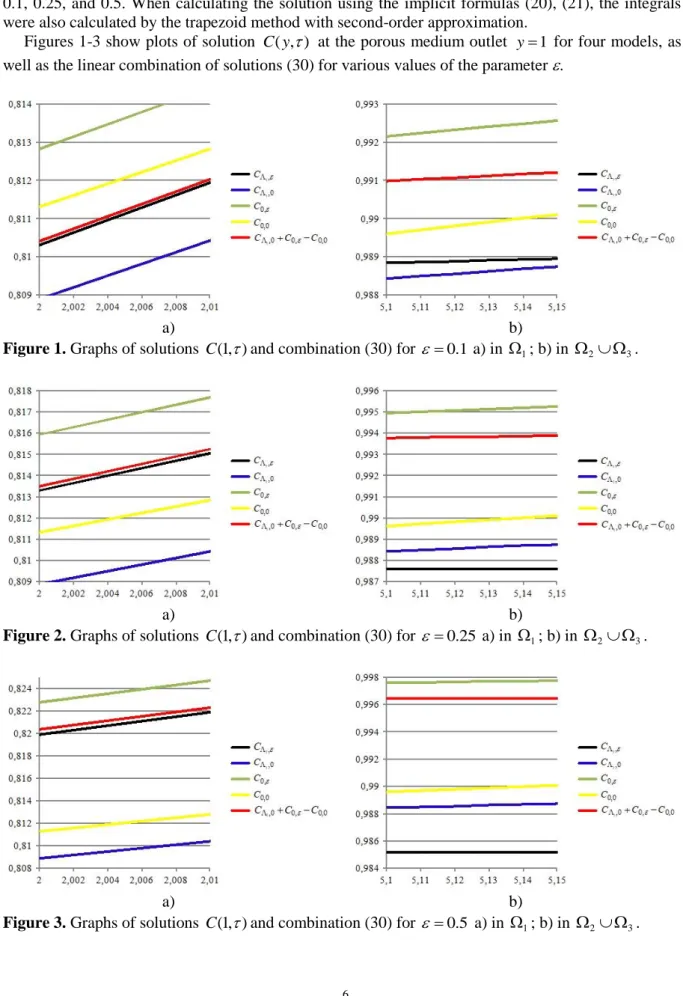
Figures 1-3 show plots of solution C y( , ) at the porous medium outlet y1 for four models, as well as the linear combination of solutions (30) for various values of the parameter .
a) b)
Figure 1. Graphs of solutions (1, )C and combination (30) for 0.1 a) in 1; b) in 2 3.
a) b)
Figure 2. Graphs of solutions (1, )C and combination (30) for 0.25 a) in 1; b) in 2 3.
a) b)
7
Figures 1-3 show that at the porous medium outlet in zone 1, the combination of solutions of
linear and semilinear models is closer to the solution of the nonlinear model, than the solutions of linear and semilinear models, and in zones 2 and 3 the solution C1,0 is the best approximation.
a) b)
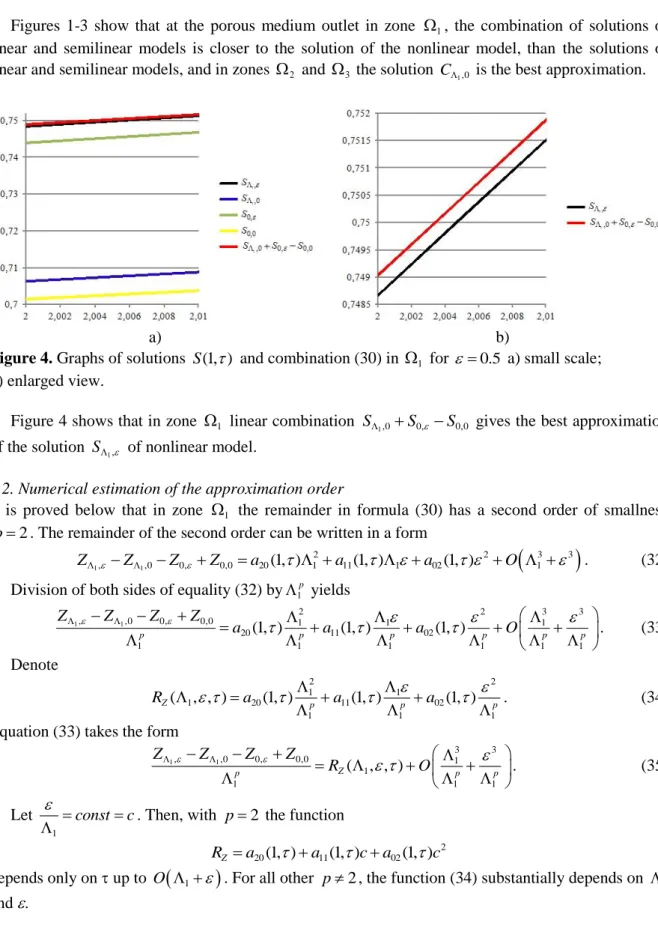
Figure 4. Graphs of solutions (1, )S and combination (30) in 1 for 0.5 a) small scale;
b) enlarged view.
Figure 4 shows that in zone 1 linear combination S1,0S0, S0,0 gives the best approximation
of the solution S1, of nonlinear model.
4.2. Numerical estimation of the approximation order
It is proved below that in zone 1 the remainder in formula (30) has a second order of smallness
2
p . The remainder of the second order can be written in a form
1 1
2 2 3 3
, ,0 0, 0,0 20(1, ) 1 11(1, ) 1 02(1, ) 1
Z Z Z Z a a a O . (32)
Division of both sides of equality (32) by 1
p yields 1 1 2 2 3 3 , ,0 0, 0,0 1 1 1 20 11 02 1 1 1 1 1 1 (1, ) (1, ) (1, ) p p p p p p Z Z Z Z a a a O . (33) Denote 2 2 1 1 1 20 11 02 1 1 1 ( , , ) (1, ) (1, ) (1, ) Z p p p R a a a . (34)
Equation (33) takes the form
1 1 3 3 , ,0 0, 0,0 1 1 1 1 1 ( , , ) Z p p p Z Z Z Z R O . (35) Let 1 const c
. Then, with p2 the function
2 20(1, ) 11(1, ) 02(1, )
Z
R a a ca c
depends only on up to O
1
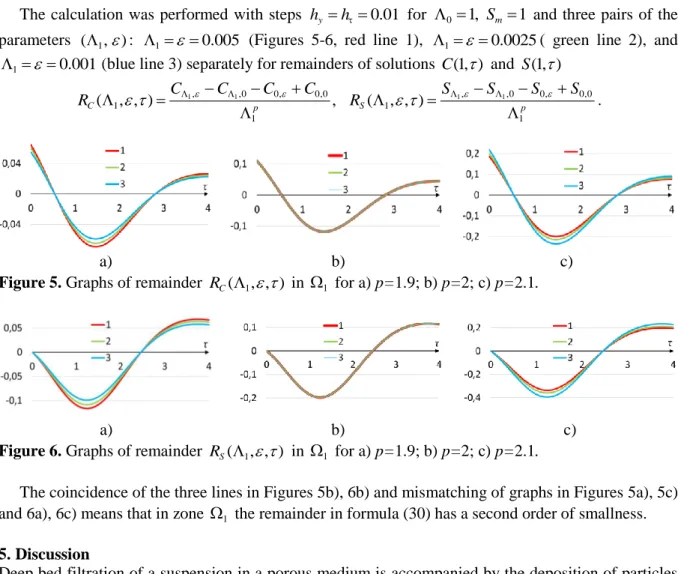
. For all other p2, the function (34) substantially depends on 1The calculation was performed with steps hy h 0.01 for 0 1, Sm1 and three pairs of the
parameters (1, ) : 1 0.005 (Figures 5-6, red line 1), 1 0.0025( green line 2), and 1 0.001
(blue line 3) separately for remainders of solutions (1, )C and (1, )S
1, 1,0 0, 0,0 1, 1,0 0, 0,0 1 1 1 1 ( , , ) , ( , , ) C p S p C C C C S S S S R R . a) b) c)
Figure 5. Graphs of remainder RC(1, , ) in 1 for a) p=1.9;b) p=2;с) p=2.1.
a) b) c)
Figure 6. Graphs of remainder RS(1, , ) in 1 for a) p=1.9;b) p=2;с) p=2.1.
The coincidence of the three lines in Figures 5b), 6b) and mismatching of graphs in Figures 5a), 5c) and 6a), 6c) means that in zone 1 the remainder in formula (30) has a second order of smallness.
5. Discussion
Deep bed filtration of a suspension in a porous medium is accompanied by the deposition of particles on the framework of the porous medium [15]. Depending on the physicochemical properties of the suspension and the porous medium, one or several particle capture mechanisms provide particle blocking [16, 17]. Accounting for several simultaneously operating capture mechanisms significantly complicates the model. Such complex nonlinear models, as a rule, do not have an analytical solution. Neglecting some of the capture mechanisms simplifies the model and allows to obtain the exact solution in explicit or implicit form [18, 19]. However, the solution of simplified models can differ significantly from the solution of a complex problem.
The paper offers a new approach to constructing the asymptotics of a complex nonlinear filtration model based on the known solutions of linear and semilinear models. The calculations show that, in the zone of linearity of the filtration function, a combination of solutions of simplified models gives the best approximation of the solution of a complex nonlinear model. The proposed method has a second-order approximation of accuracy. The problem of increasing the accuracy of the approximation remains unsolved.
Analytical solutions of deep bed filtration models open the way to solving the inverse problem of finding the coefficients of the nonlinear model from laboratory experiments [20, 21].
6. Conclusions
A nonlinear model of deep bed filtration of a monodisperse suspension in a porous medium with multiple particle capture mechanisms is proposed.
9
The solution is zero before the concentration front and is positive behind the front.
A new asymptotics of the nonlinear model is constructed in the form of a linear combination of solutions of simplified linear and semilinear models.
A numerical calculation shows that in zone 1 the combination of simple solutions is the closest to
solution of a nonlinear problem. In the domain 2 3, the best approximation is the solution of a
semilinear model with a piecewise smooth filtration function and a linear concentration function. In zone 1, a combination of simple solutions approximates the solution of a complex nonlinear
problem with a second order of accuracy; in the domain 2 3, the semilinear approximation has
the first order of accuracy.
References
[1] Bedrikovetsky P 2013 Mathematical theory of oil and gas recovery: with applications to ex-USSR oil and gas fields (Springer Science & Business Media) p 576
[2] Civan F 2014 Reservoir formation damage (Gulf Professional Publishing, Burlington, MA, USA) p 1044
[3] Tsuji M, Kobayashi S, Mikake S, Sato T and Matsui H 2017 Post-Grouting Experiences for Reducing Groundwater Inflow at 500 m Depth of the Mizunami Underground Research Laboratory Proc. Eng.191 pp 543-550
[4] Tien C 2012 Principles of filtration (Elsevier, Oxford) p 360
[5] Herzig J P Leclerc D M and Legoff P 1970 Flow of suspensions through porous media - application to deep filtration Industrial and Engineering Chemistry62(5) pp 8-35
[6] Vyazmina E A, Bedrikovetskii P G and Polyanin A D 2007 New classes of exact solutions to nonlinear sets of equations in the theory of filtration and convective mass transfer Theoretical
Foundations of Chemical Engineering41(5) pp 556-564
[7] Kuzmina L I, Osipov Yu V and Zheglova Yu G 2018 Analytical model for deep bed filtration with multiple mechanisms of particle capture International Journal of Non-Linear Mechanics 105 pp 242-248
[8] Zhang H, Malgaresi G V C and Bedrikovetsky P 2018 Exact solutions for suspension-colloidal transport with multiple capture mechanisms International Journal of Non-Linear Mechanics 105 pp 27-42
[9] Fogler H S 2006 Elements of chemical reaction engineering (Prentice Hall: Upper Saddle River, NJ) p 87
[10] Kuzmina L and Osipov Yu 2018 Deep bed filtration with multiple pore-blocking mechanisms,
MATEC Web of Conferences196 04003
[11] Wang S 2018 An Improved High Order Finite Difference Method for Non-conforming Grid Interfaces for the Wave Equation Journal of Scientific Computing77 pp 775-792
[12] Osipov Y, Safina G and Galaguz Y 2018 Calculation of the filtration problem by finite differences methods MATEC Web of Conferences251 04021
[13] Galaguz Yu P and Safina G L 2016 Modeling of Particle Filtration in a Porous Medium with Changing Flow Direction Procedia Engineering153 pp 157-161
[14] Safina G L 2019 Numerical solution of filtration in porous rock E3S Web of Conferences 97
05016
[15] Crist J T, Zevi Y, McCarthy J F, Throop J A and Steenhuis T S 2005 Transport and Retention Mechanisms of Colloids in Partially Saturated Porous Media Vadose Zone Journal4(1) pp 184-195
[16] Riisgård H U and Larsen P 2010 Particle-capture mechanisms in suspension-feeding invertebrates Marine Ecology Progress Series418 pp 255-293
[17] You Z, Bedrikovetsky P, Badalyan A and Hand M 2015 Particle mobilization in porous media: temperature effects on competing electrostatic and drag forces Geophysical Research Letters 42(8) pp 2852-2860
[18] Borazjani S and Bedrikovetsky P 2017 Exact solutions for two-phase colloidal-suspension transport in porous media Applied mathematical modelling44 pp 296-320
[19] Kuzmina L I, Nazaikinskii V E and Osipov Yu V 2019 On a Deep Bed Filtration Problem with Finite Blocking Time Russian Journal of Mathematical Physics26(1) pp 130-134
[20] Yang S, Russell T, Badalyan A, Schacht U, Woolley M and Bedrikovetsky P 2019 Characterisation of fines migration system using laboratory pressure measurements Journal of Natural Gas Science and Engineering65 pp 108-124
[21] Vaz A, Maffra D, Carageorgos T, and Bedrikovetsky P 2016 Characterisation of formation damage during reactive flows in porous media Journal of Natural Gas Science and Engineering 34 1422-1433