SPACE: Student Perspectives About Civic Engagement
Volume 3 | Issue 1 Article 3
January 2018
Truancy in High School
Itzel Ruiz
Northeastern Illinois University
Jason Mink
Northeastern Illinois University
Xochitl Aleman
Northeastern Illinois University
Follow this and additional works at:https://digitalcommons.nl.edu/space
Part of theEducational Assessment, Evaluation, and Research Commons,Numerical Analysis and Computation Commons, and theSecondary Education Commons
This Article is brought to you for free and open access by the Journals at Digital Commons@NLU. It has been accepted for inclusion in SPACE: Student Perspectives About Civic Engagement by an authorized editor of Digital Commons@NLU. For more information, please contact [email protected].
Recommended Citation
Ruiz, Itzel; Mink, Jason; and Aleman, Xochitl (2018) "Truancy in High School,"SPACE: Student Perspectives About Civic Engagement: Vol. 3 : Iss. 1 , Article 3.
Truancy in High School
Cover Page Footnote
We want to thank Jason Mink for allowing his students to take the survey. Especial thanks to Dr. Carlini, Dr. Graham, and Ms.Harris for supporting us throughout this project.
Truancy in High School
Itzel Ruiz, Jason Mink, and Xochitl Aleman, Northeastern Illinois University Purpose
As students get older, it is natural for them to become more independent and have priorities outside of school. Students come from diverse backgrounds. Some high school students’ main focus may be earning money, while others may be needed at home to babysit or do chores. Regardless, high school student attendance rates drop as students get older. We will be focusing on factors which cause upperclassmen to have low attendance rates. The reasons why student attendance rates drop are due to parents’ lack of academic support, peer pressure, and priorities students have outside of school. Unfortunately, not only are absentees’ studies impacted, but also the students who actually attend school. According to Demir and Akman Karabeyoglu (2015), the increase in absenteeism is one of the most important problems in secondary schools today. Excessive absences lead to failure in understanding the material and a general loss of interest in school. Students who are not repeatedly absent also lose instruction time because teachers are trying to reteach those students who have missed school.
Research Question
We will be focusing on the following question: How do students’ relationships with parents and teachers affect upperclassmen attendance?
Literature Review Race in Education
According to Allensworth and Easton (2007), gender and race account for only 12% of the differences in graduation rates in Chicago Public Schools. GPA and the number of courses failed is a strong predictor of graduation. Overall, there are only slight differences between the GPAs of Asian, African American, Latino, and White students. However, amongst all students with high absence rates, non-White students have lower GPAs and fail four more classes than White students (Allensworth & Easton, 2007). Nonetheless, student background characteristics such as race, gender, and mobility do not have a major impact on attendance rates (Allensworth & Easton, 2007). Also, there is great variation in attendance rates across schools with students of similar backgrounds (Allensworth & Easton, 2007). According to Ross (2016), male students who are Black or Hispanic are least likely to receive a high school diploma or obtain a GED, and come from a low-income home.
Relationship Between Students and Teachers
Students spend several hours at school where they make friends, take notes, and learn new material; but most of all, students spend a lot of time with their teachers. Research shows that commitment to school begins with the teacher-student relationship. Dislike of teachers is an important cause of absenteeism. If students do not like their teachers, they will not want to listen,
which then leads to not learning (Demir & Akman Karabeyoglu, 2015). In addition to this, absenteeism interrupts the learning process (Demir & Akman Karabeyoglu, 2015). Teachers do their best to meet all students’ needs. When several students miss class, teachers have to reteach certain material. Therefore, building a good relationship with students would improve
attendance. Also, “catching up” chronically absent students can be a difficult process in schools that do not have strong support systems (Baker Finck, 2015). Some high school teachers’
students miss 13 more days a semester than do other teachers’ students. Also, schools with more supportive environments have been found to have better attendance rates.
There are different suggestions that have been made in order to increase the attendance rates among students. Such methods include trust and creating relationships with students by teaching lessons in which students are engaged (Nemec & Watson, 2007). In this study, teachers and students were surveyed. Teachers were asked whether they believed that attendance was high in their class. The majority agreed that it was. Another question was whether they believed that there was a correlation between a student’s truancy and the classes being failed. Once again, the majority of the teachers believed this to be true (Nemec &Watson, 2007). Students at an alternative school were asked why they missed school. Listed from greatest percentage to least, they missed school due to laziness or disinterest, illness, and court dates (Nemec & Watson, 2007). It has been noted that poor student attendance also affects the teacher's teaching style. Even though students interacting with one another is an important factor in having students succeed, teachers may opt for individual work over group assignments due to the constant absenteeism among students. Another teacher commented that it was difficult to cover one topic a day because many students were usually absent. Hence, it was most likely that the following day would have to be spent reviewing for at least 20 minutes (Nemec & Watson, 2007).
Relationship Between Parents and Students
Oftentimes, parents work an 8-12 hour shift, get home and cook dinner, maybe do more work, and then go to sleep. Research indicates several reasons for student absenteeism arising from family circumstances, such as a lack of participation or not understanding school
procedures (Demir & Akman Karabeyoglu, 2015). In the United States, there are a variety of cultures and languages, which means that not all parents understand the language or rules of their child’s school. Parents might not even know that they are making a bad decision by not sending their children to school. The primary responsibility of parents is to ensure that their children regularly attend school. Conditions at home have a significant impact on children’s attendance and on their promptness (Demir & Akman Karabeyoglu, 2015). Parents of children should be informed about the importance of good attendance and achieving success not only in school but also in the future (Demir & Akman Karabeyoglu, 2015). Guardians often are misinformed on how many days of school their own children have been absent (Rogers & Feller, 2016).
According to Rogers and Feller’s study, the school should email parents regularly to inform them about their children’s attendance. Unfortunately, many parents do not see the value in school, which further deters students from attending regularly (Balfanz & Byrnes, 2012)
It is believed that parental involvement decreases during the middle school years because students tend to become more independent. At the same time, children demand being
independent from their parents (Ross, 2016). Parents who are more actively engaged within the school and through parent-teacher involvement throughout their children’s academic years tend to have children who are less likely to drop out (Ross, 2016). Another key point is that those
students who have conversations with their parents regarding their academic plans are most likely to enroll in a postsecondary institution, compared to those who do not (Ross, 2016).
Methods (Methodology)
Based on our personal interactions with high school students, and by observing their poor attendance, we decided to create a questionnaire in order to have a better understanding of why certain high school students’ attendance is low. This is in addition to the resources that we have read in our literature review. A 10-question survey (see Appendix) was given to juniors and seniors in Mink’s civics and U.S. history classes at a college prep high school in Chicago. Ninety-two students responded and finished the survey. The questions were designed to collect information on the students’ habits of attending classes, reasons for not attending classes, student relationships with teachers, and parental involvement and interest in students’ schooling.
It should be noted that Steinmetz has a population which is approximately 75% Latino. Roughly 15% of the population is White, and 10% is African American. The average daily attendance rate is approximately 90%.
Results
The results from the survey indicate that 27 students speak Spanish at home. Twelve speak Spanish and English at home. The majority of students said they missed either 1-10 days, or more than 20 days of school this year: 19 females missed between 1-10 days, 29 females missed more than 20 days, 27 males missed between 1-10 days, and 6 males missed more than 20 days. The majority of both males (22) and females (14) said they attend all classes every day. For the question on how students feel about their teachers, the majority of females (15) said only some teachers care about their achievement. The majority of male students (22) said all teachers care about their achievement. The majority of both males (15) and females (17) stated they never spoke to a teacher about issues unrelated to class.
For the students who do choose to cut class, the majority said that the main reason is boredom (12 females and 21 males). The majority of students also said that a parent has never come to school to discuss grades with one of their teachers (24 males and 19 females).
Figure 2. Shows how many times parents have attended teacher conferences.
The majority of students also stated that their parents never check Parent Portal (15 males and 17 females).
Figure 3. How many times parents check their children’s portal.
Interestingly, the majority of students described their parents’ attitudes toward their education as supportive (29 males and 22 females).
Figure 4. Shows how supportive parents are towards their child’s education.
Discussion
One thing which is obvious from the results is that many students feel that their parents are interested in their education. However, most parents do not attend parent conferences or check Parent Portal. This could be due to a language barrier, lack of time, or other commitments and previous obligations. The majority of students never speak to their teachers about issues outside of class. This would lead one to conclude that teachers at the school are not seen as mentors or a source of guidance. This would also explain the fact that many students miss class due to boredom because they are not being overly inspired by teachers. However, for those students who miss class because they have difficulty getting to school on time, this would support the argument of numerous familial obligations. Also, we recognize the possibility of a statistical error regarding the Question 10 of the survey. The choices were on the reverse side and several students did not see them. Therefore, some students proceeded to fill in their own answer for this question instead of circling one of the choices.
Of course one major limitation of the data is that it is in an objective format. It is very difficult to quantify the true nature of teacher-student relationships. If we had collected subjective responses, we may have gotten a clearer picture of students’ relationships with
teachers and parents. Another factor which could have shaped the responses is the psychological need to give the socially acceptable answer. Students may have been inclined to state that their parents are interested in their education or that they have few days of absence. They may have felt inclined to choose these answers because they did not want to be labeled as “different” or “at risk.”
Students at this school tend to be apathetic about their education. Many miss class out of boredom and do not seem to make a sincere effort to arrive at school on time. Despite many students indicating that their teachers want them to achieve, most do not seek out their teachers for extra help and guidance. Many students describe their parents’ attitudes toward their
education as supportive. Yet the students themselves do not always seem to take a sincere interest in their education. One is left to conclude that parents are supporting students’ educational decisions even if they might not be the right ones. There are several possible
explanations for this, such as language barriers, lack of understanding of the educational system, and other obstacles.
As educators, we recommend that teachers design all of their lessons around student engagement. Students must be engaged in critical thinking and problem-solving activities in groups or as an entire class. Teachers must always be cognizant of how the lesson relates to the students’ real world. If a student is forced to go to class where they are taught things they see no relevance in, they will resist. This is a necessary attribute of teachers of all subjects.
As far as parental support, this is much more difficult for teachers to control. High school teachers only deal with students for a short amount of time each day. Family members have a far greater influence on children. We recommend that teachers reach out to the parents at the
beginning of the school year with encouragement. For example, a teacher can call a parent of a student with a reputation as a trouble maker. The teacher can offer encouraging words for that student and ask if there is anything they can do to help make the class better for them. This will increase both the student’s and parents’ enthusiasm for the course.
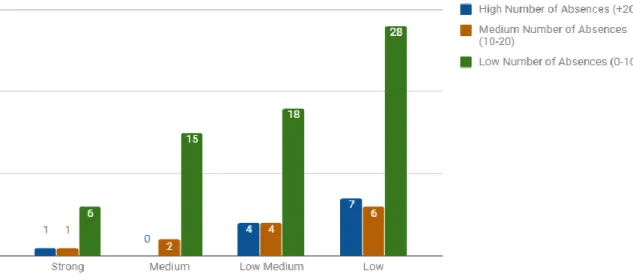
Teachers should focus on creating positive relationships with students who have high absence rates. From our data we can observe that teacher influence has the biggest impact on attendance for those students with high rates of absence. We also recommend further studies on how and why teacher influence impacts attendance. We need to find out why teacher influence has a greater impact on attendance than parental support, as our data would seem to suggest. We also need further studies on the degree to which parents provide support for students, and how that translates into academic engagement.
References
Allensworth, E., & Easton, J. (2007). What matters for staying on-track and graduating
Chicago public high schools: A close look at course grades, failures, and attendance in the freshman year. Chicago, IL: University of Chicago, Consortium on Chicago School Research.
Baker Finck, J. (2015). When students miss school: The high cost to Houston. Houston, TX: Barbara Bush Houston Literacy Foundation. Retrieved from
https://static1.squarespace.com/static/5731ee0840261d67c7155483/t/57645a759de4bb52 8a12cf78/1466194571775/Finck_When+Students+Miss+School+Final%2C+The+High+ Cost+to+Houston_2015.pdf
Balfanz, R., & Byrnes, V. (2012). The importance of being in school: A report on
absenteeism in the nation’s public schools. Baltimore, MD: Johns Hopkins University Center for Social Organization of Schools.
schools. Eurasian Journal of Educational Research, 62, 37-56. Retrieved from
http://dx.doi.org/10.14689/ejer.2016.62.4
Feller, A., & Rogers, T. (2016, March). Parent beliefs and student absences: Large absence-reduction field experiment. Paper presented at the SREE Spring 2016 Conference, Washington, DC.
Nemec, C. J., & Watson, R. A. (2007). Teacher initiatives to reduce truancy among high school students (Master’s thesis). Retrieved from
https://files.eric.ed.gov/fulltext/ED496096.pdf
Ross, T. (2016). The differential effects of parental involvement on high school completion and postsecondary attendance. Education Policy Analysis Archives, 24(30), 1-35.
Appendix
Data Collection Anonymous Survey
1. What is your sex?
2. Which language do you speak at home?
3. How many days of school have you missed this year?
a. None
b. 1-10
c. 10-20
d. More than 20
4. Which of the following best describes you?
a. I attend every class every day.
b. I purposely cut some classes and go to others.
c. I am sometimes absent, but when I am I miss all of my classes.
d. I come to school every day but don’t make an effort to go to any classes.
5. Which of the following best describes your attitude toward teachers?
a. All my teachers try to help me achieve.
b. Only some teachers help me achieve.
c. Few teachers want to help me achieve.
d. There are no adults at this school who want to help me achieve.
6. How often this year have you spoken to a teacher about issues unrelated to the class?
a. Daily
b. Once a week
c. Once or twice a semester
d. Never
7. If you choose to purposely miss classes, what is the main reason for this?
a. Boredom
b. Dislike of teacher
c. Difficulty understanding the subject
d. Difficulty arriving to school on time
a. For only one report card pick-up
b. For both report card pick-ups
c. For both report card pick-ups and other times
d. Never
9. How often does one of your parents check Parent Portal?
a. Every day
b. Once a week
c. A few times a year
d. Never
10. How would you describe your parents’/guardians’ attitude toward your studies?
a. Supportive
b. Indifferent