PERFORMANCE PAY FOR TEACHERS: A COMPARATIVE MULTI-CASE STUDY
A Record of Study by
JIMMY SCOTT GOUARD
Submitted to the Office of Graduate and Professional Studies of Texas A&M University
in partial fulfillment of the requirements for the degree of DOCTOR OF EDUCATION
Chair of Committee, Beverly J. Irby Committee Members, Lori Taylor
Vicente Lechuga Robert Muller
Head of Department, Fredrick M. Nafukho
December 2015
Major Subject: Educational Administration
ABSTRACT
Voluminous studies of performance-based compensation for teachers have been conducted to ascertain the dynamics of programs that are successful in improving teacher effectiveness and in turn student achievement. Few studies have concentrated on what the perceptions of teachers are on performance-based compensation models and what they consider fair and equitable components and structures of such models.
This study surveyed four school districts that had the Teacher Advancement Program (TAP) model and four school districts that did not have a performance pay model associated with their school districts. The research questions that guided the study were: “How do teachers in TAP school districts perceive the performance pay
components of TAP?” and “How do teachers in non-performance pay schools perceive performance pay program components?” and finally, “How do these two groups of teachers’ perceptions compare to one another about performance pay models?”
Comparing the findings from the data analysis, both the TAP and non-TAP districts agreed that performance pay components might cause resentment among staff members, undermine staff morale, and create an atmosphere where teachers would be less willing to assist colleagues.
Focus group interviews were conducted at three campuses from a TAP school district to gain in-depth insight on how teachers really perceived the components of the specific program implementation in their school district. Four themes emerged from the data analysis of the focus group interviews: (a) transparency and communication of
procedures, (b) reliability of observations and evaluations of teachers, (c) additional workload for teachers not worth the extra pay, and (d) increased professional development worthwhile.
While studies show that implementation of the TAP program with fidelity has increased student achievement based on test scores, the results of this study suggested that performance pay components within the surveyed schools was not a favorable way of increasing teacher pay. Future research should include compensation models that can be constructed without using test scores as a major component and increasing the amount of teacher input to construct the program.
DEDICATION
I would like to dedicate this work to my beautiful wife of 30 years, Debbi. You have encouraged me to keep going and “get it done.” Thank you and I love you more. To my daughters, Sammi, Syndi, Andi, and Kalli, for their willingness to let dad “do his homework” and to my grand babies, Jamisyn, Hutton, and Graisyn, who were all born during my program of study at Texas A&M, I love you all.
ACKNOWLEDGEMENTS
I would like to thank my committee members, Dr. Lori Taylor, Dr. Vicente Lechuga, and Dr. Robert Muller for their guidance through my educational journey. A special thank you to Dr. Beverly Irby for her expertise and unwavering support with my study. I could not have done it without your assistance. To my friends and colleagues in the 2012 cohort, a heartfelt thanks for your support and encouraging words. It truly was an exercise in persistence, and you all helped me keep going.
I would also like to thank my current superintendent Michelle Carroll Smith and Dr. Randy Ewing of Lytle ISD for supporting my goal of completing my doctoral program. To Joyce Nelson whose knowledge of the process kept me from missing deadlines and on track to complete my program, you are the best. Finally, to Marilyn Oliva of Action Ink, thank you for your expertise and professionalism in editing and formatting my work. You saved me hours of headaches and helped me realize my goal.
TABLE OF CONTENTS Page ABSTRACT ... ii DEDICATION ... iv ACKNOWLEDGEMENTS ... v TABLE OF CONTENTS ... vi LIST OF FIGURES ... ix LIST OF TABLES ... x CHAPTER I INTRODUCTION ... 1 Background ... 2
Teacher Attitudes and Motivation ... 4
Statement of the Problem ... 8
Purpose of the Study ... 9
Significance of the Study ... 10
Theoretical Framework ... 11 Research Questions ... 14 Definition of Terms ... 15 Limitations ... 17 Delimitations ... 18 Assumptions ... 18
CHAPTER II LITERATURE REVIEW ... 19
Introduction ... 19
Teacher Advancement Program (TAP) ... 23
A Brief History of Teacher Compensation... 24
Current Performance-Based Compensation Models ... 27
Teacher Attitudes and Motivation Related to Performance- Based Compensations ... 33
Page
CHAPTER III METHODS ... 39
Introduction ... 39 Research Design ... 39 Selection of Participants ... 40 Instrumentation ... 43 Data Collection ... 46 Data Analysis ... 48 Summary ... 50
CHAPTER IV PRESENTATION AND ANALYSIS OF DATA ... 51
Introduction ... 51
Quantitative Data ... 52
Qualitative Data ... 62
Themes ... 63
Summary ... 72
CHAPTER V SUMMARY, DISCUSSION, AND CONCLUSIONS ... 74
Introduction ... 74
Summary of Study ... 74
Purpose of Study ... 75
Theoretical Framework ... 76
Discussion of Findings ... 77
Implications for Practice ... 82
Recommendations for Further Research ... 83
Conclusions ... 84 Epilogue ... 84 REFERENCES ... 86 APPENDIX A ... 94 APPENDIX B ... 95 APPENDIX C ... 96 APPENDIX D ... 97 APPENDIX E ... 100
Page
APPENDIX F ... 103
APPENDIX G ... 104
APPENDIX H ... 105
LIST OF FIGURES
FIGURE Page
1 Principal-agent relationships in public education ... 12 2 Principal-agent relationships involving TAP ... 13
LIST OF TABLES
TABLE Page
1 Summary of Findings from Literature Reviewed ... 20
2 Size Comparison of Participating School Districts ... 41
3 Anonymous Survey Respondent School Districts ... 42
4 Demographics of Survey Participants ... 53
5 Survey Responses Regarding Test Scores ... 54
6 Survey Responses Regarding Teacher Performance Pay ... 56
7 Survey Responses Regarding Work ... 58
8 Survey Responses Regarding Climate ... 59
9 Sunset ISD Participants by Grade Level Regarding Work ... 61
10 Focus Group Participants ... 63
CHAPTER I INTRODUCTION
Mrs. Pritchard (a pseudonym) surveys her fifth grade classroom of 23 students and begins her reading lesson as she has done since September. Now that it is April, she has 10 days to review and get her students ready for the State of Texas Assessment of Academic Readiness or STAAR exam. Has she been thinking about how her students will do on the STAAR test in terms of how it will affect her bonus pay next November? Does she, in fact, really understand how the calculations are even made for her score on the printouts that come from some unknown secretive company in another state?
Mrs. Pritchard tells me that the almost $1,500 she gets around Christmas is great, but it is not what motivated her to become a teacher and it certainly does not induce her to work harder. She already puts in countless hours a week and on weekends for her kids, and her main objective is to get little Jamisyn and Hutton along with the rest of her class to pass the test so they can move on to the sixth grade. Mrs. Pritchard’s and many other stories are part of the growing trend toward paying teachers on how well their students perform on state assessments.
Performance pay for teachers, also referred to as merit or incentive pay, usually based on student tests scores, has been gaining momentum since the inception of No Child Left Behind (NCLB) 2002 legislation and new state accountability systems derived from Texas and sponsored by President George Bush (U.S. Department of Education, 2012). Educational reformers have promoted a myriad of reasons for the
movement. Advocates of the movement believe that paying teachers for student achievement will increase student success, improve teacher motivation and reward exceptional teaching. While detractors warn of unhealthy competiveness, disagreement on school goals, excessive budgets, and even cheating (Chamberlin, Wragg, Haynes, & Wragg, 2002), a large amount of literature has been compiled on teacher pay scales and performance-based compensation that spans hundreds of years as depicted in Chapter II.
Background
Littleton Independent School District (pseudonym) has had a performance-pay program associated with the Teacher Incentive Fund (TIF) grant program for the past 6 years using the Teacher Advancement Program (TAP). The goal of the TAP program is to improve the quality of teaching in the profession and in turn improve student
achievement, stating excellent teachers enhance student-learning (Solomon, 2005). School district performance-based compensation plans in TAP include an incentive pay portion for teachers who teach STAAR-tested subjects of math and
reading in grades 4 through 8 and in high school, the End-of-Course exams for English I, English II, Biology, U.S. History, and Algebra I teachers. The performance pay dollars for the STAAR-tested subject instructors are based on teacher evaluation, 50%, and value-added growth for the students in the teacher’s classroom, 30%, and a school-wide score based on State assessment results, the final 20%. Not all teachers are evaluated the same in this system, meaning that teachers of other than STAAR-tested subjects receive performance pay based on 50% teacher evaluation and 50% school-wide scores. The school-wide score is based on the test scores that of the entire campus for reading and
math in grade 4 through 8 and the end-of-course exams in English I, English II, Biology, U.S. History, and Algebra I.
This may become an equity issue, as teachers who do not teach the tested subjects may earn more performance money than the ones who actually earn the school-wide score. The equity issue may arise based on the pools that the teachers are divided into by subjects taught for the performance pay portion of TAP. Teachers who teach one of the STAAR-tested subjects noted above are grouped in one small teacher pool. All the other teachers including elective teachers are grouped into another larger teacher pool. As the money for each teacher is put into the pool, $2,000 for teachers in most TAP school districts, the pool of money for the larger group of teachers is naturally larger than the small group of STAAR-tested subject teachers. An example may be that there are 10 teachers who instruct STAAR subjects for a total of $20,000 dollars and a group of 30 elective teachers on campus for a total of $60,000 dollars. As the teachers earn each portion of the performance pay, some may not earn the total $2,000, and that money is put back into the pool or redistributed. The result could be that one teacher may benefit or be given some of the redistributed funds from the underperformance of a colleague, and thus, a perceived inequity may surface within the payout models.
The term free riders comes into play as elective physical education teachers may gain more payout dollars from the inefficiency of their colleagues but through no extra work of their own. As an administrator, it is very hard to explain to a fourth grade math teacher why a high school physical education teacher and coach may receive $2000
more dollars in bonus pay than she did. The amounts are intended to be confidential, but in small districts people talk.
Teacher Attitudes and Motivation
In reviewing the literature on teacher attitudes toward performance-based compensation, I found the discussion evolves into what motivates teachers. The
consensus is that teachers do not enter into the field of education to make huge salaries, but money does matter to them. Kelley, Heneman, and Milanowski (2000) listed 17 potential outcomes for teachers, one of which was salary bonuses for meeting
performance goals. When teachers were surveyed and asked to rank the 17 indicators, the pay bonus was at the top of the list along with professional satisfaction of observing student learning. The findings indicated that teachers not only value extrinsic rewards but other intrinsic success as well, including professional development that improves the quality of their teaching toolbox (Odden, & Kelley, 1996).
Farkas, Johnson, and Foleno (2000) created teacher focus groups and surveyed them on how to improve teacher quality. Educators ranked the most effective ways to improve quality, and smaller class size was the number one response followed by four other responses from 50 to 60% of the teachers. Increased salary was among the four other responses. As Farkas et al. (2000) suggested, higher pay for a job well done is a motivator for teachers as it is in any other outside industry. However, other structures need to be in place for teachers to support pay-for-performance schemes as they are called in many articles.
In a report from the Center for Educator Compensation Reform (CECR, 2011), the CECR discussed emerging issues in compensation structures and specifically details research on stakeholder attitudes and opinions on reward structures. The stakeholders include teachers, administrators, and teacher unions. The CECR indicated that
stakeholder engagement and buy in are essential to the success of any differentiated compensation model.
The American Federation of Teachers (AFT) has conveyed tentative support for certain types of different compensation plans in recent years. Moving beyond the traditional salary schedule, they have said compensation plans must include multiple measures of student outcomes and should reward both individual teachers and groups or as an entire school and would include multiple ways for teachers to earn extra incentive pay (AFT, 2010).
The National Education Association (NEA) by 2008, however, had not supported compensation plans based on student test scores as a major component of teacher
eligibility for monetary rewards (Flannery & Jehlen, 2008). In addition, the NEA cautioned that before any alternative pay system could be successful in school districts, there needed to be a valid, reliable, and standards-based evaluation system in place (Little, 2009). When these characteristics are in place, the system gives the teachers a perception of fairness.
Perceived fairness of the program in addition to the values and beliefs of the teachers correlate with their attitudes toward any compensation plan being suggested. The term distributive fairness is used to describe the reasonableness of a compensation
plan based on the fairness of the components of the model. The components include the form of compensation, the dollar amount, and formula to reach the monetary reward distributed (Heneman, Milanowski, & Kimball, 2007). Heneman et al. (2007) suggested that teachers are more likely to support a program that they believe fosters change in behavior, but more importantly behaviors that they value. Some teachers who value extra effort believe that individuals that contribute more and at a higher level to the goals of the school should receive higher pay (Milanowski, 2007).
The attitude of public and private school teachers and merit pay systems was the topic of a study by Ballou (2001). Ballou surveyed private school and public school teachers to gain insight into how they felt about rewards for exceptional performance. He used results for the SASS survey from 1987 to 1988 to compile the evidence. Schools with and schools without merit pay systems in place were surveyed. Notably in schools without merit pay systems, private school teachers strongly favored bonuses for exceptional performance with 41% and public schools with only 26% strongly in favor of bonuses. In schools with merit pay plans, private school teachers also topped the list with 45% in favor of the system and public school teachers 33% in favor. From the results, it appears that support for merit pay was greater in schools that had one in place and the attitudes of the private sector were very positive in schools with or without merit pay. Public school teacher attitudes were also slightly more positive in schools with merit pay plans. Compensation plans in private schools, as noted earlier, do not have to deal with teacher unions that can stifle attempts to install alternative compensation models (Ballou, 2001).
Regardless of the presence of unions, teachers across the nation tend to agree that their primary motivator is improved student achievement. Educational systems designed to increase student achievement will therefore also enhance teacher motivation.
Engaging in professional development and school-wide activities are also motivators for teachers, as are clear goals for student achievement within the school. Along with the intrinsic motivators, salary and compensation are also important. The structure of the performance-based compensation model is the determining factor in the success of the program. The research is clear on poorly structured models; they do not work and are detrimental to the educational system (Odden & Kelley, 1996).
New incentive pay plans are being tried around the country that will encompass more than a student performance measure. These plans include competitive salary levels: knowledge and skills-based pay and school performance awards. They should be viewed as a strategy to enhance student learning and advance teacher knowledge and expertise (Odden & Kelley, 1996).
Performance-based compensation models should take into account what motivates teachers, and as the research suggests and the findings of this study did confirm, is that money alone does not motivate teachers to work harder. A well-constructed plan that encompasses not only monetary incentives but also professional development and collaboration with colleagues is paramount if the performance pay plan is to achieve the intended goals of increased student achievement and high quality teaching in the classrooms.
Statement of the Problem
Incentive pay plans for teacher performance have been used in Texas school districts for several years with a variety of funding sources including the Governors Educator Excellence Grant (GEEG), the Texas Educator Excellence Grant (TEEG), and District Awards for Teacher Excellence (DATE). Evaluation of these different grants used for local school district-created performance pay programs has been done by the National Center on Performance Incentives through Vanderbilt University with cooperation from the Texas Education Agency in the form of research briefs and working papers. The TAP program has been the subject of one of these evaluations and reviews the program through the lens of improving tests scores as compared to non-TAP schools (Springer, Ballou & Peng, 2008).
Surveying the perceptions and attitudes of TAP school district teachers toward the incentive pay component of the TAP program in Texas as compared to non-TAP schools without any kind of incentive pay program in place seems to be lacking in the research. Comparing the perceptions of the structure of a performance-based
compensation plan of campuses with and campuses without such a plan gives insight into whether the program is sustainable after the grant funds have ended. If the teachers feel that the plan is worthwhile and equitable, then the district can make an informed decision to sustain the TAP model or invest in another performance-based compensation program.
Improved teacher effectiveness, increasing the amount of professional
pay program provided by the TAP model. In opposition to the structured TAP model, locally created incentive plans funded by the TEEG grant were evaluated for three consecutive years of implementation by Springer et al. (2007, 2008, 2009) where the findings suggested that the local design of the plan and the characteristics of the schools influenced the attitudes and behaviors of teachers, school environment, and teacher turnover.
Purpose of the Study
The primary purpose of this study was to compare teachers’ perceptions and attitudes toward the performance pay components of the TAP program in four Texas school districts and their non-TAP counterparts in four school districts. The school districts were matched by using indicators including student enrollment numbers,
number of teachers, and demographic information, including percentage of economically disadvantaged students enrolled at the campus. I wanted to compare the responses to questions about the implementation and perceived fairness of the TAP performance-based compensation program with teachers in school districts without a performance pay model to determine their perceptions and attitudes if such a model were being
contemplated by their school district. Finally, I investigated if the perceptions and attitudes of the teachers in TAP schools and non-TAP schools toward a performance-based compensation program would influence their teaching practices. The data collected from survey instruments of both TAP and non-TAP schools and the focus group interviews from the TAP campuses were analyzed to provide information to be used by school districts in Texas to determine if the TAP program may be a viable
choice for a performance-based incentive program and if the campuses without a performance pay program would be willing to attempt such a plan in their school districts.
Significance of the Study
The findings of this study may provide an avenue for districts considering the System for Teacher and Student Advancement, formerly the Teacher Advancement Program (TAP) and its performance-based compensation components to thoroughly evaluate all aspects of the program. It may also provide school districts that are contemplating a performance-based compensation plan with the necessary insight regarding teacher’s attitudes and perceptions of performance pay models and various components of these types of plans going forward.
In addition, the results should provide school leaders with the tools to effectively communicate to stakeholders all the inter-connecting parts of the model. Many studies and articles have been published regarding performance pay and teacher motivation, including Ballou (2001), who researched the attitudes of public and private school teachers and merit pay systems. A comparative multi-case study of TAP school districts and non-TAP school districts in Texas, including the attitudes and perceptions of the teachers in schools that have adopted the performance-based compensation program and ones that have not, has not been done.
By conducting a comparative multi-case study, the emphasis was to determine if such programs were considered fair, equitable, and a viable performance-based model as Little (2009) suggested. It is my hope that the findings will contribute to the field of
research on performance pay for teachers and their attitudes of this specific program as compared to non-TAP schools or schools without a performance-based compensation plan already in place.
Theoretical Framework
I applied the economic theory of principal-agent relationship also known as agency theory (Mitnick, 1973) to my study of TAP and the teachers who work within the guidelines of the program. First, I defined the concept of the principal-agent
relationships, and then I outlined the similarities between the economic theory and the educational setting of the study. Finally, I described the pertinent principal-agent relationships and the dilemmas that may arise in the public school domain.
In defining the principal-agent theory, Delves and Patrick (2010) described the principal-agent relationship in the business context as when one person (the principal) engages another person (the agent) to perform a service on behalf of the principal. They explained that although the principal and the agent may be working toward the same goal, they may not have the same interests. The principal is trying to maximize profits for his own benefit by employing the agent for the least amount of salary and incentives to remain cost effective. The agent on the other hand, actually may have more
information than the principal may about the work and knows how to increase
production but may not have the same incentive to produce at a high quality level since they may not be included in the profit-sharing and only receive minimum payment.
In the education field, the principal-agent relationship may include many scenarios. This may include the state as the principal and the local school district as an
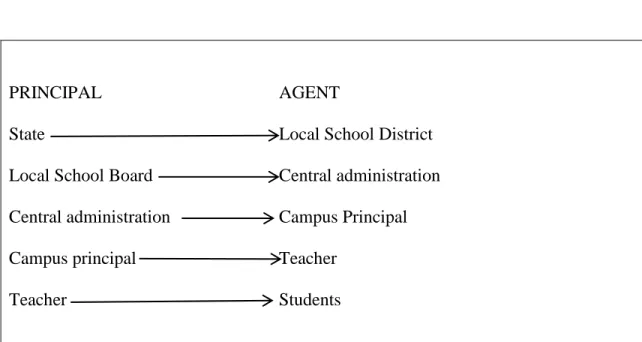
agent and the local school district as a principal and the teacher as the agent. Examples of principal-agent relationships for this study can be seen in Figure 1 that was adapted from Levacic (2009).
PRINCIPAL AGENT
State Local School District
Local School Board Central administration Central administration Campus Principal
Campus principal Teacher
Teacher Students
Figure 1. Principal-agent relationships in public education.
In her paper for the Oxford Developmental Studies, Levacic (2009) summarized and applied the principal agent theory to the teaching profession in Great Britain. She described the variables that face educators when dealing with students who may not present themselves in the business world. These included the student’s family background and preparation for schooling. Casson (2007) also elaborated on the variables that teachers cannot control using the term “student quality” (p. 90). He characterized student quality as income status, social status, and the education of the student’s parents. These uncontrollable variables in the teaching profession lead to the relationship dilemmas teachers and administrators may have when working within the constraints of the TAP program.
Framing the principal-agent theory for the purpose of this study, I extend the reference to local school districts (principals) that adopted the Teacher Advancement Program (the contract) as the performance pay compensation model and the teachers (agents) they employ, working toward educating the students in the district. The goal of the district in adopting the TAP performance-based compensation model is to provide incentives for teachers to improve student achievement through additional pay for
improving standardized tests scores, providing positive evaluation results, and increasing knowledge and skills in their field.
The TAP program itself may also be considered the contract and the school district the principal in the relationship as teachers, or agents, are complying with the principal and the guidelines of the program in order to earn the extra pay based on their student’s performance (see Figure 2). The principal-agent dilemma occurs when the performance pay of the teachers is based on the test scores of the students that the teachers may have limited influence on as several variables, described earlier, can affect the outcome of standardized tests. In addition, the school-wide score, of the TAP
incentive plan can induce some teachers to become free riders as the scores are based on the STAAR results for only a limited number of teachers and all teachers benefit from those few.
PRINCIPAL CONTRACT AGENT OUTCOMES
Local School District TAP Teacher Student Achievement Figure 2. Principal-agent relationships involving TAP.
Research Questions
If, as the principal-agent theory suggests, the goal of the school district in using the TAP program or any other performance-based incentive can be viewed, according to Odden and Kelley (1996) as a strategy to enhance student learning and advance teacher knowledge and skills, the structure of the model and how teachers perceive it is
imperative to the success of the plan. In an attempt to gather these perceptions of teachers in an incentive pay model (TAP) and teachers not in an incentive pay model, the following research questions guided my study.
1. How do teachers in TAP school districts perceive the performance pay components of TAP?
2. How do teachers in non-performance pay schools perceive performance pay program components?
3. How do these two groups of teachers’ perceptions compare to one another about performance pay models?
Secondary research questions developed in my study with data gathered from a qualitative method using focus group interviews at a TAP school included:
4. What components of the TAP performance pay model do the teachers feel are beneficial?
5. What do teachers suggest as ways to improve the TAP performance pay model?
Definition of Terms
Throughout this study, many educational terms were used that may be foreign to the reader of this study, and therefore, I provide the definition and context that was used in the research.
American Federation of Teachers (AFT) – The American Federation of Teachers (AFT, 2013), an affiliate of the AFL-CIO, was founded in 1916 and today represents 1.5 million members in more than 3,000 local affiliates nationwide.
National Education Association (NEA) – The National Education Association (NEA), the nation’s largest professional employee organization, is committed to
advancing the cause of public education. NEA’s 3 million members work at every level of education—from pre-school to university graduate programs. NEA has affiliate organizations in every state and in more than 14,000 communities across the United States (NEA 2012).
No Child Left Behind (NCLB) Act – The No Child Left Behind Act is also known as the Elementary and Secondary Education Act of 2001. George W. Bush enacted the act in 2001 to close the achievement gap with accountability, flexibility, and choice, so that no child is left behind (U.S. Department of Education, 2012).
Performance-Based Compensation – In the context of this study, performance-based compensation is the extra monetary payment a teacher may receive performance-based on a set of standards that is created by an outside organization or an internal committee and then adopted by the district. It is also known as merit pay, incentive pay and performance pay.
Schools and Staffing Survey (SASS) – The Schools and Staffing Survey (SASS) is a system of related questionnaires that provide descriptive data on the context of
elementary and secondary education and policymakers and a variety of statistics on the condition of education in the United States (National Center for Education Statistics, 1988).
State of Texas Assessment of Academic Readiness (STAAR) – The State of Texas Assessment of Academic Readiness is a series of state-mandated standardized tests used in Texas public primary and secondary schools to assess a student's achievements and knowledge learned in the grade level.
Standardized Test – Any test in which the same test is given in the same manner to all test takers is a standardized test.
Student Achievement – For the purpose of this study, student achievement refers to the students’ scores on the STAAR test in reading and math for grades 4-8 and end-of-course exams in high school.
Teacher – The term is used in this study to include core classroom teachers of STAAR-tested subjects as well as athletic coaches and elective teachers including band, drama, music, technology, and agriculture teachers.
TAP – Teacher Advancement Program now known as The System for Teacher and Student Advancement is dedicated to attracting, developing, motivating, and
retaining high-quality human capital in order to raise achievement levels for all students. Launched in 1999 by education pioneer Lowell Milken and colleagues at the Milken Family Foundation, TAP restructures and revitalizes the teaching profession by
providing teachers with powerful opportunities for career advancement, ongoing professional development, a fair evaluation system, and performance-based compensation (National Institute of Excellence in Teaching [NIET, 2013]).
TIF – The Teacher Incentive Fund (TIF) was established to encourage states and districts to develop comprehensive programs that include other elements, in addition to performance pay, that have been shown to increase student achievement and teacher skill levels. Specifically, the federal program encourages grantees to include (a) multiple measures of teacher performance, such as multiple classroom evaluations and measures of student academic growth over time; (b) additional compensation for teachers who take on additional roles or responsibilities; (c) a financial commitment from states and districts; and (d) support from a majority of teachers at the schools (TIF, 2012).
Limitations The research study had the following limitations;
1. The focus of the study was the TAP program on campuses in four school districts in Texas as compared to non-TAP campuses in four school districts also in Texas and the results may not be generalizable to other school districts with different performance pay plans across Texas or in other states.
2. The accuracy and candidness of the data collected from the participating school district during focus group interviews were beyond the control of the researcher.
3. The focus groups were conducted in one TAP school district with participants from grade spans of elementary school (grades K-5), middle school (grades
6-8) and high school (grades 9-12). Their response may not be generalizable to other TAP schools that may implement the program differently.
4. Several TAP School districts chose not to participate. Delimitations
The study was bounded by surveying school districts in Texas that used a specific performance pay program, specifically the Teacher Advancement Program and the perceptions and opinions of teachers who do not teach in a TAP district. This limited the study to the performance pay components of the TAP program used to incentivize teacher performance. Other performance pay programs were not be included in the study.
Assumptions
The assumptions included in this study of the perceptions and attitudes of teachers toward performance pay components were that the teachers were sent the links to the survey by the district liaisons and that the teachers accurately responded to the survey questions provided. I also assumed that the focus group participants spoke truthfully and without fear of retaliation.
CHAPTER II LITERATURE REVIEW
Introduction
Performance pay for teachers, also referred to as merit or incentive pay, usually based on student tests scores on standardized tests, has been gaining momentum since the inception of No Child Left Behind (NCLB) 2002 legislation and new state
accountability systems sponsored by President George Bush. Educational reformers have fostered a myriad of reasons for the movement (U.S. Department of Education, 2012). Advocates of the movement believe that paying teachers for student achievement will increase student success, improve teacher motivation, and reward exceptional teaching, while detractors warn of unhealthy competiveness, disagreement on school goals, excessive budgets, and even cheating (Chamberlin et al., 2002). A large amount of literature has been compiled on teacher pay scales and performance-based compensation that spans hundreds of years. A summary of this literature is included in Table 1.
In Chapter II, I develop a systematic review as described by Randolph (2009) of the pertinent literature for my study, the Teacher Advancement Program (TAP) and its performance-based compensation component that rewards teachers with additional pay for the performance of their students on a standardized test in Texas, the STAAR. I began by defining the purpose of my study guided by the following research questions:
1. How do teachers in TAP school districts perceive the performance pay components of TAP?
Table 1.Summary of Findings from Literature Reviewed
Literature Summary
American Federation of Teachers (2010)
Compensation plans must include multiple measures of student outcome. It should reward both individual and groups or the entire school. Also include multiple ways for teachers to earn incentive pay.
Ballou (2001) Little evidence can be cited for skills and knowledge of teachers to support student achievement. More teachers in favor of merit pay plans that already exist in their schools.
Ballou & Prodgursky (1997) Although religious schools have an easier time implementing merit pay systems, many avoid them as they may appear contrary to ethical beliefs of the school.
Bourne & MacArthur (1970) Two forms of performance pay traced back to Great Britain in 1860, knowledge and skills-based pay, also known as “notorious payment for results.” Created cheating and teaching to the test.
Brandt (1995) Tennessee program most comprehensive of its kind using summative evaluations, ongoing professional development and mentoring for monetary rewards for teachers.
Center for Educator Compensation Reform CECR (2011)
Most models use individual or group monetary rewards or a hybrid that includes both. Stakeholder buy in is essential in any
differentiated compensation model. Chamberlin, Wragg, Haynes, &
Wragg (2002)
Pay used to reward employees in five ways: piecework, equity, profit sharing, one off bonus, and merit or performance pay.
Dee & Keys (2004) Evaluated Tennessee Career Ladder Evaluation System. Made significant improvements in math but not reading.
Denver Public Schools (1999) ProComp System
Four components to program: knowledge and skills acquisition, evaluations, market incentives, and student growth on state tests. Eberts, Hollenbeck, & Stone
(2002)
Michigan pilot merit pay program was two steps: teachers to keep students in class and students evaluated teachers. Unintended results may occur.
Farkas, Johnson, & Foleno (2000)
Created teacher focus groups and asked most effective way to improve quality in education. Smaller class sizes were number one and increased salary was agreed upon by 50% to 60% of teachers. Goldin (2003) Grade-based compensation model description.
Guthrie, Springer, Rolle, & Houck (2007)
Secondary teachers in 1900s paid more than elementary.
Table 1 (Continued)
Literature Summary
Kelly, Heneman, & Milanowski (2000)
Teachers do not enter field to make large salaries, but money does matter. Bonus pay was near the top of 17 ranked survey indicators. Murnane & Cohen (1986) Described many other goals schools strive for besides test scores. National Institute of Excellence
in Teaching (NIET, 2012)
Description of four elements of program.
Odden & Conley (1992) Constructing a performance pay program agreeable to all parties and sustainable over time is a big challenge.
Odden & Kelley (1996) Poorly structured performance pay plans do not work. Primary teacher motivator is improved student achievement.
Odden & Kelley (2002) Previous merit pay schemes failed outright or are not sustainable over time.
Podgursky & Springer (2007a) Single salary schedule or step system created in 1900s. Inequities in 1900s of grade based pay. White males had more access to
secondary jobs.
Prostik (1996) History of teacher compensation room and board model. Sharpes (1987) By 1950, 97% of all schools had salary step system.
Solomon (2005) TAP program proposed to improve teaching practices and in turn enhance student learning.
Vanderbilt University (2015), National Center on Performance Incentives
Compiles research and tracks progress on national performance pay experiments.
2. How do teachers in non-performance pay schools perceive performance pay program components?
3. How do these two groups of teachers’ perceptions compare to one another about performance pay models?
Secondary research questions developed in my study with data gathered from a qualitative method using focus group interviews at a TAP school included:
4. What components of the TAP performance pay model do the teachers feel are beneficial?
5. What do teachers suggest as ways to improve the TAP performance pay model?
Next, I searched online databases including ERIC, Academic Search Complete, EBSCO, and Proquest for journal articles, theses, and dissertations with similar search terms, followed by selecting the most pertinent articles and studies from the United States that meet the criteria of my topic, performance pay or merit pay programs and teacher attitudes toward those schemes. Finally, I analyzed and synthesized the material into a cohesive review that follows my purpose of the study.
In my review of the literature, I reviewed the history of the TAP program model and its performance-based compensation component for teachers. I also investigated the history of performance-based compensation models and transition into the ones currently being used in the schools of the United States including comparing the structure and components of these models.
The next phase of the literature review included reviewing research on teacher attitudes and perceptions toward performance-based compensation models. Also included were studies dealing with student achievement and the latest information available on value added calculations and student progress.
Chapter II is divided into the following sections, (a) the history and components of the TAP program, (b) the brief history of performance-based compensation models, (c) current performance-based compensation models, (d) research on teacher attitudes
and perceptions of performance-based compensation models, (e) student achievement, including value add scores and standardized test scores.
Teacher Advancement Program (TAP)
While researching performance-based compensation models, several merit pay models will be discussed, including the TAP program that has gained notoriety over the past 15 years since it was developed. The Teacher Advancement Program now called The System for Teacher and Student Advancement and was created in 1999 by Lowell Milken and his colleagues at the Milken Foundation and implemented in schools in the 2000-2001 school year (NIET, 2013). Lowell Milken is a businessman, real estate developer, and philanthropist and has co-founded Knowledge Universe, the largest provider of early childhood education in the world. The program description from the organization’s website (NIET, 2015) describes it as an educational reform that
revitalizes and restructures the teaching profession and is comprised of four components that include
1. Multiple career paths for educators, including different levels that teachers may aspire to and earn extra stipends for an increased amount of responsibility. These levels are the regular classroom or career teacher, the next level upward is the mentor teacher who also has a class of students but receives an additional stipend to be an evaluator of peers and assist in leading professional development. The highest level for a teacher in a TAP campus is called the master teacher. These educators are given a sizeable stipend, do not have a classroom of students, and are also trained in the
evaluation process based on the instructional rubric included in the program. The master teachers lead the professional learning community meetings called cluster meetings.
2. Ongoing applied professional growth is the emphasis of the above-mentioned cluster meetings. This meeting time is built into the school day for all teachers to
collaborate and acquire new skills and strategies presented by the master and mentor teachers. The time is very structured and must follow the protocol that is designated by the program.
3. Instructionally focused accountability is the third component and the way the teachers at the TAP campuses are evaluated. Each teacher is observed at least three times per year by the master, mentor, or an administrator and includes a preconference and a post conference to discuss strengths and weaknesses noted during the observations.
4. Performance-based compensation is the financial equivalent to merit pay based on several components that is tied to the teacher’s performance throughout the school year. The educator receives extra bonus money based on evaluation results, student performance on standardized assessments, and responsibilities that are noted in the rubric called an SKR score that is skills, knowledge, and responsibility.
I surveyed the subjects of my study to determine their perceptions and attitudes toward the above-mentioned components of TAP in place in their respective school districts.
A Brief History of Teacher Compensation
Teacher compensation can be traced to the one-room schoolhouse that was born out of the increased transportation system of rural areas in the early nineteenth century.
Almost 80% of people lived in the rural communities and half of them were farmers (Protsik, 1996). Teachers received room and board for their services to the local community; hence, the room and board compensation model was created. They moved from home-to-home of the families they served (Prostik, 1996).
As the industrial age approached, more and more students required schooling and the one-room schoolhouse was not sufficient and the demand for teachers rose. This new era ushered in the grade-based compensation model for teacher compensation in the late 1800s. As Goldin (2003) described “the new economy involved a greater use of science by industry, a proliferation of academic discipline, a series of critical inventions and their diffusion” (p. 75). The compensation model rewarded secondary school teachers with higher salaries than elementary teachers.
At the time, it was believed that the skills needed to instruct older students required advanced levels of knowledge and elementary age students were easier to educate (Guthrie et al., 2007). The grade-based model created a standard to pay teachers in a constant manner by grade, but it lead to inequities of compensation resulting not only in nepotism, but also in inequalities based on gender and race as White males had unequal access to secondary positions (Podgursky & Springer, 2007a).
The grade-based compensation model for teachers gave way to the single salary schedule in the early twentieth century. The single salary or position-automatic schedule, as it was originally called, created the step system that is primarily used today. The step system for paying teachers compensates teachers the same salary with similar years’ experience and educational level (Podgursky & Springer, 2007b). Since the step system
came into existence, it has been the primary model used by districts across the nation. By 1950, 97% of all schools had adopted the single salary schedule or step system (Sharpes, 1987). Currently, an estimated 96% of all public school districts use a similar
compensation schedule to pay its teachers (Podgursky & Springer, 2007b). As
educational reformers react to lower worldwide test scores on math and science for U.S. students as compared to other countries, some current step system salary scales are being shelved for experimental compensation models, compensation models based more on performance outcomes that use student test scores as the measuring stick.
Merit-based pay or knowledge and skill-based pay are two forms of
performance-based compensation that can be traced back to Great Britain in the 1860s. During this period, the evaluation and position of each teacher was based on the results of an examination taken by their students, also referred to as the “notorious payment for results” system in Britain and lasted almost 30 years (Bourne & MacArthur, 1970, p. 20). The system created cheating and teaching to the test or examination. The system also ignored the high students and concentrated resources on lower level students or the bubble kids as we call them today (Bourne & MacArthur, 1970).
Knowledge and skill-based compensation is a system where teachers are rewarded for gaining additional knowledge in their field or subject matter. The compensation is more about the input for the teacher than the output of the students (Odden & Kelley, 1996). Although the knowledge the teachers gain may help in classroom management, curriculum awareness, and content knowledge, little evidence can be cited to support student achievement in this system (Ballou, 2001; Ballou &
Podgursky, 2001; Hanushek & Rivkin, 2004). Results or output-oriented compensation has been and continues to be the basis of salary schedules in the private sector.
Payment for results is described by Chamberlin et al. (2002) as pay that can be used to reward employees in five ways. These include piecework, equity, and profit sharing that are not applicable to the teaching profession, a fourth is called one-off bonuses that occur when a project is completed or in recognition for an award that is very seldom used in education. The fifth option is merit or performance related pay that is added to a teacher’s salary and is counted for pension purposes.
In reviewing the literature, I discovered that this type of pay for performance compensation is being tested throughout the nation in response to educational reformers calling for improvements in our educational system. As the interest grows in
performance-based pay for public education, several organizations have begun to compile research and track progress of current experiments across the nation. The most notable in this field are: (a) The Center for Education Compensation Reform, (b) Vanderbilt University’s (2015) Peabody College’s the National Center on Performance Incentives, and (c) the Education Commission of the States (Podgursky & Springer, 2007a).
Current Performance-Based Compensation Models
Innovative and bold performance pay model proposals are growing throughout the nation in response to educational reformers bellowing for higher educational
standards for students and communities wanting better schools for their children. There has not been such an outcry for reform for the teacher salary system since the early
1990s. Previously, all movements to change teachers’ pay to depend on other factors including student performance, have failed outright or have not been sustainable over long periods of time (Odden & Kelley, 2002).
In this section, a review of some of the latest attempts to improve education by creating a performance-based compensation model for the teachers who work in the public school districts across our nation will be explored. Compensation for educators includes both salary and benefits, but many researchers include the terms teacher pay, teacher salary, and compensation interchangeably as meaning a benefit package. The challenge is constructing a teacher benefit package based on performance that is agreeable to all parties and can be financed and sustained for more than a few years (Odden & Conley 1992).
Teacher performance-based compensation models use a variety of structures and qualifications for the educator to earn more money in addition to their base salary. The basic structures of most are individual or group monetary rewards or a hybrid program that includes both types of awards (CECR, 2011). Most use a combination of teacher evaluations by administrators and student performance on a standardized assessment and professional development attainment as qualifications to earn awards. What follows are several descriptions of programs that have been attempted in the United States.
The Denver Public School’s Professional Compensation System for Teachers known as ProComp began in 1999. According to the Denver Public Schools website, this model has four components that teachers may use to increase their salary. These include knowledge and skills that pay for professional development and advanced degrees and
includes tuition and student loan reimbursement. The comprehensive professional evaluation component is based on satisfactory performance evaluations. Market incentives are a third component that rewards teachers in hard-to-serve or staff schools in the district. The student growth measure of the system rewards teachers for advancing student achievement on the state-standardized test, CSAP.
Funding for the Denver compensation model was provided by an additional $25 million in taxes as voted on by the taxpayers and $22.67 million in federal money in the form of a five-year Teacher Incentive Fund (TIF) grant from the U.S. Department of Education (Podgursky & Springer, 2007a). President George W. Bush initiated the Teacher Incentive Fund program in 2004. The stated goals of the TIF grants were to “develop and implement performance based teacher and principal compensation systems in high need, disadvantaged schools” (Bush, 2004, para. 3).
A TIF grant along with other district funding sources have also been used to fund other performance pay models including the Teacher Advancement Program (TAP) proposed in 1999 by the Milken Family foundation out of Santa Monica, California (Podgursky & Springer, 2007a). The goal of the TAP program is to improve the quality of teaching in the profession and in turn improve student achievement, stating excellent teachers enhance student learning (Solomon, 2005).
One interesting experiment with performance pay was conducted in Michigan in 1996 as a pilot program. The school was an alternative campus with approximately 500 students who were seeking high school diplomas. The alternative campus staff was given the opportunity to participate in a two-step incentive plan. Step 1 was retention of
students in the class and step 2 was a student evaluation of the teacher in the classroom (Eberts, Hollenbeck, & Stone, 2002). Retention in the class was whether the student was in attendance when the principal walked through and did a spot check count of the number of students in the teacher’s classroom as compared to the beginning of the grading period. The teacher evaluation was similar to a college professor evaluation, rating the teacher effectiveness and the class content to determine the size of the incentive the teacher earned.
The average merit pay for the teachers in this pilot was approximately $5,000. Results of the study concluded that pay for performance can motivate teachers to produce outcomes that are directly rewarded. It also suggested that complex
organizations such as schools that have multiple daily tasks and stakeholders along with a team approach may produce unintended results as well unless the plan is carefully constructed and implemented (Eberts et al., 2002). Unintended results are the main reason many of the models fail. One such result is that the plan does not reward the most effective teachers but rather all teachers in a group.
Dee and Keys (2004) examined data from the Tennessee Career Ladder
Evaluation System and the Project Star class-size experiment. The teachers and students were selected at random so as not to have any bias in the results. The researchers in this case compared career ladder teachers, those who received merit pay and the students they served with non-career ladder teachers, ones who did not receive merit pay to observe any significant difference in student achievement. Their results showed a significant 3% gain in math with students who had teachers on the career ladder as
compared to those that did not. However, there was no significant difference in reading scores.
Effectiveness of a good teacher, Dee and Keys (2004) argued, is very hard to evaluate and the “evaluation problem” in schools is compounded by the fact that there are so many variables and goals in schools other than simply student achievement (p. 472). Socialization skills, promoting good citizenship, encouraging differentiated thinking are examples of goals that schools strive for (Murnane & Cohen, 1986). The pessimism of merit pay systems often hinges on what makes an effective teacher and how they are evaluated. In the study of the Tennessee Career Ladder Evaluation System, Malo and French (1987) found that it used more than one method to reward teachers. Praise for the components of the system has come from outside observers. Brandt (1995) stated that the Tennessee program is “perhaps the country’s most comprehensive
experiment in summative evaluation” (p. 475). The system includes ongoing professional development rewards as well as monetary rewards for taking on more responsibilities, as mentoring new staff members.
The system combines five stages or rungs on the career ladder including
probation, apprentice, Level I, Level II, and Level III. Under this system, teachers must apply and be evaluated for each level of the system to be rewarded with an additional salary stipend. Evaluations at each stage of the career ladder assess teachers on multiple domains and indicators using distinct district guidelines (Furtwengler, 1985). Once the teacher earns the stipends, they can range from an additional $1,000 to as much as $7,000 for the top level. Evaluating teacher effectiveness in the way the Tennessee
system does, by adding more requirements for teachers to meet to be rewarded, seems to be one of the more popular models for performance-based compensation. In the previous section of the paper, I looked at several different performance-based compensation programs throughout the nation that have been attempted.
Private school versus public school merit pay is another topic that falls in the realm of incentive pay. The literature on the use of merit pay in private schools, specifically, Ballou (2001) suggested the overwhelming reason that merit pay fails in public schools are teacher unions. The private school sector, with the exception of some of the large Catholic dioceses, does not contend with teacher unions. This gives the private schools more flexibility in contract renewals, salary schedules, and teacher certifications when negotiating incentives with their teachers. Many private schools can make awards or incentives available in a quiet, non-public manner and do not have to deal with unions representing unsatisfied employees. With the absence of teacher unions, educator contracts at the private institutions can be dissolved at the end of the school year as warranted by poor performance. Teachers who complain in a private school about salary differentiations in a merit pay system could be deemed as non-team players who put personal gain before the school (Ballou, 2001). The possibility of contract non-renewal in private schools stifles their outcry that their public school counterparts with union backing can pursue. In the public schools, many teachers are on term contracts and, therefore, are more difficult to terminate even if they do not perform well in the merit pay system. The influence of teacher unions has led to many performance-based compensation plans being undermined.
Several factors contribute to the reasons more private schools do not use a merit pay system as described by Ballou (2001). Particularly, the private sector is much smaller than the public schools and professional norms established in the public schools are adopted by the private schools. Many religious schools avoid the merit pay systems as they feel it runs contrary to their ethical values in promoting a Christian learning environment (Ballou & Podgursky, 1997). Private schools have also embraced the salary schedules of public schools to avoid discriminatory issues that would have legal
consequences. Consequently, private schools are wary of attempting any incentive pay systems that their public school counterparts do not approve. Teacher attitudes toward incentive pay in both private and public schools is a continuing topic of discussion among educators. In the next section, literature regarding teacher attitudes and what motivates faculty toward incentives will be discussed.
Teacher Attitudes and Motivation Related to Performance-Based Compensations A review of the literature on teacher attitudes toward performance-based
compensation evolved into what motivates teachers. The consensus was that teachers do not enter into the field of education to make huge salaries, but money does matter to them. The Consortium for Policy Research in Education, in a report by Kelley et al. (2000), listed 17 potential outcomes for teachers related to performance-based compensation – one of which was – salary bonuses for meeting performance goals. When teachers were surveyed and asked to rank the 17 indicators, the bonus pay was at the top of the list along with professional satisfaction of observing student learning. The findings showed that teachers not only value extrinsic rewards but other intrinsic success
as well, including professional development that improves the quality of their teaching toolbox (Odden & Kelley, 1996).
Farkas et al. (2000) created teacher focus groups and surveyed them on how to improve teacher quality. The educators were asked to rank the most effective ways to improve quality and smaller class size was the number one response followed by four other responses from 50 to 60% of the teachers. Increased salary was among the four responses. The Farkas et al. study suggested higher pay for a job well done is a motivator for teachers as it is in any other outside industry. However, other structures need to be in place for teachers to support pay for performance schemes as they are called in many articles.
In a report from the Center for Educator Compensation Reform (CECR, 2011), the CECR discussed emerging issues in compensation structures and specifically details research on stakeholder attitudes and opinions on reward structures. The stakeholders included teachers, administrators, and teacher unions. The CECR stated that stakeholder engagement and buy in are essential to the success of any differentiated compensation model.
The two major national teachers unions, the American Federation of Teachers (AFT) and the National Education Association (NEA) have conveyed tentative support for certain types of different compensation plans in recent years. The AFT (2013) actually offered a resolution on professional compensation for teachers who move beyond the rigid hierarchy of the traditional salary scales. Moving beyond the traditional salary schedule, the teachers say that compensation plans must include multiple
measures of student outcomes and should reward both individual teachers and groups or as an entire school and would include multiple ways for teachers to earn extra incentive pay (AFT, 2013).
The NEA has not supported compensation plans based on student test scores as a major component of teacher eligibility for monetary rewards (Flannery & Jehlen, 2008). In addition, the NEA cautioned school districts that before any alternative pay system can be successful, there needs to be a valid, reliable, and standards-based evaluation system in place (Little, 2009). When these characteristics are in place, the system gives teachers a perception of fairness.
Perceived fairness of the program in addition to the values and beliefs of the teachers correlate with their attitudes toward any compensation plan being suggested. The term, distributive fairness, is used to describe the reasonableness of a compensation plan based on the fairness of the components of the model. The components include the form of compensation, the dollar amount, and formula to reach the monetary reward distributed (Heneman et al., 2007). Heneman et al. (2007) also suggested that teachers are more likely to support a program that they believe fosters change in behavior but more importantly behaviors that they value. Some teachers who value extra effort believe that individuals who contribute more and at a higher level to the goals of the school should receive higher pay (Milanowski, 2007).
The attitude of public and private school teachers and merit pay systems was the topic of a study by Ballou (2001). The author surveyed private school and public school teachers to gain insight into how they felt about rewards for exceptional performance.
The study used results for the SASS survey from 1987-1988 to compile the evidence. Schools with and schools without merit pay systems in place were surveyed. Notably in schools without merit pay systems, private school teachers strongly favored bonuses for exceptional performance with 41% and public schools with only 26% strongly in favor of bonuses. In schools with merit pay plans, private school teachers also topped the list with 45% in favor of the system and public school teachers 33% in favor. From the results, it appears that support for merit pay was greater in schools that had one in place and the attitudes of the private sector were very positive in schools with or without merit pay. Public school teacher attitudes were also slightly more positive in schools with merit pay plans. Compensation plans in private schools, as noted earlier, do not have to deal with teacher unions that can stifle attempts to install alternative compensation models (Ballou, 2001).
Regardless of the presence of unions, teachers across the nation agree their primary motivator is improved student achievement. Educational systems designed to increase student achievement also enhance teacher motivation. Engaging in professional development and school-wide activities are also motivators for teachers as are clear goals for student achievement within the school. Along with the intrinsic motivators, salary and compensation are also important. The structure of the performance-based compensation model is the determining factor in the success of the program. The research is clear on poorly structured models; such models do not work and are detrimental to the educational system (Odden & Kelley, 1996).
New incentive pay plans are being implemented around the country that will encompass more than a student performance measure. These plans include competitive salary levels, knowledge and skills-based pay, and school performance awards. They should be viewed as a strategy to enhance student learning and advance teacher knowledge and expertise (Odden & Kelley, 1996).
Performance-based compensation models should take into account what motivates teachers and as the researchers have suggested, money alone does not motivate teachers to work harder. A well-constructed plan that encompasses not only monetary incentives but also professional development and collaboration with
colleagues is paramount if the performance pay plan is to achieve the intended goals of increased student achievement and high quality teaching in the classrooms.
Summary
The topic of performance-based compensation, merit pay, or incentive pay for teachers is well researched and continues to be a pivotal issue in the educational reform movement. In this literature, I reviewed and discussed the inception of teacher
compensation that began as room and board in exchange for teaching in rural areas to the introduction of the salary step schedule at the beginning of the industrial age where salary schedules were developed to reward teachers on years of experience regardless of performance in the classroom. Performance compensation models were patterned after industry, but the teaching profession has so many variables that cannot be measured by piecework so other models were developed.
The other models included multiple requirements or opportunities for teachers to earn extra pay. Districts are experimenting with professional development, knowledge and skills attainment, student achievement, and extra duties and activities. Compensation models are funded through various sources including taxpayer dollars and federal grants such as the TIF grant, state grants, and local school district budgets. Sustainability of the compensation models often was determined by the amount of funding and the years available to the school districts.
Merit pay systems in private schools versus public schools have been studied, and it was mentioned that the lack of union presences in the private sector makes
compensation models more attractive to private schools. However, many private schools use similar pay scales and policies as public schools to avoid legal issues with contract nonrenewal. Private schools sometimes shy away from merit pay based on ethical or organizational beliefs as well.
Teacher attitude and motivation are the most important indicators in successful implementation of any alternative compensation model. Teachers must believe the plan is fair, and they must value the structure of the model. Money does motivate teachers as in any other field, but the primary motivator is improved student achievement (Odden & Kelley, 1996). Unique performance-based compensation models are ongoing and funded by the Department of Education through the TIF grant funds and Race to the Top
program funds. Educational reformers will continue to lobby for improved teacher quality that in turn leads to improved student achievement for our nation and performance-based compensation models will continue to be investigated.
CHAPTER III METHODS
Introduction
The primary purpose of this study was to compare teachers’ perceptions and attitudes toward performance pay components of the TAP program in four Texas school districts to those responses of survey questions about implementation and perceived equity of a performance-based compensation program in four non-TAP schools districts or schools without a performance pay program. In addition, I investigated the
perceptions and attitudes of the teachers toward the program components in regards to influencing their teaching practices through added professional development
Research Design
A mixed-methods approach with both quantitative and qualitative methods was used in the participating districts as related to the research questions. A survey design described by Creswell (2003) as a “design that provides quantitative or numeric
description of trends, attitudes, or opinions of a population by studying a sample of that population” (p. 153) was used for the quantitative portion of the study.
The strategy for the qualitative component of my study was the case study of a participating school district in the form of focus group interviews. The focus group interview questions were general and open-ended to elicit views and opinions from the participants (Creswell, 2003). The data collected from the survey instrument and the focus group interviews from the school districts were analyzed to provide information
that may be used by school districts in Texas to determine if the TAP program or a similar performance based compensation program may be considered as one of their alternatives for an incentive pay plan.
According to Creswell, Klassen, Plano Clark, and Clegg Smith (2011) “mixed method research is more than simply collecting qualitative and quantitative evidence, it involves the intentional collection of both types of data and the combination of the strengths of each to answer research questions” (p. 5). Collecting both quantitative and qualitative data simultaneous gave me a better connection to the data and strengthened my study. The chapter is organized in