Submitted September 10, 2013
ASR Analytics, LLC
1389 Canterbury Way
Potomac, MD 20854
Federal TIN: 20-1204680
DUNS: 15-108-3305
GSA Schedule #: GS-10F-0062R
Submitted to:
Shelita Saint-Louis, Contracting Officer
National Telecommunications and
Information Administration
Broadband Technology Opportunities Program
Evaluation Study
Order Number D10PD18645
Case Study Report
Round 2
Urban Affairs Coalition
Table of Contents
Executive Summary ... 4
Introduction ... 7
1.1 What the Interviewees Told Us ... 7
Section 2. Impacts ... 9
2.1 Focus Areas ... 9
2.2 Digital Literacy... 10
2.3 Workforce and Economic Development ... 12
2.4 Education and Training... 14
2.5 Quality of Life/Civic Engagement ... 14
2.6 Healthcare ... 15
Section 3. Recovery Act Goals ... 17
3.1 Provision of Equipment and Services ... 17
3.2 Broadband and Economic Development ... 19
Section 4. Grant Implementation ... 22
4.1 Facilitating Conditions ... 23
4.2 Performance Expectancy ... 24
4.3 Effort Expectancy ... 24
4.4 Social Influence ... 25
Section 5. Techniques, Tools, and Strategies ... 26
5.1 Techniques, Tools, and Strategies ... 26
5.2 Challenges ... 27
Section 6. Conclusions... 28
Section 7. Next Steps for the BTOP Evaluation Study ... 29
Glossary ... 30
Bibliography ... 31
List of Figures
Figure 1. Words Interviewees Used Frequently ... 8
Figure 2. Grantee Training Hours Categorized by Focus Area ... 10
Figure 3. Focus Area Statements Made by Interviewees ... 10
Figure 4. Philadelphia FIGHT Job Readiness and Office Skills Training ... 13
Figure 5. Frequency of Topics Related to Recovery Goals ... 17
Figure 6. Broadband Awareness Outreach Implemented by UAC ... 18
Figure 7. Cumulative Number of Netbooks Distributed by Drexel University ... 19
Figure 8. Cumulative Number of New Household and Business Subscribers ... 20
Figure 9 Direct Jobs Created by UAC ... 21
Executive Summary
“The number of people we can serve and the number here in Philadelphia who desperately need these services is still really enormous. They range from youth who have some skills and are obviously really quick with technology but may not have professional skills, to older adults who never learned how to use a computer because they didn't have to.” – Philadelphia FIGHT Supervisor
The Urban Affairs Coalition (UAC) includes more than sixty-five partner organizations collaborating to improve the quality of life of residents in the Philadelphia, Pennsylvania area. UAC operates and manages a wide range of programs, services, and public policy initiatives that focus on the low-income and minority populations in the region. UAC assists with the fiscal sponsorship, capacity building, and program evaluation of coalition members, allowing partner organizations to focus on their individual missions.1
On September 1, 2010, the National Telecommunications and Information Administration (NTIA) awarded UAC a Broadband Technology Opportunities Program (BTOP) grant for $11,804,015 to implement the Freedom Rings: Sustainable Broadband Adoption (SBA) project. The goal of the project is to bridge the digital divide and reduce barriers to broadband adoption in Philadelphia through access, awareness, and training programs.2 UAC manages the grant and is responsible for
disseminating grant funds to partners and reporting grant progress to NTIA. UAC also manages all project partnerships, including active engagement in the grant’s evaluation and marketing efforts through the administration of subcontract agreements with its partners. UAC and its partners take a collaborative community-based approach to helping residents access technology.
The project targets at-risk youth, those living with HIV/AIDS, the homeless and formerly homeless, those in public housing, recovering addicts, and ex-offenders throughout the City of Philadelphia. Many residents of the city belong to groups with historically lower levels of broadband adoption. Philadelphia is composed of nearly 43 percent African-Americans with proportionately larger Hispanic populations than those in Pennsylvania as a whole. Approximately 20 percent of the service area population over the age of 25 does not have a high school degree or general equivalency degree (GED). This figure is more than 7 percentage points higher than the average for the state and 5 percentage points greater than that for the nation.3
BTOP also funded the City of Philadelphia’s Freedom Rings: Public Computer Center (PCC) project on July 1, 2010. The grant provided $6,362,129 to create or upgrade 77 computer centers with 829 new or upgraded computer workstations in underserved neighborhoods.4 The PCCs are
called “KEYSPOTs,” which are the physical locations that provide computer access and digital literacy training to Philadelphia residents. The UAC SBA grant complements the City of Philadelphia’s PCC grant by promoting awareness of the KEYSPOTs and program resources. The City of Philadelphia, UAC, Drexel University, and other community organizations and agencies created the Freedom Rings Partnership in 2010 to increase Internet adoption and training with the goal of reducing the digital divide. However, this report does not reflect any PCC grant-related activities or impacts.
UAC used grant funds to provide digital literacy, employment, GED, English as a Second Language (ESL), and college preparatory training. The project focuses on the most economically and socially vulnerable populations in Philadelphia. UAC implemented a four-stage broadband adoption model to increase digital literacy among the targeted populations: 1) awareness, 2) trial, 3) acceptance, and 4) conversion.5
UAC has been able to meet or exceed most of the target objectives established under the grant. The project proposed to accomplish the following, with the results shown:
Make 75,000 people aware of broadband through a viral social marketing campaign.6 By the
end of June 2013, UAC’s broadband awareness and marketing campaigns had reached a total of 460,876 participants in Philadelphia.7
Provide 100,000 hours of training to 15,000 people.8 By the end of March 2013, UAC had
exceeded this goal and provided 208,780 hours of training to 22,554 participants.9 Training
included basic Internet and computer skills and multimedia classes.10
Provide 5,000 laptops to public housing residents.11 Through its subrecipient Drexel University,
UAC had provided 5,044 netbooks to residents who participated in the Philadelphia Housing Authority (PHA) Netbook Program as of June 2013.12
Generate 5,000 new household and 50 new small businesses broadband subscriptions.13 By
the end of June 2013, UAC had generated 1,939 new household and 50 new small business or community anchor institution subscriptions.14 A subscriber is defined as a home or business that
has a paid or subsidized broadband connection.
UAC partnered with the New America Foundation’s Open Technologies Initiative (OTI) to assist with the development of partner and community relationships, develop broadband adoption strategies for the community, and administer a user survey at the KEYSPOTs to evaluate the impact of broadband adoption and digital literacy programs in Philadelphia. Patrons take the survey after they complete classroom-based, instructor-led trainings. Several preliminary key observations from the data analysis show that had it not been for the grant, users might not have received digital literacy and workforce development training to apply for jobs. Outreach, computer access, and training at the KEYSPOTs have helped users develop skills to search for employment, develop résumés, and gain new skills to apply for jobs.15 OTI is completing the final report, which will
include data from user surveys, focus groups, and interviews related to subscribership and Internet adoption.
The case study presented is one of fifteen performed by ASR Analytics, LLC (ASR) on a sample of eight PCC and seven SBA grants. It is part of a larger mixed-methods evaluation of the social and economic impacts of the BTOP program.
The purpose of this case study is to:16
Identify how the grantee maximized the impact of the BTOP investment.
Identify successful techniques, tools, materials, and strategies used to implement the project.
Identify any best practices and gather evidence from third parties, such as consumers and anchor institutions, as to the impact of the project in the community.
This report further investigates the initial impacts reported by the grantee during the first round of visits and identifies additional impacts that occurred in the time between the site visits. The results presented in this report reflect the evaluation study team’s observations at the time of the second site visit. It will serve as a basis for Interim Report 2, which will analyze data from fifteen case studies.
This case study is primarily qualitative. Although there was no mechanism in place to collect uniform data across the partners beyond what is required for the grant, UAC staff members and project partners provided accounts of positive impacts of the grant. ASR collected the information presented here during two field visits to evaluate the social and economic impacts of the grant. The evaluation study team originally met with representatives of UAC over a two-day period in September 2011, visiting administrative and project partner offices, including Philadelphia FIGHT,
focused on the grantee and project partners that were included in the first site visit excluding NCCF, which was no longer in operation as of May 2012. At the suggestion of the UAC project director, ASR interviewed another partner instead, Media Mobilizing Project (MMP).
The evaluation study team performed five site visit interviews. ASR transcribed the discussions and used this information and other data and reports provided by the grantee to supplement Quarterly Performance Progress Reports (PPR), Annual Performance Progress Reports (APR), and other publicly available information.
Six components of the project provided the most significant benefits to users: broadband awareness; access to computers and technology; access to UAC staff and resources; digital literacy training; employment and job skills training; and media training. According to UAC partners, broadband awareness, digital literacy skills, and workforce development skills have increased among patrons and helped reduce the digital divide in Philadelphia.
The evaluation study team noted the following outcomes and impacts of the project:
UAC staff reported that as part of the Freedom Rings Partnership, UAC and its partners, in collaboration with the City of Philadelphia, helped to create or save jobs for patrons who used the KEYSPOTs. Patrons used the KEYSPOTS to search for employment, create résumés, and apply for jobs online.
Upon completion of the free digital literacy training course, 150 graduates of the PHA Netbook Training program had registered for and completed credit classes at the Community College of Philadelphia (CCP).17
Grant efforts resulted in 1,939 new household and 50 new business Internet subscriptions by the end of June 2013.18 UAC in partnership with Clear Mobile Citizen and Wilco, a minority
cable provider, established and promoted a low-cost service option for PHA residents who did not qualify for Comcast Internet Essentials.19
UAC observed an increase in digital literacy skills among users. Before the grant, some users could not operate a mouse or computer. Basic digital literacy is necessary to facilitate the target populations’ ability to use the Internet to obtain information provided by UAC partners, including information about shelters, health and wellness, government benefits, and other social services.
Participants used the BTOP-funded training to complete GED courses, access and download college course information online, and complete college course assignments.
Program participants developed the skills and knowledge to create media projects, television segments, and online radio programs in an effort to mobilize Philadelphia neighborhoods around social and government issues relevant to minority communities. Projects included support for a nonviolent school campaign for students, municipal labor disputes for city workers, and state driver’s license requirements for immigrants.
The BTOP grant was essential to achieving these outcomes and impacts. Prior to BTOP, there were limited places in the city available for residents to use computers, access the Internet, and receive training at no cost. The grant was vital to improving the quality of digital literacy instruction and programming by providing more instructors and training classes. Without BTOP, the target population would not have access to the learning tools necessary to build key skills needed for finding employment, permanent housing, and enrolling in post-secondary education courses in order to improve their lives. As discussed in this report, the focus of UAC on providing these services was necessary to achieving the benefits described.
Introduction
The Urban Affairs Coalition (UAC) includes more than sixty-five partner organizations collaborating to improve the quality of life of residents in the Philadelphia, Pennsylvania area. UAC operates and manages a wide range of programs, services, and public policy initiatives that focus on the low-income and minority populations in the region. UAC assists with the fiscal sponsorship, capacity building, and program evaluation of coalition members, allowing partner organizations to focus on their individual missions.20
On September 1, 2010, the National Telecommunications and Information Administration (NTIA) awarded UAC a Broadband Technology Opportunities Program (BTOP) grant for $11,804,015 to implement the Freedom Rings: Sustainable Broadband Adoption (SBA) project. The goal of the project is to bridge the digital divide and reduce barriers to broadband adoption in Philadelphia through access, awareness, and training programs.21 UAC manages the grant and is responsible
for disseminating grant funds to partners and reporting grant progress to NTIA. The project focuses on the most economically and socially vulnerable populations in Philadelphia: at-risk youth, ex-offenders, public housing residents, seniors, the homeless, and people living with HIV/AIDS.
1.1
What the Interviewees Told Us
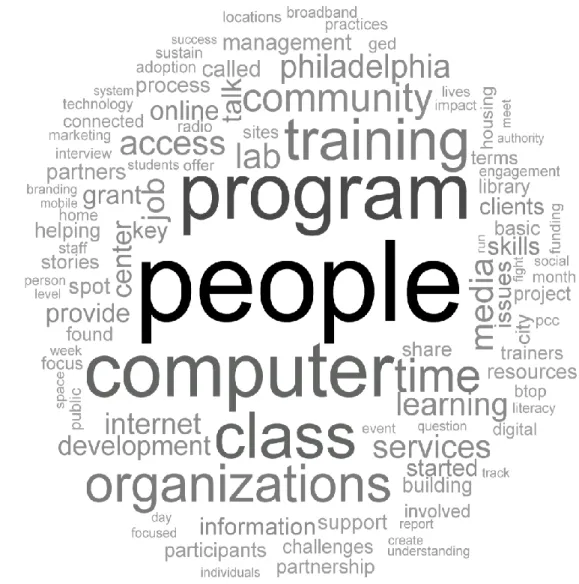
Figure 1 displays words interviewees used frequently during discussions that took place with ASR. These included five interviews with program management and project partners. The word cloud displays the 100 words interviewees used most frequently. The purpose of the word cloud is to provide a succinct visual summary of the conversations that occurred. Statements made by ASR personnel during the interviews were excluded from the analysis, as were common words, such as prepositions, articles, and conjunctions, which were identified using a standard “stop list.”
The project partners focused their efforts on broadband awareness and training, with most of the major terms used by the grantee and partners relating to this goal. The words used most frequently to describe the activities and impacts of the project include “people,” “program,” “and “computer.” The words emphasize the project’s goal to promote broadband awareness and provide computer access to the target population to reduce the digital divide. Other significant words discussed by UAC staff and project partners are “class,” “training,” “community,” and “organizations,” reflecting the partner-centric program implementation model.
Section 2.
Impacts
The most prominent impacts of the project are found in the Digital Literacy focus area. As of June 2013, UAC strategically promoted broadband awareness to 460,876 participants in Philadelphia, which influenced the number of individuals who went to the KEYSPOTs to use the workstations and other resources.22 The grant funded an array of Digital Literacy training, ranging from basic
computer classes for those without computer experience to advanced courses for more proficient users. Although UAC collected limited outcome and impact data beyond what was required for the grant, interviewees provided accounts of positive impacts of the grant. Quantitative data are summarized where available.
Trainers assisted patrons in learning to use computer programs, navigate the Internet, complete educational courses, and use video and digital media tools for community mobilization. UAC trainers reported that users completing basic computer and Internet courses are often interested in learning about advanced programs such as Microsoft Word, PowerPoint, Excel, Access, and Outlook. Examples of the accounts provided by staff and patrons include the following:
“People have found jobs after taking the training courses, which impacts employment and increases self-confidence.”
“We have the big computer lab here. We have a computer lab at our youth program. We have a computer lab at our ex-offender program. We're helping all these other organizations do it. It would not happen without this grant.”
“People will come back for other programming, whether it is getting connected to the arts or to different social services that they need. This simple piece of technology [the computer] becomes the possibility and opportunity for whole-life enrichment for people.”
UAC partnered with the New America Foundation’s Open Technologies Initiative (OTI) to assist with the development of partner and community relationships, develop broadband adoption strategies for the community, and administer a user survey to participants who completed instructor-led courses. Several key observations from the data analysis indicate that without the grant, users may not have obtained Digital Literacy and Workforce and Economic Development training to complete job-related tasks online.
2.1
Focus Areas
This section describes the impacts of the Freedom Rings project in terms of five focus areas. ASR tabulated the training hours UAC reported in the 2012 APR using the focus area categories described in Interim Report 1 to determine where impacts would be expected.23
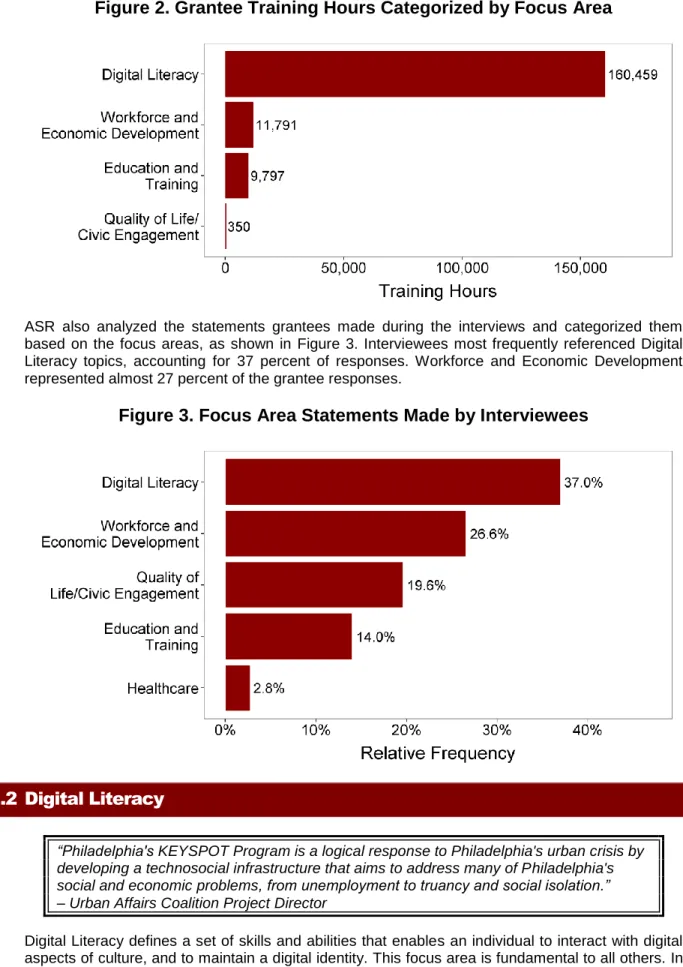
As shown in Figure 2, UAC reported 182,397 hours of training through December 2012.24 Project
partners dedicated 88 percent of training hours to computer and Internet training, group instruction, and one-on-one instruction in the focus area of Digital Literacy. Workforce and Economic Development accounted for 6 percent of training provided to patrons. Education and Training accounted for 5 percent of the training, which included GED and college preparatory courses.
Figure 2. Grantee Training Hours Categorized by Focus Area
ASR also analyzed the statements grantees made during the interviews and categorized them based on the focus areas, as shown in Figure 3. Interviewees most frequently referenced Digital Literacy topics, accounting for 37 percent of responses. Workforce and Economic Development represented almost 27 percent of the grantee responses.
Figure 3. Focus Area Statements Made by Interviewees
2.2
Digital Literacy
“Philadelphia's KEYSPOT Program is a logical response to Philadelphia's urban crisis by developing a technosocial infrastructure that aims to address many of Philadelphia's social and economic problems, from unemployment to truancy and social isolation.” – Urban Affairs Coalition Project Director
Digital Literacy defines a set of skills and abilities that enables an individual to interact with digital aspects of culture, and to maintain a digital identity. This focus area is fundamental to all others. In
the National Broadband Plan, the Federal Communications Commission (FCC) defines digital literacy as “the skills needed to use information and communications technology to find, evaluate, create, and communicate information.”25
UAC collaborated with several partners to offer Digital Literacy programs. UAC differentiates KEYSPOT users based on digital literacy skills. Some users have previous experience with computers and the Internet and visit KEYSPOTs because they lack the ability to connect at home. These users do not necessarily require training. Other users own a computer or even subscribe to broadband at home but do not know how to use the technology. Other users have little to no previous exposure to computers and the Internet. This section highlights these programs and their corresponding outcomes and impacts. Examples include:
By the end March 2013, UAC partners provided 208,780 hours of training to 22,544 users.26
UAC partners offered an array of Digital Literacy training, ranging from basic computer classes for those without prior computer experience to more advanced classes, including digital storytelling and blogging. Approximately 42 percent of respondents who completed the OTI user survey reported using KEYSPOTs for basic digital literacy training.27 Staff observed that the
Basic Internet and Computer Skills training is important for building fundamental digital literacy skills that lead to greater, broader Internet use.
The PHA Netbook Program supported Digital Literacy efforts by enabling PHA residents to earn free netbooks after completing the Broadband Technology Basics Course. The eight-hour basic computer and Internet skills training course targets users with little or no previous computer and Internet experience. By the end of June 2013, 5,048 PHA residents completed the training course and earned a free netbook.28 Users gained Digital Literacy skills to engage in a variety of
activities, including basic computer operations, using e-mail and social media, online job searching, accessing government services, and managing personal finances. PHA residents reported using the skills and technology from the program to apply for jobs, complete community college course assignments, and use online banking services.
Drexel University’s Broadband Ambassador Training program provided students with instructional skills to train others to perform a range of computer and broadband-related activities, and to recruit PHA residents to participate in the Broadband Technologies Course. Ambassadors were recruited for the program after successfully completing the Netbook Program. Drexel trained fifty-one PHA residents for the Broadband Ambassador Training program.29 One Ambassador stated that before the training she was unable to use a computer.
Through the training program, she gained the skills necessary to provide Digital Literacy training to other residents, who learned how to look for employment, use social media, and seek out information online. She promoted training and KEYSPOTs on the radio and at special events across Philadelphia, encouraging individuals to improve their digital literacy skills.
The Media Mobilizing Project (MMP) provided multimedia training and access to multimedia tools, targeting individuals historically unrepresented in mainstream media. Through programs like Radio Unidad and MMP-TV, MMP offered advanced Digital Literacy training programs to promote higher levels of Internet use through information analysis and web content creation. As of May 2013, MMP delivered 12,099 hours of multimedia training.30 Participants obtained the
audio and video skills necessary to produce radio and television journalism projects promoting social justice issues directly affecting Philadelphia communities. Users learned to produce videos and use media for organizing and community-building activities. MMP staff observed an increase in Digital Literacy skills among users. Before completing this training, some users could not operate a mouse or computer. The advanced training enabled users to host television and online radio shows.
2.3
Workforce and Economic Development
“Though many factors draw participants to public computing centers and training courses, job search is the most commonly cited motivation for seeking digital access.”
– Urban Affairs Coalition Project Director
Workforce and Economic Development includes activities to increase the overall employment of the target population, or to assist employed members of that population in finding jobs that offer increased salaries, better benefits, or a more attractive career path, including self-employment. Workforce and Economic Development activities can be performed for one’s own benefit, or may be done on behalf of another person to assist with his or her employment situation. In order for project activities to be included in this category, it must be the intention of the grantee to assist members of the workforce in improving their employment outcomes, and project resources must be devoted to this purpose.
UAC and its partners did not track employment outcomes, nor were patrons required to report receiving job offers as this was not an initial requirement of the grant. Although it was not possible to quantify the impact of the program participants’ success in finding jobs at the time of the site visit, staff interviewed during the site visit are aware of some positive outcomes:
Staff members report that at least three PCC users were hired to serve as trainers or lab managers after completing training at KEYSPOTs. These users had few digital literacy skills prior to the training.
One senior patron had no prior experience with computers or the Internet but needed to find employment. After she completed digital literacy training at YOACAP, a law firm offered her a position as a receptionist.
One patron enrolled in training at a KEYSPOT within the People's Emergency Center to develop basic computer skills. Upon completion of basic computer training and participation in a specialist certification course, the patron secured employment.31
Philadelphia FIGHT staff reported that several users found jobs after completing the career development programs. The organization hired one patron for part-time and then full-time employment after they observed her support her peers in the course. In addition, a group of women who lived at a local halfway house completed the job readiness program together. According to the staff, several of the women obtained job interviews and two received job offers. UAC and partner staff members reported that the following project components provided the most significant benefits to users seeking employment:
At KEYSPOTs, patrons had access to staff and resources for assistance with job preparation, creating résumés, job applications, and resources online. Trainers connected users to potential job opportunities, employment networks, partner organizations, and community resources. Staff members provided one-on-one assistance to patrons to address personal needs, such as homelessness, health problems, or prisoner release services needed to complete their job search.
At Philadelphia FIGHT, workforce training participants acquired fundamental skills to look for employment. Trainers provided classes and one-on-one instruction in job readiness, résumé writing, and office skills. KEYSPOTs disseminated job opportunity flyers and posted information on bulletin boards to help users in their employment search process. Users had access to résumé-writing books and other employment resources. Some UAC partners invited employers to meet with students who are job hunting. UAC reported that some people are not ready to look for a job when they first use KEYSPOTs because they need assistance with basic social services. For example, some clients were homeless, and getting them into stable housing is the priority and must occur before searching for employment.
KEYSPOTs provided opportunities for users to participate in self-paced learning to improve individual economic outcomes. At YOACAP, patrons used KEYSPOTs to develop and manage small businesses for supplemental income. For example, one patron, a disc jockey, used the skills gained in training courses to create business cards, manage his company’s online presence, and market his business.
By May 2013, Philadelphia FIGHT had provided 1,864 hours of the Job Readiness training courses to 280 participants and 1,753 hours of Office Skills training to 222 participants.32 Both
courses realized an increase in training participation after the launch of the KEYSPOT bus and subway advertising campaign in the first quarter of 2012. Figure 4 shows job preparation training hours and participation.
Figure 4. Philadelphia FIGHT Job Readiness and Office Skills Training
Each class is limited to twelve people so trainers could provide personalized lessons to each patron. For example, if students needed more help with résumés or interview skills, the trainer placed more emphasis on these areas in the course. The training curriculum created in-house included advanced courses for career development and GED classes. Patrons learned how to store all of their materials online using Google Drive, including their résumé, cover letters, job application templates, and spreadsheets for tracking jobs. Patrons also learned professional behavior, strategies to retain a job, and appropriate methods of communicating with colleagues and supervisors.
UAC participated in the Martin Luther King Day of Service Digital Job Fair. UAC and its partners set up a computer lab to assist patrons seeking employment. Staff members taught participants to create an e-mail address, develop a résumé, and apply for jobs online. In addition, patrons attended classes about the appropriate attire to an interview, steps to take once having found a job, how to resolve conflicts on the job, and other pertinent employment information.
2.4
Education and Training
“Given that many of our students had not been in a classroom in some time, I think this is an even more significant figure. These 56 BTOP graduates represent exactly how students exposed to education and the Internet through our training workshop use that knowledge to move themselves into higher education.” – CCP Coordinator for Corporate Solutions
Education and Training includes activities that lead to a certificate or diploma that would typically be awarded by an educational institution, or that indicates the recipient has received training that is recognized as valuable for career advancement. Examples of certificates or diplomas include: community college degrees, four-year college degrees, advanced degrees, GEDs, certifications in advanced software technologies such as network engineering, and other licenses or certifications that reflect knowledge of a particular subject at a level that would typically be taught at an educational institution.
Project partners devoted the majority of education and training hours to certificate training programs, GED preparation, and office skills. Outcomes and impacts related to Education and Training include:
Drexel University collaborated with the Community College of Philadelphia (CCP) and the PHA in the PHA Netbook Training Program. PHA residents who completed eight hours of digital literacy training were eligible to receive a free netbook. By the end of June 2013, Drexel reported that of the 5,048 PHA Netbook Training program graduates:33
150 graduates registered for credit classes at CCP after completing the free grant-funded training.
94 of the 150 students earned a combined 1,044 credit hours.
56 of the 150 students registered for developmental courses, remedial English 098, 099 and Math 016, 017, required for CCP placement. While developmental courses qualify as college courses, they do not accrue credit hours, thus are not included in the 1,044 credit hours. About 70 percent of students who take CCP's placement test require some manner of developmental education.
Project partners delivered 5,471 hours of advanced training to 683 participants of all ages, including International Computer Driver’s License (ICDL) Advanced Certificate Training using ICDL’s online curriculum, as of May 2013.34 This training program is an international standard
for end-user computing skills, endorsed by employers and institutions of higher education. Certification signals computer software knowledge that can lead to improved individual employment opportunities.
Project partners completed 2,044 hours of GED training with 267 participants by May 2013.35
GED attainment constitutes competencies that are fundamental for social and economic advancement.36 According to the United States Census Bureau, GED graduates have higher
earning potential than high school dropouts.37 In 2014, GED testing will only be offered online.
Staff created computer-based tutorials that mimic the online GED test to prepare and familiarize users with the digital test interface. Helping users to feel comfortable in the learning environment reduces the fear and anxiety associated with the test and technology and can lead to better test-taking outcomes.
2.5
Quality of Life/Civic Engagement
“To me, [civic engagement] is one of the most powerful and biggest impacts to break through the silence around issues.” – Media Mobilizing Project Co-director
The Quality of Life/Civic Engagement focus area includes activities that create stronger and more integrated communities, and those that promote interaction between citizens and their governments. Broadband awareness efforts, coupled with the presence of the KEYSPOTs, provided the opportunity for patrons to participate in workshops, training, and presentations to increase citizen access to government resources and participation in community-based collaboration to engage in local, state, and federal political action.
An analysis of the interviews with UAC staff and partners highlighted the following Quality of Life/Civic Engagement activities and outcomes:
Patrons had access to the social services offered by UAC partner organizations within the same facility. Patrons enrolled in state benefits programs, received temporary and long-term housing, applied for vouchers, applied for federal and state insurance programs, and received employment training.
MMP’s digital media production provided a platform for KEYSPOT users to mobilize citizens and activists around issues that are important to the community. Through structured training courses, users developed skills to create media content to initiate dialogue and action about social and economic issues relevant to minorities, immigrants, youth, and the working poor. Participants learned to create community forums, radio broadcasts, commercials, television shows, and blogs that raise awareness about civic and government issues that affect neighborhoods. MMP shared examples of the outcomes of this training:
One group of participants organized the “Fight for Driver's Licenses” project to address a 2010 amendment to Pennsylvania state law prohibiting individuals from obtaining a driver's license using a tax ID number. Many tax-paying immigrant families in the immigration process had only a tax ID number and lost their driver's licenses. Members of a radio program produced by MMP helped document and collect thousands of testimonials about how this issue affected people.
In partnership with the Philadelphia Student Union, city youth addressed issues concerning race in the school system. In late 2009, major racial conflicts and fights that erupted between the African American and Asian American youth at a South Philadelphia high school, causing discord within the school system. A group of young people worked with the Philadelphia Student Union on a radio program to start a campaign for nonviolent schools. MMP staff members stated that in recent years they have witnessed different communities and people collaborating that often do not work together. Different communities shared their struggles and issues, which helped build new relationships among groups that would not normally work together. The campaign is an ongoing initiative of the Philadelphia Student Union, and the content of their radio programming reflects the work.
2.6
Healthcare
The Healthcare category includes broadband-enabled activities undertaken by participants to improve their own health or that of someone else. This definition includes not only sophisticated tasks, such as viewing one’s medical records online, but also more common activities that might not involve a medical provider at all. Healthcare was not a focus of the Freedom Rings project. However, patrons had access to health information at project partner social service organizations. As a result, they were better able to care for themselves or family members suffering from a health-related issue. In addition, lab trainers provided support to patrons who use the KEYSPOTs to find healthcare information online and suggest additional health and social services available through partner organizations.
received a grant from the National Library of Medicine to support its progress in creating a smartphone application for online health guides. The application will be available to download on smartphones, allowing users to access reliable health information online. In addition, clients had access to the AIDS Library, where they could take courses and ask the staff about specific health questions. Patrons used the information found online and in the AIDS Library to manage their health. FIGHT offered assistance on how to use the newly developed smartphone applications to access reliable health information.
Section 3.
Recovery Act Goals
This section describes the activities and outcomes associated with Recovery Act goals. Of the five Recovery Act goals for the BTOP program as a whole, two relate most directly to SBA programs: 1. Provide broadband education, awareness, training, access, equipment, and support to
a. schools, libraries, medical and healthcare providers, community colleges and other institutions of higher learning, and other community support organizations
b. organizations and agencies that provide outreach, access, equipment, and support services to facilitate greater use of broadband services by vulnerable populations (e.g., low-income, unemployed, seniors)
c. job-creating strategic facilities located in state- or federally designated economic development zones
2. Stimulate the demand for broadband, economic growth, and job creation
Figure 5 below shows the two Recovery Act goals supported by UAC. Most of the conversations, approximately 81 percent, focused on the provision of services to increase broadband awareness and access among target populations in Philadelphia. Grantee and partner discussions about broadband and economic growth accounted for 19 percent, encompassing activities to improve employment opportunities for users.
Figure 5. Frequency of Topics Related to Recovery Goals
3.1
Provision of Equipment and Services
The grant focused on the provision of services available through seventy-nine grant-funded KEYSPOTs located throughout Philadelphia. KEYSPOTs are the physical locations used to provide broadband awareness, education, awareness, training, equipment, and access, using a combination of open-access hours and training classes. Activities supported by project partners and associated outcomes and impacts, if available, include:
Outreach Efforts. UAC and its partners conducted outreach campaigns to make individuals aware of broadband and free access to computers and resources at the seventy-nine KEYSPOTs located throughout Philadelphia. UAC worked with the City of Philadelphia to develop the KEYSPOT brand, which created a sense of community and common communication around digital literacy in Philadelphia. UAC and its partners implemented a marketing campaign to promote the KEYSPOT brand that attracted users to the KEYSPOTs to
such as radio, Southeastern Pennsylvania Transportation Authority (SEPTA) buses, television, newspaper, online, and mail. Figure 6 shows that online marketing efforts alone, including KEYSPOT portal visits, Facebook, Twitter, and e-mail, reached 268,147 participants.38 This
figure includes UAC’s efforts to promote the project portal website developed by Drexel University, which amassed 5,364 user subscriptions to the portal mailing list.39 The portal is an
important tool for advertising grant-funded training and events throughout the city.
Figure 6. Broadband Awareness Outreach Implemented by UAC
Provision of equipment. Project partners set up computer stations at special events across the city to expose the public to technology while simultaneously promoting the KEYSPOTs. Staff members distributed promotional materials, discussed the capabilities and benefits of Internet use, and enrolled individuals in classes. The project reached 167,890 individuals at such events.40 The grant enabled vulnerable populations to use the KEYSPOTs to improve their
lives by developing résumés, completing job searches, searching for housing, applying for government benefits, and connecting with family and friends. UAC staff noted that although the mainstream approach to marketing had been successful, word-of-mouth was the most powerful means of spreading information about KEYSPOT services. However, UAC did not track the outcomes of these efforts.
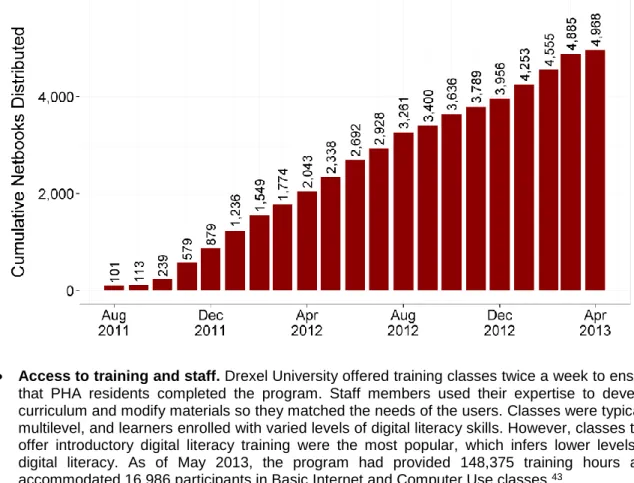
Distribution of netbooks. UAC distributed Toshiba netbooks to PHA residents through a collaboration with CCP, Drexel University, and PHA in an effort to increase broadband adoption. Residents were required to complete eight hours of training to receive the netbooks, which UAC partners distributed on a first-come first-served basis. The project’s goal was to distribute 5,000 netbooks to PHA residents. By April 2013, staff had distributed 4,968 netbooks as shown in Figure 7.41 As of June 2013, staff had exceeded their goal and distributed 5,044 netbooks to
PHA residents.42 Using the netbooks, recipients can access the Internet at home or in public
Figure 7. Cumulative Number of Netbooks Distributed by Drexel University
Access to training and staff. Drexel University offered training classes twice a week to ensure that PHA residents completed the program. Staff members used their expertise to develop curriculum and modify materials so they matched the needs of the users. Classes were typically multilevel, and learners enrolled with varied levels of digital literacy skills. However, classes that offer introductory digital literacy training were the most popular, which infers lower levels of digital literacy. As of May 2013, the program had provided 148,375 training hours and accommodated 16,986 participants in Basic Internet and Computer Use classes.43
Technology that supports social services. The social service organizations in the UAC partnership integrated computer training and digital literacy into their organizational missions and programs. Rather than focus on the technology, the staff targeted the needs of the clients and the ways in which technology can support their goals. Staff members developed the most appropriate training curriculum and comprehensive delivery method for each unique target population. Users with specific human service needs learned to use technology to resolve complex problems, resulting in decreased homelessness, better health outcomes, and reduced recidivism for ex-offenders.
3.2
Broadband and Economic Development
UAC stimulated the demand for broadband by promoting the Comcast Internet Essentials and Wilco/Mobile Citizen’s Internet programs to encourage Internet adoption at homes and businesses in Philadelphia. Both programs provide low-cost alternatives to Internet access for individuals who cannot afford full-price service. The programs offer Internet access for less than $15 per month. For some, the reduced cost of access eliminated a major barrier to home subscription. PHA residents in traditional high-rise buildings may qualify for the Comcast Internet Essentials program, but Comcast does not possess a right-of-way to provide service to their building. The partnership with Wilco, a minority cable company, filled this gap in service. The Wilco/Mobile Citizen program is the sole means of Internet access for many PHA residents. As a result, residents have access to
although the programs reduced the monthly subscription rate, the price point remained out of reach for much of the target population. Despite this hurdle to adoption, UAC reported that by the end of June 2013 more than 1,900 households and 50 businesses or community anchor institutions subscribed to broadband through these programs, as shown in Figure 8.44
Figure 8. Cumulative Number of New Household and Business Subscribers
Several factors contributed to marked increases in subscribership during the third quarter of 2012, and the first quarter of 2013. UAC launched the pilot Wilco/Mobile Citizen program during the first quarter of 2012, with a full rollout during the third and fourth quarters of 2012. During the fourth quarter of 2012, UAC launched an extended version of the user surveys to capture Internet subscribership information for patrons. If patrons stated they were not subscribers, KEYSPOT staff made them aware of low-cost Internet options. Finally, UAC implemented a holiday-related awareness campaign. These factors contributed to the dramatic increase in home and business subscribership across the grant.
Grant activities also emphasized job preparedness, including computer-based GED training. GED and Job Readiness classes combined had served more than 1,200 participants who completed more than 11,000 training hours, as of May 2013.45 This training expanded the applicant pool for
jobs requiring a GED and online applications, and jobs requiring computer and Internet skills. The grant contributed to economic development by increasing the number of qualified applicants for open positions. At the time of the site visit, UAC did not have the ability to track the number of jobs KEYSPOT users obtained.
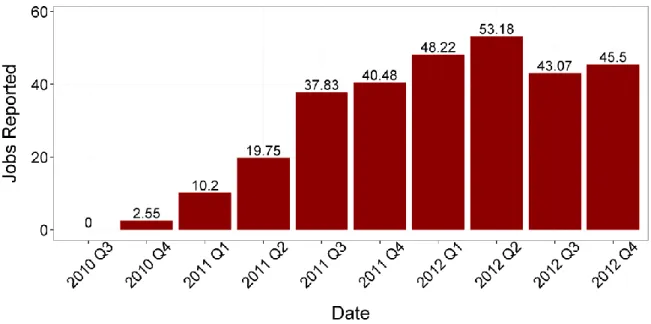
As required by the Recovery Act, UAC reported quarterly on the number of jobs created as a direct result of the project. Figure 9 shows that the project created as many as fifty-three positions by the end of June 2012.46 As of December 2012, the grant had sustained more than forty-five positions.
The project experienced an increase of nearly twenty jobs during the third quarter of 2011, corresponding with the opening of thirteen new training sites and expanded training options across partner organizations. Although UAC did not report the reason for the loss of ten jobs during the third quarter of 2012, the loss is likely the result of ending its contract with partner National Comprehensive Center for Fathers (NCCF) in May 2012 because it was no longer operational.47
Section 4.
Grant Implementation
This section describes particular aspects of the implementation of the Freedom Rings project in order to understand the composition of activities and outcomes observed. The purpose of this categorization is twofold. First, defining a consistent set of categories for each of the grants in the study sample facilitates cross-case comparison and analysis. Second, presentation of the activities and outcomes for this case by category simplifies understanding of the focus of the grantees’ work. This analysis is based on qualitative observations made during the site visits.
ASR is using a theory-based evaluation approach to examine the social and economic impacts of the BTOP program. This permits deeper understanding of grant features in terms of theory, which helps to explain how the grant activities produce impacts. For the PCC and SBA grants, ASR uses theories of technology adoption to examine factors that shape the demand-side of broadband services. The key theory ASR employs is the unified theory of the acceptance and use of technology (UTAUT), a technology adoption model proposed by Venkatesh et al. (2003).48 The
model is among the top three most frequently cited articles published in the information systems field and the preeminent article explaining the adoption of information systems. The UTAUT model traces its history from theoretical constructs found in literature that have a bearing on a user’s intention of technology adoption and use. The UTAUT model is derived from the leading theories of technology adoption, including the theory of reasoned action, technology acceptance model, motivational model, theory of planned behavior, a combined theory of planned behavior/technology acceptance model, model of personal computer use, diffusion of innovations theory, and social cognitive theory.
UTAUT explains technology acceptance by looking at a user’s intention to use an information system and the user’s long-term use of that technology. The UTAUT model combines concepts found in earlier models of technology use to posit a unified theory of information technology adoption and use. UTAUT includes four dimensions determining user intention and technology use: Performance Expectancy, Effort Expectancy, Social Influence, and Facilitating Conditions. Each of these dimensions is further classified into constructs constituting the dimension. The subsections below define and discuss each of these dimensions. Venkatesh empirically tested the model and reported that it was successful in explaining more variation in user adoption of technology than other adoption models tested.
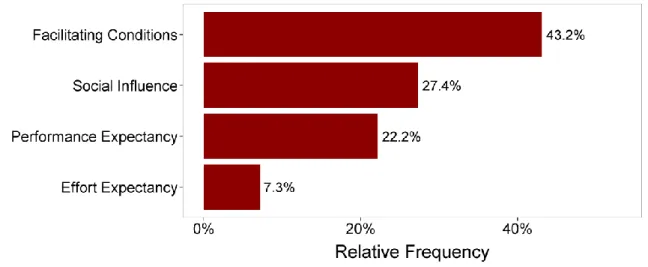
Figure 10 presents the relative frequency of topics related to the grant implementation discussed during interviews and focus groups. These topics are placed in four categories that correspond to the UTAUT categories listed above. Facilitating Conditions was the dimension most commonly referenced by UAC staff and partners, accounting for 43 percent of discussion. Social Influence as it influences technology use among patrons accounts for 27 percent of discussion, followed by Performance Expectancy and Effort Expectancy.
Figure 10. Distribution of Grant Implementation Topics by UTAUT Dimension
4.1
Facilitating Conditions
Facilitating Conditions captures the degree to which the technical infrastructure available to the user supports potential broadband adoption, and the extent to which there are organizational supports to adoption. Facilitating Conditions include access to broadband technology, the extent to which users can choose to use broadband, the compatibility of broadband with their lifestyles and activities, and the cost of using broadband. This also includes the resources needed to support the KEYSPOTs and program services that provide access to the Internet and computers, such as a broadband connection, computers, workspaces, and clean and safe computer labs.
4.1.1
Access
UAC enhanced the activities of the Freedom Rings PCC grant managed by the City of Philadelphia by promoting the seventy-nine KEYSPOTs located in low-income and underserved communities. UAC partners conducted outreach activities by radio, television, newspaper, online, and at events that bring broadband awareness to residents in Philadelphia.
KEYSPOTs are located primarily in social service organizations that individuals visit for assistance. While in the organizations’ facilities, individuals received information about the KEYSPOTs and often take advantage of the services.
UAC promoted the Mobile Labs programs of several partner organizations that took laptops into underserved communities in Philadelphia to promote broadband and UAC services. Staff members passed out promotional materials, discussed computer use, and enrolled residents in classes.
4.1.2
Supporting Training
UAC partners provided training classes at times that were convenient to patrons. Trainers assisted users during classes and open-access hours. For example, Philadelphia FIGHT offered some training courses targeting vulnerable populations once per week for a month to accommodate the patrons’ schedules.
MMP collaborated with Casa Monarca, a Latino cultural center based in South Philadelphia to host one KEYSPOT. UAC provided support with training and education. Staff members taught
Trainers incorporated patron requests when developing curriculum topics and courses implemented at the KEYSPOTs. In addition, trainers taught courses using different methods of instruction and at a pace conducive to students’ learning styles. For example, quicker-learning, experienced individuals partnered with less experienced students. This strategy provided experienced users with the opportunity to learn by providing instruction.
4.2
Performance Expectancy
Performance Expectancy measures the degree to which a potential adopter believes that using the services provided to gain access to broadband is beneficial for job searching or for an activity in another focus area. Aspects of Performance Expectancy include the perceived usefulness of the new technology, outcomes expectations, and the perceived relative advantage of the technology versus previously used technologies. Examples include the following:
Although many factors drew participants to the KEYSPOTs and the available training courses, job search was the most common activity users pursue at the KEYSPOTs. Patrons used the KEYSPOTs to create résumés, and search and apply for jobs online.
Patrons sought to develop their digital literacy skills at the KEYSPOTs to look for a job, further their education, and use the Internet to connect with family and friends.
UAC staff members reported that older adults connected with family through social media while at the KEYSPOTs. They used Facebook and Skype to communicate with their grandchildren who live elsewhere, including overseas.
Some patrons used the KEYSPOTs for educational purposes. They used the computers to access coursework and other information to complete degrees. Youth used the KEYSPOTs to complete homework assignments and apply to college. One patron reported that she completed the PHA netbook program to obtain a computer and used it to help her finish her degree.
4.3
Effort Expectancy
This category measures the expectations of the potential adopter regarding the difficulty of using broadband to achieve benefits in one or more of the focus areas described above. It includes preconceived ideas about the difficulty of using broadband technology and computers in general, and anxiety or concerns about the risks of broadband use. Examples include the following:
Staff members reported that some patrons were initially afraid to use a computer. Such patrons overcame initial apprehensiveness as they gained knowledge and skills, such as controlling a mouse, protecting a computer from viruses, and protecting personal information online.
A supportive environment facilitated by the KEYSPOT trainers helped users overcome fear associated with using a computer and the Internet. KEYSPOT trainers affected patrons’ perceptions, making technology more accessible.
Although some families have Internet access, older members are often reluctant to use it out of fear and embarrassment because of lack of knowledge and skills. UAC partner staff stated that younger family members exhibiting impatience could intimidate older relatives. KEYSPOTs offered patient instructors to assist older patrons in a supportive environment. A FIGHT program assistant used her own experiences as an example to patrons with limited computer experience overcome fear and anxiety.
4.4
Social Influence
“Important social relationships, both online and offline in the centers and across the Freedom Rings Partnership, play a critical role in organizing and powering the KEYSPOT infrastructure.” – Urban Affairs Coalition Project Director
This category measures the degree to which potential adopters perceive that others will view them favorably or interact with them in a positive way if they adopt broadband technology. This includes friends and family members who might already be using broadband technology. It also includes measures of whether the use of broadband is considered a social norm for the group to which the potential adopter belongs. Components of Social Influence include subjective norms, social factors, and the image associated with broadband use. Examples include the following:
Participants cited access to new social networks as an important component of their experience at KEYSPOTs. The social bonds that participants formed at KEYSPOTs contributed to stronger community connections.49 UAC partners reported that the social connections and networks
helped to establish a sense of community and communication in the courses. Some patrons invited family and friends to participate.
Patrons used the training to create media to mobilize individuals around civic and social issues that affect low-income communities. Patrons used media to create an open forum where the voices of people in communities across Philadelphia can influence government policies and decision making that affects their neighborhoods.
The Netbook Program operated by Drexel University provided free computers to PHA residents who enrolled and completed an eight-hour training course. Drexel staff members reported that some of the older residents gathered in a community room in the PHA with their netbooks and spent time visiting with each other.
The Netbook Program trained and empowered Broadband Ambassadors to recruit and enroll PHA residents in the computer course. The Drexel staff members believe that using trusted neighbors to emphasize the significance of the Internet is important and influential for enrolling PHA residents in the program.
Section 5.
Techniques, Tools, and Strategies
This section describes successful techniques, tools, and strategies identified by the grantee. UAC sponsored two training roundtables for the KEYSPOT trainers and lab assistants. These sessions provided a forum for staff to share many successful techniques, tools, and strategies, as well as challenges developed over the course of the grant. UAC developed a wiki page to post the notes and findings of the roundtable discussions.50 This section includes the techniques, tools, and
strategies described in the roundtables and those noted by project staff.
5.1
Techniques, Tools, and Strategies
KEYSPOT branding and outreach strategies were integral in raising awareness of broadband access and training. UAC employed a range of media outlets, including online, city events, print, radio, and television to promote the KEYSPOTs and broadband. In addition to strategic marketing, word-of-mouth was an important tool to raise broadband awareness.
Drexel University developed the KEYSPOT web portal where partners update their organization’s services and information. Using the portal, patrons can access information about the KEYSPOTs, including location, hours, and courses and training offered.
While the federal funding induced a somewhat hierarchical reporting structure, the UAC partnership was highly collaborative. Organizations of various sizes and missions collaborated in decision-making and shared best practices in training, marketing, website development, technology management, and evaluation. As a result, UAC partner organizations developed strong working relationships, encouraging information sharing and referrals.
UAC provided networking opportunities for KEYSPOT trainers and lab assistants. The staff members used these opportunities to discuss successes and challenges involved in the daily management of classrooms and working with multiple learners at different levels in the same classroom. Staff training provided professional development opportunities. Staff members also shared information and resources using wikis, LISTSERV groups, training, and roundtables. Networking provided trainers and assistants with a broader range of tools and resources to improve services to target populations.
Project partners integrated digital literacy into their organizational programs to provide a more comprehensive approach to delivering social services. Training programs focused on how technology could meet patron needs. This reduced fear and anxiety associated with technology use, and facilitates technology adoption as individuals learned how to perform tasks more easily and quickly online.
UAC encouraged peer-led training. Trainers often included former patrons who had developed the skills necessary to teach and encourage others. Trainers offered users firsthand experience with common challenges.
UAC and its partners used a variety of measures to ensure training class retention. Smaller classes implemented personalized lessons, and convenient times made training accessible to patrons. Staff placed phone calls to remind users about upcoming courses for which they had enrolled. Partner organizations also held graduations to celebrate the achievements of patrons.
Partners established both formal and informal networks to refer participants for additional digital literacy training and other social services in which particular partners had expertise, such as housing, recovery services, and educational programs.
5.2
Challenges
UAC staff reported that it was difficult to achieve buy-in with the KEYSPOT brand among all partners. Organizations had to agree to incorporate the KEYSPOT brand into their organizational marketing plans.
Many clients required childcare, which KEYSPOTs did not offer. As a result, some users found it challenging to attend classes.
Because of a variety of challenges, some members of the target population may not own a computer or adopt broadband at home. Health, financial, and residential challenges take priority over broadband. UAC found it difficult to find and implement a low-cost Internet option that met the needs of the target population.
UAC underestimated the amount of time and effort required to develop and implement a sustainable program. Initial delays in securing contracts and procurement resulted in delays in the deliverable schedule.
There was no formal referral process in place for all partner organizations. In addition, partner organizations had limited staff and capacity to maintain updated training schedules. This made it difficult to refer clients to organizations that best fit their schedule and social service needs.
The staff reported that several community organizations have contacted UAC in an attempt to become a KEYSPOT or send their employees for training. KEYSPOT lab space and lack of staff did not always support the implementation of such activities.
It was difficult to track responses to marketing efforts intended to increase household and business subscribership. In addition, ISPs were reluctant to share subscribership data. This made it difficult to attribute increases in new subscriptions to the grant activities.
Section 6.
Conclusions
The UAC BTOP grant approached issues of broadband awareness, access, and adoption by focusing on digital literacy and outreach. UAC used grant funds to employ strategic broadband awareness campaigns, promote access to the KEYSPOTs, and provide digital literacy, employment, GED, ESL, and college preparatory training. The project focused on the most economically and socially vulnerable populations in Philadelphia: at-risk youth, ex-offenders, public housing residents, seniors, the homeless, and people living with HIV/AIDS. By taking a collaborative and community-based approach, the UAC partnership experienced success in connecting these residents to resources to improve their quality of life. The partnership has also realized success in fostering capacity building and best practice sharing among local nonprofit organizations.
The majority of grant-provided training hours were attributable to the focus areas of Digital Literacy and Workforce and Economic Development. The KEYSPOTs provided a supportive environment in which job seekers could obtain assistance and acquire the skills necessary to find a job. Interviewees reported that one-on-one training was the preferred modality for teaching inexperienced users. UAC partners provided most of the assistance at the KEYSPOTs, using a grass-roots approach to increase digital literacy skills while providing patrons with community-based services to help improve their daily lives.
Six components of the project provided the most significant benefits to users: broadband awareness; access to computers and technology; access to UAC staff and resources; digital literacy training; employment and job skills training; and media training. According to project partners, awareness of broadband, digital literacy skills, and workforce development skills had increased among individuals who used the KEYSPOTs and resources. These improvements took place after implementation of the extensive outreach campaign to promote the KEYSPOTs and the training courses developed by project partners. Staff noted that these services helped reduce the digital divide in Philadelphia.
Three unexpected benefits resulted from the BTOP grant. First, the partner organizations are strengthening relationships with one another by sharing best practices and participating in partnership-wide professional development activities. The UAC partnerships designed, sponsored, and led two training roundtables for all of the KEYSPOT lab assistants and trainers. At these sessions, peers shared practical advice, instructional methods, and content resources to enrich the knowledge base of the KEYSPOT community. Partners used a wiki to exchange information and share practices. Second, partners established formal and informal networks for referring participants for additional digital literacy training and other social services in which particular partners have expertise, such as housing, substance abuse recovery services, and educational programs. Finally, project partners are integrating digital learning into their organizational missions by providing technology training that is relevant to the goals and needs of participants. One partner decided to expand its adult literacy programming because patrons who initially participated in technology training requested additional learning opportunities.
UAC worked with a host of partners and in tandem with a concurrent PCC grant in the geographical service area. This SBA grant provided training and staff to teach people how to use technology to enrich their lives. Prior to BTOP, UAC partners offered little or no training to supplement their existing services. Without the grant, these partner organizations would not be able to provide the quality of training they provided, leaving users few or no alternative resources for digital literacy training. In addition, the grant helped create partnerships to improve Internet adoption at homes and businesses and computer ownership. These elements of the grant have been crucial to achieving these impacts.
Section 7.
Next Steps for the BTOP Evaluation
Study
In early 2014, ASR will deliver Interim Report 2 to NTIA. This report will include a summary of the second round of case study visits to the fifteen PCC and SBA grants, allowing for an analysis of the impacts of the grants over time. Interim Report 2 will also summarize the findings from case study visits to twelve Comprehensive Community Infrastructure (CCI) grants. These visits will take place in the fall of 2013 and result in a set of twelve case study reports delivered to NTIA over several months.
For the PCC and SBA projects, Interim Report 2 will provide an update to and refinement of the analysis presented in Interim Report 1. For the CCI projects, Interim Report 2 will summarize the activities underway by twelve CCI grantees and the impacts these projects intend to have on broadband availability and adoption for community anchor institutions, communities, and individuals.
ASR will check in with UAC in the second quarter of 2014 to learn more about the sustainability of the project. UAC has already taken steps to ensure sustainability over the next two to three years, including collaboration with the City of Philadelphia, a partner in the Freedom Rings Partnership. UAC is considering extending partnerships with other organizations in the city who have previously expressed an interest in the project. The intention is for these new organizations to assist in sustainability by providing training to users. UAC will also pursue additional resources and funding to support ongoing training activities. The grantee has already