LIGHTWEIGHT IOT SECURITY MIDDLEWARE
FOR END-TO-END CLOUD-FOG COMMUNICATION
A Thesis presented to the Faculty of the Graduate School
at the University of Missouri
In Partial Fulfillment
of the Requirements for the Degree Master of Science
by
BIDYUT MUKHERJEE Dr. Prasad Calyam, Thesis Supervisor
The undersigned, appointed by the Dean of the Graduate School, have examined the thesis entitled:
LIGHTWEIGHT IOT SECURITY MIDDLEWARE FOR END-TO-END CLOUD-FOG COMMUNICATION
presented by Bidyut Mukherjee,
a candidate for the degree of Master of Science and hereby certify that, in their opinion, it is worthy of acceptance.
Dr. Prasad Calyam
Dr. Grant J. Scott
ACKNOWLEDGMENTS
I am extremely thankful to have Dr. Prasad Calyam as my advisor and mentor. He has imparted a lot of his enthusiasm and love for this field to me, and I would like to thank him for all the guidance and direction that has proven crucial to me as a student of computer science and as a researcher. He has been very patient, supportive and encouraging throughout my time here, and his keen insight and out-of-box pedagogy has taught me how to approach scientific research with the excitement that it deserves. Next, I would like to express my gratitude to Dr. Grant Scott and Dr. Tim Middelkoop for taking interest in my research, dedicating time to it, and for consenting to be a part of my committee. In addition, I would like to extend my gratitude to my friend and research partner Roshan Neupane, without whose help this research would have been far from ready. Our shared vision for this research and few others before it have brought them all to fruition.
Next, I would like to thank my fellow team members Songjie Wang, Wenyi Lu, Daniel Dunn, Yijie Ren, and Qi Su, who have dedicated hours and worked hard to push the bound-aries in this research and give it a new angle. This research has made leaps and bounds because of their joint effort.
I would also like to thank all the members of VIMAN Lab, who have guided and helped me selflessly. Their dedication to the lab and their research is commendable. I have great respect for all the professors who have taught me concepts at such an advanced level, or guided me in other ways. I am grateful for the opportunity that this department and University have offered to me at so many different levels. I would like to thank Elizabeth Jackson, who has been extremely loving and supportive since the very beginning. And finally, I would like to thank my parents, whom I know to be the best people in the world. None of this would be possible without their love and guidance. Thank you, everyone.
TABLE OF CONTENTS
ACKNOWLEDGMENTS . . . ii LIST OF TABLES . . . v LIST OF FIGURES . . . vi ABSTRACT . . . ix CHAPTER . . . . 1 Introduction . . . 11.1 Security in IoT Applications . . . 1
1.2 Need for a Middleware . . . 2
1.3 Intermittent and Flexible Security for Edge-Cloud . . . 4
1.3.1 Intermittent Security . . . 4
1.3.2 Flexible Security . . . 4
1.4 Thesis Outline . . . 5
2 Background and Literature Survey . . . 6
2.1 Edge-Cloud Architecture . . . 6
2.2 Security Protocols . . . 7
2.3 Panacea’s Cloud . . . 8
2.4 Literature Review . . . 9
2.4.1 Constrained and Unconstrained Network . . . 9
2.4.2 Lightweight IoT Authentication Scheme . . . 11
2.4.3 Physical Unclonable Functions . . . 12
2.4.4 Secure End-to-End Protocol with Offloading . . . 13
2.4.6 Security Configuration Frameworks for LLNs . . . 14
3 IoT End-to-End Security Scheme . . . 17
3.1 Overview . . . 17 3.1.1 Physical Infrastructure . . . 17 3.1.2 Logical Modules . . . 19 3.1.3 Deployment . . . 20 3.2 Intermittent Security . . . 20 3.3 Flexible Security . . . 23 3.3.1 Protocol Selection . . . 24
3.3.2 Authentication Scheme Selection . . . 25
3.3.3 Bulk Encryption Scheme Selection . . . 25
3.3.4 Message Authentication Code Selection . . . 26
3.4 Optimal Scheme Decider . . . 26
3.4.1 Offline Phase . . . 27
3.4.2 Online Phase . . . 34
4 Middleware Testbed and Evaluation . . . 39
4.1 Case I: Impact Test of Flexible and Intermittent Security . . . 39
4.2 Case II: Testing Optimal Scheme Decider . . . 42
5 Future Work . . . 54
6 Summary and concluding remarks . . . 56
LIST OF TABLES
Table
Page
3.1 Different security schemes forflexible security . . . 26 3.2 Parameters used for client benchmark analysis . . . 30
LIST OF FIGURES
Figure
Page
2.1 Typical IoT-based application architecture . . . 7
2.2 Panacea’s Cloud Disaster Response System architecture . . . 9
2.3 Constrained and Unconstrained Network . . . 10
2.4 Physical Unclonable Functions . . . 13
2.5 Interaction between FFDs and RFDs under the Framework . . . 15
3.1 Edge Cloud/Fog system architecture . . . 18
3.2 End-to-End IoT Security Middleware Module Diagram . . . 19
3.3 Illustration of Intermittent Security handling with Session Resumption . . . 21
3.4 Illustration of Flexible Security handling with Protocol Selection . . . 24
3.5 Scheme Groups based on configuration . . . 27
3.6 Raw benchmark data for various security schemes . . . 29
3.7 Group-A Principal Component Results . . . 32
3.8 Group-B Principal Component Results . . . 32
3.9 Group-C Principal Component Results . . . 33
3.10 Group-A Proportion of Variance Explained results . . . 33
3.11 Group-B Proportion of Variance Explained results . . . 33
3.12 Group-C Proportion of Variance Explained results . . . 34
3.13 RESTful APIs for Online Phase . . . 36
4.1 Testbed setup over the GENI Cloud Infrastructure . . . 40
4.2 Prototype of client UI . . . 41
4.3 Prototype of server UI . . . 42
4.4 Memory footprint for different encryption schemes . . . 43
4.5 Time for connection vs. resumption for different encryption schemes . . . . 44
4.6 Within-cluster sum of squares for Group-A . . . 44
4.7 Within-cluster sum of squares for Group-B . . . 44
4.8 Within-cluster sum of squares for Group-C . . . 44
4.9 Group-A Cluster . . . 45
4.10 Group-B Cluster . . . 45
4.11 Group-C Cluster . . . 46
4.12 Chosen cluster in Group-A . . . 46
4.13 Chosen cluster in Group-B . . . 47
4.14 Chosen cluster in Group-C . . . 47
4.15 Group-A Dendrogram . . . 48
4.16 Group-B Dendrogram . . . 48
4.17 Chosen scheme for a low resource device for frequent disconnections . . . . 49
4.18 Radar representation of schemeDTLS-PSK-CHACHA20-POLY1305 . . . . 49
4.19 Chosen scheme for a low resource device for high security . . . 50
4.20 Radar representation of schemeDTLS-DHE-PSK-CHACHA20-POLY1305 . 50 4.21 Radar representation of schemeTLS-DHE-PSK-AES256-GCM-SHA384 w/ Session Resumption . . . 51
4.22 Radar representation of schemeTLS-DHE-PSK-AES256-GCM-SHA384 w/o Session Resumption . . . 52
4.23 Radar representation of scheme TLS-PSK-AES256-CBC-SHA w/ Session Resumption . . . 52
4.24 Radar representation of scheme TLS-PSK-AES256-CBC-SHA w/o Session
ABSTRACT
IoT (Internet of Things) based smart devices such as sensors and wearables have been actively used in edge clouds i.e., ‘fogs’ to provide critical data during scenarios ranging from e.g., disaster response to in-home healthcare. Since these devices typically operate in resource constrained environments at the network-edge, end-to-end security protocols have to be lightweight while also being robust, flexible and energy-efficient for data im-port/export to/from cloud platforms. In this thesis, we present the design and implemen-tation of a lightweight IoT security middleware for end-to-end cloud-fog communications involving smart devices and cloud-hosted applications. The novelty of our middleware is in its ability to cope with intermittent network connectivity as well as device constraints in terms of computational power, memory and network bandwidth. To provide security during intermittent network conditions, we use a Session Resumption concept in order to reuse encrypted sessions from recent past, if a recently disconnected device wants to re-sume a prior connection that was interrupted. The primary design goal is to not only secure IoT device communications, but also to maintain security compatibility with an existing core cloud infrastructure. Experiment results show how our middleware implementation provides fast and resource-aware security by leveraging static pre-shared keys (PSKs) for a variety of IoT-based application requirements. Thus, our work lays a foundation for promoting increased adoption of static properties such as Static PSKs that can be highly suitable for handling the trade-offs in high security or faster data transfer requirements within IoT-based applications.
Chapter 1
Introduction
1.1
Security in IoT Applications
Internet of Things (IoT) systems typically comprise of a network of connected devices with limited computation and networking capacity. The term “thing” here can constitute any smart device ranging from sensor devices in automobiles, bio-chemical sensing devices in homeland security, to heart monitoring devices inside of a human body. In fact, any object that has the ability to collect and transfer data across the network can be a part of the IoT system.
As mentioned in [1], emerging IoT trends are set to completely change the way busi-nesses, governments, and consumers interact with each other, and act in a data-driven
econ-omy. The use-case range of IoT applications is very broad. IoT devices are used in various
fields e.g., Geo Sensors collect all sorts of geographical information related to soil, for-est terrains, and weather, and transmit related data sets to nearby fog computing platforms for aggregation and analysis/visualization. They can also provide critical data during e.g., disaster response scenarios or in-home healthcare.
An example of disaster response system utilizing IoT is Panacea’s Cloud [2, 3]. Such systems aid in providing medical triaging and quick response during emergency disaster situations. The system involves many remote and distributed IoT devices transmitting data from various locations in a disaster region to a responding personnel’s handheld device (IoT), which in turn utilizes a common core cloud system to provide visualization through a dashboard. On the other hand, in-home healthcare systems such as [4] are aimed at providing emergency services to the elderly, if the need arises. These involve IoT sensors and cameras keeping track of movements made by the elderly, and notifying their primary care contact if their movement signature appears to be an anomaly.
Hence, the sheer number and range of IoT applications is vast and varied.
‘Ubiquitous Computing’, as it is also referred to as, has been on the rise. As it gets more and more intrusive into our lives, a serious facet to consider is the security of such systems and applications. Considering the nature of confidentiality that many of the use-cases might require, it is imperative to ensure secure transmission and reception between the devices in an IoT systems, and between IoT systems and connected centralized services. Any loss of data, confidentiality, integrity, or availability can be catastrophic to the system and people involved, especially for applications of critical importance. At every stage there need to be protocols in place to facilitate secure and reliable working.
1.2
Need for a Middleware
IoT devices typically operate in resource-constrained (computing, memory, storage, en-ergy) environments at the network-edge. Consider the aforementioned case of disaster re-sponse systems [3]; the edge network here comprises of IoT devices and network gateways to the cloud. Such systems could become highly unstable and unreliable due to physical infrastructure damage. On top of good level of security, more importance has to be placed on the speed or quickness of transmitting the available emergency data from IoT sensors
to the responders’ devices. The availability of IoT devices could be infrequent and in-termittent, and there is no certainty to when the devices might run out of energy before successfully sending or receiving critical data. To make matters worse, security associ-ation and handshake between the IoT devices and the gateways could consume a lot of the limited computing, memory, network, and energy resources available. Frequent drops in connectivity would result in frequent handshakes, making loss of critical data a high probability.
On the other end of the IoT use-case spectrum, the fog might be used for providing ElderCare-as-a-Service, as in [4], that requires significant amount of resources to handle the big data generated from patient homes. In this case, security needs to be configured for data confidentiality and integrity, even if data transfer speeds are affected due to secu-rity overhead. More importance has to be placed on securing the data end-to-end than to transmit it with utmost speed. Any loss of confidentiality could result in extreme breach of privacy for the patients involved, considering how invasive the systems can be.
Hence, IoT-based applications almost always have to tackle trade-offs, and can have extremely contrasting use-cases which are hard to be generalized. Unfortunately, most im-plementations exist in an ad-hoc manner, forcing developers or IoT users to fully tailor their program around their needed application while keeping speed, security, and many other pa-rameters in mind to suit their case. This is not ideal, specially since every IoT application should be guaranteed some level of security, regardless of the developer’s choice or im-plementation. Moreover, there exists a fundamental difference between systems involving full desktop/server capabilities, and systems constituting remote, often battery-powered, IoT devices. The needs and challenges of both different, and so are many of the protocols involved.
To alleviate most of these issues, and to bridge the gap between the different kinds of network systems connecting various devices of differing capabilities, there can be two ob-vious ways of approaching the solution. (i) Develop a full set ofprotocols, or, (ii) Develop
a middleware to wrap existing protocols to simulate the behavior of cross-compatibility. Both have their advantages and disadvantages, and so considering that, we have decided to go with developing a new middleware to make our solution more extensible, simpler to implement, and to allow customizing the requirements, keeping the basic fundamental requirements of security intact.
Hence, in this paper, we address the above challenges and propose the design and im-plementation of an end-to-end IoT security middleware for cloud-fog communication that can be suitably used with most IoT-based applications.
1.3
Intermittent and Flexible Security for Edge-Cloud
The core features of our end-to-end IoT security middleware, and the main thesis contribu-tions are: (i) Intermittent Security, and (ii) Flexible Security.
1.3.1
Intermittent Security
Our middleware uses a Session Resumption concept in order to reuse encrypted sessions from recent past. If a recently disconnected device wants to resume a prior connection that was interrupted due to an unreliable network, this key feature has the potential to save a lot of time, energy, computation, memory, and bandwidth, during the reconnection phase of the associated devices.
1.3.2
Flexible Security
Our middleware has the ability to allow users to flexibly configure required security based on the application resource-awareness, versus blindly following a rigid security configura-tion. Every application has its own specific requirements, and implementing a trustable, re-liable security is often a challenge to developers. This enables the user to consider the
trade-offs for their IoT-based application, and thus configure higher security, prioritize faster data transfer, or simply use the most energy efficient solution.
1.4
Thesis Outline
The remainder of this thesis is organized as follows: In Chapter 2, we describe the thesis background and literature review, that provide context to the solution approach. In Chapter 3, we elaborate on our solution and provide a detailed description of our approach with ref-erence architecture. Chapter 4 evaluates the effectiveness of our middleware and compares the state of an IoT-based application with and without the middleware. Chapter 5 discusses future work and provides information on extending the many facets of the middleware. Finally, Chapter 6 concludes the thesis.
Chapter 2
Background and Literature Survey
In this chapter, we provide some background information on fundamental concepts behind the middleware. We then discuss the various literature work that have led to the idea and implementation of this research.
2.1
Edge-Cloud Architecture
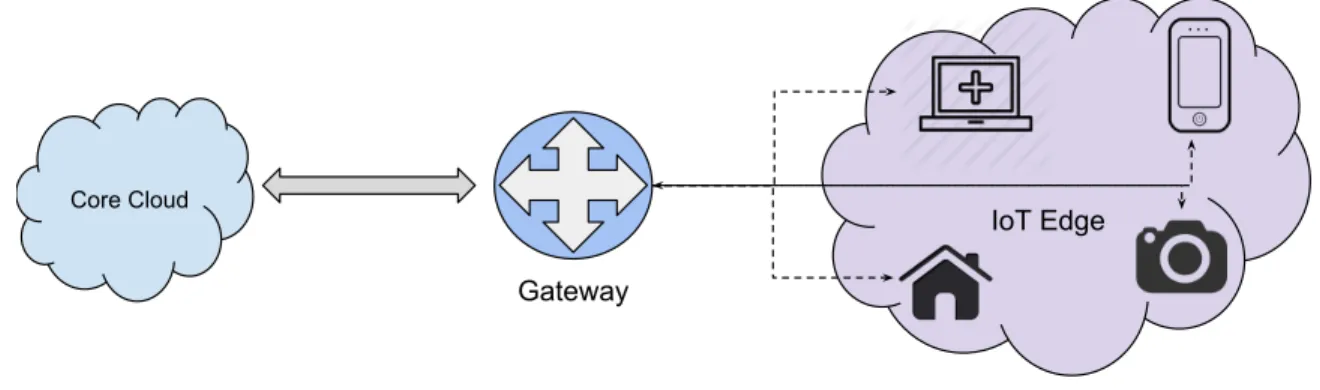
The architecture for IoT-based network, including Edge-Cloud systems, vary on a per-application basis. But in general, the overview logical diagram can be visualized as shown in Figure 2.1. The essential elements are (i) Core Cloud, (ii) Gateway, (iii) IoT Edge.
The Core Cloud is the most computationally powerful element in the system. It
per-forms data aggregation from various edges or gateways, as well as acts as the server for most systems. It provides a scalable solution in the form ofservicesto be used by gateways or IoT edges. A few examples of Cloud can be seen in Amazon Web Services, Google Cloud, Microsoft Azure, GENI, etc.
The Gateway acts as a network and data bridge between the IoT Edge and the Core
Core Cloud
Gateway
IoT Edge
Figure 2.1: Typical IoT-based application architecture
allows a translation of protocols between its two network ends. More often than not, the gateway is geographically closer to the IoT Edge than to the Core Cloud. It can perform various tasks, including routing, forwarding, buffering, etc.
And finally, theIoT Edgeconsists of a bunch of IoT devices all either interconnected, or connected through the Gateway as a hop. Devices such as smartphones, cameras, sensors, wearables, etc. are a few examples of IoT devices. The actual data collection at the source is done through these devices. Commonly, Core Cloud might have multiple gateways in-teracting with it, with each Gateway having many IoT devices in its network.
Typically, the cloud-gateway network has a set of protocols in use, while the gateway-edge has its own set of protocols, due to the difference in the nature of the two networks. Hence, the gateway has an additional task of translating the protocols to ensure exchange between the two networks.
2.2
Security Protocols
Security is an extremely important requirement for most devices and applications. It is commonly implemented using base set of instructions, called Security Protocols. These protocols exist in many different forms, often in combinations. The types can include: (i) Key Agreement, (ii) Entity Authentication, (iii) Application-level data encryption, (iv)
Symmetric Encryption, (v) Asymmetric Encryption, (vi) Message Authentication, and many others. It is often a challenge to decide on the level of best protocols to be used in a given application. In addition, making them work together is not always easy.
Often, security is implemented using TLS (Transport Layer Security), or DTLS (Data-gram TLS). This has replaced the older SSL (Secure Sockets Layer) technology. There’s even more available options in the form of RTP (Real Time Protocol), and its new exten-sion SRTP (Secure Real Time Protocol). All these protocols have a few things in common, namely, (i) They ensure secure, encrypted communication among connected devices, (ii) They work using a timed session, (iii) They undergo handshake, which usually involves exchanging keys or certificates to establish authenticity, (iv) Data transmitted through them is encrypted. Conversely, they also have a few key differences, such as (i) use-cases, (ii) default underlying transport protocols in place, etc.
On top of this, protocols also differ based on the type of device it is aimed for. For instance, a full fledged desktop computer might have all levels of crypto protocols in place, but the same would not be feasible for an IoT-based application in an IoT Edge.
2.3
Panacea’s Cloud
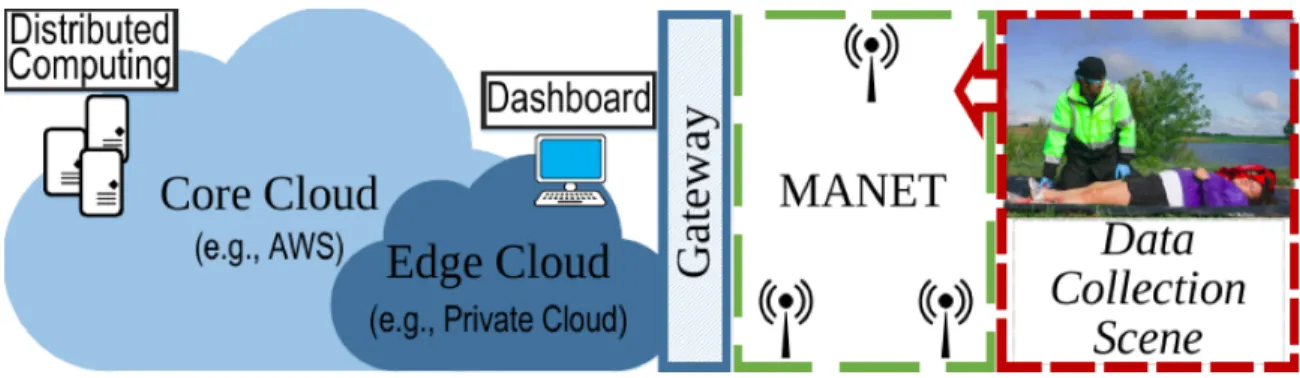
Panacea’s Cloud [2, 3, 5] is an example of IoT-based application utilizing the power of Cloud-Edge system. Its goal is to aid in emergency medical traiging, as part of incidence response during any natural or man-made disaster. The architecture for this application looks like Figure 2.2.
Similar to the basic Cloud-edge architecture shown in Figure 2.1, Panacea’s Cloud has all the components from the previous architecture, but has an additional component, the Edge Cloud. The application is novel in the sense that it utilizes a network mesh of IoT devices to collect data from patients and transmit to the private Edge Cloud, for processing and visualization.
Figure 2.2: Panacea’s Cloud Disaster Response System architecture
The system has a major challenge to overcome, in the form of security trade-off. The application deals with human patients, so confidentiality is crucial. But even more impor-tant is the speed of data to be transferred, i.e., there is a need to quickly get the data into the edge or core cloud so as to allow timely response. Hence, both speed and security need to be as high as possible. Unfortunately, it’s almost impossible to have both of those charac-teristics maxed-out. And so, there is a need of decision making to select the higher priority and operate accordingly.
2.4
Literature Review
2.4.1
Constrained and Unconstrained Network
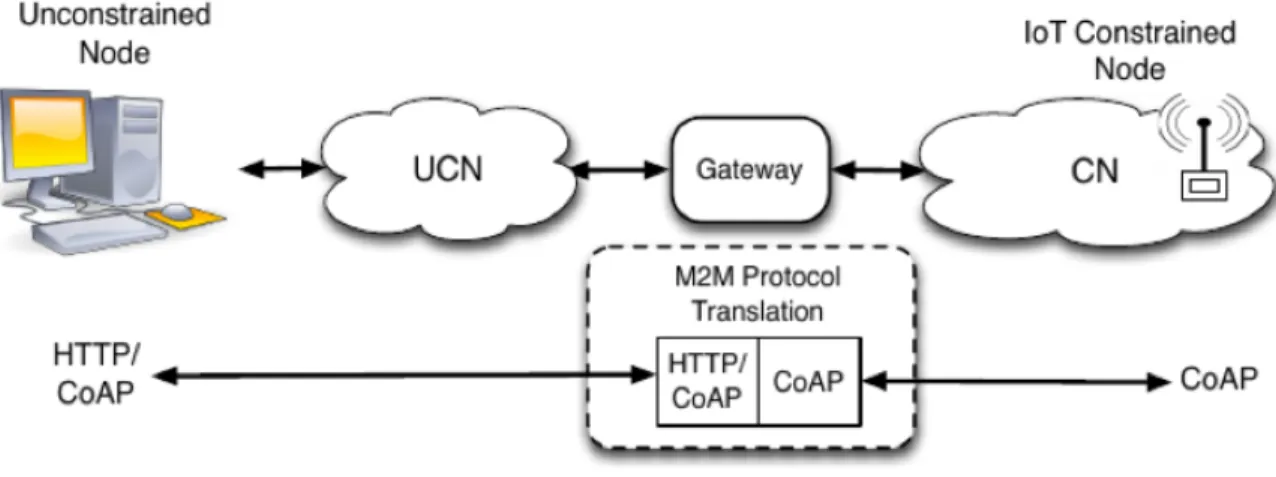
IoT-based application deployment is a relatively new trend. However, methods to secure networked IoT devices have been explored in the past. Work in [6] is based upon the cat-egorization of IoT-based network into two kinds: (i)Constrained Network (CN), and (ii)
Unconstrained Network (UCN). Constrained Network is said to typically consist of
net-work of low-resource devices, i.e., devices with limited computation, netnet-work, bandwidth, etc. Such networks are usually designed to support low bandwidth transfers. An exam-ple of a Constrained Network would be a few small IoT devices interconnected through a gateway. On the other hand, Unconstrained Network involves network of high-resource
devices. Such networks are not constrained by bandwidth or energy limitations. An exam-ple of this would be our home desktops connected to the Internet.
Figure 2.3: Constrained and Unconstrained Network
Figure 2.3 shows the role of gateway in connecting CN and UCN. Due to the funda-mental differences in CNs and UCNs, use of full-fledged security suites is not feasible on both network types. And so, the cited paper utilizes a separate protocols for CN and UCN. In their case, the gateway acts as the bridge and performs translation from one protocol to the other to allow end-to-end communication. This is a useful idea that has been extended further in our middleware.
Although setting up of secure end-to-end channels isnt directly applicable to Con-strained Network, the cited work provides a suitable security architecture for IoT discussing the following objectives: a) No modifications in the security suites employed within the Unconstrained Networks such that the unconstrained nodes do not notice any deviations from their standard procedures. b) Security handshakes handled within the Constrained Networks so that the constrained nodes handle their complexity being able to establish end-to-end secure channels. In essence, an architecture to offload computation intensive tasks to the gateway is proposed, which helps in reducing the cost of security encryptions
at the IoT node side.
However, offloading at a large scale is a tedious task as mentioned in [7]. In addition, the implementation itself is tailored around IPsec, and does not discuss usage with OpenVPN and similar tunneling suites. Moreover, due to the stringent nature of the research, it might not be flexible enough for unstable or dynamic topologies which might face infrequent connectivity or many temporary nodes connecting transiently on a need-to basis.
Overall, the logical division of Constrained Network and Unconstrained Network is a key takeaway from the paper, in addition to the idea of using gateways to offload computation-intensive tasks.
2.4.2
Lightweight IoT Authentication Scheme
Publication [8] provides a lightweight authentication scheme for heterogeneous wireless sensor networks in the context of IoT. The scheme uses nonce and Keyed-Hash Message Authentication (HMAC) to check the integrity of authentication exchange. The authors use a 3-step set up of the communication. Firstly, registration between nodes and gateway, and then registration between gateway and the cloud/remote server. Secondly, authenticating the connection. The authentication required directly link of the sensor to the remote user before the gateway comes into play. The sensor creates a nonce N of not more than 8 bytes and sends it to the remote user. The remote user then creates a nonce of its own, M, appends with that of the sensor and then sends it to the gateway creating ID for the sensor. The gateway computes HMAC and checks if the information is valid. Then it processes it with its own nonce, S, and sends it to the remote user. The remote user node then sends the information for the sensor node to confirm. Thirdly, there is a session key establishment between the sensor node and the remote user. The paper deals with different security issues and present performance evaluation and analysis to support its approach. Impersonating the sensor, replay message and so on. The mutual authentication is an advanced approach
that enhance security. Along with this, the papers talk about the identity protection, data integrity, and other features they cover. The work is scalable. Similar form of architecture is used in [9] for creating an eHealth application based on the approach discussed in [8]. The properties of scalability, mutual authentication feature, lightweight schemes and direct communication to the remote user/cloud are directly relevant to our work.
Since most of the encryption computation is offloaded, the beacons/nodes consume less energy in computation of the connection establishment. It allows both users and Base sta-tions to authenticate each others. However, there is multi-phase encryption and decryption which increases overhead and takes a lot of time.
In comparison, our work investigates a security middleware which makes use of static Pre-Shared Keys (PSKs) that is different from the paper’s multi-phase encryption and de-cryption. A major advantage in doing this is that we are able to phase down to just one iteration for authentication, and thus, our approach reduces security overhead and is quite less time consuming.
2.4.3
Physical Unclonable Functions
We encountered use of different encryption techniques. Work in [10] makes use of Phys-ical Unclonable Functions (PUF) over public key cryptography, which takes advantage of existing physical properties of the device. For encryption and authentication services, they combine this technology with Physical Key Generation (PKG) over wireless communica-tion that use physical properties of the communicacommunica-tion channel. PKG uses same compo-nents as PUF making the combination cheaper than common public-key cryptography. The authors show how the approach exploits random physical nature of noisy wireless channel between devices by tapping the wireless channel itself for secret key generation.
Figure 2.4 shows that the cited paper utilizes a Hub/Gateway to keep track of various IoT Devices {T1...Ti}. Using PUF has the added benefit of making security association
Figure 2.4: Physical Unclonable Functions
faster. The idea of using physical properties of the device is quite useful, especially for IoT-based applications, since it helps increase security. But, since the process of authen-tication involves full re-enrollment from scratch, it turns into an expensive solution for Constrained Network environments. Fortunately, we are able to go one step further in our middleware while using physical static properties of the device in conjunction with session ID to provide quick re-enrollment.
2.4.4
Secure End-to-End Protocol with Offloading
Paper [11] is a closely related finding. It provides a secure end-to-end protocol for resource-constrained devices, especially in context of health-care sensors. Their work uses same security functionality as Unconstrained Devices, but without computationally intensive op-erations. Heavy computation at constrained devices are offloaded to the neighboring trusted nodes/devices. The session, however, is secured using a session key. The key generated has a short-time validity and hence is ephemeral in nature. This is great for security, but at the expense of having to renegotiating handshake and security association all over again, in case of any disconnection.
This paper also proposes a selection criteria based on trust level to select the assisting nodes. Their protocol is compatible with other end-to-end security protocols, allowing
extensibility. Our work builds on top of this work, and uses an easier, yet effective key management scheme. Specifically, we allow creating static keys which are not short-lived, significantly reducing the key exchange cost and time.
2.4.5
HIP and Session Resumption
Paper [12] provides a comprehensive session resumption mechanism. The work uses HIP DEX i.e., Host Identity Protocol Diet EXchange, a key management protocol specially designed for Constrained Networks, that provides secured end-to-end connections in IoT. To this end, the authors present complementary lightweight protocol extension for HIP DEX, i.e., a comprehensive session resumption mechanism. Ephemeral Diffie-Hellman keys and digital signatures are forfeited and are replaced by a refined session establishment handshake based on DH keys for mutual peer authentication and key agreement. Perfect forward secrecy and non-repudiation properties of HIP result in significantly decreased protocol handshake overhead and reduced handshake run-time. The peers only perform expensive operations once during the initial sessions establishment. Storage of session state after session tear-down enables efficient re-authentication and re-establishment of a secure payload channel in an abbreviated session resumption handshake.
However, it is not the most secure solution. Our work utilizes the concept of session resumption but makes a few changes for broader compatibility. Instead of HIP, we utilize Device ID, which can additionally act as a static unique device property to quickly and securely fetch stored sessions for re-use.
2.4.6
Security Configuration Frameworks for LLNs
Authors in [13] give a standard security complaint framework to secure the IEEE 802.15.4 networks in low power lossy network (LLNs). The framework aims at proposing: a) differ-ent kinds of security architectures, b) an efficidiffer-ent mechanism for initializing a secure IEEE
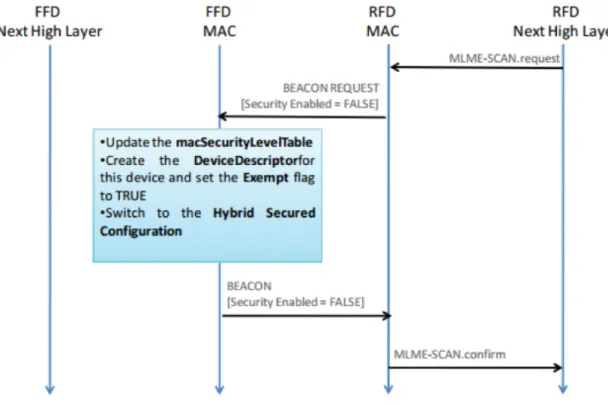
Figure 2.5: Interaction between FFDs and RFDs under the Framework
802.15.4 domain and c) a lightweight scheme to negotiate link keys among the devices. The standard considers two types of nodes that can build peer-to-peer or star networks:
Full Function Devices(FFD) andReduced Function Devices(RFD). The RFDs have
lim-ited resources, and low computational capabilities, while the FFDs have full computational capabilities. The FFDs are able to coordinate the network and hold references to the RFDs.
The framework supports 5 different levels of security with their proposed security con-figurations (i.e., Fully Secured, Unsecured, Partial Secured, Hybrid Secured and Flexible
Secured). Flexible secured configuration has the potential to change the level of security
based on requirements when needed, and shifts from full secured state to hybrid secured state. Figure 2.5 shows a small instance of cross-interaction between RFDs and FFDs. However, the approach is not quite scalable since re-entry of device request is not sup-ported. This is a gap that can be filled by the presence of a flexible, dynamic security
middleware to act as an interface for fast or secure encrypted communication. Hence, our work takes the framework a step further towards a more practical layer for use within IoT-based applications.
Chapter 3
IoT End-to-End Security Scheme
3.1
Overview
As mentioned earlier, our work closely follows the idea of flexible security framework described in [13]. We build upon the previous framework by adapting their implementation for our core features suited for a variety of application use cases.
3.1.1
Physical Infrastructure
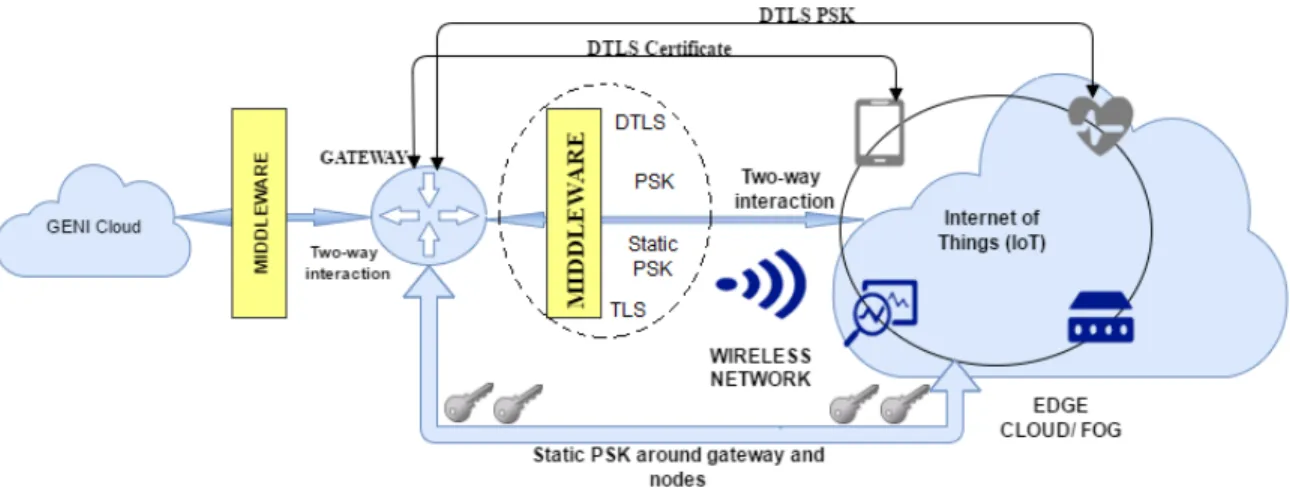
Figure 3.1 illustrates a physical infrastructure perspective of our middleware in action. The infrastructure primarily constitutes of a core cloud infrastructure, a gateway, and several edge IoT devices. The core cloud has a communication channel with gateways at the edge. The edge gateways form an interface to the network for the IoT devices. Parts of the primary middleware are installed on both the gateway and the fog IoT devices. The fog network can constitute any number or type of IoT device, such as heart monitor, bea-con, geo sensor, etc. The primary middleware allows secure and fast data transfer between the sensor devices and the gateway, using security schemes chosen through our ”flexible security” module, and ensuring robustness using the ”intermittent security” feature to
ac-commodate frequent disconnections. This is possible because the middleware stores and tracks sessions, certificates, or keys,
Figure 3.1: Edge Cloud/Fog system architecture
between both the fog and the gateway. Once data has been securely transferred to the gateway, it handles the translation of protocols to allow compatibility between the core cloud protocols and the IoT protocols.
Optionally, secondary middleware can exist between the gateway and the core cloud to provide flexibility and robustness, if needed. There is a key benefit of having this setup. The presence of intermediate gateways allows for decoupling of services and protocols between the cloud-gateway and gateway-iot subnets, essentially paving way for end-to-end security via our intermediate middleware. Our model consists of a middleware in the core cloud network side, and another middleware at the fog network side. Each middleware consists of a server-client pair interacting with just each other. At the gateway, the client of cloud interacts with the server of edge, allowing end-to-end secured communication. The middleware supports flexible security by allowing different protocols for individual nodes in the fog network, in addition to being ready to use static PSKs for quick encryption setup, and support for intermittent security through session resumption.
3.1.2
Logical Modules
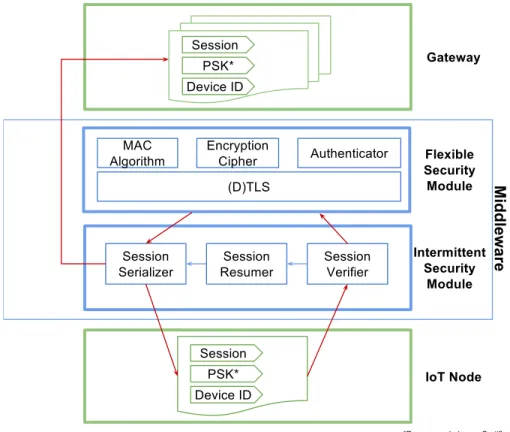
A modular diagram of our proposed middleware is shown in Figure 3.2. The involved de-vices keep track of (D)TLS sessions, PSKs, and the Device IDs. The security association occurs first by letting the Intermittent Security module try and resume a past connection, by first verifying session existence and validity. If the resumption fails, Flexible Security module acts as an interface to allow configuration of required security schemes. These two modules in conjunction form the middleware.
Figure 3.2: End-to-End IoT Security Middleware Module Diagram
Our middleware allows flexibility of security through various available protocols. The reasoning behind providing flexibility is because all applications and devices are not built with same level of security in mind. There is a trade-off between security and speed when it comes to a preset of a security protocol. High level of security is usually desired, but
not always needed. Based on the application, it might be detrimental to have full-fledged security. For instance, if an edge beacon (based on e.g., iBeacon technology) is transmitting confidential medical information, the data security is a major priority. However, if the same beacon is to be reused for emergency medical triage, the priority for speed and low power consumption goes up, at the expense of high security.
3.1.3
Deployment
In practical IoT-based deployments, the middleware can be installed at various levels, in-cluding System Level and Application Level. A System Level installation could involve integrating the features of the middleware into the Operating System services of the de-vice, ideally by the device manufacturer or software developer. This approach allows an application developer to incorporate the features of the middleware for customization by users. On the other hand, Application Level installation can allow an application developer to directly integrate the middleware features into the application logic. This approach could be useful if full device control is not available at the Application Level.
3.2
Intermittent Security
Intermittent security utilizes session resumption to quickly bring a disconnected device back in the network when next needed. This concept closely follows the ideas proposed in [12], and modifies a few factors. Our middleware implements intermittent security using “Device ID”, instead of Host Identity Protocol (HIP). This allows compatibility with a broader range of device types. The device IDs of the edge nodes are managed by the nearest hop gateway. (D)TLS sessions are stored by the devices on disconnection for future use. If such a recently disconnected edge node attempts to make a connection with the gateway, the gateway uses the client Device IDs to determine the session to resume for that requesting
node. This scheme allows security handshake steps and time to be minimized, and the data to be transmitted can still successfully be transferred, in intermittent chunks.
A possible major concern in a session resumption implementation is the possibility of Replay Attacks [14]. Given that the serialized sessions are tied to the property of the device, i.e, the Device ID, replaying using the same session is made extremely difficult by any malicious device, almost certainly having a different Device ID. To prevent an active session from being replayed by a spoofing device, a simple flag is sufficient to block such replay requests. Resume Session Flexible Security Scheme Session Data prep Session Resumption Success? Device Storage No Reuse session Yes Serialize Session Serialize Session Data transmit
Figure 3.3: Illustration of Intermittent Security handling with Session Resumption
Data Encryption is commonly done using keys established through Public Key Cryp-tography (PKC). Instead of using PKC, our middleware chooses to go with static elements such as Static Pre-shared Key (PSK) or Certificates. This is because PKC can be quite slow, in addition to being intensive in terms of time, computation, bandwidth, and memory
resources, [10]. Despite lacking in nonce and entropy compared to ephemeral schemes, static PSKs still are capable of providing a reasonable level of encryption using the user’s choice of cipher, such as block or stream ciphers. Hence, it is a preferred scheme for most use cases, allowing a tradeoff balance between speed and security requirements of an IoT-based application [15].
Algorithm 1:Intermittent Security Handler
Data: Device IDdID. Protocolp, either DTLS or TLS Data: Authentication Schemeauth, Encryption Schemeen
Data: Message Authentication Codemac
Data: sessionvariable holds encrypted session info
Data: stored sessionholds deserialized session fetched from device storage Data: f irst connect is true if this is the first time connecting
Result: The latest session is stored on the respective devices to be quickly resumable functioninitSession ()
/* Creates a new session from specified configuration */
session← f lex security vector(dID,{p, auth, en, mac}) end
functionresume ()
/* Pulls the stored session and uses it as new session */
session←stored session
end
functionserializeSession (x)
/* Store the session in storage of member devices */ whiletruedo
sleep(x)
stored session←session
end end
functionmain ()
/* Decide and create or resume a session */
if f irstConnect orstored session.isNullthen
initSession() else resume() end serializeSession() transmit() end
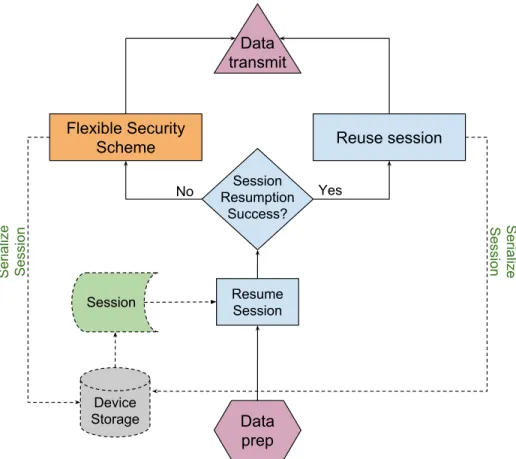
Figure 3.3 shows a flowchart illustration of how our middleware leverages intermittent security with session resumption for quick data transmission. A contingent flexible security scheme is used to quickly establish lost connections with the fastest possible way, based on the security needs of an IoT-based application.
Algorithm 1 shows our pseudocode for providing intermittent security. The main()
function gets executed first, to check whether the connection between the associated de-vices is being made for the very first time. Or, if there already is a valid session cor-responding to these devices. If so, we can simply fetch the stored session from device storage and attempt to resume it, allowing quick reconnection between them. If not, a new connection has to be established, plugging into the flexible security scheme, i.e., based on chosen protocol, authentication scheme, encryption scheme, and message authentication code algorithm, a new session would be initiated.
Once a session has been found (either new or resumed), two operations occur in paral-lel: First,serializeSession()ensures that the current session state is serialized to the device storage every few seconds, as represented by variablex. Based on the need, the value ofx
can be made higher or lower. Higher value ofxwould result in more frequent writes to the storage, providing more reliability for future session resumptions at the expense of using higher computation and storage. Conversely, less frequent writes would be less reliable, but faster and resource conservative. Second,transmit()keeps data flow active between the connected devices.
3.3
Flexible Security
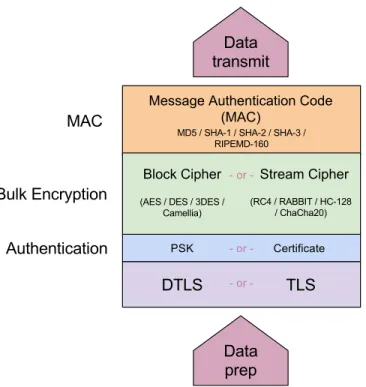
The first step for security association and communication initiation is selection of the secu-rity protocols to be used. Our middleware supports different kinds of protocols and allows switching between them. The possible choices all select one of the options in each
cate-Figure 3.4: Illustration of Flexible Security handling with Protocol Selection
gory. The categories include (i) Protocol, (ii) Authentication Scheme, (iii) Bulk Encryption Scheme, and (iv) Message Authentication Code (MAC) algorithm as shown in Figure 3.4.
3.3.1
Protocol Selection
The Protocol selection allows a choice between {TLS, DTLS}. TLS (Transport Layer Security) and DTLS (Datagram Transport Layer Security) are both extremely secure pro-tocols enforcing network encryption between participants. Both of these propro-tocols ensure confidentiality and integrity of data. DTLS is a better choice for stream-based applications, and can work over UDP (User Datagram Protocol). For use with TCP based applications, TLS is the preferred choice. The difference in performance and bandwidth requirements of TLS and DTLS can get noticeably high when adding the impact of the ideal authentication, encryption, and MAC schemes.
3.3.2
Authentication Scheme Selection
Next, Authentication Scheme can be{PSK, Certificate}. Furthermore, each of these enti-ties can either{Ephemeral, Static}. Ephemeral PSKs or Certificates require full security handshake and key exchange before use. On the other hand, Static authentication elements do not require repeated key exchange, and hence can save a lot of time and bandwidth. In our middleware, if PSK is found to be an ideal candidate, the default setup goes for Static PSK. In fact, Static PSK can exist as a device property on the IoT devices, allowing many benefits, such as quick connection, resumption, low memory footprint, low bandwidth con-sumption, low CPU usage. If the requirement is for even higher security, ephemeral PSK or Certificate can be generated using Key Exchange algorithms, such as RSA, DH (Diffie-Hellman), etc.
3.3.3
Bulk Encryption Scheme Selection
Once authentication is chosen, the Bulk Encryption scheme is the next option. Encryption can be done using either Block Ciphers, or Stream Ciphers. Block Ciphers are useful for sending large chunk of data, and can consume a lot of bandwidth and memory if the payload is small. This is due to the padding added to each block of data being sent. For example, AES uses 128-bit (16-byte) padding by default. If the data being transmitted is 1024-bit in length, then the total packets sent would bed1024/128e=8. But, if the data size is 130-bit, the number of packets sent would bed130/128e=2. The second packet would have 126 empty reserved bits. Hence, for small payload applications (such as video streams) it is better to opt for Stream Cipher, which encrypts small chunks of data before sending. The most common Stream Cipher is RC4, but ChaCha20 is starting to take over as the next generation of much faster and more secure stream ciphers. All ciphers can be configured to various key sizes (if applicable), including 128-bit, 224-bit, 256-bit, and so on.
3.3.4
Message Authentication Code Selection
Lastly, the chosen Message Authentication Code algorithm is used to generate checksum, to ensure integrity of data being sent. The available options are MD5, SHA{1/2/3}, and a few lesser-used options. SHA2 or SHA3 should be used whenever possible, since MD5 and SHA1 have been found vulnerable to various checksum attacks [16, 17] and collision attacks [18]. Through permutation and combination, the possible choices for the security scheme can be many. Table 3.1 shows a few of the possible schemes.
Table 3.1: Different security schemes forflexible security
Security Scheme Protocol Authentication Encryption MAC Description
DTLS PSK WITH CHACHA20 SHA256 DTLS Static PSK ChaCha20 SHA2(256) Very fast, secure. Excellent for secure video streaming
DTLS DHE WITH NULL SHA384 DTLS Certificate - SHA2(384) Fast scheme, high security
DTLS DHE PSK WITH 3DES EDE SHA DTLS PSK 3DES (EDE) SHA1 Fast, but risk of integrity loss due to SHA1.
TLS PSK WITH AES 128 CBC SHA TLS Static PSK AES128(CBC) SHA1 Fast, highly secure, suitable for moderately heavy data
TLS PSK WITH CHACHA20 POLY1305 TLS Static PSK ChaCha20 POLY1305 Fast, highly secure, suitable for quick bulk data transfer
TLS ECDHE WITH AES 256 GCM SHA384 TLS Certificate AES256(GCM) SHA2(384) Very high security, suitable for confidential data on a reliable network
3.4
Optimal Scheme Decider
As discussed in the previous sections, our middleware allows picking and choosing pieces of security protocols as per the user’s requirement. But when it comes to actually choosing the best scheme for an application, the decision is hard to make. It becomes even more of a challenge due to the fact that not every user might be well versed with the various security components, or have a strong understanding of the differences between the schemes, their advantages, disadvantages, etc. Hence, just having the option to choose is not enough.
This is where the optimal scheme decider comes in. With close to 200 possible security scheme choices, the decider is able to find the optimal choice of security scheme for any application, IoT-based or otherwise. This is done in two phases: (i)Offline Phase, and (ii)
3.4.1
Offline Phase
The Offline Phase is a step used to narrow down the searchable space of security schemes by filtering a database of around 200 schemes. Although schemes can be quite varied, but there exist many schemes that have close similarities in all practical aspects. Moreover, it is possible to find alternative schemes to any chosen scheme when the requirements and priorities are adjusted according to the needs of the application. Hence, it turns out, every
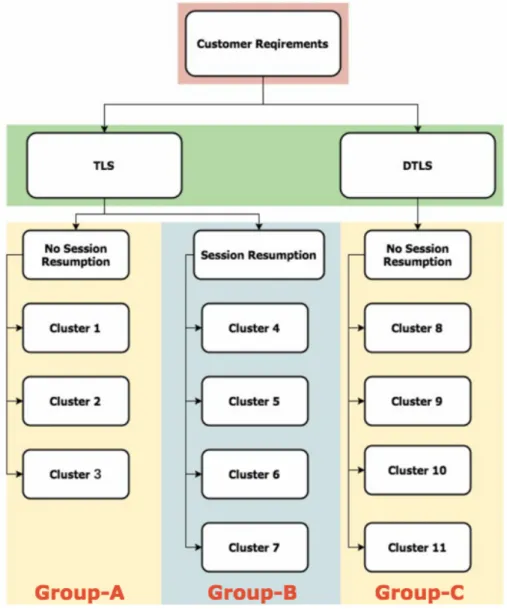
Figure 3.5: Scheme Groups based on configuration
developers. In fact, as shown in Figure 3.5, we are able to group security schemes based on their protocol choices.
In the current implementation, three groups{Group-A, Group-B, Group-C}have been formed. Group-A represents all configurations utilizing TLS as the base protocol, and using no session resumption. Group-B represents all configurations under TLS, but with support for session resumption. Group-C houses all DTLS schemes with no session resumption. A fourth group, Group-D can additionally be formed for all DTLS schemes with session resumption. The logic from start to end of theoffline-phasewill be the same for all groups, and hence will also be applicable for Group-D.
The reason why Session Resumption has been made an optional configuration is be-cause there is a trade-off of having the feature. The resumption feature itself requires some periodic disk I/O to serialize active session. In addition, the serialized files are stored on the device, utilizing some disk space. This process also ends up consuming some energy. In most cases, these factors are trivial. But for certain extremely limited IoT devices, the middleware’s option to not support session resumption can prove beneficial.
Figure 3.6 shows a part of a table with raw benchmark data of many possible scheme choices. The data is organized by protocol{TLS, DTLS}, authentication schemes {DHE-RSA, PSK, ECDSA, etc.}, encryption schemes {AES, ChaCha20, etc.}, MAC {SHA, MD5, etc.}, and session resumption support. The benchmarking is done for total mem-ory allocations on server and client, total bytes transferred on server and client, connect times, resume times, and many similar parameters.
Since our server is considered a FFD (Full Function Device), it can be safely assumed that client benchmarks are the bottleneck, and hence sufficient for forming clusters. Since the clusters are to choose the optimal security scheme targeted for the IoT-devices involved, we are able to discard the benchmark values for the server side without any negative impact on the decider.
Figure 3.6: Ra w benchmark data for v arious security schemes
Table 3.2: Parameters used for client benchmark analysis
Client Parameter Description Desired Level for RFD
CPU Usage The security scheme’s CPU usage Smaller value Bandwidth Usage The bandwidth of the security schemes network usage Smaller value Peak Bytes The peak memory consumption on device Smaller value Connection Time The elapsed time to successfully connect with server Smaller value TX The speed of transmitting data Higher value RX The speed of receiving data Higher value
Table 3.2 shows the parameters used for client benchmark analysis. The desired level represents whether high value is optimal, or lower, when operating on a Reduced Function Device. These 6 metrics can next be used to form the clusters. To move forward, we need to perform a set of operations on the raw data to successfully filter the schemes into appro-priate clusters under each group. Hence, the following steps are followed:
1. Scale the raw data
2. Identify Principal Components and generate weighted formula for clustering
3. Calculate the weight value for data elements
4. Identify number of clusters needed per group
5. Final clustering
1. Scale the raw data
This step is needed to decrease the correlation between each metric, in addition to decreasing the influence of units, i.e., Normalization. Hence, we perform data scal-ing on the raw data in Table 3.6 usscal-ing the scalscal-ing formula:
x0= xi j−xm j
σj
where
x0 : scaled value
xi j : value ofith row, jth column data
xm j : mean value of j column data
σj : standard variance for the j column data
2. Identify Principal Components and generate weighted formula for clustering
Next step involves applying Principal Component Analysis (PCA) to decide the num-ber of clusters that may exist in each for the groups{Group-A, Group-B, Group-C}. The formula for each potential cluster can be as below:
zi1=φ11·xi1+φ12·xi2+· · ·+φ1p·xip
zi2=φ21·xi1+φ22·xi2+· · ·+φ2p·xip · · ·
zip=φp1·xi1+φp2·xi2+· · ·+φpp·xip
where
zip : value of pthprincipal component
φp1: weight of each element
3. Calculate the weight value for data elements
Once we have the principal component formula, we need to calculate the value of weightφ of every element. This is an optimization problem to calculate the weightφ:
maximize φ11,···,φp1 1 n n
∑
i=1 p∑
j=1 φj1·xi j !2 subject to p∑
j=1 φ2j1=1.Figure 3.7 shows our results for Principal Components of Group-A. Every column is now categorized as per metric value similarity. For example,PC1 might have all schemes with maximum CPU consumption, PC2might represent all schemes with maximum network bandidth, and so on. Similarly, Principal Component Analysis generates the data shown in Figure 3.8 and Figure 3.9 for Group-B and Group-C, respectively.
Figure 3.7: Group-A Principal Component Results
Figure 3.9: Group-C Principal Component Results
4. Identify number of clusters needed per group
The number of clusters that need to be generated per group can next be calculated, us-ing Proportion of Variance Explained (PVE). We apply the followus-ing on the dataset:
p
∑
j=1 Var Xj = p∑
j=1 1 n n∑
i=1 x2i jThe PVE result for each group is shown in Figures 3.10, 3.11, and 3.12. Analyzing Group-A PVE in Figure 3.10 tells us that 89.1% (∼90%) of the schemes in this group can be taken into consideration if we usethree clusters. Any higher cluster count would provide only trivial advantage. For Group-B, the PVE in Figure 3.11 suggests takingfour clusters to encompass 90.4% (∼90%) of the schemes. Sim-ilarly, Group-C can benefit by housing four clusters, i.e., 90.6% (∼90%) of the schemes. Hence, we accept 3 clusters in Group-A, and 4 clusters each in Group-B and Group-C.
Figure 3.10: Group-A Proportion of Variance Explained results
Figure 3.12: Group-C Proportion of Variance Explained results
5. Final clustering
Once we have decided on number of clusters in each group, we can use k-means clustering by calculating Euclidean distance for each observation. This can be done by applying the following:
W(Ck) = 1 |Ck|
∑
i,i0εCk p∑
j=1 xi j−xi0j2. (3.1)We want to cluster together the observations with minimum distance between them. Hence, we find the minimum distance in Equation 3.1:
minimize C1,···,CK ( K
∑
k=1 W(Ck) ) .In essence, clustering allows us to reduce the overhead of storing hundreds of redun-dant security schemes, and instead finds the best alternative from smaller scope containing equivalent schemes. We are able to choose the most optimal cluster in each group, hence allowing a small subset of schemes under the hood. These subsets should ideally be able to provide all the benefits of equivalent schemes.
3.4.2
Online Phase
Once the offline-phase has been executed at the development stage of our middleware, its job is done. Unless any major changes are required in the available schemes, such as addi-tion or removal of new/old schemes, the generated set of can be reused by the middleware for finding the optimal scheme, when being run by a potential user of the middleware. The
online phase can be accessed using a set of RESTful APIs for the middleware on the IoT device, the gateway, and the core cloud. Figure 3.13 shows a table of available APIs for use. TheDecider is our decision making engine which finds the optimal security scheme for our use-case. But first, it needs to collect the metrics to find the best-match security scheme as needed by the application. The metrics taken into consideration are:
• Type of Data
• Estimated size of data transfer
• Energy available to the device
• Computation power available
• Memory available
• Session Resumption requirement
The options chosen by the user are each internally mapped to a value in the range {1,2,· · ·,10}. The mapping has been done by surveying many devices ranging from lower end of the spectrum in the metric to the higher end. For example, CPU frequency of over 750 MHz can be safely categorized as a Level-4 device, considering it is higher than most IoT devices. a full description of the acceptable parameter values can be viewed in Fig-ure 3.14.
Once the internal map has been generated, the decider algorithm kicks in to filter good candidate schemes from the cluster chosen in offline-phase. Algorithm 2 describes the various filters applied to narrow down to a single security scheme from the input metrics. We have decided to prefer Stream Cipher over Block Cipher for all multimedia applications, as well as for general applications with smaller payloads. For further filtering, we have tied DTLS protocol with STREAM ciphers, and TLS protocol with BLOCK ciphers. This is because utilizing TLS with STREAM ciphers or DTLS with BLOCK ciphers would essentially undo the benefits offered by the protocol or cipher.
Figure 3.13: RESTful APIs for Online Phase
In the algorithm, once the data type and size has been used to filter according to protocol and cipher type, we make the remainder of the decisions based on the device specifications. The priority is given to energy level of the device in question, since IoT-based applications are almost invariably limited by energy consumption or availability to securely handle data. Hence, low energy availability and extremely-high security scheme will not be clubbed together, being a recipe for disaster. Next, the best choice of scheme is picked based on the limiting value between available CPU and available Memory. For instance, a Level-2 CPU in conjunction with Level-9 Memory will still be incapable of running high security schemes. The same would be true if the CPU and Memory levels are reversed. Finally, the result generated is the choice of scheme to be used, which gets used by the transmitter program to generate the appropriate secure session.
Algorithm 2:Optimal Security Scheme Decider Data: Data to be transmitteddata
Data: Protocol to be used for transmissionprotocol
Data: Cipher to be used for encryptionmac
Data: Energy Level classification of the deviceenergyLevel
Data: CPU level classification of the devicecpuLevel
Data: Memory level classification of the devicememLevel
Result: The best security scheme is chosen /* data.SIZE in bits */
ifdata.TYPE = MULTIMEDIAordata.SIZE<128then
protocol←DT LS
cipher.TYPE←ST REAM
else
protocol←T LS
cipher.TYPE←BLOCK
end
ifenergyLevel<6then
Eliminate heavy encryption schemes end
ifmin(cpuLevel,memLevel)<4then Choose low-level security scheme else ifmin(cpuLevel,memLevel)<7then
Choose medium-level security scheme else
Choose high-level security scheme end
Chapter 4
Middleware Testbed and Evaluation
In this section, we compare the performance of various schemes accessible on our mid-dleware to randomly selected schemes. This allows us to check the difference in impact caused by a better selection. Since the middleware has multiple submodules capable of working independently, we perform our middleware evaluation using two test cases: (i) Impact Test of Flexible and Intermittent Security, and (ii) Test of Optimal Scheme Decider.
4.1
Case I: Impact Test of Flexible and Intermittent
Security
This test aims to check the impact of utilizing the middleware to switch from ephemeral, high security protocol schemes to using static properties such as PSK for secure session. This test accounts for: (i) Memory Footprint, including number of memory allocations and total size of allocation, and (ii) Time taken for security association, for initial session establishment and session resumption scenario. A minimum viable implementation of the middleware has been used on a GENI [19] Cloud testbed.
Figure 4.1 shows the network setup using the GENI Cloud infrastructure.
Figure 4.1: Testbed setup over the GENI Cloud Infrastructure
security protocols to be used. Our middleware supports different kinds of protocols and al-lows switching between them. The possible choices all select one of the options in each cat-egory. The categories include Protocol, Authentication Scheme, Bulk Encryption Scheme, and Message Authentication Code (MAC) algorithm.
Our implementation of crypto and authentication uses WolfSSL [20], an embedded SSL implementation library. Live video stream is supported using OpenCV [21]. The application itself is built completely using C/C++, using GCC compiler.
Figures 4.2 and 4.3 show an instance of our client and server prototype implementation. The server is hosted on core cloud and gateway, and listens for client requests from gateway and IoT nodes. The client side of the system provides an interactive interface where one can choose from five different levels of security. The image representing the server side shows the server when DTLS-PSK cipher scheme is being used. In general case, we choose and recommend the static PSK scheme.
Figure 4.2: Prototype of client UI
schemes we compared are Datagram TLS (DTLS), and TLS. The schemes were evaluated using Pre-shared Keys (PSKs) and certificates. Likewise, Figure 4.4(b) shows how much memory allocation size it takes to have the connection established. DTLS-PSK comes out to be low, by order of millions. We can see that certificate generation takes more size. Hence, choosing PSK for the resumption can be quite an excellent choice. Even better results are obtained using Static PSK, if high security is not critical to the use case.
Figure 4.5 shows results for the connection and resumption time for the four different schemes we compared in our experiments with our prototype middleware. Even though using DTLS-certificate gives consistently low time spent, we see that DTLS-PSK is the fastest scheme. DTLS can offer speed-up of over a few hundred times, regardless of cases where there is a fresh handshake or resumed session. Hence, our results show how
use-Figure 4.3: Prototype of server UI
ful Intermittent security in IoT systems can be, all the while without compromising the security, by allowing flexibility in configuration.
4.2
Case II: Testing Optimal Scheme Decider
In Case I test, we established the usefulness of utilizing Session Resumption, as well as having the option to choose from a few different security schemes. In Case II test, we will be taking things further and allow the middleware to form clusters from almost 200 security schemes. To test the offline phase, we check (i) Validity of the clusters formed using our method, (ii) The optimal cluster chosen, and (iii) whether limiting scope is a safe and accurate way of choosing the optimal scheme, through visualization.
In the offline phase, we attempted forming clusters to narrow down the choices to a few viable ones. Following the logic and analysis described in Chapter 3, the optimal clusters were formed. For our statistical threshold, the within-cluster sum of squares ratio of at least 60% proves that the cluster formed is valid and successful. Figures 4.6, 4.7, and 4.8 show the within-cluster sum of square ratio for the optimum cluster chosen in Group-A, B and C, respectively. As can be observed, the ratios 61.1%, 69.4%, and 62.1% are generated, and
(a) Number of memory allocations
(b) Memory allocated (in bytes)
Figure 4.4: Memory footprint for different encryption schemes
hence, the clusters are successful. This increases the certainty of optimal schemes being made available to be sifted through in the online phase. The schemes in the chosen cluster are shown in Figures 4.9, 4.10, and 4.11.
Figures 4.12, 4.13, and 4.14 show the selection of best cluster in each category, as chosen by the decider’s offline phease. The figures show a plot of each of the clusters in each group, after normalization of computation index. The computation index is nothing but the benchmark metrics used for clustering and decision making. Each of the chosen clusters have their advantages and disadvantages. These can be filtered in the online phase.
Figure 4.5: Time for connection vs. resumption for different encryption schemes
Figure 4.6: Within-cluster sum of squares for Group-A
Figure 4.7: Within-cluster sum of squares for Group-B
Figure 4.9: Group-A Cluster
Figure 4.10: Group-B Cluster
To verify that clustering and choosing a narrow scope is still able to provide us an optimal scheme, a visual representation through Dendrogram can be used. The dendrogram portrays the relationship between various schemes in a group.
As can be observed in Figures 4.15 and 4.16, multiple schemes in each group have siblings at the same level. This implies extreme similarities in the sibling schemes, and not considerable performance benefit. This redundancy can be easily handled by randomly picking one of the leaves and discarding the other scheme. Dendrogram for Group-C has not been shown since due to small number of available schemes in the cluster.
Figure 4.11: Group-C Cluster
Cluster 3 is chosen, due to collectively lowest bandwidth usage, lowest CPU usage, fastest connection speed, and data exchange speed
Figure 4.12: Chosen cluster in Group-A
And finally, the online phase requires collecting software requirements for the applica-tion to be utilized. The current requirement collecapplica-tion can be done by making an API call to
/api/gateway/:device_id endpoint. The application user may send the required
information using the parameter list to the gateway. The response from these queries help form the metrics that are later used by thedecider.
In our test case, we tested the decider by using random values as input requirements to check the scheme chosen by the middleware. The results are shown in Figure 4.17. As expected, for a low-security low-resource multimedia application, PSK-CHACHA20 com-bination was found to be the optimal choice. In addition, we analyze the trade-off
charac-Cluster 4 is chosen, due to collectively lowest bandwidth usage, lowest CPU usage, fastest connection speed, and data exchange speed
Figure 4.13: Chosen cluster in Group-B
Cluster 11 is chosen, due to collectively lowest bandwidth usage, lowest CPU usage, fastest connection speed, and data exchange speed
Figure 4.14: Chosen cluster in Group-C
teristics for various use-cases of IoT. A radar diagram in Figure 4.18 of the same portrays the trade-offs made. As can be seen, this scheme was found to have plenty of memory requirements and good re/connection speed, and not quite advance level of security.
Figure 4.15: Group-A Dendrogram
Figure 4.17: Chosen scheme for a low resource device for frequent disconnections
Figure 4.18: Radar representation of schemeDTLS-PSK-CHACHA20-POLY1305
priority being high security on a low-resource multimedia application, Epehemeral (DHE) PSK-CHACHA20 combination was found to be the optimal choice. A radar diagram in Figure 4.20 shows the security mapping of the same. In this case, security was found to be the most important criteria, even if at the expense of re/connection speed. Hence, public key cryptography scheme was chosen for key exchange, along with a highly reliable integrity check MAC algorithm (POLY1305).
In many other test cases, we have observed the radar diagram to visualize the trade-offs. This has also been used to analyze when session resumption is found useful, and when
Figure 4.19: Chosen scheme for a low resource device for high security
Figure 4.20: Radar representation of schemeDTLS-DHE-PSK-CHACHA20-POLY1305
it is not. For instance, Figure 4.21 shows the specifications for a chosen scheme for an application requiring high reconnection speed through session resumption, having lower memory and security requirements. This application appears to be a good candidate for ‘lost-edge‘ IoT use-cases. Contrasting this application to a different application’s chosen scheme trade-off specifications, as shown in Figure 4.22, we can observe that a very high level of security can be obtained at expense of faster reconnection. Such application is a good candidate for ‘smart-edge‘ IoT use-cases.
Similarly, for another lost-edge IoT application, chosen scheme’s specifications are vi-sualized in Figure 4.23. Very high reconnection speed appears to be a requirement, hence speed over security. And finally, for a similar application without session resumption sup-port, the chosen scheme specifications can be visualized in Figure 4.24. This application must be another one of ‘smart-edge‘ IoT application, as an all-rounded security scheme is needed, with a higher priority for security and initial connection speed.
Figure 4.21: Radar representation of scheme TLS-DHE-PSK-AES256-GCM-SHA384 w/ Session Resumption
Hence, we can see that using theoptimal scheme deciderwe are able to determine the optimal scheme for a given device in an IoT-based application, and support many different kinds of IoT applicationsl
Figure 4.22: Radar representation of scheme TLS-DHE-PSK-AES256-GCM-SHA384 w/o Session Resumption
Figure 4.23: Radar representation of schemeTLS-PSK-AES256-CBC-SHA w/ Session Re-sumption
Figure 4.24: Radar representation of schemeTLS-PSK-AES256-CBC-SHA w/o Session Re-sumption
Chapter 5
Future Work
The future work scope for this middleware is massive, and extension of this research can span across multiple facets. Some of the natural extensions for this research can be in the form of automating the process of collecting device parameter and software requirements, and adding many other protocols, ciphers, and MAC to the offline process.
Another nifty feature that could be implemented in close future is dynamic switching of security scheme (protocols in use), based on various factors, such as resources available, data context, importance or confidential requirements of data, and so on.
In addition, there is an opportunity to explore ‘deferred security’. Deferred sec