An Efficient Parallel Method for Mining Frequent
Closed Sequential Patterns
BAO HUYNH1,2,3, BAY VO4,5, (Member, IEEE), AND VACLAV SNASEL3 1Center for Applied Information Technology, Ton Duc Thang University, Ho Chi Minh City 700000, Vietnam 2Faculty of Information Technology, Ton Duc Thang University, Ho Chi Minh City 700000, Vietnam
3Faculty of Electrical Engineering and Computer Science, VŠB-Technical University of Ostrava, Ostrava 70800, Czech Republic 4Institute of Research and Development, Duy Tan University, Da Nang 550000, Vietnam
5College of Electronics and Information Engineering, Sejong University, Seoul 143747, Republic of Korea Corresponding author: Bay Vo ([email protected])
ABSTRACT Mining frequent closed sequential pattern (FCSPs) has attracted a great deal of research attention, because it is an important task in sequences mining. In recently, many studies have focused on mining frequent closed sequential patterns because, such patterns have proved to be more efficient and compact than frequent sequential patterns. Information can be fully extracted from frequent closed sequential patterns. In this paper, we propose an efficient parallel approach called parallel dynamic bit vector frequent closed sequential patterns (pDBV-FCSP) using multi-core processor architecture for mining FCSPs from large databases. The pDBV-FCSP divides the search space to reduce the required storage space and performs closure checking of prefix sequences early to reduce execution time for mining frequent closed sequential patterns. This approach overcomes the problems of parallel mining such as overhead of communication, synchronization, and data replication. It also solves the load balance issues of the workload between the processors with a dynamic mechanism that re-distributes the work, when some processes are out of work to minimize the idle CPU time.
INDEX TERMS Data mining, dynamic bit vectors, dynamic load balancing, multi-core processors, closed sequential patterns.
I. INTRODUCTION
Mining sequential patterns is a core problem in data min-ing, which was first introduced by Agarwal and Srikant [1]. It has been applied to various domains, such as market basket analysis [1], weblog analysis [12], [37], prediction [24] and bioinformatics analysis [27], [40].
Mining sequential patterns generates an exponential num-ber of patterns when the database contains long sequences which need high computational cost in both time and space. Therefore, in some cases, mining closed sequential patterns is a better solution than mining the complete set of sequen-tial patterns because it is more compact while information can still be fully extracted. A closed sequential pattern is a sequential pattern having no supersequence with the same support and mining of frequent closed sequential patterns has not been extensively studied as the general mining of frequent sequential patterns. Although some algorithms have been proposed, such as CloSpan [38], BIDE [36], ClaSP [11] and CloFS-DBV [32], their performance is not good for pro-cessing on large databases. CloSpan is not scalable because
it works under candidate maintenance-and-test paradigm. BIDE follows a strict depth-first search order to generate the closed sequential patterns; it does not need to keep track of any single historical frequent closed sequential (or candidate) patterns for a new pattern’s closure checking. ClaSP uses a heuristic to prune non-closed sequences. CloFS-DBV uses dynamic bit vector (DBV) structure and a vertical data format to mine frequent closed sequences. However, the compu-tational cost of these algorithms is still high because they have to explore a huge search space. Moreover, they require very expensive computations, especially for long sequence databases.
To solve this problem, developing parallel methods is necessary. Parallel processing has been attracted a lot of research and widely applied to improve processing speed for various problems. In that, multi-core processors architectures have been used to speed up processing, but there is no existing method that uses multi-core proces-sors architecture for FCSP mining. Some of mining meth-ods are used multi-core processors architectures include
PGP-mc [18], GapMis-OMP [8], SW [28]. Also based on multi-core processors architecture, two methods for mining FSPs were proposed, PIB-PRISM [15] used prime theory and pDBV-SPM [17] used dynamic bit vector data structure.
Besides speed-up processing, a multi-core system requires software programmers to make efficient use of the multiple computing cores. These challenges include determining how to divide applications into separate tasks and minimizing CPU idle time. Data partition mechanism can be accessed by the tasks running on separate cores and these tasks must be balanced workload.
Although there have been many parallel methods based on distributed system or shared memory system for min-ing frequent itemsets [42], frequent closed sequential patterns [7], [43], sub-graph mining [31], there are no meth-ods for mining frequent closed sequential pattern on multi-core processors architecture.
In this paper, we propose an efficient algorithm, called pDBV-FCSP (Parallel Dynamic Bit Vector Frequent Closed Sequential Patterns), for mining frequent closed sequential patterns. This method overcomes disadvantages of existing methods for parallel mining. They do not need to synchronize because the communication between computing nodes are eliminated. They do not require data transfer among pro-cessing units either and avoid data replication. The main contributions of this paper are summarized as follows:
1. We propose the first parallel method for mining closed sequential patterns using multi-core processors architecture and a DBV data structure.
2. We partition the work into multiple independent tasks to minimize the overhead of inter-processor communication.
3. Load balance of the workload among cores using a dynamic mechanism is re-distributed the work when some processes are out of work.
4. We early perform closure checking of prefix sequences to prune infrequent and non-closed sequences.
The rest of the paper is organized as follows. Section II gives the problem definition and related works. Section III summarizes the DBV data structure and multi-core proces-sors architecture. The pDBV-FCSP algorithm is proposed in Section IV. Experimental results are discussed in Section V. Finally, conclusions and ideas for future work are given in Section VI.
II. BACKGROUND
A. PRELIMINARIES
LetI = {i1,i2, . . . ,im}be a set ofmdistinct attributes, also
calleditems. An itemsetX is a set of items such thatX ⊆I, itemsetXis calledk-itemset or lengthkif it containskitems. Each itemset is given in brackets, the brackets are omitted for itemsets that contain only a single item. A sequence
S = hI1I2. . .Iniis an ordered list of itemsets, whereIk ⊆I
(1 ≤ k ≤ n). A sequence of lengthlis called al-sequence. A sequence δ = (b1 b2. . .bm) is called a subsequence of
sequenceλ =(a1a2. . .an) andλis a super sequence ofδ,
denoted asδ ⊆ λ, if there exist integers 1 ≤ i1 < i2 <
. . . < in ≤ m such that bk ⊆ aik, 1 ≤ k ≤ n. For
example, the sequencehH(GK)iis a 3-sequence of size 2 and it is a subsequence ofh(GH)M(GKL)i, buth(GH)Miis not a subsequence ofhGHMi.
A sequence databaseDB is a set of sequences, denoted
DB= {S1, S2, . . . ,Sn}, wherenis the number of sequences,
each sequence has the form (sid,S), where sid is a unique sequence identifier and S is a ordered list of itemsets. A pattern is a subsequence of ordered itemsets, and each itemset in a pattern is called an element. The absolute sup-port of a sequence p in a database DB is defined as the total number of sequences in DB that contain p, denoted as σ(p)= |{Si∈DB|p⊆Si}|. The relative support of p is
ratio (in percent) of the sequences that containpto the total number of sequences in the database.
σ(p)=|{Si∈DB|p⊆Si}| |DB|
Sometimes, absolute and relative supports are used inter-changeably. A sequencepis said to be a frequent sequence pattern if its support is greater or equal to a given sup-port thresholdminsup, that isσ (p) ≥ minsup. A frequent sequenceλisclosedif it is not a subsequence of any other frequent sequence with the same support, i.e., there does not existδ such thatλ ⊆ δ andσ (δ) = σ(λ). The problem of mining FCSPs is to find all frequent closed sequences in the databaseDB.
FCSP= {λ∈SP|@δ:λ⊆δ∧sup(λ)=sup(δ)}, whereSP
is the set of sequential patterns.
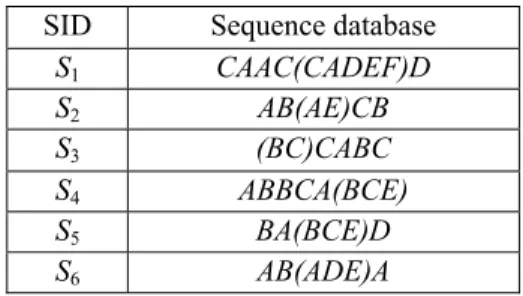
Example 1:The sequence database DBin Table 1 has a set of items is {A,B,C, D, E, F}. Assume thatminsup =3 (50%), if all frequent sequences patterns in databaseDBare mined with the givenminsup, we have result of 30 sequences, FSP= {A:6, B:5, C :5, D:3, E:5,AA:4,BB:4,AB:5,
BA:5, (CE):3,BE:4, (AE):3,AE:5,AD:3,CC:3, (BC):3,BC:4,
CB:3, AC:5, CA:3, CAC:3, BAB:4, BAC:4, BCB:3, ABA:3,
AAC:3,A(AE):3,ABC:3,ABE:3,A(CE):3}. TABLE 1.Example of sequence database.
In contrast, mining frequent closed sequential patterns has only 19 sequences.FCSP={A:6, BE:4, AE:5, AB:5, BA:5, AD:3, AA:4, AC:5, (BC):3, AAC:3, CAC:3, A(AE):3, ABC:3, BCB:3, A(CE):3, ABA:3, ABE:3, BAB:4, BAC:4}, so FCSP is more compact than FSP in general.
Definition 1: Sequence λ is a prefix of δ if and only if
ai=bi for all 1 ≤ j ≤ n. After eliminating the prefix part λof sequenceδ, the remainder ofδis a postfix ofδ. From the above definition, we know that a sequence of sizekhas (k−1) prefixes. For example, a sequencehA(CD)Eihas 2 prefixes: hAiandhA(CD)i. Therefore,h(CD)Eiis the postfix for prefix hAi, andhEiis the postfix for prefixhA(CD)i.
Definition 2: Let Sa be a sequence. Then, subk,h(Sa)
(k≤h) is defined as a substring of length (h−k+1) from positionkto positionhofSa. For example,sub2,4(CBDAD) isBDAandsub1,3(CBDBA) isCBD.
Definition 3: Let λ and δ be two frequent 1-sequences. {tλ,pλ} and {tδ, pδ} are the transaction and position of sequences λ and δ, respectively. Two forms of sequence extension.
Itemset extension:h(λδ)i{tδ,pδ}, if (λ≤δ)
∧(tλ=tδ)∧(pλ=pδ) (1) Sequence extension:hλδi{tδ,pδ}, if (tλ=tδ)∧(pλ<pδ)
(2) For example, consider databaseDBin Table 1,AandEare two frequent 1-sequences. Itemset extension produces (AE) because A ≤ E and (tA = tE) is 1 and (pA = pE)
is 5. Sequence extension produces AE because (tA = tB)
is 1 and the position of sequenceE is {5}, the position of sequenceAare {2, 3, 5}, which is smaller than all positions of sequenceE.
Definition 4: Let λ and δ be two frequent k-sequences (k ≥ 1), x = subk,k(λ), andy = subk,k(δ). {tλ,pλ} and
{tδ,pδ} are the transaction and position of sequencesλandδ, respectively. Two forms of sequence extension.
Itemset extension: λ+δi =sub1,k−1(λ)(xy){tλ,pλ}, if (x≤y)∧(tλ=tδ) ∧(pλ=pδ)∧(sub1,k−1(λ)=sub1,k−1(δ)) (3) Sequence extension: λ+δs =λy{tλ,pλ}, if (tλ=tδ) ∧(pλ<pδ)∧(sub1,k−1(λ)=sub1,k−1(δ)) (4) For example, DEandDF are two frequent 2-sequences. Sequence extension producesDED, DEE, DEFand itemset extension producesD(EF) becauseDEandDFhave the same prefix (D).
Definition 5: LetS = (p1p2. . .pn). An item pk can be
added to one of three positions of sequenceSfor extension.
S∗ =(p1p2. . .pnpk)∧(σ(S∗)=σ(S)) (5)
∃i(1≤i<n):S∗ =(p1p2. . .pipk. . .pn)∧(σ(S∗)=σ (S))
(6)
S∗ =(pkp1p2. . .pn)∧(σ(S∗)=σ(S)) (7)
In (5),S∗is called a forward extension sequence and item
pk is called a forward extension because it appears afterpn.
In (6) and (7), S∗ is called a backward extension sequence
and itempkis called a backward extension because it appears
beforepn. For example, sequenceBE:4 is a forward
exten-sion of sequenceB:4 because sequenceE is extended after sequence B. Sequence EBE:2 is a backward extension of sequenceEE:2 because sequenceBis extended in the middle of sequenceEE.
Definition 6: Consider S = (p1 p2. . .pn), the
start-ing position of sequence S is the position of the first appearance of itemset p1. For example, in the sequence
AB(BC)AD, the starting position of sequence (BC) is 3, and sequenceABDis 1.
B. RELATED WORKS
Sequential pattern mining was first proposed by Agrawal and Srikant in 1995 [1], the goal of it is to discover the full set of SPs from a sequence database, especially from large databases. The basic method for SP mining is candidate-generation-and-test strategy based on the Apriori-property, stated as follows: ‘‘every nonempty subsequence of a sequen-tial pattern is a sequensequen-tial pattern’’.
The general idea of all existing methods is to begin from short sequences and then extend them to gain long sequences. Three main types for existing methods can be categorized as following.
1) HORIZONTAL METHODS
A sequence database in the horizontal format is a database where each row is a transaction in the form sid-itemset, wheresid is a sequence ID and itemset is a set of items. Some particular algorithms use this method were proposed: AprioriAll [1], GSP [2] and PSP [20]. In this type, the runtime and memory usage are high because the database must be scanned many times.
2) VERTICAL METHODS
A sequence database in vertical format is a database where each row has a transaction in the form hitem, sidi, where
sid is a set of sequence IDs containing item. The main advantage of this type of method is that it reduces the num-ber of database scans. Some representative approaches are SPAM [4], SPADE [41], PRISM [10], PIB-PRISM [15], pDBV-SPM [17].
3) PROJECTION METHODS
Projection methods are hybrid methods between hor-izontal and vertical methods. The general idea is to examine only the prefix subsequences and project only their corresponding postfix subsequences into projec-tion databases. Some algorithms based on these meth-ods are FP-growth [14], PrefixSpan [26], an extension of FreeSpan [13], IMSR_PreTree [33] and MNSR_PreTree [25]. Sequential patterns are grown by exploring only local fre-quent patterns in projection database. The projection is based only on frequent prefixes instead of projecting sequence databases because any frequent subsequence can always be found by growing a frequent prefix. The prefix tree
architecture is efficient for organizing and storing candidate sequences.
To reduce the computational cost, instead of mining a full set of frequent patterns, many algorithms for mining frequent closed sequential patterns have been proposed. Popular algo-rithms for closed sequential pattern mining are CloSpan [38], ClaSP [11], BIDE [36], and CloFS-DBV [32]. CloSpan uses candidate-generation-and-test strategy and combines a hash-index structure with a tree structure for storing sequences. With techniques Common Prefix and Backward Sub-Pattern, this algorithm reduces the search space by prunes the patterns. The ClaSP algorithm uses a heuristic to prune non-closed sequences, this algorithm maintains previous candidates to test the closure of sequences and remove them later. The main disadvantage of maintenance of candidates is that it requires a lot of memory and explosive the number of test candidates.
BIDE uses bi-directional extension techniques to examine frequent closed patterns as candidates before extending a sequence. It reduces mining time by uses a BackScan process to determine candidates that cannot be extended sequence and pseudo projection techniques to reduce database stor-age space and is efficient for low support thresholds. However, this method is not efficient because it has to project and scan databases many times for each prefix. In addition, using dynamic bit vector (DBV) [35] data structure combined with location information in the struc-ture of the transaction, CloFS-DBV [36] perform prunes of prefix sequences early, checks the backward-extension and forward-extension quickly based on CloFS-DBVPattern structure.
All FSP and FCSP mining methods are implemented based on single-task processing and in a sequential maner. Hence, they are very time-consuming for large databases, especially long or dense databases. To improve performance, some researchers have applied parallel computing is to cut down on the execution time of processor. Based on distributed memory system, some parallel methods such as pSPADE [41], which is based on SPADE [40], Par-CSP [7] and Par-ClosP [43] were proposed. In modern processor architecture, multi-core processors [3], [30] allow for multiple tasks to be executed in parallel to enhance performance. A multi-core processor has many advantages especially for multitasking computing power of system. Some parallel algorithms were proposed based on multi-core processor architectures, such as cache-conscious optimization and lock-free parallel [19] and an effective load balancing strategy [39] for frequent itemsets mining. Parallel mining has been applied to closed item-set mining [19], [21] [29], [39] correlated pattern mining [5], parallel method for CAR mining [23], parallel method for sub-graph mining [16], generic pattern mining [22] and fre-quent sefre-quential pattern mining [15], [17].
Although the performance of these approaches is better than serial counterpart methods, these approaches still require large storage space and produce redundant results, especially for large or long sequence databases.
III. DATA STRUCTURE FOR PARALLEL MINING
A. MULTI-CORE PROCESSOR ARCHITECTURE
A multi-core processor is a single computing component that has two or more independent cores in the same physical pack-age [30], [34], with each core having its own resources. Multi-core processors allow executed multiple tasks simultaneously to increase performance.
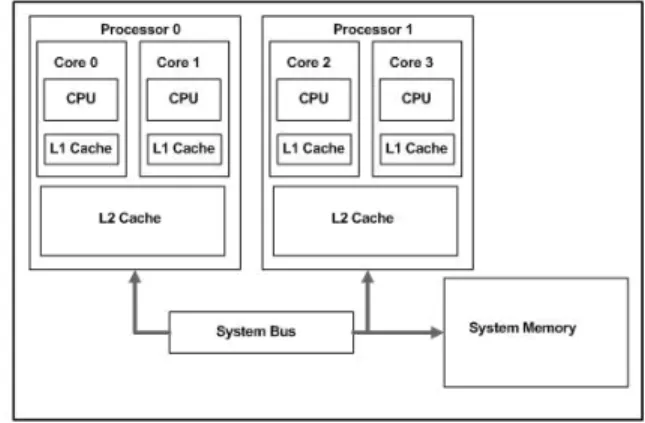
A multi-core processor may have a separate L1 cache and execution unit for each core, while it has a shared L2 cache for the entire processor, this is make the best use of the resources and to make inter-core communication efficient and more resources will be shared between the cores on the die. If multiple processes run on different cores of the same physical package and if they share data that fit in the cache, then the shared last-level cache between cores will mini-mize the data duplication. Therefore, it is more efficient in communication.
Multi-core processors are an improvement over the defi-ciencies of single-core processors. Multi-core processors can perform more works in parallel on separate operations, while reducing the power consumption and dissipate the heat [7]. Applications of multi-core processors are to speed up the work of operating systems and to support multithreading. Fig. 1 shows an example of a dual-core, dual-processor system.
FIGURE 1. A dual-core, dual-processor system.1
The main advantage of multi-core processors is lessening the heat coming off CPU and to significantly increase the speed of processing while it is cheaper than multi-processor system so it widely used in many fields including embedded, network, digital signal processing, and graphics.
The present study proposes a method for parallel mining FCSPs to improving the efficiency of systems and reduc-ing computational cost based on a multi-core processor architecture.
B. BIT VECTORS
A bit vector is an array of bits that compactly stores bits. A bit vector is built to represent the positions of an itemX
1
appearing in a sequenceS. If thei-th itemset in S contains itemX, then thei-th bit in the bit vector is 1; otherwise, it is 0. However, the sizes of bit vectors for itemsets are always equal to the number of transactions in the database. It is difficult to store them all in main memory when the number of transactions is large. In addition, a lot of time and mem-ory are needed for computing the intersection between bit vectors. The bit vector of an itemset with many ‘0’ bits can be shortened to reduce storage space and computation time. To address this issue, dynamic bit vector (DBV) were thus proposed [35], it represents a bit vector after removing the ‘0’ bits at the front and end of the vector thus it is more efficiently for itemsets with many ‘0’ bits.
C. DYNAMIC BIT VECTOR DATA STRUCTURE
The DBV data structure [35] is used vertical format layout so it quickly calculates the supports count by perform AND operations on the two DBVs from larger position value of two DBVs. If resulting value is 0, then the position value of the outcome DBV is increased by 1 until the first non-zero resulting value is reached. Next, from the position of non-zero byte, all the resulting bytes by the AND operation are kept unless the last continuous zero bytes.
A DBV consists of two parts:
• Start bit: the position of the first appearance of a ‘1’ bit. • Bit vector: a sequence of bits starting from the first
non-zero byte to the last non-non-zero byte.
For example, Table 2 is shows a bit vector of 16 transac-tions in a sequence database. The bit vector for itemineeds 16 bytes because itemiexists in transactions 6, 10 and 11. Using the DBV structure, only 8 bytes are required (6 bytes for the bit vector and 2 bytes for position).
TABLE 2. Example of 16-byte bit vector.
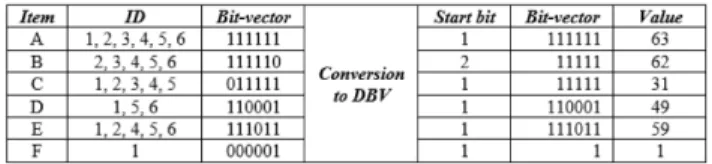
Table 4 is shows the conversion of the bit vector in Table 2 to DBV, the first non-zero byte appears at posi-tion 6 so DBV={6, 100011}.
TABLE 3. Conversion of database DB in Table 1 to DBV format.
Example 2:Consider databaseDBin Table 1, sequenceA
exists in transactions 1, 2, 3, 4, 5 and 6, the start bit is 1, the bit vector is 111111, and thusσ (A)=6 because the bit vector has four ‘1’ bits. The similar way,σ (B) = 5,σ (C) = 5, σ (D) = 3,σ (E) = 5 andσ (F) = 1. Table 3 shows the conversion of databaseDBin Table 1 to the DBV format.
TABLE 4.Conversion of bit vector to DBV.
IV. PROPOSED ALGORITHM
A. DBV-PATTERN DATA STRUCTURE
The DBV-Pattern [17], [35] data structure combines the DBV structure with a representation of a sequence. It can be briefly summarized as follows: Each DBV-Pattern including sequenceS; dynamic bit vectorDBV; and list of positions of the occurrence in the sequence of each transactionLP. List positions in the formstartPos:{list position}, wherestartPos
is the first appearance of the sequence in each transaction.
Example 3:In databaseDB, sequenceAexists in six trans-actions. In transactionS1, sequence A appears at positions {2, 3, 5}. The starting position is 2, soLP is 2:{2, 3, 5}. Similarly, LP is 1:{1, 3} in transaction S2,LP is 3:{3} in transactionS3,LPis 1:{1, 5} in transactionS4,LPis 2:{2} in transaction S5, and LP is 1:{1, 3, 4} in transaction S6. Table 5 presents the DBV-Pattern for sequenceAin Table 1. TABLE 5.DBV-Pattern for sequence A.
B. PARALLEL DYNAMIC BIT VECTORS FOR MINING FREQUENT CLOSED SEQUENTIAL PATTERNS
This section describes the proposed pDBV-FCSP algorithm, which uses a multi-core processors architecture to mine FCSPs combine with DBV data structure [39].
Therootof the search tree is labeled as the null sequence. Each node at levelk is repeatedly extended by adding one itemI to generate a child node at the next level (k + 1)-sequence. A (k+1)-sequence can be extended via sequence extension or itemset extension. In itemset extension, an item is added to the last itemset in the pattern. In sequence exten-sion, an item is appended to the sequence pattern to create a new itemset.
In the parallel mining, distributes each branch of the search tree to a single task, the computation at each node becomes an independent task and the overall computation can be parallel by distributing these tasks among the available processor cores which can be processed independently to generate FCSPs. The task parallel formulation distributes the tasks among the processor cores in the following way. First, the tree is expanded using the data-parallel algorithm at levelk+1,
withk>0. Then, the different nodes at levelkare distributed among the processor cores. Once this initial distribution is done, each processor core proceeds to generate the subtrees underneath the nodes to which they have been assigned.
The main challenges in parallel mining is that the candidate generation tree is usually not balanced. This skewness (one subtree is very deep compared to the others) of the tree can reduce the performance of the parallel algorithm. Therefore, dynamically re-distributing the works when some processes are out of work is necessary.
The proposed pDBV-FCSP algorithm uses the DBV data structure and depth first search that relies on dynamic load balancing, where each process can perform a DFS on the subtree, since they are computed independently.
The advantage of pDBV-FCSP is that each task is assigned for searching a branch of the tree and is processed inde-pendently. The advantages over using threads are a task can run on multiple cores, requiring less memory and less processing time than threads because a thread runs on only one core and it requires more memory. The oating system has initialization, destruction, and must per-form context switching between threads so it requires more processing.
When a process finishes finding all frequent closed sequen-tial patterns in its corresponding part of the tree, it actively requests an unexplored part of the tree from other processes. When a processor becomes idle, it randomly selects a ded-icator processor and sends it a work request. The dedded-icator sends a response indicating whether or not it has addi-tional work. If a response indicates that a dedicator can do any more work, the processor receives nodes to expand, along with the portion of the database associated with those nodes. Otherwise, the processor selects another donor and sends work request to that dedicator. This process contin-ues until every processor completely extended the nodes assigned to it.
Proposition 1 [32]:Consider the prefixSp = k1k2· · ·kn.
If there exists an itemkbefore the starting position of prefix
Sp in each of the transactions containing Sp in sequence
databaseDB, the extension can be pruned by prefixSp.
Con-sider databaseDBin Table 1, there exists a sequenceE that occurs afterAin each transaction that contains prefixE, it is no need to extend prefixE. If we extend prefixE, the results obtained will be absorbed due to the extension of prefix A
already containingEand having the same support.
Proposition 2 [32]: If there exists a sequence δ that is a forward-extension or backward-extension of sequence λ, sequenceλis not closed, andλcan be safely absorbed byδ. For example, suppose that α = BB:2 and δ = BCB:2. Then,BB:2 will be absorbed byBCBbecauseBB⊆BCBand σ (BB)=σ (BCB)=2.
The main steps of the pDBV-FCSP algorithm are as fol-lows.
1. Convert the sequence database to the DBV-Pattern structure.
2. Identify the frequent 1-sequences.
3. Project the database along each frequent 1-sequences and check the closure of frequent sequences to early eliminate infrequent sequences.
4. Prune the prefix sequences early. 5. Extend sequences.
The mining of FCSPs is divided into separate branches as follows.
1. Build the search tree from the set of frequent 1-sequences.
2. Parallel mine FCSPs. 3. Synchronize results.
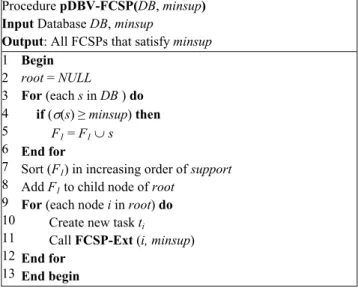
The pseudo code of the pDBV-FCSPstrategy is shown in Fig.2. The value ofrootis initialized toNULL. Next, this procedure finds all frequent 1-sequences from databaseDB
that satisfies theminsup threshold (lines 3-5). The items in
F1are sorted in ascending order by support (line 7) to gain more effectively balance of the workload. Next,pDBV-FCSP creates new tasks corresponding to each pattern inF1(line 10). Each task executes the procedureFCSP-Ext(line 11) to extend itemsets and sequences. Tasks run in parallel to generate a partial set of FCSPs. The final set of FCSPs is the union and synchronize of the partial results.
FIGURE 2. pDBV-FCSP strategy.
Consider databaseDB in Table 1 and minsup = 50%. After this procedure is executed, five frequent 1-sequences are stored, and thusF1={A:6,B:5,C:5,D:3,E:5}.
The procedureFCSP-Ext is shown in Fig. 3. This pro-cedure expands the search tree by executing propro-cedures extendItem(line 6) andextendSeq(line 9). For each node in the search tree, the pattern for that node is extended by calling extendItem and extendSeq to create a new pattern. Before sequence extension, the algorithm tests and eliminates prefixes that cannot extend frequent closed sequences using Proposition 1 (line 4). This process is repeated (line 13) until no frequent closed sequences are generated. Lines 16-22 uses Proposition 2 to check the prefix
Sx. IfSx is not a frequent closed sequence, it will be set to
NULL. After each level expansion, the processors communi-cate between each other to determine whether the work needs to be re-balanced (line 23).
FIGURE 3. FCSP-Extension procedure.
Consider a pattern with prefix A, the algorithm per-forms sequence extension to create new frequent closed 2-sequences, pattern with prefixAextends usingextendSeq by concatenation withA,B,C,DandEto make new patterns
AA,AB,AC,AD and AE, respectively, and extends using extendItem by concatenation with B,C,DandE to make new patterns (AB),(AC),(AD) and (AE), respectively. It is then checked whether the support count of these patterns satisfies the threshold or not. This process is repeated for each task until all FCSPs are obtained, as shown in Table 6. TABLE 6. Set of frequent closed sequential patterns from Table 1 with
minsup= 50%.
V. EXPERIMENTAL RESULTS
To show the effectiveness of the proposed algorithm, the experiments were conducted and performed on a personal computer with an Intel Core i5-6200U 2.3-GHz CPU with 4 cores, 3 MB of L3 cache, and 4 GB of RAM, running 64-bit Windows 10 Pro. The algorithm was implemented in C# and run on .Net Framework 4.5.
The first and second databases (C6T5N1kD10k and T10I4D100K) used for comparison were generated using the
IBM synthetic data generator. The third
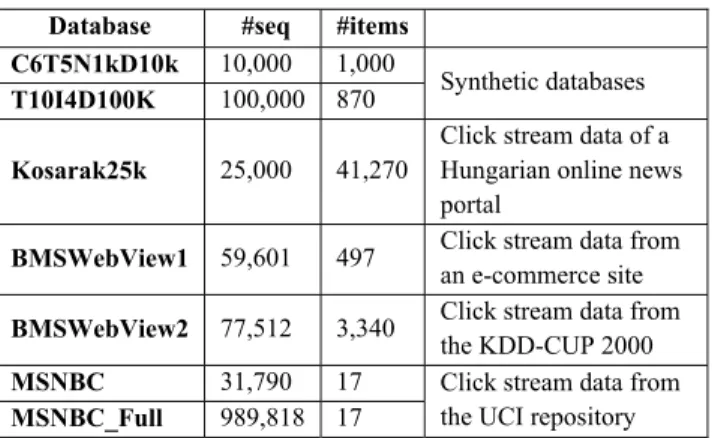
database (Kosarak25k) was provided by Bodon (http://fimi.ua.ac.be/data/). Other databases were pro-vided by Fournier-Viger (http://www.philippe-fournier-viger.com/spmf/). Statistic of the databases is shown in Table 7. The definitions of parameters used to generate the databases are shown in Table 8.
TABLE 7.Databases used in experiments.
TABLE 8.Definitions of parameters for standard databases.
Some existing methods for parallel mining closed sequen-tial patterns are designed on a distributed memory system and are performed from 4, 8, 16, 32 and 64 nodes as Par-CSP [7] and Par-ClosP [43], each node has a 1GHz Pentium III processor, 1GB main memory. Our proposed method is the first method applied to multi-core proces-sors for mining closed sequential pattern. Therefore, it is very difficult to compare our result with those methods because they are developed in different platforms. Experi-ments were conducted to compare CloFS-DBV and the pro-posed pDBV-FCSP for variousminsup values and the pro-posed method running on three figures are two, three and four cores. The proposed method is significantly improved the running time compared to the sequential counterpart.
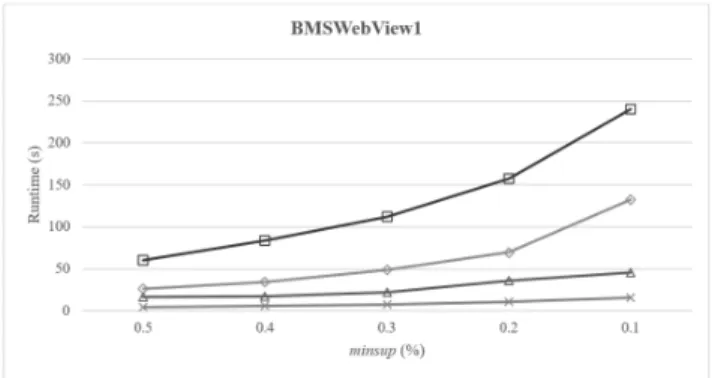
The runtime results are shown inFig. 4–Fig. 9and memory usage results are shown inFig. 10–Fig. 15for the six regard-ing databases.
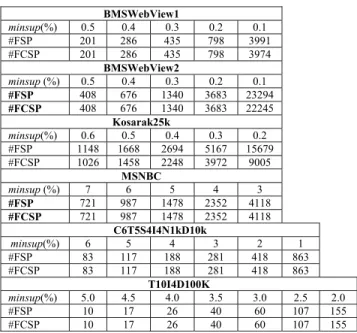
Parallel mining improves performance without affected the results. Table 8 shows the mining results of CloFS-DBV and pDBV-FCSP. The set of results of algorithms were always the same for all databases, that proves the correctness of pDBV-FCSP.
We also add a set of results of frequent sequential pat-tern (FSP) mining for comparison. With these thresholds, the result is similar for all databases among frequent closed
FIGURE 4. Runtimes on C6T5N1kD10k database.
FIGURE 5. Runtimes on T10I4D100K database.
FIGURE 6. Runtimes on Kosarak25k database.
FIGURE 7. Runtimes on BMSWebView1 database.
FIGURE 8. Runtimes on BMSWebView2 database.
FIGURE 9. Runtimes on MSNBC database.
sequential pattern (FCSP) and frequent sequential patterns. We just saw that the results are different between FCSP and FSP on the Kosarak25k database and on two databases BMSWebView1 and BMSWebView2 with the lowest threshold.
A. RUNTIME
The experimental results show that pDBV-FCSP is faster than CloFS-DBV in most cases, especially, when they are executed on a computer with more cores. With a largeminsup, pDBV-FCSP is not faster than CloFS-DBV, however, with a smallminsup, pDBV-FCSP is much faster than CloFS-DBV. In Fig. 4, for the C6T5S4I4N1kD10k database, the
run-TABLE 9. The set of results of algorithms for comparison.
times of CloFS-DBV and pDBV-FCSP were 7.06 s, 3.59 s (two cores), 2.00 s (three cores) and 0.91 s (four cores) sec-onds, respectively. The runtimes of pDBV-FCSP were always better than the others when executed on four cores while CloFS-DBV increased rapidly when minsupwas decreased from 6% to 1%. Similar results, the runtimes of pDBV-FCSP were slower than the CloFS-DBV as shown in Fig. 5 for T10I4D100K database. In Fig. 6–Fig. 9, the runtimes of pDBV-FCSP for Kosarak25k, BMSWebView1, BMSWeb-View2 and MSNBC (a short version) databases were better than CloFS-DBV in most cases, especially with smallminsup
and running on computer that has many cores. Whenminsup
was decreased, the runtimes of pDBV-FCSP were always faster.
B. MEMORY USAGE
On all databases, CloFS-DBV is always better than pDBV-FCSP in terms of memory usage, as shown
FIGURE 10. Memory usage for C6T5N1kD10k database.
FIGURE 11. Memory usage for T10I4D100K database.
FIGURE 12. Memory usage for Kosarak25k database.
FIGURE 13. Memory usage for BMSWebView1 database.
in Fig. 10–Fig. 15. This can be explained as follows. Although, both algorithms used the same DBV data structure for storing sequences information. pDBV-FCSP using more memory usage because parallel processing divided the tasks to be processed into independent branches, needing more memory to store the results. Whenminsup was decreased, more FCSPs were obtained and thus the runtime and memory usage increased. The memory usage of pDBV-FCSP between two, three and four cores was equivalents because the num-bers of nodes in the search tree of was the same.
An advantage of pDBV-FCSP is that it helps to bal-ance the search tree using a dynamic mechanism that re-distributes the works when some processes are out of work
FIGURE 14. Memory usage for BMSWebView2 database.
FIGURE 15. Memory usage for MSNBC database.
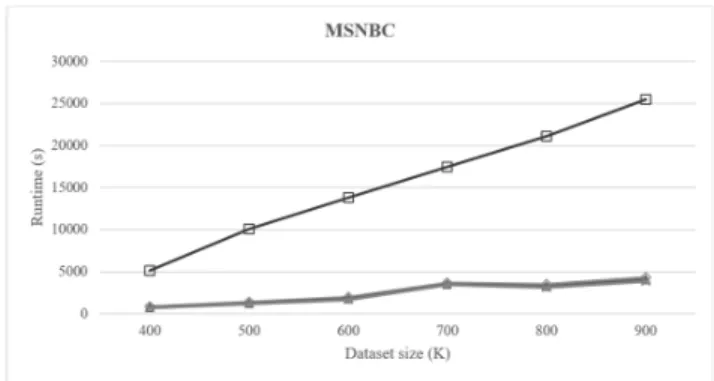
FIGURE 16. Scalability of pDBV-FCSP and CloFS-DBV for MSNBC database withminsup=7% and various database sizes.
to minimize the CPU idle time and the set of frequent 1-sequences is sorted in ascending order before task assign-ment. This strategy balances the search tree for parallel pro-cessing, and thus the search times for branches of the search tree are similar.
C. SCALABILITY
In this section, we performed scalability experiments on var-ious number of sequences for MSNBC full database which is the largest one in the experimental databases. The goal of
this experiment is to observe the influence of the number of sequences on execution time. The results inFig. 16show that pDBV-FCSP had the best scalability. We tried this database with CM-ClaSP approach proposed by Philippe et al. [9], even the CMClaSP could not run for MSNBC database from 500K sequences on the above computer.
VI. CONCLUSION AND FUTURE WORKS
This article proposed an efficient parallel strategy for min-ing FCSPs based on multi-core processors architecture and used an efficient DBV data structure for quickly determining support count. With a dynamic load balancing mechanism, the proposed algorithm solved the load balance issues of the workload between processors to minimize the idle CPU time. The experimental results show that the proposed algo-rithm outperformed the CloFS-DBV algoalgo-rithm, especially the runtime significantly reduced when the number of cores increased.
In the future, we will study some issues related to maxi-mal patterns, utility pattern and subgraph mining in complex sequence databases using multi-core processor, or hybrid environment that combine between distributed and multi-core processor. We will also study how to use other architectures to improve the efficiency of the mining process.
REFERENCES
[1] R. Agrawal and R. Srikant, ‘‘Mining sequential patterns,’’ inProc. ICDE, vol. 95. 1995, pp. 3–14.
[2] R. Agrawal and R. Srikant, ‘‘Mining sequential patterns: Generalizations and performance improvements,’’ inProc. EDBT, vol. 96. 1996, pp. 3–17. [3] A. Vajda,Multi-core and Many-core Processor Architectures. Springer, 2011, pp. 9–43. [Online]. Available: http://www.springer.com/gp/book/ 9781441997388
[4] J. Ayres, J. Gehrke, T. Yiu, and J. Flannick, ‘‘Sequential pattern mining using a bitmap representaion,’’ inProc. SIGKDD, vol. 2. 2002, pp. 1–7. [5] A. Casali and C. Ernst, ‘‘Extracting correlated patterns on multicore
archi-tectures,’’ inProc. CD-ARES, vol. 13. 2013, pp. 118–133.
[6] L. Chai, Q. Gao, and D. K. Panda, ‘‘Understanding the impact of multi-core architecture in cluster computing: A case study with intel dual-multi-core system,’’ inProc. CCGRID, 2007, pp. 471–478.
[7] S. Cong, J. Han, and D. Padua, ‘‘Parallel mining of closed sequential patterns,’’ inProc. ACM SIGKDD, vol. 5. 2005, pp. 562–567.
[8] T. Flouri, C. S. Iliopoulos, K. ParkSolon, and P. Pissis, ‘‘GapMis-OMP: Pairwise short-read alignment on multi-core architectures,’’ inArtificial Intelligence Applications and Innovations, IFIP AICT, vol. 382. Springer, 2012, pp. 593–601.
[9] P. Fournier-Viger, A. Gomariz, M. Campos, and R. Thomas, ‘‘Fast vertical mining of sequential patterns using co-occurrence information,’’ inProc. PAKDD, vol. 14. 2014, pp. 40–52.
[10] K. Gouda, M. Hassaan, and M. J. Zaki, ‘‘Prism: An effective approach for frequent sequence mining via prime-block encoding,’’J. Comput. Syst. Sci., vol. 76, no. 1, pp. 88–102, 2010.
[11] A. Gomariz, M. Campos, R. Marin, and B. Goethals, ‘‘ClaSP: An efficient algorithm for mining frequent closed sequences,’’ inProc. PAKDD, 2013, pp. 50–61.
[12] L. K. J. Grace, V. Maheswari, and D. Nagamalai, ‘‘Web log data analysis and mining,’’Adv. Comput., vol. 133, pp. 459–469, Mar. 2011. [13] J. Han, J. Pei, B. Mortazavi-Asl, Q. Chen, U. Dayal, and M. C. Hsu,
‘‘Freespan: Frequent pattern-projected sequential pattern mining,’’ inProc. KDD, 2000, pp. 355–359.
[14] J. Han, J. Pei, and Y. Yin, ‘‘Mining frequent patterns without candidate generation,’’ACM SIGMOD, vol. 29, no. 2, pp. 1–12, 2000.
[15] B. Huynh and B. Vo, ‘‘Using multi-core processors for mining frequent sequential patterns,’’ICIC Exp. Lett., vol. 9, no. 11, pp. 3071–3079, 2015.
[16] B. Huynh, D. Nguyen, and B. Vo, ‘‘Parallel frequent subgraph min-ing on multi-core processor systems,’’ICIC Exp. Lett., vol. 10, no. 9, pp. 2105–2113, 2016.
[17] B. Huynh, B. Vo, and V. Snasel, ‘‘An efficient method for mining frequent sequential patterns using multi-Core processors,’’Appl. Intell., vol. 46, no. 3, pp. 703–716, 2017.
[18] A. Laurent, B. Négrevergne, N. Sicard, and A. Termier, ‘‘Efficient paral-lel mining of gradual patterns on multicore processors,’’ inAdvances in Knowledge Discovery and Management, SCI, vol. 398. Springer, 2012, pp. 137–151.
[19] L. Liu, E. Li, Y. Zhang, and Z. Tang, ‘‘Optimization of frequent item-set mining on multiple-core processor,’’ inProc. VLDB, vol. 7. 2007, pp. 1275–1285.
[20] F. Masseglia, F. Cathala, and P. Poncelet, ‘‘The PSP approach for mining sequential patterns,’’ inProc. 2nd Eur. Symp. Principles Data Mining Knowl. Discovery (PKDD), vol. 1510. 1998, pp. 176–184.
[21] B. Negrevergne, A. Termier, J. F. Méhaut, and T. Uno, ‘‘Discovering closed frequent itemsets on multicore: Parallelizing computations and optimizing memory accesses,’’ inProc. HPCS, Jun. 2010, pp. 521–528.
[22] B. Negrevergne, A. Termier, M. C. Rousset, and J. F. Méhaut, ‘‘Para miner: A generic pattern mining algorithm for multi-core architectures,’’Data Mining Knowl. Discovery, vol. 28, no. 3, pp. 1–41, 2014.
[23] D. Nguyen, B. Vo, and B. Le, ‘‘Efficient strategies for parallel mining class association rules,’’Expert Syst. Appl., vol. 41, no. 10, pp. 4716–4729, 2014. [24] M. Norouzi, A. Souri, and M. S. Zamini, ‘‘A data mining classification approach for behavioral malware detection,’’J. Comput. Netw. Commun., vol. 1, pp. 8069672:1–8069672:9, Mar. 2016.
[25] T. T. Pham, J. Luo, T. P. Hong, and B. Vo, ‘‘An An efficient method for mining non-redundant sequential rules using attributed prefix-trees,’’
Engineering Applications of Artificial Intelligence, vol. 32, pp. 88–99, Jun. 2014.
[26] J. Pei et al., ‘‘Mining sequential patterns by pattern-growth: The PrefixSpan approach,’’IEEE Trans. Knowl. Data Eng., vol. 16, no. 11, pp. 1424–1440, Nov. 2004.
[27] K. Raza, ‘‘Application of data mining in bioinformatics,’’ Indian J. Comput. Sci. Eng., vol. 1, no. 2, pp. 114–118, 2013.
[28] F. Sánchez, F. Cabarcas, A. Ramirez, and M. Valero, ‘‘Long DNA sequence comparison on multicore architectures,’’ inEuro-Par-Parallel Processing. 2010, pp. 247–259.
[29] B. Schlegel, T. Karnagel, T. Kiefer, and W. Lehner, ‘‘Scalable frequent itemset mining on many-core processors,’’ inProc. 9th Int. Workshop Data Manage. New Hardw., 2013, Art. no. 3.
[30] Y. Solihin,Fundamentals of Parallel Computer Architecture. Boca Raton, FL, USA: CRC Press, 2009.
[31] N. Talukder and M. J. Zaki, ‘‘Parallel graph mining with dynamic load balancing,’’ inProc. IEEE Int. Conf. Big Data, Dec. 2016, pp. 3352–3359. [32] M. T. Tran, B. Le, and B. Vo, ‘‘Combination of dynamic bit vectors and transaction information for mining frequent closed sequences efficiently,’’
Eng. Appl. Artif. Intell., vol. 38, pp. 183–189, Feb. 2015.
[33] T.-T. van, B. Vo, and B. Le, ‘‘IMSR_PreTree: An improved algorithm for mining sequential rules based on the prefix-tree,’’Vietnam J. Comput. Sci., vol. 1, no. 2, pp. 97–105, 2014.
[34] A. Vajda, ‘‘Multi-core and many-core processor architectures,’’ in Pro-gramming Many-Core Chips. New York, NY, USA: Springer, 2011, pp. 9–43.
[35] B. Vo, T. P. Hong, and B. Le, ‘‘DBV-Miner: A dynamic bit-vector approach for fast mining frequent closed itemsets,’’Expert Syst. Appl., vol. 39, no. 8, pp. 7196–7206, 2012.
[36] J. Wang, J. Han, and C. Li, ‘‘Frequent closed sequence mining without candidate maintenance,’’IEEE Trans. Knowl. Data Eng., vol. 19, no. 8, pp. 1042–1056, Aug. 2007.
[37] P. Weichbroth, M. Owoc, and M. Pleszkun, ‘‘Web user navigation pat-terns discovery from WWW server log files,’’ inProc. FedCSIS, vol. 12. Sep. 2012, pp. 1176–1177.
[38] X. Yan, J. Han, and R. Afshar, ‘‘CloSpan: Mining closed sequential pat-terns in large databases,’’ inProc. SDM, vol. 3. 2003, pp. 166–177. [39] K. M. Yu and S. H. Wu, ‘‘An efficient load balancing multi-core
fre-quent patterns mining algorithm,’’ inProc. TrustCom, vol. 11. 2011, pp. 1408–1412.
[40] M. J. Zaki, J. T. L. Wang, and H. T. T. Toivonen, ‘‘BIOKDD01: Workshop on data mining in bioinformatics,’’ACM SIGKDD Explorations, vol. 3, no. 2, pp. 71–73, 2002.
[41] M. J. Zaki, ‘‘SPADE: An efficient algorithm for mining frequent sequences,’’Mach. Learn., vol. 42, pp. 31–60, Jan. 2010.
[42] M. J. Zaki, ‘‘Parallel sequence mining on shared-memory machines,’’
J. Parallel Distrib. Comput., vol. 61, no. 3, pp. 401–426, 2001.
[43] T. Zhu and S. Bai, ‘‘A parallel mining algorithm for closed sequential patterns,’’ inProc. AINA Workshops, May 2007, pp. 392–395.
BAO HUYNH received the B.Sc. degree in computer science from the University of Sci-ence, Vietnam National University, Ho Chi Minh City, Vietnam, and the M.Sc. degree in com-puter Science from the Posts and Telecommu-nications Institute of Technology, Ho Chi Minh City, Vietnam, in 2002 and 2011, respectively. His research interests include data mining and social network analysis.
BAY VO (M’16) received the Ph.D. degree in computer science from the University of Science, Vietnam National University of Ho Chi Minh, in 2011. He was an Associate Professor from 2015. His research interests include association rule min-ing, classification, incremental minmin-ing, distributed databases, and privacy preserving in data mining. He serves as an Associate Editor of the ICIC Express-Letters, Part B: Applications, a member of the review board of the International Journal of Applied Intelligence, and an Editor of theInternational Journal of Engineer-ing and Technology Innovation. He also served as the Co-Chair of several special sessions, such as ICCCI 2012, ACIIDS 2013, 2014, 2015, 2016, KSE 2013, 2014, SMC 2015, as Reviewer of many international journals, such as IEEE-TKDE, KAIS, ESWA, IEEE-SMC: Systems, Information Sciences, Knowledge Based Systems, Soft Computing, and PLOS ONE, the IEEE ACCESS.
VACLAV SNASELreceived the M.Sc. degree from Palacky University, Olomouc, Czech Republic, the Ph.D. degree in algebra and geometry from Masaryk University, Brno, Czech Republic. His research and development experience include over 25 years in the Industry and Academia. He was in a multidisciplinary environment involvinrtificial intelligence, multidimensional data indexing, con-ceptual lattice, information retrieval, semantic web, knowledge management, data compression, machine intelligence, neural network, Web intelligence, data mining and applied to various real-world problems. He has given over ten plenary lectures and conference tutorials in these areas. He has authored or co-authored several refereed journal/conference papers and book chapters. He has authored over 400 papers (147 is recorded at Web of Science). He has supervised many Ph.D. students from Czech Republic, Jordan, Yemen, Slo-vakia, Ukraine and Vietnam.
From 2001, he has been a Visiting Scientist with the Institute of Computer Science, Academy of Sciences of the Czech Republic. From 2003, he has been the Vice-Dean for Research and Science with the Faculty of Electrical Engineering and Computer Science, VSB-Technical University of Ostrava, Czech Republic. Since 2006, he has been a Full Professor. Before turning into a full-time academic, he was with industrial company, where he was involved in different industrial research and development projects for over eight years.
He is the Editor-in-Chief of two journals, he also serves the editorial board of some reputed International journals. He is actively involved in the International Conference on Computational Aspects of Social Networks; Computer Information Systems and Industrial Management; Evolutionary Techniques in Data Processing series of International conferences. He is a ACM, AMS, and SIAM.