COMPARISON BETWEEN METHODOLOGIES AND EVALUATIONS
IN CORE PHYSIC SUBJECTS IN ENGINEERING AND
ARCHITECTURE BACHELORS
M.L. Álvarez López, A. Beléndez Vázquez, P.G. Benavidez Lozano, E.M. Calzado
Estepa, J. Fránces Monllor, S. Gallego Rico, S. Heredia Avalos, A. Hernández
Prados, M.F. Ortuño Sánchez
University of Alicante (SPAIN)
Abstract
In the framework created by the new graduate in European higher education, this work focuses on the foundations of the system of teaching and learning: methodology and evaluation. The comparative study of the methodology and evaluation was performed for the core subjects of Physics, of the degrees in engineering and architecture from the Polytechnic School (EPS) of the University of Alicante (UA) over four years. The work allows comparing the subjects of physics in terms of credits, methodology, evaluation, success rates in percentage, and compared cutting-off marks for each particular degree.
Keywords: ESHA, physics subject, success rate, research projects.
1 INTRODUCTION
Within the framework established by the RD 1393/2009 of 29th October, where the management of official university studies in Spain is established, Physics is classified as core subject of undergraduate degrees in engineering and architecture. Inside the Spanish educational framework, core subjects should be offered in the first half of the degree with a minimum of 6 European Credit Transfer System (ECTS). Physical subject-matter is usually taught in these grades in one or two subjects, between the first and second year. In some degree it has a unique subject of Physics at should be limited to basic skills required by the bachelor design. In the case of the second subject in physics, this subject contains knowledge applied to the specific qualifications of the degree. Especially the Polytechnic School (EPS) bachelors can be classified by degrees related to communication technologies and related construction. In both cases competencies related to the other subjects of the degrees are acquired.
The present work is divided in the following points and tasks: (i) we study the ministerial regulations for the Bachelors studied; (ii) we compare basic skills in the field of physics; (iii) we search and collect information relating to the subject-matter of physics that is taught specifically in European universities and in the rest world; (iv) we analyse the need for the instrumental skills of the subject in each of the new Bachelors; (v) we collect the characteristics of the learning plan, methodology and evaluation of each subject; (vi) we classify the descriptors subjects; (vii) Comparing the cut-off marks; (viii) Comparison of the results of learning through success rates and efficiency.
1.1 Physic subjects in engineering and architecture bachelors
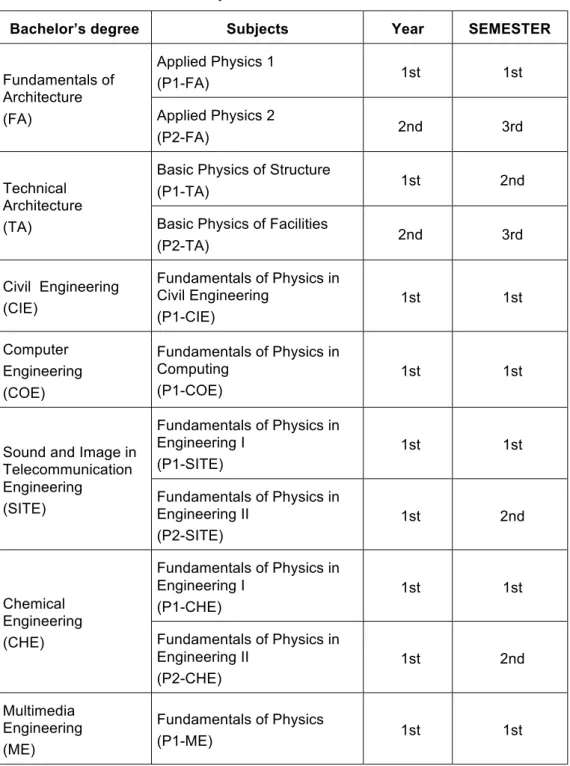
The University of Alicante is composed of six faculties and two schools. It is in the Polytechnic School where the degrees of Engineering and architecture can be studied. Table 1 shows the levels that we address in this work, and the subjects of physics, as a basic matter of these grades are shown. The table also shows the course and semester in which these subjects are taught. Each of the courses has 6 assigned ECTS corresponding to a total of 60 hours in the classroom and 90 distance-based hours.
Table 1. Physics subjects classify by Bachelor, year and semester in the Polytechnic School of UA.
Bachelor’s degree Subjects Year SEMESTER
Fundamentals of Architecture (FA) Applied Physics 1 (P1-FA) 1st 1st Applied Physics 2 (P2-FA) 2nd 3rd Technical Architecture (TA)
Basic Physics of Structure
(P1-TA) 1st 2nd
Basic Physics of Facilities
(P2-TA) 2nd 3rd Civil Engineering (CIE) Fundamentals of Physics in Civil Engineering (P1-CIE) 1st 1st Computer Engineering (COE) Fundamentals of Physics in Computing (P1-COE) 1st 1st
Sound and Image in Telecommunication Engineering (SITE) Fundamentals of Physics in Engineering I (P1-SITE) 1st 1st Fundamentals of Physics in Engineering II (P2-SITE) 1st 2nd Chemical Engineering (CHE) Fundamentals of Physics in Engineering I (P1-CHE) 1st 1st Fundamentals of Physics in Engineering II (P2-CHE) 1st 2nd Multimedia Engineering (ME) Fundamentals of Physics (P1-ME) 1st 1st
As it is shown in table 1, the 11 subjects, 8 are in the first half of the bachelor’s degree. In the case of degrees with only a subject of physics, this is taught in the semester 1. Because of the relations between contents of physics with other subjects like math. There are some difficulties of learning for example the students should know the derivation of the main functions and their integrals.
Respect to the Bachelor’s degrees in Fundamentals of Architecture and Technical Architecture, two courses are offered within the basic subject-matter of physics at all universities (at main national universities, and in some important cases also worldwide). However, in the case of bachelor’s degrees in Engineering Computer and Multimedia Engineering one or two core subjects related to the physical foundations of computer science and electronics are offered. Furthermore for Civil Engineering, it can be concluded that there are two subjects of basic physics, one is called mechanics in some universities. Finally, the bachelor’s degree of Sound and Image in Telecommunication Engineering,
both on current plans, and proposals Degrees, titles have a 95% two basic courses in Physics with a total of 12 credits.
1.2 Regulatory management of official university studies
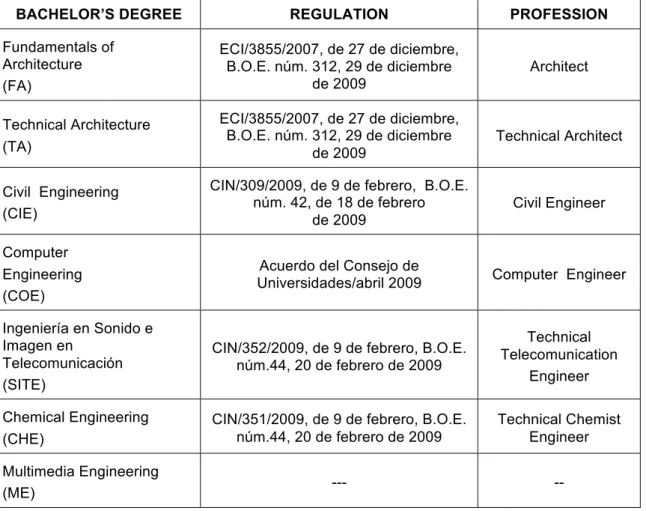
The official university studies in Spain are regulated by Royal Decree 861/2010 July 2, amending Royal Decree 1393/2007, October 29 (BOE July 3, 2010). On the other hand, they are establishing requirements that must adapt curricula leading to the award of certain bachelor-degrees in Engineering and Architecture. The titles that match with these regulations allow for the exercise of the profession of engineer or architect, depending on the regulation[1],[2],[3]. Table 2 summarizes the ministerial regulations of each of the bachelor’s degrees of the EPS and the profession for which enabled.
Table 2. Regulations and agreements for bachelor’s degrees in engineering and architecture.
BACHELOR’S DEGREE REGULATION PROFESSION
Fundamentals of Architecture (FA) ECI/3855/2007, de 27 de diciembre, B.O.E. núm. 312, 29 de diciembre de 2009 Architect Technical Architecture (TA) ECI/3855/2007, de 27 de diciembre, B.O.E. núm. 312, 29 de diciembre de 2009 Technical Architect Civil Engineering (CIE)
CIN/309/2009, de 9 de febrero, B.O.E. núm. 42, de 18 de febrero de 2009 Civil Engineer Computer Engineering (COE)
Acuerdo del Consejo de
Universidades/abril 2009 Computer Engineer Ingeniería en Sonido e
Imagen en Telecomunicación (SITE)
CIN/352/2009, de 9 de febrero, B.O.E. núm.44, 20 de febrero de 2009 Technical Telecomunication Engineer Chemical Engineering (CHE)
CIN/351/2009, de 9 de febrero, B.O.E. núm.44, 20 de febrero de 2009 Technical Chemist Engineer Multimedia Engineering (ME) --- --
1.3 Motivation
It is known that an empowering tool for personal and professional development of teachers is the collaborative work, which results in an improvement of the teaching process [4],[5],[6],[7]. In addition, collaborative work helps make teaching more efficient by eliminating duplication and encourages complementarity and continuity between the subjects [7].
An example of high capacity working together of teachers in the subjects of Physics, EPS, is reflected in the curriculum of the subjects of Physics in the new degrees offered at the EPS [1],[2],[3],[8]. The ministerial orders (Annex II of Royal Decree 1393/2007) indicate that physics is a basic subject-matter in the branch of Engineering and Architecture. According to Article 13 concerning the recognition of credits in the degree courses: are surveyed claims relating to matters of basic training of said branch, provided the degree to which pretends access belong to the same branch of knowledge. Therefore, the subjects of Physics of the different degrees of Bachelor of EPS are recognized automatically. From an overall way you can say that in the matter of Physics at the various grades
similar skills are acquired in an adequate percentage. Reach this consensus between the committees of the various qualifications required joint reflection by the teachers involved.
2 THE SUBJECT-MATTER OF PHYSICS IN GRADES OF ENGINEERING AND
ARCHITECTURE
2.1 Physic competences
In order to compare the skills to be acquired in the subjects of Physics of these bachelor’s degrees in Engineering / Architecture proposed, shown in Table 2 basic skills learned from the “Boletín oficial del Estado” for each grade. As it can be seen, and, it can be expected, for degrees within the same branch, in a core subject such as the physical, skills to be acquired by students in this matter coincide in more than 90%.
Table 3. Basic competences in physics described by the regulation. BACHELOR’S
DEGREE COMPETENCES TO BE ACQUIRED
Fundamentals of Architecture (FA)
Adapted and applied to architecture and urbanism of knowledge: Principles of general mechanics, statics, mass and geometry vector and tensor fields. The principles of thermodynamics, acoustics and optics. The principles of fluid mechanics, hydraulics, electricity and electromagnetism.
Technical Architecture (TA)
Applied knowledge of the principles of general mechanics, static structural systems, mass geometry, the principles and methods of analysis of the elastic behavior of the solid.
Knowledge of the theoretical foundations and basic principles applied to the building of fluid mechanics, hydraulics, electricity and electromagnetism, calorimetry and humidity, and noise.
Civil Engineering (CIE)
Understanding and mastery of the basics of the general laws of mechanics, thermodynamics, fields and waves and electromagnetism and its application for solving problems of engineering.
Computer Engineering (COE)
Understanding and mastery of basic concepts of fields and waves and electromagnetism, theory of electrical circuits, electronic circuits, physical principles of semiconductors and logic families, electronic and photonic devices and its application for solving problems of engineering.
Sound and Image in Telecommunication Engineering (SITE)
Understanding and mastery of the basics of the general laws of mechanics, thermodynamics, fields and waves and electromagnetism and its application for solving problems of engineering.
Chemical Engineering (CHE)
Understanding and mastery of the basics of the general laws of mechanics, thermodynamics, fields and waves and electromagnetism and its application for solving problems of engineering.
Multimedia Engineering (ME)
Understanding and mastery of the basics of kinematics, dynamics, waves and electronic components and circuits, signal processing and its application for solving problems of engineering.
2.2 Subjects and descriptors
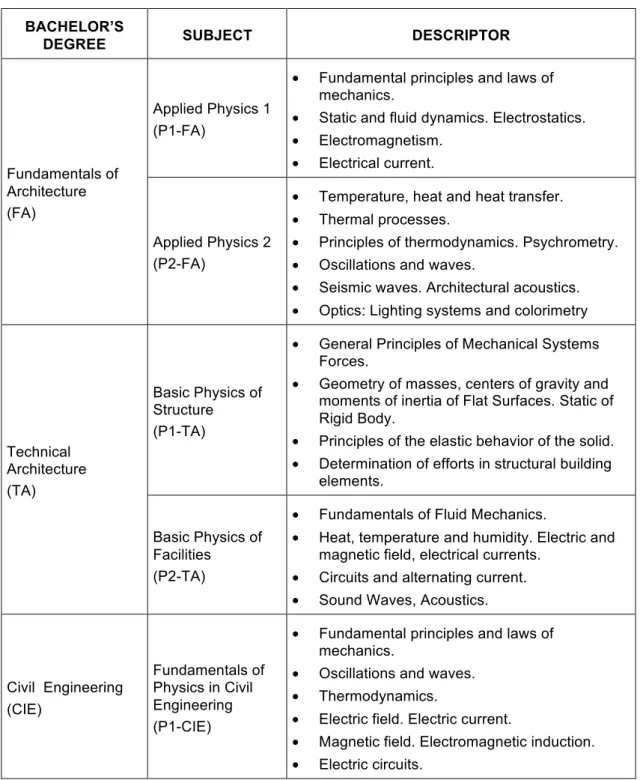
With the aim of developing skills in the teaching-learning process, subject descriptors, depending on the bachelor degree, in Table 4 are related.
The competences of subject-matter of physics are detailed in Table 3 for different grades coincide. However, if we compare the common descriptors between different subjects shown in Table 4 we obtain only two basic physical descriptors are included in the agendas of all degrees, "electric field" and "waves." The descriptor "electrical currents" and "magnetic field" are included in the 83% of bachelor’s degrees. The "kinematics" descriptor and "dynamic" are common to 67% of the grades. Specific descriptors "photonic enabled devices", "electronic devices" and "Principles of elasticity" are common to 33% of agendas.
Table 4. Grades, subjects and associated descriptors. BACHELOR’S
DEGREE SUBJECT DESCRIPTOR
Fundamentals of Architecture (FA)
Applied Physics 1 (P1-FA)
• Fundamental principles and laws of mechanics.
• Static and fluid dynamics. Electrostatics.
• Electromagnetism.
• Electrical current.
Applied Physics 2 (P2-FA)
• Temperature, heat and heat transfer.
• Thermal processes.
• Principles of thermodynamics. Psychrometry.
• Oscillations and waves.
• Seismic waves. Architectural acoustics.
• Optics: Lighting systems and colorimetry
Technical Architecture (TA) Basic Physics of Structure (P1-TA)
• General Principles of Mechanical Systems Forces.
• Geometry of masses, centers of gravity and moments of inertia of Flat Surfaces. Static of Rigid Body.
• Principles of the elastic behavior of the solid.
• Determination of efforts in structural building elements.
Basic Physics of Facilities
(P2-TA)
• Fundamentals of Fluid Mechanics.
• Heat, temperature and humidity. Electric and magnetic field, electrical currents.
• Circuits and alternating current.
• Sound Waves, Acoustics.
Civil Engineering (CIE) Fundamentals of Physics in Civil Engineering (P1-CIE)
• Fundamental principles and laws of mechanics.
• Oscillations and waves.
• Thermodynamics.
• Electric field. Electric current.
• Magnetic field. Electromagnetic induction.
Computer Engineering (COE) Fundamentals of Physics in Computing (P1-COE)
• Electric field. Electric current.
• Magnetic field. Electromagnetic induction.
• Electromagnetic waves.
• Circuits and alternating current.
• Principles of semiconductors: electronic devices.
• Principles of photonics Devices.
Sound and Image in Telecommunication Engineering (SITE) Fundamentals of Physics in Engineering I (P1-SITE)
• Fundamental principles and the laws of mechanics.
• Work and energy.
• Heat and temperature.
• Principles of thermodynamics. Electric field. Electric current. Physical principles of semiconductors.
Fundamentals of Physics in Engineering II (P2-SITE)
• Magnetic field. Electromagnetic induction.
• Electromagnetic field.
• Oscillatory and wave motion.
• Electromagnetic waves. Chemical Engineering (CHE) Fundamentals of Physics in Engineering I (P1-CHE)
• Fundamental principles and laws of mechanics.
• Static and dynamic Rigid Body.
• Mechanics of deformable solid.
• Static and fluid dynamics.
• Heat and temperature. Thermodynamics Fundamentals of
Physics in Engineering II (P2-CHE)
• Electric field. Electric current. Magnetic field. magnetic induction
• Electrical circuits and alternating current.
• Wave motion. Electromagnetic waves.
• Geometric and physical optics.
Multimedia Engineering (ME) Fundamentals of Physics (P1-ME)
• Fundamental principles and laws of mechanics.
• Static and dynamic Rigid Body.
• Oscillatory and wave motion.
• Electric field. electric current
• Magnetic field.
• Circuits and alternating current.
• Fundamentals Physics for electronics.
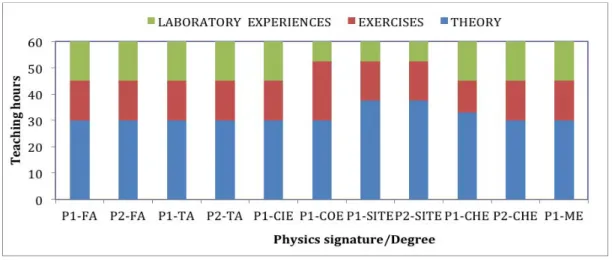
The teaching of the subject of Physics is done through training activities: theoretical lectures, exercises and laboratories experiences. In each one of them it requires a time in-class teaching hours and distance based hours to achieve the objectives of the course. Study time has been evaluated in previous studies for these three activities [1],[9],[10].The number of in-class hours for Physics subjects in each activity is shown in Fig. 1. For all subjects the time in developed in the classroom, or working time led by teachers, it is 60 hours, while the distance-based time or self-working time of students is 90 hours. As it is shown, all subjects taught at least 30 contact hours of lectures; to a weekly average of lectures in Physics from 2 to 2.5 hours. In the case of problem lectures they have at least 15 in-class hours in the semester, with an average of 1 hour weekly in-classes. As for the labs, the face time is
between 7.5 and 15 hours a semester. As shown, the time of laboratory has been considerably reduced in some of the subjects of physics regarding qualifications extinct. Because of this we have redesigned the working model in the laboratory so that students acquire the skills required, since for years we studied that best results are obtained when all the work is made in the laboratory and the out-class time could focused on other activities [1]. Each degree has a selection of practices adapted to their profile, and all other common experiences.
Fig1. In-class time for each activity for the subjects of Physics for bachelor’s degrees in Engineering and Architecture.
Summarizing, in the seven degrees while the in-class time for the subject of Physics, weekly, between 3.5 and 4.5 hours, while the time of self-working out of the class-room of students varies between 5.25 and 6.75 hours.
Regarding the transversal competences, subject-matter of Physics in all the bachelor’s degrees of EPS, try to get in addition to the skills that are part of the curriculum of the students cross regulated by Royal Decree 1393/2007, a number of cross-cutting skills and knowledge for their academic and professional development. Among the skills that are acquired by study this subject-matter are: (i) Ability to work in group, (ii) Ability to plan tasks and engage in meeting targets and deadlines, (iii) Capacity for oral and written statement, (iv ) Capacity to adopt the scientific method in the planning and implementation of various works both academic and professional, (v) capacity for self-criticism needed to analyze and improve the quality of a project and (vi) Ability to assimilate and adapt to the continuing evolution of technology in the area of professional development. These competences are worked in various activities of the subjects.
3 RESULTS, EFFICIENCY AND SUCCESS RATES
Regarding the process of the competences evaluation for the Physics subjects, in all subjects it is carried out by continuous assessment. The first evaluations of the courses begin the week 3 of the semester. For each type of activity, theory, exercises and experiences laboratories, track knowledge acquired by the students is done. Some subjects can be overcome by continuous evaluation like in Sound and Image in Telecommunication Engineering and Multimedia Engineering. Nevertheless as it can be appreciate in Table 5, the rates of return appear to be more related to the cut-off of the degree. This fact is remarkable in the subjects taught during the first semester in the first year of the Bacherlor’s degree.
Table 5 shows the results of the success rates and efficiency of all Physics subjects in Bachelor’s degrees in Engineering and Architecture for the course 2013/14. As it can be seen in Table 5, as well as in Fig.2 attached to it, the success rate is over 50% in virtually all subjects of Physics. In the case of two subjects corresponding to the degree of Architecture and Technical Architecture percentage is between 40- 50%. Also, it is noteworthy that the bachelor’s degrees with a higher cut-off mark have a higher success rate. Presumably due to the greater wealth of prior knowledge of the students who have opted for these bachelors and greater motivation, as their choice in these first options [11]. As the success rate, it is noted that the deviation from the success rate in most subjects is not very significant.
Table 5. Relationship between the admission mark and the efficacy rates during 2013/14. DEGREE ADMISSION MARK SUBJECTS SUCCES RATE EFFICACY RATE Fundamentals of Architecture (FA) 6,133 P1-FA 43% 35% P2-FA 75% 72% Technical Architecture (TA) 5 P1-TA 58% 51% P2-TA 40% 30% Civil Engineering (CIE) 5 P1-CIE 57% 55% Computer Engineering (COE) 5 P1-COE 49% 48%
Sound and Image in Telecommunication Engineering (SITE) 5,76 P1-SITE 82% 77% P2-SITE 69% 64% Chemical Engineering (CHE) 7,229 P1-CHE 85% 83% P2-CHE 77% 69% Multimedia Engineering (ME) 7,71 P1-ME 79% 77%
Fig. 2 Representation of the success rate and efficacy of the subjects of physics bacherlor’s degrees ofered in EPS during 2013/14.
4 CONCLUSIONS
This work gave us a great compilation of information and undertakes a comparative study on the subject of Physics, which is taught in the degrees of Engineering and Architecture at the Polytechnic School from the Department of Physics, Systems Engineering and Signal Theory from the University of Alicante.
The subject matter of Physics is between 22 and 28.5% of weekly student work during the semester. Studies have shown that basic training needs more time for students to learn and achieve the objectives set therein.
In designing the courses of core subjects of physics, in the bachelors in Engineering and Architecture it has not been achieved the homogenization in the number of credits. However, the descriptors of the subjects agree more than 70%. This allows the mobility of students among degrees of the same branch of knowledge.
During the process of adaptation to new bachelor’s degrees must emphasize that, it has acquired new methods of teaching and learning, it has applied advances in technology to increase interaction between teachers and students, it has expanded the evaluation process diversifying jobs student etc. Thanks to this work, it has been get that physics is quite fit the methodological model advocated for university education within the European Higher Education.
ACKNOWLEDGEMENTS
The authors wish to acknowledge the support and funding of the University of Alicante via GITE-09006-UA, GITE-09014-UA projects.
REFERENCES
[1] Investigación docente sobre la enseñanza de la Física en titulaciones de Ingeniería/ Investigar
el Espacio Europeo de Educación Superior. Investigar l´Espai Europeu d´Educació Superior / Bernabeu Pastor, J.G. & Sauleda Parés, N. Universidad de Alicante (2004).
[2] Álvarez, M. L. (coord.), et al. (2010). Diseño curricular de las asignaturas básicas del área de Física Aplicada en las titulacion es de la Escuela Politécnica Superior. En Comunidad investigadora del Programa Redes: Proyectos y resultados. Alicante, Universidad de Alicante. pp. 143–164.
[3] Álvarez, M. L., Galiana, J. J. y Migallon, V. et al. (2007). Investigación en diseño docente de los estudios de primer curso de Telecomunicación. Universidad de Alicante. Editorial Marfil SA. [4] Ferreres, V (1992). La Cultura Profesional de los Docentes. En Cultura escolar y desarrollo
organizativo, Sevilla, pp. 3-39.
[5] Escudero J. (1993). Formación en centros e innovación educativa. Cuadernos de pedagogía, 220, pp. 81-84.
[6] Bolívar, A., Domingo, J. Y Fernández Cruz, M. (2001). La investigación (auto) biográfica narrativa. Guía para la indagación en el campo. Granada: FORCE.
[7] Hargreaves, A (2003). Profesorado, cultura y postmodernidad. Madrid: Morata.
[8] Galiana J.; A. Albaladejo Blázquez, Bleda S., E. Gimeno Nieves, Gonzalez J.; Marini S., Ortiz F., Pascual Villalobos C. (2010). Conexión entre los estudios universitarios de ingeniería y los conocimientos tecnológicos de los estudios preuniversitarios. En: La comunidad universitaria: tarea investigadora anta le práctica docente. ALICANTE, Universidad de Alicante. pp. 2660-2678.
[9] Benavídez, P. G., Álvarez López, M. L., Beléndez Vázquez, A., Calzado Estepa, E. M., Hernández Prados, A., Méndez Alcaraz, D. I., Ortuño Sánchez, M.,Pérez Molina, M.
Consecución de competencias en asignaturas básicas de Física en el Grado en Ingeniería en Sonido e Imagen, (2011). [Recurso electrónico]: disseny de bones pràctiques docents en el context actual = IX Jornadas de Redes de Investigación en Docencia Universitaria: diseño de buenas prácticas docentes en el contexto actual / coordinadores, Mª Teresa Tortosa Ybáñez, José Daniel Alvarez Teruel, Neus Pellín Buades. Universidad de Alicante, Alicante.
[10] Bernabeu Pastor, J.G. y Sauleda Parés, N. (2004). Investigación docente sobre la enseñanza de la Física en titulaciones de Ingeniería/ Investigar el Espacio Europeo de Educación Superior. Investigar l´Espai Europeu d´Educació Superior. Universidad de Alicante.
[11] Datos básicos del sistema universitario español, curso 2013-14, Ministerio de Educación Cultura y Deporte