R E S E A R C H P A P E R
Platform Provider by Accident
A Case Study of Digital Platform Coring
Ted SaarikkoReceived: 27 April 2015 / Accepted: 28 January 2016 / Published online: 19 February 2016
Springer Fachmedien Wiesbaden 2016
Abstract Recent years have witnessed the rapid emer-gence of digital technology as not just an enabler, but indeed a material basis for platform development. How-ever, extant platform literature does not adequately address strategies related to digital platforms. Specifically, the notion of platform coring does not consider how a core is to be identified or the nature of a core in relation to entangled physical and digital materiality. This paper presents a single-case study of a digital platform for business-to-business services. Results suggest that rather than a specific platform element, the core of a digital platform may be described as a capability to harness the potential of digital technology. Furthermore, platform coring may be aided by adopting value propositions as a means to conceptualize the process of negotiating mutual benefit among platform stakeholders. This study contributes to the understanding of digital platform establishment as it addresses the notion of coring and the emergent process related to the distributed ontology of digital technology and a situated perception of value.
Keywords Digital platforms Platform establishment Platform coringService-orientation Value proposition Case study
1 Introduction
The need to balance efficient production with increased customer responsiveness has brought about the rise of platforms in many industries. Recent years have witnessed the rapid emergence of digital technology as not just an enabler, but indeed a material basis for platform develop-ment. As indicated by studies of platform providers such as Intel (Gawer and Cusumano 2013), Cisco (Li2009), eBay (Lin and Daim2009), Apple (Ghazawneh and Henfridsson
2013), digital technologies can be applied to supply-chain or market platforms. Digital technology is highly flexible as it permits the disaggregation of a platform’s constituent parts into physical modules that may be standardized and digital modules that can be modified, copied, and dissem-inated at very low cost (Yoo et al.2010).
Although platform literature has a firm grasp on value creation enabled by established platforms, there is still a lack of understanding regarding platform emergence (Gawer and Cusumano2013; Thomas et al.2014). Gawer (2009) describes two broad strategies for the entry into a platform market – tipping and coring. Tipping describes the act of leveraging existing resources developed in one market or industry, and introducing them into another context. The tipping strategy is largely associated with platform rivalries and the idea of making one platform more compelling than the alternative (e.g., Eisenmann et al.
2009). Coring describes the creation of a wholly new platform devoid of an existing resource base. The coring-strategy is based on the ability to solve an essential sys-temic problem that is of value for many actors in a market or industry. The solution then becomes the core of the platform and a basis for additional value creation to those who adopt the platform and incorporate it into their busi-ness processes. A similar line of discourse is provided by Accepted after two revisions by the editors of the special issue.
Electronic supplementary material The online version of this article (doi:10.1007/s12599-016-0426-4) contains supplementary material, which is available to authorized users.
T. Saarikko (&)
Department of Informatics, Umea˚ University, 901 87 Umea˚, Sweden
e-mail: [email protected] URL: http://www.informatik.umu.se DOI 10.1007/s12599-016-0426-4
Iansiti and Levien (2004) in their description of a ‘‘key-stone’’ firm as a business enabler and natural hub of a business ecosystem. However, although both Gawer (2009) and Iansiti and Levien (2004) offer strategies on how to leverage an identified core that has platform potential for maximum benefit, neither party offers any significant insights regarding how said core is to be identified. Fur-thermore, as we apply digital technology to enact plat-forms, we are empowered by the flexibility of designing structures composed of both digital- and physical compo-nents that are reprogrammable, editable, and replaceable (Kallinikos et al. 2013; Yoo et al. 2010). However, we must also consider that it is susceptible to rapid change, high degrees of modularity, and at times to emergent development trajectories (Yoo et al.2012). Hence, there is a need to address what a core is in relation to digital technology, and what form it will take in a digital platform. With this in mind, this paper will pursue the following research question:What is a core in a digital platform, and how may we approach coring in practice?
To answer the research question, we have drawn inspi-ration from the recent trend towards service-orientation in IS research (Barrett et al. 2015; Nambisan 2013) that highlights the potential of digital technology to integrate diverse resources and trigger change on multiple levels. Hence, the purpose of this study is to apply a service-oriented perspective to digital platform coring and ascer-tain how the material properties of digital technology and a situated notion of value interact. As an analytical lens, we utilized research by den Hertog (2000), Yoo et al. (2010), and Chesbrough (2011) that we integrated into a frame-work which addresses the role of technology in relation to service (here taken to mean any form of value exchange) innovation. We applied the framework to a case study of DigitalCo, a small firm based in northern Europe that originally specialized in the development of robust prod-ucts for secure data communication intended for use in remote or inaccessible places. Over the course of 15 years, DigitalCo has repositioned their offering as a platform capable of delivering digital services by linking localized user systems and centralized provider systems. With the aid of a small ecosystem of partners that offer information-based services, DigitalCo has managed to market their platform against several industries, most notably logistics and public transportation, with great success.
The paper contributes to our understanding of digitally-enabled service platforms (Lusch and Nambisan2015) by providing qualitative data in the form of a case study. Furthermore, the study also provides insights into the subjective and multidimensional nature of value (Sarker et al.2012) among partners and customers.
This article represents a more developed version of a paper presented at the 2015 European Conference on
Information Systems that examined servitization in relation to digital products and platforms.
2 Digital Platforms
Digital platforms form an intersection of two distinct streams of research – platform strategy (e.g., Gawer and Cusumano 2013; Thomas et al. 2014) which defines a platform as a set of assets that enable firms to efficiently develop derivative or complementary products, and digital innovation (e.g., Yoo et al.2010,2012) which describes the flexibility and generative potential of combining repro-grammable devices with digitized data. In an attempt to capture relevant insights from both fields, this paper pro-ceeds from an inclusive definition of digital platforms, which incorporates the physical devices needed to interact with digital data as well as the software routines that both govern devices and manipulate data.
2.1 Platform Strategy
Research into platforms is hardly a novelty, with explicit references to ‘‘product platform’’ that balance efficiency and customization dating back to 1992 (Wheelwright and Clark 1992). It has since then proliferated into several distinct streams, including organizational platforms, mar-ket platforms, and platform ecosystems (Thomas et al.
2014). Although platform configurations vary greatly depending on context and application, extant literature typically depicts the platform as built around a core that is stable over time and similar across different instances of application. The core is complemented with modules that vary between applications and typically have shorter life-cycles (Gawer and Cusumano2013). A common feature of – and indeed rationale for – platforms is their ability to create value for stakeholder(s) in situations in which the problem is well-defined (Gawer 2014). Based on an extensive literature review, Thomas et al. (2014) summa-rize the value sought from platforms in terms of three leverage logics. Production logic describes the ability of platforms to incorporate both economies of scale and economies of scope into the development and construction of differentiated products and services. Suppliers benefit from the platform by retaining the advantages of large-scale production and adding the ability to provide product variety. Innovation logic is somewhat similar to production logic, but focuses on intangible resources and the ability of firms to develop new products. Innovators benefit from the increased ability to bring their ideas to market or the ability to combine multiple innovations to create a product or service. Transaction logic is based on the notion that actors, i.e., buyer and seller, are willing to interact, but are unable
to do so. As a shared structure that is situated between two stakeholder groups, the platform provides value for both parties by providing a suitable hub for interaction and coordination which lowers search- and transaction costs. While platforms can only apply one leverage logic at a time, they can change over time, e.g., to leverage trans-action rather than innovation (Gawer2014; Thomas et al.
2014). The exception to the rule are platform ecosystems, a.k.a. industry platforms (Gawer2009), which are associ-ated with high costs (Hagiu2014), but able to incorporate multiple leverage logics into the same platform.
While literature has devoted much attention to issues such as platform development (Tiwana et al.2010), gov-ernance (Eisenmann et al.2009), and control (Ghazawneh and Henfridsson 2013), considerably less is known with regard to how platforms emerge (Gawer and Cusumano
2013; Thomas et al.2014). Extant research offers ‘‘coring’’ (Gawer2009) as a high-level strategy which is based on the notion of solving persistent technical- or business problems that affect a large number of actors in a market or industry. The solution then becomes the core of a potential platform – or the source of leverage in the words of Thomas et al. (2014). Platform growth is promoted by developing inter-faces that enable customers or complementors to incorpo-rate and adapt the core (solution) into their business processes. Iansiti and Levien (Iansiti and Levien 2004) push a similar modus operandi in their discourse on key-stone firms as natural hubs in business ecosystems. How-ever, although both Gawer (2009) and Iansiti and Levien (2004) offer strategies for how to leverage a core that has platform potential for maximum benefit, neither party offers any significant insights regarding how said core is identified. Furthermore, as digital technologies are applied to establish platforms both as architecture (e.g., Wareham et al.2014) and marketplace (e.g., Hagiu 2014), we come face to face with the material difficulties of identifying and leveraging a core. Physical hardware and digital data are highly interdependent (Blanchette2011), and the properties of the one will affect the operation (and value) of the other. With that in mind, there is a need to more thoroughly explore the distinct properties of digital platforms on their own as well as in relation to one another.
2.2 The Material Properties of Digital Platforms
The advent of digital technologies has opened up several new possibilities as they allow us to combine physical and digital components (i.e., hardware and software) to create artefacts that are both flexible and reprogrammable (Kal-linikos et al.2013; Yoo et al.2012) – attributes enabled by digitization(Yoo et al.2010). Although the implications of digitization are far-reaching, we first need to consider that the digital world and material world are entangled. Even
though digital representations such as data and software do not fit common definitions of material artefacts in that they lack tangibility (Leonardi 2010), they are nevertheless dependent on – and inseparable from – physical devices for execution, storage, and transmission (Blanchette 2011). Conversely, materializing digitized data entangles the digital and the physical, giving physical material signifi-cance to that situation (Bailey et al.2012). The relationship between physical and digital materialities is neither straightforward nor simple. Much of the complexity – and opportunity – of digital technology stems from the tension between the standards that ensure functionality and inter-operability, and the considerable malleability permitted in design as well as in the implementation of reprogrammable artefacts.
As physical artifacts (e.g., computers) are governed by instructions provided in the form of digital data, stan-dardized components and aggregate systems may be reprogrammed according to local or personal preferences. Hence, tools or devices that are physically identical when they leave a production facility may serve a wide variety of functions depending on the context into which they are introduced. The potential for reprogrammability offered by digital materiality also permits a process to be executed using a variety of different tools or technologies. However, the ostensibly seamless interoperability of digital tech-nologies does not manifest itself spontaneously, but is governed by a wide range of technical standards that enable us to derive the same functionality regardless of physical materiality (hardware) (Blanchette2011).
Digital technology offers us unprecedented flexibility to connect different resources and actors. Indeed, if one looks at the layered modular architecture outlined by Yoo et al. (2010), we find that existing platform research is applicable in each layer when regarded in isolation – software content (Tiwana et al. 2010), services (Evans 2009), networks (Greenstein 2009), and devices (Suarez and Cusumano
2009). That is to say, we can identify a ‘‘platform’’ in the sense of a relatively stable artefact that adds value and delineates between a core and modules. However, our understanding of how to employ digital technology is limited by some of the static ideas that are present in platform literature (Gawer 2014). First, market platforms are based on the assumption that suppliers and consumers are fixed roles of actors that are always present and willing to interact, but are unable to do so unless aided by an amenable structure for exchange. However, the cost and difficulty of establishing new platforms demonstrates that it takes more than the mere opportunity of interaction to attract interest (Evans 2009; Hagiu2014). Second, litera-ture on technical platforms assumes a stable core and that innovation and variation only occurs on peripheral mod-ules. It is questionable whether the simple core-module
dichotomy holds for digital platforms as they are formed of physical components that are reprogrammable and digital components that are editable ad infinitum (Kallinikos et al.
2013; Yoo et al. 2012).
Current platform research is largely limited by a sim-plistic notion of a platform core and a general notion of what constitutes value. Both assumptions are problematic as the identification of a persistent core is difficult given the emergent properties of meshing physical and digital materiality (Yoo et al.2010). Furthermore, the real benefits of digital technology cannot be ascertained when applied objectively (e.g., as a product or tool), but only subjectively as a trigger for action or change in a given situation (Nambisan2013). Given the central importance of identi-fying both ‘‘value’’ and how digital technology can be used to harness said value, the analytical benefit of incorporating a service-oriented perspective into our understanding of digital platforms becomes apparent.
3 A Service-Oriented Approach to Digital Platforms Recent contributions to IS research (Barrett et al. 2015; Lusch and Nambisan2015; Nambisan 2013) have incor-porated the concept of service-dominant logic from mar-keting research (e.g., Lusch and Vargo 2014), and highlighted its significance for the application of digital technology. In a service-oriented perspective, ‘service’ is taken to mean ‘‘…a process of using one’s resources (e.g., knowledge) for someone’s (self or other) benefit’’ (Barrett et al. 2015, p. 138). Hence, service is effectively used to encompass all manner of business activity as opposed to the specific actions that might be entailed in those activi-ties. The adoption of a service-oriented perspective has profound implications for the notion of value. While extant research (e.g., Woodard et al.2013) considers how value can be deemed an inherent property of a technology or artefact in itself, a service-oriented perspective implies that ‘‘…value occurs when the offering is useful to the cus-tomer or beneficiary (value-in-use), and this is always in a particular context’’ (Lusch and Nambisan 2015, p. 159). Hence, no actor is able to create value per se, but merely offervalue propositionsthat may or may not appeal to the recipient. This is particularly relevant in relation to plat-forms as they exist in a precarious position wedged in-between two (or more) types of stakeholders who are likely to have different agendas, requirements, and priorities (Ceccagnoli et al. 2012). Indeed, value is not only sub-jective, but also multifaceted and multidimensional (Sarker et al.2012).
Digital technologies derive much of their inherent ser-vice-potential from the combination of physical and digital materiality. Yoo et al. (2010) integrate the two forms of
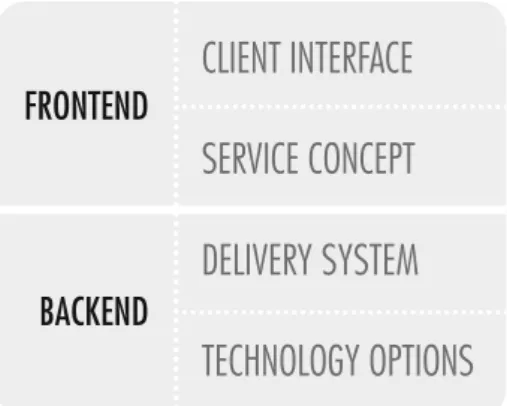
materiality in their conception of a layered modular architecture that covers four layers – device, network, service, and contents. The physical layers – device and network – encompass the basic technical architecture needed to house and transmit digitized data. Both layers may be subdivided into hardware that establishes the physical affordances, and programmed instructions that determine the operational logic. The digital layers – service and content – concern the higher-level software and data that may be created and manipulated by user(s). Although both layers represent digitized information, it is important to maintain a conceptual separation between the two. Services describe the algorithms and processes that are applied to manipulate data whereas contents represent the data itself. The distinction is tantamount to the difference between a word processor and the document it manipulates. While the layered modular architecture provides us with a basic ontology for digital technology, further elaboration is needed in order to highlight its application in relation to service-orientation. With that in mind, we draw upon research by Chesbrough (2011) and den Hertog (2000) that explicitly addresses the role and potential of technology in relation to the provision, customization, and innovation of service. Chesbrough (2011) outlines how service-efficiency can be enhanced by dividing the supply-side into two halves: backend and frontend. The backendof IT-enabled service provision essentially forms the infrastructure nee-ded to form, support, and deliver services. It is built upon standardized internal processes that enable economies of scale through effective management of resources. The frontendis intended to be adaptable in response to diverse environments and industries. The idea is to provide the requisite flexibility needed to cope with rapid change and customer preferences.
Den Hertog (2000) outlines three dimensions of service innovation – client interface, service concept, and delivery system – and how they may be affected by a fourth dimension – technology options. The technology options entail the basic architecture that enables or supports the performance of services. Although digital technologies are not the only tools used to support services, they are espe-cially pervasive given the central importance of informa-tion management in service provision. Thedelivery system describes the linkage between provider and customer, and how that impacts service design. For instance, a customer may interact with a bank by using e-commerce or by talking to a cashier. Both delivery systems are viable, but offer different opportunities. Theservice conceptdescribes the nature and function of a service. The service concept may be directly enabled by the delivery system (e.g., e-commerce permits 24-h banking), or largely unrelated to the other service dimensions. The client interface repre-sents the manner in which the service provider and
customer interact. It is generally designed to highlight a sense of purpose or value in relation to specific customers or clientele.
Figure1 integrates the works of Yoo et al. (2010), Chesbrough (2011) and den Hertog (2000) into a work for a service-oriented digital platform. The frame-work places the service-oriented concepts outlined by Chesbrough and den Hertog into a stratified structure borrowed from the layered modular architecture of digital technology. The framework is also intended to provide a basis for synthesizing the concept of ‘service’ as it appears in service literature, i.e., exchange between actors (Lusch and Vargo 2014), and IS-literature, i.e., algorithms and processes used to manipulate digitized data (Barrett et al.
2015).
4 Research Design
The purpose of this study is to apply a service-oriented perspective to digital platform establishment and ascertain how the material properties of digital technology and a situated notion of value interact. The study employs a qualitative approach which is motivated by the multiplicity of business environments addressed and the relative sig-nificance of technology in each respective context. A qualitative approach permits informed answers, enabling researchers ‘‘in-depth studies […] in plain and everyday terms’’ (Yin2011, p. 6). The study employs a single case study (Yin 2011) centered on a firm’s gradual progress from supplier of digital products for communications to digital platform for services complemented by a small ecosystem of 3rd party service providers. The study is intended to develop theory regarding a particular phe-nomenon which is in keeping with case studies’ potential for generalizability (Lee and Baskerville2003).
4.1 Data Collection
As is typical in case studies, data was collected through a combination of methods (Yin 2011). The bulk of the dataset was derived through 19 interviews with informants that represent four distinct stakeholder perspectives – platform provider, customer, partner, and systems inte-grator (Table 1). Distributing interviews over several stakeholders and professional roles serves to provide a rich understanding of the case and also minimize informant bias (Eisenhardt and Graebner2007). In addition to interviews, the author was further sensitized to the research context via attendance in meetings and workshops where different companies (including DigitalCo) attended and discussed their business model and strategic challenges. Data col-lection was conducted between 2011 and 2014. Fieldwork was conducted using iterative sampling (Miles et al.2014) whereby each activity serves to collect empirical material as well as inform subsequent data gathering as the researcher gains deeper understanding of the case and its context.
Interviews lasted between 45 and 70 min. With the exception of the integrator, interviews were conducted at the offices of the respective firm. The first interview with the integrator was held at the offices of the author, and the second at the offices of a business partner of the integrator. All interviews were recorded and transcribed, amounting to 212 pages of material (single space, font size 11). Inter-views followed a semi-structured approach (Creswell
2007) in the interest of mitigating the inherent dichotomy of interviews, i.e., the interviewer guides the conversation even though the interviewee possesses the sought infor-mation (Kvale and Brinkmann2009). It also permitted the flexibility needed to address informants with different backgrounds and expertise, yet allow similar themes to permeate all interviews. Some questions were posed in all interviews, e.g., regarding the overall nature of the firm, business challenges, and development over the past few years, whereas others were closely related to the different roles and perspectives held by informants.
4.2 Data Analysis
The analysis of the empirical material was conducted via a qualitative research process (Eisenhardt1989; Miles et al.
2014) whereby the author collects and interprets data (Walsham 2006) against a given theoretical framework. Prior to coding, category codes were created to delineate between actor types – platform provider, customer, inte-grator, and partner (i.e., 3rd party developer) serving to identify the origin of each coded datum.
The development of the final coding-scheme was con-ducted in three phases. First, the theoretical framework
served to generate an initial set of 19 theory-driven codes. Second, the initial codes were then applied to a sample of the empirical material in an interpretive approach to sen-sitize the researcher to real-world expressions of theoretical constructs. The sample consisted of one interview from each of the three main actor types – platform provider, customer, and partner – in order to balance stakeholder perspectives. The procedure also generated 21 additional codes that served to refine the coding scheme. Third, the codes were tested for inter-coder reliability where the author and a senior colleague each applied the codes to a sample of the empirical material. After a process of thor-oughly discussing the coding scheme and adding another 10 codes to further enhance clarity, we arrived at an inter-coder agreement of 93 % which is well within the acceptable range of inter-coder reliability (Miles et al.
2014). The final result was a list of 50 codes (see the appendix; available online via http://link.springer.com) related to the theoretical framework and another 4 to des-ignate stakeholder type. The full list of 54 codes was then applied to the empirical data using Atlas.ti. MS Excel was used for some of the additional tasks related to presentation and overview of codes.
5 Case Study
Based in northern Europe, DigitalCo was founded in 2000 and as of 2015 houses approximately 30 employees. Over the course of 15 years, the company has developed a plat-form, DigitalCoMobile, which provides an interface for
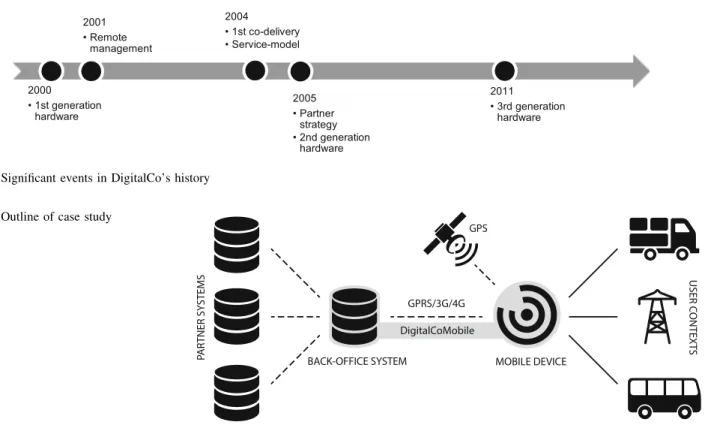
digitized business-to-business services. Development has followed parallel tracks of improving the platform itself as well as its appeal and applicability. Figure2summarizes the significant events in the company’s evolution. In addition to services developed by DigitalCo themselves, other suppliers are also able to deliver their services via the platform fol-lowing certification and testing. DigitalCo typically forms partnerships with external providers that utilize their plat-form, assuming responsibility for the link between customer and provider in return for a monthly fee. While partner firms are typically small organizations, customers range from small firms to large international enterprises. The combi-nation of reliable technology and a partnering strategy has made it possible for DigitalCo to benefit from the innovative services provided by third-party developers and leverage their platform in several industries, most notably logistics and public transportation. DigitalCo’s success is reflected in their turn-over which has increased from €1.25 million in 2006 to over€10 million in 2014.
The scope and functionality of DigitalCoMobile is focused on machine-to-machine (M2M) communication in which products and devices are connected and exchange information directly rather than via human input. At its most basic level, DigitalCoMobile may be described as a platform that links a user system to back-office sys-tem(s) and enables the provision of information-based services from several different providers. The platform is comprised of two components: A mobile device in the form of a router that is physically installed in the user context and provides a secure link for communication, and a back-office system where the bulk of information processing
Table 1 Interviews included in
study Firm Business area Informant position
Platform provider Communications Chief executive officer (2 interviews) Chief operating officer
Business area manager Area sales manager
Research and development manager Integrator Systems integration Sales manager
Sales manager?consultant Partner A Geographic information systems Developer
Sales manager Partner B Information display Chief executive officer Partner C Electronic systems design Systems developer
Partner D Fuel-efficient driving (‘‘Ecodriving’’) Research and development manager Customer A Logistics (small firm) Administrative manager
Customer B Logistics (medium-sized firm) Human resources administrator Customer C Logistics (large firm) Transport manager
Customer D Public transportation Head of systems administration Head of strategic systems Product manager
takes place. The back-office system also serves as a hub for routing data to or from partners who host their own back-office systems where their respective services are hosted. An overview is provided in Fig.3.
In some cases, the purpose of DigitalCoMobile is simply to relay data that is already generated in the localized context. For instance, modern trucks and buses already have sophisticated on-board computer systems that govern engine performance and supervise emissions. In other cases, DigitalCoMobile may augment the ability to auto-mate data-collection in a user context. For example, GPS-coordinates can show where a supply truck is located and sensors that continuously monitor cargo temperature can be used to guarantee quality of service.
6 Results
In keeping with common practice in case studies (Eisen-hardt and Graebner 2007), findings are presented as a narrative interspersed with representative quotations. The theoretical framework is used to structure the results, using technology options, delivery system, service concept, and client interface as sub-headings.
6.1 Technology Options
When it was first brought to market in 2000, Digi-talCoMobile consisted only of the mobile device and it was
marketed as a niche product for secure wireless commu-nications in tough conditions, e.g., exposure to harsh weather or vibrations produced by heavy machinery. Whereas the back-office systems that house services have been incrementally upgraded and updated over the years, the architecture of the mobile device has evolved via two major revisions – effectively differentiating between three distinct generations. The first generation (2000-2004) may be considered a product through and through where the business model revolved around selling and shipping as much hardware (i.e., the mobile device) as possible. At the time, the integration of different components and the resilience of the end product marked a novelty that attracted customers with specific requirements.
‘‘…if you look back at the first generation…the rea-son that it looked the way it did is because of the tools and technology that were available at the time. We didn’t have 3G-networks and the like. It was limited by the technical possibilities available back then. […] You could say that it was largely a prototype or proof-of-concept that everything could work together’’.
- DigitalCo, Chief Operations Officer
Although a versatile device, the first generation was built around a highly limited architecture that did not permit any significant amendments or innovations. Digi-talCo undertook the first major hardware revision in 2005 in order to accommodate new components that had become 2000 • 1st generation hardware 2001 • Remote management 2004 • 1st co-delivery • Service-model 2005 • Partner strategy • 2nd generation hardware 2011 • 3rd generation hardware
Fig. 2 Significant events in DigitalCo’s history
GPRS/3G/4G DigitalCoMobile
PA
RTNER SY
STEMS
BACK-OFFICE SYSTEM MOBILE DEVICE GPS
USER C
O
NTEX
TS
more capable as well as affordable in the years following the launch of the original product. The 2nd generation (2005–2011) made for a more capable device with a flex-ible architecture comprised of standardized components that could be incrementally replaced without redesigning the entire technical architecture. However, while compo-nents could be replaced, newer and more powerful com-ponents gradually proved difficult to run in parallel as the architecture did not scale well in terms of performance. Furthermore, the years following 2005 saw a figurative explosion in the development of mobile devices (e.g., smartphones) in the consumer market. As a consequence, components grew cheaper and more capable at an even faster rate while consumers grew more accustomed to working with digital devices and having services provided in a digital format. With possibilities as well as user acceptance for digital services both showing a positive trend, the 2nd generation also saw DigitalCo working more explicitly with developing and marketing services them-selves. Eventually, the combination of components demanding more processing-power and customers demanding more and better service gradually reached a point where the existing hardware simply could not accommodate the workload required by certain new ser-vices – or combinations of serser-vices. The 3rd generation (2011-present) furnished the mobile device with an archi-tecture that is both architecturally flexible and scalable in terms of performance. It also marks a significant step in step in pushing the platform as the market offering. In doing so, the mobile device acts as a service interface rather than traditional product for retail.
For practical (and financial) reasons, DigitalCo has strived to market a single mobile device that has been periodically redesigned. Although this approach permits parsimony with regards to logistics and warehousing, it also requires careful consideration with regards to what features to include. Furthermore, DigitalCo still has first- and second generation devices still in active use. Although technically obsolete and not able to accommodate the full range of current services, they are still fully functional and sufficient to satisfy the needs of many small and medium-sized cus-tomers that are content with the provision of one or two services essential to their needs. One partner that provides fuel-efficient driving (‘ecodriving’) services via Digi-talCoMobile summarizes the level of interest in hardware and technical infrastructure expressed by their customers.
‘‘They really don’t care at all. Most of them… be-cause they just want ecodriving’’.
- Partner D, Research and Development Manager On the other hand, large customers may require not only more services and peripherals, but may also place quite specific requirements on the future potential of the
platform. A customer active in public transportation explains how the transition from the second to third gen-eration mobile device changed the appeal of DigitalCoMobile.
‘‘Then in the spring of 2011 [DigitalCo] offered a significantly upgraded hardware-specification. […] And at that point we saw that all other qualities were really in place. Robustness, simplicity, open platform based on Linux and open source, and all that stuff we were looking for was already there. And the hard-ware-specification was where we wanted it. All of the pieces were beginning to fall into place’’.
- Customer D, Head of Systems Administration Developing and maintaining a technical architecture that satisfies general requirements of small customers and also specific requirements of large customers is a constant tug-of-war between the engineers, designers, and managers at DigitalCo. The ability to accommodate both ends of the spectrum requires a careful balancing act where features are constantly weighed against cost and business applicability. 6.2 Delivery System
All services provided by DigitalCo or one of its partners are based around the ability to gather data from a localized context (i.e., the customer) and subsequently return it to the customer in a more informative fashion. As the platform has evolved, the function of the platform device has gradually transformed into the role of an interface between customer and service provider. Much like its technical architecture, the communicative abilities of the platform device have evolved considerably over the years as better and more affordable components become available. The transition from 2G to 3G and now 4G networks has also had a significant impact as network availability and data transfer rates are both essential for DigitalCoMobile’s ability to perform as expected. While a constantly evolving technological landscape provides new opportunities, it also poses challenges related to design choices and keeping abreast of current trends. It is not simply a matter of blindly adopting every novelty that becomes available, but rather to find a delicate balance between maintaining a platform that is technically up-to-date yet financially tolerable for a wide range of customers. At times, the tension can be quite strenuous for a relatively small actor such as DigitalCo.
‘‘A major challenge in owning a platform like this […] is that we have the unique opportunity to con-duct a lot of development ourselves and raise it to a higher level. But at the same time, we have to aware of the world around us. What new processors are on the way? This GSM-module is about to become
obsolete – we need a replacement. We need [to uti-lize] 4G – are we backwards compatible with 2G? […] How does all of this affect our applications? The platform is our strength, but we also have to be very perceptive as to how these problems are handled by the world around us’’.
- DigitalCo, Research and Development Manager While the mobile device itself is standardized, the extent to which it is linked to the user context varies greatly. The ability to physically integrate DigitalCoMobile into user systems is closely related to its role as a dependable interface for services. However, physical integration is also a driver of costs since there is always manual labor involved where installation is concerned. While integra-tions that are repeated with some frequency can be stan-dardized, the realities of integrating systems that were never designed to be integrated makes a ‘‘one size fits all’’ mentality difficult to apply in practice. Much like the design of the platform device itself, the decision on whe-ther to undertake certain integrations is left to a cost-benefit analysis. Some customers have very basic requirements, e.g., a single service, where DigitalCoMobile amounts to little more than an off-the-shelf delivery mechanism that is only superficially connected to localized systems or machinery. The other extreme position is held by cus-tomers that have very specific requirements pertaining to different services, how DigitalCoMobile should interact with localized equipment and how services should be adapted to their specific needs.
‘‘For instance, one particular solution is intended to work with a truck – we’ve done that before. But it’s pulling a salt spreader from the 1980’s. We need [to pick up] signals from that as well, so we’re back to customization again. […] That’s the way it is with our customers – machinery from the 80’s meets tablet [computers] from last year’’.
- DigitalCo, Business Area Manager
Although the issue of providing a reliable linkage between partner and customer is largely a matter of tech-nical proficiency, there is also the matter of managing the relationship between partners. As the path from customer to service provider entails several distinct steps – customer system, platform device, provider system, interaction between different provider systems et cetera – it can be difficult to share responsibility when problems arise. In an effort to hide much of the complexity from customers, DigitalCo has extended their role of platform provider to include first-line support for all issues. However, the act of black-boxing complexity to customers also carries with it a diminished level of insight for partners who are often used to working with direct access to customer systems. One
systems developer expresses the sense of unease that can present itself when working with a platform.
‘‘We were given an explicit interface to work with. A bigger question was that we really don’t know what hap-pens after data passes into [DigitalCoMobile]. We collect sensor-data, we transmit it to [DigitalCoMobile]…but then we don’t know. So during development [of a new service], we’ve had to rely on [DigitalCo’s] developers […] to know if everything is working’’.
- Partner C, Systems Developer
Finding a suitable level of access and insight for partners has been an ongoing issue for DigitalCo over the past 15 years – and it has yet to be fully resolved. In an effort to promote efficiency, the ambition is to create a standardized application programming interface that can be universally applied for all partners. However, the wide range of ser-vices and areas of applications are too diverse to permit that level of simplicity. Not only can individual services vary quite substantially, but there are also combinations of different services to consider as well as interactions with localized user systems that can range from modern to vir-tually archaic. Furthermore, it is not uncommon for part-ners to carry considerably more weight than DigitalCo in certain industries. As such, it is possible for partners to leverage their influence with customers to gain better access to the platform as well as the developers and sup-port-staff at DigitalCo.
6.3 Service Concept
Although DigitalCo’s core competency may succinctly be described as getting data from point A to point B, they were initially not able to utilize this skill for their own benefit. Originally, DigitalCoMobile did not permit main-tenance to be performed remotely, meaning that even minor adjustments required direct physical access. Hence, the first ‘‘service’’ applied to DigitalCoMobile in 2001 was the ability to perform remote maintenance and thus econ-omise on post-delivery maintenance. While this first ser-vice did not create value for anyone but DigitalCo, it gradually dawned that the same service could be applied for customers as well. The inaugural customer-focused service offering was a rudimentary form of cloud services which was marketed as ‘managed services’. Although DigitalCo had the technical knowledge to deliver these services, they were however no major success when first developed in 2003. The idea of working with digital ser-vices did however not gain widespread appeal until several years later when industry giants had paved the way.
‘‘What’s happening now…I mean, we’ve been working with this business model since 2004. The driver now is [Microsoft] Office 365. It has suddenly
become a legitimate way to do business. We’re see-ing actors that would never have bought our cloud-services suddenly asking for them’’.
- DigitalCo, Chief Executive Officer
In addition to a hesitant market, DigitalCo lacked the internal resources to properly exploit their technical profi-ciency for service provision. They simply did not possess the requisite know-how to develop attractive services that convey a clear sense of value to customers. Then in 2004, they were able to land a major contract to supply a city-wide traffic information system together with another firm (‘‘partner B’’ in this study). Neither company had the requisite expertise to handle the assignment themselves, but DigitalCo’s proficiency in secure communication cou-pled with the collaborating firm’s expertise in information display systems meant that they could present a more compelling offer than the competition. In the wake of this success, the following year saw DigitalCo adopt an ecosystem strategy whereby they started to actively seek out partner-firms that could benefit from a robust platform for communications. Partners are typically small firms with deep understanding of certain types of services or appli-cations, e.g., fuel-efficient driving or geographic informa-tion systems. The key to partnering in this manner is to ensure mutual advantage. Partners are adept at creating value-added services based upon their ability to extract useful information from the data generated in the user context. The physical linkage and transmission of data from customer to back-office system is usually not a part of their core competence and merely a source of added complexity. A partnership with DigitalCo essentially ‘‘black-boxes’’ this issue which permits the partner to focus what is being transmitted rather than how it is transmitted.
‘‘A lot of people have developed fine applications. The experience has however been one of poor qual-ity. It has often been the case that it is not the application that is poor, but rather the communication’’.
- DigitalCo, Area Sales Manager
The addition of new services in the portfolio does however require a certain amount of integration and testing in order to ensure quality and reliability – a process that usually takes several months as (software) modifications are made to DigitalCoMobile as well as the partner service. 6.4 Client Interface
Some services are directly applicable across several industries and areas of application, e.g., a service that analyses fuel-consumption in a bus may be applied in a truck as well with little or no modification. In other
instances, the context may be very different, but the operational logic and sophisticated algorithms that form the back-bone of a service may be adapted to suit an entirely new purpose and range of applications. It is not uncommon for new solutions to emerge with a large degree of spon-taneity, with a different stakeholders recognizing new value in an existing service. A customer active in public transportation explains how a service originally developed for ambulance drivers can be modified be reused.
‘‘A good example that we’ve so far only dabbled with is recording what’s going on in front of the vehicle. Outside the vehicle. That is something that [Digi-talCo] apparently developed in cooperation with emergency services. […] It’s intended as an educa-tional tool for the [ambulance] driver. We then thought that our own [bus] drivers need to evaluate their own driving, but also to record bus lines so that others can learn how the routes are drawn. The ser-vice was already there even if it was designed for a different use. So it’s the same technology’’.
- Customer D, Head of Systems Administration Working with a platform for service provision rather than product retail has enabled DigitalCo to grow and evolve – but it has not been without challenge. For many years, encounters between DigitalCo and their customers were typically conducted by engineers who were solely interested in hammering out technical specifications and arriving at a mutually agreeable price per unit. A transition to service retail entails dealing with a customer that is interested in functionality and concrete benefits rather than the underlying infrastructure. As the customer is repre-sented by project managers and administrators rather than engineers, it is necessary to engage based on real-world issues and benefits rather than technical details. Conse-quently, working with customers often entails clarifying ill-defined problems, deconstructing it into its parts, identi-fying any causal factors, and then applying (or developing) services that can alleviate the problem. It can be chal-lenging to establish a rapport and outline the connection between platform, services, and their potential to solve customer problems. It is however necessary to engage with customers on their terms in order to articulate the benefits of both platform and services.
‘‘…nobody is really in the market for a platform. What they want is a solution. […] If you then look at public transportation – the bus ecosystem – there we’ve learnt how the industry works in the Nordic countries in order to supply the functionality that they actually want from this platform. In doing so it has suddenly turned into a solution’’.
The significance of understanding problems and how to solve them has enabled the proliferation of DigitalCoMo-bile into industries that have traditionally been quite slow to adopt digital technologies. A manager at a small logis-tics firm expresses how important it is to provide tangible benefits.
‘‘Finances are the big issue. We save money by using [ecodriving]. If we hadn’t adopted it, we’d probably be in big trouble by now. […] It’s a matter of tens of thousands of euro per year’’.
- Customer A, Administrative Manager
The importance of rebranding technologies and ser-vices is paramount to DigitalCo as customers cover a wide range of industries. In addition to logistics and public transportation, they also have customers in private security, forestry equipment, and building management. One of the most significant challenges facing DigitalCo as they move forward is to manage the inherent com-plexity of formulating increasingly diversified and specific market offerings that conform to different industries. Experience has shown that a service devel-oped for one industry can be redesigned to fit a com-pletely different situation. That potential is however contingent on the ability to learn the inner workings and priorities of each respective industry.
6.5 Summary of Results
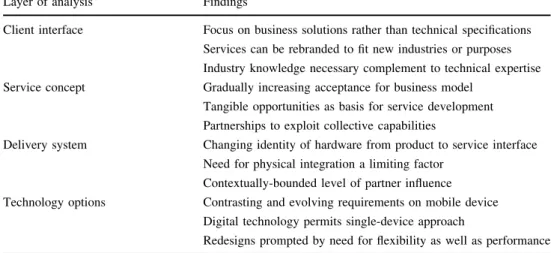
The study of DigitalCo and their development over the course of 15 years depicts a journey that is as much about deliberate strategy as it is responding to a perpetually evolving landscape of opportunities and limitations. Table2 provides a brief summary and overview of the findings from the study of DigitalCo.
7 Discussion
The purpose of this study is to apply a service-oriented perspective to digital platform establishment and ascertain how the material properties of digital technology and a situated notion of value interact. We have conducted a single-case study of a digital platform for services in an effort to answer our research question: What is a core in a digital platform, and how may we approach coring in practice?
Based on extant platform literature, we can discern that the concept of platform establishment is not well-under-stood (Gawer and Cusumano 2013; Thomas et al. 2014). The notion of ‘coring’ establishes a general strategy, but offers no practical insights into how a core is identified. Furthermore, using ‘‘core’’ as a metaphor implies that the foundation of a platform is essentiallyonespecific element. 7.1 What is a ‘Digital Core’?
Inspired by the recent trend towards service-orientation in IS research (Barrett et al. 2015; Lusch and Nambisan
2015) which highlights the situated notion of value, we develop a theoretical framework for digital platforms based on research by den Hertog (2000), Yoo et al. (2010), and Chesbrough (2011). The framework distin-guishes four layers of a digital platform: technology options, delivery system, service concept, and client interface. The technology options outline the basic tech-nical architecture that makes it possible to create and manipulate digital content (in our case services). The delivery system ensures connectivity between localized (customer) context and remote (service provider) context. The service concept expresses the operational logic applied to manipulate and integrate different data streams.
Table 2 Summary of findings Layer of analysis Findings
Client interface Focus on business solutions rather than technical specifications Services can be rebranded to fit new industries or purposes Industry knowledge necessary complement to technical expertise Service concept Gradually increasing acceptance for business model
Tangible opportunities as basis for service development Partnerships to exploit collective capabilities
Delivery system Changing identity of hardware from product to service interface Need for physical integration a limiting factor
Contextually-bounded level of partner influence Technology options Contrasting and evolving requirements on mobile device
Digital technology permits single-device approach
Finally, the client interface communicates the utility and value of services to the customer. Furthermore, a platform may also be delineated into a backend that enables service delivery and repetition, and a frontend that is flexible and easily customizable.
Although the framework maintains a descriptive dis-tinction between layers, we do not suggest that these can (or should) be considered in isolation from one another. Our ability to create, access, and manipulate digitized data is dependent upon the affordances of physical artefacts. At the same time, the functionality of physical artefacts is determined by instructions provided in the form of digi-tized data. While platform research typically delineates between a stable core and variable modules (Gawer2014), physical and digital materiality is entangled in digital platforms which makes it difficult to apply clear-cut defi-nitions of stable and variable. Our case study illustrates that while the overall platform is stable in some sense, it is difficult to pin down any specific source of stability. At first glance, it may appear that the backend which enables a variety of services may be considered the platform core. However, with back-office systems constantly revised, several generations of mobile devices in concurrent use, and different types of integration into localized user sys-tems, it is difficult to characterize the backend as stable over time or invariant across applications. The frontend, on the other hand, may be considered stable in-sofar as algorithms and operational logics that are uni-formly applied across multiple services, but it is also subject to user customization as well as reliant on a tech-nical infrastructure for execution. Hence, rather than a physical or digital structure, the study of DigitalCo sug-gests that the notion of a digital platform core may be better explained as a capability to deliver an invariant outcome (i.e., a service) despite variable technical baseli-nes and application contexts.
While the material properties of digital technology are a source of complexity, they also enable significant oppor-tunities for research. Extant literature (Thomas et al.2014) acknowledges that platforms can serve distinct leverage logics and thus provide different benefits for adopters. Furthermore, research on technology-based business strategies utilizes the notion of design value (Woodard et al. 2013) to describe how artefact design can limit or enable options for strategic action. The combination of two kinds of materiality provides a complementary perspective on both streams of research. The highly modular nature of digitized data and physical hardware (Yoo et al. 2010) implies that ‘technology’ is not subject to a single design hierarchy, but rather to two separate hierarchies. The two hierarchies can provide entirely distinctive options for strategic action and thus pursue different leverage logics. Our case demonstrates how DigitalCo has pursued
standardization and a one-size-fits-all approach in their design of the backend aspects of the platform whilst per-mitting significant variety and customization in the fron-tend – similar to the approach traditionally applied by service providers (Chesbrough 2011). Hence, we see that further exploration of digital technology in relation to platforms as well as service provision may provide valu-able insights related to the nature of a platform core. 7.2 Platform Coring in Practice
Extant platform research (e.g., Gawer and Cusumano2013; Thomas et al.2014) typically describes platform coring as a deliberate strategy of one party to leverage a solution in order to solicit support from potential adopters. It is questionable to what extent one-sided strategizing is viable for industry platforms (Gawer 2009) or multi-sided plat-forms (Hagiu2014) that incorporate multiple stakeholders. Hence, the process of platform coring should be treated as a form of co-creation by multiple parties rather than as unilateral strategic actions by a platform provider.
Insights from business ecosystems (Ceccagnoli et al.
2012; Pagani 2013; Sarker et al. 2012) suggest that instances of co-creation between different firms are tanta-mount to finding a shared perspective of what constitutes value. Applied to the study of DigitalCoMobile, value creation is essentially a tri-party process of negotiation between DigitalCo, their customers, and their partners. Hence, a coring process is not about the (prospective) platform provider offering value per se, but rather offering value propositions(Lusch and Nambisan2015; Lusch and Vargo2014) that are accepted or rejected by recipients. An overview of value propositions that influence a digital platform is provided in Fig. 4.
Based on the layered ontology of digital technology (Yoo et al.2010) as well as the case study of DigitalCo, we surmise that the coring of a digital platform may be char-acterized as the result of multidirectional, multidimen-sional, and intra-organizational value-propositions. Value propositions are multidirectional insofar as platform pro-viders need to attract at least two distinct stakeholder types – customer and complementor (Evans2009). Adopters did not spontaneously flock to DigitalCoMobile but were rather courted by DigitalCo who over time has learned to refine their sales pitch by emphasizing the benefits sought by different parties. However, just as DigitalCo offers value propositions in the form of different possibilities enabled by their platform, it is equally important to consider influences from external sources. Each integration of a partner service and each integration of DigitalCoMobile into a user context carries a cost and occupies precious organizational resources. Every new technology or stan-dard carries with it new design options just as every
industry is imbued with different rules or principles that one must learn to do business. These external influences should be treated as implicit value propositions to be carefully considered based on cost-benefit and strategic ramifications.
Value propositions that influence platform coring are also multidimensional as digital platforms are not homo-geneous structures, but rather heterohomo-geneous mixtures of hardware and software that possess different properties and adhere to different life-cycles. Although value proposi-tion(s) may well be formulated to emphasize a specific quality, platforms are sufficiently complex to permit dif-ferent actors to pick up on difdif-ferent values depending on role, interests, and know-how. For some adopters, a digital platform may be effectively invisible as they are merely concerned with the end results, i.e., access to service. For others, the technical architecture is highly relevant as an enabler of centralized efficiency coupled with localized flexibility (Monteiro and Rolland 2012). The study of DigitalCo illustrates both extremes with some customers being totally unconcerned about the platform as long as the service works as expected. After all, business value is provided by service and conveyed via the client interface – not the infrastructure. For other customers, the physical hardware is sufficiently important to determine adoption of the platform. The latter is clearly demonstrated by the customer active in public transportation which considers DigitalCoMobile a part of long-term strategic development.
While it is obvious that external stakeholders, i.e., complementors and customers, may see things differently, one must also consider that a platform provider like any other firm is a heterogeneous organization that houses different perspectives.
Hence, we should also consider how value propositions may beintra-organizationalin that opinions and priorities differ even within a firm. While design decisions that affect platform development constitute conscious strategic moves (Woodard et al. 2013), they are still based on situated assessments of value that are determined by time, context, and professional role. For instance, DigitalCoMobile did not permit remote maintenance when it was first designed in 2000 as this did not bring significant value from an engineering-perspective. However, the business-side of the
organization soon saw considerable value in the form of significantly reduced costs for post-delivery maintenance. It can be argued that the development from Digi-talCoMobile being a retail product to representing a plat-form for service has followed this basic pattern of ‘‘proposition-based’’ interaction between frontend and backend. Engineers value capable hardware as it yields better functionality, whereas managers see value in keeping it simple to be able to offer it at lower prices. Conversely, managers see value in inviting many partners as it will promote the overall appeal of the platform, but engineers see value in fewer partners in order to simplify service integration. Finding a suitable middle-road is essential for mass-market appeal and platform integrity.
This study contributes to our understanding of platform coring in two ways. First, it demonstrates that a digital platform is indeed not a one-dimensional construct that serves any single purpose, but rather a complex, layered artefact. Identification of a specific core is challenging as different stakeholders may have diverse priorities and views on benefit and value. The rapid development of digital technology makes coring an iterative process rather than an isolated occurrence, with new options and oppor-tunities forcing constant re-evaluation of what the core is – and how it creates value for different actors. Hence, for long-term strategizing, it is more appropriate to consider platform coring as a verb than platform core as a noun.
Second, rather than assume that complementors and customers are static groups of stakeholders (Gawer2014), we believe that the concept of value propositions (Lusch and Vargo2014) is useful to address dynamic, multi-party processes of platform coring. As it is the relative influence and success of these value propositions that determine the nature of a platform, we may surmise that the evolution of a platform is as much an emergent process of balancing situated perceptions of value as it is a deliberate, long-term strategy.
7.3 Limitations and Future Research
The present study depicts a rather inclusive notion of digital platform that encompasses both physical and digital aspects. Other constructs, e.g., software platforms (Tiwana et al.2010), may provoke entirely different perspectives on
Fig. 4 Value propositions influencing a digital platform
what a core is and how coring may be approached. It would therefore be interesting to study the relevance and dynamics of value propositions in other instances of coring. Although the study illustrates the manner in which a contextualized sense of value impacts the development of a product into a platform, the case also hints at an opportu-nity to more fully explore the services that are provided. Despite the relative importance of the service-sector in developed countries, research on platforms for services is still in its infancy (Thomas et al. 2014). As digital tech-nology offers significant potential to provide a platform for services, explicit attention to this phenomenon is long overdue.
8 Conclusion
Extant platform literature highlights the ability to find and exploit a stable ‘core’ as a strategy for platform estab-lishment. However, the layered ontology of digital plat-forms makes it difficult to ascertain how a platform core is to be identified and how multiple stakeholders can agree on the beneficial aspects of said core. Based on a single-case study, we find that it is difficult to describe any particular aspect of a digital platform as stable over time. Rather, the platform core may perhaps be better described as a capa-bility to differentiate one’s offer based on specific situa-tions as well as provide anticipated outcomes despite unanticipated circumstances. Furthermore, platform coring is a process of tri-party co-creation whereby the different stakeholders negotiate a mutually agreeable definition of what constitutes value in that situation. This study con-tributes to our understanding of platform coring as an emergent process and suggests that the notion of value propositions shows promise in addressing situated per-ceptions of value among multiple stakeholders.
References
Bailey DE, Leonardi PM, Barley SR (2012) The lure of the virtual. Organ Sci 23(5):1485–1504
Barrett M, Davidson E, Prabhu J, Vargo SL (2015) Service innovation in the digital age: key contributions and future research. MIS Q 39(1):135–154
Blanchette JF (2011) A material history of bits. J Am Soc Inf Sci Technol 62(6):1042–1057
Ceccagnoli M, Forman C, Huang P, Wu DJ (2012) Cocreation of value in a platform ecosystem: the case of enterprise software. MIS Q 36(1):263–290
Chesbrough H (2011) Open services innovation: rethinking your business to grow and compete in a new era. Wiley, New York Creswell JW (2007) Qualitative inquiry and research design
-choosing among five approaches, 2nd edn. Sage, Thousand Oaks den Hertog P (2000) Knowledge-intensive business services as
co-producers of innovation. Int J Innov Manag 4(4):491–528
Eisenhardt KM (1989) Building theories from case study research. Acad Manag Rev 14(4):532–550
Eisenhardt KM, Graebner ME (2007) Theory building from cases: opportunities and challenges. Acad Manag J 50(1):25–32 Eisenmann T, Parker G, Van Alstyne MW (2009) Opening platforms:
how, when, and why? In: Gawer A (ed) Platforms, markets and innovation. Elgar, Cheltenham, pp 131–162
Evans DS (2009) How catalysts ignite: the economics of platform-based start-ups. In: Gawer A (ed) Platforms, markets and innovation. Elgar, Cheltenham, pp 99–128
Gawer A (2009) Platform dynamics and strategies: from products to services. In: Gawer A (ed) Platforms, markets and innovation. Elgar, Cheltenham, pp 45–76
Gawer A (2014) Bridging different perspectives on technological platforms: toward an integrative framework. Res Policy 43(7):1239–1249
Gawer A, Cusumano MA (2014) Industry platforms and ecosystem innovation. J Prod Innov Manag 31(3):417–433
Ghazawneh A, Henfridsson O (2013) Balancing platform control and external contribution in third-party development: the boundary resources model. Inf Syst J 23(1):173–192
Greenstein S (2009) Open platform development and the commercial Internet. In: Gawer A (ed) Platforms, markets and innovation. Elgar, Cheltenham, pp 45–76
Hagiu A (2014) Strategic decisions for multisided platforms. MIT Sloan Manag Rev 55(2):71–80
Iansiti M, Levien R (2004) The keystone advantage: what the new dynamics of business ecosystems mean for strategy, innovation and sustainability. Harv Bus School Press, Boston
Kallinikos J, Aaltonen A, Marton A (2013) The ambivalent ontology of digital artifacts. MIS Q 37(2):357–370
Kvale S, Brinkmann S (2009) Interviews: learning the craft of qualitative research interviewing, 2nd edn. Sage, Thousand Oaks Lee AS, Baskerville RL (2003) Generalizing generalizability in
information systems research. Inf Syst Res 14(3):221–243 Leonardi PM (2010) Digital materiality? How artifacts without
matter, matter. First Monday 15(6)
Li YR (2009) The technological roadmap of Cisco’s business ecosystem. Technovation 29(5):379–386
Lin L, Daim TU (2009) Platform strategy framework for internet-based service development: case of eBay. Int J Ser Technol Manag 11(4):334–354
Lusch RF, Nambisan S (2015) Service innovation: a service-dominant logic perspective. MIS Q 39(1):155–176
Lusch RF, Vargo SL (2014) Service-dominant logic: premises, perspectives, possibilities. Cambridge University Press, Cambridge Miles MB, Huberman AM, Saldan˜a J (2014) Qualitative data analysis: a methods sourcebook, 3rd edn. Sage, Thousand Oaks Monteiro E, Rolland KH (2012) Trans-situated use of integrated
information systems. Eur J Inf Syst 21(6):608–620
Nambisan S (2013) Information technology and product/service innovation: a brief assessment and some suggestions for future research. J Assoc Inf Syst 14(4):215–226
Pagani M (2013) Digital business strategy and value creation: framing the dynamic cycle of control points. MIS Q 37(2):617–632 Sarker S, Sarker S, Sahaym A, Bjørn-Andersen N (2012) Exploring
value cocreation in relationships between an ERP vendor and its partners: a revelatory case study. MIS Q 36(1):317–338 Suarez F, Cusumano M (2009) The role of services in platform
markets. In: Gawer A (ed) Platforms, markets and innovation. Elgar, Cheltenham, pp 77–98
Thomas LD, Autio E, Gann DM (2014) Architectural leverage: putting platforms in context. Acad Manag Perspect 28(2):198–219
Tiwana A, Konsynski B, Bush AA (2010) Research commentary – platform evolution: coevolution of platform architecture,
governance, and environmental dynamics. Inf Syst Res 21(4):675–687
Walsham G (2006) Doing interpretative research. Eur J Inf Syst 15(3):320–330
Wareham J, Fox PB, Cano Giner JL (2014) Technology ecosystem governance. Organ Sci 25(4):1195–1215
Wheelwright SC, Clark KB (1992) Creating project plans to focus product development. Harv Bus Rev 70(2):67–83
Woodard CJ, Ramasubbu N, Tschang FT, Sambamurthy V (2013) Design capital and design moves: the logic of digital business strategy. MIS Q 37(2):537–564
Yin RK (2011) Qualitative research from start to finish. Guilford, London
Yoo Y, Henfridsson O, Lyytinen K (2010) Research commentary – the new organizing logic of digital innovation: an agenda for information systems research. Inf Syst Res 21(4):724–735 Yoo Y, Boland RJ, Lyytinen K, Majchrzak A (2012) Organizing
for innovation in the digitized world. Organ Sci 23(5):1398–1408