www.ssoar.info
Digital Platforms and Digital Inequality - An
Analysis From Information Ethics Perspective
Levina, OlgaErstveröffentlichung / Primary Publication Konferenzbeitrag / conference paper
Empfohlene Zitierung / Suggested Citation:
Levina, O. (2019). Digital Platforms and Digital Inequality - An Analysis From Information Ethics Perspective. In Proceedings of the Weizenbaum Conference 2019 "Challenges of Digital Inequality - Digital Education, Digital Work, Digital Life" (pp. 1-4). Berlin https://doi.org/10.34669/wi.cp/2.4
Nutzungsbedingungen:
Dieser Text wird unter einer CC BY Lizenz (Namensnennung) zur Verfügung gestellt. Nähere Auskünfte zu den CC-Lizenzen finden Sie hier:
https://creativecommons.org/licenses/by/4.0/deed.de
Terms of use:
This document is made available under a CC BY Licence (Attribution). For more Information see:
DOI: 10.34669/wi.cp/2.4
PROCEEDINGS OF THE WEIZENBAUM CONFERENCE 2019 CHALLENGES OF DIGITAL INEQUALITY
DIGITAL EDUCATION | DIGITAL WORK | DIGITAL LIFE
DIGITAL PLATFORMS AND DIGITAL INEQUALITY- AN
ANALYSIS FROM INFORMATION ETHICS
PERSPECTIVE
Olga Levina
FZI Forschungszentrum Informatik Berlin, Germany
A
BSTRACTDigital platforms are information technology artifacts that erode established market structures by providing a digital interaction space for producers and consumers. Therefore, it is argued here that digital platforms inherently support digital divide. This potential, if not governed or made visible for the involved actors, can lead and is already leading to undesired societal and ethical consequences. To derive these insights, Information Systems (IS) perspective is enriched with the Information Ethics approach and terminology. This interdisciplinary view allows considering both the technical and the social side of the problem. The analysis of interactions and roles is performed using the four ethical issues identified by Mason as a general taxonomy of ethical concerns in IS context. The identified aspects offer insights on the potentials of digital platforms that fosters digital inequality. Power asym-metries between the digital platform and its users are identified, outlining their potential for manifes-tation of the digital divide.
K
EYWORDS1
I
NTRODUCTIONDigital platforms are increasingly present in the discussions in public media but also in Infor-mation Systems (IS) research (Reuver, Sørensen and Basole, 2018). Their influence is reaching beyond technical aspects to economic and social debates (Reuver, Sørensen and Basole, 2018). Thus, one of the challenges in platform research, is their complex and intertwined structure on technical but also social levels.
This research augments the platform research agenda by extending the question about the plat-form design with the focus on ethical implica-tions of the design decisions. To do so, the back-ground of Information Ethics (Floridi, 1999) is applied to analyze platform governance aspects using the four categories of ethical issues in In-formation Systems as described by (Mason, 1986). In order to effectively shape the digital artifacts and the digital society as a whole in a socially and ethically responsible way, it is cru-cial to have a clear understanding of their ethical implications. As a result, an overview of the po-tential ethical issues relevant for platform actors is provided. The identified aspects offer insights on the dominance potential of digital platforms for digital inequality. This result can be used to provide ethical platform governance creation for digital platforms that minimize the potential for digital inequality.
2
D
IGITALP
LATFORMS,
T
HEIRG
OVERNANCE ANDI
NFORMATIONE
THICSDigital platforms are often positioned as a digi-tal ecosystem, see e.g. (Tiwana, 2013; Schreieck, 2016). An ecosystem in the ecology context is defined as a dynamic complex of com-munities and their environment that interact with each other as a functional entity (Schulze, Beck and Müller-Hohenstein, 2005). In the digital context the other communities are: platform pro-vider, platform user as well as application and
data providers, i.e. content providers. These ele-ments are interacting towards the preservation and success of the platform that is measured by e.g. the frequency of platform visits (Bosch, 2009), the number of applications being hosted and used (Kim, Kim and Lee, 2010; Haile and Altmann, 2013) or the online traffic being gen-erated towards the platform (Evans and Gawer, 2016). As platforms are affected by network ef-fects, the success of a platform is determined by having enough participants on the development side to attract the customer side and vice versa. These stakeholder interests need to be aligned by governance (Wheelwright and Clark, 1992; Golding and Donaldson, 2009). Therefore, the governance of the platform is a crucial aspect of platform creation and successful operation. (Schreieck, 2016) divides the design and gov-ernance concepts of a platform ecosystem as: roles, pricing and revenue sharing; boundary re-sources; openness; control; technical design; competitive strategy; trust. In this paper, the ad-dition of the ethical dimension as a governance concept based on the information ethics ap-proach is suggested. To do so, the concepts from Information Ethics are applied to conduct the analysis and examine the results.
Information ethics is concerned with the moral-ity of the information society (Kuhlen 2004; Floridi 2015; Bendel 2016). As an operationali-zation of these principles, the analysis of inter-actions and roles on a digital platform is per-formed using the four ethical issues identified by (Mason, 1986) as relevant for developing and using IS as a general taxonomy of ethical con-cerns. These four dimensions for ethical vulner-ability of information are: privacy, accuracy, property and accessibility. It is argued here that the platform designers and providers are able to distribute their power along these dimensions to potentially diminish user influence on the plat-form interactions. Hence, power asymmetries between the digital platform and its users are identified, outlining their potential for manifes-tation of the digital divide.
3
E
THICALI
SSUESA
NDD
IGITALP
LATFORMG
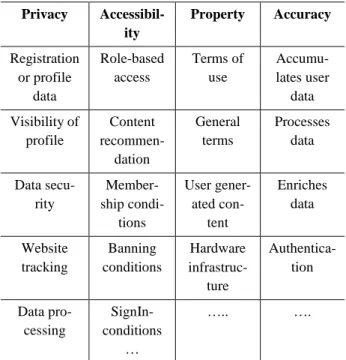
OVERNANCEDigital platforms bring together supply and de-mand via smart assessment mechanisms and cre-ate a trusted environment by facilitating transac-tions. This constellation favors the potentials for power asymmetries leading to ethical issues. Ta-ble 1 summarizes an excerpt from the potentials for exercising power asymmetries between the platform and the users or content providers. Platforms can decide unilaterally to deny a user access to the platform. This is the case at service platforms, e.g. Uber where the drivers need to have a specific rating to be able to participate (Cook, 2015). Applied technology is also a fac-tor in the access governance. By setting a tech-nological standards, e.g. APIs or specific soft-ware development language, the platform mani-fests an asymmetrical relationship on the level of accessibility for content providers (Royakkers, Timmer, Kool and van Est, 2018). Moreover, platforms tend to collect user data in the first step of the registration process. By de-fining the mandatory data fields, the platform defines the accessibility possibility for users. Via the profile settings, e.g., the platform exerts the power over privacy and accessibility issues for users. While the user is the source of the ac-curacy of his/her data, the platform decides about the verification rules. The user is partici-pating in the process of the disclosure of his/her data, partly due to the relatively new (regionally focused) legislation such as GDPR1. The most potent but also a rarely read (Obar and Oeldorf-Hirsch, 2016) document governing these issues, is the terms of use document, where the above-mentioned aspects such as mandatory profile data, content visibility, copy rights or technol-ogy standards for content presentation are gov-erned. Only recently the potential of its misuse became regulated by the legal efforts such as
1 GDPR: EU General Data Protection Regulation
GDPR and the digital copy right rules. Despite the appeals form different sources (Briegleb, 2018) this first regulations are still limited to the European region. Privacy Accessibil-ity Property Accuracy Registration or profile data Role-based access Terms of use Accumu-lates user data Visibility of profile Content recommen-dation General terms Processes data Data secu-rity Member-ship condi-tions User gener-ated con-tent Enriches data Website tracking Banning conditions Hardware infrastruc-ture Authentica-tion Data pro-cessing SignIn- conditions … ….. ….
Table 1. Potentials for power asymmetries on the platform along the IS ethical issues dimensions (excerpt).
The concerns mentioned above and in Table 1 show the ethical issues and their implementation via the platform. It is essential to understand these aspects when designing and participating in a successful platform.
4
C
ONCLUSIONThis short overview shows that from the user’s point of view informational autonomy, privacy and balance of power are at risk when the gov-ernance of the interactions on the digital form are left to their own devices or to the form provider. It was outlined that digital plat-forms can foster inequality in information pro-vision by controlling access for both content provider and user via access criteria to the plat-form, content visibility as well data collection and processing definitions. These arguments provide a basis for further discussion of the power asymmetry potentials between the user
and the platform as well as on digital divide based on information access management.
5
R
EFERENCES1. Bosch, J. (2009). “From Software Product Lines to Software Ecosystems.” In: 13th International Software Product Line Conference. San Francisco. 2. Briegleb, V. (2018). “YouTube-Chefin: Neues
EU-Copyright für Plattformen “zu riskant.”” Heise Online.
3. Cook, J. (2015, February 12). “Uber’s internal charts show how its driver-rating system actually works.” Business Insider.
4. Evans, P. C. and A. Gawer. (2016). The Rise of the Platform Enterprise- A Global Survey.
5. Floridi, L. (1999). “Information ethics- On the philosophical foundation of computer ethics.” Ethics and Information Technology, 1, 37–56.
6. Golding, P. and O. Donaldson. (2009). “A Design Science Approach for Creating Mobile
Applications.” In: International Conference on Information Systems (ICIS). Phoenix, USA. 7. Haile, N. and J. Altmann. (2013). “Estimating the
Value Obtained from Using a Software Service Platform.” In: GECON (pp. 244–255). Springer. 8. Kim, H. J., I. Kim and H. G. Lee. (2010). “The
Success Factors For App Store-Like Platform Businesses From The Perspective Of Third-Party Developers: An Empirical Study Based On A Dual Model Framework.” In: PACIS. AIS.
9. Mason, R. O. (1986). “Four Ethical Issues of the Information Age.” MIS Quarterly, 10(1). 10. Obar, J. A. and A. Oeldorf-Hirsch. (2016). The
biggest lie on the internet: Ignoring privacy policies and terms of service policies of social networking services.
11. Reuver, M. de, C. Sørensen and R. C. Basole. (2018). “The digital platform: a research agenda.” Journal of Information Technology, 33(2), 124–135. 12. Royakkers, L., J. Timmer, L. Kool and R. van Est.
(2018). “Societal and ethical issues of digitization.” Ethics and Information Technology, 20(2), 127–142. 13. Schreieck, M. (2016). “Design and Governance of
Platform Ecosystems – Key Concepts and Issues for Future Research.” In: ECIS 2016.
14. Schulze, E.-D., E. Beck and K. Müller-Hohenstein. (2005). Plant Ecology. Springer Berlin Heidelberg.
15. Tiwana, A. (2013). Platform Ecosystems: Aligning Architecture, Governance, and Strategy (Vol. 12). Newnes.
16. Wheelwright, S. C. and K. B. Clark. (1992). “Creating project plans to focus project
development.” Harvard Business Review, 70(2), 67– 83.