End-Shape Analysis for Automatic
Segmentation of Arabic Handwritten Texts
Amani Tariq Jamal
A Thesis
In The Department of
Computer Science and Software Engineering
Presented in Partial Fulfillment of the Requirements
For the Degree of
Doctor of Philosophy in Computer Science
Concordia University
Montreal, Quebec, Canada
CONCORDIA UNIVERSITY SCHOOL OF GRADUATE STUDIES
This is to certify that the thesis prepared By: Amani Jamal
Entitled: End-Shape Analysis for Automatic Segmentation of Arabic Handwritten Texts
and submitted in partial fulfillment of the requirements for the degree of Doctor of Philosophy (Computer Science)
complies with the regulations of the University and meets the accepted standards with respect to originality and quality.
Signed by the final examining committee: Dr. C. Wang Chair Dr. M. Ahmadi External Examiner Dr. N. Kharma External to Program Dr. R. Witte Examiner Dr. L. Lam Dr. C. Y. Suen Approved by: Examiner Thesis Supervisor
Dr. V. Haarslev , Graduate Program Director July 30, 2015 Dr. A. Asif, Dean
iii
Abstract
End-Shape Analysis for Automatic Segmentation of
Arabic Handwritten Texts
Amani Tariq Jamal, Ph.D.
Concordia University, 2015
Word segmentation is an important task for many methods that are related to document understanding especially word spotting and word recognition. Several approaches of word segmentation have been proposed for Latin-based languages while a few of them have been introduced for Arabic texts. The fact that Arabic writing is cursive by nature and unconstrained with no clear boundaries between the words makes the processing of Arabic handwritten text a more challenging problem.
In this thesis, the design and implementation of an End-Shape Letter (ESL) based segmentation system for Arabic handwritten text is presented. This incorporates four novel aspects: (i) removal of secondary components, (ii) baseline estimation, (iii) ESL recognition, and (iv) the creation of a new off-line CENPARMI ESL database.
Arabic texts include small connected components, also called secondary components. Removing these components can improve the performance of several systems such as baseline estimation. Thus, a robust method to remove secondary components that takes into consideration the challenges in the Arabic handwriting is introduced. The methods reconstruct the image based on some criteria. The results of this method were subsequently compared with those of two other methods that used the same database. The results show that the proposed method is effective.
Baseline estimation is a challenging task for Arabic texts since it includes ligature, overlapping, and secondary components. Therefore, we propose a learning-based approach that
iv
addresses these challenges. Our method analyzes the image and extracts baseline dependent features. Then, the baseline is estimated using a classifier.
Algorithms dealing with text segmentation usually analyze the gaps between connected components. These algorithms are based on metric calculation, finding threshold, and/or gap classification. We use two well-known metrics: bounding box and convex hull to test metric-based method on Arabic handwritten texts, and to include this technique in our approach. To determine the threshold, an unsupervised learning approach, known as the Gaussian Mixture Model, is used. Our ESL-based segmentation approach extracts the final letter of a word using rule-based technique and recognizes these letters using the implemented ESL classifier.
To demonstrate the benefit of text segmentation, a holistic word spotting system is implemented. For this system, a word recognition system is implemented. A series of experiments with different sets of features are conducted. The system shows promising results.
Thesis Supervisor: Ching Y. Suen Title: Professor
v
To my parents
vi
Acknowledgments
Firstly, I would like to express my sincere gratitude to my supervisor Professor Ching Y. Suen for his persistent guidance and scientific support during my Ph.D. studies and research. Also, I would like to thank the examination committee for their comments and feedback. Many thanks to CENPARMI’s research manager, Mr. Nicola Nobile, for his constructive discussion, inspirational instructions and technical assistance. Special thanks to my colleague, Malik Waqas Sagheer, for sharing his knowledge and providing me with immeasurable support. I am grateful to Dr. Chun Lei He, Dr. Muna Al-Khayat, and Jehan Janbi for their ideas and advices.
I want to thank Professor Mohamed Cheriet, Professor David Doerman, Dr. Haikal El Abed, and Dr. Neamat El-Gayar for their inspiring comments and wise advice. My gratitude goes to Dr. Andreas Fischer for arranging handwritten document analysis meetings. I am thankful to our office assistant, Ms. Marleah Blom, for administrative help, which I highly appreciate.
Most importantly, my gratitude goes to my parents who instilled the importance of education while always providing me with love and encouragements. This Ph.D. thesis and project would not be completed without their support. I want to thank my husband, Dr. Talal Basha, my sons, Mohammed and Adnan, along with my daughter, Nawal for their understandings, love, and support during my studies since January 2010. I would like to thank my parents-in-law, grandparents, siblings, relatives and friends for their prayers and immense caring.
Many thanks to Saudi Cultural Bureau and King Abdulaziz University for sponsoring my study and research. Thanks to Dr. Zainab Gabbani and Ms. Soha Mansour for their help and understanding.
vii
Contents
List of Figures x
List of Tables xii
List of Abbreviations xiii
1 Introduction ... 1 1.1 Definitions ... 2 1.2 Problem Statement ... 3 1.3 Motivation ... 4 1.4 Arabic Characteristics ... 5 1.5 Latin vs. Arabic ... 10 1.6 Challenges ... 11 1.7 Objectives ... 14 1.8 Proposed Method ... 15
1.8.1 Utilizing the Knowledge of Arabic Writing ... 15
1.8.2 Our Overall Methodology ... 16
1.9 Contributions ... 18
1.10 Database ... 18
1.11 Thesis Outlines ... 19
2 Removal of Secondary Components Using Morphological Reconstruction ... 21
2.1 Introduction ... 21
2.2 Related Work ... 22
2.3 Proposed Method ... 23
2.4 Experimental Result ... 24
2.5 Conclusions ... 26
3 Learning-based Baseline Estimation... 28
3.1 Baseline Definition ... 28
3.2 Motivation ... 29
3.3 Baseline Error Measurement ... 30
3.4 Challenges ... 30
viii
3.6 Proposed Method ... 37
3.6.1 Our Method ... 38
3.6.2 Baseline Ground Truth ... 41
3.6.3 Baseline Database Generation ... 41
3.7 Experimental Results ... 42
3.8 Conclusions ... 46
4 Metric-based Segmentation ... 47
4.1 Introduction ... 47
4.2 Previous Work ... 48
4.2.1 Metric-based Segmentation Approaches ... 48
4.2.2 Classifier-based Approaches ... 49
4.2.3 Historical Documents ... 50
4.2.4 Word Segmentation Contests ... 50
4.3 Our Method... 53
4.3.1 Distance Computation ... 53
4.3.2 Gap Classification ... 56
4.4 Experiments ... 58
4.5 Conclusions ... 60
5Isolated Character Recognition System ... 61
5.1 Previous Works... 63 5.2 Preprocessing ... 65 5.3 Feature Extraction ... 67 5.4 Recognition ... 70 5.5 Database ... 71 5.6 Experiments ... 71 5.7 Conclusions ... 74
6 CENPARMI Arabic Database for Handwriting Recognition ... 75
6.1 Related Works ... 76 6.2Data Collection ... 76 6.3Data Extraction ... 79 6.4Database Overview ... 79 6.5Ground Truth ... 80 6.6 Conclusions ... 81
ix
7 End Shape Letter Recognition-Based Segmentation ... 82
7.1 Related Works ... 83
7.2 ESL-Based Segmentation ... 84
7.3 Our Proposed Algorithm for Text Segmentation ... 85
7.4 Experiments ... 90
7.5 Error analysis ... 93
7.6 Time Complexity ... 95
7.7 Comparison of Results with Arabic Text Segmentation ... 95
7.8 Conclusions ... 96
8 Arabic Handwritten Word Recognition ... 97
8.1 Related Works ... 98
8.2 Database ... 99
8.3 Word Recognition System ... 99
8.3.1 Preprocessing ... 99
8.3.2 Feature Extraction ... 99
8.3.3 Recognition ... 100
8.4 Experiments and Results ... 100
8.5 Comparison with Arabic word recognition system ... 102
8.6 Conclusions ... 102
9 Impact of Text Segmentation on Word Spotting ... 103
9.1 Word Spotting in the Arabic Language ... 104
9.2 Performance Evaluation ... 105
9.3 Method Implemented ... 105
9.4 Experimentation... 106
9.5 Conclusions ... 108
10 Conclusions and Future Works ... 109
10.1 Concluding Remarks ... 109
10.2 Future Works ... 110
x
List of Figures
Figure 1: Arabic character shapes in different positions ... 6
Figure 2: Hamza's positions ... 7
Figure 3: An Arabic word with three different NLC letters ... 7
Figure 4: Arabic words with different numbers of PAWs ... 7
Figure 5: Main and secondary components of an Arabic word ... 8
Figure 6: Some representation of dots ... 8
Figure 7: A baseline of an Arabic word ... 9
Figure 8: Arabic directional markings ... 9
Figure 9: Same Arabic word with different directional markings ... 9
Figure 10: Some Arabic calligraphic styles ... 10
Figure 11: Types of recognition systems ... 13
Figure 12: Intra word gaps ... 13
Figure 13: Printed (below) and handwritten (above) Arabic texts ... 13
Figure 14: Intra and inter-word gaps in Arabic texts ... 14
Figure 15: Letter Noon in different positions ... 15
Figure 16: Overview of our methodology ... 16
Figure 17: Overall methodology ... 17
Figure 18: Main and secondary components with almost similar dimensions ... 22
Figure 19: Result of our secondary component removal method ... 25
Figure 20: Error analysis ... 26
Figure 21: Main properties of baseline ... 29
Figure 22: Baseline estimation challenges ... 32
Figure 23: Proposed method ... 38
Figure 24: Baseline range ... 39
Figure 25: Horizontal projection of text image... 40
Figure 26: Centroids of convex hulls ... 40
Figure 27: Line segments using Hough Transform ... 41
Figure 28: Distribution of the images with respect to the number of words ... 42
Figure 29: Error of baseline estimation ... 45
Figure 30: Steps illustration of metric-based segmentation using BBs ... 54
Figure 31: Steps illustration of metric-based segmentation using CHs ... 55
Figure 32: Steps illustration of metric-based segmentation using Baseline Dependent distance . 56 Figure 33: Isolated character recognition system ... 62
Figure 34: Noise removal... 65
Figure 35: Binarization process ... 66
Figure 36: White space removal ... 66
Figure 37: Skeletonization ... 67
Figure 38: Robert's Filter Mask for Extracting Gradient Features ... 68
Figure 39: Gradient features ... 68
xi
Figure 41: Filled form ... 78
Figure 42: Some samples of endWord class letters ... 85
Figure 43: Block diagram of the proposed method ... 86
Figure 44: Steps of text segmentation algorithm ... 91
Figure 45: Some common sources of errors ... 94
xii
List of Tables
Table 1: Arabic vs. English ... 11
Table 2: Statistics of number of images with two and three words in IFN/ENIT database ... 19
Table 3: Comparison of secondary components removal methods ... 26
Table 4: Results of some methods reported in the literature ... 36
Table 5: Challenges related to baseline methods ... 37
Table 6: Baseline estimation results of the first experiment ... 43
Table 7: Result of 74 classes ... 44
Table 8: Results of learning-based baseline estimation ... 44
Table 9: Comparison among baseline estimation methods... 45
Table 10: Results of the participated methods in segmentation contests in Latin scripts ... 52
Table 11: BB results... 59
Table 12: CH results ... 59
Table 13: Baseline dependent result ... 60
Table 14: Results of our method using all the classes of Arabic characters ... 72
Table 15: Comparison between different methods ... 72
Table 16: Combined classes... 73
Table 17: Experimental results with different features ... 74
Table 18: Letter shapes ... 77
Table 19: Statistics of letter shapes ... 80
Table 20: Handwritten Indian Digits ... 80
Table 21: Example of the ground truth data for Arabic letter shape dataset ... 81
Table 22: Results of Arabic word segmentation method ... 84
Table 23: Results of metric-based and ESL-based methods using subsets of IFN/ENIT ... 92
Table 24: Results of our algorithm of text segmentation algorithm ... 93
Table 25: Time complexity of the systems ... 95
Table 26: Comparisons of methods of Arabic handwritten text segmentation ... 96
Table 27: Sobel filter vs. Robert filter ... 101
Table 28: Comparison of recognition results with different features ... 101
Table 29: Recognition results using CENPARMI and IFN/ENIT database ... 102
Table 30: Result of word spotting system after manual segmentation ... 107
Table 31: Comparisons of results on Word spotting ... 107
xiii
List of Abbreviations
BB Bounding Box
CC Connected Component
CCH Center of Convex Hull
CENPARMI Center for Pattern Recognition and Machine Intelligence
CH Convex Hull
DTW Dynamic Time Wraping
ESL End Shape Letter
GMM Gaussian Mixture Model
HMM Hidden Markov Models
HP Horizontal Projection
HT Hough Transform
MLP Multilayer Perceptron
NLC Non-Left-Connected
OBB Overlapped Bounding Box
OCH Overlapped Convex Hull
xiv PCA Principal Component Analysis
PR Precision Rate
RBF Radial Basis Function
RR Recall Rate
SVM Support Vector Machine
1
Chapter 1
Introduction
Handwritten texts consist of artificial graphical marks and strokes that are written or carved by humans on a surface such as papers, metals, wood, glass, or rocks. The purpose of handwriting is to communicate, register, or transfer messages, news, ideas, information, and contracts. Handwriting is the basic tool that is used in many different areas and it is a skill that is learned by educators. This ability is affected by the educators’ physical characteristics, age, personality, or mood. In addition, for the Arabic language, the skill might be affected by the educators’ region, since various regions use different calligraphy styles. This explains the variability that is found in handwritten texts. The design of general handwriting related systems still remains a big challenge and an open problem in the area of pattern recognition and artificial intelligence.
Handwritten word segmentation, through the extraction of word units from the text and by finding word boundaries, is an essential task for many systems such as recognition and spotting. In this thesis, we look into the design and implementation of a system for word segmentation of unconstrained handwritten texts with no limitations in their writings such as texts that are not written in separate boxes, nor written with special pens, nor written neatly [129]. There are numerous challenges in the problem of word segmentation. We discuss these challenges and we present new solutions for them. Based on these solutions, new subsystems are developed and tested separately.
2
In this chapter, we define some essential concepts of handwritten document analysis in Section 1.1. The problem statement is given in Section 1.2. We discuss the motivation of our work in Section 1.3 while some of the Arabic characteristics are explained in Section 1.4. A brief comparison between Arabic and Latin languages is explained in Section 1.5. In Section 1.6, the challenges of Arabic handwritten texts segmentation are given and this thesis’ objective is summarized in Section 1.7. The proposed approach is presented in Section 1.8 with the rationale behind its application along with our overall methodology. In Section 1.9, the contributions of this thesis are given. Section 1.10 describes the database used for this research while the outline of this thesis is given in Section 1.11.
1.1 Definitions
The recognition of handwritten texts is divided into offline and online systems. Online recognition refers to the techniques that deal with the automatic processing of handwritten texts using digitized instruments. In online recognition systems, the temporal information is available. Meanwhile, offline systems deal with the text’s image.
There are some terms in handwritten documents analysis that may overlap with each other. Thus, these terms will be explained in detail. When dealing with handwritten word processing, these four concepts need to be defined precisely: word segmentation, word recognition, word spotting and word extraction or word separation. Word segmentation has two meanings in the literature. It may be used to refer to the process of dividing a word into either its characters or sub-characters. Moreover, word segmentation is used to refer to segmenting a text into words. Word recognition is the process of classifying the word from its overall shape. Word spotting, also referred to as indexing or searching, is a task to locate a word in a set of documents. Word extraction, known as word segmentation, aims at separating the text line into words. In fact, most of the authors use the term word segmentation instead of word extraction or word separation [94], [83], [73], [100], [144], [159],[95], [68], [121], [139], [133]. Therefore, we call the process of text line segmentation into words in this thesis, word segmentation.
In general, the algorithms dealing with word segmentation can be categorized into gap thresholding and metric classification. In the former, the segmentation is based on calculating the
3
distances between adjacent objects called Connected Components (CCs) in a text line and finding a threshold to distinguish between inter and intra-word gaps. In the latter, the gaps are classified into either inter or intra-word gaps by extracting some features and using classifiers.
1.2 Problem Statement
Words are the main building blocks in a text. In document understanding applications, the text needs to be segmented into word units. In the field of offline unconstrained handwritten document analysis, word segmentation is considered as a non-trivial problem to solve. Many difficulties arise in handwritten documents, making the segmentation process a challenging task, since word segmentation does not have much information about the text.
There are two main systems that are affected by the word segmentation’s accuracy, namely recognition and spotting. In addition, the performance of these systems has direct effect on some applications such as document classification, translation, and scoring. In other words, if the words are wrongly segmented, all the systems’ performance that are based on word level will be affected. In text recognition, there are two main approaches that address the segmentation problem called implicit and explicit. Segmentation and recognition are done simultaneously in implicit approaches, while the segmentation task is done before recognition in explicit approaches. These two methods, which are also called holistic and character-based approaches, are applied after segmenting the documents into words such as the work introduced in [67]. Thus, the output of these methods can be thought of as bounding boxes corresponding to each word in the text line [68].
For word spotting systems, many methods have been introduced for Latin languages and they reached promising results after segmenting the documents into words [102]. Two main approaches for word spotting, called template matching and shape code mapping, require word segmentation before spotting. For Arabic handwritten word spotting, only one work was introduced that applied spotting method after segmenting the documents into words [142]. This system got a low accuracy since the correct segmentation was low as well. The overall performance of correct word segmentation was 60% over only ten writers writing ten documents each.
4
1.3 Motivation
Arabic is the official language in more than 20 countries. In addition, it is the mother tongue of more than 300 million people, and one of the six formal languages in the United Nations [12]. Around the world, more than 1 billion Muslims read Arabic because it is their Holy book's language. The Arabic script was first documented in 512 AD. More than thirty languages use Arabic alphabets; some of them are Farsi, Pashtu, Urdu, and Malawi.
Handwriting still persists as a mean of information recording and communication in everyday life even with current technologies. A huge number of both modern and historical handwritten documents have been digitized to analyze, distribute and preserve them. Modern handwritten texts include bank cheques, postal addresses, forms, and contracts.
Extracting all the word images from a handwritten document is an essential pre-processing step for two reasons [73]. Firstly, for text recognition methods, which can be categorized into letter-based and letter-based, there is a need to work on pre-extracted word images. Secondly, for word-spotting or content-based image retrieval techniques, all the word images in the documents are required to be pre-segmented properly. Most of the techniques in handwritten document retrieval and recognition fail if the texts are wrongly segmented into words.
Word segmentation is not only an important pre-processing step for word recognition and spotting but also for many other methods of Natural Language Processing (NLP). NLP is concerned with the interaction between humans and computers. Many areas of NLP require the word segmentation from handwritten documents to facilitate some tasks. For example, words need to be extracted to improve text-to-speech methods. Automatic summarization, translation, natural language understanding, part-of-speech tagging, text-proofing, text simplification, and automated essay scoring are researched tasks that deal with extracted words.
Large databases play an important role for the development of handwriting recognition systems. For evaluation, comparison and improvement of such systems, the text labeling (corresponding transaction) are expensive and time consuming. Word segmentation can improve ground truthing by transcription at the level of individual words.
Few methods have been proposed for Arabic texts segmentation in comparison to Latin-based languages. Arabic word recognition has received considerable attention in the literature. Recently, the exploration of Arabic word spotting in handwritten documents has begun [11]. However, only
5
five papers [22], [23], [142], [78], [53] have been published for word extraction from Arabic handwritten documents since separating texts into words is challenging due to the enormous different Arabic handwriting styles.
1.4 Arabic Characteristics
It is commonly accepted that segmentation and recognition of Arabic handwritten texts face some problems. Most of these difficulties are inherent to the nature of Arabic writing that are discussed in this section. Arabic characteristics are:
Arabic script is written horizontally from right to left.
Arabic script is either cursive or semi-cursive.
Arabic alphabet contains 28 basic characters. Each character can have up to four distinctive shapes within a word depending on its position (beginning, middle, last, and isolated). Figure 1 illustrates the characters and their shapes.
In addition to the Arabic alphabet, there are four non-basic characters, which are Hamza, Ta-marbota, Alif-maqsoura, and Madaa. In some papers, non-basic characters are classified as diacritics. There are different positions for the Hamza character. Hamza can be above or below character Alif, on characters Waaw or Alif-maqsoura, or isolated. Figure 2 illustrates the different positions of Hamza. Madaa can be situated above character Alif. Ta-marbota and Alif-maqsoura come at the end of a word either connected or isolated.
Six characters cannot be connected from the left. They are Waaw, Alif, Daal, Thaal, Raa, Zaay, which we call non-left-connected (NLC) letters in this thesis. Figure 3 shows a word that has three different NLC letters.
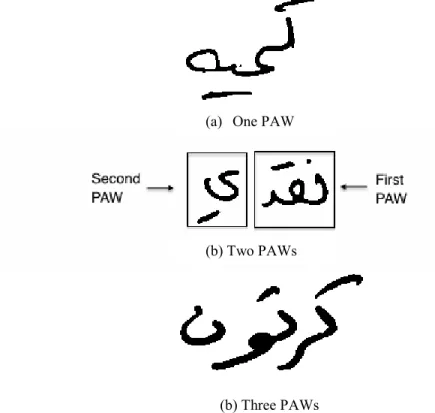
Each word may be composed of one or more Parts of Arabic Words (PAWs). In [126], a sub-word is defined "as being a connected entity of one or several characters belonging to the word". Figure 4 shows some words with different numbers of PAWs.
6
Name Isolated Beginning Middle End
Alif
ا
ا
ا
ا
Baaب
ـب
ــبـ
بـ
Taت
ـت
ـتـ
تـ
Thaث
ـث
ـثـ
ثـ
Jeemج
ـج
ـجـ
جـ
Haaح
ـح
ـحـ
حـ
Khaaخ
ـخ
ـخـ
خـ
Daalد
د
دـ
دـ
Thaalذ
ذ
ذـ
ذـ
Raaر
ر
رـ
رـ
Zainز
ز
زـ
زـ
Seenس
ـس
ـسـ
سـ
Sheenش
ـش
ـشـ
شـ
Saadص
ـص
ـصـ
صـ
Daadض
ـض
ـضـ
ضـ
Taaط
ـط
ـطـ
طـ
Daadظ
ـظ
ـظـ
ظـ
Aynع
ـع
ـعـ
عـ
Gaynغ
ـغ
ـغـ
غـ
Faaف
ـف
ـفـ
فـ
Qaafق
ـق
ـقـ
قـ
Kaafك
ـك
ـكـ
كـ
Laamل
ـل
ـلـ
لـ
Meemم
ـم
ـمـ
مـ
Nounن
ـن
ـنـ
نـ
Haaه
ـه
ـهـ
هـ
Waawو
و
وـ
وـ
Yaaي
ـي
ـيـ
يـ
7
Figure 2: Hamza's positions
Figure 3: An Arabic word with three different NLC letters
Figure 4: Arabic words with different numbers of PAWs
(a) One PAW
(b) Two PAWs
8
A PAW is composed of two parts, the main body and the secondary one which can be diacritics, non-basic characters or directional markings. In Figure 5, an illustration of the main and secondary bodies of a word is presented.
Figure 5: Main and secondary components of an Arabic word
Diacritics are usually (composed of) one dot, two dots or three dots. Sometimes, two dots are written as a dash and three dots like ^ (logical conjunction symbol). Dots can help to distinguish the main bodies. In other words, one, two or three dots can differentiate two similar main bodies. For example, Daal, and Thaal (Figure 1) have the same main body and just one dot makes them have different sounds (constant). Ten characters have one dot, three characters have two dots and two characters have three dots. Dots may be placed above or under the letter’s main body. Several representations of dots are presented in Figure 6.
Figure 6: Some representation of dots
(a) Three connected dots (b) Three isolated dots
9
One of the most important characteristics in Arabic writing is a baseline that is a horizontal line used to simplify and organize writing. Character connection usually occurs on this line. Figure 7 depicts the location of a baseline of the Arabic word.
Figure 7: A baseline of an Arabic word
A PAWs' characters are normally connected on a baseline, but others can be connected vertically, which is common with some combination of characters such as Laam and Alif.
Directional markings can be written above or below a character. In Figure 8, there is an illustration of all the directional markings. These directional markings may change the pronunciation and sometimes the meaning of a word. Figure 9 illustrates two words with the same letters and different directional markings, (a) means played, and (b) means toys. Directional markings cannot be combined within one character except with the directional marking Shadda.
Figure 8: Arabic directional markings
Figure 9: Same Arabic word with different directional markings
10
Cursive Arabic writing has many styles, more than a dozen. The three main calligraphic styles are Kufi, Naskh, and Ruqaa. Some people use different calligraphic styles in their writing and sometimes within one word. Figure 10 shows some Arabic calligraphic styles.
Figure 10: Some Arabic calligraphic styles
1.5 Latin vs. Arabic
Generally, in a handwriting recognition process, the word is segmented into characters and then the classifier recognizes each character. However, character segmentation is not simple, especially in Arabic systems which have to confront many obstacles. The most important distinction among offline handwriting recognition methods in different languages is segmentation. It has been noted that a large number of recognition mistakes in handwriting recognition system are due to segmentation errors [43]. Most of the work in Latin script focused on character segmentation, which is considered easy in comparison to other languages. As stated in [30], it is commonly accepted that the letter segmentation for Latin cursive writing is still a problem that leads to the conclusion that letter segmentation in Arabic needs more research. Hence, researchers avoid letter segmentation while applying segmentation-free methods by recognizing the Arabic word as a whole. Thus, the words must be extracted before the recognition stage. Table 1 compares some aspects between Arabic and English languages to show the difficulties that might arise from such characteristics.
11
1.6 Challenges
There are many challenges in handwritten document segmentation. We can categorize the challenges into general problems, and Arabic-related problems. Both Latin and Arabic languages face many problems due to the common challenges of handwritten documents. Arabic-related problems are caused by some of its distinct characteristics.
The tasks of offline systems are considered harder than online ones, where the sequences of points and writing traces are measured. Offline systems are less accurate since only an image of a script is available. Offline systems can be divided into three categories: printed, historical and handwritten. Printed-related methods have achieved great accuracy, while most of the historical documents also get good performance. The difficulties involved in historical-related systems are mainly based on the pre-processing stage, not on segmentation since historical documents are usually written neatly considering the importance of the information given in such documents.
Table 1: Arabic vs. English
Characteristics English Arabic Arabic Example Size of character Similar No, because of ligature دــــنب - دنب
Dotted characters Only two 15 out of 28 Number of dots
change same body part
No Yes ث - ت
Position of dots change same body part
No Yes, Above or below a baseline اي - ات Shape of letters based on location Capital,(only names, and beginning of sentences) Small beginning, middle, last, and isolated رصنع ةعبرأ عمجم ع
Non-basic characters No Yes ة ى ~ ء
Variation of shapes for the same letter
(with the same location)
No Yes, due to the used calligraphic styles
Different writing styles of dots
No Yes
12
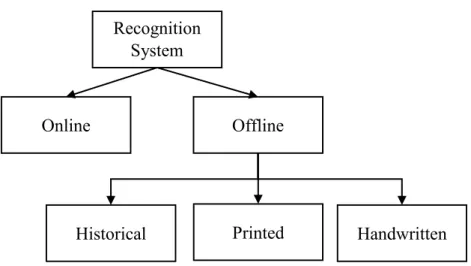
However, the systems that deal with handwritten documents like recognition system and word spotting are more challenging because of the writing styles’ variation and there is a need to perform many processing tasks to improve the accuracy of such systems, one of these pre-processing tasks is segmenting the texts into words. Figure 11 shows the two types of recognition systems: online and offline along with three types of offline systems: printed, historical and handwritten. In offline handwriting systems, the main challenge is the individuals’ writing styles. Generally, handwritten texts lack the uniform spacing that is normally found in machine-printed texts.
In the Arabic script, one of the major characteristics that differentiates this language from Latin-based ones is that twenty-two letters in the Arabic language must be connected on a baseline within a word. The remaining six letters cannot be connected from the left, which we call NLC letters. In this way, NLC letters separate a word into several parts depending on how many of these letters are included in a word. In other words, NLC letters indicate a separation of PAW. A study shows that NLC letters represent 33% of the texts [117].
Arabic texts have two types of spacing, intra-word gaps (gaps between PAWs within a word) and inter-word gaps (gaps between words). Intra-word gaps in the Arabic language are different from the ones in Latin-based languages. In Latin, intra-word gaps refer to the spaces that arise arbitrarily between any successive letters as a result of handwriting styles. In Arabic, in addition to the arbitrary spaces between letters as a result of broken PAWs, intra-word gaps are the ones between two PAWs, where the word must be disconnected due to NLC letters. This is part of the language’s structure. Figure 12 shows intra-word gaps in both English and Arabic words.
In Arabic machine-printed texts, the inter-word gaps are much larger than intra-word gaps as illustrated in Figure 13. However, in Arabic handwritten documents, the spacing between the two types is mostly the same [26]. This is pointed out in Figure 14 from the CENPARMI cheque database [14]. Since the shapes of most of the NLC letters are curved, with the open end to the left, they are usually written with long strokes, which shrink the distance between words. Sometimes, they caused overlapping, or touching between words.
13
Figure 11: Types of recognition systems
Figure 12: Intra word gaps
Figure 13: Printed (below) and handwritten (above) Arabic texts
Recognition System Online Offline Handwritten Printed Historical Gaps Gaps Gaps
14
Figure 14: Intra and inter-word gaps in Arabic texts
1.7 Objectives
The existing methods are not adequate for extracting Arabic words from handwritten texts. In word recognition and spotting applications, it is very important to achieve high levels of accuracy. This research deals with the pre-processing steps and the words extraction of handwritten texts. Our main objective is to design an efficient and robust segmentation system to solve real-life and industrial problems. This thesis’ research goals are as follows:
A survey of offline handwritten word extraction.
A review of the difficulties involved in word extraction.
Propose a novel scheme for text segmentation based on end shape analysis and recognition.
A survey of offline isolated handwritten letters recognition.
Design a promising supervised learning system for isolated Arabic handwritten letters to enhance the segmentation process.
A survey of baseline estimation methods for Arabic handwritten texts.
A review of the difficulties involved in baseline estimation.
Propose a robust baseline estimation method based on learning and feature extraction.
Introduce an efficient approach to remove secondary components.
Discover a promising supervised learning system for Arabic handwritten words to study the impact of word segmentation on word spotting system.
15
In general, we introduce new algorithms and techniques that can improve the accuracy of segmentation of Arabic handwritten words. We used all sources of foreground information and the knowledge of the language to improve the accuracy of segmentation.
1.8 Proposed Method
The main difference between our segmentation approach and previous methods is utilizing the knowledge of Arabic writing by shape analysis. In [22], [53], and [23], the authors pointed out the importance of using the language specific knowledge for Arabic text segmentation. Meanwhile in [103], the authors claim that one of the problems of Arabic text segmentation is the inconsistent spacing between words and PAWs. Our approach for segmentation is a two-stage strategy: (1) metric-based segmentation, and (2) recognition-based segmentation.
1.8.1 Utilizing the Knowledge of Arabic Writing
In the Arabic alphabet, twenty-two letters out of twenty-eight have different shapes when they are written at the end of a word as opposed to the beginning or in the middle. Two non-basic characters have different shapes at the end of a word. Therefore, analyzing these shapes can help identify a word’s ending. In fact, there are just fourteen main shapes that can be used to distinguish the end of a word, since the remaining characters have the same main part but have a different number and/or dots’ positions. Only NLC letter shapes are written the same way at the beginning, the middle or the end of a word. Therefore NLC letters cannot identify the end of a word. Consequently, End-Shape Letters (ESLs) can be categorized into two classes: endWord and non-endWord. Figure 15 shows the shape of the letter Noon when it is written at the beginning of the word, the middle and the end, and this letter is part of endWord class.
Figure 15: Letter Noon in different positions
16
1.8.2 Our Overall Methodology
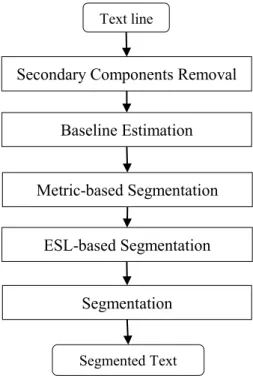
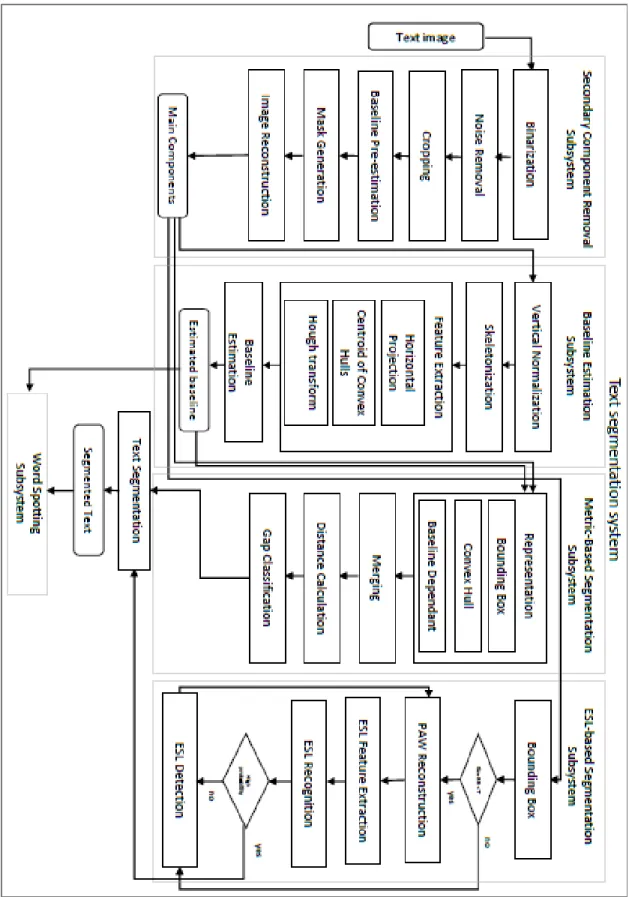
Our methodology is composed of four main tasks: (1) secondary components removal, (2) baseline estimation, (3) metric-based segmentation, and (4) ESL-based segmentation. The input of our system is a text line image. The first subsystem aims at preprocessing the image and removing the secondary component that is explained in Chapter 2. The output of this subsystem are the main components of the text line. The baseline estimation task is described in Chapter 3. This method is a learning based approach that aims at determining the position of the baseline of the text line. The third subsystem is the first stage of the word segmentation technique which is described in Chapter 4. The purpose of this task is to pre-estimate the segmentation points between the words based on calculating the distances between the main components. Then the second stage of the word segmentation is explained in Chapter 7. The overall methodology is given as a block diagram in Figure 16. The details of our methodology are given in Figure 17.
Figure 16: Overview of our methodology
Text line
Secondary Components Removal
Metric-based Segmentation ESL-based Segmentation
Segmentation
Segmented Text
17
18
1.9 Contributions
In this thesis, we present a coherent offline Arabic word segmentation system for multi-writer unconstrained scripts. The proposed system aims to solve the problem of lack of boundaries between words. The main contributions of this thesis can be summarized as follows:
The introduction of a new word segmentation approach based on recognizing the last character of PAWs with advanced state-of-the-art technologies.
The introduction of a novel learning-based baseline estimation method.
The introduction of morphological reconstruction to remove secondary components to enhance the above processes.
The creation of a new off-line CENPARMI ESL database.
1.10 Database
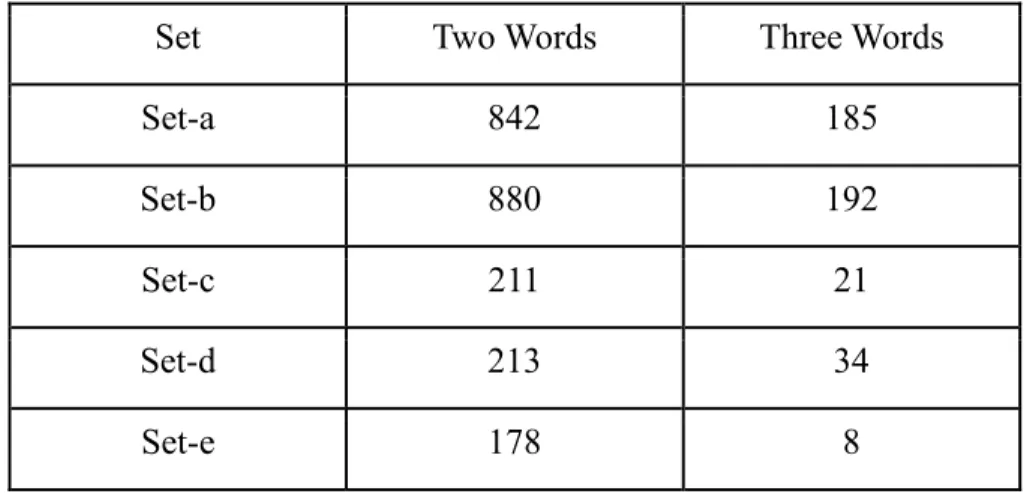
The Institute of communications Technology in Germany (IFN) and the École Nationale d’Ingénieurs de Tunis in Tunisia (ENIT) have developed an Arabic handwriting database. It contains more than 2273 handwritten forms from 411 writers with 26459 handwritten words. Most of the participants were familiar with the vocabulary. Each writer was asked to complete five forms, where each form contained 60 names. These forms were composed of 946 Tunisian town/village names. Some names appear more than 300 times while others were written only 3 times. Each handwritten word image comes with ground truth information that includes postal code, Arabic word in ISO 8859-6 code set, Arabic word as character sequence with shape index, number of words, characters and PAWs, baseline, baseline quality, and writer identifier, age, profession and writing quality. The database consists of five sets (a, b, c, d, e). Each set contains of about 6700 images. Table 2 shows the statistics of images with two and three words.
19
Table 2: Statistics of number of images with two and three words in IFN/ENIT database
Set Two Words Three Words
Set-a 842 185 Set-b 880 192 Set-c 211 21 Set-d 213 34 Set-e 178 8
1.11 Thesis Outlines
This thesis is organized into ten chapters, as described below:
In Chapter 2, we discuss the work that has been done on secondary components removal. We propose our new approach of secondary component removal using morphological reconstruction. Experiments on the proposed method are also presented. The results are compared with the existing methods on the same database.
In Chapter 3, we describe the previous works on baseline estimation for Arabic texts. We propose our own learning-based baseline estimation procedure. Different experiments are conducted and the results are presented.
In Chapter 4, we review the studies on word segmentation for Latin-based languages. In addition, our metric-based segmentation algorithm is explained. The experiments and their results are described.
In Chapter 5, a literature review is given for Arabic letter recognition methods. We present a complete isolated letter recognition system, discussing the different extracted features.
In Chapter 6, we explore the created database of Arabic words with all the different shapes of the letters.
In Chapter 7, we propose our new approach of word segmentation called End-Shape Letter Recognition based segmentation. Several experiments have been conducted and the results are compared with the metric-based segmentation method.
20
In Chapter 8, our word recognition system is discussed and the results of extracting different features are presented.
In Chapter 9, we define word spotting systems. Moreover, the impact of word segmentation on word spotting is discussed with the results of word spotting system.
Finally, we summarize this thesis in Chapter 10 with some observations and directions for future works.
21
Chapter 2
Removal of Secondary Components
Using Morphological Reconstruction
In this chapter, we start by describing secondary components in Arabic language and the importance of their removal. In Section 2.2, the previous methods of secondary components removal are explained. Our proposed method, secondary components removal using morphological reconstruction, is described in Section 2.3. The experiments and their results are provided in Section 2.4. Finally, we conclude this chapter in Section 2.5.
2.1 Introduction
An Arabic word is composed of two parts: (1) main components that represent the primary part of the connected or isolated letters, and (2) secondary components (diacritics, dots, strokes, directional markings). In this thesis, the secondary components are removed to improve the performance of metric-based segmentation and baseline estimation. For metric-based segmentation, removing the diacritics can speed up the process by avoiding calculating the
22
coordinates of these strokes that do not have direct influence on the segmentation result(s). In fact, one of the problems of text segmentation is the existence of secondary components that overlapped in some cases with adjacent words. Several methods of baseline estimation are affected by these components such as horizontal projection, principal components analysis, contour following, and skeleton based methods. Though, the removal of secondary components avoids both the disturbance of the histograms in case of horizontal projection and principal component analysis and the error of points’ selection of contour and skeleton based methods. However, many algorithms remove the secondary components to facilitate skew correction. Some methods also detect the secondary components to extract more features for recognition or spotting systems.
2.2 Related Work
Several methods have been applied that are based on height, area, positions of the components, binarization and thresholding, number of black pixels of each segment, bounding boxing, vertical layering, and contour following. The challenge is to apply a method based on the size of the connected components where isolated letters and secondary components are written in the same size, as seen in Figure 18. Generally, all of these methods are mainly based on the segments’ size. None of these algorithms adopt the idea of restoring the words based on a roughly estimated baseline.
Figure 18: Main and secondary components with almost similar dimensions
Diacritic
23
In [38], the algorithm employs the following contour technique. The biggest segment is considered as the main component. Two steps are performed in [105] to remove diacritics. The first step filters the components relying on three criteria: size of the bounding boxes, area, and vertical layering while the second filter removes diacritics after estimating the baseline. In [32], they modified the algorithms proposed in [105]. This algorithm is based on the height, the area and the overlapping of the connected components. Chan et al. [41] remove the diacritics by binarizing the images. Then with some size and orientation ranges, a threshold was applied to the connected components. In [18], the technique is based on counting the number of black pixels of each segment and the number of rows included in the segment. The segment that has more than half the total number of the black pixels of the entire image is identified as a main component while the rest are considered as secondary. This method was applied to isolated characters of five different sizes and three fonts. In [104] and [54], the diacritics were removed based on the connected component’s size. In [54], thresholds were determined based on empirical study.
2.3 Proposed Method
All the secondary components are written either below or above the main components, which are usually written on the baseline. The baseline occurs below the center of the image. We used this fact to extract only the connected components that were located in this position. Since the secondary components are concerned with the word image’s middle area, we used a morphological reconstruction method by dilation that is based on an estimated baseband.
Our method is composed of two steps. At the first step, the secondary components are removed based on the components’ sizes. At the second step, a pre-estimation of the baseline is calculated then the mask is generated based on the baseline. Finally, the reconstruction of the image is performed.
The reconstruction is a morphological transformation involving two images and structuring element that is used to define connectivity. We used 8-connectivity, which is a 3×3 matrix of ones with the center defined at coordinates (2,2). Morphological reconstruction processes one image, called the marker, based on the characteristics of another image, called the mask. The marker is the starting point for the transformation. In fact, the peak of high points in the marker image
24
identifies where the processing begins. The mask image constrains the transformation; hence the peaks spread out or dilate while being directed to fit within the mask image. The spreading processing continues until a stopping condition is reached. The fast hybrid reconstruction method is used [150].
Let I be the mask and F be the marker that are defined on the same discrete domain D and such that F I. In terms of mapping, this means that;
p D , F(p) = 1 I(p) = 1
Let I1, I2……..In be the connected components of I. The reconstruction of I from F denoted by
PI(F) is the union of the connected components I which contains at least one pixel of F
𝑃𝐼 (𝐹) = ⋃𝐹∩𝐼𝑘≠0 𝐼𝑘
We process only binary images. The word images are the masks. The marker is a generated binary image with the same size as the mask image with a horizontal line that is located below the middle of the image.
Marker (Image (mean(h):mean(h)+10, w ) ) = 1 Image = size (Mask)
where h and w are the image’s height and width . The result of our method is illustrated in Figure 19.
We found another advantage in using our method: not only are the secondary components removed, but also some strokes were extracted near the edges. These strokes appeared because of the low performance of extracting the word image from bank cheques [14] or by the low performance of text line segmentation.
2.4 Experimental Result
We applied our method to the IFN/ENIT Arabic Tunisian city names database [127]. The training is done on randomly selected images from set-a. The experiments are conducted on 751 first images of set-a as in [32]. We used two metrics: false positives and false negatives. The false negatives are identified when the number of secondary components is less than the correct number;
25
Figure 19: Result of our secondary component removal method
whereas the false positives are detected when a connected component is misclassified as a secondary component instead of a base form (PAW). Since the ground-truth information of the secondary components is not included with the IFN/ENIT, a manual evaluation is performed. The results were 2.90% false positives and 1.75% false negatives. The algorithm failed when the diacritics were touching the main components or the main components were written well above
(a) Binarization
(b) After removing secondary components based on size
(d) Mask Generation
(e) Result
26
the baseline as illustrated in Figure 20. Table 3 compares our method with the methods from Menasri et al [105] and Boukerma et al [32] on IFN/ENIT database.
Figure 20: Error analysis
Table 3: Comparison of secondary components removal methods
Method False Positives Detection False Negatives Detection Menasri [105] 14.24% 5.32% Boukerma [32] 5.72% 7.05% Proposed Method [76] 2.90% 1.75%
2.5 Conclusions
We believe that the preprocessing stage can improve both the recognition and the spotting systems. In this chapter, a preprocessing method of removing secondary components for Arabic handwriting texts is presented. Our proposed method is based on the use of morphological reconstruction. After binarizing the image, using state of the art technique, some secondary components were removed
(a) Touching between
27
based on a threshold. Then, an initial estimation of the baseline is calculated to facilitate the mask generation. Finally, the image is reconstructed based on the generated mask. The method is evaluated by using a standard database and is compared with two previous algorithms.
28
Chapter 3
Learning-based Baseline Estimation
Baseline estimation is an important pre-processing step in Arabic text recognition systems. In this chapter, the text baseline’s definition is presented in Section 3.1. The motivation and the concerns about this essential preprocessing task are given in Section 3.2. Next, the baseline error measurement is included in Section 3.3. The challenges that are related to Arabic writing characteristics are described in Section 3.4. The previous work on baseline estimation for both Latin and Arabic languages are provided in Section 3.5. In Section 3.6, the database used, the generated database for the proposed method and our method are described. Finally, our experiments are also presented in detail in Section 3.7. This chapter is concluded in Section 3.8.
3.1 Baseline Definition
Arab people use an imaginary line called the baseline, which is the main property in an Arabic script, in an un-ruled paper to simplify the actual writing. The baseline concept does not have a precise definition, but it can be defined as "the virtual line on which cursive or semi-cursive writing characters are aligned and/or joined" [17]. In other words, it is the line at the height where letters are connected, so the main bodies are written above it except for the descenders. In fact, the Arabic
29
text can be split vertically into three regions: upper, lower and middle. The main part of the letters, loops and their connections are located in the middle region which is part of the baseline position. Meanwhile, ascender, descender, dots, and diacritics lie either in the upper or/and lower parts. Figure 21 shows the baseline’s main properties.
Figure 21: Main properties of baseline
3.2 Motivation
In Arabic printed texts, the baseline can be detected easily by finding the row that has the most number of black pixels. However, in handwritten texts, this procedure cannot be applied due to the extreme variation of writing styles and irregularity in PAW alignment. Baseline estimation is used for skew normalization, slope correction, for segmentation [107], and for feature extraction [125], [51]. The dots and their positions, which are below or above the baseline, along with word descenders and ascenders, can be identified by their baseline positions. Moreover, baseline provides important information regarding text orientation as well as the connection points between characters. Baseline identification has direct influence on recognition accuracy [117] and segmentation performance. The failure of such systems may be caused by inaccurate estimation of the baseline. Moreover, some approaches are used in baseline detection as a main key for text line separation [120], [29], and [119]. In this thesis, the baseline estimation method is used for metric-based segmentation and for feature extraction stage of word recognition.
Baseline
Diacritics Dots
Connection
points Descender Ascender
30
3.3 Baseline Error Measurement
The baseline error measurement is explained in [126]. To rate the baseline position, they prepared a survey with hundreds of Arabic handwritten words from IFN/ENIT database with marked baseline positions. Then, a group of Arabic native speakers were asked to tag all baseline positions as “excellent”, “acceptable”, and “insufficient”. They observed that the baseline position was evaluated as excellent with up to a 5 pixel vertical position error, the baseline position was evaluated as acceptable for up to a 7 pixel vertical position error, and when the vertical position error is more than 7 pixels the baseline position was evaluated as insufficient. To evaluate our algorithm, we have calculated the distance between the estimated baseline with our algorithm and the baseline positions in the ground truth. This distance is used for performance evaluation.
3.4 Challenges
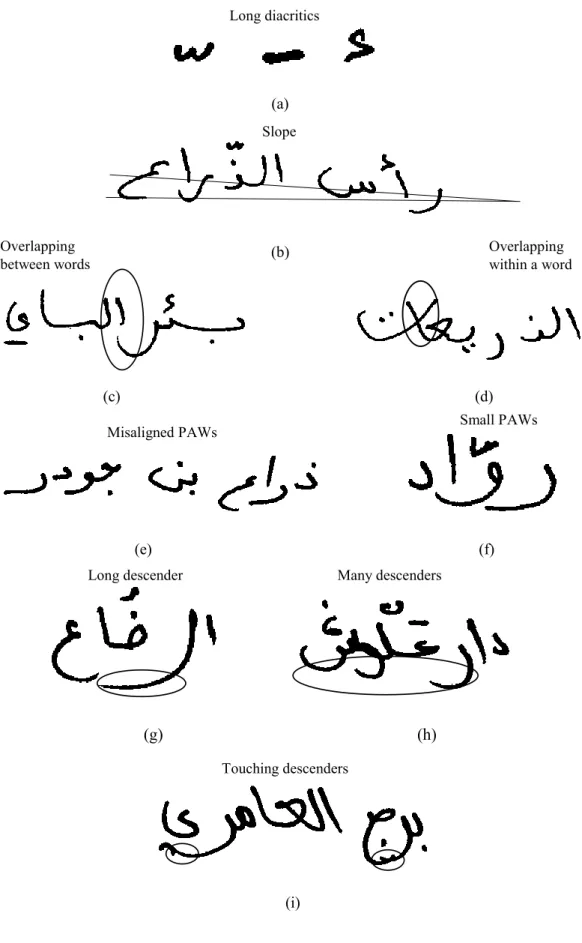
Some characteristics of Arabic writing are challenging for baseline detection. Diacritics, non-basic characters and directional markings can either affect the accuracy of baseline estimation, since baseline methods are concerned with the main body of the word, or the speed of the process that can be affected when removing such strokes. In addition, the variation of baseline within a word (between PAWs) has a big effect on baseline methods performance. A short description of some of the challenges can be found in [17], [116] and [115]. The challenges that are related to the language can be summarized as follows:
Secondary components: strokes that have zigzag shapes or long diacritics. (Figure 22(a))
Word slope. (Figure 22(b))
Overlapping
o Inter-overlapping means some characters from different words are overlapped. (Figure 22(c))
o Intra-overlapping means some characters within a word are overlapped. (Figure 22(d))
Text line length
31
o Short text line with small PAWs. (Figure 22(f))
Ligature
o Long ascenders or descenders. (Figure 22(g))
o Many ascenders or descenders. (Figure 22(h))
o Touching ascenders or descenders. (Figure 22(i))
Some of these challenges are combined, making the problem more challenging e.g. short word with slope. In addition, baselines vary among different writers. Most of the proposed methods reach satisfactory results for long lines text, but they are not as accurate with lines containing one or a few words. Several methods remove secondary components [37], [15] to improve the performance of baseline estimation. However, the rest of the challenges are not easy to manipulate before baseline estimation.
3.5 Related Works
Several methods have been proposed for baseline estimation. The various methods of Arabic baseline estimation in the literature can be categorized by (a) the basic entity of estimation (text line, word, or PAW), (b) the information of the baseline’s representation (e.g. skeleton, contour), and (c) the restriction required by the technique.
In general, baseline estimation techniques can be divided into three main categories: (1) statistical distribution methods, (2) geometrical analysis methods, and (3) combination of (1) and (2). The first technique is based on the foreground pixels distribution, while the second mainly relies on baseline-relevant points’ selection. Arabic baseline detection is gaining more attention due to the reasons mentioned earlier about the importance of features that are related to the baseline for Arabic texts.
32
Figure 22: Baseline estimation challenges
(a) (b) (c) (d) (e) (f) (i) (g) (h) Slope Overlapping within a word Overlapping between words Small PAWs Misaligned PAWs Many descenders Long descender Touching descenders Long diacritics
33
In current, the state of the art methods is Horizontal Projection based approach. This method analyses the density histogram by counting the number of foreground pixels for each row, while assuming that the maximum number of elements on a horizontal line would include the baseline. The first attempt for Arabic baseline estimation by Parhami and Taraghi used the horizontal projection in 1981 [45]. In [113], Nagabhushan et al. proposed a piece-wise painting schema where black and white blocks are extracted from the text line. After removing dots and diacritics, a horizontal projection was calculated for black blocks. Based on maximum horizontal projection profile, candidate points were selected. Olivier C. et al. [117] assumed that all the words are perfectly horizontal or have a small inclination. They applied horizontal projection while taking into account the position of the loops. El-hajj et al. [51] detected the upper and lower baselines which are based on horizontal projections. The baseline is detected through iterations of changing angles and horizontal projections [15]. The highest peak in the projection, located below the middle line, is assigned as the baseline [55]. A horizontal histogram was combined with directional features based on a skeletonized PAW [5], [4], and [6]. Several steps have been implemented: binarization, connected components extraction, dots and diacritics removal, horizontal projection and pre-estimated baseline regions, feature extraction, and baseline detection.
In [97], the entropy method was applied to measure baseline relevant information. The histogram density and corresponding entropy were calculated for each projection. Petchwitz et al. proposed an enhanced horizontal projection method [126]. The binary word image was transformed into Hough space. The dark regions of this space indicate line directions with black pixels on a straight line. The maximum in the Hough space identify the baseline position. Principal Component Analysis (PCA) is a statistical procedure to find the directions, called principal components, along which a distribution exhibits the greatest variation was used in [37]. The baseline estimation was determined according to foreground and background pixels. After angle detection and baseline estimation using eigenvector (by choosing the eigenvector with the largest eigenvalue), the image is rotated so that this estimated baseline angle lies horizontal. A horizontal projection was applied to find the peak as the baseline. The experiments were done with and without diacritics. Generally, horizontal projection profile is robust and easy to implement, however any statistical approach needs long straight line of text, which is not the case in handwritten documents, since the researcher’s assumption is based on that the density of pixels is higher around the baseline position. Thus, horizontal projection histogram based methods fail in
34
estimating the baseline with short text line and text having great number of ascenders, descenders and large diacritics. Moreover, PAW misalignment caused some errors on baseline estimation. In addition, horizontal projection is very sensitive to skew.
Various researchers employ word skeletons and word contour processing for baseline estimation. Pechwitz et al. [125], and [126] extract many features from word skeleton and categorized these features into relevant and irrelevant baseline features. As a consequence, a pre-estimated baseline region was determined based on the irrelevant features. The relevant baseline features that are located in the pre-estimated baseline region are extracted. Finally, a regression analysis of the selected features was completed to estimate the final baseline position. Boukerma et al. [31] presented an algorithm based on skeletonized PAW processing. Some points are grouped based on the aligned trajectory neighborhood direction. Next, many topological conditions were applied on the set of points that were found in the first stage to estimate the baseline. In [57], the method was based on the contour’s local minimum points. After locating the points where the contour changes direction from the lower to the upper of the image, two step linear regressions were applied to find the baseline position. Errors would occur with this kind of approach, when incorrect points were extracted due to large diacritics or word with small PAWs. Sometimes connection points between characters are not laying over the baseline. In fact, complex calculations were needed for this time-consuming operation.
In [32], an algorithm was proposed that combined the different representations of skeleton, and contour, with different techniques such as horizontal projection method, linear interpolation, and some heuristics. Ziaratban et al. introduced a baseline estimation method using a template matching algorithm with a polynomial fitting algorithm [156]. In [49], a Hough transform method was applied on main component of PAWs. A data-driven baseline detection was introduced in [140]. The main idea is to use data-driven methods trained on local character features to find the probable baseline region. Gaussian Mixture Models (GMMs) were used to estimate the likelihood of each baseline region. Finally the horizontal projection was applied on this region. Voronoi Diagram, defined as “lines that bisect the lines between a center point and its surrounding points”, was used in [16]. Edge detection, contour tracing and sampling were used to measure Voronoi diagram points. Then, only the horizontal edges were used with rule-based approach.
In Latin languages, the horizontal projection method is used to estimate lower, upper and baseline for words [33], and [36]. Most studies in the literature use some heuristics based on
35
horizontal projection profile [27], and [69]. Moreover, the horizontal projection that is based on contour pixels is proposed in [8], [29], and [152]. The baseline was estimated by maximizing the entropy of the horizontal projection histogram [151]. Linear regression is used in different approaches. A pseudo convex hull from mathematical morphology with weighted least squares was employed [59]. In [66], least square linear regression was applied by Graves et al. [66] and by Modolo et al. [34]. Two linear regressions through the minima and maxima were used by Dalal et al. [46], and Liwicki et al. [93]. Some researchers use contour based analysis combined with heuristics [20], [122], [39], and [40], and others classify the local extrema of contours by a multilayer perceptron (MLP) [155], [65], and [24]. A polygons analysis was investigated by Bengali [135]. An approach was introduced by Simard et al. [124] to automatically detect a set of points and classify them by machine learning techniques. In [70] and [71], an approximating cubic splines function was employed. A heuristics approach based on local Extrama was used in [39].
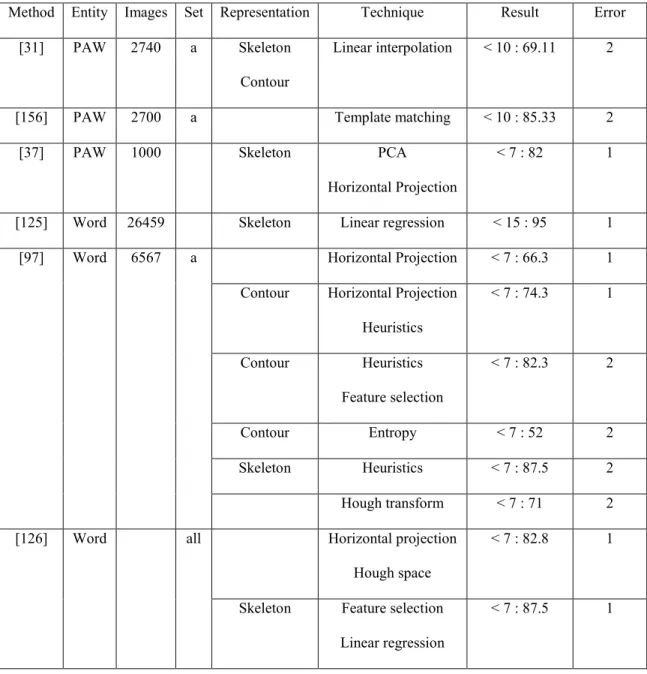
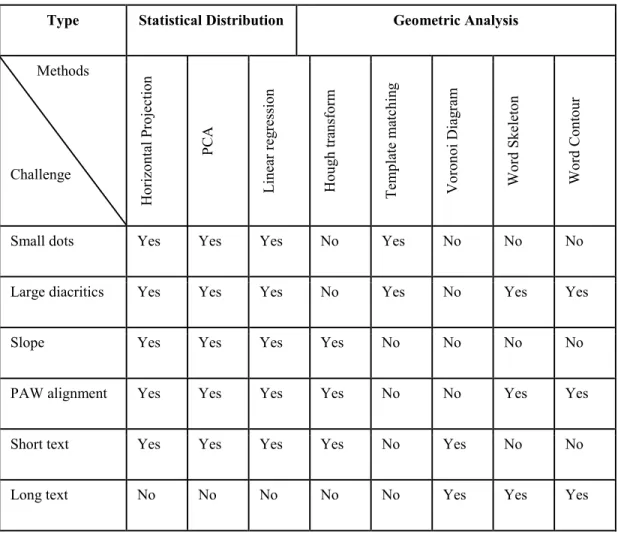
Since we use IFN/ENIT database for our experiments, Table 4 summarizes the reported results of baseline estimation based on this database. The entity refers to the basic unit that is used for estimating the baseline. Much information is added to this table, like the number of images used for testing, the name of the sets from IFN/ENIT, the word representation such as skeleton or contour, the techniques that were applied, the result (“<” refers to the number of pixels below the acceptable error range), and the type of error. We classify the errors that are related to baseline estimation into two types: (1) density confusion, and (2) miss determined candidate baseline– relevant points. By density confusion, we refer to the errors that occurred when the techniques are mainly based on both the distribution of the foreground pixels in the image, and the assumption that the high density is on baseline area. This assumption is true in case of long text line, but it does not apply to a word, a few words or short text line. The second type of errors arise when some points, considered as indication of the position of the baseline, were wrongly selected, and the technique used was based on these candidate points. Table 5 shows the comparisons between the previous works on baseline estimation and the challenges of Arabic writing characteristics that they are affected by.
36
Table 4: Results of some methods reported in the literature
Method Entity Images Set Representation Technique Result Error [31] PAW 2740 a Skeleton
Contour
Linear interpolation < 10 : 69.11 2
[156] PAW 2700 a Template matching < 10 : 85.33 2
[37] PAW 1000 Skeleton PCA
Horizontal Projection
< 7 : 82 1
[125] Word 26459 Skeleton Linear regression < 15 : 95 1 [97] Word 6567 a Horizontal Projection < 7 : 66.3 1
Contour Horizontal Projection Heuristics < 7 : 74.3 1 Contour Heuristics Feature selection < 7 : 82.3 2 Contour Entropy < 7 : 52 2 Skeleton Heuristics < 7 : 87.5 2 Hough transform < 7 : 71 2 [126] Word all Horizontal projection
Hough space
< 7 : 82.8 1
Skeleton Feature selection Linear regression
37
Table 5: Challenges related to baseline methods
Type Statistical Distribution Geometric Analysis
Methods Challenge Ho rizo ntal Pro jectio n PC A L in ea r reg ress io n Ho ug h tr an sf or m T em plate m atch in g Vo ro no i D iag ram W or d Sk eleto n W or d C on to ur
Small dots Yes Yes Yes No Yes No No No
Large diacritics Yes Yes Yes No Yes No Yes Yes
Slope Yes Yes Yes Yes No No No No
PAW alignment Yes Yes Yes Yes No No Yes Yes
Short text Yes Yes Yes Yes No Yes No No
Long text No No No No No Yes Yes Yes
3.6 Proposed Method
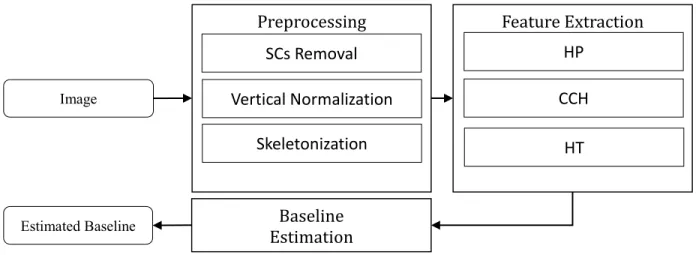
We propose a supervised learning method for baseline estimation. We aim to use a learning technique in the preprocessing stage instead of relying on geometric heuristics that need expert knowledge for designing features while sometimes lacking robustness. On the other hand, learning based approaches allow automatic features to be learned from input images. This method is depicted in Figure 23. The subsystem is divided mainly into three parts. The first part is related to the preprocessing which is concerned with obtaining a compact and reliable representation. The second part is related to the feature extraction process while the third is related to the estimation process.
38
Figure 23: Proposed method
3.6.1 Our Method
The baseline of an Arabic word consistently lies below an image’s middle line [59]. After analyzing some images from the IFN/ENIT database [127], we observed that the baseline of the words, after cropping and normalization, was roughly between the 30th and 90th row pixels along