Policy, Planning, and Resserch WORKING- PAPERS
World Development Report Office of the Vice President
Developnent Economics l-he World Bank September 1989
WPS 54
Background paper for the 1989 World Development Report
Bank Restructuring
in Malaysia
1985-88
Andrew Sheng
Malaysia's experience illustrates the pervasive incroeconomic
effects - particularly in the financial sector - of structural
adjustment to external shocks. Effectively tackling financial
distress requires both macroeconomic policy adjustments and
changes in banking legislation and supervision
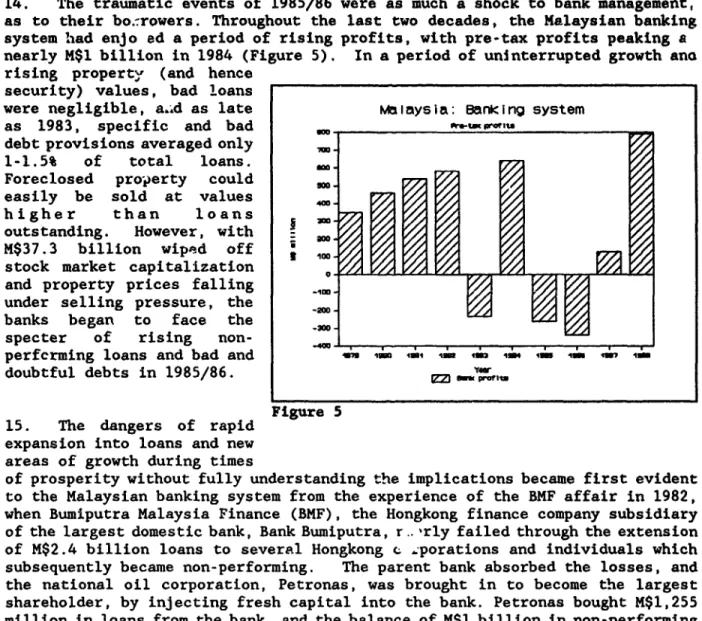
-to address the
problems of fraud and poor bank management that often emerge
in times of financial distress.
The Policy, Planning, and Research Complex distib.tes PPR Wcking Papers to disseminate the findings of work in progress and to encourage the exchange of ideas among Bank staff and all others interested in development issues. These papers carry the names of
the authors, retlect only their views, and should be used and cited accordingly. The findings, interpretations, and conclusions are the
authors' own. They shot.ld not be attuibuted to theWorld Bank, its Board of Directors, its management, orany of its membercountries.
Public Disclosure Authorized
Public Disclosure Authorized
Public Disclosure Authorized
World Devielopment Report
Between 1983 and 1986, Malaysia embarked on Losses to ailing financial institutions be-a structurbe-al be-adjustment progrbe-am to control its tween 1985 and 1986 amounted to as much as fiscal and balance of payments deficits. 4.7 percent of 1986's GNP. The Malaysian
authorities adopted several rescue packages and In reaction to the shock of sharply declining bank restructuring exercises to protect depositors commodity prices (at a time of heavy commit- - including a unique plan for converting
mernts on public expenditures), the Malaysian deposits into equity (the 50:50 solution). government drastically cut back on public
spending and allowed the exchange rate to de- Malaysia's experience shows that structural
preciate freely. adjustment to shocks emanating from changes in
the exterral environment have pervasive micro-A sharp decline in export income, combined economic effects, particularly in the financial with rising import costs and reduced public sector.
spending, caused severe disinflation - which
manifested itself in an increased number of non- Effectively tackling financial distress performing loans in the financial sector. This requires both macroeconomic policy adjust-culminated in the failure of 24 deposit-taking co- ments and timely changes in banking legislation operatives in mid-1986 and required the central and in the machinery for supervising banks - to
bank to inject substantial fresh capital to aid address the problems of fraud and poor bank three commercial banks. management that typically emerge in times of
financial distress.
This is a background paper for the 1989 World Development Report. Copies are available free from the World Bank, 1818 H Street NW, Washington DC 20433. Please contact the World Development Report office, room S13-060, extension 31393 (37 pages with charts and tables).
The PPR Working Paper Series disscininates the findings of work under way in the Bank's Policy, Planning, and Research Complex. An objective of the series is to get these findings out quickly, even if presentations are less than fully polished. The findings, interpretations, and conclusions in these papers do not necessarily represent official policy of the Bank.
CONTEFTS
Page
PART 1: THE MACRO-ECONOMIC BACKGROUND
1.1 Introduction 5
1.2 Decline in growth, 1981-86 6
1.3 The financial system 7
PART 2: IMPACT OF RECESSION ON THE FINANCIAL SYSTEM
2.1 The banking system 8
2.2 Non-bank financial intermediaries 13 PART 3: ISSUES AND RESOLUTION
3.1 Approach towards ailing financial institutions 15 3.2 Monetary and Prudential measures, 1985/86 17 3.3 Modus Operandi of Rescue Packages 19
3.4 Options for Rescue 20
3.5 The Rescue of the Problem Banks 21 3.6 The Rescue of the 24 Deposit-taking Co-operatives 22 PART 4: EVALUATION
4.1 Results and Lessons 25
4.2 Losses and costs 26
REFERENCES TABLES
TABLES
1. Principal macro-indicators 2. Aqsets of the Financial system
3. Banking system: Outstanding Interest-in-suspense and bad dobt provisions 4. Commercial banks: Average loan margins
5. Losses of the 24 deposit-taking co-operatives 6. Key data of three ailing commercial banks
7. Summary of Rescue Plan for 24 deposit-taking co-operatives
FIGURES
1. Terms of trade and current account deficit 2. Fiscal deficit and nominal GNP growth 3. Exchange rate and lending to property 4. Money supply and real GDP growth 5. Pre-tax profits of the banking system 6. Real interest rates
This is a revised and updated edition of the paper "Financial Adjustment in a period of Disinflation: The Case of Malaysia", a background study prepared for the World Development Report 1989. The author acknowledges with gratitude the research assistance of Tan Yit Seong, Tan Gaik Looi and Chan Kok Seong of the Bank Regulation Department, Bank Negara Malaysia and the secretarial assistance of Zaini Osman. I am also grateful to Alan Gelb, Ignacio Mas, Alfredo Thorne, and Yoon Je Cho of the World Bank for their helpful comments, and Karin Waelti for her typing assistance.
PART 1: -FE &.CRO-ECONOMIC BACKGROUND
1.1 Introdugtion
1. Malaysia is a small middle income oil-exporting developing economy w5 th an area of 329,800 sq km, a population of 16.5 million, and well endowed with natural resources, being the world's largest exporter of rubber, palm oil, tin, tropical hardwoods, and an important producer of cocoa and pepper. The country is a net exporter of crude oil and natural gas, and industrialization has reached the stage at which manufacturing now accounts for 22.5% of GDP, and manufactured exports accounted for 45% of gross exports in 1987. In 1988, Malaysian GNP was
Maa
I ys i a: Terms of Trade
an-d cwr. SC. df lcit 30-25 20 '10 a--10 -20 1970197119721g7319741975197619771978197919801981 19821983 158418S1S8619gB71088 Yw
a Terms of Trad + kr. cc. defl./GP
US$31.6 billion, with a GNP per capita of US$1,869. The openness of the economy can be seen from the high ratio of external trade to GNP of 130% in 1987, and the historical sensitivity of the external payments position to changes in the terms of trade (Figure 1).
2. Historically, Malaysia has been considered a model of cautious economic management. The Government has a stated policy of maintaining a surplus in its current account budget, strong external reserves backing for its currency and low inflation. In the 1960s, the country enjoyed a steady expansion in average annual real GDP of 5.2% with inflation of less than 1% annually. In the turbulent 1970s, Malaysia grew by an average of 8% in real terms, with a peak GDP growth of 9.3% in 1979, but inflation rose to an average of 6%, peaking at 11.1% in 1981
(Table 1).
1.2 DecLine in growth
3. In the light of its strong financial position and to counteract the impact of the severe international recession of 1980-82, the Government embarked in 1980 on a counter-cyclical policy to build up infrastructure and an industrial base,
Malaysia:
Fiscal
deficit
and
5an i nM I GNP roWth 20 10-5 -10 -15 -20- \ X 1976 1977 1978 1979 1980 tPt 19t82 1983 1984 1985 1986 1987 1988 Your
a Flecal deficit/GNP + Naninal GhP growth
-7-relying primarily on external borrowing. Federal government development expenditure rose from an average of M$3-4 billion annually in 1977-79 to a peak of M$11.5 billion in 1982, resulting in a deterioration in the Federal Government overall financing deficit to 19.8% of GNP in 1981 (Figure 2). The decline in commodity prices in 1981-82 sas a deteriora-lon in the terms of trade of 10.2%, and the current account deficit in the balance of payments worsened from a near-balanced position in 1980 to. M$8.4 billion or 14.1% of GNP in 1982. The net result was a tripling in the foreign debt from M$10 billion in 1980 (matched by foreign exchange reserves of the same amount) to H$31.8 billion at tne end of 1983, or 48.5% of GNP. As the debt service ratio also began to worsen at a time that international bank lending declined with the outbreak of the international debt crisis in 1982/83, the counter-cyclical policy to be financed by external borrowing was clearly unsustainable.
4. From 1983 onwards, the Government undertook a stringent structural adjustment programme to reduce the twin fiscal and balance of payments deficits and to control the growth of external debt, in particular, the expenditure and debt incurred by the non-financial public enterprises (NFPEs). On the back of a temporary recovery ir. commodity prices in 1983/84, which resulted in a revival of growth in GDP to 7.8% in 1984, the adjustment programme paid off with the balance of payments current account deficit cut to 5.3% of GNP and the overall fiscal deficit cut to 10.1% of GNP.
5. Beginning in the second half of 1985, however, commodity prices world-wide took a sharp unprecedented drop across the board, and proceeded to worsen in the course of 1986, with major falls in the prices of crude oil and palm oil. The terms of trade worsened by 4.5% in 1985 and a further 15.5% in the next year. Together with the cutback in public sector expenditure, GNP in current terms declined for the first time in a decade for two consecutive years, by 2.9% in 1985 and 7.9% in 1986. As revenue declined, the overall fiscal deficit again deteriorated to 11.3% of GNP, after the modest recovery in 1985, so that the Government was forced to retrench further expenditure, bringing development expenditure down to M$3.2 billion in 1987, the lowest level since 1979. The Government also decided to allow the exchange rate to depreciate freely as a key move to address the balance of payments problem. The ringgit depreciated by 16.7% against its composite from September 1985 (Plaza Accord) to the end of 1986. Despite the effects of depreciation on import costs, inflation fell sharply down to 0.6% in 1986, compared with 9.7% in 1981.
1.3 The Financial System
6. Malaysia has a fairly sophisticated financial system for its stage of development. It has 39 commercial banks (22 domestic, 16 fo.eign and 1 Islamic bank), 47 licensed finance companies, 12 merchant banks, seven discount houses, and a host of other specialized financial intermediaries, including development banks, building societies, provident funds and insurance companies. The foreign banks have a large presence in Malaysia, accounting for 16 of .he 38 licensed banks, one quarter of total bank loans and a fifth of total bank deposits. As at the end of 1987, total assets of the financial system amounted to M$203 billion or 269.2% of GNP (Table 2). The monetary and banking institutions, with total assets amounting to M$140 billion or 70% of the total, are under the direct
supervision of the Central Bank, Bank Negara. The remaining financise institutions are under the supervision of various agencies. For example, all deposit-taking co-operatives are urder the Ministry of Natlonal and Rural Development, some development banks are under the Ministry of Public Enterprises and others under the Ministry of Finance.
7. The degree of monetization as meast. by the ratio of broad money to GNP was 0.94 in 1986, compared with Korea (t A'), U.S.A. (0.82), United Kingdom
(0.77) and Australia (0.73). Malaysia als. hlas an active foreign e-change and capital market, with a liberal exchange control regime, and free convertibility of the ringgit for all major foreign currencies. The Kuala Lumpur foreign exchange market has an average monthly turnover of M$20 billion while the Kuala Lumpur Stock Exchange is one of the more active stock exchanges in the developing world, with a market capitalization of M$97.2 billion (US$37.<3 billion) in the first half of 1988. In 1986, equities as a percentage of total financial assets in Malaysia was 24%, about the same level as Canada, as compared with 4% for Korea and 9% for Taiwan.
PART 2: IMPACT OF RECESSION ON THE FINANCIAL SYSTEM 2.1 The Bankinft System
8. The impact of the recession on the financial system can be better appreciated against the background of events that led to the sharpest deflation in Malaysia since the post-Korean War recession of 1952-3. Since the early 1970s, the banking system 1 had undergone a continuous and rapid expansion as the nation enjoyed an unprecedented period of real growth. As incomes rose with favorable commodity prices and the arrival of significant oil income, national savings increased sharply, with concomitant growth in savings with the banking system. In the first half of the 1970s, the growth of assets of the commercial banks had accelerated from an average annual rate of 19.1% to 24.4% in the second half. The double digit growth was maintained in the early 1980s until 1984, when
it slowed down sharply to record a growth of 7% by 1987. Of particular significance was the rapid growth in loans, which averaged 22.8% in the decade 1975-84. As liquidity began to tighten due to the slower growth in national savings in the early 1980s with the decline in commodity prices, the loans-deposits ratio of the banking system rose from an average of 75% in the 1970s to over 90% by 1983. The expansion in banking was evident not only in terms of asset size, but also in its branch network and employment. Since 1970, the bank's branch network had expanded from 336 to 770 at the end of 1986. while employment had quadrupled from just under 10,000 to over 40,000 at the end of 1985. In addition, the larger domestic banks also began to expand abroad, with 45 foreign branches at the end of 1986 and foreign assets of M$11.2 billion or
15% of total assets.
9. On the real side of the economy, the halcyon years of the second half cf the 1970s and early 1980s, with real GDP growing at an average annual rate of 8.6% between 1976-80, a strong exchange rate, and influx of foreign investment,
-9
-saw a major shift in domestic investments towards real estate and speculation in equities. In the decae'a from 1976-85, the country showed signs of contracting the "Dutch Diseasen, where an appreciation in the exchange rate caused a shift towards non-tradeables, as represented by bank lending to property (Figure 3). Fuelled by strong corporate profits and speculation, the Kuala Lumpur Stock Exchange Composite Index saw
a sustained bull run from 100
in 1977 to a peak of 427 in Malaysia: Exchange rate and early 1984. The influx of XUWW
expatriate workforce, particularly arising from oil
and other foreign
investments, pushed quality S0 office and residential
rentals to unprecedented
E
\
peaks in the early 1980s. This resulted in a bout of speculation in property, D
fuelled also by the ready availability of bank credit.
Between 1975 to 1983, rental ._._._._._._._._._,_._-,
and prices of good quality la"s in in n8 in i 464i 16 4 1 * 41_
residential and commercial O ~a . to p"^"<
property roughly tripled. A
Bank Negara survey conducted Figure 3
in 1983 on property
deveiopment in Kuala Lumpur
indicated that prime
commercial property projects completed in 1986 would be five times that completed in 1983. By the end of 1986, total new banking system loans to the broad property sector (construction, housing and real estate) amounted to 54.8% of
total new loans, compared with 32.2% in 1980. The proportion of total property loans to total bank loans outstanding rose from 26.4% at the end of 1980 to 35.9% at the end of 1986.
10. In the third quarter of 1985, however, the gradual slide in commodity prices (evident since mid-1984) began to tumble, reducing total export income by 2.6% and 5.9% in 1985 and 1986 respectively. Crude oil price fell 62% from
its peak, while palm oi'l prices fell 57% to M$579 per ton in 1986, below its cost of production. The couposite commodity index dropped by 9.8% in 1985 and a further 24% the following year. Real GDP growth became negative (-1%) in 1985 for the first time since 1975, while nominal gross national income declined by 2.9% in 1985 and 7.9% in 1986. The consequence of the recession was a sharp contraction in cash flow for many companies in Malaysia, since their income declined sharply in the face of weak export sales and poor domestic demand, including delayed debt collection, while committed outflows, particularly in the property sector, continued to drain resources. Share prices slid by 59.8% from their peak in early 1984, and total market capitalization declined by 44% to M$46.7 billion at its lowest point in April 1986. As inflation fell to almost
Malaysia: Money supply 40 20
I
w S.. ,.... I**sf|. |. -. . , .. O MI +. ia * IA MPgowth Figre 4while growth of broad money, M3, also slowed down sharply to 3.6% by 1987, the slowest rate seen for 15 years (Figure 4).
11. During this period, private sector expenditure was initially slow to adjust to the declining income, resulting in a drawdown of private sector savings. Growth of deposits with the banking system fell sharply from 20.3% in 1984 to
3.8% on at annual basis in October 1986. For the corporate sector, excluding deposits from the oil sector, growth in deposits was negative in 1986 by 7.1% and by 19.2% on an annual basis in October 1986. The banking system's loan growth moderated to 6% at the end of 1986, compared with 36.5% in 1980.
12. The combination of tight liquidity, low inflation and a sharp decline in share and property prices brought sharply into focus the financial over-commitments of many entrepreneurs. Those who had built up their gross assets based mainly through speculation in shares and properties, and financed through excessive gearing, were caught in a triple squeeze, with a sharp decline in
income flows, collapse in asset values, and a rise in debt servicing. In 1983, at the height of the property boom, prime commercial property in Kuala Lumpur was valued at M$450 per square foot, with a monthly rental of M$3.20 psf. By 1986, overbuilding and forced selling had driven values down to M$180 psf, while rentals fell to $0.90 psf.
13. As the slowdown in the economy gathered momentum in the course of 1985, tightening liquidity and bad economic news caused rising depositor nervousness. In July, the Zailure of Overseas Trust Bank (OTB) in Hongkong led to a spate of rumors against a large domestic bank, which sparked off a series of runs against its branches. Although the run was quickly dispelled, it was the first time runs had appeared in Malaysia for nearly 20 years. In September, the first of the failure of deposit-taking institutions (Setia Timor Credit and Leasing), a small
credit leasing company engaged in illegal deposit-taking, mlkerged, causing further isolated runs against several lice,zaed finance compan'es. These were also quickly dispelled. However, in December 1985, the collapse of a large public-listed company in Singapore, Pan-Electric, led to the unprecedented closure of the Kuala Lumpur and Singapore stock exchanges for three days. A run then occurred on a medium-size finance company associated with the (subsequently arrested) businessman with interests in Pan-Electric. This run subsided after liquidity was provided by Bank Negara and with the appointment of an experienced professional to manage the finance company. Thus began a spell of sporadic runs throughout 1986 against the weaker financial institutions, culminating in the failure of the deposit-taking cooperatives in July/August, which made the dangers of systemic failure a real possibility throughout the year.
14. The traumatic events of 1985/86 were as much a shock to bank management, as to their bo.-rowers. Throughout the last two decades, the Malaysian banking system had enjo ed a period of rising profits, with pre-tax profits peaking a nearly M$l billion in 1984 (Figure 5). In a period of uninterrupted growth ana rising property (and hence
security) values, bad loans
were negligible, a..d as late Maiaysia: eanking system
as 1983, specific and bad oc.i *_
debt provisions averaged only 1-1.5% of total loans. Foreclosed property could mm
easily be sold at values 4X higher than loans
outstanding. However, with
M$37.3 billion wiped off Z stock market capitalization
and property prices falling
under selling pressure, the X 2 banks began to face the __
specter of rising non- ____- _. ___._,__ _. perfcrming loans and bad and
doubtful debts in 1985/86.
ea
YFigure 5 15. The dangers of rapid
expansion into loans and new areas of growth during times
of prosperity without fully understanding the implications became first evident to the Malaysian banking system from the experience of the BMF affair in 1982, when Bumiputra Malaysia Finance (BMF), the Hongkong finance company subsidiary
of the largest domestic bank, Bank Bumiputra, r.. rly failed through the extension of M$2.4 billion loans to several Hongkong c _porations and individuals which subsequently became non-performing. The parent bank absorbed the losses, and the national oil corporation, Petronas, was brought in to become the largest shareholder, by injecting fresh capital into the bank. Petronas bought M$1,255 million in loans from the bank, and the balance of M$l billion in non-performing
loans was written off in 1983, recording one of the largest losses in the history of Malaysian banking. The trial for the key persons involved is still continuing.
16. Malaysia has historically maintained a fairly high level of supervision over the banking system. The Central Bank has two departments supervising the banking system, with one in charge of off-site monitoring, and the other in bank examinations. Universal banking is not practised in the country, and the banks are constrained from acquiring shares without permission from the Central Bank, nor from buying property in excess of their own operating needs. To identify the impact of the recession on the banking system, the Central Bank introduced uniform guidelines in 1985 for financial institutions on the treatment of non-accrued income or in-erest in suspense (IIS). At the beginning of the crisis in 1984, bad debt provisions and interest-in-suspense were only M$2 billion or 3.5% of total loans of the banking system. Bad debt provisions at 2.3% were not out of line with international standards, such as that for the major British clearing banks of around 2-2.5% of total loans. However, by the end of 1988, total interest-in-suspense and bad debt provisions amounted to M$11.7 billion or 14.5% of gross loans of the banking system. These provisions covetred approximately 47% of total non-performing loans, a relatively high level compared with the average provisions of 25-40% for the international banks exposed to the highly indebted countries. The fastest rising component was IIS, indicating difficulties of the private sector in servicing debt during the recession. Between 1984 and 1988, IIS grew at an average annual rate of 72.9% from M$664 million to M$5.9 billion, while bad debt provisions rose at a slower rate of 42.3% from M$1.3 billion to M$5.7 billion (Table 3).
17. The impact of these large provisions was to cut bank profits across the board. Even the best managed foreign banks showed substantially lower profits and several reported hefty losses, which were covered by fresh injection of capital. However, the most severely affected were four medium-size domestic commercial banks which incurred heavy losses, particularly from their involvement
in the property sector. All four banks had a relatively recent history: one being majority state-owned, whose licence was issued in 1979, two were restructured banks from branches of foreign banks in the last 10 yeara, and the last was a joint-venture bank. The four banks collectively expanded their loan base aggressively between 1980-85, increasing their market share from 7.2% to 8.8% by the end of 1985. Overstretched managerial resources, poor internal procedures and controls, and instances of fraud and mismanagement led to lax control over
costs and the burgeoning of non-performing loans. The Central Bank had to step in to change the management and the board of directors, and to make arrangements to inject fresh capital into these banks, including direct Central Bank capital into three of these banks.
18. Amongst the 47 licensed finance companies, which were traditionally providers of con_umer and housing finance, problems also emerged amongst those which aggressively lent to finance real estate development and shares. especially
the new entrants to the field. In 1980, only two finance companies reported small operating losses. By 1984, 11 out of 47 finance companies reported losses totalling M$17 million (out of industry profits of M$227 million), of which 8 were new finance c.o.,anies started between 1979-85. The finance companies also
lagged behind the commercial banks in building professional expertise in commercial credit operations, and were slower in restricting loans to the property sector. Consequently, the industry was hit relatively severely and by
13
-1987, losses had risen to M$252 million. The Central Bank had to assume control of four finance companies which were unable to inject new capital to cover their losse: . Fortunately, many of the other finance companies had strong shareholders
(one-third were subsidiaries of banks) and were able to cover their capital
deficiencies.
2.2 Non-bank financial intermediaries
19. As a group, the non-bank financial intermediaries account for 31% of the assets of the Malaysian financiai system. However, the bulk of the assets were accounted for by the provident and pension funds, and the national savings bank, whose assets were primarily in government bonds or deposits with the banking system. The seven development banks in Malaysia, with total assets of M$4.6 billion, also incurred some losses during the recession, but since most of them were state-owned and funded, they had sufficient caoital funds to cushion them against the losses. The weakest link in the group of non-bank financial
intermediaries was the group of deposit-taking co-operatives (DTCs) and a handful of illegal deposit-taking institutions (DTIs) in the informal market, whose total assets altogether did not exceed M$5 billion cr 2.5% of the total assets of the
financial system.
20. These financial intermediaries emerged in the 1970s ostensibly as part of the co-operative movement, but were quasi-finance companies which acted to collect deposits to finance business activities without the constraints of supervision by tie Central Bank. The DTIs in particular were pawnbrokers or credit and leasing companies which took deposits illegally from the public to fund their lending or irvestment activities, in contravention of the law, which required a licence from the Central Bank for deposit-taking. The co-operatives, however, operated under the legal loop-hole that co-operatives could take
deposits from their members, and all depositors instantaneously became members by payment of a nominal fee. The Department of Co-operaLive Development, in charge of nearly 3,000 co-operatives, was not equipped to supervise the rapidly expanding and complex operations of the group of 35 DTCs, which expanded their operations rapidly in the last decade.
21. The first major sign of emerging financial distress was the failure in September 1985 of e DTI named Setia Timor (Eastern Trust) to honor its deposit withdrawals. Press reports of a few DTI directors and staff absconding with funds highlighted the existence of illegal DTIs in the informal sector which attracted
deposits by paying interest rates of 2-3% per month (or 24-36% per annum), as against the 8-10% per annum offered in the banking system. Over the course of 1985/87, the Central Bank investigated 33 illegal DTIs which failed, involving 8,000 depositors and total deposits of M$49 million. Depositor nervousness began to spread to the DTCs, and in earls July 1986, a large DTC named Kosatu, with M$156 million in deposits from 53,000 depositors spread over 67 branches,
suspended payments.
22. The DTC crisis which erupted bears an uncanny resemblance to the problems of the Savings and Loans institutions in the 'Jnited States. Spawning from a
relatively ulo- growing co-operative movement in the 1960s, the 35 DTCs had found deposit-taking a golden way to diversify out of traditional consumer financing and to expand their activities with minimal supervision over their lending and investment activities. Spear-headed by the Co-operative Central Bank, the largest of the DTCs, these 35 DTCs as a group had a membership of over 1 million, over 600 branches (as against 860 for the commercial banks) and total deposits of over M$4 billion. Other than a simple requirement to keep 25% of deposits in liquid form (which was often ignored), there were no statutory reserve requirements nor lender of last facilities for these DTCs. Audited accounts were sometimes up to 2 years behind time. These DTCs rapidly expanded into share and property investment, often to companies connected with DTC board membe:s or staff. The 24 DTCs investigated had 106 subsidiaries or related companies, ranging from a newspaper to a cosmetics distribution firm.
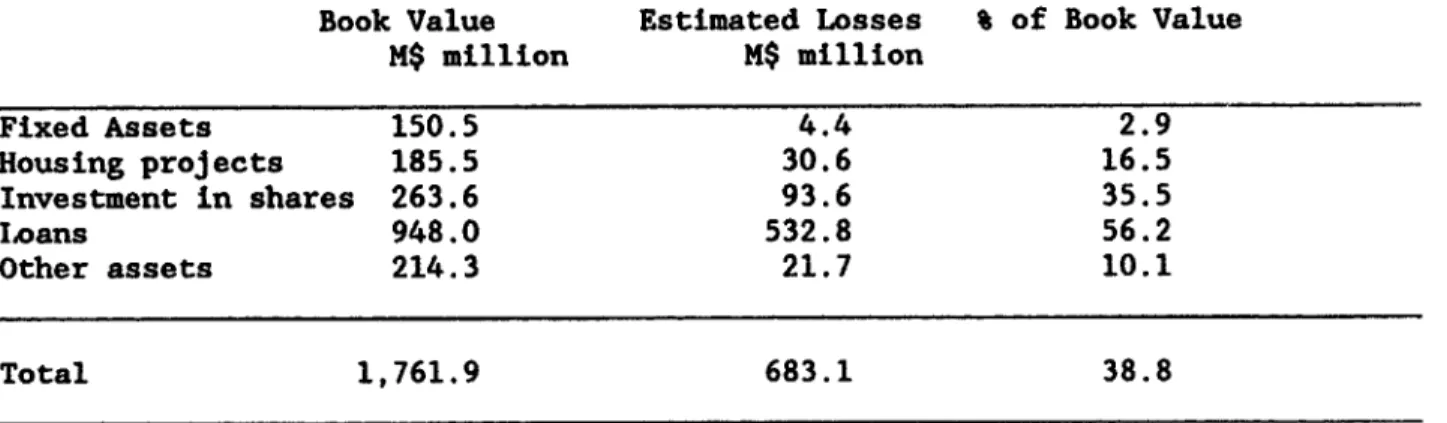
23. With no conventional legal powers and administrative machinery to cope with the crisis, the Government promulgated the Essential (Protection of Depositors) Regulations 1986 under the Emergency Act on July 23, 1986 in order to empower the Central Bank to freeze the assets of Kosatu and its principal officers, to impound their passports and conduct an investigation. However, contagion spread quickly from Kosatu to the other DTCs, which quickly ran out of funds to meet deposit withdrawals. As matters reached crisis point, the Government had to direct the Central Bank on August 5 to suspend and investigate these 23 DTCs. 24. The investigation, which mobilized 17 accounting firms to do the work in conjunction with Central Bank examination teams, found that the 24 DTCs in distress had 522,000 members, 630 branches and total deposits of M$1.5 billion. Twenty-one of the DTCs were found to be insolvent, with losses totalling an estimated M$683 million or 38.8% of total assets. Although the position varied from DTC to DTC, on the average, a DTC depositor would have lost at least 42 sen out of every M$l deposited (Table 5). The DTCs were also illiquid, since many of them did not maintain the minimum liquidity ratio of 25% of deposits and were in no position to meet significant deposit withdrawals. The problems were compounded by gross mismanagement, including over-investment in land and property, lack of control over loss-making subsidiaries, widespread speculation in shares, imprudent lending to directors and interested parties, fraudulent misappropriation of funds, criminal breach of trust and many conflicts of interest situations. Based upon the investigation results, Bank Negara reported nine cases of fraud and 21 cases of conflicts of interest and technical offenses to the police. Many court cases are still pending.
25. The investigations also revealed numerous instances of blatant disregard for rules and regulations. By opening branches freely (often without permission) and offering higher deposit rates and attractive commission schemes for their branch staff to collect deposits, the DTCs were engaged in a vicious cycle of Ponzi financing, borrowing from new depositors to meet deposit withdrawals and interest payments and to cover the mounting losses. Their fundamental structure was flawed with gross under-capitalization, and over-commitment in long-term and speculative assets, funded by short-term deposits. The lack of trust-worthy and. prudent management, together with under-capitalization and weak supervision, was a formula for disaster.
- 15
-26. Almost all the DTCs were affected by the recession. The apex co-operative to the DTCs, the Co-operative Central Bank (CCB) with 363,749 members and total deposits of M$1.5 billion, also began to face problems of non-performing loans. The 1987 audited accounts of CCB showed accumulated losses of over M$726 million, and a capital deficiency of M$652 million. The CCB was put into receivership and the Government made available a standby facility of M$323 million to help its liquidity needs. By the end of 1987, Bank Negara had 32 DTCs under its investigation or supervision, involving total deposits of M$3.1 billion or an estimated 77% of the total deposits of the 38 identified DTCs (35 original DTCs and three in Sabah) in the country.
27. Amongst the non-bank financial intermediaries, the insurance industry was also not spared from the ravages of the recession. In the financial year ended 1986, 14 out of 61 insurance companies did not comply with the minimum solvency requirement of 20% of their net premium income. Inspection findings of the Office of the Director-General of Insurance revealed that solvency problems had been compounded by the underprovisioning of outstanding claims reserves, bad debts from poor agency collection and falls in value of investments in quoted securities and landed properties. To co-ordinate supervision of the financial system as a whole, the duties and responsibilities of the Director-General of Insurance, previously a department of the Treasury, were transferred to the Central Bank with effect from April 1, 1988.
PART 3: ISSUES AND RESOLUTION
3.1 Approach towards ailing financial institutions 28. Financial stress
arising from a sudden Malaysia: Real interest rate
downward shift in relative Sim _W
prices causes fundamentally a shrinking of enterprise
balance sheets. This s
contraction occurs primarily _
through a reduced cash flow 7
and deterioration in the
I\
profit and loss account.Initially, enterprises which , /\ were not able to adjust their a\
expenditure to the shortfall 2\
in income begin to suffer
large operating losses. In
-I1A
addition, they may also 56 49s" is,= 1auu9 lis .u, . i,
suffer substantial capital +
a
n r"Mtlosses, since forced disposal
of assets in order to realize Figure 6 cash, arising from a
liquidity crisis often leads to a solvency crisis. Faced
with survival problems, many cash-strapped enterprises engaged in "distress borrowing", paying exceptionally high rates for funds just to meet temporary
liquidity shortfalls. In 1985, the real rate of borrowing had risen to an unprecedented 11.8% per annum, compared with only 2-3% per annum in 1981 (Figure
6).
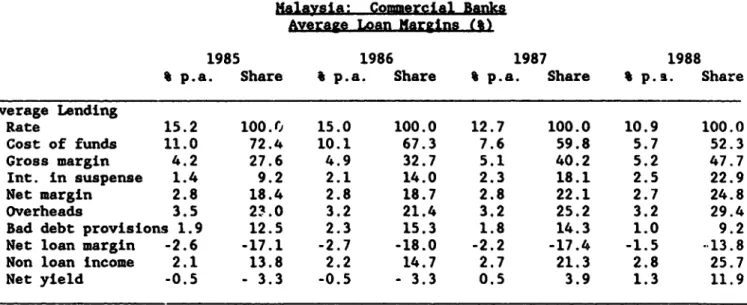
29. An interesting point to note is that while distressed borrowers were forced to pay high real interest rates in their demand for funds, the banking system was generally unwilling to reduce lending rates even when general liquidity improved and deposit rates began to fall. Between 1985 to 1988, the gross interest margin of the banks actually rose from 4.2% to 5.2 percentage points (Table 4). The reason was simply that the banks tried to maintain high lending rates, since they were either not collecting interest from their non-performing loans due to the interest-in-suspense, or they were forced to recover lost profits due to higher provisions for bad debts. They therefore maintained lower deposit rates and high nominal lending rates, so that the depositors and even good borrowers had to "subsidize" the banks' losses in the non-performing loans. At the micro-level, this was good for tne banking system, since the banks would be able to recover profitability sooner through higher spreads and loan margins. However, at the macro-policy level, high real lending rates were felt to be deterring new investments in the economy to aid the recovery process, while the continued low deposit rates was encouraging disintermediation in the banking system, as depositors shifted out of bank deposits into other assets. Accordingly, in order to ensure that the benefits of lower deposit rates could be "passed through" to the borrowers, the Central Bank had to "moral suade" the banks to reduce their interest rate margins. The banks were urged to achieve profitability and moderate loans margins through reductions in their operating costs. In other words, the banks had to reduce significantly their costs of intermediation.
30. A second factor to consider was the institutional premise that the Central Bank was established as a lender of last resort only to the banking system, to provide liquidity in times of stress. However, since Bank Negara was prevented by law from providing these facilities to institutions not under its charge, there was the danger that conta&ton from failing unsupervised financial institutions could spread to the monetary sector, i.e. the licensed banks and finance companies. It was clear therefore that a financial safety net is only as strong as its weakest link. Firstly, weaknesses in the less regulated or unregulated sectors in the financial system could pose a threat to the stability
in the regulated sector through contagion. Secondly, the sharp fluctuation in the commodity prices, share and property prices had subjected parts of the financial system to stresses and strains they were never designed to absorb. Thirdly, the uneven quality of assets, management, capital base and supervision within the financial system, including the informal sector, meant that an unco-ordinated supervisory mechanism cannot cope with shocks emanating from the recession. A legal framework which clearly delineates supervisory powers and the administrative capacity to deal with future financial stresses had to be built.
31. Another key issue faced by Bank Negara in the wake of the significant number of sporadic runs against branches of financial institutions was whether a deposit insurance scheme was necessary. Bank Negara evaluated the feasibility of establishing a deposit insurance scheme to cover small deposits which would
- 17
-serve the purpose of keeping the small depositors at bay whenever news of instability befalls any deposit-taking institution. However, a major disadvantage was that the burden on deposit insurance premium would fall unevenly between the weaker and smaller institutions on the one hand and the larger and stronger banks and financial institutions on the other. Moreover, deposit insurance carries the inherent danger of "moral hazard", whereby bank management could be encouraged to take undue risks in their management of assets, since the fear of runs against deposit liabilities is removed. Consequently, on balance, it was considered not timely to launch the scheme.
32. The bank restructuring exercise was approached essentially from twc fronts: monetary and regulatory. Both objectives were however, sometimes contradictory. Tighter monetary policy by raising interest rates had the effect of worsening the non-performing loans of the banking system, as private sector borrowers could not service the b ,h real interest rates from current cash-flow. On the other hand, institutio-al adjustments at the micro level could not be achieved without macro-economic changes, both in terms of monetary policy as well as regulatory laws and guidelines. A top priority in monetary policy was to ease the contractionary effects of fiscal retrenchment and the deterioration in the balance of payments. However, the Bank had considerable difficul-y in reducing
the abnormally high real rates of interest, even when deposit rates fell when liquidity recovered with improvements in the balance of payments in 1987. This was because of the reluctance of the banking system to reduce lending rates, due to their large over-hang of non-performing loans. The Bank had to make major amendments to meet both objectives, including the deregulation of some prudential/monetary regulations in order to promote greater efficiency in the banking industry.
3.2 Monetary and Prudential Measures 1985/86
33. In 1985/6, Bank Negara introduced a series of monetary and policy measures designed to address the macro-economic impact of the recession on the banking system. These included an extensive reform of the Bank's export credit refinancing scheme to promote exports, the creation of a M$l billion New Investments Fund to shift bank lending out of real estate to the productive (tradeables) sectors of agriculture, manufacturing, and tourism, and a reduction in the liquidity and statutory reserve ratios of the commercial banks to lower their effective cost of funds. The Bank also introduced a more flexible interest rate regime by freeing deposit rates, and encouraged the establishment of a secondary mortgage market to securitize long-term housing loans. Of key macroeconomic importance was the move to allow the currency to find its own level in the foreign exchange market, with only some intervention to stabilize sporadic speculative bouts.
34. At the same time that macro-economic adjustments were taking place in fiscal, monetary and exchange rate policies, and realizing that the adjustment process would begin to place considerable pressure on the banking system, the Central Bank also put into place in 1985/86 a number of regulatory changes designed to strengthen the structure of the banking system and its own regulatory
powers to prevent and control damage arising from the recession. These included key changes to the bankitg laws and regulations to achieve the following:
(i) Introduction of the minimum capital adequacy requirements to be maintained by the commercial banks, which had the effect of raising the average capital ratio of Malaysian banks from 7.4% of total assets at the end of 1984 to 8.1% at the end of 1987.
(ii) Dispersion in the ownership of financial institutions, by limiting the maximum holding of individuals, including family holding companies, in the equity of a financial institution to 10%, while any company or co-operative may not hold more than 20%.
(iii) Introduction of penalties to prevent abuses of authority in the bank lenc.ing process.
(iv) Powers to the Central Bank to lend against shares of, and purchase equity in, ailing financial institutions, to enable the Bank, in the event of insolvency or illiquidity of a bank or finance company, to lend or to inject additional equity quickly into the problem
institution;
(v) Restriction of bank credit to single customers to not more than 30% of shareholders' funds, to prevent the over-concentration of loans
in any particular sector or customer.
(vi) Prohibition of lending to directors and staff of banks and finance companies to prevent conflicts of interest and abuses.
(vii) Introduction of guidelines on suspension of interest on non-performing loans and provisions on bad and doubtful debts to ensure that the financial community followed sound, consistent and prudent lending policies, and to standardize the accounting treatment of income from overdue loans and provisions.
(viii) Establishment of board audit and examination committees, to reiiforce the boards' supervision of bank management over the day-to-day affairs of the banks.
(ix) Establishment of a Central Credit Bureau to monitor and improve credit information on bank and finance company customers on a consolidated basis.
(x) Improved statistical reporting to the Central Bank, such as regular reporting on size of non-performing loans, exposures to share and property financing, loan margins and bank productivity, through computerized data input.
(xi) Improved on-site bank examination capability, by strengthening the bank examination staff force and conducting more frequent bank examinations.
- 19
-35. A key legislative move to overcome the deficiencies of the existing bank legislation to combat illegal deposit-taking activities and to allow the Central Bank to act quickly in an emergency, was the promulgation of the Essential Regulations in July 1986, which empowered the Bank to:
(i) investigate the affairs of any deposit-taker, including the power to enter and search any office or place of business; compel the production and retention of accounts, books and document;
interrogate on oath or affirmation; and detain persons pending the completion of a search or interrogation.
(ii) order to freeze property and restrict departure from Malaysia, including the impounding of passports;
(iii) require the person to cease deposit-taking and refund the deposits -aken;
(iv) assume control of and carry on the business of the deposit-taker or appoint someone to do so;
(v) apply to the High Court to appoint a receiver to manage the affairs and property of the deposit-taker;
(vi) petition the High Court to wind-up the illegal deposit taker. To protect the public in the exercise of these wide powers, the Central Bank has to seek and abide by the advice of an Advisory Panel, comprising representatives of the private sector, the Chairman of the Association of Banks, the Treasury and the Attorney-General.
3.3 Modus Operandi of Rescue Packages
36. In assessing financial institutions, central banks the world over apply the famous CAMEL test, involving the assessment of capital adequacy, asset quality, management quality, earnings capacity, and liquidity. The experience of Bank Negara in the area of rescuing ailing financial institutions is that, except in the case of the DTCs, liguiditv has never been a major problem with ailing financial institutions, since they could easily borrow funds from the inter-bank market or raise interest rates to attract funds to meet immediate liquidity needs. Two elements were however vital: capital and management. Adequate capital without good management is not sufficient to prevent losses. On the other hand, the best management cannot turn around an ailing institution if it does not have adequate capital. The first priority of any rescue plan is to restore operating profits, and this implies sufficient capital to:
(a) cover all contingent and realized losses from assets revaluation, including non-performing loans; and
37. A rule of thumb to test the viability of financial institutions is that non-income earning assets must be supported by non-interest bearing liabilities.
The ailing financial institution should therefore be provided sufficient new funds to generate income to service its overheads and deposit liabilities. Inevitably, the rescue process involves four key processes - investigation and identification of the scope and depth of the losses; determination of the capital or new funds required to put the institution on a sound footing; the evaluation of various options, particularly in terms of who should foot the bill; and finally, the appointment of the right calibre persons to run the revamped institution.
3.4 Options for Rescue
38. The options available to rescue ailing financial institutions are generally as follows:
(a) Change of management
(b) Defer losses by staggering provisions, so as not to show large losses;
(c) Provide soft loans to subsidize operations;
(d) Buy out of non-performing loans by another institution; (e) Injecting new capital:
(i) by existing shareholders (ii) by new shareholders
(iii) by regulatory authorities;
(f) merger or absorption by stronger institutions; and (g) liquidation
39. Option (a) is a vital pre-condition in any rescue plan. Not only is the competence of management at stake, but the credibility of management with staff, creditors, depositors and the regulatory authority is vital to the success of any rescue plan. Retaining old management of ailing institutions to manage affairs was like "leaving monkeys to look after bananas". The losses would inevitably escalate as existing management had every incentive to cover up their mistakes (and misdeeds) and to siphon off funds before they were detected. The choice of the other options depended on the prompt recognition of the extent of the losses, the apportionment of the losses to the shareholders, depositors, other creditors or the government (directly through grants and subsidies) or
indirectly through soft loans and aid through the central bank. The question of burden sharing lies at the heart of the bank restructuring exercise.
- 21
-40. In the light of the prevailing circumstances, and given the budgetary constraint of the Government during a period of high fiscal deficits, it was decided that the matter of ailing financial institutions should be addressed head on with the Central Bank shouldering the brunt of the burden of the investigation, diagnosis of problems, evaluation and execution of the rescue plans, as well as its funding.
3.5 The Rescue of the Problem Banks
41. In general, the stance of the Central Bank in a rescue package was as follows:
Firstly: to require the ailing institutions to recognize all losses and interest in suspense immediately, rather than attempting to stagger such losses by deferring the problem;
Secondly: to change management, by first revamping the Board of Directors and then appointing tested professionals to serve as chief executives, and thereafter to give more or less full discretion
to the appointed Board to do whatever is necessary to stem the losses and turn around the institutions,
Thirdly: to require existing shareholders to inject as much capital as possible through a rights issue, and to supplement such capital
required to meet the minimum capital adequacy requirements through the Central Bank; and
Finally: to tighten reporting requirements of the ailing institution in "intensive care" to the Central Bank through regular reviews and discussion, including follow-up inspections.
42. The problems of the three ailing banks in which Bank Negara subsequently injected capital emerged from the inspections on these banks for the 1985 financial year. In all three cases, there was initially considerable bank management and shareholder resistance to recognizing immediately the enormity of the existing problems. Once it was clear that the problems were beyond the capability of existing management and shareholders to resolve, the Central Bank assumed control and appointed new directors and chief executives to undertake a thorough review of the depth and scope of the problems. In all three cases, rights issues were called and the Central Bank took up the shortfall in rights. Of the total losses of the three banks in 1985/86, amounting to $1,203 million, the existing shareholders injected $159 million in rights issues, Bank Negara injected $672 million, and the balance was met through subordinated loans of $401 million (Table 6).
43. The shares subscribed by Bank Negare are held in trust for disposal later under a buy-back scheme, whereby those shareholders who participate in the scheme would be allowed to buy back their unsubscribed shares at par plus holding cost. 3.6 The Rescue of the 24 DTCs
44. Following the freeze and investigations of the 24 ailing DTCs in July/ August 1986, pressures began to mount for a quick rescue plan. Emotions became highly charged as over 522,000 defpositors (out of a population of 16.5 million) and approximately M$1.5 billion in deposits were involved. To assess public opinion on an appropriate rescue scheme, the Government appointed a Special Action Committee on Co-operatives (ACC), chaired by Bank Negara, with representatives from the Government and private sector. The depositors expressed very strong views that their deposits should be guaranteed in full by the Government as a matter of legal and moral responsibility. The depositors also objected strongly to the conversion of their deposits into equity and also demanded prompt legal action against the DTC staff responsible for mismanagement, fraud and criminal breach of trust.
45. The task of the ACC was to find an appropriate restructuring plan that would be acceptable to all. Amongst the options studied was a preliminary plan (loosely referred to as the 25:25:50 solution), which involved the payment of up to 25% of deposits in cash immediately, a further 25% in two year deposits at a maximum of 6% per annum interest and the balance converted into equity. This scheme was designed as a general framework to restructure the co-operatives, but was rejected when it was prematurely leaked to the press.
46. The ACC also considered other options available including:
(i) Place all 24 DTCs under liguidation. This was rejected as forced selling would increase the losses of the DTCs.
(ii) Exchange deposits for unit trusts (to help depositor liquidity). This was rejected as not all depositors would agree to a conversion, and most of the DTC assets could not qualify as trustee assets under the law.
(iii) Conversion of deRosits into shares of a public company. The transfer of DTC assets and liabilities into a public company would result in the transfer of the losses to the public company. Such a company could not be listed under existing equity flotation guidelines. (iv) Merging several DTCs into one apex co-operative bank would mean
transferring the losses of the DTCs into a single institution. Merging different managements and staff of different DTCs would also compound the problems of rehabilitation.
(v) Full Government guarantee of deposits. This would imply that the Government must be prepared to inject cash of $1.5 billion ultimately, and bear losses of nearly $700 million. Under the prevailing conditic.ns of financial stringency and fiscal restraint, the Government was not able to bear such large losses.
47. The ACC recognized the enormous complexity of the problems since the capital deficiency was at least $680 million and that any rescue vehicle would be faced with a mire of legal suits which could jeopardize any rescue scheme. After studying various options, the Committee recommended a tnree-stage approach.
- 23
-For those DTCs whose net asset backing of each $1 of deposit was close to $1, the Government should invite a number of strong banks or finance companies to assume their deposit liabilities and the attendant assets. To assist the rescue package, Bank Negara should provide soft loans to meet the liquidity needs of
the banks and finance companies concerned. For those DTCs with large losses, the depositors should be offered a combination of cash and equity or convertible bonds.
48. The Government White Paper on the DTCs published in November 1986 adopted most of the recommendations of the ACC. As a matter of principle, the public should not be responsible for the large losses arising from the bad management of the co-operatives. The depositors would be able to receive the amount of their deposits in proportion to the net asset backing of their respective DTC. To help the reconstruction process, all rescue schemes which involved debt/equity conversion for the depositors would be based on the due process of law as approved by the courts.
49. The Government also decided to change th.- co-operative laws to limit co-operatives to take only specific deposits from their members, such as for housing and education, and not savings and fixed deposits. The 24 DTCs would be placed under Bank Negara's supervision until all the soft loans have been repaid. To prevent law suits from creditors or depositors from jeopardizing the whole rescue package, receivers from accounting firms were appointed by the High Court to manage the assets of the 24 DTCs. The High Court also determined the ranking of payment to unsecured creditors, such as salaries and wages, legal fees and essential services.
50. The White Paper revealed that the 24 DTCs had invested nearly half of their total assets in connected lending or investments in subsidiaries and related companies and other shares. One fifth of total assets was tied up in land, property and housing. Another fifth was in loans to the co-operative members, while only 9% as at the date of the freeze was in cash and liquid assets, due mainly to large scale deposit withdrawals during the run period.
51. The net assets available for distribution, after provisions suggested by the accountants of M$673 million, was M$890 million. This irDlied that the co-operatives had a total capital deficiency of M$601 million. After providing for secured loans and other creditors, the net asset value Rer S1 deposit for each DTC was estimated to range from 19 sen to as much as M$1.00.
52. The final rescue package was carried out in three stages. Stage One involved the "de-freezing" of the deposits of 11 co-operatives which had relatively small capital deficiencies. In January 1987, 11 DTCs (each of which had net asset backing per ringgit of deposits of close to M$l) received soft loans from the Central Bank, and reached agreement with their appointed banks or finance companies to take over their assets and liabilities, with full payment in cash to be made to all depositors over periods of up to five years without interest. These 11 DTCs had total deposits of M$l91 million from 85,000 depositors.
53. Stage Two of the rescue plan involved the group of 12 DTCs with moderate to heavy losses (which, on the whole, had an average asset backing of 39 sen per M$l depositors). The scheme provided for a $1 for $1 return to all depositors through a combination of cash and equity, of which the cash component would be at least 50% of the deposits, while the balance would be converted into equity in a licensed financial institution which would absorb all the assets and liabilities of the 12 DTCs. In December 1987, an amendment to Section 31 of the Central Bank of Malaysia Ordinance, 1958, permitted the Central Bank to acquire equity in a finance company and to utilize it as a rescue vehicle under a Government-approved scheme for the depositors.
54. Accordingly, the Central Bank acquired a small ailing licensed finance company, renamed it Kewangan Usahasama Makmur Berhad or KUMB, which in turn acquired the net assets and deposit liabilities of these 13 DTCs from their receivers. The 13 DTC depositors would be refunded in full through a combination of cash and equity depending on the net asset backing of each DTC, the minimum cash refund (over a period up to December 1989) being not less than 50%. The balance of the refund would comprise ordinary shares of M$1 each in KUMB. As soon as these shares become eligible for public listing, the intention is for KUMB to float its shares, so that the depositors stand to gain in capital appreciation if the share prices rise on flotation.
55. Stage three involved the largest of the DTCs, namely Koperatif Serbaguna Malaysia (KSM), which had deposits of $549 million and 166,000 depositors with an asset backing of about 50 sen per M$1 deposited. The Government accepted the proposal by Magnum Corporation Berhad (MCB), a large public-listed company, and its licensed finance company subsidiary, Magnum Finance Berhad (MFB) to take over the net assets and deposit liabilities of KSM, which had indirect interests in MCB. Depositors of KSM would be repaid in full on a 50:50 basis, with 50% paid in cash in stages from 1987 to 1989, with the remaining 50% repaid initially in the form of irredeemable convertible unsecured loan stocks of MCB, at a price to be determined. The loan stock would be non-interest bearing for the first two years, and would be convertible into MCB ordinary shares at a predetermined rate over 2 years from 1989-91.
56. To enable the DTC rescue schemes to work, the Central Bank would provide, in the final analysis, M$720 million in soft loans at 1% per annum, plus M$280 million in commercial loans at 4% per annum for a term of 10 years, to the rescuing financial institutions to implement the rescue schemes for the failed DTCs. Altogether, the rescue of the 24 DTCs involving deposits of M$1.5 billion, required M$1 billion in loans from the Bank as well as M$23.4 million in professional fees incurred in the investigations and receivership.
57. With respect to the persons responsible for the mismanagement of funds of the DTCs, 22 directors of eight DTCs were charged in court. Of these, four were found guilty and sentenced to jail, while the remaining are still awaiting trial. PART 4: EVALUATION
- 25
-58. The prompt action taken by Bank Negara to step in to intervene in the management and capital injection of the three ailing banks and the announcement of the rescue plans for the 24 DTCs during the course of 1987 and early 1988 had stabilized public confidence in the financial system and avoided the dangers of contagion spreading, at a time when the economy was in the trough of the recession. By the fourth quarter of 1986, commodity prices began an upturn, leading to an immediate injection of liquidity into the banking system from growing export income. As it turned out, 1987 proved to be a year of strong recovery, with GDP growing by 5.2% in real terms. The terms of trade improved by 12.4% and the current account in the balance payments recorded in 1987 a M$6.4 billion surplus or 8.6% of GNP, with gross external, reserves rising to M$19.4 billion or 7.4 months of retained imports. Although the budget of the Federal Government remained in deficit, despite continued retrenchment of development expenditure, the financing deficit of the Federal Government was reduced sharply
to 5.6% of GNP by 1988, allowing the Government to prepay over M$4 billion of its external debts. By 1989, the national external debt had fallen sharply to M$42 billion or 43.9% of GNP as against 76.1% in 1986. Clearly, the structural adjustment programme was beginning to yield results.
59. In 1988, the economy continued to rebound with vigour, with real GDP growth of 8.1%. With the depreciation of the ringgit, the terms of trade improved by
12.4% in 1987, while export proceeds jumped by 24.6% in 1987 and 21.3% in 1988. As confidence revived, the KLSE market capitalization rose by 45% from the treugh just after the October 19, 1987 crash to a recent peak of M$101.9 million on August 9, 1988. Similarly, property prices began to firm with strong sales in low-cost housing in urban centers and revival in commercial prope ty prices from the trough of M$180 per sq. ft. in 1986 to M$279 psf in early 1989. The reflation in asset prices and erterprise cash flow had their beneficial impact on bank profitability. Preliminary unaudited data on bank profits revealed a rebound in pre-tax profits to M$794 million in 1988, compared with M$125 million in 1987, as bad debt provisions fell by 28.1%. Most of the recovery was in the write-back of provisions for non-performing loans, amounting to M$828 million
in 1988, or nearly double the amount in the previous year.
60. Given the improvement in the banking environment, a radical switch in approach to the problem of non-performing loans was made when the focus of loan rehabilitation was switched from the bank level to the enterprise level. The Central Bank established a M$500 million Enterprise Rehabilitation Fund in 1988, aimed at reducing the overhang of stalled projects and non-performing loans. The Fund, financed by Bank Negara and managed by a development bank, would provide seed capital to recession-hit Bumiputera (indigenous) enterprises which have been found to be fundamentally viable. The projects would be co-financed with the existing lenders, which would provide additional working capital for the turnaround enterprises. Specialist Turnaround Groups, comprising leading professionals in the fields of manufacturing, trading, agriculture and property, would evaluate the viability of eligible enterprises for recommendation for assistance under the Fund.
61. It may still be too premature to evaluate objectively the results of the bank restructuring exercise for the DTCs, and ailing banks and finance companies. In the case of the 24 DTCs, 11 DTCs had already been resolved, with the refund
of their deposits assured, while 12 others with weaker asset backing havo been absorbed into a single licensed finance company, KUMB. The licensed finance company has been restructured with a strong Board and new management and is busily engaged in the taking over of assets of the 12 DTCs. The three problem banks have since turned around from a combined audited pre-tax loss of M$679 million in 1986 to a preliminary combined unaudited profit of M$71 million in 1988. The capital restructuring programme for the four finance companies is on-going, but the losses have been stemmed. Some of them may be absorbed into larger and more efficient banks or finance companies. While there remain pockets of unresolved problem areas in the financial institutions, especially among the smaller finance companies, on the whole, the "Malaysian banking _.ctor has regained health, and concern that the system would collapse has faded" (Asian Wall Street Journal - May 1989).
4.2 Losses and costs
62. In summary, the sharp deflation in the Malaysian economy in 1985/86 manifested itself in large losses by various financial institutions. It was most evident amongst 4 of the 3P commercial banks, 4 of the 47 finance companies and 32 deposit-taking co-opei 'ives, as well as 33 illegal deposit taking institutions. The DTIs in ti.. informal sector were relatively small in number and size, accounting for less than 8,000 depositors and M$46 million in deposits. The impact on the 4 banks, 4 finance companies and 32 DTCs which came directly under the control of Bank Negara was much larger. These institutions had
together total deposits of M$9.4 billion, comprising M$6 billion for the four commercial banks and four finance companies and M$3.4 billion for the 32 DTCs, which would comprise in sum 10.4% of total deposits of M$90 billion of the financial system at the end of 1986. In aggregate, these 40 institutions lost between 1985/87 about M$3.1 billion, comprising M$1.7 billion in the case of the banks and finance companies and M$1.4 billion in the case of the DTCs. These losses were equival]nt to 4.7% of GNP in 1986. It is interesting to note that losses in the banking sector, which was tightly supervised by the Central Bank, incurred losses amounting to 2.4% of total deposits in 1986, while losses in the lightly supervised DTC sector were as high as 40% of total deposits.
63. The rescue operations for these institutions have been costly, comprising M$1.3 billion in equity (M$672 million from Bank Negara for the three banks, and M$592 million conversion of DTC deposits into equity) and at least M$1.3 billion
in assistance loans (comprising M$l billion from Bank Negara for the 24 DTCs and M$323 million from the Government for CCB). Not all these aid funds could be considered lost. Over time, with the sustained recovery of property prices, and a turnaround in operations, the equity component and a large part of the loans have a fair chance of being recovered.
64. The key lessons from the financial adjustment package in Malaysia may be broadly summarized as follows:
(1): Prompt action has to be taken decisively and immediately to address all problem areas in ailing financial institutions. The need to determine fairly accurately the extent of the damage and to address the problems of capital adequacy and competent management, must be
- 27
-tackled with the greatest urgency. Failure to admit the size of the problems or delays in the resolution of these issues almost always
compounded the problems and the costs involved;
(2): Problems in ailing financial institutions had generally been worse than they appeared at first sight. Only in very few examples had the reverse been shown to be true. This occurred mainly because of the problems of transRarency. Many ailing financial institutions management were reluctant to recognize and report an accurate picture
to the regulatory authorities once they begin to face a deterioration in their performance. It takes a brave bank chairman to admit and pin down the true extent of the damage and recommend the necessary
dosage of medicine required;
(3): The importance of additional equity capital has proved to be vital in any rescue package. Non-performing loans can only be supported by non-interest bearing capital. Lending high interest loans to tide
over liquidity problems for an insolvent institution is pouring good money after bad. Without adequate capital and setting the gearing into the right levels, the strongest of management would have difficulty in turning around ailing institutions;
(4): For both the supervisory authorities and bank management, there is an urgent and important need to develop efficient and accurate reporting systems which can detect the true financial position of the financial institutions, including exposure to different types of risks. It is no longer sufficient to monitor institutions based purely on traditional balance sheet ratios. It is more important today to monitor frequently, sometimes on a month-to-month basis and in certain operations, on a daily basis, the profit and loss account of the financial institutions in order to pin-point the structural weaknesses in these institutions and their exposures to various risks;
(5): Prevention is better than the cure, as financial rescues are costly affairs. Devoting more resources to regular inspections and accurate monitoring would in the long run still be cheaper than rescue funding. As had been demonstrated in the case of the DTCS, light supervision without lender of last resort capabilities can result in large losses. However, as noted earlier, in an economy-wide deflation of asset prices, it is not possible to avoid losses completely;
(6): The process of financial institution supervision has to evolve with the times, as the lines of business demarcation in banking had become more blurred with competition, technological improvements and internationalization. The supervisory authorities have to monitor ..C't just the traditional monetary institutions, but also their inter-relationships with the capital market, rural deposit institutions, development banks and other financial institutions. In other words, the financial safety net, traditionally designed for the monetary
sector only, may have to be widened and strengthened. The credit information in all se_..tors have to be pooled in order to have a good early warning system of problem areas. There are substantial economies of scale to be gained in coordination and pooling of resources in the supervision of financial institutions;
(7): Traditional banking laws and regulations must also change with the times. As technology evolves, the transmission of shocks within the system accelerates through the payments meclanism, while the scope for insider trading, and white collar bank fraud and theft increases rapidly. The banking laws must therefore change to give scope for greater competition in financial products, while tightening prudenti&l regulation against abuses of the system. At the same time,
laws relating to bankruptcy (exit of enterprises) should be reformed to expedite and reduce the costs of bank restructuring. In June 1989, a new Banking and Financial Institutions Bill was tabled before Parliament to address these issues, including powers to the Central Bank to act quickly in future instances of financial distress in all
sectors of the financial system;
(8): With greater internationalization, regulatory supervision over financial institutions not only have to be coordinated among sectors within an economy, but also internationally. The work of the Basle
Committee is to be commended in this area;
(9): In the last analysis, after capital and proper control procedures have been put in place, the key to sound and healthy financial institutions still lies fundamentally in good quality management. Improved internal controls and procedures, penalties against breaches of the law, code of ethics and Chinese walls are still insufficient to deter insider trading, conflict of interests and lending to interested parties, where large sums of money are involved. The temptations in financial institutions are great. Fraud in management must be detected promptly, and must be cut out early so that better
procedures and professional competent and trustworthy management can be put into place as soon as possible;
(10): Finally, the bank restructuring exercise could only be achieved against the background of firm structural adjustment in the macro-economic environment. The twin beneficial effects of fiscal retrenchment and depreciation of the currency brought a broad-based economic recovery, which assisted the bank restructuring process. Without the recovery of underlying enterprise profitability, a high
level of national savings and adequate foreign exchange reserves to cushion the system against shocks, the bank restructuring process would have been much more protracted and difficult. The political will and financial discipline to address the looming twin deficits in the balance of payments and the public sector were vital ingredients of the recovery program.