
Conational Drivers Influencing Brand Preference among Consumers
35
0
0
Full text
(2) Abstract Consumers recognize brands by building favorable attitude towards them and through the purchase decision process. Brand preference is understood as a measure of brand loyalty in which a consumer exercises his decision to choose a particular brand in presence of competing brands. This study aims at discussing the cognitive factors that determine brand preference among consumers based on empirical research. Brand attributes including emotions, attitudes, personality, image, reputation and trust which influence consumer perceptions and temporal association with brands are critically examined in the study. The study reveals that higher brand relevance and trust build strong the association of consumers with brand in long-run.. 2.
(3) Conational Drivers Influencing Brand Preference among Consumers Introduction Individual and cultural attributes of consumers are vital to the strategy of any brand that converge consumers’ personality traits with the underlying brand propositions. These factors also add enormous value to the functional orientation of a brand. The synergy of personality traits of consumers, cultural value, brand identity effect, and functional utility of brand helps developing powerful strategy for successful brands (Kumar et al, 2007). Brand personality traits provide symbolic meaning or emotional value that can contribute to consumers’ brand preferences and can be more enduring than functional attributes. Successfully positioning a brand’s personality within a product category requires measurement models that are able to disentangle a brand’s unique personality traits from the characteristics common to all brands in the product category. Consumers perceive the brand on dimensions that typically capture a person’s personality, and extend that to the domain of brands (Rajagopal and Sanchez, 2004). The dimensions of brand personality are defined by extending the dimensions of human personality to the domain of brands. One way to conceptualize and measure human personality is the trait approach, which states that personality is a set of traits (Anderson and Robin, 1986).. Most of the multinational brands focus on growing the lifetime value of their consumers and global brands are built in reference to consumer preferences concerning buying decisions and corporate accountability. Such overwhelming focus on growing brand equity is inconsistent with the goal of growing consumer equity that emerges from the personality traits of consumers and brand identity. Consumers perceive the brand on dimensions that typically capture a person’s personality, and extend that to the domain of brands. The dimensions of brand personality are defined by extending the dimensions of human personality to the domain of brands (Rajagopal, 2008). Consumers have only one image of a brand, created by deployment of the brand assets at their disposal: name, tradition, packaging, advertising, promotion posture, pricing, trade acceptance, sales force discipline, consumer satisfaction, repurchases patterns, etc. Clearly, some brand assets are more important to product marketers than service marketers, and vice versa. Some. 3.
(4) competitive environments put more of a premium on certain assets as well. In the times of globalization consumer-centered brands, a skilled sales force, strong consumer relationships, and open organizational designs contribute to the business growth of the firm, and consumer value. Effective communication, new product development, and distribution contribute to a brand’s long-term fitness and the consumer orientation (Lev, 2004).. This study aims at discussing the cognitive factors that determine brand preference among consumers based on empirical research. Brand attributes including emotions, attitudes, personality, image, reputation and trust which influence consumer perceptions and temporal association with brands are critically examined in the study. This study also investigates the relationship between the brand personality and consumer perception on brand recognition influencing the buying behavior of consumers. Also this study seeks to develop a better understanding of how various factors influence brand perceptions among Hispanic consumers in Latin America.. Review of Literature and Hypotheses. Behavioral Drivers. The concepts of image and reputation have been increasingly emphasized in the fields of public relations and marketing. It is argued that consumer creativity; identification with the brand community, and brand-specific emotions and attitudes including personality, image, reputation and trust (PIRT) attributes drive the brand passion among consumers. In this process brand knowledge is also considered as an. important determinant of. consumers' willingness to share their knowledge with the fellow consumers and firms (Füller et al, 2008). Corporate PIRT factors of brand personality develop interrelationship between personality and trust (PT) in reference to consumers and image and reputation (IR) in the context of corporate branding. Trust on brand is considered a key aspect of brand relationships, brand personality and brand equity. Accordingly, PT dimensions at marketing level comprise functional, emotional and symbolic brand benefits while IR. 4.
(5) dimensions include corporate activities, corporate associations, organizational values, and corporate personality while corporate values, corporate brand personality and functional consumer benefits are the most critical and consistent predictors of both attitudinal and behavioral loyalty (Anisimova, 2007). Previous researches have established that there is a close relationship between the brand attributes and the corporate brand image concerning the emotional values. This relationship in turn influences the consumer's responses towards building brand loyalty (e.g. Silva and Alwi, 2006).. Perceived attractiveness of products, firms and retail stores significantly influences the consumer-brand relationship development process in meaningful and predictable ways. Owning a brand by consumers, influence their opinion of the desirability of the brand as a relationship partner. The quality connection between personality traits and brand association depends on the perceived attractiveness of the brand to a large extent. However, the role of attractiveness in the relationship varies across individual brand personality dimensions (Hayes et al, 2006). There is a significant positive relationship between brand trust and brand share in the competitive marketplace. It is also observed that relationship between brand strength which is determined as the degree of behavioral relevance of the brand and brand trust catalyzes the consumer association with brands in the long-run (Keller and Richey, 2006; Burmann et al, 2009). Hence, it is hypothesized as:. H 1(a):. The higher the brand relevance and trust, the strong the association of consumers with brand in long-run. H 1(b):. Higher brand value of the products emerge out of the consumer friendly image of the company and sustainability of the brand. Amidst growing competition and globalization effects, the luxury brands are affected by brand image inconsistencies across countries. With increased frequency of consumer travel and penetration of international media, consumers expect brands to deliver the same values on a worldwide basis. This affects the brand image significantly if inconsistencies persist across brand destinations. Luxury brands attempt to establish a. 5.
(6) unique brand identity as an international fashion label for high-quality business, but sometimes company's other brand attributes are less apparent for consumers. Hence, the depth and variety of the brand is often not fully understood by its consumers (Matthiesen and Phau, 2005). Consumer perceptions also determine the brand personality of virtual brands. E-retailing is primarily a functional activity, with pre-eminent roles for interactivity, web atmospherics, and navigability. However, users' perceptions of functional attributes are rooted in emotional associations, such as excitement or authenticity. Emotional brand associations can be utilized by e-retailers as benchmarks of key performance indicators to improve the brand performance (Merrilees and Miller, 2005).. Brand Identity Effects. The concepts of brand image and brand identity are well connected as key assets to the brand performance. The identity of brand, from the perspective of consumers, is the foundation of a good brand-building program. Effective brand management encompassing brand personality is of paramount importance in reaching the overall company goals of satisfaction, loyalty, and profitability (Roncha, 2008). Advertising effectiveness can be measured by brand and advertising evaluations. Effective brand management, encompassing brand personality, is of paramount importance in reaching the overall company goals towards satisfaction, loyalty, and profitability. Companies may choose to deliver advertising in a more appealing dimension for quick cognitive reflexes of consumers (Rajagopal, 2007a). Brand personality is one of the principal drivers of a brand identity. It is observed that though contemporary scales of brand personality may not measure brand personality, they integrate various dimensions of brand identity of which personality is one of the dimensions (Azoulay and Kapferer, 2003).. Brand identity not only augments the values of global brands but also enhances the family business' ability to persuade consumers to make purchasing decisions based on the perceived attributes of the seller through family-based brand system. Family-based brand identity influences competitive orientation (consumer versus product) and performance of. 6.
(7) firm in family businesses (Craig et al, 2008). Many global firms evolve their brand identity as a unique selling proposition (USP) in a specific retail category. The strong association between the brand image and trust (IT), increasing competition and changing consumer attitudes are considered as significant factors in re-aligning and positioning corporate brands of the global firms. However, there exist difficulties in aligning visual identity of a retailing firm with its brand and market (Kent and Stone, 2007). Thus, the following hypothesis is framed as:. H 2(a):. Consumers recognize brands with regards to differentiation in selling strategies and higher trust that attributes to the consumer satisfaction. It is also argued that self-image and brand identity congruence may be related to satisfaction in general among consumers and it affects satisfaction of consumers and brand value of the products or firms at varied levels of expectation. In the long run such congruence can significantly influence brand preference, brand satisfaction and purchase intentions of consumers (Jamal and Al-Marri, 2008). Findings of some research studies indicate that both the affective and cognitive components of corporate brand identity put forth significant influence on consumer attitudes toward the brand use, which in turn leads to more positive company attitudes and purchase intentions among consumers. The three forces that influence brand identity and consumer association consist of represented group identity, targeted brand positioning and reconciled self-image (e.g. Jun et al, 2008; Smith, 2007). It is observed that dimensions of personality also apply to the charity brands of global firms at causal and organizational levels linking individual behavior of consumers. Charity brands have been found to assist income generation by enhancing donor understanding of an organization and what it stands for (Sargeant et al, 2008).. Buyers also intend to acquire knowledge on brand origins, which significantly influences judgments on product quality, brand attitudes, and choice behavior in the marketplace. Buyers commonly obtain modest knowledge on the origins of brands to determine the performance of brand. It is observed that proficiency of buyers at recognizing foreign. 7.
(8) brand origins is predicted by variables such as socioeconomic status, past international travel, foreign language skills, and gender. Brand origin recognition is based largely on consumers’ associations of brand names with languages that suggest country origins (Samiee et al, 2005). Besides, information on attributes of the products, use value, and informative and normative interpersonal communication influence the relationship between brand personality and consumers' acceptance of brand. Thus, the relationship between brand information and consumers' acceptance of brand affects behavior of consumers directed toward action or change driving impulse, desire, volition, and striving for the brand. These factors are considered as conational drivers which determine the decision of buyers towards association with the brand (Rajagopal 2006; Xie 2008). Cultural dimensions of buyers’ self-image offer deeper insights regarding motives and desires on buying brands. The interaction of consumer self-image and perceived brandimage is to moderate the decision of buyers to develop temporal association (short or long-run) with the brand (Andronikidis, 2008). Therefore, the hypothesis is framed as:. H 2(b):. Brand is identified by the consumers in reference to associated information and origin of the brand which influence temporal association of consumers with the brand. Personality Effects on Brand. The magnitude of consumer response to clearance sales is weighed in two waysevaluative and behavioral. Firstly, consumer satisfaction with the decision process leading to the expected level of satisfaction is measured, which may be expressed as one of a number of cognitive and affective responses that may result from a clearance sale. While explaining the basic concept of satisfaction with consumers' experience in arriving at purchase decision, it has been argued that while substantial research had been performed on consumer satisfaction with the use or consumption of a good, little research had addressed consumers' experiences of learning about brands and product categories or deciding which option to purchase (Westbrook et al, 1978). Consumers often anthropomorphize brands by endowing them with personality traits, and marketers often. 8.
(9) create or reinforce these perceptions by their brand positioning. The brand management has developed to take advantage of new loyalty marketing vehicles. To build and maintain consumer loyalty, brand managers are supplementing mass-media advertising with interactive strategies, internet communications, and other innovative channels of distribution. However, brand managers have to face more threats to their brands, especially parity responses from competitors. Brand loyalty can yield significant marketing advantages including reduced marketing costs and greater trade leverage (Aakar, 1991).The factors of human personality convey different meanings when attributed to different brands. While the psycholexical approach remains a suitable procedure to identify brand descriptors, the factors used to describe human personalities appear to be inappropriate for describing the brands studied here (Caprara et al, 2001, Roodenburg, 2003). Extension of the psycholexical hypothesis for describing human personality serves as a metaphor to describe stable characteristics identifying brands and products. Attitudes towards brands probably rely on beliefs associated with a set of attributed characteristics which make them distinctive from their competitors. The type of relationship that consumers possess with the brands based on the loyalty levels is an extremely significant parameter for the marketers. New generation marketing approaches include consumer focused, market-driven, outside-in, one-to-one marketing, data-driven marketing, relationship marketing, integrated marketing, and integrated marketing communications that emphasize two-way communication through better listening to consumers and the idea that communication on brand relationships (Duncan and Moriarty, 1998). The consumer behavior emerging out of external or internal forces may be referred as derived varied behavior while direct varied behavior has been defined in reference to. ‘novelty’, ‘unexpectedness’, ‘change’ and ‘complexity’ as they are. pursued to gain inherent satisfaction. In a study the influence of product-category, and level attributes were examined and six influential factors, which are involvement, purchase frequency, perceived brand difference, hedonic feature, and strength of preference and purchase history, have been identified (Trijp et al, 1996). Accordingly, hypothesis is stated as:. 9.
(10) H3 (a):. Consumer centered brands provide higher satisfaction to the buyers, appreciate value in the long-run and turn as loyal brands. Advertising is heavily used in this process of personality creation. This follows logically from the fact that personalities are particularly useful for the creation of brand associations. Brand associations influence the ‘evaluation of alternatives’ stage in basic consumer buying behavior models. In this stage, and for these goals, advertising is considered to be the most effective communication tools (Brassington and Pettitt, 2002). Perhaps the most visible and best known way of personality creations is by means of celebrity endorsers. Public heroes, sports people, pop stars and movie stars are hired to lend their personality to a brand but this practice goes back to at least for a century (Erdogan Z and Baker, 2000). This practice is still growing in popularity. Yet, advertising primarily influences the brand personality, without the use of an endorser. In the process of personality creation in reference to advertising and marketing, communication approaches are largely used to create brand personality. It may be observed that a general model of advertising has been integrated with a model of brand personality creation as discussed in some of the studies. Based on that model a number of propositions are derived and presented thorough analysis of the role of brand personality in the creation of brand equity, thereby linking the core issue to one of the general and increasing importance (Rajagopal 2007c). Hence, the hypothesis is derived as:. H 3(b):. Effective advertising and communication help in building brand awareness among consumers which influence their long-run association with the brand. Study Design. Sampling. This study has been conducted in 6 shopping malls comprising 342 assorted stores located on three principal streets- Miramontes, Periferico and Insurgentes in south of Mexico City. Shopping malls located on the above three streets have been purposively. 10.
(11) selected on the basis of inflow of visitors2. Such sampling technique has been used in other research studies also to estimate the attractiveness of shopping malls by analyzing the distance consumers travel to shopping malls (Drezner, 2006). The sample respondents who frequently visit malls for leisure shopping in southern residential areas in Mexico City and buying product brands in the consumer goods (15) and consumer durables (9) categories were selected for this study. These respondents showed similarity in shopping behavior and brand consciousness in reference to propensity of buying, brand preference, searching on information brands, and sensitivity to brand value and brand loyalty. Data was collected administering pre-coded structured questionnaires to 500 consumers who were selected following a purposive sampling and snowballing technique. Information collected though the questionnaires were reviewed for each respondent to ascertain quality and fit for analysis.. Data Collection Tools. Data for this paper has been extracted from a larger study conducted by the author (Rajagopal, 2008b) during 2005-08 in three different festival seasons broadly categorized as April-June (Spring sales following the occasions of Easter vacations, mother’s day and father’s day), July-August (Summer sales) and November-January (Winter sales following prolonged Christmas celebrations), when point of sales promotions were offered frequently by the selected retail stores located in large shopping malls. February, September and October months are observed to be lean seasons for shopping among residents. The data collection process was initiated in July 2005 and terminated in June 2008 covering 9 shopping seasons during the study. The data collection process was spread into different shopping seasons with a view to know the consumer preferences towards familiar and non-familiar brands. During the festive and leisure seasons many new and unfamiliar brands penetrate in the market and it is observed that consumers are driven by various conational factors in developing association with new and unfamiliar 2. Inflow of consumers was estimated measuring the entry of cars in the parking of shopping malls at three different periods in a week between 0800 to 2200 hours. Three periods in the week were identified as Monday, Wednesday and Saturday and classified as lean, moderate and peak periods respectively. In order to measure the inflow of visitors in shopping malls moving average of cars entering has been computed and a car is considered as a unit for 4 persons. Accordingly, the minimum and maximum values for the selected shopping malls range from 237 to 348 which indicate that in the shopping malls 1670 visitors enter per hour.. 11.
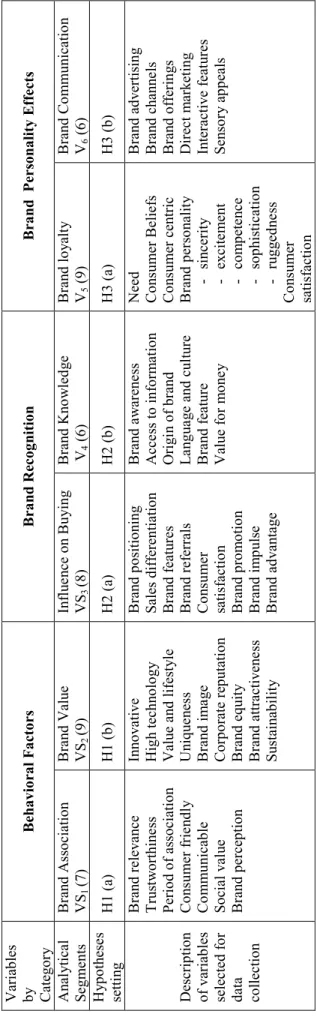
(12) brands. A focus group session was organized with potential respondents to identify most appropriate variables for data collection for the principal study and relevant variables were chosen for analysis of this sub-study.. Accordingly, 39 variables, which were. closely related for the analysis of brand association, brand value, influence on buying, brand knowledge, brand loyalty and brand communication were selected and incorporated in the questionnaires. The questionnaires were pilot tested to 76 (15.2 percent of total sample size) respondents randomly selected, and finalized after refining them based on the responses during the pilot study. The variables selected for the study have been broadly classified into behavioral factors, brand recognition and brand personality variable segments as exhibited in Table 1.. //Table 1 about here//. A questionnaire was developed to investigate the extent to which the selected variables for study have influenced the shoppers. Pre-test of the preliminary questionnaire on measuring the influence of point of sales promotions on stimulated buying behavior indicated that promotion offers introduced by the retailers acted as strong stimuli for the regular and new shoppers. Based on responses from the pre-test, the final questionnaire necessitated no significant changes. The questionnaires were translated in Spanish. All care was taken about the terminology and language being employed in each version of the questionnaire. The variables used in the questionnaire for data collection include various perspectives of brand awareness, consumer satisfaction and brand promotional practices offered by the manufacturing firms and retailers to gain competitive advantage, optimal market share and higher aggregate sales. Data was collected by means of personal interviews by undergraduate students of international commerce and marketing who hand-delivered the questionnaires to the key respondents in the self-service retail stores located in the selected shopping malls who had agreed to be the subjects of the research investigation. In most cases, the respondents completed and returned the questionnaires on the predetermined date.. 12.
(13) Response Trend. Questionnaires were administered to 500 respondents. However, during the process of data analysis, questionnaires of 67 respondents were omitted due to paucity of information. In all 433 respondents were covered under the study and the usable response rate was 86.60 percent.. The non-response bias has been measured applying two. statistical techniques. Firstly, telephonic conversations were made with those respondents who either did not respond to the questions of survey or gave incomplete information of their preference to marketplace, store brands, lifestyle perceptions and logistics related issues (Gounaris et al, 2007). It was found that the main reason for the lack of response showing 41.80 percent respondents of the non-response cases was low confidence level of participation while 31.34 percent subjects failed respond all questions of the survey due to paucity of time and 26.86 percent subjects depended on their accompanying persons to offer responses who could not do so. The consumer response is considered as unit of analysis of this study.. Secondly, T-tests were used to ascertain emerging differences between respondents and non-respondents concerning the issues pertaining to market orientation and consumer services strategies. No statistically significant differences in pre-coded responses. (α = 0.05) were found. A second test for non-response bias examined the differences between early and late respondents on the same set of factors (Armstrong and Overton, 1977) and this assessment also yielded no significant differences between early and late respondents.. Construct of Measures and Data Validation. The constructs of the study were measured using reflective indicators showing effects on the core variables. Behavioral factors (VS1 and VS2) including brand association and brand value affecting consumer decisions were measured with 21-variables (brand association related - VS1-7 and brand value related VS2 -9) on a self-appraisal perceptual scale derived originally on the basis of focus group analysis as referred in the pretext.. 13.
(14) Motivation about this construct has been derived from an original scale developed by Narver and Slater (1990) on market orientation, who conceptualized it as a multivariate construct comprising consumer orientation, competitor orientation and inter-functional coordination as principal behavioral components. This scale also comprised triadic decision coordination among brand architecture, brand equity and long-term brand association with the consumers (e.g. Rajagopal and Sanchez 2004, Rajagopal 2009a; Ruekert 1992; Hunt and Morgan 1995).. Constructs related to brand recognition (VS3, VS4) were measured using 14-variable ‘self-appraisal perceptual scale’ comprising influence on buying (VS3-8) and brand knowledge of consumers (VS4-6). Brand occupies a unique position on the market and it is a precisely defined profile with clear-cut contours of consumer preferences. The construct was developed in order to connect the relevant brand attributes with the drivers of consumer’s behavior, such as utility components and individual values (e.g. Herrmann and Huber, 2000). Construct of brand personality effect (VS5 and VS6) was measured in reference to 15-variable ‘self-appraisal perceptual scale’ consisting of variables related to brand loyalty (VS5-9) and brand communication (VS6-6). Brand personality comprises sincerity, excitement, competence, sophistication and ruggedness (Aaker, 2004). Consumers who exhibit a conscientious personality demonstrate preferences towards trusted brands. Thus, brand loyalty reconciles the influences of prestige, satisfaction, and communication on word of mouth and brand repurchase (Casidy et al, 2009; Kuenzel and Halliday 2008). Accessibility to contextual information on brands develops judgment process among the consumers to stay long with brands that turns into loyalty attitude (e.g. Nam and Strenthal, 2008; Rajagopal, 2008c).. All reflective constructs for all variable segments of the study were analyzed through the factor analysis model as a single confirmatory test. The goodness-of-fit statistics3. 3. The goodness-of-fit statistics that the Tucker-Lewis index (TLI) also known as the Bentler-Bonett nonnormed fit index (NNFI), comparative fit index (CFI) and incremental fit index (IFI) tend to range between 0 and 1, with values close to 1 indicating a good fit. The TLI (NNFI) has the advantage of reflecting the model fit very well for all sample sizes. It is observed in past empirical studies these indices need to have values above 0.9 before the corresponding model can even be considered moderately adequate.. 14.
(15) comprising chi-square statistics (1.92), root mean square error of approximation (0.064), Tucker-Lewis fit index (0.947), comparative fit index (0.913) and incremental fit index (0.926) indicate that the model used for analysis in the study fits the data adequately. All variables were loaded significantly on their corresponding segments which revealed significant p-value at 0.01 to 0.05 levels.. The data collected from respondents was tested for its reliability applying the Cronbach Alfa test. Variables derived from test instruments are declared to be reliable only when they provide stable and reliable responses over a repeated administration of the test. The test results showed acceptable reliability level (α = 0.822) on an average for all observations included for analysis in reference to all variables pooled under different segments. Descriptive statistics and correlation of selected variables are exhibited in Table 2.. //Table 2 about here//. In this study, a five-point Likert scale was employed to measure the consumer preferences in developing their association with the brands. Respondents were asked, on a five-point Likert scale (anchored by strongly agree=1/strongly disagree=5), the extent to which quality management practices were implemented. Regression analysis was performed in order to ensure that the results on these constructs become non-correlated with the mutual interaction terms (Jaccard et.al., 1990). Inter-correlations have been used among qualitative variables to measure the degree of association of variables. However, redundancy in the inter-correlation results which exhibited some degree of biasness in inter-correlations among variables has been minimized using Monte Carlo (MC) method. Bias is largely affected by sample size and biasness was found to decrease by increasing the volume of data. It has been observed that inter-correlation bias tends to decrease as the inter-correlations between the two sets of variables increase.. The numbers of predictors and criterion variables, as well as the size of the correlations between variables in each set, has relatively minimal effect on bias. MC method is a. 15.
(16) useful technique to compute numerical integration and sort out the redundancy in the statistical results. A procedure for averaging correlation coefficients using the Eigen value of an inter-correlation matrix was adopted in the study using Monte Carlo methods (e.g. Dunlap et al., 1987), which is known as Kaiser average. This process has substantially reduced the bias for correlations near zero and showed slightly smaller standard errors (greater efficiency) than the other averages for small correlations. As the data have been organized following normative distribution, in many observations the biasness of inter-correlations in results was minimized. However, due to computational limitations of the data, the statistical prejudice could not be fully eliminated. The results are more likely to project a relationship from the perspectives of judgments and efficacy. The biasness of illusory correlation effect on the judgment similarity of variables relationship, or of whether the relationship of one variable induces another, has also been statistically minimized using the MC method.. Model Specification. Structural equation models are also known as simultaneous equation model. In order to analyze the effects of different brand variables identified in the study on the brand behavior of consumers, structural equations model is derived. Multivariate regression technique has been used to estimate equations of the model. These structural equations are meant to represent causal relationships among the variables in the model (Fox, 2002; Rajagopal 2007). Let us assume that the brand attractiveness is (B x ) and consumer. [. ]. preferences on brand BPt(i1+i2 +i3 +...+in ) comprising brand attributes (i1 , i 2, i3 ...i n ) at a given time (t ) in a marketplace. Consumers perceive brand value evaluating various behavioral determinants (Db ) that helps consumers in recognizing brands (Rb ) considering factors of brand personality (Pb ) for range of products at a given time in a marketplace ( j ) . Hence,. j. [. ]. j. B x = ∑ Vb BPt(i1 +i2 +i3+ ...+in ) j + ∑ Z b [Db , Rb , Pb ] t. (1). t. Where (Vb ) denotes brand value perceived by the consumers and (Z b ) represents performance of brand, 16.
(17) ∴ B x = BPtij. ∂q ∂b ′ ∂k ∂q [Db , Rb , Pb ] = BPtij = BPtij ∂t ∂k ∂k ∂t. (2). In the above equation (BPtij ) denotes orientation of the a brand with attributes (i ) in retail stores in the marketplace ( j ) at time (t ) , (q) represents the frequency of buying preferred brand by the consumers in time t considering the competitive advantages of the brand (k ) . In the equation b ′ expresses the volume of buying of preferred brand made by consumers during the visits to the retail stores in the shopping malls. It is assumed that brand preferences of consumers are driven by the competitive advantages at a given time that each brand exhibits (∂ t ∂ k > 0) in a marketplace. Accordingly, the volume of buying is also influenced by the competitive advantages tagged to the brand (∂ b′ ∂ k > 0 ) . In reference to the age of the brand (e.g. toddler brands) x which explains familiarity of consumers to the brand and volume of buying of the brand (b′) , consumers create lower brand values with newly born brands (∂ b′ ∂ x < 0) while the competitive advantages (k ) like price, promotion, services associated with the brands enhance the consumer value. (∂ k. ∂ x > 0). irrespective of age of the brand.. Impact of various brand preferences as determinants of consumer behavior towards brands is analyzed fitting the general log linear regression model to postulate a linear relationship between the independent variables and the logarithm of the dependent variable. The dependent variable in this study is the brand preference with distinctly positive value. The natural logarithmic values of independent and dependent variables were used as transformed variables in the linear regression (e.g. Jindal et al 2003; Wooldridge, 2002). The general model of log linear regression was later used for specific variable segments such as behavioral factors (VS1 and VS2), brand recognition (VS3 and VS4), and brand personality effects (VS5 and VS6). The general log linear model is explained as:. BPtij = β 0 + β1V1 + β 2V2 + β 3V3 + β 4V4 +β 5V5 + β 6V6 + β 7V7 + β8V8 + β 9V9 + β10V10 + γ 1CV1 +. γ 2CV2 + γ 3CV3 + γ 4CV4 + γ 5CV5 + ε. (3). 17.
(18) Where variables associated with the (β ) coefficient denote principal independent (uncontrolled) variables while variables referring to (γ ) coefficient indicate controlled variables. The variables used in the above equation are explained as below:. Independent variables. V1= brand trust, V2= brand relevance, V3= informal communication, V4=brand image, V5= corporate reputation, V6= brand equity, V7= brand sustainability, V8=brand promotion, V9=brand information, and V10= consumer satisfaction Control variables. CV1= brand positioning, CV2= sales differentiation, CV3= value for money (brand), CV4= direct brand marketing, and CV5= brand advertising In the above equation (ε ) denotes error term. The model explains that different independent variables stimulate the consumer behavior about brands in the marketplace and affect satisfaction of consumers in reference to cognitive determinants, value for money, dependability, and social value and life style. The above structural equations explain that consumer perceptions and brand value determine the brand preferences. The model implies that, even if these intangible determinants are not measured, they will represent a component of the regression model’s residual terms, which will predict brand behavior of consumers (Ward, 2001). Results and Discussion. The regression results have shown strong evidence towards the brand preference of consumers in reference to behavioral determinants, factors influencing brand recognition and brand personality effects on association of consumers with brands. The results are discussed categorically indicating the hypotheses tests.. 18.
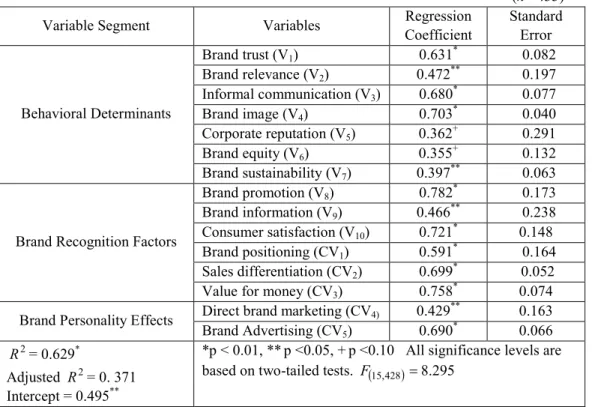
(19) //Table 3 about here//. It may be seen from the results exhibited in Table 3 that brand strength in reference to the relevance of the brand. (β = 0.472, p < 0.05) and trust of consumers on brand. (β = 0.631, p < 0.01) significantly influence the consumer association with the brand. Consumers took 12 to 18 months in gaining confidence on the brand and to measure the aspects of utility and value for money (β = 0.758, p < 0.01) of the brand. The results reveal that consumers get associated with the brand in the long-run when brand strength and trust are positively developed. Respondents opined that positioning of brand in homogenous consumer segments, standard brand recalls, brand relevance; quality advances in brand performance, improved service quality, undifferentiated brand options and quality consumer relationships also help building brand trust and perception over value for money. Accordingly, the results are consistent with hypothesis H1 (a).. Results presented in the above Table also indicate that corporate reputation of the company as a consumer-centric organization (β = 0.362, p < 0.10) and sustainability of the brand (β = 0.397, p < 0.05) over past significantly affect the brand value perceived by the consumers.. It was revealed by the respondents during the study that the corporate. reputation of companies in reference to the consumer friendly organizational culture, quality of employees and commitment to respond to stakeholders’ demands, also influence brand preference of consumers. Integrating the measures for key indicators of employee engagement, consumer loyalty and brand reputation enhance the sustainability of brands in the marketplace (e.g. Alloza, 2008). Hence, the results support hypothesis H1 (b).. Sales differentiation strategies to promote brands in retail outlets at the selected shopping malls in the study appeared to be a significant driver in enhancing the satisfaction of consumers and generating higher trust on the brand performance. Sales differentiation of brand in retail outlets included packaging, post-sales services, customization and value additions to the brand. Results shown in Table 3 reveal that sales differentiation of brands. 19.
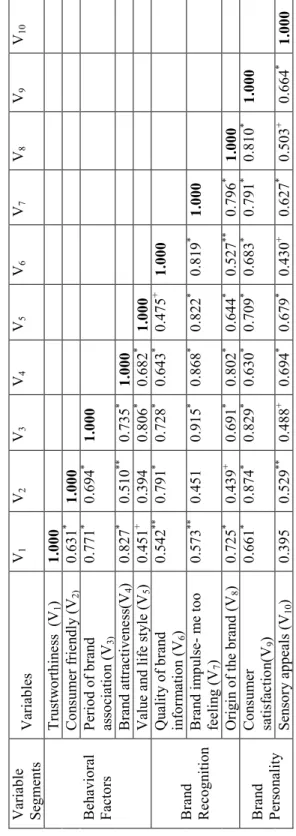
(20) (β = 0.699, p < 0.01) and brand trust (β = 0.631, p < 0.01) have delivered higher satisfaction to the consumers (β = 0.721, p < 0.01) in associating with the preferred brands. The findings indicate strong inter-relationships between sales differentiation showing consumer orientation of the brand and brand trust which leads to the consumer satisfaction. However, quality of sales differentiation plays an important role in delivering the consumer satisfaction on the brands (e.g. Ha et al, 2009). Accordingly, the results are consistent with hypothesis H2 (a).. //Table 4 about here//. The results of the correlation matrix exhibited in Table 4 indicate that there exists higher degree correlation among the variables explaining trustworthiness of brand (V1), period of association of consumers with a brand (V3), and origin of brand (V8). The correlation results for pairs of variables exhibited in the Table 4 show that association of consumers with the brands and origin of the brand (V3,V8) have significant impact on. (r = 0.691, p < 0.01) the brand perception of consumers. Similarly, variables indicating origin of brand and trustworthiness (V8, V1) show high correlation (r = 0.725, p < 0.01) revealing the consumers had shown higher trust on the brands of specific origin (e.g. electronics brands originating from Asian region).. Besides the attributes of. trustworthiness and origin of brand consumers recognize the brand also in reference to the quality of information associated (V6) with the brand which affects the decision on temporal association of consumers with the brand. Results exhibited in the above Table show that quality of information on brand and association of consumers with the brand (V6, V3) have significant impact (r = 0.728, p < 0.01) in determining the temporal pattern of brand association with consumers in a marketplace. It may also be observed from Table 3 that brand information plays an important role (β = 0.466, p < 0.05) in developing the brand performance. Accordingly, the results support the hypothesis H2 (b).. Consumer friendly brands (V2) which are built closely to value and life style (V5) of consumers to deliver maximum satisfaction (V9) are considered as consumer-centric. 20.
(21) brands. Results presented in Table 4 reveal that the above variables are closely associated with each other as well as with the period of consumer association with the brand (V3). Correlation coefficients between variables consumer friendly brand and period of consumer association (V3, V2) indicate higher degree correlation (r = 0.694, p < 0.01) . Similarly, variables of consumer satisfaction and consumer friendly brands (V9, V2) also reveal strong relationship (r = 0.661, p < 0.01) that influence consumer association (V9, V3) with the brand (r = 0.829, p < 0.01) positively for longer period. Accordingly, the results are consistent with the hypothesis H3 (a). It may be observed from the above matrix that the coefficient has a maximum value of 0.915 which shows significant concern on multicolinearity. Dissemination of information on brand and its promotions constitute core functions of brand advertising. Firms engaged in fashion goods, electronics and perfumery products carry internal and external brand marketing campaigns to bring the brand alive for retailers, outsourced sales promoters and consumers creating an emotional connection to the company. Brand awareness and buying appeals are largely generated by effective brand. advertising.. Results. exhibited. in. Table. 3. reveal. that. brand. advertising (β = 0.690, p < 0.01) , brand promotion (β = 0.782, p < 0.01) and brand information. (β = 0.466, p < 0.05) have positive impact on brand perception. Informal brand communication (β = 0.680, p < 0.01) generated through referrals and word of mouth as well supplements the brand awareness among consumers. Results presented in Table 4 also show that quality of brand information and association of consumers with the brand (V6, V3) are highly correlated (r = 0.782, p < 0.01) which indicates that. advertising and. communication help in enhancing brand awareness among consumers and influence their association with the brand. Accordingly, the results discussed above support the hypothesis H3 (b).. Overall analysis of the results reveals that determining brand preferences by the consumers is influenced by the factors associated with the brand behavior, brand recognition and brand personality. Results show that higher brand trust, sustainable. 21.
(22) brand image and effective brand advertising combined with sales differentiation that offer relatively higher value for money to the consumers, influence the choice of brand in the marketplace. In a longer run these factors build brand loyalty and consumers observe long association with such brands. However, Consumers also base their preferences for brands considering the quality of brand, the cultural myths that brands develop and efforts of the firms to address social problems which account for corporate reputation. Brands influence consumer decisions to buy in any of the above ways, or through combinations of them, sometimes with tremendous persuasive appeal. The brand-person associations can also have a more personal nature. Brands can be associated with persons who use or have used that particular brand, for example a close friend or a family member. Hence it may be stated that consumers cultivate relationship with the brands that involve in life style, gender, age, educational background, social values and culture (Rajagopal and Rajagopal, 2008).. Managerial Implications. Brands continue to change rapidly in a competitive marketplace. Firms should optimize their brand line and focus on a limited number of strategic brands in the markets in order to consolidate and strengthen their position and enhance brand power. A balance needs to be maintained by the firms between the extent to which brand names serve to differentiate product lines, or alternatively, establish a common identity across different products. Establishing strong and distinctive brand images for different product lines helps in establishing their separate identities and diversifies risk of negative associations.. An appropriate brand personality helps in building brands’ strength in a firm. Brand strength appears to be linked to four main practices including investing in brand communications to improve consumer awareness,. understanding of corporate and. product brand values, contributing to the wider community to improve corporate reputation, and improving internal communications (internal marketing). Accordingly, managers can keep themselves better informed about consumer needs, market changes and company initiatives, thereby enabling staff to help consumers better and improving. 22.
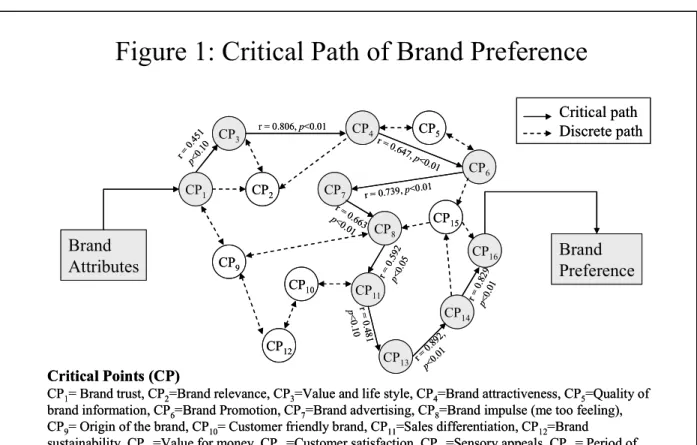
(23) service quality to improve market positioning. Brand insights need to be communicated to the consumers comprising brand promotions and competitive advantages in terms of value for money. Brand managers should understand the cognitive variables affecting consumers in associating with the brands. The critical path mapping of behavioral factors influencing consumers towards developing brand preference may be considered as guiding tool for positioning brands. Figure 1 explains the critical path to brand preference as observed by the consumers.. //Figure 1 about here//. Brand managers should integrate the critical factors in determining brand preference that include brand trust, value and life style, brand attractiveness, brand promotion, brand advertising, brand impulse (me too feeling), sales differentiation, value for money, consumer satisfaction, and period of consumer association with brand as these factors are highly inter-correlated. The integration of critical factors coupled with the focus on specific consumer-centric brand strategies which may be helpful to managers who are working in positioning new brands.. Featured brand can be developed as lead brands where to strengthen the consumer perceptions on the bands of the firm. Accordingly, perceived attractiveness of brand interacts with other consumer personality traits which enhance the brand performance and foster consumer association. Managers can improve the brand performance by integrating corporate image, reputation, brand identity, and consumer perceptions beyond their visual pretense. They need to be more proactive, and also have to express and embed their brand value propositions within their identity and reputation in their dealings with consumers. Approaches on market segmentation in reference to value and lifestyle (VALS) and personality attributes of consumers need to be carefully converged to determine positive brand effects and higher loyalty. Consumer perceptions play a key role in the life cycle of a brand. The role varies according to the stage in the life cycle, market situation and competitive scenario. It may be required for a company to invest on improving the brand. 23.
(24) attraction attributes through systematically explored concepts towards consumer-centric approach to develop brand loyalty among consumers. Brands can be successful when closely associated with the consumers and are preferred by the consumers over the unbranded products. Personality factors of the brands give consumers the means whereby they can make choices and judgments. Based on these experiences, consumers rely on chosen brands and sense guarantee standards of quality and service, which augments the consumer trust and brand value. PIRT attributes help in building consumer-centric brand strategies in a firm. Human personality traits need to be meticulously evaluated by the firms in a given market to determine the short run competitive advantage.. Conclusion. The study reveals that higher brand relevance and trust build strong association of consumers with brand in long-run. It is observed during the study that higher brand value of the products emerge out of the consumer friendly image of the company and long performing brands in the market. Results of the study also indicates that consumers recognize brands with regards to differentiation in selling strategies while higher trust attributes to the consumer satisfaction. Besides other brand attributes, origin of the brands is also found as an important determinant in long-run consumers’ association. The results of the study evidence that consumer centered brands provide higher satisfaction to the buyers, appreciate consumer value in the long-run and turn as loyal brands. In addition, effective advertising and communication brands contribute in building brand awareness among consumers which influence their long-run association with the brand.. Brands influence buying decisions of consumers with tremendous persuasive appeal. The brand-consumer associations can also have a more personal nature and they act as extensions of the personality, so it really is "all in the mind", and the key to brand management and development is a clear understanding of what benefits the consumer is looking for. The personality idea responds to the tendency in contemporary society to. 24.
(25) value personal relationships. It also refers to the idea that relationships are important in social life. In terms of Maslow’s hierarchy of needs, it tries to lift products to higher levels of need satisfaction, like belongingness, love and esteem. Hence, consumer needs, perceived use value associated with the product, and the attitudinal variables of the consumer form the core of consumer personality. A significant relationship between brand attributes and behavioral determinants of consumers in developing brand preferences in a competitive marketplace is empirically demonstrated in this study. This study contributes to the body of knowledge in the area of consumer behavior and brand perceptions, and Hispanic consumers. Discussions in the study also offer better understanding of brand attributes and cognitive factors influencing consumer decisions towards brands.. Limitations of the Study Like many other empirical studies this research might also have some limitations in reference to sampling, data collection and generalization of the findings. The samples drawn for the study may not be enough to generalize the study results. However, results of the study may indicate similar pattern of shopping behavior of urban consumers in shopping malls also in reference to other Latin American markets. The findings are limited to Mexican consumers and convenience sampling. Other limitations include the qualitative variables used in the study which might have reflected on making some causal statements. However, future studies could avoid these limitations by using data from several countries, representative samples, and additional variables.. Future Research. Future researches may address the complexities of brand attributes and cognitive factors among consumers in developing long term association with the existing and new brands. Underlying effects of changing cognitive dimensions responsible for differences in emotional response on global brand may also be an interesting direction for future research. Increasing competition in retailing is driving frequent shifts in the behavioral. 25.
(26) dimensions of consumers and attributes of brands which affect the brand preferences. Future research may be directed towards measuring such changes and their interrelationships among other influencing factors to help managers develop strategic and sound principles, and practices that respond to these changes. References Aaker D (1991), Managing Brand Equity, New York, The Free Press. Aaker D (2004), Brand Portfolio Strategy, New York, The Free Press Akula V (2008), Business basics at the base of the pyramid, Harvard Business Review, 86 (6), 53-57 Alloza, A (2008), Brand Engagement and Brand Experience at BBVA, the Transformation of a 150 Years Old Company, Corporate Reputation Review, 11 (4), 371379 Anderson P M and Robin L G (1986), Marketing Communications: Advertising, Sales Promotion, Public Relations, Display and Personal Selling, Englewood Cliffs, New Jersey, Prentice Hall Andronikidis, Andreas (2008), Psychographic segmentation in the financial services context: a theoretical framework, The Marketing Review, 8 (3), 277-296 Anisimova T A (2007), The effects of corporate brand attributes on attitudinal and behavioural consumer loyalty, Journal of Consumer Marketing, 24 (7), 395-405 Armstrong J S and Overton T S (1977), Estimating non-response bias in mail surveys, Journal of Marketing Research, 14 (3), 396-402 Azoulay A and Kapferer J N (2003), Do brand personality scales really measure brand personality? Journal of Brand Management, 11 (2), 143-155 Beard N D (2008), The Branding of Ethical Fashion and the Consumer: A Luxury Niche or Mass-market Reality? Fashion Theory: The Journal of Dress, Body & Culture, 12 (4), 447-467 Blumenthal D (2002), Beyond ‘form versus content’: Simmelian theory as a framework for adaptive brand strategy, Journal of Brand Management, 10 (1), 9-18 Brassington F and Pettitt S (2002), Principles of Marketing, 3rd Edition, Pearson Education, Prentice Hall. 26.
(27) Burmann C, Zeplin S and Riley N (2009), Key determinants of internal brand management success: An exploratory empirical analysis, Journal of Brand Management, 16 (4), 264-284 Craig J B, Dibrell C and Davis P S (2008), Leveraging Family-Based Brand Identity to Enhance Firm Competitiveness and Performance in Family Businesses, Journal of Small Business Management, 46 (3), 351-371 Caprara G V, Barbaranelli C and Guido G (2001), Brand personality: How to make the metaphor fit? Journal of Economic Psychology, 22 (3), 377-395 Caprara G V, Barbaranelli C and Guido G (1998), Personality as metaphor: Extension of the psycholexical hypothesis and the five factor model to brand and product personality description, in Basil G. Englis and Anna Olofsson, Provo, UT (Eds): European Advances in Consumer Research, Volume 3, Association for Consumer Research, 61-69. Casidy M R; Yelena T and Alastair A (2009), The Big Five and brand personality: Investigating the impact of consumer personality on preferences towards particular brand personality, Journal of Brand Management, 16 (4), 234-247 Chatterjee A, Jauchius M E, Kaas H W and Satpathy A (2002), Revving-up Auto Branding, The McKinsey Quarterly, Number 1, 134-143 Drezner, Tammy (2006), Derived attractiveness of shopping malls, IMA Journal of Management Mathematics, 17 (4), 349-358 Duncan T and Moriarty S E (1998), A Communication Based Markeing Model for Managing Relationships, Journal of Marketing, 62, 1-13 Dunlap W P, Clayton Silver N and Phelps G R (1987), A Monte Carlo study of using the first Eigenvalue for averaging inter-correlations, Educational and Psychological Measurement, 47 (4), 917-23.. Erdogan Z and Baker M (2000), Celebrity Endorsement: Advertising Agency Manager’s Perspective, The Cyber Journal of Sport Marketing, 13, December, 1-15 (www.cjsm.com) Füller J, Matzler K and Hoppe M (2008), Brand Community Members as a Source of Innovation, Journal of Product Innovation Management, 25 (6), 608-619 Goldberg L R (1990), An alternative ‘description of personality’: the big-five factor structure. Journal of Personality and Social Psychology, 59 (6), 1216– 1229. 27.
(28) Gounaris S P, Panigyrakis G G and Chatzipanagiotou K C (2007), Measuring the effectiveness of marketing information systems: An empirically validated instrument, Marketing Intelligence & Planning, 25 (6), 612-631 Guilford J (1973), On Personality, in Mischel W, Introduction to Personality, New York, Holt Rinehart and Wilson, 22-25 Ha H Y, Janda S and Park S K (2009), Role of satisfaction in an integrative model of brand loyalty: Evidence from China and South Korea, International Marketing Review, 26 (2), 198-220 Hayes, J B. Alford B L, Silver L and York R P (2006), Looks matter in developing consumer-brand relationships, Journal of Product and Brand Management, 15 (5), 306315 Herrmann Andreas and Huber Frank (2000), Value oriented brand positioning, The International Review of Retail, Distribution and Consumer Research, 10 (1), 95 – 112 Hunt S D and Morgan R M (1995), The comparative advantage theory of competition, Journal of Marketing, 59 (2), 1-15 Keller K L and Richey K (2006), The importance of corporate brand personality traits to a successful 21st century business, The Journal of Brand Management, 14 (1-2), 74-81 Jamal A and Al-Marri M (2007), Exploring the effect of self-image congruence and brand preference on satisfaction: the role of expertise, Journal of Marketing Management, 23(7-8), 613-629 Jun J W, Cho C H and Kwon H J (2008), The role of affect and cognition in consumer evaluations of corporate visual identity: Perspectives from the United States and Korea, Journal of Brand Management, 15 (6), 382-398 Kent T and Stone D (2007), The Body Shop and the role of design in retail branding, International Journal of Retail & Distribution Management, 35 (7), 531-543 Kuenzel S and Halliday S V (2008), Investigating antecedents and consequences of brand identification, Journal of Product and Brand Management, 17 (5), 293-304 Kumar S R, Guruvayurappan N and Banerjee M (2007), Cultural values and branding in an emerging market: the Indian context, The Marketing Review, 7 (3), 247-272 Lev B (2004), Sharpening the intangibles edge, Harvard Business Review, 82 (6), 109-116. Matthiesen I and Phau I (2005), The `HUGO BOSS' connection: Achieving global brand consistency across countries, The Journal of Brand Management, 12 (5), 325-338. 28.
(29) Merrilees B and Miller D (2005), Emotional brand associations: a new KPI for e-retailers, International Journal of Internet Marketing and Advertising, 2 (3), 206-218 Matzler K, Bidmon S and Grabner K S (2006), Individual determinants of brand affect: the role of the personality traits of extraversion and openness to experience, Journal of Product and Brand Management, 15 (7), 427-434 Nam M and Sternthal B (2008), The Effects of a Different Category Context on Target Brand Evaluations, Journal of Consumer Research. 35 (4), 668–679 Narver, J C and Slater, S F (1990), The effect of market orientation on business profitability, Journal of Marketing, 54 (4), 20-35 Omar M and Williams R L (2006), Managing and maintaining corporate reputation and brand identity: Haier Group logo, Journal of Brand Management, 13 (4-5), 268-275 Rajagopal and Sanchez R (2004), Conceptual Analysis of Brand Architecture and Relationships within Product Category, Journal of Brand Management, 11 (3), 233-247 Rajagopal (2007a), Brand excellence: measuring the impact of advertising and brand personality on buying decisions, Measuring Business Excellence, 10 (3), 56-65 Rajagopal (2007b), Marketing Dynamics-Theory and Practice, New Age International, New Delhi, 54-59 Rajagopal (2007c), Influence of Brand Name in Variety Seeking Behavior of Consumers: An Empirical Study, International Journal of Management Practice, 2 (4), 306-323 Rajagopal (2008), Measuring Brand Performance through Metrics Application, Measuring Business Excellence, 12 (1), 29-38 Rajagopal and Rajagopal A (2008), Team Performance and Control Process in Sales Organizations, Team Performance Management- An International Journal, 14 (1), 70-85 Rajagopal (2009a), Growing shopping malls and behaviour of urban consumers, Journal of Retail and Leisure Property, 8 (2) (in press) Roncha A (2008), Nordic brands towards a design-oriented concept, Journal of Brand Management, 16 (1-2), 21-29 Roodenburg J (2003), Cognitive style: a psycholexically-derived personality-centred model, European Journal of Personality, 17 (2), 119-141 Ruekert R W (1992), Developing a market orientation: An organizational strategy perspective, International Journal of Research in Marketing, 9 (3), 225-245. 29.
(30) Sabharwal A P, Gorman M E and Werhane P H (2004), Case study: Hindustan Lever Limited and marketing to the poorest of the poor, International Journal of Entrepreneurship and Innovation Management, 4 (5), 495-511 Samiee S, Shimp T A and Sharma S (2005), Brand origin recognition accuracy: its antecedents and consumers’ cognitive limitations, Journal of International Business Studies, 36 (4), 379-397 Sargeant A, Hudson J and West D C (2008), Conceptualizing brand values in the charity sector: the relationship between sector, cause and organization, The Service Industries Journal, 28 (5), 615-632 Silva R V D and Alwi S F S (2006), Cognitive, affective attributes and conative, behavioural responses in retail corporate branding, Journal of Product and Brand Management, 15 (5), 293-305 Smith T (2007), The existential consumption paradox: an exploration of meaning in marketing, The Marketing Review, 7 (4), 325-341 Trijp V, Hans C M, Wayne D H and Inman J (1996), Why Switch? Product-Category Level Explanations for True Variety-Seeking Behavior, Journal of Marketing Research, 33 (August), 281-192 Westbrook R A, Joseph W N, and James R T (1978), “Satisfaction /Dissatisfaction in the Purchase Decision Process,” Journal of Marketing, 42 (4), 54-60 Williamson P J. and Zeng M (2004), Strategies for Competing in a Changed China, Sloan Management Review, 45 (4), 85-91 Xie, Y H (2008), Consumer innovativeness and consumer acceptance of brand extensions, Journal of Product and Brand Management, 17 (4), 235-243. 30.
(31) Brand Value VS2 (9) H1 (b) Innovative High technology Value and lifestyle Uniqueness Brand image Corporate reputation Brand equity Brand attractiveness Sustainability. Brand Association VS1 (7). H1 (a). Brand relevance Trustworthiness Period of association Consumer friendly Communicable Social value Brand perception. Behavioral Factors. Brand positioning Sales differentiation Brand features Brand referrals Consumer satisfaction Brand promotion Brand impulse Brand advantage. H2 (a). Variable Segments. Sample Size Mean Standard Deviation Standard Error Sample Variance Skewness Data reliability testCronbach (α) scores. Output. 433 5.338 5.351 0.038 0.425 -0.225 0.74. 0.78. Brand Value VS2 (9). 433 6.119 3.105 0.042 0.528 -0.321. Brand Association VS1 (7). 0.82. 433 7.630 6.673 0.081 0.376 -0.379. Influence on Buying VS3 (8). 0.74. 433 6.927 4.830 0.096 0.547 -0.582. Brand Knowledge V4 (6). Table 2: Descriptive Statistics for the Selected Variables for the Study. 0.76. 433 5.486 6.924 0.096 0.381 -0.422. Brand loyalty V5 (9). Brand awareness Access to information Origin of brand Language and culture Brand feature Value for money. H2 (b). Brand Knowledge V4 (6). Brand Recognition Influence on Buying VS3 (8). VS=Variable Segment. Figures in parentheses indicate number of variables. Description of variables selected for data collection. Variables by Category Analytical Segments Hypotheses setting. Table 1: Variables Chosen for the Study. 0.80. 433 8.127 5.824 0.077 0.497 -0.361. (n= 433) Brand Communication V6 (6). Need Consumer Beliefs Consumer centric Brand personality - sincerity - excitement - competence - sophistication - ruggedness Consumer satisfaction. H3 (a). Brand loyalty V5 (9). Brand advertising Brand channels Brand offerings Direct marketing Interactive features Sensory appeals. H3 (b). 31. Brand Communication V6 (6). Brand Personality Effects.
(32) 32.
(33) Table 3: Determinants of brand preference perceived by consumers Variable Segment. Behavioral Determinants. Brand Recognition Factors. Brand Personality Effects R 2 = 0.629*. Adjusted R 2 = 0. 371 Intercept = 0.495**. (n= 433) Regression Standard Variables Coefficient Error * Brand trust (V1) 0.631 0.082 Brand relevance (V2) 0.472** 0.197 Informal communication (V3) 0.680* 0.077 * Brand image (V4) 0.703 0.040 Corporate reputation (V5) 0.362+ 0.291 Brand equity (V6) 0.355+ 0.132 0.397** 0.063 Brand sustainability (V7) * Brand promotion (V8) 0.782 0.173 Brand information (V9) 0.466** 0.238 Consumer satisfaction (V10) 0.721* 0.148 Brand positioning (CV1) 0.591* 0.164 Sales differentiation (CV2) 0.699* 0.052 Value for money (CV3) 0.758* 0.074 Direct brand marketing (CV4) 0.429** 0.163 * Brand Advertising (CV5) 0.690 0.066 *p < 0.01, ** p <0.05, + p <0.10 All significance levels are based on two-tailed tests. F(15,428 ) = 8.295. 33.
(34) Trustworthiness (V1) Consumer friendly (V2) Period of brand association (V3) Brand attractiveness(V4) Value and life style (V5) Quality of brand information (V6) Brand impulse- me too feeling (V7) Origin of the brand (V8) Consumer satisfaction(V9) Sensory appeals (V10). Variables. *p < 0.01, ** p <0.05, + p <0.10. Brand Personality. Brand Recognition. Behavioral Factors. Variable Segments. 0.691* 0.829* 0.488+. 0.439+ 0.874* 0.529**. 0.725* 0.661* 0.395. 0.915*. 0.735* 0.806* 0.728*. 0.451. 0.510** 0.394 0.791*. 0.827* 0.451+ 0.542**. 1.000. V3. 0.573**. 1.000 0.694*. V2. 1.000 0.631* 0.771*. V1. 0.694*. 0.802* 0.630*. 0.868*. 1.000 0.682* 0.643*. V4. 0.679*. 0.644* 0.709*. 0.822*. 1.000 0.475+. V5. 0.430+. 0.527** 0.683*. 0.819*. 1.000. V6. 0.627*. 0.796* 0.791*. 1.000. V7. 0.503+. 1.000 0.810*. V8. 0.664*. 1.000. V9. 1.000. V10. Table 4: Coefficients of correlation among qualitative variables affecting brand perception (n=433). 34.
(35) CP3. CP1. r = 0.806, p<0.01. CP2. CP4. p <0. CP8. CP6. CP15 CP16. CP11. Brand Preference. CP14. 8 r = 0.4 0 p<0.1. 2,. 1. CP12. .01. r= p < 0 .5 9 2 0 .0 5. CP9 CP10. 0. 6 47,. p<0.01 r = 0.739,. CP7 r= p< 0.66 0. 0 3 1. Brand Attributes. r=. Critical path Discrete path. CP5. r= p<0 0.829 .01. r= p< 0.4 0.1 51 0. Figure 1: Critical Path of Brand Preference. CP13. Critical Points (CP). 89 0. 1 r = 0 .0 p<. CP1= Brand trust, CP2=Brand relevance, CP3=Value and life style, CP4=Brand attractiveness, CP5=Quality of brand information, CP6=Brand Promotion, CP7=Brand advertising, CP8=Brand impulse (me too feeling), CP9= Origin of the brand, CP10= Customer friendly brand, CP11=Sales differentiation, CP12=Brand sustainability, CP13=Value for money, CP14=Customer satisfaction, CP15=Sensory appeals, CP16= Period of consumer association with brand Based on the results of correlation coefficients exhibited in Table 4.
(36)
Figure
Related documents