Self-efficacy, Information Accessibility and Utilization as
Determinants of Creativity of Managers in
Packaging Companies in Nigeria
Sunday O. Popoola1 Ibrahim A. Ayankola2*1.Department of Library, Archival and Information Studies, University of Ibadan, Ibadan, Nigeria 2.University Library, Federal University of Technology, Akure, Ondo State, Nigeria Abstract
This paper investigated self-efficacy information accessibility and utilization as factors determining creativity of managers in packaging companies in Nigeria. The research design adopted for the study was survey method. The study population comprised 540 managers in eleven packaging companies in Nigeria. The questionnaire was used to collect data from the 540 managers out of which 485 responded and valid for analysis given a response rate of 89.8 percent.The study revealed that self-efficacy, information accessibility and utilization had significant positive correlations with the creativity of the respondents. In addition, self-efficacy, information accessibility and utilization were found to be significant determinants of creativity of the managers in the packaging companies in Nigeria.It is therefore recommended that the Board of management in these companies should give much attention to self-efficacy, information accessibility and utilization when planning to improve the creativity of their managers. They should endeavour to encourage their managers to make intensive use of information and have wide access to available information resources internally and externally for better creativity.
Keywords: Self-Efficacy, Information Accessibility, Information Utilization, Managers, Packaging Companies, Nigeria.
Introduction
The basic functions of managers in business organizations like packaging companies include planning, organizing, communicating, coordinating, decision making and controlling. Managers are special group of workforce, whose activities center on managing relationships, finding innovation, creating a mindset and facilitating learning with intention of creating competitive advantage for their firms in the business world. Packaging companies in Nigeria are passing through difficult period when the government embarked on economic re-engineering for national development. The economic policy of government is centered on deregulation with a view to subject the management of the economy to the market forces. The market forces here mean the interaction of demand and supply in order to determine the equilibrium price and quantity of goods and services. It is assumed that this will bring about efficient and effective allocation of resources for the production of value-added goods and services and higher national income.
The government has mandated the manufacturing companies in Nigeria of which packaging companies are constituent elements to generate more employment, stimulate their level of investment, source their needed raw materials locally, use available local technology, adopt management styles that anchor on good corporate governance, transparency and accountability, reduce their level of importation of goods and services, produce high quality products for domestic use and exportation. It is also important to note that the packaging companies like other manufacturing companies in Nigeria are currently experiencing inadequate power supply, inadequate highly skilled manpower, keen market competition, insufficient supply of relevant information, high cost of maintenance of imported machinery for production, ineffective communication services, government increase in taxation and foreign exchange instability, inadequate water supply, high interest rate, poor road networks, and inadequate capital.
The need to overcome these aforementioned problems forced the management of packaging companies in Nigeria to change their staff recruitment pattern in favour of hiring employees with good creative and innovative abilities. This is done with a desire to produce high quality products that will withstand keen domestic and global market competition as well as make maximum profit. It is important to note that creativity and innovation are essential ingredients which business organizations like packaging firms require to succeed in the present day business world. Without creative and innovative workforce particularly managers, I doubt if organizations like packaging companies will not easily close shops and go into extinction in Nigerian domestic market. Agbor (2008) stressed that organizational creativity depends on how leaders/managers encourage and manage diversity in the organization, as well as develop an effective leadership structure that sustains the innovation process. Nadler and Tushman (1997) remarked that in the 21st – century organizational environment, creativity and innovation are the primary sources of competitive advantage.
Quigley (1998) defined creativity as the ability of a person to produce something effective and novel. Creativity includes the generation of ideas, alternatives and possibilities (Ford, 2000; Amabile & Conti, 1999;
Adeleye 2008; Politis 2005).
Creativity is generally viewed as useful novelty – not for its own sake, but novelty that can be applied and add value to an organization’s products and services (Oldham & Commings, 1996; Simonton, 2000; Findley & Lumsden, 1988). It must be noted that unless individuals in an organization believe a desired result can be attained, they will not be sufficiently motivated to act in a creative manner and exhibit high level of innovative performance. Therefore, self-efficacy may be an important factor that may foster creativity and innovation in employees particularly managers in packaging companies in any economy.
Self-efficacy can be defined as the levels of confidence individuals have in their ability \to execute certain courses of action, or achieve specific outcomes (Bandura, 1997, 1982). Efficacy expectations are said to influence initiating behaviours, and the degree of persistence applied in overcoming difficulties encountered in the pursuit of accomplishing a task or tasks (Bandura, 1997). Bandura (2001) noted that on the basis self-efficacy belief, people choose how much effort to expend in goal-directed behaviour and how long they will be committed in the face of obstacles. In this regard, self-efficacy is a belief of being able to control environmental demands (Schwartzer, 1992) which keep people committed to a course of action especially when it involves failures or obstacles (Bandura, 1986, 1993). Arguably, managers that need to carry out their assigned functions in creative and innovative ways in an organization like packaging company must believe in their ability to do so irrespective of challenges they face.
Nevertheless, information is a critical resource like money, men, technology, materials and energy for the survival of organizations like packaging companies. Information availability, acquisition, accessibility and utilization may leverage creative performance of managers in business organizations such as packaging companies. Information acquisition and use give power to be creative and innovative persons to managers over others that do not possess and use it effectively for their own personal development in an organization. Information may be viewed as knowledge communicated to the recipient in order to improve his/her creative and innovative ability. Ojedokun (2007) sees information as statement of facts, figures, ideas and creative works of the human intellect; which are logically or by way of reasoning interrelated, and have been communicated, recorded, published and distributed formally or informally or in any format. Creativity and innovation thrive on the effective communication and interactions as well as quality of information use among diverse members of an organization. Adeleye (2008) averred that information accessibility and utilization may stimulate creativity and innovation among workers in business organizations. Information accessibility may be defined as the ease of locating and retrieving needed information from their storage or available source for use by a manager within the context of this study. Popoola (2006) reported that information accessibility and utilization significantly influenced decision making of the managers in Nigerian commercial banks. Ogundele (2009) remarked that information needs, accessibility and utilization could promote creativity and innovation which can have spiral effect on job performance of managers in industrial organizations. Information utilization could be viewed as the correct application of a message received and understood, a collection of processed data from which conclusions may be drawn, factual knowledge, narrative accounts, opinions and evaluations obtained from published and unpublished sources by a manager for improved creativity. Kaye (1995) posited that organizations need information both about its own internal processes, in order to ensure effectiveness and efficiency, and about its environment, in order to respond and adapt to the actions, attitudes and decisions of external agencies such as governments, competitors and social groups. Without creativity of the workforce, I doubt if any organization like packaging companies can successfully achieve efficiency and effectiveness in its internal business processes. Auster and Choo (1994) reported that few chief executives of the Canadian telecommunications industry personally used the company library and online database services. Kobrin, et.al. (1980) surveyed large United States of America International firms about how they assessed foreign social and political environments and they found that there was a preference for obtaining information for environmental assessments directly from people whom the managers know and trust. They also relied on their subordinates, colleagues in other firms, banks and personal observations during frequent trips to other countries. Ogunlade (2007) remarked that managers in Nigerian industrial organizations do not have wide access to relevant information and made low use of available information in their business operations. In recent time, the management of the most packaging companies in Nigeria has introduced creativity and innovation into their manpower development programmes. Self-efficacy is a critical factor for successful work performance of managers in business organisation such as packaging companies. Adekunle (2015) noted that how information is attributed should influence the relationship between self-efficacy and performance of individuals in any organisation. Self-efficacy beliefs of managers in organization may be reinforced by the information received from their colleagues, subordinates and superiors officers about their capability to perform a given task. In addition, the researchers in the field of the library and information science have made little or no effort in determining creativity of managers from the perspectives of their self efficacy, information accessibility and utilisation in the Nigerian packaging companies. It is in the light of this that the present study investigates self-efficacy, information accessibility and utilisation as determinants of creativity of managers in packaging companies in Nigeria.
Hypotheses
The following null hypotheses were formulated and tested at α=0.01 level of significance to pilot the conduct of this study:-
1. There are no significant correlations among self-efficacy, information accessibility, information utilisation and creativity of managers in the packaging companies in Nigeria.
2. Self-efficacy, information accessibility and utilisation will not significantly determine the creativity of managers in the packaging companies in Nigeria.
Literature Review
Creativity and innovation have been recognized as essential tools for organizational business success in the current global market competition. Organizations like packaging companies are not left out in the struggle to infuse creativity and innovation in their business management operations in order to improve the quality of their products. Debono (1996) viewed creativity as the creation of something that has not been available in the current state. Stacey (1996) remarked that creativity is a process of being sensitive to problems, deficiencies, gaps in knowledge, missing elements and conflict. Sternberg (1995) noted that intellectual ability, knowledge, styles of thinking, personality traits, achievement motivation and environment are the inter-related factors that may promote the creative ability of a person.
Creative managers/people demonstrate autonomy and independence in thought and action but they value cooperation and self-control (Mackinnon, 1962). The creative people/managers in organizations are opened to rich experience, and have high self-efficacy beliefs as well as information processing capability. Creative people in organizations tend to trust their own judgment and they are strongly influenced by internal standards and states rather than social influence within their organizational environment (Oldham & Cummings, 1996; Hall, 1996).
Some researchers stated that the environmental factors are conducive to creativity (Amabile, 1996; Politis, 2005). In order for employees to be creative in an organization, it is necessary that the organization provides a supportive process and environment (Amabile, 1998, Eyton, 1996; Goldsmith, 1996). It must be noted that creative managers in business organizations like packaging companies are great critical thinkers, with good emotional intelligence, high self-efficacy and good information seeking behaviour.
Self-efficacy is defined as individuals perceived capabilities to attain designated types of performance and to achieve specific results (Pajares, 1996, Bandura, 1977; 1986). Self-efficacy influences goal setting, performance of efforts towards a goal, and perseverance of efforts in the face of difficultly. Bandura (2001) described self efficacy as individual’s confidence in their ability to control their thoughts, feelings, and actions and therefore influence an outcome. The perceptions of self-efficacy influence individual’s actual performance (Locke, Frederick, Lee & Bubka 1984, Schunk, 1981), emotions (Stumpt, Brief & Hartman, 1987), choices of behaviour (Betz & Hackett, 1983) and amount of effort and perseverance expended on an activity (Brown & Inouye, 1978). People with high self-efficacy choose to perform more challenging tasks and are creative (Bandura, 1997). High self-efficacy allows people to choose challenging settings, explore their environment or create new ones (Schwarzer & \Schmitz, 2005). Tella (2006) found a significant correlation between self-efficacy and creativity of newly recruited librarians in selected university libraries in south-west, Nigeria. Popoola (2009) reported that self-efficacy had significant positive correlations with effective decisions-making of managers in corporate insurance companies in Nigeria.
Nonetheless, the turbulent events occurring in the business environment of the manufacturing companies may put more pressure on the managers therein to acquire and use relevant information to improve their creativity and innovation. Information which is knowledge communicated to the recipient is very crucial to creative and innovative efforts of managers in business organization. Although several sources of information such as colleagues, customers, newspapers/magazines, radio/television, textbooks, journals, indexes/abstract, reports, CD-ROM database, Internet, corporate library, trade literature, company files, government publications, handbooks/manuals, patents/standards, memoranda/circulars, video-tapes, etc are available within and outside the business environment of managers in manufacturing companies like packaging firms but ease of access to them may serve as facilitator to their utilization. Information accessibility may be seen as ease of locating and retrieving information from the available source, while information utilization could be regarded as correct/appropriate application of messages, facts, opinions, ideas, symbols, images, databases, signals, codes, sounds and processed data obtained from published and unpublished sources to enhance creativity and innovation of managers in an organization like packaging company.
However, Popoola (2006) reported that information accessibility and utilization significantly influenced decision making of managers in commercial banks in Nigeria. Preble, Rau, and Reichel (1988) found that executive managers relied on internal sources of international environmental information much more than external sources when scanning their business environment in multinational corporations based in America. Ghoshal and Kim (1986) in their study of large South Korean firms noted that information about the immediate
business environment (competitors, existing technologies, and product markets), which is required daily for operational decisions, is usually obtained from business associates, customers, suppliers, trade associations, and bankers. It must be put in mind that, printed sources in the public domain are more important for information about the broader environment (general social, economic, political, and technological changes); these sources include general and trade journals, special government documents, and reports from academic institutions, think tanks, and consulting organizations.
It is pertinent to note that information sources availability, accessibility and use are critical factors needed to foster good creative behaviour in managers in any organization. Mckinnon and Bruns (1992) examined how middle and upper level managers in Canadian and American manufacturing firms obtain and use the information they need to control their daily operations. They found that managers’ information needs are determined by operational tasks: production managers need information to order materials and manage production facilities; sales and marketing managers seek information about orders, prices, competitor actions, and customer needs.
Nevertheless, organizations like packaging companies need to provide good climate for creativity by ensuring that all category of their workforces including managers have access to and use information sources available and relevant to their needs. In a study of research and development scientists, Gerstberger and Allen (1982) also found channel accessibility to be an important determinant of use. O’Reilly (1982) submitted that accessible information sources that are used frequently may be of lower perceived quality than other sources that are less accessible. In organizational setting, managers often consult information sources that are very easily accessible than those perceived to be of high quality. It must be borne in mind that managers in business organizations do not have enough time to verify the credibility of information sources available to them but lay much emphasis on accessibility and relevance of information sources for use to improve their creativity and innovation capabilities.
Creative performance of managers in organizations depends so much on their quality of information used, information literacy skills, organizational information culture and emotional intelligence as well as the self-efficacy. One can therefore argue that managers need creative thinking, access to and use accurate, reliable, timely and sufficient information to carry out their managerial work. Critical internal and external information such as financial information (Price/earning ratio, wage/earning ratio), human resource information (staff training and skill levels, staff morale and staffing costs), production information (production efficiency and throughput cost, wastage and quality), information on regulations and taxation, supplier information (cost, reliability, quality and speed of delivery), macroeconomic information (gross domestic product, inflation rate, interest rate, exchange rate, import and export rate), competitor information (unethical practices, sources of raw materials and trained employees), and market information (prices of goods/services, consumer lifestyles, household income and budget) when accessed and used may affect creativity and innovation of managers in business organizations. Daniells (1993) suggested that managers in business organizations must endeavour to access their needed information from reliable sources. Olabisi (2015) remarked that managers in business organizations must access and use information available in their corporate records for planning, decision making and problem solving. In fact, these critical functions of managers in business organizations call for creative thinking and innovative efforts.
However, de Alwis and Higgins (2001) reported that managers in Singapore had access to the internet and used it to obtain their needed information but rarely used CD-ROM and online information services in their decision making process. Huotari and Wilson (2001) found that publishing company in Finland used telecommunications (phone and fax) to get hold of external information at the level of marketing and sales. Virkus and Tamre (1995) carried out a study on actual use and needs of business information and services in Estonian firms. They found that the most used business information sources among the firms were newspapers, business catalogues and official publications. Nevertheless, past studies revealed that the information sources most often used are personal sources, particularly managers and staff within the organizations, whereas sources such as the company library and online databases were less frequently used (O’connell & Zimmerman, 1979; Kobrin, et.al. 1986; Auster & Choo, 1994; Popoola, 2000, 2009; de Alwis, Majid & Chaudhry, 2006). It must be noted that information accessibility, acquisition and utilization may be regarded as essential critical activities which managers in organizations must perform in order to bring about creativity and innovation in them. Libraries and information centers in business organizations are service points that are needed to acquire, process, store, and disseminate reliable, accurate and complete information on time for the use of all categories of staff particularly managers for improved creativity. Haggarth (1981) opined that the main objective of the library in an organization is to support the business operations by providing access to all relevant published information and to internally record and report information to all employees. Drake (1982) averred that as an economic resource, information must be effectively managed to enhance productivity, creativity and achievement of corporate goals and objectives. Information and knowledge sharing and utilization among employees in an organization may stimulate creativity for better work performance.
propounded by Swanson (1987). Channel disposition is “a psychological cost benefit utility evaluation in which a user implicitly trade off the benefits of a channel or source of information against the associated cost of access”. This implies that managers as rational consumers of information will use any information source of channel based on their evaluation of relative quality and accessibility. The quality of information obtained from an information source has been established to influence the frequency of use of that source (Swanson, 1987). More so, information use has been explained by a source/channel’s accessibility to a user (Culman, 1983;, Saunders & Jones, 1990; O’Reilly, 1982). Managers may make trade-offs between the two, often selecting very accessible information source despite its poor quality and tolerating poor accessibility for high quality (Swanson, 1987. The self-efficacy of managers may influence their accessibility to an information that is difficult to obtain from the available source/channel.
Methodology
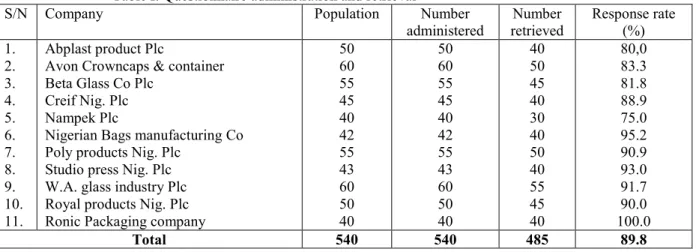
The research design adopted for this study was survey method. The survey method has been used extensively in conducting inquiry in the field of Librarianship and Information Science particularly in business information management (Jorosi, 2006; Popoola, 2006; Auster & Choo, 1994; Olaisen, 1991; Ikoja-Odongo and Ocholla, 2004; de Alwis & Higgins 2001). The study population comprised 540 managers in eleven packaging companies in Lagos quoted on the Nigerian Stock Exchange as at 2015. The questionnaire titled Creativity, Self-efficacy, Information Accessibility and utilization of managers (CSEIAUM) scale was used for data collection. It was divided into five main parts. Part “A” deals with demographic profiles of the managers such as gender, age, marital status, name of company, job status, job tenure and highest academic qualification. Part “B” deals with self-efficacy of the managers. It was a self-efficacy scale developed by Schewartzer and Jerusalem (1995) and it has 10 items/statements. The response format ranged from strongly agree (SA) = 4 to strongly disagree (SD) = 1. It has a reliability coefficient of 0.75 using Cronbach-Alpha method. Part ‘C’ deals with information accessibility of the respondents. Based on the literature review, eighteen (18) items were noted as possible sources of information accessible to managers. The response formats are: very easily accessible (VEA) = 4, Easily accessibly (EA) = 3, Occasionally accessible (OA) = 2 and Not accessibly (NA) = 1. It has a reliability coefficient of 0.74 using Cronbach-Alpha method. Part “D” deals with information utilization of the managers. Based on literature review, 20 items were noted as possible types of information to be utilized by the managers in business organizations. The response format are: very highly utilized (VHU) = 4, highly Utilized (HU) = 3, occasionally utilized (OA) = 2 and never utilized (NU) = 1. It has a reliability coefficient of 0.78 using Cronbach Alpha method. Also, managers were asked to state their impediments/barriers to information accessibility and utilization in their companies. Part “E” deals with creativity of managers. It is a 24 item that were drawn from Ibadan creativity Assessment (ICA) scale developed by Akinboye (1977). The response format are very much like me (VMLM) = 5, much like me (MLM) = 4, somehow like me (SLM) = 3, least like me (LLM) = 2 and not like me (NLM) = 1. It has a reliability coefficient of 0.76 using Cronbach-Alpha method. The six items each were drawn from the four aspects of the ICA scale namely Ideative flexibility scale with 20 items (α = 0.72); Ideative originality scale with 25 items (α = 0.77); ideative fluency with 26 items (α = 0.79); and creativity motivation scale with 17 items (α = 0.85). Ten hired and trained research assistants who were postgraduate students from the faculty of Education, University of Ibadan, Ibadan, Nigeria administered the questionnaire tagged (CSEIAUM) scale on 540 managers out of which 485 responded giving a response rate of 89.8 percent. The breakdown of questionnaire administration and retrieval is shown in Table I.
Table I: Questionnaire administration and retrieval
S/N Company Population Number
administered retrieved Number Response rate (%) 1. 2. 3. 4. 5. 6. 7. 8. 9. 10. 11. Abplast product Plc
Avon Crowncaps & container Beta Glass Co Plc
Creif Nig. Plc Nampek Plc
Nigerian Bags manufacturing Co Poly products Nig. Plc
Studio press Nig. Plc W.A. glass industry Plc Royal products Nig. Plc Ronic Packaging company
50 60 55 45 40 42 55 43 60 50 40 50 60 55 45 40 42 55 43 60 50 40 40 50 45 40 30 40 50 40 55 45 40 80,0 83.3 81.8 88.9 75.0 95.2 90.9 93.0 91.7 90.0 100.0 Total 540 540 485 89.8 The Results
the recruitment and promotion of staff into managerial positions may be the reason why males formed the bulk of staff in the managerial positions of the packaging companies in Nigeria. The marital status distribution of the respondents shows that 365(75.3%) are married and the rest 120(24.7%) are single. The age distribution of the respondents varied between 29 and 53 years with mean age (x = 42.92, SD = 4.64) years. Of the 485 respondents, 236(48.7%) had Bachelor degree certificates, 146(30.1%) had post graduate diploma certificates and 103(21.2%) had master degree certificates. The job tenure of the respondents ranged between 5 and 26 years with mean (x = 15.42, SD = 4.86) years. The distribution of the respondents by management cadre shows that 255(52.6%) are junior managers, 175 (36.1%) are senior managers and 55(11.3%) are executive managers. This implies that junior managers dominated the management positions in the packaging companies in Nigeria.
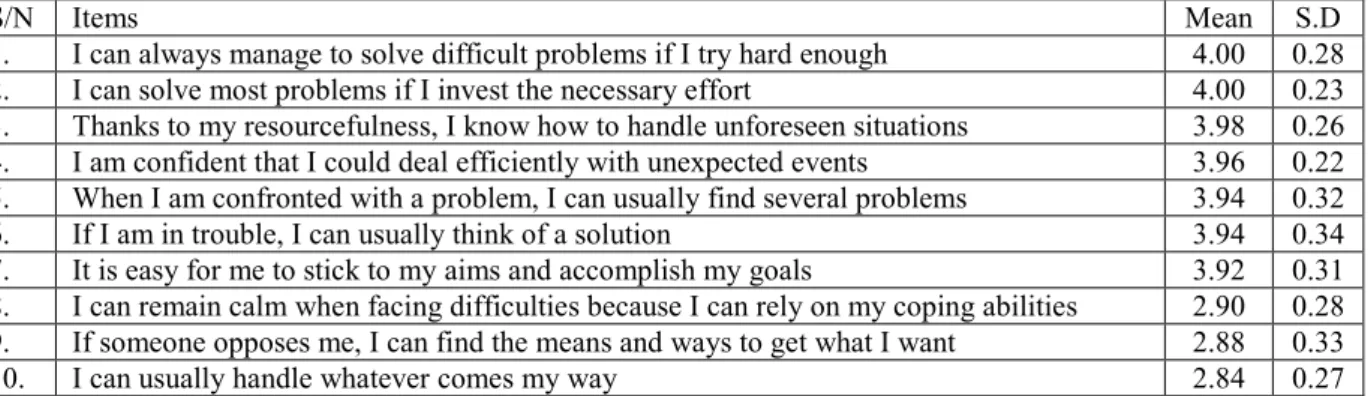
Nonetheless, to determine the patterns of the self-efficacy of the respondents, the maximum score of 40 is permissible for each of the respondents. Any manager who scores between (1-17) has low self-efficacy, (17-27) moderate self efficacy and (28-40) high self efficacy. Of the 485 respondents, 70(14.4%) have low self-efficacy and 94(14.4%) have moderate self-efficacy and 321(66.2%) have high self efficacy. One can therefore deduce that majority of the respondents have high self-efficacy. Table 1 presents mean and standard deviation scores of self-efficacy of respondents.
Table 2: Mean and Standard Deviation Scores of Self-Efficacy of the respondents
S/N Items Mean S.D
1. I can always manage to solve difficult problems if I try hard enough 4.00 0.28 2. I can solve most problems if I invest the necessary effort 4.00 0.23 3. Thanks to my resourcefulness, I know how to handle unforeseen situations 3.98 0.26 4. I am confident that I could deal efficiently with unexpected events 3.96 0.22 5. When I am confronted with a problem, I can usually find several problems 3.94 0.32
6. If I am in trouble, I can usually think of a solution 3.94 0.34
7. It is easy for me to stick to my aims and accomplish my goals 3.92 0.31 8. I can remain calm when facing difficulties because I can rely on my coping abilities 2.90 0.28 9. If someone opposes me, I can find the means and ways to get what I want 2.88 0.33
10. I can usually handle whatever comes my way 2.84 0.27
The overall mean score of self efficacy of the respondents based on arithmetic mean method is x = 34.68, SD = 5.34). This further confirms that the self-efficacy of the respondents is high. The most self-efficacy beliefs exhibited by the respondents as reflected in table 2 include among others: I can always manage to solve difficult problems if I try hard enough (x = 4.00, SD = 0.28), I can solve most problems if I invest the necessary effort (x = 4.00, SD = 0.23); thanks to my resourcefulness, I know how to handle unforeseen situations (x = 3.98; SD = 0.26), etc.
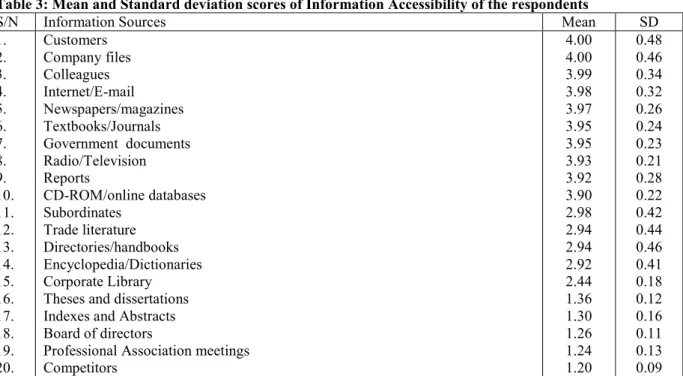
Concerning the information accessibility of the respondents, it is obviously seen from Table 3 that the major information sources accessible by the respondents are:- customers, Company files, Colleagues, Internet/E-mail, Newspapers/magazines, Textbooks/Journals, Government documents, Radio/Television, Reports, CD-ROM/online databases, Subordinates, Trade literature, Directories/handbooks.
Table 3: Mean and Standard deviation scores of Information Accessibility of the respondents
S/N Information Sources Mean SD
1. 2. 3. 4. 5. 6. 7. 8. 9. 10. 11. 12. 13. 14. 15. 16. 17. 18. 19. 20. Customers Company files Colleagues Internet/E-mail Newspapers/magazines Textbooks/Journals Government documents Radio/Television Reports CD-ROM/online databases Subordinates Trade literature Directories/handbooks Encyclopedia/Dictionaries Corporate Library
Theses and dissertations Indexes and Abstracts Board of directors
Professional Association meetings Competitors 4.00 4.00 3.99 3.98 3.97 3.95 3.95 3.93 3.92 3.90 2.98 2.94 2.94 2.92 2.44 1.36 1.30 1.26 1.24 1.20 0.48 0.46 0.34 0.32 0.26 0.24 0.23 0.21 0.28 0.22 0.42 0.44 0.46 0.41 0.18 0.12 0.16 0.11 0.13 0.09 Nonetheless, theses and dissertations, indexes and abstracts, board of directors, professional association meetings and competitors which happen to be one of the essential sources of information to managers in business world are rarely accessible to them.
Table 4 presents mean and standard deviation scores of information utilization of the respondents. The major types of information utilized by the respondents are scientific/technical, information, trade regulations, household income/budget, nature of competition, wages/salaries, tax laws, energy availability/cost, inflation rate, monetary policies, and security management.
Table 4: Mean and Standard deviation scores of information utilization of the respondents
S/N Types of Information Mean SD
1. 2. 3. 4. 5. 6. 7. 8. 9. 10. 11. 12. 13. 14. 15. 16. 17. 18. 19. 20. Scientific/technical Trade regulations Household income/budget Nature of competition Wages/Salaries Tax laws Energy availability/cost Inflation rate Monetary policies Security management Population matters Transport matters Foreign policies Political matters Socio-cultural Life styles Environmental management Information flow infrastructure Personnel management Educational matters 4.00 4.00 3.98 3.98 3.97 3.96 3.94 3.92 3.92 3.90 3.78 3.72 3.70 3.50 3.42 3.28 2.48 2.40 2.25 2.20 0.221 0.224 0.222 0.310 0.281 0.242 0.212 0.218 0.250 0.261 0.119 0.118 0.132 0.112 0.116 0.121 0.128 0.134 0.132 0.127
The types of information that are occasionally utilized by the respondents include environmental management, information flow infrastructure, personnel management and education matters.
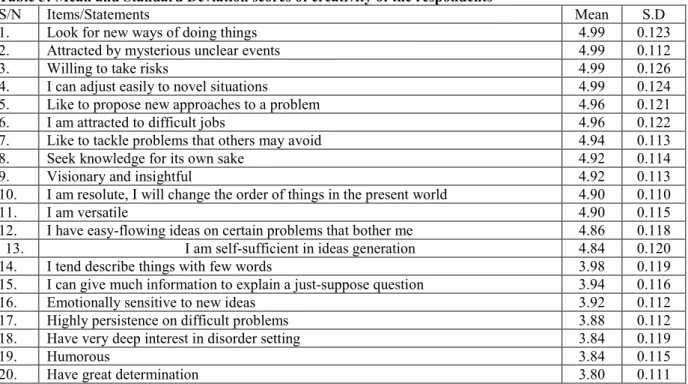
With regards to creativity of the managers in the packaging companies in Nigeria. Table 5 depicts the mean and standard deviation scores of creativity of the respondents. It is obviously seen in Table 5 that the majority of the respondents exhibited good creative behaviour. The reasons being
Table 5: Mean and Standard Deviation scores of creativity of the respondents
S/N Items/Statements Mean S.D
1. Look for new ways of doing things 4.99 0.123
2. Attracted by mysterious unclear events 4.99 0.112
3. Willing to take risks 4.99 0.126
4. I can adjust easily to novel situations 4.99 0.124
5. Like to propose new approaches to a problem 4.96 0.121
6. I am attracted to difficult jobs 4.96 0.122
7. Like to tackle problems that others may avoid 4.94 0.113
8. Seek knowledge for its own sake 4.92 0.114
9. Visionary and insightful 4.92 0.113
10. I am resolute, I will change the order of things in the present world 4.90 0.110
11. I am versatile 4.90 0.115
12. I have easy-flowing ideas on certain problems that bother me 4.86 0.118
13. I am self-sufficient in ideas generation 4.84 0.120
14. I tend describe things with few words 3.98 0.119
15. I can give much information to explain a just-suppose question 3.94 0.116
16. Emotionally sensitive to new ideas 3.92 0.112
17. Highly persistence on difficult problems 3.88 0.112
18. Have very deep interest in disorder setting 3.84 0.119
19. Humorous 3.84 0.115
20. Have great determination 3.80 0.111
that the majority of them claimed that they Look for new ways of doing things (x =4.99, SD = 0.123); Attracted by mysterious unclear events, (x = 4.99, SD = 0.112), Willing to take risks, (x = 4.96; SD = 0.126); I can adjust easily to novel situations(x = 4.99, SD = 0.124) among others.
In addition, by the norm of the creativity scale, the aggregate score of 1-33 indicating low creativity, a score of 34-66 indicating moderate creativity and a score of 67-100 indicating high creativity. The overall mean score of creativity of the respondents is (x = 88.56, SD = 6.75). One can therefore deduce that the respondents have high creativity.
However, to test the hypothesis one, simple correlation analysis was used based on Spearman product moment method. Table I presents summary of zero-order correlation matrix of the variables of interest.
Table 6: Mean, Standard Deviation and Correlation matrix of the variables of Interests.
S/N Variables Mean SD 1 2 3 4
1 Creativity (CR) 88.56 6.75 1.00
2 Self-efficacy (SE) 34.68 5.34 .072*
P=0.025 1.00 3 Information Acquisition (IA) 76.42 8.54 0.66*
P=0.016
0.54* P=0.018
1.00 4 Information Utilization (IU) 84.62 9.24 0.84*
P=0.041 0.62* P=0.021 0.52* P=0.038 1.00 NB: * P < 0.05 significant.
It is vividly seen on the Table 6 that creativity has significant correlations with: Self efficacy (r = 0.72, p<0.05); information accessibility (r = 0.66, p< 0.05), and information utilization (r = 0.84, p<0.05) of the respondents. This implies that self-efficacy, information accessibility and utilization have associations with the creativity of the respondents.
Nonetheless, the result of hierarchical regression analysis that was conducted to establish whether the self-efficacy, information accessibility and utilization are significant determinants of creativity of managers in packaging companies in Nigeria depicted in table 7. In line with the procedures suggested by Cohen and Cohen (1983), self-efficacy was entered into the regression model first, then information accessibility and lastly information utilization.
Table 7: Hierarchical Regression Analysis of Creativity of Respondents on their Independent Variables
Variables Beta R Square R Square change F Sig. P.
Step 1 Self-efficacy
Step 2 Information accessibility Step 3 Information Utilization
0.152 0.168 0.175 0.370 0.472 0.568 0.370 0.102 0.096 5.722 4.842 3.782 0.012 0.016 0.021 N.B Beta = standardized regression coefficient.
R = adjusted multiple correlation coefficient.
respondents (Beta = 0.152, p < 0.01) and that it accounted for a significant variability in creativity of the respondents (R-square = 0.370; F = 5.722, p < 0.01). When the information accessibility was entered into the regression model at the second step of the analysis, it made significant contribution to the determinant of creativity of the respondents (Beta = 0.168, R-Square = 0.472, R-Square change = 0.102,
F = 4.842, p < 0.01). This means that information accessibility is a significant determinant of creativity of the respondents. In the third step of the analysis, information utilization was entered into the regression model. Information utilization made significant contribution to the determination of creativity of the respondents. (Beta = 0.175, R-Square = 0.568, R-Square change = 0.096, F = 3.782, p < 0.01). This implies that information utilization is a significant determinant of creativity of the respondents. By and large, one can therefore deduce that self-efficacy, information accessibility and information utilization are significant determinants of creativity of the managers in packaging companies in Nigeria.
DISCUSSION OF RESULTS
Organizations need workforce particularly managers with high self-efficacy to achieve their set goals and gain competitive advantage in the market place. This study established that the greatest proportion of the managers in the studied organizations have high self-efficacy. Adekunle (2015) reiterated that workers with high self-efficacy are greatest asset to an organization because they believe in their ability to succeed amidst difficult challenges. Chen, Gully and Eden (2004) opined that self-efficacy is a useful concept for explaining human behaviour because it plays an influential role in determining an individual’s choice, level of effort and perseverance. Indeed, the chief executives of most business organizations would love to hire managers with high self-efficacy to improve their business performance.
Information is crucial to managerial functions of planning, organizing, coordinating, leading, decision making, monitoring and controlling in business organizations, like packaging companies. Starbuch et.al (1978) observed that without information, top managers of firms simply would not function smoothly and this would lead to corporate decline and failure. It must be noted that numerous information sources are available to managers in organizations to acquire their needed information but ease of accessibility to these sources of information by managers are the major problem confronting them. This study also found that the major sources of information that are accessible to the respondents include customers, company files, colleagues, Internet/E-mail, newspapers/magazines, textbooks/Journals, government documents, radio/television, reports and CD-ROM/ online databases. One can also deduce that the managers in the packaging companies in Nigeria had very easy access to human, electronic and printed sources of information. It is very surprising to find that theses and dissertations, indexes and abstracts, board of directors, professional association meetings and competitors are credible sources of information that were not accessible to the managers in the packaging companies in Nigeria. Similarly, Alwis and Higgins (2001) reported that managers in Singapore had access to the internet and used it to obtain their needed information. Furthermore, sixteen sources of information accessible to the managers in the business organizations have been identified as customers, subordinate staff, colleagues, broadcast media, newspapers/magazines, reports, competitors, government publications, company library, government officers, trade associations, conference trips, internal memoranda/circulars and electronic information services (Auster & Choo, 1994; Culman, 1983; Okello-Obuna et.al, 2007; Kaye, 1995, Popoola, 2006; Fadehan, Atinmo and Popoola, 2008). However, O’ Reilly (1982) studied the impact of information sources accessibility on the use of information sources by decision makers (managers) in four branch locations of a country welfare agency and established that superiors and peers were high sources of information accessible to them. Olabisi (2015) reiterated that the senior managers and chief executives of some manufacturing companies in Nigeria were not very easily accessible to theses and dissertations, indexes/abstracts, competitors, board of directors and conference proceedings when searching for needed information to carry out their job functions.
The rapid access to information from the variety of reliable and relevant sources may promote information utilization for better job performance and creativity/innovation of managers in business organizations. This study also revealed that the major information types utilized by the respondents are: Scientific/technical information, trade regulations, household income/budget, nature of competition, wages/salaries, tax laws, energy availability/cost, inflation rate, monetary policies, security management, population matters, transport matters, foreign policies, political matters, socio-cultural matters and life styles.
Previous studies equally established that managers in the corporate business utilized scientific and technological information, wages/salaries, population matters, household budget and expenditures, inflation rates, exchange rate, tax laws, trade regulations, and market competition (Popoola, 2009; Olabisi, 2015; Goshal & Kim, 1986; Keegan, 1974; Popoola, 2006; Alwis & Higgins 2001). Nonetheless, Obilade (2008) averred that managers in manufacturing industry in Nigeria never care to use information on environmental management, educational matters, and information flow infrastructure. Abu (2011) defined creativity, as a mental process involving the generation of new ideas, or concepts. Sam and Mohammed (2005) equally posited that creativity is the power of making a new concept or using it in a new form by several mental skills. It must be noted that
creativity and innovation of the workforce in any organization assist it to gain competitive advantage and achieve success. Business organisations having creative and innovative managers have good human asset. This study also confirms that the respondents have high creativity. The managers with high creativity are risk takers, adventurous, intelligent, great thinkers, goal achievers, better problem solvers, principled and good leaders as well as optimists. Adelani (2008) submitted that creative persons exhibit some characteristics, that is, originality, independence, involvement and detachment, discover problems, generate alternatives and challenge basic assumptions.
However, this study revealed that there are significant positive correlations among self-efficacy information accessibility, information utilization and creativity of the respondents. Akinboye (2003) opined that without creativity, a person is unable to access the fullness of information and resources available but instead is locked up in old habits, structures, patterns, concepts and perceptions. Accessing high quality information and use of information will facilitate creative ability of managers in business organizations. Past studies also reported that information seeking behaviour, information availability and utilization had significant relationships with the creativity of managers (Popoola & Okiki, 2013; Popoola, 2009; Oyedapo, 2005). de-Bono (1992) posited that the need for information accessibility, acquisition and utilization provide the basis for fostering creativity and innovation in workers in organizations. Adeleye (2008) averred that information accessibility and utilization may stimulate creativity and innovation among workers in business organizations. In the same vein, Ogundele (2009) remarked that information needs, accessibility and utilization could promote creativity and innovation which can have spiral effect on job performance of managers in industrial organizations. Self-efficacy has been found to be significantly correlated with creativity of workers (Tella, Ayeni 2006; Adeduntan, 2016).
More importantly, this study found that self-efficacy, information accessibility and information utilization are significant determinants of creativity of the managers in packaging companies in Nigeria. In support of this finding, Adejobi (2014) reiterated that emotional intelligence, self-esteem self-efficacy, information preference, acquisition accessibility and use may stimulate creativity and innovation among workers in organizations. CONCLUSION AND RECCOMENDATIONS
Creativity and innovation are the blood and veins of the modern business organizations. The creative workforce are the corporate assets of business organizations like packaging companies. They are great risk takers; tend to take the initiative, good team players and team building, pay attention to details; and work tirelessly to achieve set goals. Self-efficacy is very important to the creative ability of workers in organizations. Self-efficacious beliefs of managers in the business organisations assist them in accomplishing the tasks assigned to them. Every workforce in organizations needs high self-efficacy to succeed in the world of work.
It must be noted that the problem facing managers in the corporate world is how to access the available information resources for use to perform efficiently and effectively. Information is a critical weapon necessary for sound management of companies in depressed economy like Nigeria.
The major findings of this study are: the managers in the packaging companies in Nigeria exhibited high self-efficacy and creativity. There are significant positive correlations among self-efficacy, information accessibility, utilization and creativity of the respondents. More importantly, self-efficacy, information accessibility and utilization are significant determinants of the creativity of the respondents. Based on the findings of this study, it is recommended that the management of packaging companies in Nigeria should give high priority to self-efficacy, information accessibility and utilization when planning to improve creativity of their managers, self-efficacy training should be given to workforce in the management positions to enhance their creativity; they must be encouraged to make intensive use of information to increase their creativity; and the management should allow their managers to have wide access to available information resources in their companies for better creativity.
References
Abu, R.O. (2011). Creativity and work performance of employees in Insurance companies in Nigeria.
International Journal of Management,10, 5, 126-142
Adeduntan, B.A. (2016). Self-efficacy, goal setting and creativity of workers in the Nigerian insurance companies. Journals of Management Studies, 8, 1, 50-62.
Adejobi, B.O. (2014). Fostering creativity and innovation in employees of business organizations in Nigeria through Psychological and information factors. Journals of Business management and Technology, 8, 2, 160-171.
Adekunle, A.A. (2015). self-efficacy and work performance of workers in Nigerian Government parastatal.
Administration Bulletin, 8, 2, 50-56.
Adelami, B.O (2008). Influence of self-efficacy on leadership styles and effective leadership of managers in government parastatals in Nigeria. Journal of Applied Management,18, 4,158-169.
Journal of Labour Studies,15, 3, 81-94.
Adeleye, A.O. (2008). Using information to stimulate creativity and Innovation of workers in organizations.
Journals of Management studies, 25, 2, 120-132.
Agbor, E. (2008). Creativity and Innovation: The leadership Dynamics. Journals of Strategic Leadership, 1, 1, 39-45.
Akinboye, J.O. (2003). Creativity and innovation in life and the workplace. Ibadan. Stirling-Horden Publishers Nigeria Limited.
Akinboye, J.O. (1977). Adolescent personal data inventory. Ibadan: Maritime Printers Allen, T.J. (1977). Managing the flow of technology. Cambridge, M.A.: MIT Press
Amabile, T. and Conti, R (1999). Changes in the work environment for creativity during downsizing. Academy of Management Journal, 42, 6, 630-640.
Amabile, T.M. (1996). Creativity in context. Boulder Co: West View Press.
Amabile, T.M. (1998). How to kill creativity.Hazard Business Review, 76, 5, 77-87.
Auster, E. and Choo, C.W. (1994). CEOs information and decision making: Scanning the environment for strategic advantage. Library Trends, 43, 2, 206-255.
Bandura, A. (1977). Social learning theory, Prentice-Hall, Eaglewood Cliffs, NJ.
Bandura, A. (1977). Self-efficacy; the experience of control. New York: W.H. Freeman and Company. Bandura, A. (2001). Social cognitive theory: An argentic perspective. Annual Review of Psychology, 52, 1-26 Bandura, A. (1982). Self-efficacy mechanism in human agency. American Psychologist, 37, 122-147.
Bandura. A. (1986). Social foundations of thoughts and action: A Social cognitive theory. Eaglewood Cliffs, NJ: Prentice Hall.
Bandura, A. (1993) Perceived self-efficacy in cognitive development and functioning. Educational Psychologist,
28, 117-148.
Betz, N.E and Hackett, G. (1983). The relationship of mathematics self-efficacy expectations in the selection of science-based college majors. Journals of vocational Behaviour, 23, 329-345
Brown, L. and Invoye, D.K. (1978). Learned helplessness through modeling. The role of perceived similarity in competence. Journal of personality and Social Psychology, 36, 900-908
Chen, G.; Gully, S.M. and Eden, D. (2001). Validation of a general self-efficacy scale. Organizational Research Methods, 4, 1, 62-83.
Culman, M. J. (1983).Environmental scanning: The effects of task complexity and source accessibility on information gathering behaviour. Decision Sciences, 14, 194-206.
Daniells, L.M. (1993). Business information sources, 3rd. ed. Los Angeles, CA: University of California Press. deAlwis, G.; Majid, S.; and Chawdhry, A.S. (2006). Transformation in managers’ information seeking behaviour:
A review of the literature. Journal of Information Science, 32, 4,362-377.
deAlwis, S.M. and Higgins, S.E. (2001). Information as a tool for management decision making. A case study of Singapore. Information Research, 7, 1,1-37.
deBono, E. (1992). Superstition. New York: Harper/Collins Publishers Limited. Drake, M.A. (1982). Information and corporate culture. Special Libraries, 75, 4, 69-77. Eyton, R. (1996). Making innovation fly. Ivey Business Quarterly, 61, 1, 59-68.
Fadehan, O.A; Atinmo, M.I. and Popoola, S.O (2008). Information source quantity and use as correlates of business performance of community banks in Osun State, Nigeria. Library Progress International, 28, 2, 165-188.
Findlay, C.S and Lumsden, C.J. (1988). The creative mind: Towards an evolutionary theory of discovery and innovation. Journal of Social and Biological Structure, 11, 3-55.
Ford, C. (1996). A theory of individual creativity action in multiple social domains. Academy of Management Review, 21, 4, 1112-1142.
Ghoshal, S. and Kim, S.K. (1986) Building effective intelligence systems for competitive advantage. Sloan Management Review, 28,1, 49-58.
Goldsmith, C. (1996). Overcoming road blocks to innovation.Marketing News, 30, 4, 24-38.
Hall, D.J. (1996). The role of creativity within best practice manufacturing.Technovation, 16, 3, 370-380. Haygarth, J.A.R. (1981). Industry and research association information provision to users. London: Clive
Bingley.
Houtari, M.L. and Wilson, T.D. (2001). Determining organizational information needs. The critical success factors approach. Information Research, 6, 3, 1-17
Ikoja-Odongo, R. and Ocholla, D.N. (2004). Information seeking behaviour of the informal sector entrepreneurs: The Uganda experience. Libri, 54, 1, 54-66.
Jorosi, B.N. (2006). The information needs and information seeking behaviours of SME managers in Botswana.
Libri, 56, 97-107.
executives in multinational companies. Administrative Science Quarterly, 19, 3, 411-421. Kaye, D. (1995). The importance of information. Library Management, 6, 5, 6-15.
Kobrin, S.J.; Basek.J.; Blank, S. and Lapalombara. J. (1980). The assessment of non-economic environments by American firms. Journals of International Business Studies, 11, 32-47.
Locke, E.A; Frederick, E; Lee, C.; and Bobko, P. (1984). Effect of self-efficacy, goals, and task strategies on task performance. Journal of Applied Psychology, 69, 241-251.
Mackinnon, D.W. (1962). The nature and nurture of creative talent. American Psychologist, 17, 484-495. Mckinnon, S.M and Bruns, W.J (1992). The information mosaic. Boston, M.A: HBS Press
Nadler, D.A., and Tushman, M.L. (1997). Competing by design: the power of organizational architecture. New York: Oxford University Press, 7-10.
O’Connell, J.J. and Zimmerman, J.W. (1979). Scanning the international environment. California Management Review, 22, 2, 15-23.
Ogundele, A.A. (2009). Interplay of information and creativity for employee work performance in organizations.
Journal on Administration,18, 4, 150-164.
Ogunlade, O.A. (2007). Information needs and utilization of managers in Nigerian Financial Institutions. Journal of Business Management, 10, 2, 58-64.
Okello-Obura, C., Minishi-Majanja, M.K; Cloete, L; and Ikoja-Odongo, J.R. (2008). Sources of business information and means of access used by SMEs in Uganda. The case of Northern Uganda. LIBRES: Library and Information Science Research Electronic Journal, 18, 1, 131-147.
Olaisen, J. (1991). The use of information and information technology as a critical success factor in small and medium-sized companies. Journal of Business Venturing, 3, 223-232.
Ojedokun, A.A. (2007). Information literacy for tertiary education students in Africa. Ibadan: Third World Information Services Limited.
Olabisi, M.O. (2015). Information and job performance of managers in the Nigerian manufacturing companies.
Journal of Business and Information Management, 5, 2,110-122.
Oldham, G.R and Cummings, A. (1996). Employee creativity: personal and contextual factors. Academy of Management journal, 39, 3, 607-635.
O’Reilly. A.(1982). Variations in decisions makers’ use of information sources: the impact of quality and accessibility of information. Academy of Management of Journal, 25, 4, 756-771.
Oyedapo, R.O. (2005). Information sources availability and utilization as correlates of creativity of workers in primary school management board in Osun State, Nigeria. Ibadan: University of Ibadan, Nigeria. MLIS Project, 98.
Pajares, F. (1996). Self-efficacy beliefs in academic settings. Review of Educational Research, 66, 543-578. Politis, J.D. (2005). Dispersed leadership predictor of the work environment for creativity and productivity.
European Journal of Innovation Management, 8, 182-204.
Popoola, S.O. (2000) Scanning the environment for competitive advantages: A study of corporate banking managers in Nigeria. Libri, 50, 3, 210-216.
Popoola, S.O (2006). Information accessibility and utilisation as factors influencing decision-making of managers in commercial banks in Nigeria. Library Herald, 44, 2, 89-110.
Popoola, S.O (2009). self–efficacy, information acquisition and utilization as correlates of effective decision making among managers in insurance companies in Nigeria. Malaysian journal of library and information Science, 14, 1,1-15.
Popoola, S.O and Okiki, O.C. (2013). Information availability and utilization as determinants of creativity of managers in commercial banks in Nigeria. Information and knowledge Management, 3, 8.
Preble, J.F: Rav, P.A. and Reichel, A (1988). The environmental scanning practices in U.S multinationals in the late 1980s. Management International Review, 28, 4, 4-14.
Quigley, C. (1998). Creativity and computers [Online] Available http://arts.anu.edu/philosophy/conweb/quigley.htm (May 15, 2014)
Sam, K. and Mohammed, R. (2005). Creativity and innovation in educational organizations. Tehran: Espand Honar.
Saunders, C. and Jones, J.W. (1990). Temporal sequences in information acquisition from decision making: a focus on source and medium. Academy of Management Review, 15, 1, 29-46.
Schunk, D.H. (1981). Modeling and attributional effects on children’s achievement: a self-efficacy analysis.
Journal of Educational Psychology, 73, 93 -105.
Schwarzer, R. and Jerusalem, M. (1995). Generalized self-efficacy scale. In J.Weinmann, S.M. Johnston (eds.) measures in health psychology: a user’s portfolio (35-37) Windsor, U.K: NFER-NELSON
Schwartzer, R and Schmitz, G.S. (2005). Perceived self-efficacy and teacher burnout: a longitudinal study in ten schools. Research Paper. Germany: Freie Universitat. Berlin
55, 1, 151-158.
Stacey, R.D. (1996). Complexity and creativity in organizations. San Francisco: Bernettkoechler
Starbuck, W.; Greven, A. and Hedberg, B.L. (1978). Responding to crises. Journal of Business Administration, 9, 111- 137.
Sternberg, R.J. (1995). Handbook of creativity, Cambridge: Cambridge University Press.
Stump, S.A.; Brief, A.P. and Hartman, K. (1987). Self-efficacy expectations and coping with career-related events. Journals of vocational Behaviour,31, 91-108.
Swanson, B.E. (1987). Information channel disposition and use. Decision Sciences, 18, 1, 131-147.
Tella, A. and Ayeni, C.O. (2006). The impact of Self –efficacy and prior computer experience on the creativity of new Librarians in selected universities libraries in South-West Nigeria. Library Philosophy and Practice,
8, 2, 1-12.
Virkus, S. and Tamre, M. (1995). Business information-necessities and possibilities why smaller countries need a coordinated approach to the access of business information from home country and from abroad. What experiences does Baltikum have in this field. In information power: Proceedings from the 9th Nordic conference on information and documentation Oslo,189-198.