University of South Florida
Scholar Commons
Graduate Theses and Dissertations Graduate School
March 2018
Dynamic Energy-Aware Database Storage and
Operations
Peyman Behzadnia
University of South Florida, [email protected]
Follow this and additional works at:http://scholarcommons.usf.edu/etd Part of theComputer Sciences Commons
This Dissertation is brought to you for free and open access by the Graduate School at Scholar Commons. It has been accepted for inclusion in Graduate Theses and Dissertations by an authorized administrator of Scholar Commons. For more information, please contact
Scholar Commons Citation
Behzadnia, Peyman, "Dynamic Energy-Aware Database Storage and Operations" (2018).Graduate Theses and Dissertations.
Dynamic Energy-Aware Database Storage and Operations
by
Peyman Behzadnia
A dissertation submitted in partial fulfillment of the requirements for the degree of
Doctor of Philosophy
Department of Computer Science and Engineering College of Engineering
University of South Florida
Major Professor: Yi-Cheng Tu, Ph.D. Ken Christensen, Ph.D. Adriana Iamnitchi, Ph.D. Bo Zeng, Ph.D. Ming Ji, Ph.D. Date of Approval: March 26, 2018
Keywords: Database Management System (DBMS), Dynamic Power Management (DPM), Data Consolidation, Data Stream Management System (DSMS), Stream (Window) Join
Dedication
Acknowledgments
I would like to deeply appreciate my advisor, Dr. Yi-Cheng Tu, for his academic advice and inspirations during my Ph.D. study. He is an excellent researcher, inspiring advisor and a perfect mentor that every graduate student would like to work with.
I would like to also thank my committee members Dr. Ken Christensen, Dr. Adriana Iamnitchi, Dr. Bo Zeng, and Dr. Ming Ji for their valuable advice and feedback in my research.
Table of Contents
List of Tables ... iii
List of Figures ... iv
Abstract ... vii
Chapter 1 Introduction ... 1
1.1. Background and Motivation ... 1
1.2. Research Objectives ... 6
1.3. Research Contributions ... 8
1.4. Outline... 9
Chapter 2 Literature Survey ... 11
2.1. DPM Techniques in Disk Storage Systems ... 11
2.1.1. Data Consolidation Techniques ... 12
2.1.2. Power-Aware Cache and Prefetching Algorithms ... 16
2.1.3. Energy-Proportional Strategies in Distributed Systems ... 18
2.1.4. Other Techniques ... 20
2.2. Stream Joins ... 21
2.2.1. Join Algorithms on Sliding Windows ... 21
2.2.2. Shared-Memory Parallel Stream Joins... 23
2.2.2.1. Handshake Join ... 23
2.2.2.2. ScaleJoin ... 26
2.2.3. Multi-Way Stream Join ... 28
2.3. Database Joins ... 30
2.3.1. Hash Joins ... 30
2.3.1.1. Canonical Hash Join ... 31
2.3.1.2. No Partitioning Join ... 31
2.3.1.3. Radix Join ... 32
2.3.1.4. Parallel Radix Join ... 34
2.3.2. Sort-Merge Joins ... 35
2.3.2.1. Classical Sort-Merge Join ... 36
2.3.2.2. Parallelization of Sorting Phase using SIMD ... 37
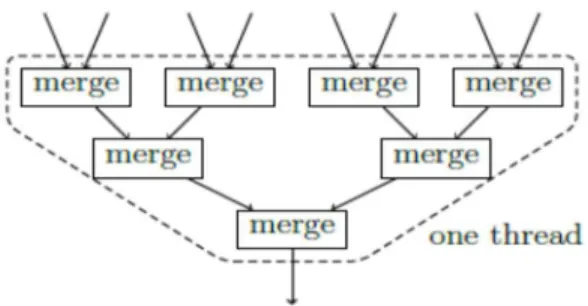
2.3.2.3. Parallel Sort-Merge Join Algorithms ... 41
Chapter 3Dynamic Energy-Aware Disk Storage Management in Database Servers ... 44
3.1. Proposed DPM Optimization Model ... 44
3.1.1. Formulation of DPM Optimization Model for Multi-State Disks ... 48
ii
3.1.3. Response Time Modeling ... 50
3.1.4. Model Predictive Control (MPC)... 51
3.1.5. Solving Strategy ... 52
3.2. Proposed Heuristic DPM Algorithm ... 52
3.2.1. Assumptions and Properties of the Algorithm ... 53
3.2.2. Algorithm Description ... 54
3.2.2.1. One-To-One Sequential Pairing Algorithm ... 54
3.2.2.2. One-To-Many Sequential Pairing Algorithm ... 56
3.3. Empirical Evaluation ... 59
3.3.1. Simulated Disk Storage System ... 59
3.3.2. Synthetic Workload Generator ... 60
3.3.3. Experimental Platform ... 61
3.3.4. Simulation Results and Comparisons ... 62
3.3.4.1. Dynamic I/O Workloads ... 62
3.3.4.2. Static I/O Workloads... 65
3.3.4.3. Large-Scale Disk Storage Simulation ... 66
3.3.4.4. MPC Robustness against Mis-Predictions ... 69
3.3.4.5. Effect of Epoch Length on Energy Saving ... 73
Chapter 4Shared-Memory Parallel Hash-Based Stream Joins in Continuous Data Streams... 75
4.1. Proposed Parallel Symmetric Hash Join ... 75
4.2. Proposed Chunk-Based Pairing Hash Join ... 80
4.3. Proposed Parallel Multi-Way Hash Join ... 83
4.4. Empirical Evaluation ... 86
4.4.1. Experimental Setup ... 87
4.4.2. Throughput and Scalability Evaluation ... 89
4.4.3. Latency Evaluation ... 92
4.4.4. Energy-Efficiency Evaluation ... 95
Chapter 5 Summary and Future Works ... 97
References ... 99
Appendices ... 105
Appendix A. Copyright Permissions ... 106 About the Author ... End Page
List of Tables
Table 2.1 Characteristics of power-saving solutions using data consolidation
techniques ...15
Table 3.1 DPM optimization model parameters ... 46
Table 3.2 DPM optimization model decision variables ... 47
Table 3.3 Hard disk specifications ... 59
iv
List of Figures
Figure 1.1 Power modes and their power consumption for the IBM UltraStar 7k6000 ...2
Figure 1.2 Sliding-window join for two data streams ...4
Figure 2.1 Taxonomy of effective DPM techniques in disk storage systems ...12
Figure 2.2 Symmetric hash join algorithm for two data streams ...23
Figure 2.3 Overview of ScaleJoin’s architecture and parallelization approach [GN15] ...26
Figure 2.4 ScaleJoin & Handshake join throughput on two different systems [GN15] ...27
Figure 2.5 Multi-way join ...28
Figure 2.6 Canonical hash join ...30
Figure 2.7 No partitioning join ...31
Figure 2.8 Partitioned hash join ...32
Figure 2.9 Radix join ...33
Figure 2.10 Classical sort-merge join...35
Figure 2.11 Sorting network ...37
Figure 2.12 Comparator implementation via min/max operators ...37
Figure 2.13 Bitonic merge network ...38
Figure 2.14 Multiple two-way merging ...39
Figure 2.15 NUMA-aware sort-merge join with multi-way merge and SIMD ...42
Figure 3.2 Flowchart for one-to-one sequential pairing algorithm ...55
Figure 3.3 Flowchart for one-to-many sequential pairing algorithm ...56
Figure 3.4 Examples of gamma distributions with different parameters used in dynamic workloads ...60
Figure 3.5 Experimental results under dynamic workloads with different mean data arrival rates...62
Figure 3.6 Average response time results under dynamic workloads with different mean data arrival rates ...64
Figure 3.7 Experimental results under static workloads with different data arrival rates ...66
Figure 3.8 Experimental results for large-scale storage system under dynamic workloads with different mean data arrival rates ...67
Figure 3.9 Average computational time results for large-scale storage system under dynamic workloads with different mean data arrival rates ...68
Figure 3.10 MPC robustness results under different prediction error rates – set 1 ...69
Figure 3.11 MPC robustness results under different prediction error rates – set 2 ...71
Figure 3.12 Effect of epoch length on energy saving ...73
Figure 4.1 Chunk-based pairing hash join algorithm overview ...81
Figure 4.2 Scalability evaluation under different window sizes and increasing number of threads ...89
Figure 4.3 Comparisons in terms of scalability and throughput ...90
Figure 4.4 Scalability evaluation for parallel multi-way hash join under different window sizes and increasing number of threads ...92
Figure 4.5 Latency evaluation of parallel schemas ...93
Figure 4.6 Latency evaluation of parallel schemas under different intensities of input streams ...94
vi
Figure 4.8 Energy consumption measurements for parallel stream join algorithms
Abstract
Energy consumption has become a first-class optimization goal in design and implementation of data-intensive computing systems. This is particularly true in the design of database management systems (DBMS), which is one of the most important servers in software stack of modern data centers. Data storage system is one of the essential components of database and has been under many research efforts aiming at reducing its energy consumption. In previous work, dynamic power management (DPM) techniques that make real-time decisions to transition the disks to low-power modes are normally used to save energy in storage systems. In this research, we tackle the limitations of DPM proposals in previous contributions and design a dynamic energy-aware disk storage system in database servers. We introduce a DPM optimization model integrated with model predictive control (MPC) strategy to minimize power consumption of the disk-based storage system while satisfying given performance requirements. It dynamically determines the state of disks and plans for inter-disk data fragment migration to achieve desirable balance between power consumption and query response time. Furthermore, via analyzing our optimization model to identify structural properties of optimal solutions, a fast-solution heuristic DPM algorithm is proposed that can be integrated in large-scale disk storage systems, where finding the most optimal solution might be long, to achieve near-optimal power saving solution within short periods of computational time. The proposed ideas are evaluated through running simulations using extensive set of synthetic workloads. The results show that our solutions achieve
viii
up to 1.65 times more energy savings while providing up to 1.67 times shorter response time compared to the best existing algorithm in literature.
Stream join is a dynamic and expensive database operation that performs join operation in real-time fashion on continuous data streams. Stream joins, also known as window joins, impose high computational time and potentially higher energy consumption compared to other database operations, and thus we also tackle energy-efficiency of stream join processing in this research. Given that there is a strong linear correlation between energy-efficiency and performance of in-memory parallel join algorithms in database servers, we study parallelization of stream join algorithms on multicore processors to achieve energy efficiency and high performance. Equi-join is the most frequent type of join in query workloads and symmetric hash join (SHJ) algorithm is the most effective algorithm to evaluate equi-joins in data streams. To best of our knowledge, we are the first to propose a shared-memory parallel symmetric hash join algorithm on multi-core
CPUs. Furthermore, we introduce a novel parallel hash-based stream join algorithm called
chunk-based pairing hash join that aims at elevating data throughput and scalability. We also tackle
parallel processing of multi-way stream joins where there are more than two input data streams
involved in the join operation. To best of our knowledge, we are also the first to propose an in-memory parallel multi-way hash-based stream join on multicore processors. Experimental evaluation on our proposed parallel algorithms demonstrates high throughput, significant scalability, and low latency while reducing the energy consumption. Our parallel symmetric hash join and chunk-based pairing hash join algorithms achieve up to 11 times and 12.5 times more throughput, respectively, compared to that of state-of-the-art parallel stream join algorithm. Also, these two algorithms provide up to around 22 times and 24.5 times more throughput, respectively,
compared to that of non-parallel (sequential) stream join computation where there is one processing thread.
Chapter 1 Introduction
In this section, required background and motivation behind this research are provided. Next, research objectives are presented. Then, major contributions of this research are discussed followed by the dissertation outline.
1.1.Background and Motivation
Data centers consume massive and growing amount of energy. A report shows that, in 2014, data centers in the United States consumed an estimated 70 billion kilowatt-hours (kWh), representing about 1.8% of total U.S. electricity consumption [SH16]. Database management system (DBMS) is one of the most important servers in the software stack of modern data centers. Data storage system is one of the key elements of database and has been under many research efforts aiming at reducing its energy consumption. Storage systems used to consume a significant portion of energy in data centers and online transaction processing (OLTP) systems [GS03, ZC05]. This trend has been changed for storage systems in recent years towards smaller fraction of the total energy consumption in data centers. However, according to a report in 2016 [SH16], storage systems consumed around 10% of the total energy consumption in data centers in 2014, which is equivalent to around 6.7 billion kWh. This shows that power saving solutions in data storage systems can still be beneficial and result in remarkable energy saving in electricity bills of data centers. This motivates this research to tackle the problem of designing a power-aware disk storage system.
Note that the use of SSD drives simplifies the problem since they are highly energy efficient compared to HDDs, but, as of today, SSDs are still not in a position to replace all magnetic disks in large-scale storage systems as the primary storage medium, especially those handling today’s big data applications, since hard drives have advantages in terms of cost and capacity compared to SSDs [NT09, AG11]. Thus, the focus of this research is on traditional hard drives and trade-offs between performance and energy efficiency.
Making storage systems green has been addressed in many research efforts in the literature. In previous work, dynamic power management (DPM) techniques are normally used to save energy in disk storage systems. Such algorithms make real-time decisions on when to transition magnetic disks to lower-power modes with the price of longer response time to data access requests.
Many modern hard disks have two power states: active and stand-by. Disks in stand-by mode stop rotation completely thus consume significantly less energy than in active state. However, it incurs a considerable cost in response time and energy to spin up the disk to active mode in order to serve a request. Figure 1.1 shows the detailed specifications related to the power and transition time among different states of a typical multi-mode disk (model Ultra-star 7k6000 from IBM) [HG15].
Given the aforementioned penalty cost in response time and energy related to disk state transition, traditional DPM methods provide either little energy savings or suffer from significant performance degradation. More effective DPM techniques attempted to improve this limitation by extending the idle period of disks by either controlling the I/O intervals [ZZ05], [PS04], [LW04], [YX06], [ZD04], [ZS04], [WY08], [PG11] or consolidating data on subset of disk [PB04], [CG02], [WO07], [VK10], [OR10]. The first set of techniques usually considers single-disk systems and utilizes energy-efficient caching or pre-fetching techniques to prolong the idle periods in the I/O workload. The second set of methods basically consolidates the most frequently accessed data (called “hot” data in literature) on subset of disks to allow “cold” disks sleep longer. They usually perform corresponding inter-disk data migration in order to achieve the hot data consolidation goal. As the major limitation, work of this type cannot effectively enough handle the dynamic workloads where arrival rate of data requests changes significantly with respect to time. Furthermore, they do not usually provide efficient disk state configuration or inter-disk data migration plans. The best known algorithm in the literature that tries to handle dynamic environment is named dynamic block exchange (BLEX) presented in [OR10]. However, we believe BLEX, again, does not strongly enough adapt to dynamicity in the workload since it performs insufficient inter-disk data migration. In this research, we tackle the limitation of the previous work.
Stream join is a dynamic and expensive database operation with many applications such as object tracking [HA03], video correlation [GW06], news item matching [GW07]. Stream join
performs the join operation in real-time fashion on dynamic and continuous data streams [AB03,
CC03, SA05, GB09]. The join operation is performed only on the most recent portion of each data
sliding-window join over two streams R and S. Sliding windows are time-based or tuple-based. The former
covers all tuples within the last t seconds while the latter covers the last n tuples in arrival order.
Window slides forward as time proceeds or new tuples arrive respectively.
Stream joins have high computational time (such cost will be quantitatively shown in section 3.1 [GN15]) and potentially consumes more energy compared to other database operations. Thus, we also study energy-efficiency of stream join algorithms in this research. According to the state-of-the-art work that analyzed efficiency in database servers [TH10], the most energy-efficient join algorithms are the highest performing ones. In particular, this work revealed that there is a strong linear correlation between energy-efficiency and performance of in-memory parallel joins as the number of cores grows in database servers. As a result, in this research, we tackle parallelization of stream join algorithms on multicore processors to achieve energy efficiency and high performance. In the literature, both nothing [GJ12], [AB13] and shared-memory [GB09, TM11, RT14, GN15] parallelization techniques have been proposed for stream join operation. The former targets at scaling out in multi-node systems while the latter aims at scaling up the performance and throughput within an individual multi-core node. We focus on shared-memory parallelization techniques in this research. Among the stream joins, equi-join is
Figure 1.2 Sliding-window join for two data streams. Adopted from [TM11].
⋈
Current window for stream R Stream S Current window for stream S Stream Rpopular hashing-based join algorithm that most effectively evaluates equi-based stream joins [XY07]. There are some research works in literature that proposed parallel nested loops-style stream joins on multi-core processors. However, the nested loops-based implementation of stream join, known as three-step procedure in literature (section 2.2.1), is not an efficient algorithm to
execute equi-based joins. The reason is that it first needs to enumerate all combination of input
tuples in a nested loop manner in the scan phase (first step) to check for the join condition. On the other hand, symmetric hash join algorithm provides hash tables as fast in-memory access structures that significantly reduce number of pairs to enumerate. As a result, symmetric hash join, as a hashed-based stream join, is known as the most effective and suitable join algorithm for evaluating equi-based joins on sliding windows. We are aware of no work on shared-memory parallel hash-based stream join processing on multicore processors. This motivates our research to devise a solution for this demanding problem.
Multi-way stream join is the major extension to the original binary stream join processing where there are more than two input data streams involved in the join evaluation. It is intuitive that the computational cost of multi-way stream joins is even higher than that of two-way stream joins since for each input tuple, there is more than one stream involved in its probe phase to find
matching tuples. There is a multi-way hash join algorithm in literature, called eager multi-way
hash join, explicitly designed for sliding windows. However, we are aware of no previous work in the literature on shared-memory parallel multi-way window joins, neither nested-loops style nor hashing-based style. This also motivates our research to design a shared-memory parallel multi-way hashing-based stream join on multicore processors.
1.2.Research Objectives
In this section, the major objectives are discussed to be achieved by this research. We aim at designing a dynamic energy-aware database disk storage. As mentioned earlier, the major limitation of previous DPM algorithms in literature is that they cannot efficiently enough handle the dynamic workloads where arrival rate of data requests changes significantly with respect to time. The best known algorithm in the literature that tries to handle dynamic environment is named dynamic block exchange (BLEX) presented in [OR10]. However, we believe BLEX, again, does not strongly enough adapt to dynamicity in the workload since it performs insufficient inter-disk data migration. As a major objective, this research aims at solving this issue by introducing an optimization model that integrates model predictive control (MPC) strategy to accommodate dynamic scenarios by enabling optimization actions in an online fashion. In particular, the current control action is obtained dynamically where, at each sampling instant, a finite horizon optimization problem is solved, and its optimal solution is applied as the current control decision. Such procedure repeats along the whole control process.
Furthermore, as a major goal, this research aims at designing a heuristic DPM algorithm that can be integrated to large-scale disk storage systems, where finding the optimal solution might be long, in order to provide fast and efficient power saving solutions. Also, we will conduct extensive set of experiments to empirically evaluate the effectiveness of the ideas in this research and compare them side by side with the state-of-the-art work in literature, BLEX algorithm.
As discussed in previous section, stream join is a dynamic and expensive database operation and the most energy-efficient stream join algorithms are the highest performing ones. Thus, we aim at reducing its high energy and computational costs through parallel design of stream join algorithms on multicore processors. Note that the goal of this research on parallel processing
of stream join algorithms is two-fold. The first goal, as the major claim of this research, is high throughput and scalability in performing stream join operation. The second goal is to also achieve the best energy-efficiency for systems running the stream joins. There is no work in literature on shared-memory parallel hash-based stream join. Thus, as the first research work, we aim at proposing a parallel symmetric hash join algorithm on multicore processors to achieve high performance in equi-based stream join execution while reducing the energy consumption. Another main objective of this research in this area is to introduce a novel parallel algorithm to further elevate data throughput and reduce the potential overhead related to inter-thread synchronization – required for concurrent access to shared data structures.
As mentioned earlier, this research also tackles parallel processing of multi-way equi-based stream join where there are more than two input data streams involved in the equi-join evaluation. It is intuitive that the cost of multi-way stream joins is even higher than that of two-way stream joins since for each input tuple, there is more than one stream involved in its probe phase to find matching tuples. are aware of no previous work in literature on parallel multi-way window joins. Thus, as a major objective, this research would be also the first to propose an in-memory parallel multi-way hash join algorithm for high-performance execution of multi-way equi-based window joins on multi-core processors. Also, we integrate the following desired parallelism properties in our parallel designs: high throughput, significant scalability, low latency, disjoin parallel, architecture independent, and hardware-specific optimization independent. We also conduct extensive set of experiments to empirically evaluate our parallel ideas in this research. We compare our two-way parallel algorithms with the state-of-the-art work in literature, ScaleJoin, in terms of throughput, latency, and energy efficiency.
1.3.Research Contributions
In this section, we summarize the major contributions that our proposed research provides to its field of science. Note that our contributions on stream join parallel processing is two-fold. The first contribution, as the main claim of this research, is to achieve high performance with low latency in performing stream joins. The second contribution is to also achieve the best energy-efficiency for the systems running stream joins. In summary, this research makes the following contributions:
1) A DPM optimization model integrated with model predictive control (MPC) strategy
is introduced to minimize power consumption of the disk-based storage system while satisfying given performance requirements. It dynamically determines the state of disks and plans for inter-disk data fragment migration to achieve desirable balance between power consumption and query response time.
2) Via analyzing the optimization model to identify structural properties of optimal
solution, a fast-solution heuristic DPM algorithm is proposed that dynamically determines efficient disk state configuration and inter-disk data migration. It can be integrated to large-scale disk storage systems holding today’s big data, where finding the most optimal solution might be long, in order to achieve near optimal power saving solution (near to that of the optimization model) within short periods of computational time.
3) Experimental simulations using extensive set of synthetic workloads are conducted to
evaluate power-saving solutions proposed in this research. Experimental results are compared in terms of both power saving and response time with those of the best existing dynamic algorithm named dynamic block exchange algorithm (BLEX). Our
results clearly demonstrate remarkable energy savings while satisfying the given performance bound. The MPC-based optimization model and the heuristic DPM algorithm outperform the BLEX algorithm significantly in terms of both energy savings and response time in data access.
4) We are the first to propose shared-memory parallel symmetric hash join algorithm on
multi-core processors that achieves high throughput and scalability in performing equi-based stream joins.
5) This research introduces a novel parallel hash-based stream join algorithm called
chunk-based pairing hash join that significantly elevates data throughput and
scalability.
6) The proposed research is the first to propose an in-memory parallel hash join algorithm
for way stream environments to achieve high-performance execution of multi-way equi-based window joins.
7) Our high-performance parallel stream join algorithms achieve the best
energy-efficiency for the systems running the stream joins. Also, our parallel ideas provide the following desired parallelism properties in addition to high throughput and scalability: low-latency, disjoin-parallel, and independency from architecture and hardware-specific optimization.
1.4.Outline
The remaining chapters of the dissertation are organized as follows: Chapter 2 presents a comprehensive literature survey that studies research proposals on energy-aware disk storage management using DPM techniques as well as state-of-the-art on shared-memory parallel join algorithms. Chapter 3 presents the power-aware solutions proposed in this research for database
disk storage systems including DPM optimization model and DPM heuristic algorithms followed by empirical evaluation and results. Chapter 4 illustrates the proposed parallel hash-based stream join algorithms in this research including parallel symmetric hash join, chunk-based pairing hash join, and parallel multi-way hash join followed by the experimental evaluation, results and comparisons. Finally, Chapter 5 provides the summary and future works, summarizing the major finding and contribution of this dissertation.
Chapter 2 Literature Survey
This chapters provides a comprehensive literature survey on previous work related to this research. In this survey, we study the research proposals on designing a power-aware disk storage system using dynamic power management (DPM) techniques. This survey presents a taxonomy of effective DPM methods for energy conservation in storage systems. Then, the existing power-saving solutions are reported and mapped onto this taxonomy. Furthermore, we explore the state-of-the-art on shared-memory parallelization techniques of stream joins as well as database joins on multi-core processors.
2.1.DPM Techniques in Disk Storage Systems
The energy conservation in disk-based storage systems is addressed in many research projects. DPM algorithms are the most popular techniques to target energy saving in this context. Basic DPM techniques attempt to transition disks to lower-power mode while experiencing relatively long idle periods However, without a careful design, they usually provide little energy saving or suffer from severe performance degradation due to non-negligible extra response time and energy costs imposed by spinning disks up and down when stand-by disks should service requests. In this section, we present a taxonomy on the effective DPM techniques. We report the existing power-saving solutions in the literate and map them on to our taxonomy.
Intuitively, the core idea of an effective DPM algorithm is to prolong the idling period of disks in order to allow them sleep longer in the lower-power mode and thus, boost power saving
opportunity. We classify algorithmic techniques extending disks idleness period into three different categories. Figure 2.1 shows taxonomy of the effective DPM techniques aiming at energy-efficiency or power-proportionality in disk storage systems.
2.1.1. Data Consolidation Techniques
The major approach taken in effective DPM algorithms is data consolidation or data
packing that concentrates the frequently accessed data (hot fragments) into fewer number of disks
(hot disks) in order to help other disks stay in idle mode longer.
Popular Data Concentration (PDC) presented in [PB04] utilizes the load consolidation idea. More specifically, the goal of PDC is to spread the data out across the disk array so that the first disk stores the most popular data, the second disk stores the next set of most popular data, and so on. The least popular data and the data that are never accessed will then be stored on the last few disks. In order to avoid overloading disk and performance degradation, PDC only migrates data onto a disk until the expected load on the disk is close to its maximum bandwidth for the workload.
Then, PDC spin down the idle disks after a fixed period of idleness (called idleness threshold in
literature) by periodically checking each disk after its last access time. A spun down disk is
Power-Aware Techniques
Data Consolidation
Data
Migration ReplicationData
RAID-Based ReplicationNecessary
Power-Aware Caching and Prefetching Cache Replacement Policy Prefetching
Rules Multi-Tier Caching
SSD Hybrid HDD Distributed Techniques Data Placement New Data Layout Modify Existing Ones Data Migration
reactivated again on the next access request to it. PDC is a logical I/O behavior-based data migration method which means that the unit of data is file (and not physical data item).
PDC is implemented in Nomad FS, a prototype energy-aware file server written in C++. Nomad FS is a user-level, event-driven server that works on top of the local file system. The server assigns a thread with each disk. This thread directly touches the disk, either for I/O operations or migrations. Based on PDC, the entire files are moved among disks although the server receives requests for 8-Kbyte file blocks. PDC works fine for specific workloads such as Web, proxy, ftp, and email server workloads, which access entire files at a time. As the major limitation, it is not clear how PDC adapts to different types of workloads as access frequency of data items are assumed static in this work while popularity of data fragments can significantly change with respect to time.
Another proposal of this category is presented in [OR10]. An efficient algorithm named dynamic block exchange (BLEX) is introduced that dynamically achieves load consolidation and performs necessary block exchange between disks. To the best of our knowledge, BLEX is the most effective algorithm in literature that tries to handle the dynamic I/O traces.
BLEX algorithm dynamically determines the number of hot disks and cold disks based on
the observed workload. More specifically, the number of hot disks, called m, is equal to total data
request arrival rate on the storage system divided by the maximum arrival rate that is sustainable
by a hot disk while satisfying the response time limit. This rate is called sustainable rate or target
threshold (TargetTH). Then, the first m disks in the sorted list of disks in decreasing order of their hotness level are set as hot disks and the rest of the disks are spun down to sleeping mode as cold disks. BLEX performs two types of data exchange between disks as follows: (1) when a data block is accessed on a cold disk, after serving the request by spinning up the disk, it exchanges the
accessed data block on the cold disk with an un-accessed data block on a hot disk. This exchange
is done if the examined arrival rate of the accessed cold disk is lower than a threshold called LowTH
which is an arrival rate threshold applied to each disk to determine whether to proceed with this type of data exchange. The logic behind of this type of data exchange is to reduce the temperature of cold disks to extend their idle time periods; (2) when a hot disk is overloaded, the accessed data blocks on the disk are exchanged with un-accessed data blocks on non-overloaded hot disk in order to balance the load between the hot disks. More specifically, given an arrival rate threshold called
HighTH, if the observed arrival rate on a hot disk exceeds HighTH, it is marked as hotspot. Then,
for each data request arriving to the hotspot, after serving the request, the accessed data block is exchanged with an un-accessed data block on a non-hotspot disk among other hot disks and this search starts from the hot disks with lowest arrival rate. Such procedure will continue whenever a request arrives to the hotspot disk until the arrival rate of the disk becomes equal or lower than the
TargetTH. Then, the hotspot mark will be removed.
The performance of BLEX is evaluated by running experimental simulations developed in SIMPY [SI10] (simulation package written in Python) using real and synthetic workloads. According to [OR10], BLEX is capable of saving energy up to 50% with acceptable response time degradation. However, we believe BLEX might not efficiently enough adapt to dynamicity in workloads especially the ones with significant arrival rate change with respect to time such as database servers. The reason is that it performs insufficient data migration and maintains some data in stand-by disks and therefore, in order to adapt to dynamic changes in data request arrival rates, it potentially needs to pay some significant penalty related to spinning stand-by disks up and down. Other proposals exploiting data concentration are found in [CG02], [WO07], [VK10]. MAID [CG02] and PARAID [WO07] both directed their research efforts at the system level for
energy conservation. MAID, instead of migration, decides caching (duplication) of frequently
accessed data into a subset of disks called cached disks in order to exploit data concentration idea.
The cached disks are always active and other disks, called passive disks, are transitioned to
lower-power mode when they experience a pre-determined idleness period. MAID’s write policy is designed to avoid spinning up idle disks. Data write requests missed in cache are written to the cached disks, and later will be written to the corresponding passive disks when they are spawn up to service read requests.
PARAID (Power-Aware RAID) is a RAID-based storage system that disks within each RAID group can “shift gears” (shift between power modes) based on the observed I/O work. In
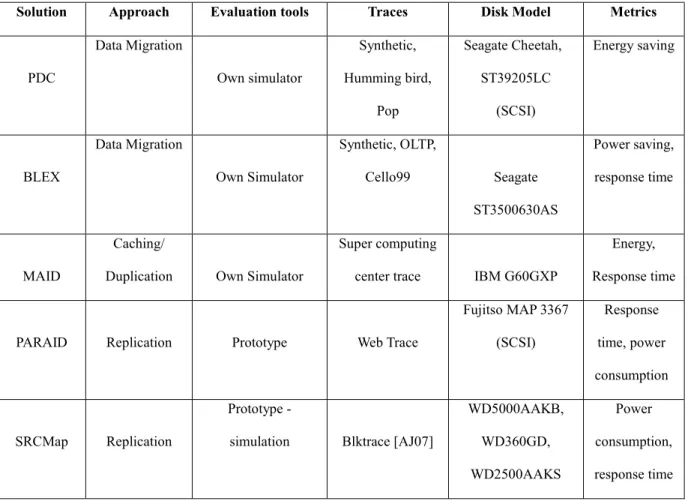
Table 2.1 Characteristics of power-saving solutions using data consolidation techniques
Solution Approach Evaluation tools Traces Disk Model Metrics
PDC Data Migration Own simulator Synthetic, Humming bird, Pop Seagate Cheetah, ST39205LC (SCSI) Energy saving BLEX Data Migration Own Simulator Synthetic, OLTP, Cello99 Seagate ST3500630AS Power saving, response time MAID Caching/
Duplication Own Simulator
Super computing
center trace IBM G60GXP
Energy, Response time
PARAID Replication Prototype Web Trace
Fujitso MAP 3367 (SCSI) Response time, power consumption SRCMap Replication Prototype -
simulation Blktrace [AJ07]
WD5000AAKB, WD360GD, WD2500AAKS Power consumption, response time
particular, PARAID (N, M) represents a RAID group consisting of N disks where M is the
maximum number of disks allowed to be shifted to stand-by mode (at least N-M active disks). For
example, PARAID (4, 2) used in [WO07] provides three gear levels available for a RAID group. The lowest, middle and highest gears include two, three and four disks on high-power mode
respectively. PARAID uses replication to exploit data concentration on active disks at each gear
level within a RAID group.
Since data replication has significant space overhead (i.e., PARAID), Sample-Replicate-Consolidate Mapping (SRCMap) [VK10] suggest a more advanced replication model for data consolidation that replicates only the working data set. The number of replicas for each data set is variable based on the corresponding cost and benefits. This results in a much less space overhead which is the amount of free space available in the storage system. SRCMap samples a subset of blocks from each disk that constitutes its working set and replicates these on other physical disks. It activates the minimum number of storage volumes that guarantees availability of at least one replica and transitions other disk volumes to sleeping mode to enable energy-proportionality. Table 2.1 highlights the characteristic of the power-saving solutions described in this section.
2.1.2. Power-Aware Cache and Prefetching Algorithms
Strategies aiming at storing data in faster and volatile memories can greatly enhance energy efficiency in disk storage systems. To that end, most of the techniques in this category tackle caching and prefetching. Caching is useful because it reduces disk utilization in general, while prefetching data into memory usually helps to extend disk idleness period. The strategies of this type try to manage I/O intervals via power-aware caching and prefetching algorithms to extend disk inactivity periods. Therefore, what all techniques in this category have in common is that they
try to gather hot data in highly energy-efficient memory while usually maintaining cold data on hard disks.
In the context of caches, LRU (Least Recently Used) is the widely used algorithm for the data block replacement policy since it is simple and effective. There are power-aware cache replacement algorithms that extend LRU with focus on energy efficiency. For instance, Power-Aware LRU (PA-LRU) and Partition-Based LRU (PB-LRU) are proposed based on this idea and they consider workload features related to energy cost [ZZ05]. PA- LRU estimates the energy cost of a data block replacement and produces miss sequences that minimize energy consumption [ZD04]. PB-LRU partitions the entire cache to separate partitions, one for each disk. It divides the cache in a way to minimize total energy consumption of the storage system. The partition sizes are dynamically adjusted based on the observed workload [ZS04]. PB-LRU performance is similar to that of PA- LRU, however, with significantly less parameter tuning. This makes it an easier choice to adapt to existing storage systems. PA-LRU and PB-LRU show that they are capable of saving 22% more energy than LRU while providing better response times for OLTP workloads as well [ZZ05, ZS04].
The power-aware caching techniques discussed in [ZZ05] assume that the memory run at its maximum utilization, meaning that it is full and swapping data in and out based on its existing policies. Thus, these techniques do not impact on memory energy usage. However, as briefly discussed by Zhu in [ZZ05], the smarter caching techniques might incur more processor cycles and thus, more CPU energy. But, they claim that this overhead on CPU is much less than the energy saving benefits of their caching techniques. Also, it is mentioned that their algorithms can be even handled by slow but low-power processors inside the storage systems. Prefetching can be also extended with focus on energy conservation in disk storage systems without performance
degradation [PS04], [SK06]. A set of rules can be used towards energy-aware prefetching. One rule is to ensure that prefetch operations do not interrupt stand-by disks unless delay on operations compromises the performance. Another rule is that prefetch operations should take place if blocks are available for replacement. This prevents the disks from spinning down when the idle period would be too short to exploit energy saving. As a result, prefetching integrated with these set of rules decreases power consumption while maintaining the performance.
Other power-aware solutions that focus on caching and prefetching rely on multi-tiered caches and data storage [WY08, PG11]. They are based on using hybrid HDD and SSD drives as caching storage media. More specifically, caching and prefetching strategies are designed to focus on increasing SSD usage and decreasing hard drives so that disks can remain in sleeping mode for longer periods of time. This yields to both energy and performance benefits since SSDs are faster and power proportional.
Most of the methods described in this category are complementary. Caching and prefetching solutions usually do not degrade the performance. The only drawback is the cost such as cost for SSD-based solutions or implementation cost for algorithmic solutions.
Moreover, there is another type of power-aware solution that is similar to this category in sense of employing cache to control I/O intervals; however, it combines redundancy with cache usage at the same time. It tries to redirect some I/O requests to be served by redundant data available in cache or on high-power mode (active) redundant disks in order to let stand-by disks sleep longer. This scheme can efficiently adapt to RAID-based storage layouts [LW04, YX06].
2.1.3. Energy-Proportional Strategies in Distributed Systems
This section discusses the solutions that target energy-proportionality in large-scale distributed storage systems. The traditional data placement strategies existing in distributed
systems restrict achievement of power proportionality [LK10] . Thus, all techniques in this category try to achieve energy proportionality either by extending the existing data placement strategies or by proposing novel data layouts. Thus, energy-proportional data placement is the core of all existing solutions for distributed systems [KC14, KC11, CK11, 28, AC10, KB10, TD11, KM11, SK08, HS10, ND08, SK10].
In data parallel computing clusters, the distributed file systems maintain a set of replicas for each data block. They introduce the covering set as a group of nodes that together contain at least one replica for each data block needed for performing computing tasks. There are algorithms developed to discover a covering set that minimizes energy consumption while maintaining the remaining nodes into a lower-power mode [KC14, KC11, CK11].
Sierra [TD11] is an energy-proportional distributed system for general read and write workloads. It introduces a new power-aware layout that allows a significant fraction of the servers to be powered down without loss of availability, load balancing or fault tolerance. It uses a novel distributed virtual log to perform updates to objects when some replicas are turned off.
Rabbit [AC10] is a power-proportional distributed file system (PPDFS) that uses its novel
equal-work data layout policies to support ideal power proportionality down to very low minimum
number of powered-down nodes which is enough to store a primary replica of available datasets. Rabbit maintains near ideal power proportionality in the face of node failures.
GreenHDFS [KB10] is an energy-conserving, hybrid, logical multi-zoned (Hot and Cold
zones) variant of Hadoop’s compute cluster. It relies on data classification-driven data placement
to support substantially long periods of idleness in a subset of servers designated as Cold zones in
performance adversely and the computational workload can be concentrated on the servers in the Hot zone without exceeding CPU utilization limits.
2.1.4. Other Techniques
Some methodologies integrate DPM algorithmic techniques with hardware facilities to
provide more power saving opportunities. One clear-cut instance is to take advantage of different rotation speeds available in multi-speed disks. Hibernator [ZC05] and DRPM [GS05] dynamically configure disk speed based on the observed workload.
DRPM adjusts each disk speed accordingly based on the arriving data request rate to match the required performance. It provides a detailed analysis of disk power consumption and how rotation speed levels can affect energy consumption [GS05]. This strategy potentially can improve the energy proportionality of hard disks.
Hibernator dynamically partitions the disk array into different tiers and assigns different speeds to disk tiers. And, it consequently moves data blocks to proper disk tier based on block hotness level—which depends on the observed data request arrival rate. The main idea of the disk speed setting algorithm is to adapt the disk speed infrequently and keep it constant during a
relatively long epoch. Thus, at the beginning of each epoch, the best speed configuration for each
disk is determined based on the predicted workload for the disk and the response time limit. The rotation speed of a disk is kept the same throughout the entire epoch unless an unexpected workload change happens. In this case, there is a performance guarantee method that would be called to take over.
A research work conducted under the EU GAMES project [GR10] proposed an adaptive mechanism for energy-aware data storage control [CH11]. It focuses on application-driven storage control in file storage systems—files are data units—for energy efficiency. Also, another research
paper utilized the application level I/O behaviors for power saving in storage systems cooperated with data-intensive applications [NN12].
2.2.Stream Joins
In this section, we first introduce stream join algorithms on sliding windows. Then, we will discuss the parallel shared-memory stream join algorithms existing in the literature.
2.2.1. Join Algorithms on Sliding Windows
We follow the semantics of sliding-window join as described in the related literature [GB09, TM11, GN15, GJ12]. A data stream is an unbounded sequence of tuples that share the common
schema based on application. In particular, each input tuple t has the schema< 𝑡𝑠, 𝐴𝑡𝑡 , . . . , 𝐴𝑡𝑡 >
where 𝑡𝑠 represents generation timestamp and 𝐴𝑡𝑡 , . . . , 𝐴𝑡𝑡 are attributes based on the
application. Tuples are assumed to arrive in timestamp order in an input data stream. Due to
unbounded nature of input data streams, the notation of window is introduced in the streaming
community so that database operators can be also evaluated over data streams Stream joins
compare tuples generated by two logical streams, R and S, based on predicate P. The join is applied
only to a finite subset of each input stream. There are different ways to define proper boundaries for windows depending on the application. One way is to restrict the scope of the join operator to
recent portion of each data stream. This leads to sliding windows which is the most common
windowing method in literature. At any point in time sliding window covers all tuples from an earlier point in time up to the most recent tuple. Sliding windows are time-based or tuple-based.
The former covers all tuples within the last t seconds. The latter covers the last n tuples in arrival
order. Both types of windows slide forward as time proceeds or new tuples arrive, respectively.
We consider time-based sliding windows with TS time units that includes all tuples {t,|t,. 𝑡𝑠 −
concept can also be easily extended to tuple-based windows that hold a fixed amount of the last
TS received tuples. When the predicate P(t , t ) is satisfied for tuples t ∈ R and t ∈ S, an output
tuple t is produced combining t and t and setting the timestamp of the output tuple to the
maximum between timestamps of t and t .
The semantics of nested loops-based stream join is commonly implemented as the
three-step procedure. For each incoming tuple t belonging to R (symmetrically for tuple t ), this
procedure (1) compares t with all t belonging to S based on the join predicate; (2) adds t to
window for R; (3) invalidates all expired tuples from window of 𝑅.
Stream join evaluation has high computational cost. For instance, if we assume that both R
and S receive N tuples per time unit and both windows for R and S hold N × TS tuples on average.
Because each tuple from R is compared with all tuples in window for S (and vice versa for tuples
from S), the average number of comparisons per time unit is 2 × TS × 𝑁 . For instance, if window
size equals to 10 minutes and N equals to 500 tuples per second, a stream join must perform 300
million comparisons per second on average. Thus, this high computation cost of stream join has motivated many research efforts to reduce it through parallel design of stream join algorithms on multicore CPUs.
Symmetric Hash Join (SHJ) is one of the fundamental algorithms for stream join processing
[XY07]. It is a hashing-based join algorithm, which also has been used to support highly pipelined processing in parallel database systems [WA91]. It supposes that the hash table for each data stream can be kept in the main memory. This algorithm symmetrically performs two phases for
newly arrived tuples: build phase and probe phase. In particular, for each incoming t ∈ R, (1)
SHJ inserts it into the hash table for R (building phase); (2) then it probes the hash table for the
symmetrically for the tuples t associated with the other data stream S. Figure 2.2 shows the
symmetric hash join algorithm for two input data streams 𝑅 and 𝑆.
Note that sorting-based join algorithms, such as the sort-merge join, have been traditionally considered unsuitable for stream joins since sorting is a blocking operation that needs to see the entire input before producing any output [XY07].
2.2.2. Shared-Memory Parallel Stream Joins
In this section, we explore the proposed shared-memory parallelization techniques for stream join algorithms on multicore processors. In literature, shared-memory parallelization techniques for nested-loop join version of stream join algorithm have been proposed [GB09, RT14, TM11, GN15]. We will discuss the two major state-of-the-art parallelization techniques in this context. To our best of knowledge, the parallel shared-memory SHJ algorithm on multi-core CPUs has not been so far designed and implemented in the literature, which makes that an interesting and potential research work.
2.2.2.1. Handshake Join
Handshake join is a schema that describes and executes stream joins and is highly cooperative to parallelized design and execution. Handshake join can naturally take advantage of
Hash Table for
R
Hash Table for
S
Stream R Stream S
Build Build
Probe Output
available hardware parallelism. It is based on the three-step procedure [KN03] corresponded to the nested loops-style join evaluation in data streams.
Traditional approaches (including CellJoin [GB09]) assume a central coordinator that divides and replicates data as required over the available cores in order to distribute the enumeration of join candidates. However, it is observed that this has become a bottleneck as the number of cores is increased. Given this limitation, handshake join does not depend on a centralized coordinator and aims to scale out to very high degree of parallelism.
Handshake join learns from soccer players and how all pairs of players from two opposing teams can be enumerated without any external coordination. Before the beginning of a game, players shake hands with all players from the opposing team by walking by each other in opposite directions and shaking hands with every player that they face. The handshake procedure used in sports games inspired the design of handshake join.
Two data streams, R and S, flow by each other in the opposite direction and their tuples are
pushed through the respective join window. When entering the window, each tuple pushes all existing tuples in the window one step to the side such that the oldest tuple falls out of the window and expires. Both join windows are lined up next to each other in a way that window tuples are pushed through in opposing directions similar to the players in soccer. Whenever two stream tuples
r ∈ R and s ∈ S see each other, they shake hands, meaning that the join condition is assessed for r
and s, and a result tuple < 𝑟, 𝑠 > is added to the join result if the condition is fulfilled.
It is clear that many handshakes happen at the same time that can be parallelized over cores.
Now, in order to parallelize handshake join over cores, each processing core is assigned one
segment of the two lined up join windows. Tuple data is kept in local memory and all tuple comparisons of the segment are performed locally. The strategy used to process a segment by its
assigned core is called immediate scan strategy. In particular, when every tuple r ∈ R enters the
segment, it is compared to all S-tuples in the segment immediately. Likewise, when a new tuple
s ∈ S enters the segment, it is immediately compared to all R-tuples that are already in the segment. Since a newly arriving tuple would synchronously push all tuples of the same stream through the respective window, all cores must simultaneously forward their oldest tuple to the respective left/right next neighbor. This requires an atomic operation over all participating processing cores and therefore an inter-core communication mode. Handshake join
implementation is based on asynchronous message passing between neighboring cores. The
aforementioned communication mode is known for its scalability advantages as number of cores increases [BB09]. In particular, one pair of FIFO queue between any two neighboring cores is implemented to perform data propagation along the chain of cores in either direction.
The aforementioned queue–based message passing scheme has potential risk of missed-join pair problem, which happens when tuples sent through message queues miss each other for joining while on the communication channels. In order to avoid the missing of the join candidates,
two-phase tuple forwarding is introduced to the queue-based message passing scheme
implemented in handshake join. More specifically, whenever a right core 𝐶 , places a tuple 𝑡
into its left send queue, it still keeps a copy of it in the local window join, but marks it as forwarded.
The forwarded tuple 𝑡 then is available for joining on 𝐶 until the second phase of tuple
forwarding, which is initiated by an acknowledgment message from the left neighboring core 𝐶 .
After 𝐶 receives an acknowledgement from 𝐶 , it removes tuple 𝑡 from its local join
2.2.2.2. ScaleJoin
ScaleJoin is a shared-memory parallel stream join algorithm that is based on the three-step procedure [KN03] corresponded to the nested loops-style join evaluation in data streams. ScaleJoin is a deterministic, disjoint (independent) parallel, skew-resilient stream join that offers high-throughput and low-latency joining of tuples delivered by arbitrary numbers of streams. These features are essential to exploit shared-memory parallel stream joins in streaming applications.
Novelty of ScaleJoin is a new data structure called ScaleGate that distills a minimal interface for
satisfying the aforementioned features and parallelism requirements. It provides ready tuples
(guarantying determinism) and allows processing cores to execute join comparisons in a disjoint-parallel way. ScaleJoin is implemented on top of ScaleGate. Given rate-varying and bursty streams, ScaleJoin keeps a balanced work among the processing threads by relying on the ScaleGate, guarantying skew-resiliency.
Determinism means that given the same sequences of input tuples, the same sequence of output tuples will be produced, independently of the tuples inter-arrival time and processing order.
Figure 2.3 Overview of ScaleJoin’s architecture and parallelization approach [GN15].
The 3-step procedure in sequential stream join does not guarantee deterministic processing.
ScaleGate guarantees determinism by merging the timestamp-sorted R and S physical streams into
one time-stamp sorted physical stream of ready input tuples, which is then consumed by processing
threads. The threads act as reader entities for this queue of ready tuples.
Figure 2.3 shows an overview of ScaleJoin’s architecture and parallelization approach.
ScaleJoin provides parallel execution of an arbitrary number n of Processing Threads (PTs) that
each consumes and matches the input tuples delivered by R and S streams. Its processing includes
three phases: (1) delivery of input tuples to PTs, (2) matching of tuples at PTs and (3) collection
of PTs’ output tuples. The first ScaleGate (SGin) is responsible for the first phase. It merges the R
and S tuples generated by an arbitrary number of physical R and S input streams into a single
timestamp-sorted stream of ready tuples.
In the second phase, the aforementioned timestamp-sorted queue of ready tuples is
consumed by nPTs. The second ScaleGate (SGout) is responsible for the third phase. It merges
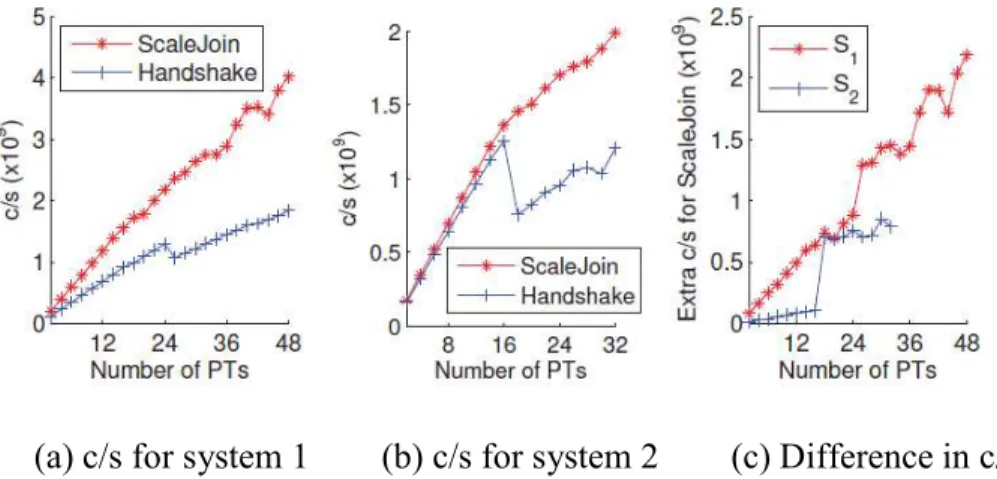
the output tuples generated by each thread into a single timestamp-sorted stream of ready output tuples. Figure 2.4 demonstrates scalability and throughput (number of comparisons per second) of
(a) c/s for system 1 (b) c/s for system 2 (c) Difference in c/s Figure 2.4 ScaleJoin & Handshake join throughput on two different systems [GN15].
ScaleJoin as number of processing threads increases. ScaleJoin’s performance is compared with that of Handshake join on two different systems [GN15].
Similar to stream joins, relational database joins are also one of the most important database operators and are very common in database query workloads. Also, database joins are normally known as both data and computation intensive, and thus contribute significantly to the execution costs in queries. There are two common join algorithms: hash join and sorted-merge join. In this section, we explore the design spaces for both in-memory hash join and sort-merge join on modern multi-core processors.
2.2.3. Multi-Way Stream Join
Multi-way stream join is considered as a major extension to the original binary stream join where more than two input data streams are involved in the join predicate evaluation. There is a
multi-way stream join algorithm designed explicitly for sliding windows in [GO03] named eager
multi-way join with two versions: nested-loops join (NLJ) and hash join. The only difference is that the latter considers hash buckets for scan purpose of the join evaluation while the former version scans the entire sliding window.
Eager multi-way join algorithm executes multiple joins together in a series of nested
for-Figure 2.5 Multi-way join. Order S ⋈ (S ⋈ S )) shown as a join tree (left) and a series of
orderings. Also, there is a join heuristic for this algorithm that attempts to minimize the number of intermediate tuples that are passed down to the inner for-loops. This means that the stream to which the new tuple belongs is processed in the outer-most for-loop, followed by the stream with the smallest number of selected tuples, and so on.
We display multi-way join for the following example. Let S , S , S be three sliding
windows to be joined with the global join ordering as S ⋈ (S ⋈ S ). In Figure 2.5, the join order
is shown as a join tree (left) and a series of nested for-loops (right). We refer to S as being ordered
first, S as being ordered second and so on. The pseudocode on right shows the general strategy
for multi-way join where the join is evaluated from top to down. The predicate is checked inside each for-loop in order to minimize the number of tuples that are passed down to the inner loops.
As we will exploit hash-based version of this algorithm for our parallel multi-way hash
join algorithm (Chapter 4), we now explain detailed steps for eager multi-way hash join algorithm
and its join ordering heuristic. Upon the arrival of a new tuple in one stream, it is inserted to the hash table of its origin stream as the build phase. In the probe phase, first, the expired tuples from the other streams are removed. Then, the join order for probing changes such that the stream to which the newly arrived tuple belongs will be ordered first, followed by the stream whose hashed bucket has the smallest size, and so on. In effect, the window at top of the order always have only one tuple and the join order changes in response to the origin of the new tuple. This is possible since it is assumed that there is a common join attribute across all input streams. This join heuristic, as mentioned earlier, attempts to minimize the number of tuples passed down to the inner loops to reduce the cost for scanning the buckets.
2.3. Database Joins
Relational database join is one of the most important database operators and is very common in database query workloads. Also, database joins are normally known as both data and computation intensive, and thus commonly contribute significantly to the execution costs in queries. This has motivated much research efforts to make join implementation more efficient through parallel design of database joins on multi-core CPUs. There are two common join algorithms: hash join and sorted-merge join. In this section, we explore the design spaces for both in-memory hash join and sort-merge join on modern multi-core processors.
2.3.1. Hash Joins
In-memory hash join algorithms proposed in the literature can be classified into two
contradictory categories: hardware-oblivious and hardware-conscious [BT13]. The former hash
join variants do not rely on hardware-specific parameters and they instead consider qualitative features of modern hardware [BL11]. They claim to achieve good performance on any similar hardware. They argue that tuning of hash join algorithms to particular underlying hardware makes them less portable and less robust. On the other hand, the latter variants of hash join claim that the
Figure 2.6 Canonical hash join.
best performance can be achieved by fine tuning the algorithm parameters (i.e., hash table sizes) to the underlying architecture [KS09], [LL13], [AK12].
2.3.1.1. Canonical Hash Join
The canonical hash join algorithm is the foundation for any modern hash join
implementation [TO11, KT83]. As shown in Figure 2.6, it consists of two phases: build phase and
probe phase. In the first phase (build), the smaller of the two input relations, R, is scanned to fill a
hash table with all R tuples. Then, in the probe phase, it scans the second input relation, S, and
probes the hash table for each S tuple to find matching R tuples.
2.3.1.2. No Partitioning Join
A direct parallel version of the canonical hash join is proposed in [BL11] that is called no
partitioning join. It does not rely on any hardware-specific parameters in contrast to the contrary
camp and does not physically partition data—as partitioning is the core for hardware-conscious joins as will be discussed shortly. They argue that the partitioning needs multiple passes over the data and can be removed by depending on modern CPU characteristics such as simultaneous multi-threading (SMT) to hide cache latencies.
Figure 2.7 No partitioning join.
Figure 2.7 illustrates no partitioning hash join. Both input relations are separated into equal-sized parts and these portions are assigned to a number of processing threads. In the build phase (first phase), all processing threads populate a hash table shared between all threads. After synchronization via a barrier, all processing threads enter the probe phase to find matching joins
for their assigned S portions. An important feature of this type of parallel hash join is that the hash
table is shared among all processing threads. Thus, concurrent insertion accesses to hash table should be synchronized. Therefore, each bucket of the hash table is protected through a latch. Each thread should obtain the latch before insertion. The contention over the latch among threads is expected to be low since the number of hash buckets is usually large in the scale of millions. However, since the probe phase is a read-only stage, there is no need for synchronization and latches between threads while probing the hash buckets. Thus, the processing threads can concurrently read from the hash buckets.
2.3.1.3. Radix Join
Given that hashing in the main-memory results in cache misses due to its random access nature, the main idea behind hardware-conscious main-memory hash join implementation is tuning main-memory access of hashing by using cache in a more efficient way, which yields better query
performance. Therefore, partitioning the hash table into cache-sized blocks decreases cache misses and improves performance. This idea is refined in [MB02] by considering the influence of
translation look-aside buffers (TLBs) during the partitioning. This resulted in multi-pass
partitioning which is a key part of radix join.
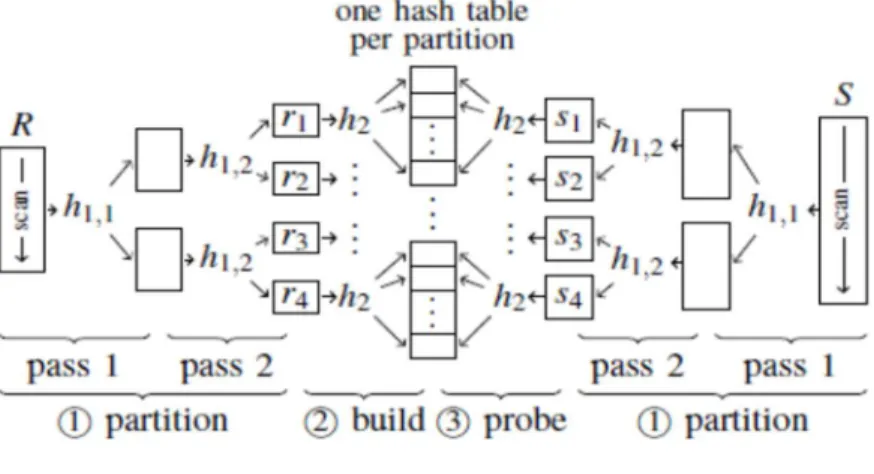
Partitioned Hash Joins: Figure 2.8 shows the partition idea for hash join. In the first
phase of the algorithm (partition), the two input relations R and S are divided into partitions. In the
build phase, a separate hash table is created for each partition of R (assuming R is the smaller
relation). Each of these hash tables can fit into the CPU cache now. In the probe phase, partitions
of S are scanned and the respective hash table for each of these partitions of S is probed for
matching tuples.
In the partitioning phase, input tuples are divided up based on their key value by using hash
partitioning, h1hash function in Figure 2.8. And, another hash function h2 is used to populate the
hash tables. Therefore, each partition of S can only match with the partition from R with the same
index number ( 𝑟 ⋈ 𝑠 = 𝜙 𝑓𝑜𝑟 𝑖 ≠ 𝑗).
Figure 2.9 Radix join.
Although partitioning the input tables avoids cache misses, it may cause another type of cache issue. The partitions have separate entries for virtual memory mapping since they usually reside on different memory pages. In modern processors, this mapping is cached by TLBs. Therefore, if the number of partitions is too large, the partitioning phase can experience TLB misses. The number of entries in TLB determined the maximum number of partitions allowed to be accessed concurrently in an effective way. Radix partitioning as described in the following can solve the aforementioned TLB miss problem.
Radix Partitioning: Multiple-pass partitioning can prevent TLB misses. More
specifically, in each pass, all partitions produced by the preceding pass are refined such that the partitioning fan-out does not violate the hardware limit given by the number of TLB entries. In
reality, each pass considers a different set of bits from the hash function h1. For common
in-memory data sizes, two or three passes are enough to create cached-size partitions.
Radix Join: Figure 2.9. Shows the complete Radix join. At first, both inputs are partitioned using two-pass radix partitioning (assuming two TLB entries are enough for this
example). Second, hash tables are then built over each partition of table R. Finally, all partitions
of S are scanned and the respective partitions from R are probed for finding the matches.
2.3.1.4. Parallel Radix Join
Parallelization of radix join can be done by dividing both input tables into sub-tables and assigning them to processing threads [KS09]. In the first pass, all threads create a shared set of partitions. As mentioned earlier, the number of partitions in this set is normally small since it is restricted by the hardware parameters. Thus, there is contention issue on these partitions since there are accessed by many individual processing threads. In order to solve this problem, within each output partition, a dedicated range is maintained for each thread. To do so, both input relations

![Figure 1.2 Sliding-window join for two data streams. Adopted from [TM11].](https://thumb-us.123doks.com/thumbv2/123dok_us/1092526.2645142/17.918.286.683.115.307/figure-sliding-window-join-data-streams-adopted-from.webp)
![Figure 2.3 Overview of ScaleJoin’s architecture and parallelization approach [GN15].](https://thumb-us.123doks.com/thumbv2/123dok_us/1092526.2645142/39.918.238.711.703.986/figure-overview-scalejoin-s-architecture-parallelization-approach-gn.webp)