Higher Physical Education Course
Support Notes
This document may be reproduced in whole or in part for educational purposes provided that no profit is derived from reproduction and that, if reproduced in part, the source is acknowledged. Additional copies of these Course Support Notes can be downloaded from SQA’s website: www.sqa.org.uk.
Please refer to the note of changes at the end of this document for details of changes from previous version (where applicable).
Contents
Course Support Notes
Introduction 1
General guidance on the Course 2
Approaches to learning and teaching 6
Approaches to assessment 11
Equality and inclusion 19
Appendix 1: Reference documents 20
Appendix 2: General advice on potential physical activities 21
Appendix 3: Glossary of terms 22
Appendix 4: Resources for learning and teaching 23
Administrative information 24
Unit Support Notes — Physical Education: Performance Skills (Higher) 25
Introduction 26
General guidance on the Unit 27
Approaches to learning and teaching 29
Approaches to assessment and gathering evidence 35
Equality and inclusion 38
Appendix 1: Reference documents 40
Administrative information 41
Unit Support Notes — Physical Education: Factors Impacting on
Performance (Higher) 42
Introduction 43
General guidance on the Unit 44
Approaches to assessment and gathering evidence 58
Equality and inclusion 60
Appendix 1: Reference documents 62
Introduction
These support notes are not mandatory. They provide advice and guidance on approaches to delivering and assessing the Higher Physical Education Course. They are intended for teachers and lecturers who are delivering the Course and its Units. They should be read in conjunction with the Course Specification, the Course Assessment Specification and the Unit Specifications for the Units in the Course.
The Course is made up of two Units and a Course assessment at SCQF level 6. Physical Education: Performance Skills (Higher) (9 SCQF credit points) Physical Education: Factors Impacting on Performance (Higher) (9 SCQF
credit points)
General guidance on the Course
Aims
The main purpose of this Course is to develop and demonstrate a broad and comprehensive range of complex skills in challenging contexts. Learners will develop the ability to use strategies to make appropriate decisions for effective performance. They will also analyse a performance (looking specifically at the impact of mental, emotional, social and physical factors), understand what is required to develop it and then apply this knowledge to their own performance. The main aims of this Course are to enable learners to:
develop a broad and comprehensive range of complex movement and performance skills, and demonstrate them safely and effectively across a range of challenging contexts
select and apply skills and make informed decisions to effectively perform in physical activities
analyse mental, emotional, social and physical factors that impact on performance
understand how skills, techniques and strategies combine to produce an effective performance
analyse and evaluate performance to enhance personal effectiveness Within the Course there are two Units and a Course assessment at SCQF level 6: H252 76 Physical Education: Performance Skills (Higher) Unit
Learners who complete this Unit will be able to:
1 Demonstrate a broad and comprehensive range of complex movement and performance skills in physical activities
H254 76 Physical Education: Factors Impacting on Performance (Higher) Unit
Learners who complete this Unit will be able to:
1 Analyse and evaluate factors that impact on performance in physical activities
2 Evaluate the process of personal performance development
Progression into this Course
Entry to this Course is at the discretion of the centre. However, learners would normally be expected to have attained the skills, knowledge and understanding required by the following or by equivalent qualifications and/or experience: National 5 Physical Education Course or appropriate Units
Wellbeing Award (SCQF level 5)
Other relevant skills, knowledge and understanding could include experience in coaching or fitness training and/or an interest in performance development, physical education or the self-analysis process.
Before they start the Course, learners should have some knowledge and
understanding of factors that impact on performance and be able to demonstrate a range of performance skills. This will help them to progress smoothly into the Course.
Skills, knowledge and understanding covered
in the Course
This section provides further advice and guidance about skills, knowledge and understanding that could be included in the Course.
Note: teachers and lecturers should refer to the Course Assessment Specification for mandatory information about the skills, knowledge and understanding to be covered in this Course.
The Higher Physical Education Course develops skills, knowledge and
understanding as stated in the Course Specification. Although these aspects can be developed in each of the Course Units, greater emphasis will be given to developing particular aspects in particular Units, as shown in the following table:
Plenty of opportunities within the Unit Some opportunities within the Unit Limited opportunities within the Unit
Skills, knowledge and
understanding within the Course
Performance Skills
Factors Impacting on Performance Planning, developing,
implementing and evaluating
performance
Selecting, demonstrating and safely applying a broad and comprehensive range of
movement and performance skills in challenging contexts
Decision-making and
problem-solving in challenging contexts
Analysing factors that impact on performance
Explaining a range of approaches for developing performance
Analysing the recording, monitoring and evaluation of
performance development
All the skills mentioned above can relate to skills for learning, skills for life and skills for work. These can be built into the Course in a range of contexts.
Progression from this Course
This Course or its Units may provide progression to: Advanced Higher Physical Education Course Higher National Certificates higher education degrees
further study, employment and/or training
Physical Education can also contribute to health and wellbeing and a healthy lifestyle, and can provide access to a range of opportunities within the sport, leisure and fitness industries.
Hierarchies
Hierarchy is the term used to describe Courses and Units which form a structured sequence involving two or more SCQF levels.
It is important that any content in a Course and/or Unit at one particular SCQF level is not repeated if a learner progresses to the next level of the hierarchy. The skills and knowledge should be able to be applied to new content and contexts to enrich the learning experience. This is for centres to manage.
This Course sits within a hierarchical structure, beginning with the National 3 Physical Education Course, and progressing through National 4 and National 5 Physical Education to Higher Physical Education. Although the Units have the same titles and similar structures, the degree of difficulty and complexity in terms of knowledge and understanding and the application of these to practical activity performance differ from one level to the next. This structure enables learners to be given recognition for their best achievement.
Assessors will need to adopt and apply different approaches and strategies to ensure that learners do not simply repeat the skills, knowledge and
understanding they have learned and achieved at the level below. Here are two examples:
In the Physical Education: Performance Skills (National 5) Unit, learners will demonstrate skills using some complex actions with control and fluency in routine and non-routine contexts. At Higher level, learners will be expected to perform more complex actions with consistency and effectiveness in
challenging, competitive and/or more demanding contexts.
In the Physical Education: Factors Impacting on Performance (National 5) Unit, learners will demonstrate knowledge and understanding by examining and explaining two factors that impact on performance. At Higher level, learners will need to be able to evaluate the potential of these factors to impact on performance in both positive and negative ways.
Approaches to learning and
teaching
The main purpose of this Course is to develop performance skills. The central theme of the Course is to develop approaches to enhance performance through evaluation and analysis.
Practical, experiential learning in relevant contexts and supported investigation techniques should be used as the vehicle for developing knowledge,
understanding and skills. The Course includes development of thinking and practical skills through problem-solving activities.
The Course will enable learners to develop skills, positive attitudes and attributes in performance and physical activity contexts and to transfer these to other contexts.
Sequencing and delivery of learning and teaching
There are two Units and a Course assessment in the Higher Physical Education Course. The level of demand in each Unit corresponds with the Scottish Credit and Qualifications Framework at level 6.
The two Units in the Course are:
Physical Education: Performance Skills (Higher) (9 SCQF credit points) Physical Education: Factors Impacting on
Performance (Higher) (9 SCQF credit points)
Units can be taught in any order. They can be taught separately or they can be integrated and taught holistically. The following diagrams illustrate two different approaches to delivering the Units.
Approach 1
In this example, the Units can be integrated and taught together in a holistic way, which creates opportunities to integrate the Unit content, and to produce more naturally-occurring evidence or holistic assessment opportunities. This approach could also support learning and teaching in a practical context for the Physical Education: Factors Impacting on Performance (Higher) Unit.
Performance Skills Unit
Factors Impacting on Performance Unit
Approach 2
In this example, the Units are taught separately. This approach can provide opportunities for the progressive development, reinforcement and consolidation of skills, knowledge and understanding throughout the Course.
General information about learning and teaching
A differentiated approach to learning and teaching materials can help assessors to plan activities and learning experiences. For example, activities from the National 5 Physical Education Course could be used, with extension work, for Higher learners. Learners, at Higher, should be supported and encouraged to take an active role in their learning. Teaching of mixed groups can be more effective when independent learning is encouraged. Such an approach supports the underlying principles of the Curriculum for Excellence.
At Higher, the expectation is that learners take on more responsibility for the way they select, order, manage, develop and apply skills, knowledge and
understanding. Learners working at this level can also take a greater control of the type of evidence and the ways of gathering the evidence required to complete the Unit and Course assessment. For example, they should demonstrate
independence in the selection and implementation of performance-development targets and this should be reflected in their personal development plan.
Structured tasks could be used to enable self and peer assessment. This, in turn, may assist assessors to gauge learners’ progress and readiness for Course or Unit assessment.
Well-planned learning and teaching activities will provide a framework that considers and meets the different learning styles of individual learners. It is good practice to ensure that the learning intentions are introduced at the start of each lesson, and that any aims that develop skills for learning, skills for life and skills for work are stated alongside the subject-specific aims. By building in
opportunities to provide feedback on progress, assessors will assist learners to identify what is expected of them.
The subject matter of the Physical Education Course provides an ideal platform for adopting a variety of learning and teaching methods. The integration of knowledge and understanding with practical activities reinforces and applies knowledge, understanding and skills in a meaningful context. Care should be taken during each learning activity to ensure that learners are aware of what they have learned, and that they are encouraged to consider the applications for the skills, knowledge and understanding in life, learning and work. Learners should
Performance Skills Unit
Courseassessment
Factors Impacting on Performance Unit
each other’s experiences and so gain confidence in being effective contributors to their own, and their peers’, learning.
Active learning is central to Physical Education and reflects the practical nature of the Course. When introducing new skills and knowledge, learning and teaching sessions can be used to identify and find solutions to problems. Learners could work in small groups or in pairs to develop their understanding and application of knowledge by working through additional problems. Through active learning opportunities in this Course, learners will be able to identify and prioritise development needs across the four factors impacting on performance (mental, emotional, social and physical). This will assist learners to focus on the
challenges they face and develop approaches to address these during the process of performance development. Active learning opportunities could include recording and reviewing performances, attending performance workshops, self-analysis, peer reviewing, evaluating static and dynamic fitness data, identifying key aspects of model performances, using recording methods such as general or focused observation schedules (GOS and FOS), identifying sub-routines using methods such as PAR analysis (preparation, action and recovery phases of skills or techniques), using a graphic organiser approach, mind mapping exercises, personality inventories, using sports competition anxiety tests (SCAT) or making a record of actual performances in log books or diaries.
Selection of the physical activity and associated challenges required for Course assessment purposes may be started at an appropriate time during the Course. However, learners should be given sufficient time to develop the necessary skills, knowledge and understanding of mental, social, emotional and physical factors impacting on performance before Course assessment takes place.
Teaching approaches should support Curriculum for Excellence’s four capacities to enable each learner to develop as a successful learner, a confident individual, a responsible citizen and an effective contributor.
The use of ICT can be used for creative and innovative learning and teaching approaches. For example, a learner could use a heart monitor and analyse video clips to evaluate performance when playing a team game. There is a wide range of online resources to enable learners to use ICT when presenting information for learning and assessment purposes. Learners could develop a blog or contribute to an assessor-led discussion forum, which could then be used for naturally-occurring evidence. In addition, electronic portfolios could enable learners to select relevant evidence to meet Assessment Standards for Units, which would encourage reflection, personalisation and choice.
Developing skills for learning, skills for life
and skills for work
Learners are expected to develop broad generic skills as an integral part of their learning experience. The Course Specification lists the skills for learning, skills for life and skills for work that learners should develop through this Course. These are based on SQA’s Skills Framework: Skills for Learning, Skills for Life and Skills for Work and must be built into the Course where there are appropriate opportunities. The level of these skills will be appropriate to the level of the Course.
It is important for learners not only to have the opportunity to develop and enhance the generic skills needed to be successful in their learning, lives and work but also to be aware of the actual skills they are developing.
The table which follows provides exemplification of how some of these skills can be further developed within this Course.
Skills for learning, skills for life and skills for work
Suggested learning and teaching activities
1 Literacy 1.2 Writing
1.3 Listening and talking
Learners could take part in group discussions or debates, or present information. Learners could communicate with one another during physical activities, when providing support to team-mates, discussing tactics giving, receiving, and listening to feedback.
3 Health and wellbeing 3.2 Emotional wellbeing 3.3 Physical wellbeing
Learners could be introduced to elements of emotional wellbeing linked to physical activity through working in teams, managing emotions and practising assertive behaviours.
Learners could be involved in collecting personal fitness data and then go on to organise and implement a fitness session to improve performance and thus contribute to physical wellbeing in a wider social context.
4 Employability, enterprise and citizenship
4.3 Working with others
When engaging in team activities, learners will have many opportunities to develop skills while working with others. Learners could be encouraged to learn how to negotiate and adapt and be able to work co-operatively and effectively with others.
5 Thinking skills
5.4 Analysing and evaluating
Learners will have opportunities to gather data and information and to analyse this information to form conclusions and make appropriate decisions about approaches which could be used to develop performance.
Learners will have the opportunity to develop evaluative skills by considering and prioritising aspects of performance and reflecting on areas for further personal development.
Approaches to assessment
The publication Building the Curriculum 5 sets out a framework for assessment that offers guidance on approaches to recognising achievement, profiling and reporting. A shared understanding of assessment standards and expectations is essential. Research in assessment suggests that learners learn best, and attainment improves, when learners:
understand clearly what they are trying to learn, and what is expected of them are given feedback about the quality of their work, and what they can do to
make it better
are given advice about how to go about making improvements
are fully involved in deciding what needs to be done next, and who can give them help if they need it
(Ref: http://scotland.gov.uk/Publications/2005/09/20105413/54156)
A holistic approach to assessment is recommended where possible. This will enrich the assessment process for the learner, avoid duplication of assessment and provide more time for learning and teaching. Additionally, it will allow centres to manage the assessment process more efficiently.
It is likely that opportunities to generate evidence for assessment will arise naturally in this Course. Peer-assessed activities, with clear guidelines and the inclusion of learner friendly marking criteria, should help learners to improve their evaluative and communication skills. It may be useful for learners to complete some aspects of assessment in a ‘closed book’ setting, as this will provide an opportunity for them to gain experience of the environment in which the question paper Component of Course assessment will be conducted.
Whatever the assessment approach used, it is important that the approach to assessment encourages personalisation and choice. It is also important that learners receive regular feedback on their performance. Assessment should meet the varying needs of all learners and, where appropriate, be in practical contexts. Some examples of assessment approaches include:
video of performance observation checklists
training diaries/electronic logbooks/development records oral evidence through question and answering
written assessment through answering of questions assessor checklists
use of ICT and relevant software
In order to ensure authenticity of learners’ work, there are guidelines that will ensure that learners present work which is their own. For more information, please refer to SQA’s Guide to Assessment.
Physical activity choices — guidance and advice
There are no mandatory physical activities prescribed in the Physical Education Courses. This promotes inclusion and enables personalisation and choice. Physical activities that are suitable for assessment will normally be chosen from those covered within the Higher Physical Education Course at the presenting centre. Learners should discuss and agree with the teacher/lecturer the activities they want to undertake. Appendix 2 of these Course Support Notes contains a table of popular physical activities that centres can refer to for suggestions. This list is not exhaustive or definitive.
Physical activities that are suitable for assessment will normally be chosen from those covered within the Higher Physical Education Course at the centre.
Appendix 2 of this document contains examples of popular activities that centres may refer to for suggestions, but the list is not definitive or exhaustive. Learners should discuss with the assessor and agree the activities they want to undertake. Although learners should be given every opportunity to develop activities for which they have a natural aptitude and which are of interest to them, it is the centre’s responsibility to ensure that sufficient assessor expertise exists to manage the assessment process and assess learner evidence. Before agreeing to assess an activity, the assessor should consider the following:
the practicality of assessing activities out with the usual learning environment health and safety and child protection issues
available resources
the time management involved in assessing the activity
the suitability and reliability of the performance context: ensuring the context is challenging enough to provide the learner with the opportunity to generate the evidence that will meet the requirements of the Course
the collation, assessment and recording of appropriate assessment evidence There is more guidance on physical activity selection in the ‘Equality and
inclusion’ section and in Appendix 2 of these Course Support Notes.
Further advice on managing performance contexts is provided in the ‘Approaches to assessment and gathering evidence’ section in the Support Notes for the Performance Skills Unit.
Preparation for Course assessment
Each Course has additional time which may be used at the discretion of the assessor to enable learners to prepare for Course assessment. This time may be used near the start of the Course and at various points throughout the Course for consolidation and support. It may also be used for preparation for Unit
assessment, and towards the end of the Course, for further integration, revision and preparation and/or gathering evidence for Course assessment.
Information given in the Course Specification and the Course Assessment Specification about the assessment of added value is mandatory.
In this Course assessment, added value will focus on:
challenge — requiring greater depth or extension of knowledge and/or skills application — requiring application of knowledge and/or skills in practical or
theoretical contexts as appropriate
The learner will be assessed through two Components: a performance and a question paper. Together, these Components will add challenge and application to the Course as the learner integrates, extends and applies the skills, knowledge and understanding they have learned during the Units.
Assessors should ensure that learners have had the opportunity to develop the necessary performance, planning, evaluative, recording and analytical skills before any Course assessment is attempted.
Component 1 — Performance
The purpose of the performance Component of Course assessment is to assess the learner’s ability to plan, prepare for, perform and evaluate their own personal performance in one physical activity. The performance will have 60 marks. This is 60% of the overall marks for the Course assessment.
The performance will give learners an opportunity to demonstrate the following skills, knowledge and understanding:
planning, developing, implementing and evaluating performance
selecting, demonstrating and safely applying a broad and comprehensive range of complex movement and performance skills in challenging contexts decision-making and problem-solving in challenging contexts
The performance consists of three stages: Planning and preparation, Single performance and Evaluation. The context of the single performance must be challenging, competitive and/or demanding. The single performance has to be of sufficient duration to allow learners to demonstrate the required skills. ‘Sufficient duration’ will be whatever the norm is for the chosen physical activity. For example, in some activities this would be a set period of play or a number of points to achieve a win, an agreed length of performance, an agreed number of attempts, a specific number of gymnastic activities or a combination of the heats and finals for an event. Assessors must ensure learners understand the relevant requirements of the single performance such as the structure of any event, the timings of any event and relevant other organisational issues.
For the Evaluation stage, learners will analyse the effectiveness of their
preparation for the two challenges they identified in the Planning and preparation stage and evaluate at least one strength of, and at least one area for
Preparing for the Single performance
For the Planning and preparation stage, learners must be able to explain the relevance of two challenges they will face in their Single performance and explain how they will prepare to meet these challenges. During learning and teaching for Unit assessment, learners should be given opportunities to recognise the
potential impact of the four factors (mental, emotional, social and physical) on performance. Opportunities to share experiences within the class through group discussion or short oral presentations will provide a more holistic view of how all four factors may impact on performance.
As part of their planning and preparation, learners will have considered that each physical activity will have different mental, emotional, social and physical
challenges which are unique to the nature of the performance (ie solo/duo/team), the individual performer and the specific role they are playing. The nature of the activity (for example individual/team, indoor/outdoor, competitive/non-competitive, presence of audience or crowd), may also influence the learner’s explanation of the challenges they anticipate.
Attending live performances at performance venues is an excellent way of
introducing performers to the challenging context the single performance requires and so may provoke discussion regarding managing this context. This might include discussing aspects such as the atmosphere in the venue, the effect of any crowd, nervousness due to unfamiliar surroundings or the facilities the performer has to prepare in prior to the performance. This may be particularly relevant to solo performers and those who have little experience of performing in front of an audience.
The learner is expected to demonstrate critical thinking when they explain the relevance of their two challenges. Sufficient learning and teaching should have taken place to allow learners to identify challenges and how they might prepare to meet them. Small groups of learners who have chosen a specific physical activity might share their experiences of what, for them, are the performance challenges and how they intend to meet these. This will broaden the knowledge base of the group as a whole.
Replaying crucial parts of a performance from a video source may also help to the identify challenges. A range of performance examples which could be used to illustrate examples of performance challenges are available online, from national and international sporting events to videos of activities such as Parkour.
Examples of possible challenges include:
mental — maintaining or regaining concentration or motivation when responding to the context of the performance; overcoming the effects of previous experience/ results
emotional — controlling aggression; overcoming fear; developing trust social — dealing with the effect of the crowd; rising to the demands of their
role in the team; dealing effectively with peers; maintaining ethics; demonstrating respect for others, including officials
physical — meeting fitness demands; developing skill-related fitness (mechanical principles — balance, centre of gravity, levers); extending skill repertoire (fluency, control, timing); developing skill level, progressing stage of learning; developing consistency in application of skill/technique; choosing, implementing and adapting specific tactics, formations and/or composition; choosing and implementing choreographic devices
In the following excerpt of an example for badminton, a learner successfully identifies a challenge specific to them (they want to improve their timing — a physical factor) and explains how they are planning to meet the challenge: ‘…I know my net shots and recovery are weak… so I need to focus on this in
special practice sessions… I will use feeder practice to work on my movement to the shot and my recovery back to base … then move on to pressure drills and conditioned games…’
In the following excerpt of an example for gymnastics, a learner has identified concentration as a mental factor they want to address:
‘My tumbling routine has many complex skills that need to be performed in a linked sequence…I need to establish and maintain tremendous concentration as I will often be pushing myself to the limit... My challenge is to be able to get myself in the correct ‘zone’ before I start to perform or….’
Carrying out the Single performance
During the Single performance, learners must demonstrate complex movement and performance skills, related to their chosen physical activity. They must show that they understand and can respond to the different nature and demands presented by the performance and follow the rules, regulations and etiquette that apply to their chosen physical activity.
The Single performance is observed and assessed in terms of grade related criteria provided in the Higher Coursework General Assessment Information document.
For the Higher Physical Education Course assessment, one physical activity must be demonstrated during a single performance, therefore evidence cannot be gathered over a series of performances, a ‘best’ mark cannot be submitted. It will help learners to achieve their optimum performance if they become familiar with the criteria upon which the Single performance will be judged. This will help them understand what the assessor is looking for. The six criteria to be
demonstrated in the performance which will be observed by the assessor are: performance repertoire; control and fluency; decision making and problem solving; effectiveness of decision making; following of rules and regulations and displaying etiquette; and control of emotions. The consistency with which the learner demonstrates the skill during or throughout the performance is important, as is the challenge of the context in which the skill is demonstrated.
Performance repertoire — The assessor will be looking for a broad, comprehensive and well established repertoire of movement and
performance skills to be applied consistently and effectively. The appropriate selection and combination of complex skills to meet the demands of the performance will also be observed. This might include evidence of applying and adhering to relevant strategic, choreographic or compositional demands. Control and fluency — The assessor will be looking for consistency in the
control and fluency of these complex movement and performance skills, (which may be discrete, serial or continuous) whilst responding effectively to challenges.
Decision making and problem solving — The assessor will be looking for the learner to anticipate and to make appropriate decisions quickly in
response to a range of challenging performance demands throughout the performance. Indicators of a performer’s ability to problem-solve and make decisions include the ability to create opportunities, disguise intent, adjust positioning or timing, react more quickly using appropriate cue recognition and perception, develop motifs, interpret stimuli and use repetition/variation/ contrast or space effectively. For example, decisive performers can vary play and use a fast tempo during a game, attack quickly, catch the defence out or be perceptive enough to try to score before the defence are organised properly.
Effectiveness of decision making — The assessor will be looking for decisions to be followed through, resulting in effectiveness throughout the performance, especially in response to challenging demands. Irrespective of the physical activity, learners should understand that the assessor will be looking for learners to choose effective options. Effective decisions are often proactive rather than reactive. If questioned about decision making during or after performance, learner response will focus on the justification of the course of action taken with regards to the challenges identified in the Planning and preparation stage 1(a), where appropriate.
In the following excerpt from an example of the effectiveness of decision making, a learner explains how, by being proactive, they were able to influence the game as it progressed: ‘… by applying the strategy of close marking from the start of the game, my opponent became tired out quickly and this gave me an advantage later in the game because…’
Following rules and regulations and displaying etiquette — The assessor will be looking for the understanding and application of appropriate rules and regulations, behaviour that is suitable for the level and context of the Single performance and the learner’s ability to maintain this consistently within the challenges faced.
Control of emotions during the performance — The assessor will be looking for a control of emotions that is suitable for the level and context of the Single performance and for the learner’s ability to consistently maintain control within the challenges faced.
Evaluating the single performance
Learners will reflect back on the challenges they identified in the Planning and preparation stage and evaluate how well they met these during the Single performance. Ideally, the evaluation of the performance should take place as soon as possible after the performance. However, this will vary depending on the timing, venue and context of the Single performance.
Component 2: Question paper
The purpose of the question paper is to assess the learner’s ability to integrate and apply knowledge and understanding from across the Units. The question paper will have 40 marks, which is 40% of the total marks available. It will give learners an opportunity to demonstrate the following skills, knowledge and understanding:
analysing factors that impact on performance
explaining a range of approaches for developing performance analysing the recording, monitoring and evaluation of performance
development
The question paper will have four questions in two Sections. The questions in Section two will be based on a scenario. The data or information in the scenario could take the form of a graph, table, chart, text or any other suitable format. The question paper will sample knowledge about aspects of performance development from across the Course.
QUESTION PAPER
Methods of collecting information to analyse factors impacting on performance
Recording, monitoring and evaluating performance
development
Approaches to performance development
Preparing for the question paper
It would be of value to learners to practise writing responses to questions in a supervised environment prior to sitting the question paper Component of the Course assessment.
Learners may gain experience of responding to restricted and extended response questions through group or classroom-based activities as well as those designed to let them experience the formal nature of a question paper and the challenge of writing responses under ‘exam’ conditions. When undertaking these activities, learners can gain useful tips on attaining maximum marks by receiving focused feedback and commentary about their responses. By deconstructing questions and ‘marking’ given answers, learners can be helped to improve their own responses to questions.
Combining assessment across Units
All Units are internally assessed against the requirements shown in the Unit Specification. Each Unit can be assessed on an individual Outcome-by-Outcome basis or via the use of combined assessment for some or all Outcomes. Units will be assessed on a pass/fail basis.
A holistic approach to assessment will enrich the assessment process for the learner, avoid duplication of tasks and therefore allow more emphasis to be put on learning and teaching. Evidence could be drawn from a range of activities for a combined assessment. Care must be taken to ensure that combined
assessments provide appropriate evidence for all the Outcomes that they claim to assess.
Integrating assessment will also give centres more time to manage the assessment process more efficiently. When integrating assessments across Units, assessors should use e-assessment wherever possible. Learners can easily update portfolios, electronic or written diaries and recording sheets. This will enable them to select relevant evidence to meet Assessment Standards for Units, and will encourage reflection, personalisation and choice.
Equality and inclusion
The following guidance should help assessors to address any issues that relate to equality and inclusion in a Physical Education context:
Centres must take into account the needs of all learners who undertake the Course.
There should be no unnecessary barrier for any learner studying this Course or its individual Units.
Centres can involve learners in negotiating the activities they wish to undertake on the Course. In this way, learners’ prior experience could be acknowledged and issues such as culture can be taken into account.
Centres can use alternative approaches to Unit assessment to meet the specific needs of learners, provided that they are satisfied that the integrity of the
assessment is maintained, and that these alternative approaches will generate the evidence of achievement required. For disabled learners, there are many sources of assistive technology available to ease text-based tasks such as reading or internet searching.
The following alternative responses/approaches to assessments in Physical Education are considered reasonable:
additional time allocation scribe or reader
audio evidence assistive technology adapted equipment
Centres could meet learners’ needs by, for example, using noise-emitting balls, scaled-down equipment and speakers placed at floor level to emphasise the beat for gymnastic or dance activities.
There are no mandatory physical activities prescribed for this Course. Assessors should consider the needs and characteristics of their learners when selecting activities. For example, the selection of a water-based activity would be suitable for a disabled learner unable to sustain weight-bearing activities.
It is recognised that centres have their own duties under equality and other legislation and policy initiatives. The guidance given in these Course Support Notes is designed to sit alongside these duties but is specific to the delivery and assessment of the Course.
It is important that centres are aware of and understand SQA’s assessment arrangements for disabled learners, and those with additional support needs, when making requests for adjustments to published assessment arrangements. Centres will find more guidance on this in the series of publications on
Appendix 1: Reference documents
The following reference documents will provide useful information and background.
Assessment Arrangements (for disabled learners and/or those with additional support needs) — various publications are available on SQA’s website at:
www.sqa.org.uk/sqa//14977.html.
Building the Curriculum 4: Skills for learning, skills for life and skills for work
Building the Curriculum 5: A framework for assessment
Course Specifications
Design Principles for National Courses
Guide to Assessment (June 2008)
Principles and practice papers for curriculum areas SCQF Handbook: User Guide (published 2009) and
SCQF level descriptors (reviewed during 2011 to 2012):
www.sqa.org.uk/sqa/4595.html
Appendix 2: General advice on potential physical activities
This list of activity groupings may support centres in their selection of activities suitable for both for the learner and the delivering centre and which offer varied, challenging and enjoyable experiences. These are suggestions only: this list is not definitive or exhaustive.
ACTIVITY GROUPINGS
AESTHETIC WATER-BASED
ACTIVITIES
ADVENTUROUS INDIVIDUAL ACTIVITIES TEAM GAMES (indoor) TEAM GAMES (outdoor) Aerobics Fitness/street/jazz dance Pilates Gymnastics Canoeing Windsurfing Water polo
Swimming (open water or synchronised) Sailing Rowing Board sailing Kayaking Lifesaving Parkour Alpine, downhill or Nordic Skiing Hill-walking Snowboarding Orienteering Mountain biking Rock climbing Bouldering Athletics Climbing Personal survival
Circuit or fitness training Archery
Badminton Bowling Boxing
Cross country running Track or road cycling Triathlon Fencing Golf Martial arts Short tennis Squash Table tennis Tennis Trampolining Netball Indoor hockey Indoor football Flag football Curling Handball Basketball Ice hockey Volleyball Football Rugby Rounders Baseball American Football Cricket Gaelic football Games-making Goalball Field hockey Lacrosse Shinty Softball Beach volleyball Kabbadi
Appendix 3: Glossary of terms
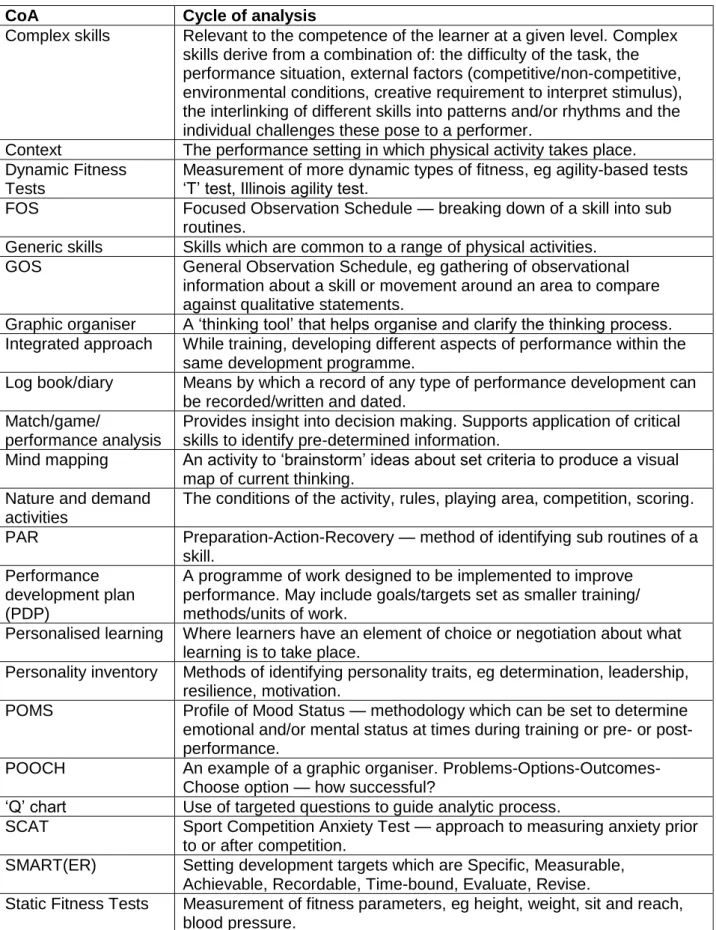
CoA Cycle of analysis
Complex skills Relevant to the competence of the learner at a given level. Complex skills derive from a combination of: the difficulty of the task, the performance situation, external factors (competitive/non-competitive, environmental conditions, creative requirement to interpret stimulus), the interlinking of different skills into patterns and/or rhythms and the individual challenges these pose to a performer.
Context The performance setting in which physical activity takes place. Dynamic Fitness
Tests
Measurement of more dynamic types of fitness, eg agility-based tests ‘T’ test, Illinois agility test.
FOS Focused Observation Schedule — breaking down of a skill into sub routines.
Generic skills Skills which are common to a range of physical activities. GOS General Observation Schedule, eg gathering of observational
information about a skill or movement around an area to compare against qualitative statements.
Graphic organiser A ‘thinking tool’ that helps organise and clarify the thinking process. Integrated approach While training, developing different aspects of performance within the
same development programme.
Log book/diary Means by which a record of any type of performance development can be recorded/written and dated.
Match/game/
performance analysis
Provides insight into decision making. Supports application of critical skills to identify pre-determined information.
Mind mapping An activity to ‘brainstorm’ ideas about set criteria to produce a visual map of current thinking.
Nature and demand activities
The conditions of the activity, rules, playing area, competition, scoring. PAR Preparation-Action-Recovery — method of identifying sub routines of a
skill. Performance
development plan (PDP)
A programme of work designed to be implemented to improve performance. May include goals/targets set as smaller training/ methods/units of work.
Personalised learning Where learners have an element of choice or negotiation about what learning is to take place.
Personality inventory Methods of identifying personality traits, eg determination, leadership, resilience, motivation.
POMS Profile of Mood Status — methodology which can be set to determine emotional and/or mental status at times during training or pre- or post-performance.
POOCH An example of a graphic organiser. Problems-Options-Outcomes- Choose option — how successful?
‘Q’ chart Use of targeted questions to guide analytic process.
SCAT Sport Competition Anxiety Test — approach to measuring anxiety prior to or after competition.
SMART(ER) Setting development targets which are Specific, Measurable, Achievable, Recordable, Time-bound, Evaluate, Revise.
Static Fitness Tests Measurement of fitness parameters, eg height, weight, sit and reach, blood pressure.
Appendix 4: Resources for
learning and teaching
Resources for studying Physical Education include professional journals, textbooks, specialist magazines, DVDs, online materials and websites. Some suggestions for resources are provided below.
Resource Description
General information about physical activities and sports
BBC Schools Website: contains sports-specific details relating to rules, nature, sporting activities, how to get into the sport. British Olympic
Association
Website: contains sports-specific information about Olympic sports.
Teach PE Website: free resources for physical education and sports coaching.
Women’s Sports Foundation
Website: forum for women in sport to discuss participation in sports, careers in sports development and coaching.
Performance development of mental, emotional, social and physical factors
(BASES) Website: British Association of Sport and Exercise
Scientists (BASES) — sports science information relating to approaches to develop performance, especially
physiological and psychological factors. BBC Schools —
Bitesize
Website: information about factors impacting on performance; useful examples of gathering information using good digital footage of elite performers.
Brianmac Website: information about how to develop performance for different sports; sport-specific demands; approaches/ methods to develop performance; example of POMS. Cooperative
Learning
Book: explains how to help learners ‘learn’.Kagan. S and Kagan. M. Kagan Publishing, San Clemente CA (2009). Online journals Websites: journals which provide abstracts of current
thinking about performance and performance development. Performance
Psychology — A Practitioners Guide
Book: a good resource to introduce the potential impact and management of psychological factors which affect
performance. Collins, Abbott and Richards (Edits) (March 2011) Churchill Livingstone.
Read it. Understand it. Communicate it.
Book: introductory level resource about understanding the effects of mental and emotional factors on performance. Use of ‘Q’ chart method. McLellan. J. Jemco Publishing (2000).
Administrative information
Published: June 2014 (version 2.0)
History of changes to Course Support Notes
Coursedetails
Version Description of change Authorised
by
Date
2.0 Support and guidance clarified and expanded throughout. Qualifications Development Manager June 2014
© Scottish Qualifications Authority 2014
This document may be reproduced in whole or in part for educational purposes provided that no profit is derived from reproduction and that, if reproduced in part, the source is acknowledged. Additional copies can be downloaded from SQA’s website at www.sqa.org.uk.
Note: You are advised to check SQA’s website (www.sqa.org.uk) to ensure you are using the most up-to-date version.
Unit Support Notes — Physical
Education: Performance Skills (Higher)
This document may be reproduced in whole or in part for educational purposes provided that no profit is derived from reproduction and that, if reproduced in part, the source is acknowledged. Additional copies of these Unit Support Notes can be downloaded from SQA’s website: www.sqa.org.uk.
Introduction
These support notes are not mandatory. They provide advice and guidance on approaches to learning, teaching and assessment for the Physical Education: Performance Skills (Higher) Unit. They are intended for teachers and lecturers who are delivering this Unit. They should be read in conjunction with:
Physical Education: Performance Skills (Higher) Unit Specification Higher Physical Education Course Specification
Higher Physical Education Course Assessment Specification Higher Physical Education Course Support Notes
appropriate assessment support materials
If the Unit Support Notes have been developed for a Unit that is not part of a Course, then it is only necessary to read them in conjunction with the Unit Specification.
General guidance on the Unit
Aims
This Unit is a mandatory Unit of the Higher Physical Education Course and is also available as a free-standing Unit. It is designed to meet the needs of a broad range of learners who may choose to study it.
The general aim of this Unit is to enable learners to develop a broad and comprehensive range of complex movement and performance skills through participating in a range of physical activities. They will select, demonstrate, apply and adapt these skills, and will use them to make informed decisions. They will also develop their knowledge and understanding of how these skills combine to produce effective outcomes. Learners will develop consistency, precision, control and fluency of movement. They will also learn how to respond to and meet the demands of performance in a safe and effective way. The Unit offers
opportunities for personalisation and choice through the selection of physical activities used for learning and teaching.
Learners who complete this Unit will be able to:
1 Demonstrate a broad and comprehensive range of complex movement and performance skills in physical activities
Progression into this Unit
Entry into this Unit is at the discretion of the centre. However, learners would normally be expected to have attained the skills, knowledge and understanding required by one or more of the following or equivalent qualifications and/or experience.
Recommended entry level into this Unit is as follows:
National 5 Physical Education Course or relevant component Units
Other relevant skills, knowledge and understanding could include experience in coaching or fitness training and an interest in performance development or physical education.
Skills, knowledge and understanding covered
in the Unit
Information about skills, knowledge and understanding is given in the Higher Physical Education Course Support Notes.
If this Unit is being delivered on a free-standing basis, teachers and lecturers are free to select the skills, knowledge, understanding and contexts which are most appropriate for delivery in their centres.
Examples of suitable contexts in which the skills, knowledge and understanding for this Unit could be developed are detailed in the sections entitled ‘Approaches to learning and teaching’ and ‘Approaches to assessment and gathering
evidence’.
Progression from this Unit
This Unit may provide progression to: Advanced Higher Physical Education Course or relevant component Units Higher National Certificate
higher education degrees
Approaches to learning and
teaching
Learning and teaching should be developed in a practical context, which is as challenging, exciting and enjoyable as possible. Teachers should take into account the individual needs of the learners when delivering the Unit.
More guidance and advice on sequencing of Unit delivery can be found in the appropriate section of the Higher Physical Education Course Support Notes. Physical activities for assessment will normally be chosen from those covered within the Higher Physical Education Course at the centre. Appendix 2 in the Higher Physical Education Course Support Notes contains a table of popular activities that centres can refer to for suggestions. This list is not definitive or exhaustive and centres can choose other appropriate physical activities. Learners should be given every opportunity to develop skills within physical activities in which they have a natural aptitude, and which are of interest to them. It is up to individual centres to decide how much time they are going to allocate to each physical activity.
A range of teaching methodologies and performance contexts can be used to support the learner to develop movement and performance skills in physical activities. At Higher level, learners should be actively encouraged to work both collaboratively and independently, and to investigate and make decisions about how they can best develop their performance.
Group work within the context of physical education provides many positive benefits for learners, promoting collaborative working practices, balanced with opportunities for individual, independent and autonomous contributions to the work of the group. Group work approaches can broaden the scope of all types of learning activity and gives valuable experience of team working — leading, taking responsibility, encouraging and sharing — which also helps to prepare learners for the workplace and life in general.
Learners should be encouraged to use ICT resources, where appropriate and available, such as models of performance from elite events to develop their understanding of what makes a quality performance. They can also use digital images (to compare against model performers) or online fitness testing to help them develop an understanding of how best to improve their own performance.
Developing complex movement and performance skills in physical
activities
Learners should be facilitated to develop and refine a broad and comprehensive range of complex movement and performance skills. This could occur in modified situations and/or in live performance contexts. Modified situations provide a context where it is possible to highlight the quality and effectiveness of execution
techniques. In situations such as conditioned games, small sided games or modified performance situations, learners can focus on the development of fluency or control and use self, peer and assessor feedback to review their own and/or others effectiveness.
Movement skills
Movement skills are skills that involve different parts of the body. They are the skills which allow us to move about and navigate our physical environment .They are the building blocks upon which more complex locomotory and performance skills are developed.
Examples of movement skills include walking, running, hopping, jumping, catching, throwing, balancing, kicking, and striking.
Within physical activities, these skills can be simple or complex depending on the context, stage of learning and ability of the performer.
Examples of more complex movement skills include hitting a moving hockey ball to a team mate on the move into space, fielding and returning a cricket ball or driving past opponents towards a basket.
Performance skills — physical
Physical performance skills are movement skills applied to physical activity and sports situations. Performance skills are closely related to the nature of the physical activity and are often identified as specific skills or techniques such as a drop shot, a vault or a pirouette. They can be performed in isolation or in
combinations.
Performance skills — other types
Performance skills also include the energy or effort put into an activity, such as the emotions shown to enhance a dance performance, or co-operating with others where this is essential, being clear about your role, spotting a space that needs to be covered to pre-empt an opponent’s attack. These occur in all
physical activities but may be more evident in creative or aesthetic performances, eg:
during a dance performance, performers must also convey the emotions associated with the piece of music
in trampolining, using turns to add to the complexity of the somersault adds challenge which would make the sequence more exciting and aesthetically pleasing
in netball, a perceptive Wing Defence might see the opponent block their Goal Attack getting into the shooting circle and move quickly to support their team mate by ‘setting a screen’ for them to penetrate the circle and receive a pass
during a volleyball performance the agreed strategy was not being carried out by the whole team, so the captain instructs teammates when and how to move on the court to carry through particular tacticsLearners should be given opportunities to develop and extend their movement vocabulary and/or repertoire of skills during learning and teaching sessions. Assessors could support this on an individual or group basis depending upon the choice of physical activities. Repeated practice will allow for time to refine these skills and demonstrate the degree of consistency of control and fluency required at Higher.
Learners could observe examples of high level and other model performances in order to identify and understand what complex skills demonstrated with control and fluency look like. Sources for these performances could include the internet, attending live performances, using motion analysis software, or class sessions where they observe and record one another’s performances and report back using set criteria. Learners could discuss and debate the role that a number of factors in the performance contribute to the breadth and complexity of skill — including the difficulty of the skill, the performance situation, interlinking different skills into patterns, and the challenge provided by external factors such as competitors, conditions, choreography demands.
Learners could devise checklists to identify key features of effective performers and compare what would be appropriate for different levels, including Higher. The checklist might include the following performance characteristics:
skills executed at the correct time with consistency fluency of execution
economy of effort
effortless movements/application of skill confident use of skills
few unforced errors dynamic performance application of flair
ability to choreograph routines/link complex skills
Learners could write up examples of movement and performance skills required at Higher in a specific physical activity, for example:
‘In tennis, performers at Higher need to have a repertoire of skills that are performed with a high degree of accuracy…use good net shots and drop shots which…, provide good length on ground shots because…cover the court well so that…’
They could also analyse examples of how movement and performance skills in a specific physical activity develop and feature during play across the SCQF levels. The following example is from table tennis and shows the development of a forehand drive.
Level Skills development in a forehand drive
National 3 Forehand drive is performed with some degree of control and fluency occasionally; little reference to opponents positioning; no top spin applied. Movement is not fluent or controlled.
National 4 Forehand drive is performed with a degree of control. Performer tries, on occasion, to move opponent; minimal top spin is applied. Movement around table more fluent and getting into better
positions to return ball effectively.
National 5 Forehand drive is performed with control and fluency; opponents positioning is taken into consideration; more attempts at top spin and some attempted back spin appearing to try to vary return. Addresses return well.
Higher Forehand drive is performed consistently with control and fluency. Performer consistently tries to move opponent around the table to create attacking options. Varies length of return. Greater use of top spin and back spin with greater degree of spin generated.
Prepares well to play next shot, often anticipating return. Footwork good and able to generate good force. Good movement around the table.
Body and spatial awareness
Motional analysis techniques, devising a focused observation sheet (FOS) or comparing their own performance with a model performance are all good ways to enable learners to understand this aspect of performance and will help them to refine their own skills and techniques. Feedback from peers, assessors and others during/after practice sessions will help learners identify competency and areas for development in the demonstration of precise body and spatial
awareness with distinct patterns and/or rhythms. Examples of spatial awareness, patterns and rhythms include: creating space in a game context, timing release from a tuck position during a vault, a change of direction, a pass through a channel, the repetition of a motif with increasing pace to give greater dynamism to choreography, effective interpretation of the musical stimulus.
For example: In volleyball, recognising the need to readjust positioning to improve court coverage when the block is set, being aware of the space behind the block and being ready to move and cover when required all
demonstrate awareness of personal positioning and that of others around in a fast paced attack.
Working co-operatively with others
There are many opportunities to work co-operatively with others during the learning and teaching of physical education, sometimes as a leader and sometimes in a supporting role. Applying rules, fair play and etiquette before, during and after an activity will also provide an opportunity to demonstrate
communication, compliance and co-operation. Learners should be encouraged to support each other as they each develop their own performance for example acting as a spotter or supporter, completing a match analysis sheet for a peer or
starting the music for a dance. Learners could take on roles that might arise and work together to devise appropriate strategies. Learners could reflect on their responsibilities in a logbook or blog, or produce a poster for younger pupils, for example:
‘As a team we were not working together as a unit…this led to…at half time we discussed what to do next…in the second half we…’
In gymnastics, while working to perfect the landing of a handspring, the supporter would need to step in to ensure no over rotation.
‘In doubles badminton, when my partner serves short, I know to drop back to cover the rear of the court and allow her to follow the shuttle into the net in case of a short low reply when she can pick it up early with a smash…’
Techniques, compositions and tactics
Learners should have an opportunity to explore and practice techniques, compositions and tactics which cover all four factors impacting on performance (mental, emotional, social and physical). Groups of learners could try out different techniques to deal with the same challenge and compare notes as they practice and implement the technique. Effective approaches to develop techniques, compositions and tactics include personal practice, analysis of model
performances, footage of elite performers and peer review during class sessions. At Higher, learners should be aware of well-established skills or techniques and tactics to impact a game situation or specific performance in a more aesthetic activity, for example:
mental factors: a breathing routine or visualisation emotional factors: assertive behaviour or self-talk/3 Rs social factors: process training or role modelling
physical factors: weight training or setting SMART goals
Decision making
Learners should be guided to develop awareness of how to make appropriate decisions in challenging contexts. It will be good practice for learners to keep a log book or diary to reflect on decisions they made so they can get used to reviewing the appropriateness of their decision making. Learners should gather feedback from a variety of sources in order to confirm or amend their own
analysis. Some decision making may be evident during performance and in other physical activities decision making will be evident between attempts or heats, or when modifying strategies during performance, for example:
a learner makes changes to a pre-determined plan during a track athletics event because a fellow competitor makes a decision which affects the event a learner chooses to perform a lower tariff vault because they are not able to
generate enough speed at take-off to complete a higher tariff vault successfully
It is always useful for learners to be questioned during/after sessions so that they and others can gain an insight into what they did and why.
Making effective safe adaptations
During performance of physical activities, learners will have to react appropriately and make effective, safe adaptations in response to a wide range of challenging variables. Practising a physical activity (for example using a whole-part-whole practice approach) is an effective way to develop this aspect of performance as it provides an opportunity for appropriate adaptations to be tried and tested: it is specific, has real relevance to the learner and uses the necessary timing, spatial aspects and contexts pertinent to that activity. Using external resources such as video replay, model performances and other sources to introduce effective examples of making adaptations and reacting appropriately during performance are also useful approaches to raise awareness, for example:
in volleyball, the setter makes the adaptation of reverse setting in an attempt to avoid a tall opposing front court player on the opposing team
in handball, shooting low to the bottom corners of the goal to force the less agile goalkeeper to react is an appropriate adaptation to score more goals in hockey, deciding not to lift the ball in a crowded area would ensure others
safety and that you were not penalised for dangerous play
Developing skills for learning, skills for life
and skills for work
Information about developing skills for learning, skills for life and skills for work in this Unit is given in the Higher Physical Education Course Support Notes.
Approaches to assessment and
gathering evidence
All of the Outcomes and Assessment Standards in a Unit must be covered in the assessment of a Unit.
Evidence can be gathered in a variety of forms to suit the needs of the learner and of individual centres. Assessors, where appropriate, should provide a balance of assessment methods and encourage alternative approaches. Learners should be assessed at an appropriate stage in the Unit.
In order to ensure authenticity of learner’s work, there are guidelines for ensuring that learners present work which is their own. For more guidance, please refer to SQA's Guide to Assessment.
Regardless of the chosen assessment approach, the following will always apply to the Performance Skills Unit:
All of the Assessment Standards must be met for each of two different physical activities.
Physical activities will have different performance and movement skills depending on the nature of the physical activity.
Performance and movement skills can be assessed within any context that is sufficient to allow the learner to demonstrate the standards required, including conditioned activities.
Some physical activity choices may require discussion with the assessor before, during or after performance to best obtain evidence for some Assessment Standards (eg Assessment Standards 1.3 and 1.5).
Learners can exercise a degree of personalisation and choice of activities provided expertise exists within the centre to make the relevant assessment judgements.
Evidence for this Unit can be gathered over a number of teaching sessions: such an approach will allow for the gathering of naturally-occurring evidence. For this Unit, evidence of movement and performance skills can be assessed in a live performance context, conditioned games, small sided games, modified
performance situations or any other relevant context. Formal assessment tasks may be set, especially if learners require remediation or have had an injury/illness and have missed an earlier assessment opportunity.
Whatever assessment approach is used, it is important that the approach to assessment encourages personalisation and choice. Assessment should meet the varying needs of all learners and, where appropriate, occur in practical contexts. The minimum competences, as exemplified in Unit assessment support, must always be met.
Some examples of possible assessment approaches include: video of performance
observation checklists
training diaries/electronic logbooks/blogs/wikis/development records oral evidence through question and answering
written assessment through answering of questions use of ICT and relevant software
The types of ICT that learners might use to help them work towards their assessment could include motion capture and analyse programmes. Digital capture of performance is a good way to gather assessment evidence, as digital images of performance can be held on record and submitted as evidence, with corroboration of authenticity. Teachers/tutors should maintain records of learner attainment. Observation checklists (completed by the assessor or peers) can also be used to gather assessment evidence, as well as self