1
The Effect of Visual Metaphor on Advertising Response
An Integrative Framework
Adel Sakr
Doctor of Philosophy
Aston University
March 2016
© Adel Sakr, 2016
Adel Sakr asserts his moral right to be identified as the author of this thesis.
This copy of the thesis has been supplied on condition that anyone who consults it is
understood to recognise that its copyright rests with its author and that no quotation
from the thesis and no information derived from it may be published without
appropriate permission or acknowledgement.
2
Aston University
The Effect of Visual Metaphor on Advertising Response An Integrative Framework
Adel Sakr Doctor of Philosophy
2016
Thesis Summary
This thesis contributes toward the better understanding of the use and effect of visual metaphor in print advertising through an integrative framework. Two overall research questions are answered in this context. Firstly, why is visual metaphor in advertising such an important phenomenon that is worth further research? Secondly, how does visual metaphor engage the consumer and elicits favorable responses to different print advertisements? Two studies were conducted to answer these questions. Study one, a content analysis on 320 print advertisements answered the first overall research question. This study provided a comprehensive assessment of the use of visual metaphor in print advertising. Results showed that visual metaphor is strongly present in print advertising and that this presence shows an increasing trend over time. Study two answered the second overall research question through two experiments. The first experiment compared the effect of different types of visual metaphor on different consumer responses. Results from this experiment showed that replacement metaphor had the most positive effect on effectiveness of the ad. Furthermore, replacement metaphor together with fusion metaphor had the most positive effect on attitude toward the brand and purchase intention. Verbo-pictorial metaphor on the other hand scored the lowest with regards to its effect on the three aforementioned responses. The effect of replacement metaphor on effectiveness of the ad, attitude toward the brand and purchase intention was positively mediated through elaboration and subjective ad comprehension. Objective ad comprehension also positively mediated the effect of replacement metaphor but only on effectiveness of the ad and purchase intention. The same results applied to verbo-pictorial metaphor. However, the mediation effects in this case were negative. Findings, also uncovered that ads that compare two metaphorical objects which are conceptually similar particularly in terms of their functional characteristics are better comprehended. Therefore, a specific visual structure may vary in its effect and hence effectiveness depending on the nature and character of this conceptual similarity as perceived by consumers. The second experiment tested the moderating effect of ad viewing time on consumer response to visual metaphor in advertising. Results, however, did not support the hypothesis related to this moderating effect. Finally, comparing the content analysis and experimental findings provides valuable insights for advertising practitioners. Practitioners can better frame their advertisements and make more effective use of the different types of visual metaphor for this purpose. Therefore, this thesis has also important practical implications.
3
Dedication
To my parents
4
Acknowledgements
I am delighted to take this opportunity to thank people without whose support, advice and company I would not have managed to complete this thesis. First and foremost I would like to express my sincere gratitude to my supervisory team Dr. Dina Rasolofoarison and Professor Heiner Evanschitzky. Their combined knowledge, expertise, support and words of encouragement made this doctoral research experience not only a valuable learning experience but also an enjoyable one. I would like to thank Dr. Dina for her flexibility, patience and support when I was selecting my research topic. Her guidance in the design of the content analysis as well as the experimental research was also valuable. I also appreciate her ability to keep a balance between providing directions and supporting my efforts while offering me the opportunity to find my own way forward. There are so many things to thank Professor Heiner for, but I will just single out a few that I really admired him for. His great ability to provide essential and continuous support at all the stages of my PhD studies. I am grateful to him for being able to fuel my motivation and enthusiasm to progress with my research even at the most challenging times. His expertise and guidance helped me prioritize my tasks and manage my time to meet the different deadlines throughout this project. His knowledge in research design and data analysis was also of great value to me and I did learn from him a lot in this regard.
Very special thanks to my friend and colleague Katharina Kils. Without her essential help and support, I would never had been able to complete the content analysis study on time. I will always be grateful and remember our chats on Christmas and new years’ eve, which you generously devoted to support me and work on this study. I wish to also thank Aston Business School represented in all the faculty members in the Marketing Group. You were all more than generous with your time whenever I had a question or I needed any kind of support. Special thanks also to Mr. Paul Hebron, Head of Marketing and Alumni Relations at Aston Business School. Without his tremendous help in connecting me with Advertising practitioners I would never had been able to recruit the needed participants for the qualitative study conducted as part of this thesis. His valuable support enabled me to complete this study on time. I would also like to give special thanks to the RDP team (Dr. Elizabeth Bridges, Ms. Jeanette Ikuomola, Ms. Irene Vickers and Ms. Ranjit Judge) for ethically supporting the whole PhD experience. Your informal chats and kind words of encouragement had a valuable impact on my progress with my research. Thank you for being there for me. Last and definitely not least I would like to thank all my friends and colleagues at Aston Business School and also back home for their continuous encouragement and support.
5
Table of Contents
Thesis Summary ... 2 Dedication ... 3 Acknowledgements ... 4 Table of Contents ... 5 Chapter 1 Introduction ... 11 1.1 Introduction ... 121.2 Aim and Research Objectives ... 17
1.3 Organization of the Thesis ... 18
Chapter 2 ... 23
Philosophy and Research Structure ... 23
2.1. Introduction ... 24
2.2. The Different Philosophical Approaches ... 24
2.2.1 Interpretivism ... 24
2.2.2 Realism ... 25
2.2.3. Positivism and Its Roots ... 26
2.2.4 Pragmatism ... 28
2.3. Critical Discussion of the Research Structure ... 32
Chapter 3 ... 35
Literature Review (Part 1) ... 35
3.1. Introduction ... 36
3.2 What is a Visual Metaphor? ... 36
3.3. Typologies of Visual Metaphor in Advertising ... 41
3.4. Previous Research on the Presence of Visual Metaphor in Print Advertising ... 52
Chapter 4 ... 55
Contemporary Uses of Visual Metaphor in Print Advertising ... 55
4.1. Introduction ... 56
4.2. Qualitative Study with Advertising Experts ... 57
4.2.1 Aim of the study ... 57
4.2.2. Context and Reason for Choice ... 57
4.2.3. Research Objectives ... 60
6
4.2.4.1 Why Qualitative in-depth interviews? ... 61
4.2.4.2. Sample... 62
4.2.4.3. Interviews Structure ... 62
4.2.4.4. Materials ... 63
4.2.4.5. Data Analysis ... 63
4.2.5. Research Findings ... 64
4.2.5.1. Metaphor in Print Advertising ... 64
4.2.5.2. The Visual Element ... 64
4.2.5.3. The Textual Element ... 65
4.2.5.4. The Brand Element ... 68
4.2.5.5. Managerial Insights ... 69
4.2.6. Conclusion ... 73
4.3. Content Analysis on Print Ads ... 74
4.3.1. Aim of the study ... 74
4.3.2. Research Objectives ... 74
4.3.3. Method ... 75
4.3.3.1. Descriptive Study ... 75
4.3.3.2 Why Content Analysis? ... 75
4.3.3.3. Steps of Content Analysis ... 76
4.3.4. Research Findings ... 87 4.3.4.1 Visual Metaphor ... 88 4.3.4.2 Visual Element ... 93 4.2.4.3. Textual Element ... 97 4.2.4.4. Brand Element ... 105 4.4. Discussion ... 105 Chapter 5 ... 111
Literature Review (Part 2) ... 111
5.1. Introduction ... 112
7
5.3 Effects of Visual Metaphor on Consumer Responses ... 114
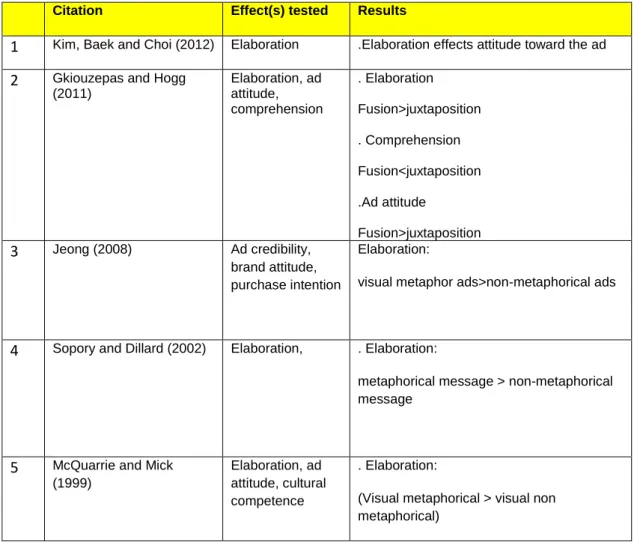
5.3.1 Cognitive Elaboration ... 115
5.3.2. Comprehension ... 122
5.3.3 Attitude Toward the Ad ... 128
5.3.4 Ad Credibility ... 129
5.3.5 Attitude Toward the Brand ... 131
5.3.6. Purchase Intention ... 132
5.3.7. Perceived Quality of Advertised Product ... 133
5.3.8. Effectiveness of the ad ... 134
5.3.9. Ad Recall ... 134
5.4. Previous research on the effect of Forceville’s (1996) typology on consumer response. ... 135
5.5. Moderating Factors ... 147
5.6. The Gap in the Literature ... 151
5.7. The Derived Conceptual Model ... 152
Chapter 6 ... 154
Experimental Research ... 154
6.1. Introduction ... 155
6.2. Methodology ... 156
6.2.1. Why Experimental Research? ... 156
6.2.2. Why More Than One Experiment? ... 156
6.3. Experiment One ... 157
6.3.1. Introduction ... 157
6.3.2 Proposed Hypotheses ... 160
6.3.3. Methodology ... 163
6.3.4. Data Analysis and Results... 173
6.3.5. Small Complementary Study ... 194
6.3.6. Discussion ... 197
6.4. Experiment Two... 205
8
6.4.2. Proposed Hypothesis ... 206
6.4.3. Methodology ... 206
6.4.4. Data Analysis and Results... 214
6.4.5 Discussion ... 219
6.5. General Discussion ... 220
6.6. Ethical Considerations for Experiments ... 222
Chapter 7 ... 223
Discussion ... 223
7.1. Introduction ... 224
7.2. Aim and Objectives of This Thesis ... 224
7.3. Meeting the Objectives ... 225
7.4. Managerial Implications ... 233
7.5. Limitations and Future Research ... 234
References ... 237
9
List of Figures
Figure 1: Welti-Furer Ad Figure 2: Greenpeace Ad ... 12
Figure 3: Reflex Racquet Ad (Phillips, 1997) ... 41
Figure 4: Replacement Metaphor - Clerget ad (Source, Forceville, 1996) ... 42
Figure 5: Juxtaposition Metaphor - Chocolate Cherry Cookies Ad (Source, Lagerwerf, van Hooijdonk, & Korenberg, 2012). ... 43
Figure 6: Verbo-Pictorial Metaphor - BMW Motorbike Ad (source, Forceville, 1996)... 44
Figure 7: Phillips and McQuarrie (2004) Typology ... 46
Figure 8: Gkiouzepas and Hogg (2011) Typology ... 49
Figure 9: Example of a Print Ad ... 80
Figure 10: Importance of The Three Ad Elements ... 81
Figure 11: Key Finding for the Ad Elements as Percentages of Total Sample ... 88
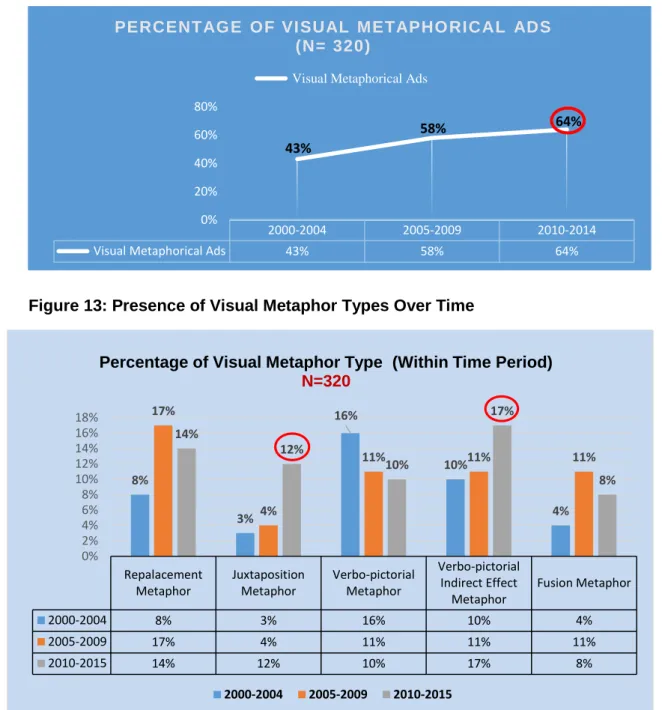
Figure 12: Visual Metaphor in Print Advertising – An Increasing Trend over Time ... 89
Figure 13: Presence of Visual Metaphor Types Over Time ... 89
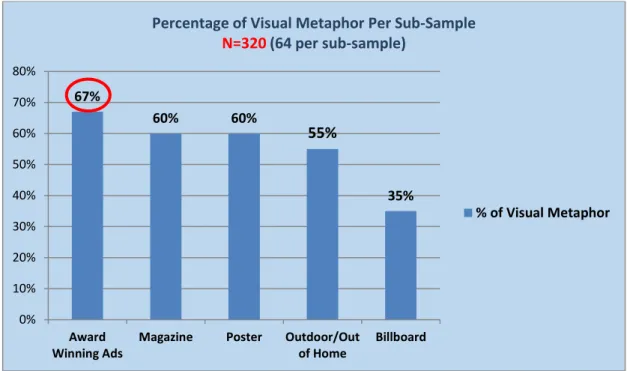
Figure 14:Visual Metaphor in Different Print Media Categories and Award Winning Ads. ... 90
Figure 15: Verbo-Pictorial Indirect Effect Metaphor - Harvey Nichols Ad ... 91
Figure 16: Total Replacement Metaphor - Terrain Ad - (Source: AdForum Database) ... 92
Figure 17:Key Findings for Visual Content... 93
Figure 18: Key Findings for Color in Ad ... 96
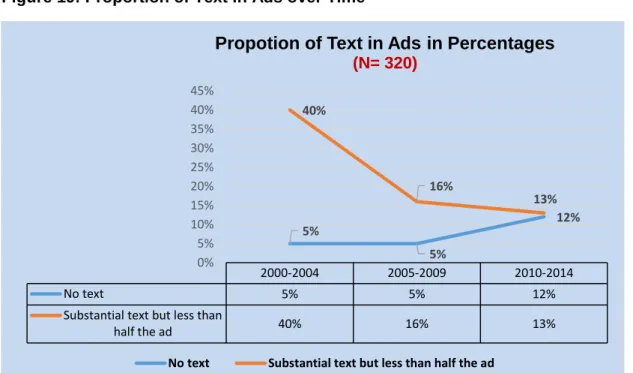
Figure 19: Proportion of Text in Ads over Time ... 97
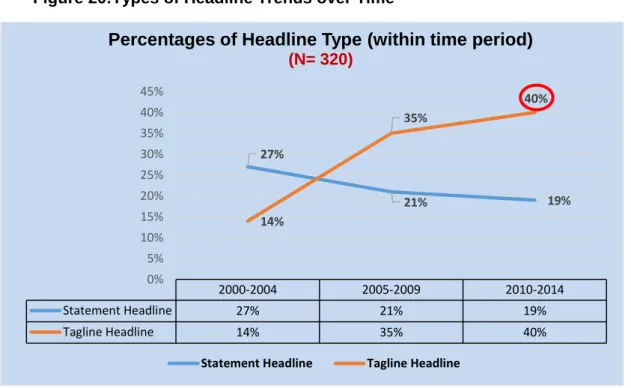
Figure 20:Types of Headline Trends over Time ... 98
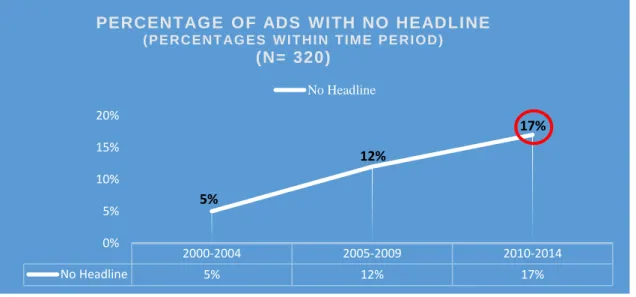
Figure 21: No Headline in Ads - Increasing Trend over Time... 99
Figure 22: Types of Headline in Ads ... 100
Figure 23: Tagline Identity - Examples ... 102
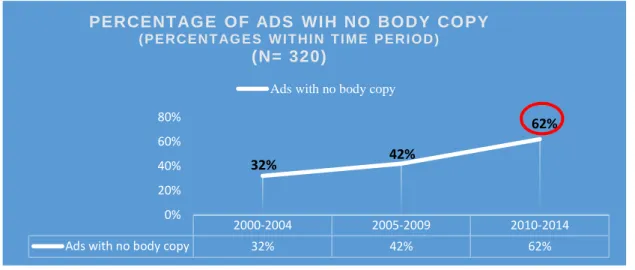
Figure 24: Ads Including No Body Copy - Increasing Trend Over Time ... 104
Figure 25: Example of an award winning ad with a declarative tagline ... 109
Figure 26: Advertising Stimuli used by Mohanty and Ratneshwar (2015) ... 144
Figure 27: The Conceptual Model ... 153
Figure 28: Objective Metaphor Comprehension Results ... 190
Figure 29: Complementary Study - Results ... 195
Figure 30: Complementary Study Results ... 196
Figure 31: Procedures Followed in the Limited Ad Viewing Time Condition ... 212
Figure 32: Objective Metaphor Comprehension for the Four Conditions ... 218
10
List of Tables
Table 1: Summary of Thesis ... 22
Table 2: The Pillars of Pragmatism as a Philosophy Underlying This Thesis ... 31
Table 3: Summary of The Research Design ... 34
Table 4: Previous Research on Elaboration ... 115
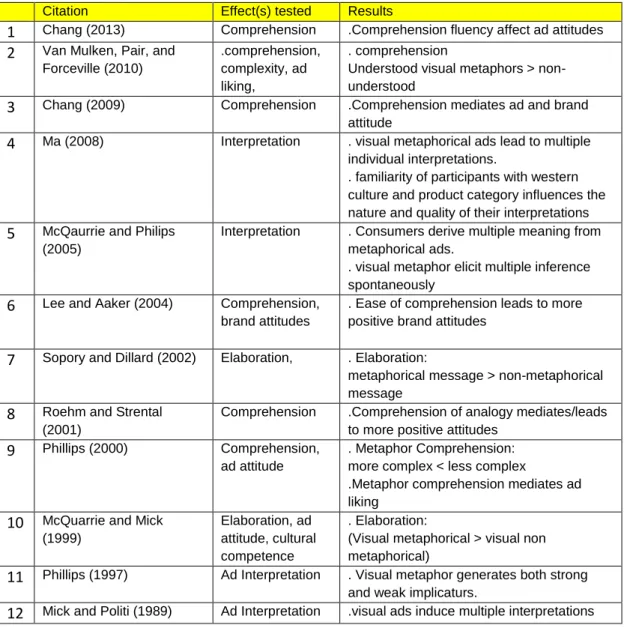
Table 5: Previous Research on Comprehension ... 122
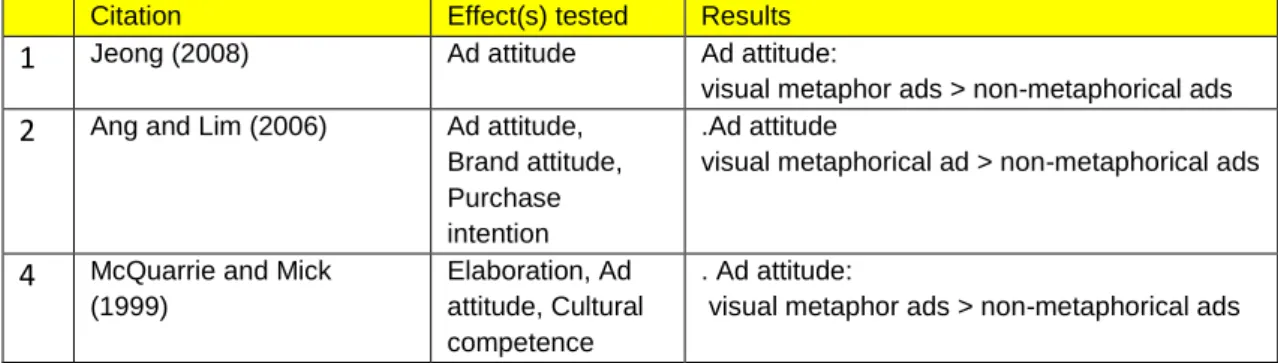
Table 6: Previous Research on Attitude Toward the Ad ... 128
Table 7: Previous Research on Ad Credibility ... 129
Table 8: Previous Research on Attitude Toward the Brand ... 131
Table 9: Previous Research on Purchase Intention ... 132
Table 10: Previous Research on Ad Recall ... 134
Table 11: Summary of Previous Research on the Effect of Forceville (1996) Typology ... 135
Table 12: Advertising Stimuli used in Experiment one ... 165
Table 13: Mean and Standard Deviations For Dependent Variables (N=200) ... 173
Table 14: Open Ended Questions Results – Replacement Metaphor ... 191
Table 15: Open Ended Questions Results – Fusion Metaphor ... 191
Table 16: Open Ended Questions Results – Juxtaposition Metaphor ... 192
Table 17: Open Ended Questions Results – Pictorial Metaphor and Verbo-Pictorial Indirect Effect Metaphor ... 193
Table 18: Means and Standard Deviations For Subjective Comprehension ... 208
Table 19: Means and Standard Deviations For Subjective Comprehension ... 210
Table 20: Advertising Stimuli used in Experiment Two ... 211
Table 21: Linear Model of Predictors of Subjective Comprehension. ... 216
Table 22: Linear Model of Predictors of Objective Comprehension ... 217
11
Chapter 1
Introduction
12 1.1 Introduction
Figure 1: Welti-Furer Ad Figure 2: Greenpeace Ad
Figure 1 is a visual of VanGogh depicted as a passenger sitting in a comfortable first class seat of an airplane. In the lower right part of the visual a tagline reads ‘Finest Art Transport’. This tagline is placed just above the brand name ‘welti-furer’. This visual is actually a print advertisement for a leading company for fine art transports in Europe. Van Gogh, the first class comfortable passenger represents the utmost care with which different artworks (similar to Van Gogh the passenger) are transported through this carrier, the advertised brand. This ad was designed in Switzerland. Figure 2 is another visualshowing a plastic bag on green grass that blows up in the shape of an atomic mushroom, surrounded by the gloomy sky. This time the visual stands on its own with only one word ‘Greenpeace’ placed in the lower right part of the visual. This is another print advertisement for
Greenpeace. Greenpeace communicates with this visual the severe environmental damage caused by exploitation of plastic bags, and hence calls for reducing the civil use of plastic bags. This advertisement was designed for Greenpeace Greece. But how did the visual of Van Gogh the passenger help in communicating the ad’s key meaning? and how did the plastic bag in the shape of an atomic mushroom communicate this environmental concern? This thesis examines these visuals as carriers of meaning.
Print advertising relies heavily on visuals to persuade. Pollay (1985) states that during the course of the 20th century, visuals occupy an ever-increasing portion of magazine ads, compared to the number of words that have steadily decreased (McQuarrie and
13
Research evidence also suggests that particularly in print ads the emphasis on visual rather than words has increased remarkably over the last century (Phillips and McQuarrie, 2002; Phillips and McQuarrie, 2004). Indeed, consumer researchers have recognized visual imagery in advertising as something other than an irrelevant cue or a simple mean of effect transfer (McQuarrie and Mick, 1999). The visual element is understood to be an essential, interrelated, meaningful, and culturally embodied characteristic of contemporary advertising (McQuarrie and Mick, 1999). Despite the fact that visuals are an integral part of print
advertising, not enough research attention has been dedicated to produce a systematic understanding of how different facets and characteristics of visual advertising work (Gkiouzepas, 2006). The two visuals described above are also examples of a rhetorical figure in visual form. Aristotle defined rhetoric as the art of effective communication, which uses all the possible means to persuade (Kenney and Scott, 2003). In the aforementioned definition it can be seen that rhetoric can go beyond words and can include also other ‘means’ of communication and persuasion (i.e. visuals) (Kenney and Scott, 2003). Despite the tradition of this discipline, visual rhetoric is a newly researched area in the field of advertising. The main purpose of visual rhetoric research is to understand how visuals in advertising actually work (e.g. McQuarrie and Mick, 1999; Phillips, 1997, 2000; Gkiouzepas, 2006). “Visual rhetoric may be described as a form of communication that uses images for creating meaning or constructing an argument” (Bulmer and Buchanan-Oliver, 2006, pp.55). Advertising also uses visuals and images to create and communicate meaning, usually brand meaning.
According to Scott (1994), this approach understands imagery as a symbolic system. More specifically, Scott (1994) suggested that visuals are an inherently persuasive device rather than a supplement to a verbal message. Furthermore, she proposed that visuals in advertising do not just reflect the reality depicted in them. Instead they also have a symbolic character or meaning that goes beyond what is simply depicted (Bulmer and Buchanan-Oliver, 2006). Therefore, communicating an indirect meaning. For this reason, Scott (1994) stated that advertising visuals can pose arguments, raise questions, create fictions, present metaphors and hence introduced the concept of ‘visual rhetoric’ to the
consumer research literature (Scott, 1994; Bulmer and Buchanan-Oliver, 2006).
Visual rhetoric is broadly employed in advertising. From a research perspective, however, it is only recently that academic research has begun to give visual rhetoric proper consideration (Andrews, 2011; Kenny and Scott, 2003; Scott, 1994). One of the most commonly employed rhetorical figures in print advertising, is visual metaphor.
14
A visual metaphor compares two dissimilar objects to imply similarities that may not literally exist (McQuarrie and Mick, 1996; Mothersbaugh, Huhmann, and Franke, 2002). For example, the Greenpeace ad described above shows a plastic bag that blows up in the shape of an atomic mushroom. This visual is actually a visual metaphor in which the plastic bag is compared to the atomic mushroom in terms of the harm and severe damage it causes for the environment. The designer of this visual implied a similarity between two literally unrelated objects, the plastic bag and the atomic mushroom. The way, however, the plastic bag was presented taking the shape and form of an atomic mushroom, created a relation between the two object. This metaphorical relation constructed also the key meaning of the ad. This is that the exploitation of plastic bags is similar to an atomic explosion in terms of the severe damage it causes to the environment. Using this single metaphorical visual, the advertiser was able to build a convincing argument about an important but also a relatively intellectual issue. This was done, however, in a simple and convincing way that a layperson can understand and also relate to. Moreover, this ad also won an Act Responsible Tributes prize at the Cannes Palais des Festivals in 2008.
With regards to academic research, for a long time, metaphor studies focused almost exclusively on language or verbal metaphor. Over the past two decades, however, the concept of visual metaphor has been fairly developed, and employed particularly in the context of print advertising. Kaplan (1992) examined 464 current print ads for automobiles and alcoholic beverages and found that 31% of the ads in his sample contained visual metaphors (Phillips, 2003). Another study conducted by Phillips and McQuarrie (2002) focused on the development, change and transformation of rhetorical style in magazine advertisements from 1954 to 1999. This study showed that visual figures, specifically tropes (i.e. visual metaphor) doubled in appearance between the periods 1954-1974 and 1975-1999 from 11.3% to 20.1% (Phillips and McQuarrie, 2002). The most recent study was conducted by McQuarrie and Phillips (2008). This study documented change in advertising style between 1969 and 2002. Results for the overall levels of visual rhetorical figures were consistent with the ones reported by Phillips and McQuarrie (2002). The only noted change was that the ratio of visual figures to verbal figures increased remarkably when ads from the 1960’s (1:10 ratio) are compared with ads from 2002 (1:4 ratio). This further supports the growing importance of the visual element in print advertising. Indeed, many leading
companies and brands are employing visual metaphors in their communication campaigns. Examples of which are such as: Club Med and also Clinique. Club Med used a total of 16 visual metaphors in its advertising campaign for 2013 to communicate the idea of happiness. A meaning that is manifested in the DNA of the brand (PR Newswire US, 2013).
15
Clinique lipstick also used a glass of soda in an advertisement to claim that the lipstick is cool and fresh (Scott, 1994). Other examples of top international brands that have used the same creative strategy include among others: Lipton tea, BMW, and Adidas (van Mulken and Pair, 2012).
One of the overall research questions raised in this dissertation is: why is visual metaphor in advertising such an important phenomenon that is worth further research? The answer to this question as framed in this thesis builds on and updates the research
conducted by Kaplan (1992) and also Phillips and McQuarrie (2002). It does so by comprehensively analysing the presence of visual metaphor in contemporary print
advertising over the last fifteen years as well as the nature of this presence (i.e. the types and forms by which visual metaphor is depicted in print advertising). Different previous attempts to synthesize the set of rhetorical figures have been disabled by one or more reasons.
One main reason is that the taxonomic categories of these figures are vague and ill-defined. A second reason is that the categories are not linked to consumer responses (McQuarrie and Mick, 1996). Despite of that, McQuarrie and Mick (1996) developed a framework which was presented as a taxonomy of verbal rhetorical figures in advertising. This framework was grounded on a large sample of real ads and only rhetorical figures that were found in this sample were included in the framework. This framework was to a high extent capable of reflecting the range of rhetorical figures present in advertisements (McQuarrie and Mick, 1996). This taxonomy differentiated between two different modes of figuration. These modes correspond to the distinction between what is referred to as
schemes and tropes. To define and further clarify this distinction, the same authors state that a figure in the schematic mode occurs when text contains excessive order or regularity, while a figure in the tropic mode occurs when a text contains a deficiency of order or irregularity. Thus, schemes and tropes include two distinguished modes of formal deviation (McQuarrie and Mick, 1996). A typical example of a trope figure is metaphor. The detailed discussion of those figures and the properties that differentiate each of these rhetorical figures is, however, beyond the scope of this thesis. Moreover, McQuarrie and Mick (1999) transferred and applied these verbal rhetorical figures to the visual domain. For example, they created mock ads in which they presented different figures including metaphor in a visual form.
16
The approach followed by the same authors was criticized by other researchers (e.g. Gkiouzepas, 2006), as not taking into consideration as much as it ought to the distinguishing characteristics of the visual domain. This mere transference of the verbal figures into a visual mode did not explain the specific visual manipulations involved in this process in a
systematic way. And how these visual manipulations affected consumers’ processing of these visual rhetorical figures. After McQuarrie and Mick’s work, other researchers took alternative approaches in categorizing visual rhetorical figures. One of the most important typologies developed in this visual domain, was proposed by Forceville (1996). Forceville (1996) categorized specifically visual metaphor in advertising. He was driven by the need to identify formal visual properties through which this important figure can be defined. The importance of the specific typology stems out the fact that the differentiating characteristics between the different types of visual metaphor were very clear and paid attention to the structure of the visual. Moreover, these visual manipulations were realistic, meaning that they were based on corpus of real print ads. In this way they directly corresponded to how visual metaphors are actually encoded in print advertising. The types of visual metaphor proposed by Forceville (1996) are the following: Juxtaposition metaphor, fusion metaphor, replacement metaphor and verbo-pictorial metaphor. These type will be discussed in detail in chapter two of this thesis.
Visual metaphors as employed in advertising are “artful deviations” from audiences’ expectations and manifest in them the meaning of novelty. Moreover, they ‘decorate’ and ‘beautify’ the ad meaning, making it more attractive and impressive for audience. This same beautification and decoration is the essence of ‘figuration’ which is manifested in a visual metaphor as a rhetorical figure. This is also showed in the visual ads described above. For example, depicting a plastic bag as an atomic mushroom in the Greenpeace ad, creates and comparison but also a relation that is not expected by the audience of this ad. Moreover, it deviates from their expectations. The same ad, however, still managed to attract their attention and create an interest about the issue addressed in this ad. Furthermore, as mentioned earlier, this visual ad is just one of many. From the above-mentioned ad it can be seen that a visual metaphor embodies novelty and figuration. Indeed, this novel atomic mushroom made out of a plastic bag could be perceived as an error at one point by the audience. This may lead to negative tension. When the ad’s metaphorical meaning is understood, however, the negative tension is relieved. Viewers feel that they finally ‘got it’. This subsequent resolution of the initial ambiguity of the ad is rewarding and elicits pleasure (McQuarrie and Mick, 1992; Jeong, 2008).
17
This same pleasure could contribute to positive attitude towards the ad, which in turn could enhance the positive attitude towards the brand as well as the overall advertising effectiveness (Mick, 1992; Jeong, 2008; Dillard, Weber, and Vail, 2007). The existing
academic research on visual rhetoric and more specifically on visual metaphor in advertising shows that indeed this creative advertising strategy has an effect on consumers and also has a persuasive power. Advertising and Marketing literature has recognized the effect of visual metaphor on consumer response to advertising. This research, however, is still
underdeveloped and partial, with regards to the number of response variables measured and also the types of visual metaphor investigated for their effect. Moreover, research results related to this stream of literature tend to be fragmented and contradictive to a high extent (Gkiouzepas, 2006). For example, Gkiouzepas and Hogg (2011) found that fusion metaphor provokes more elaboration than juxtaposition metaphor. Madubu, Sen and Ranganathan (2013), however, found the opposite. In this study juxtaposition metaphor elicited more elaboration than fusion metaphor. Furthermore, many conditions that could also affect the impact of visual metaphors (e.g. consumer characteristics) have also not been fully tested (Myers, Faber, Duff and Lutchyn, 2011). To cover this lack of research this thesis answers another important overall research question which is: How do visual metaphor engages the consumer and elicits favourable responses to different print advertisements?
1.2 Aim and Research Objectives
Considering the aforementioned the aim of this thesis is to provide an integrative framework for the use and effect of visual metaphor on consumer response to advertising.
More specifically the different parts of this thesis and their related research objectives are the following:
The first part represented in this introduction is followed by a presentation and a discussion of the philosophical underpinnings of this thesis. The second part starts with the critical literature review that has the objective of identifying and examining previous research on the nature and the different typologies that have been developed to categorize visual metaphor in advertising. Following that the first study that takes the form of a small qualitative study with advertising experts is presented.
18
This study sought after the managerial practices and knowledge of these advertising practitioners. The key objective of this qualitative study was to question existing advertising theory and use the insights of these advertising experts to formulate realistic and valid operational definitions for the different ad elements to be analysed (e.g. headline, types of visual, etc.) in a subsequent content analysis study. The main objective of the content analysis study is to provide a comprehensive assessment of the use of visual metaphor in print advertising. In this way also the relevance of Forceville’s (1996) typology with regards
to its actual existence in print advertising is identified. Therefore, this study answers the first overall research question (why is visual metaphor in advertising such an important
phenomenon that is worth further research?) Following that the second part of the critical literature review is presented and has the objective identifying and examining previous research on the effect of visual metaphor in advertising. This in turn leads to the proposed hypotheses, the research gap, and derived conceptual model.
The third and final part of this thesis presents the final study conducted as part of this research project, which answers the second overall research question: (how do visual
metaphor engages the consumer and elicits favourable responses to different print advertisements?) It answers this question through two experiments, which also test the derived conceptual model empirically. The objective of the first experiment is to compare the effects of the different types of visual metaphor proposed by Forceville (1996) on consumer responses to advertising. Moreover, to test the mediating effects of elaboration, subjective ad comprehension and objective ad comprehension on consumer response to visual metaphor in advertising. The objective of the second experiment is to test the moderating effect of ad viewing time on consumer response to visual metaphor in print adverting. The thesis then concludes with a general discussion chapter.
1.3 Organization of the Thesis
Chapter two presents the philosophical underpinnings of this thesis. This chapter starts by discussing the different philosophical approaches to research and explains further, which of these approaches represents the philosophical stand applied to this thesis.
Moreover, it discusses the rationale for choosing this particular stand to represent the philosophical approach that drives this current research. Following that, a critical discussion of the proposed research structure followed in this thesis is presented and the rationale for using the specific structure is provided.
19
Chapter three reviews literature on the nature of visual metaphor as well as the different typologies of visual metaphor in advertising. Moreover, it shed light particularly on the importance of the Forceville (1996) typology and provides the rationale for this
importance and hence for choosing this particular typology to be used and further researched in the context of this thesis. This chapter also highlights the need for further research on the presence of visual metaphor in print advertising as existing previous research is limited and dated.
Chapter four presents two studies. The first study is a qualitative study conducted with advertising experts. This study presents an overview of managerial practices and state of knowledge regarding visual metaphors. The chapter discusses the methodology
represented in the qualitative in-depth interviews conducted with copywriters and art director. These results of this study represent the insights of these advertising practitioners regarding print advertising design as a process. These insights also provided ‘realistic’ operational definitions for the different print ad design elements (e.g. headline, visuals, etc.). These definitions fed directly the development of a comprehensive and detailed coding grid that is used in the second study presented in this chapter. This study is a content analysis. The rationale and steps followed in conducting this content analysis are discussed in detail. This content analysis was conducted on 320 print ads representing four different print media categories. These categories are: magazine ads, outdoor ads, billboard ads, poster ads. In addition, a sub-sample of award winning ads was also analysed in this study. The sample of ads used in this study covers a time period of fifteen years, from 2000 to 2014. The results of this study provide an update on the frequency and percentage of visual metaphor in print advertising. This update, covers the different types proposed by Forceville (1996) as they appear in print advertising. Moreover, it extends the Forceville typology and identifies two new additional types of visual metaphor in print ads. These new types are also presented as part of the results related to this study in chapter four.
20
Chapter five presents the second part of the literature review on the effect of visual metaphor in advertising in terms of the different consumer response outcomes to visual metaphor in advertising. This leads to the proposed hypotheses related to each of these response variables. This literature review also introduces a ‘new’ potential moderating factor that could moderate the effect of visual metaphor on consumer response to advertising. This factor is ad-viewing time. Moreover, it proposes a hypothesis related to this moderating factor based on the review of relevant literature. The lack of research conducted on the effect of visual metaphor on consumer response to advertising is highlighted. This lack of research is related to the types of visual metaphor investigated (i.e. Forcevile’s 1996 typology), the number of the response variables tested as well as the hierarchy of these responses. The literature review leads to the proposed hypotheses related to each response variable discussed. Following that, the research gap is presented and finally, the conceptual model derived and proposed in this thesis is presented.
Chapter six, this chapter presents two experiments that answer the second overall research question (How do visual metaphor engages the consumer and elicits favourable responses to different print advertisements?). This chapter starts by providing the rationale for using experimental methodology. It then presents the rationale as well as the purpose of conducting the first experiment. The first experiment compares the effect of visual metaphor on consumer responses across five different types of visual metaphor. Moreover, it
investigates the mediating effect of elaboration, subjective ad comprehension and object ad comprehension on consumer response to visual metaphor in advertising. The design of this experiment is a between subject design which takes the form of a multiple-independent-groups-design (5 groups). Experiment twotests the moderating effect of ad viewing time. It tests this effect across two types of visual metaphor. These two types are: replacement metaphor and verbo-pictorial metaphor. These two type are also the ones that differed mostly with regards to their effect on consumer’s response in experiment one. The
experimental design is a between subject design: 2 x 2 (2 types of visual metaphor – verbo-pictorial metaphor, replacement metaphor) x (2 ad viewing time spans – unlimited time, limited time of fifteen seconds). The two aforementioned experiments are presented in the following format: Firstly, the purpose of the experiment is stated, followed by hypothesis section which present the specific hypothesis tested in each experiment. Following that the details of the experiment with regards to the sample, the advertising stimuli used, the procedures, the measures as well as the data analysis and results are presented. Each experiment ends with a discussion section. Finally, a general discussion is presented at the end of this chapter.
21
Chapter seven, this final discussion chapter primarily serves an evaluation purpose for the whole thesis in terms of how it managed to meet its initial objectives. It starts by restating the aim and the objectives of this PhD thesis that were mentioned earlier in this chapter. Following that each chapter will be discussed separately in terms of its specific objectives and how it met them starting with chapter three and ending with chapter six while also reflecting on the key findings of the different studies.
The key contributions of this thesis as well as the managerial implications will then be presented. Finally, this chapter will end with the limitations of this research project and the recommendations for future research.
Table 1 belowpresents a summary of this thesis. The key research objectives addressed in each chapter are stated.
22 Table 1: Summary of Thesis
Chapter Objectives
Chapter 2 To discuss the philosophical underpinnings underlying this thesis
To critically discuss of the research structure
Chapter 3 To identify and examine previous research on the nature and the different typologies of visual metaphor in advertising.
Chapter 4 To question existing advertising theory and use insights of advertising experts to formulate realistic and valid operational definitions for the different ad elements.
To provide a comprehensive assessment of the use of visual metaphor in print advertising.
Chapter 5 To identify and examine previous research on the effect of visual metaphor in advertising.
Chapter 6 To compare the effects of the different types of visual metaphor proposed by Forceville (1996) on consumer responses to advertising.
To test the mediating effects of elaboration, subjective ad comprehension and objective ad comprehension on consumer response to visual metaphor in advertising.
To test the moderating effect of ad viewing time
23
Chapter 2
Philosophy and Research Structure
The Philosophical Underpinnings and the Research Structure24 2.1. Introduction
This chapter will present and discuss the philosophical and theoretical orientation of this thesis as well as the rationale behind choosing the particular research design. The chapter starts by presenting and discussing four main philosophical approaches. These approaches are the following: interpretivism, realism, positivism, and pragmatism. Following that an explanation is provided with regards to why the philosophical underpinning
underlying this research project is pragmatism. Finally, a critical discussion of the proposed research structure is presented together with a table summary of the research design employed in this thesis.
2.2. The Different Philosophical Approaches
There are a number of philosophical stands that could be taken in approaching a research project. In this section four main philosophies will be discussed. These
philosophies are, Interpretivism, realism, positivism, and pragmatism. Moreover, this section explains why and how pragmatism is applied as a philosophical approach in the context of this thesis.
2.2.1 Interpretivism
The legacy of this philosophical stand originates from two intellectual traditions: Phenomenology and symbolic interactionism. Phenomenology refers to “the way in which we as humans make sense of the world around us” (Saunders, Lewis and Thornhill, 2009, pp. 116). According to symbolic interactionismon the other hand we are in a continuous process of redefining and adjusting our own meanings and actions.
This is caused through the process of interpreting the actions of others with whom we interact and the ‘world in large’. In this regards, crucial to the Interpretivism philosophy is that the researcher tries to understand the ‘world’ of the subjects or participants point of view.
The ‘world’ that they themselves have constructed according to their personal interpretations. This does not diminish, however, the validity of this approach. Indeed, the main criterion in any research that takes this philosophical stand is validity. To achieve this interpretivists try to be as objective and systematic as possible in their research. Moreover, there are traditional methods that interpretivists use and which aid them in understanding the ‘world’ from their participants’ point of view.
25
These methods are such as unstructured observations, in-depth interviews (Marsh, 2002). In this regards interpretivism has been powerful enough to influence a whole field of research brightening up in this way people’s everyday life experiences.
2.2.2 Realism
The essence of this philosophical position is that the “truth” is what the senses show us as reality. This means that object’s existence stands independent of the human mind. In this way realism is opposite to idealism which stresses that only the mind and its context exist. Realism shares some similarities with another philosophical stand which is positivism in that it supposes a scientific approach to the development of knowledge (Saunders, Lewis and Thornhill, 2009). There are two main types of realism.
Direct realism, this type of realism states that “what you see is what you get: what we experience through our senses portrays the world accurately” (Saunders, Lewis and
Thornhill, 2009, pp. 114). The second type of realism is called critical realism, argues that what we experience is not the things directly but rather sensations and images of these things. Critical realism presumes that our senses often deceive us. A simple way to
differentiate between direct and critical realism is as follows. Critical realism presumes that experiencing the world one should follow two steps. The first thing is the thing itself and the sensation that is conveyed through this thing. The second is the mental processing that lasts for some time after that sensation meets our senses (Saunders, Lewis and Thornhill, 2009). Direct realism stops at this first step. Another distinction that is made between direct and critical realist is concerned more with the stand that a researcher takes with regards to his research. For example, a researcher who adopts a direct realist’s perspective would suggest that the world is relatively unchanging. This means that it operates only at one level. A critical realist on the other hand would suggest that a phenomenon could be studied at a more multi-level (e.g. individual’s level, group level, and organizational level). This multi-level approach could in turn change the researcher’s understanding of the phenomenon being studied (Saunders, Lewis and Thornhill, 2009).
Feigl a member of the Vienna-circle was the first to develop and disseminate a logical empiricist philosophy of science, which is also referred to as realist position. Feigl argued that concepts (e.g. motivation, electron, force, etc.) are not defined by their
observation (meaning that they are unobservable) but yet “real” and they can be defined in the context of their theoretical explanations.
26 2.2.3. Positivism and Its Roots
The Renaissance era was an era during which several artistic and also scientific endeavours took place. Furthermore, the time of Reformation, was also an era that was associated with an increase in scientific thinking. Galileo, (1564-1642) for example made fundamental discoveries. In the same period Francis Bacon (1561-1626) began to give explanations for the idea of physical causes, and scientific methods which can lead to the discovery of laws of nature.
Rene Descartes (1596-1650) an original modernizer questioned the assumption that evidence is provided by the senses. Instead he tried to determine a method in order to accurately discover scientific knowledge. “I think therefore I am”.
Descartes’ belief rationalismgives more value to pure reason as opposed to observed data that are seen as inferior and untrustworthy. Enlightenment, however, arrived bringing a new era of belief in the primacy of science and reason over unfounded belief and dogma. On this basis came John Locke (1632-1704), one of the founders of empiricism. Empiricism stresses that knowledge can come only from observations, and any innate human idea comes only from experience (Lee and Lings, 2008). George Hegel (1770-1831) was another contributor to the philosophy of science. Hegel suggested that reality is better represented through a dialectic process, which normally takes place between the idea thesis and its opposite antithesis.
The solution to the struggle between the ideas usually occurs when a synthesis or a more truthful idea, is attained. Therefore, the dialectic process is essential for the creation of knowledge. Betrand Russell (1872-1970) further supported this stand by considering that breaking something down into components (i.e. analysis) and further constructing it again from its component parts (i.e. synthesis) is essential for understanding it as well as being certain about it. At this same time this purely philosophical contribution to the understanding of science was replaced with a more scientific approach as scientists started presenting their thoughts regarding the philosophy of science (Lee and Lings, 2008).
In this regard the Vienna circle consisted of practicing scientists (e.g. Moritz Schlick, Otto Neurath, etc.), who strongly believed that knowledge only comes from science, with philosophy playing merely a supportive role through which concepts are clarified and confusions are cleared. This in turn led to the introduction of the term logical positivism, which was seen as a natural evolution of empiricism.
27
For the logical positivists only empirically tested ideas and hence verifiable ones are the ones that were meaningful. This means that anything that cannot be directly observed was impossible to actually “know” about. Indeed, positivism is based on the assumption that empirical knowledge relies on the principles of objectivity, verificationism, and reproducibility which represents the ground base of original knowledge (Bryman, 2001).
This philosophical approach stems out of an objectivistic stance towards scientific enquiry and human knowledge that assumes there is an external ‘reality’ that exists independently of the observer (Gkiouzepas, 2006). Under this philosophical stance a researcher prefers to work with observable social reality. Accordingly, the outcome of this type of research can be law like generalizations similar to those produced by the natural scientist (Remeney et al, 1998; Saunders, Lewis and Thornhill, 2009). Moreover, credible data will be produced only from phenomena that can be observed. The key construct research in this case has to be objectively defined and its effect measured. Existing theory has to be used and hypotheses have to be developed to collect this data. These hypotheses are tested, are wholly or partially supported or rejected. This in turn leads to further
development of theory that can be also tested with more research (Saunders, Lewis and Thornhill, 2009). This means that the researcher in this case is concerned with factsrather than impressions, and this is an important characteristic of the positivist approach.
Another characteristic of this approach, is that the research is taken, as far as possible in a value-free way. Hence, the researcher is seen as external to the process of data collection, and there is nearly nothing that could be done to change the substance of the data collected. Moreover, the researcher in this case is independent and does not affect the subject of the research. Therefore, little can be done to alter the substance of the data collected. This is also another important characteristic of the positivist approach. For this reason, a research that considers this approach will employ a methodology that is highly structured, so that replication is facilitated. Furthermore, large samples are used in these experiments which will lead to quantitative data that will undergo statistical analysis. Again this conforms more with the characteristics of positivism in research (Saunders, Lewis and Thornhill, 2009). Advertising research usually relies on empirical knowledge and the principles of objectivity and verificationism. For this reason, positivism is typically the “mainstream advertising research paradigm” (Saunders, Lewis and Thornhill, 2009; Gkiouzepas, 2006). In some cases, however, researchers think that it is somewhat
unrealistic to choose one single epistemological position that define their research. This kind of debate often occurs when having to choose between either positivism or interpretivism.
28
In this case then a researcher could be adopting another approach. This approach is pragmatism. In the following section this approach will be discussed. Moreover, the rationale for adopting this approach in this thesis will be explained.
2.2.4 Pragmatism
Similar to the other philosophical stands pragmatism represent also a worldview. Pragmatism essentially can be better known through the practicality or usefulness of the concepts (Harvey,2012). Under this philosophical view knowledge, concepts, and their related values are true if are also practically useful. In this way pragmatism and in turn pragmatists emphasize the importance of the practical function of knowledge (Harvey,2012). Through this practical function, knowledge can be used to adopt to reality and also control it.
Therefore, truth is relative to the time, place and purpose of the enquiry. For this reason, it is modified through new discoveries. This by all means does not mean that we do not ‘know’ things. Instead it means that we can always ‘know more’ about things and
concepts. This is because concepts subsume a variety of meanings and dimensions that cannot be understood always directly. Concepts can be understood and also acquire meaning through researchers who encounter with these concepts through their research enquiry and further define it in practice (Harvey, 2012).
According to Saunders, Lewis, and Thornhill (2009), the most important determinant of adopting the pragmatic epistemology is the research question. Research questions are entwined with the purpose of the research. The purpose of this thesis is to provide an integrative framework for the use and effect of visual metaphor in advertising. Moreover, the two overall research questions that this thesis answers are the following: a) why is visual metaphor in advertising such an important phenomenon that is worth further research?
b) how do visual metaphor engage the consumer and elicits favourable responses to different print advertisements?
29
These two research questions clearly reflect this practical function of knowledge mentioned above. The answer to the first research question provides the justification for further researching the concept of visual metaphor. This thesis answers this question through a comprehensive assessment of the contemporary uses of visual metaphor in print advertising. This provides knowledge about the relevance and the actual use of visual metaphor in contemporary print advertising. This same knowledge justified why it is
important and useful to research this concept further. It is important because it is a relevant and existing phenomenon in print advertising. Moreover, this also represents the practical function of the knowledge derived from this research. Based on this practical function, this research progresses with answering the second research question. The knowledge provided by answering the second research question, again is not interesting for its own sake
(Harvey, 2012). Instead it is seen more as an aid to action. If advertisers indeed employ visual metaphor in print ads, they probably do this for a reason. In this thesis it is suggested that visual metaphor is used because it can result in possible positive response outcomes from consumers. For this reason, hypotheses are developed to predict these possible consumer responses.
Therefore, the knowledge derived provides empirical and practical proof of how consumers will respond to the use of visual metaphor in print advertising. This again
represents the practical function of the knowledge gained from this research (Harvey, 2012). Therefore, pragmatism is indeed the philosophy that should underlie this research. In this thesis the researcher uses qualitative research method and seeks ‘realistic’ definitions for the different print ad designs elements from practitioners. Moreover, qualitative interviews probe further into how practitioners understand, use and interpret the concept of visual metaphor and its importance to advertising. The knowledge sought from this qualitative enquiry has a practical function because it is useful. It is useful because it directly contributes to the operational definitions of the different ad elements analysed in the
subsequent content analysis study. Furthermore, results from this content analysis aided in ‘knowing more’ about visual metaphor and further defining this concept in practice.
Moreover, it confirmed the wide usage of visual metaphor in print advertising. Therefore, it provided useful knowledge with a practical function. This useful knowledge aided the researcher to further investigate the concept. Indeed, the researcher objectively defined visual metaphor and further used quantitative methods to measure its effect on consumer response. In this way the phenomenon was observed and tested to produce credible data (Saunders, Lewis and Thornhill, 2009). Large samples are used to collect the data. Furthermore, this data was collected using existing theory to develop hypotheses.
30
These hypotheses are tested using experiments. As a result of this, these
hypotheses will be confirmed, wholly or partially, or refuted, leading to further development of theory and further research (Saunders, Lewis and Thornhill, 2009). Therefore, the ‘truth’ of the propositions made in this research are measured by their correspondence with the experimental results. This is also one the principles that pragmatism is based one. In a small part of these experiment an open ended enquiry was also employed. This open ended part sought after the interpretations of consumers regarding the different visual metaphors. The objective was to better understand how consumers interpret and assign meaning to visual metaphor in advertising. From the aforementioned, it can be seen that in this thesis the visual metaphor phenomenon was both observed and its effect was measured. Moreover, it was also better understood through the interpretations and meanings that both practitioners and consumers assigned to it. Both the observable phenomenon and the subjective
meanings provided useful and acceptable knowledge that answers the research questions. This is also a key characteristic of pragmatism as an epistemology.
Traditionally the theme in research is that positivism is linked more with quantitative methodologies and interpretivism is more with qualitative. To answer the two overall
research questions stated in this thesis, both qualitative and quantitative methods were used. In this way this research employed a mixed method approach.Indeed, mixed method approach involves the use of quantitative and qualitative methods within the same research project. Moreover, pragmatism is seen as an appropriate philosophical underpinning for research that employs mixed methods (Creswell, 2008). “As a philosophical underpinning for mixed methods studies, Tashakkori and Teddlie (1998), Morgan (2007), and Patton (1990) convey its importance for focusing attention on the research problem in social science research and then using pluralistic approaches to derive knowledge about the problem”
(Creswell, 2008, p.10). The aforementioned is again related to what was stated earlier regarding the pragmatist’s view of truth and reality and how both are related ‘to what works at the time’.Similar to pragmatic views about reality mixed methods research use both quantitative and qualitative data to provide the best understanding of a research problem at a certain point (Creswell, 2008). Indeed, the researcher in this thesis had the freedom of choice and he chose the methods, techniques, and procedures of research that best meet the needs and purpose of this thesis.As a pragmatist researcher he drew liberally from both quantitative and qualitative assumptions to engage in his research (Creswell, 2008)
31
Pragmatism does not see the world as an absolute unity. Similarly, the researcher by employing mixed methods, looked to many approaches for collecting and analysing data. Instead, of considering only one way (e.g., quantitative), that is widely agreed upon (Creswell, 2008).
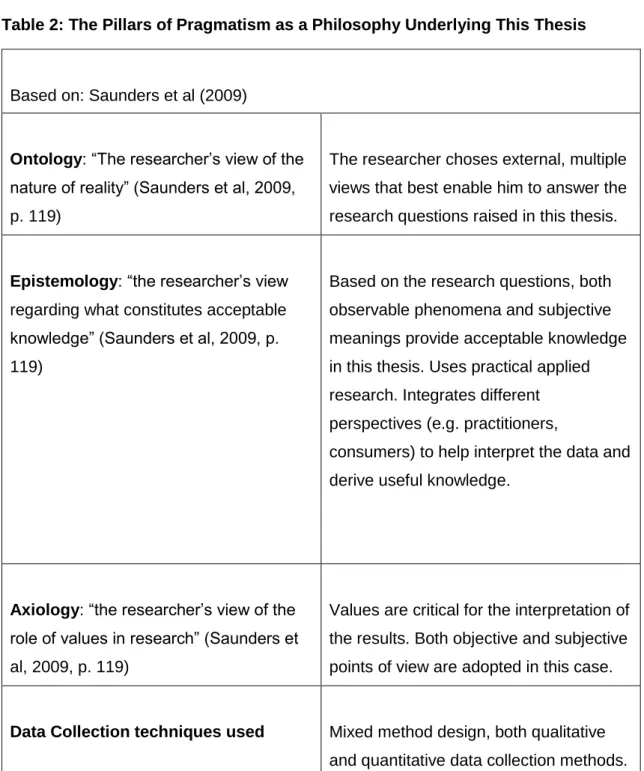
Table 9 below, summarizes how pragmatism relates and is used as philosophical approach for this thesis. It explains this in terms of the ontology, the epistemology, the axiology as well as the data collection techniques used.
Table 2: The Pillars of Pragmatism as a Philosophy Underlying This Thesis
Based on: Saunders et al (2009)
Based on (Saunders et al, 2009)
Ontology: “The researcher’s view of the nature of reality” (Saunders et al, 2009, p. 119)
The researcher choses external, multiple views that best enable him to answer the research questions raised in this thesis.
Epistemology: “the researcher’s view regarding what constitutes acceptable knowledge” (Saunders et al, 2009, p. 119)
Based on the research questions, both observable phenomena and subjective meanings provide acceptable knowledge in this thesis. Uses practical applied research. Integrates different
perspectives (e.g. practitioners,
consumers) to help interpret the data and derive useful knowledge.
Axiology: “the researcher’s view of the role of values in research” (Saunders et al, 2009, p. 119)
Values are critical for the interpretation of the results. Both objective and subjective points of view are adopted in this case.
Data Collection techniques used Mixed method design, both qualitative and quantitative data collection methods.
32
Pragmatism opens the door todifferent worldviews, multiple methods, and different forms of data collection and analysis. Mixed methods researchers however, have to specify the purpose for using mixed methods, and why quantitative and qualitative data need to be mixed in the first place (Creswell, 2008). The following section explains this through a brief critical discussion of the research structure used in this thesis.
2.3. Critical Discussion of the Research Structure
This thesis aims at providing an integrative framework for the use and effect of visual metaphor in advertising. As mentioned in the previous chapters, research on the use of visual metaphor in advertising is limited (e.g. Kaplan, 1992). Moreover, there are not many studies that have investigated how consumers also respond to visual metaphor in
advertising (e.g. Philips, 1997; McQuarrie and Mick, 1999; Morgan and Reichert, 1999; Ma, 2008; van Mulken, Pair, and Forceville, 2010). The research investigating the factors that moderate consumer’s response to visual metaphor is even more limited (e.g. McQuarrie and Mick, 1999; Myers, Feber, Duff, and Lutchyn, 2011).
The text-interpretive perspective or approach is sometimes used by the researchers. This perspective draws on semiotic, rhetorical, and literary theories. Under this approach a systematic analysis of the individual elements that make up an ad is conducted (e.g. Durand 1987; Scott, 1994). Moreover, under this approach visual elements are treated equally to verbal elements with regards to their ability to convey important meanings as well as their ability to be differentiated and worth analysis. On the other hand, however, this approach hardly collects or analyses advertising responses from consumers. Moreover, the causality under this condition is usually assumed rather than demonstrated (McQuarrie and Mick, 1999). Another approach is the reader-response approach, which emphasizes on meanings that consumers draw from ads (Mick and Politi, 1989; Phillips, 1997; McQuarrie and Mick, 1999). Using this approach Mick and Politi (1989) for example in one of the early studies employed the protocol interpretive method, which was also used by Phillips (1997) in her study later on with some slight variations in the procedures. McQuarrie and Mick (1999) took this a step further and used a more sensitive elicitation technique represented in interviews to get a more thorough and sensitive exploration of the meanings consumers actually derive or interpret from the visual ads and further clarify and relate this to the cultural competence of consumers. In this study, however, McQuarrie and Mick (1999) conducted a small number of interviews (12 interviews), and used this method to supplement two experiments that were conducted in the same study.
33
Indeed, experimental research is the predominant method that has been used by researchers investigating the effect of visual metaphor on consumer response. The main strength of the experimental tradition is represented in the rigorous causal analysis
combined with theoretical specification. On the other hand, under this tradition the consumer response elicited tend to be abbreviated and weakened (McQuarrie and Mick, 1999).
Furthermore, the theoretical specification is mostly applied to consumer processing rather than to the visual element per se (McQuarrie and Mick, 1999). Considering the in-depth investigatory nature of this research, the researcher will follow McQuarrie and Mick’s (1999) recommendations, and will use a combination of different methods as presented in the following section. These different methods will complement one another and this research will draw on the strengths of each method.
The approach used is mixed method research as it uses both quantitative and qualitative data collection techniques and analysis procedures. In this case these different techniques are used one after the other (sequential). It does not combine them.
as it will be described below. This means that, although this research uses both qualitative and quantitative techniques at the research method stage, quantitative data are analysed quantitatively and qualitative data are analysed qualitatively (Saunders, Lewis, and Thornhill, 2009). Furthermore, usually when using this mixed method research one of the two
techniques (either the qualitative or quantitative predominate) predominates. In the case of this research project the quantitative techniques are the predominant ones (Saunders, Lewis, and Thornhill, 2009). Finally, this mixed method approach builds on previous attempts to show the value of a critical pluralism for consumer research (McQuarrie and Mick, 1999). In table 10 below each research question answered in this thesis is stated. Moreover, the type of research that is proposed as well as the specific research study designed to answer each research question is stated. For this reason, this table represents a summary of the research design employed in this thesis. A detailed discussion for each of the research studies stated below will be provided in the relevant chapters related to each study.
34 Table 3: Summary of The Research Design
Research Question Proposed Research Type Study(s) designed to answer the research question
Why is visual metaphor in advertising such an important phenomenon that is worth further research?
Qualitative + Quantitative Study 1: Qualitative in-depth-interviews with advertising experts
Study 2: Content analysis on print ads.
Which type of visual metaphor is the most effective with regards to consumer response (i.e. juxtaposition, fusion, replacement etc.)?
What is the mediating effect of elaboration, subjective ad comprehension and object ad comprehension?
Quantitative Study 3:
Experiments 1
What is the moderating effect of ad-viewing time?
Quantitative Study 3:
35
Chapter 3
Literature Review (Part 1)
36 3.1. Introduction
The main objective of this chapter is to examine previous research on the nature of visual metaphor in advertising. This chapter starts by defining the concept of visual metaphor and its importance in the advertising context. Following that the different typologies that have been developed to categorize visual metaphor in advertising are critically discussed. An evaluation of these different typologies is also presented. Finally, this chapter ends with a discussion on previous research that has been conducted on the actual presence of visual metaphor in print advertising. This further highlights the lack of this research with regard to its scope or in other words the types of visual metaphor investigated as well as their relation to other ad elements (e.g. text elements). In addition to the limited print media categories (e.g. magazine, billboard, etc.) that were covered in this previous research. The chapter concludes with the need for further research that updates and complements previous research on the presence of visual metaphor in advertising. Furthermore, it stresses the importance of this research considering the quick and rapid evolution and change that takes place in print advertising style over time.
3.2 What is a Visual Metaphor?
Rrhetoric has an established history, which links back to Aristotle, the ancient Greek philosopher. Despite its tradition, consumer and marketing researchers have only recently adopted the rhetorical approach in the advertising context (McQuarrie and Mick, 1993; Scott, 1994). Metaphor is one of the most important rhetorical figures. It has received the majority of marketing researcher’s attention (e.g. McQuarrie & Mick, 1999, Phillips, 2000, Phillips and McQuarrie, 2004; Gkiouzepas, 2006; Boozer, Wylde, & Grant, 1992; Ward & Gaidis, 1990; Gkiouzepas, 2006). Previous research has organized, categorized and tested verbal
rhetorical figures in different ways (e.g. Tonar & Munch, 2001; McGuarrie, 2000; McQuarrie & Mick, 1996). This thesis will focus and give emphasis to visual metaphor.
“The essence of metaphor is understanding and experiencing one kind of thing in terms of another” (Lakoff and Johnson, 1980, pp.5). Consumer researchers agreed on the fact that metaphor invites a comparison between two objects or terms by suggesting that one term is like another while they are literally quite different (McQuarrie and Phillips, 2005; Philips, 1997; Stern, 1990; Ward and Gaidis, 1990). This means that for a metaphor to exist a ‘relationship’ between two different terms or objects must be established; signifying that for a metaphor to exist, two conditions must also exist. The first condition is the presence of the two different objects. The second condition is the relationship that is established between these two objects.
37
This relationship is established by transferring certain features from one object to the other. In this way the first object or term borrows some characteristics or features from the second object and hence becomes similar to that object in terms of those features or
characteristics. What makes this relationship unique is the fact that it is established between two very different things or objects, therefore this relationship is unexpected. The same unexpectedness, novelty and uniqueness of this relationship is what makes a metaphor a rhetorical figure. A rhetorical figure is defined as an artful deviation from the normal or usual way of expression (Corbett, 1990; McQuarrie and Mick, 1996; Tom and Eve, 1999).
A metaphor presents or expresses an idea in an artful and creative way that is not expected by the audience. This artfulness and creativity again stems out of the unexpected relationship that a metaphor establishes between two very different objects. This deviation however, occurs, only at the level of style and not content. This means that metaphor as a rhetorical figure is concerned with the style or the ‘way’ in which a particular message is conveyed, but not with the content or ‘essence’ of this message. The core idea of the message remains unchanged and the meaning is not altered as a function of variation in rhetorical style (Mothersbaugh, Huhmann, and Franke, 2002). Hence, the metaphorical expression is not seen or rejected by the audience as senseless or inappropriate (McQuarrie and Mick, 1996; Phillips, 2003; Tom and Eves, 1999). Rather it is seen as a creative and novel way of communicating a message. Furthermore, the metaphor may aid in enhancing the intended meaning (Mothersbaugh, Huhmann, and Franke, 2002). From the
aforementioned a metaphor should be seen more as a ‘vehicle’ or a ‘mechanism’ through which meaning is communicated.
From the above mentioned it can also be seen that metaphor embodies in its essence the concept of creativity. Creativity is a concept that is central to advertising. Creative advertising attracts consumers’ attention and also persuades (Ang and Low, 2000). Oglivy (1983) supports that the ‘big idea’ with regards to advertising is essentially based on creativity. Moreover, Zinkhan (1993) states that advertising involves ‘dreaming up’ new ways to present selling propositions (Ang and Low, 2000). Ang and Low (2000) define creativity as “something novel, divergent from the norm, unique, original, meaningful, value added and acceptable”. Novelty refers to” the degree to which an ad is unexpected and deviates from the norm”. Meaningfulness on the other hand “concerns whether the elements in an ad are relevant to the message conveyed”. According to the same authors, these two dimensions are also complemented by a third dimension which is emotional content. This dimension can be seen more as an outcome of novelty and meaningfulness.